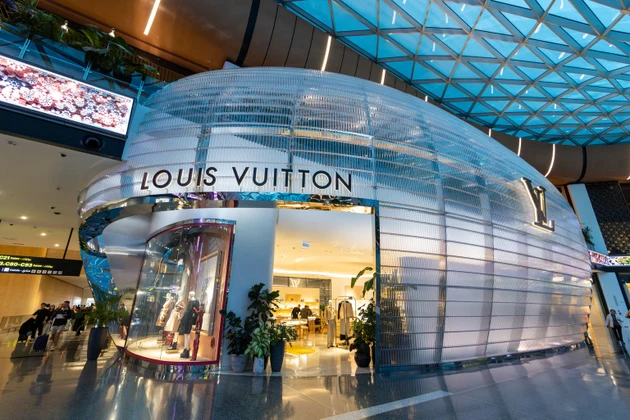
LVMH (LVMHF) updated investors that third-quarter revenue reached €18.50B, slightly above analysts’ €18.46 billion consensus. Organic sales growth of 1% was reported, down from the 3% pace seen in the second quarter. Strength in the U.S., Europe, and Japan offsets weaker demand in China.
Eurozone annual inflation accelerated to 3.8% in September, up from 3.2% in August and above market expectations of 3.6%, according to preliminary estimates.
Core inflation, which excludes energy and food, rose to 2.5% from 2.4%, in line with expectations.
Growing up, Alejandra Villarreal was accustomed to the dry Mexican heat, trapped inside the small historic venues where she and her sisters would perform as kids. But as temperatures hit 103 degrees outside the Fonda Theatre in Hollywood, she couldn’t help but shout.
“¡Ay, qué calor!” she said, swinging her bass guitar.
Inside the nearly 100-year-old theater, Alejandra was onstage for a sound check. She ran through distorted, metal-influenced riffs as her sisters — drummer Paulina Villarreal and lead vocalist-guitarist Daniela Villarreal — prepared for the second of three sold-out shows at the Fonda, as the rapidly rising rock band the Warning.
The Warning has been shaking the walls of L.A. theaters since the group first landed in the city eight years ago — but this year feels especially monumental for the sisters.
Released in August, the band’s most recent album, “Everything’s Falling,” is a snarling, noisy and melodic rock joyride that rarely, if ever, slows down.
Written between L.A. and their hometown of Monterrey, the straight-to-the point lyricism documents the Villarreal sisters’ frustrations, anger and failures — most fiercely on “Kerosene,” which lambasts a jealous critic who “falls asleep with me on your screen,” so sings Daniela.
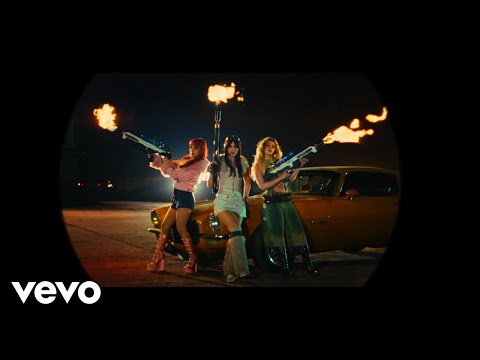
“Kerosene” recently shot up to the No.1 spot on the Billboard Mainstream Rock Airplay chart, which made the Warning the first Mexican and first all-female band to make the spot. Another single, their Spanish-language anthem “Ego,” was nominated for rock song at the 2026 Latin Grammys.
Members of the Warning hold up Billboard No. 1 awards after performing at the Fonda Theatre.
(Kayla Bartkowski / Los Angeles Times)
The legend of the Warning began in 2014, when Alejandra was just 9 years old and Paulina and Daniela were 12 and 14, respectively. The sisters came home from a Sunday carne asada with their family — and recorded a righteous cover of Metallica’s “Enter Sandman.”
Dressed in floral blouses and white capris, the girls thundered through the song with a focus and technical ability that sparked the interest of audiences worldwide — earning them a current total of 27 million views, not to mention praise from Metallica guitarist Kirk Hammett.
“We were wearing our sandalias, our church clothes,” Paulina said. “It’s just pretty crazy to think that one random Sunday afternoon we recorded that and it jump-started our whole career.”
The idea for the group came from playing the video game “Rock Band,” which led the sisters to performing at local “Battle of the Bands” competitions and posting cover songs to YouTube.
But the success of the “Enter Sandman” cover changed the course of their lives, taking them from local venues like Cafe Iguana — or, as Paulina calls it, “Monterrey’s Whisky a Go Go” — to appearing on the Ellen DeGeneres Show and various international music festivals.
“We started having adult responsibilities way early in our lives,” Paulina said. “We didn’t have that [average] teenage experience at all.”
“We didn’t go to normal school, we didn’t go and hang out with other teenagers,” she continued. “We were mostly hanging out with adults like our parents, [or] on tour and working. So there was this huge disparity between what our friends were living through and what we were going through.”
Over the course of its 13-year career, the Warning has opened for acts ranging from the Foo Fighters to Yungblud, writing and recording tirelessly in between. Now that the bandmates are all in their 20s, they say they “wouldn’t change it for anything.”
“When I was 10, I was like, ‘This is what I’m going to do for the rest of my life,’” Alejandra said. “I guess I did miss out on high school and ‘the norm.’ But honestly, I’m very grateful that we did this.”
In “Everything’s Falling,” the Warning contends with self-imposed songwriting limits that boxed them in as children — and tear down old personas to reveal their continuous, however imperfect, process of growth.
“All of our lives, we felt like we needed to sound a certain way,” said Alejandra. “English is not our first language, so we always found ourselves using really complex words — so that people would say, ‘They know the language.’ The lyrics of this album are very straightforward. We don’t have anything to prove anymore. It was a very liberating album to make.”
1/4
(Kayla Bartkowski / Los Angeles Times)
2/4
(Kayla Bartkowski / Los Angeles Times)
3/4
(Kayla Bartkowski / Los Angeles Times)
4/4
(Kayla Bartkowski / Los Angeles Times)
The group’s highly technical progressive rock style, influenced early on by bands like Muse, Metallica and Paramore, brought it a legion of Gen X fans who admired the sisters’ dedication to shredding, mathematical guitar solos and classical training base.
On their latest album, the sisters introduce new levels of fuzz and overdrive that blur their usually crisp instrumentals, plus verses that “lean into femininity” and take inspiration from a source that may surprise some: K-pop.
The rising global genre, known for its catchy harmonies and bouncing performance style, inspired the sisters to bring pop elements to their recording sessions.
“We love getting inspired outside of our genre,” Paulina said. “I think what happens a lot in rock is that, it’s very purista [purist]. Especially as women, whatever you do is very scrutinized. So if you ever step out of those confines it’s like, ‘Well [if] you’re not rock, you shouldn’t even be participating.’”
The sisters’ desire to defy expectations is most apparent in their jam-packed touring schedule.
(Kayla Bartkowski / Los Angeles Times)
“I fainted onstage [in July], and it was very dramatic,” recalled Paulina. “More than it being scary, I think people for the first time realized how hard we work. People were like, ‘Oh, your team is pushing you too hard.’”
“Nobody’s forcing us to be here,” she added, resolutely. “We’re grown women. We know what we’re doing and we know how much we can take.”
Daniela, the lead vocalist, had come down with a cold during the group’s L.A. shows, which required her to step back from interviews to rest her voice. The first night, she sang through the entire setlist, screaming and all — but by the third, she could only perform a few songs. Rather than cancel the concert, the Warning insisted that the show go on.
A la Karen Carpenter, Paulina sang lead vocals from behind the drum kit, calling on the crowd to clap and sing along to the music. They also brought out fans and collaborators to help them perform, including songwriter Annie Schindel, as well as rock acts Holy Wars and Dead Poet Society.
“We push forward through a lot of bad experiences,” Alejandra said. “One time I felt like I was dying — and that was the one of the few times we canceled a show. We only do it in extreme measures, because we know how much planning a show takes.”
One could blame it on the “Mexican work ethic,” they said.
Before taking on Hollywood, the sisters joined regional Mexican artist Carín León on the first night of his sold-out weekend at the Sphere in Las Vegas: the first time a Latin artist had ever headlined the venue. The band released the bluesy rock single “Love to be Loved” earlier this year with the Sonora native, recalling the first time they played it together “a highlight of our lives.”
“[Even if] we do our own thing in a different genre, we still shared that pride because of where we come from,” Paulina said. “Everything about that show was so Mexican … The unity, the community that we have outside of our country. Hopefully the people that went there felt how special it was.”
“I cried,” Alejandra added. “[Watching Carín perform], it was emotional.”
(Kayla Bartkowski / Los Angeles Times)
A week later, at the Fonda, they smiled as fans launched into chants like “Olé, Olé, Olé” and “Viva Mexico.” The line had been forming since 3 p.m., and once the show had begun, the Warning transformed from jovial 20-somethings to well-seasoned professionals.
“I feel like there will be a very clear change in what we do, ‘Everything’s Falling’-forward,” Paulina said. “I feel like we really allowed ourselves to be more emotional in the music and these shows, and that feels really powerful.”
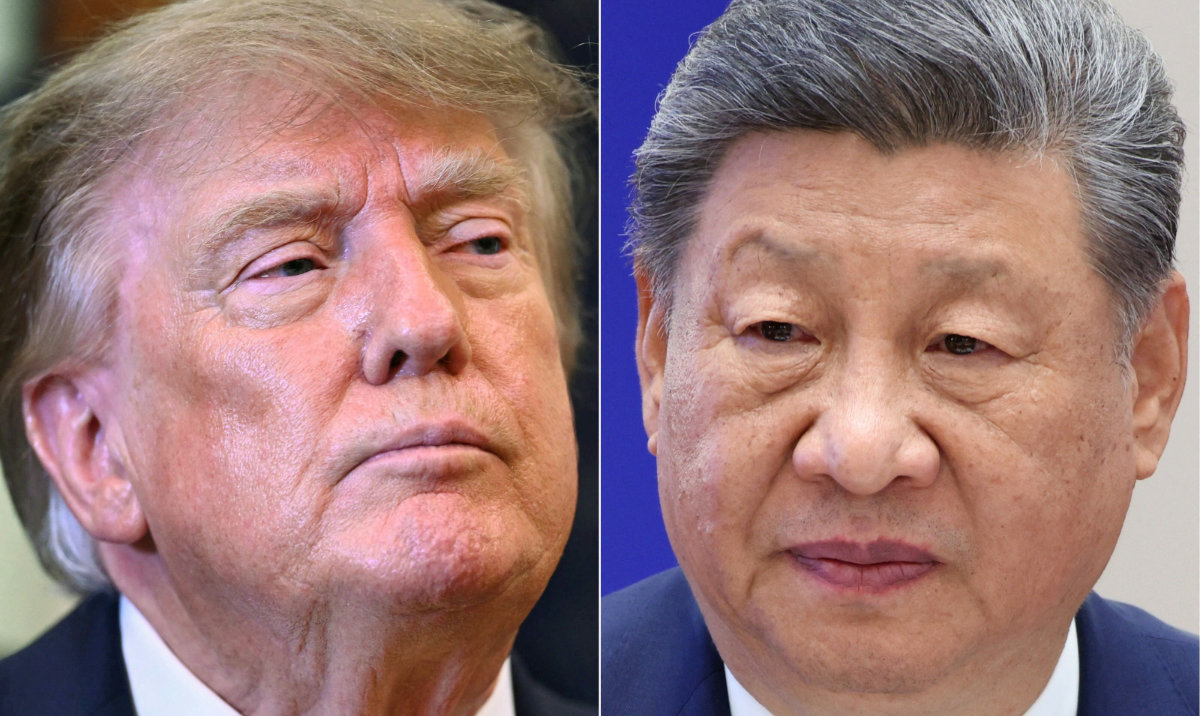
WASHINGTON, United States: The US military honor guard has been rehearsing and the new White House helipad is ready. But will Xi Jinping and Donald Trump achieve lift-off at their summit next week?
Warnings of an AI apocalypse hang heavy over the Chinese president’s first talks at the White House with his US counterpart, with both countries racing for supremacy in this technology.
Trump’s Iran war casts a long shadow too, as China seeks to avoid US sanctions against countries dealing with Tehran, despite reports that Beijing supplied Tehran with intelligence for a strike on US troops.
A trade war is of even greater concern and the world’s two largest economies are still seeking to mitigate the fallout from Trump’s global tariffs. The threat of war over Taiwan looms large as well.
Behind it all is desire to manage tensions between a superpower keen to keep its place at the top and a rapidly rising rival determined to make the 21st century a Chinese one.
“I’ll be discussing almost everything with him,” Trump told reporters aboard Air Force One on Sunday, ahead of their meeting on September 24.
‘Don’t expect much’
But the two leaders are more likely to simply extend a relative truce rather than produce any concrete results, like when Xi hosted Trump in Beijing four months ago, experts said.
“I don’t expect much to come out of this,” Jonathan Czin of the Brookings Institution told AFP.
“In many ways, this is going to be a recapitulation of Trump’s visit to Beijing back in May, where the focus was really on the ostensible rapport between the two leaders.”
With fears about AI making global headlines, agreement to cooperate on regulation or a slowdown is expected to be a major topic of discussion between Trump and Xi.
But any major deals are “politically out of reach for now,” said Wang Dong, a professor at Peking University, as Beijing and Washington both fear losing out in the race for AI dominance.
Tensions over Iran will also come up. US Treasury Secretary Scott Bessent is due to meet his Chinese counterpart He Lifeng this weekend for pre-summit talks including on Iran sanctions.
Trump has, however, played down reports that Chinese entities supplied Iran with satellite imagery for an attack on a US military base in Jordan, saying Xi had “behaved reasonably well” and that “we spy on them, too.”
On trade, there is “room for progress on tariffs, agricultural purchases and selected export controls,” Yue Su of The Economist Intelligence Unit told AFP.
‘Spectacle’
Yet Trump has, as so often before, appeared more interested in the optics of his meeting with a powerful foreign leader than with the substance.
“This is less a summit and more a spectacle. This is designed for deep public consumption,” said Kurt Campbell, former US Deputy Secretary of State and now Chairman of The Asia Group.
Trump pushed for a new granite helicopter landing pad on the White House South Lawn to be open in time for Xi’s visit, which will include a grand state dinner.
Troops in flashy uniforms have been rehearsing on the White House driveway this week ahead of the welcome ceremony.
Trump’s only disappointment is that his under-construction $400 million ballroom won’t be ready — though he has said that when finished it will “top” Beijing’s Great Hall of the People, where Xi hosted him in May.
During the Beijing trip Trump showered praise on Xi, only for the Chinese leader to warn about possible “conflict” over Taiwan.
Fears of a possible Chinese invasion of the self-governing island and global semiconductor hub — which Beijing claims as its territory — remain the most sensitive topic between Washington and Beijing, said Peking University’s Wang.
One possible concrete deliverable is an announcement of further summits.
Trump and Xi are expected to meet in November at the Asia-Pacific Economic Cooperation (APEC) forum in Shenzen, China. The Kremlin has suggested a three-way meeting with Russian President Vladimir Putin.
Trump is meanwhile expected to invite Xi to the G20 summit in December at his Doral resort in Miami.