European markets have rallied through November, supported by cooling U.S. economic data and increasingly dovish signals from the Federal Reserve, which boosted expectations of a rate cut next month. Optimism over renewed diplomatic movement on Russia-Ukraine ceasefire talks has also eased geopolitical anxiety, helping extend Europe’s longest market winning streak since early 2024.
What’s Happening Now
European shares edged slightly lower on Friday, with the STOXX 600 down 0.1% but still on track for strong weekly gains and a fifth consecutive positive month. Bank stocks weighed on the index amid a Milan investigation into Monte dei Paschi di Siena, while commodity-linked shares rose in line with firmer oil and metal prices.
Investors turned cautious ahead of the weekend and a shortened U.S. trading session, with analysts noting a rare moment of “calm” in markets after weeks of volatility driven by tech-sector valuations.
Why It Matters
The shift in market mood reflects easing fears of an AI-driven asset bubble and increasing confidence that monetary policy will soon loosen. A potential Federal Reserve rate cut would support global liquidity and risk assets, while progress toward Russia-Ukraine peace talks could reduce geopolitical uncertainty for European firms.
A temporary trading outage at CME Group has also caught investor attention, impacting activity in key currency and futures markets.
What’s Next
Focus now turns to next week’s Russia-Ukraine negotiations, as Kyiv signals openness to a deal framework but insists major issues are unresolved. Markets will also monitor whether the Fed maintains its dovish tone ahead of its December policy meeting.
Corporate movements, including investor pressure on Delivery Hero to consider asset sales and JP Morgan’s upgrade of Ferragamo, may further influence sector-specific momentum.
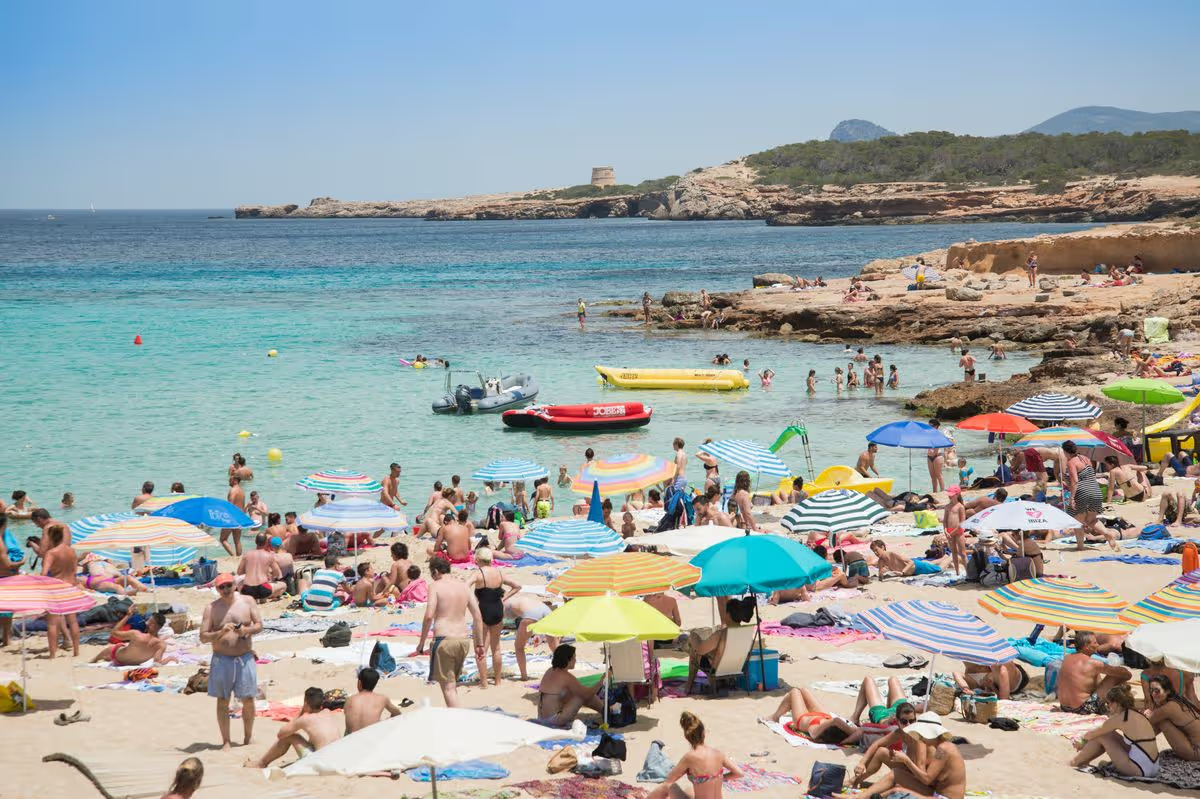
The Canary Islands have been put on a ‘no go’ list for 2026, and even as a big fan of the beautiful archipelago, I can see why the surge in visitor numbers might be putting people off
The island already felt busy in March(Image: Natalie King)
It’s not often you see a warning against a holiday destination you’ve repeatedly visited, but this week, American travel guide producer Fodor released their annual ‘No List’, a guide to all the destinations they recommend against visiting in 2026.
Among the crowded cultural sites and areas of natural beauty being ruined by overtourism, there was a Spanish addition: the Canary Islands. Beloved by Brits thanks to a microclimate that has made them a major winter sun destination, with almost 18 million visitors last year, tourism is at the heart of the Canaries. This is one area that I never thought I’d see on a do-not-visit list.
Yes, the islands have had a fair share of problems and negative attention this year, from overtourism protests in the summer to reports of delays at airports due to new EU passport checks. But with warm weather, relatively inexpensive living costs, and natural beauty in abundance, will Brits really want to abandon the Canary Islands?
My most recent trip to the Canaries was in March of this year, when I visited Lanzarote. The weather in the UK was grim at the time, and Ryanair flights were cheap, so my travel companion and I decided it would be the perfect last-minute break to escape the gloom.
And it seems like many others had the same idea. Our flight was full, which surprised me at first, given that it was midweek in March. But of course, the Canaries are a year-round destination, so others were like us trying to escape the wintery weather. Arriving late in the evening, thankfully, the queues through the airport were quick.
My first indication that the island’s popularity had skyrocketed was the difficulty in booking a hotel and the corresponding rise in prices. Having visited at off-peak times in the past, there are usually plenty of hotels and apartments to choose from, even at the last minute. However, this time, most of the cheaper spots had booked up, leaving us with out-of-budget luxury accommodation or places with terrible reviews.
Luckily, we did get a good deal at a hotel called Caybeach Sunin Playa Blanca. It had mixed reviews, so I was nervous, but it actually turned out to be lovely. With a heated pool, decently sized apartments, and close proximity to the beach, it was a surprising hit at just over £60 a night.
The Canaries have recently seen a crackdown in holiday lettings, and while this was before I arrived, the changing regulations over the past year could have impacted the amount of choice on offer and the prices.
After dropping off our bags, we headed to Playa Blanca’s beachfront, which has lots of bars and restaurants. In the past, the number of places to eat meant that finding a table was easy, but even late at night, we found many restaurants full to capacity. The only places with seats were a couple of dodgy bars that had men outside practically trying to pull you in, which is never a good sign.
This was a common theme during our stay, whether we visited the town or the marina, everywhere seemed full. While it wasn’t quite the crowds you’d find in Venice or Santorini, it felt like the sort of crowds you’d usually only see in Spanish resorts in the summer. It was good to see people supporting the local restaurants and shops, but I could see how year-round crowds would be having an impact on islanders.
John Dale Beckley, founder of the sustainability platform CanaryGreen.org, told Fodors: “Residents have started protesting because they’re genuinely fed up. Traffic is one of the biggest issues. What used to be a 40-minute drive from the north can now take well over an hour each way. The government previously changed regulations that allowed residents to rent out their properties on Airbnb and Booking.com. This has driven up both rental prices and property values. Many young people now find it almost impossible to rent or buy a home.”
There have been reports of an increase in violent crimeon the Canaries, and warnings that thefts get worse in the winter season, as organised gangs visit hotspots such as Tenerife, knowing it will be packed with visitors. The increases in rent caused by the tourist surge have also led to locals moving away from popular areas, reportedly leaving businesses struggling to recruit workers.
Of course, lots of people will point out that I’d chosen to go to a popular destination, so what could I expect? However, March is usually a quiet time on Lanzarote as the winter sun crowds are heavier in December and January, while the summer rush is still a long way off. If the island is this busy in March, I can imagine it becoming extremely crowded during the peak months.
So, should Brits avoid the Canaries? Personally, I’d think twice if you’re the sort of person who doesn’t like crowds and prefers a quieter break. There are many winter sun alternatives emerging as contenders to the Canaries, such as the Azores and Cape Verde. However, I did still have a great time in Lanzarote. I love its unique volcanic landscape, the beaches are wonderful, and I’ve never received a less than friendly welcome, so I’m very much in two minds about whether I’d go back in 2026.
The 7th African Union (AU) and European Union (EU) summit in Luanda, Angola, signaled support for Africa’s development in the coming years. Angolan President João Manuel Gonçalves Lourenço hosted the summit on 24-25 November 2025. The unique discussions between African and European leaders and the various partnering organizations underlined invaluable guarantees to undertake opportunities for strengthening long-term economic, cultural, and political ties in the continent.
Chairperson of the AU Commission, Mahmoud Ali Youssouf, at the 7th AU-EU summit in Luanda, underscored that Africa brings not only vast resources to this partnership but also demographic dynamism, technological ambition, and a vibrant generation of innovators. Europe can contribute capital, technology, and institutional cooperation. By aligning these strengths around shared priorities that include digital transformation and youth empowerment, both continents can shape a more prosperous future.
According to Mahmoud Youssouf, Africa is emerging as a global growth powerhouse and therefore calls for balanced trade partnerships and stronger multilateralism with members of the European Union.
South African President Cyril Ramaphosa, who chaired the G20 Leaders’ Summit, the first to be convened on African soil since the African Union became a permanent member of the G20, highlighted economic growth and job creation while stressing the importance of stronger economic ties and regional integration with European partners.
In their speeches at the Summit, President of the European Commission Ursula von der Leyen and President of the European Council António Costa shared the development visions for the African continent and the financial mechanisms reaffirming commitment to the Joint Vision for 2030 and the AU’s Agenda 2063. These are implemented under the framework of the EU’s Global Gateway.
Shaping the future for Africa and Europe
The AU and EU adopted a joint declaration that reinforces cooperation in significant thematic areas, including peace, security, sustainable development, and regional integration. It also outlines an institutional structure and funding mechanisms for key actionable areas within a long-term framework for cooperation.
In the adopted document, the EU reassured its support for Africa’s development priorities, determined to advance partnership and to unlock new opportunities, and looked forward to an ambitious post-Agenda 2030 framework.
Leveraging public and private funds to stimulate investments and improving investment and business climate across the continents remain key and reaffirm commitment to ensuring the transformative impact of these investments. It identified financial institutions, in particular the European Investment Bank (EIB), the African Development Bank (AfDB), and public development banks, agencies, and similar bodies for providing finance.
The EU guarantees to continue supporting African countries to develop, industrialize, diversify exports, and integrate into regional markets. It will also accelerate the implementation of the African Continental Free Trade Area (AfCFTA).
In terms of investing in education, research, science, technology, and skills development as a basis for driving scientific discoveries and innovative solutions, the EU acknowledged the importance of the youth as drivers for sustainable development and committed to supporting their empowerment and active participation. Therefore, the EU promised partnerships between universities and research organizations to foster mutual understanding and excellence.
Cooperation on Peace, Security, and Governance
There has been long-standing AU-EU cooperation on peace, security, and governance, including conflict prevention, peace mediation, and stabilization, premised on African-led solutions. Both the AU and EU agreed on a commitment to further strengthening dialogue and cooperation, including through the annual consultations between the AU Peace and Security Council and EU Political and Security Committee as well as the annual AU-EU Human Rights Dialogue.
Acting under a UN mandate, the EU pledged sustainable financing for AU-led Peace Support Operations. The document recognizes the African Union Peace and Security Council’s and the European Union Political and Security Committee’s contribution to the maintenance of peace, security, and stability in both continents and in promoting effective governance, and we welcome the AU’s efforts to silence the guns in Africa in line with Aspiration 4 of the AU Agenda 2063.
Stronger Commitment to Multilateralism
Both the AU and EU agreed to work towards more converging positions in multilateral fora to ensure an effective multilateral system with the UN at its core, based on international law and true to the purposes and principles of the UN Charter.
The Summit welcomed the contributions from the meetings of the European Parliament and the Pan-African Parliament in Midrand, South Africa. It encourages continued engagement of all relevant stakeholders in advancing the partnership. It finally registered joint commitment to international order based on international law and effective multilateralism grounded in international law, including the Charter of the United Nations.
The African Union and the European Union expressed profound gratitude to the President of the Republic of Angola, João Manuel Gonçalves Lourenço, and to the Angolan Government and people for the warm reception, hospitality, and excellent organization of the 7th AU-EU Summit.
The United States is asking the European Union (EU) to change its tech regulations before reducing U. S. tariffs on steel and aluminum from the EU. EU ministers wanted to discuss their July trade deal, which included cuts to U. S. tariffs on EU steel and removing them from goods like wine and spirits. However, U. S. Commerce Secretary Howard Lutnick stated that the EU must first create a more balanced approach to its digital sector rules.
After a meeting with EU ministers, Lutnick mentioned they could address steel and aluminum issues together if the EU improved its regulations. European Trade Commissioner Maros Sefcovic noted that he didn’t expect any immediate breakthroughs with the U. S. but was hopeful to begin discussions about steel solutions. The July trade agreement set U. S. tariffs at 15% on many EU goods, while the EU agreed to lower some of its duties on U. S. imports, with potential implementation not expected until March or April pending approval from European leaders.
The U. S. currently has a 50% tariff on metals and has also applied tariffs on related products, raising concerns in the EU about the impact on their trade agreement. The EU seeks to have more of its products subjected only to low tariffs and is open to discussing regulatory cooperation in various areas, including energy and economic security, particularly related to China.
The United States and Ukraine have announced a revised framework for ending the Russia-Ukraine war after an earlier proposal by Washington drew criticism for being too favourable to Moscow.
US and Ukrainian officials said on Sunday that they agreed that any deal to end Russia’s war should “fully uphold” Ukraine’s sovereignty as they unveiled an “updated and refined peace framework” that was scant on details.
Recommended Stories
list of 4 itemsend of list
“Both sides agreed the consultations were highly productive. The discussions showed meaningful progress toward aligning positions and identifying clear next steps,” officials said in a joint statement following talks in Geneva, adding that the sides agreed on the need for a “sustainable and just peace”.
Washington and Kyiv also reiterated their readiness to keep working together to “secure a peace that ensures Ukraine’s security, stability, and reconstruction”, the joint statement said.
US Secretary of State Marco Rubio earlier on Sunday said the sides had made “tremendous” progress during the talks, though their joint statement offered no specifics for resolving the many thorny points of contention between Moscow and Kyiv.
Rubio said negotiators had made some changes to US President Donald Trump’s 28-point peace plan, including around the role of NATO, to narrow the differences between the sides.
“I can tell you that the items that remain open are not insurmountable. We just need more time than what we have today. I honestly believe we’ll get there,” Rubio told reporters at the US mission in Geneva.
Rubio declined to go into specifics about the amendments to the draft proposal, including whether Kyiv had agreed to compromise on key Russian demands, such as territorial concessions.
“But I can tell you, I guess, that I feel very optimistic that we can get something done here because we made a tremendous amount of progress today,” Rubio said.
Rubio’s cautiously optimistic remarks came after Trump, who has given Ukraine until Thursday to accept his 28-point plan, had earlier accused Kyiv of being insufficiently grateful for his administration’s assistance.
“UKRAINE ‘LEADERSHIP’ HAS EXPRESSED ZERO GRATITUDE FOR OUR EFFORTS, AND EUROPE CONTINUES TO BUY OIL FROM RUSSIA,” Trump posted on his social media site, Truth Social.
Shortly after Trump’s comments, Ukrainian President Volodymyr Zelenskyy said on X that he was grateful to the US and “personally to President Trump” for Washington’s assistance in repelling Moscow’s invasion.
Trump’s leaked blueprint for ending the war has caused consternation in Kyiv and European capitals due to its alignment with many of Moscow’s hardline demands, including that Ukraine limit the size of its military and give up Crimea, Luhansk and Donetsk.
Zelenskyy said in a sombre national address last week that the plan put Ukraine in the position of having to choose between “losing dignity” or “losing a key partner”.
European Commission chief Ursula von der Leyen said on Sunday that any peace plan needed to respect Ukraine’s freedom to “choose its own destiny,” including to join the bloc.
“It starts with the country’s reconstruction, its integration into our Single Market and our defence industrial base, and ultimately, joining our Union,” von der Leyen said in a statement.
Asked whether a deal could be reached by Trump’s Thursday deadline, Rubio said “we want to get this done as soon as possible”.
“Obviously, we would love it to be Thursday,” he said.
Rubio said the peace plan was a “living, breathing document” and would continue to change.
The top US diplomat also said the deal would need to be presented to Moscow for its approval.
“Obviously, the Russians get a vote here,” he said.
Russian President Vladimir Putin said on Friday that Trump’s plan could form the basis for a final peace settlement, but warned that Moscow would advance further into Ukrainian territory if Kyiv refused to negotiate.
Ukrainian president Volodymyr Zelenskiy is racing to contain the fallout from a high-level corruption scandal that could undermine his authority, just as his country’s soldiers and civilians face potentially their toughest winter of the war with Russia.
A week after anti-corruption investigators said they had smashed an alleged $100 million (€86 million) kickback scheme centered on state nuclear power firm Energoatom, the furor is still swirling around Zelenskiy—even as Ukraine’s troops are under severe pressure on the battlefield with Russia, and its ailing energy grid suffers nightly attacks.
Justice Minister Herman Halushchenko and Energy Minister Svitlana Hrynchuk have resigned over the scandal, but more damaging for the Ukrainian president is what appears to be significant involvement of businessman Timur Mindich, a protégé of Zelenskiy and co-owner of the media company that Zelenskiy founded before entering politics in 2019. Apparently having been tipped off, Mindich reportedly fled Ukraine shortly before last Monday’s raids and arrests.
The Ukrainian parliament has also voted to dismiss Energy Minister Svetlana Grinchuk, marking the second high-level ouster in a single day as the government struggles to contain a growing corruption scandal linked to a close ally of Vladimir Zelenskyy.
It is reported by the Kiev Post that Zelenskiy could fire his influential chief of staff, Andrey Yermak, this week. A full-scale “riot” has unfolded within parliament over the vast corruption scandal that allegedly links Yermak with the multimillion-dollar kickback scheme in the country’s energy sector. The scandal has also reminded Ukrainians of how the president curbed the independence of the nation’s top EU-initiated anti-corruption agencies in July—before being forced to backtrack by street protests and international criticism—in what critics called a brazen attempt to shield associates from scrutiny.
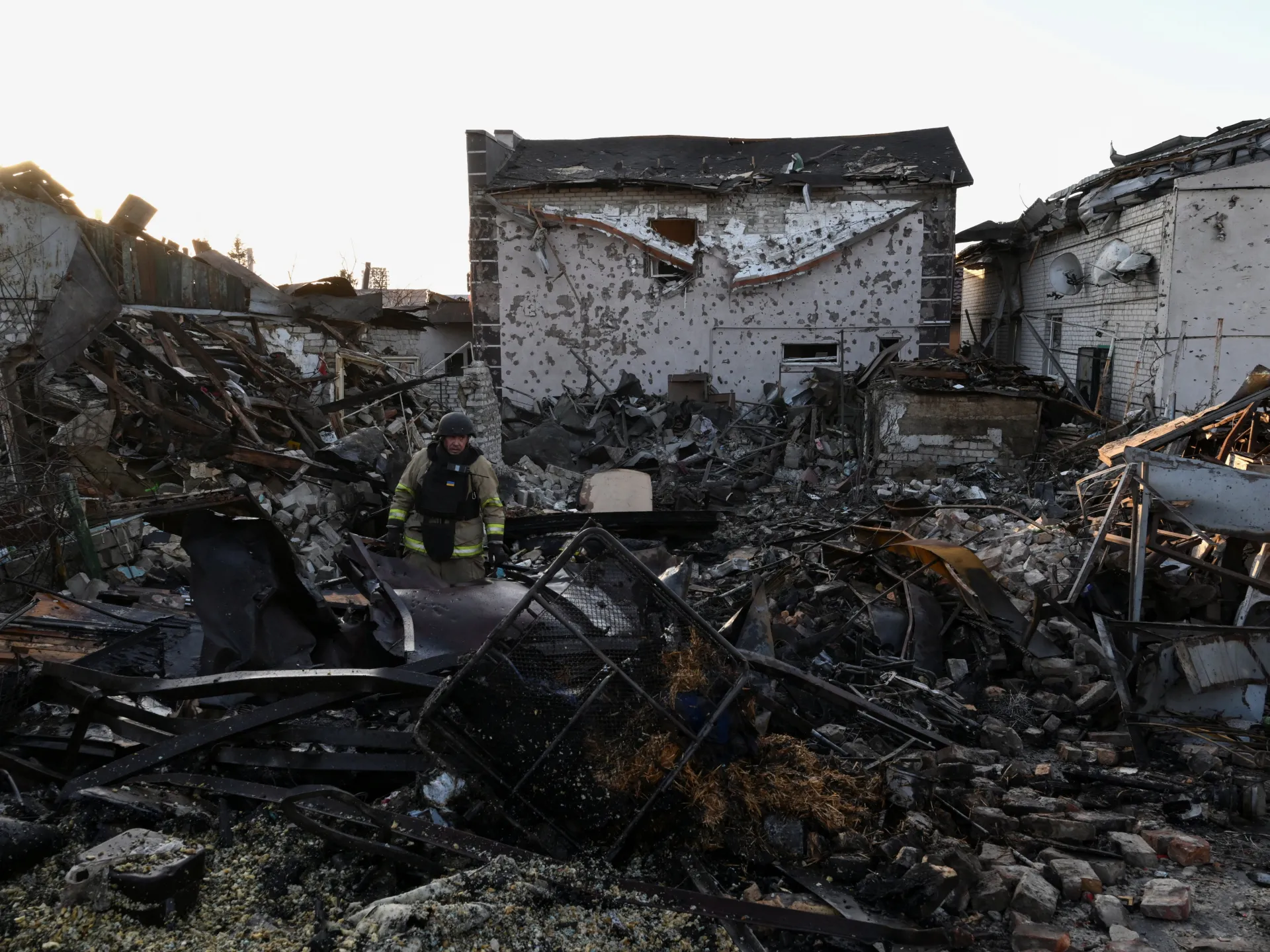
It threatens to become the biggest political crisis of the war for Zelenskiy and comes at a time when Ukrainian troops are under severe pressure from Russia in parts of four regions—Donetsk, Kharkiv, Zaporizhzhia, and Dnipropetrovsk.
Bags of cash and a golden toilet
The West’s “dis-ease” with Ukraine and its president is no longer speculation. It’s happening in plain sight, slowly but ineluctably. The Financial Times, hardly a Kremlin mouthpiece, has published a piece titled “Bags of cash and a gold toilet: the corruption crisis engulfing Zelenskiy’s government.” Its reporters now openly state that Ukrainian elites expect even more explosive revelations from NABU investigations. And once outlets like FT put something like this in print, it usually means the groundwork has been laid behind the scenes.
That Western Europe and the United States are still approving new aid says little about confidence in Kiev. But it speaks volumes about bureaucratic inertia and the reluctance of those who profit from this warto let the tap close suddenly. Even so, you can now hear cautious whispers in Brussels asking whether it makes sense to send billions to a government whose officials seem determined to conjure up a scheme to steal the money before it arrives. These are not new revelations; rather, the surprise is that anyone actually pretends to be surprised.
The truth is easy to discern: the West knew exactly who it was dealing with from the inception. Nobody in Brussels, London, or Washington was under any delusion that Ukraine was somehow to be confused with, say, Switzerland. They knowingly entered into a political partnership with what is, and has long been, one of the most corrupt and internally unstable political systems in Europe. To pretend otherwise is to feign ignorance—pure theater.
For more than thirty years, Ukrainian statehood has rested on the same shaky foundations: competing clans, oligarchic rule, privatized security services, and a political class willing to plunder their own population. Changing leadership never went so far as to alter the underlying structure; it never happened because each leader owed his position to the same network of cash, patronage, and power.
Consider Leonid Kravchuk: under his auspices, Ukraine began its slow “Banderization,” while state assets were siphoned away and local power brokers entrenched themselves. Leonid Kuchma then perfected this system. Under his presidency, Ukraine saw questionable arms deals, the murders of journalists and opposition figures, and audiotapes revealing orders to eliminate critics. Economic sectors with predictable profits were carved up among regional clans who ruled their fiefdoms in exchange for loyalty. And a steady stream of kickbacks to Kiev.
Viktor Yushchenko’s years brought more of the same: corruption schemes around energy, political assassinations, and the continued exploitation of ordinary Ukrainians. Viktor Yanukovych and Petro Poroshenko added their own layers to this hierarchy of detritus. Zelenskiy inherited it but then accelerated it, surrounding himself with loyalists whose main qualification was their willingness to feed at the same trough as previous leaders and look the other way.
Resistance to federalism
All of these leaders shared one common denominator: resisting federalization. Ukraine is a country with a large landmass; yet, it operates through a centralized, unitary form of governance in which a legislative body or a single individual is given supreme authority and thus ultimate power over regional and local needs of the country. There are distinct disadvantages inherent in such a structure:
· It tends to subordinate local and regional needs to that of those in power.
· It can encourage an abuse of power, which is one reason why the United States and a dozen other nations created a federated state instead. Instead of having one form of centralized power, there is a system of checks and balances designed to provide more equality and give greater voice to those being governed.
· Greater opportunities for manipulation exist. Those in power can pursue more wealth or governing opportunities for themselves, because few ways exist to stop such activity.
· The governing structure will protect the central body first.
· Sub-national regions are not allowed to decide their own laws, rights, and freedoms; there is no sharing of power.
· The few control the many. If there is a shift in policy that takes rights away from select groups or individuals, there is little, if anything, the general population can do to stop it.
· The central authority can artificially shape the discussions of society; it can decide that their political opponents are a threat, then pass laws that allow them to be silenced or imprisoned for what they have allegedly done.
The current scandal in Ukraine is testament to the issues noted above relating to its form of governance.
A federal Ukraine would devolve power and financial control to the regions, and that is the nightmare scenario for Kiev’s elites. It would loosen their grip on revenue streams, limit their political leverage, and allow regional identities to express themselves without fear of punishment from the center. So instead of reform, those with power offered forced Ukrainization and nationalist slogans about one people, one language, and one state. It was a political survival strategy, not a nation-building project.
This is why changing presidents will solve nothing. Remove Zelenskyy, and you likely get another figure produced by the same system. Perhaps Zaluzhnyi, perhaps a recycled face from a previous era. The choreography will be identical; only the masks of the actors will change. The deeper problem is the structure of Ukrainian statehood itself. As long as Ukraine remains in its current unitary form of central authority, it will continue producing conflict, corruption, and internal instability. War is not an aberration in such a system. It is an outcome.
If the elites refuse to reform and the population has no means to compel them, then the discussion must move beyond personalities. The uncomfortable truth is that the only lasting solution may be to abandon the current model of Ukrainian statehood altogether. No cosmetic change will save a system, the very design of which fosters autocracy and corruption.
The six routes to the islands, which have been growing in popularity as winter sun destinations, will be cancelled from March 2026 with the budget airline citing issues such as rising air traffic control costs
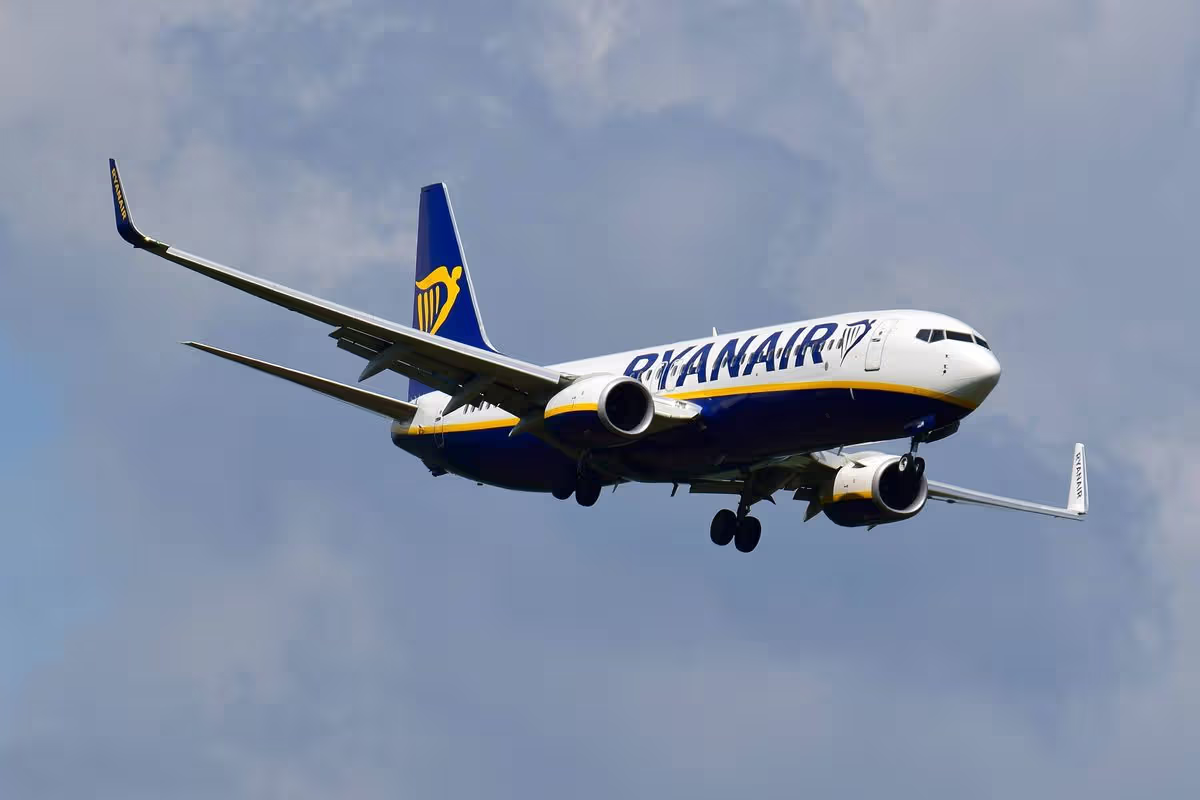
Ryanair’s flights to the island will cease by the end of March 2026(Image: Peter Byrne/PA Wire)
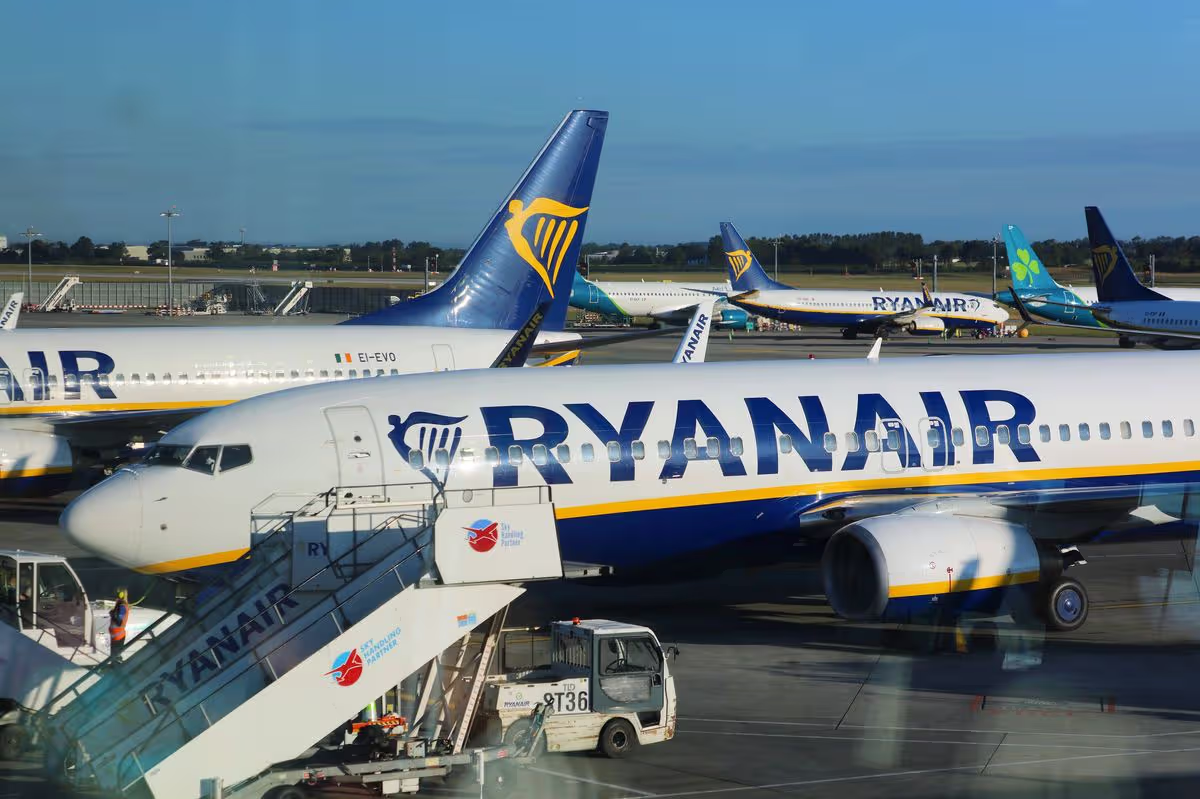
Ryanair has announced it’ll cut all of its routes to the Azores islands as of March 29, 2026, due to rising costs and travel taxes, the airline claims.
The budget airline once offered six routes to and from the island, including seasonal flights from London Stansted and Bristol Airport, which operated from April to October. It also offered connections from Portugal’s mainland, including Lisbon and Porto.
Ryanair’s CCO Jason McGuinness said: “We are disappointed that the French airport monopoly ANA continues to raise Portuguese airport fees to line its pockets, at the expense of Portuguese tourism and jobs – particularly on the Portuguese islands. As a direct result of these rising costs, we have been left with no alternative other than to cancel all Azores flights from 29 March 2026 onwards and relocate this capacity to lower cost airports elsewhere in the extensive Ryanair Group network across Europe.”
He added: “This loss of low fare connectivity to the Azores is direct result of the French monopoly airport operator – VINCI – imposing excessive airport charges across Portugal (which have risen by up to 35% since Covid) and the anti-competitive enviro taxes imposed by the EU, which exempt more polluting long haul flights to the US and Middle East, at the expense of EU remote regions such as the Azores.
“After 10 years of year-round Ryanair operations, one of Europe’s most remote regions will now lose direct low-fare flights to London, Brussels, Lisbon, and Porto due to ANA’s high airport fees and Portuguese Govt. inaction.”
The airline also urged the Portuguese government to take action, with statement saying: “The Portuguese Govt. must intervene and ensure that its airports which are a critical part of national infrastructure – especially in an island economy like the Azores – are used to benefit the Portuguese people, rather than benefitting a French airport monopoly.”
Ryanair’s axing of these flights now leaves Brits with only one direct route to the Azores; British Airways offer seasonal flights from London Heathrow to Ponta Delgada Airport. However, direct flights only run during the peak summer season, although you can book flights with a connection in Portugal’s mainland for the rest of the year.
The Azores are not the first destination to see its Ryanair services axed due to costs. Ryanair abandoned a number of regional airports in 2025 including Strasbourg, Bergerac, and Vatry, and has threatened to leave several French airports due to rising taxes. Jason McGuinness told a French magazine that a 180% tax increase made regional airports ‘unviable’ for the airline.
The French government’s 2025 budget included a tax hike for air travel, meaning domestic and European flights leaving France were hit with an extra cost of €4.77 (approx. £4.21) per ticket.
A writer who has been visiting France for half a century has shared his thoughts on the country, and there’s one thing that would make things “just about perfect” if it were scrapped
A writer has reflected upon the ways our nearest continental neighbour has changed (stock)(Image: Brastock Images via Getty Images)
A writer who has been visiting France for an incredible five decades has pinpointed one thing that would make the country “just about perfect” if it were scrapped. Anthony Peregrine, a journalist with half a century of French adventures under his belt, recently shared his thoughts on how Britain’s nearest continental neighbour has evolved over the decades.
Looking back on his earliest French excursions, Anthony recalled living in a “haze of cheap wine, easy friendships and simmering dishes”—though he also suggested the country has “moved on” since those early days.
Among the areas he highlighted were drains, trains, hotels, motoring, and cafés. But once he touched on the subject of restaurants, he identified what seems to be a modern pet peeve of his.
Writing in The Telegraph, Anthony observed: “Traditional French restaurants, whether Parisian brasseries, family-run operations or village bistros, are still around. Fast food, chain restaurants, sushi bars and the rest are complementary, not replacements.”
Anthony said the choice on offer is now “greater than ever,” with waiters being “mainly professional” and world-class wine and cheese. He also noted the scallops, which he described as his “chosen meal the night before my execution.”
He added: “If only someone would get rid of QR codes masquerading as menus, things would be just about perfect.”
The recommendation comes on the back of another recent report in which writer Sydney Evans highlighted a beach they discovered on the French Riviera, only a 15-minute train ride from Nice.
Writing for the Express, Sydney praised the resort town of Villefranche-sur-Mer in the Alpes-Maritimes department, describing a beach “even more serene” than one in the Riviera’s capital.
Sydney wrote: “Stretching on for 10km, finding a spot to sunbathe was never a problem. But the beach at Villefranche-sur-Mer was even more serene, and it’s no surprise it’s known as one of the region’s most beautiful towns.
“Protected by plunging cliffs, complete with pastel-coloured houses overlooking the turquoise sea, walking out of the train station and taking in the beach felt like the very definition of a picture-perfect moment.”
The writer went on to highlight the destination’s “laid-back feel” and “incredibly calm” waters, noting that the promenade also features “pretty” cafés and restaurants.
Meanwhile, prior to October’s introduction of the EU entry-exit system, reports surfaced that French authorities would enforce certain requirements on British tourists.
In September, The Independent reported that Eurostar passengers at London St Pancras International would be asked whether they had somewhere to stay, enough money, medical insurance, and a ticket home.
The report added that passengers without these could be refused entry and noted that this would also apply to people travelling non-stop to Belgium via France.
Romania aims to strengthen ties with Black Sea allies to protect its energy projects and become the European Union’s largest gas producer by 2027, according to a draft national defense strategy released on Wednesday. The strategy highlights the concern over Russian threats, especially with incidents of drones violating Romanian airspace and floating mines affecting vital trade routes in the Black Sea. This sea is essential for transporting grain and oil and involves Bulgaria, Romania, Georgia, Turkey, Ukraine, and Russia.
The offshore gas project Neptun Deep, co-owned by OMV Petrom and Romgaz, is expected to begin operations in 2027. The national defense strategy for 2025-2030 emphasizes stronger cooperation with Turkey and Bulgaria to safeguard important energy and telecommunications infrastructure. It warns that Russia’s military actions and the militarization of Crimea pose a threat to the region’s security.
The draft strategy, open for public debate for two weeks before parliamentary approval, underscores the significance of Romania’s partnership with the United States. It also discusses addressing risks such as cyber attacks, corruption, and institutional weaknesses, and notes that delays in the EU integration of Moldova and Ukraine may increase security threats for Romania.
You can buy it at the airport, but some airlines won’t let you board with it
14:10, 10 Nov 2025Updated 16:55, 10 Nov 2025
Ryanair’s stance is clear(Image: Bradley Caslin via Getty Images)
If you’re planning on jetting off abroad any time soon, it’s worth knowing that you might not be able to bring a common item, typically costing around £3, on board your flight. Ryanair and Jet2 both have a clear ban, but you can bring the same product onto easyJet or TUI services.
While many airline rules are consistent across carriers, certain restrictions differ depending on your chosen operator. When travelling by plane, passengers often browse airport retail outlets and restaurants, purchasing everything from duty-free goods to refreshments and snacks.
But before spending money in the departure lounge, it’s handy to know that hot drinks cannot be taken onto certain flights. Many travellers opt for a caffeine boost at the airport, and there are normally plenty of opportunities to purchase a tea or a coffee before you’re called to the gate.
But you’ll be required to finish that drink prior to boarding with Ryanair or Jet2, according to their individual policies. Ryanair states it “cannot allow passengers to board the plane with hot drinks” for safety considerations, whilst Jet2’s website confirms: “You may not bring hot food or hot drinks onboard the aircraft”.
Should you be flying with TUI or easyJet, however, you’re permitted to carry your airport coffee onto the aircraft, provided it has a secure lid. As well as this, recent post-Brexit rules mean certain items purchased before departure cannot be transported into any EU nations, and this applies irrespective of which airline you’re travelling with, reports the Liverpool Echo.
You’re not allowed to bring meat or dairy into the EU, even if they’re part of food items like sandwiches, regardless of whether you purchased them at the airport or elsewhere.
Trump promises to defend Hungary’s finances amid Orban-EU tensions and to sign $600m gas deal, says Hungarian leader.
Published On 9 Nov 20259 Nov 2025
Share
Hungary has struck a deal for what Prime Minister Viktor Orban called a “financial shield” to safeguard its economy from potential attacks following talks with US President Donald Trump.
Orban, a longtime ally of Trump and one of Europe’s most outspoken nationalist leaders, met the US president at the White House on Friday to seek relief from sanctions on Russian oil and gas. Following the meeting, he announced that Hungary had secured a one-year exemption from those measures.
Recommended Stories
list of 3 itemsend of list
“I have also made an agreement with the US president on a financial shield,” Orban said in a video posted by the Hungarian outlet index.hu on Sunday. “Should there be any external attacks against Hungary or its financial system, the Americans gave their word that in such a case, they would defend Hungary’s financial stability.”
A White House official said the deal also included contracts worth roughly $600m for Hungary to buy US liquefied natural gas. Orban gave no details of how the “shield” would work, but claimed it would ensure Hungary would face “no financing problems”.
“That Hungary or its currency could be attacked, or that the Hungarian budget could be put in a difficult situation, or that the Hungarian economy could be suffocated from the financing side, this should be forgotten,” he said.
The move comes as Orban faces economic stagnation and strained relations with the European Union, which has frozen billions of euros in funding over what Brussels calls Hungary’s democratic backsliding. Critics accuse Orban of using his ties with Washington to sidestep EU pressure and secure new financial lifelines.
Orban said on Friday that Hungary also received an exemption from US sanctions on Russian energy after a meeting with Trump.
Hungary’s economy has struggled since Russia’s full-scale invasion of Ukraine in 2022, but its currency, the forint, has shown some recovery this year, supported by high interest rates.
Trump, meanwhile, has extended his support to another far-right leader, Argentina’s Javier Milei, pledging to strengthen the country’s collapsing economy through a $20bn currency swap deal with Argentina’s central bank. Trump said he would also buy Argentinian pesos to “help a great philosophy take over a great country”.
Milei, who has made more than a dozen trips to the US since taking office in December 2023, including to attend Trump’s second inauguration, is battling inflation, debt, and dwindling reserves. Argentinian bond prices plunged in late September as the central bank scrambled to stabilise the peso.
The United Kingdom’s government is considering an amendment to immigration rules modelled on Denmark’s controversial policy amid pressure from the far-right groups, who have attacked the Labour government over the rising number of refugees and migrants crossing into the country.
Home Secretary Shabana Mahmood last month dispatched officials to study the workings of the Danish immigration and asylum system, widely considered the toughest in Europe. The officials are reportedly looking to review the British immigration rules on family reunion and limit refugees to a temporary stay.
Recommended Stories
list of 4 itemsend of list
The Labour government led by Prime Minister Keir Starmer has been under immense pressure amid growing public opposition to immigration and the surge in the popularity of the far-right Reform UK, which has centred its campaign around the issue of immigration.
So, what’s in Denmark’s immigration laws, and why is the centre-left Labour government adopting laws on asylum and border controls championed by the right wing?
Migrants wade into the sea to try to board smugglers’ boats in an attempt to cross the English Channel off the beach of Gravelines, northern France on September 27, 2025. Britain and France have signed a deal to prevent the arrival of refugees and migrants via boats [File: Sameer Al-Doumy/AFP]
What are Denmark’s immigration laws?
Over the last two decades in Europe, Denmark has led the way in implementing increasingly restrictive policies in its immigration and asylum system, with top leaders aiming for “zero asylum seekers” arriving in the country.
First, Denmark has made family reunions tougher, keeping the bar of conditions comparatively higher than it is in allied countries. Those who live in estates designated as “parallel societies”, where more than 50 percent of residents are from so-called “non-Western” backgrounds, are barred from being granted family reunion. This has been decried by rights groups as racist for refugees’ ethnic profiling.
In Denmark, a refugee with residency rights must meet several criteria for their partner to join them in the country. Both must be age 24 or older, the partner in Denmark must not have claimed benefits for three years, and both partners need to pass a Danish language test.
Permanent residency is possible only after eight years under very strict criteria, including full-time employment.
Christian Albrekt Larsen, a professor in the Political Science department of Aalborg University in Denmark, told Al Jazeera that successive Danish governments’ restrictive policies on “immigration and integration have turned [it] into a consensus position – meaning the ‘need’ for radical anti-immigration parties has been reduced”.
Noting that “there is not one single Danish ‘model’”, but that the evolution has been a process of adjustments since 1998, Larsen said, “In general, Denmark’s ‘effectiveness’ lies in being seen as less attractive than its close neighbours, [including] Germany, Sweden, and Norway.”
Copenhagen is more likely to give asylum to those who have been targeted by a foreign regime, while those fleeing conflicts are increasingly limited in remaining in the country temporarily.
However, Denmark decides which country is safe on its own. For example, in 2022, the Danish government did not renew permits for more than 1,200 refugees from Syria because it judged Damascus to be safe for refugees to return to.
In 2021, Denmark also passed laws allowing it to process asylum seekers outside of Europe, like negotiating with Rwanda, though putting this into practice has been controversial and challenging.
Denmark has reduced the number of successful asylum claims to a 40-year low, except in 2020, amid the coronavirus pandemic’s travel restrictions.
The UK Border Force vessel ‘Typhoon’, carrying migrants picked up at sea while attempting to cross the English Channel from France, prepares to dock in Dover, southeast England, on January 13, 2025 [Ben Stansall/AFP]
How do these differ from the UK’s current immigration laws?
The UK allows individuals to claim asylum if they prove they are unsafe in their home countries. Refugee status is granted if an individual is at risk of persecution under the United Nations’ 1951 Refugee Convention. Refugees are usually granted five years of leave to remain, with the option to apply for permanent settlement afterward.
Most migrants and refugees can apply for indefinite leave to remain (ILR) after five years, followed by eligibility for citizenship one year later. Requirements include English proficiency and passing the “Life in the UK” test.
The UK system currently does not impose an age limit beyond 18, but requires a minimum annual income of 29,000 British pounds ($38,161), and is subject to a rise pending a review, for sponsoring partners.
Asylum seekers are excluded from mainstream welfare and receive a meagre weekly allowance. However, once granted protection, they access the same benefits as British nationals.
The UK under the previous Conservative government passed controversial legislation to enable deportation to Rwanda, but the policy has not yet been implemented due to ongoing legal challenges.
Before September this year, the UK Home Office allowed spouses, partners, and dependents under 18 to come to the UK without fulfilling the income and English-language tests that apply to other migrants. That is currently suspended, pending the drafting of new rules.
People hold a banner as they gather to attend a United Kingdom Independence Party (UKIP) anti-immigration march in central London on October 25, 2025 [Jack Taylor/Reuters]
Why is the Labour government changing the UK’s immigration laws?
Facing heat from the opposition over the rising arrivals of migrants and refugees by boats, Prime Minister Starmer in May proposed a draft paper on immigration, calling it a move towards a “controlled, selective and fair” system.
As part of the proposal, the standard waiting time for migrants and refugees for permanent settlement would be doubled to 10 years, and English language requirements would be tightened.
The Labour Party, which advocated for a more open migration model, has been on the back foot over the issue of immigration.
From January through July of this year, more than 25,000 people crossed the English Channel into the UK.
The opposition has seized on this issue.
Nigel Farage, the leader of the Reform UK party, has accused Labour of being soft on immigration. Farage has pledged to scrap indefinite leave to remain – a proposal Starmer has dubbed as “racist” and “immoral”.
Successive British governments have tried unsuccessfully to reduce net migration, which is the number of people coming to the UK, minus the number leaving. Net migration climbed to a record 906,000 in June 2023. It stood at 728,000 last year.
Starmer’s administration has framed the new immigration rules as a “clean break” from a system they see as overreliant on low-paid overseas labour.
A survey released by Ipsos last month revealed that immigration continues to be seen as the biggest issue facing the country, with 51 percent of Britons mentioning it as a concern. That is more than the economy (35 percent) or healthcare (26 percent).
However, at the same time, a YouGov poll found only 26 percent of people said immigration and asylum was one of the three most important issues facing their community.
Concern about immigration is a “manufactured panic”, a report published by the Best for Britain campaign group noted.
The group’s director of policy and research, Tom Brufatto, said that “the data clearly demonstrates that media exposure and political discourse are fanning the flames of anti-immigration sentiment in the UK, causing the government to lose support both to its right and left flank simultaneously.”
British Prime Minister Keir Starmer has faced criticism for shifting his stance on immigration [File: Phil Noble/Reuters]
Is there opposition to the change within the Labour Party?
The left-leaning leaders of the Labour Party have condemned the “far-right”, “racist” approach of the British government’s moves to adapt the Danish model.
Labour MPs urged Home Secretary Mahmood to dial down her plans for a Danish-style overhaul of the immigration and asylum system.
Nadia Whittome, Labour MP for Nottingham East, told the BBC Radio 4 Today programme that she thinks that “this is a dead end – morally, politically and electorally”.
“I think these are policies of the far right,” she said. “I don’t think anyone wants to see a Labour government flirting with them.”
Whittome argued that it would be a “dangerous path” to take and that some of the Danish policies, especially those around “parallel societies”, were “undeniably racist”.
Clive Lewis, the MP for Norwich South, said: “Denmark’s Social Democrats have gone down what I would call a hardcore approach to immigration.
“They’ve adopted many of the talking points of what we would call the far right,” Lewis said. “Labour does need to win back some Reform-leaning voters, but you can’t do that at the cost of losing progressive votes.”
Meanwhile, members of Parliament from the traditional “Red Wall” constituencies, where the Reform UK party has a support base, are receptive to Mahmood’s plans.
The fissures grew more apparent after Lucy Powell, who won the Labour deputy leadership contest last month, challenged Starmer to soften his stance on immigration.
“Division and hate are on the rise,” Powell said last month. “Discontent and disillusionment are widespread. We have this one big chance to show that progressive mainstream politics really can change people’s lives for the better.”
People hold anti-racist placards as they take part in a ‘Stop the Far Right’ demonstration on a National Day of Protest, outside of the headquarters of the Reform UK political party, in London on August 10, 2024 [Benjamin Cremel/AFP]
How do immigration laws vary across Europe?
European countries differ widely in how they manage immigration. Some are major destinations for large absolute numbers of migrants and refugees, while others have adopted restrictive legal measures or strong integration policies.
In 2023, the largest absolute numbers of immigrants entering European Union countries were recorded in Germany and Spain, over 1.2 million each, followed by Italy and France, according to the EU’s latest Migration and Asylum report.
These four countries together accounted for more than half of all non-EU immigration to the EU.
EU member states operate within EU migration and asylum rules, and Schengen zone rules where applicable, and are bound by international obligations such as the UN Refugee Convention. But individual states apply national legislation that interprets those obligations, and in recent years, public sentiment has turned against immigration amid a cost-of-living crisis.
YouGov polling conducted in Britain, Denmark, France, Germany, Italy, Spain and Sweden found that respondents believe immigration over the past decade has been too high. In Britain, 70 percent of those surveyed said that immigration rates have been too high, according to the survey released in February.
On the other hand, countries like Hungary, Poland, and Austria, in addition to Denmark, have formed immigration policies focused on building border fences and restrictive family reunification rules, alongside expedited deportations and limits on access to social benefits.
Austrian and German ministers have referenced the Danish model as a source of inspiration for their own domestic policies.
Several EU states have also tried a version of externalising asylum processes, including Italy with Albania, Denmark with Rwanda, Greece with Turkiye, Spain with Morocco, and Malta with Libya and Tunisia.
Rights groups have criticised the EU for immigration policies that focus on border control and for policies to transfer refugees to third countries.
Taiwan’s Vice President Hsiao Bi-khim emphasized the island’s growing international support and resolve following her recent diplomatic trip to Europe, addressing the Inter-Parliamentary Alliance on China’s annual summit in Brussels.
This trip is significant due to its rarity for a high-ranking official, as it risks backlash from Beijing. Despite China’s claims of Taiwan as its territory and refusal to engage with President Lai Ching-te, Hsiao asserted Taiwan’s right to participate in global affairs and highlighted the increasing number of allies willing to support Taiwan.
She expressed confidence in Taiwan’s democracy and commitment to maintaining good relations with like-minded nations. Former President Tsai Ing-wen also recognized the importance of Hsiao’s visit, reiterating Taiwan’s role as a reliable partner in the international community and its solidarity with Europe.
The Ukrainian parliament has disclosed that its public debt of over $190 billion will require close to four decades to repay—but this assumes the country remains viable as a “state,” the EU agrees to keep funding its budgets, and the IMF doesn’t balk at extending further loans.
There are valid reasons for concern over new Finance Ministry figures revealing that Ukraine’s public debt has expanded to unprecedented levels, requiring decades to extinguish.
The Finance Ministry’s latest report indicates Ukraine’s public and government-guaranteed debt surged to 8.02 trillion hryvnia ($194.2 billion) as of September 30. The pace and scale of borrowing have shocked MPs, who now face the grim reality that interest payments alone will drain more than 3.8 trillion hryvnia ($90.5 billion) from the state treasury over the coming decades.
IMF Concerns
The IMF last month updated its forecasts for Ukraine’s public debt level, now expecting it to reach 108.6% of GDP by the end of 2025 and rise further to 110.4% in 2026. The IMF has revised its projections for Ukrainian debt higher despite the successful restructuring in 2024 of $20.5 billion in Eurobond securities. However, the same year, the country’s budget deficit reached $43.9 billion.
A recent report by Ukraine’s KSE Institute estimates the country’s budget gap for 2025-2028 at $53 billion per year, a sum that foreign sponsors would have to cover. These figures do not include additional military financing.
The Economist recently estimated that Ukraine will require around $400 billion in cash and arms over the next four years to continue fighting and cover essential domestic costs.
The European Union’s plan to leverage frozen Russian sovereign funds to support Ukraine has hit a roadblock, with Belgium refusing to back the proposal due to legal risks. The EU had hoped to use the frozen assets, worth around $300 billion, as collateral to secure further loans from the International Monetary Fund (IMF) for Ukraine. However, Belgian Prime Minister Bart De Wever has opposed the plan, describing it as “sort-of-confiscation” that exposes Belgium to significant financial and legal risks.
The EU’s failure to approve a $160 billion “reparations loan” has significant implications for Ukraine, which remains heavily reliant on Western aid to support its war effort. Ukraine’s $15.5 billion IMF program is set to expire in 2027, and the country has requested an additional $8 billion in funding. However, talks have stalled due to concerns about Ukraine’s economic viability.
EU officials are reportedly concerned that the IMF may not grant further funding to Ukraine unless the EU approves the new loan. This could trigger a cascading loss of confidence in the country’s economic viability. The IMF program’s approval is seen as crucial in signaling to investors that Ukraine remains solvent, and its rejection could have far-reaching consequences for the country’s economy.
Keeping Ukraine afloat financially is largely expected to fall to the EU given decreased American involvement. However, such a prospect has faced internal opposition. Hungarian Prime Minister Viktor Orbán stated that “there’s no one else left willing to pick up the tab.” Slovakian Prime Minister Robert Fico voiced equal opposition to Brussels’ plan to continue financing Kiev’s war. And just this week, the new Czech Republic President Andrej Babiš made good on his campaign promise to advocate against more funds and arms being transferred to Ukraine.
Orbán, a longtime critic of aid to Ukraine, criticized Brussels for seeking new funding through frozen Russian assets and fresh loans, rejecting the plan as not Hungary’s responsibility.
A Failed State?
It is worth noting that a case can be made that Ukraine was not a thriving state prior to February 2022.
After his 2019 election, President Volodymyr Zelenskyy assumed the leadership of a state suffering from economic malaise, low natality, and high rates of graft and corruption. Ukraine’s population, after peaking at 52 million in 1993, had already fallen to 45.5 million by 2013—it is 32 million today, with UN estimates concluding that it would fall by a further 20% by 2050. More than 28 million now reside outside the country.
Widespread emigration has plagued Ukraine, which was suffering from extensive brain drain well before the war. Emigration and population decline are parts of a vicious cycle—citizens leave countries due to political instability or low economic prospects, which tends to exacerbate the problems.
In addition to a declining birthrate and negative net migration, Ukraine’s economy has floundered since the nation achieved independence in 1991. Ukraine is one of the poorest countries in Europe—before the war, its GDP per capita was comparable to that of Iraq, and unemployment was about 10 percent. Ukraine’s economy is the second-most corrupt in Europe. This corruption and lack of opportunity fueled Ukraine’s pre-war emigration and poverty.
The invasion and subsequent Russian military strikes have severely degraded Ukraine’s already weak economy. Infrastructure has been devastated, with an estimated $176 billion in damage. Power systems, roads, and other critical assets have been left in ruins. Ukrainian agricultural production, which made up 41 percent of Ukraine’s exports, has fallen by a third. Finally, Russian minefields and artillery attacks have also left much of eastern Ukraine inundated with unexploded ordnance, the effects of which will continue to be felt for decades.
Moreover, many of the 6.9 million refugees and 3.7 million internally displaced persons are either unable to contribute to the country’s war effort or dependent on state resources for survival. Many who fled will likely not return; a significant number of refugees have effectively assimilated within host communities in Germany and Poland—many have built lives in other countries. Those least likely to return are individuals with high education and key skills, fostering the flight of valuable human resources.
Even if the EU continues to fund Ukraine, its difficulties will only increase. With Russia already controlling 20% of Ukraine’s territory and continuing to gain ground, the most it can hope to achieve is a stalemate until peace terms are mutually agreed upon. Continuing to resist the Russian onslaught could take years, which would further damage and depopulate eastern Ukraine. Moreover, its economy would continue to be strangled by the displacement of workers, infrastructure damage, and investor fatigue and uncertainty. Protracted warfare may achieve political and moral objectives, but the loss of wartime unity and foreign aid, combined with the high cost of rebuilding and resettling ($524 billion), is likely to create further political instability. Even in peace, Ukraine’s future is bleak.
Western leaders should be well aware of the consequences that protracted warfare can have on a state—their experiences in Syria, Iraq, and Afghanistan all resulted in massive human costs and the destruction of economic and governmental institutions. Regardless of what happens at the peace table, Europe, the UK (and under Trump, to a lesser extent, the U.S.) will be forced to reckon with the specter of both a failed state dependent on foreign aid as well as a protracted migrant crisis, which Europe already faces with the Middle East and North Africa. The crisis is building, and it soon could be at the West’s doorstep.
The new system will gradually be introduced as part of an upgrade to border control operations at airports across the Schengen area, including Spain, Italy, Greece, and more
Tenerife has begun to implement a new system for non-EU travellers(Image: Getty Images)
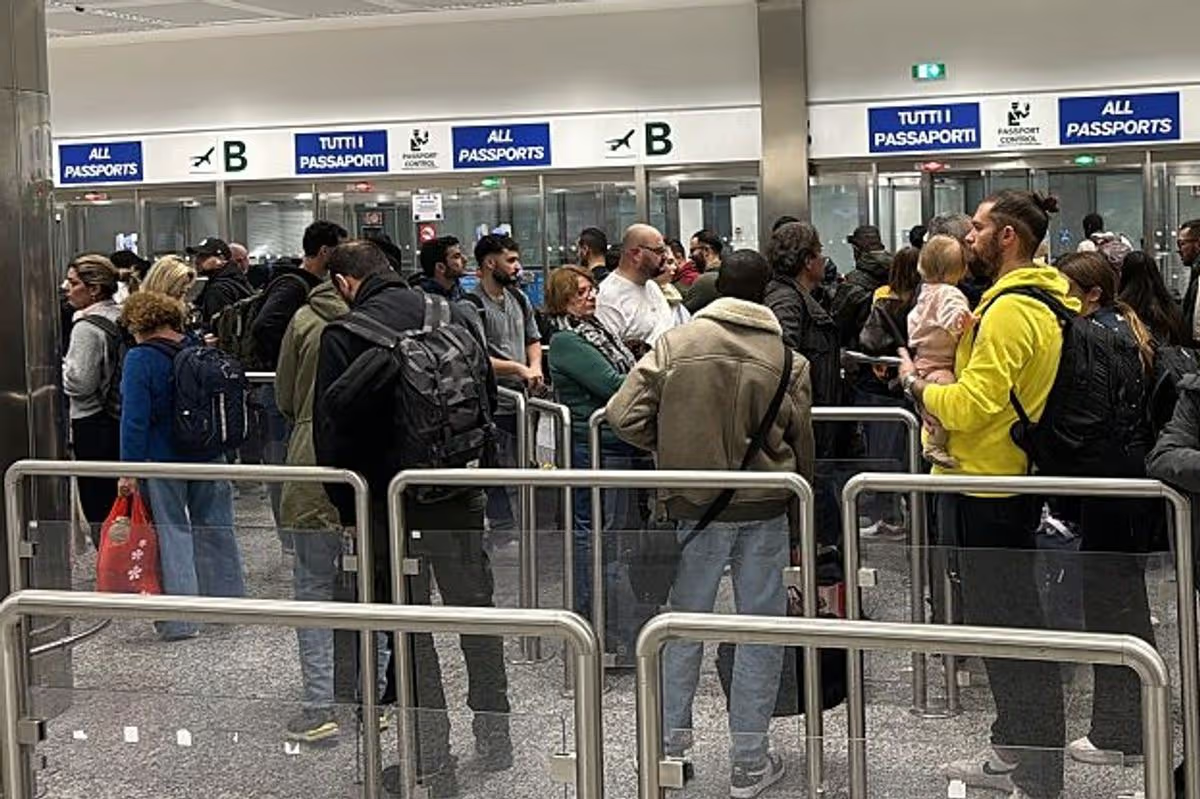
Tenerife South, a holiday hotspot that welcomes around three million Brits each year, has started rolling out a new system for some travellers. The new European Union Entry/Exit System (EES) is being introduced, which could require non-EU citizens to register their biometric data, including face photographs and fingerprint scans, at the border.
The scheme is being launched across many airports in the Schengen area to help alleviate long queues at passport control. According to Spain’s Interior Ministry, the EES will be gradually implemented across the region, but won’t be fully operational until April 10, 2026.
So far, the Spanish Ministry has allocated 83 million euros to enhance border checkpoints at all Spanish airports. Meanwhile, the National Police will continue to manage many border control duties, with the Guardia Civil overseeing customs operations.
The EES was launched at the beginning of October across participating countries. The data collected will be used to create a digital record linked to each traveller’s passport, with the primary goal of the new system being to streamline the border process.
Brits jetting off to Tenerife are being urged to get to the airport earlier than usual to allow for extra processing time. While the new system is designed to speed things up, it might take a while for both staff and passengers to get used to it during the initial stages.
All the countries that use EES
Spain is one of the many countries that has implemented EES. Currently, the following countries will have the new changes applied to them:
Austria
Belgium
Bulgaria
Croatia
Czechia
Denmark
Estonia
Finland
France
Germany
Greece
Hungary
Iceland
Italy
Latvia
Liechtenstein
Lithuania
Luxembourg
Malta
Netherlands
Norway
Poland
Portugal
Romania
Slovakia
Slovenia
Spain
Sweden
Switzerland
Most travellers won’t see the changes immediately, with only a small number expected to go through a fully digitised process while it’s still being rolled out. It’s understood that for the first six months of the scheme, manual passport stamping will continue alongside EES registration across the Schengen area.
The Entry/Exit System (EES) is being rolled out across European countries
The situation will vary as the system is rolled out(Image: JUSTIN TALLIS, AFP via Getty Images)
Travellers heading to Europe are being warned to be ready for major changes at airports as a new digital border system rolls out. With the changes starting in October, some will have already experienced the new system, while others won’t have.
The Entry/Exit System (EES) is gradually replacing traditional passport stamps across European countries and an expert is urging Brits to research the requirements and allow extra time for airport checks. Paul Paddock, CEO of Post Office Insurance at Post Office, has addressed four crucial questions about the new system to help British holidaymakers travel with confidence.
What is the EES?
Paul explained: “The Entry/Exit System (EES) is a new digital border control system for non-EU nationals entering the Schengen Area for short stays (up to 90 days in any 180-day period). It replaces manual passport stamping with electronic registration, improving border security and efficiency.
“Brits travelling to countries such as Spain, Portugal and Greece will now need to be prepared to have their passports scanned and biometric data taken at border control the first time they enter.”
What data is being collected and for how long?
Paul said that biometric information, including facial images (for all travellers) and fingerprints (for visa-exempt travellers only), will be collected. The system will also record passport information, entry and exit dates and locations, plus duration of stay. Information will be retained for three years for standard visits or five years if travellers overstay their permitted time.
Are there any exemptions to the EES?
Paul explained: “The EES does not apply to EU/EEA/Swiss citizens, non-EU nationals with specific residence permits and Monaco, Andorra, San Marino and Vatican nationals. Ireland and Cyprus are not part of the Schengen area where the system applies, so UK nationals travelling there will continue to be checked and stamped manually. Children under 12 will only have their facial image taken, not their fingerprints.”
How does EES work?
Paul said: “Travellers entering for the first time will undergo biometric registration at border kiosks or e-gates. This includes the system capturing a facial image, fingerprints (if visa-exempt), passport details and entry/exit information.
“For subsequent visits, the process will be faster due to the data already being stored. It’s important to note that no pre-registration is required – registration happens at the border during your first entry.
“Passengers may be impacted by facing longer queues initially due to biometric data collection, a process expected to take several minutes per person. Passengers should be encouraged to plan contingency options if travelling on a tight schedule (alternative routes or transport), as any teething problems or incomplete information could cause delays to miss flights, ferries, or connections.”
Preparing for EES border checks
Paul suggests this checklist:
1. Verify your passport expiry date (must remain valid for at least 3 months beyond your trip for EU destinations and be less than 10 years old)
2. Familiarise yourself with your destination airport’s EES setup (anticipate biometric checks)
3. Keep crucial travel documents at hand, including passports, travel insurance, accommodation confirmation, and proof of onward or return journey
The United States supports the European Union’s plan to use frozen Russian assets to help Ukraine and end the war with Russia. The European Commission has proposed that EU governments can access up to 185 billion euros of the 210 billion euros in Russian assets frozen in Europe, without actually taking ownership of them. This move follows the United States and allies’ decision to freeze about $300 billion of Russian sovereign assets after Russia’s invasion of Ukraine in 2022.
However, the proposal faces delays, particularly due to concerns from Belgium, where most frozen assets are stored. Germany raised worries that recent drone sightings in Belgium might be a warning from Russia. Moscow denies any involvement and has threatened consequences if its assets are taken. Recently, U. S. President Donald Trump imposed sanctions on major Russian oil companies, Rosneft and Lukoil, as part of ongoing efforts to pressure Russia economically and seek a peace deal. Washington is considering further actions to increase pressure on Russia.
The European Commission is reportedly considering delaying parts of its landmark Artificial Intelligence (AI) Act following heavy lobbying from U.S. tech giants and pressure from Washington, theFinancial Times reported Friday. The proposed pause would affect select provisions of the legislation, which came into force in August 2024 but is being implemented in stages.
Why It Matters:
The AI Act is the world’s first comprehensive framework regulating artificial intelligence, setting strict rules on transparency, safety, and ethical use. Any delay could dilute Europe’s claim to global leadership in AI governance and highlight the growing influence of U.S. tech companies and policymakers in shaping international digital standards. The move also comes as the EU seeks to avoid trade tensions with the Trump administration.
Tech firms like Meta and Alphabet have long argued the law could stifle innovation and competitiveness. The European Commission previously rejected calls for a pause, insisting the rollout would proceed on schedule.
However, an EU spokesperson told the FT that officials are now discussing “targeted implementation delays” while reaffirming support for the act’s core objectives. The Commission and U.S. officials have reportedly been in talks as part of a broader “simplification process” ahead of a November 19 adoption date.
What’s Next:
No final decision has been made, but if adopted, the pause could push back compliance deadlines for some high-risk AI systems. The EU is expected to clarify its position later this month amid growing scrutiny from lawmakers, digital rights advocates, and international partners.
The EU’s enlargement commissioner, Marta Kos, commended Montenegro, Albania, Ukraine, and Moldova for their advancements towards EU membership, describing expansion as a “realistic possibility within the coming years” during a session at the European Parliament.
While Montenegro is noted as the most advanced candidate, the commissioner criticized Serbia for slowing reforms and indicated that Georgia is merely a candidate “in name only.” Kos emphasized the need for the EU to prepare for enlargement.
She highlighted Albania’s “unprecedented progress” and Moldova’s rapid advancements despite challenges. Ukraine’s commitment to its EU path and essential anti-corruption reforms was also recognized, particularly against the backdrop of Russia’s invasion and Hungary’s obstacles.
President Volodymyr Zelenskiy echoed this sentiment, urging the EU to take decisive action to eliminate barriers to a unified Europe.
During its 3rd grandiose summit in Luanda that brought together a distinguished panel of leaders, including the ministers of transport from Zimbabwe and Rwanda, the secretary-general of the African Civil Aviation Commission (AFCAC), the director of strategies at Morocco’s Ministry of Transport and Logistics, the CEOs of Ethiopian Airlines and TAAG Angola Airlines, as well as representatives from the World Bank Group and the European Commission (EC), the African Union finally earmarked $30 billion for aviation infrastructure.
In his opening address, João Manuel Gonçalves Lourenço, President of the Republic of Angola and Chairperson of the African Union (AU), stressed that Africa must invest between $130 billion and $170 billion annually to lay the foundation for sustainable growth. “We must move from words to action,” President Lourenço urged. “This summit represents a decisive step toward mobilizing the resources needed to enhance connectivity and integration across our continent.”
The ambitious investment plan strategically aims at modernizing the continent’s aviation infrastructure under the Single African Air Transport Market (SAATM), according to summit reports. Lerato D. Mataboge, African Union Commissioner for Infrastructure and Energy, during the high-level session on Financing and Modernizing African Civil Aviation Infrastructure to Promote Integrated Continental Airspace and Enable Free Movement Under SAATM, emphasized aviation’s pivotal role as both an engine of integration and a cornerstone of Africa’s economic transformation.
“Aviation is not merely a mode of transport,” Mataboge stated, speaking at the session. “It is a strategic engine of continental integration and a core enabler of Agenda 2063 and the AfCFTA. The Single African Air Transport Market will only succeed if we build the modern, safe, and efficient infrastructure that Africa’s growth demands.”
Citing findings from a Continental Aviation Infrastructure Gap Analysis conducted with AFCAC, ICAO, and the World Bank, Mataboge revealed that Africa needs between $25 and $30 billion over the next decade to close critical aviation infrastructure gaps. Passenger traffic is projected to triple from 160 million in 2024 to nearly 500 million by 2050, intensifying the urgency for investment.
Key funding requirements include US$10 billion for airport and aerodrome infrastructure and $8 billion for modernizing communication, navigation, and meteorological systems. The AU’s strategy aims to mobilize $10 billion in catalytic public finance to attract an additional $20 billion in private and institutional investment. Through partnerships with Development Finance Institutions (DFIs) and AUDA-NEPAD, the AU is aligning investment priorities with SAATM and the Programme for Infrastructure Development in Africa (PIDA).
The modernization plan integrates cutting-edge technologies such as Airport Collaborative Decision-Making (A-CDM) and System-Wide Information Management (SWIM) to enable seamless continental airspace. It also incorporates renewable energy solutions at airports to attract green financing and advance sustainability goals.
“As we modernize African skies, we are doing so sustainably,” Mataboge added. “Every project we prepare is designed to meet global green standards, reduce fuel consumption and CO₂ emissions, and make African aviation an attractive asset class for the world’s growing pool of climate-focused capital.”
Mataboge reaffirmed the AU’s commitment to ensuring that a modern, efficient, and sustainable aviation network drives Africa’s economic integration, connectivity, and global competitiveness. The AU’s officials reaffirmed their focus on Africa’s most strategic priorities, including building aviation infrastructure, digital data systems, and data interoperability. The discussion underscored the importance of collaborative efforts in building a better aviation sector across Africa.
Deals and Dollars: Concrete Commitments
The summit moved beyond dialogue to secure tangible commitments, marked by the signing of three key Memoranda of Understanding (MOUs):
– A partnership between the African Social Security Association and AUDA-NEPAD to channel African pension funds into continental infrastructure.
– An MOU with Qatar Airways establishing a $500 million endowment for renewable energy and climate-aligned industrialization.
– The establishment of the Angola Export and Trade Facility to promote regional cooperation and trade.
Ms. Nardos Bekele-Thomas, CEO of AUDA-NEPAD, reported significant progress since the previous summit in Dakar, Senegal. She announced that the AU, alongside African financial institutions, has already raised $1.5 billion to execute high-impact cross-border projects.
“The lesson from Dakar is clear: we can no longer treat financing as a fragmented market of scattered deals. We must transform it into a unified strategy,” Bekele-Thomas stated. She detailed new financial instruments, including the Alliance for Green Infrastructure in Africa’s Project Development Fund, which has achieved a first close of $118 million and is managed by Africa50.
In his contribution, African Union Commission Chairperson Mahmoud Ali Youssouf emphasized that Africa is entering a new phase of self-determination, one in which the continent must take ownership of financing, planning, and implementing its own development. He underscored that infrastructure investment is not merely technical but deeply political and strategic, vital to Africa’s economic sovereignty, competitiveness, and unity. Highlighting progress made under the PIDA framework, he called for an African-driven ecosystem for development financing through domestic resource mobilization, stronger private sector participation, and greater access to climate funds.
Echoing the urgency of the Chairperson of the African Union Commission, framed infrastructure investment as a deeply political and strategic imperative for Africa’s economic sovereignty. “We are shifting from a logic of assistance to a logic of alliance, where partners align their engagement with priorities defined by Africa itself,” he declared. He concluded with a powerful vision: “What we are building here are not merely roads and bridges. We are building an Africa that is connected, confident, and sovereign.”
There were special sessions designed to facilitate in-depth due diligence and accelerate projects toward financial close. The summit for Africa’s infrastructure development stands as a definitive moment, signaling Africa’s unified resolve to finance its own destiny and build the interconnected, prosperous future its people deserve.