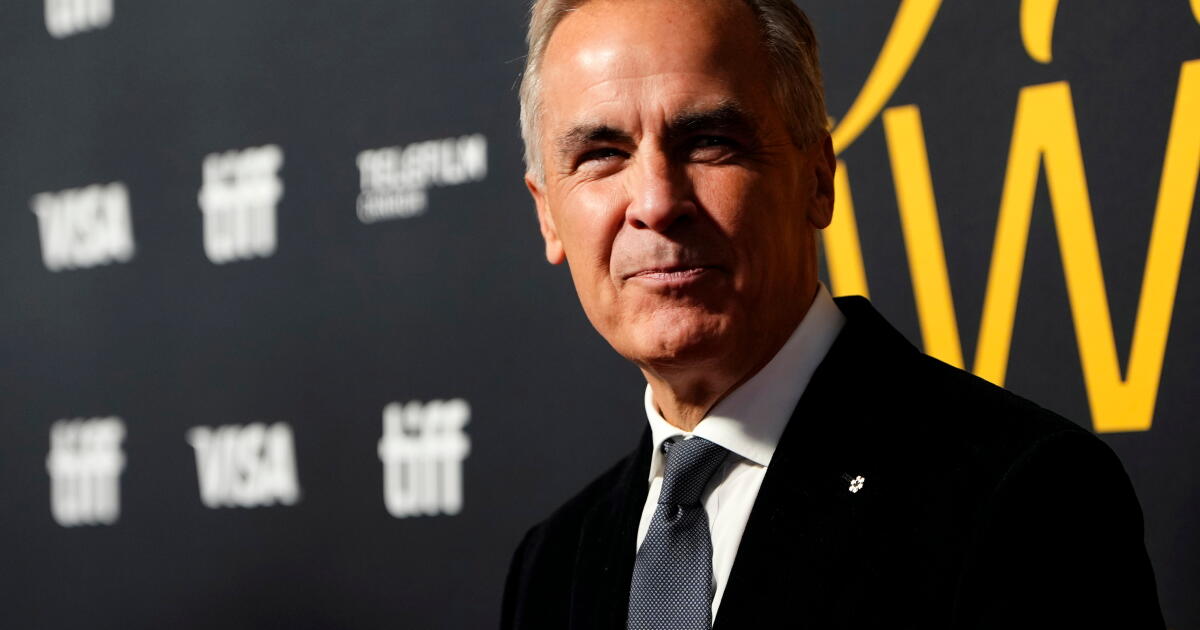
Carney heads to Europe for high-stakes speech and deeper EU ties as Canada clashes with Trump
TORONTO — Canadian Prime Minister Mark Carney is heading to Europe in the middle of a trade war with President Trump, seeking a deeper relationship with the European Union that could give Canadians greater freedom to work and study there.
Canada will seek an arrangement that would allow Canadians to live and work in Europe without visas as part of a strategic partnership, according to a senior Canadian official familiar with the discussions.
The official said Ottawa is not seeking to replicate the arrangements Norway or Switzerland have with the EU and did not propose “associate membership,” a term used in a recent report. Canada instead wants a partnership tailored to its priorities, with investment at its core.
Roughly 70% of Canadian exports go to the United States. Europe is central to Carney’s effort to reduce that dependence.
Carney has ruled out EU membership, saying Canada instead wants “a unique security and economic alliance” with the bloc. He said formal discussions will begin next month.
Economics is only part of the push, Carney said Tuesday. “The core of this, yes, there is an economic component, but it is about greater sovereignty,” he said.
Canadian government officials have consulted provinces and labor groups but have not settled on what form the relationship should take. The official spoke on condition of anonymity because they were not authorized to discuss the talks publicly.
Carney’s Trump challenge returns to Europe
Carney will attend European Commission President Ursula von der Leyen’s State of the Union address Wednesday as a guest of honor before addressing the European Parliament on Thursday.
Carney cautioned against expecting a major announcement in Europe, saying the “real deepening discussions” will begin at the Canada-EU summit in Montreal in late October.
The trip puts him back on the European stage as relations with Washington reel from tariffs, threats and personal attacks since trade talks collapsed.
Carney said Tuesday that economic integration, once viewed largely as an asset, is increasingly “being used as a weapon by certain countries,” making it more important for Canada to deepen ties with trusted partners. He is also carrying to Europe a message that has won praise there but that European governments have been reluctant to follow in dealing with the United States: Middle powers should resist economic coercion and be willing to walk away from a bad deal.
Carney’s Davos speech on middle powers in January drew a personal rebuke from Trump, and another forceful defense could raise the temperature again.
Canada has retaliated against U.S. tariffs and rejected terms Carney says would weaken its sovereignty. Europe, by contrast, shelved retaliation and accepted a deal leaving most EU exports to the U.S. facing tariffs of up to 15%.
That choice is striking given the EU’s economic weight as the world’s largest trading bloc.
At Davos in January, Carney urged middle powers to band together rather than bow to great powers. When countries negotiate alone with a hegemon, he said, “we negotiate from weakness. We accept what is offered.”
“This is not sovereignty,” Carney said. “It is the performance of sovereignty while accepting subordination.”
In a European Parliament debate in March, French lawmaker Chloe Ridel said Carney had “said out loud what many Europeans think quietly,” while German lawmaker Tobias Cremer urged Europe to “show the same courage as the Canadians have done in this moment of rupture.”
Tobias Gehrke of the European Council on Foreign Relations said Europe accepted economic pain in hopes of preserving U.S. support for NATO and Ukraine, but gained neither firm security commitments nor stable ties with Washington.
“European governments will be watching closely to see whether retaliation creates leverage or simply produces more escalation and an increasing bill,” Gehrke said.
Building a hedge against Washington
Canadian Finance Minister Francois-Philippe Champagne rejected the idea that Canada’s push toward Europe is simply an effort to gain leverage over Washington, saying Ottawa intends to keep working with the United States even as it builds stronger partnerships elsewhere.
“It’s always about us,” Champagne told the Associated Press. “We will still do things with the United States.”
But Champagne also said the geopolitical landscape has fundamentally shifted. “The world has changed and America has changed,” he said. “And I think the world has taken notice.”
Carney’s trip follows his global investment summit in Toronto, part of a broader push to attract international capital and reduce dependence on the United States.
Canada and the EU already cooperate on trade, defense, energy, technology and critical minerals. Bilateral trade reached about $147 billion in 2025, making the EU Canada’s second-largest trading partner.
Europe moves closer to Canada too
Underscoring the push for closer ties, the European Parliament said Monday that it will open an office in Ottawa, its 10th outside the EU, with a regional mandate extending to the Arctic.
“At a time when the world is becoming more unpredictable, like-minded partners need to work even more closely together,” European Parliament President Roberta Metsola said.
Canada this year became the first non-European country to join the EU’s $173-billion SAFE defense program, giving Canadian companies access to joint procurement.
Ian Lesser of the German Marshall Fund in Brussels said Trump’s tariffs and policies toward the North Atlantic Treaty Organization and his stated intention to acquire Greenland for the U.S. have accelerated efforts by Canada and Europe to diversify their economic and security ties.
“The sheer unpredictability emanating from Washington has given history a shove,” Lesser said. He said many in Brussels still prefer to accommodate Washington or “wait and see” whether November’s midterm elections produce a Congress able to constrain Trump.
Carney will also travel to Britain to meet Prime Minister Andy Burnham for the first time. Both men are supporters of Everton soccer club and are expected to meet at the team’s League Cup match against Wolverhampton on Wednesday.
Gillies writes for the Associated Press. AP reporter Sam McNeil in Brussels contributed to this report.