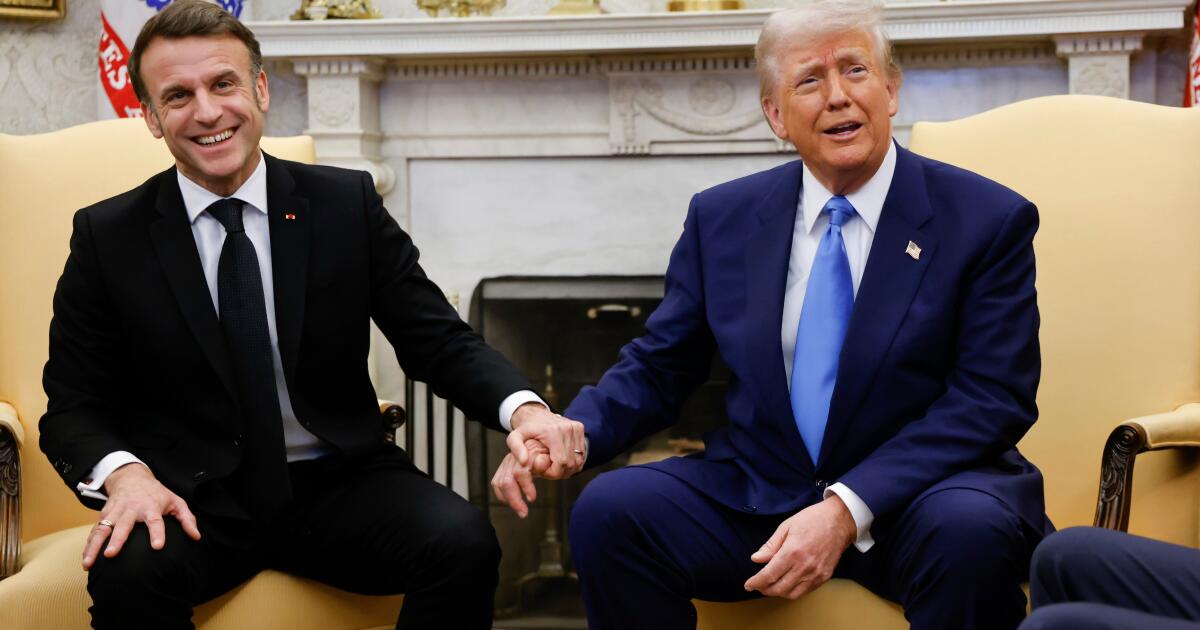
Macron once had a knack for managing Trump. The G7 may test it
WASHINGTON — The relationship between President Trump and French President Emmanuel Macron started simply enough, with a handshake, nearly a decade ago.
But even then, there were signs of strain in their relationship — tensions that could be on full display during next week’s G7 summit in France.
Back in 2017, Trump was a brash businessman just elected to America’s most powerful office, and Macron was an upstart politician who had won his race in a landslide. At a NATO summit in Brussels, they clinched hands far longer than most people do when they meet for the first time. Neither seemed to want to be the first to break a grip so tight that it exposed white knuckles.
Nevertheless, a friendship was born. And early on, Macron seemed to be the one European leader with a knack for managing his mercurial, three-decades-older counterpart.
Macron invited the Republican president to join him for Bastille Day celebrations in July 2017, including an Eiffel Tower dinner date with their wives. Trump reciprocated by making Macron the guest of honor the following year at his first White House state dinner, the highest diplomatic honor the United States can extend to an ally.
But by the end of Trump’s first term, the bromance had faded. And in his second term, the leaders now openly trade barbs, disagreeing over tariffs, Ukraine and the Iran war. That dynamic will be scrutinized next week when Trump and the leaders of Britain, Canada, Germany, Italy and Japan join Macron in the French lakeside resort of Evian-les-Bains for the G7 summit.
Trump’s long-simmering frustrations with US allies could be on display
There could be awkward moments between Trump and Macron, as well as among Trump and the other G7 leaders he’s criticized for not joining him in Iran.
“But I also think European leaders are quite professionals when it comes to politics, and in some ways diplomacy at this point, and will maybe see it as an opportunity as well,” Max Bergmann, director of the Europe, Russia, and Eurasia Program at the Center for Strategic and International Studies, said in an interview.
Kurt Volker, a former U.S. ambassador to NATO, said the Trump-Macron relationship has been further complicated by the Iran war and Trump’s complaints “that Europeans weren’t helping, when they hadn’t been consulted, and their interests are very much affected by this.”
“I think that was a negative for Macron,” Volker said.
Trump joined Israel in a war against Iran over its nuclear program back in February without consulting other U.S. allies. He then complained publicly when European countries spurned his requests for their help.
Waning support for Ukraine in its war against Russia from the Trump administration “has really irritated the French,” Volker said. “They feel this is important and we’re not paying attention to it.” Macron invited Ukrainian President Volodymyr Zelenskyy to join the leaders’ discussions on Tuesday.
Macron is the G7 member who has dealt with Trump the longest
In Trump’s first term, Macron appeared confident that he could persuade and influence the U.S. leader, but the relationship increasingly has come to be defined by their disagreements.
Macron now says he is “careful” about Trump’s statements, suggesting he no longer takes them at face value. Their relationship remains cordial as each calls the other “my friend.” But the relationship has also experienced some ups and downs.
As president-elect, Trump attended the reopening of Notre Dame Cathedral in Paris in late 2024 at Macron’s invitation. After Trump began his second term in 2025, Macron was an early Oval Office visitor. The president wrote on social media that he was “delighted” to welcome Macron back to the White House and said the relationship with France has been “very special.”
But at one point during the meeting, the French president publicly corrected Trump after he wrongly suggested that Europe would recover the money it had provided to support Ukraine. With a smile, Macron touched Trump’s forearm and replied, “We provided real money.”
Macron also condemned as “brutal and unfounded” new tariffs that Trump slapped on steel, aluminum and a broader range of European imports in early 2025.
But there have also been some lighter moments mixed with the tensions.
A documentary aired last year on French television showed Macron telling Trump during a phone call that Zelenskyy had agreed to a U.S.-backed ceasefire proposal. Trump replied, “You’re the greatest.”
Macron has often said he can reach Trump directly whenever he needs to — and proved his point during last year’s U.N. General Assembly session in New York. After police officers blocked the French leader from crossing a street because traffic had been halted for Trump’s motorcade, Macron whipped out his cellphone and dialed the U.S. president.
“How are you?” Macron said. “Guess what? I’m waiting in the street because everything is frozen for you!”
‘This is not a show,’ Macron has said about Trump’s NATO ambiguity
Macron has argued that Trump’s “America first” policies bolstered his case for a stronger European defense capability that would lessen reliance on the United States.
In April of this year, as Trump sent mixed signals about Washington’s commitment to NATO after the start of the war in Iran, Macron delivered some of his sharpest criticism of the U.S. president.
“There is too much talk, and it’s going in all directions,” Macron said. “We all need stability, calm and a return to peace. This is not a show.”
“You have to be serious, and when you want to be serious, you don’t say the opposite every day of what you said the day before,” he said.
Trump, while mimicking a French accent, recently has taken to reenacting a conversation he says he had with Macron over drug prices and tariffs. Trump also poked Macron by telling a private luncheon in April that his wife, Brigitte Macron, treats her husband badly. The comments were in a video the White House had posted on its YouTube channel before blocking access.
Macron didn’t see any humor in Trump’s comments. “The remarks I heard were neither elegant nor appropriate,” he said. “They do not deserve a response.”
Still, Macron has tried to accommodate Trump’s schedule to ensure his presence at the summit in Evian-les-Bains, knowing that he has a record of leaving such gatherings early.
Macron originally had set Sunday, which is Trump’s 80th birthday, as the opening day of the summit, but he pushed the start back a day because Trump is celebrating the occasion with a UFC show staged on the White House grounds.
Superville and Corbet write for the Associated Press. Corbet reported from Paris.