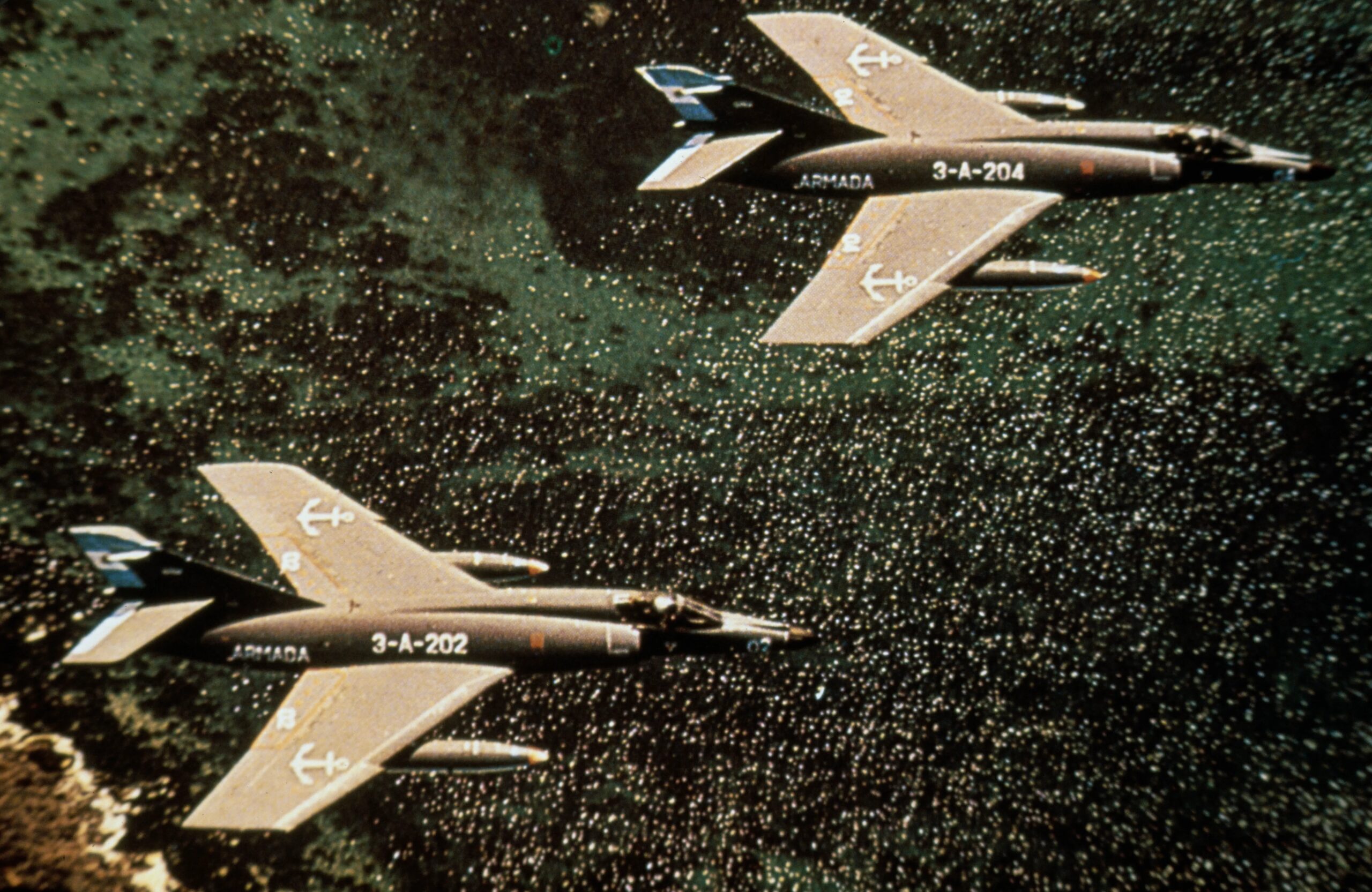
Britain’s Final Plan To Kill Argentina’s Super Étendards Attack Jets
No single Argentine capability shaped British planning during the 1982 South Atlantic conflict more than the pairing of the Dassault Super Étendard strike fighter and its deadly AM39 Exocet anti-ship missile. Against that threat, the British launched a series of special forces operations, all with the same objective: kill the Argentine pilots and destroy their aircraft and missiles before they could be used again. Together, the strike fighter and missile pairing had proven to be the biggest threat to the Royal Navy task force that had been sent to recapture the islands.

Five Super Étendard aircraft and five AM39 Exocet missiles had been delivered to Argentina before a French embargo took hold. The jets were flown by the Argentine Navy’s 2nd Naval Fighter and Attack Squadron out of Río Grande, on Tierra del Fuego, a region at South America’s southernmost tip, shared by Chile and Argentina. The Super Étendard/Exocet combination had already cost the British the destroyer HMS Sheffield on May 4 and the container ship Atlantic Conveyor on May 25.

The special forces operations were broken down into four phases — named PLUM DUFF, MIKADO, KETTLEDRUM, and IMPI — the last of which is the least well-documented, and the focus of this article.
PLUM DUFF was the insertion phase and was a reconnaissance mission. On May 16, an RAF Hercules airdropped eight special forces troops onto RFA Fort Austin to form a recce party. On the night of May 17/18, a Sea King HC4, ZA290, lifted off from the aircraft carrier HMS Invincible for a one-way flight to Tierra del Fuego, where the men were to observe Río Grande and report back. The patrol was set down far from the objective and never completed the reconnaissance; the helicopter crew flew on into Chile, where the aircraft was deliberately burnt to try and hide the evidence, while they tried to evade capture.

MIKADO was the planned attack phase, and it depended on that missing intelligence. Two Hercules were to air-land up to 70 men of B Squadron, 22 Special Air Service (SAS), directly on Río Grande — the air operation order of May 19 also named Río Gallegos, further up the Argentine coast, as an alternative. The men would destroy the Super Étendards and their Exocets on the ground, kill the pilots, and then withdraw overland into Chile. Commander Task Force 317, at Northwood, accepted from the outset that the mission could well cost both Hercules.

The aircrew did not refuse the task, but they were blunt about what it demanded: formation landing by two heavy transports on a possibly heavily defended, icy military runway, with a probable 20-knot tailwind, at night and on passive night-vision goggles in minimum light levels, with intelligence that was inadequate to support any air-land option at all. The RAF planning team recommended an airdrop as the better way to maintain a covert posture, and the Senior Air Staff Officer at Headquarters 38 Group warned the Air Commander to watch for overambitious schemes coming out of the SAS.
The U.K. Ministry of Defense formally cancelled MIKADO on June 4.
KETTLEDRUM was planned as the third of the set. It was aimed at Puerto Deseado, Santa Cruz Province of Argentina, and would have inserted a Special Boat Service party (SBS, the Royal Marines’ special forces unit) from the submarine HMS Onyx — a boat that will reappear before the end of this story.
None of the three was executed as planned.

Less well-known is that the cancellation of MIKADO produced a fourth project: Operation IMPI, named after a Zulu fighting force.
Cancelling MIKADO did not mean the wider operation was over. Also on June 4, the U.K. Ministry of Defense tasked CTF 317 to produce a new plan for special forces to destroy the combat effectiveness of the Super Étendards.
CTF 317’s staff went to work on what became IMPI. The planning document, Ops 1/3, is dated June 14 — the day of the Argentine surrender in the islands. In broad terms, the objective was to be attacked by special forces arriving both by air and by sea.
That much has been known, in fragments.

What has not been published until now is the fact that the operation had already been resourced.
At 2240Z on June 12, Maj. Gen. Jeremy Moore, commanding the land forces as CTG 317.1, signalled Rear Admiral Sandy Woodward’s battle group (CTG 317.8), with Admiral Sir John Fieldhouse at Northwood (CTF 317) and Commodore Michael Clapp’s amphibious group (CTG 317.0) as information addressees. The message called for B Squadron, 22 SAS, to be made available for operations as soon as possible: cover was needed against rapid developments of an unfavorable nature in West Falkland (Gran Malvina), and the theatre’s existing special forces assets were fully absorbed supporting the battle for Stanley — and IMPI. Operation IMPI, Moore noted in passing, was by then self-sufficient.

Examining two lines of routine signal traffic settles several things at once. Forty-eight hours before the surrender, IMPI was not a staff study but an operation that had been resourced, and that was enough to consume the theatre’s special forces and justify calling a fresh SAS squadron forward. It is also the only contemporary, operational-level reference to IMPI released so far: everything else comes from a narrative written years afterwards.
As that later narrative describes it, the concept behind IMPI was much leaner than MIKADO. Against two Hercules and 70 men, the air element of IMPI rested on a single RAF Hercules.

The aircraft was to fly from Ascension Island, refuel in flight, and then track east of the Falkland Islands and south of Cape Horn before making a low-level approach below Argentine radar cover for a night landing of special forces at the airfields codenamed San Jose and Arco Iris. Other special forces would have been inserted by sea. That air element, as will be seen, is the most questionable part of the entire file.
The routing is worth attention, because it rules out the intuitive picture of a direct run south from Ascension. Instead, the aircraft would have entered from the least-covered and least-expected direction, coming around the bottom of the continent rather than from the northeast.

The precise identities of San Jose and Arco Iris are not established in the declassified record.
The most likely reading is that they stand for Río Grande and Río Gallegos — the airfields at which the planned navigation ended, and the two named in MIKADO’s air operation order a month earlier. For a document circulating through restricted channels, encrypting the names of the two targets was an elementary precaution, although it should be noted that an operational order would more commonly have designated them simply as Target One and Target Two.
None of this rules out Chilean participation in other phases of the operation; if anything, it suggests it’s more likely. The narrative survives inside a folder classified Top Secret and restricted to the Chief of the Air Staff, whose declared subject is cooperation with Chile. That setting contrasts with the earlier stage of the planning, when mounting and recovering a special forces insertion from a Chilean airfield was considered and expressly discounted on political grounds — much as the use of an Antarctic strip was discounted after the New Zealand High Commission advised that the Antarctic winter precluded safe trans-polar flight.
The maritime half of IMPI can be traced in the records of those who were there.
Navigational support for the final phase was to come from the nuclear attack submarine HMS Conqueror. On June 9, 1982, Conqueror was off Bahía Camarones, working as an advanced picket and hunting targets of opportunity that ventured outside the 12-nautical-mile limit of Argentine territorial waters, with authority to sink any civilian vessel judged to be running to the Falklands/Malvinas; that same morning the sub had in fact entered Argentine territorial waters trying to locate the Argentine Navy’s Task Group 79.2.

That day, Conqueror received preparatory information on IMPI. The sub’s task was to come to periscope depth and act as a radio beacon, giving the Hercules a radio reference against which to refine a navigation that, low and at night, allowed no error. The resulting picture is an odd one: a nuclear submarine deployed on interdiction off the Patagonian coast, turned into a navigation aid for a transport aircraft.
The insertion itself fell to HMS Onyx, the Oberon class diesel-electric boat that had already taken part in Operation KETTLEDRUM and the only conventional submarine Britain deployed to the South Atlantic. On June 14, at 0815Z, lying in San Carlos Water, Onyx embarked a party of 10 men from B Squadron, 22 SAS and the SBS for the mission. The timing matches Moore’s signal of two days earlier almost exactly.
The plan called for the submarine to surface some two nautical miles offshore at night. The troops would close the beach in Gemini inflatables and destroy the objective — aircraft and missiles, if any were there — using anti-tank weapons and demolition charges.
What happened next illustrates the inertia of military machinery. The Argentine surrender in the islands came on that same June 14, hours after the party had gone aboard Onyx. Even so, preparations did not stop at once: on June 15 the embarked troops carried out practice landings from a Gemini. That does not mean IMPI was ever executed — it was not — but it does show that with the strategic outcome already settled, the machine was still rehearsing.

The British record closes the matter with administrative dryness: the surrender of the Argentine forces in the Falkland Islands and the cessation of hostile activity by Argentine aircraft resulted in the operation being cancelled.
The air part of the mission is another matter entirely and is where IMPI becomes more uncertain.
The only link between IMPI and an aircraft is a single paragraph in an RAF historical narrative. The folder that holds it was opened on April 18, 1986 — four years after the war — as an eyes-only briefing file for the Chief of the Air Staff, and the pages appear to be a working draft rather than a finished submission, carrying pencil amendments throughout.
Had a Hercules been earmarked, there is no doubt which unit would have provided it. The Special Forces Flight that runs through the whole chapter — five crews, commanded by a squadron leader, exercising regularly with SAS and SBS Sections — appears with its squadron number blanked out, yet the number surfaces a few paragraphs later, where two of its crews are described training on the probe-fitted Hercules C1P. The unit was No. 47 Squadron, RAF, home-based at Lyneham, and it would keep the special forces air support role for decades afterward.
The men who were at Ascension with that detachment, however, say they had nothing to do with it. Reliable sources with direct knowledge of the flight’s activity state that they never saw the codeword at the time, had never heard of the operation until this file surfaced, and consider it inconceivable that a special forces Hercules and crew could have been earmarked for a mission of this kind without the flight — a community of five crews that has stayed in touch ever since — learning of it at some point in the intervening four decades. By June 14, at most one aerial-refueling-qualified special forces crew was at Wideawake.
That skepticism is reinforced by the way the same narrative handles events those crews lived through. Its account of their own work-up does not survive contact with their logbooks.
For example, a practice infiltration into RAF Laarbruch in Germany that the narrative describes as successful had in fact been detected; the Hercules was notionally shot down about two miles out on the approach. The ramp toes (attachable extension plates located at the very end of the rear cargo ramp) it describes as droppable at 20 to 30 knots were never meant to be lowered with the aircraft moving, which would have been unsafe and risked the airframe. There are other anomalies, too.

A document that misstates the squadron’s own exercises is thin evidence on which to place that squadron over Tierra del Fuego.
What is not in question is what the Special Forces Flight could have done, had it been asked.
By mid-May the flight had two crews qualified in air-to-air refueling — one deployed to Ascension, the other held in the United Kingdom to train the others — flying Hercules C1s fitted with probes and, where the task required it, additional fuel tanks in the fuselage. It had rehearsed stream landings and rapid offloads, parachute insertion below radar cover to a pinpoint coastal feature, as well as flying on ANVIS goggles at 250 feet over sea and land. The goggles themselves were fitted to the crews’ helmets by RAE Farnborough specialists in a single day in mid-April. The reach was demonstrated on May 16, when the sortie that dropped the PLUM DUFF party stayed airborne for 24 hours and five minutes, with Victor tankers refueling some 1,800 miles from Ascension. Almost none of it was routine: nearly everything the force did during the conflict was improvised, at speed, in a matter of weeks.

What never had an answer — not for MIKADO, and not for whatever IMPI intended — was the other end of the problem. Putting men ashore deep inside Argentine territory was the solvable half. Getting an aircraft and its passengers out again after a direct action, from a strip in range of the Argentine Air Force, was not.
All of the above is reconstructed from lateral references: the RAF’s narrative in file AIR 20/13036 at the National Archives, unit records, submarine logs, operational signal traffic, and the accounts of participants.
The specific file — the one holding the complete plan with its annexes, the identification of the airfields and the execution sequence — remains closed. It is DEFE 71/980, titled Operation Corporate (Falklands Conflict): Operation IMPI, retained at the National Archives at Kew with no announced opening date. Until it is released, the air element of IMPI cannot be settled either way.
Forty-four years after the conflict, the last British special operation of the war is still, in essence, a document the British state is not prepared to show. That is not a trivial detail: the files touching on cooperation with Chile have consistently been the most reluctantly opened of all.

What remains is an operation of two halves. One of them is solid: a resourced plan, declared self-sufficient on June 12, with a nuclear submarine briefed to act as a beacon, 10 men of the SAS and the SBS embarked in a conventional submarine in San Carlos on the morning of the surrender, and rehearsals continuing the following day. The other half — a lone Hercules coming round Cape Horn to land on a codenamed strip — rests on one paragraph of a flawed staff narrative and is rejected by the only men who could have flown it.
Either way, the obsession is the same.
Between June 4 and June 14, 1982, while the final battle for Port Stanley/Puerto Argentino was being fought and the Argentine land campaign was collapsing, part of the British planning effort was still revolving around five French-built aircraft, their 10 aircrew, and their missiles. That the plan carries the date of the surrender itself, that it was still being rehearsed the following day, and that it remains classified today says a good deal about how far the British were prepared to go to destroy the Super Étendards and their Exocets.
Contact the editor: thomas@thewarzone.com
Mariano Sciaroni holds a master’s degree in Strategy and Geopolitics as well as a postgraduate diploma in Contemporary Military History, both earned at the Argentine Army’s Military Academy. Sciaroni has published five books and numerous articles on military and naval history. He is also an active member of the Argentine Institute of Military History and serves as a sub-lieutenant in the Argentine Army Reserve (Army Aviation Reserve Squadron). You can find out more about his books here.