Eritrea

Witnesses spot Eritrean troops inside northern Ethiopia as tensions flare | Abiy Ahmed News

Eritrea dismisses allegation as Ethiopia’s pretext for more war.

Eritrean soldiers have been seen driving through a northern town inside Ethiopia, witnesses tell the Reuters news agency, days after the neighbouring countries severed ties.

At least two witnesses told Reuters they saw “dozens” of Eritrean soldiers drive through Adigrat in two trucks on Wednesday. The town is located 25km (15 miles) south of the border with Eritrea.

The witnesses said they could identify the soldiers as Eritrean by their off-white camouflage uniforms.

Another Adigrat resident who was not in town at the time said family members had told him they had also seen Eritrean troops, according to Reuters, which could not independently verify their accounts.

“The Eritrean army has entered Tigray in uniform, equipped with heavy weaponry,” said Gebreigziabher Beyene, commander of the Tigray Peace Force, a pro-government militia that has fought alongside the federal army.

“This force is being struck by drones,” he said, adding Eritrea was “deliberately deploying its forces so that the fighting takes place inside Tigray rather than spilling into Eritrea”.

Last week, the chief administrator in Ethiopia’s northeastern Afar region said Eritrean troops were fighting in the area, but Reuters was unable to confirm the claim.

In a statement on X, Eritrea’s Information Minister Yemane Meskel did not deny that troops had crossed the border, but said Ethiopia’s government was creating “a fallacious narrative of ‘self-defense’ to rationalise and camouflage its war of aggression”.

If confirmed, it would mark the first time Eritrean forces have been seen inside Ethiopia since the renewal of fighting between Ethiopian forces and a seven-group armed alliance, including the Tigray People’s Liberation Front (TPLF), on September 23.

Ethiopia has accused Eritrea, as well as Egypt and Sudan of backing the armed alliance which is fighting to remove the government. All three countries have denied involvement.

Eritrea announced it was severing ties with Ethiopia on Thursday after Addis Ababa announced it would close its embassy in Asmara and expel 10 Eritrean diplomats.

In a statement, Eritrea’s Ministry of Foreign Affairs said Ethiopia’s actions had left it with “no option but to reciprocate in kind and sever all diplomatic ties with Ethiopia”.


Members of the Ethiopian pro-government Tigray Peace Force (TPF) gesture as residents welcome them while they ride in a pickup truck during a street patrol after Ethiopian federal and allied forces entered the Tigray capital of Mekelle, on October 4, 2026.
Members of the Ethiopian pro-government Tigray Peace Force (TPF) give a thumbs up to residents after Ethiopian federal and allied forces entered the Tigray capital of Mekelle on October 4, 2026 [AFP]

On Monday, Ethiopian forces captured Tigray’s regional capital Mekelle, days after the TPLF confirmed that it had withdrawn from the city and moved its regional administration “temporarily” to another location.

It happened as Ethiopia’s Prime Minister Abiy Ahmed was sworn in for another five-year term, during which he insisted that his landlocked country must have access to the Red Sea.

On the same day, Eritrea joined Somalia, Sudan and Egypt in issuing a joint declaration calling for a political and peaceful solution to the war in Ethiopia.

The declaration appeared to push back against several policies pursued by Ethiopia in recent years, highlighting widening rifts between Addis Ababa and its neighbours.

Source link

Ethiopia’s government forces retake airport from Tigray rebels in Mekelle | Conflict News

The rebels are seen leaving the capital of the northern Tigray region, according to local sources.

Ethiopia’s federal army and pro-government fighters have recaptured the main airport in the capital of the northern Tigray region, with the rebels seen leaving the city, according to multiple unnamed sources.

The Ethiopian National Defence Forces regained control of Alula Aba Nega Airport in Mekelle, one source with knowledge of events in the city and a humanitarian source told Reuters news agency on Saturday.

Recommended Stories

list of 3 itemsend of list

The airport, which is about ⁠10km (6 miles) from the centre of Mekelle, was one of three airfields in the region that were seized by the rebel forces at the start of the fighting on September 23.

The fighters, as well as the leaders of the Tigray People’s Liberation Front (TPLF), were seen retreating from the city, a local journalist and residents told the AFP news agency.

The journalist added that federal forces had not yet been seen inside Mekelle.

“I am concerned that government and public property could be exposed to looting because there are no security forces in the city,” a resident told AFP.

“I am worried that lawlessness could spread in the city, and I am also afraid for my life. I want us to quickly return to law and order,” added another resident.

Al Jazeera could not independently confirm these claims. Media access is currently heavily restricted in Ethiopia, and there have been significant communications blackouts.

Last month, rebels announced the formation of a seven-party rebel coalition led by the TPLF, the same armed group that fought in the 2020-2022 civil war against federal forces from Addis Ababa. The new coalition includes rebel groups of varying sizes from across the country.

Later that month, the coalition started an offensive, seizing three airports around the contested Tigray state and engaging in fighting on the borders with Amhara and Afar states.

The government is now engaged in a counteroffensive, pushing into Tigrayan territory along three axes towards Mekelle, according to the Critical Threats Project, part of the American Enterprise Institute think tank.

Fighting has so far been concentrated in Tigray. However, rebels have reportedly carried out drone attacks on Addis Ababa.

The TPLF and government have not commented on developments on the ground.

The fighting has seen drone attacks, intensified forced conscription, and attacks on civilian infrastructure, according to Amnesty International, a global rights group.

The renewed conflict has not yet reached the heights of the Tigray war, which lasted from 2020 to 2022 and saw hundreds of thousands of deaths, but it is quickly taking on an international dimension.

Risk of conflict spreading

The government of Prime Minister Abiy Ahmed has accused Eritrea, Sudan and Egypt of backing the opposition coalition. Khartoum and Cairo have denied involvement.

Eritrea has severed diplomatic ties with Ethiopia over the accusations.

On Thursday, Eritrea also denied involvement in the Tigray conflict, and accused Addis Ababa of “pursuing an agenda of incessant hostility”. It also said Ethiopia, which is landlocked, was planning to invade Eritrea to secure sovereign access to the Red Sea coast.

The TPLF’s leader, Debretsion Gebremichael, said in a video published on Thursday that “the war is regional and it is a war to control the Red Sea”.

Ethiopia has previously ruled out seeking conflict with Eritrea over access to the coast.

Source link

Ethiopia, Eritrea break ties: Does the conflict risk becoming regional war? | Conflict News

Eritrea has cut off diplomatic relations with neighbouring Ethiopia, escalating a long-simmering conflict between the two states rooted in territorial disputes and mutual accusations of interference.

The move comes as fighting flares in northern Ethiopia between Ethiopian federal troops and an opposition alliance that Addis Ababa accuses Eritrea of backing.

Recommended Stories

list of 3 itemsend of list

The clashes are the most severe in Ethiopia since its 2020-2022 civil war that killed hundreds of thousands of people.

But this time, the ripple effects could go further, potentially fuelling broader unrest in a region already plagued by numerous interrelated conflicts, analysts warn.

Here’s what we know about the Ethiopia-Eritrea conflict, the latest fighting in northern Ethiopia and what it could mean for the region at large:

Why did Eritrea break off ties with Ethiopia?

Eritrea announced it was severing ties with Ethiopia on Thursday, after Addis Ababa announced it would close its embassy in Asmara and expel 10 Eritrean diplomats.

In a statement, Eritrea’s Ministry of Foreign Affairs said Ethiopia’s actions had left it with “no option but to reciprocate in kind and sever all diplomatic ties with Ethiopia”.

The Eritrean ministry accused Ethiopia of pursuing a years-long “agenda of incessant hostility”, including by infringing on its coastal areas and arming fighters opposed to Ethiopia’s government.

Ethiopia has likewise accused Eritrea of backing armed groups opposed to its government. Both sides have rejected the other’s accusations.

The diplomatic breakdown follows months of worsening relations, driven largely by disputes over landlocked Ethiopia’s push for access to the Red Sea and allegations that Eritrea is backing the rebel Tigray People’s Liberation Front (TPLF), which leads the Ethiopian Peoples’ Forces Alliance for Survival, a rebel alliance fighting for control of parts of northern Ethiopia.

Have Ethiopia’s ties with Egypt and Sudan been hit, too?

Yes. Ethiopia accuses Egypt and Sudan of joining Eritrea in backing Tigrayan rebel forces, worsening already strained ties with both countries.

Ethiopia has long been at odds with Egypt over the status of Ethiopia’s Grand Ethiopian Renaissance Dam (GERD) project, which Cairo views as a risk to its water security and share of the Nile.

Ethiopia and Egypt have also expelled diplomats. Cairo ordered an Ethiopian diplomat to leave the country on Thursday, after Addis Ababa earlier kicked out an Egyptian diplomat, Egyptian state-linked media reported.

Egyptian state-linked broadcaster Al-Qahera News quoted an Egyptian official as calling Ethiopia’s move to expel the Egyptian diplomat as “regrettable and unjustified” and saying that Cairo responded in line with “the principle of reciprocity”.

The latest conflict also has implications for Sudan, whose military-backed government accuses Ethiopia of backing rebel forces it is fighting in its own civil conflict. Ethiopia rejects those allegations.

“The conflicts in Ethiopia and Sudan have become more interconnected, with the Ethiopian government and Sudanese Armed Forces accusing each other of harbouring and equipping respective opposition forces from inside their own borders,” Ahmed Soliman, senior research fellow at the Chatham House think tank’s Africa programme, told Al Jazeera.  “Egypt has also been drawn into the escalation with its long-running enmity with Ethiopia over the Nile.”

What is happening in northern Ethiopia?

Tigrayan-led rebel forces have engaged in clashes with Ethiopian government-backed forces in the country’s north since last week. Fighting is concentrated in three regions: Tigray, Amhara and Afar.

Al Jazeera’s bureau chief in Ethiopia, Mohammed Taha Tawakel, reported that forces loyal to the federal government have made significant gains in the Tigray region, taking control of several towns and closing in on the regional capital, Mekelle.

Further east in Afar, a pro-government armed group claimed on Thursday to have recaptured the town of Erebti, which rebel forces had taken control of earlier in the week. The pro-government group thanked the Ethiopian military for its “magnificent air support” and said it would pursue further advances.

Despite the pro-government advances, Tawakel reported that rebel forces still maintain what he described as a “strong rear link with Eritrea” along the countries’ border.

He also reported growing fears that fighting could move into major urban centres of Tigray, such as Adwa, Axum, Shire and Mekelle. Some people have already begun fleeing to Amhara and Afar, he added.

Outside northern Ethiopia, the conflict appeared to spill into the capital, Addis Ababa, for the first time early on Thursday, as an explosion was reported at the Ministry of Defence.

AFP quoted a diplomatic source as saying small drones were the most probable cause of the blast.

While Ethiopia’s army has a much larger arsenal of drones, rebel forces have previously used them to target airbases and airports in various parts of the country, reported conflict monitor ACLED.

What are the roots of the Ethiopia-Eritrea dispute?

Ties between the neighbours have been historically fragile. In 1962, Ethiopia annexed Eritrea. An armed independence struggle, led by Eritrea’s current President Isaias Afwerki, secured independence in 1993. The countries fought another border war from 1998 to 2000.

When Ethiopian Prime Minister Abiy Ahmed came to power in 2018, he moved to end the tensions and normalise diplomatic relations with Eritrea. During Ethiopia’s last civil war in 2020-2022, Eritrea even backed Ethiopia’s government against the TPLF.

But Abiy’s ambitions to seek direct sea access for landlocked Ethiopia have contributed to recent tensions, say analysts. Abiy has repeated that Ethiopia has a right to sea access, words that officials in Asmara take as a declaration of territorial conflict with Eritrea.

Could the current conflict spread in the region?

Many analysts fear it could.

Laura Hammond, professor in development studies at SOAS University of London, told Al Jazeera this scenario is already under way.

“The risks that conflict will spread to other countries, or that neighbours in the region will be brought into the present conflict are already playing out in terms of Eritrea’s support for the TPLF and the Alliance for Survival,” said Hammond.

“There is a strong possibility that Eritrea will become more involved in the conflict on the ground inside Tigray if it continues much longer,” she continued. “There is also a risk that the conflict could inflame relations with and inside Sudan.”

Martin Plaut, an analyst specialising in the Horn of Africa, also said there was a “real danger” of the conflict spreading.

“The situation is extremely tense and it would only require a spark to ignite a conflagration that could engulf [Ethiopia and Eritrea], as well as neighbouring Sudan,” he told Al Jazeera.

Source link

Ethiopia blames regional rivals as risk of conflict spillover rises | Conflict News

As renewed fighting spreads across northern Ethiopia, the government has accused Eritrea, Sudan and Egypt of backing armed opposition groups, raising fears that the conflict could draw in regional powers.

Over the weekend, Ethiopian army chief Birhanu Jula attributed his country’s unrest to those he called Ethiopia’s “historical and contemporary adversaries”.

Recommended Stories

list of 3 itemsend of list

Birhanu accused Eritrea of being the go-between linking these external powers – including Sudan and Egypt, which he explicitly named – with armed groups inside Ethiopia.

Eritrea, Sudan and Egypt have all rejected the accusations. Speaking to Al Jazeera, Egyptian Foreign Ministry spokesperson Nader Zaki said that Egypt’s foreign policy was founded on “full respect for the sovereignty, unity and territorial integrity of states, and noninterference in the internal affairs of other countries”.

Zaki added that Egypt “is fully committed to the rules of international law and the Charter of the United Nations, and rejects any practices that would undermine regional security and stability”.

Major-General Samir Farag, the former head of the Egyptian Armed Forces’ Morale Affairs Department, also told Al Jazeera that the accusations against Egypt were false. “It has not been Egypt’s policy to interfere in the internal affairs of any state in the region,” he said.

Sudan’s military also dismissed the accusations as “baseless” and levelled its own charge of destabilising behaviour at Ethiopia, accusing it of supporting the paramilitary Rapid Support Forces (RSF), which has been fighting the Sudanese Armed Forces since 2023. Ethiopia has denied those allegations.

Troubled relations

Ethiopia’s relations with the countries it has accused have already been strained by other disputes that predate the latest fighting.

Relations between Cairo and Addis Ababa have remained tense as a longstanding dispute over the Grand Ethiopian Renaissance Dam (GERD) remains unresolved. Competition between the two has increasingly extended to regional security, the Red Sea and the Horn of Africa.

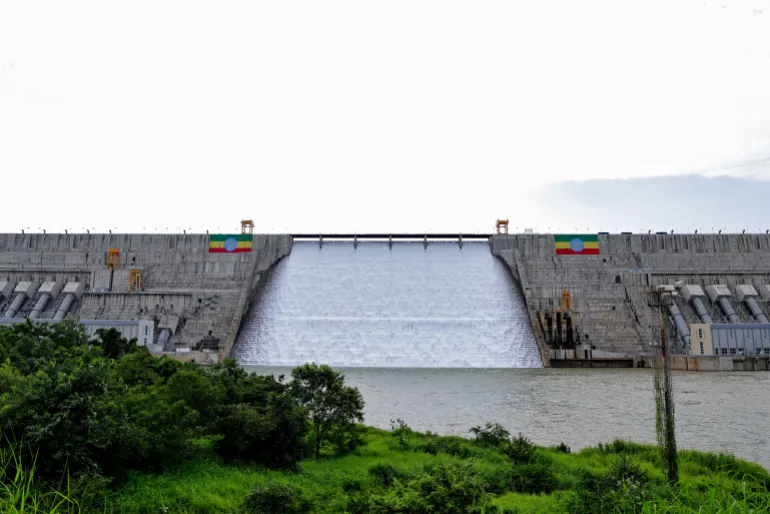
Large Ethiopian flags are displayed on the Grand Ethiopian Renaissance Dam (GERD), built along the Blue Nile, during its inauguration, in Guba, Benishangul-Gumuz region, Ethiopia, September 9, 2025. REUTERS/ Tiksa Negeri
The Grand Ethiopian Renaissance Dam, the construction of which stoked fears in Cairo that Ethiopia could choke off the Nile River, September 9, 2025 [File:Tiksa Negeri/Reuters]

Sudan’s relations with Ethiopia are similarly troubled. Since the outbreak of the Sudanese civil war, Khartoum has accused Addis Ababa of providing training, supplies and the use of Ethiopian territory to the RSF.

Eritrea had fought alongside Ethiopia against rebel groups in the latter’s Tigray region during a war between 2020 and 2022, but relations between the two neighbours have since soured, with Eritrea alarmed by Ethiopia’s attempts to gain access to the Red Sea.

Against that background, some analysts and Ethiopian opposition figures say that Addis Ababa is pointing the finger at foreign conspiracies in a bid to rally support behind its national army.

Mohamed Selim, deputy chair of the Egyptian parliament’s African Affairs Committee, told Al Jazeera that he believes the accusations were an attempt to shift attention from Ethiopia’s domestic problems by creating an external enemy and seeking to unify the internal front.

Amani al-Tawil, director of the Africa Programme at the Al-Ahram Centre for Political and Strategic Studies, similarly described the accusations as “an understandable attempt to escape from internal crises”.

She questioned why Egypt would choose this moment to intervene militarily in Ethiopia, given the two have been in dispute over GERD since 2011.

Al-Tawil said the breadth of the new opposition alliance in Ethiopia – seven groups representing disparate ethnic groups and regions announced the coalition last week – presented a challenge to Addis Ababa.

INTERACTIVE - Ethiopias ethnic groups and regions-1779798522
(Al Jazeera)

Spillover concerns

The renewed fighting in Ethiopia has spread across Tigray and into neighbouring Amhara and Afar.

Mohammed Hussein, the chairman of the Prosperity Party Afar Region Branch Office – the ruling party in Ethiopia’s Afar region – told Al Jazeera that the three regions together have a population of more than 38 million, according to his estimate, and include areas near the borders with Djibouti and Eritrea, raising fears of a regional war.

Ammar Arki, a writer focusing on Horn of Africa affairs, told Al Jazeera that Ethiopia had, at various stages, blamed Sudan, Egypt and Eritrea for contributing to instability inside Ethiopia.

He said the latest accusations could be interpreted as an attempt to redirect some domestic attention towards an external threat and build support around the federal government.

But Arki warned that the longer Addis Ababa continued to explain its internal crisis in terms of an “external conspiracy”, particularly if neighbouring states responded in the same way, the greater the risk that Ethiopia’s conflict could move beyond Ethiopia’s borders and become regional.

Source link

Ethiopia’s army promises restraint amid fears of new civil war | Conflict News

Army chief accuses Eritrea of funding and supporting armed groups to weaken Ethiopia.

Ethiopia’s federal military has said it is handling rising tensions in the country’s north with restraint, as fears grow that Ethiopia could be heading towards another civil war.

In his first comments on the recent military developments, Army Chief of Staff Field Marshal Berhanu Jula said the army was responding to what he called provocations from the Tigray front with “wisdom and restraint”.

Recommended Stories

list of 3 itemsend of list

He accused Eritrea of funding and supporting armed groups to weaken Ethiopia, describing the “Tsimdo” alliance as an extension of a longstanding pattern of hostile alliances, which he said cannot confront the state without outside backing.

Eritrea, wary that landlocked Ethiopia may be seeking to invade it to gain access to the Red Sea, denied the accusations.

The fighting has spread from Tigray into neighbouring Afar and Amhara regions after seven armed groups announced an alliance, the Ethiopian Peoples’ Forces Alliance for Survival, committed to removing Prime Minister Abiy Ahmed’s government.

In Afar, the latest battles have taken place around Abala, where the military has been trying to prevent rebels from seizing control.

Separately, in North Wollo, a zone of Amhara bordering Tigray, the army said on Thursday it had killed 272 Tigrayan fighters and wounded 260 in a counter-offensive, reporting heavy losses for the Tigray People’s Liberation Front (TPLF).

EEthiopia’s 2022 Pretoria Agreement ended the Tigray war but left key political, territorial and security disputes unresolved, allowing the TPLF to regroup and reposition as tensions have resurfaced.
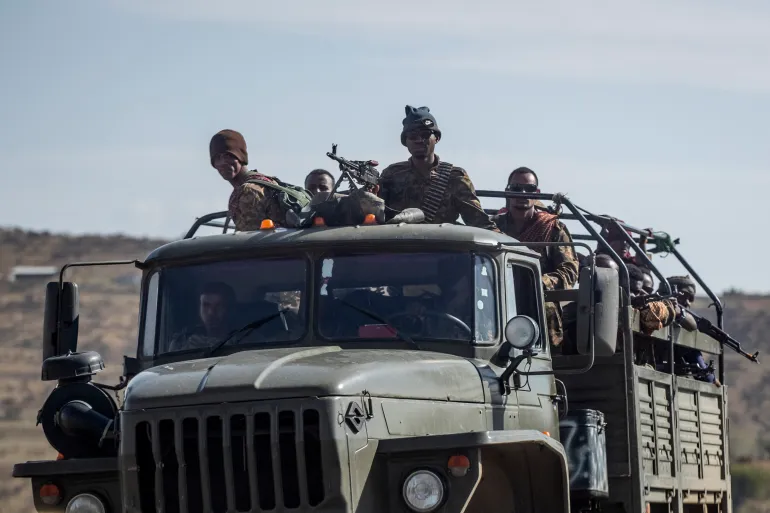
Members of the armed forces ride a military vehicle as fighting across Ethiopia intensifies amid fears of full-scale civil war [AP]

The TPLF’s Tigray Army said the federal government had launched a “full-scale offensive” involving infantry, mechanised units and drones.

Abdisalam Balema, a TPLF central committee member, told Al Jazeera the situation had become a “full war”.

Fighting has also continued around Sama, Soqota and Raya Alamata, with government forces reportedly closing in on the town of Alamata.

The army command said it prefers a strategy of “strategic calm” over a large-scale military confrontation, arguing the Tigray front’s popular support is dwindling and its leadership divided.

Internet access was reportedly cut across northern Ethiopia on Friday, a day after the UN said it was alarmed by reports of drones being used against civilians there.

The renewed fighting has put the 2022 Pretoria Agreement, which ended a brutal two-year civil war in Tigray, under severe strain. It comes weeks after Washington lifted sanctions on Ethiopia and Eritrea tied to atrocities from the last war, saying the “national emergency … has expired”.

It marks the most serious challenge yet to that agreement, raising fears of a wider regional conflict that could draw in armed groups from across Ethiopia.


Addressing the UN General Assembly, Ethiopia’s president sought to portray the country as a force for regional stability, accusing unnamed external actors of meddling in Ethiopia’s affairs while highlighting Addis Ababa’s role in supporting peace efforts in neighbouring Sudan.

Alemayehu Weldemariam, a professor of law at Indiana University, told Al Jazeera that the federal government bears much of the blame for the collapse of the Pretoria Agreement.

“This war has been in the making for a while now. Much of the provisions in the cessation of hostilities [in the 2022 agreement] were primarily sabotaged by the federal government itself,” he said, citing fuel, service and cash restrictions imposed on Tigray, and the government’s failure to set up the interim administration the deal had promised.

“What was supposed to be an interim arrangement turned out to be permanent,” with Tigray excluded from national elections since, he added.

Source link

Italy to deploy warships to protect shipping through Bab al-Mandeb | Global Energy Crisis News

Italy’s defence minister warns of severe economic fallout if Bab al-Mandeb becomes impassable, bypassing EU delays.

Italy will deploy warships to ensure safe passage for its commercial vessels through the Bab al-Mandeb strait, Defence Minister Guido Crosetto said, adding that Rome would not wait for a joint decision from the European Union.

“We have the capabilities to protect the passage,” Crosetto said, warning that if the waterway became impassable, the economic consequences would be severe.

Recommended Stories

list of 3 itemsend of list

The Italian defence minister said that Rome “must not allow bureaucratic delays in decision-making to exacerbate an already complex situation”.

Bab al-Mandeb links the Red Sea to the Gulf of Aden, forming one of the world’s busiest shipping corridors between Europe and Asia and a critical route for oil, gas and container traffic heading to and from the Suez Canal.

Roughly 12 to 15 percent of global trade has historically passed through the narrow waterway, which separates Yemen from Djibouti and Eritrea on the African side and is only about 30km (19 miles) wide at its narrowest point.

The strait’s importance has grown sharply since Iran effectively seized control of the Strait of Hormuz earlier this year amid its war with the United States and Israel, choking off the world’s most important oil chokepoint and pushing much of the Gulf’s crude exports towards alternative routes.

Saudi Arabia, in particular, has increasingly relied on pipelines and Red Sea shipping to bypass Hormuz altogether, making the Bab al-Mandeb strait one of the last major arteries still open to Gulf oil reaching global markets.

Control of the strait has been contested for years, as Yemen’s government, Houthi rebels and, at times, forces in the region have held stretches of its coastline at different points since the war in Yemen began in 2015.

The significance of the strait has been hit dramatically in the past few weeks, when the Iran-backed Houthi movement launched a rapid offensive that brought the entirety of Yemen’s western Red Sea coast under its control, including several strategically located islands.

The advance has given the Houthis effectively unrestricted access to the waterway, a development seen as a major setback for international shipping, given the group’s history of attacking vessels it associates with the US or its allies in the region.

The US and the European Union have already carried out military operations aimed at better protecting merchant ships from Houthi attacks in the area, though those efforts have struggled to fully secure the route as fighting in Yemen has escalated.

Source link