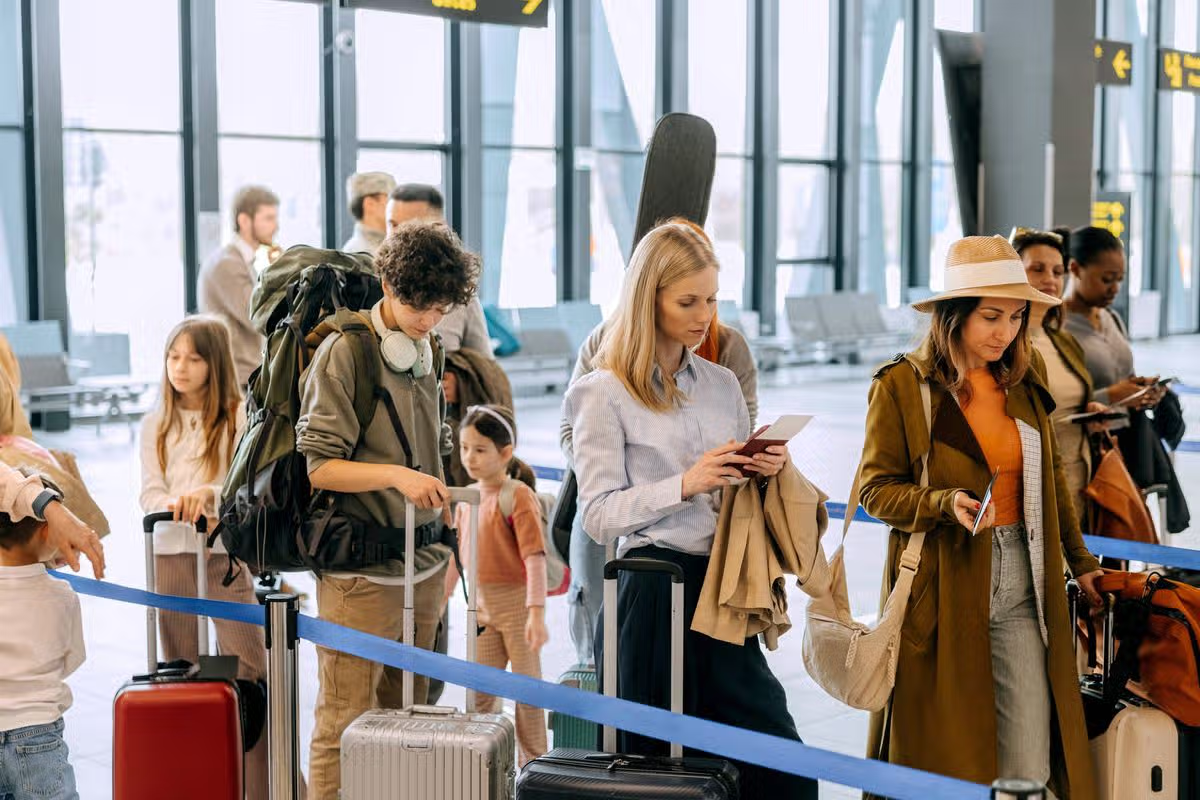
A WOMAN from the UK was stopped at the border abroad after she was told she had overstayed in Europe – despite her not.
Paula Pugh was going on holiday to Italy but was taken back to the UK after systems showed she had overstayed her limit of 90 days in a 180-day period in the Schengen Area.
One British woman was deported from Italy after an EES errorCredit: AlamyHer exit from a previous European country had not been correctly recordedCredit: Alamy
EES has been causing chaos for lots of Brits since it was first introduced earlier this year including airport delays and missed flights,
But now, it is also causing problems for passengers by incorrectly claiming they are staying too long in Europe.
Sign up for the Travel newsletter
Thank you!
Talking to The Telegraph, Paula Pugh, 60, explained how she was escorted out of Italy and taken back to the UK because of the error.
Travelling with her husband and cousin for a five-day trip to southern Italy, Paula was flagged at border control shortly after landing.
She was accused of overstaying her 90 limit in the Schengen Area despite taking just three short visits to Spain and one to France – which totted up to 22 days.
Talking to the publication Paula explained she “wasn’t allowed to go anywhere without a police presence.”
Paula was put on a flight home on the same day from another airport with Ryanair along with her family.
Her passport was given to the captain for the duration of their flight.
She added: “My husband then asked the cabin crew where I would get my passport, and we had to walk to the front of the plane.
“Somebody came onto the plane, took me off the plane, had a look, gave me my passport, and said ‘There you go.’ As though it was all over and all forgotten.
“I’m still very upset when I think about it.”
The cancelled trip and return flights home cost the family around £2,000.
EES has replaced the need for manual stampsCredit: REUTERS
Now, Paula is trying to get her record corrected.
Previously, Brits were manually stamped in and out of a country at border control. EES has replaced that with the taking of biometrics and fingerprints.
However, in some cases where EES has been turned off at airports due to faults, or delays, the exit for Brits has not been recorded and the days spent in the Schengen Area continues without them knowing.
A UK Government spokesman told The Telegraph: “While EES is anEU scheme, we recognise this is a significant change for British travellers, and advise that they read the latest Foreign, Commonwealth & Development Office (FCDO) Travel Advice about the scheme before travelling.“
In August, the UK Foreign Office altered its advice to Brits asking them to carry evidence of when they last left the EU, to avoid being wrongly refused entry.
Brits travelling from the UK to Europe can spend 90 days out of every 180 in the EU – staying over this limit will mean both refusal of entry and a fine.
In some cases a fine can be as much as £8,550.
Advice from the Foreign, Commonwealth & Development Office (FCDO) reads: “If you believe you have been incorrectly entered into EES or your record of time spent in the Schengen area is incorrect, approach border officials when you next cross the Schengen border and request a correction.
“If you are exempt, carry documentation confirming your status. If you believe your time spent in the Schengen area has been recorded incorrectly, raise this with border officials and be prepared to provide supporting evidence if requested.”
If you want to check the days left on your record before travelling, the The European Commission has anEES online tool.
New mandatory entry requirement for UK travellers is about to come into force
A new scheme is about to come into force(Image: South agency via Getty Images)
British passport holders could be turned away at the border in Spain, France, Italy and several other destinations due to a post-Brexit scheme set to launch later in 2026.
Once the initiative comes into effect, UK holidaymakers will be required to pay for a digital travel authorisation document to gain entry to around 30 European nations. British travellers will need to register with the European Travel Information and Authorisation System (ETIAS), which will soon become an entry requirement for visa-exempt nationals visiting a specific group of 30 countries.
With a valid ETIAS travel authorisation, travellers can enter these European countries as often as they wish for short-term stays, typically up to 90 days within any 180-day period. Originally, the ETIAS was expected to cost around 7 euros per person, however it has since been confirmed the fee will be nearly triple that amount, coming in at 20 euros per eligible traveller.
Those aged under 18 or over 70 are exempt, meaning a family of four travelling with two children would pay 40 euros in total. Once the scheme is up and running, failing to hold a valid ETIAS could see you refused entry to any of the following countries: Austria, Belgium, Bulgaria, Croatia, Cyprus, Czech Republic, Denmark, Estonia, Finland, France, Germany, Greece, Hungary, Iceland, Italy, Latvia, Liechtenstein, Lithuania, Luxembourg, Malta, Netherlands, Norway, Poland, Portugal, Romania, Slovakia, Slovenia, Spain, Sweden, and Switzerland.
The scheme has faced numerous delays, and it is now anticipated that ETIAS will be launched over the next few months. The ETIAS is stored electronically against the passport.
While the vast majority of applications are expected to be approved “almost immediately”, if the system detects an error in your ETIAS submission, it could face rejection. Reasons for ETIAS applications being refused are reported to include holding an invalid passport, being considered a “risk” or having a Schengen Information System (SIS) alert, submitting an incomplete application, or failing to attend a mandatory interview.
Should your ETIAS application be turned down, you have the right to lodge an appeal.
The Foreign, Commonwealth and Development Office (FCDO) has updated its travel guidance for British nationals travelling to Thailand, with tighter visa-free stay restrictions for UK travellers coming into force on 15 September 2026, alongside revised weather warnings
The new rules came into force this morning(Image: Twenty47studio via Getty Images)
The Foreign Office has warned Brits to check their paperwork is in order as a country changes its entry rules.
As of today, Thailand’s entry system has changed. After two years running a generous scheme under which citizens of 93 countries and territories could enter visa-free for stays of up to 60 days, a harsher system has taken over. Effective this morning, the length of stay has been cut in half from 60 days to 30 days for many nationalities.
For US, UK, Australian and Canadian citizens, the principle remains straightforward: no visa is required for a tourist stay of up to 30 days in Thailand. However, the visa-free period has been halved from 60 to 30. If you want to stay in the country for longer than that, you’ll have to apply for an extension of up to 30 additional days. The Thai government has indicated that this should be granted.
Another major change is that the visa-free scheme now applies only to tourists. Those entering the country for work or other purposes now use the visa category corresponding to their activity.
The reform also reintroduces a restriction on land-border entries, with those using the 30-day visa exemption allowed only two land-border crossings per calendar year. Nationals of Brunei, Indonesia, Malaysia and Singapore are not subject to this limit.
Ahead of the changes coming into effect today, the UK’s Foreign, Commonwealth and Development Office (FCDO) issued updated advice to Brits, a record-breaking million of whom visited Thailand last year. The government warned of the consequences of overstaying your visa or visa-free period.
“If you overstay the period of your visa, you will get a fine of 500 Thai baht a day up to a maximum of 20,000 baht. You risk being:
held in detention
deported at your own expense
banned from re-entering Thailand for up to 10 years
“Conditions in detention centres can be harsh.”
Thailand relaxed its visa rules in 2024, expanding the number of countries that qualified for visa-exemption, while extending the maximum length of stay to 60, in a bid to boost its tourism sector post-Covid. Tourism accounts for as much of 20% of the country’s GDP.
However, the rise in visitor numbers has caused tensions in the country. Back in May government spokesperson Rachada Dhanadirek told reporters that while tourism provided “benefits, such as boosting the economy”, the former visa scheme had allowed people to “exploit” the system. Foreigners overstaying and illegally operating businesses in tourism hotspots, without the proper permits, is a particular concern in parts of the country.
The full FCDO advice reads: “From 15 September 2026, if you enter Thailand under the visa exemption scheme, you can stay for up to 30 days for tourism. If you entered Thailand before 15 September 2026, you will usually be allowed to stay for the period granted when you arrived. If you want to stay longer, you must get the appropriate visa before you travel or, if eligible, apply for an extension through the Thai immigration authorities.
“You may be asked to show that you meet the entry requirements. This could include proof that you have enough money for your stay (at least 10,000 Thai baht per person or 20,000 Thai baht per family) and evidence of onward or return travel. British nationals have been refused entry for failing to provide this evidence.
“If you overstay your permission to stay in Thailand, you could be fined, detained, deported or banned from re-entering the country. Make sure you understand the conditions of your stay and get any visa extension you need before your permission expires.”
Alongside the entry guidance, the Foreign Office has revised its advice on Thailand’s rainy season and the dangers posed by heavy downpours.
The rainy season generally runs from May to October across most of the country, and from November to March in Koh Samui and south-east Thailand. However, the updated guidance warns that “weather patterns have become increasingly unpredictable and periods of intense rainfall can occur across Thailand.”
It continues: “Heavy rainfall can cause flash flooding, landslides and disruption to transport, particularly in northern, north-eastern and mountainous areas. Conditions can change rapidly and may result in road closures and local travel disruption. Lakes, caves and waterfalls are particularly at risk of dangerous flash flooding.”
Holidaymakers should follow instructions from local authorities and keep a close eye on weather warnings from the Thai Meteorological Department.