Energy

Israel-Iran conflict exposed China’s ‘limited leverage’, say analysts | Israel-Iran conflict News

Through the 12 days of the recent Israel-Iran conflict, China moved quickly to position itself as a potential mediator and voice of reason amid a spiralling regional crisis.

The day after Israel’s unprovoked attack on Iran on June 13, Beijing reached out to both sides to express its desire for a mediated solution even as the country’s top diplomat, Foreign Minister Wang Yi, condemned Israel’s actions as a violation of international law.

Chinese President Xi Jinping soon followed with calls for de-escalation, while at the United Nations Security Council, China joined Russia and Pakistan in calling for an “immediate and unconditional ceasefire”.

When Iran threatened to blockade the strategically important Strait of Hormuz, through which 20 percent of the world’s oil passes, Beijing was also quick to speak out.

The Ministry of Foreign Affairs instead called for the “international community to step up efforts to de-escalate conflicts and prevent regional turmoil from having a greater impact on global economic development”.

Beijing’s stance throughout the conflict remained true to its longstanding noninterference approach to foreign hostilities. But experts say it did little to help shore up its ambition of becoming an influential player in the Middle East, and instead exposed the limitations of its clout in the region.

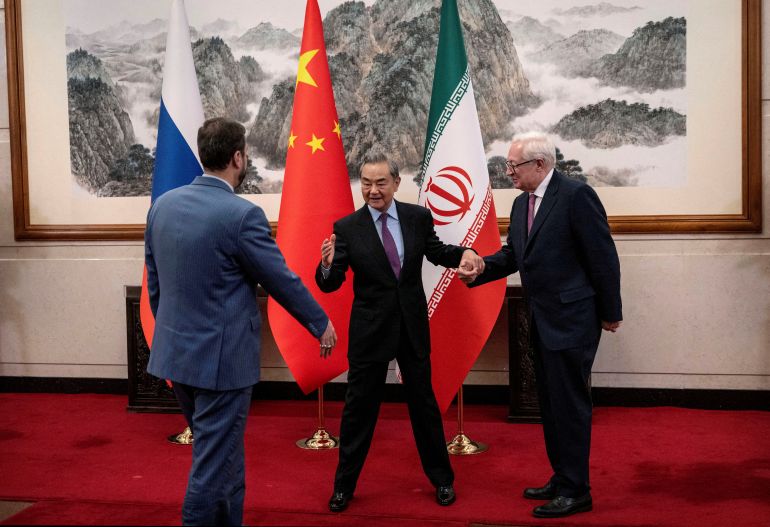
Chinese Foreign Minister Wang Yi welcomes Russian Deputy Foreign Minister Sergey Ryabkov and Iranian Deputy Foreign Minister Kazem Gharibabadi, before a meeting regarding the Iranian nuclear issue at Diaoyutai State Guest House on March 14, 2025, in Beijing, China. Pool via REUTERS TPX IMAGES OF THE DAY REFILE - CORRECTING NAMES FROM "WAG YI" TO "WANG YI" AND "KAZEEM GHARIBABADI" TO "KAZEM GHARIBABADI
Chinese Foreign Minister Wang Yi, centre, welcomes Russian Deputy Foreign Minister Sergey Ryabkov, right, and Iranian Deputy Foreign Minister Kazem Gharibabadi, left, before a meeting regarding the Iranian nuclear issue on March 14, 2025, in Beijing, China [Pool via Reuters]

Why China was worried

Unlike some countries, and the United States in particular, China traditionally approaches foreign policy “through a lens of strategic pragmatism rather than ideological solidarity”, said Evangeline Cheng, a research associate at the National University of Singapore’s Middle East Institute.

This approach means China will always focus on protecting its economic interests, of which it has many in the Middle East, Cheng told Al Jazeera.

China has investments in Israel’s burgeoning tech sector and its Belt and Road infrastructure project spans Iran, Saudi Arabia, Qatar, Oman, Kuwait, Iraq, Egypt and the United Arab Emirates.

Critically, China relies on the Middle East for more than half of its crude oil imports, and it’s the top consumer of Iranian oil. A protracted war would have disrupted its oil supplies, as would an Iranian blockade of the strategically important Strait of Hormuz – something threatened by Tehran’s parliament during the conflict.

“War and security instability not only undermines Chinese investment and trade and business… but also the oil price and gas energy security in general,” said Alam Saleh, a senior Lecturer in Iranian Studies at the Australian National University.

“Therefore, China seeks stability, and it disagrees and opposes any kind of military solution for any type of conflict and confrontations, no matter with whom,” he said.

John Gong, a professor of economics at the University of International Business and Economics in Beijing, told Al Jazeera that China’s top concern through the conflict was to avoid “skyrocketing oil prices” that would threaten its energy security.

Flexing diplomatic muscle, protecting economic might

Aware of China’s friendly relations with Iran and Beijing’s economic fears, US Secretary of State Marco Rubio called on Beijing to keep Tehran from closing the Strait of Hormuz as ceasefire negotiations stumbled forward this week.

It was a brief moment of acknowledgement of Beijing’s influence, but experts say China’s overall diplomatic influence remains limited.

“China’s offer to mediate highlights its desire to be seen as a responsible global player, but its actual leverage remains limited,” Cheng said. “Without military capabilities or deep political influence in the region, and with Israel wary of Beijing’s ties to Iran, China’s role is necessarily constrained.”

To be sure, Beijing has demonstrated its ability to broker major diplomatic deals in the region. In 2023, it mediated the normalisation of relations between Iran and Saudi Arabia. While seen as a huge diplomatic win for China, experts say Beijing owed much of its success to fellow mediators, Oman and Iraq. China also mediated an agreement between Palestinian factions, including Hamas and Fatah, in July 2024, under which they committed to working together on Gaza’s governance after the end of Israel’s ongoing war on the enclave.

But William Yang, a senior analyst for Northeast Asia at the Brussels-based International Crisis Group, said the odds were stacked against China from the beginning of the latest conflict due to Israel’s wariness towards its relationship with Iran.

In 2021, China and Iran signed a 25-year “strategic partnership”, and Iran is an active participant in the Belt and Road project. Iran has also joined the Beijing-led Shanghai Cooperation Organisation and this year took part in China’s “Maritime Security Belt” naval exercises.

Iran’s “resolute opposition to American hegemony” also aligns well with China’s diplomatic interests more broadly, compared with Israel’s close ties to the US, Yang said.

Iranian Foreign Minister Hossein Amir-Abdollahian and Saudi Arabia's Foreign Minister Prince Faisal bin Farhan Al Saud and Chinese Foreign Minister Qin Gang shake hands during a meeting in Beijing, China, April 6, 2023. Iran's Foreign Ministry/WANA (West Asia News Agency)/Handout via REUTERS ATTENTION EDITORS - THIS PICTURE WAS PROVIDED BY A THIRD PARTY TPX IMAGES OF THE DAY
Iran’s late Foreign Minister Hossein Amirabdollahian, left, and Saudi Arabia’s Foreign Minister Prince Faisal bin Farhan Al Saud, right, and China’s then-Foreign Minister Qin Gang during a meeting in Beijing, China, in April 2023 [Handout/Iran’s Foreign Ministry/WANA (West Asia News Agency) via Reuters]

China’s dilemma

It’s a scenario that could be repeated in the future, he said.

“This case also reinforces the dilemma that China faces: while it wants to be viewed as a great power that is capable of mediating in major global conflicts, its close relationship with specific parties in some of the ongoing conflicts diminishes Beijing’s ability to play such a role,” Yang said.

For now, Beijing will continue to rely on the US as a security guarantor in the region, he added.

“It’s clear that China will continue to focus on deepening economic engagement with countries in the Middle East while taking advantage of the US presence in the region, which remains the primary security guarantor for regional countries,” Yang said.

“On the other hand, the US involvement in the conflict, including changing the course of the war by bombing Iranian nuclear sites, creates the condition for China to take the moral high ground in the diplomatic sphere and present itself as the more restrained, calm and responsible major power,” he said.
Source link

EU leaders meet to discuss sanctions, tariffs, and Middle East policy | Energy News

EU leaders gather in Brussels to address sanctions on Russia, US tariffs, and Middle East conflicts.

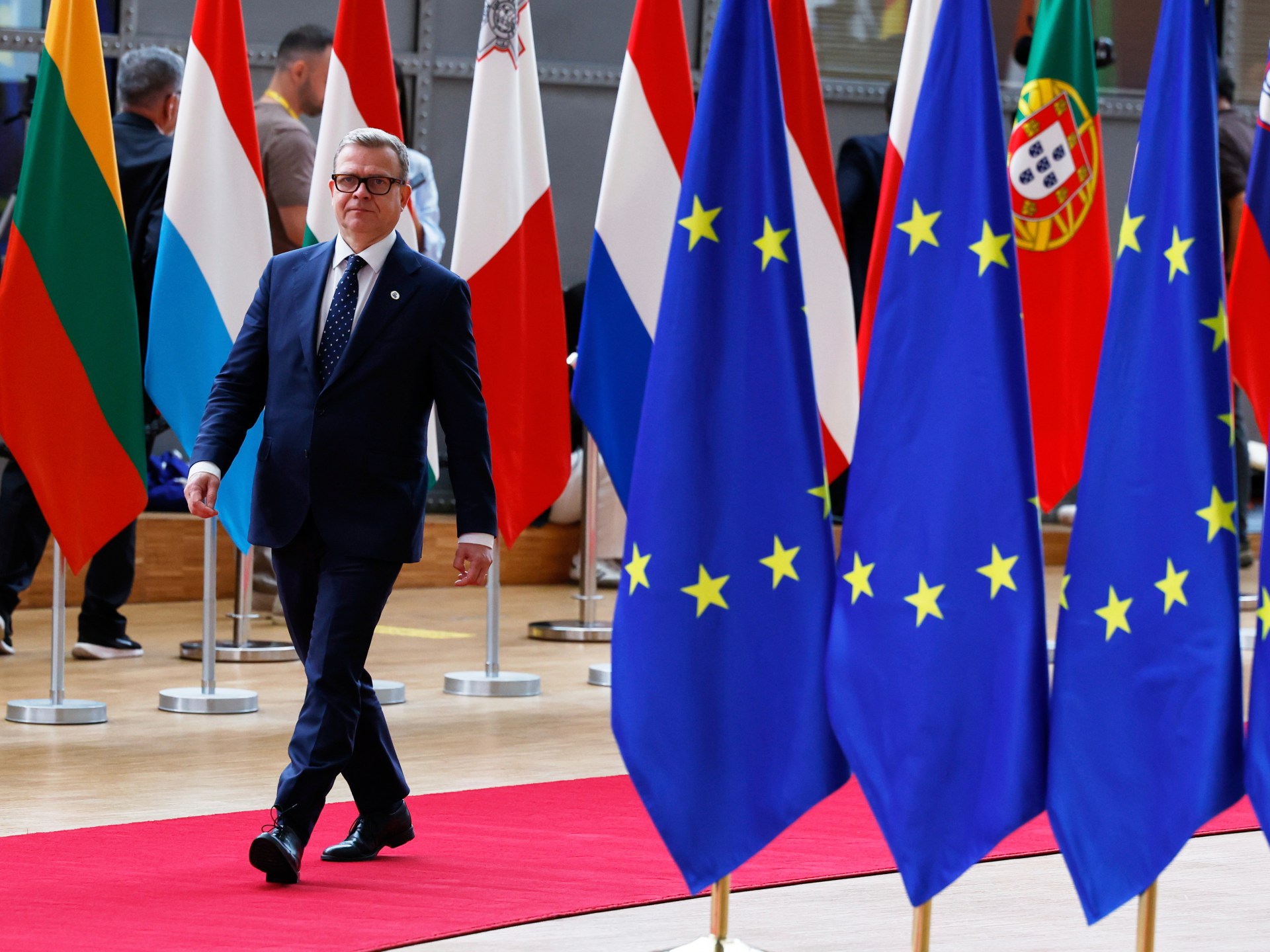
The heads of the European Union’s 27 member nations will meet in Brussels to discuss tougher sanctions on Russia, ways to prevent painful new United States tariffs, and how to make their voices heard in the Middle East conflicts.

Most of the leaders will arrive at the event taking place on Thursday from a brief but intense NATO summit, where they pledged a big boost in defence spending and papered over some of their differences with US President Donald Trump.

Ukrainian President Volodymyr Zelenskyy will join the EU summit by videoconference, after having met Trump on Wednesday.

US-led NATO downgraded Ukraine from a top priority to a side player this week, but Russia’s war in Ukraine remains of paramount concern for the EU.

Members will be discussing a potential 18th round of sanctions against Russia and whether to maintain a price cap on Russian oil, measures that some nations oppose because it could raise energy prices.

Meanwhile, Trump’s threatened tariffs are weighing on the EU, which negotiates trade deals on behalf of all 27 member countries. He lashed out at Spain on Wednesday for not spending more on defence and suggested yet more tariffs. France’s president criticised Trump for starting a trade war with longtime allies.

European leaders are also concerned about fallout from the wars in the Middle East, and the EU is pushing to revive diplomatic negotiations with Iran over its nuclear program.

EU members have internal disagreements to overcome. They are divided over what to do about European policy towards Israel because of its conduct in its war on Gaza. And left-leaning parties are attacking European Commissioner Ursula von Der Leyen’s pivot away from the EU’s climate leadership in favour of military investment.

Defence and security are likely to top the agenda. The summit will end with a statement of conclusions that will set the agenda for the bloc for the next four months, and can be seen as a bellwether for political sentiment in Europe on key regional and global issues.

Source link

Why Iran conflict has raised new questions about IAEA’s credibility | Israel-Iran conflict News

Israel launched an unprecedented strike on Iran’s military and nuclear sites on June 13, a day after the International Atomic Energy Agency (IAEA) board passed a resolution saying Tehran was not complying with its commitment to nuclear safeguards.

Though Israel did not use the United Nations nuclear watchdog’s resolution to justify the Iran attack, its Ministry of Foreign Affairs welcomed the IAEA resolution, calling it “a necessary and overdue step” that confirmed Iran’s “systematic clandestine nuclear weapons programme”.

Iran’s Ministry of Foreign Affairs and Atomic Energy Organization in a joint statement condemned the resolution, calling it “politically motivated”. The resolution, the joint statement said, “seriously undermines the credibility and integrity of the IAEA”.

Tehran insists its nuclear programme is for civilian purposes and that its facilities are monitored by the UN nuclear watchdog.

Here’s what the IAEA said about the Iranian nuclear programe earlier this month, and its criticisms against its past actions.

Did the IAEA think that Iran was building nuclear weapons?

The IAEA cannot fully assess Iran’s nuclear energy programmes, as Tehran halted its implementation of the Additional Protocol in February 2021, which permitted the IAEA enhanced inspection rights – including snap inspections and continuous surveillance.

Iran continued to comply with IAEA’s Comprehensive Safeguards Agreement after 2021, which permitted access to Iran’s declared nuclear sites (Natanz, Fordow, Bushehr) and also allowed for routine monitoring and verification of declared nuclear material.

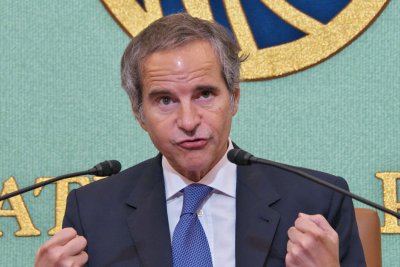
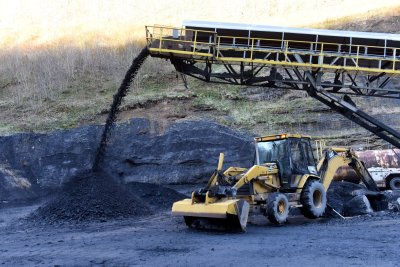
At a press event in Vienna on June 9, however, IAEA Director-General Rafael Grossi said Iran’s recent failure to comply with reporting obligations had “led to a significant reduction in the agency’s ability to verify whether Iran’s nuclear programme is entirely peaceful”.

During the IAEA’s Board of Governors meeting (which took place from June 9-13), Grossi said Iran had “repeatedly either not answered… the agency’s questions” regarding the presence of man-made uranium particles at three locations – Varamin, Marivan and Turquzabad.

Grossi also described Iran’s “rapid accumulation of highly-enriched uranium” as a “serious concern”, referring to the 60 percent pure uranium enrichment facilities at Fordow and Natanz.

In 2023, the IAEA had discovered 83.7 percent pure uranium particles at Fordow – close to the 90 percent purity required to make an atomic bomb.

On June 12, one day before Israel’s attacks on Iran’s nuclear facilities, the IAEA board passed a resolution declaring that Tehran was breaching its non-proliferation obligations.

Al Jazeera’s Hashem Ahelbarra, reporting from Vienna on June 12, noted it was the first time in almost 20 years that the IAEA, which monitors Iran’s nuclear programme, had accused Tehran of breaching its non-proliferation obligations.

Last week, however, Grossi emphasised that the IAEA had found no evidence of Iranian nuclear weapons production.

In an interview with Al Jazeera on June 19, Grossi was emphatic that Iran’s alleged violations of its assurances had not led his agency to conclude that Tehran was building bombs.

“We have not seen elements to allow us, as inspectors, to affirm that there was a nuclear weapon that was being manufactured or produced somewhere in Iran,” he said.
United States Vice President JD Vance invoked the IAEA resolution to make a case for the military action against Iran.

“They’ve been found in violation of their non-proliferation obligations by the International Atomic Energy Agency (IAEA), which is hardly a rightwing organization,” he posted on X on June 17.

The US president ordered his military to bomb three Iranian sites on June 22 – a decision welcomed by Israeli Prime Minister Benjamin Netanyahu, who has been making claims for decades that Iran was on the cusp of making nuclear weapons.

Trump has claimed that the nuclear sites have been “obliterated” and Iran’s nuclear programme has been set back by decades.

How has Iran responded?

On June 23, the national security committee of Iran’s parliament approved the outline of a bill designed to suspend Tehran’s cooperation with the UN nuclear watchdog, committee spokesperson Ebrahim Rezaei told the Tasnim news agency.

Rezaei said that, according to the bill, installing surveillance cameras, allowing inspections, and submitting reports to the IAEA would be suspended as long as the security of nuclear facilities is not guaranteed. Iran joined the IAEA in 1959.

In particular, Rezaei said Iran asserts its right, as a 1968 signatory to the UN’s nuclear Non-Proliferation Treaty (NPT), to develop nuclear technology for peaceful purposes, including uranium enrichment.

Parliament still has to approve the NPT withdrawal bill in a plenary.

Tehran has long complained that the treaty fails to protect it from attack by a country with a nuclear arsenal, the US, and another widely believed to have one, Israel.

What’s more, Iranian authorities have claimed Grossi is looking to become the next secretary-general of the UN, and is therefore sacrificing the nuclear watchdog’s integrity by adopting pro-Western rhetoric to gain personal favour.

On June 1, the head of Iran’s Atomic Energy Organization, Mohammad Eslami, told state TV: “Rafael Grossi [is] driven by his ambitions and a strong desire to become the UN secretary-general, is seeking to gain the approval of a few specific countries and align himself with their goals.”

Did the IAEA skirt controversy over the Fukushima disaster?

In June 2023, the Japanese government started releasing treated, but still radioactive, water from the ruined Fukushima Daiichi nuclear power station into the Pacific Ocean.

The IAEA gave the controversial plan the green light following a two-year review.

At the time, Grossi said the agency’s safety review had concluded the plan was “consistent with relevant international safety standards… [and] the controlled, gradual discharges of the treated water to the sea would have a negligible radiological impact on people and the environment”.

More than 1.3 million tonnes of water had built up at the Fukushima plant since a March 2011 tsunami destroyed the power station’s electricity and cooling systems and triggered the world’s worst nuclear disaster since Chornobyl.

The release of the water, which began in August 2023, encountered fierce resistance from Japan’s neighbours and Pacific island nations as well as fishing and agricultural communities in and around Fukushima, which fear for their livelihoods.

Beijing, in particular, was a fierce critic of the water discharge plan. In a statement following the IAEA’s July 2023 report, China’s Ministry of Foreign Affairs chastised its “hasty release”, claiming it “failed to fully reflect views from experts”.

Are there echoes of Iraq in the current debate about Iran?

To several observers, there are.

In the lead-up to the 2003 US invasion of Iraq, the US and the United Kingdom asserted that Iraq possessed Weapons of Mass Destruction (WMDs), including chemical weapons, in addition to pursuing a nuclear weapons programme.

These claims were central in justifying military action under the argument that Iraq posed an imminent threat to regional and global security.

Towards the end of 2002, the IAEA carried out several inspections of Iraqi weapons programmes.

In early 2003, they established the existence of high-tolerance aluminium tubes in Iraq. In theory, these can be used to enrich uranium for use in a nuclear warhead.

The aluminium tubes became a cornerstone in the Bush administration’s Iraq mandate. As the only physical evidence the US could brandish, they gave credibility to the apocalyptic imagery invoked by President George W Bush and his advisers.

The tubes were “only really suited for nuclear weapons programmes”, Condoleezza Rice, the US national security adviser, explained on CNN on September 8, 2002. “We don’t want the smoking gun to be a mushroom cloud.”

For its part, the IAEA refuted the theory that the tubes were destined for use in a nuclear programme. And after the invasion, extensive searches found no active WMD programmes in Iraq.

Source link

Heatwave poses risks to US power grid | Energy News

As heat related power outages surge, things are expected to worsen, with AI-focused data centres sucking up power.

The heatwave currently blanketing two-thirds of the United States with record-setting temperatures is straining the nation’s power system.

On Monday, Con Edison, New York City’s power provider, urged residents to conserve electricity. It reduced power voltage to the borough of Brooklyn by 8 percent as it made repairs; it did the same to areas in the boroughs of Staten Island and Queens yesterday. Thousands also lost power as the grid could not handle the strain.

Comparable outages have been felt around much of the East Coast and Midwest including in the states of Virginia and New Jersey. In Philadelphia and Cleveland, power went out for thousands of customers after severe thunderstorms late last week, and has yet to be restored as the region faces high temperatures.

The national railroad corporation Amtrak reported delays on Tuesday due to speed restrictions caused by the heat on routes that went through Washington, Philadelphia and New York.

Power grid woes

This heatwave is bringing attention to the vulnerability of the power infrastructure in the US.

In the latest annual assessment from the North American Electric Reliability Corporation (NERC), large parts of the US have insufficient power reserves to operate in “above-normal conditions”, including parts of the Midwest, Texas, New England and southern California.

Heat-related power grid strains have surged in recent years. According to a report from Climate Central released last year, there have been 60 percent more heat-related power outages between 2014-2023 than in the 10 years prior.

This comes amid new but growing pressures on the US power grid, including the prevalence of artificial intelligence data centres and the energy needed to power them. In 2022, in northern Virginia, Dominion Energy warned that data centres there used up so much energy that it might be unable to keep up with surging demand.

For AI data centres, that strain is only set to get more pressing as generative AI booms. It is expected that AI server farms’ power demand will increase to 12 percent by 2030.

There are also more immediate concerns of a cyberthreat from Iranian-backed “hacktivists”, which could target the US power grid at a vulnerable moment to avenge the recent US attack on Iran’s nuclear sites, CNN reported. The US power grid cyberthreat sharing centre has been monitoring the dark web for threats, it said, as the Department of Homeland Security issued a warning on Sunday about potential cyberattacks.

“Both hacktivists and Iranian government-affiliated actors routinely target poorly secured US networks and Internet-connected devices for disruptive cyber attacks,” the advisory said.

In 2023, Iran-linked hacktivists targeted a water authority in Pennsylvania with minimal success. In 2024, US authorities discovered that Iran-associated hackers were behind cyberattacks on US healthcare facilities.

Power grids are particularly at risk, according to a 2024 report by the North American Electric Reliability Corporation (NERC), which said that there are as many as 23,000 to 24,000 susceptible points in the US power grid systems that could be vulnerable to cyberattacks.

Source link

Asia in the Iran-Israel Ongoing Conflict: China, Energy, and the Future of Global South Geopolitics

A New Chapter in Global Escalation

Israel’s attack on the heart of Iran in June 2025 was not just the latest episode in the long history of the Middle East conflict. It was a loud signal that great power rivalry is now transforming into an open struggle, with Asia and the Global South as the main arenas of interest. For China, which has always maintained a balance between Iran and Israel, this war is a real test of its diplomatic strategy and national interests.

China: From Balancing to Taking Sides?

China has historically pursued a policy of “dual engagement” in the Middle East—strengthening economic ties with Israel while building a strategic partnership with Iran, especially in the areas of energy and security. However, the 2025 war revealed a significant shift in Beijing’s attitude. Just a day after the Israeli attack, China’s Ambassador to the UN, Fu Cong, openly called Israel’s actions a violation of Iran’s sovereignty and territorial integrity, while urging an end to Israel’s “military adventurism.” This strong statement was reinforced by President Xi Jinping and Foreign Minister Wang Yi, who reiterated their support for Iran’s right to self-defense and rejected further US military involvement.

This policy is not just rhetoric. China is a major buyer of Iranian oil, with more than 80% of Iran’s oil exports going to China—even amid Western sanctions. The 25-year partnership signed in 2021 deepens energy dependence and infrastructure investment, making Iran a key pillar of the Belt and Road Initiative (BRI) in the region. This relationship, economically and geopolitically, positions China as the main defender of Iran’s interests in global forums.

However, this position carries significant risks. China-Israel relations, which previously flourished in the technology and infrastructure sectors, are now experiencing serious rifts. Israel and its Western allies see China’s stance as a bias that undermines trust and narrows the space for dialogue. Iran, on the other hand, views China as an important strategic partner in the face of Western pressure, although it remains aware of the limits of Beijing’s commitment to direct military involvement.

Immediate Impact on Asia and the Global South: Energy, Economics, and Uncertainty

The domino effects of the conflict were immediately felt in Asia and the Global South. The surge in world oil prices—topping $75 per barrel—triggered inflation, increased the fiscal burden on energy-importing countries, and depressed people’s purchasing power. Indonesia, India, and ASEAN countries immediately evacuated residents from conflict zones, strengthened energy reserves, and prepared for economic contingency scenarios.

Asia’s dependence on Middle Eastern energy has now become a strategic vulnerability that cannot be ignored. Any threat to the Strait of Hormuz, a vital route for one-third of the world’s oil supply, immediately shakes markets and creates investment uncertainty. For countries in the Global South, energy price volatility means the risk of slowing growth, weakening currencies, and rising living costs—issues that exacerbate inequality and increase the potential for domestic political instability.

China as Mediator: Ambitions, Challenges, and Realities

China is seeking to capitalize on this momentum to assert itself as a global mediator. Beijing has actively offered itself as a mediator, pushed for a ceasefire, and called for multilateral dialogue in forums such as the UN and the Shanghai Cooperation Organization (SCO). In its official narrative and state media editorials, China has emphasized the importance of a political solution, respect for sovereignty, and rejection of Western-style “unilateral intervention.”

However, the effectiveness of China’s mediation role faces real limitations. China’s influence over Israel is very limited, given Tel Aviv’s closeness to Washington and skepticism of Beijing’s neutrality. On the other hand, China’s over-involvement risks provoking a confrontation with the United States, which remains the dominant player in the Middle East. The reality on the ground shows that while China has been able to construct a narrative as a new counterbalance, its ability to truly change the dynamics of the conflict is still constrained by its limited military and political leverage.

Strategic Implications: Global Polarization and the Future of Asia

The Iran-Israel conflict deepens global polarization between Israel’s pro-Israel bloc (the US and its Western allies) and Iran’s pro-Iran bloc (China, Russia, and much of the Global South). Asian and Global South countries are now faced with a strategic dilemma: balancing relations with the two great powers without getting caught up in a rivalry that could undermine regional stability.

For China, this conflict is a test of its ambition to become a leader of the Global South and a counterweight to Western dominance. Beijing’s firm stance in defending the principle of sovereignty and rejecting military intervention is a strong message to developing countries that have long felt marginalized in the global order. However, the challenge ahead is how to transform this diplomatic capital into real influence in resolving conflicts and building inclusive collective security mechanisms.

Conclusion: Asia and the Global South as Deciders of the Future

The Iran-Israel conflict and China’s response mark a new chapter in world geopolitics. Asia and the Global South are no longer spectators, but rather determiners of the future of the global order. By strengthening solidarity, policy innovation, and collective diplomacy, developing countries can take a greater role in maintaining world peace and prosperity. The challenges are great, but the opportunities to build a more inclusive and equitable world order are now wide open—and China, along with Asia and the Global South, is at the center of that change.

Source link

What Happens If Iran Closes the Strait of Hormuz?

After the recent military escalations between Iran and Israel, where the U.S. was involved symbolically but in a limited manner, the focus of the international strategic community has shifted back to one of the world’s most important maritime chokepoints: the Strait of Hormuz. Although the matter of closing such a waterway has been around in various forms of threats since the 1980s, the current situation in the Middle East is a clear signal that those threats are going to be actual events instead of mere rhetoric. Accordingly, the issue of how the world would react to a decision of Iran to shut down or impose restrictions on the Strait is now not a merely theoretical discussion—it is a current situation that is capable of affecting the whole world.

Why Hormuz Matters

The Strait of Hormuz acts as the main artery through which around 20% of the world’s oil for trade and more than 30% of global liquefied natural gas are transported each day. Its narrow geography—only 33 kilometers wide at the narrowest point—makes it a region that is unstoppably within Iran’s influence. This location is critical as it is the area where the Middle East’s vast oil resources are transported to the world’s markets. A conflict here would not only be equivalent to cutting off the energy export infrastructure in Gulf countries like Saudi Arabia, the UAE, and Qatar but also to a power outage in international energy markets. In a global economic scenario currently facing various challenges such as supply chain realignments, inflationary trends, and geopolitical rivalries, the closure of Hormuz would not just be an energy crisis; it would be a major systemic event.

Military Feasibility and Constraints

Technically, Iran definitely has the capabilities to disrupt or block the Strait for a short period. The Islamic Revolutionary Guard Corps (IRGC) has multiple layers of assets in the region, such as fast-attack boats, coastal missile batteries, naval mines, and drone systems. It has been building and rehearsing asymmetric strategies that are intended to fool the shipping lanes and stop the U.S. from intervening in its navy; these strategies are implemented through repeated exercises. On the other hand, Iran could carry out such a closure or be the major disruptor, but the continuation of it would be difficult. This move would most probably incite a very strong and well-coordinated military counterattack from the United States and its partners, which may also include a multinational maritime security coalition, apart from those opponents mentioned. Besides that, the international community would certainly impose severe penalties on Iran in the form of retaliatory actions, diplomatic isolation, and economic free-fall. Therefore, it is possible that Tehran wants to continue to calibrate its harassment or partial closures instead of implementing a full-scale blockade.

Energy Security and Economic Fallout

An incident in the Strait of Hormuz would cause a very rapid increase in oil and gas prices, and Brent crude would probably go up to more than $150 a barrel in the first few days of the crisis. Energy-exporting countries—especially in Asia, where China, India, South Korea, and Japan are the main players—would not only have energy shortages but also energy price inflation. After the Ukraine crisis, Europe changed the direction of its gas imports to Gulf LNG, but it is still going to be affected. Though some capacity exists in the form of overland pipelines, like Saudi Arabia’s East-West system, these alternatives are not sufficient to make up for the shortage of the flow through Hormuz. The impact would be felt globally—through inflation, increased shipping insurance charges, currency instability, and lack of investor confidence in emerging markets. At the end of the day, the economic cost would not be limited to energy consumers alone; it would also hit the very core of the global economic interdependence structure.

Diplomatic and Legal Implications

International law legally defines the Strait of Hormuz as an international strait—that means it is the free navigation route allowed for ships under the law of the sea. This right of passage is given to ships registered as UNCLOS (United Nations Convention on the Law of the Sea). Although Iran is not a party to UNCLOS and they firmly believe that they have the right to issue regulations for traffic, especially at times of insecurity, they are nonetheless free to assert their prerogatives. This situation of uncertainty in the interpretation of the laws only goes to highlight a bigger issue: necks like Hormuz are not only regulated by law but also by power. When the legal norms conflict with geopolitical situations, the implementation of the law is more influenced by the use of force, negotiations, or peacekeeping units than by court decisions. In the course of the global order’s evolution toward multipolarity, traditional means of enforcement are more and more divided; the international community has to come to terms with the fact that maritime governance is at its end.

Global Responses and Strategic Calculus

If Iran were to interfere with the transit in the Strait of Hormuz in a serious manner, it would necessitate a strong reaction from the United States. The latter has always considered the freedom of navigation as a vital interest. To this end, they could send their naval forces, form coalitions as in 2019 and carry out Operation Sentinel, or ask the UN Security Council to solve the issue, though Russia or China are likely to block any resolution. European countries could request the de-escalation and the mediation of the conflict, but they do not have a unified military force in the region. China and India, on the other hand, need to think about their next moves: they can’t lose their energy security, but they shouldn’t look like they’re sticking with the West; otherwise, they’ll be in trouble with their other friends. Russia might be in a good position to profit from the rising oil prices, but on the other hand, it has to be careful not to damage its partnerships in the region. Most importantly, nations in the Gulf region such as Oman, Qatar, and the UAE are expected to be at the forefront of diplomatic efforts to calm down tensions, using their secret communication channels to reach a truce, thus preventing the situation from spiraling into open warfare.

Conclusion: A Chokepoint as a Global Fault Line

The hypothetical closing of the Strait of Hormuz has attracted attention not only to it as a regional conflict but also as a challenge for the international system. It displays, first of all, the weakness of energy and trade flows, which are extremely dependent on special narrow geographic corridors. Oddly enough, after so many years of discussions about energy diversification and supply chain resilience, the world still remains terribly dependent on several maritime corridors that are at the center of geopolitical struggles. The second point is that this event shows the absence of any credible regional security framework in the Persian Gulf. Several next attempts to build inclusive architectures—whether led by the United States, Russia, or even China—were not successful in creating crisis prevention or conflict resolution mechanisms. As a result of this situation, the region is no longer strategically stable but becomes reactive all the time.

On the third point, the whole situation with Hormuz undermines those sea governance foundations that still remain. Legal concepts like transit passage only work when they are supported by a multilateral consensus and have credible enforcement. In their absence, rules give way to power politics, and coercive signaling becomes a tool of diplomacy. Way, The precedent it would establish at Existing even time would lead to other chokepoints at play: the Suez Canal, the Bab el-Mandeb, and the South China Sea. In conclusion, the crisis would be a strong reassertion of the supply of preventive diplomacy. The current escalatory spiral between Iran and Israel, compounded by the lack of sustained dialogue mechanisms, leaves the door open for miscalculation and unintended conflict. Restoring regional diplomacy, be it through a new Gulf security initiative or improved nuclear talks, is not an option—it is a must.

In conclusion, the Strait of Hormuz is definitely not only a maritime corridor. It is a political fault line where local crises meet with global insecurity. The manner in which the international community deals with or neglects the danger could be the factor that decides the path of world peace in the next ten years.

Source link

Energy crisis adds to survival threats in war-torn Gaza: NGO | Israel-Palestine conflict News

The Norwegian Refugee Council says the ‘deliberate denial of energy access’ undermines human needs in Gaza.

The lack of reliable energy sources is a key threat to survival in war-torn Gaza, an NGO has warned.

The “deliberate denial of energy access”, like electricity and fuel, “undermines fundamental human needs” in the war-torn enclave, a report published on Monday by the Norwegian Refugee Council (NRC) cautioned. The alert is just the latest regarding the dire humanitarian crisis in Gaza, which is driven by Israel’s blockade amid its war against Hamas.

Israel halted the entry of food, water and fuel in March, putting the Palestinian territory’s population at risk of famine.

Electricity supply has also been limited. The United Nations Office for the Coordination of Humanitarian Affairs (OCHA) estimates that 2.1 million people in Gaza have no access to power.

“In Gaza, energy is not about convenience – it’s about survival,” Benedicte Giaever, executive director of NORCAP, which is part of NRC, said.

“When families can’t cook, when hospitals go dark and when water pumps stop running, the consequences are immediate and devastating. The international community must prioritise energy in all humanitarian efforts,” she added.


NRC’s report noted that without power, healthcare facilities in Gaza have been adversely impacted, with emergency surgeries having to be delayed, and ventilators, incubators and dialysis machines unable to function.

Lack of electricity has also impacted Gaza’s desalination facilities, leaving 70 percent of households without access to clean water and forcing households to burn plastic or debris to cook, NRC said.

The humanitarian organisation also highlighted how the lack of power has increased the risks of gender-based violence after dark.

“For too long, the people of Gaza have endured cycles of conflict, blockade, and deprivation. But the current crisis represents a new depth of despair, threatening their immediate survival and their long-term prospects for recovery and development,” NRC’s Secretary General Jan Egeland said, urging the international community to ensure the people in Gaza gain access to energy.

Amid the humanitarian crisis in Gaza, hundreds of people have been killed by the Israeli military as they have sought food and other vital supplies from aid stations set up by the controversial Israel- and US-backed Gaza Humanitarian Foundation (GHF).

In its latest daily update released on Monday, the Health Ministry in Gaza said the bodies of at least 39 people had been brought to hospitals over the previous 24 hours. At least 317 people were wounded, it added.

Since Israel eased its total blockade last month, more than 400 people are reported to have died trying to reach food distribution points.

The UN’s top humanitarian official in the occupied Palestinian territory issued a stark warning on Sunday over the deepening crisis.

“We see a chilling pattern of Israeli forces opening fire on crowds gathering to get food,” said Jonathan Whittall, who heads OCHA in Gaza and the occupied West Bank.

“The attempt to survive is being met with a death sentence.”

Source link

Tesla signs deal for $556 million grid-scale battery storage station in China

June 20 (UPI) — Tesla Friday signed a $556.8 million agreement to build a grid-scale battery storage station in China.

The deal is with China Kangfu International Leasing Co., as well as the Shanghai local government.

It’s the first Tesla large-scale battery storage facility in China.

In a statement on Chinese social media site Weibo, Tesla said, “Tesla’s first grid-side energy storage power station project in mainland China has been officially signed.The grid-side energy storage power station is a ‘smart regulator’ for urban electricity, which can flexibly adjust grid resources.”

Tesla said that, when complete, this project is expected to become the largest grid-side energy storage project in China.

Utility-scale battery energy storage assists energy grid management by keeping supply and demand in balance. More is being built worldwide.

Tesla competed against two Chinese companies that offer similar products. CATL and automaker BYD have significant global market share in these battery storage products.

China plans to add nearly 5 gigawatts of electricity supply powered by batteries by the end of 2025, which would bring the total capacity to 40 gigawatts.

Source link

U.S. company to provide $6 billion loan for British nuclear power project

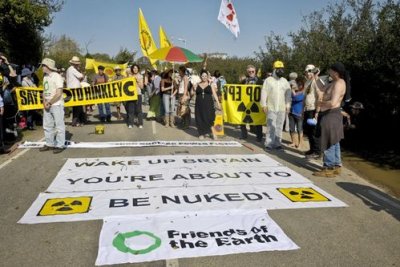
Protesters hold banners outside Hinkley Point power station in Somerset, United Kingdom, in 2011 against EDF Energy’s plans to renew the site with two new reactors. The project began in 2017 and has had delays and funding problems File Photo by Ben Birchuk/EPA

June 20 (UPI) — Apollo, a U.S. asset management group, plans to provide a $6 billion loan to the British nuclear project Hinkley Point C being built by a French multinational electric utility company.

Hinkley’s estimated cost has soared from $23.7 billion to almost $60.6 billion and won’t be operational until at least 2029, Baha Breaking News reported. Construction began in 2017.

Apollo will provide an investment-grade debt financing package at an interest rate below 7% for the project developer, Electricite de France, sources told CNBC and the Financial Times.

Apollo, which was founded in 1990 by Leonard Black, Josh Harris and Marc Rowan, manages capital for institutional and individual investors. Apollo, headquartered in New York City, had revenue of $26.11 billion in 2024 with a net income of $6.373 billion.

The loan has a maximum maturity of 12 years.

EDF is building two new nuclear reactors at the site in Somerset and will be able to borrow $2 billion each of the three years as part of the package.

The company has had a shortfall since China General Nuclear Power Group, which was supposed to provide a third of the cost of the project, stopped providing further financing in 2023.

CGN was removed by the British government from another project — Sizewell C — because of concerns about Chinese influence.

The funding could be used for other British projects by EDF.

Jamshid Ehsani, head of global principal structured finance at Apollo, described the deal as the “largest ever” sterling private credit deal.

“It’s going to help finance a critical, low-carbon nuclear project. This is the business Apollo is in today,” he said. “Europe is a huge focus for us.”
Source link

California decarbonization projects are among two dozen eliminated by Trump’s Department of Energy

California Democrats are denouncing the Trump administration’s decision to terminate $3.7 billion in funding for two dozen clean energy projects, including three in the Golden State.

The 24 awards recently canceled by the U.S. Department of Energy were issued by the Office of Clean Energy Demonstrations under the Biden administration and primarily focused on carbon capture and sequestration and decarbonization initiatives. Trump officials said the projects do not “advance the energy needs of the American people” and would not generate a positive return on investment for taxpayers.

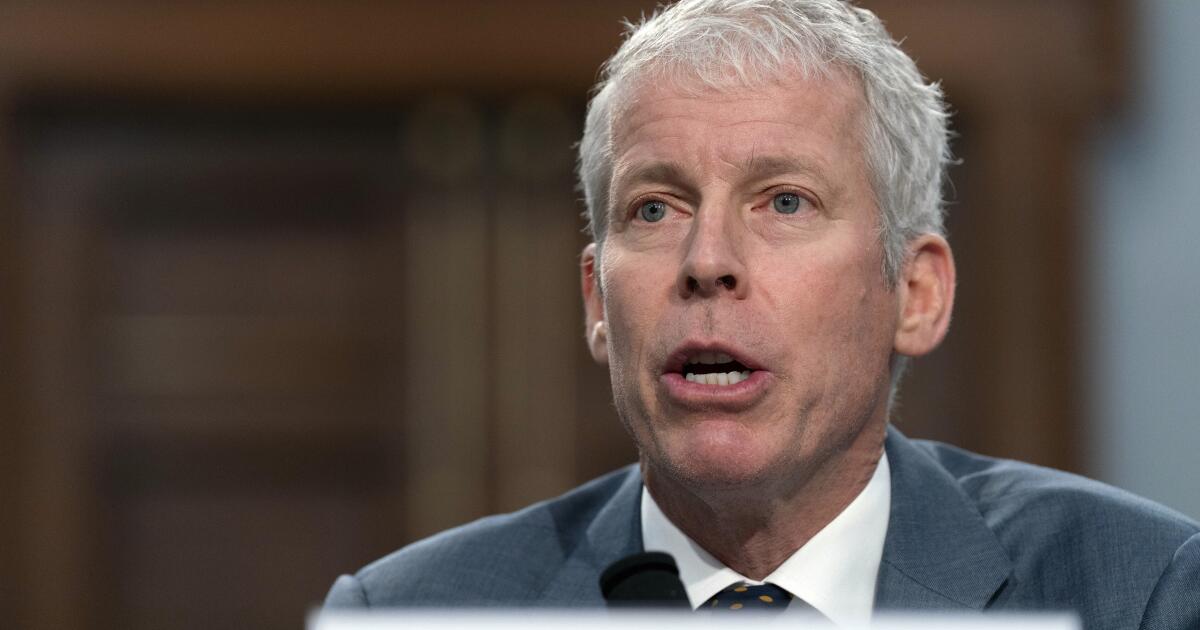
“While the previous administration failed to conduct a thorough financial review before signing away billions of taxpayer dollars, the Trump administration is doing our due diligence to ensure we are utilizing taxpayer dollars to strengthen our national security, bolster affordable, reliable energy sources and advance projects that generate the highest possible return on investment,” DOE Secretary Chris Wright wrote in his announcement about the terminations.

One of the largest cuts was a $500-million award for the National Cement Company of California, whose first-of-its-kind Net-Zero Project in Lebec was geared toward developing carbon-neutral cement. Cement production is notoriously emission-intensive, accounting for as much as 8% of planet-warming greenhouse gases due to both the high heat needed in the process and its byproducts.

National Cement Company officials said the project would capture up to 1 million tons of CO2 per year — effectively the entire emissions profile of its cement plant near the border of Los Angeles and Kern counties — but also would act as a roadmap for the cement industry as a whole.

“As we understand the new priorities of the U.S. Department of Energy, we want to emphasize that this project will expand domestic manufacturing capacity for a critical industrial sector, while also integrating new technologies to keep American cement competitive,” the company said in an email. It is now exploring options to keep the project alive.

The funding cuts arrive amid sweeping changes driven by Trump’s orders to rein in federal spending and “unleash American energy.” The president has removed barriers for fossil fuel companies, such as regulations that limit greenhouse gas emissions from power plants, and called for increased oil and gas drilling and natural resources mining.

California, meanwhile, has set some of the nation’s most ambitious decarbonization goals, including its aim to reach carbon neutrality by 2045. Environmental experts, including the Intergovernmental Panel on Climate Change, say capturing and storing carbon will be essential for slowing global warming, in addition to efforts to reduce overall carbon emissions.

In a letter to Wright dated Tuesday, California Sens. Adam Schiff and Alex Padilla said the terminations “run counter to our shared interest in boosting energy production, innovation, and economic vitality.” They urged Wright to reinstate the projects.

“The United States cannot afford to halt our progress and hinder American companies’ efforts to move beyond outdated technologies if we hope to remain competitive and truly energy dominant around the globe,” the senators wrote. “These irrational cancellations will increase energy prices, hamper innovation, and set us backwards as we strive toward a clean energy future.”

The cement project wasn’t the only one canceled in California. The DOE also terminated a $270-million award for an air-cooled carbon capture and sequestration facility at the Sutter Energy Center, a natural gas power plant in Yuba City. Carbon sequestration is the process of capturing CO2 and preventing it from entering the atmosphere by storing it underground, in aquifers or other geologic formations.

The Sutter project was projected to reduce emissions from the plant by up to 95% and capture and store up to 1.75 million metric tons of CO2 each year, according to its federal project page.

The federal government also canceled $75 million for a project at the Gallo Glass Company in Modesto, which would have demonstrated the viability of replacing gas-powered furnaces with a hybrid electric melter, reducing natural gas use by as much as 70%, the federal database shows.

Schiff and Padilla said all of the awards were provided through legally binding contract agreements between the recipients and the federal government, and so cannot be canceled “on a political whim.”

For its part, the DOE said it arrived at its decisions following a thorough and individualized financial review of each project, which found that they “did not meet the economic, national security or energy security standards necessary to sustain DOE’s investment.”

However, the terminations also appear to run counter to the administration’s own public commitments. The White House on Earth Day said Trump seeks to promote energy innovation “by supporting cutting-edge technologies like carbon capture and storage, nuclear energy, and next-generation geothermal.”

The DOE eliminated funding for projects across the country, including in Texas, Mississippi, Kentucky, Wyoming, Louisiana, Texas, Alabama, Ohio, New York, Illinois, Massachusetts, Texas, Washington, Arizona and Nevada.

But the cancellations in California mark yet another affront to the climate conscious state, which has in recent weeks also seen the Trump administration overturn its ability to set strict tailpipe emission standards and eventually ban the sale of new gas-powered gars. The state is suing the administration over that decision.

Source link

Oil prices spike, US stocks fall on Israel-Iran crisis | Oil and Gas News

Crude oil prices jump more than 4 percent amid fears the US may join Israel’s offensive against Iran.

Oil prices have spiked amid fears that the Israel-Iran crisis could spiral into a broader conflict involving the United States.

Brent North Sea Crude and West Texas Intermediate – the two most popular oil benchmarks – rose 4.4 percent and 4.3, respectively, on Tuesday as US President Donald Trump demanded “unconditional surrender” from Tehran.

The benchmarks stood at $76.45 per barrel and $74.84 per barrel, respectively, following the jump.

Oil prices edged up further in early trading on Wednesday, with both benchmarks about 0.5 percent higher as of 03:30 GMT.

US stocks fell on the rising geopolitical tensions overnight, with the benchmark S&P500 and tech-heavy Nasdaq Composite declining 0.84 percent and 0.91 percent, respectively.

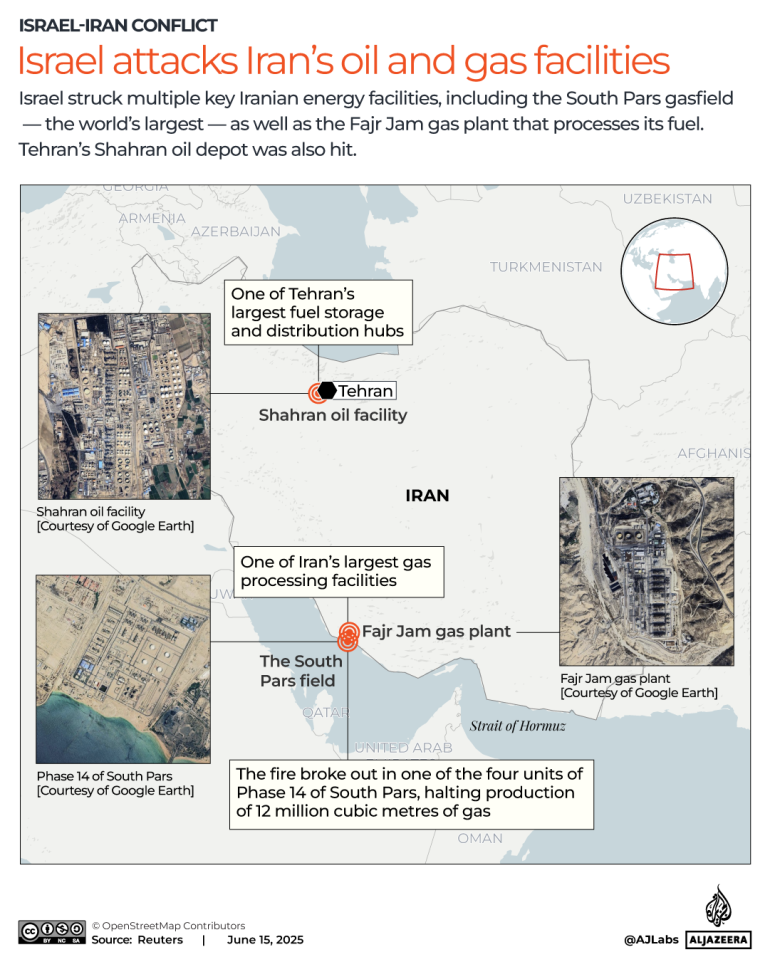
Israel has bombed multiple oil and gas facilities in Iran since Friday, including the South Pars gasfield, the Fajr Jam gas plant, the Shahran oil depot and the Shahr Rey oil refinery.

While there has been little disruption to global energy flows so far, the possibility of escalation – including direct US involvement in Israel’s military offensive – has put markets on edge.

On Tuesday, Trump ratcheted his rhetoric against Iran, adding to fears that his administration could order a military strike against Iran’s uranium enrichment facility at Fordow.

In a thinly veiled threat against Iranian Supreme Leader Ayatollah Ali Khamenei, Trump said in a Truth Social post that the US knew his location but did not want him killed “for now”.

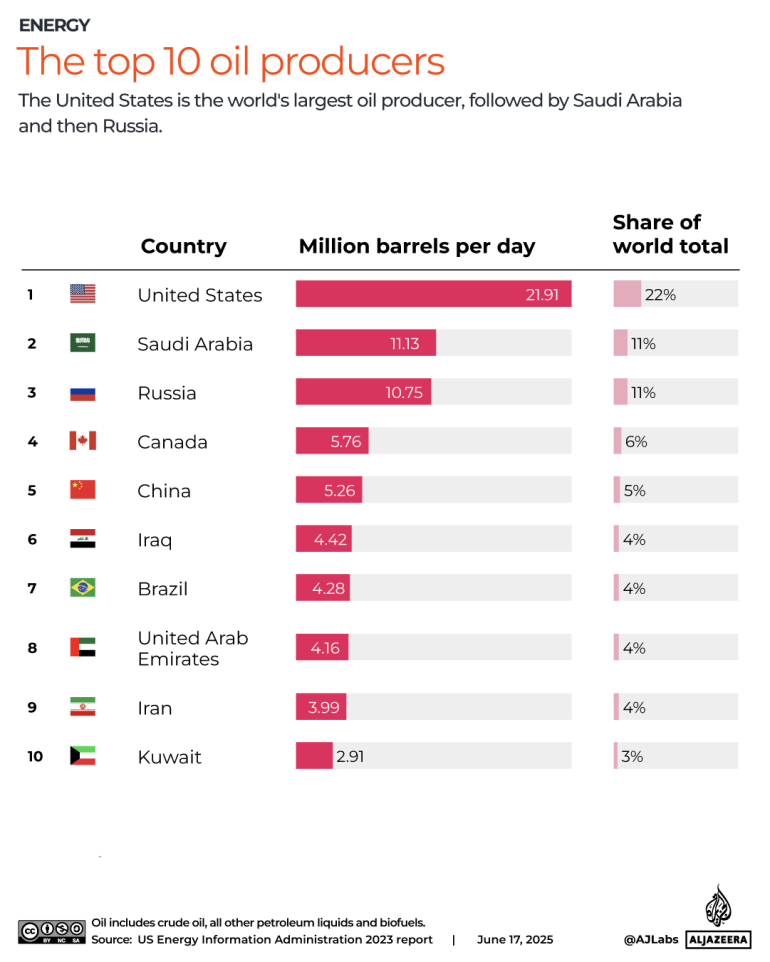
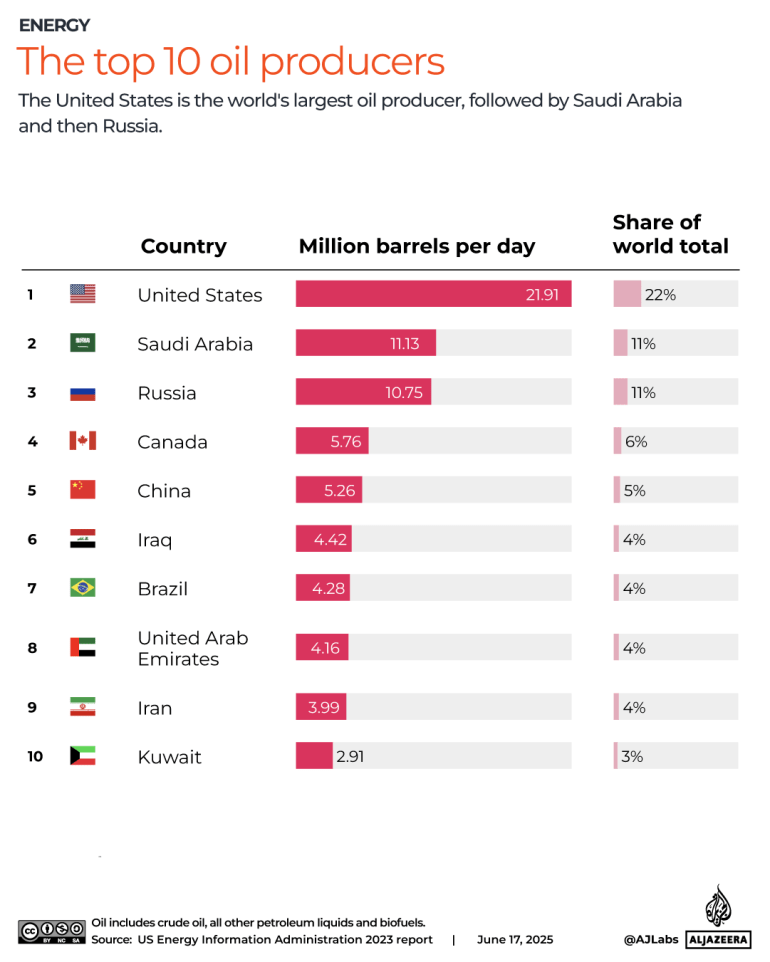
INTERACTIVE-The top 10 oil producers- JUNE16-2025 copy 2-1750160548

Iran has the world’s third-largest reserves of crude oil and second-largest reserves of gas, though its reach as an energy exporter has been heavily curtailed by US-led sanctions.

The country produced about 3.99 million barrels of crude oil per day in 2023, or 4 percent of global supply, according to the US Energy Information Administration.

Iran also sits on the Strait of Hormuz, which serves as a conduit for 20-30 percent of global oil shipments.

Nearly all of Iran’s oil exports leave via the Kharg Island export terminal, which has so far been spared from Israeli bombing.

“In the context of seeking to destabilize Iran, Israel may choose to strike its oil exports, believing that working to finish off a hostile regime is worth the risk of alienating allies concerned with potential price escalation,” Clayton Seigle, a senior fellow at the Center for Strategic and International Studies in Washington, DC, wrote in an analysis on Monday.

“Israeli strategists are likely well aware that Iran’s oil export capacity is quite vulnerable to disruption. Its offshore oil export terminal at Kharg Island accounts for nearly all of its 1.5 million barrels per day average export volume.”

Source link

Mapping Iran’s oil and gas sites and those attacked by Israel | Israel-Iran conflict News

Israel and Iran are engaged in attacks for a fifth straight day, with Israel targeting Iran’s nuclear facilities, military sites, oil and gas facilities, and state TV headquarters.

The escalation has raised fears of a widening conflict and turmoil in global energy markets.

Iran is one of the top global producers of oil and gas and holds the world’s second largest proven natural gas reserves and the thirdlargest crude oil reserves, according to the United States Energy Information Administration.

How big is Iran’s oil industry?

With about 157 billion barrels of proven crude oil, Iran holds about a quarter (24 percent) of the Middle East’s and 12 percent of the world’s proven oil reserves.

Iran is the ninth largest oil producer globally and the fourth largest within OPEC, producing about 3.3 million barrels of crude oil per day. It exports roughly 2 million barrels of crude and refined fuel each day.

INTERACTIVE-The top 10 oil producers- JUNE16-2025 copy 2-1750160548

In 2023, Iran’s net oil export revenues were estimated at $53bn, up sharply from $37bn in 2021. While Iran’s economy is relatively diversified compared with many of its neighbours, oil continues to be a critical source of government income.

However, years of limited foreign investment and international sanctions have kept Iran’s oil production well below its full potential.

After Israel’s attacks on Iran began on Friday, fears of a wider Middle East conflict sent oil prices soaring nearly 7 percent in a single day. Prices have held steady about that level since.

Where are Iran’s oil facilities?

Iran’s oil facilities are spread across several regions, mainly in the south and west of the country. These include onshore oilfields, offshore platforms, refineries, export terminals and pipelines.

Nearly all of Iran’s crude oil flows through Kharg Island, the country’s main export terminal, which handles close to 1.5 million barrels per day.

More than 20 percent of the world’s seaborne oil passes through the Strait of Hormuz, a narrow maritime chokepoint between Iran and Oman.

INTERACTIVE-IRAN-OIL-MAP-JUNE 17, 2025-1750160323

Major onshore oilfields include:

  • Ahvaz Field – Iran’s largest oilfield and one of the biggest globally
  • Gachsaran Field – second-largest Iranian field, producing light crude
  • Marun Field – another high-output field near Ahvaz
  • Agha Jari, Bibi Hakimeh and Karanj fields – located mostly within Khuzestan province in southwestern Iran, a key oil-producing region

Major offshore fields include:

  • Abuzar, Foroozan, Doroud and Salman fields – located in the Gulf and shared with Saudi Arabia and the United Arab Emirates

Its main refineries include:

  • Abadan Refinery – one of the oldest and largest refineries in the Middle East
  • Tehran Refinery – supplies the capital and nearby provinces
  • Isfahan, Bandar Abbas, Arak and Tabriz refineries – process various crude types for domestic use and export

How big is Iran’s gas industry?

Iran has the world’s second largest proven natural gas reserves after Russia. They are estimated at 1,200 trillion cubic feet (34 trillion cubic metres), which accounts for 16 percent of global reserves and 45 percent of OPEC’s total.

Iran is the third highest producer of natural gas behind the US and Russia with production reaching 9,361 billion cubic feet (265 billion cubic metres) in 2023, accounting for at least 6 percent of global production.

Like oil, Iran relies heavily on domestic companies to develop its gasfields due to international sanctions, which have limited foreign investment and technology access.

INTERACTIVE-The top 10 producers of natural gas- JUNE16-2025-1750160699

Where are Iran’s gas facilities?

Iran’s gas facilities are concentrated primarily in the south, especially along the Gulf, with major gasfields and processing plants.

Iran’s largest gasfield, and the largest in the world, is the South Pars field, which it shares with Qatar, where it’s known as the North Field.

Other important gasfields are the North Pars, Golshan, Ferdowsi, Kangan and Nar fields.

Iran’s main gas-processing centre is the South Pars Gas Complex, located in Bushehr province.

INTERACTIVE-Iran's GAS-MAP- JUNE16-2025-1750160333
(Al Jazeera)

Which facilities has Israel attacked?

Israel has struck multiple energy facilities, including the South Pars gasfield, Fajr Jam gas plant, Shahran oil depot, Shahr Rey oil refinery and Tehran fuel depots.

INTERACTIVE - Israel attacks world's largest gas field - JUNE15, 2025-1750160787
(Al Jazeera)

Source link

Which Iranian oil and gas facilities has Israel hit? Why do they matter? | Oil and Gas News

Israel has struck some of Iran’s most vital oil and gas facilities, the first such attacks despite decades of rivalry between the Middle Eastern nations, raising fears of a widening conflict and threatening turmoil for the markets.

Late on Saturday, Iran’s Ministry of Petroleum said Israel struck a key fuel depot, while another oil refinery in the capital city of Tehran was also in flames, as emergency crews scrambled to douse the fires at separate sites.

Iran has also partially suspended production at the world’s biggest gasfield, the South Pars, which it shares with neighbour Qatar, after an Israeli strike caused a fire there on Saturday.

The latest round of exchange of projectiles began on Friday after Israel launched attacks on Iran’s military and nuclear sites and assassinated several top military officials and nuclear scientists. Tehran retaliated by firing ballistic missiles and drones at multiple cities in Israel amid global calls for de-escalation.

According to Iranian state media, Israeli attacks have killed at least 80 people, including 20 children, and wounded 800 others over the past two days. Israeli authorities said that 10 people had been killed in Iranian strikes, with over 180 injured.

Israel’s unprecedented and sudden attacks on Iran’s energy facilities are poised to disrupt the oil supplies from the Middle East, and could shake up global fuel prices, even as both countries threaten each other with even more intense attacks.

So, what are the key energy sites in Iran hit in Israeli attacks? And why do they matter?

INTERACTIVE - Israel attacks world's largest gas field - JUNE15, 2025-1749983731

Which major facilities were hit in Israeli attacks?

Iran holds the world’s second-largest proven natural gas reserves and the third-largest crude oil reserves, according to the United States government’s Energy Information Administration (EIA), and its energy infrastructure has long been a potential target for Israel.

Before the current spiral in their conflict, Israel had largely avoided targeting Iranian energy facilities, amid pressure from its allies, including the US, over the risks to global oil and gas prices from any such attack.

That has now changed.

On Friday, Israel’s Defence Minister Israel Katz warned that if Iran retaliated to its attacks, “Tehran will burn”.

Late on Saturday, major fires broke out at two opposing ends of the Iranian capital — the Shahran fuel and gas depot, northwest of central Tehran, and one of Iran’s biggest oil refineries in Shahr Rey, to the city’s south.

While Iran’s Student News Network subsequently denied that the Shahr Rey refinery had been struck by Israel, and claimed it was still operating, it conceded that a fuel tank outside the refinery had caught fire. It did not explain what sparked the fire.

But Iran’s Petroleum Ministry confirmed that Israel had struck the Shahran depot, where firefighters are still trying to bring flames under control.

The Israeli aerial attacks also targeted the South Pars field, offshore Iran’s southern Bushehr province. The world’s largest gasfield is the source of two-thirds of Iran’s gas production, which is consumed nationally. Iran shares the South Pars with its neighbour Qatar, where it is called the North Field.

The strikes triggered significant damage and fire at the Phase 14 natural gas processing facility and halted an offshore production platform that generates 12 million cubic metres per day, reported the semiofficial Tasnim news agency.

In a separate Israeli attack, fire reportedly broke out at the Fajr Jam gas plant, one of Iran’s largest processing facilities, also in the Bushehr province, which processes fuel from South Pars. The Iranian Petroleum Ministry confirmed that the facility was hit.

Why are these sites important?

The Shahran oil depot is one of Tehran’s largest fuel storage and distribution hubs. It has nearly 260 million litres of storage capacity across 11 tanks. It is a vital node in the capital’s urban fuel grid, distributing petrol, diesel, and aviation fuel to several terminals across northern Tehran.

The Tehran Refinery, located just south of Tehran, in the Shahr-e Rey district, operated by the state-owned Tehran Oil Refining Company, is one of the country’s oldest refineries, with a refining capacity of nearly 225,000 barrels per day. Experts warn that any disruption to this site — whatever the cause of the fire — could strain fuel logistics in Iran’s most populous and economically significant region.

Down south, the offshore South Pars gasfield in the Gulf contains an estimated 1,260 trillion cubic feet of recoverable gas, accounting for nearly 20 percent of known global reserves.

Meanwhile, the hit on the Fajr-e Jam Gas Refinery, in Bushehr province, threatens to disrupt Iran’s domestic electricity and fuel supplies, particularly for the southern and central provinces, which are already under huge stress. In Iran, blackouts cost the economy about $250m a day, according to the government’s estimates.

Uncertain global markets

Adding to the uncertainty in global markets, Iran has noted that it is considering closing the Strait of Hormuz amid the intensifying conflict with Israel – a move that would send oil prices soaring.

The Strait of Hormuz, which splits Iran on one side and Oman and the United Arab Emirates on the other, is the only marine entryway into the Gulf, with nearly 20 percent of global oil consumption flowing through it. The EIA describes it as the “world’s most important oil transit chokepoint”.

The Israeli attacks on Friday, which spared Iran’s oil and gas facilities on the first day of the fighting, had already pushed oil prices up 9 percent, before they calmed just a bit. Analysts expect prices to rise sharply when oil markets open again on Monday.

Alan Eyre, a distinguished diplomatic fellow at the Middle East Institute, told Al Jazeera that Israel was trying to push the US into participating in its attacks on Iran. “Ultimately, Israel’s best case scenario is to encourage, if not regime change, then the toppling of this regime,” he said.
“Iran’s options are very limited; they have to respond militarily to save face domestically [but] it is very unlikely that Iran can cause enough damage to Israel internally or put enough pressure to stop bombing,” Eyre said.
“Iran does not have many allies in the international community – and even if it did, Israel has shown that it is spectacularly unwilling to listen to international opinion,” added Eyre.

Source link

Iran-Israel tensions and an unpredictable Trump to dominate G7 | Business and Economy News

The unfolding Israel-Iran conflict will “immensely” dominate the upcoming gathering of the leaders of the Group of Seven, not just because of the dangers of further escalation, but also because of the “sheer uncertainty” of United States policy under President Donald Trump, experts say.

The informal G7 grouping of the world’s seven advanced economies is set to meet from June 15 to 17 in Kananaskis, Alberta.

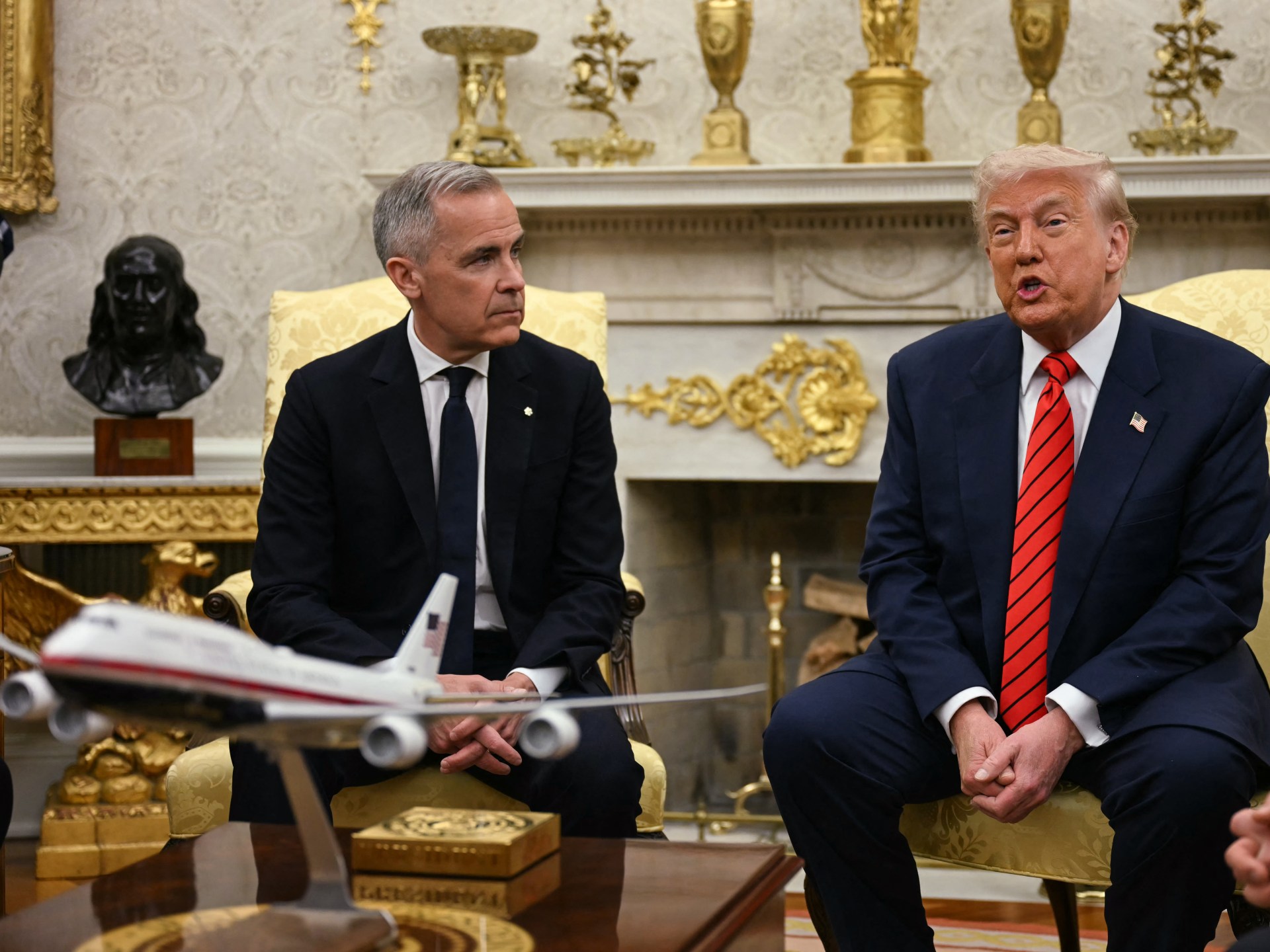
Holding the current presidency of the G7, Canada is hosting this year. While the agenda items will change in importance, depending on how things evolve in the Middle East, the latest crisis is already set to shift focus from what was expected to be a platform for host Canadian Prime Minister Mark Carney to showcase his leadership at home and to a global audience.

The G7 countries include Canada, France, Germany, Italy, Japan, the United Kingdom and the United States, as well as the European Union. In addition, the host country typically invites the heads of a handful of other countries, usually because they are deemed important to global and economic affairs. Canada has invited India, Saudi Arabia, Ukraine along with a few others.

Carney is likely to have been hoping to avoid a repeat of the last time US President Donald Trump attended – also in Canada – in 2018. That was when he refused to sign the final communique – which G7 countries usually issue in a show of unity at the end of the summit – and left early, calling then-Canadian Prime Minister Justin Trudeau “very dishonest and weak”.

As a result of that spectacle, Carney was planning not to press for a joint communique at all this year – instead he was gearing up to write his own “chair’s summary” and seek agreement on a set of specific issues. Presenting an image of unity against a backdrop of looming, aggressive US trade tariffs, is the main aim.

But Robert Rogowsky, professor of trade and economic diplomacy at the Middlebury Institute of International Studies, said there is no way G7 members can avoid the subject of the latest crisis in the Middle East, which was triggered by a massive Israeli assault on military and nuclear sites in Iran on early Friday morning – and has since prompted retaliatory strikes by Iran. The US said it was not involved in the Israeli strike on Iran, but Trump told reporters on Friday that it was informed of the attack in advance.

“That attack, counterattack, and the US declaration that it was not involved and its warning about staying away from American assets as targets is likely to be the first thing discussed, as it now creates the possibility of a real, all-out war in the Middle East. The major neighbouring parties will have to decide how to align themselves,” Rogowsky said.
A ‘crisis response’ group?

The G7 “was designed to be a crisis response group with the ability to act and adapt quickly to international challenges … so in some ways, it’s good they’re meeting this weekend as they’ll have the ability to respond quickly”, said Julia Kulik, director of strategic initiatives for the G7 Research Group, among others, at Trinity College at the University of Toronto.

Even before this latest flare-up, the G7 in its 51st year comes “at a hinge moment because of economic disruptions and but also because of geopolitical shifts,” said Vina Nadjibulla, vice president and head of research at the Asia Pacific Foundation of Canada. Nadjibulla was referring to the global tariffs unleashed earlier this year by Trump as well as a shifting foreign policy for the US under his leadership, with old alliances no longer cared for, as well as an “America First” message.

Against that backdrop, “Prime Minister Carney has been trying to meet the moment and be as purposeful as possible,” Nadjibulla added, pointing to the list of priorities Canada announced last week ahead of the summit.

That list focuses on strengthening global peace and security, including by countering foreign interference and transnational crime, as well as improving responses to wildfires; spurring economic growth by improving energy security, and bringing in public-private partnerships to spur investments.

The priorities announced, important domestically but also internationally, are a “testament” to Carney’s intentions, and “building the economy is front and centre”, said Nadjibulla.

Conversations on global peace would have focused on the Russia-Ukraine conflict and Israel’s war on Gaza but attention will now pivot to Iran, said Kulik, “and there will be tough questions from other leaders around the table to Donald Trump about what went wrong with the negotiations and about what he’s going to do to get Israel to de-escalate before things get worse”.

Trump is a ‘coin flip’

Experts were already on the lookout for flare-ups at the upcoming three-day event with the mercurial Trump in attendance.

“His reactions are very emotional and performative, so it could be any of those and that could decide the dynamics of the G7,” said Rogowsky. “If he comes in wanting to build some bridges, then it could be a success, but if he wants to make a point, and this is another world wrestling federation for him, then [it can go anywhere]. With Trump, it’s a coin flip.”

But despite the Iran-Israel face-off, the G7 will still be an opportunity for Carney to set the tone at a complex time of tariff wars and slowing domestic and global economies. He is also aware that Canada has to “up its political game” and find new ways of boosting its economy and security. That is particularly visible in the invitation to Indian Prime Minister Narendra Modi, as Canada has had diplomatic tensions with India over the 2023 killing of a Sikh leader on Canadian soil in the recent past.

This shows that Carney is aware that to make progress on his agenda items, he will “need to work with countries that you may have disagreements with, but you can’t let those issues dictate the big picture,” said Nadjibulla. “Carney is setting the stage for a consequential meeting.”

Rogowsky added: “Carney is a globalist and wants to allow Canada to become a force in unity, in a multilateral system. I see him as taking on a role as a bridge builder. Maybe he’s the one guy who can pull this off.”

At the same time, he said, “it will be interesting to see how the other leaders approach Trump. Will it be a case of kowtow to the ruler, or he’s the bully on the playground and we’re going to stand up to him.”

For Rogowsky, the “cayenne pepper” in the meeting is the expected presence of Ukrainian President Volodymyr Zelenskyy, who was berated by Trump and US Vice President JD Vance in the White House on live television for not being “grateful” enough for US assistance.

The three-day event follows initial meetings in May between finance ministers and central bank governors belonging to G7 countries in Banff.

Source link

International Atomic Energy Agency: Iran in breach of non-proliferation commitments

June 12 (UPI) — The U.N. nuclear energy watchdog ruled Thursday that Iran was in breach of its Nuclear Non-Proliferation Treaty obligations by failing to come clean about undeclared nuclear material and activities at multiple sites.

A meeting of the 35-member-nation board of the International Atomic Energy Agency in Vienna voted 19-3 in a favor of the resolution, the first against Iran in 20 years, amid heightened tension over its nculear program and fears an pre-emptive military strike by Israel could be imminent.

Russia, China and Burkina Faso voted against the U.S., British, French and German-sponsored resolution, 11 countries abstained and two did not take part at all.

The vote came after IAEA Director-General Rafael Grossi, in a briefing on the body’s quarterly report, told the board that Iran had not been cooperating and had sufficient 60% enriched uranium to build nine nuclear warheads.

He said the IAEA had been seeking answers from Tehran ever since inspectors found man-made uranium particles at three undeclared locations in 2019 and 2020, including via a series of high-level meetings and consultations that he said he had been personally involved in.

“We have been seeking explanations and clarifications from Iran for the presence of these uranium particles. Unfortunately, Iran has repeatedly either not answered or not provided technically credible answers to the agency’s questions. It has also sought to sanitize the locations, which has impeded agency verification activities,” Grossi said.

The decision prompted a strong reaction from Tehran, which issued a statement criticizing what it called a “political” move that placed the IAEA’s credibility and stature in doubt and that it would bring forward “a new [uranium] enrichment center in a secure location” and update first generation centrifuges at another site.

Prior to the vote it threatened to quit the 1970 NPT, which Tehran has signed but failed to ratify the part that authorizes international inspection teams access to remote regions of Iran where they have reason to believe illicit nuclear development projects may be underway.

On Wednesday, Foreign Minister Abbas Araghchi warned the so-called E3 [Britain, France and Germany] against punishing Iran for its own failures with regard to the 2015 Joint Comprehensive Plan of Action under which the United States, E3, Russia and China agreed to lift some sanctions in return for Iran reining in its nuclear program.

“The E3 have had seven years to implement their JCPOA commitments. They have utterly failed, either by design or ineptitude. Instead of displaying remorse or a desire to facilitate diplomacy, the E3 is today promoting confrontation through the absurd demand that Iran must be punished for exercising its right under the JCPOA to respond to non-performance by its counterparts,” he wrote on X.

“As I have warned: Another major strategic mistake by the E3 will compel Iran to react strongly. Blame will lie solely and fully with malign actors who shatter their own relevance.”

A joint statement issued by the Foreign Office in London said Britain, France, Germany, and United States welcomed the action by the IAEA.

“The board’s collective action upholds the integrity of the IAEA safeguards system and the broader nuclear nonproliferation regime: states will be held to account if they do not live up to their obligations.

“The action creates an opportunity Iran should seize. Iran still has a chance to finally fulfill its obligations, in full candor, and answer the IAEA’s crucial, longstanding questions on undeclared nuclear material and activities,” said the statement.

However, ongoing U.S.-Iran negotiations mediated by Oman that began in April were apparently unaffected with a sixth round between Araghchi and Steve Witkoff, U.S. President Donald Trump‘s special envoy, scheduled to go ahead Sunday as planned, according to Omani Foreign Minister Bad Albusaidi.

The negotiations, exactly five years after Trump pulled the United States out of the JCPOA during his first term, are aimed at replacement deal ensuring Iran does not and cannot develop a nuclear weapon in exchange for removing sanctions.

Iran has always denied working toward developing nuclear weapons, insisting its nuclear program is strictly for energy and other peaceful purposes.

Source link

As Trump’s tariffs loom, Southeast Asia’s solar industry faces devastation | Climate Crisis News

Bangkok, Thailand – A brief text message informed Chonlada Siangkong that she had lost her job at a solar cell factory in Rayong, eastern Thailand.

The factory operated by Standard Energy Co, a subsidiary of Singaporean solar cell giant GSTAR, shut its doors last month in anticipation of United States President Donald Trump’s tariffs on solar panel exports from Southeast Asia.

From Monday, US Customs and Border Protection will begin imposing tariffs ranging from 375 percent to more than 3,500 percent on imports from Thailand, Cambodia, Vietnam and Malaysia.

The punishing duties, introduced in response to alleged unfair trade practices by Chinese-owned factories in the region, have raised questions about the continuing viability of Southeast Asia’s solar export trade, the source of about 80 percent of solar products sold in the US.

Like thousands of other workers in Thailand and across the region, Chonlada, a 33-year-old mother of one, is suddenly facing a more precarious future amid the trade crackdown.

“We were all shocked. The next day, they told us not to come to work and would not pay for compensation,” Chonlada told Al Jazeera.

US officials say Chinese producers have used Southeast Asian countries to skirt tariffs on China and “dump” cheap solar panels in the US market, harming their businesses.

US trade officials have named Jinko Solar, Trina Solar, Taihua New Energy Hounen, Sunshine Electrical Energy, Runergy and Boviet – all of which have major operations in Thailand, Malaysia, Cambodia or Vietnam – as the worst offenders.

thailand
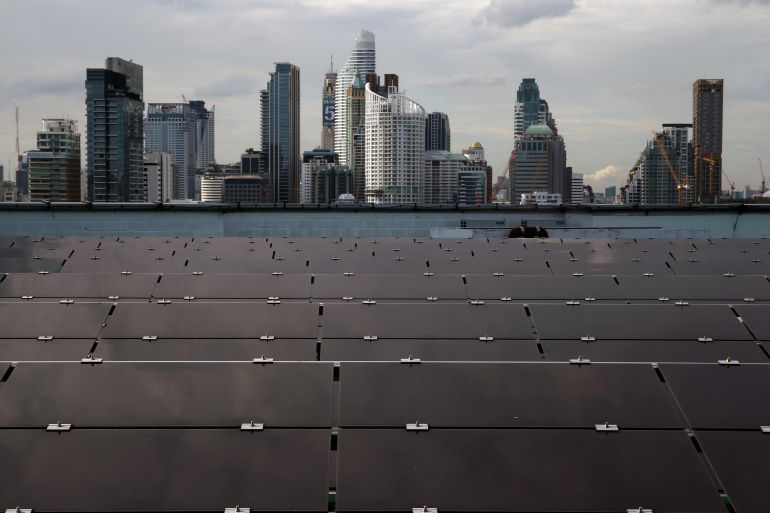
Solar panels are pictured on the roof of a building in Bangkok, Thailand, on August 9, 2017 [Athit Perawongmetha/Reuters]

Thai solar exports to the US were worth more than $3.7bn in 2023, just behind Vietnam at $3.9bn, according to the latest US trade data.

Standard Energy Co’s $300m facility in Rayong had been in operation for less than a year, producing its first solar cell to great fanfare in August.

“I’m baffled by what’s just happened,” Kanyawee, a production line manager at Standard Energy who asked to be referred to by his first name only, told Al Jazeera.

“New machines have just landed and we barely used them, they’re very costly too – a few million baht for each machine. They’ve also ordered tonnes of raw materials waiting to be produced.”

Ben McCarron, managing director of the risk consultancy Asia Research & Engagement, said Southeast Asian manufacturers are facing a serious hit from the US turn towards protectionism.

“There are suggestions that manufacturing might exit Southeast Asia entirely if tariffs are introduced either in a blanket way, or that specifically address Chinese-owned manufacturing capacity in the region,” McCarron told Al Jazeera.

“The implications are significant for these countries; Thailand, Vietnam, Cambodia, and Malaysia accounted for about 80 percent of the US’s solar imports in 2024,” McCarron said, adding that “some manufacturers have already begun shutting down and moving out of the region”.

Unfair advantage

US officials and businesses have accused China of giving its solar firms an unfair market advantage with subsidies.

China was the largest funder of clean energy in Southeast Asia between 2013 and 2023, pouring $2.7bn into projects in Indonesia, Malaysia, the Philippines, Thailand, and Vietnam, according to Zero Carbon Analytics.

The American Alliance for Solar Manufacturing Trade Committee, a coalition of seven industry players, was among the loudest voices to lobby for a sharp rise in levies on Chinese imports.

Without a reprieve from the notoriously unpredictable Trump, companies affected by the tariffs have little recourse apart from the ability to file an appeal once a year, or after five years, once a “sunset review” clause takes effect.

Some observers believe the sector may never recover.

“It’s not just the low-skilled labour that was affected by the trade war; many workers in the solar cell supply chain are technicians, skilled labourers,” Tara Buakamsri, an adviser to environmental organisation Greenpeace, told Al Jazeera.

“Even if you make a lot of savings, solar cell exporters would still need to cut down on these skilled workers.”

Others take a more bullish view, arguing that, once the dust has settled, Chinese solar firms will drive the supply of products needed to meet regional emissions targets.

While Thailand, Cambodia, Malaysia and Vietnam welcomed Chinese solar companies in part due to the large sums of up-front investment on offer, they are all also seeking to meet more of their energy needs with cleaner sources.

Before Trump entered office with his tariff agenda, Thailand had announced plans to become carbon neutral by 2050 and produce net-zero greenhouse gas emissions by 2065.

Thailand
Employees of a solar farm company take notes in Nakhon Ratchasima province, Thailand, on October 3, 2013 [Athit Perawongmetha/Reuters]

“A slowdown [or halt] in solar exports as a result of US tariffs may supercharge efforts in Southeast Asian markets by Chinese solar companies, which see the region as a critical and well-aligned destination for green technologies,” McCarron said.

“Leftover supply from slowing exports could be absorbed by domestic markets in Thailand, Malaysia, Cambodia, Vietnam, particularly if governments use the situation as a cost-effective opportunity to rapidly accelerate policy initiatives that stimulate domestic solar.”

For Southeast Asia’s solar companies, survival is also likely to depend on governments cutting red tape and loosening the control of oil and gas monopolies over the energy mix.

At the same time, the US’s exclusion of Southeast Asian solar imports could hamper the shift towards greener energy in the world’s top economy.

“Thailand’s solar cell production is heavily export-driven and the US has historically been a major export destination,” Pavida Pananond, a professor of international business at Thammasat Business School in Bangkok, told Al Jazeera.

But solar tariffs will “also hurt American consumers and the green transition in the US as prices become higher”.

Source link

Interior Department approves modifying federal coal mining project in Montana

June 6 (UPI) — The Department of the Interior on Friday announced approval of a mining plan modification for Bull Mountains coal mine in Montana, a move criticized by environmental organizations.

Signal Peak Energy LLC was authorized to mine roughly 22.8 million tons of federal coal and 34.5 million tons of adjacent non-federal coal in Roundup.

The mine, which in Musselshell and Yellowstone counties, exports coal to Japan and South Korea.

“By unlocking access to coal in America, we are not only fueling jobs here at home, but we are also standing shoulder-to-shoulder with our allies abroad,” Interior Secretary Doug Burgum said in a statement.

In 2023, a federal judge halted the mining of federal coal at the Bull Mountains Mine pending a thorough analysis of the mine’s impacts on ranchers, vital water sources, and the climate.

The Trump administration approved the expansion without a draft environmental impact statement or the opportunity for public comment on a draft.

The Interior Department said it is using “alternative arrangements” for compliance with the National Environmental Policy Act, the 1969 law requiring federal agencies to assess potential environmental effects of their decisions.

Earthjustice, a nonprofit environmental law organization, described it as one of the most notorious mining operations in the country.

In 2023, The New York Times reported on corruption and criminal history surrounding Signal Peak. It revealed embezzlement, a fake kidnapping, bribery, cocaine trafficking, firearms violations, past links to Russian President Vladimir Putin, and worker safety and environmental infringements.

“It’s utter hogwash that we have to sacrifice the climate, water resources, wildlife and area ranching operations in order to send coal overseas to be burned by foreign countries,” Anne Hedges, executive director of the Montana Environmental Information Center said in a news release. “Signal Peak has thumbed its nose at state and federal laws for decades.

“Now the Trump administration is rewarding these bad actors with a free pass without considering the harm to ranchers’ livelihoods, wildlife that depend on vanishing area water resources, or the devastation that will result from making the climate crisis even worse. There is no excuse for this type of lawlessness and there is certainly no national energy emergency being alleviated.”

Melissa Hornbein, senior attorney at the Western Environmental Law Center, said: “The Trump administration will have a very difficult time in federal court explaining how expediting approval for expanding operations at a coal mine that exports 98% of its product falls under an extremely specific domestic energy emergency declaration. The energy emergency declaration, preposterous on its face, only ever served as an abuse of the federal government to enrich fossil fuel barons. Using it to expand the Bull Mountains coal mine makes that explicit.”

The Trump administration policy of increasing fossil fuel production stands in stark contrast to Biden administration policies.

In October 2024, the Biden administration announced $428 million in funding for 14 federal energy projects in small towns historically known for coal production.

The Trump administration is in the process of attempting to undo that clean energy approach while doubling down on coal, oil and gas production.

For the Bull Mountains coal mine, the Interior Department said Friday it is using emergency permitting procedures to disregard normal environmental review.

The Interior Department said in an April statement that the procedures reduce what would normally be “a multi-year review process down to just 28 days at most.”

The department asserts that the procedures using the radically shortened review process still upholds environmental standards.

“The Bull Mountains project is proof that we can meet urgent energy needs, work with local communities and uphold strong environmental standards,” Acting Assistant Secretary for Land and Minerals Management Adam Suess in a statement.

According to the Interior Department, “These alternative arrangements apply both to actions not likely to have significant environmental impacts and to actions likely to have significant environmental impacts.”

The Trump administration is using a so-called national energy emergency declared by President Donald Trump on Jan. 20 to avoid fully complying with full environmental regulations agencies would normally have to follow.

Under the alternative arrangements, companies would notify the department they want those alternative arrangements.

The official responsible for reviewing the application would then “prepare a focused, concise, and timely environmental impact statement addressing the purpose and need for the proposed action, alternatives, and a brief description of environmental effects.”

According to the Interior Department, the Bull Mountains project is expected to generate “over $1 billion in combined local, state and county economic benefits, including wages, taxes and business activity.”

Signal Peak Energy, which is the only underground mining operation in Montana, said on its website it is “committed to reimagining the industry through top-quality safety procedures and cutting-edge production methods. Our mission is to create an environment where our employees can thrive — complete with a comprehensive benefits package and an industry-leading safety record.

Source link

Constellation, Meta agree on 20-year nuclear energy deal

June 3 (UPI) — Constellation Energy Corporation announced Tuesday it has made a deal to provide the Meta technology company with clean energy for a couple of decades.

Constellation said it signed a 20-year power purchase agreement with Meta for the output of the Clinton Clean Energy Center, located in Clinton, Ill., to help Meta meet its clean energy goals and operations in central and southern Illinois with more than 1,100 megawatts of emissions-free nuclear energy.

“We are excited to partner with Constellation and the Clinton community to ensure the long-term operations of the nuclear plant, add new capacity, and help preserve over 1,000 jobs,” Meta’s Head of Global Energy Urvi Parekh said.

The agreement will launch in June of 2027, and supports the relicensing and continued operations of Constellation’s high-performing nuclear facility in Clinton once the state’s ratepayer-funded zero-emission credit program has expired. The deal will allow the facility to expand its energy output by 30 megawatts and preserve 1,100 local jobs. The pact is also expected to bring in $13.5 million in annual tax revenue, and to provide $1 million to area nonprofits over a period of five years.

Constellation CEO and president Joe Dominguez said the company was proud to partner with Meta as it “figured out that supporting the relicensing and expansion of existing plants is just as impactful as finding new sources of energy.”

“Sometimes the most important part of our journey forward is to stop taking steps backwards,” Dominguez said.

The Clinton Clean Energy Center, which employs more than 530 people, contributes around $13.5 million in annual taxes and generates enough electricity to power over 800,000 homes, was scheduled to close in 2017 due to several years of financial losses. However, it was saved by the Future Energy Jobs Act, which created a Zero Emission Credit program that provided the plant enough financial support to support it into 2027.

The deal with Meta will replace that program and keep the plant operational without ratepayer support.

Meta’s deal with the plant also fits its pledge signed in March to join other major corporate energy users to support the tripling of nuclear energy capacity by 2050.

Both companies have apparently already benefited financially following the agreement, as Constellation shares were up 2.38% by 7:45 a.m. in pre-market trading, while Meta jumped 3.62%.

Source link

Moscow Wants Moldova. Europe Must Stop It

A major crisis is unfolding in Moldova, where Russia is using energy as a political weapon to influence the outcome of the autumn parliamentary elections. The first salvo came on Jan. 1, as Moscow halted the gas deliveries that had long provided low-cost electricity. Although Russia has since resumed gas flows to the pro-Russian separatist region of Transnistria, the rest of Moldova has been left to grapple with soaring prices, growing public discontent, and rising pressure ahead of a crucial vote. The goal, quite clearly, is to derail the country’s European path and tip it back into Moscow’s orbit.

As is typical in the course of its geopolitical skullduggeries, Vladimir Putin’s regime has deployed disinformation, distractions, and complicated moves aimed at contriving a version of plausible deniability.

A dangerous dependency on Russia

Historically, Moldova has depended on Russian gas via a complex mechanism involving the separatist region, where a large power plant generated electricity for the rest of the country. But on Jan. 1, 2025, both Moldova proper and the separatist enclave were plunged into an energy crisis after Russian gas supplies were halted following the expiration of a transit agreement with Ukraine.

It was actually Kyiv, engaged in full-scale war with Russia, that declined to renew the longstanding deal that allowed Russian gas to flow westward through its territory—but the move was telegraphed for many months, and alternatives existed.

Mainly, Russia could have easily rerouted gas to Transnistria via the TurkStream and Trans-Balkan pipelines, which run through Turkey, Bulgaria, and Romania. But it declined to do so, even as households and businesses in Moldova faced skyrocketing prices, and Transnistria itself remained without gas. Russia justified this by accusing Moldova of owing $709 million in unpaid gas bills — a claim that has been thoroughly debunked: An independent international audit commissioned in 2023 found the true amount owed by the Moldovan government to Gazprom was just $8.6 million.

In early February, the European Union stepped in to avert a humanitarian emergency. It provided €20 million in emergency aid to subsidize gas deliveries to Transnistria for 10 days — from February 1 to February 10 — enabling the region to restart electricity production for Moldova proper. This was from arranged external deliveries, supported through EU subsidies.

The EU then offered to extend this arrangement through mid-April with a larger €60 million package. But Transnistrian authorities rejected the offer, reportedly objecting to conditions that would have required greater transparency and price alignment with EU standards. Some analysts believe the refusal reflected a desire to maintain dependency on Moscow rather than risk deeper integration with the West. Others simply have concluded Moscow was calling the shots.

Indeed, by mid-February, Russia resumed gas supplies to Transnistria. Deliveries came through the expected detour involving the Black Sea, Turkey, and the Balkans. But it is no longer reaching Moldova—ostensibly by a decision of the separatists.

Moldova’s pro-European government, led by President Maia Sandu, is convinced these maneuvers amount to a deliberate attempt to punish its Western, pro-EU tilt and sway the upcoming September parliamentary elections toward pro-Russian opposition parties. In response, Moldova accelerated diversification efforts, sourcing electricity and natural gas from Romania and other EU partners—at far higher prices than before.

Russia is, of course, under no obligation to provide anyone with gas. But the timing of its move is no coincidence, and the impact has been staggering: In Moldova proper, gas prices are up 24%, electricity 75%, and heating bills 40%. Because of downstream effects, overall inflation is expected to exceed 30%, creating severe economic distress just months before the vote.

The energy crisis triggered a sharp spike in inflation in Moldova. In January 2025, the annual inflation rate jumped to 9.1% compared to a year earlier, up from 7.0% in December 2024, marking the steepest increase in recent months. This surge was largely driven by significant hikes in tariffs for heating, gas, and electricity, as well as rising prices for food and medicine.

The result is a textbook case of Russia’s energy leverage at work: create pain for adversaries, reward loyal proxies, and manipulate regional infrastructure to achieve geopolitical goals. In this instance, to erode trust in Moldova’s leadership and swing the election. If the pro-Russian opposition were to win the election, the result will be a global shock because in the middle of the Ukraine war, a small but strategically consequential European country will have fallen, seemingly voluntarily, back into the Kremlin orbit.

The episode underlines the need for a longer-term strategy: one that shores up Moldova, counters Russia’s manipulation, and keeps this EU-candidate country on track.

Why Moldova Matters

If Moldova is pulled back into Russia’s orbit, the consequences will ripple far beyond its borders. It would deal a serious blow to Ukraine, whose EU accession is closely tied to Moldova’s. A pro-Kremlin government in Chișinău could legitimize and make permanent the Russian military presence in Transnistria, which has been in place for decades, even though Moldova’s government has considered this illegal.

A move in this direction would further destabilize NATO’s eastern flank and threaten Romania, Poland, and the entire Black Sea region. Worse still, inviting Russian troops into Moldova proper itself would undermine Moldovan sovereignty and European security.

Success in Moldova would also validate this model of energy blackmail and electoral interference. If left unchecked, similar tactics could be deployed in the Baltic states, the Balkans, and other vulnerable regions, many of which still rely on Russian energy or face internal political divisions that Moscow can exploit. The message would be clear: Russia can strangle a country’s economy, manipulate public opinion, and tilt an election—all at virtually no cost.

What Europe Must Do

Europe’s effort to assist in February suggests that there is an understanding of the stakes. But to safeguard Moldova’s democratic path and broader European security, the EU must do far more — not only to confront the energy blackmail but also to mitigate its political and social consequences.

·       Provide Massive Economic Aid to Offset Inflation: Moldova cannot afford Western market prices for energy. Inflation has already hit ordinary citizens hard, creating fertile ground for political discontent. A robust EU aid package must go beyond energy subsidies to include targeted social assistance, price caps, and support for small businesses. This is not just an act of solidarity—it’s a strategic imperative to prevent anti-European forces from exploiting popular frustration.

·       Counter Russian Disinformation at Scale: Moscow’s propaganda machine is working overtime to pin the energy crisis on Moldova’s leadership. Europe must respond with a coordinated campaign to expose Russian tactics, debunk misinformation, and promote media literacy. One promising step is the EU’s decision to open an Eastern Partnership office in Moldova—the first of its kind in the region—with disinformation as a top priority. But far more investment in narrative warfare is needed.

·       Fast-Track Moldova’s EU Membership: Most importantly, it’s time to stop viewing Moldova through a narrow bureaucratic lens. The country faces governance challenges, yes—but so did many prior EU entrants. Moldova’s small size (2.5 million people) makes integration manageable, while its geopolitical importance is undeniable. A fast-tracked accession process, similar to the one Ukraine has received, would send a powerful message: that Europe stands with its partners in their hour of need. And it would focus the minds of voters, counteracting the interference from Moscow.

Russia’s playbook is clear: create hardship, fuel resentment, and leverage democratic elections to install loyalist regimes that will cement authoritarianism and attempt to make permanent their hold on power. If it succeeds in Moldova, the European dream will be blocked from that country for a generation. Ukraine will be further isolated, and the Kremlin will chalk up another geopolitical win without firing a shot.

This is not just Moldova’s problem. It is Europe’s. It can be averted — but time is running out.

Source link

Amid energy deal, United States reopens Syrian ambassador’s residence

Chairman of the Inaugural Committee and real estate investor Thomas J. Barrack Jr. stops to talk to members of the media in the lobby of the Trump Tower in New York, N.Y., in 2017. Barrack was appointed a special envoy to Syria Thursday. File Pool Photo by Anthony Behar/UPI | License Photo

May 29 (UPI) — The United States ambassador’s residence in Damascus, Syria, re-opened Thursday after being closed for 13 years, presaging a warming of relations between the two countries.

Tom Barrack, the current U.S. ambassador to Turkey, has also been appointed special envoy to Syria, and raised a U.S. flag outside the residence to inaugurate it, according to the Syrian run news agency SANA.

“Tom understands there is great potential in working with Syria to stop Radicalism, improve Relations, and secure Peace in the Middle East,” a statement from the State Department on X said. “Together, we will make America and the world, SAFE AGAIN!”

Barrack met with Syrian President Ahmed al-Sharaa to witness the signing of an agreement with Middle Eastern countries aimed at developing a $7 billion, 5,000 megawatt energy project that would revitalize Syria’s aging and worn electricity grid and use it as the backbone of the new power project.

The new energy project could supply Syria with 50% of its electricity needs, according to a statement from Qatari-based UCC Holding, which is among the partners in the project.

In a further sign of warming relations between the United States and the Middle East, President Donald Trump met earlier this month with al-Sharaa in Riyadh, a move that prompted the United States to begin walking back sanctions imposed on Syria during the repressive regime of Bahsar al-Assad.

During the reopening of the ambassador’s residence Thursday, Barrack called lifting the sanctions a “bold move,” and said it comes with “no conditions, no requirements.”

Barrack credited Trump for “your bold vision, empowering a historically rich region, long oppressed, to reclaim its destiny through self-determination.”

Source link