Confusion over protected status leaves employers and Salvadoran immigrants scrambling
Thousands of Salvadoran immigrants nationwide faced uncertainty after the federal government failed to decide by a Wednesday deadline whether to extend or terminate their longtime temporary protections against deportation.
Those protections, known as Temporary Protected Status or TPS, allow immigrants to obtain work permits and by Thursday some Salvadorans had already been fired from their jobs. Others who had been let go were reinstated after the Trump administration clarified that an announcement on TPS for Salvadorans would come “at the appropriate time” and that they would retain work authorization in the meantime.
Employers also expressed uncertainty about whether the statement was enough to legally keep Salvadoran employees on their payroll. Those who lost their jobs worked across the U.S. in construction, at hotels and as janitors.
Some took the announcement that work authorizations remained in place — made late Wednesday by U.S. Citizenship and Immigration Services — as a cause for hope, while others saw it as prolonged mental torture. There are 170,000 Salvadoran TPS holders, including 36,000 living in California.
Asked for further guidance on Thursday, Homeland Security sent a link to the USCIS website.
Advocates with the National TPS Alliance distributed a letter including the administration’s announcement for TPS holders to share with their employers and stating that “any decision to terminate could not take effect for a minimum of 60 days.” The letter seemed to help, as advocates reported that some fired employees had been able to return to work.
Not everyone was reinstated. Jose Ramirez reported to his construction job in Santa Monica for the last time on Wednesday.
The 63-year-old had been legally working in the U.S. since 2001, when TPS was first extended to Salvadoran immigrants.

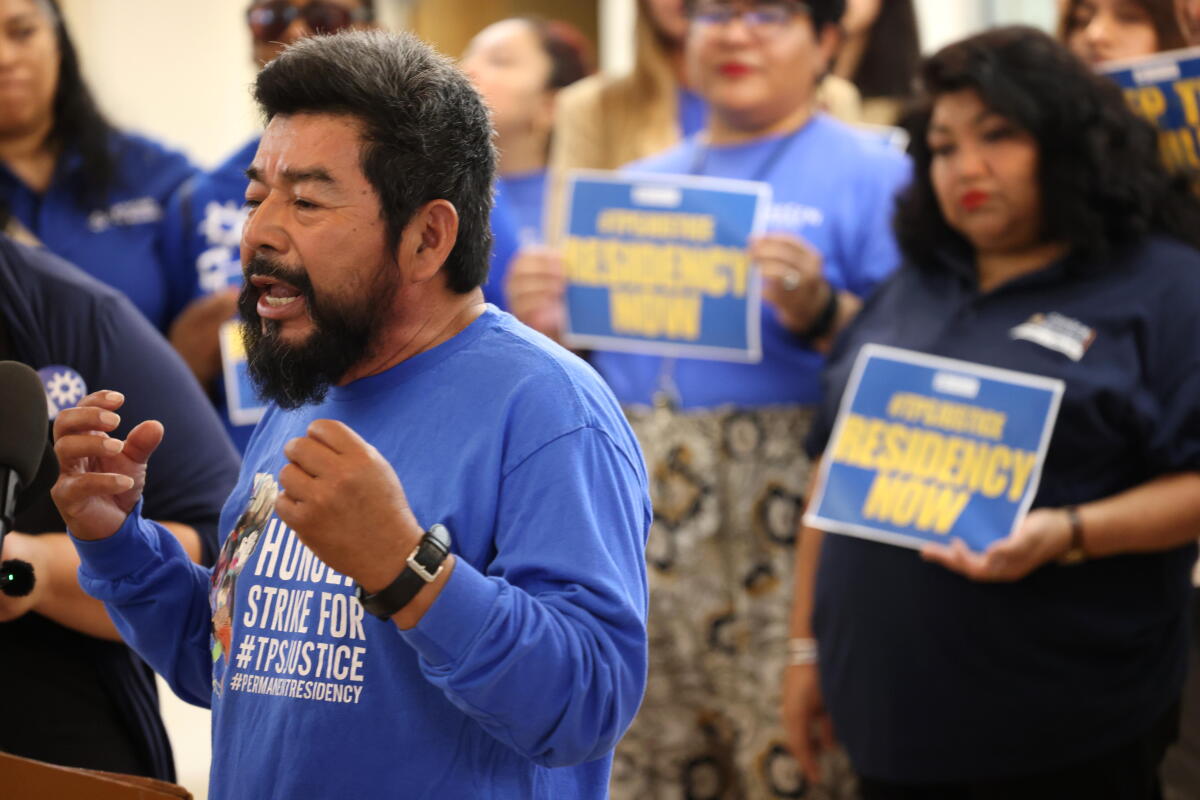
Jose Ramirez, a TPS holder from El Salvador, speaks during a news conference in Los Angeles on Thursday.
(Genaro Molina/Los Angeles Times)
He had been in the country for six years before that, and constantly struggled to find stable work. The work permit was a lifeline. He’d dedicated the last 25 years to construction, during which he fathered three daughters and set roots in Compton.
Still, his boss said Ramirez could no longer present for work Thursday.
“I’ve worked on buildings that reach the skies of Los Angeles,” Ramirez said. “I’ve contributed economically and lent my labor to this great country.”
Ramirez’s boss said his job would be available to him, but he’d need to show proof of an active work permit. A notice or a letter is not enough, Ramirez said.
The USCIS announcement was “a ray of hope that they will give us an extension,” Ramirez said. “But, it’s just not certain. Anything can happen. We’re just praying to God that the government will make it official.”

Signs at a news conference to provide an update on the status of TPS designation for Salvadoran immigrants.
(Genaro Molina/Los Angeles Times)
Ending TPS would be a shock to El Salvador’s economy, where remittances from Salvadorans in the U.S. make up nearly a quarter of the nation’s GDP — nearly $10 billion last year. In 2019, President Nayib Bukele, an ally of President Trump, publicly called on the U.S. to extend TPS for Salvadoran immigrants.
More recently, Bukele has embraced Trump’s deportation agenda, including by accepting controversial deals to house foreign detainees in the country’s mega-prison. The number of people deported to El Salvador nearly doubled in the first three months of 2026.
The decision by the Department of Homeland Security to extend or terminate TPS typically has been made at least 60 days before the designation was set to expire. DHS can extend the program for a six, 12 or 18-month period or decide to cancel the designation.
But the Trump administration has delayed announcements, including some made days after the designation expired. A Supreme Court ruling in June determined that the Homeland Security secretary has final authority over the program and cut down the ability for advocates to sue.
Lauren Truslow, CEO of 3D Enviro, a Virginia company that does identification and abatement of hazardous materials, said the lack of a decision on TPS has been stressful and costly. Three of her 30 employees are TPS holders from El Salvador. Another, who is married to a Salvadoran TPS holder, told her his family plans to leave the country if the program is canceled.
3D Enviro is a federal contractor, and Truslow said that her employees’ driver’s licenses and federal badges expired on Wednesday.
“How do they continue to work for me?” she said. “No one seems to know the answer to that. They can’t get into federal facilities without valid ID. Them showing a memo from USCIS is not going to cut it.”
During a news conference organized on Thursday by the Central American Resource Center of Los Angeles, other immigrant rights groups and local elected officials, speakers urged TPS holders to form a plan for their families and schedule a legal consultation with a trusted lawyer. They also called on the administration to issue a decision on TPS for El Salvador and a pathway to permanent legal status.
“Salvadoran families deserve clear, timely and trustworthy information from the government,” said Martha Arévalo, CARECEN’s executive director. “As we gather this morning, we don’t have an extension for TPS. … What we have is another waiting game and a renewed limbo for families.”
“We are going to fight this,” vowed Los Angeles Mayor Karen Bass.
In a statement, Sen. Alex Padilla (D-Calif.) called the USCIS announcement “clear as mud.”
“Once again, the Trump Administration is punishing immigrants who have followed the rules with chaos, uncertainty, and cruelty,” he wrote.
Also in attendance at the news conference was Carmen Sanchez, 49, who works the night janitorial shift cleaning offices in Los Angeles. She said many of her co-workers who were also protected under TPS were told not to return to work after Wednesday.
Sanchez planned to report to work Thursday evening, but was sure she’d suffer the same fate. She said she has three adult children in El Salvador and is helping two of them pay for college.
“If we lose our work permit, we lose our job. We lose our stability. We lose everything,” Sanchez said. “We’re being kept on this thread of extensions, and we don’t know when that thread is going to break.”