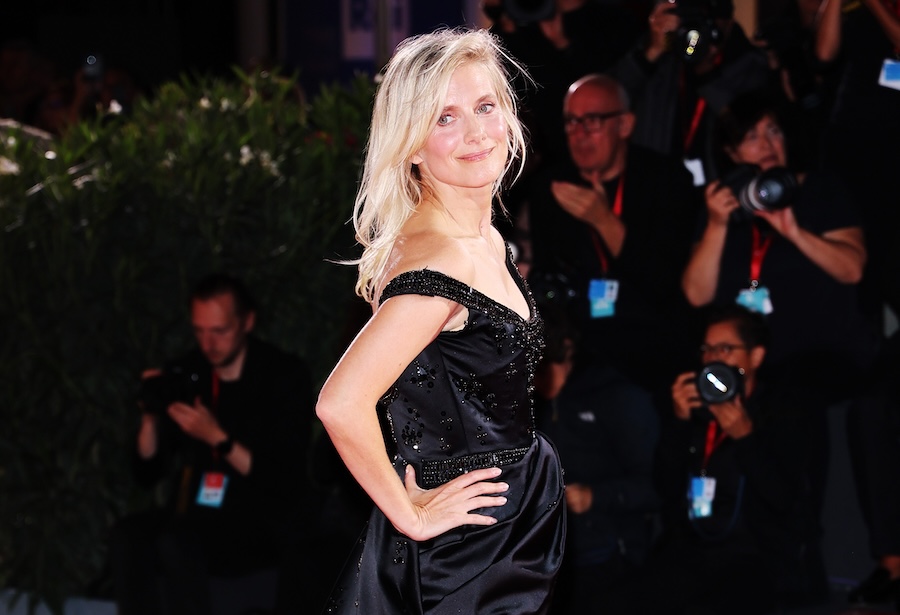
Arab News | Melanie Laurent stuns Venice in Elie Saab

DUBAI: French actress Melanie Laurent made a dramatic red-carpet statement in an Elie Saab Haute Couture Fall/Winter 2025–26 gown at the Venice Film Festival.
The sculptural black creation from the Lebanese couturier hugged her silhouette before cascading into a floor-skimming skirt, while intricate silver embellishments illuminated the bodice and skirt with a liquid-metal effect.
Meanwhile, the Venice Film Festival awarded its top prize on Saturday to a drama directed by Danish-Egyptian filmmaker May El-Toukhy about a woman trying to hide a wartime relationship with a Nazi — the only feature film with a female director in the competition.
“Woman Unknown” was a major talking point at the festival because of its subject matter, which has rarely been explored in film, and because El-Toukhy was one of only two female directors in the event.
Only one other woman — Israel’s Rachel Szor, co-director of the chilling documentary “NAZA” about Israel’s war on Gaza — was behind the 21 films vying for prizes at the star-studded closing ceremony in Venice.
“‘Woman Unknown’ is about the female body as a battleground and a public matter. And at the same time, the film tells the tale of women who are invisible, unseen and voiceless,” El-Toukhy, who grew up in Denmark with a Danish mother and Egyptian father, told the ceremony.
The head of this year’s jury, American actor-director Maggie Gyllenhaal, had questioned the dearth of women-directed films on the opening day, but she declined to discuss the issue further at a final press conference.
“I think I’m tired of talking about this same subject over and over,” she said. “I just want to celebrate a brilliantly made movie that I felt was like a laser beam.”
The second-place Silver Lion went to “Possible Love,” a poignant relationship study by South Korean auteur Lee Chang-dong that was one of the most highly praised movies of the festival.
The best director prize went to Russian-born Ilya Khrzhanovsky for his vast, riotous and experimental cinema project “DAU,” which chronicles the life of the troubled father of the Soviet nuclear program, Lev Landau.