United States Vice President JD Vance is travelling to Budapest to bolster support for Hungarian Prime Minister Viktor Orban, whose Fidesz Party faces its most difficult election in over a decade.
The White House announced last week that Vance would arrive in Hungary on Tuesday and hold two days of bilateral meetings.
Recommended Stories
list of 3 itemsend of list
In February, US President Donald Trump endorsed right-wing leader Orban ahead of Hungary’s April 12 parliamentary elections, while US Secretary of State Marco Rubio visited the country that month to show support.
Kim Lane Scheppele, a professor of sociology at Princeton University in the US who has spent years as an analyst and critic of Orban’s government, says that the trip is meant to underscore the close relationship between Trump and his Hungarian counterpart.
“Orban will make a big deal out of the fact that he’s got Trump’s support. And that’s why Vance is coming,” she said, adding that she is sceptical that Vance’s trip will have a large impact on the outcome of the election.
“If you look at the polls in Hungary, they show the opposition with an 8 to 12 percent lead, in some recent polls up to a 20 percent lead. One visit by a relatively low-profile American vice president is not going to change that.”
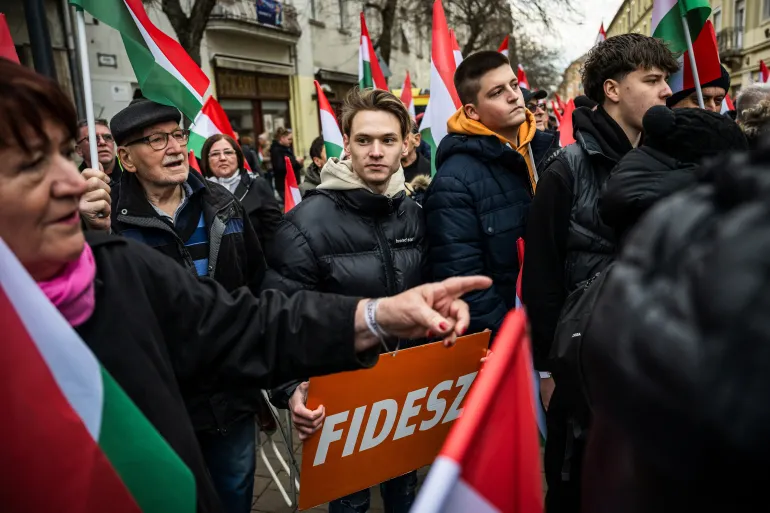
Fidesz party voter Gergo Farkas takes part in Prime Minister Viktor Orban’s election campaign rally with his friends in Szombathely, Hungary, April 2, 2026 [Marton Monus/Reuters]
Robust opposition
Orban’s 16-year tenure has been marked by the erosion of the independence of institutions such as the judiciary and the media, as well as reforms that critics say have slanted the electoral system in favour of Orban and his Fidesz party.
But despite what the opposition has described as a deeply imbalanced electoral environment, most polls show the 62-year-old Orban trailing the 45-year-old opposition leader, Peter Magyar, and his Tisza Party.
Magyar is a former high-ranking Fidesz official who broke with the party two years ago and has emerged as a popular voice railing against Orban’s rule.
His campaign has focused on corruption, deteriorating social services, economic conditions, and Orban’s combative relationship with the European Union, which has often centred on immigration and support for Ukraine.
The European Union suspended billions of euros in funding for Hungary in 2022 over what it characterised as democratic backsliding and declining judicial independence.
Magyar has pledged a more cordial relationship with the European bloc, as well as reforms that could lead to the restoration of suspended funds.
While Orban has depicted the opposition as a destabilising force that will sell out the country’s national interests on behalf of Ukraine and the EU, Magyar’s right-leaning politics mean that policies on issues such as immigration would see little change.
“Magyar is centre-right; he’s basically a believer in much of what Orban has done, minus the corruption. In EU terms, he’s slightly eurosceptical but wants to get the money back,” said Scheppele.
Peter Magyar, Hungarian opposition leader of the ‘Tisza’ (Respect and Freedom) Party, delivers a speech at a demonstration during commemorations of the 178th anniversary of the 1948-49 Hungarian Revolution on March 15, 2026 in Budapest, Hungary [Janos Kummer/Getty Images]
Blueprint for the US right
While Orban’s approach to consolidating power and his embrace of far-right politics have mired his relationships in Europe, they have made him a source of inspiration for the US far right and prominent members of the Trump administration, such as JD Vance.
Hungary has previously hosted the Conservative Political Action Conference (CPAC), an annual summit where individuals and groups from across the US right and allies from other countries gather to discuss the future of the conservative movement.
When CPAC convened in Budapest in 2024, Trump sent a video praising Orban for “proudly fighting on the front lines of the battle to rescue Western civilisation”.
Shared ire for Muslims, immigrants, and centres of liberal politics such as universities has helped cement that bond, and Vance himself has enjoyed especially close relations with Orban’s government.
When he was selected as Trump’s running mate in July 2024, Orban’s political director shared a photo of himself posing with Vance, captioned: “A Trump-Vance administration sounds just right.”
Orban’s Hungary has been at the centre of the Trump administration’s shifting policy towards Europe, firmly aligning itself with far-right parties and immigration restrictionists in countries such as France and Germany.
Scheppele says that Orban’s relationship with the Trump administration and status as an icon of the global far right may be of limited use in an election that is mostly focused on domestic issues.
But she noted that more tangible steps, such as a pledge of US financial support from the Trump administration if Orban wins, could buoy his chances in the closing days of the race.
“The big thing to watch is that, when Orban came to the US recently, Trump appeared to promise a fiscal safety net if Orban wins,” said Scheppele, adding that the US took similar steps before the 2025 midterm elections in Argentina in order to bolster right-wing ally Javier Milei, now the country’s president.
“Trump hasn’t made that kind of formal promise, and he’s now denied that he made any specific promise. But the Orban people think that Trump is going to backstop them if they win the election,” Scheppele added. “If Vance makes that kind of announcement, it could be a real game-changer.”
Assam, India – Amoiya Medhi says attending an election rally organised by the right-wing Bharatiya Janata Party (BJP) in her hometown in India’s northeastern state of Assam is a matter of both religious compulsion and personal gratitude.
On March 29, Medhi was among thousands of men and women who thronged the rally held on the outskirts of Jagiroad, an industrial town in central Assam’s Morigaon district, ahead of the state assembly election scheduled on Thursday.
Recommended Stories
list of 4 itemsend of list
Nitin Nabin, the BJP’s national president and chief guest at the event, trumpeted the welfare schemes launched by Chief Minister Himanta Biswa Sarma’s government – schemes that Nabin claimed benefitted the Assamese people, especially women.
Medhi, 38, nodded in agreement as she listened attentively to the speeches. “This government has done so much for everyone, including women,” she told Al Jazeera. “I am going to only vote for the BJP.”
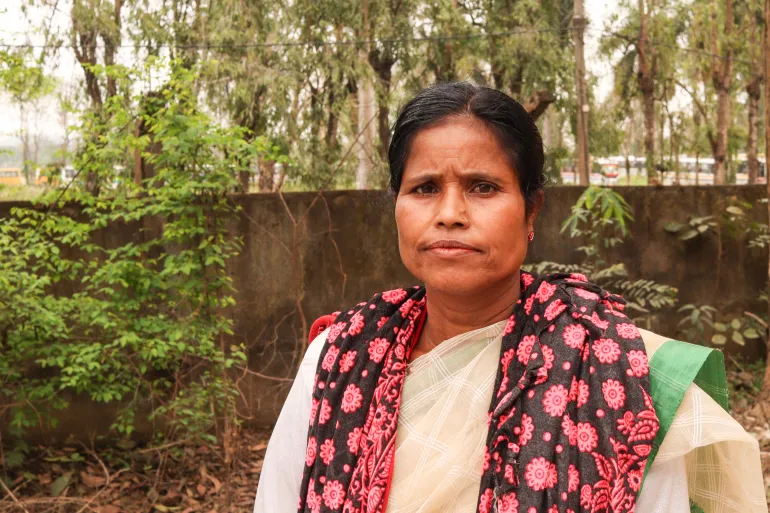
Amoiya Medhi wants the BJP to return to power for a third straight term [Arshad Ahmed/Al Jazeera]
Like Medhi, dozens of women attending the rally said they were the beneficiaries of multiple government schemes, including Orunodoi, a direct benefit transfer scheme that saw nearly four million women receive 9,000 rupees each on March 10 – the largest such disbursement in the state’s history, which included a three-month bonus to mark the Bihu festival held in April.
The disbursement came barely a month before Thursday’s vote in which Sarma, 57, is seeking a third consecutive term for his party.
Since becoming the chief minister in 2021, Sarma has been accused of pursuing a hardline Hindu supremacist agenda (popularly known as “Hindutva”) coupled with a xenophobic campaign targeting Muslims. They constitute 34 percent of Assam’s 31 million population, according to the last census conducted in 2011. That’s the highest among Indian states, with only the federally-governed territories of Indian-administered Kashmir and Lakshadweep higher.
An overwhelming nine million of Assam’s 10.3 million Muslims speak Bengali and not Assamese. They historically migrated to Assam in waves – a majority of them moving during British rule, when Bengali-speaking Hindu and Muslim communities moved from East Bengal (now Bangladesh) to work in Assam’s tea estates and rice fields.
‘Protecting our Hindu identity’
For decades, the BJP and other Hindu groups have labelled the Bengali-speaking Muslims as “foreigners”, accusing them of being undocumented immigrants from Bangladesh. Assam founded special tribunals to try these Muslims, sending hundreds to detention centres built across the state.
Thousands of “miya”, as Bengali-speaking Muslims in Assam are pejoratively called, have also been declared “doubtful” voters. The “miya” issue has shaped the BJP’s politics in Assam. Leading the charge against them, Sarma himself publicly admitted that he had instructed BJP workers to file an objection with the Election Commission of India to remove half a million Bengali-speaking Muslims from electoral rolls.
In 2024, Sarma told the state assembly that his government “will take sides” and “will not let miya Muslims take over all of Assam”. Two months ago, a 17-second artificial intelligence-generated video, produced and shared by the BJP on X, showed Sarma holding a rifle and shooting at pictures of two Muslim men, with the caption saying: “No Mercy”. The clip, titled ‘Point Blank Shot’, was deleted after outrage.
Champa Hira, another woman attending the Morigaon rally, said while the BJP’s financial aid and other welfare schemes have been a major draw, her support for the party goes beyond financial benefits.
“For us, it is also about protecting our Hindu identity,” she told Al Jazeera.
“Our Hindu religion is born out of the lotus,” Hira said, referring to the BJP’s election symbol. “We will let the lotus bloom once again for such schemes and also for our Hindu identities.”
In the run-up to the polls, the BJP’s political messaging on roadside billboards, wall graffiti and posters had the party showcase its anti-Muslim policies pursued in the past decade.
The party boasts about clearing around 20,000 hectares of government land – an area more than three-and-a-half-times the size of Manhattan – from the “osinaki manuh” (“strange people” – a veiled reference to Bengali-speaking Muslims). The eviction drives, which intensified after Sarma became the chief minister in 2021, are a part of the BJP’s “war” on Bengali-speaking Muslims to “reclaim every inch of land” allegedly encroached by them. Without providing evidence, Sarma has repeatedly accused the Bengali-speaking Muslims of a conspiracy to change Assam’s demography and reduce Hindus to a minority. The government’s crackdown also saw dozens of Muslims “pushed back” to Bangladesh – their alleged homeland – or their properties bulldozed.
Alongside such hardline policies targeting Muslims, the BJP also touted the launching of various welfare schemes for women and youth. And has promised an increase in financial aid from $13 to over $32 in the Orunodoi cash transfer scheme. In the Udyamita scheme, an entrepreneurial fund reserved for rural women to bootstrap their businesses, the increase is from $107 to $269.
A BJP election rally in central Assam’s Morigaon district [Arshad Ahmed/Al Jazeera]
Akhil Ranjan Dutta, who teaches political science at Assam’s Gauhati University, says the Hindu nationalist party is using a strategy that mixes “heightened polarisation and a developmental pitch” to woo the Assamese voters.
“To me, it is a cocktail of Hindutva and welfarism,” Dutta told Al Jazeera. “The BJP is experimenting with a brand of Hindutva by co-opting Indigenous armed struggle and cultural nationalism, while solidifying Hindu identity and othering the Bengali Muslims.”
The Bengali-speaking Muslims say the BJP’s election promises have heightened their anxiety. In its manifesto, the party has promised more crackdowns on the community, including a proposal to implement a Uniform Civil Code, which, according to critics, will override Muslim personal laws on marriage, divorce and inheritance.
The Uniform Civil Code, a longstanding demand from Hindu groups, is already in place in two BJP-ruled states, including Prime Minister Narendra Modi’s home state of Gujarat. The BJP has also promised a pushback against “Love Jihad”, an unproven conspiracy theory floated by right-wing Hindu groups, under which Muslim men allegedly lure Hindu women into marriage and convert them to Islam.
A former Assamese parliamentarian from the main opposition Congress party, who requested anonymity fearing reprisal from the government, agreed with political scientist Dutta. “The BJP has managed to turn Hindus against Muslims and enjoy support,” he added.
BJP spokesman in Assam, Kishore Upadhyay, rejected the allegation, claiming the government’s eviction drives were not targeted at any community.
“It is directed only against illegal encroachment, irrespective of religion or identity. Unfortunately, successive Congress governments in the past allowed or even facilitated such illegal settlements, creating today’s challenges,” he told Al Jazeera.
“It is also important to highlight that this is about restoring land rights of indigenous and tribal communities, protecting forest areas and ensuring proper land governance.”
Will welfare schemes help BJP?
Opposition parties and analysts say the BJP is mainly milking two cash transfer schemes – Orunodoi and Udyamita – to influence voters in this election.
In December 2025 and January this year, the government distributed cheques of $107 each under the Udyamita scheme. Additionally, it withheld a monthly honorarium of $13 for poor women under the Orunodoi scheme for three months, but handed it out last month in the run-up to the election.
Isfaqur Rahman of the Communist Party of India (Marxist) said the Sarma government’s disbursement of cash only days before the polls will help it in securing significant numbers of female votes. “If cash is disbursed to them on the eve of the election after making the beneficiaries wait, it will help influence their choice to vote,” Rahman told Al Jazeera. “This is nothing more than vote buying by the BJP.”
Economist Joydeep Baruah agreed, saying that distributing a lump sum of money will “bear a positive political result for the ruling party”, as he estimated that that at least 10 to 15 percent of the scheme’s four million women beneficiaries could vote for the BJP.
“While the rural wages in Assam have been stagnant due to a growing unemployment, the Orunodoi financial aid converts into 10-15 percent of their monthly income,” said Baruah, who teaches economics at state-run Krishna Kanta Handiqui State Open University in Assam’s main city of Guwahati.
Baruah said such populist schemes help in sustaining pro-incumbency.
“That way, the BJP is establishing more of a patron-client relationship, with patrons being the BJP and the clients being the beneficiaries,” he told Al Jazeera. “Such a transactional relationship materialises on the ground.”
Dipika Baruah, a 34-year-old woman in Kathiatoli town in central Assam’s Nagaon district – who is not related to economist Baruah – said the government grants empowered her to live with dignity.
“The money helped me keep the flame in my stove going,” she told Al Jazeera as she shopped at Mama Bazar, a marketplace named after Sarma, who is fondly called “mama” (maternal uncle in Assamese and Bengali) by his supporters. “This was possible because of mama. Women will only vote for Mama.”
A cutout showing Assam’s BJP Chief Minister Himanta Biswa Sarma as ‘mama’ [Arshad Ahmed/Al Jazeera]
Pre-poll surveys in Assam also suggest that cash transfer schemes will help the BJP consolidate votes in its favour.
An opinion poll conducted by political research firm, Vote Vibe, revealed that 54 percent of respondents believe the government’s cash transfer schemes will consolidate and even attract opposition voters. The survey also showed 38 percent of female respondents saying the schemes had strengthened the BJP’s voter base, while 21 percent of females said the schemes will poach opposition votes.
BJP spokesman Upadhyay told Al Jazeera the allegations of influencing voters by transferring cash before the election are “factually incorrect and politically motivated”.
“It [Orunodoi] is a long-standing welfare initiative aimed at supporting economically vulnerable women-led households, not a last-minute electoral measure,” he told Al Jazeera.
‘Kill us all at once’
Back at the BJP rally in Morigaon, where its leaders delivered fiery speeches calling for the expulsion of “infiltrators from Bangladesh”, Amir Ali remembered his sister Afsana.
On February 18, 1983, one-year-old Afsana was among an estimated 1,800 Bengali-speaking Muslims massacred by a Hindu and Indigenous mob in what came to be known as the Nellie massacre. The killings were in 14 villages, including Ali’s Matiparbat, a 40-minute drive from where the BJP rally was held.
Ali, now in his 50s, said he attended the BJP rally only to prove that he is not an “illegal immigrant” but a citizen of the state.
“When children were massacred, we had no choice but to vote to prove that we are not illegal Bangladeshis,” he told Al Jazeera. “Likewise, we have no choice now but to prove we are not infiltrators or ‘strangers’ as Sarma claims.”
In a quaint corner of Jagiroad town, Noorjamal shares Ali’s sentiments. Two years ago, he was rendered homeless after the houses of nearly 8,000 Muslims were bulldozed during a government eviction drive.
“The chief minister says he is evicting Bangladeshis from government land, but how are we Bangladeshis if my father and forefathers were born and died in India?” Noorjamal’s mother Maherbanu Nessa asked.
“The way Himanta ‘mama’ is bulldozing our homes, he might as well just kill us all at once.”
Maherbanu Nessa’s infant daughter was killed in the 1983 Nellie massacre [Arshad Ahmed/Al Jazeera]
In a communication sent to India’s Permanent Representative to the United Nations in Geneva, the United Nations Committee on Elimination of Racial Discrimination (CERD) said on January 19 this year that Bengali-speaking Muslims in Assam are facing racial discrimination, resulting in forced evictions, hate speech and excessive use of force by the law-enforcement agencies.
An investigation by The New Humanitarian, an independent news outlet, published on March 24 found that between May 2021, when Sarma became Assam’s chief minister, and early 2026, more than 22,000 structures were demolished and 20,380 families evicted in the state, an overwhelming majority of them being Bengali-speaking Muslims.
As Sarma’s BJP vows to “break the backbone of miyas” after the election, Ali and Nessa worry about survival amid such hostilities.
“We have nothing to resist this cruel government but prayers and our votes,” Ali told Al Jazeera. “But maybe, if not today, then someday we will find peace in this land. We are still hopeful.”
April 2 (UPI) — A Colorado appeals court on Thursday threw out the sentence of Tina Peters, a former elections clerk, who was convicted in an election data case.
Peters was sentenced to nine years in prison in August 2024 on seven of the 10 counts for which she was charged.
She allowed an unauthorized person to make copies of voting machine hard drives that included classified information. The data from those drives was then leaked online by conspiracy theorists who falsely said it proved President Donald Trump correct in his assertion that the 2020 election was “stolen.”
Trump later pardoned Peters, but Colorado officials said he has no power to do so because she was convicted by the state. He has since pressured Colorado Gov. Jared Polis to pardon her.
The judges of the Colorado Court of Appeals ruled that District Judge Matthew Barrett wrongfully used Peters’ beliefs and promotion of election fraud conspiracy theories in his sentencing.
“We reverse her sentence because it was based in part on improper consideration of her exercise of her right to free speech,” the court wrote, sending her case back to the trial judge. Now Barrett must re-sentence Peters without using her beliefs to make the decision, the appeals judges said.
At the sentencing, Barrett said Peters had no remorse and called her a “charlatan” who abused her position to “peddle snake oil.”
“I am convinced you would do it all over again if you could,” The Hill reported Barrett said. “You’re as defiant as any defendant this court has ever seen.”
In its decision, the appeals court said her beliefs shouldn’t color the sentencing.
“Her offense was not her belief, however misguided the trial court deemed it to be, in the existence of such election fraud; it was her deceitful actions in her attempt to gather evidence of such fraud. Indeed, under these circumstances, just as her purported beliefs underlying her motive for her actions were not relevant to her defense, the trial court should not have considered those beliefs relevant when imposing sentence.”
The appeals court did not overturn Peters’ conviction and formally said Trump doesn’t have the power to pardon a person for state law offenses.
“The crux of Peters’ argument is that the phrase ‘Offences against the United States’ includes an offense against any of the states in the union,” the court wrote. “We join what appears to us to be every other appellate court that has addressed the issue and reject such an expansive reading of the phrase.”
Peters served as a clerk in Mesa County, Colo., whose county seat is Grand Junction, in western Colorado.
She was convicted on three counts of attempting to influence a public servant and one count each of conspiracy to commit criminal impersonation, first-degree misconduct, violation of duty and failure to comply with the requirements of the secretary of state.
For the second year in a row, United States Vice President JD Vance has topped the straw poll at the 2026 Conservative Political Action Conference (CPAC), one of the biggest right-wing gatherings in the country.
The poll is a bellwether – albeit, not necessarily an accurate one – for who might ultimately become the Republican nominee for the next presidential race.
Recommended Stories
list of 3 itemsend of list
During this year’s four-day conference, attendees were asked which candidate they would prefer at the top of the Republican Party ticket for the 2028 election.
The results were revealed on stage Saturday. Vance had swept up 53 percent of the votes cast by nearly 1,600 attendees.
But rising up the ranks was another senior official under US President Donald Trump: his top diplomat, Secretary of State Marco Rubio. A former senator from Florida, Rubio notched 35 percent of the vote.
It was a markedly improved standing for Rubio, who tied for fourth place at last year’s CPAC straw poll.
That poll, taken within weeks of Trump starting his second term, showed Vance with 61 percent support, former Trump adviser Steve Bannon with 12 percent, and Florida Governor Ron DeSantis with 7 percent. Rubio and Representative Elise Stefanik both earned 3 percent.
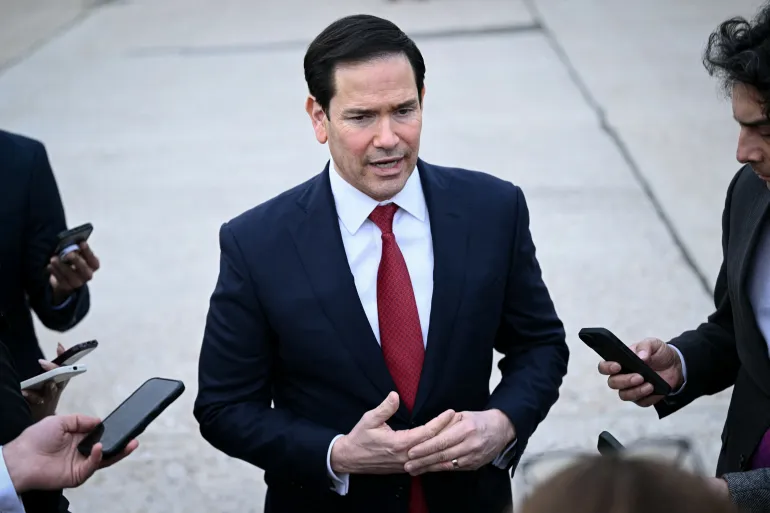
US Secretary of State Marco Rubio speaks to the press following a G7 Foreign Ministers’ meeting on March 27, 2026 [AFP]
Attendance at CPAC, an annual conference, tends to skew away from the political centre and farther to the right.
Speakers at this year’s conference included Senator Ted Cruz of Texas, Iranian opposition leader Reza Pahlavi, and Eduardo and Flavio Bolsonaro, the sons of Brazil’s former far-right president Jair Bolsonaro, who was imprisoned last September for attempting to subvert his country’s democracy.
But this year’s straw poll comes at a critical time for the Republican Party.
Less than eight months remain until November’s midterm elections in the US, and Republicans are hoping to defend their congressional majorities at the ballot box.
Trump, long the standard-bearer for his party, has seen his approval numbers sink since his return to office in 2025. Earlier this week, a survey from the news agency Reuters and the research firm Ipsos found that only 36 percent of US citizens approved of his job performance, a new low.
The ongoing war in Iran and economic frustrations, including rising gas prices linked to the conflict, are among the factors contributing to the slump.
While Trump has teased he may seek a third term, US law prevents modern presidents from serving more than two. His second presidency is set to expire in 2028.
That leaves an open question as to who may succeed the 79-year-old Republican.
Vance, a veteran and former single-term senator from Ohio, is seen to represent a more isolationist branch of Trump’s “Make America Great Again” (MAGA) base. He has generally been opposed to US involvement in foreign conflicts, though he has defended Trump’s decision to join Israel in joint strikes on Iran.
Rubio, meanwhile, has a longer political resume than Vance and is seen to be more hawkish towards regime change, particularly in his family’s ancestral home of Cuba. He served as a senator for Florida from 2011 until his unanimous confirmation as secretary of state in 2025.
Both men had been critical of Trump before joining his administration. Vance once called Trump “unfit” for office, and Rubio derided Trump as a “con artist” and an “embarrassment” when he was a rival candidate for the 2016 Republican presidential nomination.
Senator Ted Cruz speaks at the Conservative Political Action Conference on March 28 [Gabriela Passos/AP Photo]
CPAC tends not to survey participants about who should be president when a Republican is already in the Oval Office.
But the straw polls it held before and after Trump’s first term, from 2017 to 2021, have shown a noticeable realignment in the Republican Party.
In the decade leading up to the 2016 election – Trump’s first successful campaign for office – moderate Republican Mitt Romney and libertarian Rand Paul consistently topped the CPAC straw polls.
Ever since his first term, however, Trump has trounced the competition.
Despite his 2020 election defeat, he still topped the straw poll in 2021, with 55 percent support, and his numbers climbed each successive year, through to his re-election in 2024.
Experts have noted that the Republican Party has largely consolidated around Trump’s politics, with the few remaining moderate and critical voices increasingly marginalised.
The CPAC straw poll, however, is not always accurate. Ahead of Trump’s victory in 2016, the majority of straw poll participants backed Senator Cruz of Texas to be the next president. Trump came in third place with 15 percent support, trailing Rubio at 30 percent.
For the first 18 years of post-monarchy Nepal, the country had 14 prime ministers — leaders changing almost every year, with some taking office, being forced out, and then returning again a few years later.
On March 5, Nepal appeared to draw a line in the sand. Months after a Gen Z-led uprising ousted the then prime minister, KP Sharma Oli, millions of voters chose rapper-turned politician Balendra Shah — or Balen as he is widely known — and his Rastriya Swatantra Party (RSP) to lead the nation. On Friday, March 27, Shah was sworn in as Nepal’s prime minister.
The RSP is barely four years old, and Shah’s only prior political experience is as mayor of the capital, Kathmandu.
Now, with a landslide win, analysts and voters say that Shah and the RSP have an historic opportunity to build on the popular 2025 revolt and deliver on the aspirations of young Nepalis. But with that opportunity comes risks, they add.
“There is so much excitement with the heavy mandate. This is a historical and unprecedented opportunity for him to execute his agenda because his party is likely to have close to a two-thirds majority,” political analyst Bishnu Sapkota told Al Jazeera. But, he added, “ expectations are enormous. I do not think it is realistic for him to fully meet them.”
Too big a mandate?
In the election, Shah defeated Oli in a constituency that had been the former prime minister’s stronghold for decades. The RSP won 125 of the 165 first-past-the-post seats in parliament. Seats determined through proportional representation — 110 seats are up for grabs — are yet to be divided among parties, but everything points to a two-thirds majority for the RSP.
That’s a larger mandate than even the RSP itself expected.
“We were expecting just over a 50 percent majority, but a two-thirds mandate was beyond our expectations,” RSP leader Shishir Khanal told Al Jazeera. Khanal, who was a lawmaker in the outgoing parliament, won re-election on March 5.
“The challenge is that such a mandate creates very high expectations among people, who want fast results. Given Nepal’s institutional capacity and almost stagnant economic growth, delivering those results will be extremely difficult.”
One immediate test for Shah will be implementing the findings of the Karki Commission, formed by the interim Sushila Karki government that took charge after Oli’s ouster last year. The commission was tasked with investigating the killings and property damage during the Gen Z movement last year. The panel submitted its report to the government last Sunday. This interim government is expected to hand over the investigation to the incoming Shah government to implement.
“There is a popular demand that the report be made public and implemented quickly,” Sapkota, the analyst, said. “If the interim government hands over the report as promised, implementation will have to happen in stages. As soon as he begins doing that, political reactions will follow, and he will have to manage them carefully.” The protests last year were driven by public anger over corruption, poor governance and lack of accountability, issues that voters expect the new government to address urgently. High-profile corruption investigations involving politicians are likely to be among the upcoming government’s first major tasks.
That won’t be an easy challenge to address.
Shah joined the RSP only weeks before the election, and was nominated as its prime ministerial candidate, while Rabi Lamichhane, the television presenter-turned-politician who founded the party, remains its president.
Lamichhane himself remains a controversial figure, facing allegations of fraud, organised crime and money laundering. He has previously served jail sentences and is currently out on bail. Lamichhane is accused of illegally holding two passports, US and Nepali, which is forbidden under Nepali law.
Two power centres?
The relationship between Shah and Lamichhane — and the balance of power between them — will also come under scrutiny, say experts.
Gehendra Lal Malla, professor of political science at Tribhuvan University in Kathmandu, described their alliance as a “marriage of convenience”.
“Balen needed a party to contest the election, and Rabi needed Balen’s popularity,” he said. “But differences could emerge later.”
Malla said Shah will also face a difficult test in dealing with the ongoing charges against Lamichhane. “We have a culture in Nepal where politicians protect each other,” he said. “Shah must uphold the rule of law and not protect anyone from his own party.”
At the same time, Malla noted that Shah’s popularity was the main factor behind the RSP’s success. “Balen’s appeal was the reason the party gained such a huge mandate,” he said. “He could end up having a stronger grip on the party than its president.”
Analyst Sapkota said that the RSP leadership, including Lamichhane, would need to acknowledge that the overwhelming mandate they received was largely because of Shah’s appeal. “They have to recognise that and give Shah absolute freedom to form the cabinet of his choice. Of course, the party can give their inputs and suggestions,” said Sapkota.
Khanal said, based on the conversation and an agreement they had signed, Shah will lead the government and Lamichhane the party. “From that perspective, they have their individual role sorted out, and both will have to face challenges and manage expectations on their own respective front,” Khanal told Al Jazeera. “I have observed them work very closely together within the last election cycle and campaigning. Their decision-making has also been in collaboration. So, with what I have experienced so far, there wouldn’t be any friction between them.”
The first 100 days
For Sapkota, Shah’s political novelty might work in his favour. “He doesn’t have the baggage of party cadres and internal factions,” Sapkota said. “That gives him more freedom compared to previous prime ministers.”
RSP leaders say the government plans to move quickly. “In the first 100 days, the honeymoon period, people will begin to see changes,” Khanal said.
The party has planned to prioritise anticorruption measures, including investigations into the wealth of senior officials and politicians since 1990. “We want to form a commission to investigate the assets of high-level officials and reopen high-profile corruption cases that were paused,” Khanal said.
These steps respond directly to the demands of last year’s Gen Z protests.
For many young activists who drove the protests, the election result represents hope, but also a new government that must be held accountable.
Gen Z activist Yujan Rajbhandari, 23, said the new government must prioritise good governance and protect civic freedoms, or face pushback from the same movement that enabled its rise. “With the RSP’s large majority, parliamentary opposition will be weak,” he said. “So the streets will play a major role as opposition.”
Beyond immediate reforms, Nepal is in the middle of a debate about whether to introduce broader constitutional reforms — with questions about how decentralised power needs to be.
Khanal said the party plans to establish a committee to review whether amendments may be necessary.
Shah’s critics have also questioned his diplomatic skills, citing past social media posts attacking Nepal’s neighbours, including India and China, and important partners such as the US. As Kathmandu mayor, he briefly banned Indian films and displayed a “Greater Nepal” map that showed Indian territory as part of an aspirational larger Nepal.
Sapkota said those concerns were being overblown.
“When he made those remarks, he was a mayor, not a national leader responsible for foreign policy,” he said. Sapkota argued that Shah’s lack of political baggage could allow Nepal to pursue a more independent diplomacy. “This is a clean slate,” he said. “Previous leaders had historical ties and obligations with different countries. Shah does not have that baggage, which could give Nepal greater independence.”
Neighbouring India has already signalled a willingness to work with Nepal’s new leadership.
Indian Prime Minister Narendra Modi congratulated both Shah and Lamichhane after the election and expressed hopes for stronger bilateral relations. Shah responded by emphasising the importance of maintaining the “historical, close and multifaceted relations” between Nepal and India and congratulating India for their recent T20 Cricket World Cup win.
For Malla, another important element to watch would be Shah’s relationship with the media. “Balen should engage more with the press once he becomes prime minister,” he said. “In the past, he has often said he prefers to work more and talk less. But as a national leader, communication and accountability are essential.”
REDDING — At a Board of Supervisors meeting in rural Shasta County last month, Clint Curtis dropped a bombshell: A sheriff way down in Riverside was going to confiscate all the ballots from a recent election.
Curtis, the county registrar of voters, was the first to announce the planned ballot seizure. Even the sheriff himself, Chad Bianco, had not publicly revealed his intentions.
Later, as Bianco’s move grabbed headlines — he is a leading Republican candidate for governor — Curtis’ behind-the-scenes maneuvering remained largely unknown. The registrar had worked with the Riverside County citizens group whose fraud allegations had sparked Bianco’s investigation, even traveling 600 miles south to speak on their behalf.
Shasta County Clerk and Registrar of Voters Clint Curtis poses last month in the new election observation room at the elections office in Redding.
In his short time in Shasta County, Curtis, whose claims about rigged voting machines stretch back to the early 2000s, has solidified his position as a torchbearer of the election denialism movement, vowing to take his message about untrustworthy machines and potential fraud across California and beyond.
Critics here say he has steadily disenfranchised voters. He has eliminated nine of the vast county’s 13 ballot drop boxes, telling The Times he did not trust ballots in the hands of “little old ladies running all over” to collect them. And he has advocated for a local ballot initiative that would limit elections to one day, eliminate most voting by mail and require voter ID as well as a hand count of ballots.
Curtis also has accused his predecessors in the registrar’s office, without evidence, of election fraud and has called for federal authorities to raid the office he now runs.
“Do I think ballots were stuffed? Yes. Have I contacted the DOJ? Yes,” Curtis said at the Feb. 24 Shasta County supervisors’ meeting just before announcing Bianco’s planned ballot seizure.
Curtis, a 67-year-old attorney, was appointed by the Shasta County supervisors last April. He lived in Florida then, had no previous ties to the area and had never run an election.
He got the job based largely on two stated qualifications: He wanted to hand-count votes. And he had worked with Mike Lindell, the MyPillow chief executive and pro-Trump conspiracy theorist.
In his public job interview, Curtis promised to grill local elections staffers to “find out what they know.”
Now Curtis is running for election himself, trying to keep his job in this Northern California county where a majority of the supervisors were so swept up in President Trump’s discredited election fraud claims that they ditched their Dominion voting machines in 2023 and opted to hand-count ballots (quickly prompting a new state law that banned them from doing so).
Share via
Curtis says he is running to make elections more transparent by questioning the status quo and hanging cameras everywhere to capture election workers’ every move.
“Republicans love me,” Curtis told The Times. “The Democrats are pretty good. And then I have these crazy socialist people that just hate me.”
Beliefs aside, Curtis has quickly become a colorful local character.
He took a lie detector test to attest that he didn’t rig the November election. He chose as his number two a heavy metal guitarist from San Francisco — stage name “Turmoil” — who is a progressive Democrat.
And last September, surveillance cameras captured him pushing an antique metal safe through the Shasta County elections office on a Saturday while his wife assisted with a pulling harness. Curtis wore blue jeans — and no shirt.
He said he moved the safe, which contained odds and ends, on a hot day to make more room for election observers.
Curtis first gained national attention for election skepticism in December 2004, in testimony before Congress.
He had been working as a computer programmer in Florida and was brought in as an expert witness by Democrats on the House Judiciary Committee, who were reeling over President George W. Bush’s defeat of John Kerry a few weeks earlier and furious about an error with an electronic voting machine that gave Bush extra votes in Ohio.
Curtis claimed that he had written “a prototype” of software that would allow cheaters to alter votes using “invisible buttons” on touch-screen balloting machines. His claims were largely dismissed. But he continues to tout his congressional testimony to cast himself as an expert on election malfeasance.
A woman passes by a “Greetings From Redding” mural on Feb. 25.
After testifying, he unsuccessfully ran for office multiple times in Florida. He refused to concede after one loss, alleging the machines were rigged.
In Shasta County, he saw a chance for redemption.
During the COVID-19 pandemic, the Board of Supervisors gained a hard-right majority supported by anti-vaxxers, secessionists, members of a local militia and pro-Trump election deniers.
In 2022, someone hung a trail camera — the kind hunters use to track wildlife — behind the elections office to monitor the staff. Some observers yelled at staffers and got in the face of Cathy Darling Allen, the longtime registrar, who installed a 7-foot metal fence to keep them at bay.
Joanna Francescut, who worked in the elections office for 17 years, is running to be county registrar.
Darling Allen clashed with the supervisors as they pushed to hand-count votes, a process she argued would be slow, expensive and prone to error. She retired in 2024, citing health reasons.
Her successor resigned after less than a year. The supervisors appointed Curtis in a 3-2 vote, passing over Joanna Francescut, who had worked in the elections office since 2008 and was Darling Allen’s number two.
Days later, Curtis fired Francescut. She is now running against him in the June 2 election.
David Becker, executive director of the Center for Election Innovation & Research and a former senior trial attorney overseeing voting enforcement for the U.S. Department of Justice’s Civil Rights Division, called Curtis a “nationally known conspiracy theorist.”
“I can’t imagine bringing in someone who is neither an election administrator nor a Californian for a job like that and basically chasing out experienced election officials whose work had withstood scrutiny for decades,” Becker said. “The voters of Shasta County, unfortunately, are paying the price.”
Curtis has accused Francescut and other elections staffers of stuffing ballots to sabotage conservative Republicans.
“I want to laugh because it’s that ridiculous,” Francescut, 43, said of the allegations.
“People that work in this field, they’re doing this work because they care about elections,” she said. “They want the community to be better. They want what both sides want — transparent and accurate elections.”
During her 17-year tenure, the elections office got little public attention. But “once 2020 hit, people went from completely trusting us to, the day after election day, calling and yelling at our staff so much that we couldn’t get the work done to count ballots,” she said.
Curtis was a favorite of then-board chairman Kevin Crye, a hard-right supervisor who enlisted Lindell to support the county’s crusade against Dominion. Crye had survived a 2024 recall effort by just 50 votes.
1
2
1.Carl Bott, co-owner of KCNR 96.5 FM, interviews Joanna Francescut on Feb. 25, 2026, in Redding, Calif.2.Joanna Francescut’s campaign manager, Mary Williams, wears an orange button that reads “Vote for Jo for County Clerk” as Francescut waits in the offices of talk radio station KCNR.
Citing that close margin, Curtis said he believed recent elections were rigged because Republicans were not winning by large enough margins in a county where registered Republicans greatly outnumber Democrats.
In a letter to the U.S. Justice Department, Curtis said he had learned of lax security and potential ballot stuffing in 2024, the year of the attempted recall against Crye. Curtis sent a copy of the letter to Trump and requested a federal investigation because “the destruction of these ballots is nearing.”
In 2019 and 2024, a Shasta County grand jury investigated local election procedures and found no wrongdoing.
“How does it make me feel? Really angry,” Darling Allen, who is advising Francescut’s campaign, said of Curtis’ allegations. “It calls into question the integrity and character of every single person who worked in the elections department.”
To replace Francescut, Curtis hired Brent Turner, the guitarist from San Francisco. He is a longtime election reform activist who has pushed for nonproprietary open-source voting systems with software code that can be examined by anyone.
Turner described their partnership as: “Republican and Democrat team up to fight outdated software for elections. Oh, my!”
“We have to have the adult conversation in the United States that if the systems are loose enough to allow people — in this case, we’re talking about even people internal to the system — to cheat, they might cheat,” Turner said.
Last October, Secretary of State Shirley Weber wrote to Curtis, asking him to detail planned changes to voting procedures. He responded with a 15-page letter.
Election observers, he wrote, were “treated like invaders … corralled behind spiked fences.” And drivers who picked up ballots from drop boxes sometimes left them in their vehicles. Under his watch, he wrote, “no detours or even bathroom breaks are allowed.”
A woman exits the Cottonwood Post Office in Shasta County.
Curtis told Weber that someone had carved death threats on his vehicle and left “antifa” business cards on his windshield wipers.
Weber’s communications team said in an email that her office “continues to monitor new election processes proposed by Shasta (or any county) County to ensure they do not violate state law.”
In his letter to Weber, Curtis promised to take a lie detector test after each election. Answering pre-written questions he had submitted, Curtis said in a January polygraph test that he did not change the results of the November election and believed a predecessor had rigged previous contests, according to a summary obtained by The Times.
The examiner wrote that he “was likely telling the truth.”
Inside the elections office, Curtis created a large room, decked out with American flags, for citizens to observe the vote-counting process.
More than a dozen large TV monitors display close-up video, also streamed online, of election workers’ hands inserting ballots into machines. On June 2, those workers will sit beneath iPhones hung overhead to record them while observers are positioned on barstools a few inches behind them.
The new public observation room at the Shasta County elections office is decorated with American flags.
Curtis has been traveling across California to tout his methods. He told The Times he has spoken about his video setup in Kern and San Joaquin counties and discussed it with candidates for state office.
And he advised the Riverside County citizens group that claimed to have found an overcount of 45,896 ballots in the November election for Proposition 50, which redrew the state’s congressional districts to favor Democrats.
Art Tinoco, the Riverside County registrar of voters, has refuted that number — saying it was based on a misunderstanding of raw data that had not been fully processed.
After Bianco last week announced that his office had seized more than 650,000 ballots, Curtis appeared on the social media broadcast of a right-wing election integrity advocate who called him “the stealth behind the scenes in making that happen.”
Curtis smiled and repeated what he has been espousing since the early 2000s: “You can’t really trust a computer.”
Gregoire headed a list uniting the traditional left, the Greens and the Communists to victory in French capital.
Published On 22 Mar 202622 Mar 2026
The Socialist Party’s Emmanuel Gregoire has won the Paris mayoral race, as the results of nationwide municipal elections showed gains for the traditional left and right, and a major win for the far right in the city of Nice.
Sunday’s run-off votes in more than 1,500 communes saw Gregoire on course to become mayor of the French capital, with exit polls showing that the far-right National Rally (RN) fell short of taking control of the key southern cities of Marseille and Toulon.
Recommended Stories
list of 3 itemsend of list
Gregoire, who headed a list uniting the traditional left, the Greens and the Communists, clinched the prized mayoralty with an estimated 51 to 53 percent of the vote, according to pollsters, seeing off Conservative rival Rachida Dati, who conceded defeat.
The 48-year-old son of a teacher and civil servant is stepping into the spotlight after previously serving as deputy to outgoing mayor and fellow Socialist Anne Hidalgo. During his bid, he had promised that Paris would stand as a “city of refuge” and a “bastion against the right and the far right”.
In Marseille, the second-largest city in the country, Socialist Mayor Benoit Payan was on track to be re-elected with 56.3 percent of the vote, according to an Elabe poll for BFM TV. RN’s chances of winning the coveted prize took a hit after the withdrawal of a hard-left candidate from France Unbowed (LFI) aimed at uniting left-wing voters.
Socialist Party chief Olivier Faure hailed the wins in Paris and Marseille, positioning his party as a bulwark against the far right. “Only the left can prevent France from this regression,” he said.
In Toulon, an Elebe poll showed centre-right candidate Josée Massi leading at 53.5 percent, with RN candidate Laure Lavalette conceding defeat. Yet, senior RN officials rejected suggestions that the party’s loss indicated it had hit a “glass ceiling” ahead of next year’s presidential election.
“The National Rally and its candidates have achieved tonight, in this municipal election, the biggest breakthrough in its entire history,” RN chief Jordan Bardella said, alluding to wins in local constituencies where it previously had no presence.
In the first round, Bardella’s anti-immigration party won re-election in the southern city of Perpignan, and it won in smaller cities, too. And on Sunday, exit polls indicated that Eric Ciotti, a former mainstream conservative who is now an ally of the RN, won in Nice, France’s fifth-biggest city.
Former Prime Minister Edouard Philippe was re-elected mayor in his northern city of Le Havre, according to the TF1 and LCI broadcasters, delivering a better-than-expected performance that boosts his hopes of running for president in 2027.
Philippe, a centre-right politician who served as prime minister under centrist President Emmanuel Macron, made a speech with a clear national message, saying his victory showed that “there were reasons to be hopeful” in the values of France and that the extremes can be beaten.
Turnout at 5pm local time (16:00 GMT) was just higher than 48 percent in France’s mainland, more than than in the 2020 vote held during the COVID-19 pandemic, but four points lower than in 2014, according to the Ministry of Interior.
Governing liberals edge ahead of opposition conservatives in a race too close to call, according to exit poll.
Published On 22 Mar 202622 Mar 2026
Slovenia’s governing Freedom Movement (GS) is on track to win a parliamentary election but will need to find more coalition partners to form a government, according to an exit poll.
GS was set to secure 29.9 percent of the votes, or 30 seats in the country’s 90-seat parliament, in a dip from its previous result of 41 seats, according to the poll, published by TV Slovenia and Pop TV on Sunday.
Recommended Stories
list of 3 itemsend of list
The opposition Slovenian Democratic Party, led by populist Janez Jansa, is expected to come second and secure 27 seats in parliament, according to the Mediana polling agency.
As he voted, incumbent Prime Minister Robert Golob, 59, called on citizens to cast their ballots.
“Democracy and Slovenia’s sovereignty cannot be taken for granted any more,” he told reporters.
Jansa welcomed the exit poll results and said he would wait for the final result.
“If someone wants a government like the one we’ve had so far, then they are probably satisfied with what these parallel results indicate,” Jansa said.
“Whoever wants change will likely have to wait for the final results, just as we will, and then we will analyse the situation. But we have done everything that was within our power,” he said.
The opposition party leader has served as prime minister three times, most recently from 2020 to 2022.
Ahead of the vote, the election had been marred by controversy after a report last week alleged that Jansa met with officials from the Israeli spy firm Black Cube in December.
Golob told journalists after the report: “The fact that … foreign services are interfering in the elections of a democratic member state of the European Union is something unheard of.”
Voters choosing between incumbent PM Robert Golob and pro-Trump Janez Jansa, with neither likely to win parliamentary majority.
Published On 22 Mar 202622 Mar 2026
Slovenians are voting in a tight parliamentary election, as incumbent liberal Prime Minister Robert Golob takes on right-wing populist Janez Jansa, who is eyeing a comeback.
Polls opened at 7am local time (06:00 GMT) on Sunday and will close at 7pm (18:00 GMT), with exit poll results to be released after voting.
Recommended Stories
list of 4 itemsend of list
A return of Jansa, an admirer of United States President Donald Trump, could see the former Yugoslav nation, a European Union member of two million people, take an illiberal turn again after four years of centre-left rule under 59-year-old Golob.
Neither is likely to win a parliamentary majority in the vote, which could be decided by smaller coalition partners.
Latest opinion polls confirm Jansa’s Slovenian Democratic Party (SDS) and Golob’s Freedom Movement (GS) are set for a close race after an eleventh-hour campaign drama involving allegations of foreign meddling and corruption.
Golob, left, and Jansa at the last televised debate ahead of the election, in Ljubljana, March 20, 2026 [AFP]
The last government of three-time premier Jansa, who is pro-Israel and an ally of nationalist Hungarian Prime Minister Viktor Orban, saw mass protests and EU criticism over rule-of-law concerns.
Under Golob, a political newcomer when he took over from Jansa in 2022, Slovenia legalised same-sex marriage and became one of the few EU countries to describe Israel’s war in Gaza as genocide.
Analysts say Jansa, 67, has a devoted voter base, and the lower the turnout, the higher the chances of him winning the election.
At stake is the domestic and foreign agenda of Slovenia, where the outgoing government focused on social and health reforms but delivered mixed results, resulting in a fall in popularity for Golob’s governing coalition.
Jansa has promised to introduce tax breaks for businesses and cut funding for civil society, welfare and media.
Slovenia, an Alpine country with a developed industrial base, emerged stronger from the collapse of Yugoslavia than other states such as Serbia or Bosnia and Herzegovina, which have been held back by war, economic sanctions and political infighting.
Jansa would also likely change Golob’s foreign policy under which Slovenia was one of the few European countries that recognised an independent Palestinian state and last year imposed an arms embargo on Israel.
Slovenia heads to the polls on Sunday in a closely contested race between incumbent Prime Minister Robert Golob and right-wing former Prime Minister Janez Jansa.
Opinion polls currently suggest no clear winner between Golob’s Freedom Movement (GS) and Jansa’s Slovenian Democratic Party (SDS), with the outcome likely to hinge on smaller parties and coalition-building.
Recommended Stories
list of 4 itemsend of list
Jansa has served three times as prime minister, between 2004-2008, 2012-2013 and 2020-2022.
Golob’s domestic agenda has been broadly reform-driven and welfare-focused, with a mix of social policy, green transition, and institutional reforms, something Jansa has promised to reverse by introducing tax breaks for businesses and cutting funding for welfare programs.
The election will also decide which direction the Alpine nation, which gained independence in 1991, will take on foreign policy, especially given the wildly divergent views on Israel and Palestine.
Slovenia’s government has been an outspoken critic of Israel’s war; in contrast, Jansa is a staunch supporter of Israel.
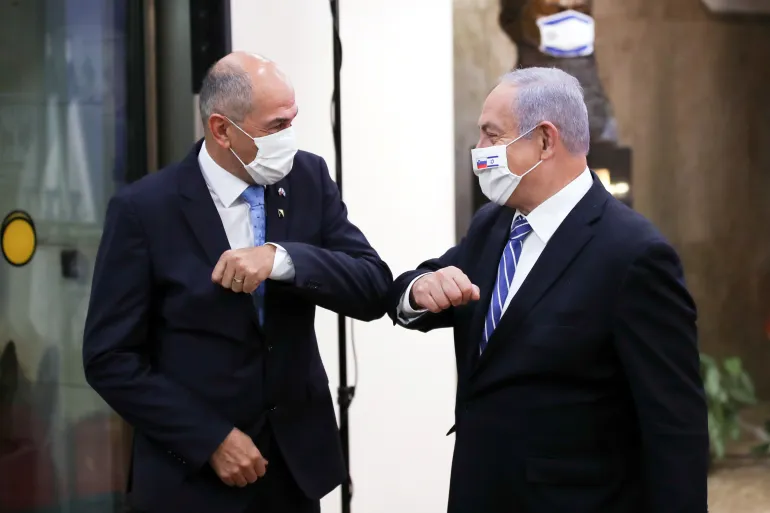
Slovenian then Prime Minister Janez Jansa and Israeli Prime Minister Benjamin Netanyahu met in Jerusalem on December 8, 2020 [Ohad Zwigenberg/Pool via Reuters]
Diverging views on Israel-Palestine
For a small nation – roughly the size of New Jersey in the United States – home to two million people, the Israel-Palestine conflict has played a significant role in its politics.
Slovenia’s current government has openly criticised Israel’s actions in Gaza and the occupied West Bank, even introducing a ban on imports of goods produced in the occupied Palestinian territory.
In May 2024, the country recognised Palestinian statehood, raising a Palestinian flag alongside the flags of Slovenia and the European Union in front of a government building in downtown Ljubljana.
A Palestinian flag flies next to a Slovenian and an EU flag, at the government building in Ljubljana, Slovenia, May 30, 2024 [Borut Zivulovic/Reuters]
In May 2025, Slovenia’s President Natasa Pirc Musar told the European Parliament that the EU needed to take stronger action against Israel, condemning “the genocide” in Gaza.
Later in the year, it banned far-right Israeli cabinet ministers Itamar Ben-Gvir and Bezalel Smotrich from entering the country and became the first country in the EU to ban all weapons trade with Israel over its genocidal war on Gaza.
It has also backed Slovenian International Criminal Court (ICC) Judge Beti Hohler, after she was sanctioned by the US for her role in issuing arrest warrants for Israeli Prime Minister Benjamin Netanyahu and former Defense Minister Yoav Gallant.
In a letter sent to the EU heads of state on March 13, Golob and Musar warned that Europe’s refusal to condemn the sanctions indicated that “concern for economic consequences has taken precedence over a principled defence of judicial independence and international justice … at a moment when armed conflicts rage, when international law is being violated, when the victims of the gravest crimes look to the ICC as their last hope for justice.”
Palestinian Foreign Minister Varsen Aghabekian Shahin meets with Slovenia’s Prime Minister Robert Golob, at the Office of the Prime Minister of the Republic of Slovenia, in Ljubljana, Slovenia, August 25, 2025 [Borut Zivulovic/Reuters]
Nika Kovac, a Slovenian sociologist and cofounder of the 8th of March Institute, a nongovernmental organisation focused on human rights, told Al Jazeera that support for Palestine is in part rooted in the fact that Slovenia is “a very young country”, which means “there is … solidarity with countries that want to be independent, and they cannot be.”
However, the country’s approach to Palestinian rights could shift if pro-Israel Jansa were to be elected.
Jansa has been a close ally to Israeli Prime Minister Benjamin Netanyahu and lambasted Slovenia’s decision to recognise the state of Palestine, with a statement from his party claiming it was tantamount to “supporting the terrorist organisation Hamas”.
A woman votes during the early voting before national elections, in Ljubljana, Slovenia, March 17, 2026 [Borut Zivulovic/Reuters]
Accusations of ‘foreign information manipulation’
In the lead-up to the election, a series of covertly recorded conversations was published online, featuring a Slovenian lobbyist, a lawyer, a former minister and a manager.
The videos purportedly show the individuals discussing ways to influence decision-makers in Golob’s coalition to expedite procedures and secure contracts.
On Tuesday, Golob accused “foreign services” of interfering in Slovenia’s elections, after a report by the 8th of March Institute and investigative journalists claimed that representatives of the Israeli private spy firm Black Cube had visited the country in December and Jansa’s headquarters in the weeks leading up to the leaks.
On Wednesday, Slovenia’s Intelligence and Security Agency confirmed the arrival of Black Cube representatives in Slovenia and presented a report on foreign interference in elections, which the agency’s director said was alleged to have been carried out at the behest of people in Slovenia.
The State Secretary for National and International Security in the Office of the Prime Minister of the Republic of Slovenia, Vojko Volk, made a statement following the announcement, saying, “According to information available to date, representatives of Black Cube have stayed in Slovenia on four occasions over the past six months.”
On Thursday, Golob sent a letter to European Commission President Ursula von der Leyen notifying her of “alarming information regarding what appears to constitute a grave instance of foreign information manipulation and interference currently unfolding in the Republic of Slovenia”.
French President Emmanuel Macron told reporters on Thursday that Golob “was the victim of clear-cut interference” by “third countries”.
“Today, in every election in Europe, there is interference that disrupts electoral processes,” Macron said.
Jansa has admitted to meeting with a Black Cube representative but denied any wrongdoing.
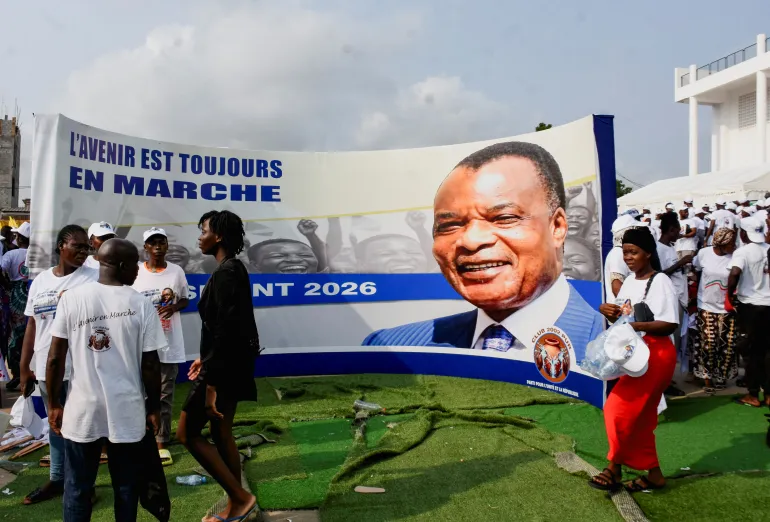
Congolese President Denis Sassou Nguesso’s election success will extend his nearly 42 years in power.
Published On 17 Mar 202617 Mar 2026
Republic of Congo President Denis Sassou Nguesso has been re-elected for a fifth consecutive term, extending his nearly 42 years in power, according to provisional results.
On Tuesday, Interior Minister Raymond Zephirin Mboulou announced on state TV that Sassou Nguesso received 94.82 percent of Sunday’s vote.
Recommended Stories
list of 3 itemsend of list
State television also reported turnout of 84.65 percent; however, many polling stations in the capital, Brazzaville, on Sunday had short lines or no lines at all.
Sassou Nguesso, 82, was projected by analysts and diplomats to easily win the election after he ran against six candidates who were less well known.
Boycott
Two key parties had boycotted the elections over allegations of unfair electoral practices, with two of the best-known opposition figures, General Jean-Marie Michel Mokoko and Andre Okombi Salissa, imprisoned for nearly 10 years.
But in the run-up to the election, the internet was shut down as usual during a presidential vote, and traffic was restricted across the capital.
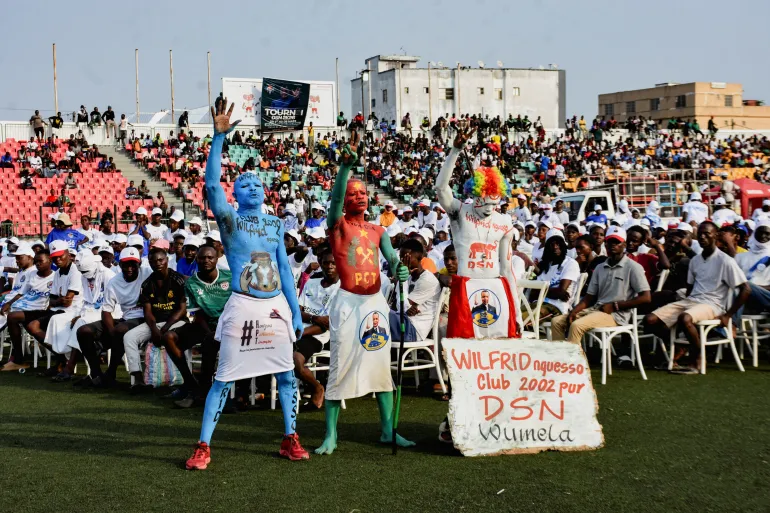
Supporters of incumbent President of the Republic of Congo and presidential candidate Denis Sassou Nguesso stand on the side of the road as they wait for him to arrive at a polling station in Brazzaville on March 15, 2026 [Daniel Beloumou Olomo/AFP]
Clarisse Massamba, a teacher who voted at the Lyce Javoueh in Brazzaville, told The Associated Press news agency that it was a given that Sassou Nguesso would win the election.
“Everyone knows that, faced with his six inexperienced opponents, President Denis Sassou Nguesso will be re-elected with a high score as usual. Since the election is not a big issue, we shouldn’t cut off communication,” Massamba said.
During the campaign period, Sassou Nguesso and his opponents were mismatched with the incumbent president, the only candidate to travel around the country to canvass voters, with effigies placed in the capital.
Moreover, Joe Washington Ebina, a Congolese human rights activist, told the Reuters news agency that human rights activists were arrested, several opposition parties were suspended, and public gatherings were closely monitored in the run-up to the election.
Decades in power
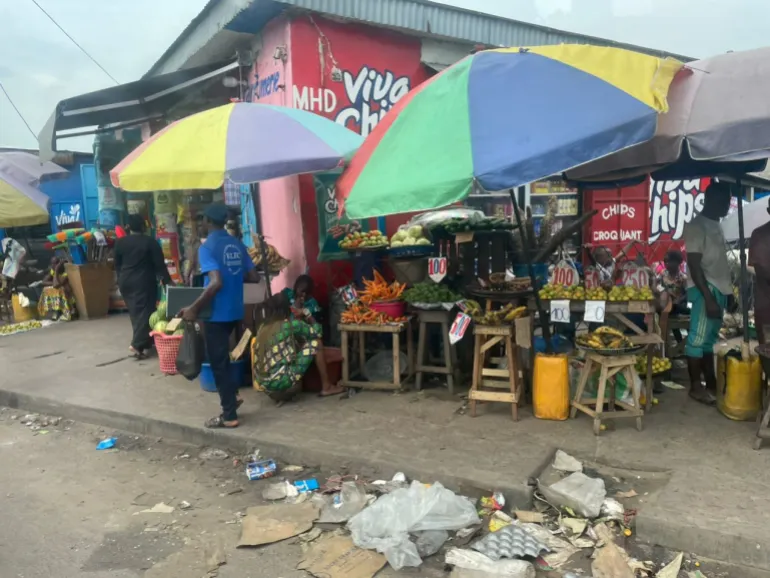
Republic of Congo continues to struggle with high international debt, which, according to the World Bank, stands at 94.5 percent of its gross domestic product, despite being an oil and mineral-rich country.
Sassou Nguesso, who runs the Congolese Party of Labour, first came to power in 1979 and ruled until 1992.
In 1997, Sassou Nguesso returned to power as militia leader following a four-month civil war. In 2015, a constitutional referendum removed presidential age and term limits, allowing him to run again.
WASHINGTON — An advocacy group hoping to expand support for child and elder care is planning to spend $50 million to back Democrats in congressional races, tying the costs of caregiving to the nation’s affordability debate.
The Campaign for a Family Friendly Economy, created a decade ago, aims to make caregiver issues more salient in elections. The announcement comes as the cost of child care continues to rise and as waiting lists for federal child-care subsidies, which support working families in poverty, continue to grow.
Sondra Goldschein, executive director of the campaign and its political action committee, said child care and elder care are important to the affordability conversation, especially as child-care costs exceed what families pay for housing. Then there is the pressure on the “sandwich generation,” composed of middle-aged people who are caring simultaneously for their own children and parents.
“When child care can cost more than your rent or a mortgage, or you have to sacrifice a paycheck in order to be able to take care of a loved one,” that can motivate how people vote, said Goldschein. “Each election cycle, we see candidates recognizing that more and more.”
She hopes the message will resonate as families face a slew of rising costs, including climbing gas prices driven by a war in Iran that is unpopular with many voters.
The campaign plans to pour support for Democrats into Senate races in North Carolina, Georgia, Michigan, Maine and Ohio and into House races in Iowa and Pennsylvania. It is also slated to dispatch volunteers to talk with voters about caregiving.
The National Republican Congressional Committee did not immediately respond to a request for comment.
Republicans have begun to back child care as an issue crucial to growing the workforce, but their proposals tend to be less dramatic than those offered by Democrats. Last year, through President Trump’s One Big Beautiful Bill, Republicans made an estimated 4 million more families eligible for a child-care tax credit. The law also increased child-care aid for military families and tax credits for employers who provide child care to their workers.
Before 2020, many candidates rarely spoke about child care. But the COVID-19 pandemic laid bare the child-care industry’s precarity and necessity. Preschools and child-care centers were pressed to stay open so parents in front-line jobs — such as those in healthcare — could return to work.
Then-President Biden successfully persuaded Congress in 2021 to pass $39 billion in aid for child care, allowing states to offer support to more families and subsidizing wages for child-care workers. Later that year, Biden sought to create nationwide universal pre-kindergarten and to vastly expand child-care subsidies for families so that none would pay more than 7% of their household income for care. But the proposal narrowly failed in Congress. Since then, the pandemic aid has dried up and families are feeling the pinch of rising costs.
Now, several candidates have centered their campaigns around child-care affordability. New York Mayor Zohran Mamdani, a democratic socialist who won election after pledging to make the city more affordable for middle-class residents, ran on universal child care. Democratic Gov. Mikie Sherrill of New Jersey and Gov. Abigail Spanberger of Virginia won elections after pledging to expand child-care subsidies.
Candidates this election cycle are running on universal child-care pledges. They include Democrats Janeese Lewis George, who is running for mayor in Washington, D.C., and Francesca Hong, a gubernatorial candidate in Wisconsin. New York Gov. Kathy Hochul, who is up for reelection this year, has pledged to support Mamdani’s ambitions and eventually to expand universal child care statewide.
Neither the White House nor the Department of Health and Human Services, which oversees federal child-care programs, responded to requests for comment. In his 2024 campaign, during an address to the Economic Club of New York, Trump said increasing foreign tariffs would “take care” of the expense of child care. That plan, thus far, has not materialized.
In Trump’s current term, the administration has largely focused on cracking down on fraud, after a viral video alleged Somali-run child-care centers in Minneapolis were billing the government for children they weren’t caring for.
While there have been prosecutions stemming from child-care subsidy fraud, the Minneapolis video’s central claims were disproven by state inspectors. Nonetheless, the Trump administration attempted to freeze child-care funding for Minnesota and five other Democratic-led states until a court ordered the funding to be released.
Vietnamese elect members of parliament from a list of candidates almost exclusively fielded by the governing party.
Published On 15 Mar 202615 Mar 2026
Share
Voters in Vietnam are casting their ballots for members of the National Assembly, the country’s top legislative body, which serves mainly to ratify decisions by the governing Communist Party.
Nearly 93 percent of the 864 parliamentary candidates in Sunday’s election are Communist Party members, while 7.5 percent are independents, according to the national election council, down from 8.5 percent in 2021.
Recommended Stories
list of 4 itemsend of list
The five-yearly elections in the tightly controlled one-party state will see more than 73 million voters elect 500 members of the National Assembly and representatives for local councils.
The Communist Party, which has ruled the Southeast Asian nation of 100 million people unopposed for decades, holds 97 percent of the parliamentary seats.
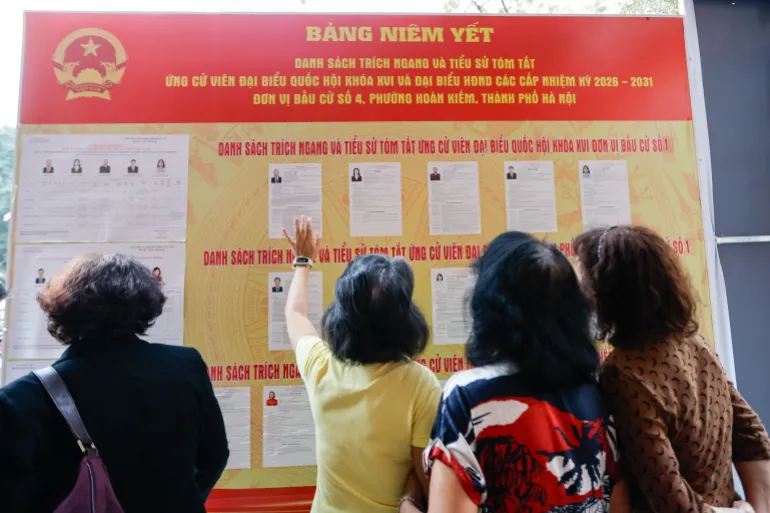
People look at the lists of candidates at a polling station in Hanoi, March 15, 2026 [Luong Thai Linh/EPA]
Voters expressed hope their representatives would continue modernising Vietnam, whose booming economy is undergoing major reforms introduced by top leader To Lam.
Red-and-yellow banners fluttered from lampposts and traffic lights in the capital, Hanoi, where well-dressed senior citizens were some of the first to vote.
“I do expect top leaders after this election will make major changes to make our country better,” Nguyen Thi Kim, 73, told the AFP news agency at a polling station set up in a community room of a high-rise residential block in Hanoi.
But in a country where major policies and projects are decided by senior cadres, many citizens feel lukewarm about elections. “I don’t think who wins will have any impact on my life,” said a woman, who gave her name as Huyen, in Hanoi.
Most polling stations are scheduled to close at 7pm (12:00 GMT), with results expected on March 23, parliament Chairman Tran Thanh Man told local media.
Voters cast ballots in Hanoi, Vietnam, March 15, 2026 [Hau Dinh/AP]
The opening plenary session of the National Assembly is scheduled for early April, when lawmakers are expected to approve the state’s top leaders previously nominated by the party, including the president and the prime minister.
The party confirmed Lam as its general secretary, Vietnam’s most powerful position, during its five-yearly congress in January, when it also selected the 19 members of the Politburo, its top decision-making body.
After voting on Sunday morning in Hanoi, Lam said on live television that the election aimed “to choose the most prestigious people to continue leading the country to more development”.
First-time voter Nguyen Kim Chi, 18, said she cast her ballot in the capital for “all the young” candidates.
“I know top positions are already set,” she added, “but I still hope my votes count.”
The list of candidates running for Los Angeles city and school board offices is set, with a number of incumbents facing what could be competitive primary elections on June 2.
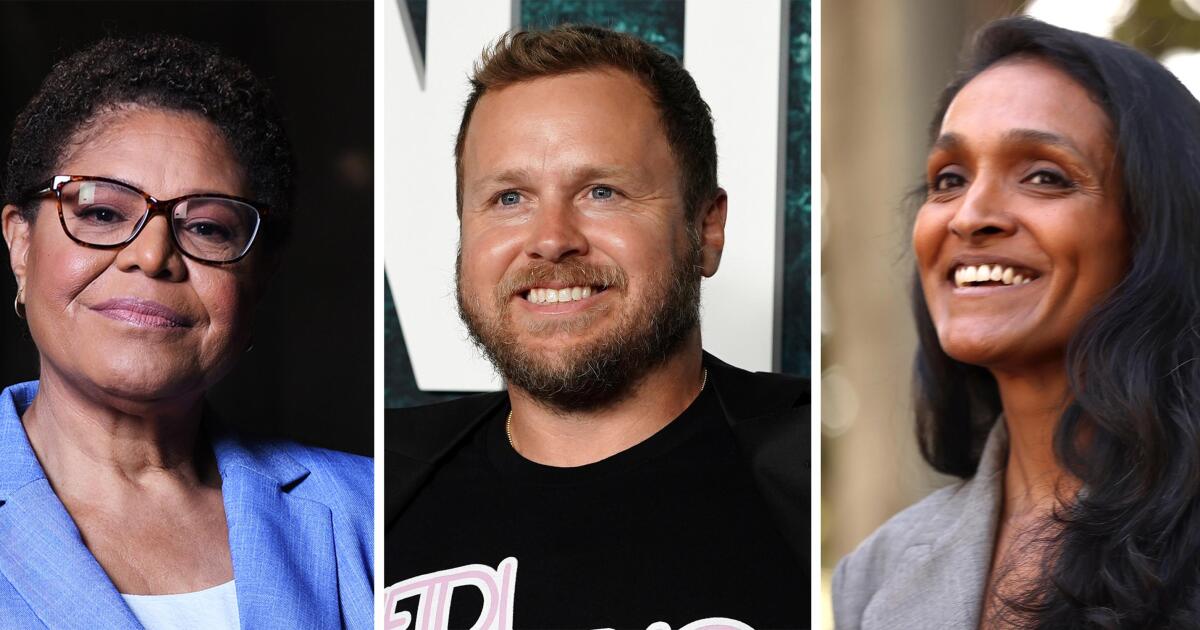
Fourteen Angelenos have qualified to run for mayor, including incumbent Karen Bass, City Councilmember Nithya Raman and former reality TV star Spencer Pratt.
Seven City Council incumbents face at least one challenger, while Councilmember Monica Rodriguez is running unopposed to represent her northeast San Fernando Valley district.
City Atty. Hydee Feldstein Soto is running against three opponents — deputy attorney general Marissa Roy, human rights attorney Aida Ashouri and Deputy Dist. Atty. John McKinney.
In the race for city controller, incumbent Kenneth Mejia will battle it out against Zach Sokoloff, who is on sabbatical from his job as senior vice president of asset management at Hackman Capital Partners.
For the last week and a half, workers at the City Clerk’s Office have been verifying the legitimacy of voter signatures submitted by the candidates, finishing the last batch on Friday.
Gathering the required 500 signatures is relatively easy in citywide races but harder in council and school board districts. Some candidates who submitted petitions by the March 4 deadline failed to qualify because some of their signatures were deemed invalid.
In each race, if no candidate gets more than 50% of the vote in June, the top two finishers will compete in a November runoff.
The field of 14 for mayor narrowed significantly from the roughly 40 who filed initial paperwork on Feb. 7. The qualifiers include a game streamer, a singer-songwriter and a tech entrepreneur, as well as government veterans like Asaad Alnajjar, a longtime engineer for the city. Rae Huang, a pastor and housing advocate, will also appear on the ballot.
Raman, a former Bass ally, shook up the race with her surprise entry, hours before the filing deadline.
A recent poll found that about 51% of Los Angeles voters are undecided on who they want for mayor. Bass led at 20%, followed by Pratt at just over 10% and Raman at slightly more than 9%, according to the Emerson College Polling/Inside California Politics poll.
Tech entrepreneur Adam Miller was supported by just over 4% of those polled, with Huang at about 3%.
In District 1, which stretches from Glassell Park and Highland Park to Chinatown and Pico Union, four challengers are looking to unseat City Councilmember Eunisses Hernandez. They are Maria Lou Calanche, a former Los Angeles Police Commissioner and founder of the nonprofit Legacy LA; Nelson Grande, an executive consultant and former president of Avenida Entertainment Group; Raul Claros, founder of CD1 Coalition, which organizes cleanup days; and Sylvia Robledo, a small-business owner and former council aide.
Councilmember Bob Blumenfield is terming out in District 3, leaving the race to represent the southwestern San Fernando Valley open to a newcomer. The three candidates are Timothy K. Gaspar, who founded a private insurance company; Barri Worth Girvan, a director of community affairs for an L.A. County supervisor; and Christopher Robert “C.R.” Celona, a tech entrepreneur.
In District 5, which includes Bel-Air, Westwood, Hancock Park and other West L.A. communities, Councilmember Katy Yaroslavsky faces two challengers: tenants rights attorney Henry Mantel and accountant Morgan Oyler.
With Councilmember Curren Price terming out in District 9, six candidates are vying to represent parts of downtown and South L.A. They are Jose Ugarte, who was formerly Price’s deputy chief of staff; Estuardo Mazariegos, a lead organizer at the Alliance of Californians for Community Empowerment; nonprofit director Elmer Roldan; entrepreneur Jorge Nuño; professor and therapist Martha Sánchez; and educator Jorge Hernandez Rosas.
Councilmember Traci Park, who represents the Westside communities of District 11, including Brentwood, Pacific Palisades and Venice, will face off against civil rights attorney Faizah Malik.
In District 13, which includes Hollywood and East Hollywood as well as parts of Silver Lake, Echo Park and Westlake, Councilmember Hugo Soto-Martínez is defending his seat against three challengers. They are Colter Carlisle, vice president of the East Hollywood Neighborhood Council; Dylan Kendall, an entrepreneur and founder of Grow Hollywood; and Rich Sarian, vice president of strategic initiatives for the Social District.
And in District 15, which includes San Pedro and other harbor-area communities as well as Watts, Councilmember Tim McOsker is running against community organizer Jordan Rivers, who is continuing his campaign after reports that he stabbed a neighbor when he was 12. Rivers said it was an “accident” that happened a decade ago.
Three seats are open on the Los Angeles Unified School District board.
In District 2, incumbent Rocío Rivas is being challenged by Raquel Zamora, an LAUSD teacher and attendance counselor.
In District 4, incumbent Nick Melvoin is facing off against Ankur Patel, director of outreach at the Hindu University of America.
District 5 school board member Kelly Gonez is running unopposed for her third term.
Fans of the musical “Hamilton” know three things about the nation’s first Treasury secretary because of Lin-Manuel Miranda’s brilliance. First, that Alexander Hamilton cheated on his wife, Eliza. Second, he was killed by the vice president, Aaron Burr. Third, and most importantly, he was considered a highly principled man. And when it came to the topic of nationalizing elections, do you know how this Revolutionary War vet and founding father characterized doing so?
A threat.
Referring to corruptible public officials, Hamilton wrote in the Federalist Papers: No 59: “With so effectual a weapon in their hands as the exclusive power of regulating elections for the national government, a combination of a few such men, in a few of the most considerable States, where the temptation will always be the strongest, might accomplish the destruction of the Union, by seizing the opportunity of some casual dissatisfaction among the people to discontinue the choice.”
Hamilton’s prescient views became the framework for the Election Clause in the Constitution. And since returning to the White House, President Trump has been searching for ways to usurp it. Last month he made calls to nationalize elections. This month he’s at it again.
He’s also pushing Congress to pass his so-called SAVE Act, which would require voters to show proof of citizenship when they register to vote. It sounds innocuous until you realize a driver’s license isn’t good enough; a passport would often be required. But half the country doesn’t have a passport, and it costs roughly $200 and a few weeks to get one. The logistical burden is unreasonable and cruel: Consider that this year, during primary season, we’ve already witnessed natural disaster — such as the tornadoes that recently ripped through the Midwest or the fires in Texas — upend entire communities. Many people would not have been able to vote, simply because they had been separated from their papers during the disaster.
The financial obstacles that would be created by the SAVE Act are at least as onerous: Why would Congress choose to financially burden voters — with what is essentially an unlawful poll tax — at a time when the unemployment rate and gas prices are up and the approval rating for nearly everyone in office is down? There are a couple of reasons. One is that the party controlling Congress hopes to suppress voting in order to defy the will of the American majority and cling to power.
Another reason lawmakers support this terrible bill is simply that Trump wants it. Some Republicans in office are so afraid of angering a vengeful president that they would rather entertain his authoritarian tendencies than go through the fire of his opposition during a primary.
For politicians such as Sen. John Cornyn (R-Texas), who this week changed his long-held position on the filibuster in order to push the SAVE Act, it’s simply about political survival. He needs the president’s endorsement heading into the runoff for his Senate seat.
Trump has called the election overhaul bill his top priority — not the war he started with Iran, not returning the billions collected from illegal tariffs, not justice for Jeffrey Epstein’s victims. Before there was a Constitution, there was a warning, written by Hamilton and other founders, whose concerns about nationalized elections are well documented and have proved to be well founded.
You would think a nation in the midst of beating its proverbial chest about our 250th birthday would take more heed from the country’s founders. But nope: This week Florida state lawmakers, in an attempt to appease their state’s most powerful resident, passed an election overhaul law that mirrors the federal SAVE Act. More red states are likely to follow, not because a national wave of voter fraud has been unearthed by authorities, but because the authorities want to stay in the good graces of someone who has yet to prove any widespread fraudother than his own.
The party that famously railed against “the bridge to nowhere” is now offering bills that solve nonexistent problems. Or in some cases, creating problems, particularly for women who changed their names after marriage so their state IDs don’t match their birth certificates.
Cornyn is not alone in exchanging his principles for Trump’s favor; he’s just the most recent. However, the manner in which he announced his flip flop was particularly tone deaf.
“If a man takes a swing at you and barely misses, that doesn’t make him a pacifist — it just means he has bad aim,” Cornyn wrote in an op-ed about the bill for the New York Post, the newspaper founded by Hamilton in 1801. “Standing still and giving him a second free swing wouldn’t be wise or honorable: it would be foolish.”
In 2016, then-candidate Trump took his first big swing at our elections when he implied — without evidence — that his opponent, Sen. Ted Cruz, had rigged the election after losing to him in the Iowa Republican caucus. Reportedly Trump even tried to get the state’s party chair to overturn the result. He’s been throwing jabs at our elections ever since. The Jan. 6 riot was a haymaker that barely missed. Given the president’s propensity to hand out Trump 2028 hats, it seems passing the SAVE Act would be, in Cornyn’s words, setting voters up to stand there while Trump takes another swing at our democracy.
The following AI-generated content is powered by Perplexity. The Los Angeles Times editorial staff does not create or edit the content.
Ideas expressed in the piece
Alexander Hamilton, writing in Federalist No. 59, warned that exclusive state power over federal elections posed an existential threat to the Union, cautioning that “a combination of a few such men, in a few of the most considerable States” could “accomplish the destruction of the Union” through control of election regulations[1]
The SAVE Act requiring proof of citizenship to vote imposes unreasonable logistical and financial burdens on voters, effectively functioning as a poll tax by requiring passports costing approximately $200 that roughly half the country does not possess[1]
Natural disasters and unforeseen circumstances already disrupt voting access, and citizenship verification requirements would further prevent Americans from voting by separating them from necessary documentation during emergencies such as tornadoes or fires[1]
The stated rationale for election overhaul legislation—addressing voter fraud—is not supported by evidence, as authorities have failed to unearth a national wave of voter fraud despite repeated claims[1]
Republicans supporting the SAVE Act are motivated by partisan interests rather than election security concerns, with some lawmakers abandoning long-held principles to secure Trump’s political endorsement during primary races[1]
Election nationalization efforts represent an authoritarian threat to democracy that the nation’s founders specifically warned against, making it imperative to heed historical lessons about centralized electoral control[1]
Different views on the topic
Hamilton argued in the Federalist Papers that the national government required ultimate authority over election regulations to prevent state legislatures from abandoning their responsibility to choose federal representatives, which could render “the existence of the Union entirely at their mercy”[4]
The Constitution’s design allocates election regulation authority primarily to states with a federal backstop, recognizing that the national government must possess a check on state power to maintain union stability and prevent states from exploiting their regulatory control[3][4]
Federalist No. 60 establishes that the system of separated powers—with the House elected directly by people, the Senate by state legislatures, and the president by electors—creates structural safeguards preventing any single faction from monopolizing electoral control[2]
Voter identification requirements serve legitimate election integrity purposes, with proponents arguing that citizenship verification represents a reasonable measure to ensure eligible voter participation[1]
Voters in the Republic of Congo will choose their next president on Sunday, although longtime leader Dennis Sassou Nguesso is likely to be elected unchallenged, analysts say.
The central African nation, which has been led almost continuously by Nguesso for more than 40 years, is one of the most politically repressive in the world, with Freedom House giving it a 17 out of 100 rating for freedom.
Recommended Stories
list of 4 itemsend of list
The country is Africa’s third-largest oil exporter. It sells between 236,000 and 252,000 barrels per day, alongside copper and diamonds.
Congo is also highly biodiverse. Sprawling expanses of tropical rainforest in the country form part of the Congo Basin – the second-largest rainforest network in the world after the Amazon. The Nouabale-Ndoki National Park in the north is a UNESCO World Heritage site and is home to elephants, endangered lowland gorillas, and chimpanzees.
Still, the country of 6 million people is racked by economic woes. Corruption and mismanagement, analysts say, contribute to Congo being 171st of 193 countries on the United Nations Human Development Index.
A fractured political opposition, meanwhile, has only allowed Nguesso’s governing Congolese Labour Party (PCT) to consolidate power over the years, although a newcomer is raising hopes.
Here’s what we know about Sunday’s polls:
Supporters of outgoing President Denis Sassou Nguesso, who is running for re-election, take part in a campaign rally before the March 15 presidential election, in Brazzaville, Republic of Congo, March 7, 2026 [Roch Bouka/Reuters]
When do polls open?
Polls will open on Saturday, March 15, between 6am (05:00 GMT) and 6pm (05:00 GMT). More than 2.6 million people are eligible to vote; that is, they are more than 18 years old and have been registered.
Voter turnout in 2021 — during the last election — was 67.70 percent according to the International Foundation for Electoral Systems (IFES). Authorities have announced that borders will be closed during voting.
Candidates with an absolute majority usually win the elections, or in rare cases, a run-off will be called between the two top polling candidates.
Presidential terms in Congo are for five years. While the constitution had previously allowed a maximum of two terms and an age limit of 70, those were removed in 2015.
France’s President Emmanuel Macron speaks with President of Congo Denis Sassou Nguesso during the signing of a letter of intent by Denis Christel Sassou Nguesso, Congolese minister of international cooperation and promotion of partnership, and France’s Delegate Minister for Francophonie and International Partnerships Thani Mohamed Soilihi at The Elysee Presidential Palace in Paris on May 23, 2025 [File: Thomas Samson/Reuters]
Who’s running?
Dennis Sassou Nguesso: The 82-year-old was first elected to office in 1979 and led the country for 12 years under a one-party state. He lost elections after opposition lawmakers voted to introduce a multiparty system. On his second attempt in 1997, he seized power in a bloody civil war and has remained in office since. He is Africa’s third-longest serving ruler.
Nguesso’s legacy has been one of gross underdevelopment and corruption, said Andrea Ngombet, the exiled founder of Sassoufit, a group advocating for Nguesso’s exit. In 2015, Nguesso pushed through a controversial referendum that reset presidential term limits from two to three. It also completely removed age restrictions, allowing him to run for the fifth consecutive time in 2021.
A strong hold on the country’s judiciary and the Independent National Electoral Body (CENI) has helped secure Nguesso’s hold, analysts say. His strategic international alliances, from Beijing to Moscow to Paris, have ensured foreign investments and boosted his influence, according to Ngombet. However, since 2013, France has launched investigations into his family’s numerous assets in Europe and the US under pressure from civil society. French authorities seized property belonging to his son, Denis-Christel Sassou Nguesso, in 2022.
Melaine Deston Gavet Elengo: At only 35, Elengo’s candidacy has caused ripples. The oil sector engineer leads the Republican Movement and is the youngest contender in the race. Although a first-time presidential candidate, Elengo appears to be pulling an unusual amount of interest as he presents himself as a departure from the old system. His campaign has emphasised a government built on transparency, an independent justice system, and inclusive development.
“He could secure at least 20 percent of the vote, signalling a generational shift,” Ngombet said.
“His unique advantage lies in the unspoken support from UPADS dissidents frustrated with the boycott,” he added, referring to the opposition party, Pan-African Union for Social Democracy (UPADS), which boycotted the March 21, 2021, presidential election over concerns of integrity. UPADS is doing the same this year but has called on its supporters to go out and vote according to their “conscience”.
Elengo is also closely allied with political heavyweights like the opposition Union of Humanist Democrats, founded by the popular opposition figure, late Guy-Brice Parfait Kolelas, who came second in 2016.
A man walks past a campaign banner of presidential candidate Destin Gavet, before the presidential election scheduled for March 15, in Brazzaville, Republic of Congo, March 11, 2026 [Roch Bouka/Reuters]
Joseph Kignoumbi Kia Mboungou, 73: The veteran lawmaker is the leader of the political party The Chain and represents the southwestern Lekoumou department. He has run several times in the past without much success, with his 2021 bid resulting in just 0.62 percent of the vote. Mboungou’s campaign promised political change and an economy that diversifies from oil, while reducing poverty.
Uphrem Dave Mafoula, 43: The economist is leader of the New Start party. He is making his second bid for the top post after running as the youngest candidate in 2021 and securing just 0.52 percent of the vote. Mafoula’s goal, he says, is to implement governance reforms, create jobs, and reduce inequalities.
Vivien Romain Manangou, 43: The independent first-timer is a university lecturer campaigning on institutional reforms, improving public finances, and promoting national unity.
Mabio Mavoungou Zinga, 69: Running under the opposition coalition Alliance party, the retired customs inspector and former member of parliament promises to tackle corruption and free jailed opposition leaders. It’s his first bid.
Anguios Nganguia Engambe, about 60: The president of the Party for Action of the Republic is running for his fourth time as presidential candidate. In 2021, he won only 0.18 percent of the vote. This time, he has pledged to bridge political divisions in the country and foster better political participation.
Which opposition leaders have been targeted?
Several opposition leaders are either jailed or have fled into exile. Some are:
Jean-Marie Michel Mokoko,78: A former chief of the army and an adviser to Nguesso, who turned against the president and ran for elections in 2016. He called for protests after the results showed that he won 13.74 percent and placed third. He was arrested afterwards on charges of undermining state security and was in 2018 sentenced to 20 years in prison.
Andre Okombi Salissa: a one-time leading member of the governing Congolese Labour Party, and a former minister, Salissa also switched to the opposition in 2016 to contest the polls. He was arrested shortly after, also on security charges. In 2019, he was sentenced to 20 years of hard labour.
What are the key issues?
Poverty despite oil riches
Analysts have long warned that a lack of economic diversification hurts the country’s prospects. As Africa’s third-largest oil producer, Congo earns more than 80 percent of its export revenue from oil, according to the World Bank, making the economy vulnerable to shocks.
Government investment in hydrocarbons has only intensified in recent years. In 2015, authorities aimed to boost daily output to 500,000 barrels of oil per day within three years. Liquefied natural gas (LNG) production and export also began in 2024.
Despite this, around half the population lives below the poverty line. Most live in the main cities of Brazzaville and Pointe-Noire where access to electricity and roads is available but dismal. The situation is even worse in rural areas, analysts say.
While the population is young, with nearly half under 18, job creation is weak. Many young people with degrees have to turn to menial work for survival. The unemployment rate hovers at approximately 40 percent, with inadequate electricity being one of the major barriers for business, according to the World Bank.
Forests and agriculture
Before it began extracting oil in the 1970s, agricultural produce and timber were the biggest revenue generators in Congo.
However, Congo has become reliant on food imports amid the shift to oil.
Although the country has up to 10 million hectares (24 milllion acres) of arable land, only a small percentage is being cultivated, and that’s mostly for low-yield subsistence farming.
The government has touted plans to boost cassava, maize, sorghum, and soy farming, along with developing fisheries and poultry.
Meanwhile, deforestation in the Congo Basin, which encompasses parts of Congo and five neighbouring countries, nearly doubled between 2010 and 2020, compared to the previous decade.
Political freedom and post-Nguesso race
Protests are rare in the country as authorities don’t provide permits and respond with violence when demonstrators gather, according to the Africa Center for Strategic Studies.
Opposition members are routinely jailed. Nguesso appoints national judges himself, meaning the judiciary is not independent.
Many Congolese expect Nguesso to win Sunday’s elections, so much attention is now on who will likely take over leadership in the country in the coming years.
Analysts say an intense succession race is already brewing behind the scenes.
Denis-Christel Nguesso, the president’s son and minister of international cooperation, is the clear favourite, but he faces challenges from the president’s nephew and Head of National Security Jean-Dominique Okemba.
The Nguessos’ cousin, Jean-Jacques Bouya, who is currently the minister of planning and works, is another contender.
Pointe-Noire and Brazzaville, Republic of Congo – In Pointe-Noire, the economic capital of the Republic of Congo, the aisles of the Grand Marche come alive in the early hours of the morning. Among the market stalls, street vendors, and shoppers pushing their way through the crowd, Romain Tchicaya is selling medicines on the sly.
As the price of basics – including pharmaceutical products – rises, and people turn to more affordable unregulated options, merchants like Tchicaya step in to fill the gap while trying to earn a living in a struggling economy.
Recommended Stories
list of 3 itemsend of list
However, the 37-year-old’s background is far from typical for a street vendor.
With a degree in management, he thought he would find a stable job after graduating from university. But like many young Congolese, he found himself facing a tight job market with few opportunities.
“We are told that the country is rich in oil. But I don’t see that wealth in my daily life,” he told Al Jazeera. “Look at Pointe-Noire, formerly nicknamedas Ponton la Belle [Beautiful Pointe-Noire]. Today, the city is unrecognisable.”
Around the Grand Marche, the main roads are potholed, and when it rains, the streets get flooded, making it almost impossible to drive.
Like Tchicaya, Brice Makaya, in his 40s, has never managed to find a stable job here despite having a degree in computer science.
With no stable employment, he is unable to rent a house and now lives outside the church where he prays.
“I am still underhoused at my age and have no prospects for the future,” he told Al Jazeera. “Without a job, I can’t plan ahead. I’m just trying to survive.”
For many young Congolese, daily life is a paradox: though they live in a resource-rich country – the third largest oil producer in sub-Saharan Africa and a producer of liquefied natural gas (LNG) – nearly half the population live below the poverty line.
This Sunday, Congo goes to the polls in which President Denis Sassou Nguesso, 82, is again seeking another term. For young voters, jobs and the economy are a big concern. But for the government, there appear to be limitations to what is possible.
During one of his speeches in the election campaign, Nguesso pointed out that the civil service could not absorb all job seekers, and urged young people to take charge of their own futures by encouraging self-employment.
A market in the Republic of the Congo before the 2026 presidential election [Al Jazeera]
Oil: ‘Fuel of the political system’
According to the World Bank, oil accounts for about 70 percent of Congo’s exports and nearly 40 percent of its gross domestic product (GDP).
But this wealth does not automatically translate into an improvement in living standards for most of the populace.
The World Bank estimates that more than 40 percent of Congolese people live below the poverty line, despite the country’s significant natural resources.
For economist Charles Kombo, this can be explained in large part by the very structure of the Congolese economy, which is dependent on oil revenues.
“Oil dependency plays a structuring role in many African economies. In what some call a ‘rentier state’, a large part of public resources comes from the exploitation of natural resources rather than taxation,” he explained.
In a rentier state, the country generates substantial revenue from “renting out” natural resources, such as oil, to foreign companies. In exchange for the exploitation rights granted on these resources, the state receives royalties, taxes, or a share of production.
In this type of system, Kombo explains, the management of revenues becomes central to political power.
“Control of this revenue often reinforces institutional centralisation,” he said, explaining that dependence is no longer solely economic, but becomes institutional and sometimes psychological, as it influences budgetary priorities, political strategies, and even perceptions of development.
He points out that when the economy relies heavily on extractive revenues, economic and political resources tend to become intertwined, which can limit electoral competitiveness.
“Oil revenues can generate significant income, but they do not guarantee the structural transformation of the economy,” he said.
This oil dependence also exposes the country to fluctuations in oil prices on international markets.
After the fall in crude oil prices in 2014, the Congolese economy experienced a severe crisis. Public debt exceeded 90 percent of GDP, before being restructured under agreements with the International Monetary Fund and several international creditors.
Although this has helped stabilise the macroeconomic situation, the country remains heavily indebted. According to the World Bank, public debt fell from 103.6 percent of GDP in 2020 to about 93.6 percent in 2024, reflecting a gradual improvement, but also the continued vulnerability of Congo’s economy to fluctuations in global oil prices.
For political analyst Alphonse Ndongo, oil revenues also influence political life in Congo.
“Oil has become the fuel of the political system. It is used to finance parties, co-opt elites, and maintain social balance,” he said.
According to him, “oil money comes easily and quickly”, but this financial windfall has long delayed necessary structural reforms such as economic diversification.
In his view, the steady flow of money from the oil sector can create a sense of complacency within the system, reducing the pressure to pursue deeper structural reforms. As a result, debates around economic diversification tend to emerge mainly during periods of financial stress, when falling oil prices expose the limits of the model. But when revenues rise again, he argues, the urgency to diversify often fades, leaving the economy heavily dependent on the same resource.
A man walks past a campaign banner of first-time presidential candidate Destin Gavet, in advance of the election [Roch Bouka/Reuters]
‘An uphill battle’
As the country’s oil wealth fails to filter to the majority of the population, young people are particularly affected and many face unemployment.
According to data from the World Bank and the International Labour Organization, the youth unemployment rate in Congo is among the highest in Central Africa, while the informal sector absorbs the majority of new entrants to the labour market.
During a news conference on March 4 in Brazzaville, Prime Minister Anatole Collinet Makosso, who is also spokesperson for presidential candidate and incumbent leader Nguesso, said that young people were at the heart of the government’s policy.
“Youth has always been at the centre of Denis Sassou Nguesso’s policies and social projects,” he said, citing investments in education and the construction of universities.
He also claimed that the unemployment rate had fallen from 44 percent to 39 percent in recent years.
But on the ground, many young people remain sceptical.
Landry, 23, a student in the capital Brazzaville who did not want to give his last name, says he has lost faith in political promises.
“Promises of jobs come back every election. It’s become a cycle,” he said.
A months-long strike at Marien Ngouabi University, the country’s main institution of higher education, forced him to interrupt his studies.
“I went back to my parents’ house to wait and see what I could do. Today, I’m seriously thinking about going abroad.”
Another student in Brazzaville, a 26-year-old woman who did not want to give her name, expressed similar frustration.
“The only sector that is really recruiting today is the army. But not everyone can become a soldier. Becoming a civil servant is also an uphill battle,” she said.
Even sectors that are supposed to be structured are not immune to precariousness. Regine, a young journalist who also did not want to provide her last name, said she works without a stable employment contract.
“In the media, many young people live off ‘camora’, one-off payments for services. It’s not a real salary.”
She also lamented the difficulties of everyday life, including infrastructure issues, such as power cuts and inconsistent water supplies, despite repeated government investment plans.
“In the 21st century, people rejoice when the electricity comes back on. And when the water finally flows, everyone rushes to fill buckets,” she said.
President of Congo Denis Sassou Nguesso [File: Minasse Wondimu Hailu/Anadolu Agency]
‘Social time bomb’
Congo’s infrastructure problems are a reminder to Regine and many others that economic difficulties go beyond the issue of employment.
At the same time, the consequences of the country’s youth employment crisis also reverberate more widely and into the social sphere.
Analyst Ndongo sees this as a potentially explosive situation.
“When there are large numbers of young people who are unemployed and have no prospects, it can become a social time bomb,” he said.
This dynamic is already visible in the tensions that emerge when unemployment and inequality intersect, Ndongo explained: As large numbers of young people struggle to find work while wealth linked to the oil sector remains visible, frustration can build among those excluded from economic opportunities.
He says pressure can be contained for a time, but without meaningful job opportunities and stronger education systems, resentment may deepen. Over time, he warns, groups of unemployed and poorly trained youth can become more vulnerable to crime or gang activity.
The Congolese population is very young: more than 60 percent of people are under 25, according to United Nations data. This demographic reality represents both economic potential and a major challenge for the authorities.
For economist Kombo, the issue goes far beyond just unemployment.
“Demographics are a major political factor in many African countries. When the population is predominantly young, expectations for employment and social mobility are particularly high.”
According to him, long-term political stability will depend on the ability to create economic opportunities.
“Development is not distributed,” he said, “it is built.”
Despite the frustrations, political mobilisation remains limited, even as several candidates rally to compete against Nguesso in this weekend’s vote.
Chris Taty, a young student in Brazzaville, says he is not interested in the current election, as it is clear that the president who has already been in power for more than 40 years will once again reign supreme.
“Everyone already knows who is going to win. So why bother voting? I’d rather stay at home and do other things,” he said.
“Sometimes we joke that Sassou [Nguesso] is our grandfather,” the young journalist Regine said. “He has been ruling for so long that many of us have never known another president”
Nguesso has been a dominant figure in Congolese politics for decades, first ruling the country from 1979 to 1992 before returning to power in 1997 following a brief period out of office. His long tenure has enabled him to consolidate influence over key state institutions. Meanwhile, analysts say the country’s opposition remains fragmented and lacks the organisational capacity to pose a strong challenge.
For some potential voters, the perception of a largely predictable outcome has contributed to a degree of political disengagement, which Ndogo says is a “feeling of resignation”.
“Resignation is ingrained in everyone … Students, politicians, intellectuals … everyone is forced to scramble for a piece of the pie,” he said.
“We are all lulled into resignation because we tell ourselves that if we stand up against the established order, against those in power, we risk ending up in prison or even six feet under. It’s risky to oppose the system today.”
This combination of economic frustrations and limited political participation is a main challenge facing Congo, observers say. And the issue of youth unemployment risks becoming a major crisis in the coming years if nothing is done to fix it.
For many educated yet underemployed young people in the oil-rich country, the question is whether or not Congo can transform its natural wealth into concrete opportunities for its people.
“We are not asking for much,” said Regine. “Just the chance to work, to live in our own country with dignity and to believe that our future can be built here, without connections, with equal opportunities for young people, and without conditions.”
Rastriya Swatantra Party, founded just four years ago, set to dominate new parliament with near two-thirds majority.
Published On 12 Mar 202612 Mar 2026
Share
A political party led by a rapper-turned-politician has won a sweeping parliamentary majority in Nepal, official results show, capping one of the most dramatic elections in the country’s recent history.
The Rastriya Swatantra Party of Balendra Shah, a 35-year-old former civil engineer and hip-hop artist known simply as “Balen”, secured 182 seats in the 275-member lower house of parliament, the Election Commission said on Thursday, with 125 won directly and a further 57 through proportional representation.
Recommended Stories
list of 2 itemsend of list
The Nepali Congress party finished in second place, with 38 seats. The Marxist party of veteran four-time Prime Minister Khadga Prasad Sharma Oli, whose government was ousted in a youth-led uprising last year, won just 25 seats.
Shah himself defeated the 74-year-old Oli in his own constituency.
Oli, who had dominated Nepali politics for years, congratulated his rival on X, wishing him a “smooth and successful” term.
The September 2025 protests that reshaped the country’s political landscape were initially set off by a government ban on social media, but rapidly swelled into a mass movement against corruption and economic stagnation, leaving at least 77 people dead.
Shah, whose music had long targeted those same grievances, emerged as a figurehead of the unrest, his song Nepal Haseko, or Nepal Smiling, accumulating more than 10 million YouTube views during the turmoil.
His path to likely prime minister, from engineer to rapper to Kathmandu’s first independent mayor in 2022, reflects a generational shift in a country where more than 40 percent of the nearly 30 million population is under 35, yet whose established party leadership has long remained in its 70s.
Shah said his victory was a signal of refusal to take “the easy way out” and a reckoning with the “problems and betrayals that have affected the country.”
The RSP, founded the same year as his mayoral win, ran a highly organised campaign backed by diaspora funding, particularly from Nepali communities in the United States.
Nepalese journalist Pranaya Rana described Shah to Al Jazeera as embodying “the outsider spirit that many young Nepalis are looking for to shake up the status quo.”
India’s Prime Minister Narendra Modi called the vote a “proud moment” in Nepal’s democratic journey, pledging close cooperation with the incoming government.
Under Nepal’s constitutional process, parties must now submit names to fill proportionally allocated seats before parliament is formally summoned by the president. A new prime minister, who will need the support of at least half of all members, is not expected to be confirmed for several days.
Brazzaville, Republic of Congo – On main roads and public squares across the Congolese capital, posters are up featuring the seven main candidates vying for president.
But at the Moukondo Market in Brazzaville’s fourth district – between lively discussions, people jostling for space and saleswomen trying to attract customers – many voters are less than enthusiastic about this weekend’s election.
Recommended Stories
list of 3 itemsend of list
Fortune, a 27-year-old unemployed university graduate who did not want to give his last name, said he does not expect much to come from the polls.
“When you see how money is spent during the campaign, you wonder if those in power really care about the living conditions of the population,” he said.
While Congo is the third largest oil producer in sub-Saharan Africa, about half the country’s population of about six million people live below the poverty line.
A few metres away, Gilbert, 44, shared similar sentiments. The civil servant explained that his salary is not enough to cover all his household expenses.
“I do odd jobs to supplement my income. At my age, believing that these elections will change our daily lives would be almost suicidal,” he said.
“I’ve known practically the same leader all my life,” Gilbert added. “Some call it stability. Others say that nothing changes.”
It’s a sentiment shared by many in the country: That after 40 years under a single leader, political continuity has become the norm.
President Denis Sassou Nguesso, 82, who is once again standing in the election, first came to power in Congo in 1979. After a period of political transition in the early 1990s, he returned to the presidency in 1997 after a civil war and has ruled the country without interruption ever since.
Two major constitutional revisions have marked his political trajectory. The 2002 constitution and the one adopted in 2015 notably changed certain eligibility requirements, allowing the head of state to continue to run for office.
For Nguesso’s supporters, this political longevity is primarily attributed to the stability the country has managed to maintain in a region often marked by conflict.
Congo’s neighbours include the conflict-racked Central African Republic; Gabon, which witnessed a coup in 2023; and the Democratic Republic of the Congo, where the government is facing armed groups, most notably M23.
In official discourse, peace and institutional continuity are regularly presented as the main achievements of the Nguesso government.
However, several foreign observers painted a more nuanced picture of the political situation. The pro-democracy organisation Freedom House classified Congo as a “not free” country while the Ibrahim Index of African Governance highlighted limited progress in democratic participation and political accountability.
Supporters of Nguesso, who is running for re-election, take part in a campaign rally in Brazzaville before the March 15, 2026, presidential election [Roch Bouka/Reuters]
‘Asymmetrical political competition’
In the last presidential election in 2021, the official results gave Nguesso more than 88 percent of the votes cast with a reported voter turnout of 67 percent.
Nguesso is widely expected to win again when the country goes to the polls on Sunday.
Some analysts said the president’s political longevity can be partly explained by the country’s political structure.
Charles Abel Kombo, a Congolese economist and public policy observer, described the political system as a hybrid model.
“The Congolese political system combines formally pluralistic institutions – elections, political parties, parliament – with a high degree of centralisation of executive power,” he explained. “Nguesso’s political longevity can be explained in part by the structure of the institutional apparatus and the predominant role of the executive branch in the management of the state.”
According to him, the continuity of power is also linked to perceptions of stability in a country marked by the conflicts of the 1990s.
“In this historical context, this continuity can be seen as a factor of stability. But it is also accompanied by asymmetrical political competition.” In other words, political change remains theoretically possible but politically difficult.
For the economist, however, the issue goes beyond political change alone.
“The central challenge remains the ability of political actors to propose a credible plan for economic transformation. Countries dependent on natural resources need a strategic state capable of diversifying the economy and guiding productive transformation.”
Other observers took a more critical view of this political longevity.
For economic and political analyst Alphonse Ndongo, the stability often touted by the authorities must be examined with caution.
“There is indeed a stabilising regime because it has succeeded in maintaining peace. This is what is being sold today as the main recipe for success: There is no war, so the country is at peace. But this peace also allows those in power to remain there. We are in a kind of democratic illusion where elections often resemble a deal,” he said.
According to him, the current political architecture makes a change in leadership unlikely in the short term.
“It is difficult for the institutions responsible for managing elections to produce a result that differs from what everyone already expects. Everything is structured, from voter registration to the organisation of the ballot. Under these conditions, a surprising result seems unlikely,” he said.
A campaign billboard touts candidate Uphrem Dave Mafoula in Brazzaville [Roch Bouka/Reuters]
‘Political alternatives exist’
As the debate continues in Congolese society over whether the country’s political continuity is a mark of stability or a system that is hard to change, the opposition appears fragmented and weakened.
Some established parties are boycotting the vote while some prominent potential candidates are in prison or exile.
In June, the party of opposition leader Clement Mierassa was removed from the official list of recognised political parties.
For him, the conditions for a truly democratic election are not in place.
“We have always called for essential reforms: a truly independent national electoral commission, reliable voter rolls and a law regulating campaign spending,” he said. “Without these guarantees, it is difficult to talk about free and transparent elections.”
Other political actors, however, have chosen to run in the election.
Christ Antoine Wallembaud, spokesperson for candidate Destin Melaine Gavet, said participation remains a way of defending the political space.
“The electoral system has flaws, but that does not mean that those who participate in it condone fraud. Participating also serves as a reminder of the need for reform and shows that a political alternative exists.”
For many observers, access to the media is also a key issue during election campaigns.
“Access to public media remains a recurring problem for opposition candidates. The ruling party candidate always gets the lion’s share even though the High Council for Freedom of Communication has established a list of appearances on state media so that all candidates can present their programmes,” said a Congolese journalist who requested anonymity.
Faced with these difficulties, opposition candidates often turn to private media outlets to spread their messages.
Congolese authorities, for their part, insisted that civil liberties are fully guaranteed for all.
The prime minister and spokesperson for Nguesso, Anatole Collinet Makosso, recently said freedom of opinion and expression “is doing very well”.
“Freedom of expression is alive and well in Congo. The proof is the multitude of foreign journalists here to cover this election. No journalist has been arrested because of their work or prosecuted,” he said.
For the government, this international media presence is evidence of the transparency of the electoral process and the ability of the media to work freely in the country.
However, some press freedom organisations paint a different picture. In its World Press Freedom Index, Reporters Without Borders regularly highlights the difficulties faced by local journalists, particularly in terms of access to public information, political pressure and economic constraints.
People shop at a market in the Republic of Congo days before the 2026 presidential election [Al Jazeera]
Adapting to circumstances
In the working-class neighbourhoods of Brazzaville, reactions to Sunday’s election range from resignation to pragmatism.
In Bacongo, a young man on the street explained that he has learned to adapt to circumstances.
“When the country goes left, we go left. When it goes right, we go right. Doing the opposite can be dangerous,” he said while refusing to give his name.
Beyond the political debate, economic concerns remain central.
The Congolese economy is heavily dependent on oil, which accounts for about 70 percent of its exports and nearly 40 percent of its gross domestic product (GDP), according to the World Bank. This dependence exposes the country to fluctuations in international energy prices.
Public debt has also reached high levels in recent years, exceeding 90 percent of the GDP before being partially restructured under agreements with international creditors.
In this context, several economists said the electoral stakes go beyond the single issue of political change.
Diversifying the economy, creating jobs for a predominantly young population and improving public services are major challenges in the years ahead.
But many Congolese aren’t hopeful that Sunday’s election will make a difference to their material reality because political and economic power will likely remain in the same hands.
“We all understand the system in this country,” Fortune said. “The [economic] crisis doesn’t affect everyone, nor does poverty.”