elect

Republicans want voters to elect Kansas Supreme Court justices

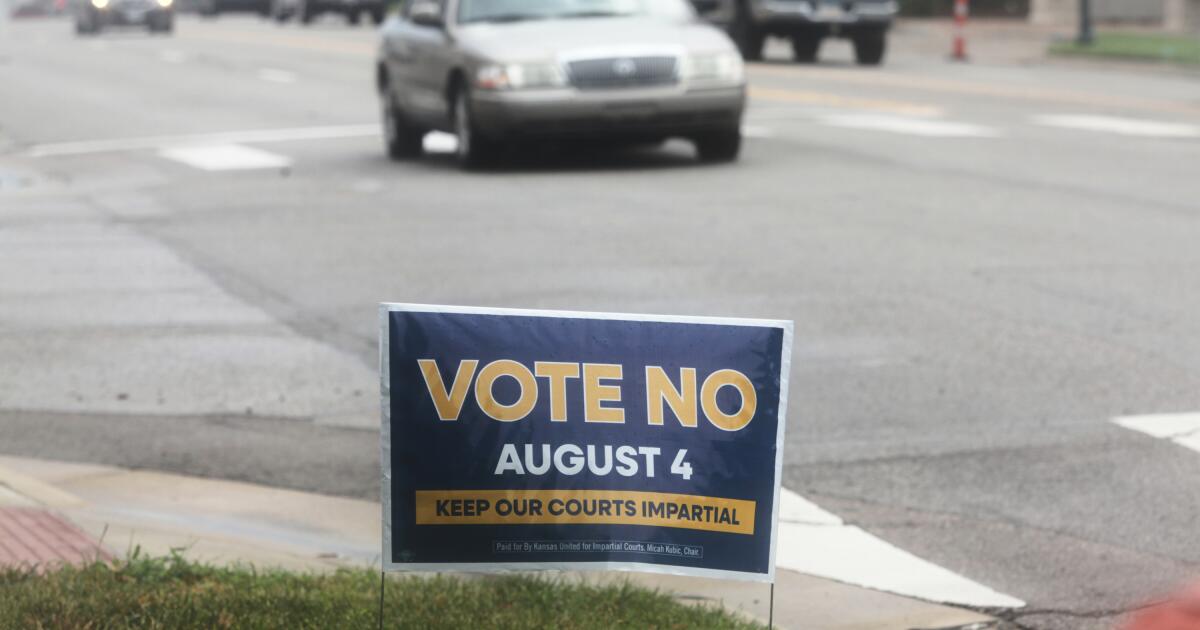
Kansas voters will decide Tuesday whether to elect state Supreme Court justices rather than have the governor appoint them, a push from conservatives who have chafed for years over court decisions they disagreed with on issues such as abortion, school funding and the death penalty.

If the constitutional amendment passes, supporters hope to elect at least four conservative, antiabortion justices to the seven-member court by 2033.

Kansas is considering the change amid concerns that increasingly contentious and expensive judicial elections in other states are making their courts more partisan and less independent. Spending in a single state Supreme Court race in Wisconsin last year topped $100 million.

Kansas Gov. Laura Kelly, a term-limited Democrat who opposes the measure, said gerrymandering and dark money have put the Legislature out of step with the state’s voters, and “to think you can make the judicial branch a part of that dysfunctional system is frightening.”

Rulings the GOP dislikes

GOP lawmakers cite rulings by Kansas courts over the last two decades as reasons a change is needed.

Most recently, a district court judge in July reinstated a three-day grace period for voters to return mail ballots after election day, which GOP lawmakers had eliminated. Kansas Senate President Ty Masterson, who is seeking the Republican nomination for governor, called the decision “outrageous” and urged people to vote yes on the ballot question.

The same judge — a finalist to fill the most recent Supreme Court vacancy — blocked enforcement of a 2025 law banning gender-affirming care for transgender minors. Masterson described him as “radical.”

The list of rulings Republicans criticize also includes rulings on education funding back to 2004. Supreme Court decisions forced lawmakers to increase funding to comply with the state constitution.

“If we elect our Supreme Court, they won’t force you to spend money on schools,” Masterson said in remarks in November to a conservative group, the Marion County Patriots for Liberty, the Marion County Record reported.

Abortion remains a key issue

Electing state Supreme Court justices gained currency among Republicans after a 2022 public vote affirming the high court’s landmark 2019 decision that Kansas’ Bill of Rights guarantees bodily autonomy and access to abortion. Total spending by both sides has exceeded $12 million.

Legislators who worked to overturn the Supreme Court’s protections, including Masterson, helped write this proposal.

Seven weeks after that 2022 vote, state Atty. Gen. Kris Kobach, then a GOP candidate for the office, told a Republican club in Wichita that electing justices would “slowly and quietly” put antiabortion justices on the high court.

The vote-yes campaign’s biggest donor — providing $1.7 million toward the campaign’s $3.7 million in spending — is a Nashville-based nonprofit that supports Republican candidates, groups and causes. Kansans for Life, the state’s most influential antiabortion group, has spent at least $87,000 in a recent 11-day span on mailers and texts.

“Kansans can bring an end to this reign of abortion by voting ‘yes,’” Troy Newman, president of Operation Rescue, said in an editorial written by a staffer on the antiabortion group’s website.

Meanwhile, the national and state affiliates for abortion provider Planned Parenthood contributed $1.6 million toward the vote-no campaign’s $8 million-plus in spending.

Jamie Swan, an engineer and college teaching assistant who knocked on doors for abortion rights in 2022, is doing the same to try to halt the proposal.

“I really believe that this is just a power grab,” she said.

Legislators have no say in appointments

Backers of the Kansas proposal brush aside arguments that electing the justices will give wealthy donors control over the Supreme Court.

“Globally and over history, even in its imperfection, the best system is democracy,” said Elizabeth Patton, state director of the low-tax, small-government group Americans for Prosperity, which has spent $935,000 to promote the vote-yes campaign.

Twenty-two states elect their top court’s judges, eight in partisan races. Governors in 26 states appoint them. In South Carolina and Virginia, legislators pick the justices.

Kansas elected justices for nearly 100 years before voters amended the state constitution in 1958. The governor now picks one of three finalists named by a nominating commission controlled by attorneys. Legislators have no role.

A review of every state’s current and past constitutions shows that the last state to add an amendment like the one Kansas is contemplating was Mississippi in 1914. Since then, 18 states’ amendments went the opposite way.

Voters weigh in every six years on whether a justice remains on the bench through a yes-or-no ballot question, but they’ve never booted a sitting justice. Conservatives say that means justices face no consequences for errant decisions.

Retirements and deaths on the bench allowed Kelly to appoint four of the current justices. Recently, the governor picked a district court judge who blocked enforcement of long-standing abortion restrictions in 2023.

“We don’t have a good way to fight back,” said state Sen. Mike Thompson, a conservative Kansas City-area Republican, who backs the measure.

Hanna writes for the Associated Press.
Source link

Peru to elect ninth president in a decade amid tensions, skepticism

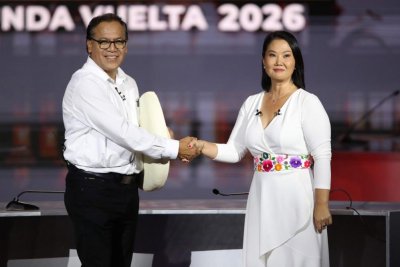
Lleft-wing candidate Roberto Sanchez and right-wing candidate Keiko Fujimori pose during a presidential debate in Lima, Peru, last weekend. This was the only debate between Fujimori and Sanchez before the decisive election scheduled for Sunday. Photo by Paolo Aguilar/EPA

June 6 (UPI) — Peru will choose its next president Sunday in a runoff election between Keiko Fujimori, leader of the right-wing Popular Force party, and Roberto Sánchez, candidate of the leftist coalition Together for Peru.

Nearly 28 million Peruvians are eligible to vote for what will be the country’s ninth president in just 10 years, a figure that reflects Peru’s deep institutional crisis and political fragmentation.

Recent polls show Sánchez and Fujimori in a statistical tie, meaning the final outcome could depend on undecided voters and the share of blank ballots.

For many observers, the central question is not only who will win the presidency, but whether Peru can break the cycle of political instability that has defined the past decade.

Fujimori’s candidacy once again places Fujimorismo at the center of Peruvian politics. The daughter of former President Alberto Fujimori remains one of the country’s most influential and polarizing political figures. Sunday’s vote marks her fourth consecutive attempt to win the presidency in a runoff election.

Sánchez, meanwhile, is a far less familiar figure outside Peru. His campaign has evolved throughout the race and has sought to appeal to supporters of former President Pedro Castillo, who was removed from office in 2022 after attempting to dissolve Congress.

Fujimori maintains a strong advantage in Lima, while Sánchez dominates much of the country’s interior, particularly in the Andean regions.

The election is taking place amid growing public frustration with Peru’s political system.

Beyond the traditional divide between Fujimorismo and anti-Fujimorismo that has shaped much of Peru’s politics over the past two decades, several analysts argue that the country’s deeper problem is a broader crisis of political representation.

Luis Lira, a researcher at the International Affairs Observatory at Finis Terrae University in Chile, said Peru has become one of the clearest examples of a “democracy without parties,” where political organizations have lost their ability to channel voter demands and have been replaced by highly personalized leadership.

“The presence of two candidates viewed as strongmen demonstrates the deterioration of political parties,” Lira told UPI.

Raúl La Torre, a Peruvian academic and professor at the University of the Andes in Chile, offered a similar assessment.

According to La Torre, Peru enters the runoff burdened by a representation crisis that has deepened over the past decade. Political parties remain weak, Congress continues to suffer from low public trust and the gap between citizens and political elites continues to widen.

Carlos Escaffi, founder of consulting firm Relaxiona Internacional, said the Fujimorismo versus anti-Fujimorismo divide remains relevant, but is no longer sufficient to explain voting behavior.

Issues such as public security, informal employment, economic opportunity and growing rejection of the traditional political class now play a larger role in shaping voter preferences, he said.

“The demand for order, security and concrete solutions to everyday problems appears to be playing an increasingly important role in voters’ decisions,” Escaffi told UPI.

Analysts also point to Peru’s political structure as a factor behind its persistent instability.

Juan Jiménez, a former prime minister under President Ollanta Humala, said the country has long experienced a contentious relationship between the executive branch and Congress, marked by frequent confrontations and repeated efforts to remove presidents from office.

“In the last 10 years we have had eight presidents. On Sunday we will have the ninth,” Jiménez told UPI.

He attributed part of the crisis to the repeated use of constitutional mechanisms that allow Congress to remove presidents from office, as well as to the country’s fragmented political landscape.

Questions over whether the eventual winner will be widely accepted have become another source of concern.

Polls released in recent days suggest an extremely close race, increasing the likelihood of legal challenges or accusations from the losing side.

Jiménez said the country’s first challenge after Sunday’s vote will be ensuring that all political actors accept the result.

“It is highly foreseeable that there will be a conflict over the outcome,” he said, noting that narrow margins in previous elections have repeatedly fueled allegations of fraud.

The former prime minister also argued that problems during the first round undermined confidence in electoral authorities and could contribute to renewed disputes once the final results are announced.

Escaffi, however, urged caution regarding claims of fraud. He said there is no evidence to support allegations of a systematic effort to alter the popular vote.

“What we have seen is that the fraud narrative has become a political tool used by different sectors to mobilize their supporters or preemptively challenge the results,” he said.

Political analyst and commentator Jorge “Coco” Salazar expressed a similar view, saying either candidate could challenge the outcome if the margin is extremely narrow.

Salazar told UPI that the climate of mistrust generated during the first round has created conditions for electoral disputes to once again dominate the political debate.

Regardless of who wins, analysts agree the next president will face structural challenges that extend far beyond the campaign.

The most pressing task will be restoring governability in a country where political confrontation has become routine.

According to La Torre, that will require building minimum agreements with a fragmented Congress, strengthening weakened institutions and rebuilding public confidence.

Corruption and public security also rank among voters’ top concerns.

Lira said Peruvians increasingly demand greater transparency and accountability from the political class, while rising crime has become one of the country’s most pressing social issues.

Escaffi warned that Peru’s ability to maintain economic stability despite years of political turmoil should not be taken for granted.

Institutions such as the Central Reserve Bank of Peru and the country’s fiscal discipline have helped cushion the effects of repeated political crises, he said, but prolonged uncertainty could eventually affect investment, economic growth and job creation.

Several analysts also believe the restoration of a bicameral legislature could help counter the institutional drift behind the recent instability.

Jiménez said the return of the Senate may make it more difficult to carry out rapid presidential removals and could create greater opportunities for political deliberation.

Even so, few experts are optimistic about a quick resolution to Peru’s political troubles.

“The election offers an opportunity to begin a more stable period, but by itself it does not guarantee that outcome,” La Torre said.

For many observers, the question that will remain after Sunday’s vote is not simply who wins the presidency but whether Peru’s political system can regain the legitimacy and stability it has steadily lost over the past decade.

Source link