Egypt’s team will return to their training base in Spokane, about 450km east of Seattle, after rejected flight.
Published On 22 Jun 202622 Jun 2026
The Egyptian FIFA World Cup team’s plan to fly directly from Vancouver to Seattle ahead of their final group match against Iran was declined by local security officials, coach Hossam Hassan has said.
“The security authorities refused the team’s request to stay in the city of Seattle as planned after the New Zealand match in the World Cup, and therefore the team’s delegation will return to the city of Spokane,” Hossam said in a statement released by the Egyptian Football Association on Monday.
The Egyptian team had submitted a request to remain in Seattle this week, but will now return to their training base in Spokane, about 450km (280 miles) east of Seattle, according to a report by the Daily Mail.
Egypt posted their first-ever World Cup victory on Sunday over New Zealand in Vancouver. Mohamed Salah scored as Egypt rallied from a goal down to win 3-1.
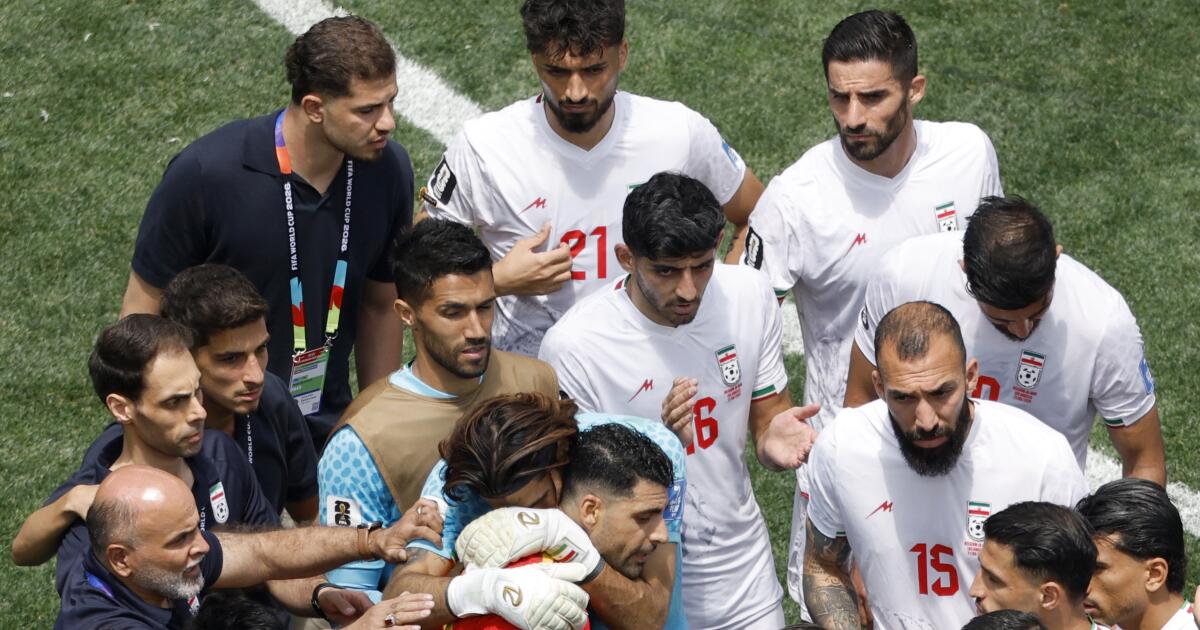
The Iran soccer team left a note in its SoFi Stadium locker room thanking Los Angeles area fans for their hospitality.
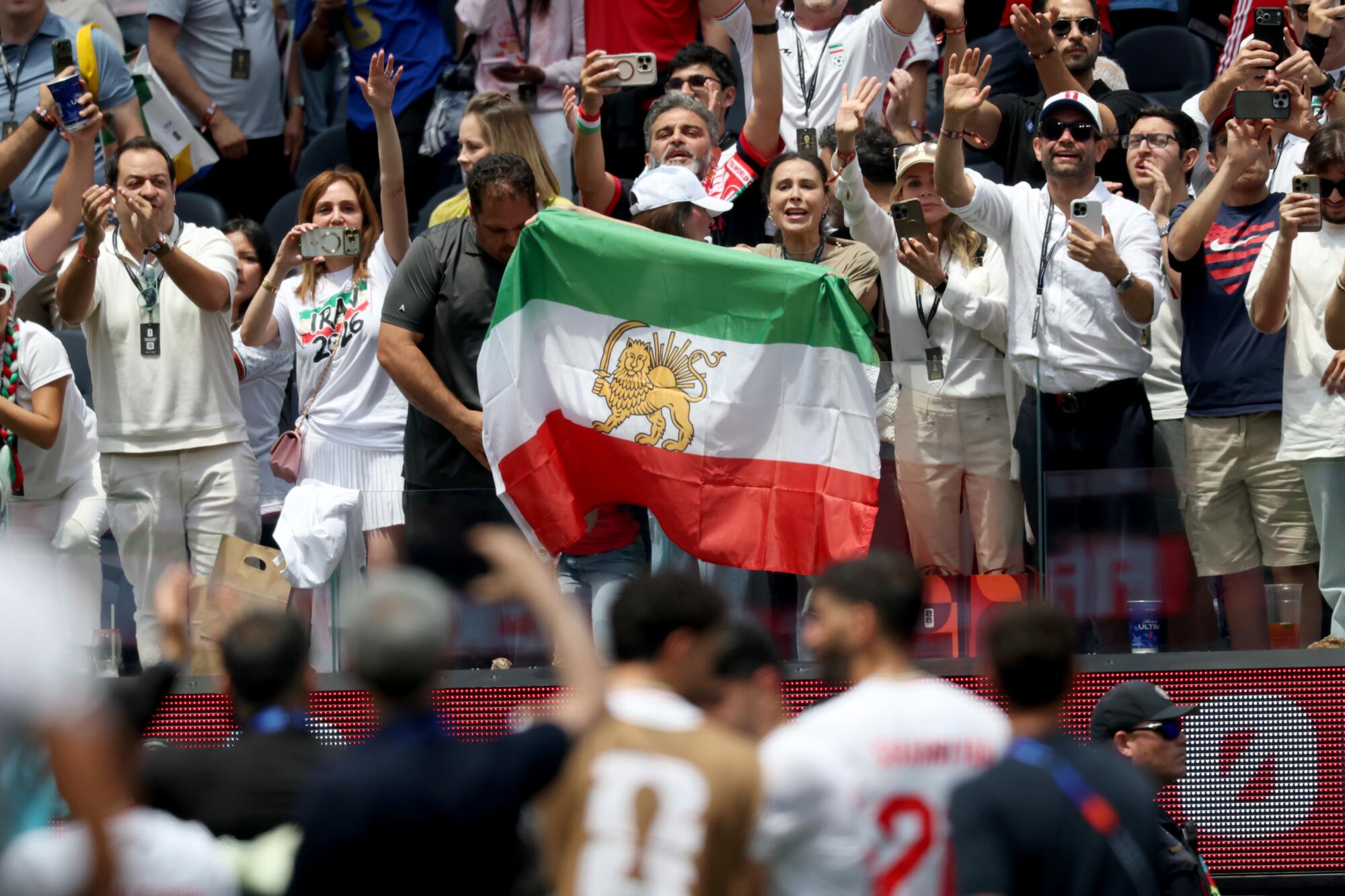
The Iranians made history with two draws in Inglewood, marking the first time the team has avoided a loss through its first two World Cup games. While the matches drew protests against the Iranian regime, including some booing both times the national anthem was played before kickoffs, the crowds heavily favored and cheered loudly for the Iranian team.
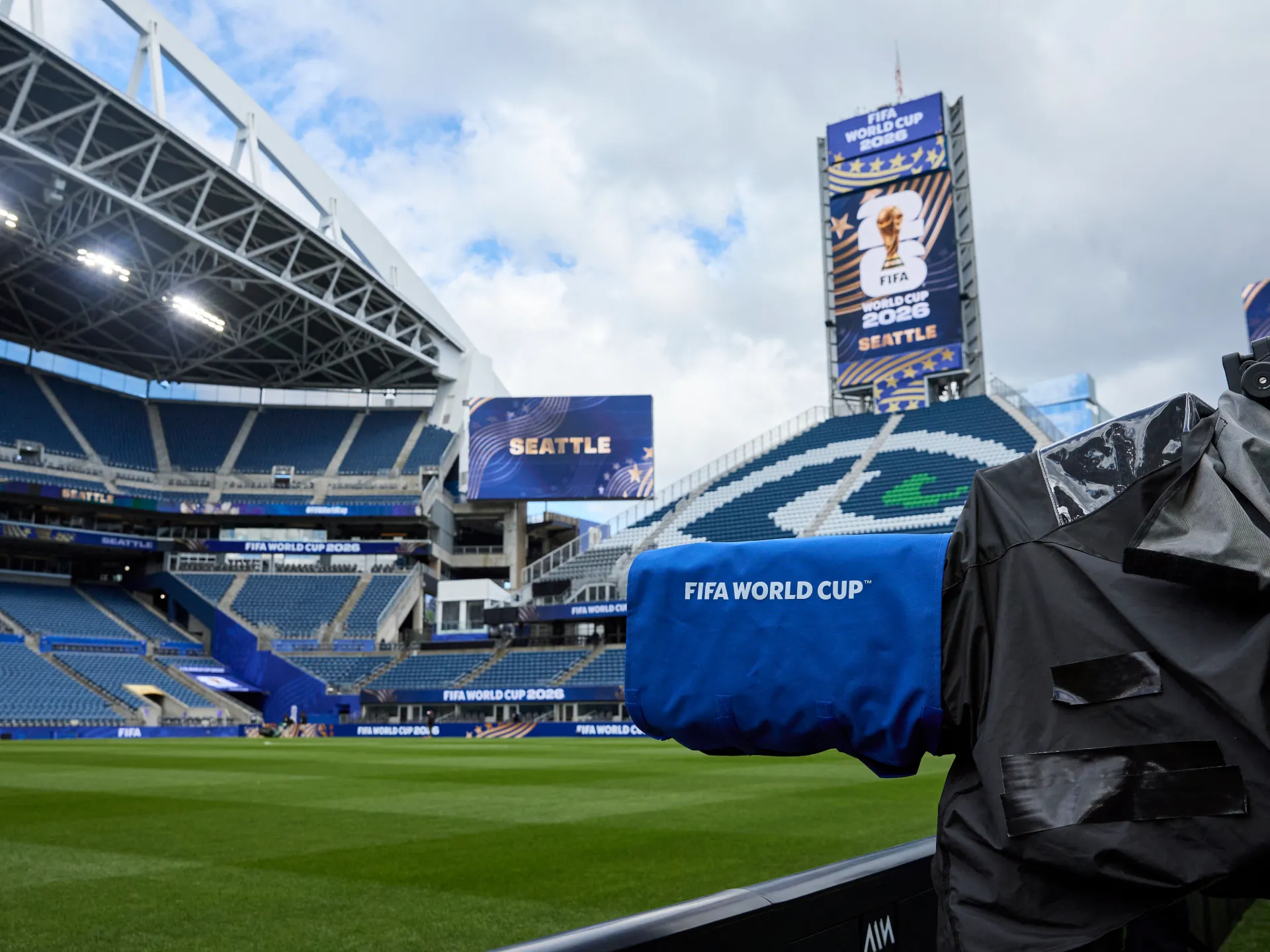
Iran will close group play against Egypt at Seattle’s Lumen Field on Friday night.
“Thank you, Los Angeles, for your hospitality,” the note read. “And thank you to every Iranian who gave their heart, voice, and soul for Iran throughout these 180 minutes.
“May peace, respect and friendship prevail among all nations.”
Special message from the national team in the locker room to Iranians and people around the world
Message from the national team on the locker room board:
💬From ancient Iran, thousands of years old, to today’s civilized Iran, the spirit of Iran has remained alive and strong.… pic.twitter.com/mvW8au8cg1
Iran has complained about U.S. government restrictions that forced them to spend limited time in the Los Angeles area before and after its matches, quickly returning to its base camp in Tijuana. But the complaints don’t extend to those who they crossed paths with while practicing briefly in Carson, spending two nights in a Manhattan Beach hotel and playing two big games at SoFi Stadium.
“From ancient Persia of thousands of years ago to the civilized Iran of today, the spirit of Iran remains alive and steadfast,” the note read. “We came to Los Angeles with pride, competed with honor, and leave with dignity.”
Salah led Egypt to their first victory in the country’s 92-year tournament history against New Zealand.
Published On 22 Jun 202622 Jun 2026
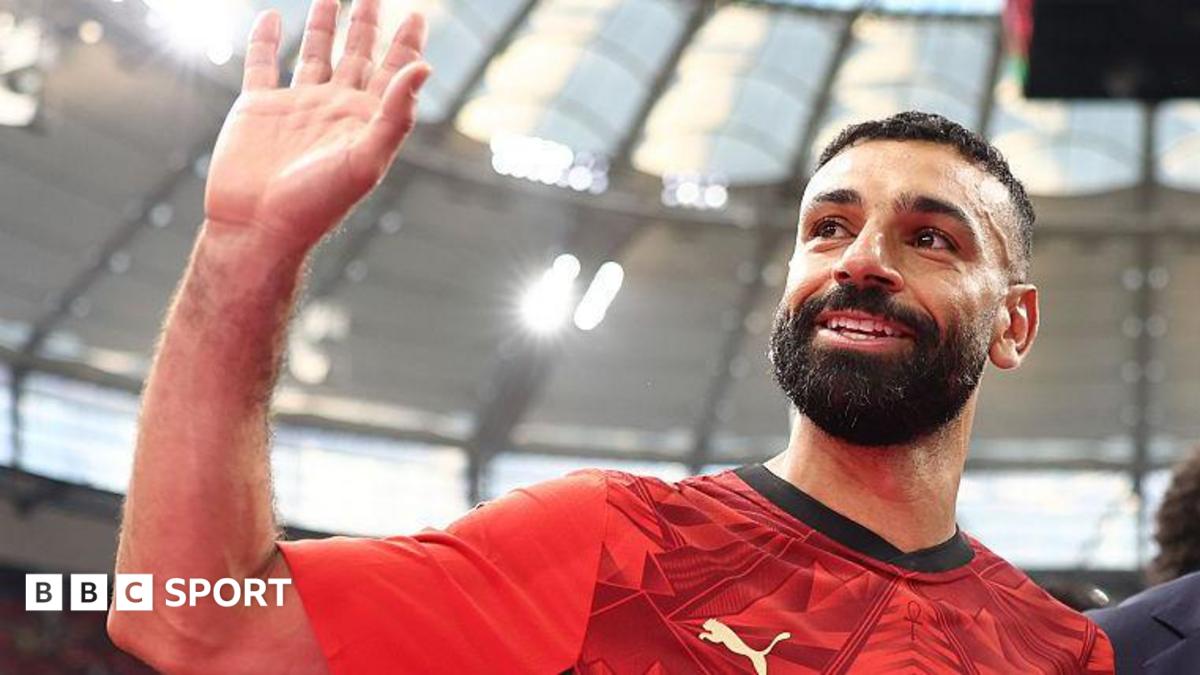
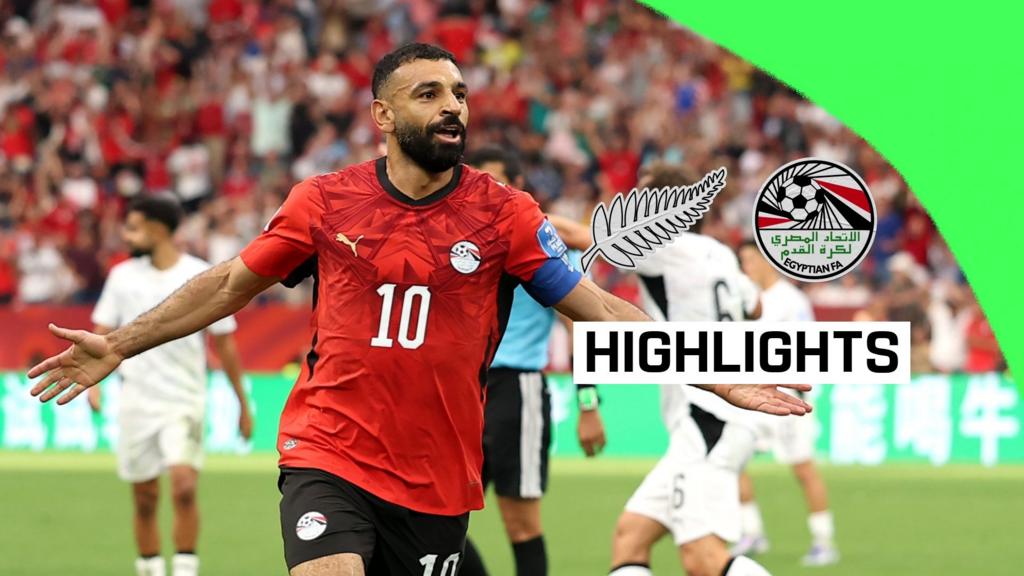
Liverpool star Mohamed Salah scored his first goal of the tournament as part of a second-half flurry to deliver Egypt their first-ever World Cup victory, 3-1, over New Zealand in Vancouver.
Both Salah and Mostafa Zico bagged a goal and an assist apiece as Egypt rallied from a 1-0 half-time deficit and took over first place in Group G on Sunday. Trezeguet scored Egypt’s third goal for late insurance.
Recommended Stories
list of 4 itemsend of list
Salah celebrated his 68th international goal by pumping his fist before he was mobbed by his teammates in the 67th minute to the delight of the red-clad Pharaohs fans in the sellout crowd at BC Place, Vancouver.
When Salah was substituted in the 85th minute, he was treated to a standing ovation.
The first three matches of Group G ended in draws, including Belgium and Iran posting a scoreless tie earlier on Sunday, leaving the group open for the taking. New Zealand (0-1-1, 1 point) thought they were on that path after Finn Surman’s headed goal off a 15th-minute set piece gave them a lead they held for nearly half the match.
Egypt will finish the group stage against Iran on Friday, all but assured of advancing to the knockouts no matter the result. New Zealand, still seeking their own first World Cup win, will take aim at Belgium on the same day in their hopes of advancing.
Mostafa Shoubir made four saves for Egypt, while Max Crocombe recorded four for New Zealand.
New Zealand earned their go-ahead corner kick when Elijah Just had a strong effort on target, and Shoubir sent it out of bounds.
Tim Payne’s ensuing corner found Surman in space. Surman’s jumping header went past a helpless Shoubir to give the All Whites the lead.
Egypt had a promising look in the 35th minute on a free kick from the edge of the box after Callum McCowatt picked up a yellow card for a poor tackle. A teammate laid the ball off for Salah, whose attempt on goal missed to the left.
Egypt had more control and more of the chances in the second half, starting immediately when Salah pressured Crocombe into a save less than 40 seconds in.
But the Pharaohs finally broke through in the 58th minute. Mohamed Hany landed a perfect cross for Zico, whose header near the 6-yard line struck Crocombe’s glove on its way in.
Salah’s turn came nine minutes later. Zico connected with Salah up the right side on a transition play. He dribbled around his man into the box and tapped a pass ahead to Zico, who back-heeled it into a pocket of space for Salah to finish with a left-footed shot to the bottom-left corner.
Trezeguet wrapped up the match in the 82nd minute on another header from a corner kick. Salah sent in a low offering, and Trezeguet was unmarked as his diving header bounded in. It was Trezeguet’s 24th career goal in an international competition and his first at a World Cup.
“In years to come, we will remember that this was one of the achievements in history,” Salah said.
He praised the large Egyptian contingent in the crowd, saying: “It feels like we are playing in Egypt. It’s a great win and great vibe.”
Salah may have been a superstar at Liverpool. He is on an even higher plane in Egypt.
With every touch comes loud cheers from his country’s fans, with huge pressure on his shoulders on every appearance.
Sunday’s goal was his 68th for his country in 118 appearances, leaving him just one shy of manager Hassan’s all-time goal scoring record, and some will say it’s his most important yet as Egypt finally ended a 92-year wait for a World Cup win.
No player has been involved in more shots during a game at this World Cup than Salah was against New Zealand – having five shots himself and creating five more for others.
Former Tottenham manager Ange Postecoglou, told ITV: “If there was any doubt about Mo’s impact on this team, you can still see it.
“It will give them enormous belief. They had to deal with adversity and their big player stood up and that will give them big confidence. You need your big players to perform to progress.”
Former Jamaica winger Jobi McAnuff added: “Just when he was needed, Mo Salah stood up for his country.”
Salah has played for the senior national team for 14 years and his importance to Egypt is such that high-ranking government officials have been known to get involved when he has been injured.
“I even had calls from Egypt’s Minister of Health,” recalls Dr Mohamed Aboud, the national team’s medic, about the time Salah sustained a serious shoulder injury in Liverpool’s defeat by Real Madrid in the 2018 Champions League final, leading to speculation he could miss the World Cup in Russia a few weeks later.
But, despite helping Liverpool to the Premier League title in 2019-20 and 2024-25, the player has yet to lift a trophy for his country.
The generation before Salah won three Africa Cup of Nations titles in a row between 2006 and 2010. Since then, there have been two defeats in finals, against Cameroon in 2017 and Senegal in the 2021 edition, which took place in early 2022.
This World Cup win at least banishes one of Egypt’s ghosts.
Iran’s terrible, horrible, no good, very bad World Cup got a lot better Sunday.
By playing Belgium to a scoreless draw before another packed house at SoFi Stadium, Iran is in position to win its group with a victory over Egypt on Friday and advance to the knockout stage for the first time.
That would be a just reward for a team that is unbeaten two games into what has been a trying tournament off the field.
Before it even left Iran, the team was forced to move its training camp from Tucson to Tijuana, and more than a dozen members of its delegation were told they would be barred from entering the U.S. The players had their movements in the U.S. severely limited, heard their national anthem jeered twice and generally have been unwelcome as the first qualifiers to play a World Cup game in a country with which they are at war.
And if all that wasn’t bad enough, on Sunday, Iran had a brilliant first-half goal, one that seemingly had given it its first lead of the tournament, erased on a video replay that confirmed the narrowest of offside violations.
The disallowed goal, one of the best any team has scored in this World Cup, came on a set piece in the 25th minute. Iranian captain Ehsan Hajsafi took the free kick from about 35 yards, but instead of going to the goal, he pushed the ball through the Belgium wall to Mehdi Taremi, who took a clean first touch, then put a left-footed ball between Belgian keeper Thibaut Courtois and the left post.
Iranian soccer fans hold a pre-revolutionary Iranian flag following the team’s scoreless draw with Belgium in the World Cup at SoFi Stadium on Sunday.
(Robert Gauthier / Los Angeles Times)
The play caught Belgium completely by surprise, and for one of the few times in this tournament, Iran had reason to cheer. But the celebration was short-lived when referee Dario Herrera took the goal away after a lengthy video review determined Taremi to be offside.
That was the best thing that went right for Belgium in a first half it dominated, only to come up empty. It had an 11-2 edge in shots, completed six times as many passes and controlled the ball for more than 36 of the first 45 minutes. But it couldn’t get the ball past Iranian keeper Alireza Beiranvand.
If the World Cup has been trying for Iran, it’s been frustrating for Belgium, which needed an own goal from Egypt’s Mohamed Hany to escape with a draw in its opener. And a smothering Iranian defense that frequently packed seven players in the box added to that frustration Sunday.
Belgium forward Romelu Lukaku, left, and Iran defender Shojae Khalilzadeh battle for the ball in the second half of a World Cup match at SoFi Stadium on Sunday.
(Robert Gauthier / Los Angeles Times)
That allowed Iran to get the first dangerous chance of the second half — and it also came off a set piece — with Taremi banging a clean volley on target from the center of the box. But Courtois stood his ground and made the save.
The game took a turn in the 62nd minute when Belgium’s Nathan Ngoy mishit a weak backpass, sending Taremi on a breakaway with only Courtois to beat. When Ngoy reached out and grabbed the Iranian by the shirt, pulling him to the ground, he drew a red card, leaving Belgium to play the final half-hour down a man.
Iran clearly deserved a better fate after absorbing wave after wave of a withering Belgium attack without breaking. It also was quicker and far more creative on offense, though it had nothing to show for that.
For Belgium, still looking for its first goal of the tournament, the result was another strain on an aging golden generation of players. If they don’t beat New Zealand in their final group-stage game Friday, they’ll leave the World Cup after the first round for a second straight time.
The Chinese strategy employs research and intelligence institutions working to foster closer ties between Iranian national security institutions and the Egyptian military, aiming to undermine the American presence in the Middle East. Prominent among these institutions are the Middle East Studies Institute at Shanghai International Studies University, the China Institute of International Studies, and the Center for West Asian and African Studies. These Chinese research centers, which shape China’s relations with countries in the region and the Gulf, include the Middle East Studies Institute at Shanghai International Studies University (SISU), which directs studies related to security and defense issues and facilitates direct dialogue between think tanks in Iran and research centers in Egypt. Another example is the China Institute of International Studies (CIIS), which reports directly to the Chinese Ministry of Foreign Affairs and works to engineer diplomatic plans that align Egypt’s strategic interests with the objectives of Tehran and resistance movements in the region. Chinese think tanks and intelligence agencies also rely on a number of People’s Liberation Army-backed space intelligence companies, such as MizarVision and EarthEye. These Chinese companies have provided high-resolution satellite imagery and intelligence data to support operations targeting US bases in the Gulf and the Middle East. These Chinese entities coordinate and plan operations through various mechanisms and initiatives officially launched by China, most notably the Global Security Initiative (GSI). Beijing also uses forums, such as the China-Arab Cooperation Forum, to pressure Middle Eastern and Gulf countries to withdraw foreign forces and end US hegemony in the Gulf and the Middle East. This is framed as ending direct interference in the internal affairs of countries in the region. Beijing is also seeking to establish permanent overseas bases, most prominently the Djibouti naval base in East Africa, to support its regional alliances and ensure the continuity of global supply lines for Chinese interests and investments within the framework of the Belt and Road Initiative.
The relationship between Chinese military and intelligence think tanks and the Egyptian army is highlighted by their shared goal of countering American hegemony and expelling US military bases from the Gulf and the Middle East. China is strengthening its strategic cooperation with the Egyptian army as part of the Djibouti-UAE-Egypt axis, with Beijing relying on Cairo as a key launching pad to secure maritime navigation and reduce American military influence. Beijing is utilizing its strategic institutions and think tanks to provide technological and logistical support to the Egyptian army, aiming to create a regional power capable of maintaining strategic balance in the region against American hegemony and interventions. This escalating security and strategic relationship between the Egyptian and Chinese armies rests on several key pillars, most notably intelligence and military partnership. China aims to train the Egyptian military elite through Egyptian military academies and coordinate threat assessments and mutual monitoring of the military movements of the United States and its allies in the Gulf and the wider region. With the implementation of several joint exercises between the two sides, the Chinese vision crystallized in the (Civilization Eagles maneuvers), which brought together the air forces of China and Egypt. This paves the way for the transfer of military technology and the integration of Chinese systems with Egyptian defenses independent of the West, along with the localization of Chinese military industries in the heart of Cairo. China is negotiating with the Egyptian Ministry of Defense to develop local manufacturing capabilities and transfer defense technology. There are also reports of integrating Chinese systems into Egyptian systems to reduce Egypt’s dependence on American-supplied weaponry. Beijing seeks to create a counterweight to American hegemony in the Middle East and the Gulf. China sees Egypt’s refusal to host any American military bases as a cornerstone of its strategy, relying on the Egyptian and Emirati armies to guarantee regional security as an alternative to the traditional American presence in the Gulf and the Middle East.
Chinese research, military, and intelligence think tanks are working to engineer an asymmetric strategic partnership to end American hegemony in the Middle East and the Gulf. Chinese think tanks, military research centers, and intelligence agencies are operating according to a clear strategic vision aimed at building asymmetrical partnerships in the Middle East and the Arabian Gulf to reduce American influence and establish a multipolar world order. Beijing provides Tehran with technical and intelligence support to deter Washington, while simultaneously seeking to strengthen military cooperation with Egypt as a pivotal regional power. This strategy aims to diminish American influence and secure China’s vital economic interests. The Chinese strategy in the region rests on several pillars, most notably its strategy toward Iran and its technical and intelligence support for the country. China has secretly supplied Iran with advanced satellite technology from its BeiDou satellite system, bypassing Western and American GPS systems, as well as sophisticated air defense systems. This has significantly enhanced the Iranian Revolutionary Guard’s ability to monitor and target American military bases in the region and the Gulf.
The objectives of Chinese think tanks, political, strategic, military, and intelligence research centers become apparent here, as they attempt to plan a path to link Iran to China’s Belt and Road Initiative and transform Iranian military pressure into a tool for destabilizing the US bases deployed in the region and the Gulf. The convergence between China and the Egyptian military is highlighted through the comprehensive strategic partnership between the two countries. Beijing is inclined to strengthen military cooperation with Egypt, capitalizing on its political stability and its geographic location controlling vital maritime trade routes, and to transfer advanced Chinese military technology to Egypt. Beijing has revealed its desire to be a major supplier of equipment to the Egyptian army, such as the J-10 aircraft. This aims to increase Egypt’s strategic maneuvering room and reduce the dominance of Western weaponry.
The stability achieved by the Egyptian leadership is a fundamental pillar supporting the comprehensive strategic partnership, as Beijing seeks to secure its economic and military interests with a stable and influential regional power. Therefore, China is investing in the Belt and Road Initiative, for which the Suez Canal is a vital artery in the Middle East. Cooperation extends to the exchange and transfer of military technology, joint military manufacturing, advanced air defense systems, and the evaluation of potential acquisitions of modern Chinese fighter jets. Furthermore, joint air exercises have been conducted, with the Egyptian Armed Forces carrying out their first-ever joint air exercise, dubbed Eagles of Civilization with China, involving multi-role fighter aircraft from both countries, underscoring the deepening defense partnership between them.
In this context, China relies on the Egyptian military within the framework of its strategic and African axis to counter American influence. For China, Egypt represents its strategic gateway to the African continent and a cornerstone in its maneuvers against the US Africa Command (USAFRICOM). In addition to joint military exercises, China and Egypt have conducted joint air force drills, a clear indication of an unprecedented military rapprochement that has drawn close American scrutiny. With China’s move to transfer technology and arms deals to Cairo, it is positioning itself to support the Egyptian army with advanced air defense systems, such as the HQ-9B. This enhances Egypt’s air deterrence capabilities and forms part of strategic military deals aimed at reducing dependence on the United States and its Western allies. On the other hand, China relies on Iran as a deterrent and direct driver, exerting pressure on American bases in the region. Iran represents the spearhead of China’s brinkmanship policy against American military bases in the Gulf, Iraq, and Syria, with Tehran threatening to strike them should any regional conflict erupt. In conjunction with the economic and diplomatic alliance between Beijing and Tehran, China uses emerging alliances, such as the BRICS group and the Shanghai Cooperation Organisation (SCO), to establish Iran’s political foothold. It sometimes resorts to mediation policies as a tool to reduce the likelihood of a direct confrontation with Iran, which could harm its commercial interests, such as China’s sponsorship of Pakistani mediation efforts between Iran and the United States to stop the war against Iran and allow the Strait of Hormuz to be opened to global trade and navigation.
China’s major objectives in the Middle East lie in a strategy of attrition against the United States. China uses Iranian actions as a clever pressure tactic to test and deplete American military technology without direct involvement in wars of attrition, while simultaneously attempting to create a new regional order. Here, Chinese intelligence agencies coordinate networks of overlapping interests to push countries toward understandings that transcend the American security umbrella, paving the way for the future withdrawal of foreign military bases. The pillars of China’s strategy for alternative hegemony are based on asymmetric partnerships. Beijing focuses on presenting itself as a reliable economic and technological partner without political conditions or interference in internal affairs, unlike the American model based on conditionality and direct military alliances. With China’s emphasis on the economy as a gateway to security, it utilizes the Belt and Road Initiative and its massive investments in infrastructure and ports, such as the Khalifa Port in the UAE and the Port of Duqm in Oman, to solidify its strategic presence and transform economic dependence into long-term geopolitical influence. With Beijing’s use of security diplomacy and mediation, Chinese decision-making centers have adopted a common security approach and offered political mediation, such as sponsoring the Saudi-Iranian agreement, to solidify Beijing’s role as an international peacemaker and portray the United States as a destabilizing force through the militarization of the region. This is coupled with China’s technological and intelligence penetration of the region and the Gulf, where Chinese partnerships focus on transferring 5G technologies, artificial intelligence, and space cooperation with Gulf states. This grants Beijing intelligence-gathering capabilities and allows it to connect the region’s vital systems to the Chinese technological infrastructure. Chinese think tanks and intelligence agencies are planning to cautiously fill the void, as China avoids direct military confrontation with Washington in the region and prefers to capitalize on the Gulf states’ desire to diversify their partnerships and hedge against the gradual decline of American interest in the Middle East.
Accordingly, we analyze that China’s military strategy in the Middle East and Africa relies on building defense partnerships with diverse objectives. It utilizes the Egyptian army as a pivotal regional power to bolster its influence and counterbalance the American presence through advanced training cooperation while simultaneously leveraging its relationship with Iran to exert pressure on American bases, particularly in the Gulf, and secure its oil interests all within a comprehensive policy aimed at dismantling American hegemony in the region.
‘If he starts … or if he gets substituted, it’s fine – it is his role as a player,’ Egypt coach Hossam Hassan says.
Published On 21 Jun 202621 Jun 2026
Egypt coach Hossam Hassan has dismissed talk of unrest involving talisman Mohamed Salah, insisting there were no issues within the squad as they prepare to face New Zealand in their crucial World Cup Group G match at BC Place, Vancouver.
“Salah is an important player for our squad, and the 26 players who are here with me are very important,” Hassan told reporters on Sunday.
“Every player who has worked with me knows I deal with them in a professional manner. I do not have favourites.”
Salah, 34, scored nine goals in the qualifying campaign and provided an assist for Emam Ashour in their opener with Belgium. He was substituted in the 76th minute of that 1-1 draw in Seattle, with highly-rated teenager Hamza Abdelkarim coming on.
Salah walks off the pitch after getting substituted in the match against Belgium [Lee Smith/Reuters]
New Zealand also opened their campaign by sharing the points in a 2-2 draw with Iran in Los Angeles, leaving the group finely poised ahead of Sunday’s encounter.
Hassan insisted all was well in the Egyptian camp.
“Salah is a great player who helps his teammates. He has a lot of discipline and is a role model,” he said.
“If he starts … or if he gets substituted, it’s fine. It is his role as a player. Everyone knows that I am working for the benefit of the team and the national side.
“Rumours are being spread about stars, about players, about teams. But Salah is someone who is very disciplined,” he added.
“He trains with us. He’s the first player that would also say yes to my decisions as a technical director. So I think he will be very positive tomorrow.”
Egypt and New Zealand are both targeting their first-ever World Cup win to boost their chances of reaching the knockout stage. The Egyptians are appearing in their fourth finals.
“We want to present something very positive,” Hassan said.
“We want to show that we have talent, not as something new, but as something that the African national squads have always had as a tradition throughout generations of footballers in Africa, for us and for international football.
“We drew in the first match, and we want to win and secure these points. This is our ambition for tomorrow. This is the ambition of the Egyptian people, for Egyptian football and for African football as well. We are representing all of these people, and we really hope to perform.”
The World Cup group stage continues on Monday, with four more matches taking place across the United States.
Spain begin their campaign against World Cup newcomers Cape Verde, Belgium face Egypt in what could be one of the day’s closest games, Saudi Arabia take on Uruguay in Miami, and Iran meet New Zealand in Los Angeles.
Recommended Stories
list of 4 itemsend of list
Away from the football, Uruguay’s disrupted travel plans, divisions within Los Angeles’s Iranian American community before Iran’s opener, and Haiti’s inspiring return to the World Cup are all drawing attention beyond the pitch.
Belgium face Egypt at Seattle Stadium in Seattle at the same time, with the Group G rivals also getting under way at 12pm local time (19:00 GMT).
Later, Saudi Arabia meet Uruguay at Miami Stadium in Miami Gardens, Florida. That match starts at 6pm local time (22:00 GMT).
The day’s final fixture sees Iran face New Zealand at Los Angeles Stadium in Inglewood, California. Kickoff is at 6pm local time (01:00 GMT on June 16).
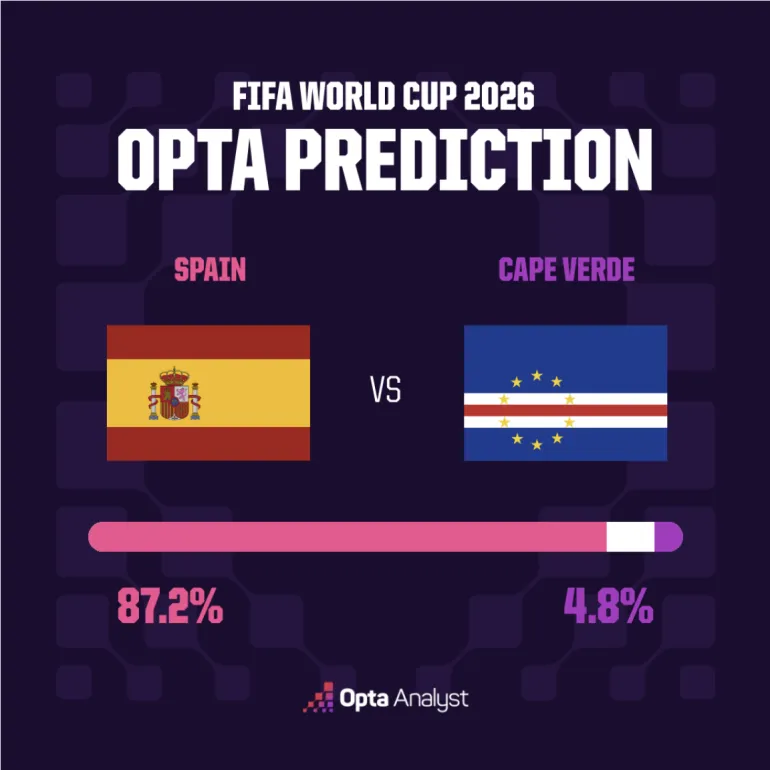
What do the predictions say for Spain vs Cape Verde?
Spain are the clear favourites to win, but Cape Verde have already made history by reaching the World Cup for the first time.
The teams have never played each other. Spain’s last two World Cup matches against African opponents came against Morocco, drawing 2-2 in 2018 before losing on penalties after a 0-0 draw in the 2022 quarterfinals.
Opta’s predictions strongly favour Spain. After running 25,000 simulations, the statistics company gave Spain an 87.2 percent chance of winning the Group H opener. A draw was predicted in 8.1 percent of the outcomes, while Cape Verde were given a 4.8 percent chance of causing an upset.
Only one African team has ever beaten Spain at a World Cup: Nigeria, who won 3-2 in the group stage in 1998.
Spain vs Cape Verde
What do the predictions say for Belgium vs Egypt?
This one could be much closer than many people expect.
Opta’s predictions suggest there is very little separating the sides. In 25,000 match simulations, Belgium won 37.2 percent of the time, while Egypt came out on top in 35.5 percent. A draw happened in 27.3 percent of the simulations.
Belgium are slight favourites. It could end up being one of the closest games of the day, with a single goal potentially making the difference.
Belgium face pressure to avoid repeating their performance in 2022 in Qatar, when they did not advance beyond the group stage. The Belgians finished third in 2018 in Russia.
Belgium vs Egypt – World Cup
What do the predictions say for Saudi Arabia vs Uruguay?
Saudi Arabia and Uruguay have met only once before at a World Cup. Uruguay won that match 1-0 in 2018.
The teams have also faced each other in a friendly match. That game, played in Saudi Arabia in 2014, ended in a 1-1 draw.
The predictions favour Uruguay. In 25,000 simulations run by Opta, Uruguay won 64.7 percent of the time. Saudi Arabia won 13.9 percent of the simulations, while 21.4 percent ended in a draw.
Saudi Arabia vs Uruguay – World Cup
What do the predictions say for Iran vs New Zealand?
Iran and New Zealand have only played each other twice before, and this will be their first meeting in a competitive match.
Their first game ended in a 0-0 draw in New Zealand in 1973. Thirty years later, Iran won 3-0 in Tehran, with Ali Karimi scoring twice before Hossein Kaebi added a third goal.
The predictions give Iran the edge. In 25,000 simulations run by Opta, Iran won 53.8 percent of the time. New Zealand won 20.4 percent of the simulations, while 25.8 percent ended in a draw.
Iran vs New Zealand – World Cup
What else is shaping the World Cup?
Uruguay’s travel plans hit by delays before World Cup opener
Uruguay’s preparations for their World Cup opener have been disrupted after travel problems delayed the team’s arrival in the US.
The squad had been due to fly from Cancun, Mexico, before Monday’s Group D match against Saudi Arabia in Miami. However, reports in Uruguay said the charter flight was not cleared to enter the US, forcing the team to make alternative arrangements.
The Uruguayan Football Association (AUF) said the delay was outside its control. A replacement plane was eventually organised, with the team expected to reach South Florida only about a day before kickoff.
“Due to problems beyond the control of the AUF, the departure from Mexico has been delayed,” the association said in a statement. “The squad is resting at the hotel. The new departure time set by FIFA is 4:15pm [21:15 GMT].”
Japan fans continue World Cup cleanup tradition after Netherlands draw
The blue bags Japanese fans waved while celebrating their team’s goals, and then stayed behind for something else after the match ended.
Following Japan’s 2-2 draw with the Netherlands, supporters stayed behind to collect rubbish from the stands before leaving the stadium, continuing a tradition that has become a familiar part of the World Cup.
The cleanup effort first caught global attention at the 1998 tournament in France, and Japanese fans have kept it going at every World Cup since.
Iranian Americans divided over Team Melli
As Iran prepare to begin their World Cup campaign in Los Angeles, members of the Iranian American community in Westwood, or “Tehrangeles”, remain split over how to respond.
While some opposition activists plan protests against the team, others are setting politics aside to support the football. Business owner Roozbeh Farahanipour told Al Jazeera’s reporter Ali Harb that “the community is divided” and there is no consensus on whether to boo the national team or back the US-Israel war against Iran.
Trudeau defends attending US match instead of Canada’s opener
Former Canadian Prime Minister Justin Trudeau attended the US World Cup opener against Paraguay in California instead of Canada’s game against Bosnia and Herzegovina in Toronto.
Trudeau said he chose to be at the game in Inglewood because his girlfriend, singer Katy Perry, was performing in the pre-match show at SoFi Stadium.
“Sometimes supportive boyfriend duties call. But you know who I’m rooting for to take the Cup,” he wrote on X.
Canada’s opener in Toronto and the US match in Los Angeles were played just hours apart, prompting some fans to question why the former prime minister was not supporting the home team.
Trudeau served as Canada’s prime minister from 2015 to 2025.
After returning to the World Cup for the first time since 1974, Haiti’s campaign has given people a rare reason to celebrate.
For Olivier Woodensky Pierre, the World Cup is a dream come true. He is the only player in Haiti’s squad who still lives in the country. Born in Cite Soleil, one of the poorest areas in the capital, Port-au-Prince, Pierre hopes the team’s achievement will inspire young people back home.
“Every player always wishes to play in the World Cup. That was my dream. That’s why I’m fighting to be here. I got the chance to be selected to play in the World Cup. I am advising the youth not to be discouraged. Keep fighting, work, and be disciplined,” Pierre told Al Jazeera’s Teresa Bo.
Haiti’s qualification has brought a sense of hope to a country going through one of the most difficult periods in its recent history. Gangs control large parts of the capital, violence has displaced hundreds of thousands of people, and many Haitians have taken to the streets to demand peace while also celebrating the team’s return to football’s biggest stage.
The journey to the World Cup was far from straightforward. Because of the ongoing political crisis, Haiti had to play its home qualifiers abroad. There was also a lack of funding.
“It was really difficult before because there were no sponsors to finance the team. You know, since we qualified for the World Cup, FIFA provided money for preparation, and the government provided $4m that were crucial to help us prepare,” Thecieux Jeanty of the Haitian Football Federation told Al Jazeera.
Pastor Winston Noel also voiced disappointment over US visa restrictions affecting Haitians.
“FIFA must talk to the Trump administration to tell them that this cannot be the case because it is the World Cup. All countries that qualify must have their fans to come and support their teams,” he said.
“The World Cup is something special for us Haitians. Many children here in Haiti will participate in the World Cup, even though this generation doesn’t know the names of all the players. But we are very happy because it’s a great achievement for us,” Noel said.
Haiti eventually opened their World Cup campaign with a 2-0 defeat to Scotland, but for many supporters the tournament is about more than results. It remains a rare moment of pride, unity and hope for a country that has endured years of hardship.