WASHINGTON — The Senate for the first time approved a war powers resolution Tuesday seeking to block U.S. military action against Iran, as lawmakers warily watch President Trump’s efforts to resolve a conflict that the administration launched on its own and now needs Congress to fund.
It was the 10th time the Senate has tried to stop the war, and the outcome, on a vote of 50 to 48, was a stunning turnaround from past efforts. While the resolution is largely symbolic, and does not fully carry the force of law, it reflects the growing concerns from a number of Republican lawmakers in both the House and Senate over both the war and the deal Trump struck with Iran to end it. The House approved the resolution earlier this month.
“Time after time, the vast majority of Senate Republicans sided with Trump and his war instead of the American people,” said Senate Democratic Leader Chuck Schumer of New York.
Schumer said Americans have paid the price for “Trump’s historic blunder in Iran. It’ll go down in the history books as one of the worst foreign policy forays America has ever made.”
In the past, as many as four GOP senators have voted for the war powers resolutions, and they did so Tuesday — Republicans Lisa Murkowski of Alaska, Susan Collins of Maine, Rand Paul of Kentucky and Bill Cassidy of Louisiana. One Democrat, Sen. John Fetterman of Pennsylvania, voted against the resolution.
On this vote, the absence of two Republicans, including Sen. Mitch McConnell of Kentucky, who was admitted to the hospital recently for an undisclosed matter, left the GOP without a full majority to halt the effort. Sen. Dave McCormick (R-Pa.) also missed the vote.
The vote also comes as the Pentagon is seeking $80 billion from Congress, mostly for the Iran war as it backfills munitions and stockpiles.
Trump to meet senators as Republicans balk at Iran deal
Trump himself is headed to the Capitol this week to meet with GOP senators as Vice President JD Vance has been overseas working to negotiate with Iran to end its nuclear ambitions — which had been among the stated rationales for the war.
The president is not pleased with the Republicans who have been critical of the deal he struck with Iran, according to one GOP senator granted anonymity to discuss the private dynamics.
The terms of the Iran deal are spelled out in a memorandum of understanding that Trump signed last week, starting a 60-day clock for the sides to reach a broader agreement over ending Iran’s nuclear program.
But Republicans have particularly objected to the $300-billion fund to help Iran rebuild, which is far greater than the $1.7 billion then-President Obama refunded the country under his administration’s 2015 Iran deal.
“I believe President Trump is getting very poor advice on Iran,” Sen. Ted Cruz (R-Texas) said last week on his podcast after the deal was made public.
Democrats have repeatedly forced Iran votes
Over and again, Democrats have been forcing votes on the Iran war, almost since the U.S. and Israel launched missile strikes on Iran on Feb. 28.
Nearly each week they’re in session, the Senate Democrats have put forward war powers resolutions, but they have failed to amass the majority needed for passage in the narrowly split chamber, where Trump’s Republican Party holds the majority.
The House pushed its own version to passage earlier this month, with four Republicans joining all Democrats in approving the war powers resolution, over the objections of House Speaker Mike Johnson (R-La.) and the GOP leadership.
While such resolutions do not go to the president for his signature, passage stands as a powerful, if symbolic, statement from Congress and a rebuke of the administration’s military actions.
Sen. Tim Kaine, the Democrat from Virginia who has led his party’s efforts, said the pause in warfighting, as Trump’s team works to shore up a fragile ceasefire, provides the perfect time for Congress to step back and assess “what should the next chapter be.”
Hegseth seeks $80 billion from Congress for the Iran war
Defense Secretary Pete Hegseth is also on Capitol Hill this week, seeking roughly $80 billion in supplemental funding to shore up defense supplies in the aftermath of the Iran war, which is drawing scrutiny when many Americans are reeling from high gas prices and costs of living.
The Pentagon early on had estimated the war cost $11.3 billion during its first week, and experts have put the overall price tag at close to $100 billion.
The Defense Department’s funding request is part of a broader beef-up of military money the White House wants as part of its budget request this year.
The Trump administration is seeking $1.5 trillion in defense funding this year — a 50% increase — including $350 billion that it wants in a so-called budget reconciliation package. Johnson and GOP leaders are working to pass that package on their own, over the objections of Democrats, much the way they approved Trump’s big tax cuts bill last year.
The 2025 tax cuts package also included a sizable increase of about $175 billion for the military.
MINNEAPOLIS — A federal judge has blocked an attempt by the Trump administration to subpoena Minnesota Gov. Tim Walz and other state officials, calling it an effort to “harass and retaliate against them.”
In a ruling unsealed Monday, U.S. District Judge Patrick Schlitz found the “dominant purpose” of the subpoenas was to “coerce Minnesota officials into assisting the federal government with enforcing civil immigration law and to harass and retaliate against them for failing to do so.”
The subpoenas were served in January as part of an investigation into whether Walz and other officials obstructed or impeded law enforcement during a sweeping immigration operation in the Minneapolis-St. Paul area.
The subpoenas, which seek records, were sent to the offices of Walz, Atty. Gen. Keith Ellison, Minneapolis Mayor Jacob Frey, St. Paul Mayor Kaohly Her and officials in Ramsey and Hennepin counties.
The judge ruled that there appeared to be “extremely weak to nonexistent” connections between the information sought in the subpoenas and any possible criminal violation. The subpoenas seek materials “that largely if not entirely relate to constitutionally protected conduct,” the judge wrote, noting that Minnesota has the legal right not to devote its resources to enforcing federal immigration law.
The Justice Department “is not conducting a criminal investigation,” the judge wrote, “but is instead using the grand jury process for other (unlawful) purposes.”
The evidence that the subpoenas were issued for unlawful reasons is overwhelming, the judge said, arguing that the Justice Department “has struggled — without success — to identify a single plausible investigatory justification” for them.
Walz, in a statement, called the ruling “a victory for the rule of law and our democracy.”
“The U.S. Justice Department is pursuing criminal investigations into the President’s political opponents,” said Walz, the 2024 Democratic nominee for vice president. “This case was just one example of that, but we are seeing daily reminders of this administration’s lawlessness — in Minnesota and around the country. We all must continue to seek justice and uphold the rule of law.”
Ellison said “it should disturb every American that Donald Trump is weaponizing the criminal justice system against people he disagrees with.”
The subpoenas are “a politically motivated retaliation against our city for lawfully standing up to ICE and fighting for our residents,” Her said in a statement, referring to U.S. Immigration and Customs Enforcement.
Frey said the investigation was “never about justice, law, and order, but the absence of it.”
“Subpoenaing political opponents because they spoke on behalf of their constituents violates the core tenets of our democracy and human decency,” he said.
Frey also observed that criticizing government action is not a crime.
“One of the defining strengths of our democracy is the ability to challenge those in power without fear of retribution. Elected officials have both the right and the responsibility to speak honestly about how government decisions affect the people they serve,” he said.
Bauer and Richer write for the Associated Press. AP writer Eric Tucker in Washington contributed to this report.
U.S. National Park Service employees are pictured using a vacuum pump to clean algae off the bottom of the newly repainted Lincoln Memorial Reflecting Pool on the National Mall in Washington, D.C., on Wednesday, which on Friday started peeling and floating to the top of the pool. Photo by Bonnie Cash/UPI | License Photo
June 19 (UPI) — After cleaning algae from the Lincoln Memorial’s Reflecting Pool weeks after its $15 million renovation, the Interior Department now has to deal with blue paint applied to its bottom peeling off.
President Donald Trump‘s renovation of the national monument was meant to clear the water and prevent algae, and included painting the bottom of the pool “American Flag Blue” in the effort to improve it’s look.
The Reflecting Pool has for decades been known for some algae and unclear water, though it was designed to reflect the Washington Monument and sky rather than appear similar to other fountains and water features at monuments that have filtration systems that prevent water from being still enough to reflect their surroundings.
The pool’s new paint job was meant as an upgrade ahead of celebrations for the 250th birthday of the United States of America but after it was refilled following the paint job, green sludge started appearing on the water’s surface — and on Friday, chunks of paint could be seen floating to its top, as well.
The Interior Department on Friday told The Washington Post that it is treating the pool with hydrogen peroxide and a “high-tech nanobubble ozone technology” to prevent algae growth.
Swimming pool experts told The Post that it is possible the resurfacing was improperly installed, or that there could be water seeping under the repainted surface that is causing it to peel.
In posts on X on Wednesday, as the department started treating the water to reduce algae blooms, officials reported that some parts of the pool had seen clearer water as a result.
“The nanobubbler technology and vacuuming have been incredibly effective,” the Interior Department said in one post, “making the water crystal clear with the American Flag Blue coating shining brightly on the bottom of the pool.”
The cost to repaint the pool, along with other enhancements the administration has made, cost more than $14.65 million for the main contract on the work, with another $1.74 million paid to a separate company for the nano bubble technology that is expected to kill algae in the pool, ABC News reported.
According to a lawsuit filed by The Cultural Landscape Foundation, a thorough review of the renovation plans before the administration started work may have identified “potential problems — like algae and exfoliating paint — and, perhaps, suggest solutions.”
“Instead, the Park Service granted themselves a ‘streamlined review,’ which they admitted was done under pressure from ‘White House leadership,'” the TCLF’s CEO Charles Birnbaum told The Post.
President Donald Trump presents a Medal of Honor to Tom Ripley on behalf of his father, John W. Ripley, during a Medal of Honor award ceremony in the East Room of the White House on Thursday. Photo by Aaron Schwartz/UPI | License Photo
An effort to exempt new apartment buildings in Los Angeles from the so-called mansion tax moved forward Wednesday, amid concerns that the tax is suppressing housing construction and making the affordability crisis worse.
In a 9 to 5 vote, the City Council directed the City Attorney to draft a ballot measure that would ask voters to change Measure ULA, which funds subsidized housing construction and homeless prevention efforts by taxing nearly all property sales over $5.3 million.
Once the proposal is drafted, it must come back to council for a final approval to make it onto the November ballot.
Wednesday was the deadline for the council to take the vote and stay on track to make the ballot this fall, said Councilmember Katy Yaroslavsky, who introduced the proposal along with Councilmember Tim McOsker.
“We should protect what is working and fix what’s not,” Yaroslavsky told colleagues before the vote. “If we fail to act today, that door closes.”
The ULA tax, approved by voters in 2022, is known as the mansion tax but applies a 4% tax to nearly all properties — whether they are mansions or not — if they sell for more than $5.3 million, increasing to 5.5% for sales at or above $10.6 million.
Under the proposed ballot measure, the ULA tax wouldn’t apply to multifamily buildings sold within 10 years of construction. There would also be some more technical changes put before voters, including to allow ULA money to be spent on temporary housing for homeless people.
Since ULA passed, apartment construction in Los Angeles has plummeted. Some studies have found that the additional tax on property sales has played a big role in the drop-off by adding extra costs for developers.
That’s led to fears that the tax, in some ways, is making the affordability crisis worse by suppressing new supply.
A coalition of business groups and pro-development activists have been pushing the council to amend ULA, in part hoping that the effort will blunt another possible measure on November’s ballot that would cancel ULA and other similar taxes altogether.
ULA supporters, however, have fought the exemption for new construction and say that other factors — like high interest rates — are the reasons for the multi-year construction drop-off. They also point to a surge in new building during the first three months of this year to argue that it’s too early to know ULA’s long-term impact.
Also on Wednesday, the council, in a unanimous vote, directed the City Attorney to draft a separate ballot measure that would exempt homeowners impacted by the Palisades fire from paying the ULA tax for five years, retroactive to Jan. 7, 2025.
“ULA has been an impediment to the Palisades recovery, leaving properties sitting empty and people mired in tax and regulatory hell,” City Councilmember Traci Park, who represents Pacific Palisades, told colleagues before the vote. “We need to move forward with this exemption.”
Similar to the broader ULA changes, the Palisades changes must receive a second council approval to make the ballot.
Weekly insights and analysis on the latest developments in military technology, strategy, and foreign policy.
In a significant development for Europe’s future air combat ambitions, Airbus is trying to restart the program to develop a sixth-generation combat jet, now under German and Spanish leadership. This comes less than a week after the Franco-German-led New Generation Fighter (NGF) effort effectively collapsed in its original form, amid acrimony between Paris and Berlin. The NGF was planned as the crewed centerpiece of the pan-European Future Combat Air System (FCAS), which Airbus, as the leading European aerospace corporation, now hopes to get back on track.
An exciting step for European sovereignty at ILA Berlin: “Team Gen 6”, a group of eight leading German defence and aviation companies signed a strategic positioning paper. The German and French governments have announced a realignment of the European Future Combat Air System… pic.twitter.com/aZcjAaO6dE
Airbus’s Defense and Space unit launched the ‘Team Gen 6’ initiative today with a message on X, declaring that it was “an exciting step for European sovereignty.” So far, eight German defense and aerospace contractors have signed a strategic positioning paper as part of the effort. Those firms are Autoflug, Diehl Defense, Hensoldt, Liebherr, MBDA Germany, MTU Aero Engines, and Rohde and Schwarz.
Reflecting the German-Spanish nature of the new program, those companies are now “closely integrated” with firms from Spain, comprising GMV, Grupo Oesia, Indra, ITP Aero, and Sener.
“While the development of the overarching [FCAS] ‘system of systems’ is progressing as before, the sixth-generation fighter aircraft integrated within it requires a new, agile industrial setup,” Airbus said.
A screencap from an Airbus video showing a notional future fighter working with remote-carrier-type drones. Airbus screencap
“As Team Gen 6, we have the capabilities and the capacities. Now, we are looking for close alignment with policymakers and the air force[s] to drive forward a superior European air combat system for collective security,” the X post stated.
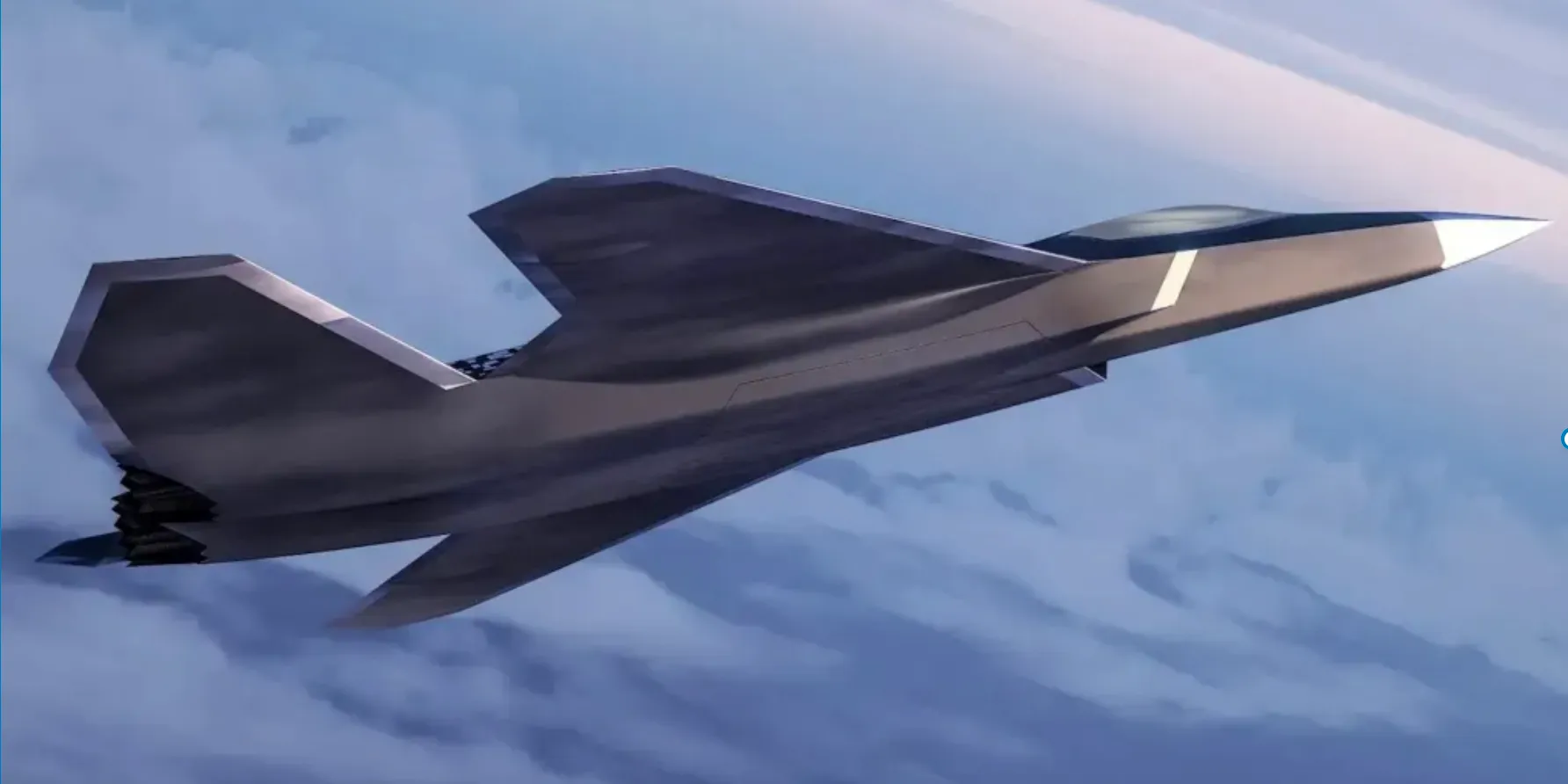
Airbus also presented a video showing a notional concept aircraft flying with multiple uncrewed platforms. While not too much (as in not much at all) should be read into this, the crewed aircraft features canard foreplanes, a chin intake, and an unusual cranked wing.
Speaking just ahead of the announcement, at the ILA Berlin airshow today, where TWZ was in attendance, Jean-Brice Dumont, head of air power at Airbus Defense and Space, said the company remains committed to delivering a sixth-generation combat jet. “There is a need for a bit of a reshaping and reconsidering the reality of today,” Dumont added.
German Federal Chancellor Friedrich Merz (second from left) and Jean-Brice Dumont (second from right), head of air power at Airbus Defense and Space, stand in front of a drone during a tour of the International Aerospace Exhibition (ILA). Photo by Sebastian Gollnow/picture alliance via Getty Images
Dumont explained that the now-abandoned NGF was one of seven separate “pillars” of technology development being worked on under FCAS. As well as the crewed jet, pillars include powerplant, remote carrier vehicles, precision-guided weapons, and data connectivity.
“We have to consider safeguarding areas where it works, and how we reshape,” he added. “At the moment, we are going to seek guidance from our governments [on] what they want us to do. There has to be demonstrated an industrial feasibility of what is being asked — not only technical. That’s probably a lesson now,” Dumont added.
Dumont continued: “The world in 2026 is very different to the world of 2017 when the [FCAS] programme was launched. We have to accept that fact and reshape it — we need another way to get to the same goal, with faster milestones.”
“The problem we had is that we had drawn a line to 2040, and new technologies for everything,” Dumont added, referring to the goal of having the FCAS, including the NGF, in service by that date. “Today, you see demonstrations of connectivity, systems of systems and unmanned vehicles all around the world. The need is there, and in the countries that we are competing with, they are using it already.”
According to Dumont, the company has “put a number of options on the desk of our ministers and ministries of defense,” and is now awaiting further guidance from officials.
As the centerpiece of FCAS, in its original form, the NGF element was the most high-profile and challenging component of the project. However, it had long been dogged by disagreements over industrial workshare and leadership between Airbus and Dassault Aviation, which were the prime contractors for Germany and Spain, and France, respectively.
A 1:1 scale model of the NGF is unveiled at the Paris Airshow in 2019. Dassault Aviation
Dassault had demanded that it play the defining role in NGF, reflecting key requirements for the jet driven by the French Armed Forces. These included the ability to operate from aircraft carriers, and provision to deliver nuclear weapons. Germany or Spain needed neither of these functions.
Despite the disagreements that derailed NGF, Dumont argued that there had still been useful lessons learned from the FCAS program.
“What Phase 1A and 1B [of the program] have given is a very thorough analysis of the repartition of the work between the crewed and uncrewed platforms, and this remains. That kind of shapes what the manned aircraft will have to do.”
As an example of this work, Dumont pointed to ongoing work that will involve trials of a Eurofighter operating as a “command fighter” — a crewed jet that can operate in collaboration with drones, or what Airbus now refers to as uncrewed collaborative combat aircraft (UCCAs). The tests will see a Eurofighter fitted with a Rafael Litening 5 targeting pod modified to serve as the interface between the crewed jet and UCCAs. This should pave the way toward an in-service command fighter capability being introduced to the Eurofighter, something that will be incorporated in the sixth-generation combat jet from the outset.
A German Eurofighter with a Litening laser targeting and reconnaissance pod on the centerline station. Crown Copyright
Initial trials will involve a Learjet test configured as a surrogate command fighter and flying with drones in an “enhanced teaming” mode. Airbus hopes to have the command fighter-configured Eurofighter ready for operational service in 2029.
“The demand from the customers is: be ready early,” Dumont explained. “This is not a contradiction to the Future Combat Air System challenge — it is the need to have our platforms evolved earlier than we had traditionally planned.”
A model of a notional sixth-generation fighter displayed at ILA as part of a command fighter study by the German Aerospace Center (DLR). Thomas Newdick
The termination of NGF and the launch of Team Gen 6 leaves plenty of questions over the future of Europe’s air combat landscape.
TWZ spoke to Douglas Barrie, senior fellow for military aerospace at the International Institute for Strategic Studies (IISS) research institute in London, for his take on what might happen next.
On the matter of Germany and Spain now teaming up under the Airbus umbrella, Barrie said that the relationship makes a lot of sense, but its success is far from certain. On the one hand, the two countries already work together within Airbus, and both Germany and Spain are seeking a replacement for their Eurofighter fleets.
A pair of Spanish Air and Space Force Eurofighters. Spanish Ministry of Defense
“In terms of Team Gen 6, I do wonder if there’s an element of trying to kind of scramble to recover something from the wreckage of NGF, as it were, that the collapse of NGF doesn’t signal the end of Spanish industrial interest in next-gen combat aircraft development,” Barrie said. “But if somebody asked me, do I think between Germany and Spain, they can put together a credible program if nobody else is involved? I think that the numbers would be very difficult to stack up.”
Putting the German and Spanish future fighter requirements together, the two countries might, at best, need to build 300 new combat jets, with a figure of 250 more likely, Barrie contended. Team Gen 6 would then face a real struggle to break even.
This reality will, Barrie believes, force Germany and Spain to look for other partners, which will likely come down to a choice between the British-led Global Combat Air Program (GCAP) and the Swedish next-generation combat aircraft program, led by Saab. Of these, GCAP has the Tempest crewed fighter as its centerpiece, and also involves Italy and Japan. Sweden’s crewed fighter requirements are less clear at this point.
A scale model of a possible Tempest configuration, in Italian Air Force markings. Leonardo
Building a role for Airbus in GCAP would be difficult at this point. With the industrial architecture already in place, bringing not one, but two more partners into that program would be disruptive, particularly in terms of timeline. Already, the Japanese in particular are concerned about the pace of the program, especially since the United Kingdom has not yet fully committed to it in terms of funding.
“My own view is that the United Kingdom remains committed to the program, but there are financial pressures elsewhere,” Barrie noted. “I think that the more likely outcome in all of this is a kind of German, Spanish, Swedish tie-up. The kind of requirements in some ways are aligned a bit better.”
This extends to the size of the aircraft, Barrie observed.
“The kind of aircraft that the Swedes seem to be thinking about, the crewed element is probably more of a bigger Gripen E/F, heading towards Typhoon, in terms of size. This is more in keeping with what the Germans and the Spanish seem to be looking for. Obviously, the United Kingdom and Japan, in particular, need something with longer legs and bigger internal payload, hence GCAP.”
The Saab Gripen E. Saab
“GCAP will be highly capable,” Barrie continued. “That will come with a unit cost to go with it. Maybe what the Swedes, the Germans, and the Spanish might do will be cheaper.”
Provided a German, Spanish, Swedish teaming arrangement could work, the resulting combat jet could still enter a space where it would face competition for important export orders from France, which looks set to continue the development of the Rafale, especially now that NGF has collapsed. Further competition could be provided by South Korea with further developments of its KF-21 and Turkey with the TF Kaan, although these are notably less-ambitious fifth-generation designs.
The Tempest, as currently envisaged, with its very different set of requirements, would not necessarily be a direct competitor to Team Gen 6, Barrie argued, since it would be a closer match to the F-47 in terms of size, capabilities, and cost. While the potential size of this market would be more limited, probably U.S. reluctance to export the F-47 would play in the Tempest’s favor.
An official rendering of the Boeing F-47. U.S. Air Force
As to the possibility of the United States offering a ‘watered-down’ export model of the F-47, Barrie considers this unlikely to generate much interest.
“Yeah, you can have a downgraded version of my super airplane — as a kind of marketing slug that hardly sells, does it?” Barrie continued. “Even if it’s 10 percent less capable, even if it’s 10 percent less expensive, it’s still a likely unit cost of $250 million or more, which is eye-watering.”
This leaves us with the French, and what they might be able to recover from NGF.
If France goes it alone with a sixth-generation combat jet, Dassault will likely be strongly backed by the French government, and the company has traditionally punched well above its weight.
In the medium term, Dassault has a healthy backlog of orders for the Rafale and is very much at the right end of the cost curve. Barrie considers that the Rafale will remain a profitable airplane for the foreseeable future, but at some point, France will need to think about a successor based on an all-new airframe. Industrially, France has the capability to go alone with this, but they would likely look to a partner or partners to come on board. The likelihood of those partners coming from Europe has now been reduced, but other possibilities might be found in the Gulf states.
A pair of Rafales from the Qatar Emiri Air Force. Dassault Aviation www.twz.com
Then there is the question of India, which may still buy more Rafales but which, in the fullness of time, is likely to look for a new-generation fighter, and could be a potential partner for France.
“I don’t see the Indians ever being fully committed to only one country,” Barrie continued. India has already hinted that it might want to try and join the pan-European FCAS or GCAP. Meanwhile, Russia has been a long-term military partner for India, and Barrie thinks that the recent appearance of a two-seat version of the Su-57 Felon may well indicate another effort to sell that fighter to India.
The previously unknown two-seat version of the Sukhoi Su-57 Felon, which appeared earlier this year. UAC UAC
Were India to continue its pattern of buying Russian combat aircraft, that would give any potential European partner serious pause for thought, based on the security implications. Meanwhile, India also remains committed to developing its own next-generation fighter.
What the NGF debacle has demonstrated is that any potential partner with France on its next-generation combat aircraft program will likely have to be happy taking a junior role, with Dassault calling the shots.
The collapse of the New Generation Fighter could well be a pivotal moment for European defense cooperation, but it does not signal the end of Europe’s sixth-generation combat aircraft ambitions.
Airbus’s Team Gen 6 announcement marks the start of a German-Spanish-led industrial approach that its backers hope will be more agile and less contested than its Franco-German-led predecessor. However, significant political, financial, and industrial challenges remain, including the search for a reliable partner, or partners. As with NGF, the success of Team Gen 6 will ultimately depend on whether European governments can align their strategic priorities and industrial interests to deliver a sovereign future air combat capability.
Weekly insights and analysis on the latest developments in military technology, strategy, and foreign policy.
The troubled pan-European Future Combat Air System (FCAS) appears to have lurched to an undignified — but predictable — end, at least in its current form. A flurry of media reports today indicate that France and Germany, the two major partners in the program, have abandoned their program to develop a crewed New Generation Fighter (NGF) aircraft together, a conclusion supported by a French diplomat who spoke to TWZ today.
According to sources including the Frankfurter Allgemeine Zeitung, German Chancellor Friedrich Merz has urged French President Emmanuel Macron to pull the plug on the NGF. The German newspaper cited unnamed government sources in Berlin. Reportedly, the French and German leaders concluded that the companies involved — Dassault and Airbus — have been unable to reach agreement on key aspects of the project, specifically relating to the jointly developed fighter jet.
Concept artwork of the NGF future fighter. Dassault Aviation
At this stage, it is reported that Merz and Macron cannot see a future for the NGF, although it is apparently still unclear whether the French government fully shares this assessment and is prepared to accept its consequences.
At this point, it should be recalled that there are at least three separate FCAS initiatives in Europe.
As well as the pan-European version headed up by France and Germany, with Spain and Belgium as junior partners, there is a rival British-led FCAS. This has the Tempest crewed fighter as its centerpiece, involves Italy and Japan, and is now more commonly referred to as the Global Combat Air Program (GCAP). Finally, the Swedish next-generation combat aircraft program, led by Saab, is also known as FCAS.
Returning to today’s developments, French officials are reportedly surprised by what they viewed as uncoordinated messaging from Berlin. From Paris’s perspective, it is the responsibility of political leaders to provide industry with clear direction.
French President Emmanuel Macron talks with Eric Trappier, chairman and CEO of Dassault Aviation, after the unveiling of a full-scale model of the NGF at the Paris Air Show in 2019. BENOIT TESSIER/AFP via Getty Images BENOIT TESSIER
The French government is also said to be frustrated over what it sees as Germany’s increasing preference for national solutions, which threatens to sideline its own industrial input.
A French diplomat told TWZ: “The President of the Republic and the Federal Chancellor have held extensive and frequent discussions on ways to move forward with this important project for European defense. Both leaders expressed regret that the industrial partners have been unable to reach an agreement on the continuation of the project. The German authorities considered that it was not possible to exert further pressure on the companies involved. France remains convinced that Franco-German cooperation is essential both for our two countries and for our European partners in the fields of defence and security.”
The diplomat added: “The French authorities will continue to encourage our industries and armed forces to explore avenues for ambitious European projects that are consistent with our national security interests.”
According to reports, Macron and Merz discussed the future of FCAS last week, in the latest of several recent efforts to keep the program on track. At the same time, however, Merz had become increasingly vocal about his skepticism regarding the project’s prospects.
The FCAS program was launched back in 2017, with the primary aim of replacing France’s Rafale fleet and Germany’s Eurofighters.
A German Luftwaffe Eurofighter pair. Bundeswehr/Bicker A pair of Eurofighters from Tactical Air Force Wing 73 “Steinhoff” during air-to-air training. Bundeswehr/Bicker
FCAS was envisioned as a next-generation European combat air system entering service around 2040, spearheaded by the NGF crewed fighter. As of 2022, it was envisaged that “in-flight demonstrations” would be achieved by 2028 or 2029.
Before long, however, the project was overshadowed by arguments over workshare agreements, and it is unclear how far the partners had got in terms of agreeing on NGF requirements and starting its design.
By February of this year, Merz was publicly raising doubts about the program’s viability, arguing that key issues had never been fully resolved during the planning phase. According to the German leader, Germany and France have fundamentally different operational requirements for a future combat aircraft.
Merz pointed to the specific French requirements that call for aircraft to be capable of carrying nuclear weapons and operating from aircraft carriers. Merz argued that Paris is seeking to shape the aircraft around French military requirements, which do not necessarily align with Germany’s needs.
French President Emmanuel Macron (right) greets German Chancellor Friedrich Merz at the Elysee Palace in Paris in January 2026. Photo by Tom Nicholson/Getty Images Tom Nicholson
“This is not primarily a political disagreement,” Merz said. “The real issue lies in the requirements profile. If we cannot reconcile those differences, the project cannot continue.”
Within France, Dassault CEO Éric Trappier recently declared the FCAS project dead if Airbus refuses to cooperate, while Macron continued to make efforts to resuscitate the program.
There are indications that Paris will still try to do its best to keep the program alive, and it remains possible that the broader FCAS architecture, or parts of it, could continue even without the NGF. FCAS has always intended to field families of drones, air-launched weapons, and potentially other aerial platforms, within an overarching ‘combat cloud.’
An Airbus concept showing an NGF connected via satellite-based Combat Cloud to Remote Carriers, as well as a variety of legacy combat and support platforms. Airbus
The German government considers that the “true essence of FCAS” should be continued as a European system of systems, according to the Frankfurter Allgemeine Zeitung.
FCAS System of Systems
Whatever happens next, the program appears to be at a crossroads, and facing its biggest existential challenge yet.
It is highly questionable whether either France or Germany (even with Spanish industrial support and finance) could develop a fighter without the other major partner.
This could open the door to a radical reshaping of European combat air programs.
There have already been suggestions at the highest military levels that the British-led and Franco-German FCAS efforts could be fused in some way. However, it seems highly unlikely that all these partners could come together with agreement. Just as questionable is whether the GCAP effort would be able to admit new major partners at this late stage.
Then there is the issue of Sweden.
Last month, we reported on Airbus having raised the possibility of teaming with Saab on the manned tactical component of FCAS. That was one of the clearest indications yet that Airbus is actively exploring post-FCAS alternatives, or, at the least, a major overhaul of the program’s structure.
A Saab study for a supersonic uncrewed platform as part of its own FCAS effort. SVT screencap via X
Potentially, Airbus and Saab could now team up to develop a joint next-generation fighter, with their requirements likely to be more closely aligned than those of France. Germany and France also have a less urgent need for a sixth-generation combat jet, with Sweden only now introducing the Gripen E, and with Germany looking forward to receiving F-35s as well as more Eurofighters.
The first Gripen E for the Swedish Air Force. Saab SAAB
For France, losing its partners for NGF could be more critical, although it continues to work on advanced versions of the Rafale. In 2024, France also unveiled plans to develop a new uncrewed combat air vehicle (UCAV) that will complement the forthcoming Rafale F5 crewed fighter. The industrial side of the drone program will be headed up by Dassault, drawing upon its previous nEUROn UCAV demonstrator, which has already been used in trials with crewed combat aircraft.
A Rafale accompanies a nEUROn drone during a test flight. Dassault Aviation/Anthony Pecchi Dassault Aviation/Anthony Pecchi
The F5 standard of the Rafale is planned to keep the multirole combat aircraft in frontline service until around 2060. That will at least give France some time to consider what to do about a future crewed fighter.
A French Air and Space Force Rafale C. Dassault Aviation
Drones are also increasingly part of the combat-air picture in Germany, too. Delays in fielding a sixth-generation fighter could be mitigated, to a degree, by Airbus developing combat drones. Airbus and Kratos are already pitching the stealthy XQ-58A Valkyrie drone to Germany, and Airbus has also been working on a stealthy CCA-like concept of its own, known as Wingman.
A rendering of the Airbus Wingman CCA-like drone. Airbus
In the background, the U.S.-made F-35 continues to expand its customer base in Europe. There is also the prospect that, in the future, the sixth-generation F-47 might also be offered for export in the region, although this might only be in a watered-down form.
Overall, though, the latest development is a poor reflection on Franco-German cooperation, which has singularly failed to come to agreement about what should be a flagship program, providing a cornerstone of efforts to strengthen Europe’s defense capabilities.
With the ILA Berlin airshow starting on Wednesday, this news could hardly be worse-timed. On the other hand, we may well learn more about Germany’s vision for its future combat aircraft program before the week is out.
WASHINGTON — With virtually no strings attached, Congress is on the verge of providing a sizable infusion of cash to the Department of Homeland Security, powering President Trump’s mass deportation agenda for the remainder of his term in the White House.
The nearly $70-billion package, which cleared the Republican-held Senate in a middle of the night vote and now heads to the House, was declared a “rotten bill” by the Democratic leader and an “ATM for ICE” by pro-immigrant advocates.
But for those aligned with Trump’s campaign promise for the largest mass deportation operation in U.S. history, it all but guarantees an uninterrupted flow of money to carry out the administration’s immigration enforcement operations — and comes on top of some $170 billion Congress already approved for the department last summer, as part of Trump’s big tax breaks bill.
“We’re going to continue to arrest people, we’re going to continue to detain people and we’re going to keep deporting people,” Trump border advisor Tom Homan told CBS News on Friday.
He hinted at summer sweeps of enforcement actions coming next to New York City.
The work of Congress comes at a pivotal time for the Republican president and his party as they face restless voters before the midterm elections. About 1 in 3 U.S. adults know someone who has been affected by Trump’s immigration operations, according to an AP-NORC poll conducted in April. And as America celebrates its 250th anniversary, most say it’s no longer a great place for immigrants.
The funding package from Congress is just a slim dozen-page bill that carries none of the usual guardrails or directives typically demanded in legislation. It turns loose $30 billion for Immigration and Customs Enforcement operations, and billions for the Border Patrol, and others, prepaying the department’s operations into 2029.
“Their options are limitless in terms of what they can do with this money,” said Vanessa Cardenas, the executive director at America’s Voice, a longtime advocacy organization for immigrants.
“That is such a hard thing to accept as a taxpaying citizen that our dollars are going to this massive, mass deportation machine, while Americans are struggling to meet healthcare costs, and have access to food and they’re paying so much in gas.”
The administration has sought to shift the debate over its immigration operations, installing new leadership at Homeland Security in the aftermath of violent scenes of immigration enforcement earlier this year and the shooting deaths of Americans Renee Good and Alex Pretti in Minneapolis.
Rather than the dramatic street sweeps, the administration is working behind the scenes on actions that are stripping immigrant groups of their ability to remain in the U.S., by doing away with Temporary Protected Status or making it more difficult to secure green cards.
The so-called Dreamers, young immigrants brought illegally to the U.S. as children, have reported delays in renewing their Deferred Action for Childhood Arrivals status, exposing them to potential deportation.
But protests on American streets continue, including over detention conditions at the Delaney Hall facility in New Jersey.
At the same time, Homeland Security continues to hire more ICE agents — it’s hosting an employment fair next month in Florida — build more detention facilities and partner with countries around the world to take people who are being deported from the U.S.
In a statement, the department said Trump and Homeland Security Secretary Markwayne Mullin are “laser focused on ensuring the hardworking men and women” of ICE and Customs and Border Patrol are fully funded. It said the package from Congress “will ensure our critical national security operations continue despite any Democrat attempts to hold our great patriotic employees hostage in the future.”
Typically a funding package from Congress would run hundreds pages or more, with a range of specific instructions about how the money can be spent and on what timelines.
Congress, after all, holds the power of the purse, and often uses that constitutional role to put checks on the administration.
But after Democrats refused to fund Homeland Security earlier this year following the violence in Minnesota, Republicans retaliated by using the congressional budget resolution process to muscle the package through on their own, outside the traditional appropriations channels.
It’s the same process both parties have used in the past, most recently on Trump’s 2025 tax cuts bill.
“All this important oversight doesn’t happen,” said Bobby Kogan, a former staff member of the Senate Budget Committee and now at the Center for American Progress, a think tank.
Overnight, Democrats in the Senate worked to exert that authority, offering amendments to ensure Congress had some say in the process. Sen. Dick Durbin of Illinois, for example, sought to protect “Dreamers” from deportation as their DACA renewals are being delayed. But those efforts all failed.
Meanwhile the administration is under enormous pressure to deliver on its promise to boost deportations to some 1 million a year, after the Republican president’s first year numbers fell short.
Mike Howell, president of the Oversight Project, is a leader of the Mass Deportation Coalition that is pushing the Trump administration to stick to its promises.
“Everyone’s talking about it like ICE is about to get another massive cash injection, and that’s not how I see it at all,” he said. “They’re getting like life-support money.”
“We’re not asking them to keep going,” Howell said. “We’re asking them to start.”
Howell said there’s little chance the Trump administration will be able to reach the president’s deportation goals unless it drops its priority to go after what they call the “worst of the worst.”
His group put out a framework earlier this year that proposes more comprehensive sweeps to arrest immigrants, particularly in the workplace. He also wants to see the Trump administration make it more difficult for immigrants who are in the U.S. to use the banking system, get social services and obtain driver’s licenses. Republicans in Congress have offered bills tackling some of those issues.
The administration has been amping up its own rhetoric and recently posted a new website that characterizes immigrants as “aliens” — with outer-space themes — and suggests ways the White House is working to prevent people from staying in the U.S.
The state of California is leading an effort to prepare a possible lawsuit that could thwart Paramount Skydance Corp.’s planned acquisition of Warner Bros. Discovery, a potential obstacle for the $111 billion deal.
The lawsuit, which could be filed as early as this month, would likely involve multiple states, according to a source familiar with the deliberations who was not authorized to comment publicly.
The litigation would seek to challenge the proposed merger on antitrust grounds, arguing it would thwart competition, lower wages and lead to widespread job losses.
“The Paramount acquisition of Warner Brothers remains an active investigation, and we do not have any updates to share at this time,” said California Atty. General Rob Bonta’s office in a statement.
In a statement, Paramount said it “will continue to fight against any attempt to derail a deal that plainly benefits consumers, creators and the industry as whole.”
“Opposing this deal means opposing expanded consumer choice, new opportunities for creators and workers, and greater competition throughout the creative ecosystem — the opposite of what antitrust law is meant to achieve,” the company added.
Under Paramount Chairman David Ellison’s proposal, Warner investors would receive $31 a share, nearly four times the price of the company’s stock in April 2025. He also said he will keep both studios’ release schedules of 15 movies a year for a total of 30 films a year.
Nonetheless, Ellison and his team have vowed to make $6 billion in cuts following the merger, which requires regulatory approval. The combined company would have to contend with $79 billion in deal debt.
The prospect of substantial job cuts during a period of downsizing in Hollywood has ignited widespread opposition to the sale.
Thousands of people who work in the TV and film industry, including actor Joaquin Phoenix and director-writer-producer JJ Abrams signed an open letter opposing Paramount’s planned acquisition of WBD, saying it would lead to fewer production jobs and fewer choices for consumers. Others have also raised concerns about the impact it could have on content.
“The consequences would be felt nationwide, from destroying CNN the way that Ellisons have devastated CBS to entertainment industry job losses and consumers losing access to independent voices and a competitive market,” said Norm Eisen, executive chair of Democracy Defenders Fund, one of the groups that organized the open letter. “State attorneys general have both the authority and the responsibility to act when a transaction of this scale directly threatens the public’s interest, and I hope states across the country will join any effort to challenge this deal,” Eisen said in a statement.
The potential lawsuit, first reported by Bloomberg and Reuters, is being considered by other states, including New York and Colorado.
“Paramount and Warner Bros. haven’t cleared regulatory scrutiny,” Bonta told The Times in March. “My office has an open investigation into [the deal] and we intend to be vigorous in our review.”
Despite the potential obstacle, Raymond James equity analysts said in a note on Thursday that they “still believe the deal is likely to close.”
Last month, Paramount hired antitrust attorney Jeffrey Kessler to defend its planned acquisition of Warner Bros. Discovery. Kessler recently led a case for state attorney generals against concert promoter and ticketing firm Live Nation, resulting in a win for states, including California.
“We also think there are win/win solutions to be had particularly in California given exodus of production from CA in recent years and efforts to bring production back to Hollywood,” the analyst said in their note.