editor

California’s post-production workers urge governor to sign tax credit

Hollywood’s film and TV post-production workers took their case directly to Gov. Gavin Newsom on Thursday, urging him to sign a bill that would create the state’s first standalone post-production tax incentive.

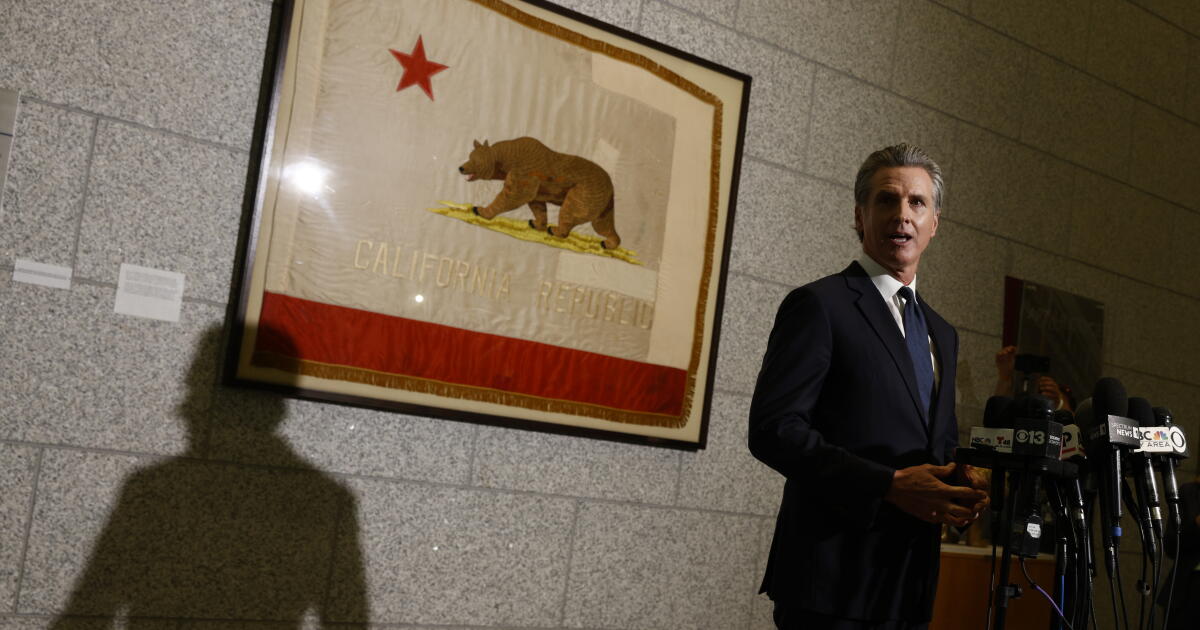
Workers such as editors, singers and sound supervisors joined bill author Assemblymember Nick Schultz (D-Burbank) and Mayor Karen Bass at a news conference Thursday morning in front of the Television Academy’s headquarters in North Hollywood.

The bill, AB 2319, is aimed at supporting the industry’s editors, sound mixers, composers and visual effects artists. It passed the state Senate 33 to 5 on Aug. 30, and the Assembly approved the final version 72 to 2 the same day. Newsom, who has not taken a public position on the measure, has until Sept. 30 to sign or veto it.

Bass urged supporters not to let up before then.

“We need our industry in full force,” Bass said. “It’s all a part of making our city more affordable. We know that this is one of the biggest issues in our city, and so having a strong, robust industry helps Angelenos across the board.”

The incentive would allow a 35% to 50% credit on qualified expenses relating specifically to post-production in California. The state’s existing film and TV tax credit program already covers post-production, but only if 75% of filming or the overall budget is spent in the state. The new credit doesn’t require productions to shoot in California.

Even if Newsom signs the bill, the program would start small. Schultz initially proposed $100 million to fund the effort, but the Legislature’s end-of-session budget sets aside $10 million to launch it.

“When you think about production, it’s easy to think about the actors, the directors and the writers; you don’t think about all that happens when the camera stops rolling,” Schultz said. “What’s changed is that they’re now telling their story about the struggles they’re facing.”

For industry veteran Karen Baker Landers, the decline in local post-production work is impossible to overlook. A two-time Oscar-winning supervising sound editor, Baker Landers is vice president of California Post Alliance, the group sponsoring the bill.

“It’s affecting people in huge ways, like losing their health insurance. I get people calling me asking to get just two weeks of work to qualify for coverage,” said Baker Landers. “It’s really difficult.”

Last year, California expanded its film and TV tax credit program, more than doubling the old $330-million cap to $750 million through June 30, 2030. But a state budget measure Newsom signed in June capped how much in tax credits a business can claim each year, a limit industry groups warned would undercut the expanded program. Lawmakers passed a fix on the final day of the legislative session and it is also awaiting the governor’s signature.

Despite the state’s bigger bet on the industry — and this summer’s fight over the cap — L.A. City Councilmember Adrin Nazarian, whose district includes North Hollywood, argued at the press conference that this is the right moment to keep asking for more.

“It’s that exact momentum that we need. When you double down on something, you’re giving more than hope, and you’re saying welcome back. Please come and do your work. Don’t stop doing this,” Nazarian said.

Source link

Stars and Stripes editor says he has been fired for insubordination after doing interview

The Pentagon on Friday fired the editor-in-chief of Stars and Stripes, as well as its publisher and a reporter, the editor said. He said he was dismissed for insubordination after an interview he gave that objected to potential censorship by the U.S. military.

Erik Slavin, editor-in-chief of the military newspaper that is partly funded by the Pentagon but has a long legacy of editorial independence, told The Associated Press that he and the others had received notices of separation.

The moves come at a time when the Trump administration, in its second term, has been increasingly aggressive and combative toward the news media — including sharply curtailing Pentagon access for the press corps that covers the Defense Department. Trump or other parts of the executive branch have also, in policy and in the courts, grappled with the Wall Street Journal, the Associated Press and The New York Times — in addition to using the FCC to target broadcast networks.

Slavin said he was being fired “for stating in a CBS interview that hypothetical censorship of news for service members would constitute a red line.” He said he stands by the principle “that Stars and Stripes must remain editorially independent.”

Earlier this week, publisher Max Lederer announced his retirement effective at the end of September. He too received a separation notice, according to Slavin, as did Middle East reporter Lara Korte, who was cited for the same CBS interview as Slavin. Neither Lederer nor Korte immediately responded to requests for comment.

Lederer made his announcement a few weeks after the Pentagon installed a new deputy publisher, an active duty service member, under Lederer at the newspaper without his prior knowledge. Three Democratic senators on Thursday wrote to Defense Secretary Pete Hegseth, asking why the new deputy — Navy Capt. William Urban — had been installed.

It was unclear whether Urban would now become the new publisher. In an email message to the AP, Urban said, “I am currently the Military Deputy to the Publisher. I can’t comment on what my role will be in the future.”

The retirement of Lederer, who had been at Stars and Stripes for three decades and publisher since 2007, comes as Hegseth’s Pentagon moves to exert editorial control and eliminate what it asserts are “woke distractions.”

Lederer, the second full-time civilian in the position, wrote in a staff memo that it had “become clear that my philosophy of leadership, and my understanding of the value and mission of Stars and Stripes, differ in fundamental ways from the direction the leadership of the Department of Defense has for the organization.”

In April, the Pentagon fired Jacqueline Smith, ombudsman for the newspaper, whose job had been to safeguard editorial independence.

Noveck writes for the Associated Press.

Source link