Asian stocks fall as naval blockade threat injects new turmoil into financial markets.
Published On 13 Apr 202613 Apr 2026
Oil prices have risen sharply following US President Donald Trump’s announcement of a naval blockade of Iran.
Brent crude, the international benchmark, rose more than 8 percent on Sunday to top $103 a barrel.
Recommended Stories
list of 4 itemsend of list
It was the first time the benchmark rose above the psychologically important threshold of $100 since Tuesday, when prices surpassed $111 a barrel.
Trump announced on Sunday that the US Navy would block all ships from entering or exiting the Strait of Hormuz, following the collapse of ceasefire talks between US and Iranian officials over the weekend.
US Central Command said in a later statement that it would only block vessels travelling to and from Iran and that other traffic would not be impeded, in an apparent scaling back of Trump’s threat to impose a full blockade.
The command said the blockade would take effect on Monday at 10am Eastern Time (14:00 GMT).
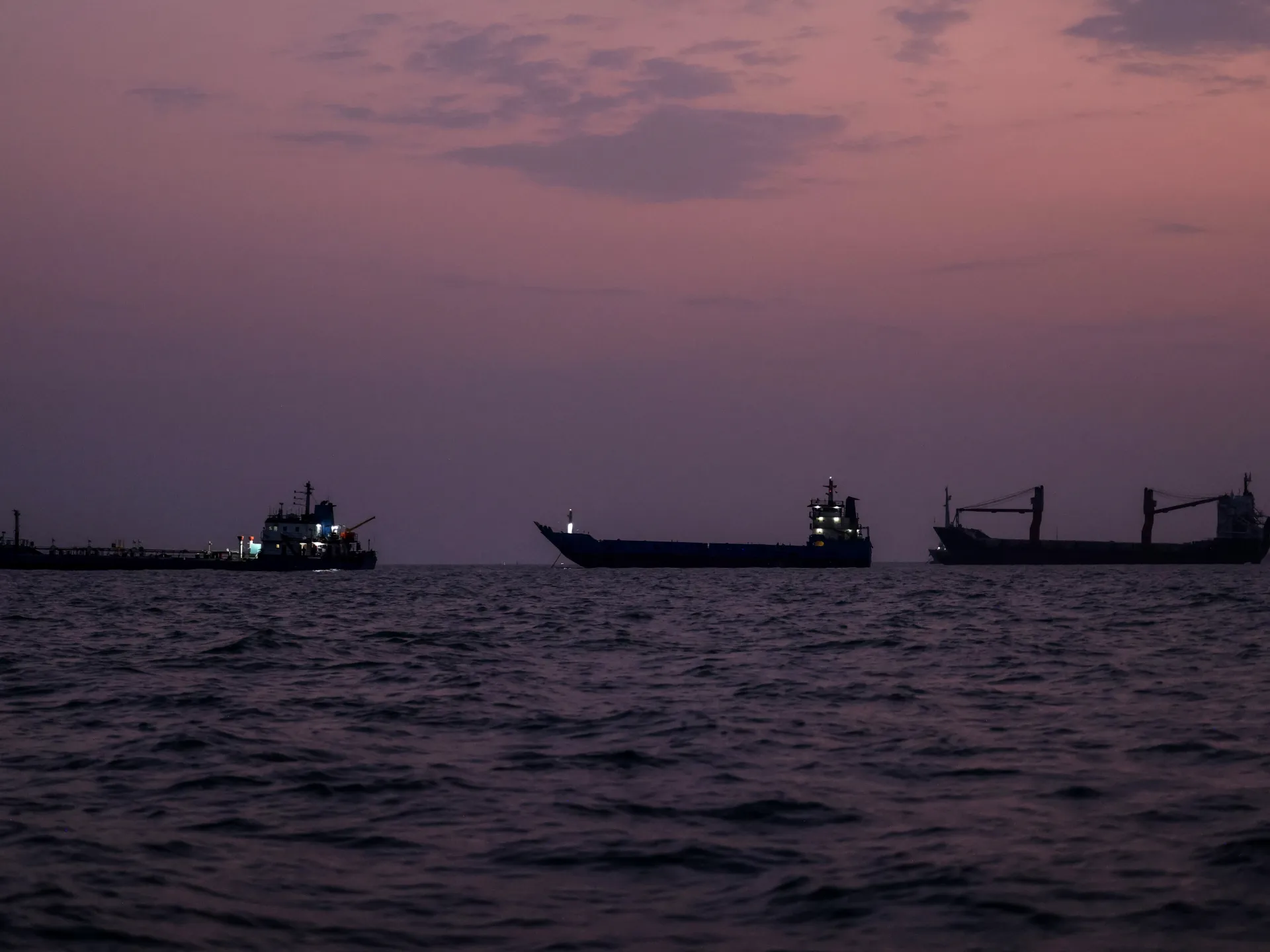
Oil prices have been a rollercoaster since US-Israeli strikes on Iran prompted Tehran to impose a de facto blockade of the Strait of Hormuz, a conduit for about one-fifth of global oil and natural gas supplies.
After topping $119 last month, Brent fell below $92 a barrel last week after the US and Iran announced a two-week ceasefire following more than six weeks of war.
While Iran has allowed a limited number of ships to transit the waterway, subject to prior vetting and authorisation, traffic has been reduced to a trickle compared with peacetime levels.
Despite Washington and Tehran’s fragile truce officially remaining in place until April 22, only 17 vessels crossed the strait on Saturday, according to maritime intelligence firm Windward, down from roughly 130 daily transits before the war.
Major stock markets in Asia opened lower on Monday as Trump’s blockade threat stoked uncertainty on trading floors.
Japan’s benchmark Nikkei 225 fell 0.9 percent in morning trading, while South Korea’s KOSPI dropped more than 1 percent.
US stock futures, which are traded outside of regular market hours, also fell, with those tied to the benchmark S&P 500 down about 0.8 percent.
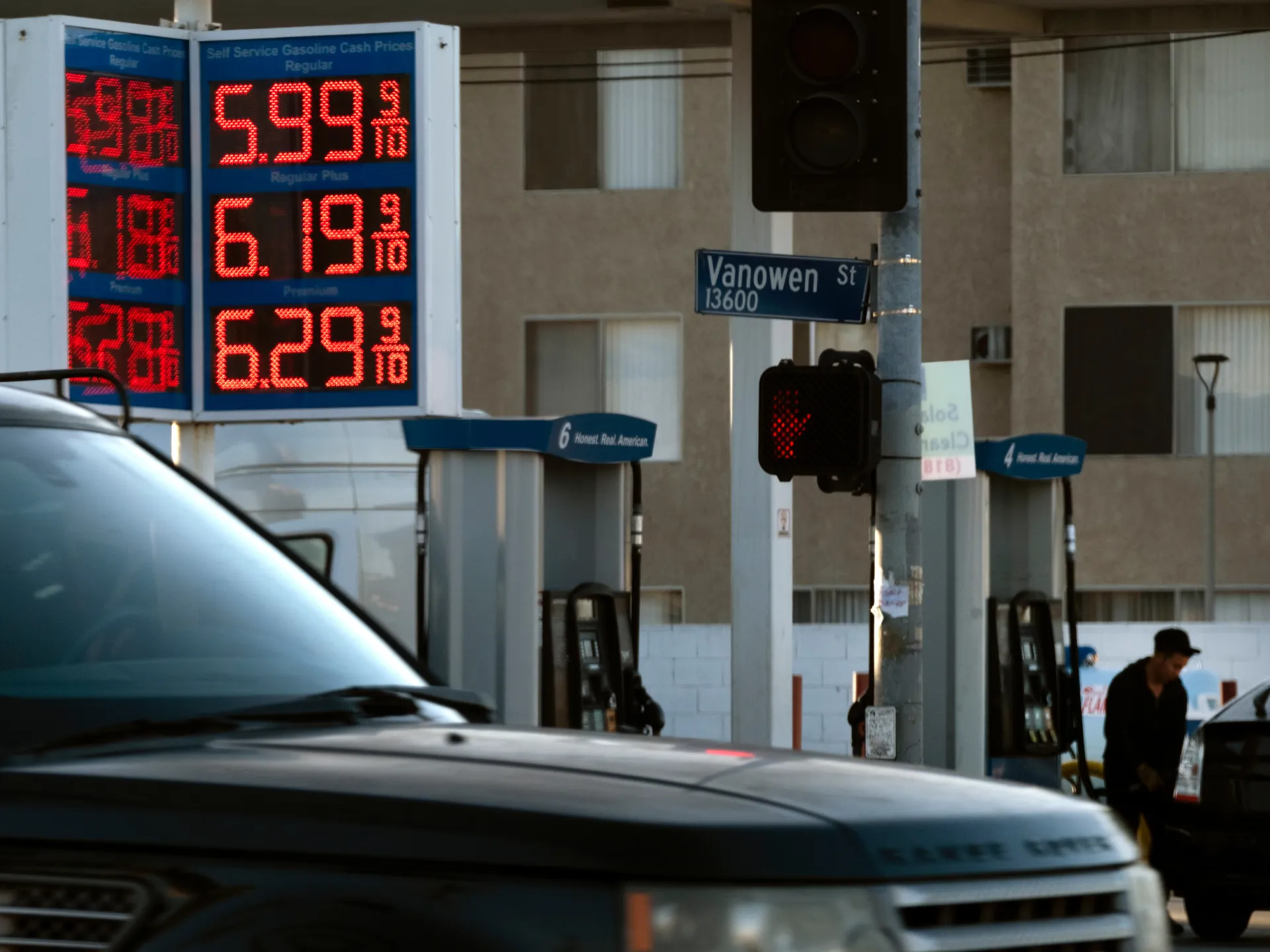
U.S. President Donald Trump acknowledged that oil and gasoline prices could remain elevated through the fall, signaling potential political and economic consequences from the ongoing conflict with Iran.
“It could be, or the same, or maybe a little bit higher, but it should
Even though a fragile ceasefire between Iran and the United States and Israel has been announced, it’s going to be a long time before prices of oil and gas come back to pre-war levels, experts say.
In response to the US-Israeli attacks, Iran choked off the Strait of Hormuz, the narrow channel linking the Gulf to the Gulf of Oman, through which roughly 20 percent of the world’s oil and gas exports pass from the Middle East, mainly to Asia and also to Europe.
Recommended Stories
list of 4 itemsend of list
It also attacked energy infrastructure in several Gulf countries, leading to soaring prices of not just energy but also of byproducts like helium, used in a range of products like tiles used in homes and semiconductor equipment. Fertilisers that rely on some of these inputs were hit too, impacting sowing seasons.
As a result, consumers the world over, but particularly in developing countries of Asia and Africa, have felt the brunt of those shortages and soaring prices. The question on many minds: Now that there is a ceasefire in place, how quickly will prices normalise?
“Anyone who tells you they know the answer to that question is lying,” said Rockford Weitz, professor of practice in maritime studies at The Fletcher School at Tufts University. “It’s too early to tell when we return to normal.”
“What we’re seeing is the biggest disruption in the history of global oil markets,” said Weitz.
Before this conflict, approximately 120-140 ships passed through the Strait of Hormuz every day. On Wednesday, only five vessels crossed the strait, while seven passed through the waterway on Thursday.
That shows why “to get back to normal is going to be a while”, Weitz told Al Jazeera. “And it’s too complicated to know at this stage when that will happen, as it requires collaboration with the great powers [US, China and Russia], but also regional powers [UAE, Saudi Arabia, India and Pakistan]. It’s hard to say when it will end, as there are so many parties who can make it not happen.”
There is also some concern that developments, like Iran charging a toll fee to allow ships to pass through and skyrocketing insurance fees, will keep oil prices high.
“There are reports that Iran is charging fees to tankers going through the Hormuz Strait,” US President Donald Trump wrote on TruthSocial Thursday.
“They better not be and, if they are, they better stop now.”
But experts agree that those fees, rumoured to be about $2m per vessel, are not enough to move the needle on oil prices.
“What is causing oil prices to rise is not insurance. It’s about getting tankers through. Tolls won’t be the cost driver,” said Weitz.
‘Signs of strain’
Some of that reality was on display with the reopening of the strait, showing “signs of strain just hours after the ceasefire was announced”, said Usha Haley, W Frank Barton Distinguished Chair in international business at Wichita State University.
Compounding that problem was the fact that some countries, including Iraq, had shut down production because of limited storage capacity, further taking oil supplies offline.
“That will take weeks and months to reopen,” Haley added.
“It’s going to be a contested reopening … LNG [liquefied natural gas] will take months to rebalance because of the hits to infrastructure, and can take three to six months to normalise if everything else remains normal. And it’s not.”
Slower growth
On Thursday, International Monetary Fund managing director Kristalina Georgieva warned that the fund will downgrade its forecast for the world economy next week from the current expectation of 3.3 percent. “Growth will be slower – even if the new peace is durable,’’ Georgieva said.
While the war has hit most economies, “it hasn’t really affected the two primary [US] targets – Russia and China. Russia, in fact, has benefitted enormously, and Chinese ships have been allowed to go through,” said Haley.
The US has hit Russia with multiple sanctions for its war on Ukraine, including capping sales of Russian oil to undercut its income stream. Similarly, the first Trump administration put tariffs on China and curbed US exports of certain high-end technology, measures that were held up under the administration of former US President Joe Biden and further ratcheted up by Trump last year with his tariffs blitz.
But amid the war on Iran and the effective closure of the Strait of Hormuz, the US temporarily eased some sanctions on Russian oil, and countries desperate for crude have since paid far higher prices to Moscow than the subsidised energy that President Vladimir Putin’s government was previously offering them.
“We [the US] really need to decide what we want to do long-term, who our targets are. There’s got to be some coherence to what we want to do.”
For now, “an overhang of greater risk premium of supplies out of the Gulf means oil prices will remain higher than what they were before the attack started”, said Rachel Ziemba, adjunct senior fellow at the Center for a New American Security.
While it’s possible that some of the blocked oil and oil products could be released soon, providing a short boost of supplies in the coming days and weeks, “that would be a temporary support” and is still conditional on the ceasefire holding and converting to a broader deal, said Ziemba.
For now, she’s keeping an eye on Iraq to see if it strikes a side deal with Iran. Iraq, long a proxy battleground between the US and Iran, can produce at least 3.5 million barrels of oil per day, production that it had shut off because of limited storage capacity, said Ziemba.
Should that come back online, it will help oil flows and, eventually, prices. But the uncertainty of the truce and the history of attacks on Iraq mean that the future of the country’s oil production remains unclear. “In that environment, who wants to invest in scaling up production?” Ziemba wondered.
Washington and Tehran accuse each other of not honouring truce agreement.
Published On 10 Apr 202610 Apr 2026
Shipping remains at a standstill in the Strait of Hormuz despite the ceasefire agreement between the United States and Iran, dampening hopes for a resolution to one of the worst global energy disruptions in history.
Only a handful of vessels have transited the critical strait since Washington and Tehran on Tuesday announced a two-week pause in fighting, according to ship tracking data.
Recommended Stories
list of 4 itemsend of list
Five vessels crossed the strait on Wednesday, down from 11 the previous day, and seven transited on Thursday, according to data from market intelligence firm Kpler.
More than 600 vessels, including 325 tankers, are still stranded in the Gulf due to the blockage of the strait, according to Lloyd’s List Intelligence.
“While some vessel movement has resumed, traffic remains very limited, compliant shipowners are likely to stay cautious, and safe transit capacity is expected to remain constrained at maximum 10–15 passages a day if the ceasefire holds, without consideration of tolls applied,” Kpler trade risk analyst Ana Subasic said in an analysis on Thursday.
The waterway, which usually carries about one-fifth of global oil and liquefied natural gas (LNG) supplies, typically handled about 120-140 transits before the US and Israel launched their attacks on Iran on February 28.
On Thursday, US President Donald Trump accused Iran of failing to live up to its part of the ceasefire agreement, which includes a commitment to allow “safe passage” through the waterway for two weeks.
“Iran is doing a very poor job, dishonorable some would say, of allowing Oil to go through the Strait of Hormuz,” Trump said in a post on Truth Social.
“That is not the agreement we have!”
Iranian Foreign Minister Abbas Araghchi earlier accused the US of not honouring the deal, warning, in reference to Israel’s ongoing attacks on Lebanon, that it had to choose between a ceasefire or “continued war” via its ally.
“The world sees the massacres in Lebanon,” Araghchi said in a post on social media.
“The ball is in the US court, and the world is watching whether it will act on its commitments.”
After plummeting on the back of the ceasefire announcement, oil prices have begun to tick up as markets digest the reality that maritime traffic remains effectively halted despite the truce.
“This moment requires clarity. So let’s be clear: the Strait of Hormuz is not open,” Sultan Ahmed Al Jaber, the CEO of the United Arab Emirates’ state-run oil company, ADNOC, said in a social media post on Thursday.
“Access is being restricted, conditioned and controlled. Iran has made clear – through both its statements and actions – that passage is subject to permission, conditions and political leverage. That is not freedom of navigation. That is coercion.”
Brent crude, the international benchmark, stood at $96.39 as of 02:00 GMT on Friday, after falling below $95 a barrel on Wednesday.
Asia’s main stock markets opened higher on Friday, following overnight gains on Wall Street driven by hopes of a resolution to the war.
Japan’s benchmark Nikkei 225 was up 1.8 percent in early trading, while South Korea’s KOSPI and Hong Kong’s Hang Seng Index were up about 2 percent and 1 percent, respectively.
The government of Ecuadorian President Daniel Noboa has surged its tariffs on the neighbouring country of Colombia to 100 percent, effective May 1.
On Thursday, Ecuador’s Ministry of Production issued a statement blasting Colombia for failing to adequately address drug-trafficking and border security.
Recommended Stories
list of 3 itemsend of list
It was the latest salvo in an ongoing cross-border dispute between the right-wing Noboa and his left-wing counterpart in Colombia, Gustavo Petro, who have been feuding for months.
“After noting the lack of implementation of concrete and effective measures regarding border security on the part of Colombia, Ecuador is obliged to take sovereign actions,” the Ministry of Production wrote in its statement.
It justified the tariff hike as a necessary incentive to “confront the presence of drug trafficking on the border”.
“For Ecuador, security, as well as the fight against corruption and drug trafficking, are a non-negotiable priority,” the ministry said. “This measure reaffirms the country’s commitment to protecting its citizens and safeguarding the integrity of its territory.”
Already, Noboa had slapped Colombia with 50 percent tariffs on its exports to Ecuador as of March. That, in turn, was a spike from a 30 percent tariff rate announced in January and implemented in February.
Just over an hour after the new tariff rate was announced, Petro responded on social media that Ecuador’s actions were causing the collapse of the Andean Pact, a regional free-trade agreement whose origins stretch back to the 1960s.
“This is simply a monstrosity, but it signifies the end of the Andean Pact for Colombia. We have no business there anymore,” Petro wrote.
He called on Colombia to shift its focus away from its Andean trading partners and towards Mercosur, a trade alliance helmed by Brazil, Uruguay, Paraguay, Argentina and Bolivia.
“The Foreign Minister must initiate the process for us to become full members of Mercosur and steer us — with greater vigor — toward the Caribbean and Central America,” Petro added.
The escalating tensions between Ecuador and Colombia come within the final months of Petro’s presidency. Elected in 2022, Petro is Colombia’s first left-wing president and a former rebel involved in the country’s six-decade-long armed conflict.
But his government has faced stiff opposition from right-wing political movements both domestically and abroad.
Leaders like Noboa and United States President Donald Trump have repeatedly condemned him for not doing enough to tackle the illicit drug trade, despite historic drug seizures during Petro’s term in office.
But Petro has also championed a policy he calls “Total Peace”, which involves negotiations with rebel groups and criminal networks to put an end to the country’s internal conflict.
Trump and Petro have been at odds over multiple issues, including US immigration policies and its boat-bombing campaign in the Caribbean Sea and eastern Pacific Ocean.
In September, however, the Trump administration took the extraordinary step of decertifying Colombia as an ally in its “war on drugs”, saying that it had “failed demonstrably” in its efforts.
Then, in October, Trump sanctioned Petro and his family, blaming the Colombian president for having “allowed drug cartels to flourish”.
Noboa has echoed Trump’s stance on several foreign policy issues, including its pressure campaign on another left-wing government, Cuba.
He was among the right-wing leaders in Latin America to join Trump’s “Shield of the Americas” coalition, designed to confront criminal networks and cartels in the region.
In announcing the initial volley of tariffs in January, Noboa claimed his country had shown a “genuine commitment” to combatting drug trafficking, while Colombia had not.
“We have made genuine efforts to cooperate with Colombia, even while facing a trade deficit exceeding $1bn annually,” Noboa wrote.
Colombia remains the world’s largest producer of cocaine, a persistent trend that has existed since before Petro’s presidency.
But other factors have aggravated tensions between the two neighbours.
On Wednesday, for instance, Ecuador recalled its ambassador from Colombia over statements Petro made about its imprisonment of left-wing politician Jorge Glas, calling the former vice president a “political prisoner”.
Noboa had warned earlier in the week that he considered such rhetoric an “assault on [Ecuador’s] sovereignty”. He had previously faced criticism for authorising a raid on Mexico’s embassy to arrest Glas, which prompted Mexico to sever its relations with Ecuador.
Petro, meanwhile, has accused Noboa of bombing close to the Colombian border, as part of joint military operations with the US. Colombian officials have said they recovered 27 charred bodies from the border region.
Since Ecuador first imposed its tariffs, Colombia has suspended cross-border energy sales, which have been vital in helping Ecuador’s government navigate electricity shortages prompted by recent droughts. It has also issued retaliatory tariffs on certain Ecuadorian products.
Washington, DC – Preliminary data from the Organisation for Economic Co-operation and Development (OECD) has found that international development aid from its members dropped by about 23 percent from 2024 to 2025.
Much of that decline was attributed to a major shortfall in funding from the United States.
Recommended Stories
list of 3 itemsend of list
The forum, which includes many of the the largest economies across Europe and the Americas, said on Thursday that the US saw a nearly 57 percent drop in foreign aid in 2025.
The OECD’s four other top contributors — Germany, the United Kingdom, Japan and France — also saw declines in their foreign aid assistance.
The report marked the first time foreign development assistance from all five of the OECD’s top donors simultaneously declined. The total assistance for 2025 totaled only $174.3bn, down from $214.6bn the year before, representing the largest annual drop since the OECD began recording the data.
OECD officials warned the dramatic decrease comes at a time when global economic and food security has been cast into doubt amid the stresses of the US-Israeli war with Iran.
“It’s deeply concerning to see this huge drop in [development funding] in 2025, due to dramatic cuts among the very top donors,” OECD official Carsten Staur said in a statement.
Thursday’s preliminary data shows that only eight member countries met or exceeded their funding from 2024.
“We are in a time of increasing humanitarian needs,” Staur added, citing growing global uncertainty and extreme poverty. “I can only plead that DAC donors reverse this negative trend and start to increase their [assistance].”
The data covers the 34 members of the OECD’s Development Assistance Committee (DAC), which provide the vast majority of global foreign assistance.
But the numbers offer an incomplete picture of global development aid, as it fails to include influential non-DAC members including Turkiye, the United Arab Emirates, Qatar and China.
The data tracked by the OECD distinguishes official development assistance from other forms of aid, including military funds.
US drives ‘three-quarters of the decline’
In its preliminary assessment, the OECD noted that the US “alone drove three-quarters of the decline” in 2025, the first year of President Donald Trump’s second term.
Trump has overseen widespread cuts to the US’s aid infrastructure, including dissolving the US Agency for International Development (USAID) as part of a wider effort to shrink government spending.
The US contributed about $63bn in official development assistance in 2024, which was cleaved to just short of $29bn in 2025, according to OECD.
Research this year from the University of Sydney has suggested that cuts to US funding over the past year have corresponded with an increase in armed conflict in Africa, as state resources grow more scarce.
Other experts have noted that the slashed assistance is likely to prompt upticks in cases of HIV-AIDS, malaria and polio.
Analysts at the Center for Global Development have projected that the US cuts were linked to between 500,000 and 1,000,000 deaths globally in 2025 alone. A recent article published in the medical journal The Lancet found that a “continuation of current downward trends” in development funding could lead to over 9.4 million new deaths by 2030.
The Trump administration, meanwhile, has maintained it is transforming, not eschewing, the US aid model.
In recent months, it has struck a handful of bilateral assistance agreements with African countries that it says are in line with its “America First” agenda.
But while the details of such deals have not been made public, critics note that some negotiations appear to have involved requests for African countries to share mineral access or health data.
‘Turning their backs’
Oxfam, a confederation of several non-governmental aid organisations, was among those calling on wealthy countries to change course following Thursday’s report.
“Wealthy governments are turning their backs on the lives of millions of women, men and children in the Global South with these severe aid cuts,” Oxfam’s Development Finance Lead Didier Jacobs said in a statement.
Jacobs added that governments are “cutting life-saving aid budgets while financing conflict and militarisation”.
As an example, he pointed to the US, where the Trump administration is expected to request between $80bn and $200bn for the US-Israeli war with Iran, which has currently been paused amid a tenuous ceasefire.
The administration has separately requested a historic $1.5 trillion for the US military for fiscal year 2027.
“Governments must restore their aid budgets and shore up the global humanitarian system that faces its most serious crisis in decades,” Jacobs said.
The Strait of Hormuz, which links the Gulf to the Gulf of Oman, has held global attention since Israel and the US began their war on Iran in February.
Until fighting began, the narrow channel, through which 20 per cent of the world’s oil and liquefied natural gas (LNG) supplies are shipped from Gulf producers in peacetime, remained toll-free and safe for vessels. The strait is shared by Iran and Oman and does not fall into the category of international waters.
Recommended Stories
list of 4 itemsend of list
After the US and Israel began strikes, Iran retaliated by attacking “enemy” merchant ships in the strait, effectively halting passage for all, stranding shipping, and creating one of the worst-ever global energy distribution crises.
Tehran continued to refuse to re-open the strait to all traffic at the start of this week, despite US President Donald Trump’s threats to bomb Iran’s power plants and bridges if it did not relent. Trump backed away from his threat on Tuesday night when a two-week ceasefire, brokered by Pakistan, was declared.
That followed a 10-point peace proposal from Iran that Trump described as a “workable” basis on which to negotiate a permanent end to hostilities.
As part of the truce, Tehran has now issued official terms it says will guide its control of the Strait going forward. The US has not directly acknowledged the terms ahead of talks set to begin in Islamabad on Friday. However, analysts say Tehran’s continued control will be unpopular with Washington, as well as other countries.
During the crisis, only a few ships from specific countries deemed friendly to Iran and those which pay a toll have been granted safe passage. At least two tolls for ships are believed to have been paid in Chinese yuan, in what appears to be a strategy to weaken the US dollar, but also to avoid US sanctions. China, which buys 80 percent of Iran’s oil, already pays Tehran in yuan.
Here’s what we know about how shipments will work from now on:
(Al Jazeera)
Who is controlling the strait now?
On Tuesday, Iran’s Foreign Minister Abbas Aragchi said Iran would grant safe passage through the strait during the ceasefire in “coordination with Iran’s Armed Forces and with due consideration of technical limitations”.
On Wednesday, the Islamic Revolutionary Guard Corps (IRGC) released a map of the strait showing a safe route for ships to follow. The map appears to direct ships further north towards the Iranian coast and away from the traditional route closer to the coast of Oman.
In a statement, the IRGC said all vessels must use the new map for navigation due to “the likelihood of the presence of various types of anti-ship mines in the main traffic zone”.
Alternative routes through the Strait of Hormuz have been announced by Iran’s Islamic Revolutionary Guard Corps (IRGC), providing new entry and exit pathways for maritime traffic [Screen grab/ Al Jazeera]
It is unclear whether Iran is collecting toll fees during the ceasefire period.
However, Trump said on Tuesday the US would be “helping with the traffic buildup” in the strait and that the US army would be “hanging around” as the negotiations go on.
The Strait will be “OPEN & SAFE” he posted on his Truth Social media site on Thursday, adding that US troops would not leave the area, and threatening to resume attacks if the talks don’t go well.
It’s not known to what extent US troops are directing what happens in the strait now.
Delhi-based maritime analyst C Uday Bhaskar told Al Jazeera that there is a lot of “uncertainty” about who can sail through the strait, and that only between three and five ships have transited since the war was paused.
How does Iran’s 10-point plan affect the Strait?
Among Tehran’s main demands listed on its 10-point plan are that the US and Israel permanently cease all attacks on Iran and its allies – particularly Lebanon – lift all sanctions, and allow Iran to retain control over Hormuz. The plan has not been fully published but is understood to be a starting point for talks.
Iranian media say Iran is considering a plan to charge up to $2m per vessel to be shared with Oman on the opposite side of the strait. Other reports suggest Iran could charge $1 per barrel of oil being shipped.
Revenues raised would be used to rebuild military and civilian infrastructure damaged by US-Israeli strikes, Tehran said.
Oman has rejected the idea. Transport minister Said Al-Maawali said on Wednesday that the Omanis previously “signed all international maritime transport agreements” which bar taking fees.
What does international law say about tolls on shipping?
Critics of Iran’s plan to charge tolls say it violates international law guiding safe maritime passage, and should not be part of a final ceasefire agreement.
The United Nations Convention on the Law of the Sea (UNCLOS) says levies cannot be charged on ships sailing through international straits or territorial seas.
The law allows coastal states to collect fees for services rendered, such as navigation assistance or port use, but not for passage itself.
Neither the US nor Iran has ratified that particular convention, however.
Even if they had, there could be ways to get around this law anyway. Analyst Bhaskar told Al Jazeera that if Iran instead charged fees to de-mine the strait and make it safe for passage again, that could be allowable under maritime laws.
There is no precedent in recent history of countries officially taxing passage through international straits or waterways.
In October 2024, a United Nations Security Council report alleged that the Iran-backed Houthis in Yemen were collecting “illegal fees” from shipping companies to allow vessels to pass through the Red Sea and the Bab-el-Mandeb strait, where it was targeting ships linked to Israel during the Gaza war.
Last week, a top adviser to Supreme Leader Mojtaba Khamenei suggested the Houthis could shut the Bab al-Mandeb shipping route again in light of the war on Iran.
(Al Jazeera)
How might countries react to a Hormuz toll?
Tolls for passage through the Strait of Hormuz would likely most affect oil and gas-producing countries in the Gulf, but ripple effects will spread to others as well, as the current supply shocks have shown.
Gulf countries, which issued statements calling for the reopening of the passage and praising the ceasefire on Wednesday, would also face a continuing degree of uncertainty, analysts say, as Iran could again disrupt flows in the future.
Before the ceasefire was announced, Bahrain had already proposed a resolution at the UN Security Council calling on member states to coordinate and jointly reopen the passage by “all necessary means”. It was backed by Qatar, the UAE, Saudi Arabia, Kuwait and Jordan. On April 7, 11 of 15 UNSC members voted in favour of that resolution.
But Russia and China vetoed the resolution, saying it was biased against Iran and did not address the initial strikes on Iran by the US and Israel.
Beyond the region, observers say the US is unlikely to accept indefinite toll demands by Iran as part of the negotiations expected to begin on Friday.
A toll to pass through the Strait of Hormuz “is not going to go down well with President Trump and his expectations that the strait should be open for everyone”, Amin Saikal, a professor at the Australian National University, said.
Other major powers have also voiced opposition. Ahead of the ceasefire, Britain had begun discussions with 40 other countries to find a way to reopen the strait.
Practical realities in the strait might see a different scenario play out with ship owners losing millions each day their vessels remain stranded seeking to get them out quickly and undamaged experts say. They are more likely to comply with Iran, at least for now.
“If I were the owner of a VLCC [very large crude carrier] which weighs about 300,000 tonnes, whose value could be a quarter billion dollars…I would believe the Iranians if they said we have laid mines,” Bhaskar said.
What exactly is stagflation, and why do some economists and investors believe the global economy could be heading toward it? Al Jazeera’s Yasmeen ElTahan explains.
It’s not clear under what legal authority Trump can tack on this tariff, and analysts called it an ’empty threat’.
Published On 8 Apr 20268 Apr 2026
United States President Donald Trump has said imports from countries supplying Iran with military weapons will face immediate 50 percent tariffs with no exemptions, announcing the threatened duty in a social media post just hours after agreeing to a two-week ceasefire with Tehran.
Trump’s Truth Social post on Wednesday did not specify which legal authority he would invoke to impose such tariffs, as the Supreme Court in February struck down his use of the International Emergency Economic Powers Act [IEEPA] to impose broad global tariffs, prompting a lower court to order refunds of some $166bn collected over the course of a year.
Recommended Stories
list of 4 itemsend of list
The 1977 IEEPA law has been used extensively for decades to back financial sanctions against Iran, Russia and North Korea, but the court ruled that Trump overstepped his authority in using it to impose trade tariffs.
“A Country supplying Military Weapons to Iran will be immediately tariffed, on any and all goods sold to the United States of America, 50%, effective immediately. There will be no exclusions or exemptions! President DJT,” Trump wrote.
However, “it’s a lot more complicated to do that after IEEPA was struck down”, Rachel Ziemba, adjunct senior fellow at the Center for a New American Security, told Al Jazeera. “There’s no immediate policy lever and authorisation that is available for the US to do that. So they need either an act of Congress or need to adapt some other trade tool, and there isn’t really a national security-oriented trade tool.”
Trump did not name any countries that could face punitive tariffs. China and Russia have helped Iran build military capacity to counter US and Israeli pressure, supplying missiles, air defence systems and technology intended to bolster deterrence.
But that support appeared capped during the US-Israeli attacks on Iran. Both Beijing and Moscow have denied supplying any weapons recently, although allegations against Moscow have persisted.
The Reuters news agency has previously reported that Tehran was considering a purchase of supersonic antiship cruise missiles from China. In March, Reuters reported that China’s top semiconductor maker, SMIC, has sent chipmaking tools to Iran’s military, according to two senior Trump administration officials.
“This is a China-related threat, the way I read it. And China will read it that way,” said Josh Lipsky, vice president and chair of international economics at the Atlantic Council.
Although drone and missile parts routinely flow from Chinese entities to Iran, evading US sanctions, Lipsky said Trump was unlikely to follow through with new tariffs in the near term because that would derail his planned trip to Beijing to meet with Chinese President Xi Jinping in mid-May.
“US tariffs on Chinese products have gone down a lot since the court ruling,” said Ziemba, “and slapping on 50 percent tariffs now would be very expensive, especially for US importers and consumers.”
Moreover, with the Trump-Xi meeting looming, “this is kind of an empty threat, but shows that when push comes to shove, Trump comes back to tariffs”, Ziemba said.
Trump does have active “Section 301” unfair trade practices tariffs on Chinese goods from his first term, to which he may be able to add duties and similar pending cases related to excess industrial capacity and China’s compliance with a 2020 trade deal. But these would require a public notice period before they could take effect.
Trump also may be able to invoke Section 232 of the Cold War-era Trade Expansion Act of 1962, which allows sector-specific tariffs to protect strategic domestic industries on national security grounds, but using this law would require a new months-long investigation and public comments.
Russia has been another source of arms technology for Iran, but US imports of Russian goods have fallen sharply since the invasion of Ukraine in 2022 and the wave of financial sanctions imposed on Moscow as a result.
US imports from Russia, one of the only countries not subject to Trump’s now-cancelled “reciprocal” tariffs, jumped 26.1 percent to $3.8bn in 2025. These are dominated by palladium used in automotive catalytic converters, fertilisers and their ingredients, and enriched uranium for nuclear reactors. The US Department of Commerce is already moving to impose punitive tariffs on Russian palladium after an anti-dumping investigation.
Mukalla, Yemen – Mohammed Salem heads out every morning for his job as a teacher at a government-run school. But once his shift is finished at that school, he then goes to a private school, where he also teaches. After a brief stop home for lunch, Mohammed is off to his third job, in a hotel, where he works the rest of the day.
“If I had any spare time for a fourth job, I would take it,” Mohammed, a teacher with 31 years of experience, said. He spoke to Al Jazeera outside his flat in a large housing complex in the eastern suburbs of Yemen’s southeastern port city of Mukalla.
Recommended Stories
list of 3 itemsend of list
He has been forced into taking on the extra jobs because of Yemen’s dire economic situation, and specifically the Yemeni riyal’s slide against the US dollar in recent years.
“I return home at night completely burned out,” he said. “Teachers are devastated and have no time to take care of their students. During classes, they are preoccupied with the next job they will take after school.”
Despite working from morning until night, the father of six says he earns less than half of what he made a decade ago, down from the equivalent of $320 a month to $130.
For more than a decade, Yemen has been mired in a bloody conflict between the Iran-backed Houthis and the Saudi-backed government, a war that has killed thousands, displaced millions and affected nearly every sector, including education.
The conflict has devastated the country’s main sources of revenue, including oil exports, customs and taxes, as rival factions wage an economic battle alongside fighting on the front lines.
The Houthis, who control Yemen’s densely populated central and northern highlands, including the capital Sanaa, have not paid public sector salaries since late 2016, when the internationally recognised government relocated the central bank from Sanaa to the southern city of Aden.
The Yemeni government, which controls Aden and the south, has also failed to raise public sector wages or pay them regularly, citing dwindling revenues after Houthi attacks on oil export terminals in southern Yemen.
Thousands of Yemeni teachers have voiced frustration over stagnant and delayed pay, saying their salaries have not improved since the war began. When they are paid, it is often late, and the wages have lost much of their value as the Yemeni riyal has plunged from approximately 215 to the dollar before the war started, to about 2,900 to the dollar in mid-2025. The Yemeni riyal is currently valued at about 1,560 to the dollar in government-controlled areas.
Faced with meagre and irregular incomes, teachers like Mohammed have adopted harsh survival strategies to keep their families afloat. His family has been forced to skip meals, cut out protein-rich foods such as meat, fish and dairy, and move to the outskirts of the city in search of cheaper rent.
He also asked one of his children to forgo university and instead join the military, where, he said, soldiers earn about 1,000 Saudi riyals ($265) a month.
“If we have money, we buy fish. When there is nothing, we eat rice, potatoes and onions. We do not look for meat, and we can only get it during Eid through donations from the mosque or charities,” Mohammed said.
During holidays and weekends, he lets his children sleep until the afternoon so they do not wake up asking for breakfast.
And when one of his children falls ill, he first treats them at home with natural remedies, such as herbs and garlic, only taking severe cases to hospital to avoid unaffordable medical bills. “I only take them to the hospital when they are extremely sick,” he said.
Mohammed Salem, a teacher with 31 years of experience in Mukalla, says he has taken on three jobs to make ends meet after his salary lost much of its value due to the rapid devaluation of the Yemeni riyal [Saeed al-Batati/Al Jazeera]
Generation at risk
According to the United Nations Office for the Coordination of Humanitarian Affairs (OCHA), in its Yemen Humanitarian Needs and Response Plan 2026 released on March 29, the country’s education sector continues to be hit by a catastrophic, multilayered crisis.
An estimated 6.6 million school-aged children have been deprived of their right to education, while 2,375 schools have been damaged or destroyed. Teachers have also been severely affected, with about 193,668, nearly two-thirds of the national total, receiving no salaries.
In the al-Wadi district of Marib province, Ali al-Samae, who has been teaching since 2001, said his salary of about 90,000 Yemeni riyals barely covers his own expenses.
The financial strain has forced him to leave his family of seven in his home city of Taiz.
“Instead of focusing on preparing lessons and using modern teaching methods, our entire focus is on how to earn enough money to support our families,” he said. “Before the war, my salary was equivalent to 1,200 Saudi riyals [$320]. Now it is about 200 Saudi riyals [$52],” al-Samae told Al Jazeera.
To survive, he has taken on extra jobs, while his family has been forced to skip meals and cut out meat and chicken. He now visits them only once a year, often arriving empty-handed after spending most of his salary on transportation.
“We now live just to survive, rather than to teach. In the past, salaries covered our basic needs, but now they are not enough; even milk has become a luxury. Life has become very difficult.”
Part-time teachers say they are worse off than their full-time counterparts, as the government has neither raised their salaries nor added them to the official payroll.
Hana al-Rubaki, a part-time teacher in Mukalla, and the sole breadwinner for her mother and three sisters, told Al Jazeera that her salary barely covers expenses for 10 days.
Despite eight years of service, she earns the same as newly hired contract teachers. “There is no job security, despite my eight years of service. There is no difference between me and a contractor hired last year; everyone receives the same salary,” she said. “After taxes, my salary is just 70,000 Yemeni riyals [$44] a month. With the high cost of living, it feels more like a token allowance than a real salary.”
She added that delayed payments further worsen her situation. “Delayed salaries disrupt our daily lives and leave me struggling to meet even my most basic needs. While some teachers can find additional work to support their families, it is incredibly difficult for us female teachers to do the same.”
Protests and patchwork solutions
To highlight their plight and pressure the government to improve salaries, teachers across government-controlled areas have staged sit-ins, taken to the streets in protest and gone on strikes, disrupting education for months.
The cash-strapped government, which is mired in internal divisions and spends much of the year operating from abroad, has largely left the issue to provincial authorities.
Some governors have responded by approving modest incentives. In Hadramout, a raise of 25,000 Yemeni riyals ($16) a month was approved, while in other areas they have ranged between 30,000 Yemeni riyals ($19) in others and up to 50,000 Yemeni riyals ($32).
“The incentives provided by local authorities vary from one province to another, depending on each governor’s priorities and capacity to support teachers in their region,” Abdullah al-Khanbashi, head of the teachers’ union in Hadramout, told Al Jazeera, adding that protests would continue until teachers receive better and regular pay.
“Teachers are showing up in torn clothing, and sometimes their students have more money in their pockets than they do. Some families have broken apart, while others have been evicted from their homes because they could not pay the rent. Other teachers have children suffering from malnutrition because they cannot afford to feed them,” he said.
In Marib, Abdullah al-Bazeli, head of the teachers’ union in the province, said local farmers have stepped in to help teachers remain in classrooms by giving them some of their produce.
“Farmers support teachers, especially those coming from outside the province, by giving them tomatoes, potatoes and other vegetables for free,” al-Bazeli said.
He also called for teachers’ salaries to be raised to the level of ministers. “A teacher’s salary should be equal to that of a minister. Teachers educate generations, while ministers often fail to make a meaningful impact. Some teachers have begun to die from hunger,” he told Al Jazeera.
In Houthi-controlled areas, teachers have rarely taken to the streets to protest the suspension of their salaries, as authorities suppress dissent and blame the Yemeni government and the Saudi-led coalition for imposing a “blockade” that they say has hindered their ability to pay public sector wages.
Acknowledging the problem of low salaries, the Yemeni government says dwindling and disrupted revenues during the war have prevented it from increasing public sector pay. “The main reason is weak financial resources resulting from the war and recurring instability, which have undermined institutions and revenue streams,” Tareq Salem al-Akbari, who served as Yemen’s education minister from 2020 to 2026, told Al Jazeera.
Teachers interviewed by Al Jazeera say they are running out of patience with the repeated promises that their salaries will be improved, warning that they may abandon the profession altogether if they find better-paying jobs that could spare them from hunger or begging in public.
“The idea of leaving teaching is always on my mind, but I have not found an alternative job,” Mohammed Salem said. “I feel pity, and sometimes cry, when I see a teacher begging in mosques or calling from a hospital, asking for help to pay for a child’s medical treatment.”
Billionaire investor Bill Ackman’s Pershing Square has proposed a takeover of Universal Music Group in a $64bn deal, the latest twist in his nearly five-year quest for the music label giant.
Pershing Square proposed a cash-and-shares offer on Tuesday through its acquisition vehicle that values Universal Music at about 30.40 euros ($35) per share, a 78 percent premium to the last closing price of 17.10 euros ($20), making the deal worth 55.75 billion euros ($64.31bn).
Recommended Stories
list of 4 itemsend of list
Universal Music Group (UMG) – the company behind international superstars, including Taylor Swift, Billie Eilish and Kendrick Lamar – is expected to move its listing to New York from Amsterdam, paving the way for more investors, including index funds, to own the company and ultimately lead to more robust earnings and a higher valuation.
Universal Music declined a Reuters news agency request for comment.
For Ackman, one of the world’s most voluble investors, who cemented his fame and fortune as an activist investor, forcefully pushing corporate America to adopt changes, this is a far friendlier approach, investors and industry analysts said.
Even as the music industry is flourishing, UMG’s share price has lagged, something Ackman is pledging to fix with this proposed deal.
Ackman’s letter to Universal Music Group’s board carried a mixed tone, at times complimentary of current management, led by chairman and chief executive Lucian Grainge, and critical of the company’s “underutilized balance sheet” and handling of its 2.7 billion euro ($3.1bn) investment in Spotify Technology.
Fears of AI disrupting the music industry have played a role in UMG’s lacklustre performance. Its share of the music market has been sliding, and streaming growth is decelerating, Wells Fargo analysts noted. In March, UMG delayed its plans for a US listing.
Nonetheless, Ackman will need the support of UMG’s top shareholders – Bollore Group, which holds an 18.5 percent stake, and Vivendi, which owns 13.4 percent – to push through any transaction. China’s Tencent is a significant shareholder. French billionaire Vincent Bollore’s family controls 80 percent of UMG’s voting rights.
Old target
Ackman first flirted with Universal Music Group in 2021, when his Pershing Square Tontine Holdings, a shell corporation created to take a private company public, zeroed in on its target. But Ackman shelved the complex deal in the wake of heavy US regulatory scrutiny. Instead, Pershing Square became one of UMG’s biggest investors in 2021, and Ackman sat on its board until last year.
Post transaction, Ackman said Grainge should remain Universal Music’s chief executive.
Ackman said he and former Hollywood super-agent Michael Ovitz met with Grainge over dinner “a couple of weeks ago” to discuss the potential merger.
“Lucian encouraged us to send it in,” Ackman said.
Ackman proposed adding new directors, including Ovitz – who shepherded the careers of Madonna and Michael Jackson – who would become the board chair. Additionally, two representatives from Pershing Square would get seats, he said, not saying yet whether he would be one of the directors.
Shares of UMG, which is listed in Amsterdam, were up 13 percent on Tuesday, while Bollore Group climbed 5 percent. Shares in Vivendi were up more than 10 percent.
Pershing bought a 10 percent stake in UMG from Vivendi ahead of its 2021 Amsterdam IPO and has since repeatedly pressed for a New York listing, arguing it would boost UMG’s share price and liquidity.
Pershing currently has a 4.7 percent stake, making it UMG’s fourth-biggest shareholder.
UMG’s shares have lost almost a third of their value since its IPO.
Even as global music revenues grow year after year, UMG and other major labels, like Sony and Warner Music, are scrambling to stay competitive as streaming services from Spotify, Amazon, Apple and Deezer take an ever greater share.
They are now also contending with disruptions brought on by the expansion of AI – from copyright disputes to the advent of song-generating AI tools – that threaten to upend how music is created, consumed and monetised.
One survey last year found that a staggering 97 percent of listeners could distinguish between AI-generated and human-composed songs.
Under Tuesday’s proposal, Pershing’s SPARC Holdings would merge with UMG, and the new entity would become a Nevada corporation listed on the New York Stock Exchange.
The US-Israel war on Iran has sparked a global fuel crisis as thousands of tankers carrying crucial deliveries of oil and liquefied natural gas (LNG) remain stranded on either side of the Strait of Hormuz, currently under a blockade imposed by Iran.
On Saturday, Egypt’s government said it is among the “best-performing” countries in tackling the crisis because of the measures it has implemented to save on fuel.
Here is what we know about the steps Egypt is taking and whether other countries are doing the same.
Why has the Iran war caused an energy crisis?
Pressure on oil and gas markets is mounting due to the almost complete halt to shipping through the Strait of Hormuz as well as air strikes on and around key energy facilities in the Gulf as the United States-Israel war on Iran enters its sixth week.
One-fifth of the world’s oil and LNG is shipped from producers in the Gulf through the Strait of Hormuz in peacetime. This is the only route from the Gulf to the open ocean.
On March 2, two days after the US and Israel began strikes on Iran, Ebrahim Jabari, a senior adviser to the commander in chief of Iran’s Islamic Revolutionary Guard Corps (IRGC), announced that the strait was “closed”. If any vessels tried to pass through, he said, the IRGC and the navy would “set those ships ablaze”. Since then, traffic through the strait, carrying cargoes including 20 million barrels of oil each day, has plunged by more than 95 percent.
Now, Tehran is allowing just a handful of tankers through after reaching agreements with some countries to do so.
Besides this, energy infrastructure in the Middle East has suffered damage over the course of the war.
On March 24, QatarEnergy declared force majeure on some of its long-term LNG supply contracts after an Iranian attack on Qatar’s Ras Laffan LNG facility – the largest in the world – wiped out about 17 percent of the country’s LNG export capacity, causing an estimated $20bn in lost annual revenue and threatening supplies to Europe and Asia.
All of this disruption has sent energy prices soaring. On Tuesday, global oil benchmark Brent crude was around $109 per barrel, compared to around $65 per barrel right before the war started.
How is Egypt tackling the energy crisis?
Egypt’s Petroleum Ministry has announced rises in fuel prices ranging from 14 percent to 30 percent.
On March 28, Egyptian Prime Minister Mostafa Madbouly’s office told a press conference that the country’s energy import bill had increased from $1.2bn in January to $2.5bn in March.
Egypt is both one of the region’s largest energy importers and among its most heavily indebted economies. While domestic gas and oil account for the majority of its total energy supply, the country still relies on imported fuels, especially refined oil products and some natural gas, from Israel and the Gulf states.
Madbouly announced measures Egypt is taking to mitigate this and preserve state energy resources.
From March 28, shops, malls and restaurants are closing at 9pm (19:00 GMT) every day for one month, except Thursdays and Fridays.
On Thursdays and Fridays, the closing time will be 10pm (20:00 GMT).
Fuel allocations for government vehicles will be reduced by 30 percent.
Street lighting and street advertisement lighting will be cut by 50 percent.
From April 1, eligible employees will work remotely on Sundays, the first day of the working week. Some essential services, such as pharmacies, grocery stores and tourist facilities, will be exempted from this.
Which other countries have introduced energy conservation measures?
Besides Egypt, other countries are also taking steps to save energy.
Last week, Malaysia ordered civil servants to work from home to save energy in government offices.
In mid-March, it was revealed that government offices in the Philippines had moved to a four-day work week, officials in Thailand and Vietnam were being encouraged to work from home and limit travel, and Myanmar’s government had imposed alternating driving days.
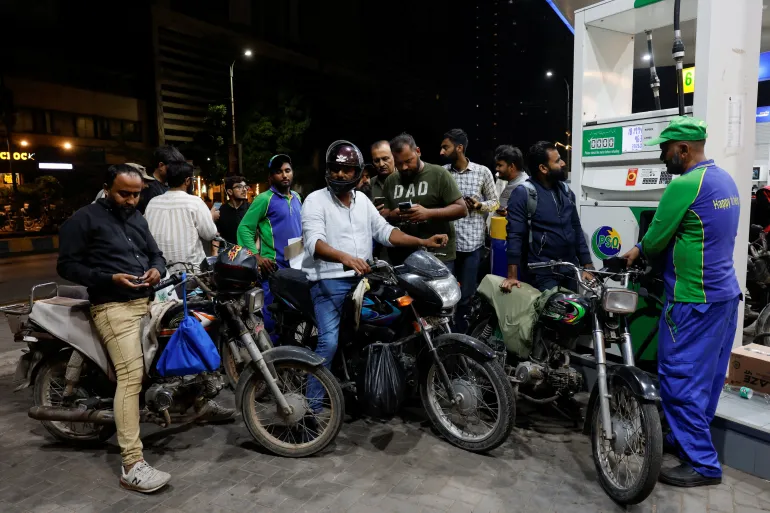
Pakistan, which imports about 80 percent of its energy from the Gulf, announced on Monday of this week that markets and shopping malls would close at 8pm (15:00 GMT) across the country, except in Sindh province. The government’s statement added that food outlets would close at 10pm (17:00 GMT), which is also when marriage ceremonies at private properties and houses must end.
Bangladesh has reduced working hours for government and private workers and banking services hours in a bid to conserve electricity.
In Sri Lanka and Slovenia, authorities have introduced fuel rationing and purchase limits to manage shortages and soaring costs.
Ho Chi Minh City, Vietnam – After a long day of ferrying passengers to and fro recently, e-hailing driver Nguyen was dejected to find he had spent half of his earnings on fuel.
“I drove for around seven or eight hours, making around 240,000 Vietnamese dong [$9.11] and then I paid 120,000 Vietnamese dong [$4.56] on petrol,” Nguyen, a motorcyclist who connects with passengers via the locally developed super-app Be, told Al Jazeera, asking not to be identified by his real name.
Recommended Stories
list of 4 itemsend of list
“I can’t survive with this amount of money in the city.”
In Vietnam, the ripples of the US-Israel war on Iran are hitting many gig workers hard.
The Southeast Asian country normally sources about 80 percent of its crude oil from Kuwait, but shipments have dried up amid Iran’s effective blockade of the Strait of Hormuz, driving up fuel prices.
Diesel prices have more than doubled, while petrol prices have risen almost 30 percent, making getting from point A to point B an increasingly expensive proposition in cities such as Ho Chi Minh City, home to more than 7 million motorcycles.
“Because the petrol price is so high, so many drivers are turning off the app, going home and just not working,” Nguyen said.
“After today, I will turn off the app and stop working for a few days to see if the price goes down or if the government is helping in any way.”
A Be driver picks up a passenger at Thu Duc Metro Station in Ho Chi Minh City, Vietnam, on March 30, 2026 [Govi Snell/Al Jazeera]
Vietnam’s government has rolled out a series of emergency measures to cushion the blow for citizens.
Prime Minister Pham Minh Chinh last month announced that an environmental tax on diesel, petrol, and aviation fuel would be suspended until April 15 to help stabilise prices.
Nguyen Khac Giang, a Vietnamese-born visiting fellow at the ISEAS-Yusof Ishak Institute in Singapore, said authorities had been forced to act to stave off rising disgruntlement among citizens.
“There are a lot of complaints and frustrations about rising living costs, because gas prices are everything in Vietnam,” Giang told Al Jazeera.
“It’s not only necessary in terms of making the population feel relief about the rise of gas prices, but at the same time, it will keep the macroeconomic stability intact, given the turbulence outside Vietnam.”
Despite the government sacrificing an estimated $273m in revenue via the tax cut, signs of strain are mounting across the economy.
Public transportation is stretched to capacity in major cities, while domestic carriers such as Vietnam Airlines and Vietjet Air have slashed flights.
“As a very, very open economy, Vietnam is super vulnerable to international shocks,” Giang said.
Gig workers have been particularly exposed due to the double whammy of heavy fuel consumption and minimal labour protections.
“Their income is changeable due to factors beyond their control,” Do Hai Ha, a research fellow at the University of Melbourne who has studied Vietnam’s gig platforms, told Al Jazeera.
“They have no chance to negotiate with the platforms.”
Many drivers have had no choice but to work longer hours as they are “excluded from labour protection, so there’s no guarantee in terms of minimum wages or overtime pay”, Do said.
A commuter refuels at a petrol station in Ho Chi Minh City, Vietnam, on March 27 [Govi Snell/Al Jazeera]
Companies, too, are feeling the crunch.
Anh Dao, who collects fares on Ho Chi Minh City’s bus route 13, said the bus operator has been losing money due to the surge in diesel prices, despite raising ticket prices by 3,000 Vietnamese dong ($0.11).
“As we already signed the contract, we cannot just stop running the buses,” Ahn told Al Jazeera.
For one fisherman in the coastal region of Binh Thuan, about 200km (124 miles) from Ho Chi Minh City, rising fuel costs have prompted a frantic search for cheaper options to power his basket boat.
“Now that fuel prices are rising, it’s having a big impact,” the fisherman told Al Jazeera, asking not to be identified by name. The middlemen he does business with have been citing weak demand to justify offering lower prices for his catch, he said.
“What I was usually able to sell for 800,000 Vietnamese dong [$30] is now only selling for 650,000 Vietnamese dong [$24],” he said.
Families kept apart
For some low-income families, the rising costs are reshaping daily life in other ways.
After a weeklong trip to the Mekong Delta region, Uyen Pham, a communications manager for the Saigon Children’s Charity, said she has seen the strain firsthand.
“Several parents noted that the cost of bottled cooking gas has nearly doubled,” Pham told Al Jazeera.
“Most of our beneficiary families have always relied on wood-fired stoves or a hybrid of wood and gas to save money. With the recent price hike, they are now strictly limiting their gas usage even further, relying almost entirely on wood to cut every possible expense.”
For many parents, the rising fuel costs have also meant less time with family.
“Many parents in remote areas must leave their children with grandparents to work in cities,” Pham said.
“Rising fuel prices directly increase their commuting costs, while manual labour wages remain stagnant. This pinches their take-home pay and, in some cases, reduces how often they can afford to travel home to see their children.”
For the government in Hanoi, the price volatility has intensified the focus on greater energy independence, Giang, the visiting fellow, said.
“The longer-term question this crisis has enacted is a very important question about the strategic autonomy of Vietnam in terms of energy dependencies, especially when we are a net importer of oil,” he said.
Policymakers will need to “more aggressively accelerate Vietnam’s energy independence by building more refineries,” Giang said, “because now we only have two refineries, which is not enough for the Vietnamese market.”
With long-term solutions likely to take years to come to fruition, authorities are scrambling for short-term fixes.
Commuters wait for the train at Thu Duc Metro Station, in Ho Chi Minh City, Vietnam, on March 30, 2026 [Govi Snell/Al Jazeera]
Late last month, Vietnam’s prime minister and a delegation from the Ministry of Industry and Trade visited on the Nghi Son Refinery and Petrochemical Complex, the country’s largest refinery, in Thanh Hoa, a coastal city about 1,500km (932 miles) north of Ho Chi Minh City.
During their visit, officials said the refinery, which supplies about 40 percent of Vietnam’s petrol needs, would urgently need to find alternative sources of crude, as current supplies were expected to run out by the end of May.
The war on Iran also appears to be reshaping at least some domestic investment.
Vingroup, Vietnam’s largest conglomerate, last month informed authorities that it wanted to halt plans to build the country’s largest liquefied gas-fired power plant and put the funds towards a renewable energy project instead, according to a letter reported by the Bloomberg and Reuters news agencies.
In the letter, the company cited “the significant risk of high fuel prices for LNG power projects” due to the war.
In the meantime, Duy, who works at a cafe tucked behind a Ho Chi Minh City petrol station, is feeling some relief after the government’s fuel tax cut, which authorities projected would reduce petrol prices by about one-quarter and diesel prices by about 5 percent.
“I usually pay 100,000 Vietnamese dong [$3.80] a week on gas, but at the peak of the high prices a few days ago, it was almost double that,” she told Al Jazeera.
The talks have focused on a ‘smooth passage’ through the Strait of Hormuz, as Tehran effectively blocks the vital waterway.
Published On 5 Apr 20265 Apr 2026
Oman and Iran have held deputy foreign minister-level talks, discussing options to ensure the smooth transit of vessels through the Strait of Hormuz, according to the Omani Foreign Ministry.
The meeting was held on Saturday “at the level of undersecretaries in the foreign ministries of the two countries”, the ministry said on Sunday in a post on X, adding that it was “attended by specialists from both sides”.
Recommended Stories
list of 3 itemsend of list
“Possible options were discussed regarding ensuring the smooth passage through the Strait of Hormuz during these circumstances witnessed in the region,” it added. “During the meeting, experts from both sides presented a number of visions and proposals that will be studied.”
On Sunday, three Omani ships appeared to be transiting the Strait of Hormuz, outside Iran’s “approved corridor” near Larak Island, according to tracking data monitored by shipping journal Lloyd’s List.
The convoy consists of two large oil supertankers and one liquefied natural gas (LNG) carrier that are sailing “unusually close to the Omani coast”, according to the United Kingdom-based outlet.
The developments come after an Iranian official said on Thursday that Iran was drafting a protocol with Oman to monitor traffic in the strait, through which about a fifth of global oil supplies travel, and which Iran has severely restricted in retaliation for the ongoing US-Israeli war on the country.
Since the war began on February 28, Iran’s Islamic Revolutionary Guard Corps (IRGC) has allowed some vessels to transit, including Pakistani, French, and Turkish-linked vessels. But about 3,000 others are stranded.
Strait effectively blocked
The waterway is a critical chokepoint for global energy shipments, especially oil and gas moving from the Gulf to Europe and Asia.
Disruptions there have injected volatility into the market and pushed oil- and gas-importing countries to seek alternative sources.
United States President Donald Trump, in a social media post over the weekend, threatened to unleash “all Hell” if it is not opened by Monday.
Egypt’s Foreign Minister Badr Abdelatty held separate calls to discuss proposals for regional de-escalation with US Special Envoy Steve Witkoff and regional counterparts, including Iranian Foreign Minister Abbas Araghchi, the Egyptian ministry said in a statement on Sunday.
Amin Saikal, a professor emeritus at the Australian National University, said an expansion of the war “is going to be hell for the whole region”. “There has to be some kind of negotiated settlement,” he told Al Jazeera on Sunday.
“But at this stage, the door for a diplomatic solution seems to be very narrow, unless President Trump decides that this conflict has caused so many problems for him domestically, as well as internationally, that it is really time to reach some compromise with the Iranians,” Saikal concluded.
Tehran says Iraq will face no restrictions in waterway, praising country’s ‘struggle’ against the US.
Published On 5 Apr 20265 Apr 2026
Iran has announced that Iraqi ships are free to pass the Strait of Hormuz, the latest sign of Tehran easing its stranglehold on the critical conduit for global energy supplies.
Iraq will be exempt from all restrictions in the strait, with controls only applying to “enemy countries”, Iran’s Khatam al-Anbiya Central Headquarters said in a statement on Saturday.
Recommended Stories
list of 4 itemsend of list
“We hold profound respect for Iraq’s national sovereignty,” the military command said in the statement carried by the semi-official Tasnim News Agency.
“You are a nation that bears the scars of American occupation, and your struggle against the US is worthy of praise and admiration.”
Iran’s announcement came as US President Donald Trump reiterated his demands for Tehran to make a deal or relinquish control of the waterway, warning in a social media post that “all hell” would rain down within 48 hours otherwise.
Iran’s Khatam al-Anbiya Central Headquarters rejected Trump’s demand, calling his threat a “helpless, nervous, unbalanced and stupid action”.
Iran has effectively blockaded the strait, which usually carries about one-fifth of global oil and liquified natural gas supplies, since the US and Israel launched their war on the country on February 28.
While maritime traffic has ticked up in recent weeks under a de facto toll booth system imposed by Tehran, it is still down more than 90 percent from normal levels, according to ship tracking data.
According to Lloyd’s List Intelligence, there were 53 transits through the strait last week, up from 36 the previous week and the most since the war began.
The collapse of shipping in the waterway has thrown a wrench in global energy markets, pushing up fuel prices and prompting authorities in many countries to roll out emergency energy conservation measures.
Brent crude, the international benchmark, has hovered above $109 a barrel in recent days, with many analysts predicting prices to surge much higher if the waterway is not unblocked soon.
Iraq’s oil production, which provides most of Baghdad’s revenues, has been hit especially hard by the war.
Iraq’s oil ministry announced last month that production had fallen to 1.2 million barrels a day, down from 4.3 million barrels, amid declining crude shortage capacity due to the effective halt of exports through the strait.
Iraq was the world’s six-biggest oil producer in 2023, accounting for 4 percent of global supply, according to the US Energy Information Administration.
A United States federal judge has once again batted down a pair of subpoenas from the administration of President Donald Trump seeking information about Jerome Powell, the chairman of the Federal Reserve, the country’s central bank.
In a brief, six-page opinion published on Friday, Judge James Boasberg rejected the Department of Justice’s motion to reconsider his earlier ruling rejecting the subpoenas.
Recommended Stories
list of 3 itemsend of list
“The Government’s arguments do not come close to convincing the Court that a different outcome is warranted,” Boasberg wrote.
On March 13, Boasberg, a judge for the federal court in the District of Columbia, nullified the subpoenas on the basis that they were issued for an “improper purpose”: to pressure Powell into compliance with the president’s demands.
Trump and Powell — an appointee from the president’s first term — have been at loggerheads since the Republican leader returned to the White House in January 2025.
Although the Federal Reserve is an independent government agency, not subject to political demands, Trump has repeatedly called on the bank to slash interest rates, and he has denounced Powell as “incompetent”, “crooked” and a “fool” for not following suit.
For months, pressure had been building from the Trump White House to investigate Powell and push him prematurely from his job as Federal Reserve chair. Powell’s term is slated to expire in May.
Much of the Trump administration’s focus has fallen on renovations to the Federal Reserve’s historic 1930s buildings in Washington, DC, which have gone over budget.
The administration has pointed to the cost overruns as evidence of malfeasance.
Last July, for instance, Trump appointee William Pulte called on Congress to investigate Powell for “political bias” and “deceptive” testimony related to the renovation project.
The following month, Trump posted on his platform Truth Social that he was considering “a major lawsuit against Powell” in response to “horrible, and grossly incompetent” work on the renovations.
The pressure reached a climax on January 11, when Powell made a rare statement announcing he was under a Justice Department investigation over the renovation project. He dismissed the probe as a “pretext” to undermine the Federal Reserve’s leadership over monetary policy.
“The threat of criminal charges is a consequence of the Federal Reserve setting interest rates based on our best assessment of what will serve the public, rather than following the preferences of the president,” Powell said.
The Federal Reserve has since sought to have the subpoenas into Powell’s behaviour tossed.
Boasberg sided with the central bank in his initial ruling, and in Friday’s opinion, he called the Trump administration’s efforts to change his mind insufficient.
The Justice Department had argued that it does not need to produce evidence of a crime to seek a grand jury subpoena.
Boasberg agreed with that point, but he said subpoenas were also subject to a legal standard that bars them from being issued for “improper” purposes.
“The subpoena power ‘is not unlimited’ and may not be abused,” Boasberg wrote, citing court precedent.
He therefore ruled that the lack of evidence overall against Powell was relevant to the legality of the subpoenas.
“The controlling legal question is what these ‘subpoena[s’] dominant purpose’ is: pressuring Powell to lower rates or resign, or pursuing a legitimate investigation opened because the facts suggested wrongdoing,” Boasberg said.
“Resolving that question requires probing whether the Government’s asserted basis for the subpoenas — suspicions of fraud and lying to Congress — is colorable or tenuous. That inquiry, in turn, means asking how much evidence there is to back up the Government’s assertions.”
Boasberg underscored that he has seen no suggestion that Powell committed criminal wrongdoing and pointed to the long list of statements Trump has made attacking the Federal Reserve chair, suggesting an ulterior motive.
“The Government’s fundamental problem is that it has presented no evidence whatsoever of fraud,” he concluded.
Friday’s ruling is likely to set the stage for the Trump administration to appeal. US Attorney Jeanine Pirro has previously denied any political motivation for the investigation.
She has also asserted that Boasberg is “without legal authority” to nullify the subpoenas.
US president has said that he will use tariffs to bring down costly pharmaceutical drugs, but the impact remains uncertain.
Published On 2 Apr 20262 Apr 2026
United States President Donald Trump has signed an executive order that could slap long-threatened tariffs of up to 100 percent on some patented drugs if pharmaceutical companies don’t reach deals with his administration in the coming months.
Under Thursday’s executive order, companies that have signed a “most favoured nation” pricing deal and are actively building facilities in the US will have a zero-percent tariff.
Recommended Stories
list of 3 itemsend of list
For those that don’t have a pricing deal but are building such projects in the US, a 20 percent tariff will apply, but it will increase to 100 percent in four years.
A senior administration official told reporters on a press call that companies still have months to negotiate before the 100 percent tariffs kick in. Bigger companies will have 120 days, and 180 days are offered for everyone else.
The official, speaking on condition of anonymity to preview the executive order before it was issued, did not identify any companies or drugs that were in jeopardy of getting hit with the increased tariffs.
But the source noted the administration had already reached 17 pricing deals with major drugmakers, 13 of which have signed.
In Thursday’s executive order, Trump wrote that he deemed the tariffs necessary “to address the threatened impairment of the national security posed by imports of pharmaceuticals and pharmaceutical ingredients”.
The order arrived on the first anniversary of Trump’s so-called Liberation Day, when the president unveiled sweeping new import taxes on nearly every country in the world, sending the stock market reeling. Those “Liberation Day” tariffs were among the duties the Supreme Court overturned in February.
Critics, pharmaceutical leaders and medical groups warned of the consequences the new tariffs could bring.
Stephen J Ubl, the CEO of the pharmaceutical company trade group PhRMA, said taxes “on cutting-edge medicines will increase costs and could jeopardize billions in US investments”.
He pointed to America’s already large footprint in biopharmaceutical manufacturing and noted medicines sourced from other countries “overwhelmingly come from reliable US allies”.
Trump has launched a barrage of new import taxes on US trading partners since the start of his second term and repeatedly pledged sky-high levies on foreign-made drugs.
But the administration has also used the threat of new levies to strike deals with major companies — like Pfizer, Eli Lilly and Bristol Myers Squibb — over the last year, with promises of lower prices for new drugs.
Beyond company-specific rates, a handful of countries have reached trade frameworks with the US to further cap tariffs on drugs sent to the US.
The European Union, Japan, Korea and Switzerland will see a 15 percent US tariff on patented pharmaceuticals, matching previously agreed rates for most goods.
Meanwhile, the United Kingdom will get 10 percent, which Thursday’s order noted would “then reduce to zero” under future trade agreements.
The UK previously said it secured a zero-percent tariff rate for all British medicines exported to the US for at least three years.
Gurdaspur, Punjab, India – Ramesh Kumar, 42, is anxiously doing the calculations for his crops this year.
Standing at the edge of his wheat field in northwest Punjab’s Gurdaspur, he runs through the numbers in his head, totting up fertiliser costs, expected yield, and market prices.
Then he shifts to more personal concerns: School fees, household expenses, loan repayments and the money he has been saving for his daughter Varsha’s wedding.
“I don’t know if we can afford it this year,” he says. “Everything depends on the crop.”
The uncertainty has crept in quietly.
Fertiliser, once a fairly predictable staple in farming, has become more expensive and harder to secure in time. For Kumar, it is not so much a question of cost as it is the difference between stability and strain.
“If prices go up more, we will have to cut somewhere,” he says. “Maybe delay the wedding. If things get worse … even children’s education becomes difficult.”
School fees for his eldest son, Amit, 12, are due in the coming weeks, and Kumar has been setting aside money for his younger daughter Varsha’s future wedding.
It’s never easily affordable, even in good times. “We somehow manage,” Kumar says. “But if the harvest is weak, then we have to think about what to prioritise, what to delay.”
For farmers like him across South Asia, the United States-Israel war on Iran – unfolding thousands of kilometres away – is not just a matter of distant geopolitics.
It is shaping decisions inside their homes.
A worker pours fertiliser into a sack at a storage facility in Srinagar, Indian-administered Kashmir [Sajad Hameed/Al Jazeera]
A distant crisis with local consequences
At the centre of the unfolding crisis is the Strait of Hormuz, a narrow shipping lane more than 2,000km (1,240 miles) from India’s northern plains. It lies between Iran and Oman, linking the Gulf and its oil producers to the open ocean and, from there, to global markets.
About one-fifth of the world’s oil and liquefied natural gas (LNG) supplies pass through this body of water, which Iran closed down shortly after the first US-Israeli strikes on Tehran on February 28.
Vast volumes of LNG, essential for manufacturing nitrogen-based fertilisers, are transported from Gulf producers to Asia via this route. Any disruption can delay shipments, push up freight and insurance costs and place a stranglehold on supply.
Interruptions to the supply of fertiliser can ripple quickly, reducing crop yields, increasing costs and raising food prices.
The risks are already being felt thousands of kilometres away.
South Asia, home to nearly two billion people, relies heavily on fertiliser-intensive farming to produce staple crops such as wheat and rice. Over the past few decades, the increasing use of fertilisers – which can hugely boost crop yields – has played a key role in agricultural productivity across the region.
The agriculture sector now employs about 46 percent of the workforce in India, about 38 percent in Pakistan, nearly 40 percent in Bangladesh, and more than 60 percent in Nepal.
A farmer spreads fertiliser around apple trees in an orchard in Baramulla, Indian-administered Kashmir, March 2026 [Sajad Hameed/Al Jazeera]
The degree to which countries in the region depend on the Strait of Hormuz varies, but all rely heavily on the trade in fertilisers that this shipping route facilitates.
In India, the agriculture sector is worth $400bn, according to Indian government and World Bank data, and supports the livelihoods of more than half the population, either directly or indirectly. More than 100 million farming families are directly dependent on the sector.
The country imports a substantial share of its fertiliser requirements and other key raw materials, particularly phosphates and potash, as well as natural gas used to manufacture fertiliser, with about 30–35 percent of these supplies moving through or originating from routes that pass via the Strait of Hormuz.
In Pakistan, the agriculture sector contributes close to 20 percent of gross domestic product (GDP), according to Pakistan government estimates, and employs millions. About 20-25 percent of Pakistan’s fertiliser imports, particularly DAP (diammonium phosphate), pass through the Strait of Hormuz at some point in transit. Additionally, the sector relies on domestic natural gas for the production of urea, a key nitrogen-based fertiliser and, with Gulf natural gas supplies held up in the Strait of Hormuz, the price of natural gas everywhere – even at home – is on the rise.
In Bangladesh, where millions of smallholder farmers rely heavily on imported fertilisers, the agricultural sector accounts for about 12-13 percent of GDP, according to government data. The country’s farming industry relies heavily on imported fertilisers to sustain crops, meaning farmers are highly exposed to international supply shocks and price swings.
Furthermore, roughly 25-30 percent of Bangladesh’s imported fertiliser is shipped via routes passing through the Strait of Hormuz.
Nepal, where agriculture contributes about 24 percent of GDP, imports nearly all of its fertiliser needs, with about 25-30 percent of arriving via India, via the Gulf and the Strait of Hormuz.
A worker handles granular fertiliser at a storage facility in Punjab, northern India, March 2026 [Sajad Hameed/Al Jazeera]
Livelihoods at stake
Overall, even minor disruption in the Gulf – let alone the complete closure of the critical Strait of Hormuz – can have dire consequences for hundreds of millions of people.
The Indian government has sought to reassure farmers that supplies remain secure – for now.
Prime Minister Narendra Modi told Parliament on March 23: “Adequate arrangements have been made for fertiliser supply for the summer sowing season…The government has diversified options for oil, gas and fertiliser imports… Domestic production of urea, DAP and NPK [nitrogen, phosphorus and potassium fertilisers] has been expanded… Farmers now have access to Made in India Nano Urea and are encouraged to adopt natural farming…”
He added: “Under the PM Kusum scheme, more than 22 lakh (2.2 million) solar pumps have been provided, reducing dependence on diesel… I am confident that through joint efforts, India will manage these challenges effectively and continue to support our farmers.”
On the ground, however, confidence is low. Farmers say uncertainty is already influencing decisions.
In Pampore, in the south of Indian-administered Kashmir, 53-year-old mustard farmer Ghulam Rasool says price signals travel faster than supply disruptions.
“We hear about war, about shipping problems,” he tells Al Jazeera. “Even before shortages happen, fertiliser becomes expensive.”
Rasool says farmers often respond early by cutting down on the amount of fertiliser they are using, even before actual shortages emerge.
“If we use less, production will fall,” he says. “But sometimes we have no choice.”
In Pakistan’s South Punjab, wheat farmer Muneer Ahmad, 45, is preparing for the next sowing cycle.
“If fertiliser becomes expensive, it will affect everyone here,” he says.
Government officials have expressed confidence in Pakistan’s fertiliser supply amid the Middle East conflict, and claim the government is fully prepared to ensure adequate supplies during the region’s peak sowing period, which typically begins between April and June, depending on the crop.
According to a statement by Pakistan’s federal secretary for agriculture to Al Jazeera, Federal Minister Rana Tanveer Hussain told a meeting on March 25 that the government has started proactive monitoring, is expanding domestic urea and DAP production and taking steps to ensure fertilisers reach farmers at affordable prices.
However, urea production requires supplies of natural gas, meaning global energy price shocks can still translate into rising production costs.
A farm worker spreads fertiliser across a field as part of routine crop management during the growing season in north India [Sajad Hameed/Al Jazeera]
For farmers, even small increases matter
“We already have loans and expenses,” Ahmad says. “If costs go up, we feel it immediately.”
In Rangpur, northwestern Bangladesh, farmer Mohammad Ibrahim, 41, says fertiliser supplies are already becoming unpredictable.
“Sometimes it is available, sometimes not,” he says. “And when it comes, the price is higher.”
Meanwhile, in Nepal’s Gulmi district, farmer Meghnath Aryal, 38, worries that crops will be reduced if a major supply problem does appear.
“If fertiliser does not arrive on time, the crop suffers,” he says. “If it becomes expensive, we reduce use.”
Bangladesh’s Agriculture Secretary Rafiqul Mohammad told Al Jazeera the government is “closely monitoring the situation” and officials have tried to reassure farmers that fertiliser supplies are sufficient for the coming months.
The government has finalised plans to import about 500,000 tonnes of urea in the near term, while also exploring alternative suppliers such as China and Morocco to secure additional supplies in the longer term.
There is no immediate shortage at present, the Agriculture Ministry says.
Ram Krishna Shrestha, joint secretary at Nepal’s Ministry of Agriculture and Livestock Development, told Al Jazeera that fertiliser distribution within the country remains largely stable for now, with supplies already secured for the upcoming rainy season, particularly for paddy crops such as rice.
However, he warned that there may be delays to contracted shipments as a result of the Middle East crisis.
“We have managed fertilisers for the upcoming season, but there could be challenges in timely supply because of the current situation,” he said, pointing to global price increases and logistical disruptions, including those caused by the closure of the Strait of Hormuz.
Shrestha added that as companies report shortages and rising prices in international markets, the government has asked suppliers to expedite deliveries.
“Authorities are also advising farmers to increase the use of traditional nutrient sources such as farmyard manure, compost, green manuring and azolla [a natural fertiliser] to offset any potential shortfall in chemical fertilisers,” he said.
No immediate new fertiliser subsidies have been announced, he said, though adjustments remain under discussion as the situation evolves.
Mustard farmer Ghulam Rasool scatters fertiliser by hand in a field in Pampore, Kashmir, India [Sajad Hameed/Al Jazeera]
Rising food prices on the horizon
The implications extend beyond individual farmers.
Across South Asia, fertiliser use has been central to maintaining crop yields – and keeping large populations fed. Any reduction in availability or increase in costs can quickly lower production. That, in turn, pushes up food prices, a sensitive issue in a region where households spend a large proportion of their income on food.
For governments, the challenge is complex.
In the past, subsidies have kept fertilisers affordable for farmers, but this becomes a fragile balancing act if global prices rise, placing additional pressure on public finances.
In India, Ramesh Kumar is already making adjustments – but he is walking a tightrope.
He has decided to use less fertiliser this season, even though he knows it could reduce yields.
“It is a risk,” he says. “But what choice do we have?”
Lower production will mean less income and harder decisions at home.
“School fees have to be paid,” he says. “Household expenses cannot stop.” He looks across his field.
“And the wedding… we will see.”
Ultimately, sacrifices will have to be made in his household.
Across borders, the same uncertainty is unfolding.
In Pakistan, Ahmad is worried about rising costs. In Bangladesh, Ibrahim is mostly concerned about the availability of fertiliser and, in Nepal, Aryal fears delays in supply.
For Ramesh Kumar, the stakes are clear.
“For others, this is about war,” he says. “For us, it is about whether we can take care of our family.”
A Russian tanker has delivered enough fuel to meet Cuba’s energy needs for up to 10 days, following a three-month blockade.
Published On 31 Mar 202631 Mar 2026
A Russia-flagged tanker carrying 730,000 barrels of oil has docked in Cuba, marking the first time in three months that an oil tanker has reached the island nation.
The administration of United States President Donald Trump allowed the Anatoly Kolodkin to proceed despite an ongoing US energy blockade. The Aframax tanker entered the Bay of Matanzas – the country’s largest supertanker and fuel storage port – on Tuesday at daybreak.
Recommended Stories
list of 4 itemsend of list
The vessel, under US sanctions, entered Cuban territorial waters late on Sunday, not far from the US Navy base at Guantanamo Bay. The United States said it was allowing the tanker to deliver fuel for humanitarian reasons.
The Anatoly Kolodkin entered the Bay of Matanzas under clear skies and light winds at sunrise. Much of the nearby city – and the majority of Cuba – was without power when the tanker arrived at the port area.
Cuba has not received an oil tanker in three months, according to President Miguel Diaz-Canel, exacerbating an energy crisis that has led to seemingly endless blackouts across the country of 10 million people and brought hospitals, public transportation, and farm production to the brink of collapse.
Cubans, including Energy and Mines Minister Vicente de la O Levy, cheered the ship’s arrival. A shortage of petroleum has exacerbated a deep economic crisis, leaving the population mired in long blackouts and facing severe shortages of food and medicine.
“Our gratitude to the Government and People of Russia for all the support we are receiving. A valuable shipment that arrives amidst the complex energy situation we are facing,” de la O Levy wrote on X.
The fuel, if delivered, would give Cuba’s communist-run government breathing room amid growing pressure from the Trump administration, which has promised change in Cuba.
It will take days before the crude on board the Anatoly Kolodkin can be processed domestically and turned into motor fuel and refined products, such as diesel and fuel oil for power generation.
The ship is carrying Russian Urals, a medium sour crude, which is a good fit for Cuba’s ageing refineries.
Cuba produces barely 40 percent of its required fuel and relies on imports to sustain its energy grid. Experts say the anticipated shipment could produce about 180,000 barrels of diesel, enough to feed Cuba’s daily demand for nine or 10 days.
Cuba used to receive most of its oil from Venezuela, but those shipments have been halted ever since the US attacked the South American country and abducted its leader, Nicolas Maduro, in early January.
US Department of Defense demands retraction of report alleging broker sought multimillion-dollar investment for Hegseth.
Published On 31 Mar 202631 Mar 2026
The United States Department of Defense has demanded the retraction of a newspaper report alleging that a broker for defence chief Pete Hegseth attempted to make a large investment in weapons companies in the run-up to the war on Iran.
Pentagon spokesman Sean Parnell demanded the “immediate” retraction on Monday after The Financial Times reported that a wealth manager for the defence secretary contacted BlackRock about making a multimillion-dollar investment in a defence-related fund in the weeks leading up to the war.
Recommended Stories
list of 4 itemsend of list
Hegseth’s broker at Morgan Stanley ultimately did not go ahead with the investment in the exchange-traded fund, whose holdings include Lockheed Martin and Northrop Grumman, because it was not yet available for purchase at the time, The Financial Times reported, citing three unnamed sources.
“This allegation is entirely false and fabricated. Neither Secretary Hegseth nor any of his representatives approached BlackRock about any such investment,” Parnell said in a post on social media.
“This is yet another baseless, dishonest smear designed to mislead the public.”
Hegseth and his department “remain unwavering in their commitment to the highest standards of ethics and strict adherence to all applicable laws and regulations,” Parnell said.
Al Jazeera could not independently confirm the Financial Times report.
The Defense Department did not immediately respond to a request for comment sent outside of usual business hours.
The Financial Times and Morgan Stanley also did not immediately respond to inquiries.
BlackRock declined to comment.
The report comes amid scrutiny of well-timed trades in financial and prediction markets that have fuelled speculation that figures with insider knowledge may be profiting off of US President Donald Trump’s war plans.
While The Financial Times reported that the attempted investment by Hesgeth’s broker did not go ahead, the defence chief would not have made money on such a purchase in the month since the war began.
While the iShares Defense Industrials Active ETF has risen more than 25 percent over the past year, it has fallen nearly 13 percent since the US and Israel launched strikes on Iran on February 28.
United States President Donald Trump said on Sunday that he wishes to “take the oil” in Iran, as the US-Israel war against Iran enters its second month.
On Monday, President Trump threatened to target Iran’s energy infrastructure, including oil wells, if Tehran does not reopen the Strait of Hormuz, which has been under a de facto Iranian blockade for weeks, triggering a global energy crisis.
The Trump administration has unveiled no clear goal behind its military campaign against Iran, one of the world’s biggest oil producers and under US sanctions for decades.
Here is more about what Trump says, how much oil Iran has, and whether Trump could take it.
What has Trump said about Iran’s oil?
Trump told the Financial Times that his “preference would be to take the oil” in Iran and that US forces could seize Iran’s export hub at Kharg Island.
Kharg is a 22-square-kilometre (8.5-square-mile) coral outcrop in Iran’s Bushehr province. Closely guarded by the Islamic Revolutionary Guard Corps (IRGC), entry to the island is restricted to those with official security clearance.
Kharg processes 90 percent of Iran’s total oil exports, handling approximately 1.5 million barrels every day.
On March 14, Trump announced that the US Air Force had bombed Iranian military facilities on the island.
“For reasons of decency, I have chosen NOT to wipe out the Oil Infrastructure on the Island. However, should Iran, or anyone else, do anything to interfere with the Free and Safe Passage of Ships through the Strait of Hormuz, I will immediately reconsider this decision,” Trump wrote on Truth Social.
Critics say the Trump administration was emboldened by the success of its brazen military operation in January to abduct Venezuelan President Nicolas Maduro from Caracas. Washington says it is now in control of Venezuela’s oil exports.
Earlier this month, Trump claimed that 100 million barrels of Venezuelan oil had been brought to refineries in Houston, Texas in the US. He added that an additional 100 million barrels of Venezuelan oil were on the way.
Ties between Venezuela, which has the world’s largest proven reserves of crude oil, and Washington had deteriorated under former President Hugo Chavez, who decided to nationalise the oil sector. Relations collapsed further under Maduro, who succeeded Chavez in 2013. Venezuela’s current interim president, Delcy Rodriguez, has since opened the sector for private investment.
The country holds the world’s second-largest proven natural gas reserves and the third-largest crude oil reserves, according to the United States Energy Information Administration.
Iran holds around 24 percent of the Middle East’s and 12 percent of the world’s proven oil reserves, with about 157 billion barrels of proven crude oil.
It is the ninth-largest oil producer globally, and the fourth-largest within the Organization of the Petroleum Exporting Countries (OPEC), producing about 3.3 million barrels of crude oil per day.
Before the war, Iran was exporting around two million barrels of crude and refined fuel each day, though its exports dropped dramatically after Trump slapped sanctions on Iran in 2018 during his first term in power. The Iran nuclear deal signed under US President Barack Obama in 2015 – the Joint Comprehensive Plan of Action (JCPOA) – placed limits on Iran’s nuclear programme in exchange for sanctions relief in place for decades.
The US cut diplomatic ties with Iran after pro-Washington ruler Shah Mohammad Reza Pahlavi was toppled in the 1979 Islamic Revolution and the subsequent hostage crisis involving US citizens.
Can the US seize Iranian oil?
The Pentagon is preparing for limited ground operations in Iran, potentially including raids on Kharg Island and coastal sites near the Strait of Hormuz, according to US officials quoted by the Washington Post newspaper.
The plans, which fall short of a full invasion, could involve raids in special operations and by conventional infantry troops, the newspaper reported on Saturday.
However, even if the US invades or occupies Kharg Island, this would not give the US access to Iranian oil.
In order to access Iranian oil, the US would have to occupy Iran’s oil production sites and refineries. In essence, the US would need to occupy mainland Iran.
(Al Jazeera)
What would it mean if the US were to take Iranian oil?
In 2023, Iran’s gross domestic product (GDP) was around $457.5bn, according to World Bank data.
In the same year, Iran’s net oil export revenues were estimated at $53bn.
That export figure is equivalent to roughly 12 percent of Iran’s GDP, although export revenues and GDP are not directly comparable.
At the same time, if the US were to lift sanctions on Iranian oil after seizing it, it could lead to a flow of more Iranian oil into global markets, bringing down oil prices.
Iran is one of the most heavily sanctioned countries in the world. The US first imposed sanctions on Iran in November 1979, after Iranian students stormed its embassy in Tehran and took Americans hostage. The hostage crisis ended when dozens of US citizens were released after more than a year.
The US-Israeli war on Iran has sent global oil prices soaring. Benchmark Brent crude rose to more than 3 percent on Monday to $116 a barrel – the highest level in nearly two weeks. The oil price was about $65 per barrel before the war.
Has the US tried to interfere in Iranian oil before?
Yes; this is not the first time the US has shown an interest in Iranian oil.
In 1953, the government of Mohammad Mossadegh, Iran’s first democratically elected prime minister, was toppled in a CIA-orchestrated coup after he nationalised the British-controlled firm Anglo‑Iranian Oil Company (AIOC), the predecessor of modern-day BP.
Washington framed the operation – codenamed “Operation Ajax” – as a Cold War necessity to keep Iran and its energy reserves out of Soviet hands.
The coup restored and entrenched the shah’s rule, a turning point that still haunts Iran’s relationship with the West.
Neighbouring Iraq’s oil revenue is still effectively under US control more than two decades after the US invaded the Middle East nation. Iraq’s oil revenues are deposited into an account at the Federal Reserve Bank in the US before making it to Baghdad.