Iran signed a secret missile agreement worth approximately €500 million (approximately $589 million) with Russia in order to rebuild its air defense system, the Financial Times claimed in a report published on Sunday, Anadolu reports.
An agreement was signed between Iran and Russia in Moscow in Dec. 2025, according to information obtained by the newspaper.
Under the agreement, Russia is expected to deliver 500 Verba portable launch units and 2,500 9M336-type missiles to Iran within three years.
As part of the roughly €500 million deal, the missiles are planned to be delivered to Iran in three separate phases between 2027 and 2029.
Some sources indicated that certain systems may have been delivered to Iran earlier than the scheduled timeline, according to the daily.
Following the attacks carried out by Israel and the US against Iran in June 2025 and the 12-day war that ensued, it was claimed that the Tehran administration formally requested these defense systems from Russia in July 2025.
Iran made this request in order to boost its defense capacity and protect its strategic facilities following the attacks.
The Verba is known as one of Russia’s most modern air defense systems.
The system can be used effectively against cruise missiles and low-altitude unmanned aerial vehicles (UAVs).
The Palestinian prisoners in Israel’s Shatta Prison are medically neglected and enduring unprecedented maltreatment, the Palestinian Commission of Detainees’ and Ex-Detainees’ Affairs said on Thursday.
The Commission described the conditions of the Palestinian prisoners in Shatta as “horrifying,” reported the Palestinian Information Centre. “They are exposed constantly to brutal beatings and pepper spray attacks, and served raw and unsalted food.”
According to the Commission’s lawyer who visited the prisoners in Shatta recently, they are medically neglected and not provided with any treatment. The lawyer specifically mentioned Waleed Musallam, who suffers from severe psoriasis, and Fadi Raddad, who has been suffering from sharp pains in his back and right shoulder since Israeli jailers assaulted him.
The detainees appealed to rights groups to intervene with the Israel Prison Service to allow them to practice their religious rituals during the holy month of Ramadan without restrictions, to improve the quality of food, and to provide them with copies of the Holy Qur’an and clocks.
Hundreds of US troops have been pulled out of the Al Udeid Air Base in Qatar, The New York Times reported Friday, citing anonymous Pentagon sources.
The report also said forces have been evacuated from Bahrain, where the US Navy’s 5th Fleet is based.
American forces remain stationed at bases in Iraq, Syria, Kuwait, Saudi Arabia, Jordan and the United Arab Emirates.
The withdrawal is being interpreted as a precautionary measure amid rising tensions about a possible US. attack on Iran, with Tehran expected to respond by striking American forces in the region.
The US military’s Central Command, which covers Iran and much of the surrounding region, did not immediately respond to a request for comment.
In a letter Thursday to the UN secretary-general, the head of Iran’s mission to the UN said if Iran were attacked, then “all bases, facilities, and assets of the hostile force in the region would constitute legitimate targets,” and the “United States would bear full and direct responsibility for any unpredictable and uncontrolled consequences.”
Al Udeid is the largest US military base in the Middle East, hosting 10,000 troops.
Weekly insights and analysis on the latest developments in military technology, strategy, and foreign policy.
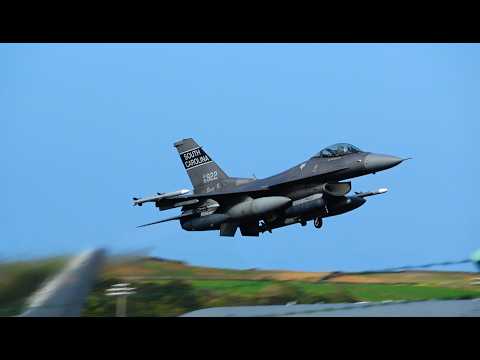
A group of Block 52 F-16CJ Vipers belonging to the South Carolina Air National Guard was recently spotted heading east across the Atlantic as part of a huge build-up of U.S. forces ahead of potential strikes on Iran. Each of the Vipers was notably seen carrying an Angry Kitten pod, a new electronic warfare system that helps defend against anti-air threats, and that may now be headed for its first use in real combat. Angry Kitten also has a very unique genesis, which we will dive into in a moment. These particular F-16s are primarily tasked with the Wild Weasel mission and are optimized for neutralizing enemy air defenses, something that would be crucial in any future operation aimed at the regime in Tehran. They can fulfill many other types of missions, as well.
The 12 F-16CJs arrived at Lajes on the island of Terceira in the Azores, a Portuguese archipelago in the mid-Atlantic, on February 17 and left the next day. The Vipers are readily identifiable as ones assigned to the South Carolina Air National Guard’s 169th Fighter Wing by the “South Carolina” emblazoned on many of their tails, as well as distinctive markings reflecting the wing’s nickname, the “Swamp Foxes.” They were accompanied by at least one KC-46A Pegasus tanker. A substantial U.S. Air Force tanker force is now also forward-deployed in Lajes to support the ongoing build-up.
Roar of the F-16s Over the Atlantic | KC-46A Opens the Afternoon ✈️🇺🇸
Military Stopover in the Azores | F-16 & KC-46A ✈️🇺🇸 at Lajes
Continuing the US flexing of its muscles towards the Middle East… 15 USAF KC-46 tankers pictured today at Lajes AFB (Azores, Portugal) 📷 Kurt Mendonça pic.twitter.com/RW2ar1nAdU
— Air Safety #OTD by Francisco Cunha (@OnDisasters) February 20, 2026
The F-16s transiting through Lajes carried inert AIM-120 Advanced Medium Range Air-to-Air Missiles (AMRAAM) on their wingtips and drop tanks under each wing, as well as a single baggage pod. Each Viper also had a LITENING targeting pod and an AN/ASQ-213 HARM Targeting System pod. The AN/ASQ-213 is a key feature of Wild Weasel F-16s and is primarily designed to support the employment of members of the AGM-88 High Speed Anti-Radiation Missile (HARM) family. AGM-88-series missiles are chief among the munitions U.S. aircraft typically use during suppression and destruction of enemy air defenses (SEAD/DEAD) missions.
However, the most notable stores seen on the jets were the Angry Kitten pods hanging underneath their fuselages. U.S. Air Force F-16s, and especially Wild Weasel CJs, typically carry other types of electronic warfare pods, such as the AN/ALQ-184 and AN/ALQ-131, on that station.
Angry Kitten has a very different story from other electronic warfare pods in U.S. military service. It is a direct outgrowth of the AN/ALQ-167, a series of pods primarily used to mimic hostile electronic warfare threats for training and testing purposes for decades. There are some documented examples of U.S. aircraft carrying AN/ALQ-167s, at least on an ad hoc basis, on real combat missions.
A US Navy F-14 carrying an AN/ALQ-167 pod, as well as other munitions and stores, during a sortie in support of Operation Southern Watch in 1997. DOD
The development of Angry Kitten, which dates back to the early 2010s, was originally focused on providing improved electronic warfare capabilities for testing and training use, especially by aggressors playing the role of ‘red air’ adversaries. However, the potential value of the new pods as operational assets to help protect friendly aircraft quickly became apparent. The ability to rapidly adapt the pods in training to provide different effects simulating enemy systems, in particular, opened the door to a much more agile electronic system for use on real-world missions.
An Angry Kitten electronic warfare pod. USAF
“We had a jammer called ‘Angry Kitten.’ It was built to be an adversary air jamming tool,” now-retired Air Force Gen. Mark Kelly, then commander of Air Combat Command (ACC), told TWZ and other outlets back in 2022. “And all of a sudden, the blue team said, ‘you know, hey, we kind of need that, can we have that for us?’ And so I see this iterating and testing our way into this.”
“Unlike the older AN/ALQ-167s, Angry Kitten is designed to be more readily modifiable and updatable to more rapidly adapt in parallel with the threat ecosystem. This is enabled in part by advanced Digital Radio Frequency Memory (DRFM) technology, which allows radio frequency (RF) signals to be detected and ‘captured,’ as well as manipulated and retransmitted. Electronic warfare systems that use DRFM can project signals from hostile radars (and radar seekers on missiles) back at them to create false or otherwise confusing tracks. Data collected via DRFM can also be used to help improve and refine the system’s capabilities, as well as for other intelligence exploitation purposes.”
“In general, electronic warfare systems need to be able to accurately detect, categorize, and respond to waveforms based on information contained in their built-in threat libraries to work most effectively. This, in turn, requires specialists to routinely reprogram systems to keep them as up to date as possible. Automating and otherwise shortening that process at every step of the way by developing what are known as cognitive electronic warfare capabilities has become a major area of interest for the entire U.S. military. The absolute ‘holy grail’ of that concept is an electronic warfare system capable of adapting its programming autonomously in real-time, even in the middle of a mission, as you can read more about here.”
A picture showing testing of an F-16 carrying an Angry Kitten pod on its centerline station in an anechoic chamber. USAF
Details the Air Force has previously shared about Angry Kitten have highlighted how the system important stepping stone for new cognitive electronic warfare capabilities.
“Unlike the F-16 tests, where pre-programmed mission data files were used, the C-130 testing includes development engineers aboard the aircraft who can modify jamming techniques mid-mission based on feedback from range control,” a release last March from the Air National Guard Air Force Reserve Command Test Center (AATC), which has been heavily involved in Angry Kitten’s development, explained.
“They are making changes [in] real-time to the techniques and pushing updates to the pod, seeing the change in real-time,” Chris Culver, an electronic warfare engineer involved in the work, said in that same release. “This approach allows for rapid optimization of jamming techniques against various threat systems.”
An HC-130J Combat King II combat search and rescue (CSAR) aircraft carrying an Angry Kitten pod on a Special Airborne Mission Installation and Response (SABIR) system installed in place of its left rear paratrooper door. Fred Taleghani / FreddyB Aviation Photography
For F-16s supporting future operations in and around Iran, Angry Kitten would offer a valuable boost in self-defense capability for the fourth-generation jets. Stealthy B-2 Spirit bombers, as well as F-22 and F-35 fighters, spearheaded the Operation Midnight Hammer strikes on Iran last year, with non-stealthy platforms providing support on the periphery. A new protracted campaign would involve more substantial effort to break Iran’s air defense overlay, which would likely require heavier use of fourth-generation tactical jets. The SEAD/DEAD missions that the South Carolina Air National Guard jets are optimized for inherently involve added risk since the aircraft are deliberately tasked with finding anti-air threats and engaging them.
Past TWZ analysis of air defense capabilities that Iran has supplied Houthi militants in Yemen offers some sense of the risks involved, even to stealth aircraft. However, Iran’s own capabilities are more advanced. At the same time, Israeli strikes took a significant toll on Iranian air defense systems during last year’s 12 Day War, especially in the western end of the country. It’s unclear to what degree that capacity has been restored in the interim.
Angry Kitten is, of course, just one part of the massive array of electronic warfare and other capabilities that the U.S. military has deployed in and around the Middle East in recent weeks.
“They better negotiate a fair deal,” Trump said today when asked if he had a message for the Iranian people.
Reporter: Do you have any message to the Iranian people?
Trump: The Iranian people in Iran or people here?
Reporter: In Iran
Trump: They better negotiate a fair deal. You know, the people of Iran are a lot different than the leaders of Iran. And it’s very, very very sad… pic.twitter.com/0a7i5LtGf2
“The most I can say – I am considering it,” Trump had also said earlier today when asked if he was considering strikes on Iran.
If the Trump administration does decide to move ahead with a new Iran operation, Wild Weasel F-16s from the South Carolina Air National Guard carrying Angry Kitten pods are among the capabilities that could be brought to bear.
Mike Huckabee, the United States ambassador to Israel, has suggested that he would not object if Israel were to take most of the Middle East, stressing what he described as the Jewish people’s right to the land.
In an interview with conservative commentator Tucker Carlson that aired on Friday, Huckabee was pressed about the geographical borders of Israel, which he argues are rooted in the Bible.
Recommended Stories
list of 3 itemsend of list
Carlson told Huckabee that the biblical verse had promised the land to the descendants of Abraham, including the area between the Euphrates River in Iraq and the Nile River in Egypt.
Such a swath would encompass modern-day Lebanon, Syria, Jordan and parts of Saudi Arabia.
“It would be fine if they took it all,” said Huckabee, who was appointed by President Donald Trump last year.
Carlson, who appeared taken aback by the statement, asked Huckabee if indeed he would approve of Israel expanding over the entire region.
“They don’t want to take it over. They’re not asking to take it over,” the ambassador replied.
The US envoy, an avowed Christian Zionist and staunch defender of Israel, later appeared to walk back his assertion, saying that it “was somewhat of a hyperbolic statement”.
Still, he left the door open for Israeli expansionism based on his religious interpretation.
“If they end up getting attacked by all these places, and they win that war, and they take that land, OK, that’s a whole other discussion,” Huckabee said.
The Department of State did not respond to Al Jazeera’s request for comment on whether Secretary of State Marco Rubio shares Huckabee’s views on Israel’s right to expand.
The principle of territorial integrity and the prohibition against the acquisition of land by force have been a bedrock of international law since World War II.
In 2024, the International Court of Justice (ICJ) ruled that Israel’s occupation of the Palestinian territories is illegal and must cease immediately.
But Israeli law does not clearly demarcate the country’s borders. Israel also occupies the Golan Heights in Syria, which it illegally annexed in 1981.
The US is the only country that recognises Israel’s claimed sovereignty over the Syrian territory.
After the 2024 war with Hezbollah, Israel also set up military outposts in five points inside Lebanon.
Some Israeli politicians, including Prime Minister Benjamin Netanyahu, have openly promoted the idea of a “Greater Israel” with expanded borders.
Israel’s Finance Minister Bezalel Smotrich stirred international outrage in 2023 when he spoke at an event featuring a map that included the Palestinian territories and portions of Lebanon, Syria and Jordan as part of Israel, set against the colours of the Israeli flag.
In his interview with Carlson, Huckabee tried to argue that Israel’s right to exist is rooted in international law, but he also attacked the legal institutions that oversee international law for their opposition to Israeli abuses.
“One of the reasons I’m so grateful President Trump and Secretary Rubio are pushing hard, trying to get rid of the ICC [International Criminal Court] and the ICJ is because they have become rogue organisations that are no longer really about an equal application of law,” he said.
Beyond his professed religious devotion to Israel, Huckabee has faced criticism for failing to speak up for the rights of US citizens who have been killed and imprisoned by Israeli forces during his ambassadorship.
Last year, Huckabee even sparked anger from some conservatives in the US when he met with convicted spy Jonathan Pollard, who sold US intelligence secrets to the Israeli government, details of which later made it to the Soviet Union at the height of the Cold War.
Pollard, a former civilian analyst in the US Navy, served 30 years in jail and moved to Israel in 2020 after his release. He never expressed regret for his crimes, and in 2021, he called on Jewish employees in US security agencies to spy for Israel.
Huckabee said he does not agree with Pollard’s views, but he denied hosting him, arguing that he simply held a meeting with him at the US embassy in Jerusalem.
Asked if anyone can walk into the embassy to meet the envoy, Huckabee acknowledged that such a meeting requires a pre-approved appointment.
“He was able to come to the US embassy to have a meeting at his request. I did, and frankly, I don’t regret it,” Huckabee said.
“I met with a lot of people over the course of the time I’ve been here and will meet with a lot more.”
The Palestinian prisoners in Israel’s Shatta Prison are medically neglected and enduring unprecedented maltreatment, the Palestinian Commission of Detainees’ and Ex-Detainees’ Affairs said on Thursday.
The Commission described the conditions of the Palestinian prisoners in Shatta as “horrifying,” reported the Palestinian Information Centre. “They are exposed constantly to brutal beatings and pepper spray attacks, and served raw and unsalted food.”
According to the Commission’s lawyer who visited the prisoners in Shatta recently, they are medically neglected and not provided with any treatment. The lawyer specifically mentioned Waleed Musallam, who suffers from severe psoriasis, and Fadi Raddad, who has been suffering from sharp pains in his back and right shoulder since Israeli jailers assaulted him.
The detainees appealed to rights groups to intervene with the Israel Prison Service to allow them to practice their religious rituals during the holy month of Ramadan without restrictions, to improve the quality of food, and to provide them with copies of the Holy Qur’an and clocks.
A general view of the completely collapsed building belonging to the Abdulhadi family after an airstrike carried out by the Israeli military as residents examine the rubble of the building and search for usable items in the southern Gaza Strip city of Khan Yunis, on April 06, 2025 [Abed Rahim Khatib – Anadolu Agency]