Dubai Airport

Packing innocent 35p item in bags or suitcases could see you stopped at airport

It might seem harmless at first glance, but it could lead to unnecessary delays

Packing for a holiday can feel like navigating a minefield, with a long list of rules on what can and can’t go in your luggage. While some banned items are obvious, others seem completely innocent at first glance – yet bringing them to the airport could still result in officials delaying your journey.

There is one everyday item that is allowed by all major airlines, including Ryanair, Jet2, TUI, easyJet and British Airways, but could still attract attention during security screening if officers are unable to identify it clearly on the scanner. To avoid unnecessary delays or having to unpack your luggage at the checkpoint, travellers are advised to pack toiletries in a way that makes them easy to inspect.

A simple bar of soap – buyable at Sainsbury’s for 35p, for example – might seem like one of the most harmless items you could take on holiday. However, it is not the soap itself that can cause concern – it is the way a solid item may appear when passing through security scanners.

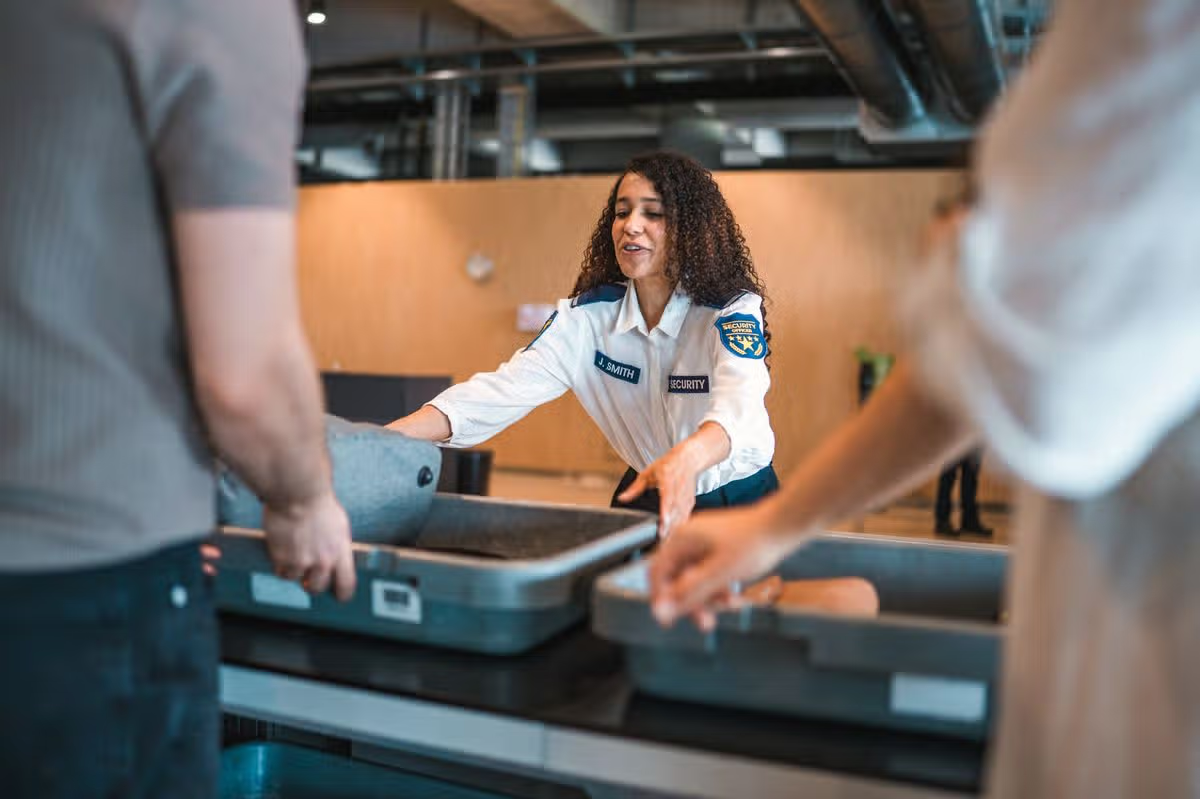
Airport security staff do not routinely search luggage simply because it contains a bar of soap. However, dense items can sometimes make X-ray images harder to interpret, particularly when they are packed alongside electronics, cables or other bulky belongings. If officers cannot clearly identify an item, they may carry out additional checks before allowing passengers through.

The government information website GOV.UK says: “Airport security staff will not let anything through that they consider dangerous – even if it’s normally allowed in hand luggage.” While soap clearly is not dangerous, if a bar of soap raises an alert on the scanner, they are legally required to stop the passenger and inspect it.

The US Transport Security Agency (TSA), for instance, says passengers are often asked to separate dense items because they can “clutter bags and obstruct clear images on the X-ray machine.” When a solid block of soap, cheese, or other dense organic material blocks the scanner’s view or mimics a threat signature, protocol requires a physical bag search or chemical swab testing to clear the item.

According to GOV.UK, solid bars of soap are permitted in both hand luggage and checked baggage. Security officers can still manually inspect any item they are unable to identify clearly during the screening process, regardless of whether it is allowed.

To reduce the chances of your bag being opened, experts recommend keeping dense items easy to access and, if requested, placing them in a separate tray during screening. Avoid storing them inside thick metal tins or rigid plastic cases alongside items such as power banks, charging cables and other electronics, as this can make X-ray images harder to interpret.

It’s also important not to confuse solid soap with liquid toiletries. While bars of soap are exempt from liquid restrictions, liquid soaps, shower gels and similar products carried in hand luggage must normally be in containers holding no more than 100ml, unless you’re travelling through an airport that has introduced next-generation security scanners permitting larger liquids.

The rules apply regardless of which airline you’re flying with, as baggage screening is carried out by the airport rather than carriers such as Ryanair, Jet2, TUI, easyJet or British Airways. A manual inspection is simply a precaution and does not mean you’ve broken any rules or packed a prohibited item.

Taking a few moments to think about how you pack everyday toiletries could help make your journey through security a little smoother. Although a 35p bar of soap is perfectly legal to travel with, storing it sensibly could help avoid unnecessary delays before your holiday even begins.
Source link

World’s biggest airport to open after £23.5billion project — robot staff and ‘no queues’

It is set to become the world’s largest airport after a £23.5billion expansion and refurbishment project is completed

Dubai is preparing to unveil the world’s largest and most cutting-edge airport, complete with robot staff and ‘no queues’ for passengers. Al Maktoum International Airport will become the biggest in the world once its £23.5billion expansion and refurbishment is finished.

It is anticipated to handle 260 million passengers annually and boasts features specifically designed to make travelling as seamless as possible. The airport claims it will eliminate queuing altogether, as bags can be dropped off before travellers even reach the terminal.

This means passengers will not need to repeat the security and customs processes.

Dubai Airports CEO Paul Griffiths described this as a “no red lights” concept while speaking to Khaleej Times.

Another way the passenger experience will be improved is through an ‘integrated underground Automated People Mover system’ that removes the need to walk from one end of the vast airport to the other.

This will feature a multi-track train, with 14 stations to shuttle passengers between terminals and concourses.

Collecting baggage is also set to be a far quicker process, as the new system will be capable of handling tens of thousands of bags in under 60 minutes.

Luggage is also expected to be available within minutes of landing, meaning the dreaded wait at the baggage carousel will become a thing of the past.

All of these impressive features will be made possible through automated travel systems, AI security checks and robot staff. These robots will be responsible for tasks such as baggage handling and may even tackle customer service queries.

According to details published by Dubai Aviation Engineering Projects (DAEP), the infrastructure developer for Dubai’s aviation sector, plans for DWC include “a new era of smart airport systems and passenger-centric facilities, taking travellers to worldwide destinations in the most awe-inspiring and comfortable way possible”.

The expansion also features five parallel runways and up to 400 aircraft gates.

Once construction at Al Maktoum International Airport is complete, the neighbouring Dubai International Airport will shut down permanently.

Dubai International Airport (DXB) is set to close its doors for good in 2035, according to reports.

All operations currently running through the bustling travel hub will be relocated to Al Maktoum International Airport (DWC).

Source link

Emirates airline issues Monday afternoon update to passengers

Emirates carries hundreds of thousands of UK passengers every year, including from London Heathrow, Gatwick, Manchester, Birmingham and Glasgow

A major airline has issued an announcement to customers after an update to its service. Emirates carries hundreds of thousands of passengers on UK services every year going through airports including London Heathrow, Gatwick, Newcastle, Manchester, Birmingham and Glasgow.

Using its 615-seater A380s the route from London Heathrow to Dubai alone offers more than one million seats. Now those travelling on the aircraft will be able to access internet connections, which the airline hails as “better than at home” following the completion of the first installation of next-generation Starlink Wi-Fi onboard.

Making the announcement on Monday afternoon, the airline said: “Emirates A380 was one of the first commercial aircraft in the world to offer internet to its customers, with first generation systems offering a total aircraft bandwidth of less than 1 Mbps. Emirates’ installation of three Starlink antennas on each A380 will improve the Wi-Fi available onboard a thousand-fold – offering a ‘better than at home’ connectivity experience for customers, while flying at 40,000 feet.”

The first Emirates A380 aircraft equipped with Starlink made its return to Dubai this week, after its installation and certification were accomplished in Newquay. More A380s are scheduled for accelerated installation throughout 2026 allowing passengers to stream, game, browse, and work throughout their journey on personal devices.

The service will be complimentary for all customers. The airline has future plans to add Live TV streaming over Starlink, initially on personal devices and later integrated into seatback screens.

Making the announcement on X, the airline said: “Our A380 is entering a new era with next-gen @Starlink Wi-Fi onboard. Ultra-fast, complimentary connectivity across all cabins, customers can stream, browse and stay connected seamlessly at 40,000 feet. A fully connected journey, redefined.”

Content cannot be displayed without consent

And passengers were delighted to hear the news. One said: “Let’s go. The old system was under 1 Mbps.” Another added: “Please don’t ever ground this airplane.”

The “double-decker” Emirates Airbus A380 is the world’s largest passenger airliner. It is known for its onboard luxury including shower spas, onboard bars and lounge.

Source link