N-DUBZ rapper Dappy filmed himself driving in his car with his daughter, despite pals claiming he does not have a licence.
The star, 39 — real name Costadinos Contostavlos — has filmed himself behind the wheel of a Mercedes and posted a number of clips online.
Dappy filmed himself driving in his car with his daughter, despite pals claiming he does not have a licenceThe N-Dubz rapper filmed himself behind the wheel of a Mercedes and posted a number of clips online
In one video seen by The Sun, Dappy is driving and swearing at the camera with his 11-year-old with him in the passenger seat.
Insiders said the footage, posted on his Instagram account, had been passed to Herts Police.
Sign up for the Showbiz newsletter
Thank you!
Drivers face six points and a £200 fine if they hold or use a phone while driving.
A source said: “Dappy won’t be getting points on his licence as he doesn’t have one. He never passed his test.
In one video, Dappy is driving and swearing at the camera with his 11-year-old with him in the passenger seatDappy became a household name after he and his cousins Tulisa and Faser formed hip-hop group N Dubz in 2000Credit: Rex
“He thinks he’s above the law and can do what he likes but driving without a license and filming himself is putting innocent members of the public at risk.
“He needs to be stopped if not for himself but for others.”
The Sun have contacted Dappy’s representatives for comment.
Dappy became a household name after he and his cousins Tulisa and Faser formed hip-hop group N Dubz in 2000.
‘Dappy won’t be getting points on his licence as he doesn’t have one. He never passed his test’, revealed an insider‘He needs to be stopped if not for himself but for others’, warned a source
They got their big break in 2008 with debut album Uncle B.
Since then they have landed four UK Top Ten singles and four UK Top Ten albums.
For Dylan Feierabend, there are few things more life-affirming than fishing for redtail surfperch and smelt at Centerville Beach in rural Humboldt County.
His favorite spot, where the Eel River meets the Pacific Ocean, is a few miles from the main road — too far to walk with fishing poles and an ice chest in tow. He instead gets there by driving a side-by-side, a small off-road vehicle, right onto the sand.
He might not be able to do so much longer.
If the California Coastal Commission has its way, vehicular access will soon be nixed at Centerville Beach County Park outside Ferndale — one of just a handful of beaches along the state’s 840-mile coastline where driving is allowed.
This month, the Coastal Commission approved a request from Humboldt County for a coastal development permit to rebuild a 0.17-mile segment of a storm-battered road adjacent to the fast-eroding beach — but only if the county stops people from driving on the sand.
Coastal Commission staff, in a 78-page report, said motorized vehicles threaten both sensitive vegetation and critical habitat for the federally threatened western snowy plover, a small, white-bellied shorebird.
“California’s dune habitats are particularly rare and important, so where driving could damage these sensitive areas, the Coastal Act requires that we protect them,” commission spokesman Joshua Smith said in a statement to The Times.
However, he said, the agency does not “have a one-size-fits-all policy on driving on the beach.”
But Humboldt County residents and officials decry the move as just the latest example of overregulation and government overreach in liberal California — and of the disconnect between its rural and urban places.
“What you see in Southern California isn’t what we see up here,” resident Joey Sancho told the Coastal Commission during its meeting in Eureka this month. “The beaches aren’t overly populated. They’re not being torn up by ATVs and so forth. But yet, [it’s] just one more thing just to take away from us up here in the North Coast.”
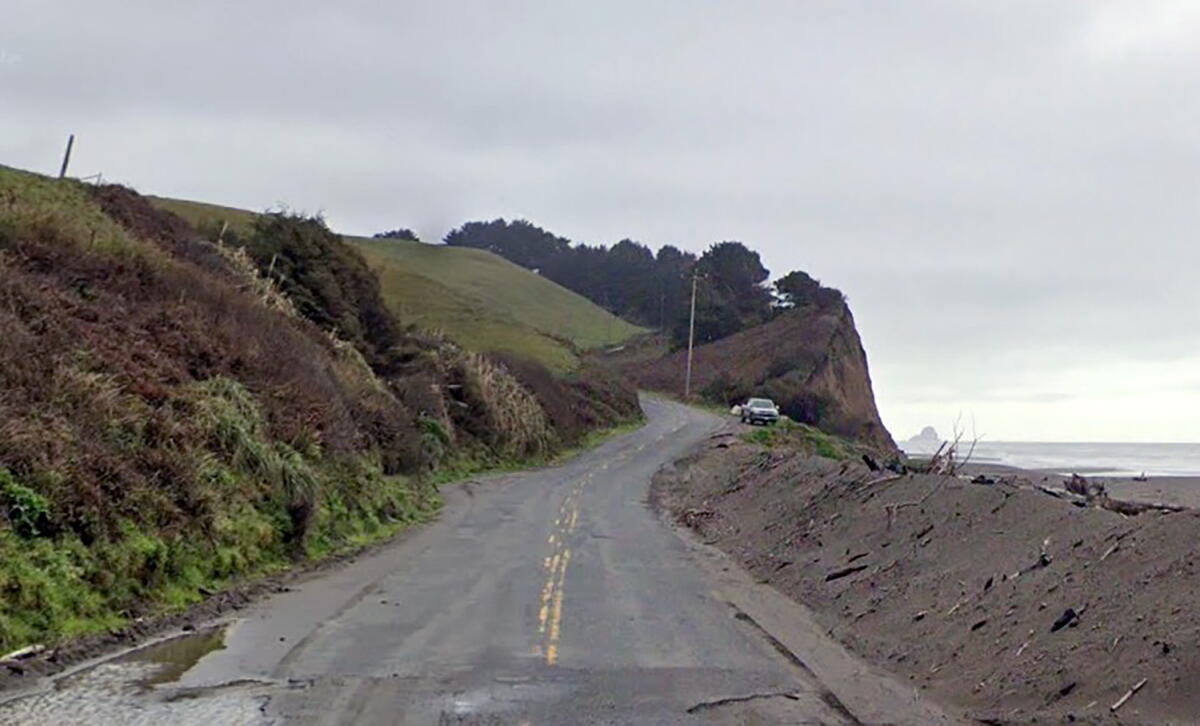
Humboldt County wants to make improvements to Centerville Road.
(Google street view)
Feierabend, a 36-year-old loan officer, told The Times: “It’s about slowly choking out the individuals that utilize the beach and gaining control under the ruse, or the guise, of conservation.”
Amid this wider debate, beach driving has emerged as an unexpected flashpoint.
Last month, Republican gubernatorial candidate Steve Hilton called coastal commissioners “idiots” for their years-long effort to end off-road driving at Oceano Dunes State Vehicular Recreation Area, the only state park that allows recreational driving on the beach.
Cars, bikes and pedestrians share the sand at Oceano Dunes State Vehicular Recreation Area near Pismo Beach in February 2021.
(Myung J. Chun / Los Angeles Times)
Oceano Dunes, near Pismo Beach in San Luis Obispo County, temporarily closed to off-roaders this spring amid long-running legal battles between recreation advocates and environmentalists who say all-terrain vehicles are tearing through western snowy plover habitat and sending clouds of unhealthy dust into nearby neighborhoods.
“Surprise, the Coastal Commission are trying to shut it down because they’re joyless bureaucrats who don’t want anyone to have fun,” Hilton said in a social media video as he leaned on a bright yellow dune buggy on the sand. “And it’s not just about fun. This is a real economic engine for this community.”
If elected, he said, he would create a state “Office of Fun and Freedom.” Its first task? Protecting off-roading at Oceano Dunes.
The campaign for Xavier Becerra, the Democratic gubernatorial candidate, did not return requests for comment.
In Humboldt County, residents have stressed that rural Centerville Beach is nothing like Oceano Dunes, where thousands of pickup trucks, ATVs and dirt bikes may carve through the sand on a given day.
Centerville Beach’s nearest town, Ferndale, the childhood home of celebrity chef Guy Fieri, has a population of just 1,500. Residents say the beach typically sees a handful of four-wheelers and side-by-sides — with most heading out to fish, not joy-riding.
“Centerville is not a beach anyone can just drive on — you’ve got to know what you’re doing,” said Shawn Griggs, a painter who surfs there most mornings. “It’s a very volatile beach with coarse sand. It’s steep right off the shore; the sand bars are transient.”
A view of Centerville Beach, near where Humboldt County is looking to repair a stretch of Centerville Road.
(Beau Sanders / For The Times)
Griggs, 57, described himself as “an environmentalist at heart” who appreciates efforts to protect threatened species. But he doubts vehicles are doing much harm at Centerville.
“With the amount of sand that is pushed off that beach every year and moved around, it’s hard for me to imagine that beach would be a super stable beach for the snowy plover,” he said.
The Coastal Commission staff report says the area is “moderately suitable for plovers,” but that “heavy human use” has degraded the habitat.
In Humboldt County, driving is allowed on a handful of county-maintained beaches, as well as portions of the Samoa Dunes Recreation Area, which is managed by the federal Bureau of Land Management.
Feierabend, who grew up next to Centerville Beach, said vehicles are not destroying the beach — the ocean is.
“No one’s going too fast,” he told the Coastal Commission. “No one’s driving through dunes. In fact, there are no dunes.”
Centerville Beach, home to some of the state’s fastest-eroding cliffs, has been shrinking for decades. The rising and warming sea has accelerated that process in recent years, and powerful El Niño-charged storms this fall and winter could wreak further havoc on the coastline.
A beach parking lot that once accommodated up to 100 vehicles has already washed away. And Centerville Road — a narrow county thoroughfare that provides access to the beach, a few rural homes and the federally managed Lost Coast Headlands — is so regularly slammed by powerful storm waves that it is often covered with sand and made impassable.
The road is what initially brought Centerville Beach to the Coastal Commission’s attention.
The Humboldt County Department of Public Works applied for a required coastal development permit to repair a short stretch of storm-damaged roadway, a project for which it had already secured federal and state funding.
The county has proposed elevating the road 10 feet and adding a new parking area. It also is looking to build a revetment — a sloping layer of rocks on the sand meant to protect the road from waves, at least for a few decades.
Humboldt County initially pushed to move the roadway farther inland, but faced resistance from private landowners.
According to the Coastal Commission staff report, beach erosion puts Centerville Road at “severe risk of being destroyed” within the next five years.
Given the urgency of the needed repairs, the decision to tie the development permit to beach driving felt like “a backroom deal stuck into the project,” Humboldt County Planning Commissioner Iver Skavdal said at the Coastal Commission meeting.
The commission is “holding the project, the residents and the county hostage,” said Skavdal, noting that seven generations of his family had enjoyed the beach.
Though the commission approved the permit on the condition beach driving will be stopped, it added an amendment after locals pushed back — giving Humboldt County an opportunity to write a plan to allow restricted driving, provided it would not harm sensitive habitats. That plan would have to come back to the commission for approval.
The Humboldt County Board of Supervisors still must decide whether to accept the stipulations of the coastal development permit before any construction begins.
The potential loss of driving on Centerville Beach — a unique attraction in California’s sparsely populated, economically depressed northwest corner — struck a chord with residents, about two dozen of whom sat through several hours of a Coastal Commission meeting on a Wednesday morning to speak about it.
“Families here don’t have a lot to do,” Sue Long, former mayor of the nearby city of Fortuna, told the commission. “There’s not a lot of the kind of entertainment you guys have, with waterslides and Disneyland and all of those things. … We count on nature.”
Mike Astry, who runs a small off-road recovery business pulling out vehicles stuck in sand or mud throughout the region, told the commission most people towed off Centerville Beach are out-of-town tourists who traveled just to drive on the beach.
Stopping vehicular access is “a big deal to a lot of people,” Astry, 49, said in an interview. “People driving from out of town that want to come drive on that beach are not going to come to our town and spend money on hotels and food.”
Astry, who also is an automotive maintenance supervisor for Humboldt County, started the towing business with his souped-up Jeep during the COVID-19 pandemic, when people flocked to outdoor spaces during lockdowns. Now, he typically gets one or two calls a week.
At Centerville Beach, he said, “I’ve had some pretty gnarly tows,” including some “little old ladies who thought, ‘Oh, I thought my Prius could go here,’ and it can’t.”
A few years ago, he yanked a Tesla out of the ocean. Powerful waves ripped off its bumper. The driver was from the Bay Area.
“People are just sick of California, their mandates, and this is just one more thing to add to it,” he said of the coastal commission decision. “It’s just a power trip. We pay our frickin taxes.”
Jennifer Savage — California policy associate director for the Surfrider Foundation, a coastal protection nonprofit — was one of the few speakers at the Coastal Commission meeting who focused on a different aspect of the county’s Centerville Beach proposal: the rock revetment next to the old, crumbling road.
Revetments and sea walls, which generally are not allowed for developments built after the Coastal Act took effect in 1977, “make a beach erode significantly faster,” she told The Times.
Erosion has been a known problem for a long time, she said, and “the failure to prepare doesn’t justify sacrificing the public beach.”
Details continue to come in, but police in the United Kingdom have declared a “major incident” and ordered evacuations near RAF Fairford after the arrest of “several men on suspicion of offenses under the explosives act,” the Gloucestershire Constabulary stated.
RAF Fairford is a major hub for U.S. military aircraft in the United Kingdom. It is a regular host of strategic assets, including bombers and U-2 spy planes. It also acts as a pit stop for other aircraft, including fighters, that are being ferried to and from the United States. Bomber strikes launched from Fairford were a central aspect of major U.S. combat operations against Iran earlier this year.
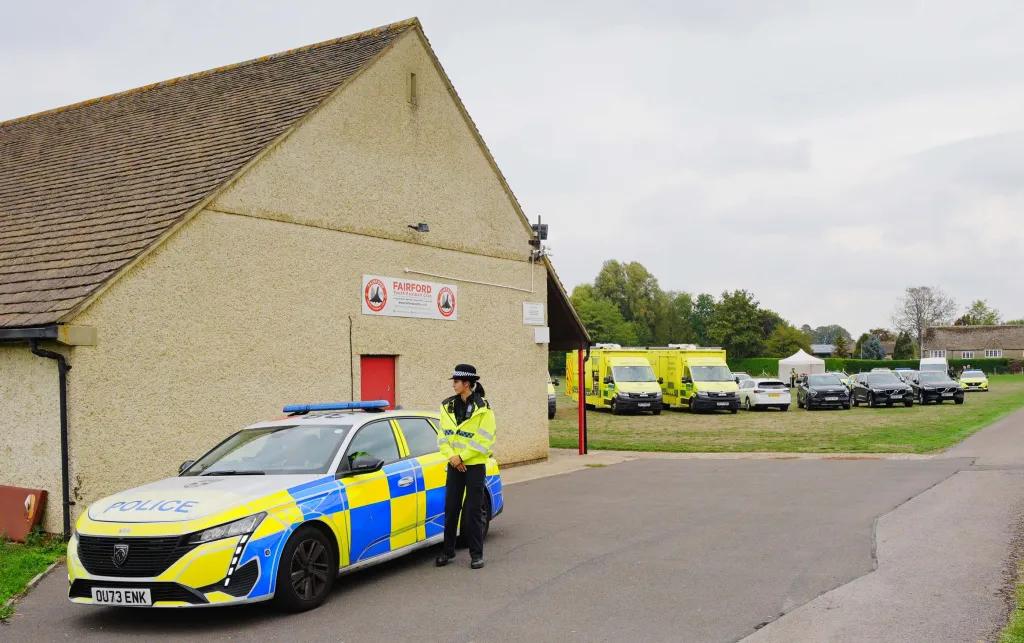
“A number of properties are currently being evacuated in the Whelford area following the declaration of a major incident,” the Gloucestershire Constabulary also announced today in light of the incident.
Emergency services in Fairford after a major incident has been declared, with armed police manning a cordon near the village of Whelford in Gloucestershire, near RAF Fairford, which is used by the United States Air Force (USAF). (Photo by Ben Birchall/PA Images via Getty Images) Ben Birchall – PA Images
The evacuations were spurred by the arrests.
“The Army’s specialist explosive ordnance disposal team are currently examining a number of vehicles,” Gloucestershire Constabulary added. “The local residents are being evacuated to a nearby leisure center.”
“A cordon is currently in place, but we’d like to reassure people that we believe this incident is contained,” the law enforcement agency explained. “We are working closely with our partners and are enacting the well-rehearsed plans we have in place.”
The incident began around 12:45 AM local time Sunday “when police received a call relating to three suspicious vehicles traveling towards RAF Fairford,” according to Gloucestershire police Assistant Chief Constable Richard Ocone. “Armed officers responded and subsequently arrested five men in the Whelford area on suspicion of committing offenses under the Explosives Act. The men were taken into custody, where they remain.”
“A 400-meter cordon has been put in place around the vehicles while the army’s explosive ordnance disposal unit examined them,” Ocene continued. “As a precaution, around 85 households have been advised to evacuate while these examinations take place.”
BREAKING:
The British authorities issue a first official statement on the suspected terror plot against RAF Fairford
They sent in a local low-ranking policemen to deliver a statement saying 5 men have been arrested and that people shouldn’t speculate about the case.
Video has emerged showing British military explosive ordnance disposal robots reportedly defusing the vans used by the suspects.
“We are aware of the current reporting, for questions regarding off-base incidents please contact the local authorities,” a U.S. Air Force spokesperson told us in response to our questions about whether the incident had raised force protection levels at RAF Fairford or other installations in the area hosting American forces. Unconfirmed reports by the local aviation spotter community claimed RAF Fairford had been placed under what is called FPCON Delta, the highest level of alert at U.S. military installations.
The incident at RAF Fairford has been escalating overnight, this is what is clear so far.
Gloucestershire Police has announced that they have arrested multiple men on suspicion of offences under the Explosives Act, and that they have declared a Major Incident.
“For operational security reasons we will not discuss specific force protection measures,” the Air Force spokesperson added. “The 501st Combat Support Wing and our fellow UK-based Wings remain vigilant and will take appropriate actions to ensure the safety and security of our U.S. service members, civilians, contractors, and their families. We constantly assess a variety of factors that determine what measures we institute or modify to protect our installations, our people and their families.”
It is unclear if airfield operations at RAF Fairford have been affected. U.S. Air Force officials did not immediately respond to our request for comment.
The British Defense Ministry did not immediately provide comment on this unfolding event.
RAF Fairford is a major hub for U.S. military aircraft, with strategic assets, like B-1B Lancer bombers, being forward deployed to the base and tactical and other assets often using it as a pit stop during flights ‘across the pond.’
A U.S. Air Force B-1B Lancer at RAF Fairford. (U.S. Air Force photo by Tech. Sgt. Robert M. Trujillo) Tech. Sgt. Robert Trujillo
As mentioned, RAF Fairford played a key role in major combat operations against Iran earlier this year. No connection has been established yet between today’s incident and any particular group, but the base has drawn direct threats from the regime in Tehran in the past.
“The American aggressor army, which used to launch cruise missiles from its vessels in the Indian Ocean in its aggression after the official resumption of the war, with the end of the missile reserves of the aforementioned vessels, yesterday switched to using B1 planes flying from Fairford Air Base, England,” Tasnim News Agency, a quasi-state outlet in Iran with ties to the country’s powerful Islamic Revolutionary Guard Corps (IRGC), claimed on Telegram on July 23. “As the officials of the Ministry of Foreign Affairs also stated, any base that is used to invade Iran’s territory is our legitimate goal.”
the enemy must pay the price for its breach of promises, and this time we will not allow America to use deceptive ceasefires to replenish its oil and ammunition stockpiles and then resume attacks once again.
Considering its importance to U.S. military operations, the base is a major potential target for nefarious actors, in general. Like other bases across Europe, it is a major potential target for Russia’s ‘hybrid war’ or ‘gray zone’ activities, as well.
Asked about the threats at the time, a British official told us that the country was prepared to defend itself.
“Our Armed Forces are ready to keep the United Kingdom safe from any kind of attacks, whether it’s on our soil or from abroad,” a government official told TWZ. “The UK stands ready 24/7 to defend itself. This includes through operating a layered approach to air and missile defense, provided by Royal Navy, British Army and Royal Air Force assets equipped with a range of advanced capabilities, working closely with our NATO allies.”
“In the Defense Investment Plan we have made air and missile defense a priority after years of underfunding, dedicating £790 million to enhance protection of the UK homeland and overseas bases from air, drone and missile threats,” the official added. “That is complemented by more than £2 billion of funding to deliver further air defense and counter-drone capabilities, and to upgrade and sustain our Typhoon fleet.”
This is a developing story.
UPDATE: 10:49 AM Eastern –
A Temporary Flight Restriction (TFR) has been imposed over Whelford, Gloucestershire, following the incident. It applies to all aircraft, including “any small balloon, any kite, any UAS and any parachute, including a parascending parachute or paramotor,” according to the FAA. “Pilots are forbidden to fly within the designated area without permission.”
HomePrivate CreditBy the Numbers: Key Trends Driving Private Lending, Finance Talent, and Global Shipping
Key data points tracking shifts in private credit, finance talent, and global shipping costs.
This article appears in the September 2026 issue of Global Finance Magazine.
Each month, Global Finance readers can look forward to our “By the Numbers” feature: A spotlight with key industry metrics that highlight a market in transition. This edition brings you three charts: a break down the numbers driving strategic moves across private lending, corporate talent, and global trade.
US Private Credit Lender Leaderboard for Q2 2026
Despite a significant drop in deal volume from the previous quarter, driven by higher financing costs, interest-rate uncertainty, and a possible AI-driven market correction, direct lenders are still finding opportunities.
Audax led the field by a wide margin, closing 62 deals in the second quarter — 16 more than second-place TPG Twin Brook (46) and 19 ahead of MidCap Financial (43), according to 9fin data. That gap at the top suggests deal flow is concentrating among a handful of active lenders even as overall volume contracts.
Apollo (37), Churchill (36) and Barings (34) formed a tightly bunched second tier, each within three deals of the next. Apogem (32), Blackstone (30), Monroe (27) and Jefferies Credit Partners (25) rounded out the top 10.
Smaller, middle-market-focused shops like Audax and Twin Brook outpaced Blackstone this quarter despite its scale, making the firm’s eighth-place finish notable. Lenders with flexible mandates—rather than the biggest balance sheets—will likely keep writing checks amid higher financing costs and rate uncertainty.
The Finance Workforce Evolution 2024 – 2030
Source: Gartner
Gartner reports that traditional talent still overwhelmingly staff today’s finance function, with 85% holding conventional backgrounds and just 15% dedicated to digital skills. That balance will flip within four years.
Gartner projects traditional finance talent will shrink to 20% of the workforce. Dedicated digital finance talent will likely grow to another 20% — and 60% of the workforce will be made up of “nondedicated” digital finance talent, employees who blend finance expertise with data, automation and technology skills rather than fitting neatly into either camp.
The shift means the finance department of 2030 will look less like a roomful of accountants and more like a hybrid team built around technology fluency, with only one in five employees carrying a purely traditional finance profile.
Dry Bulk Shipping Market Growth
Increased geopolitical risk, fuel costs, insurance premiums, and operating expenses are fueling a steady growth in shipping costs for the foreseeable future.
Every so often, an aspiring screenwriter wanders into the dim red glow of Jumbo’s Clown Room hoping to interview one of the dancers. “They’re like: ‘I’m writing a screenplay. Can I interview you?” says Cecilia Fairchild, one of the longtime dancers at the renowned East Hollywood bikini bar.
Her response is usually some version of this: “I’m like, ‘Why are you writing about that? Don’t you know we are all writing that too? Leave us alone,’” Fairchild says with a mischievous laugh. What bothers Fairchild is the assumption behind it — that the dancers are voiceless and helpless. Worst of all, they’re presumed to have stories worth mining but not the ability to produce literature themselves.
Jumbo’s has a longstanding reputation of being part of L.A.’s literary lore.
In the 1970s and 1980s, Charles Bukowski — L.A. nightlife’s debaucherous poet laureate — was rumored to haunt the bikini bar in its early days. David Lynch wrote his classic screenplay “Blue Velvet” at the bar. (According to local legends, the iconic opening shot of “Blue Velvet” came to Lynch when he spotted a dancer with only one ear.) Writer and director Quentin Tarantino reputedly wrote at the bar. But while Jumbo’s has garnered a mythology as a magnet for filmmakers, writers and musicians who collect impressions, the dive’s dancers have shifted from being the subject to the artists.
Many of Jumbo’s dancers write fiction and memoir, host literary salons across Los Angeles and find ways to tell their own stories rather than serve as muses. “It’s funny because I wish that male auteurs would tell the story of customers. I want a sniffer’s memoir. I think that’s a real point of view,” Fairchild says. (Speaking of alienation and horniness, the dancer has been meaning to crack the Marcel Proust canon.)
Honey Ryder (Claudia Musikul) types on the bar inside Jumbo’s Clown Room.(Carlin Stiehl / For The Times)
Fairchild is a playwright, poet and memoirist. Her recently completed memoir, “The Poison + The Spit,” traces a life of tumultuous love affairs and a stint dancing in New Orleans, rendered in prose that is whimsical, surreal and deeply emotional. The dancer also hosts the Downpour, a popular monthly literary salon at Bar Covell, and recently directed “Fool in the Pool,” a play that premiered at El Condor in Silver Lake this summer.
Her writing style mirrors her dancing: kinetic, wild and unpredictable. She sometimes takes the stage in roller skates, dancing to David Bowie. Her memoir achieves that same sense of hypnotic motion. “The memoir is so heavy,” she says. “Everything was so sad that I needed some lens to look at it that was fun, zippy and crazy.”
For Fairchild, dancing and writing possess the same need to expose oneself. “Vulnerability is one of the most interesting things about dancing,” she says. “There really is the potential to look into people, and they look into you, and you wordlessly share something with them that is half sexual and half this other thing.”
Meanwhile, Danielle Henderson — another dancer and aspiring novelist at Jumbo’s who writes under the pen name D.M. Faulk — has been working on a science-fiction novel titled “Meridian.” The book imagines a dystopian American wasteland where pregnant women are surveilled and controlled. She has been a longtime science-fiction fan since she and her father watched “Jurassic Park” and “Planet of the Apes” when she was a child.
Long treated as passive muses by visiting writers, Jumbo’s dancers — from left, Caroline Blaike (Caroline Moyer), Honey Ryder (Claudia Musikul), and Cecilia Fairchild — are reclaiming the narrative as active poets, memoirists and screenwriters.
(Carlin Stiehl / For The Times)
Unexpectedly, the Jumbo’s comically tiny dressing room became the inspiration for her novel. In 2022, when Roe v. Wade was overturned, conversations between dancers about reproductive rights ignited in the dressing room, which in turn informed her novel.
“A lot of those conversations happen in the dressing room. I’m incredibly inspired by the women I’m with who are incredibly sex positive and strong.” That ethos informed Henderson’s protagonist, Zayla.
In recent years, the bar has become a local author hangout. Allie Rowbottom, the author of the recent buzzy adult film novel “Lovers XXX,” discovered the bar in 2011 on the occasion of writer Elizabeth Hall’s birthday party. “I recall sitting front row on novelist Jon Lindsey’s lap, raining dollar bills on dancers performing intricate, beautiful athletic feats,” Rowbottom says. “I spent more than I could afford that night and have been back often since.”
Increasingly, Jumbo’s has cemented itself as a watering hole to the local writing scene. “Two years ago, I rented out a few tables for Jon Lindsey’s birthday, attended by Los Angeles literati like Tea Hacic-Vlahovic, Sammy Loren, Morgan Krantz, Tex Gresham and Nada Alic,” she adds.
According to Rowbottom, Jumbo’s is rife for literary inspiration. “To me, Jumbo’s feels uniquely dedicated, as a venue, to intersecting sex and art, despite the obvious dissonance of selling either,” she says. “I suspect such is what has historically made it a rich spot for writers, dissonance and tension being of utmost importance to good literary work.”
From left, Caroline Blaike (Caroline Moyer), Honey Ryder (Claudia Musikul), Cecilia Fairchild and Stephen (Aaron Laughton) inside Jumbo’s Clown Room.
(Carlin Stiehl / For The Times)
A charged scene in L.A. writer Aiden Arata’s critically-acclaimed 2025 essay collection, “You Have a New Memory,” features a night out at Jumbo’s Clown Room. “The dancers are starlets, athletes, artists; the theme is clown, and also longing — longing is a high form of physical comedy,” says Arata. “It possesses that heady mix of scuzz and glamour that can trick you into thinking your life is about to change.”
Jumbo’s burgeoning literary interest revives a hotly debated question: Who gets to tell the stories of sex work? For decades, the club has inspired celebrated writers and filmmakers, but Claudia Musikul — a dancer at Jumbo’s and a screenwriter herself — hopes its literary legacy will increasingly belong to the people at its core: the dancers.
“I hope that everybody can actually get their work out there because I feel it’s much deserved,” says Musikul. “You’ve probably heard about Bukowski, David Lynch doing ‘Blue Velvet’, or Anthony Bourdain. That’s all really cool, but in a way, it’s the actual dancers’ turn to have that kind of recognition.”
Musikul primarily writes screenplays about strippers, a subject she believes is seldom represented authentically. She has been in writing partnerships and workshops while developing scripts centered on dancers. In a sea of films depicting sex work, she cites Paul Verhoeven’s “Showgirls” as a film that resonates with her experience.
“‘Showgirls’ is my very favorite movie,” she says. “It’s my very special place in my heart movie.”
For Caroline Blaike, a poet and dancer at Jumbo’s, the connection between dancing and writing lies in observation. Years of performing have made her acutely attentive to the people who pass through the club, a voyeuristic habit that carries over into her poetry.
“When you’re a dancer, you’re very observant. You watch every person that walks in,” she says. “I feel like the way dancing makes you observe people helps you write from a perspective that other people can then relate to.”
Blaike has been working on a poetry collection that explores love, queerness, desire and personhood. “It’s gotten a little sexier over time, which is kind of fun,” she says. “I also just write about love, being gay, just existing. It can be a little aggressive, but people seem to like it, so that’s good.” She writes these poems from her prized typewriter — a “1951 Olympia typewriter that is my child.”
Among Blaike’s earliest literary touchstones was Maya Angelou. She still remembers encountering Angelou’s line in her poem “Still I Rise,” “I dance like I have diamonds at the meeting of my thighs,” and being stunned by it.
“I was like, ‘Oh, you can write that? That’s amazing,’” she says.
The literary ambitions at Jumbo’s extend well beyond the stage. Stephen Laughton, one of the club’s security guards, jokes that he leads a double life. By night, he keeps watch at the door; by day, he is an award-winning playwright. He’s recently been named the new associate artistic director of the Echo Theater in Atwater Village, and Laughton’s served as the writer-in-residence in the astrophysics department at the Natural History Museum in New York. Last November, his latest play became the first in the world to be staged in a planetarium.
“It’s this crazy, beautiful science play about two guys who meet in a club that explores mental health in the LGBT community, human interaction, time and astrophysics,” Laughton says.
Like many of his co-workers, Laughton has found himself turning Jumbo’s into copy. The club, he suggests, has a way of compelling everyone who works there to write about it.
“I think that probably what we’re all going to realize is that we’re all writing a version of the exact same story,” Laughton jokes.
Blaike argues that the dancers’ diverse talents are a key reason why Jumbo’s Clown Room has become such a beloved institution in the city. “It attracts confident, creative women who work there,” says Blaike. “Our community of women is supportive of each other and each other’s endeavors. … It really does facilitate that.”