Morocco’s PJD: what has the party learned from its dramatic fall | Elections News
Morocco’s Justice and Development Party (PJD) went from a decade of being the main political beneficiary of the country’s post-2011 reforms to suffering a dramatic electoral defeat in 2021.
The party won 107 of the 395 seats in Parliament in the November 2011 election, after protests that year called for political reform, greater accountability and a more responsive government. Its leader, Abdelilah Benkirane, became head of government.
Morocco’s 2011 constitutional changes expanded the formal powers of Parliament and government while retaining significant authority for the monarchy. The king appoints the head of government from the party that comes first in the House of Representatives, while he chairs the Council of Ministers, where strategic orientations of state policy are considered.
In the 2016 election, the PJD increased its seats to 125, but Benkirane spent months unable to form a governing coalition. In March 2017, King Mohammed VI ended his mandate and appointed Saadeddine Othmani to replace him. The PJD remained in government until its electoral collapse four years later.
In the September 2021 election, the party fell from 125 seats to just 13, losing 112. The National Rally of Independents (RNI) won 102 seats and became the largest party.
How much of the comeback rests on Benkirane?
Benkirane’s return raises another question: How much of the PJD’s comeback is being built around him?
A recent Al Jazeera Studies analysis describes Benkirane as a political “brand” whose long public career, media presence and direct communication style have created a personal profile that can function as electoral capital for the party.
It examines whether his visibility and personal appeal can help the PJD rebuild after its 2021 collapse.
Benkirane remains one of Morocco’s most recognisable political figures. But his return does not by itself show that the PJD has rebuilt its support.
The party lost 112 seats in 2021; its task now is to turn the attention generated by its leader into support for the party itself.
A broader programme
The PJD’s 2026 programme contains 467 measures across five broad areas: identity and family; political and institutional reform; public services and social protection; the economy and employment; and foreign policy.
It calls for greater transparency in public procurement, rules addressing conflicts of interest and illicit enrichment, and improvements to public services. It also highlights housing, social protection, food, water and energy sovereignty.
Its programme foregrounds practical issues such as prices, jobs, schools, hospitals and corruption.
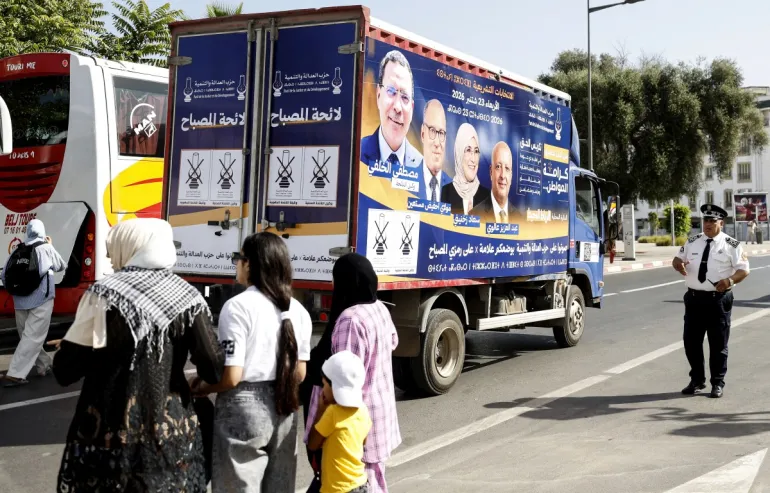
![The PJD is campaigning on public services, jobs, purchasing power and political reform as it seeks to rebuild after its 2021 electoral collapse [Abdel Majid BZIOUAT / AFP]](https://i0.wp.com/occasionaldigest.com/wp-content/uploads/2026/09/AFP__20260912__C84F3GR__v1__MidRes__MoroccoPoliticsElection-1789565328.jpg?w=640&ssl=1)
Saad al-Sabahi, 38, who works with the PJD’s regional secretariat in Casablanca-Settat, said the programme was developed through studies, consultation meetings and proposals submitted through an online platform.
“These commitments cover a range of sectors and areas affecting the lives of the Moroccan people,” he told Al Jazeera, pointing to political participation, fighting corruption, public education, healthcare, employment and economic sovereignty.
“These commitments, among others, form the basis of the agreement between the party and voters. We will work to fulfil and implement them with integrity and competence,” al-Sabahi said.
What changed after 2021?
The PJD says one of its main lessons from the 2021 defeat has been the need to reorganise internally and examine more critically its years in government.
“The party was able to overcome its crisis following its extraordinary and regular congresses, and after Secretary-General Abdelilah Benkirane took over the leadership,” al-Sabahi said. “The party also reorganised its internal affairs through communication and the renewal of its structures.”
The party’s own assessment of the 2021 defeat includes criticism of its political and organisational choices. It has also accused unnamed actors of undermining democratic choice and pointed to what it describes as electoral corruption and disinformation.
Those are the PJD’s explanations for the result, rather than independently established findings. But the scale of its losses forced the party to confront how far its record in government had separated it from parts of its former support base.
That matters particularly when it comes to younger voters.
Imane Traifi, 37, of the PJD Youth, said the party needed to create sustained opportunities for young people to take part in political life rather than treating them simply as voters during election campaigns.
“We are keen to ensure that young people move from being recipients to becoming participants, initiators and people who take on responsibility,” she told Al Jazeera.
The ghosts and crocodiles
However, a question for any future PJD government is not only what it would seek to change, but what it could change once in office.
Benkirane repeatedly referred to “ghosts and crocodiles” as a metaphor for powerful or hidden interests that he said had obstructed his government when it was in power.
The clearest example is the party’s position on Israel.
The PJD has campaigned against Morocco’s normalisation with Israel and continues to support the Palestinian cause. Its 2026 programme explicitly calls for opposition to normalisation. Yet Morocco restored diplomatic ties with Israel in 2020 while the PJD was in government and Saadeddine Othmani was head of government.
The PJD opposed the move, while Othmani later defended it as a state decision and said Morocco’s support for the Palestinian cause remained unchanged. The agreement went ahead in December 2020 as part of a US-brokered deal that included Washington’s recognition of Moroccan sovereignty over Western Sahara.
Six years later, the relationship has moved further. On September 16, Morocco and Israel agreed to elevate their diplomatic missions to embassy level and appoint ambassadors, while also expanding air travel and advancing economic and trade agreements.
The PJD reaffirmed its opposition to normalisation and cooperation with Israel the following day, describing its position as longstanding.
But it also leaves a question for the party’s return: If such forces were powerful enough to constrain the government then, what has changed?
Has the PJD developed a different understanding of the limits of government authority or will it find itself once again beset by “ghosts and crocodiles”?
The limits of government power
The PJD has made clear on several occasions that the change it seeks is from within Morocco’s existing political and constitutional system, rather than a challenge to the monarchy itself.
Benkirane has repeatedly reaffirmed his support for the monarchy while arguing that elected institutions should play their role in governing and improving the country.
That distinction is important to understanding the PJD’s return. Its opposition to policies such as normalisation with Israel sits alongside its acceptance of a constitutional and political framework in which the monarchy retains a central role in strategic state decisions.
Under the constitution, the king chairs the Council of Ministers, which considers the strategic orientations of state policy.
That applies not only to Israel but to other areas where major policy decisions remain closely tied to the monarchy.
For the PJD, rebuilding means more than recovering the seats it lost in 2021. It means showing what it learned from a decade in government, what it can deliver and how it would avoid the political costs of its collapse.
Al-Sabahi said the party wanted to regain what he described as the gains citizens had previously enjoyed.
“We will work to restore the gains that citizens previously enjoyed and to restore their dignity and rights,” he told Al Jazeera.
Yassine Elachiri, a member of the National Bureau of PJD Youth and the party’s National Council, said the relationship with younger Moroccans had to be built over time rather than during campaigns.
“Earning the trust of a new generation of young people cannot be reduced to electoral mobilisation or short-term campaigns in the run-up to voting day,” he said. “Rather, it is a cumulative process built on sustained engagement, guidance, training and creating opportunities for young people to participate actively in public affairs.”
“Our goal is not simply to reach young people at the moment of an election, but to build a lasting relationship with them based on trust, training and active participation,” Elachiri said.