President Donald Trump and China’s President Xi Jinping arrive at a state dinner at the Great Hall of the People in Beijing in 2017. Trump announced Tuesday that he is delaying his planned trip to visit Xi. File Photo Thomas Peter/EPA
March 17 (UPI) — President Donald Trump told reporters Tuesday that he has delayed his trip to China for “five or six weeks” to focus on the war against Iran.
Trump told the Financial Times Sunday that he would postpone the trip if Chinese President Xi Jinping wouldn’t help secure the Strait of Hormuz.
“It’s only appropriate that people who are the beneficiaries of the Strait will help to make sure that nothing bad happens there,” Trump said. He said that 90% of China’s oil comes from the Middle East.
“We’re resetting the meeting, and it looks like it’ll take place in about five weeks,” Trump said. “We’re working with China. They were fine with it.”
The trip was scheduled for March 31 to April 2 and focused on trade.
Treasury Secretary Scott Bessent said Monday that “we will see whether the visit takes place as scheduled,” adding that if the trip were delayed, “it wouldn’t be delayed because the president’s demanded that China police the Straits of Hormuz,” NBC News reported.
After Bessent’s comments, White House press secretary Karoline Leavitt told Fox News that the president’s “utmost responsibility right now as commander in chief is to ensure the continued success of Operation Epic Fury, as he’s doing 24/7 here at the White House and here at home.”
Official Chinese customs data show that in 2025, China got less than half of its oil from the Middle East. Russia supplied just under one-fifth of China’s oil, and sanctioned Iranian oil accounted for 11.5 %.
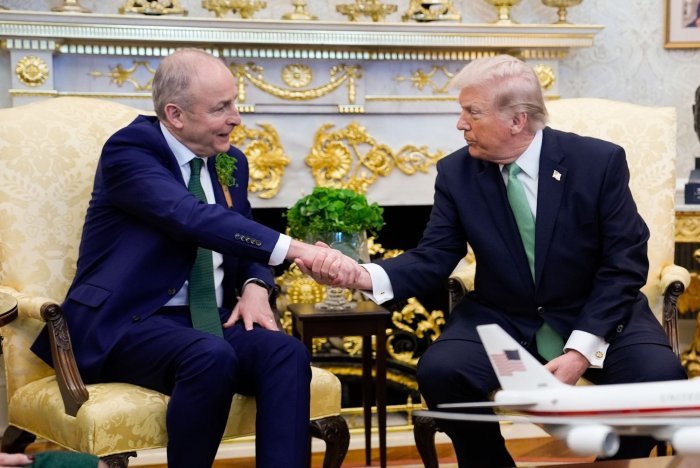
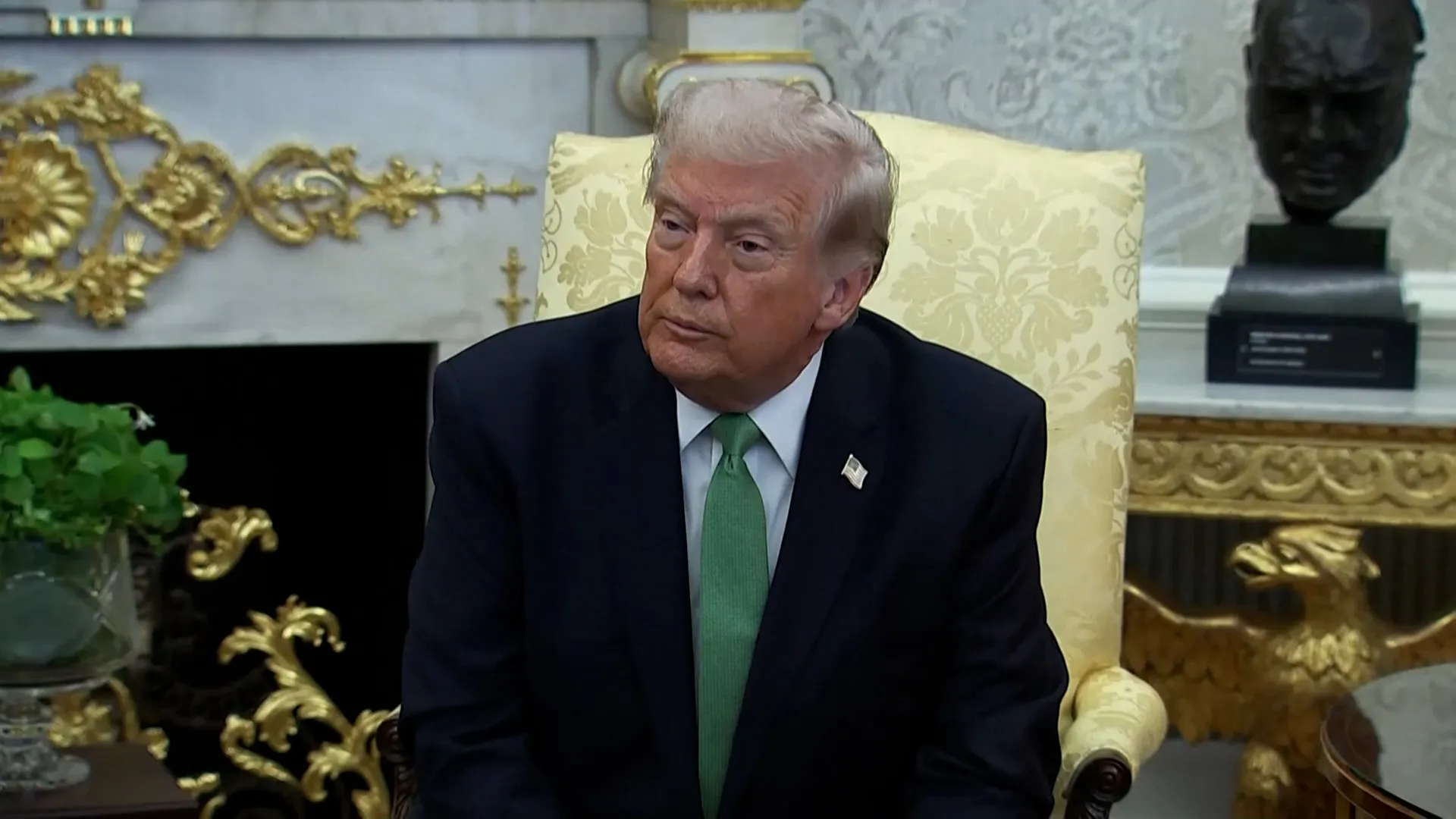
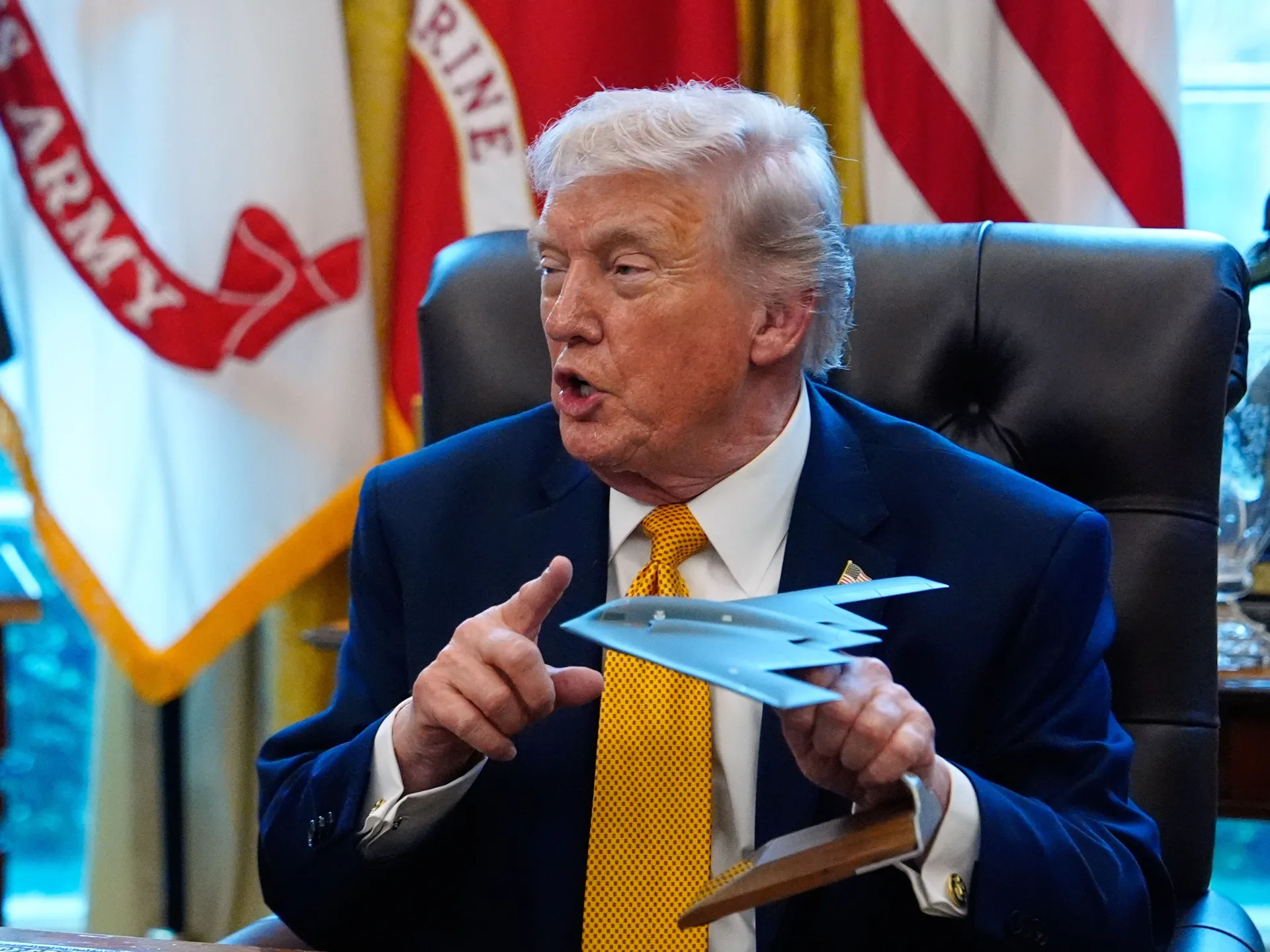
President Donald Trump meets with Taoiseach of Ireland Micheal Martin in the Oval Office of the White House on Tuesday. They will both attend a Friends of Ireland luncheon on Capitol Hill for St. Patrick’s Day. Photo by Yuri Gripas/UPI | License Photo
Washington continues to block fuel to island nation, as Trump floats ‘doing something with Cuba very soon’.
Published On 17 Mar 202617 Mar 2026
United States Secretary of State Marco Rubio has said that Cuba “has to get new people in charge,” and the administration of US President Donald Trump continues to heap pressure on the island nation.
Rubio made the comment on Tuesday during an Oval Office event, saying Cuba “has an economy that doesn’t work in a political and governmental system”.
Recommended Stories
list of 3 itemsend of list
He spoke as the US has continued to impose a de facto fuel embargo on Cuba since the abduction of Venezuelan leader Nicolas Maduro. The threat of sanctions against any country that delivers fuel to the island has worsened a years-long economic crisis and stoked humanitarian fallout.
Rubio said that Cuba’s decision announced this week to let citizens living in exile invest and own businesses in the country did not go far enough.
“What they announced yesterday is not dramatic enough. It’s not going to fix it. So they’ve got some big decisions to make,” he said.
Rubio further said Cuba has survived “on subsidies” since the Cuban revolution in the 1950s, adding “the people in charge, they don’t know how to fix it”.
“So they have to get new people in charge,” he said.
Trump floats imminent action
For his part, Trump, who on Monday said he could “take” Cuba, and has previously floated a “friendly takeover” of the country, said on Tuesday that a new action was imminent.
“We’ll be doing something with Cuba very soon,” he said.
Last week, the US and Cuba announced they had entered into talks to end the pressure campaign.
Several US media outlets have since reported that the Trump administration is calling for President Miguel Diaz-Canel to step down, although no details have emerged about his possible replacement.
The US has maintained a decades-long trade embargo against Cuba and its communist government.
On Monday, a national power outage further underscored the dire situation on the island, where periodic blackouts have long been common.
By early Tuesday, power had been restored to two-thirds of the country, including to 45 percent of the capital Havana, which is home to 1.7 million people.
March 17 (UPI) — President Donald Trump hosted Irish Prime Minister Micheál Martin at the White House on Tuesday during their annual St. Patrick’s Day visit.
Taoiseach Martin thanked the president for “affirming the tremendous bonds” between the two countries at the Oval Office.
Trump said there is a “tremendous trade relationship” between Ireland and the United States.
“We have a tremendous trade relationship with Ireland, and we’ll keep it that way. I think it’s going to be expanded very quickly,” Trump said. “Probably they want to talk a little bit about tariffs, but I won’t mention that – you might want to be discussing that a little bit.”
Vice President JD Vance also hosted a breakfast in honor of Martin at the vice president’s residence in the U.S. Naval Observatory in Washington, D.C.
A reporter asked Trump what his message was to Irish people who are paying high energy prices because of the war with Iran.
“I have a lot of friends from Ireland, they’re very happy that I’m getting rid of … a nuclear power, a nuclear terrorist,” Trump said. “And as soon as that war is over, which will be soon, your prices are going to drop like a rock. You watch.”
Martin said the connection between the two countries is important.
“The Irish have helped to build America,” he said. “We’re very proud of that connection, and we think you hosting us here in the White House is affirmation to all the Irish-Americans out there and to our diaspora in this country for what they’ve contributed to America.”
He also said he wants to develop a legal path for migration between the two countries.
Some Irish politicians have boycotted the trip.
Sinn Féin President Mary-Lou McDonald and Northern Ireland First Minister Michelle O’Neill are boycotting the St Patrick’s Day events in the United States because of the Trump administration’s policies in Gaza, the BBC reported.
Revelers wearing green cheer as the St. Patrick’s Day Parade marches through Fifth Avenue in New York City on March 17, 2026. Photo by John Angelillo/UPI | License Photo
Defence official tells Congress that 47 alleged drug-trafficking vessels have been struck since campaign began.
Published On 17 Mar 202617 Mar 2026
The United States military has confirmed that at least 157 people have been killed in lethal strikes against alleged drug-trafficking boats off Latin America, described as a campaign of extrajudicial killings by legal experts.
Senior defence official Joseph Humire said that 47 “narco-trafficking vessels” have been struck in the Caribbean and Eastern Pacific since the campaign began in September, in a written statement to members of the US Congress.
Recommended Stories
list of 3 itemsend of list
Asked by lawmakers on Tuesday whether the quantity of drugs entering the US has gone down, Humire stated that the movement of drug-trafficking vessels had decreased by 20 percent in the Caribbean.
“We’ve measured the decrease in the movement of the vessels,” said Humire.
“But that’s a no in terms of the drugs actually getting into the US,” Representative Adam Smith responded.
Experts have expressed scepticism that the strikes are having any significant impact on the drug trade, and legal scholars have said that the campaign is a clear violation of international law and is blurring the distinction between armed conflict and criminal activity. Under international law, military force is permitted for the former, but not the latter.
The Inter-American Commission on Human Rights (IACHR) is holding hearings on the strikes, and advocates hope that the hearings could open the door to possible legal accountability for those responsible.
The Pentagon has shared videos on social media showing strikes on the vessels, but has provided few details about those killed or evidence of their status as drug vessels.
The administration of US President Donald Trump has embraced a militarised approach to combatting drug trafficking that has allowed the US to expand its military footprint across the region.
The US has stepped up collaboration with friendly governments such as Ecuador and threatened military strikes against countries like Mexico and Colombia if they do not do more to accommodate US demands.
US President Donald Trump has reacted to the resignation of the US National Counterterrorism Centre’s director, Joe Kent, saying that he couldn’t work with somebody who didn’t believe Iran was a threat. Trump also said his decision to bomb Iran avoided a ‘nuclear holocaust’.
March 17 (UPI) — U.S. gasoline prices have surged by 27% and diesel by 34% since the start of U.S. attacks on Iran last month, fuel costs reported Tuesday indicate.
AAA reported that the national average cost for a gallon of gas in the United States was $3.79 Tuesday morning. Diesel was $5.044 per gallon, topping the $5 threshold for the first time in three years, CNBC reported.
A year ago, those prices were $3.078 and $3.592, respectively. A month ago, they were $2.917 and $3.651.
Fuel prices have been on the rise globally since the United States and Israel launched attacks on Iran on Feb. 28 amid negotiations over Iran’s nuclear program. The attacks, which killed Iran’s supreme leader, Ayatollah Ali Khamenei, prompted Tehran to effectively close down the Strait of Hormuz by banning ships linked to the United States or Israel. About 20% of the world’s oil runs through the waterway that separates Iran and Oman.
Brent Crude, the benchmark price for oil worldwide, rose about 2% to $102 a barrel Tuesday, The New York Times reported. The West Texas Intermediate, the U.S. benchmark, rose to $95 a barrel.
Diesel prices are particularly tied to the U.S. economy, which depends on it for the transportation of goods via trucks, trains and barges. Recent surges in prices could have a cascading effect.
Andy Lipow, president of Lipow Oil Associates, said Tuesday that trucking and rail companies have begun increasing their fuel surcharges in response to the fuel hikes.
“One should really be worried about higher diesel prices,” he said in a note published by CNBC.
President Donald Trump this week put pressure on other nations that rely on oil shipped through the Strait of Hormuz to join a coalition to police the transit route and reopen traffic.
Speaking aboard Air Force One on Sunday, Trump said the United States doesn’t need to be involved in reopening the Strait of Hormuz because little of its oil passes through the waterway. About 7% of the United States’ crude oil and condensate imports passed through the strait in the first half of last year, the U.S. Energy Information Administration said.
He said the United States was protecting it “almost like we do it for habit” and to help “some very good allies that we have in the Middle East.”
Patrick De Haan, head of petroleum analysis at GasBuddy, said Monday, “until we see a meaningful resumption of oil flows through the Strait of Hormuz, upward pressure on fuel prices is likely to persist.”
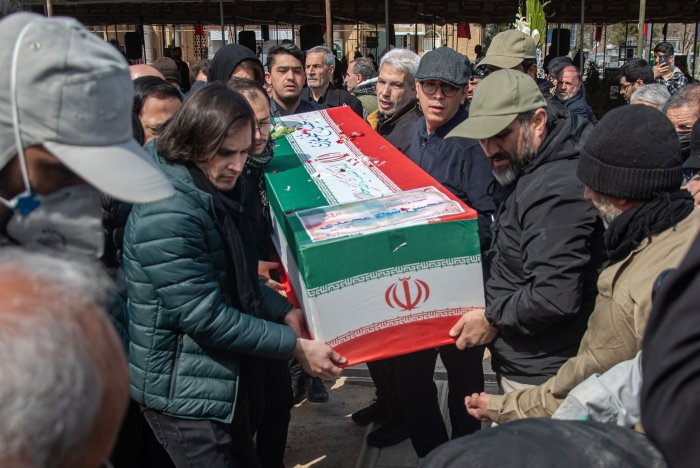
Iranians attend a funeral for a person killed in recent U.S.-Israel airstrikes at Behesht-e Zahra cemetery on the southern outskirts of Tehran in Iran on March 9, 2026. Photo by Hossein Esmaeili/UPI | License Photo
Women chat in Havana on Monday. Cuba’s national electrical grid has suffered a total collapse after a three-month halt in foreign oil shipments. Photo by Ernesto Mastrascusa/EPA
March 17 (UPI) — A magnitude 5.8 earthquake struck eastern Cuba early Tuesday, hours after the island’s national power grid collapsed, leaving nearly the entire country without electricity and compounding an already severe economic and social crisis.
The U.S. Geological Survey reported the quake at magnitude 5.8, while Cuba’s National Seismological Research Center measured it at 6.0. The epicenter was located off the coast of Guantánamo province and was widely felt across eastern Cuba.
State local newspaper Granma reported no fatalities or significant material damage.
The tremor followed the total disconnection of Cuba’s National Electric System shortly before 2 p.m. Monday, the sixth nationwide blackout in roughly 18 months. The Ministry of Energy and Mines said on X that the causes remain under investigation.
The outage left nearly 10 million people without electricity, disrupting water pumping, telecommunications and Internet service. Residents relied on candles, torches and battery-powered radios, according to a report by Mexican broadcaster TV Azteca.
The ministry said the failure affected the entire country, including Havana. The U.S. Embassy in Cuba issued a security alert saying no information was available on when power would be restored.
Energy Minister Vicente de la O Levy said on X that authorities are following established protocols and working to restore electricity to the country’s largest generating units.
Independent outlet Diario de Cuba reported that the government has yet to explain the collapse, which coincided with renewed protests in Havana and growing signs of public discontent.
Officials initially said service was being partially restored through localized “microsystems” in several provinces, prioritizing essential facilities while attempting to restart major thermoelectric plants. Full recovery could take time, especially due to fuel shortages that have limited distributed generation since January.
Frequent blackouts have slowed industrial activity and strained public services nationwide. Recent demonstrations in several cities have resulted in arrests.
Official figures show the Cuban economy has contracted more than 15% since 2020. Much of the state-run industrial sector remains idle and essential services have deteriorated sharply.
Independent experts estimate that fully restoring the power system would require between $8 billion and $10 billion, sums widely seen as beyond the reach of the Cuban economy.
Days after President Miguel Díaz-Canel acknowledged talks with the United States to address longstanding disputes, the government announced measures to allow greater entry of private capital, including from U.S. companies and Cuban expatriates in Miami.
In an interview with state-run Canal Caribe, Vice Prime Minister Óscar Pérez-Oliva Fraga said investors could own private companies on the island and access the financial sector. He confirmed that Cuban emigrants may become partners or owners of private businesses without living in Cuba and may associate with local firms under the Foreign Investment Law.
They also would be allowed to enter the national financial system, open foreign currency accounts and create cooperation and investment funds with authorization from the Central Bank.
Pérez-Oliva Fraga said the measures respond to demands from the diaspora and aim to expand its role in economic development as the government seeks to attract foreign capital and diversify the private sector.
He said “Cuba’s doors are open” to foreign investment, including U.S. companies, while again blaming the U.S. embargo for the island’s energy crisis and fuel shortages.
On Monday, President Donald Trump said he would have “the honor of taking Cuba,” describing the country as weakened after decades of rule by what he called violent leaders.
“You know, all my life I’ve heard about the United States and Cuba. When will the United States have the honor of taking Cuba? That would be a great honor,” Trump said from the Oval Office, according to CNN.
“Taking Cuba in some way, yes, taking Cuba. I mean, whether you free it or take it, I think I can do whatever I want with it,” he added.
His comments came as senior administration officials have repeatedly said a conflict with Iran could end within days and after Trump suggested that Cuba could be next on his agenda.
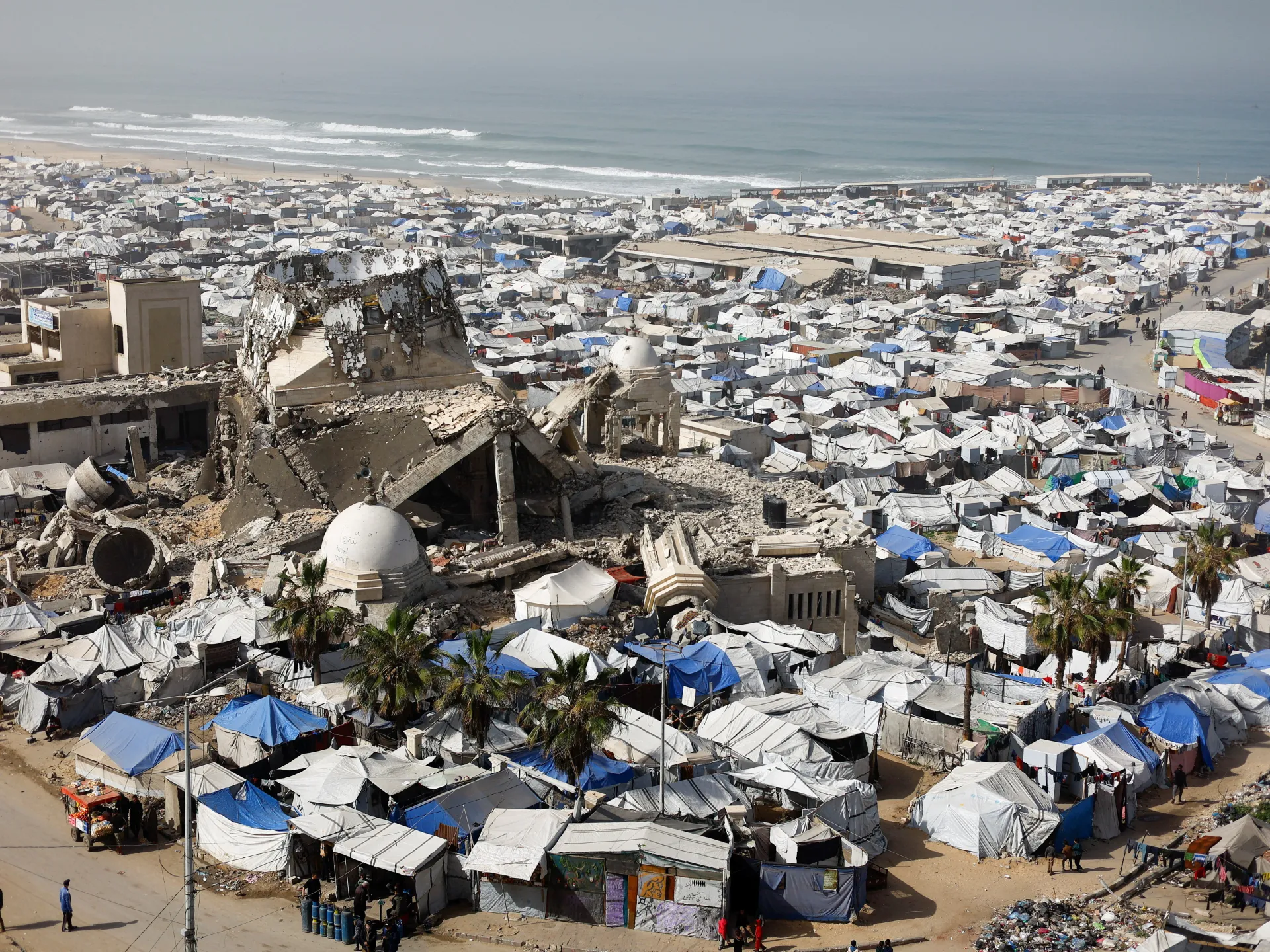
In a devastated enclave where more than two million Palestinians remain crammed into a shrinking strip of land under the overwhelming shadow of Israeli military occupation and bombardment, daily survival is tethered to a fragile October “ceasefire”.
But as Israeli and US bombs rain down on Iran, and Tehran retaliates across the region, that battered truce faces a breaking point, prompting an unprecedented diplomatic manoeuvre: direct talks between United States President Donald Trump’s “Board of Peace” and Hamas.
Recommended Stories
list of 4 itemsend of list
Envoys from the new body, personally headed by Trump to oversee post-war Gaza, but with more far-reaching designs, met with Hamas representatives in the Egyptian capital over the weekend, according to the Reuters news agency.
The meetings aimed to safeguard the “ceasefire”, which has been under even more severe strain since the regional war began on February 28.
Following the talks, Israel announced it would partially reopen the Rafah border crossing between Gaza and Egypt on Wednesday. The crossing, Gaza’s sole pedestrian lifeline outside direct Israeli control, was shut when the Iran offensive began.
Despite the diplomatic push, violence in the enclave persists. Israeli strikes on Sunday killed at least 13 Palestinians including two boys, a pregnant woman, and nine police officers, serving as a stark reminder of Israel’s all-encompassing military grip on the territory.
A pragmatic shift or tactical ploy?
While the talks mark a notable engagement by Washington, analysts view the move not as a legitimisation of the Palestinian group, but as a calculated tactic underpinned by the threat of renewed violence.
Abdullah Aqrabawi, a Palestinian political analyst, noted that Washington’s willingness to meet Hamas reflects a stark reality on the ground. “There is a comprehensive, realistic acknowledgement that the main military, political, and social actor in the Gaza Strip is Hamas,” Aqrabawi told Al Jazeera.
However, he warned against viewing the meetings as a fundamental shift in US policy. In the era of the Trump administration, diplomatic meetings do not equate with political recognition. Instead, Aqrabawi argued, the approach is framed by the constant threat of a return to a “war of extermination”.
The ultimate goal of these talks, he explained, is to empower a newly formed technocratic committee in Gaza to build a social base capable of challenging the armed group.
The illusion of ‘reverse blackmail’
Initial reports suggested that Hamas had threatened to abandon the “ceasefire” if Gaza border restrictions continued, purportedly using the regional chaos of the Iran war to force Israel’s hand.
Aqrabawi dismissed this assessment, noting that Hamas has consistently expressed a desire to avoid a return to full-scale war. Rather than a successful Palestinian pressure campaign, he said the reopening of the Rafah crossing serves a different strategic purpose for Washington and Tel Aviv.
“Any facilities, whether the Rafah crossing or allowing aid entry, come through the “Board of Peace” and the new technocratic committee formed in the Gaza Strip,” Aqrabawi said. “It is not a response to negotiations or Palestinian pressure, but rather in the context of allowing this committee to penetrate Palestinian society.”
He added that this aims to establish a security foundation that allows for the disarmament of the resistance, even if it leads to internal Palestinian civil conflict.
Disarmament and the 20-point plan
Prior to the regional escalation, Trump’s flagship Middle East initiative – a 20-point plan for Gaza – had partially halted the mass killings and secured the release of Israeli military captives and some Palestinian prisoners. In exchange, Hamas accepted a ceasefire that left the Israeli military occupying more than half of the enclave.
But the second phase of Trump’s plan, which hinges on Hamas laying down its weapons in exchange for amnesty and reconstruction, remains deadlocked. While some might assume the regional conflict gives Hamas leverage to scrap the disarmament clause entirely, Aqrabawi suggested the opposite is unfolding.
The US and Israel, heavily engaged in Iran, are likely intensifying pressure on the Palestinian group to secure a swift, enforceable victory in Gaza. “The pressure happening today on the occupation government and the American perspective of the war with Iran may push them to pressure Hamas to accomplish this task as quickly as possible,” Aqrabawi said.
Yet, Hamas remains resolute. The group views its weapons as essential for resisting the occupation and forming the foundation of future Palestinian security institutions.
As Washington and Tel Aviv attempt to use the spectre of renewed genocide to engineer Gaza’s political future, the reality for the Palestinians trapped inside the enclave remains unchanged. For them, the partial reopening of a single border crossing is not a diplomatic breakthrough, but a fleeting gasp of air in a besieged Gaza Strip where daily survival is held hostage to the demands of the military occupation.
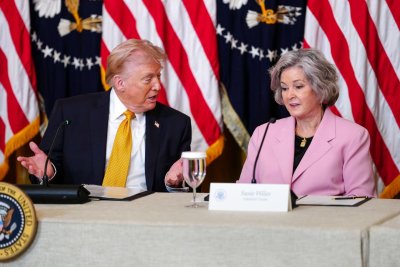
1 of 5 | President Donald Trump speaks with White House chief of staff Susie Wiles during a meeting with trustees of the John F. Kennedy Center for Performing Arts in the East Room of the White House in Washington, D.C., on Monday. Photo by Aaron Schwartz/UPI | License Photo
March 16 (UPI) — White House chief of staff Susie Wiles has been diagnosed with breast cancer and has an “excellent” prognosis, President Donald Trump announced Monday.
In a post on Truth Social, Trump said Wiles has “early stage breast cancer” and will be undergoing treatment “immediately.”
“She has a fantastic medical team, and her prognosis is excellent!” Trump wrote. “During the treatment period, she will be spending virtually full time at the White House, which makes me, as President, very happy!”
Wiles confirmed her diagnosis hours later in a statement on X.
“Nearly one in eight women in the United States will face this diagnosis. Every day, these women continue to raise their families, go to work and serve their communities with strength and determination,” she said.
“I now join their ranks.”
The diagnosis was made last week, she added, while expressing her gratitude to the doctors who “detected the cancer early.”
“I am encouraged by a very good prognosis,” she said.
“I am also deeply thankful for the support and encouragement of President Trump as I undergo treatment and continue serving in my role as White House chief of staff.”
The Hill reported that Wiles was seated next to Trump during Monday’s John F. Kennedy Center for the Performing Arts board meeting at the White House.
Vice President JD Vance also voiced his support for Wiles in a post on X.
“The Vance family is praying for our dear friend as she takes on her next fight!” he wrote.
Trump ally Elon Musksaid he was “hoping for the best,” while rapper Nicki Minajsaid, “God will get the glory for your testimony, my sister.”
‘For 40 years, we’re protecting you’: US President Donald Trump criticises allies’ reluctance to commit forces to open the key waterway for Gulf oil exports.
The 33-year-old Columbia University protester had been held in immigration detention centre for a year.
Published On 16 Mar 202616 Mar 2026
Share
Leqaa Kordia, a Palestinian woman detained in the United States after taking part in pro-Palestine demonstrations in 2024, has been released after a year in custody.
The 33-year-old, who grew up in the occupied West Bank before moving to the US in 2016, was held at a detention facility in the state of Texas since March last year.
“I don’t know what to say. I’m free! I’m free! Finally, after one year,” a smiling Kordia told reporters after leaving the detention centre on Monday.
An immigration judge had ruled Kordia was eligible to be released on bond three times. Immigration officials appealed the first two rulings but Kordia was freed on $100,000 bond after government lawyers did not challenge the third.
After her release, Kordia said she was looking forward to going home and hugging her mother “so hard.” But she also said she would keep fighting on behalf of people still being held at the detention centre
“There is a lot of injustice in this place,” she said. “There is a lot of people that shouldn’t be here the first place.”
Kordia, who lost nearly 200 members of his family during Israel’s genocidal war against Palestinians in the Gaza Strip, was among several protesters targeted by immigration officials for taking part in pro-Palestine demonstrations at Columbia University in 2024.
Until Monday, she was the only person targeted in connection with the demonstration who was still in immigration detention after the release of others, including Mahmoud Khalil and Mohsen Mahdawi.
Kordia, who was held at Prairieland Detention Center in Alvarado, was recently hospitalised for three days following a seizure after fainting and hitting her head at the privately run detention facility.
At a hearing on Friday, Kordia’s lawyers said she had a neurological condition that had worsened while in custody, putting her at an elevated risk of seizure. They reiterated that she could stay with US citizen family members and did not pose a flight risk.
The immigration judge, Tara Naslow, agreed.
“I’ve heard testimony. I’ve seen thousands of pages of evidence presented by the respondent, and very little evidence presented by the government in any of this,” Naslow said.
Offering another rationale for the US-Israeli war on Iran, Donald Trump claimed he ordered strikes to prevent a nuclear conflict that would have turned into World War III. He also said not even the “greatest experts” thought Iran would retaliate with attacks on Gulf states.
Speaking at the Oval office, US President Donald Trump stated that Somalia is a “fourth world nation” while repeating claims without evidence that Congresswoman Ilhan Omar had illegally entered the country by marrying her brother. Omar has consistently denied the “sick” allegations.
Israeli forces have attacked multiple towns in southern Lebanon after announcing “limited and targeted ground operations” against Hezbollah. Israel has warned residents will not be able to return to their homes until the military says so.
March 16 (UPI) — The board of trustees for the John F. Kennedy Center for the Performing Arts in Washington, D.C., is set to attend a meeting Monday to determine whether to shutter the facility to carry out renovations that some critics worry could result in a structural overhaul akin to the White House’s East Wing.
The agenda for Monday’s meeting, obtained by The New York Times, indicates the board will vote on whether to begin renovations starting July 6. President Donald Trump announced last month that he wants to close the Kennedy Center for two years for construction amid artist cancellations and boycotts over his cultural agenda.
Trump said the decision to close the facility came after a yearlong review in consultation with contractors, musical experts, arts institutions, and advisers and consultants. He had initially considered a partial project that would permit shows to continue, but decided the best option for the venue was a temporary closure.
Rep. Joyce Beatty, D-Ohio, an ex officio member of the board who sued to have access about the details of renovations, said she believes Trump wants to shutter the Kennedy Center in response to dozens of individuals and cultural organizations who have canceled appearances there in response to Trump trying to rename the center after himself. Beatty said the documents she received about the renovations were “inadequate.”
She said “the documents prove that there is absolutely no basis to shutter this precious living memorial and beloved institution,” she said in a statement. “It certainly looks like President Trump is shutting down the center because he is embarrassed that ticket sales are down and artists are fleeing since his illegal renaming.”
Beatty’s lawyers said she was concerned Trump might use his hand-selected board to push through wholesale changes at the Kennedy Center to design a facility more to his liking. In October, Trump had the East Wing of the White House demolished to make room for a $250 million ballroom.
In a post on Truth Social on Friday, Trump shared renderings of what he expected the so-called Trump-Kennedy Center to look like after the renovations. He said he’s not planning to rip out the facade.
“I’ll be using the steels. So we’re using the structure, we’re using some of the marble, and some of the marble comes down,” he said.
A Washington Post analysis of the renderings show very few changes to the exterior of the building, including altered cornices, updated roof and some windows, painted columns, new signage and landscaping changes.
The group Hands Off the Arts has held weekly protests outside the Kennedy Center over the changes. A participant, drag queen Tara Hoot, said “there’s no need for it to close.”
“The carpet’s brand new, right? They already have some things planned in the works to redo the Kennedy Center and parts of it, maintenance, so there’s no reason to close it,” Hoot said, according to WUSA-TV in Washington, D.C.
“There are jobs, lots of jobs, and people are going to lose their jobs. The economy is terrible right now. Why do we want more people to lose their jobs?”
President Donald Trump speaks during an event celebrating Women’s History Month in the East Room of the White House on Thursday. Photo by Bonnie Cash/UPI | License Photo
As the war US-Israeli war on Iran enters its third week, Iran’s Foreign Minister Abbas Araghchi has said that his country has shown it is ready to take the war “as far as necessary” and that the conflict must end in a way “that our enemies will never again consider repeating these attacks”.
Iran stepped up its targeting of Gulf neighbors, attacking and setting on fire a fuel tank close to Dubai International Airport, forcing flights to be suspended, and the key Fujairah oil export hub on the UAE’s east coast, on the supposed “safe” side of the Strait of Hormuz. Photo by Stringer/EPA
March 16 (UPI) — Emergency services in the United Arab Emirates were battling a major blaze at the country’s strategically key Fujairah oil export hub on Monday morning after the second drone strike on the facility in two days.
Emirate of Fujairah authorities said in a post on X that no one had been hurt in the attack on the Fujairah Industrial Petroleum Zone and that efforts were ongoing to bring the fire under control. They appealed to people to refrain from spreading misinformation.
“Civil defense teams in the Emirate immediately responded to the incident and are continuing their efforts to control it. The competent authorities call on the public not to circulate rumours and to obtain information only from official sources,” wrote the Fujairah Media Office.
The facility is strategically important because it is the only oil export terminal on the UAE’s eastern coast, located on the Gulf of Oman, the “good” end of the Strait of Hormuz.
Critically, it means oil tankers servicing the port do not need to run the gauntlet of the 21-mile-wide sea lane that Iran has effectively closed.
An approximately 250-mile-long cross-country oil pipeline from Habshan, a key onshore field 80 miles southwest of Abu Dhabi, feeds as much as 1.8 million barrels per day of crude into Fujairah.
However, Iran’s Islamic Revolutionary Guard Corps threatened ports, docks, military facilities and other “legitimate”U.S. targets in the UAE while the state media uged workers and residents in and around Fujairah, Jebel Ali and Khalifa ports to evacuate due to the presence of U.S. military forces.
Monday’s incident, following on from a separate strike and fire on Saturday, highlighted how exposed Fujairah — one of the world’s key crude oil and fuel storage hubs — was to Iranian threats.
The UAE has been repeatedly targeted by Iranian drones and missiles since the United States launched its airborne offensive against Iran on Feb. 28.
A drone attack earlier Monday that forced the temporary grounding of all flights at Dubai International Airport after a fire erupted in a fuel tank close by and an announcement by Israel that it was nowhere near done with hitting Iran indicated the war was likely headed into a third week.
Israel also announced plans for an expansion of its ground offensive in Lebanon against Hezbollah operatives and strongholds after the Iranian proxy group attacked Israel with rockets and missiles on March 2, two days into the war.
An Israeli bombing campaign and targeted actions by ground forces has already forced hundreds of thousands of civilians in the country to flee their homes and killed more than 850, more than 170 of them women and children, according to the Lebanon Health Ministry.
European Union foreign ministers were set to meet on Monday in Brussels to discuss the situation in the region as oil prices continued their upward trajectory with the benchmark Brent crude futures briefly hitting $106 per barrel during trade on Monday.
Shipping of oil, gas and all cargo through the Strait of Hormuz remains stalled despite calls by U.S. President Donald Trump at the weekend for countries that get their oil from Gulf producers to step up and help restart movement of ships in and out of the Persian Gulf.
Iranians attend a funeral for a person killed in recent U.S.-Israel airstrikes at Behesht-e Zahra cemetery on the southern outskirts of Tehran in Iran on March 9, 2026. Photo by Hossein Esmaeili/UPI | License Photo
March 16 (UPI) — Senate Republicans are trying to pass the SAVE America Act this week, as both the GOP and Democrats are gearing up to fight over the election reform bill that would require those registering to vote to show proof of citizenship with passports or birth certificates.
The Safeguard American Voter Eligibility Act already has broad public support, but Democrats are strongly against it. Republicans and President Donald Trump want a prolonged fight, forcing Democrats to defend their opposition.
Republicans say it will make elections safer, but Democrats call it a “voter suppression act.”
The bill would force people registering to vote to show proof of citizenship with a passport or certified birth certificate. People who have legally changed their name, including transgender people and most married women, would have a more difficult time.
According to State Department statistics, around half of Americans have a valid passport, and a first-time applicant would have to pay $165 to get one. The University of Maryland’s Center for Democracy and Civic Engagement said that 2.6 million Americans do not have a government-issued photo ID.
A recent Harvard CAPS/Harris poll showed that 71% of voters support the SAVE Act.
House Republicans passed a version of the bill along party lines in February. But the Senate needs 60 votes to avoid a filibuster. Right now, Republicans have a 53-47 majority, and Sen. John Fetterman, I-Pa., who usually votes with the GOP, has said he’s against the bill.
On Thursday, Senate Majority Leader John Thune, R-S.D., said he wants to bring the bill to a vote to “put Democrats on the record.”
Sen. Mike Lee, R-Utah, told The Hill that Trump wants to see an epic fight, similar to the two-month battle to pass the 1964 Civil Rights Act.
“What I want to do is try to maximize the period of time in which we debate it,” Lee said.
“They faced a 32-vote cloture deficit at the time it came over from the House in March of ’64,” Lee told The Hill. “They were able to close a 32-vote cloture deficit. It took them 60 days, but they got there.”
He said taking a longer time gives lawmakers clarity.
“Debating a bill that continues to get more popular even as people are trying to slow it down and stop it and obstruct it sometimes sharpens the minds of individual lawmakers and makes them more amenable in the end to negotiation,” Lee added. “That’s what we’re looking at here.”
Trump and other conservative Senators want to force Democrats to do a talking filibuster, but Thune has said there just aren’t enough votes to do so. He said the Republicans aren’t unified enough to table potential Democratic amendments.
“The votes aren’t there, one, to nuke the filibuster and the votes aren’t there for a talking filibuster. It’s just a reality,” The Hill reported Thune said last week. “I’m the person who has to deliver sometimes the not-so-good news that the math doesn’t add up but those are the facts and there’s no getting around it.”
Senate Minority Leader Chuck Schumer, D-N.Y., said Democrats are prepared for the battle.
“We don’t yet know what Thune is doing … but we’re prepared for every possible scenario,” Schumer told reporters Sunday.
“My caucus really feels strongly that this would be a horror … one of the worst things that’s happened in the history of this country in terms of allowing people to vote,” he said.
President Donald Trump speaks during an event celebrating Women’s History Month in the East Room of the White House on Thursday. Photo by Bonnie Cash/UPI | License Photo
As anticipated, it ended up being One Battle After Another’s night at the 98th annual Academy Awards, with the political thriller carting away six Oscars out of a total of 13 nominations.
But while Paul Thomas Anderson’s magnum opus continued its march towards award-season domination, there were moments of genuine surprise and subversion in Sunday’s ceremony.
Recommended Stories
list of 3 itemsend of list
Some of those moments had to do with the current political climate in the United States.
Host Conan O’Brien and his fellow presenters deftly avoided mentioning President Donald Trump by name, but their barbs took direct aim at his policies since returning to office.
Other surprises came from within the filmmaking community itself. For only the seventh time in Oscar history, a tie was announced: Two films had gotten an equal number of votes for Best Live Action Short.
As a result, both the surrealist thriller Two People Exchanging Saliva and the moody bar-room drama The Singers shared the Academy Award.
Here are six key takeaways from the night.
Actor Michael B Jordan holds the Oscar for Best Actor next to director Ryan Coogler, who earned an Oscar for Best Original Screenplay [Valerie Macon/AFP]
A two-horse race between Sinners and One Battle
The vampire film Sinners came into Sunday night’s ceremony with a record 16 Oscar nominations. But the big question of the night was: How many nods could it actually convert into wins?
Its biggest competition was, of course, Anderson’s One Battle After Another, which had the second highest tally of nominations.
Sinners director Ryan Coogler and Anderson were in direct competition in several top categories, including Best Picture and Best Director.
In both cases, Anderson came out ahead, though he acknowledged how fickle such awards can be.
“ I just want to say that, in 1975, the Oscar nominees for Best Picture were Dog Day Afternoon, One Flew Over the Cuckoo’s Nest, Jaws, Nashville and Barry Lyndon,” the four-time Best Director nominee said, listing films now considered to be Hollywood classics.
“There is no best among them. There is just what the mood might be that day.”
In the categories for Best Supporting Actor and Best Film Editing, One Battle After Another also triumphed, as well as for the inaugural award for Best Casting.
But in a sign of how well matched their two films were, both Coogler and Anderson emerged from the night with writing Oscars.
Anderson picked up Best Adapted Screenplay award for his use of the Thomas Pynchon novel Vineland, while Coogler made off with the Best Original Screenplay Oscar for Sinners, a work inspired by his uncle’s love of the blues.
US cinematographer Autumn Durald Arkapaw poses in the press room with her Oscar for Best Cinematography [Valerie Macon/AFP]
Jordan dunks on Chalamet in Best Actor race
Sinners, which won four Academy Awards overall, earned some of the most emotional, nail-biting victories of the night.
In the Best Cinematography category, for instance, Autumn Durald Arkapaw became the first woman to top the field.
It was her first nomination and first win, with Arkapaw besting veteran cinematographers like Marty Supreme’s Darius Khondji and Frankenstein’s Dan Laustsen, both multiple nominees.
Another big win for Sinners came in the form of Michael B Jordan, the actor whom Coogler has cast in every film since his directorial breakout in 2013’s Fruitvale Station.
Jordan, 39, was in a tight race for Best Actor with another young performer, 30-year-old Timothee Chalamet of the 1950s ping-pong drama Marty Supreme.
But Chalamet’s aggressive campaigning may have ultimately sabotaged his prospects. Multiple cracks were taken throughout the night at Chalamet’s recent comments disparaging opera and ballet.
“Nobody cares anymore” about either art form, Chalamet said in an interview last month.
“We can change society through art, through creativity, through theatre and ballet and also cinema,” director Alexandre Singh said pointedly during his acceptance speech for Best Live Action Short.
O’Brien, meanwhile, acknowledged the backlash with a joke about heightened security at the night’s Oscar ceremony.
“I’m told there are concerns about attacks from both the opera and ballet communities,” O’Brien said, before turning to Chalamet. “They’re just mad you left out jazz.”
Irish actress Jessie Buckley celebrates her win during the 98th Annual Academy Awards [AFP]
A conga line of snubs
Given the dominant performances from Sinners and One Battle After Another, plenty of critically acclaimed films left empty-handed, or nearly so.
Guillermo del Toro’s Frankenstein, as expected, earned three wins in technical categories, including Best Production Design, Best Costumes and Best Hairstyling and Makeup.
Netflix’s smash hit KPop Demon Hunters, meanwhile, also fulfilled expectations that it would dominate in its categories, Best Animated Feature and Best Original Song.
But then there were former frontrunners like Hamnet that failed to generate much traction, including for director Chloe Zhao, a past Oscar winner. Out of eight nominations total, it only came away with one win: a Best Actress trophy for Irish performer Jessie Buckley.
Marty Supreme and the Brazilian film The Secret Agent fared worse, however. Despite having nine nominations and being considered an early shoo-in for Best Actor, Marty Supreme scored no wins.
The Secret Agent, which swept the Best Actor and Best Director categories at the 2025 Cannes Film Festival, also earned nothing at this year’s Oscars.
Same was true for the quirky kidnapping drama Bugonia, from Oscar darling Yorgos Lanthimos.
South Korean-US singer Ejae poses with the Oscar for Best Original Song for the film KPop Demon Hunters[Angela Weiss/AFP]
Fears about artificial intelligence
The ceremony, however, did occasionally veer away from the competition between the films to discuss issues facing the film industry and the country as a whole.
Among those was the creeping growth of artificial intelligence (AI) in the creative sector.
In the weeks leading up to the 98th Oscars, an AI-generated video clip had gone viral, appearing to show Hollywood icons Brad Pitt and Tom Cruise in a rooftop brawl worthy of a James Bond movie.
The clip had been generated through AI software developed by the Chinese firm ByteDance, and Hollywood leaders quickly denounced it as a threat to their livelihood, not to mention a copyright infringement.
Those concerns reverberated on the Oscar stage on Sunday, with O’Brien and others addressing the growing use of AI.
“Tonight we are celebrating people, not AI, because animation – it’s more than a prompt,” actor Will Arnett said emphatically as he introduced the animation awards.
O’Brien, meanwhile, joked that, by next year, his hosting gig would be taken by “a Waymo in a tux”.
Host Conan O’Brien performs onstage during the 98th Annual Academy Awards [Patrick T Fallon/AFP]
Trump skewered for threatening free speech
Another concern looming over the night’s Oscar ceremony came in the form of President Donald Trump, who has courted controversy by launching deadly military attacks in Venezuela and Iran, as well as leading a violent immigration crackdown in the US.
At no point was Trump mentioned by name. But his leadership was alluded to throughout the night.
O’Brien, the host, set the tone early on with his oblique jabs at the Republican president in his opening monologue.
“When I hosted last year, Los Angeles was on fire,” the two-time Oscar emcee said in remarks dripping with sarcasm. “But this year, everything’s going great.”
Fellow comedian Jimmy Kimmel was even more direct. Last September, his show was briefly suspended after Trump criticised the comedian.
The head of the Federal Communications Commission, a Trump appointee, subsequently threatened the broadcasting license of the TV channel Kimmel performs on.
“There are some countries whose leaders don’t support free speech. I’m not at liberty to say which. Let’s just leave it at North Korea and CBS,” Kimmel quipped, referring to another channel that cancelled a fellow late-night comedy show.
Several filmmakers honoured at the Oscars likewise waded into the controversies surrounding Trump.
Best Documentary Feature winner David Borenstein, for instance, implied a parallel between his film — an exploration of authoritarianism in Russia — and what is currently happening in the US.
“Mr Nobody against Putin is about how you lose your country,” Borenstein explained.
“What we saw when working with this footage is that you lose it through countless small little acts of complicity: when we act complicit, when a government murders people on the streets of our major cities, when we don’t say anything, when oligarchs take over the media.”
Indian actress Priyanka Chopra and Spanish actor Javier Bardem present the award for Best International Feature Film [Patrick T Fallon/AFP]
Political speeches avoid mention of Iran war
The Oscars come roughly seven months ahead of the pivotal midterm elections in the US, which could see Trump’s Republican Party lose its majorities in Congress.
But while several filmmakers did hint at their anti-Trump stances, few explicitly denounced his policies.
For example, Norway’s Joaquim Trier, the winner of the Best International Feature category, veiled his criticism in a James Baldwin quote about the duty to protect children.
“Let’s not vote for politicians who don’t take this seriously into account,” Trier said.
No artist during the night referenced the US and Israeli war against Iran either, though its effects were felt among the participants of this year’s Oscar crop.
Writer-director Jafar Panahi, whose work was up for two Oscars on Sunday, has already said he plans to return to his native Iran after the awards season concludes.
Meanwhile, Iranian politician Sara Shahverdi — the subject of a nominee in the Best Documentary Short category — was prevented from attending the Oscars at all due to Trump’s ban on visas for 39 countries.
Palestinian actor Motaz Malhees, star of the Oscar nominee The Voice of Hind Rajab, likewise told media outlets he could not be present at the ceremony due to the travel ban.
The most pointed acknowledgements of the US-led and US-backed conflicts in the world were brief. When Spanish actor Javier Barden took the Oscar stage to present an award, he offered up six words, “No to war, and free Palestine!”
Russian filmmaker Pavel Talankin, meanwhile, made a similar appeal to the audience. “In the name of our future, in the name of all of our children, stop all of these wars now,” he said.
But by and large, the Oscar winners and presenters kept their remarks vague, emphasising global unity over political criticism.
“If I can be serious for just a moment, everyone watching right now around the world is all too aware that these are very chaotic, frightening times,” O’Brien told the audience at the outset of the night.
“It is at moments like these that I believe that the Oscars are particularly resonant. Check it out. Thirty-one countries across six continents are represented this evening, and every film we salute is the product of thousands of people speaking different languages.”
Cinema, he and others argued, transcended borders. The talent on stage was not the US’s alone.
Taiwan on Sunday reported a sudden surge in Chinese military aircraft flying near the island and crossing its air defense alert zones after a two week period of relatively few of the flights. The Taiwanese Defense Ministry noted, however, the China’s Navy — its Shandong aircraft carrier can be seen during a Chinese military exercise in 2025 — continued to circle the island daily. File Photo by Taiwan Military News Agency/EPA-EFE
March 15 (UPI) — Taiwan’s defense ministry on Sunday said that more than two dozen Chinese military aircraft and several naval vessels were detected near the island, which comes after a period with relatively few such incursions.
After decreased presence of Chinese incursions into the island’s air defense identification zone (ADIZ) during the last two weeks, China sent 26 aircraft that were spotted around the island – 16 of which violated the ADIZ – and seven naval vessels sailed toward it, The Independent and The Wall Street Journal reported.
China considers Taiwan to be its territory. On a regular basis, it sends military aircraft and naval vessels toward the island, but during 10 of the last 16 days — from Feb. 27 to March 5 and March 7 to 10 — no flights near the island were reported.
On the other days, there were as few as two flights detected.
Taiwan regards the incursions into its airspace and waters as routine harassment, for the most part, but China also has held military exercises close to what Taiwan considers its territory and has threatened to take the island by force if it deems it necessary.
Wellington Koo, Taiwan’s defense minister has said that although there has been a noticeable decrease in aircraft nearing or crossing the ADIZ, the island nation’s military planned to stay on guard.
“We cannot rely on a single indicator like the absence of aircraft,” Koo told The Journal, because naval vessels still circle the island daily.
Analysts have suggested that the decrease in incursions is timed to a meeting of the Chinese legislature, which has happened previously, or be part of a diplomatic or strategic play before U.S. President Donald Trump and Chinese President Xi Jinping meet in Beijing at the end of the month.
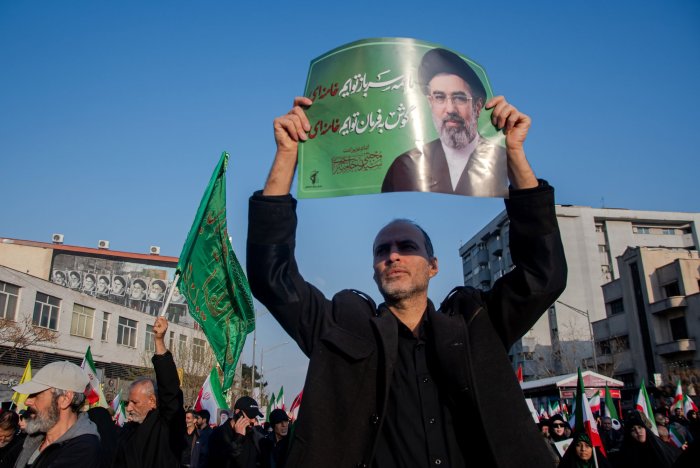
An Iranian man raises a portrait of new supreme leader Mojtaba Khamenei during a rally on Revolution Street in Tehran on March 9, 2026. Photo by Hossein Esmaeili/UPI | License Photo
United States President Donald Trump has called for a naval coalition to deploy warships to secure the Strait of Hormuz, through which one-fifth of world oil shipments transit, as oil markets reel from supply disruptions caused by the US-Israeli war with Iran.
What is essentially the closure of the Strait of Hormuz by Iran in response to the attacks by the US and Israel has sent oil prices soaring to more than $100 per barrel.
Iran’s new supreme leader, Mojtaba Khamenei, has promised to keep the maritime artery closed while another top official in Tehran warned that oil prices could shoot up beyond $200 per barrel.
Trump said he hoped a naval coalition could secure the vital waterway, which connects the Gulf to the Gulf of Oman and the Arabian Sea. Iran has struck more than a dozen ships trying to sail through the narrow waterway since the hostilities started two weeks ago.
But will Trump’s solution work?
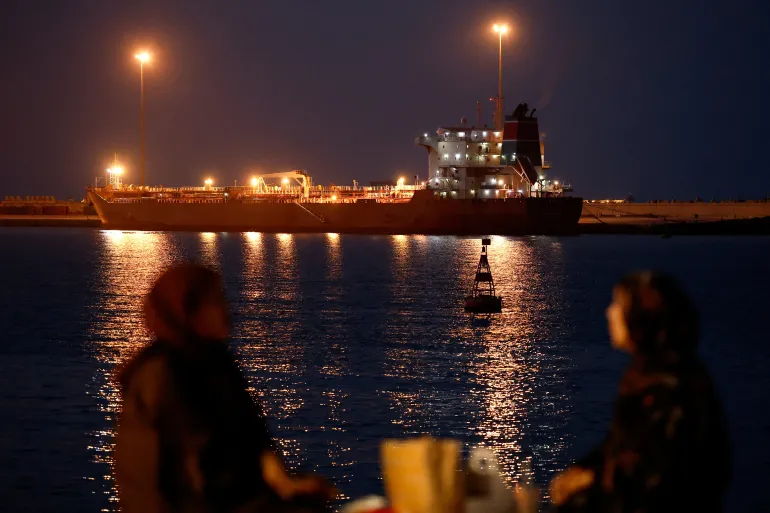
A tanker sits at anchor in Port Sultan Qaboos in Muscat, Oman, as oil shipments through the Strait of Hormuz have plummeted [File: Benoit Tessier/Reuters]
What has Trump said?
The US president has been facing domestic pressure over starting the war alongside Israel with no endgame or off-ramps in sight.
“On the strait of Hormuz, they had NO PLAN,” US Democratic Senator Chris Murphy wrote in a post on X. “I can’t go into more detail about how Iran gums up the Strait, but suffice it [to] say, right now, they don’t know how to get it safely back open.”
After threatening to bomb Iran more, Trump called on China, France, Japan, South Korea and the United Kingdom to send warships to secure the strait.
Trump claimed “100% of Iran’s military capability” had already been destroyed but added that Tehran could still “send a drone or two, drop a mine, or deliver a close-range missile somewhere along, or in, this waterway”.
“Hopefully China, France, Japan, South Korea, the UK, and others, that are affected by this artificial constraint will send ships to the area so that the Hormuz Strait will no longer be a threat by a nation that has been totally decapitated,” Trump wrote in a post on his Truth Social platform.
“In the meantime, the United States will be bombing the hell out of the shoreline, and continually shooting Iranian Boats and Ships out of the water. One way or the other, we will soon get the Hormuz Strait OPEN, SAFE, and FREE!”
Not long after, Trump returned to the keyboard, extending the invitation to all “the Countries of the World that receive Oil through the Hormuz Strait” to send warships, adding that the US would provide “a lot” of support to those who participated.
Israeli soldiers walk by a billboard commissioned by the evangelical Christian group Friends of Zion during the US-Israel war on Iran in Tel Aviv, Israel [File: Nir Elias/Reuters]
What has Iran said?
Alireza Tangsiri, commander of the Islamic Revolutionary Guard Corps Navy, said in a statement that claims by the US about destroying Iran’s navy or providing safe escort for oil tankers were false.
“The Strait of Hormuz has not been militarily blocked and is merely under control,” he said in a statement.
Iranian Foreign Minister Abbas Araghchi later doubled down on this, saying the strait remained open to international shipping except for vessels belonging to the US and its allies.
“The Strait of Hormuz is open. It is only closed to the tankers and ships belonging to our enemies, to those who are attacking us and their allies. Others are free to pass,” Araghchi said.
Khamenei – son of the late Supreme Leader Ali Khamenei, who was killed on the first day of the US-Israeli strikes – suggested in his first statement since taking power that the Strait of Hormuz would remain closed to provide leverage for Iran during the conflict.
F-18 combat aircraft are parked on the deck of the USS Abraham Lincoln aircraft carrier in the Gulf of Oman near the Strait of Hormuz during a 2019 deployment [File: Ahmed Jadallah/Reuters]
What are the challenges in the Strait of Hormuz?
The strait, which is just 21 nautical miles (39km) wide at its narrowest point, is the only maritime passage into the Arabian Gulf (known as the Persian Gulf in Iran). Shipping lanes in the waterway are even narrower and more vulnerable to attacks.
It separates Iran on one side from Oman and the United Arab Emirates on the other.
In brief, there is no way in or out by sea when the Strait of Hormuz is closed.
Alexandru Hudisteanu, a maritime security expert who served 13 years in the Romanian navy, told Al Jazeera that in the type of coalition that Trump is hinting at, “interoperability is the biggest hurdle.”
“That’s the ability of cruises to work together or with different units and different doctrine when basic communication would be an issue,” he said.
Then, there is the geography of the Strait of Hormuz: “a very unforgiving environment to sail with this type of wartime threats”, Hudisteanu said. “Especially difficult under missile threats and these asymmetric potential mines or unmanned systems that could damage or destroy ships.”
Providing escorts to ships would be a costly option, and it would pose risks to participating foreign warships from possible Iranian attacks, which would likely further drag more countries into the ongoing war.
From Iran’s point of view, “the fact that the shoreline is so close and the actual maritime passage is highly congested and confined is an advantage by default,” Hudisteanu added. Geographically, Iran keeps it as a gauntlet, with no way out for the ships unless Tehran allows it.
Another major challenge for any naval coalition trying to secure the passage would be the timeline of any operation. ”The security of the strait could be achieved. It’s just a matter of how much time you need and how many assets you need,” the analyst said. Rushing through it “could have negative implications for the security of the mission and the region”.
Smoke rises from the Thai bulk carrier Mayuree Naree near the Strait of Hormuz after an attack on March 11, 2026 [Handout/Royal Thai Navy via AFP]
How have countries responded?
No country has so far publicly agreed to Trump’s call to send warships to secure the Strait of Hormuz.
London said it is “intensively looking” at what it can do to help reopen the maritime passage. British Energy Secretary Ed Miliband said: “We are intensively looking with our allies at what can be done because it’s so important that we get the strait reopened.”
Chinese Ministry of Foreign Affairs officials said Beijing is calling for hostilities to stop and “all parties have the responsibility to ensure stable and unimpeded energy supply.”
Japan said the threshold is “extremely high” to send its warships on such a mission. “Legally speaking, we do not rule out the possibility, but given the current situation in which this conflict is ongoing, I believe this is something that must be considered with great caution,” said Takayuki Kobayashi, policy chief of Japan’s ruling Liberal Democratic Party.
France also confirmed that it will not send ships. The Ministry for Europe and Foreign Affairs said in a statement on Saturday: “Posture has not changed: defensive it is,” in reference to President Emanuel Macron’s assertion that France will not join the war against Iran.
South Korea, which imports 70 percent of its oil from the Gulf, said it was “closely monitoring” Trump’s statements and “comprehensively considering and exploring various measures … to ensure the safety of energy transport routes”.
(Al Jazeera)
Are countries negotiating with Iran?
Some countries have been negotiating with Iran to secure passage for their petroleum shipments.
Two Indian-flagged tankers carrying liquefied petroleum gas (LPG) have sailed through the Strait of Hormuz. New Delhi depends on this passage for 80 percent of its LPG imports.
The war on Iran has caused a critical shortage of cooking gas for India’s 333 million households. New Delhi has long had ties with Iran, but the government of Prime Minister Narendra Modi has not condemned the killing of Ali Khamenei. It has condemned Iran’s retaliatory attacks on Gulf countries, where millions of Indian citizens work and send $51bn in remittances home every year.
Iran’s ambassador to India, Mohammad Fathali, said Tehran had allowed some Indian vessels to pass through the Strait of Hormuz in a rare exception to the blockade but did not confirm the number of vessels.
A Turkish-owned vessel was similarly granted permission last week after Ankara negotiated passage directly with Tehran. Fourteen more Turkish vessels are awaiting clearance.
France and Italy also reportedly opened talks with Iranian officials to negotiate a deal to allow their vessels through the strait, but there has been no official confirmation yet.
“Iran is affecting maritime supply,” Hudisteanu said. “It’s affecting the maritime security of the region and the entire ecosystem and bringing the entire world to the table as the global price for oil and gas increases.”
The decision by United States President Donald Trump to launch a war on Iran has left many international law experts questioning if the world order established after World War II is actually working.
In his second presidential term, Trump seems to be wielding total power without restraint, and the system of checks and balances enshrined in the US Constitution appears to be failing to limit his power.
Recommended Stories
list of 4 itemsend of list
Since Trump was sworn in in January 2025, he has ordered two unprovoked attacks on independent states, Venezuela and Iran; threatened to annex Greenland; strained traditional alliances with Europe; undermined the United Nations; and rattled international trade with his sweeping tariffs.
Previous constraints set by the UN system and international law appear supplanted by what Trump told reporters in January was a vision of power limited only by his “own morality”.
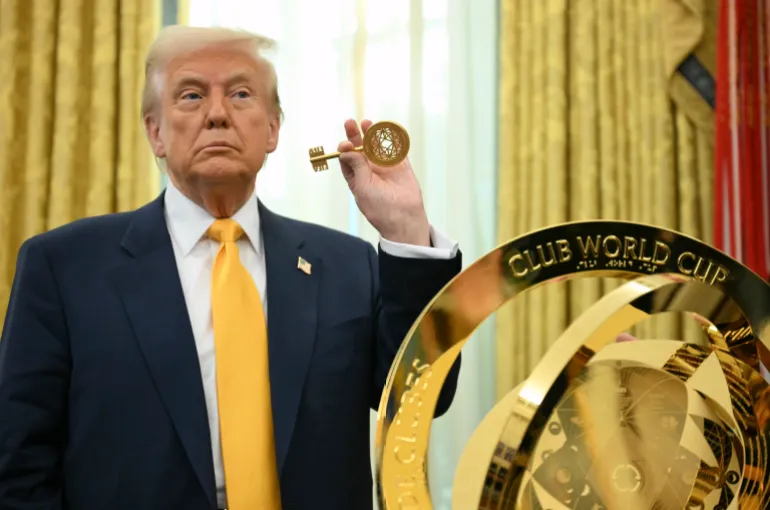
President Donald Trump holds the key to unlock the FIFA Club World Cup trophy, which he said is staying at the White House, requiring a replica to be presented to the tournament’s winners, Chelsea, in July 2025 [File: Pool via AP]
So what checks are there on Trump? Is he really free to attack states, set tariffs at will and, as leader of the world’s most powerful state, essentially dictate global policy? And if so, why are so many observers now saying his war on Iran is faltering?
Has international law put any checks on Trump?
Not so far.
According to analysts, both his attacks on Venezuela and Iran were in clear breach of international law and the UN Charter, principally the prohibition on the use of force under Article 2(4).
Debates about international law, how it has been geared over the decades to underpin the interests of the West and the US specifically, are hardly new. However, experts said, the Trump presidency has seen even the notional restraints of international law trampled underfoot.
Trump himself has brushed aside international law, saying in January that it would be up to him to decide when and how much international law applied to the US and his actions.
“In many respects, international law has historically served US interests, and self-interest should continue to generate US support for a rules-based order organised around the core principles enshrined in the UN Charter,” Michael Becker, a professor of international human rights law at Trinity College in Dublin who previously worked at the International Court of Justice in The Hague, told Al Jazeera, “But finding value in international law often requires adopting a long-term outlook that does not sit easily with short-term political agendas.”
“In the current geopolitical climate, the capacity of international law to provide a meaningful constraint on US action under Donald Trump has proven negligible,” Becker added. “That seems unlikely to change, especially given the failure by other states to strike a united front against Trump’s gangsterism.”
What about the UN?
Not so much.
From its founding, the role of the UN has been to promote dialogue instead of conflict and provide a global response to international challenges. However, Trump’s relationship with the body, like so many of the president’s associations, has rarely been so straightforward. On the one hand, while appearing to try to supplant the body with his members-only Board of Peace as well as sidelining UN aid efforts in Gaza, he has on occasion sought the legitimacy of the UN for a number of his projects, such as his calls in August for the UN to establish a Support Office in Haiti, to help limit migration to the US.
However, while the support of the UN may be helpful, it is clear that Trump has no intention of abiding by its charter, Richard Gowan, the Crisis Group’s UN director from 2019 to 2025, said.
“While other UN members see the US is breaking international law on a regular basis, they often hold back from criticising Washington too loudly in forums like the Security Council because they fear blowback from Trump,” Gowan said. “So Trump is learning he can sidestep the UN when he wants to and get away with it while occasionally using it for instrumental purposes.”
What about other powers?
Up to a point.
Many countries known as “middle powers”, such as Canada, the United Kingdom, France, and other Western and European states, have proven successful so far in pushing back against Trump’s efforts to unilaterally annex Greenland. But European powers have failed to condemn Trump’s unprovoked war on Venezuela and Iran, exposing their double standards in conflicts in the Middle East and the Global South.
Many analysts expect that a withdrawal of investments in the US by Gulf states, which are bearing the brunt of Iran’s retaliation to US and Israeli attacks, may also hasten the war’s end.
“Middle powers can generate friction but not a veto,” HA Hellyer of the Royal United Services Institute for Defence and Security Studies in London said. “Collective action – European governments, Gulf states – can raise costs and extract tactical adjustments. The structural imbalance remains: The US retains decisive military, financial and institutional primacy.”
Smaller states often hedge their bets, follow Washington or look to regional alliances for protection, Hellyer added, continuing that while pressure was strongest in Europe, where the US is no longer seen as a reliable security guarantor, the idea of establishing an alternative continues to be a hurdle. “The logic of an alternative model is accepted; the capacity to execute it quickly is not. A prolonged interregnum follows. The Gulf Arab states are in an analogous position,” he said.
In the meantime, Trump and the US are free to act as they choose. “These are exposure-management strategies, pursued until structural dependence on the US security umbrella can be reduced,” he said.
China and Russia have so far criticised the breaches of international law while avoiding clear escalation, and India and other members of the BRICS bloc have largely stayed silent, suggesting a preference for strategic ambiguity over confronting Washington directly.
Canadian Prime Minister Mark Carney warned Trump of a ‘rupture’ in the Western alliance at the World Economic Forum in Davos, Switzerland, in January 2026 [File: Denis Balibouse/Reuters]
What about domestic restraints?
Not really.
The US Supreme Court was able to block Trump’s use of tariffs to manage large parts of his foreign policy by rewarding allies with lower tariffs and punishing critics with punitive import duties.
But none of the other traditional guardrails – such as Congress; the Department of Justice, which has provided unwavering support to the president; and even the news media – has contained the president’s ambitions. This isn’t entirely new. Previous presidents have ordered wars without congressional approval. However, with Trump, analysts suggested, it has been systematic.
Powerful US institutions have largely failed to hold the Trump administration accountable, analysts, such as Kim Lane Scheppele, a professor of international affairs at Princeton University, said.
“His base of strong supporters are saying that they are willing to experience short-term increases in gasoline prices if it leads to a friendly government in Iran in the long term. His opponents have been his opponents on everything, so he simply ignores and threatens them,” Scheppele told Al Jazeera.
“Trump pays more attention to market performance than to public opinion, so he started saying that he was minimising costs and saying that the Iran war is short term to boost markets again.”
“What the US is spectacularly missing is leadership to oppose Trump. Congress is not doing its constitutional job to constrain him. The Supreme Court is in his pocket because he packed the court in his first term. Lower court judges are heroic and have done amazing work under serious pressures, but they don’t get foreign policy questions, given the difficulty of anyone getting ‘standing’ … in the area of international matters,” she said, referring to the requirement that parties to a lawsuit must show actual or future direct harm to themselves to bring a case to court.
She noted that lower federal courts, although limited on foreign policy, have repeatedly checked executive overreach on immigration, sanctions designations and emergency powers, often under intense political pressure.
A bulk carrier and tanker at anchor in Muscat, Oman, as Iran has essentially closed the Strait of Hormuz by threatening to attack vessels transiting the waterway [File: Benoit Tessier/Reuters]
So why are so many people saying Trump’s war is faltering?
In the eyes of many observers, Trump, with no clear war aims or a defined resolution, is in danger of losing control of a conflict that appears to be both growing and reaching into economic areas apparently unforeseen by his administration, so while traditional restraints don’t apply, market forces, like gravity, always do.
Trump has repeatedly said the war would be over soon despite none of his claimed war aims being achieved.
Oil prices have surged due to his attacks on Iran, Tehran’s counterstrikes and threats to shipping in the Strait of Hormuz, through which about 20 percent of the world’s oil and liquefied natural gas passes.
The International Energy Agency’s decision on Wednesday to release 400 million barrels of oil from international petroleum reserves has failed to tame the prices. Iran has warned that oil could hit $200 a barrel as it continues its stranglehold of the waterway.
“Ultimately, the factors that might be most likely to constrain Donald Trump’s neoimperialist impulses – or his willingness to pursue the policy goals of those who have his ear – are the economic fallout from disrupting global energy markets and a broader disenchantment among US voters with his globe-trotting militarism, his rampant self-dealing and his callous disregard for the human costs of war,” Becker said.