Donald Trump

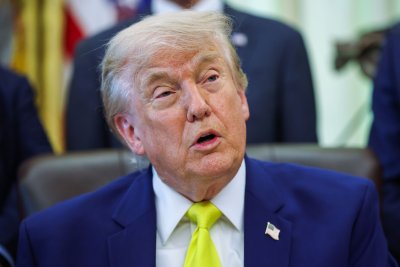
Trump again threatens to fire Powell if he doesn’t step down

April 15 (UPI) — President Donald Trump again threatened to fire Federal Reserve Chair Jerome Powell if he doesn’t step down from his position in May.

“Then I’ll have to fire him,” the president said on Fox Business. “If he’s not leaving on time — I’ve held back firing him. I’ve wanted to fire him, but I hate to be controversial. I want to be uncontroversial.”

Powell’s term as chair ends on May 15 and Trump does not have the authority to fire him without cause. But his nominated replacement, Kevin Warsh, hasn’t been confirmed by the Senate. If he doesn’t get confirmed, Powell could stay on as chair pro tempore.

“That’s what the law calls for. That’s what we’ve done on several occasions,” Powell said.

He said he plans to stay on the board.

“I have no intention of leaving the board until the investigation is well and truly over with transparency and finality,” Powell said.

The Senate Banking Committee is scheduled to have hearings on Warsh’s nomination on April 21.

Powell’s term as a Fed governor goes until 2028, but he said he hasn’t decided if he’ll serve out that term.

Complicating matters, the Trump administration has been trying to prosecute Powell for his role in the $2.5 billion renovation of the Fed headquarters. The building went far over budget, and Trump has implied that something illegal is happening.

U.S. attorney for the District of Columbia Jeanine Pirro tried to subpoena Powell over the renovation, but a judge denied it. Pirro admitted she had no evidence.

Sen. Thom Tillis, R-S.C., who is on the Senate Banking Committee, said he will continue to block Warsh’s confirmation until the investigation into Powell ends.

But Trump said he isn’t worried about Tillis.

Tillis “is an American; he knows what to do,” he said.

Trump said the investigation must happen.

“What they’ve done to that, so it is probably corrupt, but what it really is is incompetent, and we have to show the incompetence of that,” he said.

Trump has wanted Powell out of the Fed since he was elected to office for the second term. He has said he wants interest rates dropped, but Powell has taken a more conservative approach. Powell has lowered the rates, but not fast enough for the president.

“Does that mean we stop a probe of a building that I would have done for $25 million that’s going to cost maybe $4 billion? Don’t you think we have to find out what happened there?” Trump said in the interview at the White House. “I have to find out.”

He called Powell “a disaster.”

“Here’s a man who took this little, tiny building and a couple of other little, tiny complex, and he’s spending more than $3 billion. I want to know who the contractor is, because that contractor is making billions of dollars, perhaps.”

The Fed said the building’s cost overruns are due to “unforeseen conditions” requiring more spending, including “more asbestos than anticipated, toxic contamination in soil, and a higher-than-expected water table.”

Trump has also tried to oust Fed governor Lisa Cook on the allegation that she committed mortgage fraud.

Speaker of the House Mike Johnson, R-La., presents the family of Benjamin Ferencz with his Congressional Gold Medal during the Holocaust Memorial Museum’s Days of Remembrance ceremony at the U.S. Capitol on Tuesday. The gold medal was presented posthumously to Ferencz, who served in the Army during World War II and prosecuted Nazi war criminals during the Nuremberg Trials. Photo by Bonnie Cash/UPI | License Photo

Source link

Trump says talks with Iran likely to restart in next 2 days in Pakistan

April 15 (UPI) — U.S. President Donald Trump said peace talks with Iran “could be happening in the next two days,” with American negotiators most likely to return to Islamabad where the first round of talks at the weekend ended without a breakthrough.

In an interview with the New York Post on Tuesday, Trump said talks between the sides were “happening, but, you know, a little bit slow,” saying a new round of direct negotiations would probably be hosted by a country in Europe.

However, around 30 minutes after the interview had concluded, Trump called back to tell the Post that it should keep its reporter covering the talks in Islamabad in place and not bring them home.

“You should stay there, really, because something could be happening over the next two days, and we’re more inclined to go there [Islamabad]. It’s more likely, you know why? Because the field marshal is doing a great job,” Trump said, referencing Pakistan’s Field Marshal Gen. Asim Munir who has a direct line of communication with the regime in Tehran and a strong relationship with Trump.

“He’s fantastic, and therefore it’s more likely that we go back there. Why should we go to some country that has nothing to do with it?” added Trump.

The Washington D.C.,-headquartered Institute for the Study of War also said a fresh round of negotiations was likely this week but said it believed Iran’s approach would be to try to buy time by spinning out the talks

“Iran likely aims to protract negotiations as long as possible in order to prepare for a potential resumption of conflict,” ISW said in a post on X.

The developments, which came as a fragile cease-fire that took effect April 7 entered its second week, followed earlier reports in which unnamed White House officials told CNBC, CNN and NBC News that in-person negotiations could restart before the truce expires on Tuesday.

Vice President JD Vance said round one of the talks in Islamabad, which ran for more than 20 hours, foundered on differences over Iran’s nuclear program — which the United States wants it to give up completely to ensure it can never develop a nuclear weapon — and control of the Strait of Hormuz.

Reports later emerged that more progress had been made than initially suggested, with the sides getting close to agreement on nuclear enrichment after Iran countered U.S. demands for a 20-year suspension with an offer to halt all enrichment for 5 years.

Trump told the Post he was unhappy with the thinking that a moratorium on enrichment, instead of terminating the program, would make the regime in Tehran more amenable to a lasting peace agreement by providing them a face-saving “success” to sell to the Iranian people.

“I’ve been saying they can’t have nuclear weapons. So I don’t like the 20 years. I don’t want them [Iran] to feel like they have a win.”

Experts concurred with Trump’s analysis, saying the only way to guarantee Iran would not be able to pursue a nuclear weapon in the future was to make sure the entire program was put beyond use, in a verifiable way, and that it needed to happen while Trump was still in office.

Under the Joint Comprehensive Plan of Action, a 2025 deal between Iran and the United States, Britain, France, Germany, Russia and China, enrichment by Tehran of its 300 Kg stockpile of uranium was capped at 3.67%, in exchange for sanctions relief.

However, that deal lapsed in October, although in practice it was long dead after Trump pulled the United States out of the agreement in May 2018, during his first term, with Iran subsequently proceeding to enrich an expanded 441 kg uranium stockpile to around 60%, not far short of weapons grade.

Speaker of the House Mike Johnson, R-La., presents the family of Benjamin Ferencz with his Congressional Gold Medal during the Holocaust Memorial Museum’s Days of Remembrance ceremony at the U.S. Capitol on Tuesday. The gold medal was presented posthumously to Ferencz, who served in the Army during World War II and prosecuted Nazi war criminals during the Nuremberg Trials. Photo by Bonnie Cash/UPI | License Photo

Source link

Top admirals of S. Korea, U.S., Japan discuss trilateral cooperation in Seoul

South Korean Chief of Naval Operations Adm. Kim Kyung-ryul (L) and U.S. Pacific Fleet Commander Adm. Stephen Koehler (R) hold talks in Seoul on Wednesday. The two were also set to meet with Japan’s top naval commander for trilateral talks on strengthening maritime cooperation. Photo courtesy of South Korea Navy

Top naval commanders of South Korea, the United States and Japan gathered in Seoul on Wednesday to hold a series of talks aimed at strengthening their trilateral maritime security cooperation, the South’s Navy said.

The gathering brought together Chief of Naval Operations Adm. Kim Kyung-ryul, U.S. Pacific Fleet Commander Adm. Stephen Koehler and Adm. Akira Saito, chief of staff of the Japan Maritime Self-Defense Force, for bilateral talks and a trilateral dinner meeting, according to the armed service.

The meetings came amid heightened tensions in the Middle East, raising speculation over whether their talks would address the ongoing U.S. blockade of Iranian ports.

U.S. President Donald Trump earlier called on South Korea, Japan and others to send warships to the Strait of Hormuz to help secure shipping lanes.

In the bilateral talks between Kim and Koehler held earlier in the day, both sides exchanged opinions on the robust South Korea-U.S. combined defense posture as well as cooperation in the area of naval maintenance, repair and operations, the Navy said.

Kim and Saito, meanwhile, held in-depth discussions on expanding personnel exchange and resuming joint maritime search and rescue exercises (SAREX) as discussed in a ministerial meeting between their defense chiefs earlier this year, it added.

In January, Defense Minister Ahn Gyu-back and his Japanese counterpart, Shinjiro Koizumi, met in Japan and agreed to resume joint SAREX drills for the first time in nine years as part of efforts to strengthen bilateral defense cooperation.

The top admirals of the three countries were set to attend a dinner meeting later Wednesday to likely discuss trilateral coordination measures to respond to and deter North Korea‘s advancing nuclear and missile threats.

Copyright (c) Yonhap News Agency prohibits its content from being redistributed or reprinted without consent, and forbids the content from being learned and used by artificial intelligence systems.

Source link

U.S. says blockade has ‘completely halted’ Iran’s maritime trade

The U.S Central Command said late Tuesday that its forces have halted all maritime traffic to and from Iran. File Photo by Ali Haider/EPA-EFE

April 15 (UPI) — The U.S. military’s maritime blockade of Iran has “completely halted” sea-based trade with the Middle Eastern country, U.S. Central Command said late Tuesday.

President Donald Trump announced the blockade on Sunday after negotiations to end the U.S.-Israeli war with Iran collapsed.

The blockade of 12 U.S. warships, more than 100 fighter and surveillance aircraft and more than 10,000 soldiers began at 10 a.m. EDT Monday, an effort to prohibit maritime traffic to and from all Iranian ports.

According to U.S. military officials, it covers the entire southern coastline of Iran, including ports on the Arabian Gulf and Gulf of Oman, between which lies the Strait of Hormuz.

“A blockade of Iranian ports has been fully implemented as U.S. forces maintain maritime superiority in the Middle East,” Adm. Brad Cooper, Central Command commander, said in a statement.

“In less than 36 hours since the blockade was implemented, U.S. forces have completely halted economic trade going into and out of Iran by sea.”

Central Command said earlier Tuesday that no ships had made it through during the blockade’s first 24 hours and that six vessels had complied with U.S. forces’ direction to return to an Iranian port on the Gulf of Oman.

“The blockade is being enforced impartially against vessels of all nations entering or departing Iranian ports and coastal areas,” Central Command said.

The blockade comes amid a two-week cease-fire between the United States and Iran that Trump announced on April 8. During the fragile truce negotiations on a permanent end to the war were to be conducted.

However, negotiations with Iran collapsed in Pakistan on Sunday, seemingly over disagreements on Iran’s nuclear program and control of the Strait of Hormuz.

Not long after the war began with the United States and Israel attacking Iran on Feb. 28, Iran sharply restricted vessel traffic to the Strait of Hormuz, an important trade route through which flows roughly 27% of the world’s maritime trade in crude oil and petroleum products as well as 20% of global liquefied natural gas trade, according to the U.S. Congressional Research Service.

Iran’s control of trade through the strait has caused gas prices to spike, threatening countries with energy crises.

The U.S. blockade appears aimed at financially squeezing Iran by cutting it off from maritime trade revenue.

According to Maid Maleki, senior fellow of the Foundation for Defense of Democracies, a nonpartisan Washington, D.C., research institute, the blockade could cost Iran about $435 million a day.

“The blockade makes continued resistance economically impossible,” he said in a statement.

Source link

South Africa appoints former apartheid-era negotiator as US ambassador | Donald Trump News

Roelf Meyer will replace the South African ambassador who was expelled from the US by President Donald Trump in 2025.

South Africa has appointed Roelf Meyer, who helped negotiate the end of white minority rule in his country in the 1990s, as the next ambassador to the United States, according to local media.

Meyer’s appointment is seen as a sign that Pretoria is aiming to improve its relations with Washington following a “turbulent year”, according to the South African Broadcasting Corporation.

Recommended Stories

list of 4 itemsend of list

South Africa has gone without diplomatic representation in Washington, DC, since March 2025, when US President Donald Trump expelled Ambassador Ebrahim Rasool for his criticism of the Make America Great Again (MAGA) movement.

Posting on social media at the time, US Secretary of State Marco Rubio accused Rasool of being a “race-baiting politician” who hates the US and Trump.

Rubio’s post linked to a story by US conservative news site Breitbart that reported on a talk Rasool gave on a webinar organised by a South African think tank. Rasool had spoken in academic terms of the Trump administration’s crackdown on diversity and equity programmes, as well as immigration, and mentioned the possibility of a future US where white people would no longer be in the majority.

South African President Cyril Ramaphosa (CL) and Former Minister and constitutional negotiator Roelf Meyer (CR) looks at attendees during the first National Convention at the University of South Africa (UNISA) in Pretoria on August 15, 2025. The first National Convention marks the start of the National Dialogue (a chance where all South Africans come together to discuss the country's challenges) at local meetings, national discussions and public platforms aimed at shaping a better future for the next thirty years. (Photo by Phill Magakoe / AFP)
South African President Cyril Ramaphosa, centre left, and former minister and constitutional negotiator Roelf Meyer, centre right, during the first National Convention at the University of South Africa, Pretoria, in August 2025 [File: Phill Magakoe/AFP]

Trump last year also issued an executive order freezing most foreign assistance to South Africa amid the country’s legal action at the International Court of Justice over Israel’s genocide in Gaza and the passage of a controversial South African law aimed at correcting historic racial disparities in land ownership.

Tensions escalated further when Trump then launched a refugee programme for white South Africans, whom the US president claims face government-led persecution in their home country.

Meyer, 78, is a seasoned negotiator with experience working under pressure. As a member of South Africa’s white Afrikaans minority, he once served as a minister under the apartheid Nationalist Party government.

He rose to prominence in the 1990s, during the final days of apartheid, as the Nationalist Party held talks with the African National Congress (ANC) to end segregation and white minority rule. The talks paved the way for South Africa’s first democratic elections in 1994.

As the chief negotiator, Ralph had become acquainted with South Africa’s current president, Cyril Ramaphosa, who was then an ANC negotiator.

Meyer himself later joined the ANC in 2006.

He is set to take up the post as US ambassador once all protocols are complete in Washington, DC, according to Ramaphosa’s office.

Source link

Thune: Senate may vote next week on ICE, Border Patrol funding

April 14 (UPI) — A budget resolution to fund federal immigration enforcement could hit the Senate floor by next week, Senate Majority Leader John Thune said Tuesday, as Republicans seek to bypass Democratic demands for reforms to Immigration and Customs Enforcement and Border Patrol.

Federal funding for Immigration and Customs Enforcement and Border Patrol lapsed on Feb. 14 after Republicans agreed with the Democrats to remove the Department of Homeland Security from a larger spending package and avert a government shutdown.

Neither agency has been funded through regular DHS appropriations since, though they continue operating through other, emergency funding.

Democrats began demanding reforms to the federal immigration enforcement agencies before agreeing to restore funding after two U.S. citizens were killed by federal immigration officers amid President Donald Trump‘s aggressive immigration crackdown.

Amid a stalemate in negotiations, Republicans are considering passing three years of funding for the agencies through a complicated legislative mechanism called a budget reconciliation bill that permits certain spending legislation to pass with a simple majority rather than 60 votes, Thune told reporters Tuesday in the Capitol.

“Republicans are going to stand with our Border Patrol, with our law enforcement agencies and we’re going to ensure that they are funded, not only today but well into the future,” Thune, R-S.D., said.

Sen. Lindsey Graham, R-S.C., is preparing the resolution to fund the agencies that will be followed by the reconciliation bill “to ensure the job gets done,” he said.

Democrats have blocked funding for ICE and Border Patrol until reforms — including requiring judicial warrants and banning officers from wearing masks — are made, but the reconciliation bill tactic could ensure funding without any votes from Democratic lawmakers.

The same tactic was used last year to pass Trump’s sweeping spending and tax cut bill, which provided $75 billion for ICE.

“All of the things that the Democrats made this about, which was supposed to be about reforms to the way that ICE and Border Patrol operate — they get none of that,” Thune said.

“And now, we’re going to fund those agencies for three years into the future. The only thing the Democrats got out of this was they now own the issue of open borders and defund law enforcement.”

Republicans hold a narrow 53-47 majority in the Senate, with two independents caucusing with the Democrats, as well as a 218-213 majority in the House.

The Senate has twice passed bipartisan bills to fund DHS aside from ICE and Border Patrol, which the House has balked at. Democrats blame the Trump administration’s influence on the lower chamber.

“Republicans are dragging the Senate through a partisan circus just to avoid basic accountability for ICE and Border Patrol,” Senate Minority Leader Chuck Schumer told reporters at the Capitol during a separate press conference on Tuesday.

He said Democrats will continue to push for immigration enforcement reforms.

“So, the pattern, unfortunately, with this administration is clearer and clearer,” the veteran New York Democrat said. “Chaos abroad — the war; chaos at home with not funding DHS with reforms. A failed war overseas, a manufactured crisis here in Washington — in both cases Republicans aren’t leading, they are following orders.”

Source link

US forces kill 4 people in latest strike on vessels in eastern Pacific | Donald Trump News

The killings mark the fourth US deadly strike in the past four days on vessels in the eastern Pacific Ocean.

The US military has killed four more people in its fourth deadly attack on vessels in the eastern Pacific Ocean over the past four days.

US Southern Command (SOUTHCOM) announced the attack in a social media post on Tuesday, alongside a video that showed a stationary boat with outboard engines being hit by a missile and exploding into a huge ball of flames.

Recommended Stories

list of 4 itemsend of list

SOUTHCOM, which is responsible for US military operations in Latin America and the Caribbean, claimed that the four people killed were “narco-terrorists”, but provided no evidence to support its claims.

Justification for the lethal attack, according to SOUTHCOM, was due to intelligence – details of which were not provided – that confirmed that “the vessel was transiting along known narco-trafficking routes in the eastern Pacific and was engaged in narco-trafficking operations”.

The latest killing of people on board vessels in international waters in the eastern Pacific Ocean and Caribbean brings the overall death toll to at least 175 since early September, when US President Donald Trump ordered the attacks to stop what the White House claims are Latin American cartels transporting drugs to the US.

Tuesday’s killings came after two people were killed in a US strike on Monday, and five people were killed in two separate strikes on Saturday, also in the eastern Pacific.

The Associated Press news agency reported that the US coastguard has suspended a search for one survivor from the two attacks reported on Saturday.

International legal experts and rights groups say the US military campaign amounts to “extrajudicial killings” in international waters and that the attacks have targeted civilian fishing boats.

Legal experts have said that if some vessels were involved in drug trafficking, those on board should face the law, rather than deadly attacks.

Critics have also questioned the effectiveness of the US military operation in part because the fentanyl behind many fatal overdoses in the US, which Trump has used to justify his campaign, is typically trafficked to the US over land from Mexico, where it is produced with chemicals imported from China and India.

Source link

Justice Department asks court to dismiss Jan. 6 convictions of Proud Boys, Oath Keepers members

1 of 3 | Stewart Rhodes, founder of the far-right extremist group the Oath Keepers, is among those Jan. 6, 2021-related convictions the Justice Department is seeking to dismiss. File Photo by Bonnie Cash/UPI | License Photo

April 14 (UPI) — The Justice Department on Tuesday asked a federal court to dismiss the convictions of Proud Boys and Oath Keepers members who were found guilty of leading and organizing the Jan. 6, 2021, riot and attack on the U.S. Capitol.

The request includes 12 former members of the groups, all of whom prosecutors said were ringleaders of the attack. After his return to office in 2025, President Donald Trump pardoned most of those who were convicted for their parts in the riot, a move affecting more than 1,000 people. However, the sentences of some, including these 12, were commuted to time served instead, freeing them from prison though the convictions remained.

The group involved in the Justice Department request on Tuesday includes Stewart Rhodes, a leader of the Oath Keepers who was sentenced to 18 years in prison for seditious conspiracy and other charges. Prosecutors said Rhodes and other Oath Keepers “began plotting to oppose by force the lawful transfer of presidential power” after the 2020 election, CBS News reported.

Others whose sentences were commuted are Proud Boys leaders Ethan Nordean, Zachary Rehl, Dominic Pezzola and Joseph Biggs, who were also convicted of seditious conspiracy for their role.

Appeals involving this group have continued, and the Justice Department requested Tuesday that federal appeals panels vacate the earlier convictions and drop the cases in whole.

“The United States has determined in its prosecutorial discretion that dismissal of this criminal case is in the interests of justice,” wrote Assistant U.S. Attorney Daniel Lenerz in the filing, Politico reported.

Greg Rosen, former chief of the Justice Department’s Capitol Siege Section, criticized the move, CBS News reported.

“It’s a reminder of what drove the pardons in the first place-the political violence is acceptable as long as your politics align,” he told CBS News. “And it’s a continuing and sad commentary on the current state of the department.”

Source link