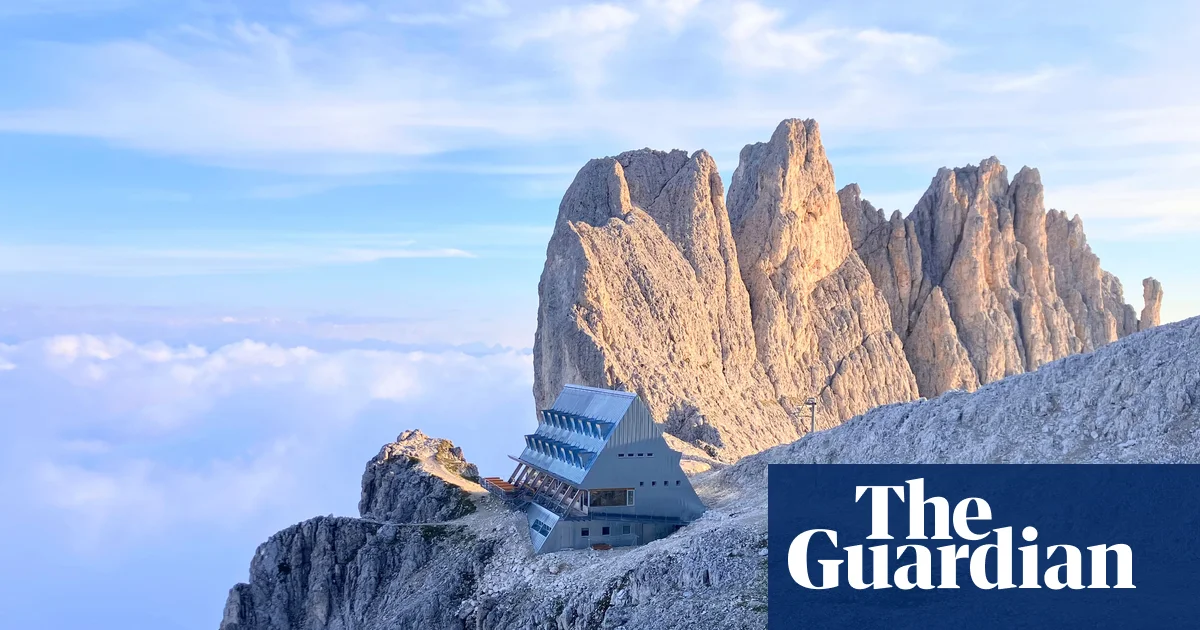
‘Like a Bond villain’s lair’: I climbed the Dolomites to the world’s most spectacular mountain hut | Dolomites holidays
‘I think my boots are falling apart!” shouts Nigel just as we hit the pinnacles, a whole range of them jutting up and out from the mountainside, all thrillingly tall, spiky and knobbled. Through them we painstakingly step, fingers aching in gloves, heads sweating in helmets – squashing up narrow chimneys, squeezing through mighty boulders and inching along slender ledges on a twisting path that’s only just discernible through swathes of sharp white scree.
I know how Nigel’s boots are feeling: the going is far harder than I was expecting. This is only the first day of our annual trip to the Dolomites, a vast range of breathtaking sawtooth peaks in northern Italy, but my head’s already full of the thought I have every year as we start out: “If only you’d got fitter.”
But it should be worth all the scrapes, bumps, scares and sweat. Somewhere up ahead, hopefully not too far, is Rifugio Passo Santner, or Santnerpass Hut, a spectacular mountain refuge that, as everyone who sits near my desk at work knows, has been obsessing me ever since I first saw a picture of it eight months ago.
Allowing you to stay deep in the mountains for days on end, the high-altitude Dolomites huts we overnight at all have their charms, from hearty food to giddying views to a generous way with the grappa. But in terms of appearance, they tend to fall into two not particularly pulse-quickening camps: stone block or cuckoo clock. Although you’re almost always overjoyed to see them, none could ever pass for a Bond villain’s lair, however much grappa you’ve had.
Yet that is exactly what Santnerpass Hut resembles. Perched on top of a sheer cliff, this elongated triangle encased in a gleaming wrapper of galvanised steel looks like a giant Toblerone still in its foil – an eyepopping hit of modernity, originality and innovation in a place where tradition usually dictates more of the same.
After one final push, the five of us scramble up on to the summit and there it is just ahead, side on and glowing silver in the late afternoon sun, like a star that has touched down on Earth to enjoy the stunning views of the surrounding peaks with the rest of us, up at the bracing height of 2,734m.
“Welcome!” says the bartender as we enter. “You made it. Well done!” With the customary relief – if not actual jubilation – that follows a tough climb finally ending, we ease off our backpacks, gloves and boots then look around, slowly realising that Santnerpass Hut isn’t just a treat for the eyes from the outside.
Inside, what you first notice is the unbroken parade of huge windows wrapping around the refuge’s front and flanks. This doesn’t just turn every spot of the roomy ground floor into a light-filled observation point. It also means the hut achieves passive heating since it’s effectively one big solar collector. So there’s no need for log-devouring stoves. That’s quite an achievement at ground level; at more than 2km up, with no road access, it’s verging on miraculous.
Then there’s the wood. It’s blond and everywhere. Guests are basically cocooned within a spellbinding timber tapestry that casts everything in a warm yellow glow, quite a novelty to anyone used to the dingy two-watt corridors and bedrooms of most refuges.
The flooring is larch, the restaurant furnishings maple and the load-bearing A-frame spruce, its hefty angular joists exposed on the sundeck, where we soon find ourselves sinking well-earned ice-cold drinks and marvelling at this beacon of sustainable architecture.
There are other things to marvel at. Off in the distance, piercing up through an immense blanket of cloud, the lofty peaks of the Latemar group are catching the last rays of the sun, turning pink, orange and purple in a ravishing Dolomites phenomenon known as the enrosadira, triggered by calcium and magnesium in the rock. “This place is incredible,” says Donnie, sipping an Aperol spritz. “I’ve never been anywhere like it in my life.”
Santnerpass Hut was built in 1956 but in the last decade or so was taken over, closed and rebuilt, finally opening its generous glass doors in 2023. Designed by alpine specialists Senoner Tammerle Architects, the new refuge is not just meant to please the eye: the shape lets it shed thick snow and deflect howling winds.
There are more surprises when we take our pre-dinner showers. Not only does the wood here give way to zesty yellow laminated panels that wouldn’t look out of place in a chic nightclub, the showerheads also actually stay pointing at your body for the full three minutes of hot water a token gets you.
Dinner, however, may have been the biggest surprise of all. It was completely vegetarian – a shock for all of us and a treat for veggies Sam and Nigel. No goulash, no ragu, no pork chops. Instead, out of the kitchen came herb-sprinkled lentils with asparagus, radish and onion, pea and mint soup, then beetroot dumplings on a rich bean, tomato and yellow pepper broth, washed down with superb local wine in actual wine glasses and finished off with creme brulee.
“A delicious and nutritious meal,” said Sam, running his spoon round his plate. “What an eye-opener. A win-win for hiker and planet.”
Curfew was at 10pm but the restaurant was clearing out anyway. This may have been due to the fact that, in high spirits after our action-packed day, we had taken the hut’s guitar off the wall and treated everyone to that Proclaimers Alpine classic Sunshine on Leith, managing to get a singalong going with the very up-for-it, very international audience.
The refuge sleeps 4o in 16 rooms. Ours was a spacious affair with bunkbeds, a dainty dormer window and two large cubbyholes each, one for your bag, the other for your stuff – so much more useful than the usual pointless wardrobes and drawers that no one ever unpacks into, since you’ll be gone in a hurry at the crack of dawn.
We reached Santnerpass Hut via the König Laurin cable car, 22 miles (35km) from Bolzano, gateway to the Dolomites. After that, it’s a rising, fairly straight line to the refuge, a two-to-three-hour hike through loose scree, then boulders and pinnacles. But be warned: the last section is a via ferrata, meaning there’s a metal cable for you to clip your harness to, and grab hold of as you reach trickier, more treacherous passages. It’s not for beginners.
I’d heard, though, that there was another route and, keen to take it back down to the cable car, asked at reception. “Yes, there’s another way,” said Romina Huber, who co-owns and runs the hut with her husband (and chef) Michel Perathoner. “It’s not a via ferrata and it’s super beautiful.”
She wasn’t kidding. First it took us past the Vajolet towers, dramatic spires that lure climbers from all over the world. Then we swung right on to a winding path of fine white scree that rises sharply through meadows full of edelweiss, saxifrage, dwarf pine and boulders, leading to bulging cliffs and eventually the Coronelle Pass, an astonishing vantage point at 2,360m.
“Well, that was a walk and a half,” said Mac as we descended in the cable car 30 minutes later, exhausted after the final knee-popping trudge down from the pass on timber-pinned switchbacks. “My boots,” said Nigel, lifting his feet to let us see a rip in one and a sole flapping off the other, “have completely had it.”
Santnerpass Hut starts at €105pp per night, including breakfast and four-course vegetarian dinner
Hutiquette: the mountain hut code
Mountain huts may occasionally be rather luxurious these days, but their original function, still relevant, is survival. There are, as you might expect, several very sensible codes that make great use of words like “respect”, “other users”, and “environment”. My own code is no less worthy and comes from hard-won experience.
No complaining
Huts are not hotels. If there’s a problem, go sort it out. Certainly, never complain about snoring, even when you are convinced it is about to trigger an avalanche. I once did, only to be informed, rather too forcefully, that is was me doing the snoring, an outrageous lie that triggered grunts of approval from other grumpy insomniacs. Gel ear plugs work well.
Share
It’s sometimes hard to drop the urban habit of self-assertion to ensure survival. One night in a Corsican hut with a shared sleeping platform, an obnoxious Brit in a down bag shoved all the other sleepers into a pile at one end of the bench, claiming later that he was “dreaming of being pushed”. I pray never to run into him again.
Clean up after yourself
… and take your rubbish home. The British Mountain Bothy Code has a good reminder on this point. I’d go even further and say, try to leave absolutely no trace at all. Visiting one treasured wild swimming spot recently, I found the scorch mark of a campfire. Whoever it was had not left any rubbish, and there was nothing to mark their visit, except that dreaded black spot, as if Blind Pew had delivered a death sentence.
The hut is for everyone
I once cycled to a remote Icelandic hut and found it blissfully empty of people. Lighting the fire, I prepared my simple meal, and apart from wishing I had packed a beer, looked forward to a night of splendid isolation. Then a large group of locals arrived. I felt my heart sink. My solitary bliss was gone. They sat down, gave me a beer, and two hours later, after helping to eat their huge delicious feast, I felt like I’d joined a tribe. When a hut generates that kind of gang conviviality, it’s uplifting.
Look after others
In Scandinavia, this is a social habit that is deeply embedded. You turn up in a hut in winter and there are logs because the last visitors left them for you. You cut your finger and they all have the plaster that you forgot to bring. The Norwegian Mountain Code has a list of essential reminders.
Kevin Rushby