Dollarization

Fix the Deficit and Venezuela’s Dollar Question Answers Itself

Folks confuse the medicine with the symptoms when they ask for dollarization or argue against it, as if the magic wand of switching to the dollar would cure the deep debt and the fiscal imbalances of the broken State-led model that crippled Venezuela.

Marcos Planchart wrote on this site last week that “it is certainly not the paper where the bolívar is printed the element that corrupts people or destroys the economy: it is the system behind it.” I agree with that sentence entirely. However, dollarization is not the first decision. There is a sequence that comes before it, and it is the sequence, not the currency, that determines whether any of this holds.

Antonio Ecarri and Steve Hanke want to change the unit of account. Planchart wants to keep it and repair the institutions standing behind it. Both are arguing about the currency. The currency is the second question, and it answers itself once you have answered how to fix the fiscal imbalance. 

Those imbalances have four fixes: a legitimate and credible government, a closed deficit, restored conditions for private investment, and an open and transparent market for trading bolívares and dollars. Or you can dollarize. Notice that the first four require no change in the unit of account at all.

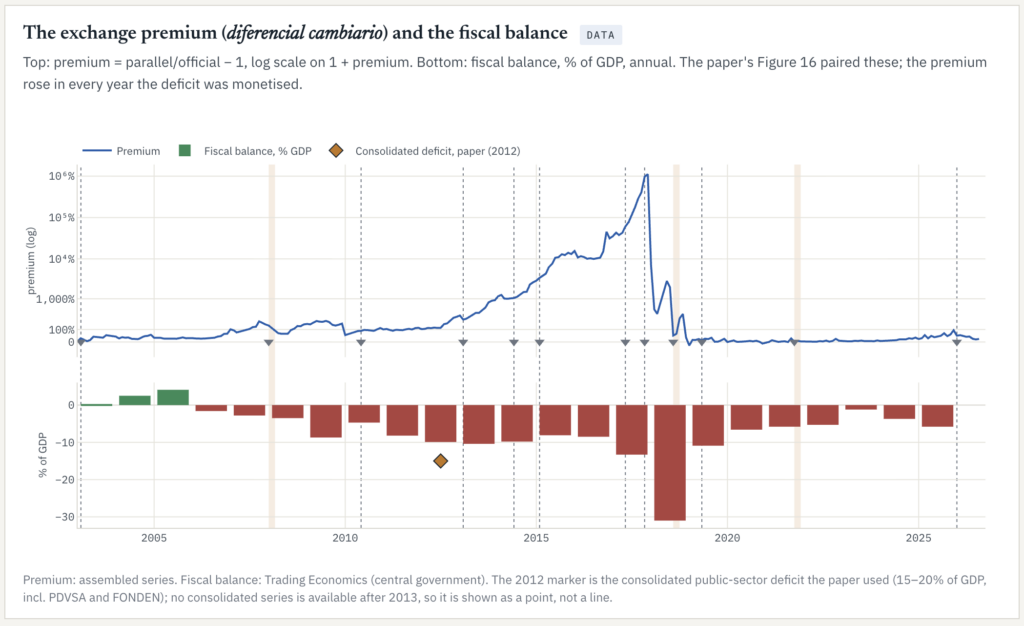
Here is the simplified mechanism: A government running a deficit it cannot finance has the Central Bank issue bolívares to cover it. The new money goes looking for dollars and for hard assets, and the rate moves. Running an official rate alongside the market one does not stop that. It only decides who captures the difference.

Top: Venezuela’s exchange premium, the parallel rate over the official rate, on a log scale, rising from near zero to over a million percent in 2017 and back down. Bottom: the fiscal balance as a share of GDP, in deficit every year from 2006.
The exchange premium and the fiscal balance. The premium rose every year the deficit was monetized. Premium from the assembled official and parallel series. Fiscal balance from Trading Economics, central government. The 2012 diamond is the consolidated public sector deficit used in the 2013 paper, which included PDVSA and FONDEN; no consolidated series is published after 2013.

Dollarization is a reasonable destination after the fiscal work and a ruinous substitute for it. Do the work and you may not need it, because the inflation it was sold to cure will already be gone. Skip the work and it will cost you more than the bolívar does. Redundant or ruinous. There is no third case.

The three consequences, one at a time

Planchart lists what the case for dollarization claims: eliminating inflation, forcing fiscal discipline, eradicating corruption. Take them in that order.

First: it does eliminate inflation. This is Hanke’s most popular claim, and it is true. Ecuador dollarized in January 2000. Inflation averaged 39% a year through the 1990s and 2.9% from 2003 to 2024. The policy does achieve inflation reduction, and it does so quite fast.

Top: Venezuela’s exchange premium, the parallel rate over the official rate, on a log scale, rising from near zero to over a million percent in 2017 and back down. Bottom: the fiscal balance as a share of GDP, in deficit every year from 2006.
The exchange premium and the fiscal balance. The premium rose every year the deficit was monetized. Premium from the assembled official and parallel series. Fiscal balance from Trading Economics, central government. The 2012 diamond is the consolidated public sector deficit used in the 2013 paper, which included PDVSA and FONDEN; no consolidated series is published after 2013.

Now notice what that concession costs the other side. Inflation is the entire platform. It is why the argument is popular in Caracas, and why anyone is listening to Ecarri in 2026. The harder thing to see is this: if we stabilize the fiscal accounts and jump-start private investment, inflation can be tamed and the case for dollarization goes with it. You cannot sell a cure for a disease the patient no longer has.

Second, it does not force fiscal discipline. Ecuador ran deficits in twelve of the thirteen years from 2013. The one exception was 2022, by four hundredths of a percentage point. Public debt went from 19% of GDP in 2011 to 64% in 2020, and Ecuador defaulted that year. It is 54% now. Growth averaged 6.4% a year from 2011 to 2014 and 1.4% from 2015 to 2019.

The mechanism is the one Planchart names himself. He warns that dollarization leaves a country “even more vulnerable to external shocks, such as a sudden plunge in oil prices.” That is precisely what happened to Ecuador after 2014. Oil fell, Ecuador could not devalue, and the shock had nowhere to go except the budget, and from the budget into debt and into lost growth. He states the fear and never uses the country it happened to. It is the best evidence in his own case and he leaves it on the table.

The deficit does not disappear when the currency changes. It simply has to be paid in a currency you cannot print.

Dollarization took away the printing machine, not the deficit, so the adjustment fell on debt instead of on prices. Ecuador does not show that dollarization is harmful. It shows that it is not enough. Of its two defaults, 2008 is the weaker example: it fell in a surplus year and was a choice rather than a financing crisis.

Third, regarding corruption, Planchart has already answered it, and I will not repeat a good argument badly. The exchange differential was never an oversight. It was an instrument. Change the currency and the people who built it still hold the pen.

What getting the sequence wrong costs

Planchart says a failed dollarization would force the government into more debt and severe cash shortages. He is right. Here is the size of it.

We ran the model with the same economy twice from the same starting position, $13.4 billion of reserves in 2026, changing one thing. Dollarize now on today’s deficit, alter nothing else, and the state’s dollar position will fall through zero in the third year and reach minus $24 billion by 2034. Dollarize after fiscal consolidation, with private investment recovering, and the same position accumulates to plus $127 billion. Same reserves, same model, one difference.

The deficit does not disappear when the currency changes. It simply has to be paid in a currency you cannot print.

Two lines from the same starting point of $13.4 billion in 2026. The green line, dollarization after the deficit is closed, rises steadily to about $80 billion by 2031. The red line, dollarization alone with the deficit unchanged, falls steadily and crosses zero in 2029, marked “dollars run out, 2029”.
Dollarizing without fiscal reform is a recipe for disaster. Shown to 2031; the simulation runs to 2034, by which point the red path is minus $24 billion and the green one plus $127 billion. Every assumption behind it is a control the reader can move at https://www.bolivarjesus.com/KangarooPegRevisited2026/

Why 576% inflation sits on a deficit near 6%

Planchart gives the number: inflation reached 576% year on year in July. The mechanism above explains the direction. It does not explain the size, and the size is the interesting part.

The bolívar base has collapsed; measured at the parallel rate, it was around $15 billion in 2011 and 2012. In July 2026, it was $1.7 billion. The base that can be monetised is a ninth of what it was.

In 2013, Gino Bettocchi and I wrote about a State running a consolidated deficit of 15% to 20% of GDP, including PDVSA and FONDEN. On the narrower central government measure that is still published, the deficit has roughly halved since then, from 9.9% in 2012 to 5.8% last year. A far smaller deficit now carries the inflationary force that an enormous one carried then, because there is so little left to dilute. That cuts against both camps. It is not evidence that the bolívar is cursed, and it is not evidence that only the dollar can fix it. It is arithmetic about a very small base.

Where I actually disagree

Planchart wants to keep the bolívar permanently, in part to preserve room for industrial policy. The unit of account does not carry that weight, in either direction.

What breaks or holds a monetary regime is the deficit, private investment, and the institutions behind them. Those three decide the outcome, whether prices are quoted in bolívares or in dollars.

The argument about maintaining the unit of account in bolívares is about the State’s capacity to protect and nurture strategic industries. But industrial policy is paid for by a State with fiscal room, and Venezuela has neither. It becomes possible after stabilization, not instead of it.

Without credible rules, there is no private investment. Without investment, there is no oil and no tax base. Without revenue, there is a deficit. And a deficit breaks any exchange rate regime, whether it is denominated in bolívares or in dollars.

Planchart may well be right. His is a claim about what Venezuela becomes over the medium and long term; mine is about what stops the bleeding now. Our hope is that between the two visions, readers get the order of operations.

His best line is that starting dollarization under chavista rule is like handing the reconstruction of the oil sector to a man who helped destroy the electricity grid. I would make it structural rather than personal, because it is an argument about order.

Stage one is not monetary. It is a legal framework credible enough that private capital comes back. Without credible rules, there is no private investment. Without investment, there is no oil and no tax base. Without revenue, there is a deficit. And a deficit breaks any exchange rate regime, whether it is denominated in bolívares or in dollars. Once those policies are in place, they will open the market and the premium will close on its own. Then, the decision about Venezuela adopting the dollar formally can be taken calmly, from strength, rather than desperately as a rescue.

In 2013 we wrote that the choice was reform or hyperinflation. Maduro chose hyperinflation, and it ran from 2017 to 2021. The 2026 version of that choice is not dollar or bolívar. A currency is imported. A State is built.

“The Kangaroo Peg” was written by Gino Bettocchi and Jesús Bolívar, Second Year Policy Analysis, Harvard Kennedy School, 2013, advised by Ricardo Hausmann. The thirteenth year update, with both figures, the model and its sources, is available here.

You can also track all macroeconomic metrics in the UnoPago monitoring website.
Source link

Why the US Dollar Won’t Fix Venezuela’s Economy

A few weeks ago, non-chavista politician Antonio Ecarri and American economist Steve Hanke managed to unearth one of Venezuela’s longstanding and unsettling debates: whether the country’s economy should be formally dollarized. After decades of economic hardship brought by repeated devaluations, hyperinflation and scarcity, the country’s monetary regime is heavily fragmented. 

De facto dollarization rules most of the transactions, while the bolívar, crypto stablecoins, euros and the currencies of neighboring countries split the rest of the monetary market share used to maneuver through Venezuela’s complex economy. With the US pushing for the country’s economic stabilization to increase trust in foreign investors, the fragmented monetary ecosystem can be detrimental to the process made so far.

Venezuela’s economic outlook has improved after Maduro’s capture and since the US took control over Delcy’s decisions. Mainly because of a sharp recovery of oil exports to the US recovered sharply; by April, these were up 192% from their 2025 average. The energy sector is spearheading the recovery while attempting to partially compensate for the devastation caused by the twin earthquakes. GDP growth projections for Venezuela are forecasted at 5.8%, almost four times the country’s 2025 growth (1.5%). Yet the threat of inflation and instability compounds investors’ worries about entering the country. After repeated announcements by the interim regime promising to close the exchange gap and tackle inflation, their actions show otherwise.

Delcy continues to erode the bolívar by stimulating the money printer needed to feed chavismo’s patronage system. Exchange rate controls, which have long incentivized corruption and inflation, are still there. On the dollar side, credit loans and transactions remain “officially” forbidden, creating an artificial tax on USD transactions and fear amongst businesses who can be punished for their use.

Eliminating inflation would require abolishing all existing exchange rates and creating a new one based on an agreed technocratic approach.

The result of this unaddressed monetary disaster has been a persistent rise in inflation, which increased by 6.1% in July, bringing year-on-year inflation to 576% and 2026 cumulative inflation to 175.5%.

This is not the first time the call for dollarization has been in the spotlight in Venezuela. Nonetheless, US control over the country’s economy may increase the possibility of it becoming a reality. While dollarizing might be an effective measure to rapidly generate trust and reduce inflation, it raises important questions about its implementation under the interim regime and the future of Venezuela’s monetary sovereignty. Similar to Trump’s oil deal or the post-earthquake reconstruction, all discussions and actions are taking place behind the scenes, sidelining the very population that will have to deal with its consequences. 

The US dollar is not the solution

Discussions regarding dollarization have primarily focused on three benefits: eliminating inflation, forcing fiscal discipline, and eradicating corruption. However, as long as those managing the dollarization process are the same ones who have guided Venezuela to the worst economic crisis in the region’s history, the result might be equally as bad but with a different set of consequences. 

Hanke asserts that no preexisting institutional, fiscal or political conditions are necessary for dollarization to be successful. However, this process requires the willingness of all three areas to move forward. Eliminating inflation would require abolishing all existing exchange rates and creating a new one based on an agreed technocratic approach. Currently, there is no incentive for anyone in the interim regime’s leadership to converge the exchange rates.

A struggling or failed dollarization plan could further erode trust while leaving the country even more vulnerable to external shocks.

The exchange rate differentials have not been an economic policy mistake overlooked by chavismo. These have been an integral part of chavismo’s strategy to undermine and replace old political elites with select, loyal ones. Long ago, they became crucial to maintain the status quo. There are no signs in favour of change in this area, as economist Juan Comella argued in May. Doing so would compromise the structure that keeps her in power.

A struggling or failed dollarization plan—which forces the government to take on further debt, experience severe cash shortages and fundamentally depend on its commodity exports—could further erode trust while leaving the country even more vulnerable to external shocks, such as a sudden plunge in oil prices. The neoliberal constraints posed by dollarization, like an extremely limited Central Bank to aid the government, will not fix decades of institutional erosion, but only try to avoid it while possibly unleashing a fresh round of obstacles that menace an already fragile economic recovery.

The bolívar is not the problem

Decades of monetary policy failures made the population skeptical of the bolívar. For long enough, the system and institutions have incentivised and even rewarded the wrong people to take advantage of its vulnerabilities at the expense of the population and evading any personal consequences.

It is certainly not the paper where the bolívar is printed the element that corrupts people or destroys the economy: it is the system behind it. It is not far-fetched to think of a plan that grants the Venezuelan Central Bank complete independence, empowering the correct people to safeguard the economy from the risks of inflation while maintaining government spending in line and preparing for external shocks.

Relinquishing our monetary sovereignty would be a mistake in a world where governments actively participate and spend to tackle modern challenges, including AI and natural disaster relief. China’s rise as a global power has been, in part, a consequence of decades of industrial policy under intense government intervention. The US and EU have started to catch up in recent years. The US has done so with the CHIPS and Inflation Reduction Act under Biden and, most recently, with the Trump administration imposing protectionist tariffs and taking equity stakes in major companies with the aim of safeguarding US interests in key sectors. The EU aims to increase competitiveness under the Clean Industrial Deal and the Industrial Accelerator Act. If Venezuelan leaders seek to move past the country’s commodity dependence, climb up in the global value chain, become competitive and diversify the economy, industrial policy will be crucial. Dollarization would compromise those goals.

Starting a dollarization process under chavista rule is similar to entrusting the reconstruction of Venezuela’s oil sector to a businessman who contributed to the destruction of the country’s electricity grid.

Foreign investment will be the driver of short- and medium-term recovery and growth for Venezuela. However, industrial policy will be crucial to guide the long-term objectives of the country. For this, Venezuela needs the bolívar, even if it’s in an open and competitive currency market where the people decide which currency earns their trust.

The Ecarri-Hanke duo surprised public opinion not only because of their proposal but also because of the odd pairing. Ecarri represents the efforts of Venezuelan politicians with limited legitimacy to enter the spheres of influence in Washington, and also chavismo’s ability to neutralize them. Hanke only views Venezuela as part of a larger plan to promote and deepen the use of the dollar internationally, in a global context that increasingly mistrusts the US currency and is hedging against it.

Ecarri is the result of a system that empowers the wrong people. Hanke represents the oversight of the reality on the ground and the impact Venezuelans will have to absorb. Both display the same shortcomings of Venezuela’s monetary institutions over the past decades. Their proposal simply tries to hide the sun with one finger instead of addressing the historical root causes of Venezuela’s monetary instability.

Starting a dollarization process under chavista rule is similar to entrusting the reconstruction of Venezuela’s oil sector to a businessman who contributed to the destruction of the country’s electricity grid. Policy should depart from both trauma-instilled calls for complete dollarization and a patriotic defense of the bolívar. Instead, it should focus on economic stability and our capacity to meet the challenges of tomorrow.

Source link

Venezuela: Opposition Lawmaker Ecarri Proposes Dollarization Plan

The opposition legislator has hired former Reagan administration adviser Steve Hanke. (AFP)

Caracas, August 26, 2026 (venezuelanalysis.com) – Venezuelan opposition lawmaker Antonio Ecarri has proposed dollarizing Venezuela’s economy and abolishing the bolívar, the country’s official currency, as a way to “stop devaluation” and “protect citizens’ purchasing power.”

Ecarri, a National Assembly Deputy from Alianza del Lápiz, has hired US economist Steve Hanke as an advisor for his plan to change the national currency.

“We are working on a serious dollarization proposal to put the brakes on the infernal devaluation that is destroying people’s wages. Enough of bureaucracy financing public spending by confiscating the private property and labor of Venezuelans,” Ecarri said.

Hanke, a Johns Hopkins University academic who served in the Reagan administration, has advised countries such as Ecuador and Zimbabwe on similar initiatives. In an article for business magazine Fortune, he confirmed that he has already drafted “a bill for the Venezuelan parliament.”

According to the US economist, the transition would begin with the establishment of a fixed USD-bolívar exchange rate before converting bolívar-denominated accounts to US dollars. The Venezuelan Central Bank (BCV) would retain administrative functions but lose the ability to issue money or set interest rates.

Hanke previously revealed that he has held meetings with US Treasury and White House officials to discuss an international strategy aimed at strengthening the US currency through dollarization of foreign countries, currency boards, and other instruments.

Ecarri’s proposal drew significant criticism, with Venezuelan National Assembly President Jorge Rodríguez announcing “an investigation process to establish the offenses committed” by the opposition lawmaker. Ecarri was also removed from his position as chairman of the Venezuela-US Parliamentary Friendship Group, a post he had held for just two months.

According to a published statement, the opposition deputy allegedly violated the legislature’s internal procedures as well as the constitutional provision establishing that “the monetary unit of the Bolivarian Republic of Venezuela is the bolívar” and that the Central Bank “is the public entity that, exclusively and mandatorily, exercises monetary policy.”

Rodríguez also described the proposal during a parliamentary session as “absurd and outrageous.” Ecarri, however, defended his stance and decision to hire Hanke, whom he called “an authority in the field and a personal adviser of mine for some time.”

The opposition lawmaker argues that Venezuela is “at a key moment” to debate the adoption of a different currency. 

“The country is already de facto dollarized, but those who continue to receive their wages in bolívars that lose value every day are our teachers, nurses, workers, and pensioners,” he stressed. “The government itself has just approved a law allowing rents to be paid in foreign currency.”

Ecarri claimed that growing oil revenues would supply Venezuela with enough foreign currency to adopt the dollarization plan, which he argued “should be accompanied by a Macroeconomic Stabilization Fund to protect the value of the currency against potential external shocks in the United States.”

Since 2018, the Venezuelan government has tolerated the circulation of US dollars amid efforts to control inflation. Though the bolívar remains the official currency, businesses and retailers establish cost structures and prices using US dollars. Venezuelan authorities have also fixed monthly bonus payments, which constitute virtually the entire income for workers and pensioners, in dollars, which are then paid in bolívars using the exchange rate established daily by the BCV.

The Central Bank has continually devalued the bolívar, with the USD-bolívar exchange rate growing by more than 150 percent since the beginning of 2026. The currency depreciation is a key driver of inflation. Prices rose by 19.9 percent in July, and accumulated 12-month inflation presently stands at 576 percent.

Financial authorities have likewise been unable to control a parallel, speculation-driven exchange rate which currently stands 15-20 percent above the official one.

Despite the persistent devaluation-inflation issues, formal dollarization is opposed by most Venezuelan policy analysts, including government critics. Economist Asdrúbal Oliveros warned that dollarization would be an effective mechanism for drastically reducing inflation but “is not the best solution,” since it would be a “nearly irreversible” decision that would limit the country’s monetary policy options.

Right-wing economist José Guerra likewise considers dollarization “a straitjacket” for an oil-producing country. “Without a central bank issuing currency, an external shock will cause deflation, an inability to pay salaries and finance public spending, as happens in Ecuador. It also creates a high dependence on the US and is a one-way path,” he said.

Rodrigo Cabezas, former finance minister under President Hugo Chávez, similarly expressed his “complete opposition” to dollarization, stating that it is “unreasonable” for a country to surrender essential economic tools, losing control over foreign exchange policies and interest rates.

For his part, economist and former United Socialist Party (PSUV) legislator Tony Boza contended that Washington wants to push dollarization in Latin America to “stave off its economic downfall.” Boza went on to criticize the acting Delcy Rodríguez government and the National Assembly for subordinating economic policies and the country’s national resources to US and foreign capital interests.

Edited by Ricardo Vaz in Caracas.


Source link