In Trumpworld, dogs who commit voter fraud aren’t as bad as immigrants
When federal prosecutors charged 28 California immigrants with illegally registering to vote, they invited friendly media outlets to document the early morning arrest of one suspect.
At a news conference in Los Angeles this week, First Assistant U.S. Atty. Bill Essayli intoned that the defendants’ alleged crimes proved President Trump’s long-held conspiracy theory that voter fraud threatens democracy and that noncitizens are voting by the boatload. Mug shots of the accused — lawful permanent residents, some of whom said they didn’t recall registering to vote — were displayed as if they were part of a Mafia-like conspiracy.
It all felt staged for maximum humiliation.
So what happened to a Costa Mesa woman who registered her dog to vote and attempted to cast ballots for it in two elections?
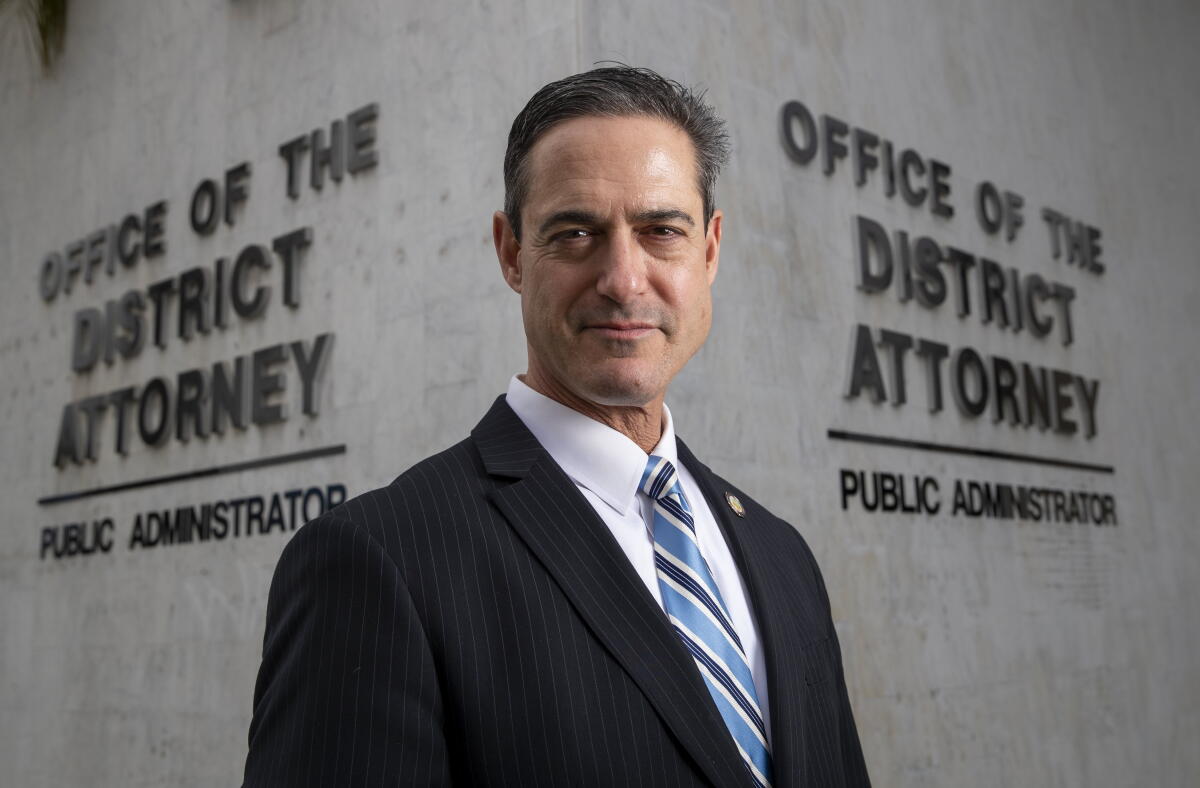
There was no perp walk for Laura Lee Yourex, who pleaded guilty to a misdemeanor. No melodramatic news conference from Orange County Dist. Atty. Todd Spitzer.
Nah, Spitzer dismissed Yourex’s case after she paid $1,500 for four electronic billboards along the 22 and 55 freeways. They feature a photo of her late boxer Maya Jean sporting an “I Voted” sticker alongside a warning — “Don’t be a dog. Voter Fraud is a Crime” — and the district attorney’s election fraud hotline number.
Yourex’s attorney has said she was trying to expose flaws in the state’s voter registration system by showing that even a dog could cast a ballot, a gimmick for which Spitzer had little sympathy.
He’s usually the modern-day equivalent of a hanging judge, the type of hard ass who wants his prosecutors to not only throw the book at defendants but also to bury them with a library. In an email, he told me that his office has successfully prosecuted two other voter fraud cases during his eight years in office and is pursuing three current ones. But as serious as voter fraud is, Spitzer has never preened in these cases the way Essayli has.
The Republican stalwart declined to comment on Essayli’s approach, saying he’s “not privy to any of the evidence in those cases.” When I asked why he chose a chuckle-inducing billboard as Yourex’s punishment, he argued that it successfully “address[ed] the harm that is done when engaging in this type of criminal behavior.”
Leave it to the Trump administration to make Spitzer — whose campaign slogan for his 2022 reelection was “#NoLAinOC” — come off as a big ol’ liberal softy. But when it comes to voter fraud, at least he’s meting out penalties that fit the crime, while Essayli is once again making Trump his North Star, not the Constitution.
The defendants charged with voter fraud deserve punishment, if they are indeed guilty. But as my colleagues Brittny Mejia and Kevin Rector reported, citing election experts, cases of noncitizens registering to vote are often a result of administrative error or confusion on the part of immigrants, for example, if they accidentally check a box at the DMV.
Essayli’s record as Trump’s top lawman in Southern California — he can’t even call himself the region’s U.S. attorney, since he hasn’t been confirmed by the Senate — is so laughable that I wouldn’t believe him if he claimed that water is wet.
His prosecutors have gone after activists involved in protests against Trump’s masked deportation goons with shoddy charges that were dropped, rejected by grand juries, ridiculed as “amateur hour” by a federal judge or resulted in not guilty verdicts. He’s a lackey who silently stood and watched last year as FBI agents tackled Alex Padilla during a news conference in Los Angeles just because the U.S. senator dared to challenge then-Homeland Security Secretary Kristi Noem’s ludicrous defense of mass immigration raids. He’s a coward who regularly declines to talk to press outlets — including The Times — that don’t think Trump is the greatest president in history.
Unsurprisingly, my request to interview Essayli — or at least receive emailed answers to questions including whether every felony defendant gets arrested with a phalanx of armed officers surrounding their home, whether that’s occurred in other voter fraud cases and whether his office regularly releases mug shots of felony defendants — went unanswered.

Orange County Dist. Atty. Todd Spitzer said his office is pursuing three voter fraud cases.
(Allen J. Schaben / Los Angeles Times)
Mejia and Rector spoke to some of the accused immigrants and their families swept up by “Operation Protect the Vote,” who were bewildered as to what they had done wrong and why the U.S. Justice Department was swinging such a heavy hammer against them. They shouldn’t be.
What Essayli is doing in the name of rooting out voter fraud isn’t about upholding the law. It’s about validating Trump’s xenophobia. The show trials the defendants will probably face are not about getting rid the worst of the worst, as Trump long claimed. It’s about casting suspicion on all immigrants, legal and not.
What’s especially ironic — no, disgusting — about Essayli’s claims that immigrants who wrongly register to vote are disenfranchising American citizens is that the portrait of this country’s biggest election scofflaw hangs in every federal courthouse. It was Trump who wanted Congress to stop the electoral college from formalizing his 2020 loss to Joe Biden, claiming that Democrats stole the White House from him, and provoked a mob to storm the U.S. Capitol.
But facts have never stopped Essayli from making a pendejo out of himself. His pathetic, dangerous charade reminds me of an infamous voter fraud case from 30 years ago. I wrote about it this summer when Trump first announced he was going to sic the Justice Department on noncitizens who were supposedly voting en masse.
Back then, Loretta Sanchez forever changed O.C. politics when she beat Republican Rep. Bob Dornan by fewer than 1,000 votes. Like Trump, Dornan claimed he lost because of immigrants who illegally voted. Like today’s GOP, sympathetic prosecutors and lawmakers at the local and federal levels spent way too much time and taxpayer money looking into the baseless allegations.
Just as Operation Protect the Vote has already shown this year, with only 28 charged out of about 23 million registered voters in California, Sanchez’s 1996 victory was not achieved through a vast immigrant voting conspiracy.
At least in the Dornan fiasco, Republicans finally dropped their investigation and moved on. The few immigrants who did vote improperly had their ballots tossed but otherwise faced no legal problems.
I doubt Trump and Essayli will give up so easily. That would require humility, mercy and the ability to admit they’re wrong.
But hey, if a dog can cast a vote in California, I guess anything’s possible.