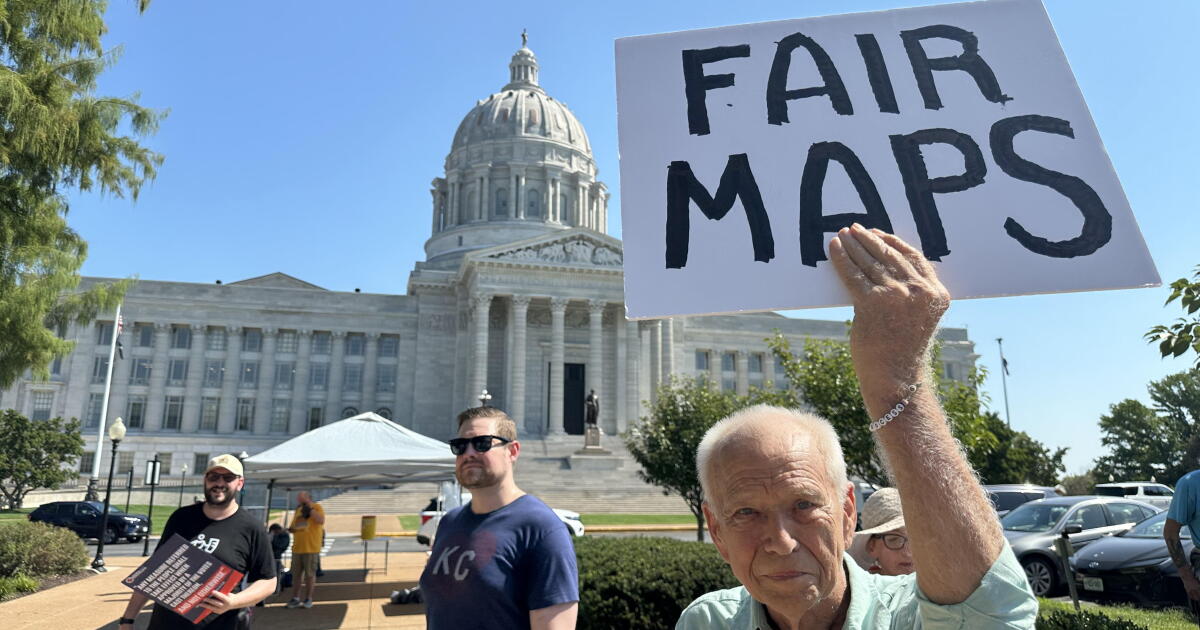
districts

Federal court blocks Alabama plan for new congressional districts that could help Republicans

Federal judges on Tuesday blocked Alabama’s plan to use a congressional map that could give Republicans an advantage in a key U.S. House race in the midterm elections.

A three-judge panel in the state’s long-running redistricting case issued a preliminary injunction that prevents the state from switching maps, ruling that the Republican-backed plan “intentionally discriminated based on race” by including only one Black-majority district. The judges instead required Alabama to continue using a court-ordered map in place for the 2024 elections that includes two districts where Black residents comprise a majority or close to it.

“Ultimately, we cannot see our way clear to requiring Alabamians to cast their votes in the 2026 elections under a districting plan tainted by intentional race-based discrimination,” the judges wrote.

The ruling is a setback for Republicans, who want to use a map for the November midterms that would give the GOP a chance to reclaim the seat now held by Democratic U.S. Rep. Shomari Figures. However, the state could appeal the ruling to the U.S. Supreme Court.

Figures said he is pleased with the ruling but expects an appeal. “This is a significant step in the right direction, but there is still a long way to go before this fight is settled,” Figures said.

The court order is the latest development in the twisting legal and political saga following a U.S. Supreme Court ruling that struck down a Black-majority district in Louisiana and weakened the federal Voting Rights Act. That ruling has led Republicans in several Southern states, including Alabama, to take steps to reshape voting districts with large minority populations that have elected Democrats.

The redistricting frenzy is part of a broader push by President Trump to try to hold on to Republicans’ slim House majority in the November elections.

Alabama court fight stretches back several years

The three-judge panel in 2023 ruled that a map drawn by Republican state lawmakers intentionally diluted the voting power of Black citizens. The court said the state, which is about 27% Black, should have two districts where Black voters are the majority or close to it. The court-selected map was used in 2024.

After the Supreme Court’s recent ruling in the Louisiana case, Alabama officials moved to implement the 2023 state-drawn map. The Supreme Court’s conservative majority agreed to lift the injunction that had blocked the map’s use and sent the case back to the three-judge panel for reconsideration in light of the Louisiana ruling.

In the meantime, Alabama Gov. Kay Ivey set Aug. 11 special primaries using the new map.

Upon further review, the panel said there was “undisputed evidence” of intentional racial discrimination. It said the special congressional primaries should instead proceed under the previous court-approved districts.

The decision to temporarily block the map switch came after a seven-hour court hearing Friday in which judges sharply questioned state lawyers about the timeline and the impact of the Louisiana ruling.

Using the same districts that had been in place for the previous election would prevent “an expensive, aggressive, and perhaps logistically impossible voter reassignment effort,” the judges wrote.

“Candidate and voter confusion is troublesome and warrants significant consideration, but we do not see that a preliminary injunction will worsen it. To the contrary, we expect a preliminary injunction to lessen it,” the judges said.

Deuel Ross, director of litigation for the NAACP Legal Defense Fund, said the court ruling “again vindicated the constitutional rights of voters in the Black Belt, and our clients look forward to voting under a fair map this fall.”

Redistricting changes affect primaries in several states

Other states also have considered adjustments to their primary elections to allow time for congressional redistricting after the U.S. Supreme Court’s decision affecting the Voting Rights Act. Louisiana’s congressional primaries, scheduled for May 16, were postponed until later this summer by Republican Gov. Jeff Landry so that state lawmakers could consider a new U.S. House map that would eliminate a majority-Black district.

In South Carolina, the Republican-led legislature is considering a plan that could throw out the votes from its June 9 congressional primary and instead hold a new primary in August under revised districts that could improve Republicans’ chances of winning an additional seat.

Tennessee also moved quickly to enact new U.S. House districts after the Supreme Court’s ruling, carving up a Black-majority district based in Memphis that had elected the state’s only Democratic representative. The new map gives Republicans a chance to sweep all nine of the state’s seats. As part of the plan, Tennessee temporarily reopened the candidate qualifying period for its August congressional primaries, allowing new candidates to enter the race and existing ones to either switch districts or drop out.

Since Trump first urged Texas to redraw its U.S. House districts last summer, about a half-dozen Republican-led states have enacted new voting districts, though some still face legal challenges. Democrats countered with new districts in California and also expect to gain a seat from new court-imposed districts in Utah.

Chandler and Lieb write for the Associated Press.

Source link

L.A. voters will cast ballots in eight City Council districts, two with open seats

Los Angeles voters will cast ballots in eight City Council district elections next week, including for two open seats where incumbents are leaving because of term limits.

The contests for the seats being vacated by Councilmembers Bob Blumenfield and Curren Price have drawn large fields of candidates, but the biggest spending has been in the Westside’s District 11, where incumbent Traci Park is facing challenger Faizah Malik, a public interest attorney and one of four council candidates backed by the local chapter of Democratic Socialists of America.

Park has raised $1.3 million, according to the latest campaign finance reports filed Friday, while challenger Faizah Malik reported about $520,000 in contributions. In addition, more than $3 million has been spent in the race by so-called independent expenditure committees that spend money to elect or defeat candidates but which are barred from coordinating their activities with the campaigns.

The district includes Venice, Mar Vista, Brentwood and Pacific Palisades, which was devastated by wildfire in January 2025.

Malik said Friday she is confident heading into the primary election, saying most of her donations are under $100 each, and that she hasn’t taken money from corporations.

Los Angeles City Council candidate for CD11 Faizah Malik attends a canvassing event.

Los Angeles City Council candidate Faizah Malik attends a canvassing event March 15 in Westchester.

(Eric Thayer / Los Angeles Times)

“This is what it means to be a grassroots candidate, and it is just more evidence that the people of CD11 believe in our vision for a Westside that is affordable for everyday people,” Malik said.

A Park campaign aide said Park’s haul is indicative of the councilmember’s record of getting results.

“But no one is taking anything for granted,” the aide said in a statement. “We’re working until the final vote is cast because this election will determine whether the Westside keeps moving forward or gets pulled backward into the same failed ideological politics Angelenos are exhausted by.”

Los Angeles City Councilmember Traci Park gives a pep talk to members of United Firefighters of Los Angeles City.

Los Angeles City Councilmember Traci Park, center, with members of United Firefighters of Los Angeles City on May 12.

(Genaro Molina / Los Angeles Times)

Park has emphasized her advocacy for fire recovery efforts, including pushing for permit fee waivers for residents wanting to rebuild. Malik has said Park has been too focused on single-family homeowners and said she would focus more energy on renters.

They have contrasting views on policing: Malik said she opposes expanding the size of the Los Angeles Police Department and instead supports shifting more resources to the city’s unarmed crisis response program. Park said the Police Department should have about 10,000 sworn officers, up from about 8,700 currently. She voted in favor of a 2023 LAPD contract that gave raises to officers and increased salaries to new hires.

They stand in contrast of each other on the Venice Dell housing development project, which would turn a city lot into 120 housing units for low-income and homeless people. Park opposed the completion and instead wants to turn it into a “mobility hub” and move the housing project to an adjacent lot. Malik, who represented the developer that filed a suit against the city claiming Park and others sought to kill the project, said the project was a motivating factor for her campaign.

District 9

Six candidates are vying to replace Councilman Curren Price, who hit the 12-year limit, in District 9. The district includes the Convention Center, USC and communities along the Harbor Freeway.

The candidates vary on key issues, including policing and housing. Estuardo Mazariegos, co-director of the Alliance of Californians for Community Empowerment Los Angeles, is backed by the Democratic Socialists of America. He has called for reducing the LAPD budget and redirecting funds to other city departments.

Two other candidates — Jorge Hernandez Rosas, an educator, and Jose Ugarte, who previously worked for Price — said they support hiring more police officers. Another hopeful, Elmer Roldan, executive director of Communities in Schools of Los Angeles, said he believes in keeping the LAPD at its current size.

Ugarte, Roldan, Rosas and Martha Sánchez, a therapist, all support enforcing Municipal Code 41.18, which bars homeless encampments near schools and daycare centers. Mazariegos and Jorge Nuño, an entrepreneur, say the code doesn’t solve homelessness and instead just moves people around.

Ugarte has raised the most in contributions of any candidate and has been endorsed by the Los Angeles County Democratic Party in the nonpartisan race.

District 3

Three candidates are competing for an open seat in District 3, where Councilmember Bob Blumenfield has termed out of office. The district encompasses Woodland Hills, Canoga Park, Reseda, Winnetka and Tarzana.

The candidates are Tim Gaspar, who founded an insurance company, Barri Worth Girvan, district director for Los Angeles County Supervisor Lindsey Horvath, and Christopher Robert “C.R.” Celona, a tech entrepreneur.

The three candidates are similarly positioned on public safety, backing Mayor Karen Bass’ long-term goal to increase the LAPD ranks to at least 9,500 officers. All three also support enforcing Municipal Code section 41.18.

Gaspar and Worth Girvan have both scored key endorsements. Gaspar is backed by Blumenfield, billionaire developer Rick Caruso and Councilmembers Monica Rodriguez, Tim McOsker and John Lee and billionaire developer Rick Caruso. Worth Girvan has endorsements from a long list of state Democratic lawmakers, the county Democratic Party, the Sierra Club and labor unions.

Gaspar leads in campaign contributions, followed by Worth Girvan. Celona, who has promised to resuscitate the city’s entertainment industry by fast-tracking film permits and cutting red tape, trails far behind.

District 1

Councilmember Eunisses Hernandez faces four challengers in District 1, which stretches from Highland Park on the northeast to University Park on the southwest. She is backed by the local Democratic Socialists of America, and her challengers claim the district has suffered under under her leadership, pointing to MacArthur Park as emblematic of the homelessness and drug addiction crisis plaguing the city.

Hernandez counters with a list of accomplishments, including helping secure a $6.3-million state grant to house homeless individuals near the Arroyo Seco riverbed and advocating for a citywide network of unarmed crisis response teams.

She faces challenges from Maria Lou Calanche, a former Los Angeles police commissioner and founder of the nonprofit Legacy LA; Nelson Grande, an executive consultant and former president of Avenida Entertainment Group; Raul Claros, founder of California Rising; and Sylvia Robledo, a small-business owner and former council aide.

Hernandez’s campaign has also faced an onslaught of accusations of “dark money” spending. A group called Neighbors First has sent mail pieces critical of Hernandez and other leftist City Council candidates.

District 5

Incumbent Katy Yaroslavsky faces two challengers for her District 5 seat, both of whom oppose her stance on housing and public safety spending. The district includes some of the city’s wealthiest neighborhoods, including Bel-Air, Westwood, Cheviot Hills and Hancock Park.

Challengers Henry Mantel, a tenants’ rights lawyer, and Morgan Oyler, an accountant, say Yaroslavsky hasn’t done enough to increase the district’s housing supply. Yaroslavsky, who holds a wide lead in fundraising, has said she supports increasing housing density near transit centers but cautioned against building more than the city can sustain.

District 13

Councilmember Hugo Soto-Martínez, who is also backed by the Democratic Socialists of America’s L.A. chapter, faces three challengers in District 13, which includes Atwater Village, Glassell Park, Elysian Valley, Echo Park, Silver Lake and East Hollywood.

The list of challengers includes Colter Carlisle, vice president of the East Hollywood Neighborhood Council, Dylan Kendall, who runs Grow Hollywood, and Rich Sarian, vice president of strategic initiatives for downtown’s South Park Social District.

While Soto-Martínez supports expanding the city’s unarmed personnel program, Carlisle and Kendall would like to expand the police force. Sarian has said he supports the unarmed personnel program and wants to examine the LAPD’s current size and resources.

District 15

Incumbent Tim McOsker is facing off against community organizer Jordan River in District 15, which covers Harbor City, Harbor Gateway, San Pedro, Watts and Wilmington. McOsker has decades of experience in the political world, having worked in the mayor’s office, and the city attorney’s office before joining the City Council in 2022. Rivers, who is unemployed, is a member of the Green Party.

District 7

Monica Rodriguez is running unopposed for the District 7 seat in the northeast San Fernando Valley.

Times staff writers David Zahniser, Noah Goldberg and Sandra McDonald contributed to this report.


Source link

Democrats ask the Supreme Court to halt a Virginia ruling blocking new congressional districts

Democrats on Monday filed an emergency appeal with the U.S. Supreme Court seeking to halt a Virginia ruling invalidating a ballot measure that would have given their party an additional four winnable U.S. House seats.

The move came after the Virginia Supreme Court on Friday struck down a constitutional amendment that voters narrowly passed just last month. The 4-3 state court decision found that the Democratic-controlled legislature improperly began the process of placing the amendment on the ballot after early voting had begun in Virginia’s general election last fall.

Democrats argued unsuccessfully that the U.S. Supreme Court has held that, even if early voting is underway, an election does not happen until election day itself.

The appeal is the latest twist in the nation’s mid-decade redistricting competition. It was kicked off last year by President Trump urging Republican-controlled states to redraw their lines and was supercharged by a recent Supreme Court ruling severely weakening the Voting Rights Act.

“The Court overrode the will of the people who ratified the amendment by ordering the Commonwealth to conduct its election with the congressional districts that the people rejected,” wrote lawyers for Virginia Democrats and Democratic state Atty. Gen. Jay Jones. “The irreparable harm resulting from the Supreme Court of Virginia’s decision is profound and immediate.”

The filing is a sign of Democratic desperation after the Virginia decision. Democrats are still favorites to recapture the U.S. House of Representatives, but their GOP rivals have claimed to have gained more than a dozen seats through redistricting. The voter-approved Virginia map would have partly offset that.

Democrats are taking a legal long shot in asking the justices to reverse the Virginia court’s ruling. The Supreme Court tries to avoid second-guessing state courts’ interpretations of their own constitutions. In 2023, it turned down a request by North Carolina Republicans to overrule a state Supreme Court decision that blocked the GOP’s congressional map.

Politically, the appeal could help a party struggling to compete with Republicans in the unusual mid-decade redrawing of congressional boundaries by providing fodder for election-year messaging about a partisan Supreme Court. The court recently allowed Louisiana Republicans to proceed with redistricting after the justices struck down a majority Black district as an unconstitutional racial gerrymander.

Democrats have been set on their heels because, days after the Virginia ballot measure passed, the Supreme Court’s conservatives reversed decades of rulings and in effect neutered the Voting Rights Act, paving the way for Southern states to eliminate some majority Black districts and further pad Republican margins in Congress.

The Virginia amendment had been launched long before that ruling. It was intended as a response to Republican gains in Texas, Missouri, North Carolina and Ohio, and to blunt a new map in Florida that just became law. Once the Virginia amendment passed, it briefly turned the nationwide redistricting scramble into a draw between the two parties.

That was unraveled by the Virginia Supreme Court’s decision. The justices are appointed by the legislature, which has flipped between the two parties in recent decades, and the body is generally not seen as having a clear ideological bent.

Whitehurst writes for the Associated Press.

Source link

Alabama lawmakers pass plan for new U.S. House primary, if courts allow different districts

A national redistricting battle over U.S. House seats swung toward Republicans on Friday, as a Virginia court invalidated a Democratic gerrymandering effort and Republicans in Alabama approved plans for new primary elections if courts allow GOP-drawn House districts to be used in the November midterm elections.

The Alabama legislation, which was signed quickly into law by Republican Gov. Kay Ivey, is part of an effort by Republicans in Southern states to capitalize quickly on a recent U.S. Supreme Court ruling that significantly weakened Voting Rights Act protections for minorities.

Tensions ran high in the Alabama Statehouse. And Republican lawmakers in Louisiana and South Carolina also faced staunch opposition from civil rights activists and Democrats as they presented plans Friday to redraw their congressional districts.

The action came just a day after Tennessee enacted new congressional districts that carve up a Democratic-held, Black-majority district in Memphis. The state Democratic Party sued on Friday, seeking to prevent the districts from being used until after this year’s elections because of the tight time frame

Even before last week’s Supreme Court ruling in a Louisiana case, Republicans and Democrats already were engaged in a fierce redistricting battle, each seeking an edge in the midterm elections that will determine control of the closely divided House. That battle tilted further toward Republicans when the Virginia Supreme Court ruled Friday that Democratic lawmakers had violated constitutional requirements when placing a redistricting amendment on the ballot.

Since President Trump prodded Texas to redraw its congressional districts last summer, Republicans think they could gain as many as 14 seats from new districts in several states while Democrats think they could gain up to six seats. But the parties may not get everything they sought, because the gerrymandering could backfire in some highly competitive districts.

Alabama primaries could be in flux

Demonstrators outside the Alabama Statehouse on Friday shouted “fight for democracy” and “down with white supremacy.”

“I was out there in 1965 marching for the right to vote, and now we are back here in 2026 doing the same thing,” Betty White Boynton said.

During debate inside the statehouse, Black lawmakers sharply criticized the Republican legislation, saying it harks back to the state’s shameful Jim Crow history. The new law would ignore the May 19 primary results for some congressional seats and direct the governor to schedule a new primary under revised districts, if a court allows it. Lawmakers also approved a similar bill related to state Senate districts.

“What happened here today is that we were set back as a people to the days of Reconstruction,” Democratic state Sen. Rodger Smitherman said after the vote.

Senate Democrats shouted “hell no” and “stop the steal” as the vote occurred in the Alabama Senate.

The special primary would happen only if the courts agree to lift an injunction that put a court-selected map in place until after the 2030 census. That order required a second district where Black voters are the majority or close to it, resulting in the 2024 election of Democratic Rep. Shomari Figures, who is Black. If a court lifts the injunction, Republican officials want to put in place a map lawmakers drew in 2023 — which was rejected by a federal court — that could allow them to reclaim Figures’ district.

“With this special session successfully behind us, Alabama now stands ready to quickly act, should the courts issue favorable rulings in our ongoing redistricting cases,” Ivey said in a statement.

Virginia ruling centered on timing of election

Democrats had hoped to gain as many as four additional U.S. House seats under new districts narrowly approved by voters in April. But the state Supreme Court invalidated the measure because it said the Democratic-led legislature violated procedural requirements.

To place a constitutional amendment before voters, the Virginia Constitution requires lawmakers to approve it in two separate legislative sessions, with a state election sandwiched in between. The legislature’s initial approval of the redistricting amendment occurred last October — while early voting was underway but before it concluded on the day of the general election. The legislature’s second vote on the amendment occurred after a new legislative session began in January.

The Supreme Court said the initial legislative approval came too late, noting that more than 1.3 million ballots already had been cast in the general election, about 40% of the total votes ultimately cast.

Louisiana lawmakers look at map options

A Louisiana Senate committee considered several redistricting options Friday from Republican state Sen. John “Jay” Morris that would eliminate either both or one of the current Black-majority U.S. House districts.

“Every one of these maps reduces Black voting power in every one of the districts. And I think that’s a problem,” Democratic state Sen. Sam Jenkins told Morris.

Morris denied that the proposed redistricting maps were racially discriminatory. He said his goal was to be “respectful of the traditional boundaries” of the state’s six congressional districts.

“I don’t think we should care that much about race,” Morris said.

The only four Black congressmen who have represented Louisiana since the end of the Reconstruction era appealed to state senators to keep two majority-Black districts in a state where one-third of voters are Black.

Leona Tate, who as a 6-year-old girl was escorted by federal marshals through a racist white mob trying to prevent her from desegregating a New Orleans elementary school, told lawmakers she felt they were taking a step backward in time by reducing Black political power.

“You have a choice in front of you: You can draw a map that reflects what Louisiana actually is — a state where Black voices belong in the halls of Congress,” said Tate, 71. “Or you can draw a map that tells my grandchildren that their votes don’t count, that their faces don’t matter and that the progress I helped build with my own two feet as a 6-year-old can be erased at will.”

South Carolina considers a House map

A small group of South Carolina lawmakers held a rare Friday meeting to discuss a proposed new congressional map intended to allow Republicans a clean sweep of the state’s seven U.S. House seats.

The hearing was the first step in redistricting. But its future remains murky. The state Senate has yet to agree to consider new districts later this month, an action that would require a two-thirds vote.

The new map has some Republicans nervous. Breaking up the 6th District, represented by Rep. James E. Clyburn (D-S.C.), makes the other six districts less Republican.

At Friday’s subcommittee meeting, lawmakers heard hours of testimony, almost all against the new map. The hearing included a consultant who reviewed the map, saying it appeared to be legal under the Supreme Court’s decision in the Louisiana case.

“I agree if the law allows us to do it, then we can do it,” Democratic state Rep. Justin Bamberg said. “But I can slap somebody’s mama and it’s not the right thing to do.”

Some absentee ballots already have been returned for the state’s June 9 primary elections. The legislative subcommittee advanced a plan to delay the congressional primaries to August and reopen a candidate filing period, if a new map is approved.

Chandler, Brook, Collins and Lieb write for the Associated Press. Collins reported from Columbia, S.C.; Brook from Baton Rouge, La.; and Lieb from Jefferson City, Mo.

Source link

South Carolina joins Southern redistricting push after U.S. Supreme Court ruling on minority districts

An election-year redistricting movement has spread to South Carolina as Republicans attempt to redraw majority-Black congressional districts that have suddenly become susceptible because of a U.S. Supreme Court ruling upending protections for minority voters.

Urged on by President Trump, South Carolina Republicans are attempting to redraw a district long held by a Black Democratic lawmaker in their quest for a clean sweep of the state’s seven congressional seats.

Lawmakers already are meeting in special sessions in Alabama and Tennessee in a bid to change their U.S. House districts. And Louisiana lawmakers are making plans for new congressional districts after the Supreme Court last week struck down the state’s current map.

The stakes are high for minority voters who stand to lose their preferred representatives and for any Republican lawmakers reluctant to follow Trump’s wishes. In Republican primary elections Tuesday, Trump-endorsed challengers defeated at least five of the seven Indiana state lawmakers targeted by Trump’s allies for refusing to support a congressional redistricting effort last year.

The Supreme Court’s recent ruling said Louisiana relied too heavily on race when creating a second Black-majority House district as it attempted to comply with the Voting Rights Act. The ruling significantly altered a decades-old understanding of the law, giving Republicans grounds to try to eliminate majority-Black districts that have elected Democrats.

The ruling revved up an already intense national redistricting battle ahead of a November midterm election that will determine control of the closely divided House.

Since Trump prodded Texas to redraw its U.S. House districts last year, a total of eight states have adopted new congressional districts. From that, Republicans think they could gain as many as 13 seats while Democrats think they could gain up to 10 seats. But some of the new districts could be competitive in November, meaning the parties may not get all they sought.

South Carolina to test its will for redistricting

Democratic U.S. Rep. Jim Clyburn has represented South Carolina’s 6th Congressional District since it was redrawn to favor minority voters in 1992. He’s running for an 18th term. But it could get harder for him to win reelection if Republicans redraw his district.

Leaders in the state House and Senate said a redistricting effort needs to start with a two-thirds vote in each chamber. The issue could come up as soon as Wednesday. But if only a few Republicans aren’t on board, it can’t succeed.

Senate Majority Leader Shane Massey has warned that redistricting could backfire because of thin political margins, resulting in a second Democrat in the U.S. House. Massey told reporters Tuesday that he had a cordial conversation with Trump about redistricting, each laying out their concerns.

The state’s primaries are June 9 and early voting starts in three weeks.

Alabama looks at setting a new primary

The state House on Wednesday could debate legislation that would allow Alabama to hold a special congressional primary, if the Supreme Court clears the way for the state to change its U.S. House districts.

In light of the court’s ruling on Louisiana’s districts, Alabama officials have asked courts to set aside a judicial order to use a U.S. House map that includes two districts with a substantial number of Black voters. Republicans instead want to use a map passed in 2023 by the Legislature that could help the GOP win at least one of those two seats currently held by Democrats.

Alabama’s primaries are scheduled for May 19. If the Supreme Court grants the state’s request after or too close to the primary, the legislation under consideration would ignore the results of that primary and direct the governor to schedule a new primary under the revised districts.

Democrats denounced the legislation as a Republican power grab that harkens back to the state’s shameful history of denying Black residents equal rights and representation.

Republicans are “working to secure an electoral victory by taking Alabama back to the Jim Crow era, and we won’t go back,” Democratic U.S. Rep. Terri Sewell told a crowd gathered outside the Alabama Statehouse.

Tennessee plan targets Memphis district

Republican Gov. Bill Lee called Tennessee lawmakers into a special session to consider a plan urged by Trump that could break up the state’s lone Democratic-held U.S. House district, centered on the majority-Black city of Memphis. Republicans didn’t say much about the plan Tuesday.

But as the state Senate began work Tuesday, shouts of “shame, shame, shame” could be heard inside the chamber from protesters gathered in the hallways. On the chamber floor, state Sen. Raumesh Akbari, a Black Democrat from Memphis, called the redistricting “an act of hate.”

Martin Luther King III sent a letter to Tennessee legislative leaders expressing “grave concern” about the plan to divide Memphis, saying the move could undermine the work for voting rights carried out by his father, Martin Luther King Jr.

The candidate qualifying period in Tennessee ended in March, and the primary election is scheduled for Aug. 6.

Thousands had already voted in Louisiana

After last week’s Supreme Court decision, Republican Gov. Mike Landry postponed the state’s May 16 congressional primary to allow time for lawmakers to approve new U.S. House districts. State Sen. Caleb Kleinpeter, a Republican, said a redistricting committee he leads plans to hold a public hearing Friday.

Louisiana voters had already sent in more than 41,000 absentee ballots by last Thursday, when Landry suspended the House primaries, according to the Secretary of State’s Office. That’s about a third of all the absentee ballots sent out to voters. Around 19,000 were from registered Democrats, 17,000 from registered Republicans and the remainder belonged to neither party.

Democrats and civil rights groups have filed several lawsuits challenging the suspension of Louisiana’s congressional primary.

Collins, Loller, Chandler and Lieb write for the Associated Press. Chandler reported from Montgomery, Ala., Loller from Nashville and Lieb from Jefferson City, Mo. AP writer Jack Brook contributed to this report from New Orleans.

Source link

Florida Gov. Ron DeSantis delays special session to redraw districts

Florida Gov. Ron DeSantis makes remarks at the Kennedy Space Center in Florida on January 8, 2025. On Wednesday, he delayed plans for the state legislature to hold a special session to redraw the state’s congressional districts. File Photo by Joe Marino/UPI | License Photo

April 16 (UPI) — Florida Gov. Ron DeSantis has delayed a special session he called for the state legislature to work on redrawing the state’s U.S. congressional districts.

The session was scheduled to take place next week, but DeSantis said Wednesday it would now happen on April 28 to give the governor’s office more time to work on its proposal, The New York Times reported.

He also called legislators back to work to vote on a bill to give parents more freedom to opt out of giving their children school-mandated vaccines and one to protect minors from artificial intelligence, Politico reported. DeSantis called on lawmakers to return to Tallahassee from April 28 to May 1.

DeSantis issued a proclamation in January calling for the special session to reconsider the state’s congressional map.

“Every Florida resident deserves to be represented fairly and constitutionally,” he said at the time.

DeSantis said the redistricting would better ensure that race was not a predominant factor in determining congressional districts. He referenced a Supreme Court case in which Louisiana lawmakers were accused of creating a congressional district comprising mostly racial minorities.

Florida has 28 seats in the U.S. House, gaining one in 2022 after the 2020 census. Republicans hold 20 seats and Democrats have 8.

First lady Melania Trump speaks during a House Ways and Means Committee roundtable discussion on protecting children in America’s foster care system in the Longworth House Office Building near the U.S. Capitol on Wednesday. The bipartisan group of lawmakers are looking to address challenges children in foster care face, including barriers to education and educational advocacy, housing, employment opportunities, financial independence, and technology. Photo by Bonnie Cash/UPI | License Photo

Source link