Other than “The Odyssey,” the biggest news in Los Angeles film circles last week was the return of the Cinerama Dome.
The iconic theater, which has been closed since March 2020, will be restored and reopened by Sony Pictures Entertainment and its Alamo Drafthouse theater chain. As my colleague Cerys Davies reported, renovations begin next month and will continue until early 2028.
For more than 60 years, the dome has been a landmark on Sunset Boulevard. With its 86-foot-wide curved screen, it has premiered such iconic Hollywood films as 1977’s “Close Encounters of the Third Kind,” and made a cameo of its own in 2019’s “Once Upon a Time … in Hollywood.”
Ever since the dome closed at the start of the COVID-19 pandemic, there have been questions about whether it would return. Filmmakers like “Anora” director Sean Baker and “Baby Driver” director Edgar Wright publicly called for its reopening, while a “Save Your Cinema” preservation campaign led by Benjamin Steinberg kept the geodesic icon in the public eye.
“It was definitely the capital of, like, the movie-going experience in L.A.,” Steinberg told my colleague, adding that he plans to visit the theater two to three times a week when it reopens. “I can’t wait to go back inside the Cinerama Dome and watch movies.”
You’re reading the Wide Shot
Samantha Masunaga delivers the latest news, analysis and insights on everything from streaming wars to production — and what it all means for the future.
By continuing, you agree to our Terms of Service, which include arbitration and a class action waiver. You agree that we and our third-party vendors may collect and use your information, including through cookies, pixels and similar technologies, for the purposes set forth in our Privacy Policy such as personalizing your experience and ads.
The theater will be operated by Alamo Drafthouse, though Sony says it plans to keep the “Cinerama” name and exterior branding, as well as the dome’s “traditional concession experience” — meaning you won’t be able to order food and drinks to your seat. (Cinephiles recently have criticized the chain for changing its in-seat ordering system to require use of mobile phones in the theater.)
Alongside traditional theatrical showings, the dome also will include some Alamo Drafthouse specials, including repertory screenings, premieres, events and filmmaker series.
Adjacent to the dome, the 14-screen former ArcLight Cinemas will reopen as an Alamo Drafthouse, Sony said, offering dine-in food and beverages, as well as karaoke rooms and “fan celebrations.”
“It’s such a great location,” Ravi Ahuja, chief executive and chairman of Sony Pictures, told me. “It’s historic, people love it and the theater was successful before it closed. It’s one of a kind, which is the kind of experience we’re after.”
The move also highlights the opportunity Sony sees in the experiences business — an increasingly important strategy for Hollywood.
The Alamo Drafthouse acquisition was part of this, as was the studio’s recent $100-million investment and minority stake in Cosm, a virtual reality venue operator that has a location at Inglewood’s Hollywood Park.
The studio also has “Wheel of Fortune Live!,” a touring version of the popular game show, “Jeopardy! Bar League,” which was incubated at Alamo Drafthouse, and events for its streaming service Crunchyroll at anime conventions.
“It’s another leg of the franchise stool,” Ahuja said. “Fans want to engage in person with each other. It’s part of a human need when you have deep fandom around something.”
As the theatrical market waxes and wanes and the television business has become more unpredictable, it makes sense that studios like Sony increasingly look to diversify and attract fans in new ways.
After all, people have a lot of things they can do with their time and money. And after a period of slow returns since the pandemic, they’ve increasingly been coming back to in-person activities. To keep loyal fans in the fold, studios need to give them more ways to interact with the stories and entertainment they love, or they’ll move on.
Betting on the experiences business isn’t new. Walt Disney Co. makes the majority of its operating income not from its theatrical movies or streaming service, but from its theme parks and cruise line division. Last year, Universal opened Epic Universe, a major investment in its Orlando theme park resort that indicates the importance of this business for the company and owner Comcast.
But not every company wants or needs to start a theme park business. For one, it’s expensive. And for a studio like Sony, which doesn’t have a lot of kid-focused franchises, it doesn’t really make sense.
As a result, some are getting into the experiences space in more specific and limited ways, such as studio tours or branded attractions.
For Sony, that’s meant building a business around these in-person offerings that align more with its adult-leaning audiences. Lionsgate has a “John Wick Experience” in Las Vegas, while Warner Bros., among other things, recently debuted “Harry Potter: A Hogwarts Express Adventure” train event at the Southern California Railway Museum in Perris. (Universal licenses Harry Potter from Warner Bros. for inclusion in its parks.)
For most studios without a major theme park presence, this kind of location-based entertainment is still likely a relatively small part of their corporate revenue, potentially less than 1%, said Dennis Spiegel, founder and chief executive of the International Theme Park Services, Inc. consulting firm. But what these experiences do is help lengthen the life of a franchise by keeping licensing revenue flowing and keeping brands relevant between film releases, he said.
“Hollywood increasingly sees it as an essential part of maximizing the lifetime value of its intellectual property,” he wrote in an email. “In many ways, we have seen how these experiences have become as much of a marketing engine as they are a profit center.”
As for the Cinerama Dome, don’t take it as a sign that Sony is looking to build out an exhibition empire. The studio is looking for only special and selective deals like the dome, Ahuja said, and there are no plans to add more L.A. exhibition locations.
Stuff We Wrote
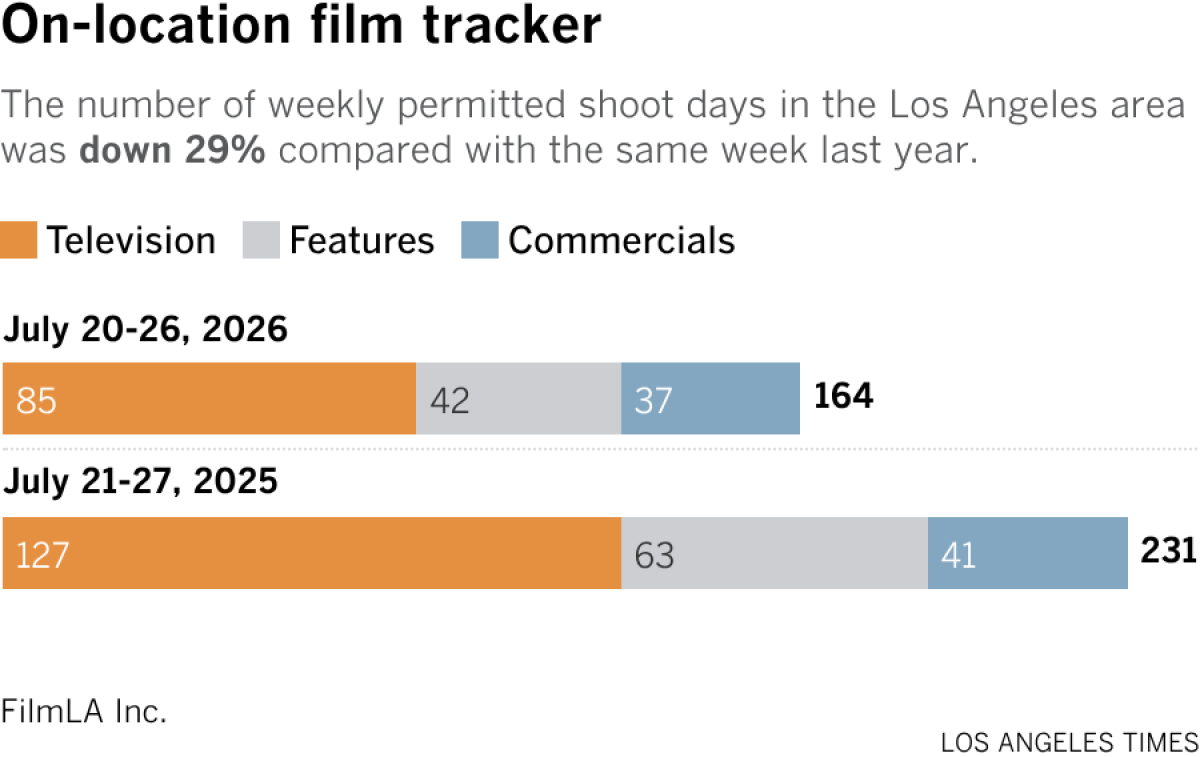
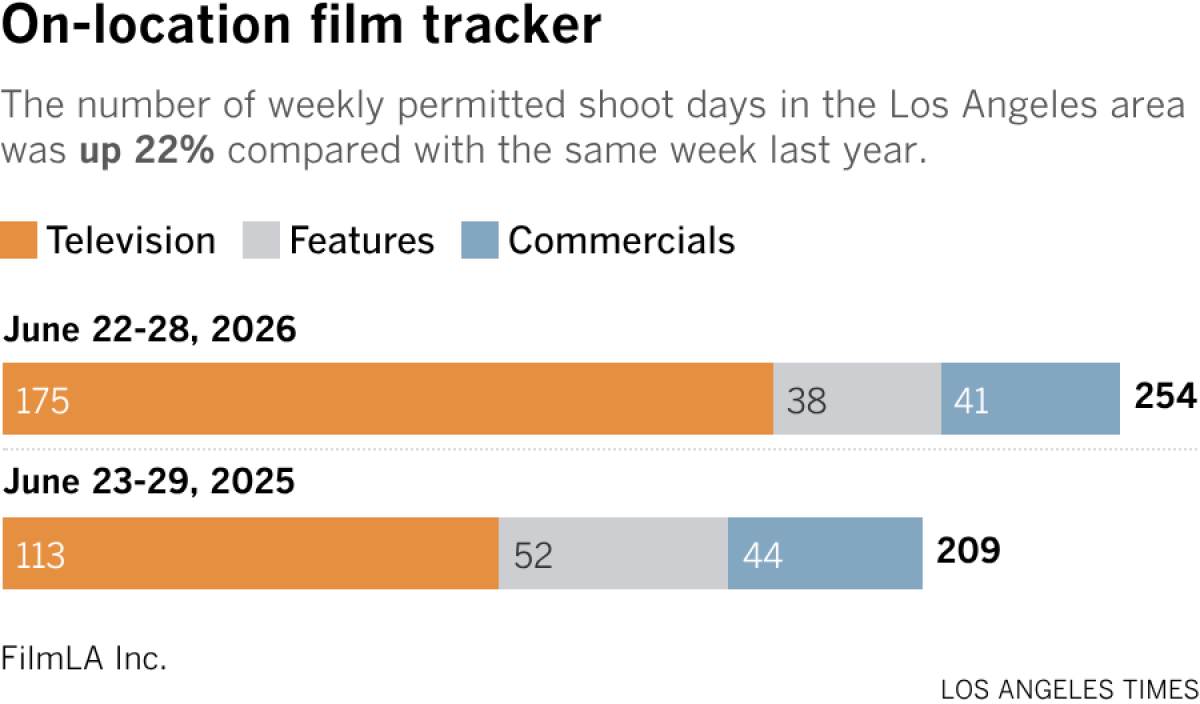
Film shoots
Number of the week
Christopher Nolan’s “The Odyssey” continued its dominance at the box office in its second outing with a three-day domestic haul of $90 million, down only 27% from its debut weekend.
Internationally, the Universal Pictures film raked in $137.6 million for a worldwide total of $652 million.
The big box office performance came as an unauthorized copy of the film leaked online over the weekend. The studio said it “immediately initiated takedown protocols” once it became aware of theillegal posting on X and “will pursue all appropriate remedies to protect our content and intellectual property rights.” The post was viewed more than 2.1 million times before a takedown notice replaced the copy of the film.
What I’m watching
I did not expect Amazon MGM Studios’ “The Sheep Detectives” to deliver a profound message on death and grieving when I sat down to watch it with a friend, but those talking ovine sleuths really got to me.
Universal Studios Hollywood surprise-opened its flashy new high-speed roller coaster Fast & Furious: Hollywood Drift on Monday. After much hype and anticipation — and even some unfounded rumors that the coaster would not hit its promised summer launch — Hollywood Drift is at last ready for its close-up.
Billed as one of the most intense roller coasters in Universal Studios’ global ride portfolio, Fast & Furious: Hollywood Drift can reach speeds of 72 mph while taking guests through multiple inversions in vehicles that can rotate 360 degrees. It is the fastest coaster that Universal Creative, the division of the company responsible for theme park experiences, has designed.
There is some fine print.
You’re reading Mr. Todd’s Wild Ride newsletter
Todd Martens’ newsletter delivers news and commentary on the past, present and future of theme parks, right from the theme park capital of the world — Southern California.
By continuing, you agree to our Terms of Service, which include arbitration and a class action waiver. You agree that we and our third-party vendors may collect and use your information, including through cookies, pixels and similar technologies, for the purposes set forth in our Privacy Policy such as personalizing your experience and ads.
Fast & Furious: Hollywood Drift has still not announced its official grand opening. The ride is operating in what Universal is calling “technical rehearsals.” Think of this as a soft opening.
What that means: Fast & Furious: Hollywood Drift is not guaranteed to be running if you visit the park. It’s still, for all intents and purposes, in a testing phase, and can be closed down at any time. If you’re thinking about rushing to the park to be one of its first riders, proceed with caution. Until Universal gives the coaster a proper opening — and expect some sort of gala to go with it — Hollywood Drift may not be fully operational.
Technical rehearsals help ensure that when a ride does receive a formal opening, it can operate, in theory, without any issues or prolonged downtime. My advice: Visiting a theme park is an investment, and if experiencing Hollywood Drift is vital to your day at Universal Studios, it would be safest to wait until the coaster gets its date. At this point, it should be a matter of weeks, if not days.
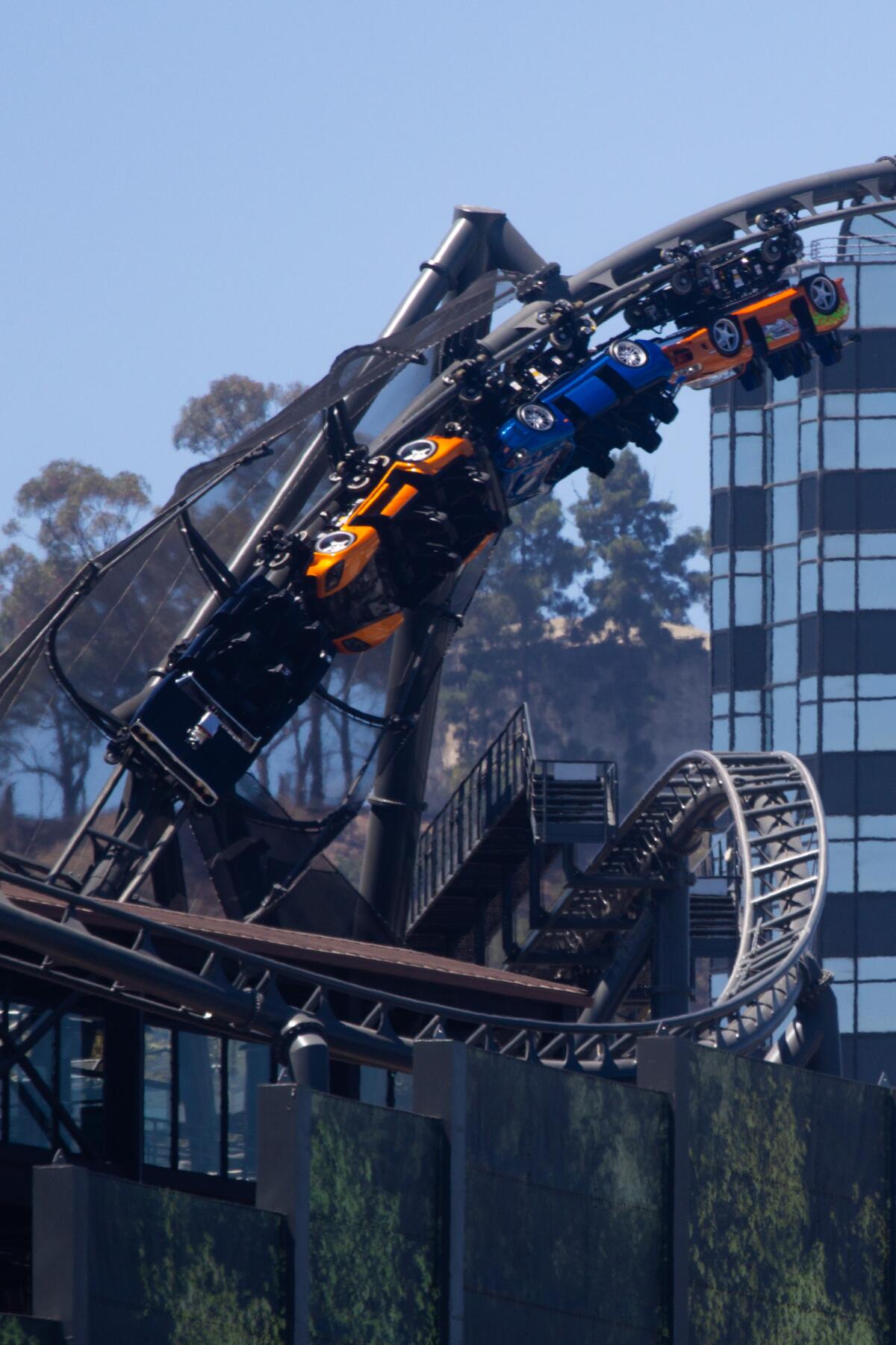
A view of Fast & Furious: Hollywood Drift when it was still in testing mode.
(Kayla Bartkowski/Los Angeles Times)
But I certainly understand that theme park FOMO.
Hollywood Drift has long been circled as the most important theme park attraction opening in North America in 2026. The ride has been about 10 years in the making, and has many unique attributes. Not the least of which is its location, as the coaster is built on a steep hill between the park’s upper and lower lots, meaning at times it will go over and under its famed escalators.
“It wouldn’t be your first choice,” says Jon Corfino, Universal Studios Hollywood’s lead creative, of the topography. “But in a way, it makes it more dynamic that we were able to do it.”
Meanwhile, the ride has also raised eyebrows among the community surrounding Universal Studios Hollywood. The park’s neighbors in the adjacent Toluca Lake neighborhood have been none too pleased with some of the rider screams that emanated from the coaster on a day of testing earlier this summer. I talked to several residents as well as Universal and representatives from Los Angeles County for a story published last week, “Fast & Furious’ coaster screams rattle quiet neighborhood: ‘Like someone is getting murdered.” Whether those concerns fade, or how that issue is ultimately resolved, will be but one of the storylines that will follow the attraction.
Fast & Furious: Hollywood Drift on a test-run. The coaster has been the most anticipated theme park opening of 2026.
(Todd Martens / Los Angeles Times)
Yet most guests will simply be concerned with how it rides. While other coasters can rotate 360 degrees, they don’t do it at this speed and through this many twists, turns and loops. And then there’s the design. Hollywood Drift puts riders in mini cars, each one heavily detailed and with unique engine and breaking noises. Of course, the ride may simply move too fast to pay attention to all that.
“It’s a high level of intensity, absolutely, for sure,” Corfino says.
Stay tuned to Mr. Todd’s Wild Ride for detailed impressions of Fast & Furious: Hollywood Drift.
This week in SoCal theme parks
A glass slide from the Medusa portrait in Disneyland’s Haunted Mansion is going up for auction.
(Matt Roppolo / HA.com)
Bid on a piece of Disneyland history. I have mixed feelings on auctions involving Disneyland artifacts. And by mixed, I mean mostly negative, as they tend to inflate prices for the fans who care about the items most, and many of these treasures belong in a museum rather than someone’s private collection. But if you’ve ever wanted a mummy prop from Indiana Jones Adventure, or — gasp — an original glass slide from the Haunted Mansion’s changing Medusa portrait, now’s your chance. The Disney Experiences Auction — Rare and Remarkable Finds is part of next month’s all-things Disney fan convention D23, and is hosted by Heritage Auctions. The live auction is Aug. 16, but online bidding is open.
A Halloween Horror Nights original. Spooky season is now just a few weeks away, and Universal Studios Hollywood’s lineup for Halloween Horror Nights is mostly set. The latest addition to the event, which begins Sept. 3, is an exciting one, as it’s a brand new haunted house not based on any existing film or television properties. The maze, Dead, Deader, Deadest, is set in a funeral home, based on a plot involving a “miracle drug” that can restore the features of the deceased without embalming. Halloween Horror Nights mastermind John Murdy revealed on socials that it connects to past original haunted houses at the park, for those deep into Halloween Horror Nights lore.
Hope you like Kraft Mac & Cheese, Disney fans. Times Business writer Samantha Masunaga reports on a deal between the Walt Disney Co. and Kraft Heinz. As part of the agreement, more Kraft Heinz products will be available in Walt Disney Co.’s U.S.-based theme parks and on cruise ships, including Heinz, Philadelphia cream cheese and Kraft Mac & Cheese.
Tell us your stories. Ask us your questions.
Have a theme park tale to share? Whether it was a good day or less-than-perfect day, I would love to hear about it. Have a question? A tip? A fun photo from the parks to share? Email me at todd.martens@latimes.com. I may feature your note in an upcoming newsletter.
As performers protest and studios sue in their war on artificial intelligence, the entertainment industry is deepening its dependence on it.
Although few places are better than Hollywood at crafting a narrative and concealing what happens off-frame, a Los Angeles Times survey of job postings sheds light on what is happening offstage.
Among hundreds of job postings in late June, more than one in 10 was likely connected to AI. The top studios’ public postings suggest they have been recruiting people to build AI tools. They are also recruiting teams to defend their intellectual property against unauthorized AI use.
“There are plenty of studios that are hiring [for AI] but never talk about it in public,” said Yoland Yan, a co-founder of ComfyUI, a company that helps studios juggle different AI tools.
Companies have been hesitant to detail how they use generative AI in film production — partly because they are concerned about consumer and union backlash.
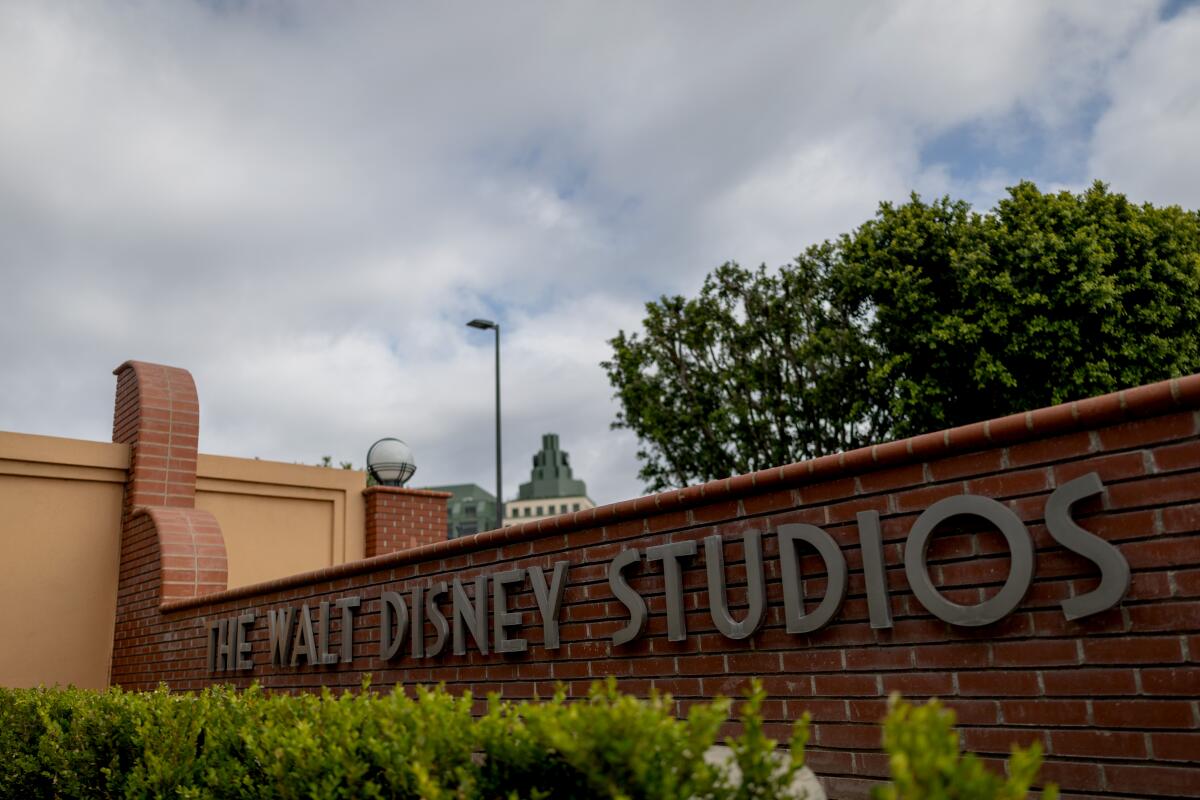
The Walt Disney Studios complex on May 3 in Burbank.
(Eric Thayer/Los Angeles Times)
Some in Hollywood described AI use as the new cosmetic surgery, where everyone knows it is happening, but few will admit to it.
Recent want ads show Amazon MGM Studios trying to find a principal AI executive and Walt Disney Studios advertising for a production innovation technologist job.
“What you’re seeing in those job postings is that adoption is already happening,” said Bryn Mooser, chief executive of Asteria, an AI film studio.
Netflix recently posted a job that didn’t exist a year ago.
The streamer was hiring for the role of “Manager, Generative Workflows,” a job to help integrate more AI into Netflix films. It promised hands-on experience with the cutting-edge technology.
“The industry is flooded with speculative GenAI roadmaps, but few are battle-tested in production,” the post said, referring to generative AI. The post said the role will work on introducing AI into Netflix’s slate of films being released in the U.S. and Canada.
Although some companies may be shy about sharing their AI plans, big stars who don’t have to answer to others have been more open about their embrace of the new technology for storytelling.
An exterior view of the Netflix sign at Netflix on Vine in Hollywood in 2025.
(Allen J. Schaben/Los Angeles Times)
Rejecting AI is like picking a horse and buggy over a car, said “Star Wars” creator George Lucas.
“Artificial intelligence means it’s much easier for us to make movies,” he told a trade magazine earlier this year. “There’s nothing you can do about it. That’s progress. It’s the future.”
Some in Hollywood have a softer stance on artificial intelligence, with studios cutting deals with AI companies, and filmmakers like Martin Scorsese backing AI companies.
Ben Affleck launched an AI film tech company then sold it to Netflix for half a billion dollars.
When launching InterPositive, Affleck said he wanted to keep “storytelling human” by building AI tools that could fix lighting, generate missing shots and other things while “keeping creative decisions in the hands of artists.”
The Times’ survey turned up two senior InterPositive roles to update the programming to apply AI to visual effects .
The Culver Studios on Feb. 12 in Culver City.
(Kayla Bartkowski/Los Angeles Times)
To gauge what is happening behind the scenes, The Times used Claude Code to build a scraper to identify job postings at Disney, Universal, Paramount, Warner Bros., Sony, Netflix and Amazon MGM. It found around 250 film studio job postings that were still public as of late June. Around 30 of those seemed to be connected to AI.
Disney, Netflix and Amazon had job postings that were about using AI on the creative side of the business. Universal, Paramount, Warner Bros. and Sony had job ads suggesting they were also using AI but for marketing, distribution and audience analytics.
The postings suggest the Disney, Netflix and Amazon studios are building repeatable AI workflows for visual effects, animation, sound and dubbing. The companies also seem to be building in-house teams to develop custom generative-AI models, while also using third-party software.
None of the jobs advertised were to create AI that wrote scripts or created AI actors.
Disney’s ten or so AI jobs showed the century-old studio building out its AI research and production muscle, while protecting its vault of beloved characters.
Mouse House is hiring PhD-level talent to study “computer graphics and AI” for Pixar and Disney films, people to “bridge the gap between research and practical studio application.”
Industrial Light & Magic, the Disney-owned visual effects shop, was searching for supervisors to “explore emerging technologies (including AI/Machine Learning)” to develop new production workflows.
The company’s audio post-production unit, Skywalker Sound, seemed to be recruiting to build proprietary AI models for soundtracks, voice separation, and voice transfer, the process of taking a speaker’s tone and pitch, and applying it to new content.
Disney was also hiring to defend itself. Three of its jobs were for “content security” to assess AI tools and guard against piracy, watermarking and rights-protection work.
The company’s public posture has so far been pursuing lawsuits against AI companies for inappropriate use of copyrighted material, and it pulled out of its plans to invest $1 billion in an equity investment deal with OpenAI.
Netflix’s posts suggested it is bringing more AI to the creative side of its business.
Netflix’s senior director of creative innovation, Girish Balakrishnan, outlined at the Runway AI film festival how AI was used to create soccer fans in “Brazil ’70” and establish shots for fight scenes in “Glory.”
Amazon, an early adopter, was hiring a principal AI executive to drive AI-tool adoption across production, plus roles in operations automation and LLM content classification, the listings revealed.
The Seattle-based streamer has been the most aggressive AI adopter in studios, and commissioned three AI animation series through its GenAI creator fund in May. Amazon has also bankrolled a Manhattan Beach production services company, Innovative Dream.
Even as studios build bigger AI teams, many in the industry are resisting, and some film fans are concerned.
The actors’ guild SAG-AFTRA in June ratified a new four-year contract with special protections against synthetic performers, and the union has backed a national bill designed to protect individuals from unauthorized, AI-generated digital replicas.
Studios have met with the union twice a year since 2023 to provide a confidential report on their AI-related activities. The studios tell the union they aren’t yet using AI that would entirely replace humans, said a person familiar with the discussions.
The union says it has no evidence that generative AI is being used to create performances, and the studios are supposed to notify the union if that happens.
Actors, writers, production staff and movie fans are still resistant to the overuse of AI and defining when and where it is acceptable, so studios are treading lightly, said AI film studio CEO Mooser.
“It’s been really a challenging thing to adopt both socially, ethically and legally, but we are seeing more adoption of it than we’ve ever seen before,” he said.
More than 16 congressional Democrats accused the Federal Communications Commission this week of running a license-review process “tainted by animus and ideology,” demanding the agency back off its early scrutiny of Disney stations, including Los Angeles’ KABC-TV and San Francisco’s KGO-TV — while alleging the FCC has politicized its power.
The lawmakers signed letters to FCC Secretary Marlene H. Dortch to register their dismay and question the legitimacy of the FCC’s review protocol.
The letter campaign is a response to FCC Chairman Brendan Carr’s decision in April to order an early review of Disney’s licenses for the eight ABC television stations that it owns. The review is entering its home stretch; public comments are due to the FCC by July 29.
Calling a station’s licenses for an early review is rare, and it’s been four decades since the FCC revoked a TV station license.
Carr’s move requiring Disney to submit to an early review came after President Trump and First Lady Melania Trump expressed outrage over a joke by ABC late-night host Jimmy Kimmel that referenced the first lady.
“This early renewal process is merely a smokescreen to pursue President Trump’s vindictive agenda to silence minority voices and punish companies that decline to do his bidding,” according to the letter signed by Reps. Laura Friedman (D-Glendale), Kevin Mullin (D-South San Francisco), Nancy Pelosi (D-San Francisco), Ro Khanna (D-Fremont), Ted Lieu (D-Torrance) and others.
The FCC maintains the ABC station review sprung from concerns about Disney’s internal diversity, equity and inclusion programs, but the lawmakers said there was no evidence that Disney’s personnel policies violate any laws.
Instead, they said, Trump has made it clear that he sees TV license renewals as a means to squeeze media outlets whose coverage he dislikes.
Disney has pushed back against the early evaluation of its TV station licenses, which were originally up for review between 2028 and 2031. The Burbank giant filed its renewal applications “under protest.”
“The Commission had not demanded early renewal in over five decades,” Disney’s WABC-TV station, based in New York, wrote in a May filing with the commission. “And it has never before demanded simultaneous license renewal applications from a group of stations commonly owned with a network as it has here. The order has no legitimate purpose.”
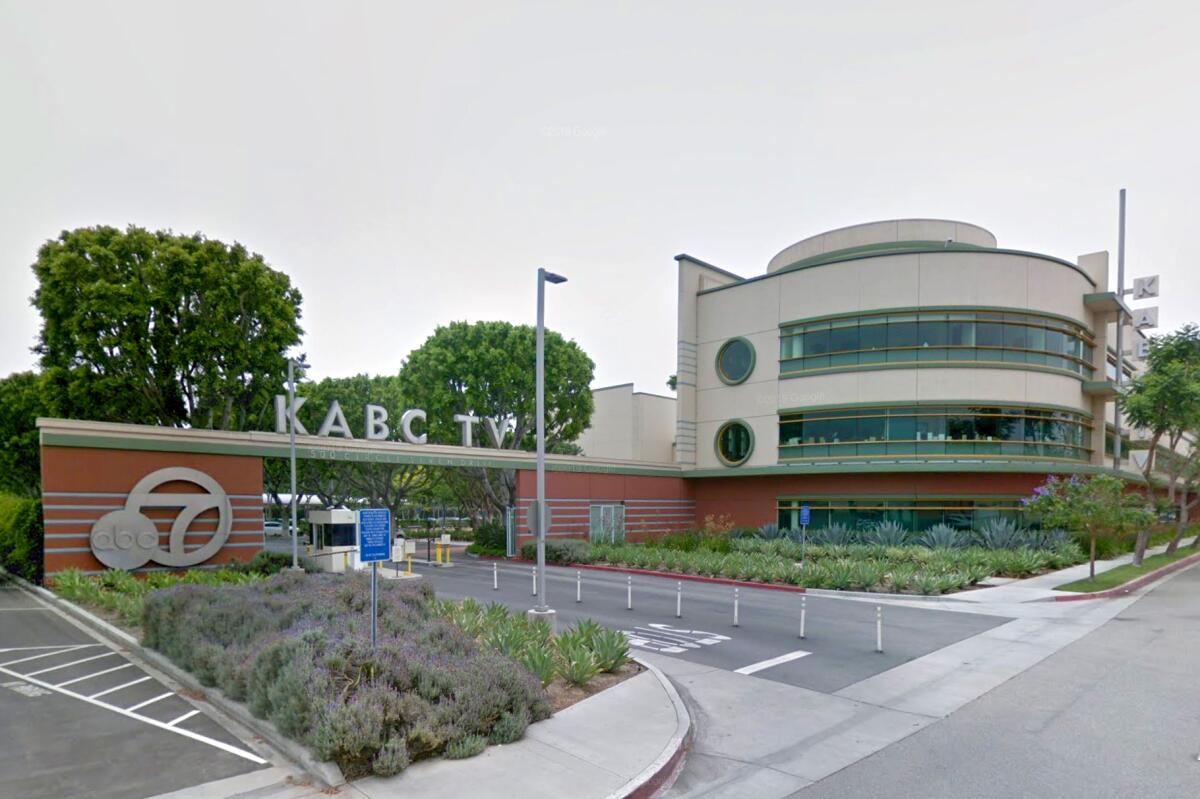
California congressional Democrats have strongly condemned Federal Communications Commission Chairman Brendan Carr’s decision to mandate early, unprecedented license renewals for eight Disney-owned ABC stations, including KABC-TV in Los Angeles.
(Google street view)
The FCC maintains that Disney is the one politicizing the station review.
“Contrary to Disney’s claim that the FCC called in their broadcast licenses for early renewal for no reason, the record shows something very different,” Carr said in a May statement. “Broadcast licensees have a unique obligation to operate in the public interest. The FCC will follow the facts and law wherever they may lead.”
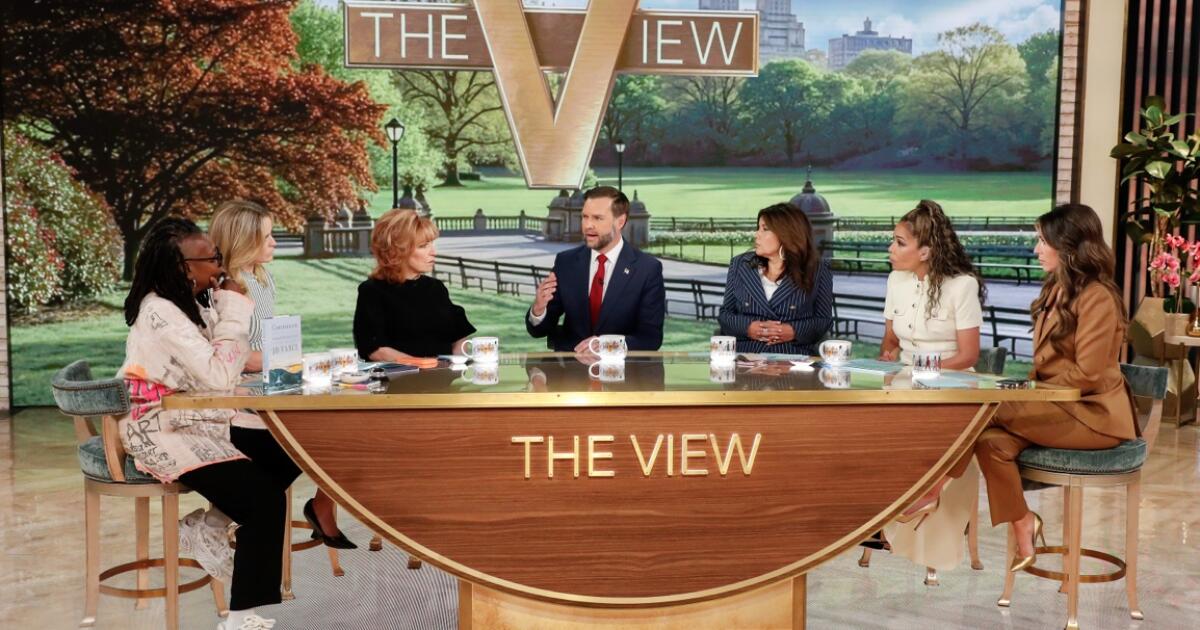
In the tussle over whether “The View” qualifies for an exemption to the so-called equal time rules for politicians, an FCC spokesperson said in a statement: “ABC should focus on complying with its public interest obligations, rather than misleading the public about them.”
The lawmakers, in the two letters, did not wade into the controversy over “The View.”
Instead, they stressed the importance of the two stations — KABC and KGO — to their local communities.
“KABC is an important local television station that millions of our constituents rely on for daily news, traffic, emergency weather alerts, and programming that serves our local community,” according to the letter spearheaded by Friedman, whose district includes Disney’s headquarters.
“Any refusal to renew this license would be strongly against the public interest,” the group wrote.
Congresswoman Laura Friedman is leading a letter campaign by Democrats in Congress to defend Disney’s KABC-TV.
(Myung J. Chun / Los Angeles Times)
A second letter highlighted the importance of Disney’s San Francisco station, which serves nine counties in that region.
“For over 75 years, KGO has been operating in the public interest in our region, offering reliable journalism, indispensable emergency information, and steadfast community engagement that our constituents and viewers rely on,” according to the letter headed by Mullin.
The station also serves as a broadcast partner to the San Francisco Chinese New Year Parade, the city’s Pride parade, the Oakland Black Joy parade and the Bay to Breakers race. It also raises awareness for organizations including Lighthouse for the Blind and Visually Impaired and Bay Area Autism Collective, the lawmakers said.
“KGO’s operations reflects the television station’s deep investment and commitment to viewers in the Bay Area,” the lawmakers wrote. “KGO is a community partner. … We urge the FCC to reconsider its unlawful censorship campaign against ABC and all other political opponents of President Trump.”
More Kraft Heinz products will be available in Walt Disney Co.’s U.S.-based theme parks and on cruise ships after the two companies recently inked a multiyear partnership.
Ten Kraft Heinz brands will be part of the deal, including Heinz, Philadelphia cream cheese and Kraft Mac & Cheese, the companies said in a statement Tuesday.
Both Disney and Heinz declined to comment on the financial terms of the deal, but a Heinz spokesperson said it is Disney’s “highest level of partnership” and designed to be an ongoing effort.
The partnership, which begins this summer, will result in new menu items, experiences and product offerings at Anaheim’s Disneyland Resort, Orlando’s Walt Disney World and on Disney cruise ships sailing out of ports in North America.
In the short term, new Heinz condiment stations and custom-designed equipment will be installed throughout the parks, the companies said.
Beyond the use of Kraft Heinz brands at Disney parks and on cruise ships, the partnership also allows for “integrated marketing campaigns” and digital content across Disney’s media platforms.
“Together we will build creative experiences for our consumers across our destinations, platforms, and fan touchpoints,” Becca Vodnoy, Walt Disney Co. senior vice president of corporate alliances, said in the statement.
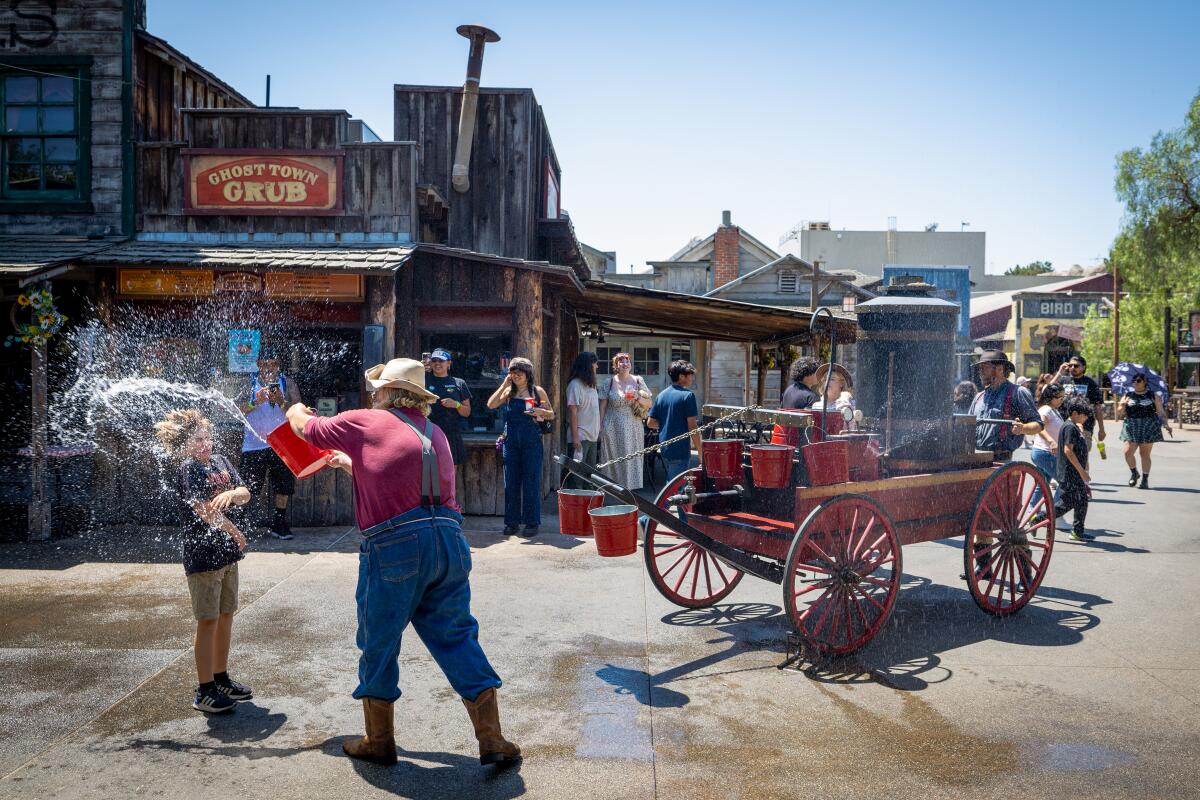
My theme park day begins with gunfire. A jailbreak! But shortly after, I‘m attending a wedding. Next I’m on a mission, helping the local postmaster justify his uncontrollable desire to open everyone’s packages, and trying to find a way to do so without telling a lie.
This is just another Sunday morning at Knott’s Berry Farm’s “Ghost Town Alive!,” a now-10-year-old interactive show — live-action role-playing game is more accurate — that has become the best summer offering at any theme park, and not just in SoCal but in America. There’s a daily story, including three editions of a single-page newsletter that are updated every day. There’s also lots of improv. Over the years, I’ve found myself on the prowl for mysterious elixirs, playing matchmaker, collaborating on group stories in a schoolhouse, doing police work, participating in a mustache contest or flashing a press badge.
“Ghost Town Alive!” ultimately is the promise of theme parks fulfilled, that is that we can enter a fantasy world and play as cartoonish, or maybe even idealized, versions of ourselves.
You’re reading Mr. Todd’s Wild Ride newsletter
Todd Martens’ newsletter delivers news and commentary on the past, present and future of theme parks, right from the theme park capital of the world — Southern California.
By continuing, you agree to our Terms of Service, which include arbitration and a class action waiver. You agree that we and our third-party vendors may collect and use your information, including through cookies, pixels and similar technologies, for the purposes set forth in our Privacy Policy such as personalizing your experience and ads.
It’s a rarity, an event with 46 actors — about 30 of whom appear each afternoon — who lead guests through scavenger hunts, puzzles or just conversations about life in Calico, the fictional town of Knott’s Berry Farm’s Ghost Town area. The cast ranges from those just out of college to those in their mid-70s, and no character is ever played by more than one actor. This gives Calico a sense of life, an illusion that it’s actually populated, but also allows actors to fully develop a personality and let their characters evolve.
Before creative director Andy Crocker was working on “Ghost Town Alive!,” she was visiting it as a fan. Crocker, an experiential designer who has worked on projects for companies as wide-ranging as the Los Angeles Public Library and Walt Disney Imagineering, specializes in particular on guest-to-actor interactions.
“Ghost Town Alive!” unfolds like a live-action role-playing game. But expect plenty of silliness.
(Allen J. Schaben / Los Angeles Times)
“I will never forget the first time I saw it as a guest,” Crocker tells me. “I came with my husband, and we did not bring our kid. We walked in, and I saw a little girl in a pink cowboy hat with a painted-on mustache following an outlaw off to jail. That outlaw was giving a gritty HBO performance. Wasn’t patronizing. Wasn’t talking down. He was giving her a hero moment, and I burst into tears. I didn’t know this was possible to do on this scale with such an institution. The empowerment that performer gave to that guest, I will never forget.”
To make a theme park feel personal is no easy feat. In fact, designers have long been trying to solve this problem, whether by creating interactive attractions that feel responsive to the guest, or short-lived experiments such as the late but great Star Wars: Galactic Starcruiser, colloquially known as the Star Wars hotel.
Crocker says others have asked for the “secret sauce” to “Ghost Town Alive!” They’ve tried — and are trying — but she’s not so sure the magic can be replicated. One, Knott’s is blessed with a real, 100-year-old Ghost Town. That allowed for the investment to be solely in the cast and performance rather than infrastructure. And yet actors, of course, aren’t cheap.
A single-page newspaper is printed three times a day during “Ghost Town Alive!”
(Todd Martens / Los Angeles Times)
“The amount of people that we have, that’s tough for a lot of places,” Crocker says. “They try to do it with less, and it doesn’t quite work.”
Speaking on a panel hosted by trade group the Themed Entertainment Assn., Jeff Tucker, Knott’s Berry Farm’s show writer, says one early mistake Knott’s made was thinking everyone who works in Ghost Town could partake. That meant, for instance, taping dialogue cues to cash registers in the saloon in the hopes that bartenders could become a character. The concept failed. “It’s a logistical nightmare,” he says. The lesson: Hire actors to perform. Let bartenders be bartenders and retail staff be retail staff.
Another reason Crocker tells me “Ghost Town Alive!” is so rare, and will remain so: It doesn’t rely on intellectual property, or a known franchise, which has become the lifeblood of modern theme parks. “With things that are heavy IP, it’s very tricky to control your IP and to allow for real play, guest agency, and, honestly, artist agency,” she says.
Evan Battle, center, who plays Deputy Chester Davenport, at Knott’s Berry Farm’s “Ghost Town Alive!” in 2024. The interactive theatrical experience allows guests to mingle with about 30 actors.
(Allen J. Schaben / Los Angeles Times)
That’s important, as “Ghost Town Alive!” can shift with the whims of the guest. There’s a core storyline this year. A rich, Beverly Hills-like family is revealed to be the true owners of Calico, and how the residents respond is the key narrative of the day. But there are multiple tales to uncover, including hidden factions (check out the Calico Historical Society) and who is taking who to the 4 p.m. hoedown, which ends each daily game of “Ghost Town Alive!”
But Crocker has also seen it get rather heartwarming.
“My mom came to see it,” she says. “She has some health concerns. There was a character who was in a crazy mix-’em-up and said he would not make it to the hoedown and that this would be his last day on Earth. This character and my mom ended up having this conversation about how if you know you don’t have a lot of time left, what would you do with your time? I was surprised by that pivot.”
It helps, Crocker says, that she’s noticed one commonality among the “Ghost Town Alive!” staff. They play — or were weaned on — tabletop role-playing games such as “Dungeons & Dragons,” which at their best allow for an anything-goes approach designed to follow the direction of the players rather than a strict script.
Tucker on the panel said there was one rule the crew lives by that defines the success of “Ghost Town Alive!”: “It’s not real,” he said. “We can do whatever we want.”
This week in SoCal theme parks
Not yet ready for prime time, Knott’s Berry Farm has delayed the opening of Montezooma: The Forbidden Fortress.
(Todd Martens / Los Angeles Times)
Montezooma is not yet zooming. Knott’s Berry Farm initially intended to launch its reimagined Montezooma’s Revenge, now known as Montezooma: The Forbidden Fortress, this week. Late Thursday, the park delayed its public unveiling, with a spokesperson citing additional fine-tuning that surfaced during its final days of testing. The delay is not expected to be a prolonged one. “We appreciate everyone’s understanding and look forward to welcoming media and guests in the coming days when we can showcase the attraction exactly as intended,” read a statement from the park.
A monthlong Lego celebration. Carlsbad’s Legoland likes to describe its Lego Festival, which started Monday and runs through Aug. 30, as a child’s first fest. Expect lots of characters and an assortment of play-focused areas. One is dedicated to music, another is a free-run creative zone and a third is a Lego garden designed to soothe. New this year is a game-heavy center dedicated to the Pokémon franchise, as well as a challenge-filled F1 installation.
It’s now more expensive to eat at Disneyland. Price hikes, unfortunately, are a yearly-occurrence at the Disneyland Resort, and this summer, like every summer, hundreds of food items have ever-so-slightly increased in cost. Most are in the range of a dollar or so — give or take a quarter or two — but expect to pay $7, up from $6.50, for a scoop of popcorn. I admittedly do not keep a database of Disneyland food prices, but sites like Mickey Visit or Theme Park IQ have tracked the most egregious price bumps. Looking at their data, you may want to think twice about dining at Disneyland’s Rancho del Zocalo Restaurante, where prices have been increasing even as portions over the years have been declining.
Where is Fast & Furious: Hollywood Drift? We’re now in midsummer, and Universal Studios Hollywood’s Fast & Furious: Hollywood Drift still does not have an official opening date. While sources familiar with the coaster’s operations point to routine mechanical issues that have arisen during its test and adjustment phase, one thing is certain: It’s not delayed due to noise complaints from neighbors, as rumors suggested last week. A Universal spokesperson pushed back on the notion that the coaster is delayed, stating it would still open this summer, which lasts into late September.
The best thing I ate at the parks
The hearty cottage pie from Downtown Disney’s Gordon Ramsay at the Carnaby.
(Todd Martens / Los Angeles Times)
I’ve been eagerly anticipating the opening of Gordon Ramsay at the Carnaby at the Disneyland Resort’s Downtown Disney, the latest concept in which the celebrity chef has agreed to lend his name. This one is an upscale gastropub, and while I’ll leave the full cuisine analysis to the professional food writers, as a parkgoer I do believe it fills a void in Disneyland’s shopping and entertainment district, bringing the area an adult-focused space with upscale (read: expensive) twists on old favorites like fish and chips ($33) and cottage pie ($38). And after reading breathless press release-like articles and posts from my theme park peers (“utter perfection,” proclaimed one) I couldn’t have been more excited to dine there this weekend.
Let’s start with the vibe, which I found to be rather confused. I was seated in the tiny, uncomfortable indoor bar, a place that felt like an afterthought and leaned airport terminal drinking hole, as it’s situated at the top of a stairwell and serves primarily as a thoroughfare into the dining hall. That a pub, especially one with an extensive cocktail menu (I did love my $22 cotton candy-infused Old Fashioned) would treat its introductory bar as a throwaway rather than a centerpiece of the experience was disappointing (an outdoor bar is significantly more enticing). The core dining space leans contemporary more than a traditional, wood-infused pub, feeling cafe-like with its ‘60s rock posters and framed portraits of those in mod outfits. More theme-ing would have been welcome, as I read it as slightly cold and corporate rather than homey and intimate. Instead of, say Pasadena’s Lucky Baldwins, this felt like a nice break room at a major record label.
But my dish was delightful. I had my heart set on the cottage pie, this one infused with a hearty portion of short rib. I probably should have taken leftovers, because it’s heavy, but in the best way possible. The potato-rich top felt creamy and buttery, while the meat was equally soft. The whole thing felt invitingly plush. I walked away mixed. No complaints on my entrée, and I’m eager to come back and try the fish and chips, and yes, that viral sticky toffee pudding dessert, but longing for a more welcoming atmosphere, especially at this price point.
Tell us your stories. Ask us your questions.
Have a theme park tale to share? Whether it was a good day or less-than-perfect day, I would love to hear about it. Have a question? A tip? A fun photo from the parks to share? Email me at todd.martens@latimes.com. I may feature your note in an upcoming newsletter.
Ride on,
Todd Martens
P.S.
Drowned Out Productions’ “The Shoebox Museum” explores love and loss.
(Drowned Out Productions. )
There’s a show running Saturday and Sunday in Los Angeles that I believe theme park fans should make time for. “The Shoebox Museum,” at North Hollywood’s After Hours theater, is a walk-through immersive experience at its most thoughtful. It’s short, at around 30 minutes, but it stayed with me for hours after it concluded.
“The Shoebox Museum,” from Drowned Out Productions’ Jackson Mancuso, who does theme park design by day, is a mediation on heartbreak, asking what we want to leave behind, and take with us, as we explore our grief. It’s meticulously designed, as we follow light cues through byzantine rooms filled with everyday ephemera — the type of stuff that only holds meaning to those who were in love. It’s a show about how an once broken heart, even mended, still finds ways to haunt us.
It took an ancient Greek epic to ignite a fire at the box office last weekend, as Christopher Nolan’s adaptation of “The Odyssey” became one of the biggest movie events of the year.
The film, led by Matt Damon as Odysseus, hauled in $123.5 million in the U.S. and Canada on its way to a global total of nearly $264 million — the biggest-ever global opening for one of Nolan’s films.
In many ways, “The Odyssey” is a throwback to old-school Hollywood filmmaking, with Nolan’s use of practical effects and numerous on-location shoots. It’s also a sign that audiences will still pack theaters for the right kind of movie.
The Universal Pictures film also outperformed studio expectations of a $117-million domestic premiere and set a record for the highest-grossing opening weekend for a live-action or R-rated film this year.
“Audiences always want to be thoroughly immersed in the theatrical experience and engulfed by the story and the production, and Christopher Nolan’s ‘The Odyssey’ is a perfect example of that,” Jim Orr, Universal’s president of domestic distribution, said Sunday. “When you have a very substantial opening, and you have those kinds of audience scores, it only points to what should be a remarkable run throughout the summer and into the fall.”
That’s good news for the summer box office, which lately has seen a bit of ebb and flow.
“The Odyssey” now ranks as the third-largest domestic opening of the year, trailing only kid-friendly films such as Walt Disney Co. and Pixar’s “Toy Story 5” and Universal, Illumination and Nintendo’s “The Super Mario Galaxy Movie.” Though family-friendly films have become power players for theaters, the two most recent flicks — Disney’s live-action “Moana” and Universal and Illumination’s “Minions & Monsters” saw softer openings.
After the big weekend for “The Odyssey,” the summer box office is up 7.3% compared with the lackluster 2025 season, according to entertainment data firm Rentrak. More encouraging, the year-to-date domestic box office is now 10.4% higher than for the same period last year.
That’s been helped not only by big blockbusters such as “The Odyssey,” which had a production budget of $200 million to $250 million, but also by the success of smaller-budget films such as A24’s “Backrooms” and Focus Features’ “Obsession.”
The common denominator is the draw of directors who have cultivated strong fan bases. “Obsession” director Curry Barker, 26, and 21-year-old Kane Parsons, who helmed “Backrooms,” have been building their reputation on YouTube among Gen Z audiences, and that loyalty is starting to count for something at the box office.
Nolan, of course, is one of the masters of building a faithful following over more than two decades. Fans started grabbing Imax 70 millimeter tickets for “The Odyssey” when they first went on sale a year ago, and the film ended up driving record presales for the Canadian entertainment tech company, which operates out of Playa Vista.
The film has notched a 95% on aggregator Rotten Tomatoes and an A CinemaScore rating.
“His films have tapped into the cultural zeitgeist,” said Shawn Robbins, director of movie analytics at Fandango and founder of the website Box Office Theory. “That’s what keeps bringing people back. They know they’re going to get a different experience; there’s always going to be a watercooler conversation around his movies, and they’re part of the cultural fabric.”
For “The Odyssey,” part of that conversation was Nolan’s old-school movie magic, including the puppetry, animatronics and robotics he used in scenes with the Cyclops, as well as the real Viking ship that the actors learned to sail.
The film also has driven interest in 70mm screenings from film buffs and casual moviegoers.
Ahead of the premiere of “The Odyssey,” Allen Michaan, owner of Oakland’s Grand Lake Theater, knew the weekend would be very busy for his four-screen movie palace. He is showing the film both in standard digital format and on 70mm film.
You’re reading the Wide Shot
Samantha Masunaga delivers the latest news, analysis and insights on everything from streaming wars to production — and what it all means for the future.
By continuing, you agree to our Terms of Service, which include arbitration and a class action waiver. You agree that we and our third-party vendors may collect and use your information, including through cookies, pixels and similar technologies, for the purposes set forth in our Privacy Policy such as personalizing your experience and ads.
Michaan has made 70mm showings a priority since 1982, when the projector was installed for the release of Steven Spielberg’s “E.T. the Extra-Terrestrial.” He said the theater played that movie for 45 weeks that year. Due to the demand at the time, he installed two more 70mm projectors, making three of his four screens capable of the old-fashioned format.
Demand for the 70mm showings of “The Odyssey” has significantly outperformed their digital screenings, he said.
“We’re thrilled to get any 70mm print because it’s a gift from the filmmaker and the studio,” Michaan said.
Enhanced format screenings for “The Odyssey” made up 53% of the domestic weekend box office, with Imax film and digital revenue accounting for nearly 24%.
Imax 70mm accounted for about 4% of that total, with Imax digital making up the rest. Non-Imax 70mm film screening revenue totaled 3%, while 35mm showings made up 0.3%.
The nearly three-hour epic also marked the first feature film shot entirely on Imax cameras, a feat that required extensive collaboration between Nolan and Imax.
Nolan first told Imax Corp. Chief Executive Rich Gelfond in early 2024 that he was considering making an entire film with Imax cameras and laid out what he’d need for that to happen, including a quieter and lighter camera, a way to make film reloads easier and getting enough trained projectionists.
“It took a fair amount of time and investment” to figure out those challenges, Gelfond said. But by August 2024, the Imax team put together a series of tests to show cinematographer Hoyte van Hoytema. Two months later, Nolan saw the tests and was impressed.
“As filmmakers and studios integrate Imax, we become an increasingly important part of the ecosystem,” Gelfond said. “When a film is released in Imax or shot in Imax, I think it’s a signal to audiences that it’s somewhat special, and the filmmaker is really leaning in in a unique way.”
Times staff writer Cerys Davies contributed to this report.
Stuff We Wrote
Film shoots
Number of the week
Streaming giant Netflix narrowed its 2026 revenue forecast to $51 billion to $51.4 billion from its previous, larger range of $50.7 billion to $51.7 billion in its last Thursday’s second-quarter earnings report, renewing concerns among investors and equity analysts about the Los Gatos-based company’s future growth.
On the Friday morning after the earnings call, Netflix stock slid 13% to $65.08 a share, marking a new 52-week low. Shares eventually closed that day at $68.95.
As my colleague Wendy Lee has reported, investors are growing nervous that in recent months, Netflix’s share of TV viewing time in the U.S. has been decreasing, while YouTube’s share has increased, according to Nielsen data. Investors are concerned that if consumers are watching Netflix less, they’ll cancel their subscriptions, and that will put pressure on the company’s ability to raise prices in the U.S.
Netflix has said its engagement rates are healthy.
What I’m watching
I love a good teen mystery show, especially when it has a bit of a “Veronica Mars” vibe, so I binged Paramount+’s “School Spirits” last weekend.
Where Veronica Mars was solving realistic crimes around her local beach city, “School Spirits” tries to dig into why so many teens have died at (and haunt) a Wisconsin high school. At times, they’re hitting at a lot of different themes and storylines, but I loved the colorful ensemble of ghost characters from different decades, and Jennifer Tilly makes for an incredible villain.
LONDON is getting its very first ‘amazement’ park – and it’s set to be Europe’s largest immersive art experience.
Visitors to its other UK venue have dubbed it ‘dystopian Disney‘.
A new Wake The Tiger experience is coming to LondonCredit: Wake The TigerIn London there will be two floors of instillations and immersive art experiencesCredit: Wake The Tiger
The new indoor attraction will spread over two floors across 80,000sqft.
Sign up for the Travel newsletter
Thank you!
The experience is called Absurd City and will transport visitors to different districts which will be a “surreal, parallel world of imagination, transformation, and otherworldly art”.
Through the experience, visitors will discover secret passageways and see the new installations all in a makeshift cityscape.
In a previous statement, Luke Mitchell, Co-Founder and Chief Creative Officer at Wake The Tiger, said: “This is a culmination of over 20 years of creative world-building, from the ground-breaking Boomtown Fair Festival to a new genre of immersive visitor attractions in Amazement Parks®.
“The space in Westfield London has totally blown our mind. It’s as if it was created for us and we can’t wait to transform it into an alternate dimension.”
Tickets have been released today and can be bought from £27.
On its website, the experience has also teased that ‘After Hours’ adult-only sessions will be held which will be on Thursday and Friday evenings.
It’s not the only one in the UK – the very first Wake The Tiger opened in 2022.
It calls itself the world’s first ‘amazement park’ and previous guests have raved about the attraction, with some comparing it to Disney.
There is another Wake The Tiger in Bristol which opened in 2022Credit: Andre Pattenden
One person who said he used to work at Disney said: “The Imagineers who create the rides would be in awe of this also.”
Another said: “Felt like a dystopian Disney land.”
In the Bristol venue, visitors can explore the world of Meridia which has 27 unique art installations including strobe lighting, hidden portals and doorways, and rooms with moving parts.
Tickets at the Bristol venue start from £16.50 for adults and £13.50 for children.
AS A kid, we all dream of going to Disney World, but what if I told you, you could actually live there?
Well, you can in Disney-themed houses littered with subtle details from hidden Mickeys to Beauty and the Beast character door knobs.
Mum and content creator Cristie Anne has a home in Disney WorldCredit: Cristie Anne / @thetravelingred
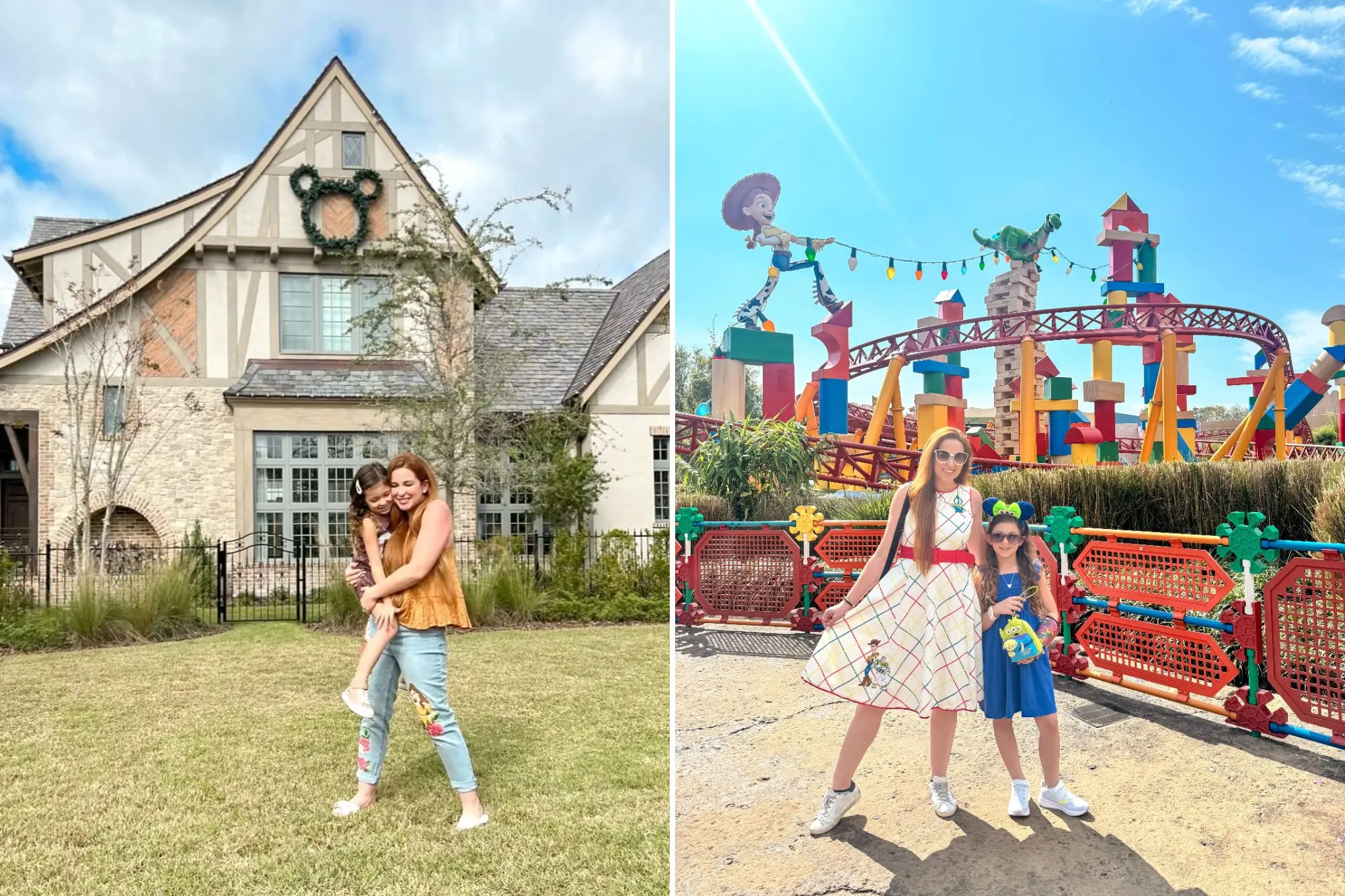
Mum and content creator, Cristie Anne, and her family bought a house in Golden Oak at Disney World Florida back in 2020 – the exclusive community that is directly on Disney property.
In fact, it is so exclusive that only residents are allowed into the community where there are 300 homes, as well as a clubhouse, a pool, a coffee bar and a fitness suite.
“We always have neighbourhood events and we have met some of the nicest people there.”
Cristie Anne added: “At the time, Charlie [her daughter] was just two-years-old, so the idea of having a place where our family could spend time together while being so close to Disney felt absolutely perfect.”
And with Mickey Mouse himself as your neighbour, there are obviously some big perks including being just minutes away from both the Epcot and Magic Kingdom parks.
Instead of battling for a car parking space, residents simply make a call to be picked up and then they’ll be dropped directly at the park.
The parks are just a few minutes from the houseCredit: Cristie Anne / @thetravelingredThe house is part of an exclusive community called Golden OakCredit: Cristie Anne / @thetravelingred
Cristie Anne said: “A Golden Oak van will take us directly to the parks and drop us right at the front entrance. They’ll actually take us anywhere on Disney property.
“Being able to decide at breakfast that you want to spend the afternoon in a Disney park and be there just minutes later is something I never take for granted.”
In addition to a concierge team and a full calendar of events, the community also gets front row seats to the theme park’s daily fireworks, without even leaving their homes.
“Our third-floor reading room has the most perfect view of the Magic Kingdom fireworks.
“We can hear them a little from inside, but from up there the view is incredible,” she said.
Every house in the community is unique, with Cristie Anne’s home being inspired by Belle’s cottage from Beauty and the Beast on the outside.
On the inside, you can expect a Winnie the Pooh room as well as a bedroom with Bambi-inspired bunk beds, complete with a Mickey seared into the wood.
There’s even a ‘Haunted Mansion’ in one of their walk-in cupboards.
She added: “Some of the themed rooms inside our neighbours’ homes are absolutely incredible and would completely blow you away.”
When asked about the mistakes tourists make when visiting Disney World, Cristie Anne simply replied: “Trying to do too much.”
A lot of the homes have subtle theming inside including hidden MickeysCredit: Cristie Anne / @thetravelingredThe exterior of Cristie Anne’s home is themed around Belle’s cottage from Beauty and the BeastCredit: Cristie Anne / @thetravelingred
She added: “People spend months planning and then arrive with a schedule so packed that they’re stressed before they even walk through the gates.”
Instead of checking rides off a list, Cristie Anne recommends slowing down, watching the parade, exploring a resort and hunting for a great meal.
Or she simply lets her daughter lead the day, instead.
“You’ll enjoy Disney much more if you leave room for spontaneity, and if you’re well rested,” she added.
And of all the spots to enjoy, Cristie Anne of course has some hidden gems up her sleeve, confessing that many people don’t leave the parks but should.
She revealed: “Disney’s resorts are attractions in their own right. The lobbies, restaurants, seasonal decorations, and activities create an entirely different side of Disney that most tourists never experience.
“If I had to pick one specific experience, I’d recommend visiting Animal Kingdom in the evening.
“Many guests leave early, but Pandora at night is one of the most beautiful places anywhere on Disney property and feels completely different after dark.
“It’s more romantic and there’s great restaurants. If we just want something quick and simple, we love Nomad Lounge. If we want a full meal, Tiffin’s is fantastic. Animal Kingdom in the evening could be a great date night without all the chaos.”
She also revealed her hidden gems in Disney WorldCredit: Cristie Anne / @thetravelingredThe mum said make sure to visit the resorts, including Animal KingdomCredit: Cristie Anne / @thetravelingred
By the end of this summer, Charlie will have visited 21 countries (a number Cristie Anne admits would be even higher if it wasn’t for the Covid-19 pandemic).
And for those wanting to travel with their kids more, the mum recommends “just doing it”.
She said: “The first few trips may feel overwhelming, but every trip gets easier.
“At nine-years-old, Charlie’s incredibly comfortable navigating airports, long flights, different cultures, and unfamiliar places. She gets excited about trying new foods, meeting new people, and exploring new destinations.
“I truly believe that’s because she grew up doing it. Travel isn’t something intimidating or stressful to her… It’s something she loves.”
She added that travelling with a child allows you to slow down, stay in a place for longer and really experience it – rather than parenthood stopping you from travelling, it just changes the way you travel.
Cristie Anne revealed: “We leave room for pool days, playground stops, long dinners, and spontaneous adventures. Ironically, slowing down has allowed us to enjoy our travels so much more.
“The temporary challenges of traveling with a toddler are far outweighed by the memories you create and the confidence, adaptability, and curiosity that travel helps build in them.”
TV station ownership groups may finally get their wish to own more outlets.
Federal Communications Commission Chairman Brendan Carr announced Wednesday that the agency will vote next month to end the rule that allows companies to own no more than two TV stations in a single market. The cap also limits the national coverage of any station owner to 39% limit of the U.S.
Carr said the agency will consider a “case by case” review on station merger and acquisition deals that would result in exceeding the current limits. The commission, which has two Republicans and one Democrat, will vote on Aug. 6.
“Previously, the cap operated as a blanket prohibition on any and all deals that would combine stations in [excess] of the 39% limit — regardless of whether it was a good deal or bad deal for the country,” Carr wrote on the right-wing website Breitbart. “Our new proposal would allow the FCC to approve deals that exceed the 39% cap, but only if doing so would promote the public interest.”
TV station owners and its lobbying group the National Assn. of Broadcasters have been clamoring for a change in the rule, citing the changes in technology that have occurred since the ownership limit. The 39% threshold was set in 2004 when streaming video was still a nascent business.
The station groups say the ability of tech companies such as Google and Netflix to reach every consumer in the U.S. puts them at a disadvantage. At the same time, streaming now accounts for more than 40% of all viewing, according to Nielsen, pulling consumers away from traditional TV. TV stations are also seeing their share of carriage fees from cable and satellite companies shrink due to cord-cutting.
But proposed changes to the cap limits have been met with push back from consumer groups and state government officials. They have said station consolidation will result in journalist layoffs and fewer voices for the communities they serve.
Earlier this year, a group of attorneys general filed suit to block Nexstar Media Group’s proposed $6.2-billion acquisition of Tegna, arguing it violates a 112-year-old U.S. antitrust law by knocking out a major competitor. The deal would give Irving, Texas-based Nexstar control of 265 television stations across the country, up from 164. And, in dozens of markets, including San Diego and Sacramento, Nexstar would own multiple TV network affiliates.
U.S. District Court Chief Judge Troy L. Nunley issued a preliminary injunction in April that forbids Nexstar — which owns KTLA-TV Channel 5 in Los Angeles — and Tegna, from combining operations. Nexstar is appealing.
Carr’s proposal would largely put the FCC in charge of picking winners and losers on a case-by-case basis.
When faced with a merger proposal, Carr said the commission would consider such issues as commitment to local journalism and “viewpoint diversity.”
Carr also questioned whether ABC’s daytime show “The View,” where negative Trump commentary is rampant, should qualify as a bona fide news program that is exempt from giving equal time to qualified candidates.
Carr’s Breitbart column also reiterated his view that large media companies such as Disney and NBCUniversal parent Comcast hold too much sway over their affiliates.
“New York and Hollywood interests have steamrolled those local TV stations and the broader media market in recent years in ways that run directly counter to the regulatory framework that Congress and the FCC put in place,” he wrote. “Their national programs naturally reflect the values of the New York and Hollywood executives that produce them. This power imbalance has contributed to a steady decline in locally produced news — and with it, a weakening of the public’s trust in the media.”
How owning more stations would give groups leverage in their dealings with networks is unclear. The networks control the rights to the NFL — the No. 1 TV ratings attraction for broadcast television by a mile. Stations pay the networks compensation for those games, which they use when negotiating the carriage fees they receive from cable and satellite companies.
Times staff writer Meg James contributed to this report.
Todd Martens’ newsletter delivers news and commentary on the past, present and future of theme parks, right from the theme park capital of the world — Southern California.
By continuing, you agree to our Terms of Service, which include arbitration and a class action waiver. You agree that we and our third-party vendors may collect and use your information, including through cookies, pixels and similar technologies, for the purposes set forth in our Privacy Policy such as personalizing your experience and ads.
So when I had the opportunity to talk to Chris Mortensen, one of the Disneyland Resort’s longest-tenured vacation planners, I wanted to know his.
Mortensen recently celebrated his 40th year with the company, and has spent more than 20 of them in his current role as director of West Coast Travel Operations. That means a significant part of his job is talking on the phone with those who want advice on how to plan their Disneyland days.
He comes from a Disney family. His wife has spent about 30 years with the resort, and one of their children is also a cast member. If anyone should know how to plan a special day at Disneyland, it’s Mortensen.
One of his key pieces of advice: Decide what’s most important to you as a guest. “Is it a thrill ride? Is it entertainment? Is it food?” Mortensen asks. “One of the things that I like to tell people is that you’re going to have a really busy day, but take time for yourself.”
Here are some of Mortensen’s other favorite park tips. We steered the conversation to Southern California locals, and those who may want a little glimpse of what makes Disneyland so special.
Get around the park by train
Here’s one hint, off the bat, that Mortensen says he gives most everyone: “Use the Disneyland Railroad as a form of transportation. Yes, it’s a great little attraction. Seeing the dinosaurs is one of my favorites. But it’s also a great way to get from one place to another. If you’re on Main Street and don’t want to walk all the way back to see ‘Bluey,’ jump on the railway. It’s a great way to get a little rest, and experience the park.”
Decompress at Disneyland’s most tranquil spot
Disneyland’s Snow White Grotto is a tranquil spot overlooked by many guests.
(Todd Martens / Los Angeles Times)
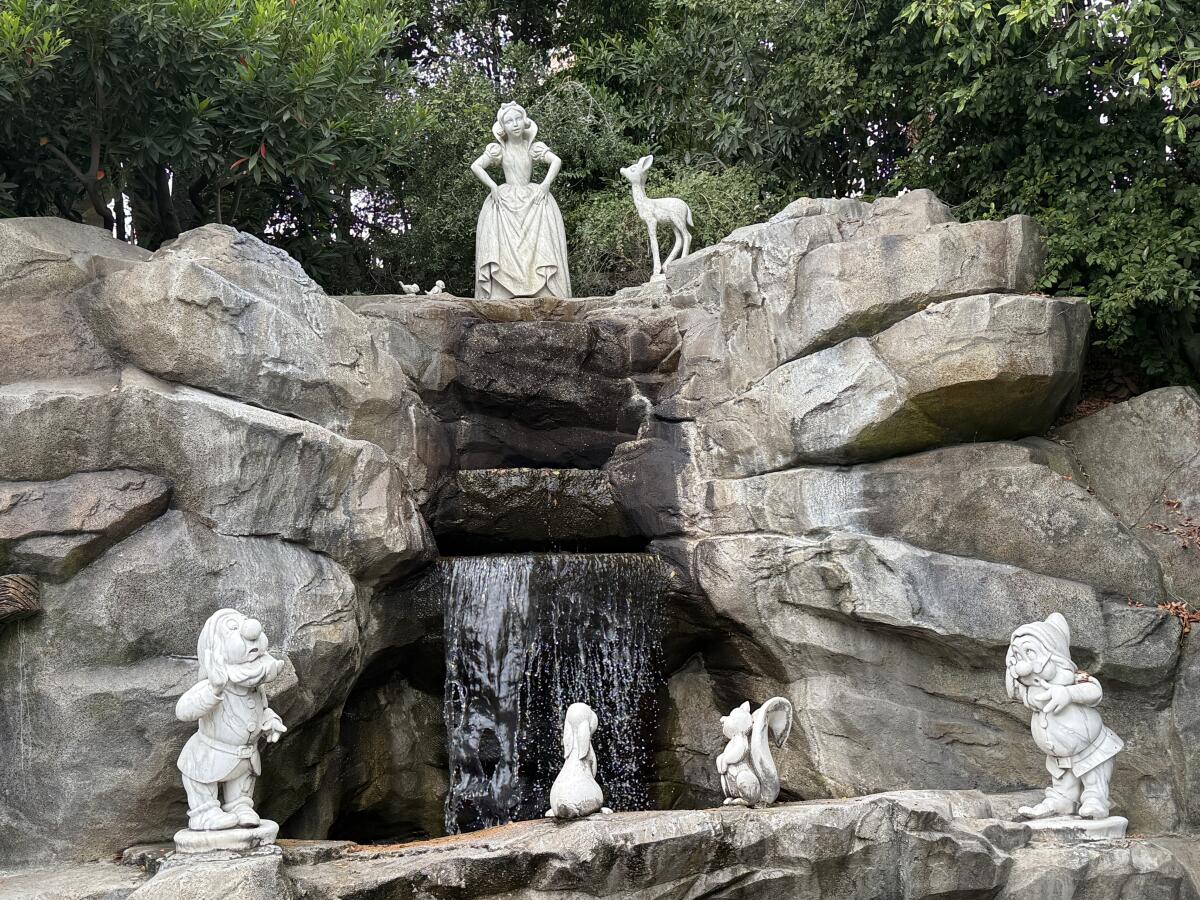
Mortensen notes that it’s impossible to see all Disneyland has to offer in a single day, but rather than stressing about rushing from attraction to attraction, prioritize those that are important to you, and then take a breather at some overlooked park elements, especially those that add to its beauty and tranquility. I couldn’t agree more, and was pleased when Mortensen singled out one of my favorite places in the park: the Snow White Grotto, which is on a path on the eastern side of Sleeping Beauty Castle.
Sculpted by Leonida Parma from Carrara marble, the initial figures have, according to Disney’s fan club D23, been since replaced by fiberglass ones built from the original molds. The eight figures are still a sight, and Disney legendary designer John Hench constructed the fountain that holds them in 1960. The character figures, in the midst of a collection of jutting rocks and log bridges surrounding a peaceful waterfall, are all the same height, so Hench used forced perspective illusions to make it seem like Snow White was towering over the dwarf sculpts.
“The Snow White wishing well — you won’t find that anywhere [else],” Mortensen says. “Bring a quarter and toss it in, experience that.”
Take time for the Sleeping Beauty Castle Walkthrough, a lesser-known attraction
Don’t sleep on the Sleeping Beauty Castle Walkthrough at Disneyland.
(Todd Martens / Los Angeles Times)
“People don’t know about it,” Mortensen says of the self-guided mini-tour that tells the tale of Princess Aurora.
Indeed, I had the Sleeping Beauty Castle Walkthrough to myself one late Sunday morning. The attraction, best experienced with patience in mind, is largely inspired by the artwork of Eyvind Earle. Earle’s approach, after all, is designed to transport us, to place us in lush, fairy-tale-like environments that contain an ever-so-slightly foreboding atmosphere.
Think of this as a mini-art gallery where illuminated dioramas spring to life and transform before us. The walk-through was updated with new effects and artwork in 2008 but dates to 1957.
It’s Disneyland. Order the iconic turkey leg.
Mortensen and I clearly have different palates. If I’m recommending a must-try Disney snack, it’s not the churro. It’s the corn dog. Mortensen, however, is voting for the turkey leg. A brave choice, I believe, as it’s a hefty item and, well, a lot of tough meat. Mortensen, however, made his case.
“It’s unique,” he says. “Yes, you can get a churro, but where else can you walk around and just literally bite out of a turkey leg? It’s about trying to create memories. Every time we have conversations with someone, it’s about, ‘What’s going to make a memory for you?’ You’re always going to remember walking around Disneyland as a 5- or 6-year-old little boy or girl with a turkey leg.”
Turn It’s a Small World into a scavenger hunt
Cinderella is one of the many Disney characters that was added to It’s a Small World in the late 2000s.
(Todd Martens / Los Angeles Times)
Mortensen had my attention when he declared It’s a Small World a must-do attraction at the park. After all, the Mary Blair-styled boat excursion is my favorite Disneyland ride.
Mortensen highlights a once controversial but now beloved late 2000s renovation that added more than two dozen Disney and Pixar characters to the attraction. When riding It’s a Small World, he says, try to spot as many as possible. Disneyland even recently placed Miguel from “Coco” in the ride. Focusing on the scavenger hunt, says Mortensen, helps turn a familiar attraction into one that feels fresh.
“There’s more to it than just riding the attraction,” he says.
Spot details in the windows of Main Street
Enjoying a horse-drawn trip around Main Street, U.S.A., is a relaxing start to a Disneyland day.
(Todd Martens / Los Angeles Times)
Disneyland’s introductory land is a joy. Often, I start my day with a ride on one of Disneyland’s horse-drawn carriages, which venture from the foot of Main Street, U.S.A., to the Sleeping Beauty Castle and back. It’s a relaxing way to settle into the theme park and take a look at the exquisite designs of the Main Street buildings, which many guests rush past on their way to one of the park’s many rides.
Mortensen wanted to call specific attention to Main Street’s windows, which celebrate those who were integral to the development of the park. Many are nods to famed Disneyland designers. Most recently, the park awarded a window to the just-retired Kim Irvine and her mother, Leota Toombs. Irvine and Toombs were longtime creatives with Walt Disney Imagineering vital to the development of the park.
“I love to point out the windows on Main Street,” Mortensen says. “If you and I were walking in, that’s what I would do. I’d grab a box of popcorn, and just point out two or three of the names. Some people you may recognize. Some people you may not.”
And I certainly won’t argue with popcorn for breakfast.
This week in SoCal theme parks
Disney legend Don Iwerks died last week at 96.
(Lori Shepler / Los Angeles Times)
A legend was lost. Don Iwerks, whose inventiveness helped transform Disney’s theme parks, died July 9 at the age of 96, reported the Walt Disney Co. For Disney and his own studio, Iwerks Entertainment, Iwerks helped develop technologies and techniques like Circle-Vision, the 360-degree camera behind “America the Beautiful” and other early Disney attractions, and the 3D effects used in attractions like Captain EO and Star Tours. He also had major contributions to the world of cinema, instrumental, particularly, in the effects sequences of “Mary Poppins.” Read more about Iwerks in The Times’ obituary by Corinne Purtill.
Fiesta Village is no more. The Inland Empire amusement park, which stood for more than 50 years, closed for good last weekend. A center for mini golf, roller skating and go-karting, Fiesta Village announced the closure last week, citing rising operation costs and declining attendance.
Montezooma’s Revenge is back. The reimagined coaster, now known as Montezooma: The Forbidden Fortress, is set to return to Knott’s Berry Farm on Monday. Shuttered for the last four years, the ride has essentially been rebuilt, now featuring enhanced Aztec theming, new trains and a modern launch system. Look for a report on the remade coaster next week.
It’s almost Halloween season. Disneyland in mid-August will launch its Oogie Boogie Bash, Universal will follow in early September with Halloween Horror Nights and Knott’s Berry Farm isn’t far behind with its Knott’s Scary Farm. The latter is the longest-running Halloween event in the Southland, and defined the maze-focused haunt formula. Tickets are now on sale for all three happenings.
Happy 71st anniversary, Disneyland! On Friday, Disneyland will turn 71. While the occasion won’t be as grand as the 70th anniversary, which has been celebrated for the past year and will essentially continue up until the start of the park’s Halloween activities, the Anaheim theme park typically recognizes the birthday with some light festivities for guests. Think, perhaps, a character cavalcade or some specialty treats.
Tell us your stories. Ask us your questions.
Have a theme park tale to share? Whether it was a good day or less-than-perfect day, I would love to hear about it. Have a question? A tip? A fun photo from the parks to share? Email me at todd.martens@latimes.com. I may feature your note in an upcoming newsletter.
Ride on,
Todd Martens
P.S.
The initial news for those who purchased Disneyland’s specially priced $59 nighttime ticket is good. While now sold-out, Disneyland launched the promotional evenings this past Sunday, and the park didn’t appear flooded with twilight guests. Attendance was continuing a summer trend of being relatively light, and though wait times increased in the evening, nothing was headache-inducing.
At times, even showcase attraction Star Wars: Rise of the Resistance stood at about 40 minutes, with Space Mountain often showing a similar wait time. Most rides, however, were even more approachable, topping off at around 25 minutes throughout the night. Since the evening ticket only gives guests a taste of Disneyland — five hours worth — it’s a positive sign that the event’s opening night kept things manageable, providing those who bought in at a budget price a prime experience.
Don Iwerks, an Academy Award-winning special effects pioneer whose innovations transformed film and Disney theme parks, died peacefully Thursday at the age of 96, the Walt Disney Co. announced.
For Disney and his own studio, Iwerks Entertainment, Iwerks helped develop technologies and techniques like Circle-Vision, the 360-degree camera behind “America the Beautiful” and other early Disney attractions, and the 3-D effects used in attractions like Captain EO and the Star Tours ride.
“There was a ‘can-do’ attitude I learned from Walt and my father,” Iwerks said, according to a statement shared by the Disney Co. “Walt gave everyone a feeling that they were creating things that others had never thought of before, of being a part of history.”
Born July 24, 1929, Iwerks received his first camera at age 14 as a gift from his father, animator Ub Iwerks.
The elder Iwerks met fellow artist Walt Disney when both men were teenagers working at a Kansas City, Mo., art studio. They would go on to work together at the Disney Brothers Cartoon Studio, where Iwerks designed and animated “Plane Crazy,” the first Mickey Mouse cartoon.
After a stint at his own animation studio, Ub returned to Disney as a special effects engineer, pioneering techniques like the 360-degree motion-picture camera.
“He was absolutely my inspiration because he was technically minded. He made my childhood and formative years one of the greatest times of my life,” Don Iwerks told The Times in 1998.
The Iwerks family moved to the San Fernando Valley in 1936, where Don graduated from Van Nuys High School in 1947.
He served as a photographer in Germany during the Korean War and joined his father at Disney following his 1952 discharge from the U.S. Army. An allergic reaction to chemicals used to develop film led to his transfer to the company’s Studio Machine Shop, where he spent the next 34 years.
Don spent three months in the Bahamas manning underwater cameras for the 1954 Disney film “20,000 Leagues Under the Sea.” He then worked as the camera technician on “A Tour of the West,” an original Tomorrowland attraction at the soon-to-be opened Disneyland. The immersive 360-degree film was shot on the Circarama camera system his father invented.
Together, Don and Ub developed technologies like the “endless loop” system that enabled a single film print to run for up to 10,000 performances with minimal intervention and refinements to the photography processes used in “Mary Poppins” (his favorite of the Disney films) and other movies.
His own hands were used as the model for those of the Abraham Lincoln Audio-Animatronics figure in “Great Moments with Mr. Lincoln,” which opened at Disneyland in 1965. The “Iwerks Hands” now appear on similar figures at Disney parks around the world, according to his family.
In 1986, he co-founded Iwerks Entertainment, which soon became a major player in the film and theme park industries. The company specialized in large-format films and created the 3-D projection system used in the Terminator rides at Universal Studios parks in Hollywood and Florida.
His innovations were honored with the Academy of Motion Picture Arts and Sciences’ honorary Gordon E. Sawyer Award and an Academy Scientific and Technical Award, among other prizes.
“It’s very obvious that computers are playing a big role in motion pictures today. The digital technology in film is able to put elements of scenes together on a film and have them look lifelike. It’s hard to know where that will go,” Iwerks said in a 1998 interview.
“My view is that technology should support a good story and add to it. Technology for technology’s sake?” he said with a shrug. “You still need good films.”
Iwerks is survived by his wife of 54 years, Betty; his sons, Larry and John; John’s wife, Chris; his daughter Leslie, and great-nephew,Mike, both of whom have also worked for Disney, according to an obituary shared by his family. His daughter Tamara preceded him in death.
“Like his father, he was a humble genius, a consummate problem solver, and delighted in sharing knowledge, encouraging others, and approaching every challenge with confidence and grace,” his family said in the statement from Conejo Mountain Funeral Home in Ventura.
Both Don and Ub Iwerks are commemorated in a storefront window on Main Street U.S.A. in Disney World’s Magic Kingdom. Located above the Main Street Bakery, the window is a lasting tribute to a family who made some of the park’s magic possible.
“Iwerks-Iwerks Stereoscopic Cameras,” the lettering reads. “No Two Exactly Alike.”
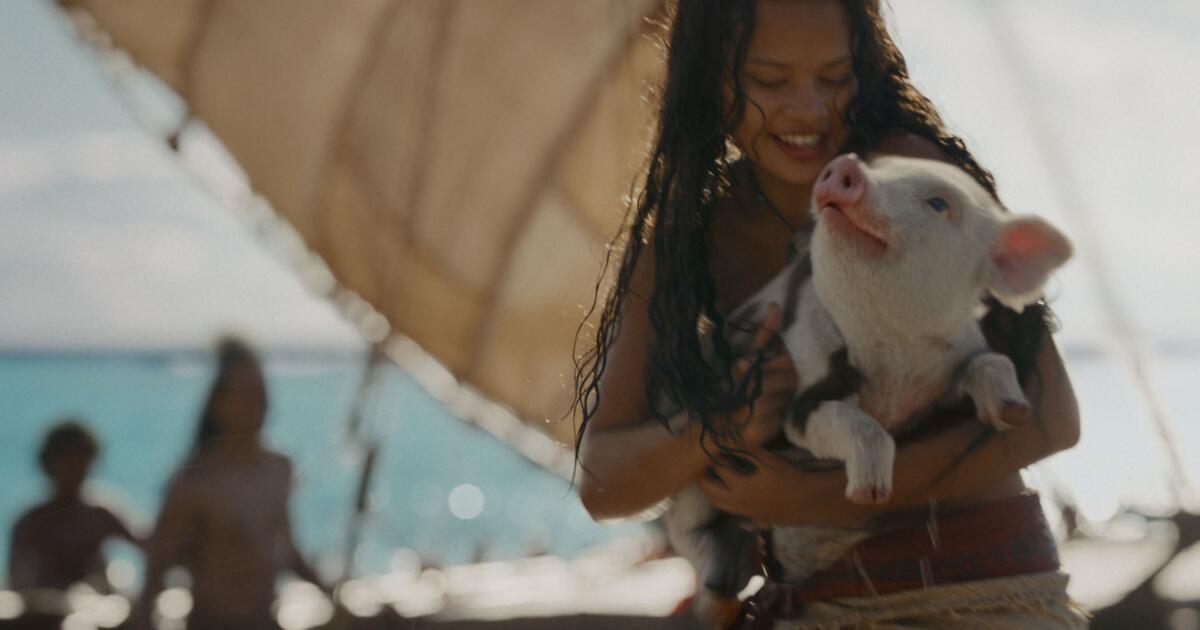
Walt Disney Co.’s “Moana” lost its way at the box office this weekend as the company’s latest live-action remake opened to a sluggish $43 million in the U.S. and Canada.
The domestic haul for “Moana” underperformed studio expectations, which ranged from $60 million to $65 million. Globally, the film brought in a total of $95 million on a production budget of about $250 million.
Despite its lackluster debut, the film still came in first at the box office during a weekend where it had few new competitors in the family film space.
The “Moana” franchise has been a box-office and streaming juggernaut. The original 2016 animated movie brought in more than $643 million worldwide and is the most-watched movie on Disney+, while a 2024 sequel grossed more than $1 billion at the global box office. On the merchandise side, more than 22 million “Moana”-themed toys have been sold. “Moana” also appears in the Disney theme parks.
But the theatrical reception for the live-action film may signal that audiences think there’s been too much “Moana” in just 10 years. (The 2024 film sequel was originally set to be a streaming series before it was moved to Disney’s theatrical calendar.)
Most of Disney’s previous live-action remakes have come decades after the original animated movie, such as 2025’s “Lilo & Stitch,” which arrived 23 years after its animated predecessor and grossed more than $1 billion in worldwide box office receipts.
The theatrical haul for the latest “Moana” may also have suffered from poor reviews — the film got a 34% on aggregator Rotten Tomatoes, with several critics highlighting its nearly frame-by-frame similarity to the original film. The audience score on Rotten Tomatoes, however, was 90%.
Still, as the last of this summer’s major animated films, “Moana” could see a longer tail in theaters, particularly with many children still on break from school. Disney’s live-action “Mufasa: The Lion King” opened in 2024 to a middling $35 million, but ended up grossing more than $722 million globally through the holiday season.
Universal Pictures and Illumination’s “Minions & Monsters” came in second at the domestic box office this weekend with $20.5 million. Disney and Pixar’s “Toy Story 5” continued its strong run with an $18.5-million haul, enough for third place and contributing to a total global gross of $879.1 million.
Warner Bros.’ “Evil Dead Burn” ($13.7 million) and Angel Studios’ “Young Washington” ($6.4 million) rounded out the top five.
Also notable this weekend: Lionsgate’s musical biopic “Michael” crossed $1 billion in worldwide box office revenue, the first time that the studio has reached that milestone and the second film this year after “The Super Mario Galaxy Movie” to hit that mark.
Walt Disney Co.’s ABC network has stepped up its defense of “The View” amid its battle with Federal Communications Commission Chairman Brendan Carr, who has targeted the network’s programming and its hiring policies.
At issue is whether “The View” still qualifies for an exception to FCC rules that require broadcasters to provide equal air time for opponents of various political candidates.
Carr has called the daytime talk show “overtly political.”
Late Monday, ABC filed documents with the FCC to support its request for a declaratory ruling that “The View” is indeed a bona fide news interview program entitled to the equal-time rule exemption that covers newscasts, political debates and documentaries.
The show was granted the exception in 2002.
“Today, the program in the Commission’s sights is The View,” ABC said in this week’s filing. “The principle in the balance is far larger: whether a federal regulator may override a broadcaster’s editorial judgment about whom to interview — a judgment the Constitution commits to broadcasters and their audiences, not to the state.”
Since the FCC opened its inquiry in late May, the agency has received more than 77,000 public comments — most in support of the long-running daytime talk show.
“While ABC insists that ‘The View’ is a ‘bona fide news program’ under the law, ABC should focus on complying with its public interest obligations, rather than misleading the public about them,” an FCC spokesperson said in a statement sent to The Times.
Losing the licenses for its stations, including KABC-TV Channel 7 in Los Angeles, would be a significant blow to the Disney-owned network.
Some conservatives, including Sen. Ted Cruz (R-Texas) have suggested the FCC actions are an overreach while others have encouraged the agency to come down hard on Disney.
“The Commission can take this opportunity to address multiple pending complaints against ABC related to its programming,” conservative lawyer Daniel Suhr, head of the Center for American Rights, wrote in his 65-page petition in support of revoking Disney’s licenses.
“The View,” which features Trump critics Whoopi Goldberg, Sunny Hostin, Joy Behar and Ana Navarro, helps make a case that Disney is running a partisan network, Suhr alleged in his documents.
“Democrats are featured on The View at an insanely high ratio compared to Republicans,” Suhr wrote, noting that at least a third of the show’s 348 guests in 2025 were liberals — including Sens. Bernie Sanders (I-Vt), Elizabeth Warren (D-Mass) and Cory Booker (D-N.J.). Meanwhile, two prominent conservatives, former Georgia Republican Rep. Marjorie Taylor Greene and actor Cheryl Hines, the wife of Health and Human Services Secretary Robert F. Kennedy, Jr., were featured last year.
Since Carr opened the review, the ABC show has avoided conversations with political candidates in competitive races leading up to this year’s pivotal midterm elections.
The show has continued its tradition of hosting politicians, though, including a highly rated interview last month with a Carr ally — Vice President JD Vance.
ABC has asked the FCC for a declaratory ruling on the status of “The View.” The network maintains that “The View” books politicians based on newsworthiness and not partisanship.
“Big fan of the show. Hope my vote counts,” wrote one viewer, Wilson Vélez, in a comment filed with the FCC on Monday.
Another viewer, Patricia Pomeroy, wrote: “Freedom of speech, Freedom of speech, Freedom of speech.”
ABC’s filing noted that the program has kept the same format and focus on topical news events since its inception.
“What has changed is not the program but the political climate around it,” ABC said in the petition.
Disney’s filing, signed by attorney Paul Clement, commended the “robust response” from the public, saying the outpouring “represents laudable civic engagement of the kind the Commission should welcome given its statutory obligation to make decisions based on the public interest.”
Made In Chelsea royalty Jamie Laing and his wife Sophie Habboo have reportedly landed a second series of their Disney+ show Raising Chelsea, in a deal said to be worth £500,000
19:38, 07 Jul 2026Updated 19:38, 07 Jul 2026
Sophie Habboo and Jamie Laing in Raising Chelsea
Jamie Laing and Sophie Habboo are reportedly adding a second Disney+ series to their TV empire. The former Made In Chelsea star and his wife are said to have landed a second series of their show Raising Chelsea.
Jamie, 37, and Sophie, 31, allowed cameras to follow their lives as they prepared for the birth of their son Ziggy during the first three-part series of the show.
The second series would focus on their lives now that Ziggy, who is seven months old, is here. Producers are said to be hoping to film enough content to make the next edition span more than three episodes.
A source told The Sun that Disney bosses were “delighted” with how audiences responded to Raising Chelsea, adding that Jamie and Sophie “secured the hearts of Disney subscribers” with how “authentic and vulnerable” they were. “The deal’s done,” the source continued. “And filming is set to start soon.”
According to the insider, the couple have been offered £500,000 to continue sharing their lives with the public. Jamie and Sophie were previously on Made In Chelsea. He spoke to the BBC about how he wanted their return to screens as a couple in Raising Chelsea to feel “real”.
He said: “If there are three cameras and a set-up, it feels forced. We wanted to capture everything and I wanted to make sure it was really real so you see everything. Even when things happened that were intense we kept it in because we made a deal. There is nothing off limits – I don’t like the idea of a filtered version of ourselves, it’s not true, authentic or real.”
Sophie also told the publication that doing the show felt “natural” as they’d already been on reality TV. But, she continued, there were moments when she forgot they were filming as just one camera was involved in capturing content.
During the show, a camera was even permitted into the delivery room as Sophie gave birth to Ziggy, who was born in December 2025. The anaesthesiologist filmed it on Sophie’s phone. She shared that she didn’t initially want that recorded, but ultimately decided that it was part of the story and should be included.
Jamie has also landed another TV role. According to reports, the newly married father of one, has now landed a role as a guest investor on BBC’s Dragon’s Den alongside veteran business entrepreneurs including Deborah Meaden and Peter Jones.
He is reported to be joining the judging panel for the 23rd series, following in the footsteps of other celebrities who have guest judged, including Joe Wicks and Gary Neville.
Away from the telly, Jamie is quite the businessman. He co-founded a successful vegan confectionary business, Candy Kittens in 2012, which sells sweets in flavours including Eton Mess and Sour Watermelon. Back in 2024, his company had a £15million turnover and this was later followed up by the £36million acquisition of healthy snack bar Graze.
The Mirror contacted Jamie and Sophie’s reps for comment.
America’s semiquincentennial came and went, and the Disneyland Resort marked the occasion with a transformation of its now-classic Soarin’ ride. Gone, for now, is Soarin’ Over California and Soarin’ Around the World. In their place is Soarin’ Across America, a lightly patriotic-themed journey from coast to coast.
There are flyovers of nationalistic symbols such as the Statue of Liberty, Mount Rushmore National Monument and the Washington Monument, but the majority of its dozen locations are national parks, making Soarin’ Across America a love letter to America’s natural and diverse beauty. And it felt like a four-and-a-half-minute celebration.
You’re reading Mr. Todd’s Wild Ride newsletter
Todd Martens’ newsletter delivers news and commentary on the past, present and future of theme parks, right from the theme park capital of the world — Southern California.
By continuing, you agree to our Terms of Service, which include arbitration and a class action waiver. You agree that we and our third-party vendors may collect and use your information, including through cookies, pixels and similar technologies, for the purposes set forth in our Privacy Policy such as personalizing your experience and ads.
Soarin’ Across America has the strongest scene of any of the three attraction films, which envelop riders as they ascend in the sky on a hang glider simulator. That’s its opening, a shot of a rocket launch at Florida’s Kennedy Space Center. We start level with the spacecraft, and then follow its journey into the clouds. Being this close to a liftoff, and feeling the sensation of rising with it, creates an inspiring, rousing moment. As in any Soarin’ film, we are promised the great outdoors, but here we get magnificent ingenuity.
Is it the best Soarin’? I’d still rank Soarin’ Over California as No. 1, as it has a sort of goofball charm, such as tumbling skiers or a golf ball flying toward the audience. But Soarin’ Across America is a worthy successor. It takes a more patient approach, as the ride now seems to linger longer over certain locales, allowing us to take in the majesty of the Grand Canyon West or vibrancy of the Louisiana bayou without distraction. I appreciated the tonal shift, which makes it stand on its own and doesn’t try to force itself to capture the original’s whimsy.
A coastal scene from Soarin’ Across America.
(Disney Parks)
I also enjoyed the new smells. When hovering near the Hawaii coast, for instance, the tropical fragrances that wafted over guests seemed to reflect the gummy fruitiness of a mai tai. (No, that wasn’t just me longing for an afternoon break at Trader Sam’s.)
I went in with a bit of skepticism, and I’m relieved to say my fears weren’t realized. Well, fully realized. This is a divisive time in American history, and cultural works are increasingly viewed through a political lens. When announcing the attraction, Disney did so with symbolism of the American flag, a bald eagle and the Statue of Liberty, art that was admittedly bright and welcoming, but also could be read as giving it an uncomfortable, chauvinistic sheen.
Share via
Not everyone in 2026 may be excited with a flight simulator that serves as a cheerleader for America. And I still question the inclusion of Mount Rushmore, which has a long, controversial history, and has been a fascination of President Trump’s. But aside from that scene, and some odd red, white and blue sparkler-like fireworks visible in the New York Harbor, which curiously distract from a view of the Statue of Liberty, Soarin’ Across America doesn’t lay on the jingoism. At least until the final moments, when we see an American flag in the sky above Disneyland’s Sleeping Beauty Castle.
I’ll take it. The vibe throughout is one of restraint. When we glide near a Maine lighthouse, the film seems to pause, allowing the rocky coast and long-standing structure to be the stars. A dip across the American plains takes us above a herd of bison, but by and large movement is kept to a minimum (here the scent is of grassy freshness, which I’m betting is not what a bison smells like). A train in the Ozarks, for instance, comes to us rather than the film rushing to trace its path.
Filmed primarily with helicopters and drone shots, Soarin’ Across America utilizes CGI, courtesy of Industrial Light & Magic, less than Soarin’ Around the World, and primarily on scene transitions when we appear to fly next to a bird. This is an attraction that leans more National Geographic, that is it is unobtrusive and unstaged, than past iterations of Soarin’. While some may miss more active visuals, I appreciate that each Soarin’ film takes a different approach. Long term, it will allow Soarin’ Across America to serve as a snapshot in time, of an America at a certain point in history.
Soarin’ Across America shows aerial vistas across the United States, and it’s arriving at a divisive moment in our nation’s political history.
(Disney Parks)
And that’s already true. For when the film takes us down in front of the Washington Monument, we can off in the distance ever-so-slightly glance at the Lincoln Memorial Reflecting Pool, caught before its current Trump adminstration remodeling. Depending on your point of view, it can be unintentionally uncomfortable or amusing to see a locale before it became a political lightning rod. But that’s sort of the appeal of the Soarin’ films. They’re glimpses of not just a moment in time, but of a constantly changing world.
In that sense, there’s something relatively quaint about Soarin’, especially for our fast-paced, thrill-focused world. Soarin’ was groundbreaking when it debuted in 2001, but today we have venues like Las Vegas’ Sphere and Inglewood’s Cosm, whose spherical screens are higher definition and can even create the illusion of movement. Soarin’ Across America charms — all four of my rides last week ended in audience applause — by simply being a calming, relaxed journey that stokes our sense of adventure.
This week in SoCal theme parks
Disneyland Park has now welcomed more than 1 billion guests.
(Christian Thompson / Disneyland Resort)
Disneyland: More than 1 billion served. The Disneyland Resort over the weekend welcomed its 1 billionth guest. The distinction went to 8-year-old Andres Robles, who with his family was treated to a VIP tour of the park. Disneyland has updated its population sign atop the Disneyland Railroad’s Main Street Station. To help put into context how unfathomably large 1 billion is, it’s worth noting that it took Disneyland, which in recent years has been drawing around 17 million attendees, nearly 71 years to reach that number.
The Cenobites are coming to Universal Studios Hollywood. The latest addition to this year’s Halloween Horror Nights has been revealed, and it’s a haunted house based on the “Hellraiser” franchise. Pinhead actor Doug Bradley will reprise his role for the walkthrough attraction by voicing the character’s representation in the house. Halloween Horror Nights is set to launch Sept. 3.
Don’t miss this look into Disney history. PBS SoCal will on Friday, July 17, show the documentary, “Bob Gurr: Living by Design.” It’s a revealing look into the life of a key early Disneyland designer, as Gurr created the look and feel of the Haunted Mansion “Doombuggies,” the original Autopia cars, the bobsleds of the Matterhorn and, of course, the first Disneyland Monorail. Before you watch, get to know the colorful, outspoken Disney legend.
A Disneyland deal for Anaheim residents. Good news for those who live near the Disneyland Resort. For a limited time from July 20 through Aug. 8, Anaheim residents will have access to a locals-only deal. Adult one-day tickets will start at $71, while child tickets will be $50. Park-hoppers for adults will sell for $104 while child tickets will remain $50. It’s a significant savings and a great way to see the start of the park’s Halloween season. The tickets go on sale July 16.
The best thing I ate at the parks
The al pastor pork chop at Lamplight Lounge.
(Todd Martens / Los Angeles Times)
One of Disneyland’s best dishes is currently available at Disney California Adventure’s Lamplight Lounge, its Pixar-decorated pub-like outpost. It’s a sliced al pastor pork chop served with cheese polenta, pineapple relish and a spicy red chili butter sauce ($32). The pork is soft, the polenta creamy and it carries just enough heat to give it a bit of an edge. While filling, it’s surprisingly not too heavy, and Lamplight is always a lively spot to take a break from the parks. I only wish the place had a non-hazy IPA.
Your questions answered
Disneyland’s Sleeping Beauty Castle on a crowded 2019 day.
(Jay L. Clendenin / Los Angeles Times)
Hi Todd, we went to the park [Sunday] and it was empty: walk on to Cars, walk on to Indy. Thirty minutes for Guardians. Everything else was down to about 5 [minutes] besides Tiki Room because it’s a 15 min show. Are they struggling this summer? I haven’t seen a day like that at Disney since I was a kid. — Jake from Riverside
Disneyland has been unseasonably comfortable this summer (read: less people). And the Fourth of July holiday week was kind of a breeze, with low wait times at most attractions at both parks.
But I wouldn’t says struggling, as I have seen busy days in recent weeks and Sunday was particularly unique. Mexico and England were playing a much-buzzed-about World Cup match, which no doubt kept crowds at bay. But it’s true that Disneyland this summer has, on a whole, been more pleasant, crowd-wise, than in year’s past.
Ultimately, I attribute the potentially lighter attendance to a combination of factors. One, the park has likely hit the peak price it can currently offer guests (fingers crossed this is true, as I don’t think most Disneyland fans can absorb another yearly price hike right now). Two, the aforementioned World Cup is drawing away potential attendees. And three, everything is more expensive today, forcing families to choose between, say, an afternoon at Dodger Stadium or a day at Disneyland. It’s increasingly untenable to do both.
And people are hungry for different, approachable ticket options. Last week, for instance, Disneyland unveiled a new evening ticket deal for all guests. The $59 offer allows attendees to enter either Disney California Adventure at 5 p.m. or Disneyland at 7 p.m. Available Sundays to Wednesdays through Aug. 5, all dates sold out in six days, unless Disneyland allots more tickets for the deal.
Tell us your stories. Ask us your questions.
Have a theme park tale to share? Whether it was a good day or less-than-perfect day, I would love to hear about it. Have a question? A tip? A fun photo from the parks to share? Email me at todd.martens@latimes.com. I may feature your note in an upcoming newsletter.
Ride on,
Todd Martens
P.S.
Universal Studios Hollywood first began exploring a high-speed coaster more than a decade ago.
(Todd Martens / Los Angeles Times)
Universal Studios Hollywood’s new Fast & Furious: Hollywood Drift is set to open soon, and while many are excited, I’m curious to hear from those who live near the theme park. Universal has emphasized how it has instituted a number of noise-mitigating factors, from placing pea gravel in the tracks to building sound walls and creating shields designed to capture rider screams.
Theme park rides, however, can still be loud. If you’re in one of the neighborhoods surrounding the park, drop a line at todd.martens@latimes.com and let me know if Universal’s efforts have been enough, or if the coaster is a disruptive presence.
AS a family, we absolutely love a theme park holiday – it’s a chance to escape everyday life – and, if we’re honest, the adults probably need that just as much as the kids do.
Whether it’s white-knuckle rollercoasters, splash zones, storybook castles, safari adventures or pint-sized rides for mini adrenaline junkies; Europe has a theme park for it all.
I travel for a living and have found the most family-friendly theme parks in Europe
But when you consider ticket prices, crowds, endless queues and the familiar challenge of keeping every age group entertained, choosing the right destination can feel less like a holiday and more like a logistical marathon.
I’m a travel expert and mum-of-two and I love sharing tips on my page Instagram@thetravelmumon how to travel the world without spending a fortune.
Here are my pick of Europe’s best family theme parks that strike a balance between adventure and convenience, and how to enjoy them without the stress.
Plus, the best cheap accommodation to stay in while you’re there.
Europa Park, Germany
Europa park has 21 themed lands and over 100 attractions to exploreEuropa is Germany’s largest theme park and even has a waterparkCredit: Getty
At Germany’s largest theme park, and Europe’s second largest (behind Disneyland Paris) – you’re absolutely spoilt for choice.
There’s 21 lands all themed on a different country, with world-class rollercoasters, over 100 attractions and 20 different shows.
It’s also home to waterpark, Rulantica, where you could easily spend a day in itself. Here there’s more rides and slides, as well as a toddler splash pool and a spa area for those over twelve years old.
The scale of this park, which costs Adults (12+) €67.00 (£57) – €76.00 (£65) and Child/Senior: €56.50 (£47) – €65.00 (£55) for a one-day ticket, means you’re best to explore it over a few days – stay at one of the park’s six hotels – and it’s better suited to families with older children and teens.
Getting there: 6.5 hour drive from Calais.
The nearest airports are Strasbourg, Baden Baden and Basel.
Flights:Ryanair: London Stansted to Baden Baden – return flights August 6 to August 8 August 2026 (summer holidays) from £107 per person.
Easyjet: London Gatwick to Basel – is another route often offering cheap fares.
Accommodation: Stay on-site at the new Riverside Western Lodge – a comfort plus room coming in at £1,035.50 for a family of four, on a bed and breakfast basis for three nights in October half term (October 26-29).
Kids will love the Wild West themed rooms, the free shuttle ‘Rust’ bus makes getting around easy and, as a hotel guest, you get VIP early access to the waterpark – Rulantica.
On a budget? The on-site ‘Tipi Town’ offers a variety of glamping and lodge options – some are shared ‘dorm’ style, and some are private, but with shared bathroom facilities. From €172 (£147) for a 4-bed tipi this August, or alternatively, bring your own tent and pitch up in the Europa park campsite from €59 (£50) a night.
The savings can be substantial compared to the on-site hotels, but it’s worth noting that some options require you to bring your own bedding.
Staying on-site guarantees you access to best price park tickets, and free parking across all the accommodation types.
Our top tips:
Book accommodation early
Utilise budget airlines and for best prices be flexible on which airport you fly into as they’re all an easy 1-1.5 hr drive from Europa Park
Buy tickets in advance online to save money
Use the park app to plan your day
Take advantage of the excellent baby facilities onsite
Bring refillable water bottles
Plan for two full days in the park (three if doing Rulantica).
Efteling, Netherlands
Efteling is one our favourite theme parks to visit – especially with young childrenCredit: Jen CarrEfteling is a fairy-tale inspired theme park in the NetherlandsCredit: Efteling
One of our personal favourites to visit with our two young children, this fairy-tale inspired park with tickets ranging from €40-€56 (£34-£48), does a great job of catering to a wide range of people.
It blends rides, gentle attractions and some great rollercoasters, with beautifully detailed storytelling.
Families love the enchanting Fairytale Forest, while older children will enjoy thrill rides like Baron 1898 and Python.
The on-site accommodation is fab and, if you do want to spend more than one day in the park, it’s worth pricing up an overnight stay as it can work out better value as you typically get park tickets for both your arrival and departure days included.
Getting there: Three-hour drive from Calais.
The nearest airports are Eindhoven and Amsterdam Schiphol, with fights from £27 return.
Getting to the Netherlands from the UK is easy – whether you prefer to drive, fly or take a ferry – you’ve got plenty of options.
Accommodation: Staying off site – we love Guesthouse Hotel Kaatshuevel – it’s not onsite but it’s within walking distance to Efteling and is perfectly designed for families.
Think spacious rooms with bunk beds for the kids, pancakes for breakfast and a rooftop garden terrace with mini golf and games.
It’s affordable too – in October half term you can get rooms from £135 per night.
In the summer, I’d recommend Bosrijk Village, woodland cottages dotted around in a pretty forest setting – with playgrounds and little streams, perfect for cooling off.
There’s an indoor pool complex too. I also loved the Efteling Grand Hotel which opened in August 2025 and has a cosy fairytale vibe – which really adds to the magic when visiting Efteling in the colder months.
Our top tips:
You’ll want at least two full days in the park – three would be ideal
If staying onsite – use your early entry to do the big attractions before the queues build
Download the app for site map, queue times and route planning
Pack for all weathers – the Netherlands (just like the UK!) can be unpredictable
Plan your lunchtime to avoid busy times – eat at 11.30am or 14.00pm – the popular restaurants get busy
Don’t skip the shows – great for giving little legs a break.
PortAventura World, Spain
You get everything at PortAventura – it’s a theme park and waterpark in oneCredit: Jen CarrYou can stay on-site at its hotels with easy access to the park and it’s quieter on weekdaysCredit: Alamy
Located on Spain’s Costa Dorada, PortAventura World combines a major theme park, waterpark and Ferrari Land resort in one destination, along with six on-site hotels.
The theme park area is divided into six lands, each with its own atmosphere and character.
One thing we did notice is that the height requirements were higher than we have seen anywhere else, so make sure you take this into account.
There is still plenty to do for younger visitors, including the Sesame Street themed land.
We stayed in the Wild West themed Colorado Creek hotel when we visited, having booked our stay as a package from the UK – with flights, transfers, accommodation and park tickets included, it felt so easy.
On The Beach currently has a package holiday including flights, hotel and park tickets for four nights from £303pp for a family of four in August.
If you’re able to travel off-peak, it was noticeably quieter on weekdays than weekends, and another tip we learnt was that, as far as theme park fast passes go, they were relatively good value here.
For instance, On the Beach has the same 4-night offer in early September from £218pp, for a family of four.
Tickets to just the park cost £45 euros per adult and £36 for kids for two days, and also allow access to Ferrari Land.
Getting there: The nearest airport is Reus, followed by Barcelona El Prat.
Flights: Ryanair, EasyJet and Jet2 both fly from London Stansted or Manchester to Reus.
For example, you can fly with Ryanair from Manchester to Reus from 27th July to 30th July for just £65.98 return, excluding luggage.
Accommodation: The onsite hotels start from €130 (£112) per night, and come with their own swimming pools and park tickets included.
They can also be booked as a package with Jet2Holidays too.
For example, a family of four can stay onsite at the 4* Hotel Gold River in October half term on a half board basis for £3,411 – which is a great price considering it includes your flights, transfers and theme park tickets for everyday you’re there.
Our top tips:
Travel off-peak – it was noticeably quieter on weekdays compared to weekends
Avoid July / August (if you can) – it’s busy and it gets hot!
Express passes offer good value here, compared to other theme parks
If staying onsite – retreat back to your hotel and make the most of the pools or air con during the hottest part of the day.
Puy Du Fou, France
Puy du Fou has no rides but is still very entertaining for familiesCredit: AlamyThe theme park has previously been voted the best in the world, twiceCredit: AFP via Getty Images
Puy du Fou is different from the other theme parks on our list, as there’s no rides.
Instead, all the action centres around 20 spectacular historical shows, featuring Viking battles, Roman gladiators, birds of prey, sword fights, thundering horses, fire and unbelievable stunts.
While the shows are all spoken in French, most people say it doesn’t matter as they’re so visual, but you can listen to a translation via a headset.
If you’re thinking this doesn’t sound like your thing, Puy du Fou (tickets from £38.25 (€46) for adults and kids ages 3–11 from £27.67 (€33)) was voted best theme park in the world twice.
It’s best suited to families with children aged six and over.
There’s a range of themed accommodation on site, or plenty of places to stay nearby, as you need at least two full days there to ensure you can see everything, especially as some of the shows happen after dark.
The park is huge, so prepare for long days and a lot of walking.
Use the app to map out your day in advance as you want to arrive at the shows around 30 minutes before they start to ensure entry.
It might not be your traditional theme park, but if you enjoy theatre, history and live action, immersive experiences – it’s definitely one for the list.
Getting there: It’s a six hour drive from Calais. Or the nearest airport is Nantes.
Ryanair and easyJet both serve Nantes airport from London airports, with flight prices as low as £37 return in October.
Unless you only plan on visiting Puy du Fou, you’d be best hiring a car if travelling to France by plane.
Accommodation: If you’d like to stay onsite then I strongly advise you book accommodation as far in advance – especially during the summer holidays – with prices starting at around €60 (£51.62) per person per night.
Nearby towns like Les Epesses and Les Herbiers have plenty of accommodation available on booking sites and are just a few kilometres away from Puy du Fou.
Eurocamp has two sites within an hour’s drive of Puy de Fou Castel Camping La Garangeoire or Château La Forêt, which would make for an easy way to combine a visit here with a longer family break in the area.
You can stay for a week at the latter for a family of four in the summer holidays for just under £600.
Our top tips:
Download the official app and map out your day in advance – the site is huge
Comfortable shoes are a must
Arrive at shows 30 minutes before the start time to secure your space
Allow for two full days in the park
Book restaurants in advance – they get busy
LEGOLAND Billund, Denmark
My family and I prefer Billund’s Legoland to the one in the UKCredit: Jen CarrLegoland Billund is considered one of the best LEGOLAND parks in the worldCredit: Alamy Stock Photo
Built beside the original LEGO factory in Denmark, Legoland Billund is widely considered one of the best LEGOLAND parks in the world.
We actually prefer the park in Billund to the one in the UK.
Packed with interactive attractions, mini cities and creative play zones, it perfectly suits younger families and tickets cost from 349 DKK (£40).
The atmosphere is relaxed, clean and easy to navigate, with plenty of rides children can enjoy together with parents.
Staying in one of the themed hotels adds extra magic for younger children.
Ideal for ages two to 12, particularly primary school-aged LEGO fans.
Whilst Billund is a fairly small place, you can also tie in a trip to Lalandia Waterpark, Lego House and Wow Park.
Getting there: The nearest airport is Billund.
Billund Airport couldn’t be any closer to Legoland – it’s just a five minute drive or bus away.
However, since Ryanair stopped flying there, flight options are more limited – you can fly directly with British Airways or Norwegian from Heathrow, Gatwick and Edinburgh.
We found return flights with British Airways from Heathrow to Billund 2nd to September 7 for less than £104 return.
The next best option is to fly to Copenhagen and take a three-hour drive or train from there.
This could be a great excuse to explore Copenhagen too, we think it’s one of the best city breaks you can do with kids.
Accommodation: For the full Lego experience, you need to go all in and stay onsite at Legoland.
There’s a choice of accommodation, similar to the Windsor park – Legoland Hotel, Castle Hotel plus cabins and glamping barrels.
A night in September including park tickets at the Legoland hotel for a family of four is around £415 in total.
We’d recommend using the Legoland short breaks website – as it brings up the availability and prices of not only all of the onsite accommodation but also off site options too – some of which can include your park tickets.
Just remember to consider how far away you want to be from the park – and factor in the cost of car hire or public transport.
Our top tips:
Don’t just focus on the rides, there’s so much more to do here – two full days would be ideal
Packed lunches are allowed to be brought into the park and a great way to save money
Denmark’s weather can be unpredictable – you’ll want to pack layers, waterproofs and suncream at most times of the year
Always book your tickets in advance – it’s never the best price at the gate on the day
Energylandia, Poland
Energylandia in Poland has some thrilling rides and rollercoasterCredit: InstagramYou can easily get to Energylandia by heading to KrakowCredit: Energylandia
Poland’s largest theme park has fast secured a spot as one of Europe’s biggest thrill-ride destinations, known for rides like Hyperion – one of Europe’s tallest, and Zadra with its huge vertical drop.
It boasts the joint largest number of roller coasters (20) at any theme park around the world.
However, there’s still plenty to do for those looking for a more gentle experience, with dedicated areas for younger children, as well as an open-air water park included within the entry price 169PLN (£34) for kids up to 140cm and from 209PLN (£46) for anyone over 140cm.
Compared with other parks, Energylandia often comes up as one of the more budget-friendly options.
The park is do-able in a day, especially if you’re able to visit off-peak, but two days would give you a more relaxed experience – especially if you’re catering to multiple ages.
With many regional airports flying to Krakow, you can really shop around for a great deal on flights – great if you’re keen to keep costs down.
For example, we found Wizz Air flights from Gatwick to Krakow from September 8-11 for under £80 return.
Accommodation: Stay at Western Camp, just 1km away from the park – about as close as you could get. You can walk in less than 20 minutes or there’s a free shuttle.
There are often offers when booking accommodation here which include entry tickets and even a fast pass.
From Wild West themed wagons, log cabins – perfect for larger families, to tipis and even house boats – wooden lodges on stilts over the lake, it’s the perfect place for a unique and memorable family stay.
Prices start from £60 per night, and include a buffet breakfast.
Our top tips:
The waterpark is included in the theme park entry fee – so remember to pack swimwear
The food onsite here is very reasonably priced – but queues for food can be long at peak times, so plan for an earlier or later lunch
It’s a huge site with lots of walking between areas, so wear comfy shoes!
Download the app to see live queue times
Buy your tickets online – not only is it cheaper, but you’ll get in quicker too
Tivoli Gardens, Denmark
Tivoli Gardens in Copenhagen is one of the oldest amusement parks in the worldCredit: Jen CarrIt’s a beautiful spot filled with classic family ridesCredit: Alamy
One of the world’s oldest amusement parks, Tivoli Gardens combines vintage charm with modern attractions right in the heart of Copenhagen, and is said to have provided Walt Disney with some of his inspiration for Disneyland.
Unlike some of the other theme parks included in this guide, UK visitors tend to include Tivoli Gardens as part of a city break rather than as a dedicated theme park holiday.
It’s a unique place to visit, with shows, classic rides, and a few larger coasters all within beautifully landscaped gardens.
It’s not on the same overwhelming scale as some of the parks, and its range of attractions within a relatively compact area makes it a great option for all ages.
Entry tickets to the park and rides cost tickets cost 249DKK (£28) for kids aged 1-7 years and 499DKK (£57) for anyone 8 and upwards.
But you can also buy park access tickets for to 190DKK – 95DKK (£21 – £10) (but kids under three go free and children aged 3-7 are half price).
But that only gets you access to the gardens, events and concerts – you also need to pay for a ride pass 349 DKK (approx. £39) for visitors 8 and older, and 174 DKK (approx. £19) for children aged 1–7.
separately – which is great if not all of your family want to go on the rides.
Tivoli Gardens really comes to life after dark, the twinkling lights adding to the cosy, magical vibes – for extra atmosphere, we’d recommend visiting during their popular Halloween and Christmas event weeks too.
Getting there: The nearest airport is Copenhagen.
Just a short 1.5 hour flight will land you in Copenhagen, we found bargain £55 return flights from Manchester with Ryanair from November 17-20 – which would make for a great trip to kick off the festive season.
Accommodation: A great family-friendly hotel just 10 minutes out of the city by bus, or an easy 20- minute walk is Tivoli Hot. This place has a huge indoor play area – complete with bouncy castle and games room for older childr -n, along with a swimming pool.
Based on a family of three sharing a room, a three-night stay between November 17-20 would be around £660 in total – which includes a fab buffet breakfast.
Our top tips:
Combine Tivoli Gardens with a city break to Copenhagen – but remember it isn’t open all year round
Visit at night for extra magic – although expect it to be busier!
You can leave and re-enter the park during the day (handy if you want to hunt out cheaper food options)
Bring refillable water bottles – tap water is free and safe
Parque Warner Madrid, Spain
Parque Warner is perfect for fans of superheroes
The perfect destination for superhero fans, Parque Warner Madrid is themed around DC Comics and Warner Bros across its five areas.
With six rollercoasters, Looney Tunes attractions for younger visitors, and live stunt shows, there’s plenty to do for all ages.
Being a slightly under the radar option, you can find lower queue times than at some of the larger European parks we’ve featured, particularly if you’re visiting midweek and outside of Spanish holiday periods.
It’s worth noting though that the park, with tickets costing from €32.90 (£28) doesn’t open until midday – but stays open late.
With Madrid temperatures soaring over the summer, you might want to factor in some time out of the heat.
If you fancied more than a day trip here, there’s a separate waterpark attraction that’s open over the peak summer months.
Whilst there’s no hotels on site, there’s a range of accommodation nearby, from apartment rentals to hotels.
As you’d expect, reaching the capital of Spain is straightforward from the UK, with flights from most major cities.
We found return flights with Ryanair from Birmingham for just £72.98 in October half term – leaving on October 24 and returning on October 29.
Accommodation: Whilst there’s no hotels on site, there’s a range of accommodation nearby, from apartment rentals to hotels.
The best location will depend on whether you are intending to combine the park with other activities in the local area.
I’d recommend either staying centrally to Madrid and using the official shuttle bus (easier than public transport which requires a train and a bus), or in Pinto – the closest town to the park.
In Pinto, the 4* Princesa de Eboli has family rooms for around £150 per night, and is 13kms away from Parque Warner.
Our top tips:
Plan your route to the park in advance – especially if relying on public transport
Arrive at opening time when it’s quieter, and head for the big attractions first
Don’t skip the shows, note down the timings and plan your day accordingly
The water park is seasonal and separate to the park – it does sell out on hot days – make sure to buy tickets in advance
The shops stay open after the rides close – so save souvenir shopping to the end of the day to maximise ride time
Gardaland, Italy
Gardaland is in one of the prettiest locations in Europe – Lake GardaCredit: Jen CarrIt has high thrill rollercoasters and children’s rides tooCredit: Getty
Set beside Italy’s Lake Garda, Gardaland combines family rides, themed areas and impressive scenery in one of Europe’s most picturesque locations, with tickets costing from €44 (£37).
The park caters well to younger children, but also offers major attractions including Oblivion and Blue Tornado for thrill-seekers.
Many UK families combine a visit with a relaxing Italian lakes holiday, making it ideal for mixed itineraries.
Nearby hotels and campsites provide plenty of family accommodation options. Best suited to children aged four to 15.
Getting there: The nearest airport is Verona, with flights from low-cost airlines like Ryanair, EasyJet and Jet2.
Milan Bergamo and Venice airports are also within travelling distance, so you can definitely shop around for the best flight times and prices.
You can fly from London Stansted to Verona with Ryanair on October 1-6 for just under £83 return.
Accommodation: The original Gardaland resort, Gardaland Adventure and Gardaland Magic all have access to an outdoor swimming area.
Two nights in a Princess themed room within the Gardaland resort at the end of August is around £800 for a family of four, but does include two days entry to Gardaland, plus entry to the Legoland Water Park and to the Sealife Centre.
The highly rated Bella Italia Eurocamp is just a 10-minute drive away – where a week’s stay in a safari lodge tent would cost £1326 for a family of four, arriving on August 24.
Our top tips:
Arrive early to make the most of the quietest (and coolest) part of the day
Visit midweek and avoid Italian public holidays for fewer crowds and shorter queues
Ditch the flip flops – many rides require closed footwear!
You will get wet on the water rides – bring a spare change of clothes and a towel!
If you’re arriving by public transport, the nearest train station is Peschiera del Garda – there’s a free shuttle service to the park from there
These are the nine best family-friendly theme parks in Europe
Ultimately, there’s no single “best” theme park in Europe for families – it all comes down to what kind of trip you’re looking for.
Whether you want all-out thrills, immersive storytelling, toddler-friendly rides, spectacular live shows or a more relaxed atmosphere, there’s a park to suit every style of family holiday.
Above all, remember that the moments your children will remember most probably won’t be the perfectly planned itinerary – but the excitement of choosing the next ride together, the shared laughs, and the feeling of escaping normal life.
Decades of Hollywood empire-building ended with a quake in 2017 when Australian media mogul Rupert Murdoch decided to sell much of his Fox entertainment holdings amid the rise of Netflix and other tech giants.
This week, another titan who has been instrumental in shaping American media and telecommunications began to unwind his Hollywood holdings.
Brian L. Roberts — who with his father built Comcast into a cable TV and internet colossus — announced his company would spin off its prestigious NBCUniversal unit into a separate publicly traded company sometime next year.
The move reverses Roberts’ purchase of NBCUniversal in 2011 — a bold bet that created a behemoth with popular programming and cable pipes to pump that content into consumer homes.
Comcast’s breakup marks the close of a Hollywood era, one dominated for 40 years by a class of maverick moguls: Murdoch, CNN founder Ted Turner, Viacom’s Sumner Redstone, cable titan John Malone and the Philadelphia-based Roberts family.
Now, a new crop of leaders has emerged, reflecting Silicon Valley’s vast influence over the film and and TV business, which has been upended by streaming and, now, artificial intelligence.
“There was a time that Murdoch, Malone and Brian were really industry leaders who could affect change,” said Bank of America managing director Jessica Reif Ehrlich in an interview. “That’s not true any longer.”
Analysts widely believe Monday’s announcement is a prelude to eventual sales of both Comcast and NBCUniversal, a theory that Comcast rejects.
Roberts, 67, told analysts he will remain involved in both NBCUniversal and Comcast after the separation. Still, he plans to relinquish his chief executive role after 25 years and a half century at Comcast. Roberts has picked trusted associates to run each firm, and his family will continue to hold controlling shares of both companies.
But the shift underscores a dramatic loss of clout by Comcast and other traditional media enterprises. Netflix, Apple, Amazon and Google’s YouTube have diminished the industry’s financial pillars — box office receipts and cable programming fees — and given consumers control over when and how they watch programming.
Murdoch was the first to flee. In 2014, he was rebuffed in his $80-billion bid to beef up his 21st Century Fox by buying HBO, CNN and other Time Warner assets. Murdoch’s defeat led to the Fox asset sale to Walt Disney Co.
Last fall, Comcast made a run for the same properties with a plan to unite NBCUniversal with Warner Bros.
Instead, 43-year-old tech scion David Ellison — with help from his billionaire father, Oracle software co-founder Larry Ellison — scooped up the prize for a staggering $111 billion.
The pending blockbuster merger of Ellison’s Paramount Skydance and Warner Bros. Discovery is expected to reshape the industry and leave NBCUniversal increasingly vulnerable to a takeover.
“It looks like Comcast’s NBCUniversal was left standing on the dance floor without a partner,” MoffettNathanson media analyst Robert Fishman wrote in a Tuesday note to investors.
Paramount’s play for Warner Bros. came a month after Ellison finalized his family’s purchase of cash-strapped Paramount from Shari Redstone. The one-two acquisition punch would propel the Ellison family to top-tier moguls with influence over CNN, CBS News, HBO, Turner Classic Movies and two historic Hollywood studios.
“It’s a flagging industry. … The industry will have to consolidate to survive,” said C. Kerry Fields, a USC Marshall School of Business economics professor. “Those who have content plus [streaming] distribution are going to be the winners.”
Roberts knows distribution. His father in 1963 bought his first cable TV system in Tupelo, Miss. It was a quirky bet for Ralph Roberts, who figured his belts and suspenders business would soon be toast as beltless polyester pants became the rage.
Brian Roberts joined Comcast as a high school intern, setting up supermarket promotions. In 1975, he became a trainee cable installer, climbing poles and stringing cables. He joined Comcast full time in 1981 after graduating the Wharton School at the University of Pennsylvania.
For more than 30 years, he worked in tandem with his dad. With key associates, they built the nation’s foremost cable TV service — then the entertainment gateway — and grew stronger by offering internet, phone and then wireless service.
Analysts credit the 2011 purchase of NBCUniversal as a huge success; Comcast rescued a company that was on the ropes due to General Electric’s under-investment.
Over the years, Comcast rebuilt NBC and Spanish-language Telemundo, writing big checks for the best sports rights, including the FIFA World Cup, NFL, NBA and Major League Baseball.
Comcast also recognized value in theme parks and invested heavily, building Universal Studios as a formidable rival to Disney. NBC finished the season in first-place among traditional TV broadcasters and its L.A. film studio is an industry leader.
But the world has changed.
“One of the defining characteristics of this company has always been our willingness to look ahead, embrace change, and position ourselves for the future,” Roberts told analysts during a Monday call.
Reif Ehrlich, the Bank of America analyst, said Comcast needed to do something — or watch its stagnant stock sink farther.
Wall Street has punished the company amid steep losses in its cable TV and broadband internet units, and because NBCUniversal has historically generated its biggest profits from its cable channels.
In January, Comcast spun off those networks, including CNBC, MS NOW, USA Network and Golf Channel, to create a new entity called Versant.
But the move failed to boost Comcast’s battered stock, which dropped 3.3% on Wednesday to $23.73.
Five years ago, Comcast stock topped $50 a share.
“It was just a very challenged market on both sides, and it’s getting worse, not better,” Reif Ehrlich said.
Comcast faces competitors beyond traditional telecommunications firms, including AT&T and T-Mobile. SpaceX’s Starlink provides satellite internet service.
NBCUniversal must jockey alongside other well-capitalized players, including Amazon, Netflix and Disney. NBC’s streaming service, Peacock, has struggled to get traction. It counted 46 million paying subscribers as of the first quarter, a fraction of Netflix’s 325 million and the nearly 132 million subscribers of Disney+.
“It’s kind of a subscale player,” Reif Ehrlich said. “It’s just a real battle, and NBC has expensive sports rights.”
Roberts conceded the difficult landscape on the analyst call.
“The world is changing faster than ever,” Roberts said. “Technology, consumer behavior, competition, capital requirements are all evolving at an unprecedented pace … When we acquired NBCUniversal, more than 15 years ago, the industry looked very different.”
He will retain control for at least three years. The NBCUniversal spin-off is envisioned as a tax-free transaction for shareholders, providing a short-term buffer from deal-making to preserve that structure.
NBCUniversal could be up for grabs by 2029 — a pivotal year when the NFL is expected to open negotiations for a new round of broadcast rights. That auction is expected to draw heavy interest from Amazon and other streamers — not just veterans Fox, NBC, Disney’s ESPN and Paramount’s CBS.
“Brian Roberts has already proven his willingness to play the long game and with continued control should be the end decision maker,” Fishman said.
Much like Murdoch, who is now 95 and partially retired.
“Rupert was the smartest guy in Hollywood — he got out at the top,” Reif Ehrlich said.
He entrusted power to his 54-year-old son, Lachlan, who has been busy remaking Fox after the 2019 sale to Disney, which included Fox’s film and TV studios, streaming service Hulu and the FX and National Geographic channels. Fox also unloaded its regional cable sports networks — a savvy move before that business cratered.
The Murdochs kept Fox Sports, the Fox broadcast network, TV stations, Fox News Channel and the studio lot.
The company has been expanding. Lachlan Murdoch led Fox’s purchase of Tubi, which provides free TV channels and movies for smart televisions, keeping Fox in the streaming game. The company launched Fox News and weather products, and subscription service Fox One, which streams the company’s sports and news.
Earlier this month, Lachlan Murdoch stunned the industry by agreeing to pay $22 billion for Roku, a leading streaming platform that reaches 100 million viewers worldwide. Murdoch called the proposed purchase “a defining moment for Fox.”
Since its opening in 1967, Pirates of the Caribbean has stood as an anchor at Disneyland, a statement piece that has defined the direction of the park.
And that remained true last week when Walt Disney Imagineering unveiled a new audio-animatronic pirate. It’s wow-inducing. It’s also narrative-wrecking. And it fundamentally shifts the vibe of the attraction’s early scenes.
The high-tech pirate, we can bet, is just a small preview of the park’s next-gen toys. Because when changes come to Disneyland, they often hit Pirates of the Caribbean first. Over a half-century ago, the robotic figures of Pirates were a symbol of Disneyland’s technological ambitions, dazzling audiences with characterized but lifelike movements. With the ride, Disneyland made it clear that as the world advances, so, too, would the park.
You’re reading Mr. Todd’s Wild Ride newsletter
Todd Martens’ newsletter delivers news and commentary on the past, present and future of theme parks, right from the theme park capital of the world — Southern California.
By continuing, you agree to our Terms of Service, which include arbitration and a class action waiver. You agree that we and our third-party vendors may collect and use your information, including through cookies, pixels and similar technologies, for the purposes set forth in our Privacy Policy such as personalizing your experience and ads.
As culture shifted and the lecherous buccaneers of the ride began to look more like symbols of sexual harassment, they would be forced to undergo some welcome personality adjustments. A redheaded victim of sex trafficking would transform into one of the ride’s most striking characters, and a number of rides from the Jungle Cruise to Splash Mountain would eventually undergo similar reassessment.
For Pirates of the Caribbean, after all, is the attraction that defined the Disneyland template. Its mastery is that it is a series of larger-than-life dioramas constructed around an abstracted narrative where themes of greed, lust and intemperance take precedence over a plot with a firm beginning, middle and end. And thus it made sense for Imagineering, the outfit of the company responsible for theme park experiences, to unveil its latest tech-driven master work on the ride.
A new animated pirate on Disneyland’s Pirates of the Caribbean shifts from living to dead using projection technology.
(Todd Martens / Los Angeles Times)
Reaction, however, has been less than enthused. Disneyland’s own social media accounts are flooded with pointed critiques, but even if we consider that social media tends to lead with gripes, some of the park’s most ardent fan sites have referred to the reimagined scene as a gutting. Why so much hullabaloo over a single robot? If we allow that Disneyland is a place that generations make pilgrimages to, then Pirates of the Caribbean is its most sacred temple. Handle with care.
Where once was a foreboding skeleton frozen in time atop a treasure and swords, there is now an animated figurine built with the latest in projection technology. The latter transitions from living to dead, caught in a perpetual loop with each glimpse of the cavern’s “cursed treasure,” which it continually lifts and drops. The pirate is placed after the ride’s two dips in a gold-filled room among the winding, mysterious underground chambers that help set its tone.
Dead pirates fill the caverns of Disneyland’s Pirates of the Caribbean.
(Todd Martens / Los Angeles Times)
Since the attraction’s opening, the only living beings in this portion were a lone seagull and maybe a stray sea critter or two. It is here where the mystique of Pirates of the Caribbean is set, and guests are placed in the active role of piecing together the time-shifting narrative. Story is hinted at rather than fed to us. We hear tales of the hexed fortunes found in the caves via ghostly narration, but see only its after-effects — skeletons locked in a chess battle or standing behind the wheel of a crumbling ship.
The centerpiece treasure room, where our new pirate is found, has long been a breathtaking scene. Previously, a now decayed body sat atop a mountain of wealth, an empty, soulless figure done in by selfish pride. It was disquieting, and a bit ghoulish. Stray, soft musical notes underscored the tragedy. Further on, a trapped pirate quietly transitions from living to dead via an old theatrical mirror illusion, and the boats float into a city filled with battles and buffoonery.
Gone is the subtlety. A somber tableau is now relatively loud, as our eyes no longer take in the full set but zero in on a bright and at times lively figurine. I cannot deny that it is an impressive piece of technology. On the multiple rides that I took Monday morning, I overheard two teens describe it as “pretty cool” and watched as a young child excitedly shouted to his mom and dad that the figure’s face was changing.
The caverns of Pirates of the Caribbean set a foreboding tone.
(Todd Martens / Los Angeles Times)
Such reactions are no doubt what Imagineering is hoping for. Part of the job of stewarding a classic attraction, after all, is ensuring it maintains an appeal to future generations. But I believe two things can be true. The new pirate may captivate some audiences and it can also stylistically and tonally clash with the attraction. This is the right tech, perhaps, for a more animated experience, one such as the in-development “Coco” ride coming to Disney California Adventure. Unfortunately, in Pirates it’s misplaced. Worse, it’s distracting, as we’re immediately drawn to its movement, grunts and quick-transitioning face.
I lament losing what was there. Projected figures, even the best of them, such as this one, are still media and can still gleam with light. And while the original Pirates of the Caribbean designs by Marc Davis were exaggerated, they were brought back to reality by Blaine Gibson, who sculpted them with bold, hardened features that made them at once heightened but believable. They may have been cartoonish, but they weren’t actual cartoons, and this figure is too much of a contrast, its comic-like excess feeling less relatable, less human. And that says nothing of its snort-like laughs, which reminded me too much of the huffs and puffs of the ride’s donkeys.
It also raises more story questions than it answers. Why, for instance, aren’t the other skeletons caught in a loop? Sometimes more is said by saying less, and this feller leans silly in a portion of the ride that calls for spooky. Ultimately, it just feels unnecessary, a symptom of our often exhausting, tech-obsessed, digital-drenched age where new, needless tools are shoved in our faces daily.
Thankfully, the rest of the attraction serves as a reminder that no computer wizardry can out-class old-school theater. Theme parks should evolve with the times, but sometimes it takes artful restraint to not mess with what’s already timeless.
This week in SoCal theme parks
Disney California Adventure turns Soarin’ Over California into Soarin’ Across America. The makeover will be unveiled July 2, just in time for the Fourth of July holiday and the celebration of America’s semiquincentennial. While Soarin’ Across America is already open at Florida’s Walt Disney World and I’ve written about the patriotic re-imagining, I’ve waited to see it in the flesh and will have impressions next week.
Fireworks! If you’re looking for them this weekend, our theme parks have got you covered. Disneyland, of course, has an annual Fourth of July show with patriotic music, and the park will be running “Disney’s Celebrate America! — A Fourth of July Concert in the Sky” Friday through Sunday. If you’re heading to Knott’s, be sure to check out the park’s free-to-visit Independence Hall, a replica of the Philadelphia landmark that will be offering guided tours Friday and Saturday, while Six Flags will feature fireworks Friday through Sunday. Universal Studios Hollywood will on Friday and Saturday debut a new Fourth of July-themed fireworks show.
Shattered glass on Fast & Furious: Hollywood Drift. Fans are eagerly awaiting the opening of Universal Studios Hollywood’s new “Fast & Furious”-inspired coaster, and word spread via social media recently that a panel of glass on one of the ride’s sound barriers had shattered. Universal declined to comment, but sources familiar with the ride characterized it as an “installation error” that shouldn’t delay the public launch of the ride, which is expected by mid-summer. I reached out to California’s Division of Occupational Safety and Health’s Amusement Ride & Tramway Unit (Cal/OSHA), which monitors the state’s theme park attractions. A spokesperson said the situation was looked into but did not warrant further evaluation.
Have a theme park tale to share? Whether it was a good day or less-than-perfect day, I would love to hear about it. Have a question? A tip? A fun photo from the parks to share? Email me at todd.martens@latimes.com. I may feature your note in an upcoming newsletter.
Ride on,
Todd Martens
P.S.
Visitors tie paper tags bearing wishes onto trees in the courtyard of the Broad as part of an exhibition dedicated to Yoko Ono.
(Kayla Bartkowski / Los Angeles Times)
Theme parks often are about the power of imagination, allowing us to play pretend in heightened, alternate worlds. And I had theme parks on my mind while I traversed the Broad’s excellent current exhibit dedicated to Yoko Ono.
What, perhaps you wonder, does Ono have to do with theme parks? “Yoko Ono: Music of the Mind” documents the entirety of the artist’s career, and much of her early work centers on play. Real, philosophical play, essentially the idea that through creativity, fantasy and a bit of silliness, we can all see the world differently.
Whether it was communicating with her audience while in a bag (1964’s “Bag Piece”), an antecedent to Meow Wolf’s “Experience Tube,” or offering instructions to count stars, tally our wrinkles, drop off peas on a morning walk, attach wishes to a tree or create fictional maps of our neighborhoods, much of Ono’s career was dedicated toward building community and connections through playfulness and imagination.
It’s freeing work, and a reminder that a little frivolity via participatory art — and that’s really what theme parks and so-called immersive entertainment provide — is a necessary ingredient for happiness.
It’s been about a month into the all-important summer box office season, and already, there is a noticeable boost in optimism.
I wrote last week about how the massive debut of Walt Disney Co. and Pixar’s “Toy Story 5” was a promising sign; many analysts and movie theater operators believe the summer’s theatrical revenue could finally reach pre-pandemic levels.
The cinema business has been propelled by the likes of Paramount Pictures and Miramax‘s “Scary Movie,” Universal Pictures’ “Disclosure Day” and, of course, A24’s “Backrooms” and Focus Features’ “Obsession.”
With more potential blockbusters on the way, my colleagues David Viramontes, audience editor for arts and entertainment, and Cerys Davies, who covers the business of the entertainment industry, joined me to give our best predictions for how this summer will shape up.
What will be the biggest movie of the summer?
Masunaga: After seeing how family movies — specifically, PG-rated films — were the winners of the last two years, I think we’ll be seeing “Toy Story 5” emerge at the top. The movie has already brought in more than $585 million worldwide less than two weeks after it opened, and if its billion-dollar-grossing predecessors are any indication, this franchise may still have a long life at the box office.
Viramontes: After the R-rated, three-hour drama “Oppenheimer” made nearly $1 billion at the worldwide box office in 2023, it would be professional malpractice not to pick Christopher Nolan’s “The Odyssey” as the biggest movie of the summer — and possibly the year. 70-millimeter IMAX screenings were sold out a year in advance and premium format tickets are still hard to come by in Los Angeles. Not to mention tentpole movies like this attract repeat viewings and even encourage viewers to seek out screenings in every format. And we haven’t even talked about how the film boasts one of the most stacked casts in recent history.
Davies: In an effort to play it safe, I’m going to pick a family movie and bet on “Toy Story 5.” Think about the dog days of summer — when the air gets heavy, a sense of inexplicable boredom takes over and it’s almost too hot to do anything. Deep down, you know the only reprieve is sitting in the comfort of your local theater chain’s air conditioning. But, at this point, you already saw “The Odyssey” with all your friends at the earliest available IMAX showing. What else will scratch that box office itch? I’m willing to bet it’ll be none other than the familiar faces of Woody, Jessie and Buzz Lightyear, as they fend off technology in their home.
You’re reading the Wide Shot
Samantha Masunaga delivers the latest news, analysis and insights on everything from streaming wars to production — and what it all means for the future.
By continuing, you agree to our Terms of Service, which include arbitration and a class action waiver. You agree that we and our third-party vendors may collect and use your information, including through cookies, pixels and similar technologies, for the purposes set forth in our Privacy Policy such as personalizing your experience and ads.
Which movie’s marketing campaign will be the talk of the summer?
Masunaga: The marketing for “The Odyssey” has been less overt than that of other summer releases, giant Trojan horse in Venice Beach notwithstanding. But a film helmed by Nolan and starring a plethora of A-list actors basically markets itself. After all, both official trailers for the film have garnered more than 30 million views on YouTube.
Viramontes: I’m prepared for Spider-Man to be everywhere. From buses and billboards to talk shows and TikTok, the movie will reach full saturation. While “Brand New Day’s” marketing campaign hasn’t reached fever pitch just yet, I’m prepared to be inundated with activations, posters and commercials for the four-quadrant fave that’s poised to be one of Marvel’s biggest successes in years.
Davies: A massive orange monster named Irene with dozens of eyeballs has nearly engulfed the historic Carney’s restaurant on Sunset. A giant inflatable “Rich” minion, sporting a goatee and a blinged out chain, popped up on Fairfax. And minions have taken over Wendy’s frosty machines with a new banana flavor. At this point, Universal and Illumination could put a minion on every Los Angeles street corner, and I wouldn’t grow tired of them. (The ominous, goggle-wearing eye overlooking the 101 freeway just isn’t enough.)
What will be the biggest wild card of the summer?
Masunaga: The biopic “Young Washington” could make waves. Distributed by Provo, Utah-based Angel Studios, the movie has the backing of the studio’s 2 million Angel Guild members, who determine its slate and get other perks, including free movie tickets. That support proved crucial for 2023’s “Sound of Freedom,” which ended up grossing more than $250 million worldwide, and could end up being a factor here, too.
Viramontes: “The End of Oak Street” has been teasing a dinosaur adventure in trailers, but can the mystery box movie starring Anne Hathaway and Ewan McGregor attract audiences? There’s also potential counter programming to blockbuster hopefuls dotted throughout the summer with “Teenage Sex and Death at Camp Miasma.” But I’m putting my money on “Evil Dead Burn.” Horror movies put butts in seats, and this summer doesn’t have many other straight-down-the-middle scares in store for audiences.
Davies: There’s an Anthony Bourdain biopic called “Tony” hitting theaters in August. These days, it feels like Hollywood will make a biopic about just anyone, but something about seeing Dominic Sessa channel the chef’s undying passion for food and effortless swag on screen seems irresistible. Plus today’s audiences love stories about intense kitchens (“The Bear”) and debatable biopics (“Michael”) — let’s see what happens when the two marry.
Both Warner Bros.-owned DC Studios’ “Supergirl” and Sony Pictures‘ “Spider-Man: Brand New Day” are part of this summer’s lineup. Will we see a turnaround from the recent superhero fatigue at the box office?
Masunaga: This past weekend marked a disappointing debut for “Supergirl,” which brought in just $37.1 million in the U.S. and Canada and about $62.6 million worldwide on a reported budget of $170 million. Box office analysts had been expecting a domestic opening of about $47 million to $50 million. On the other hand, pre-sales for “Spider-Man: Brand New Day” have been extremely strong. Not every superhero movie prints money anymore, so even with a potentially big haul for “Spider-Man,” I don’t know that it’ll signify a complete turnaround for the genre as a whole.
Viramontes: If there’s any superhero with enough pull to rescue the genre from fatigue after “Supergirl’s” poor performance, it’s your friendly neighborhood box office king Spider-Man.
Davies: Tom Holland’s Spider-Man definitely has the potential to cure superhero fatigue, at least for a few months. But as soon as the internet’s favorite couple, Zendaya and Holland, stop walking red carpets and doing press together, audiences are likely to put superhero movies on the back burner once again.
Analysts and theater owners have predicted that this summer’s box office will reach pre-pandemic levels. Will that momentum continue for the rest of the year?
Masunaga: Yes. The lineup of movies this year is more plentiful and varied than in years past, and with massive blockbusters slated for the holiday season, I think it’s very possible we could see a year-end domestic box office total of $9 billion or more.
Viramontes: Yes. We’ll have an action horror in September with “Resident Evil,” Zach Cregger’s follow-up to “Weapons.” In October, Tom Cruise’s long-awaited “Digger” might hit pay dirt. Following that in November is the new “Hunger Games” movie, “Sunrise on the Reaping.” And I don’t even have to mention “Avengers: Doomsday” and “Dune: Part Three,” the juggernauts waiting for us in December, do I?
Davies: Given the overall excitement from audiences of all ages and the variety this summer’s box office has to offer, this season will definitely be the one to do it. When Christopher Nolan, Spider-Man, the minions and the toys from “Toy Story” join forces, there’s no stopping them.
“The Pitt” and its economic effect on California
As film and TV production has fled the Golden State in search of cheaper locales, HBO Max medical drama “The Pitt” stands out as a major contributor to California’s economy.
My colleague Meg James wrote about the economic impact of the show, which films almost entirely on the Warner Bros. lot in Burbank and has provided jobs for about 1,000 people. The show’s first season alone contributed $125 million to California’s gross domestic product, according to an estimate from Oxford Economics.
“We’re old men who didn’t want to go away from our homes any longer,” series star Noah Wyle, who also serves as an executive producer and writer on the show, said, half-joking. “We’ve all been plying our trades out of state, chasing tax credits and being away from our families for a really long time.”
Stuff We Wrote
Film shoots
Number of the week
Disney and Pixar’s “Toy Story 5” continued its dominance this weekend, pulling in $70 million in the U.S. and Canada to stay on top at the box office.
The animated film has now grossed more than $585 million worldwide in less than two weeks. The haul for “Toy Story 5” helped push Disney past the $3-billion mark at the global box office, making it the first studio so far this year to hit that milestone.
What I’m watching
I feel like I’m always catching up on shows, and this week was no exception. I’m just now starting Season 2 of Netflix’s “A Man on the Inside,” which continues the hilarious exploits of retired engineering professor-turned-private-investigator Charles, played by Ted Danson. As a fan of “The Good Place,” I’ve loved the similar humor of this latest Michael Schur show.
Former Walt Disney Co. Chief Executive Bob Iger and Thrive Capital founder Joshua Kushner have hired investment bankers and discussed making a bid for the National Basketball Assn. expansion team in Las Vegas, according to people familiar with their plans.
The bid would be for a majority investment in the team, according to the people, who asked to not be identified because the discussions are private. The NBA’s board of governors approved the exploration of a potential franchise expansion in Las Vegas and Seattle in March.
Iger and Kushner are discussing making the bid through Thrive Eternal, a company set up by Kushner’s firm to invest in iconic brands and cultural assets. The company operates as a holding company, structured to raise new capital and make investments into businesses without a set exit timeline. Iger is involved with Thrive as an advisor.
It’s unclear what the size of the bid and the valuation of the franchise would be. Representatives for Thrive Capital and Iger declined to comment.
Iger, who took over as CEO of Disney from 2005 to 2020 and then again from 2022 to March of this year, had a tenure marked by acquiring marquee entertainment franchises and expanding them, including Pixar, Marvel Entertainment, Lucasfilm and 21st Century Fox. The executive previously bought a controlling stake in Angel City Football Club, a women’s soccer team, with his wife, Willow Bay. A big basketball fan, he’s had a lot of experience with the NBA through Disney’s ESPN sports networks.
Kushner, meanwhile, has been building an investment portfolio of tech startups for decades, from investing early into OpenAI and Instagram, and working on dozens of incubations through his venture firm, Thrive Capital. The venture firm has total assets under management of more than $50 billion, according to a regulatory filing. Earlier this year, the firm raised more than $10 billion for its largest fund ever. The NBA discussions show the latest iteration in how Thrive is expanding beyond its roots of investing in technology startups, into also influencing culture through entertainment and sports.
Announced in April, Thrive Eternal, which operates a permanent capital vehicle, raised its initial capital from existing Thrive investors. “These are assets with qualities that cannot be replicated by technology,” Kushner said in a social media post. “In a world shaped by abundant intelligence where creation scales and distribution fragments, we believe they will matter even more.”
Thrive Eternal’s first investment, though not a controlling stake, was backing a Major League Baseball team, the San Francisco Giants. The capital of that deal is set to go toward the Giants’ Oracle Park and its surrounding real estate, according to a person familiar with the matter, Bloomberg previously reported.