Denmark

Do Russia and China pose a national security threat to the US in Greenland? | Donald Trump News

US President Donald Trump sees Greenland as a United States national security priority to deter Washington’s “adversaries in the Arctic region”, according to a White House statement released on Tuesday.

The statement came days after Trump told reporters that the US needs Greenland from a national security perspective because it is “covered with Russian and Chinese ships”.

Recommended Stories

list of 4 itemsend of list

Here’s what you need to know about what Trump said, whether Russia and China are present in Greenland, and whether they do pose a threat to American security.

What has Trump recently said about Greenland?

“Right now, Greenland is covered with Russian and Chinese ships all over the place. We need Greenland from the standpoint of national security,” Trump told reporters aboard Air Force One on January 4.

The White House statement on Tuesday fleshed out further details on how the US would go about its acquisition of Greenland.

“The president and his team are discussing a range of options to pursue this important foreign policy goal, and of course, utilizing the US military is always an option at the commander-in-chief’s disposal,” the White House statement says.

Over the course of his second term, Trump has talked about wanting Greenland for national security reasons multiple times.

“We need Greenland for international safety and security. We need it. We have to have it,” he said in March.

Since 1979, Greenland has been a self-governing territory of Denmark, and since 2009, it has had the right to declare independence through a referendum.

Trump has repeatedly expressed a desire to take control of the island, which hosts a US military base. He first voiced this desire in 2019, during his first term as US president.

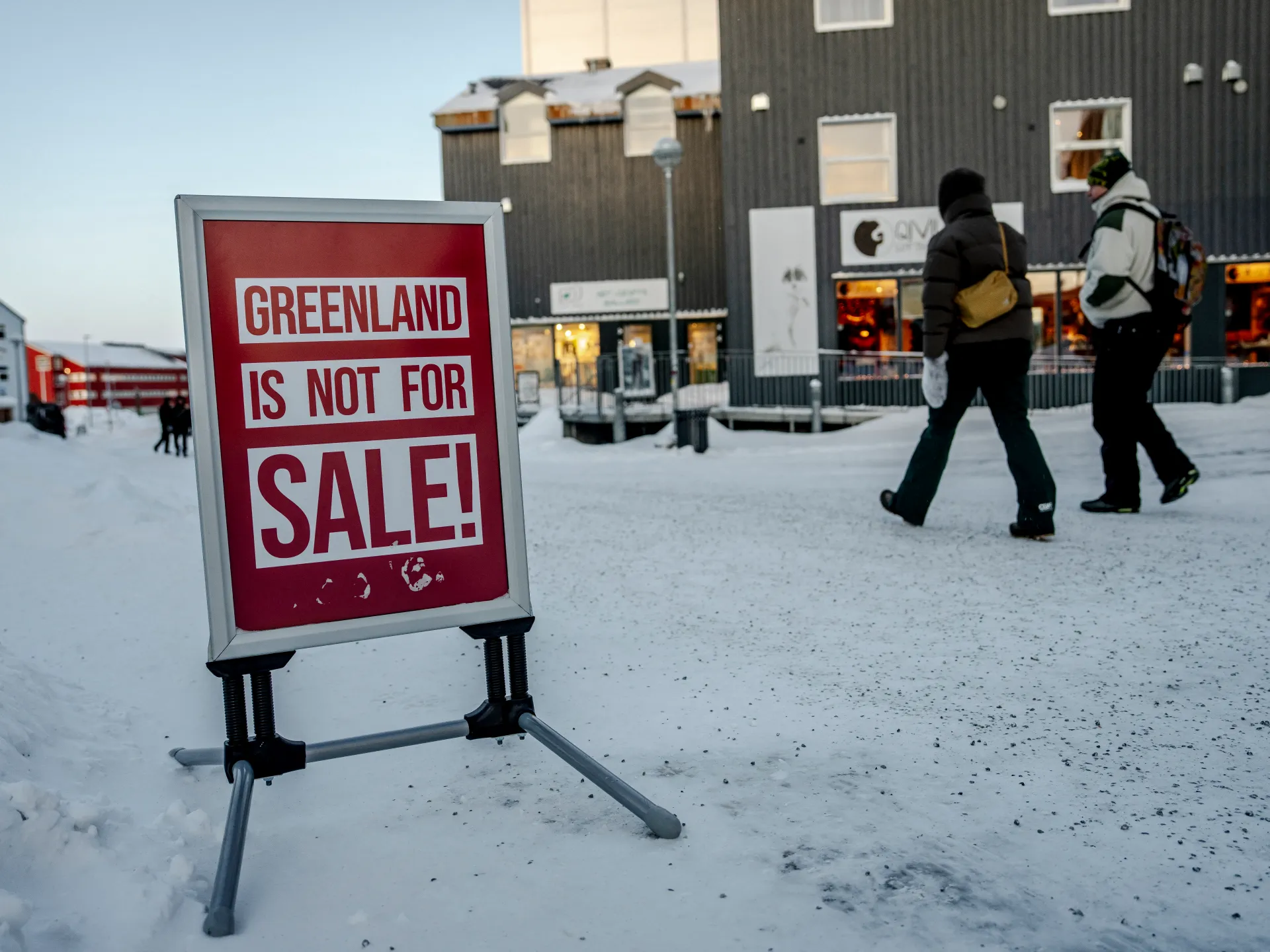
As a response, leaders from Greenland and Denmark have repeatedly said that Greenland is not for sale. They have made it clear that they are especially not interested in becoming part of the US.

On January 4, Denmark’s Prime Minister Mette Frederiksen said, “It makes absolutely no sense to talk about the US needing to take over Greenland.”

“The US has no right to annex any of the three countries in the Danish kingdom,” she said, alluding to the Faroe Islands, which, like Greenland, are also a Danish territory.

“I would therefore strongly urge the US to stop the threats against a historically close ally and against another country and another people who have very clearly said that they are not for sale,” Frederiksen said.

US special forces abducted Venezuelan President Nicolas Maduro during an operation in the Venezuelan capital, Caracas, on January 3.

Hours later, Katie Miller, the wife of close Trump aide and US Homeland Security Advisor Stephen Miller, posted a photo on X showing the US flag imposed on the map of Greenland.

Greenland’s Prime Minister Jens-Frederik Nielsen hit back in an X post, writing, “Relations between nations and peoples are built on mutual respect and international law – not on symbolic gestures that disregard our status and our rights.”

Why does Trump want Greenland so badly?

The location and natural resources of the Arctic island make it strategically important for Washington.

Greenland is geographically part of North America, located between the Arctic Ocean and the North Atlantic Ocean. It is home to some 56,000 residents, mostly Indigenous Inuit people.

It is the world’s largest island. Greenland’s capital, Nuuk, is closer to New York City  – some 2,900km (1,800 miles) away – than the Danish capital Copenhagen, which is located 3,500km (2,174 miles) to the east.

Greenland, a NATO territory through Denmark, is an EU-associated overseas country and territory whose residents remain European Union citizens, having joined the European Community with Denmark in 1973 but having withdrawn in 1985.

“It’s really tricky if the United States decides to use military power to take over Greenland. Denmark is a member of NATO; the United States is a member as well. It really calls into question what the purpose of the military alliance is, if that happens,” Melinda Haring, a senior fellow at the Atlantic Council Eurasia Center, told Al Jazeera.

Greenland offers the shortest route from North America to Europe. This gives the US a strategic upper hand for its military and its ballistic missile early-warning system.

The US has expressed interest in expanding its military presence in Greenland by placing radars in the waters connecting Greenland, Iceland and the United Kingdom. These waters are a gateway for Russian and Chinese vessels, which Washington aims to track.

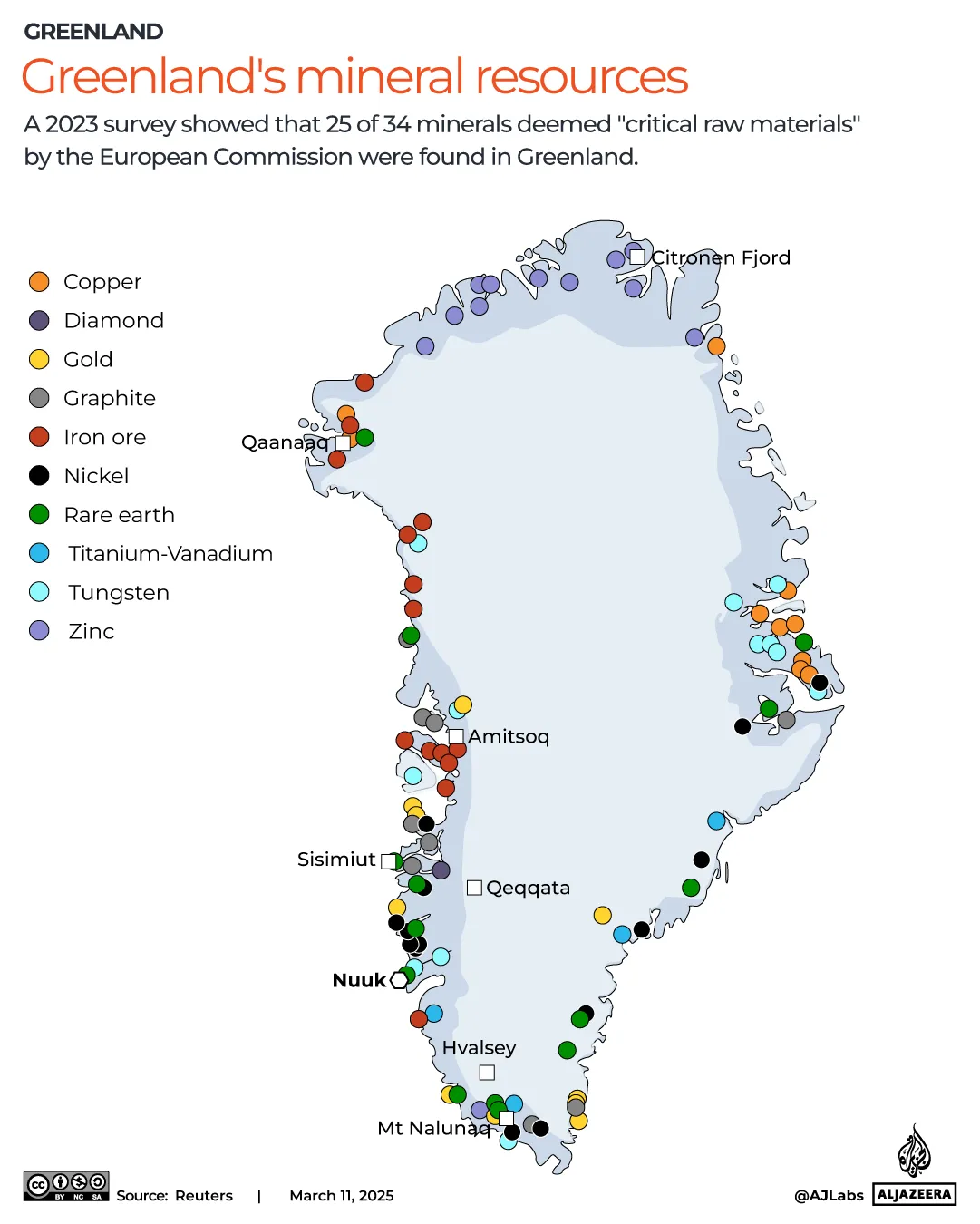
The island is also incredibly rich in minerals, including rare earth minerals used in the high-tech industry and in the manufacture of batteries.

According to a 2023 survey, 25 of 34 minerals deemed “critical raw materials” by the European Commission were found in Greenland.

Greenland does not carry out the extraction of oil and gas, and its mining sector is opposed by its Indigenous population. The island’s economy is largely reliant on its fishing industry.

INTERACTIVE - Where is Greenland Map

Are Chinese and Russian ships swarming Greenland?

However, while Trump has spoken of Russian and Chinese ships around Greenland, currently, facts don’t bear that out.

Vessel tracking data from maritime data and intelligence websites such as MarineTraffic do not show the presence of Chinese or Russian ships near Greenland.

Are Russia and China a threat to Greenland?

The ships’ location aside, Trump’s rhetoric comes amid a heightened scramble for the Arctic.

Amid global warming, the vast untapped resources of the Arctic are becoming more accessible. Countries like the US, Canada, China and Russia are now eyeing these resources.

“Russia has never threatened anyone in the Arctic, but we will closely follow the developments and mount an appropriate response by increasing our military capability and modernising military infrastructure,” Russian President Vladimir Putin said during an address in March 2025 at the International Arctic Forum in the Russian city of Murmansk, the largest city within the Arctic Circle.

During this address, Putin said that he believed Trump was serious about taking Greenland and that the US will continue with efforts to acquire it.

In December 2024, Canada released a policy document detailing plans to ramp up its military and diplomatic presence in the Arctic. Russia is also constructing military installations and power plants in the region.

Meanwhile, Russia and China have been working together to develop Arctic shipping routes as Moscow seeks to deliver more oil and gas to China amid Western sanctions while Beijing seeks an alternative shipping route to reduce its dependence on the Strait of Malacca.

The Northern Sea Route (NSR), a maritime route in the Arctic Ocean, is becoming easier to navigate due to melting ice. The NSR can cut shipping trips significantly short. Russia is hoping to ramp up commerce through the NSR to trade more with Asia than Europe due to Western sanctions. Last year, the number of oil shipments from Russia to China via the NSR rose by a quarter.

China is also probing the region, and has sent 10 scientific expeditions to the Arctic and built research vessels to survey the icy waters north of Russia.

Source link

US says military ‘always an option’ in Greenland as Europe rejects threats | Donald Trump News

The United States has raised the prospect of using military force to take control of Greenland as leaders in Europe and Canada rallied behind the Arctic territory, saying it belongs to its people.

In a statement on Tuesday, the White House said that US President Donald Trump sees acquiring Greenland, which is part of Denmark, as a national security priority, necessary to “deter our adversaries in the Arctic region”.

Recommended Stories

list of 4 itemsend of list

“The president and his team are discussing a range of options to pursue this important foreign policy goal, and of course, utilizing the ​US military is always an option at the commander-in-chief’s disposal,” it said.

Any attempt by the US to seize Greenland from longtime ally Denmark would send shockwaves through the NATO alliance and deepen the divide between Trump and European leaders.

The opposition has not deterred Trump, however.

His interest in Greenland, initially aired in 2019 during his first term in office, has been rekindled following the US’s abduction of Venezuelan President Nicolas Maduro in an attack on Caracas.

Emboldened by the operation, Trump has said that “American dominance in the Western Hemisphere will never be questioned again”, and has stepped up pressure on both Colombia and Cuba. He has also argued that controlling Greenland is vital to US national security, claiming the island “is covered with Russian and Chinese ships” and that Denmark lacks the capacity to protect it.

Greenland, the world’s largest island, but with a population of just 57,000 people, has repeatedly said it does not ‍want to be part of the US.

Its strategic location between Europe and North America makes it a critical site for the US ballistic missile defence system, while its mineral wealth aligns with Washington’s ambition to reduce reliance on Chinese exports.

Greenland ‘belongs to its people’

The White House statement on Tuesday came as leaders of France, Germany, Italy, Poland, Spain and the United Kingdom joined Danish Prime Minister Mette Frederiksen in issuing a statement reaffirming that Greenland “belongs to its people”.

“It is for Denmark and Greenland, and them only, to decide on matters concerning Denmark and Greenland,” they said.

Canadian Prime Minister Mark Carney also voiced support, announcing that Governor General Mary Simon, who is of Inuit descent, and Minister of Foreign Affairs Anita Anand would visit Greenland early next month.

In a separate statement, Nordic foreign ministers – from Finland, Iceland, Norway, Sweden and Denmark – also stressed Greenland’s right to decide its own affairs. They also noted they had increased their investments in Arctic security, and offered to do more in consultation with the US and other NATO allies.

Polish Prime Minister Donald Tusk also warned that threats against a NATO member undermined the alliance’s credibility. “No member should attack or threaten another ‌member of the North Atlantic Treaty Organisation. Otherwise, NATO would lose its meaning,” he said.

Greenland Prime Minister Jens-Frederik Nielsen welcomed the European leaders’ pledge of solidarity and renewed his ‌call to the US for a “respectful dialogue”.

Denmark, meanwhile, rejected Trump’s assertion that it is unable to protect Greenland.

“We do not share this image that Greenland ‍is plastered with Chinese investments… ⁠nor that there are Chinese warships up and down along Greenland,” Danish Minister for Foreign Affairs Lars Lokke Rasmussen said, adding that the US was welcome to invest more on the island.

Greenland’s government said it had asked for an urgent meeting with US Secretary of State Marco Rubio, together with Rasmussen, to discuss the situation.

Also on Tuesday, Louisiana Governor Jeff Landry, whom Trump appointed last month as US special envoy to Greenland, said he was not interested in talking to people in Denmark or European diplomats over Greenland.

Instead, he said he wants to have conversations directly with residents of Greenland. “I want to talk to people who want an opportunity to improve the quality of life in Greenland,” the Republican said on a Fox News radio show.

Separately, The Wall Street Journal reported that Rubio had told US lawmakers during a congressional briefing that the recent threats did not signal an imminent invasion of Greenland and that the goal is to ‌buy the island from Denmark.

The White House deputy chief of staff, Stephen Miller, also dismissed concerns about Danish sovereignty.

“You can ⁠talk all you want about international niceties and everything else,” Miller told CNN. “But we live in a world, in the real world, that is governed by strength, that is governed by force, that ​is governed by power.”

Members of Congress, including some of Trump’s fellow Republicans, pushed back.

“When Denmark and Greenland make it clear that Greenland is not for sale, the United States must honour its treaty obligations and respect the sovereignty and ‌territorial integrity of the Kingdom of Denmark,” said Democratic Senator Jeanne Shaheen and Republican Senator Thom Tillis, the co-chairs of the Senate NATO Observer Group.

Source link

The £3.4bn bridge connecting two countries that costs £50 to cross

The 8-kilometre bridge is crossed by about 70,000 people each day

For more than 24 years, the 8-kilometre Øresund Bridge has served as a crucial link between Sweden and Denmark, providing a combined railway and motorway connection across the Øresund strait.

The bridge, a joint venture between Swedish firm Svedab and Danish company A/S Øresundsforbindelsen, makes up half of the journey from Sweden to the Danish Island of Amager.

Beginning near the city of Malmo on the Swedish coast, it extends to the man-made Danish Island of Peberholm, situated in the middle of the strait.

From Peberholm, a tunnel completes the remaining journey to the island of Amager, where Copenhagen airport is located, bringing the total distance travelled to around 16 km.

Construction on the bridge began in 1995, and it officially opened its lanes to traffic in July 2000. Just two years later, it was recognised with the IABSE Outstanding Structure Award, reports the Mirror.

Peberholm acts as a junction between the tunnel and the bridge.

It’s fitted with a motorway exit, restricted to authorised vehicles only, and a helicopter pad for use in emergencies.

The bridge, which sees an average daily footfall of 70,000 people, came with a hefty price tag of around £3.4 billion. The cost is expected to be recouped by 2037.

Crossing fees vary depending on the type of vehicle. Motorcyclists are charged £25.68, passenger cars £50.77, and vans, motorhomes or passenger cars with a trailer pay a staggering £178.55.

The Øresund Bridge claims the second spot as the longest bridge in Europe, only outdone by the 18.1km Kerch Bridge.

The latter spans the Kerch Strait, linking the Taman Peninsula of Krasnodar Krai in Russia and the Kerch Peninsula of Crimea.

Source link

Trump’s threats of intervention jolt allies and foes alike

Venezuela risks “a second strike” if its interim government doesn’t acquiesce to U.S. demands. Cuba is “ready to fall,” and Colombia is “very sick, too.”

Iran may get “hit very hard” if its government cracks down on protesters. And Denmark risks U.S. intervention, as well, because “we need Greenland,” President Trump said.

In just 37 minutes while speaking with reporters Sunday aboard Air Force One, Trump threatened to attack five countries, both allies and adversaries, with the might of the U.S. military — an extraordinary turn for a president who built his political career rejecting traditional conservative views on the exercise of American power and vowing to put America first.

The president’s threats come as a third of the U.S. naval fleet remains stationed in the Caribbean, after Trump launched a daring attack on Venezuela that seized its president, Nicolás Maduro, and his wife over the weekend.

The goal, U.S. officials said, was to show the Venezuelan government and the wider world what the American military is capable of — and to compel partners and foes alike to adhere to Trump’s demands through intimidation, rather than commit the U.S. military to more complex, conventional, long-term engagements.

It is the deployment of overwhelming and spectacular force in surgical military operations — Maduro’s capture, last year’s strikes against Iranian nuclear facilities, assassinations of Islamic State leadership and Iran’s top general in Iraq — that demonstrate Trump as a brazen leader willing to risk war, thereby effectively avoiding it, one Trump administration official said, explaining the president’s strategic thinking.

Yet experts and former Trump aides warn the president’s approach risks miscalculation, alienating vital allies and emboldening U.S. competitors.

At a Security Council meeting Monday at the United Nations in New York — called by Colombia, a long-standing and major non-North Atlantic Treaty Oranization ally to the United States — Trump’s moves were widely condemned. “Violations of the U.N. Charter,” a French diplomat told the council, “chips away at the very foundation of international order.”

Even the envoy from Russia, which has cultivated historically strong ties with the Trump administration, said the White House operation was an act of “banditry,” marking “a return to the era of illegality and American dominance through force, chaos and lawlessness.”

Trump’s threats to annex Greenland, an autonomous territory of the Kingdom of Denmark with vast natural resources, drew particular concern across Europe on Monday, with leaders across the continent warning the United States against an attack that would violate the sovereignty of a NATO ally and European Union member state.

“That’s enough now,” Greenland’s prime minister, Jens-Frederik Nielsen, said after Trump told reporters that his attention would turn to the world’s largest island in a matter of weeks.

“If the United States decides to militarily attack another NATO country, then everything would stop,” Denmark’s prime minister, Mette Frederiksen, told local press. “That includes NATO, and therefore, post-World War II security.”

Trump also threatened to strike Iran, where anti-government protests have spread throughout the country in recent days. Trump had previously said the U.S. military was “locked and loaded” if Iranian security forces begin firing on protesters, “which is their custom.”

“The United States of America will come to their rescue,” Trump wrote on social media on Jan. 2, hours before launching the Venezuela mission. “We are locked and loaded and ready to go. Thank you for your attention to this matter!”

In Colombia, there was widespread outrage after Trump threatened military action against leftist President Gustavo Petro, whom Trump accused, without evidence, of running “cocaine mills and cocaine factories.”

Petro is a frequent critic of the American president and has slammed as illegal a series of lethal U.S. airstrikes against alleged drug boats in the Caribbean and the eastern Pacific.

“Stop slandering me,” Petro wrote on X, warning that any U.S. attempts against his presidency “will unleash the people’s fury.”

Petro, a former leftist guerrilla, said he would go to war to defend Colombia.

“I swore not to touch a weapon again,” he said. “But for the homeland, I will take up arms.”

Trump’s threats have strained relations with Colombia, a devoted U.S. ally. For decades, the countries have shared military intelligence, a robust trade relationship and a multibillion-dollar fight against drug trafficking.

Even some of Petro’s domestic critics have comes to his defense. Presidential candidate Juan Manuel Galán, who opposes Petro’s rule, said Colombia’s sovereignty “must be defended.”

“Colombia is not Venezuela,” Galán wrote on X. “It is not a failed state, and we will not allow it to be treated as such. Here we have institutions, democracy and sovereignty that must be defended.”

The president of Mexico, another longtime U.S. ally and its largest trading partner, has also spoken out forcefully against the American operation in Caracas, and said the Trump administration’s aggressive foreign policy in Latin America threatens the stability of the region.

“We categorically reject intervention in the internal affairs of other countries,” President Claudia Sheinbaum said in her daily news conference Monday. “The history of Latin America is clear and compelling: Intervention has never brought democracy, has never generated well-being or lasting stability.”

She addressed Trump’s comments over the weekend that drugs were “pouring” through Mexico, and that the United States was “going to have to do something.”

Trump has been threatening action against cartels for months, with some members of his administration suggesting that the United States may soon carry out drone strikes on drug laboratories and other targets inside Mexican territory. Sheinbaum has repeatedly said such strikes would be a clear violation of Mexican sovereignty.

“Sovereignty and the self-determination of peoples are non-negotiable,” she said. “They are fundamental principles of international law and must always be respected without exception.”

Cuba also rejected Trump’s threat of a military intervention there, after Trump’s secretary of State, Marco Rubio, himself the descendant of Cuban immigrants, suggested that Havana may be next in Washington’s crosshairs.

“We call on the international community to stop this dangerous, aggressive escalation and to preserve peace,” Cuban President Miguel Díaz-Canel posted on social media.

The U.S. attacks on Venezuela, and Trump’s threats of additional military ventures, have caused deep unease in a relatively peaceful region that has seen fewer interstate wars in recent decades than Europe, Asia or Africa.

It also caused unease among some Trump supporters, who remembered his pledge to get the United States out of “endless” military conflicts for good.

“I was the first president in modern times,” Trump said, accepting the Republican presidential nomination in 2024, “to start no new wars.”

Wilner reported from Washington and Linthicum from Mexico City.

Source link

Denmark PM urges Trump to stop ‘threatening’ Greenland | Donald Trump News

The US president’s latest threat comes a day after Washington bombed Venezuela and abducted its president.

Denmark’s prime minister, Mette Frederiksen, has ‍urged US President ‍Donald Trump to stop threatening to take over Greenland, after the latter reiterated his wish to do so following Washington’s abduction of the leader of Venezuela.

“It makes absolutely no sense to talk about the US needing ⁠to take over Greenland. The US has no right to annex any of ​the three countries in the Danish Kingdom,” Frederiksen said in ‍a statement on Sunday.

Recommended Stories

list of 3 itemsend of list

The comments followed an interview published by The Atlantic magazine, in which Trump said: “We do need Greenland, absolutely. We need it for defence.”

On Saturday, the United States bombed Venezuela and toppled President Nicolas Maduro, raising concerns in Denmark that the same could happen with Greenland, a Danish territory.

“I would therefore strongly urge the US to stop the threats against a historically close ally and against another country and another people who have very clearly said that they are not for sale,” Frederiksen said.

The Greenlandic prime minister’s office did not ​immediately comment on Trump’s latest remarks.

The US president has repeatedly called for Greenland, a self-governing Danish territory and NATO member, to become part of the US.

Last month, the Trump administration named Louisiana Governor Jeff Landry, who publicly supports annexation, as special envoy to the mineral-rich Arctic Island.

Greenland’s strategic position between Europe and ⁠North America makes it a key site for the US ballistic missile defence system, and its mineral wealth is attractive, as the US hopes to reduce its reliance on Chinese exports.

Katie Miller, the wife of Trump’s deputy chief of staff, Stephen Miller, posted on Saturday the contentious image of the Danish autonomous territory in the colours of the US flag on her X feed.

Her post had a single word above it: “SOON”.

Stephen Miller is widely seen as the architect of much of Trump’s policies, guiding the president on his hardline immigration and domestic agenda.

Greenland’s prime minister, Jens-Frederik Nielsen, called the post “disrespectful”.

“Relations between nations and peoples are built on mutual respect and international law – not on symbolic gestures that disregard our status and our rights,” he said on X.

But he also said that “there is neither reason for panic nor for concern. Our country is not for sale, and our future is not decided by social media posts”.

Denmark’s ambassador to the US, Jesper Moeller Soerensen, reacted to the post on Sunday by saying, “We expect full respect for the territorial integrity” of Denmark.

Soerensen gave a pointed “friendly reminder” that his country has “significantly boosted its Arctic security efforts” and had worked with the US on that.

“We are close allies, and should continue to work together as such,” he wrote.

Source link

Trump’s appointment of envoy to Greenland sparks new tension with Denmark

The leaders of Denmark and Greenland insisted Monday that the United States won’t take over Greenland and demanded respect for their territorial integrity after President Trump ‍announced the appointment of a ‌special envoy to the semiautonomous territory.

Trump’s announcement on Sunday that Louisiana Gov. Jeff Landry would be the envoy prompted a new flare-up of tensions over Washington’s interest in the vast territory of Denmark, a NATO ally. Denmark’s foreign minister told Danish broadcasters that he would summon the U.S. ambassador to his ministry.

”We have said it before. Now, we say it again. National borders and the sovereignty of states are rooted in international law,” Danish Prime Minister Mette Frederiksen and her Greenlandic counterpart, Jens-Frederik Nielsen, said in a joint statement. “They are fundamental principles. You cannot annex another country. Not even with an argument about international security.”

“Greenland belongs to the Greenlanders and the U.S. shall not take over Greenland,” they added in the statement emailed by Frederiksen’s office. “We expect respect for our joint territorial integrity.”

Trump called repeatedly during his presidential transition and the early months of his second term for U.S. jurisdiction over Greenland, and has not ruled out military force to take control of the mineral-rich, strategically located Arctic island. In March, Vice President JD Vance visited a remote U.S. military base in Greenland and accused Denmark of under-investing there.

The issue gradually drifted out of the headlines, but in August, Danish officials summoned the top U.S. diplomat in Copenhagen following a report that at least three people with connections to Trump had carried out covert influence operations in Greenland.

On Sunday, Trump announced Landry’s appointment, saying on social media that “Jeff understands how essential Greenland is to our National Security, and will strongly advance our Country’s Interests for the Safety, Security, and Survival of our Allies, and indeed, the World.”

Landry wrote in a post on social media that “it’s an honor to serve you in this volunteer position to make Greenland a part of the U.S.”

Danish broadcasters TV2 and DR reported that in comments from the Faroe Islands on Monday, Danish Foreign Minister Lars Løkke Rasmussen said he summoned the U.S. ambassador in Copenhagen, Kenneth Howery, to his ministry.

Greenland’s prime minister wrote in a separate statement that Greenland had again woken up to a new announcement from the U.S. president, and that “it may sound significant. But it changes nothing for us here at home.”

Nielsen noted that Greenland has its own democracy and said that “we are happy to cooperate with other countries, including the United States, but this must always take place with respect for us and for our values and wishes.”

Earlier this month, the Danish Defense Intelligence Service said in an annual report that the U.S. is using its economic power to “assert its will” and threaten military force against friend and foe alike.

Denmark is a member of the European Union as well as NATO.

Anouar El Anouni, a spokesperson for the EU’s executive Commission, told reporters in Brussels on Monday that it wasn’t for him to comment on U.S. decisions. But he underlined the bloc’s position that “preserving the territorial integrity of the Kingdom of Denmark, its sovereignty and the inviolability of its borders is essential for the European Union.”

Moulson writes for the Associated Press.

Source link