demolitions

Israeli demolitions threaten schools and homes in Masafer Yatta | Israel-Palestine conflict News

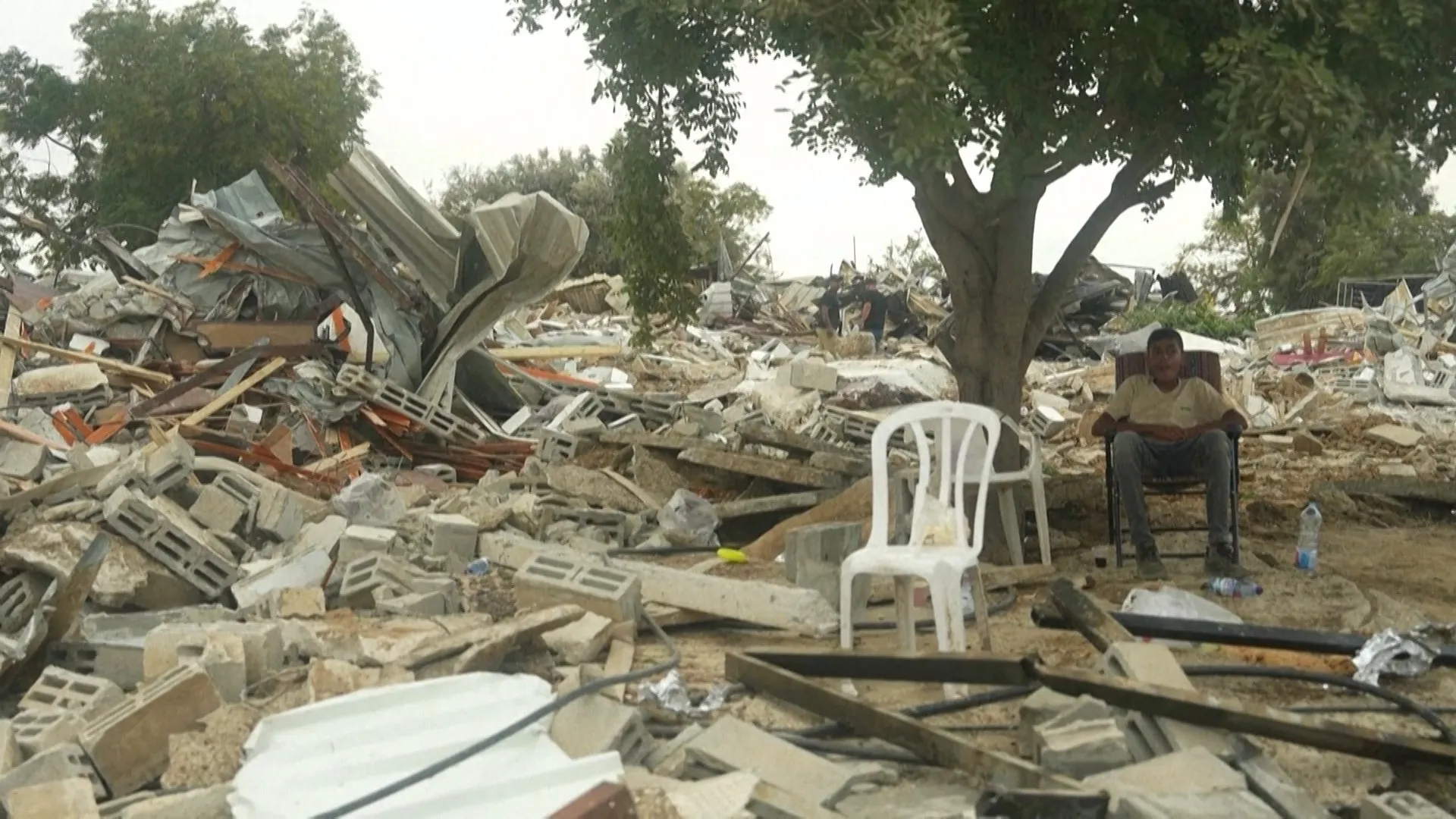
On Tuesday morning, 12-year-old Sundus al-Hamamdeh left her home in the Masafer Yatta village of Khirbet al-Fakhit, and went to school.

It was the third day of the new school year in the occupied West Bank.

Recommended Stories

list of 3 itemsend of list

But when the sixth-grade student at al-Fakhit Secondary School returned from her classes, the house she had left behind was gone.

Israeli forces had carried out a large-scale demolition operation in Khirbet al-Fakhit, destroying homes, livestock shelters, water infrastructure, and solar-power installations.

For al-Hamamdeh, her house was more than four walls and a roof. It was her safe space, the place she came back to every day.

For children in Masafer Yatta, south of Hebron in the occupied West Bank, the spectre of demolition is always present.

Much of Masafer Yatta lies in Area C of the West Bank, where Israel has control over planning and construction. Israeli authorities justifies the demolition orders by saying that the structures were built without permits; Palestinians, backed by the United Nations, note that such permits are nearly impossible for them to obtain.

And it’s not just their homes that are under threat, but their schools.

On August 4, Israeli forces surrounded Shaab al-Butum school, according to Bassam Jabr, the director-general of education in Masafer Yatta.

An Israeli military bulldozer then demolished two rooms used by teachers and administrators, and a storage room.

The UN independently documented the demolition of the rooms, saying Israeli authorities had cited the lack of an Israeli-issued building permit.

Things could still get worse; the main school building remains under a demolition order.

Focus of attacks

Established in 2015, the school serves about 60 students from kindergarten through 11th grade. Its remote location makes transferring students to other schools particularly difficult, Jabr said.

Education officials have appealed to Israeli courts, and called on the United Nations and foreign governments to intervene.

But the schools remain under threat. Even as the Israeli military and settlers’ pogroms against Palestinians continue across the West Bank, Masafer Yatta is especially targeted.

The remote communities there have little ability to defend themselves and conditions are harsh. In addition, the Israeli military has designated large parts of the area a military firing zone, another justification for forcing out the Palestinian population.

Masafer Yatta’s schools are a central part of the effort to keep Palestinians here – ensuring that families do not have to travel far for their children to be educated. Palestinians argue that is why the schools have been particularly targeted.

Intisar Omar Abu Sabha, an administrative director at the Masafer Yatta Directorate of Education, says schools in the communities of Zif, ar-Rifaiyah, Umm Qussa, Umm al-Kheir, Jinba, Shaab al-Butum, Khirbet al-Daba, and al-Majaz are among those facing demolition orders.

In addition to the threats to their schools, students and teachers also have to navigate road closures, checkpoints, and the presence of settlers to reach their classrooms.

Abu Sabha said schools have also faced damage and settler incursions or harassment in and around their grounds. She describes a cycle in which children risk losing both their homes and their schools.

“Imagine a student who is at school, then returns home and finds their home demolished … and comes back the next day to find their school demolished,” she said.

Yasmeen Sallaq, a Palestinian lawyer, says the threat to the Masafer Yatta schools directly undermines children’s right to education.

But Sallaq says that Israeli restrictions on movement, military raids, arrests, displacement, and attacks affecting students and education workers make that right increasingly difficult to exercise.

“We face the demolition of schools every day, making the continuation of the educational process almost impossible,” Sallaq said.

‘The only outlet’

At Zif Secondary School for Girls, headteacher Hanaa al-Salameen says about 250 students attend the school.

It first received a demolition notice in 2016. Years of legal proceedings followed, but an appeal against demolition was dismissed this year, with efforts continuing to obtain an interim injunction.

The uncertainty has already taken a toll. Some girls are experiencing fear and anxiety, while others have transferred to different schools, al-Salameen said.

“The school is not just a place for education,” she said. “This school is the students’ only outlet.”

She fears the school’s demolition could push some girls out of education altogether if alternative schools are too far away or require them to travel along unsafe roads.

At Zif, 10th-grade student Rabiha Yousef Jibril described the school’s importance.

“I am growing up in this school, and my dreams are growing with me day by day,” Jibril said, adding that while students fear its demolition, they insist they will continue to attend.

“Even if they demolish the school, we will continue to study, even under the trees,” she said. “Even if they confiscate the books, we will keep them in our hearts, as well as our minds.”

Source link

Arab News | 4,000+ Palestinians displaced in West Bank this year by demolitions and settler violence

NEW YORK CITY: About 4,100 Palestinians have been displaced across the West Bank so far this year as a result of demolitions and settler violence, UN deputy spokesperson Farhan Haq said on Thursday.

He warned of a sharp rise in demolitions in the Masafer Yatta area of the southern West Bank in recent days. The Office for the Coordination of Humanitarian Affairs said Israeli authorities demolished 20 homes and other structures, including a water cistern and solar panels, in two Palestinian herding communities there on Tuesday.

This activity, and demolitions in a nearby third community on Wednesday, displaced nearly 60 people, half of them children, and affected a further 30 seasonal residents. Many of the destroyed properties were built with donor support, Haq said.

Masafer Yatta is home to about 1,200 Palestinians in 13 communities, all of whom have been under pressure to leave after Israeli authorities designated the area a “firing zone.”

Haq said humanitarian officials have reported increased violence by Israeli settlers targeting those communities following the establishment in recent years of settlement outposts nearby.

Representatives of the UN and its humanitarian partners visited Masafer Yatta on Tuesday to speak with displaced residents who are receiving emergency shelter, food, hygiene items, baby products and psychosocial support, Haq said.

Across the West Bank, he added, about 1,500 Palestinians have been displaced so far this year as a result of demolitions, and more than 2,600 have been displaced by settler violence and related access restrictions.


Source link

In southern Lebanon, Israeli demolitions continue ‘day and night’ | Israel attacks Lebanon News

Froun, Lebanon – Hasan Saeid Ramadan, 56, was at home in this southern Lebanese municipality when he heard the explosions.

“It shook the ground like an earthquake, and the mountain collapsed,” he said, pointing at the nearby Qantara mountains.

Recommended Stories

list of 3 itemsend of list

Israeli forces are present just south of Froun and occupy large areas of southern Lebanon, where they conduct operations, including regular detonations, that they say target the Lebanese group Hezbollah.

The ones conducted by Israel along the Qantara mountain range this week led to a visible collapse in at least two places in the mountains. Locals and officials in villages along the edge of Israeli-controlled Lebanese territory, such as Froun, Ghandouriyeh, Bourj Qalaway and Qalaway, told Al Jazeera that the sounds of war – warplanes, drones but, most of all, Israeli demolitions – are constant and often keep them up at night.

While Ramadan was speaking, an explosion echoed in the distance – another apparent Israeli detonation of a home. “Day and night,” he said. “We even see them.”

He added: “It’s become routine.”

Pilot zones

In March, Israel invaded Lebanon for the second time in less than two years. The first invasion in October 2024 was followed by a near-full Israeli withdrawal with soldiers remaining in five locations in southern Lebanon. After the second invasion, however, Israeli officials have said their troops will stay on in southern Lebanon despite promises from United States officials that the Israelis do not have territorial ambitions in Lebanon.

While US President Donald Trump announced a ceasefire in April, Israel’s military has continued to attack what it says are Hezbollah targets and infrastructure around southern Lebanon.

Meanwhile, the Lebanese state has been locked in US-brokered direct discussions with Israel despite objections from Hezbollah and its allies, who favour indirect discussions with the Israelis to try to end the war and the Israeli presence in southern Lebanon.

Israel and Lebanon agreed a “framework agreement” in June, which launched a “pilot zone” plan. The pilot zones are to act as a test area for the Lebanese army to disarm Hezbollah and for the Israelis to withdraw. The first pilot zones were the villages of Froun, Srifa and Zawtar al-Gharbiyeh. But locals disputed the inclusion of Froun and Srifa, saying they were never occupied by Israel in the first place.

“[The Israelis] didn’t take a single step here,” Ramadan said.

For its part, Israel is also reportedly critical of the pilot zone scheme, and analysts doubt their willingness to allow it to progress.

“The pilot zones can only really work if you have goodwill of various parties,” Nicholas Blanford, a nonresident senior fellow at the Atlantic Council and author of a book on Hezbollah, told Al Jazeera. “The trouble is the Israelis have said they are not going to stage any more withdrawals, so it brings the process to a halt.”

And regardless of the efforts from the Lebanese state and the Lebanese army, both Hezbollah and Israel have played a role in undermining the process.

“Hezbollah opposes the scheme outright and argues that Lebanon should rely on Iran to pressure the US into demanding an Israeli withdrawal,” David Wood, the International Crisis Group’s senior analyst for Lebanon, told Al Jazeera. “Israel has paid lip service to the pilot zones scheme but has recently expanded – rather than reduced – its occupation of Lebanese territory.”

Demolitions and destruction

In the villages near the areas Israel controls, many of the homes and local infrastructure lie destroyed. Piles of concrete rubble and dust line many of the roads to the villages. Explosions were heard throughout the day on Thursday, and locals said they are often worse at night and disrupt their sleep.

During the harshest days of the war, these villages were ghost towns. Residents fled north to Sidon or Beirut, where they stayed with family, in displacement centres, or slept rough on the streets, locals said.

Residents began to return to these villages after the announcement of the framework agreement. But what they returned to was not what they had left behind.

Mohammad Ali Nader, the head of the municipality of Ghandouriyeh, said his area was mostly agricultural and farmers grew olives, wheat, chickpeas, corn and tobacco, among many other crops. But now, the area lies overwhelmingly in ruins. Most residents don’t have access to water or electricity.

The clanking sound of cranes and other construction equipment moving rubble or smashing concrete echoed out into the rolling hills behind Nader. He stood on the ruins of a home that had been destroyed by two Israeli rockets.

“Much like all the other houses that were destroyed, this house is no longer habitable,” he said, saying it had once boasted two storeys and a large garden. He added that the electric and water infrastructure in the area was also mostly destroyed. “We used to grow carob here, but where is there carob now?” he asked rhetorically. “Not a carob is left nor olives, tobacco or wheat.”

Nasser Mokdad, an official in the municipality of Froun, said the area was currently not receiving state-provided electricity but added that the Lebanese government was working on returning services, setting September 15 as a target date.

No water, no electricity, no return

Residents in the affected villages said the current period reminds them of the days of the Israeli occupation of southern Lebanon from 1982 to 2000. Hasan Bazzi, the head of the municipality of Froun, said the only difference is that during the previous occupation, southerners remained in their Israeli-occupied villages.

This time around, the Israeli demolitions are ensuring that those whose homes are in Israeli-occupied areas will have difficulty returning, even if the troops eventually withdraw.

When the war restarted this year, Ramadan fled his home of 30 years and took refuge in an area near Tyre, a coastal city in southern Lebanon, and then moved farther north to Sidon, about an hour south of Beirut.

When he returned after the truce in the area, his house had been badly damaged. Still, it fared better than the neighbouring houses, which he said belonged to his cousins. He’s now sleeping in his garage with his wife. Their house, like the surrounding area, has no access to water or electricity.

He said the heat at night bothers him and he’s developed a bad heat rash. During the day, he slowly works on fixing the shrapnel-pocketed walls of his home.

Dripping with sweat under the midday sun, he smiled. “My conscience is at ease because I’m by my home,” he said.

Source link