democracy

Heads up, Latino men: The future of democracy hangs on your vote

Man, we Latino men have it rough.

Americans have demonized us as criminals, buffoons, lechers, invaders, criminals and job stealers since the fall of the Alamo. Latino culture typecasts hombres as eternal machos always a few drinks away from brawling or bawling. Educators view us as underachievers. The political class long stereotyped Latino men as a sleeping giant who could change the country, if only we showed up to vote with the same enthusiasm as attending a Raiders game or lining up for a sneaker drop.

And then came Donald Trump.

So many of us fell for his siren call that 48% of Latino voters of all genders chose Trump in 2024, the highest percentage ever captured by a Republican presidential candidate. Progressives immediately blamed Latino men for Trump’s victory while holding up Latinas as the brave heroines who stood up against tyranny.

The blame game continues. A study released this month by UCLA’s Latino Policy & Politics Institute basically paints Latino men as little better than MAGA minions, trumpeting a gender gap on standing up to this administration’s deportation deluge, defending democracy and “fighting the Trump agenda.” To the media and to outraged internet commentators, it didn’t matter that two-thirds of Latino men had responded that each of those three issues was “very important” or “somewhat important.”

We just aren’t anti-Trump enough, which marks us as alien to the president’s critics. The UCLA paper’s cover page even features a red man and a blue woman conversing in what look like Aztec speaking glyphs — as if the sexes can’t understand each other and probably never will.

To explain the Latina-Latino political chasm, UCLA offers hypotheses straight out of “Men Are From Mars, Women Are From Venus.” The women supposedly work more in caretaker jobs like teaching and healthcare, softening their views toward the least of us. The men are in blue-collar sectors with a Darwinian outlook. But it doesn’t take a fancy academic paper to come to that conclusion — all you need to do is, you know, talk to Latino men.

When Trump descended that damned escalator in 2015 to announce his first presidential run by sliming Mexican immigrants as rapists and drug dealers, I knew that this racist excuse for a leader — the most anti-Latino politician in our nation’s history — would nevertheless appeal to many Latino men.

The reasons were evident: Trump’s fame. His strongman persona. His riches. His default setting of, as we Mexicans say, me vale madre — I don’t give a damn what people think. Yet three successive Democratic presidential campaigns willfully ignored these flashing sirens, instead insisting that Green New Deals and diversity, equity and inclusion programs would appeal to working-class Latino men.

Pundits thought we were still motivated by the radical politics of the Chicano movement, as previous generations were. What they didn’t realize was that assimilation had transformed Latino men into the modern equivalent of President Nixon’s silent majority.

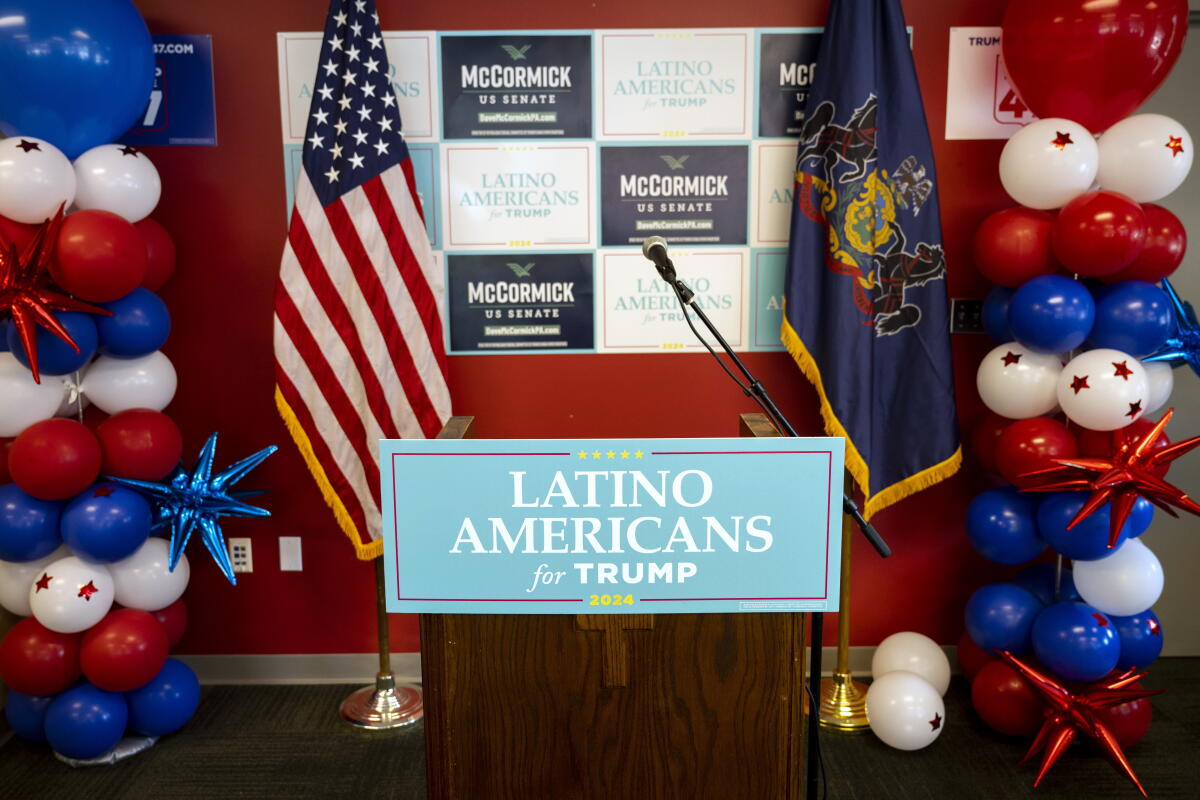
A "Latino Americans for Trump" office in Reading, Pa., during the 2024 elections.

A “Latino Americans for Trump” office in Reading, Pa., during the 2024 elections.

(Joe Lamberti / Associated Press)

I’ve always thought Latino male Trumpers were deluded — but I’ve always understood where they’re coming from. They’re believers in rancho libertarianism, my neologism for the individualistic politics exemplified by the Mexican men who raised me and who I grew up with.

Rancho libertarians, like their Scotch-Irish cousins from another mother, are forever skeptical of government, respect insurgents who want to take on the establishment, love their people and subscribe to a bootstraps approach to life. Not as praiseworthy is a tendency to dislike being told what to do, and in proving a point, to not only cut off their nose to spite their face but to lop off their heads as well.

No wonder so many Latino men went for Trump. To quote another Mexican saying, por eso estamos como estamos. That’s why we’re the way we are.

And look at what it’s earned us.

MAGA has been a miasma on this land, but especially for the blue-collar Latinos whom Trump increasingly courted with each election cycle. Immigration agents have arrested U.S.-born Trump supporters and thrown their friends and family members into squalid detention centers to await certain deportation. Diesel and gas prices are outrageously high, after Trump started a war with Iran that seems to have no end.

Nothing has degraded more for Latino men, however, than the simple pleasures of life.

When my dad and my brother had a pool party for some cousins and their children last month at our Anaheim home — no more than 15 people — the cost of carne asada, chicken, chorizo and tortillas from a local carnicería was more than $200. That side of the family never supported Trump while not exactly being wokosos, either. As Spotify blasted Antonio Aguilar and Banda El Recodo, they complained about the economy and the Republicans who have rubber-stamped the Trump agenda, when we should have been talking about the Dodgers and vacations back to our ancestral Mexico state of Zacatecas.

If my Arellano cousins are ready to stick it to Trump on election day, so should the Latino men who supported him two years ago.

In 2024, Latinos were the pivotal vote that delivered swing states to Trump. In this year’s midterms, Latino men are the swing vote within that constituency, from congressional races once considered safely red in Texas and Florida to local elections across the country. It’s gotten so dire for Republicans that Florida Rep. Maria Elvira Salazar put out a television ad warning Trump that “the same Hispanics who brought you to the White House … feel betrayed today.”

Honor remains big among rancho libertarians, and no politician has insulted the Latino way of life more than Trump. Helping to flip the House and Senate to the Democrats wouldn’t end his influence, but it sure would help. Plus, it would be a perfect rebuke to a pendejo who fooled too many good Latino men.

American society, whether the left or the right wing, will never fully accept us. We’ll always be thought of as too conservative, too dumb, too reactionary, too violent by too many.

Well, if we’re going to be loathed, we might as well stand on the right side of history. It’s time for Latino men to stand up and hit Trump with another Mexican saying:

Ya, güey. Enough already, man.

Source link

Taiwan vice president makes rare Europe visit for conference on democracy | Politics News

European Parliament’s Vice President Pina Picierno says Hsiao Bi-khim’s visit ‘was kept secret until her arrival to protect her participation’ in the conference.

Taiwanese Vice President Hsiao Bi-khim is making a rare visit to Europe, attending a forum on democracy in Italy alongside the island’s foreign minister, the presidential office said.

Hsiao has been invited to attend the Ventotene Conference for Freedom and Democracy, and is travelling with Taiwanese Foreign Minister Lin Chia-lung, the presidential office said in a brief statement.

Recommended Stories

list of 4 itemsend of list

Other details will be provided once the two return to Taiwan from the Italian island of Ventotene, it added,

While Taiwan’s foreign ministers occasionally visit Europe and other parts of the world that have no formal ties to the Chinese-claimed island, it is rare for an official as senior as the vice president to do so, given the risk of backlash from Beijing against the host nation.

Pina Picierno, vice president of the European Parliament, said Hsiao’s planned participation “was kept secret until her arrival to protect her participation” in the conference.

“No one can determine who can be hosted on European soil, what voices can be heard, and what presences must be hidden,” Picierno said in a Facebook post. “It is a simple and very clear message: intimidation cannot decide who participates in our democratic debate.”

“Freedom of debate is not negotiable with autocracies. And Ventotene, more than ever today, must continue to be the place where freedom and democracy are defended without fear,” she added.

The Ventotene conference takes place from Thursday until Saturday this week. Italy, like most countries, has no formal diplomatic ties with Chinese-claimed Taiwan.

Oleksandra Matviichuk, a 2022 Nobel Peace Prize laureate and president of Ukraine’s Centre for Civil Liberties, is also expected to participate in the conference.

China says Taiwan is one of its provinces, a view the democratically governed island strongly rejects.

Last November, Hsiao spoke at the Inter-Parliamentary Alliance on China’s annual summit, held in the European Parliament in Brussels.

Source link

Venezuela’s Democratic Transition Has 7% Progress

One of the most complex concepts in political science is democracy. While we all have a feel for what it is, whether it is elections, civil liberties, freedom of speech, or a combination of all of the above, it’s rather complicated to measure how democratic a country is. In a context like Venezuela’s rapidly evolving political environment, it’s essential to have a benchmark to evaluate whether the transition the country is experiencing is toward democracy or toward something entirely different. 

Now, a group of political scientists is proposing one way to measure it: comparing it to the installation of an operating system.

“Installing Democracy” is a project led by political scientists Beatriz Fernández and Pablo Hernández Borges to operationalize democracy in Venezuela. It’s part of Umbral, an initiative created by Hernández Borges after January 3rd to evaluate the possible outcomes of Venezuela’s political crisis, drawing from experts and the public. 

Hernández Borges said the initiative emerged partly as a way to combat misinformation, “with the goal of showing citizens that a transition is a very complex process and that it will not happen quickly. This platform sheds light on the path toward transition at a moment when people feel that democracy is at the threshold of possibility.”

A group of experts then independently evaluates each action on a scale from 0 to 100% based on the available evidence. Their assessments are aggregated into a common estimate.

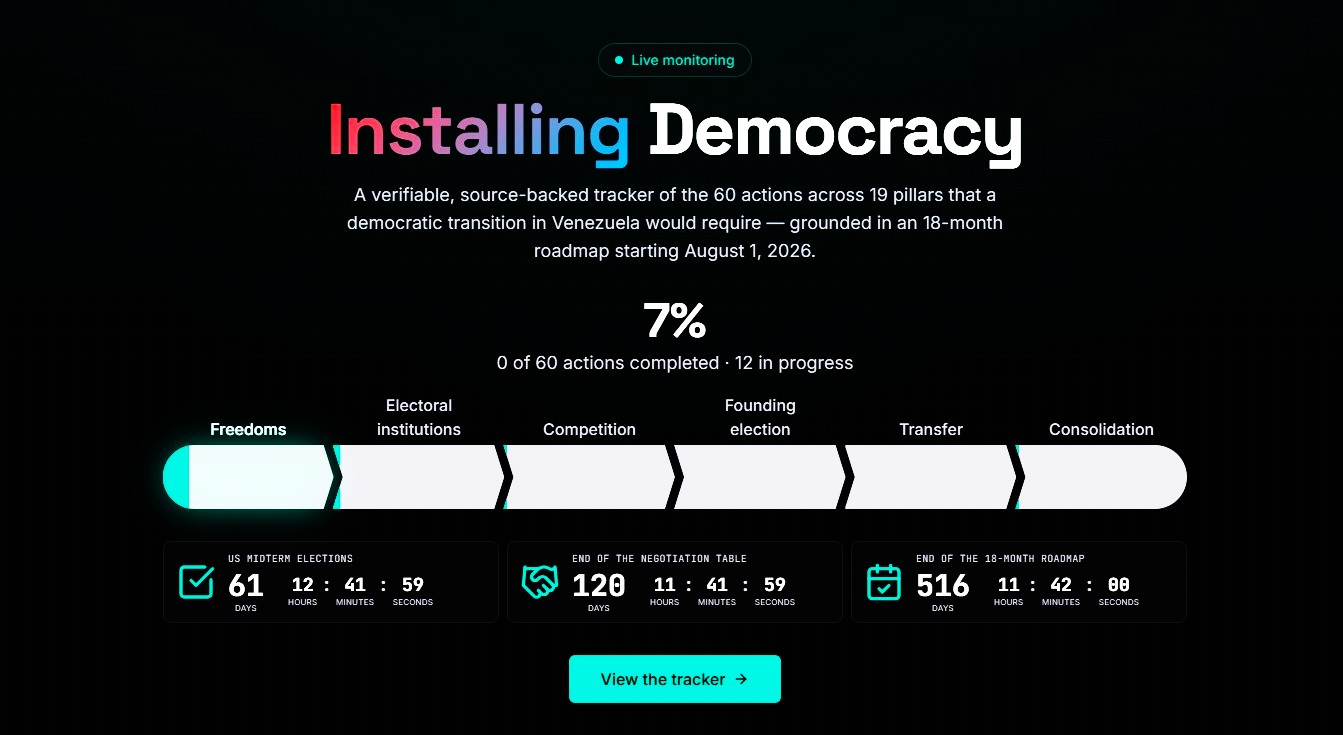
The new branch of the project, rather than presenting potential outcomes, shows a progress bar from 0 to 100%. The project’s creators envision democracy holistically, rather than as an “on and off switch.” Their methodology divides the transition into 11 pillars, ranging from human rights, security, and institutions to political competition, elections, justice, and the economy. 

To calculate the percentage shown on the dashboard, the project identifies 60 key variables consisting of tangible events, timeframes, and verifiable indicators. These include the release of political prisoners, the opening of the electoral registry, press freedom, the renewal of electoral authorities and, eventually, the holding of free elections. Drawing from existing proposals for Venezuela’s democratic transition, the project organizes these actions along an 18-month timeline starting in August 2026, with each one assigned a deadline, an indicator, and a source of verification. A group of experts then independently evaluates each action on a scale from 0 to 100% based on the available evidence, and their assessments are aggregated into a common estimate.

The resulting score places each action into one of four categories: completed, in progress, pending or unfulfilled, or not yet evaluable. This structure allows the dashboard to capture an uneven transition. Currently, it lists the installation of democracy at 7%.  

The identities of the 13 expert evaluators are kept anonymous. “They are a highly qualified group. They are Venezuelan academics, both inside and outside the country. There’s also a group of Spanish academics with expertise in transitions and knowledge of the Venezuelan context,” said Beatriz Fernández.

“These are not variables like measuring a kilo of sugar, whether it’s 800 or 783 grams. We don’t have the precision of the hard sciences. This is an informed approximation…”

Fernández joined Umbral with “Installing Democracy” after previously working with Varieties of Democracy, or V-Dem, a leading global research project that measures different dimensions of democracy across countries using hundreds of indicators and assessments from country experts. Her experience with V-Dem helped inform the project’s approach, alongside elements drawn from presidential performance trackers.

Still, Fernández acknowledged that measuring democracy is particularly complicated. “These are not variables like measuring a kilo of sugar, whether it’s 800 or 783 grams. We don’t have the precision of the hard sciences. This is an informed approximation, which is what experts do and which is valid.”

When users log into “Installing Democracy”, they can see the individual variables, the entity responsible for each aspect of the transition, the verifiable indicators, and the overall progress bar for each of the “milestones” of Venezuela’s potential democratic transition. In addition, it’s possible to see the progress, stagnation or backsliding of each milestone. Moreover, the dashboard includes countdowns for the scheduled end of the negotiation table between the interim authorities and the 2015 National Assembly, the US Midterm elections, and the end of the proposed 18-month roadmap.

Ultimately, the purpose of the project is to show audiences that the discussion of democracy goes deeper than whether elections are held or not. Fernández and Hernández Borges emphasize that the conditions under which those elections take place, and whether their results are respected, are just as important. In fact, they argue that projects like this one invite citizens to think beyond elections as the “be-all and end-all” of a democratic transition and, as their press release puts it, to evaluate “the forest rather than the latest event.” At 7%, the forest is still very much taking shape.

Source link