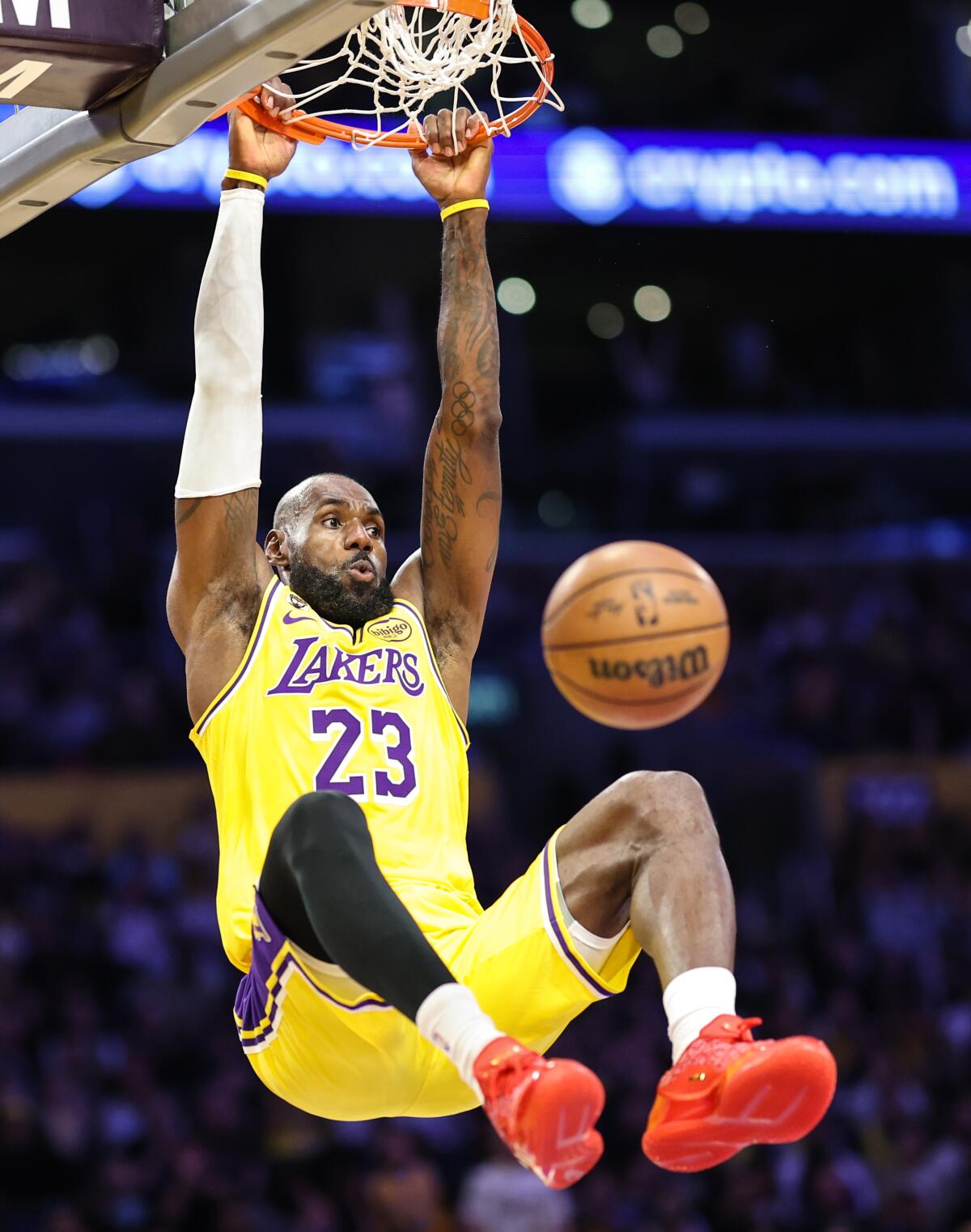
The Lakers followed the lead of their oldest member, the triple-double producing LeBron James, in dispatching the Wizards 120-101 at Crypto.com Arena on Monday night.
Two days off between games left James looking spry, with lob dunks and dunks on the fast break contributing to his 21 points, 12 assists and 10 rebounds. James was eight for 16 from the field in notching his third triple-double of the season and the 125th of his 23-year NBA career, ranking him fifth all time.
At 41 years and 90 days old, James once again became the oldest player in league history to record a triple-double, passing his previous mark (41 years, 79 days).
Lakers star LeBron James dunks against Washington at Crypto.com Arena on Monday.
(Robert Gauthier / Los Angeles Times)
“I mean, I’ve had moments more this year and last year that I’ve enjoyed more in the moment,” James said. “It’s pretty cool to know that I’m at this point in my career (and) I’m still able to do those things, man. It’s super dope. It’s super humbling. And I just try to put the work in and continue to put the work in and those are the results of it.”
James achieved the triple-double despite playing just 33 minutes.
“Yeah, I don’t know what to say. He’s very praise-worthy,” Lakers coach JJ Redick said. “I tried to give every version of the same soliloquy about his longevity. But I don’t have anything for you tonight.”
For James and his teammates, Sunday’s practice had “value” because it allowed them to clean up some things, do some “teaching” and get some “reps” that will pay off with the playoffs approaching.
They put that into action against the Wizards, but the Lakers did so without star guard Luka Doncic, who did not play after being given a one-game suspension by the NBA for his 16th technical foul.
Austin Reaves took over the primarily ballhandling duties with Doncic out, running the show in delivering a near double-double with 19 points and nine assists. Reaves was just four for 11 from the field and he missed all four of his three-point attempts, but he was 11 for 12 from the line.
Lakers guard Luke Kennard, center, drives between Washington’s Tre Johnson, left, and Jamir Watkins during the first half Monday.
(Robert Gauthier / Los Angeles Times)
Backup center Jaxson Hayes was outstanding in scoring 19 points on eight-for-eight shooting, including a three-pointer with six minutes and 41 seconds left.
Luke Kennard had 19 points off the bench, knocking down four of five from three-point range.
Deandre Ayton was a force for the Lakers, his efficient five-for-five shooting leading to 12 points, seven rebounds and three blocks.
Each of them played their part to help the Lakers win for the 12th time in 13 games and limit the effect of Doncic’s absence.
Doncic leads the NBA in scoring (33.7 points per game), is fourth in assists (8.2), second three-pointers made (4.0) and first in points scored in the first quarter (12.0). He’ll return against the Cleveland Cavaliers on Tuesday night.
“Yeah, I mean we had a professional approach,” James said. “We came in, we got the job done, understanding it doesn’t matter who we’re playing, we’re still trying to build habits for the postseason. So, a good win for us.”
Although the Lakers won handily, it was against a Wizards team tied for the worst record in the NBA (17-58). Washington has lost 18 of its past 19 games.
For the Lakers (49-26), the game was about making strides from a practice they rarely get to have.
“The value is being able to continue to improve,” Redick said before the game. “And again, I said this, we’ve placed a heavy emphasis on what we’re teaching in film and what we’re cleaning up in film, because we haven’t had court time to do that. So [Sunday], it was some of the game clean-up stuff. All the guys got some reps doing some things that they probably won’t do during a real game.”
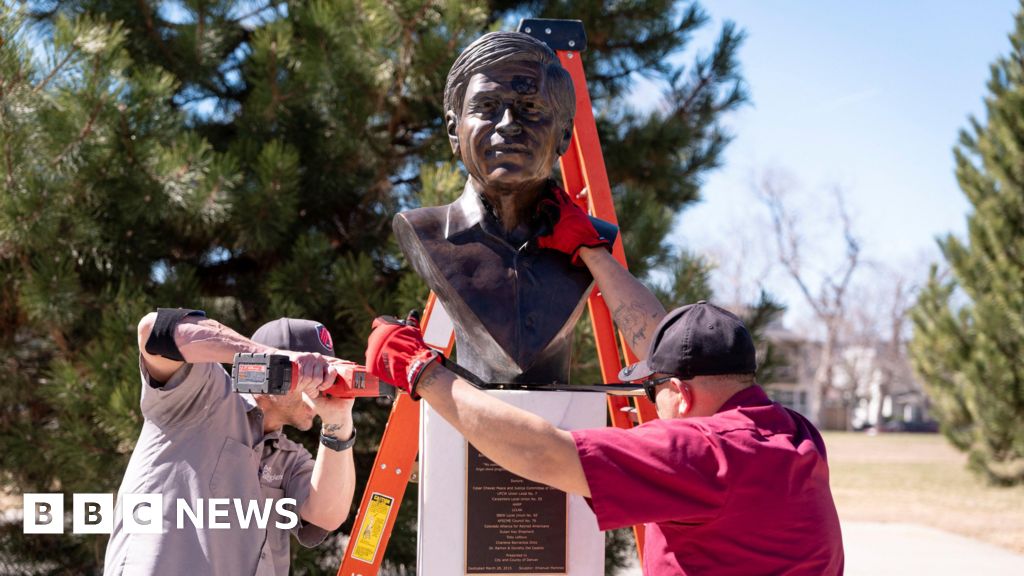
As a prominent labour organiser, Chavez helped lead a major strike against Delano grape growers in the 1960s, which sparked boycotts across the country, in order to gain better wages and conditions for workers. His mantra, “si, se puede” – which means “yes, we can” in Spanish – has been adopted by activists and politicians who came after him, and was even used by Barack Obama’s presidential campaign during his first run for office.
Hi, and welcome to another edition of Dodgers Dugout. My name is Houston Mitchell. The Dodgers are on pace to finish 162-0! That might be a record.
Are you a true-blue fan?
Get our Dodgers Dugout newsletter for insights, news and much more.
By continuing, you agree to our Terms of Service, which include arbitration and a class action waiver. You agree that we and our third-party vendors may collect and use your information, including through cookies, pixels and similar technologies, for the purposes set forth in our Privacy Policy such as personalizing your experience and ads.
Some random thoughts after an opening three-game sweep of the Arizona Diamondbacks.
—It is apparent that the Dodgers will never be out of almost any game. They’re 3-0, and they trailed in all three games.
—Opening day is always fun, filled with pomp and circumstance.
—However, having the starting lineup on opening day come in from center field, walk up a stage and back down it, was a bit much. Even the players seemed somewhat embarrassed, and I was just waiting for someone to turn an ankle on the stairs.
—Shohei Ohtani is hitting only .125. He is so overpaid.
—Clayton Kershaw did really well as an analyst. He seemed to know a lot about the Dodgers. I wonder how?
—Bob Costas told Kershaw he had permission to leave in a few minutes for the ring ceremony. Way to do your homework there, Bob. The ring ceremony was the next day.
—Kershaw sat in the stands next to the dugout during the game. Sitting across the aisle from him was Magic Johnson. Two of the greatest sports legends in L.A. history. We have an embarrassment of riches here.
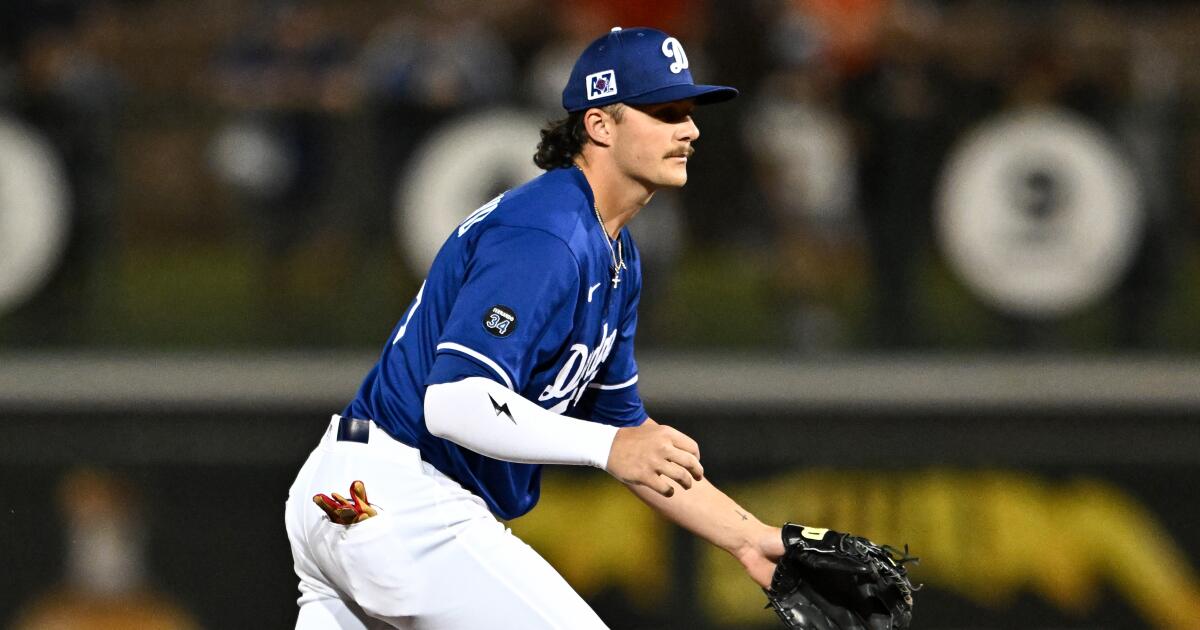
—Alex Freeland certainly showed why he belongs on the roster. Meanwhile, in Oklahoma City, Hyeseong Kim went five for five on Saturday.
—It took all the way until the second inning of the second game of the season to get an email from a reader concerned about the team. “They don’t look ready!”
—Will Smith comes through on Will Smith bobblehead night. You can’t write it any better than that.
—OK, the Timmy Trumpet entrance by Edwin Díaz is really cool. If you haven’t seen it, you can here.
—That brings me a to quick poll. Which Dodgers closer had the best entrance?
—Eric Gagne, “Welcome to the Jungle” by Guns N’ Roses —Kenley Jansen, “California Love” by Tupac Shakur —Edwin Díaz, “Narco” by Blasterjaxx and Timmy Trumpet
—Remember in the last newsletter when we talked about Will Klein perhaps reaching a new level after his Game 3 performance last season? Well, he has pitched two scoreless innings and has a win.
—The first three batters in the lineup are hitting below .200, but the Dodgers are 3-0. A good sign.
—If you believe social media, there were apparently a lot of fights in the stands in the opening homestand. I can’t speak as to this season yet, but in the past it has always been ridiculously easy to get around their beer limitation policies. And alcohol has been a prime factor in every fight I’ve ever seen there.
—What a bizarre schedule. Games on Thursday, Friday and Saturday, but no game on Sunday.
—Take a look at the very, very early NL West standings. Maybe the experts were right about everyone except the Dodgers finishing with a losing record.
Dodgers, 3-0 San Diego, 1-2 Arizona, 0-3 Colorado, 0-3 San Francisco, 0-3
—The Dodgers’ magic number is 158. Too soon?
—There are only 159 games left to go in the season.
Meet Maddie Lee
Jack Harris, our former Dodgers beat writer, has left us to become a Tibetan monk (at least, that’s what I’ve heard). We have a new Dodgers beat writer this season: Maddie Lee, who spent the last few years covering the Chicago Cubs. Here’s a Q&A with her:
Q. Welcome to The Times. What was the road that led you here?
Lee: Thank you. It was a pretty winding road, to be honest. I grew up in Seattle, played Division III softball in Portland, and have covered everything from high school football, to MLS, to the NBA. But the last six years I’ve been a Cubs beat writer, first for NBC Sports Chicago and then for the Chicago Sun-Times.
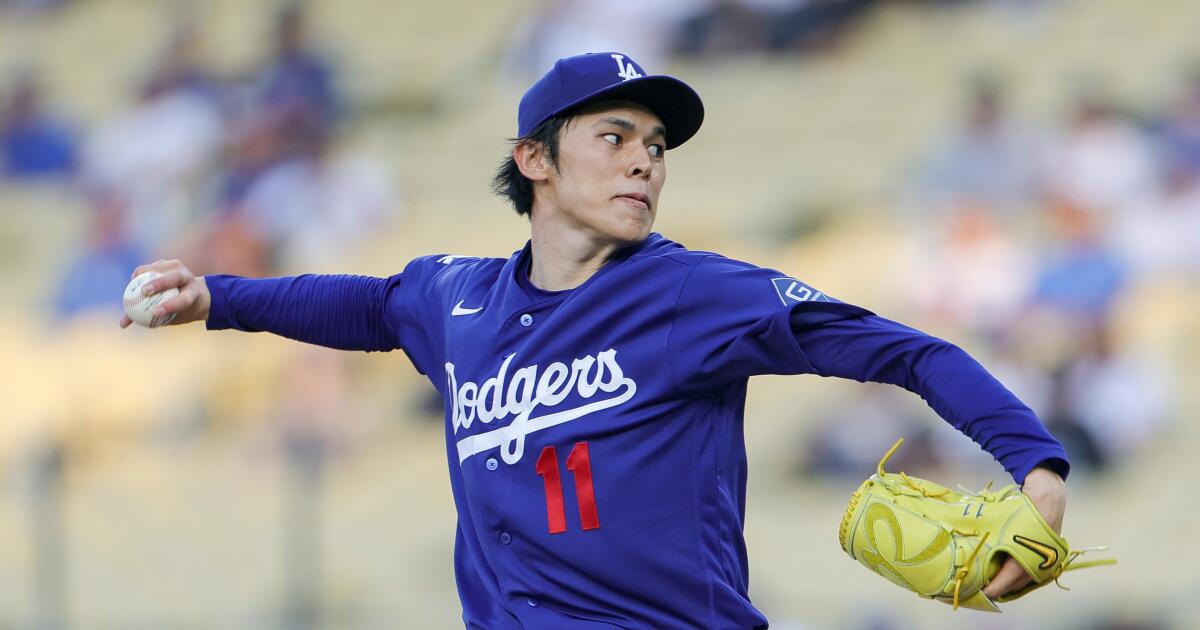
Q. We will just jump right into the fire: Roki Sasaki. He looks lost at times. Is he really the best pick for the rotation?
Lee: Sasaki’s spring performance rightfully made him a controversial pick. And if his first regular-season start goes the same way, we could very well see Justin Wrobleski coming in to pitch multiple innings behind him. But with Sasaki’s record in Japan, and even last year, the Dodgers are hoping that pitching in games that matter will help him snap into compete mode and pull out a better version than we’ve seen so far. And if that doesn’t happen, they may have to reevaluate.
Q.You covered the Cubs for a bit. Have you detected any big differences in the way the teams do things? Which team has the best press box?
Lee: I haven’t been around the Dodgers enough yet to give a fair comparison between the organizations. But I’ve spent plenty of time in both press boxes. The Wrigley Field press box is roomier, but this time of year it’s also usually freezing.
Q.Why Alex Freeland and not Hyeseong Kim?
Lee: This was another decision that wasn’t rooted in spring performance. The Dodgers thought Kim could get value going to triple A, where he could get his swing and plate discipline back on track with regular at-bats, while also playing multiple positions. On the other hand, they saw a greater development opportunity for Freeland in the majors, where he’d be tested against a higher caliber of pitching. And it’s not a long-term decision. Kim is expected to make an impact on the major-league roster this year. And when Tommy Edman is ready to return from the IL, the Dodgers will have to clear a spot on the active roster for him.
Q. For many of our readers, covering the Dodgers sounds like a dream job. But there’s travel, little free time, not to mention the fact you have to try and find somewhere to live and move all your belongings. What do you do in your little free time to stay sane?
Lee: Let me be clear, it’s definitely a dream job. That will never be lost on me.
Also, what’s this free time you speak of?
Just kidding, most of my time away from the ballpark is spent with my dog, who loves beach walks and hikes.
Q. I understand you once had Tommy John surgery! What was that recovery like, and can you still touch 100 on the radar?
Lee: I had TJ between my freshman and sophomore year in college. I also got nerve damage from the operation, which added a bit of a wrinkle to the recovery, but I played all four years. I was a catcher and luckily my biggest strength was my softball IQ, not any physical gifts. What a shock that I would end up in the press box rather than on the field.
Q. Lastly, some Dodger fans aren’t satisfied unless the Dodgers build a 20-game lead in April and then slowly pull away. Do you have a prediction for how many games they will win this season?
Lee: I like using PECOTA projections as a jumping off point. They have the Dodgers at 103 wins, which would be a big improvement from their 93-win season last year. But the Dodgers obviously dealt with the injury bug last year and underperformed in the regular season. And, of course, Kyle Tucker and Edwin Díaz were big offseason additions. So, 103 wins feels attainable. I’ll go with 100.
The new rings are here
A detailed look at the inside of the Dodgers’ 2025 World Series championship ring.
(The Champions Collective)
The Dodgers gave out World Series rings on Friday. The diamond- and sapphire-encrusted rings include engravings of the 2024 and 2025 trophies on both the outside and inside of the ring.
The L.A. logo is made up of 17 custom-cut blue sapphires, one for every postseason game the Dodgers played last year.
On the underside side of the ring, the four playoff series are listed, along with “11.01.25,” the date of Game 7 of the World Series.
A detailed look at the inside of the Dodgers’ 2025 World Series championship ring.
(The Champions Collective)
The ring top holds dirt collected from home plate during Game 7, visible through a glass window when the ring is opened. Inside the ring sits a band that’s also set with sapphires and a diamond.
The total attendance figure for the 2025 season (4,012,470) gleams in blue on the bottom of the ring. Each player’s ring is also personalized with his signature, last name and number.
Up next
Monday: Cleveland (*-Parker Messick) at Dodgers (Roki Sasaki), 7:10 p.m., Sportsnet LA, AM 570, KTNQ 1020
Tuesday: Cleveland (TBA) at Dodgers (Shohei Ohtani), 7:10 p.m., Sportsnet LA, AM 570, KTNQ 1020
Wednesday: Cleveland (Gavin Williams) at Dodgers (Yoshinobu Yamamoto), 5:20 p.m., Sportsnet LA, AM 570, KTNQ 1020
Have a comment or something you’d like to see in a future Dodgers newsletter? Email me at houston.mitchell@latimes.com. To get this newsletter in your inbox, click here.
1 of 4 | John Hinckley Jr. is flanked by federal agents as he is driven away from court April 10, 1981. On March 30, 1981, John Hinckley Jr. shot U.S. President Ronald Reagan outside a Washington hotel. UPI File Photo | License Photo
March 30 (UPI) — On this date in history:
In 1842, Dr. Crawford Long became the first physician to use anesthetic (ether) in surgery.
In 1858, a U.S. patent was granted to Hymen Lipman for a pencil with an attached eraser.
In 1867, U.S. Secretary of State William Seward reached an agreement with Russia for the purchase of Alaska for $7.2 million in gold.
File Photo by Library of Congress/UPI
In 1870, the 15th Amendment, granting African American men the right to vote, was adopted into the U.S. Constitution.
In 1923, the Cunard liner Laconia arrived in New York City, the first passenger ship to circumnavigate the world. The cruise lasted 130 days.
In 1975, the South Vietnamese city of Da Nang fell to North Vietnamese forces. UPI correspondent Paul Vogle described “the flight out of hell” as refugees attempted to flee the city.
In 1981, John Hinckley Jr. shot and injured U.S. President Ronald Reagan outside a Washington hotel. White House Press Secretary James Brady, a Secret Service agent and a Washington police officer also sustained injuries. Hinckley was released from a psychiatric hospital in September 2016.
In 1999, a jury in Oregon awarded $81 million in damages to the family of a smoker who died from lung cancer. A state judge reduced the punitive portion to $32 million.
In 2006, Jill Carroll, a freelance reporter for The Christian Science Monitor, was freed in Baghdad after being held for 82 days by kidnappers.
In 2018, at least a dozen Palestinians died in the first week of the so-called Great March of Return protests in Gaza. More than 180 people died in the nearly weekly protests through the end of 2019.
In 2023, a Manhattan grand jury took the unprecedented step of voting to indict a former president, formally charging Donald Trump in an investigation into hush-money payments made to adult film actor Stephanie Clifford, known professionally as Stormy Daniels.
It was a devastating experience for Abdul Rahman Azzam, 65, to recently cut down the olive trees he had planted decades ago on his land south of Jenin in the occupied West Bank, following an Israeli decision to confiscate it for the construction of a road for an illegal Israeli settlement.
The land slated for confiscation last December spans more than 513 dunams (51.3 hectares), 450 of which belong to the village of al-Fandaqumiya alone, with the remainder belonging to neighbouring towns such as Silat ad-Dhahr and al-Attarra.
Recommended Stories
list of 4 itemsend of list
As Palestinians commemorate the 50th anniversary of Land Day this year, the challenges of illegal Israeli settlement expansions, land confiscations, and restrictions on access to their land, particularly in Area C, persist.
Meanwhile, Israeli government leaders continue to declare that the annexation plan is a fait accompli.
Land Day commemorates the events of March 30, 1976, when Israeli authorities announced the confiscation of vast tracts of Palestinian land in the Galilee region.
In response, widespread strikes and demonstrations were organised in several towns and villages, which were met with force, resulting in the deaths of six Palestinians and the injury and arrest of hundreds.
Since then, this day has become a national symbol, embodying the connection of the Palestinians to their land and the rejection of its confiscation.
Twice taken
Since childhood, Azzam had worked alongside his father, grandfather, and uncles, planting and ploughing the land with olive trees.
He developed a deep connection to it, which he continued to work on until 2002, when the illegal Israeli settlement of Tarsala and the Sanur military base were established on it, and he and his family were barred from accessing it.
Following the 2005 disengagement plan, the Israeli army withdrew from the camp and the settlement of Tarsala. Azzam and other landowners returned to their land, and their joy was indescribable.
However, after the recent Israeli decision, the Palestinian landowners were denied access to their land, which is now entirely under Israeli military control.
Palestinian land being bulldozed in the occupied West Bank town of Ein Yabrud [Mohammed Turkman/Al Jazeera]
“Suddenly, we found the land number in the official newspaper along with a confiscation order for the construction of a road connecting the settlements of Homesh and Tarsala, to which the settlers had returned after the 2005 withdrawal. We saw the Israeli army had already begun bulldozing the land,” Azzam told Al Jazeera.
To prevent the Israeli army from cutting down his olive trees during the bulldozing, Azzam went to his land and cut them down himself. He wept as he did so. He then noticed that all the other landowners had done the same, fearing for their trees.
“It’s easier for us to cut them down ourselves than for the army or settlers to do it. This is our land, and our trees are like our children; we cherish them and treat them with kindness because we toiled to cultivate and care for them,” he added.
Confiscation in several ways
The Oslo Accords, signed between Israel and the Palestine Liberation Organization in 1993, divided the West Bank into three categories: Area A, under full Palestinian control, comprising approximately 18 percent of the West Bank; Area B, under joint Palestinian and Israeli control, comprising 22 percent; and Area C, under full Israeli control, comprising 60 percent.
Since October 2023, Israel has been issuing confiscation orders for Palestinian lands in Area C at an accelerated pace in the West Bank, in preparation for implementing its annexation plan, which Palestinians believe is already being carried out on the ground without a formal declaration.
According to data from the Palestinian Authority’s Commission Against the Wall and Settlements, Israel seized 5,572 dunams of Palestinian land in 2025 through 94 confiscation orders for military purposes, in addition to three expropriation orders and four declarations of state land.
These orders were not isolated or circumstantial, but rather geographically distributed to serve the expansion of settlements, secure their borders, and construct settlement roads that further fragment Palestinian land and sever its natural contiguity, as it said.
Concurrently, Israel allocated 16,733 dunams of previously confiscated land for settler grazing, a move that reveals a dangerous escalation in the tools of control, according to the commission’s annual report.
In another report, the commission stated that between October 2023 and October 2025, Israel confiscated 55,000 dunams of land, including 20,000 dunams under the pretext of modifying the boundaries of nature reserves, and 26,000 dunams through 14 declarations of “state land” in the cities of Jerusalem, Nablus, Ramallah, Bethlehem and Qalqilya.
A total of 1,756 dunams were confiscated through 108 orders for military purposes, aimed at establishing military towers, security roads, and buffer zones around settlements.
However, it has become increasingly apparent that many land seizures are carried out without official military orders. Soldiers or settlers prevent Palestinian landowners from accessing their land, leaving them surprised to find it seized without any prior notification.
Mohammed Fouad’s land was cleared without warning in the town of Ein Yabrud to make way for a road to an illegal Israeli settlement [Mohammed Turkman/Al Jazeera]
Mohammed Fouad, 56, was surprised on Wednesday to find an Israeli army bulldozer razing his land in the town of Ein Yabrud, east of Ramallah.
He went to the nearest point to the land and watched as the bulldozer removed trees, seemingly clearing a road for settlers.
“My land is 15 dunams … and is only 1km from the Beit El settlement, which is built on land north of Ramallah. I fear this bulldozing is a prelude to its annexation to the settlement, especially since it’s classified as Area C,” Fouad told Al Jazeera.
He was not notified of any decision regarding the confiscation of his land. A farmer who was nearby informed him of it. When he tried to inquire with the armed men accompanying the bulldozer, they told him they were from the Israeli army and intelligence services and expelled him from his land.
“I’ve always cared for this land, and now I’m watching it being bulldozed right before my eyes, unable to reach it. It’s as if they’re forcing me to leave. But I’ll try to reach it every day,” Fouad said bitterly.
Land confiscation procedures have been facilitated by several Israeli policies over the past two years to complete the annexation plan.
Raed Muqadi, a researcher at the Land Research Centre, told Al Jazeera that settlers have resorted to fencing off Palestinian lands to seize them, especially in the Jordan Valley.
This has affected thousands of dunams in the occupied West Bank that were used as pastures or agricultural land. Because of the fencing, Palestinians are prevented from entering or using it.
“The Israeli Knesset also recently approved what is called lifting the ban on data concerning landowners in the West Bank, which makes it easier for settlers to seize land and allows them to purchase it, even in Area A, with the help of settlement associations,” he explained.
Actual expulsion
The tragedy is not limited to land confiscation and seizure in the West Bank, but extends to the expulsion of entire Palestinian communities from their homes under the weight of attacks.
Qusay Abu Naim, 23, a resident of the Bedouin community of al-Khalail in the village of al-Mughayyir, east of Ramallah, told us that he and all other residents were forced to leave in February due to the intensity of settler attacks on the residents, some of whom were injured.
On February 21, Israeli settlers attacked the community intermittently, assaulting men, women, and children, resulting in injuries to an entire family of four, including two children. The Israeli army then joined the attack after the settlers filed a complaint that the Palestinians had resisted them. The soldiers opened fire, wounding the children, aged 12 and 13, further.
“This incident was the last straw. We decided to leave because the attacks were almost constant. When we returned from the hospital to dismantle our homes, we were shocked to find that the settlers had destroyed them and vandalised their contents,” Abu Naim explained.
The attacks against this community began in December 2024, intending to seize the lands of al-Mughayyir. The settlers deliberately targeted women, beating them and stealing sheep to force the residents to leave.
“Because of the numerous attacks, we sought help from international solidarity activists, but that didn’t stop the settlers. The activists were attacked several times in 2024 and 2025. Among the attacks, settlers broke my brother’s arm so severely that he needed a metal plate to repair the fracture. While he was receiving treatment, the Israeli army arrested him, even though he was the victim. He is currently being held in administrative detention without charge,” Abu Naim added.
In addition to the attacks, the homes of this community were repeatedly robbed by armed settlers. They would break into the houses and steal food from refrigerators, terrorising women and children.
The residents of the community were forced to leave for neighbouring villages, including Deir Jarir and areas within al-Mughayyir itself, but they still remember the years when they lived there in their communities, amid a beautiful Bedouin life, the images of which remain with them to this day, and they lament leaving it.
“Of course, it is now forbidden for any Palestinian to access the al-Khalail community area, which is under the control of settlers and the Israeli army. We left it, but the land will return to its original owners,” he concluded.
According to the Office for the Coordination of Humanitarian Affairs (OCHA), at least 4,765 Palestinians were displaced from 97 locations between January 2023 and mid-February 2026 due to settler violence.
Most of those displaced were from Bedouin and herding communities in Area C. At the beginning of this year alone, 600 people were forced to leave a single Bedouin village, Ras Ein al-Auja, in the Jordan Valley.
According to the United Nations Development Programme (UNDP), the number of Palestinian Bedouins in the West Bank is approximately 40,000. Most Bedouins are originally from the Naqab Desert, from which they were forcibly displaced or fled during the 1948 Arab-Israeli War, following further displacement after 1967, and then throughout the 1980s, they have continued to face waves of expulsion to this day.
Tommy Fury has risked pregnant Molly-Mae’s wrath after announcing a huge fight the day after her due dateCredit: facebook/@SportskeedacombatMolly Mae and Tommy announced they’re expecting second child in heart-warming post last monthCredit: Instagram @mollymaeIf you look closely at the photo, it gives away when the influencer’s baby will be bornCredit: Refer to source
As she showed off some young lambs on her Instagram stories, it sparked worry as there is a risk of contracting disease from animals who’ve recently given birth.
.The Children’s Farm has a section on its website dedicated to safety and measures pregnant women can take to reduce the risk of infection.
Molly went on to admit she is not suffering from a cold or any illness but still finds herself feeling as though she cannot breathe in the morning – leading to her reaching for the sprays every day.
She said: “I don’t have a cold. I don’t feel ill but I wake up and I can’t breathe.”
But she assured fans she was feeling well within herself and her pregnancy as she nears her due date.
Molly-Mae has been teasing her fans about her unborn child since the pregnancy newsCredit: InstagramMolly Mae appears to be due to give birth a day before Tommy’s big fightCredit: @mollymae9879/YouTubeFans were excited to hear the news of Tommy’s next fightFans wondered if Tommy might miss the birth of his second childMolly-Mae recently raised concerns when she visited Ash End House Children’s Farm with BambiThe couple’s fans were delighted at their pregnancy news last month
Tensions continue to rise with Iran warning a ‘heavy price’ will be paid after Israeli attacks on nuclear and industrial sites.
Published On 28 Mar 202628 Mar 2026
President Donald Trump said he is “very disappointed” with NATO’s response to the United States-Israeli war on Iran, accusing the alliance of failing to support Washington despite years of US military spending on its allies.
Meanwhile, Iran warned a “heavy price” will be paid after Israeli attacks on nuclear and industrial sites, with Tehran accusing the US and Israel of “playing with fire” by targeting energy infrastructure. Iran also said there was no radioactive leak following attacks on two nuclear facilities.
The warnings come as fighting and tensions continue to escalate across the Middle East, with growing fears of a wider conflict.
Here is what we know:
In Iran
Israel hits Tehran: Israel’s military said it launched attacks on Iranian “regime targets” early Saturday.
Hopes for Iran talks this week: US envoy Steve Witkoff said he expects meetings with Iran “this week” and is waiting for Tehran’s response to a 15-point peace plan.
Iran pledges “heavy price” for plant strikes: Iran’s Foreign Minister Abbas Araghchi said Tehran would exact a “heavy price for Israeli crimes” after attacks on nuclear sites and two of the country’s largest steel factories.
Iran feels “forced” into talks: Al Jazeera’s Mohamed Vall, reporting from Tehran, said many Iranians believe they are being pushed into negotiations that are not in their favour, with the sense that “the Americans are bombing their way towards a negotiation table.” Rather than relying on US or Israeli promises, he said Iran is relying on “its missiles, its drones, and the resolve of its soldiers”.
Russia likely aiding Iran with satellite intelligence: Al Jazeera’s Mansur Mirovalev reported Iran is likely receiving data on US military assets from Russia’s Liana spy satellite system, according to a space programme expert.
War diplomacy
Trump criticises NATO over Hormuz: Trump said NATO allies “weren’t there” when asked to help secure the Strait of Hormuz, despite the US spending “hundreds of billions” protecting them. “I’ve always said NATO is a paper tiger. And I always said we help NATO, but they’ll never help us.”
Possible Pakistan meeting: Turkiye said talks with Pakistan, Saudi Arabia, and Egypt could take place in Pakistan this weekend as Islamabad mediates between Iran and the US.
UN nuclear watchdog urges “restraint”: The International Atomic Energy Agency repeated its call for “restraint” in the Middle East war after Israel struck two Iranian nuclear facilities, including a uranium processing plant.
“Regime change” unlikely: The war is unlikely to lead to “regime change” in Iran, said German Chancellor Friedrich Merz. “If that’s the goal, I don’t think you’ll achieve it. It’s mostly gone wrong” in past conflicts, he said, pointing to the Afghanistan war.
In the Gulf
Saudi Arabia intercepts missile: Saudi Arabia said it “intercepted and destroyed” a missile targeting the capital Riyadh. Meanwhile, at least 12 US military personnel were wounded, including two seriously, in an Iranian attack on an airbase in the kingdom, The Associated Press and Reuters news agencies reported on Friday.
United Arab Emirates: The UAE’s Ministry of Defence reported that air defence systems and fighter jets intercepted and shot down incoming missiles and drones from Iran.
Kuwait: Though experiencing some slower nights recently, residents in Kuwait say they have grown accustomed to the disruption of alarms sounding throughout the night.
In the US
US aims to finish war in “weeks”: Secretary of State Marco Rubio said Washington expects to complete its Iran war objectives in the “next couple weeks”, leaving Iran “weaker”.
US soldiers wounded: More than 300 American soldiers have been wounded since the start of the war on February 28, US Central Command said.
In Israel
Direct attacks: Israel continues to face significant incoming fire on multiple fronts. Iran launched a missile salvo that struck a busy commercial street in Tel Aviv.
Man killed: Israeli emergency responders said a man was killed in Tel Aviv on Friday, and several others were wounded across the country after the military reported missiles fired from Iran.
In Lebanon, Yemen, occupied West Bank
Houthis warn they’ll join the fight: Yemen’s Houthi rebels warned they would enter the war if attacks on Iran continue or if more countries join the conflict. The Houthis have in the past attacked shipping in the Red Sea in response to regional conflicts, but have so far not intervened in this war.
Israel expands ground war in Lebanon: Israeli troops entered Khiam and clashed with Hezbollah near Tyre as Israel pushes to create a “security zone” up to the Litani River. Hezbollah said it attacked Israeli tanks and fired at a warplane over Beirut.
Israel cites Hezbollah threat: Al Jazeera’s Rob McBride, reporting from Amman, said Israel is using the threat from Hezbollah in the north to justify expanding its ground incursion into southern Lebanon to push Hezbollah back and create a “buffer zone”.
Hezbollah escalation: Hezbollah forces have fiercely resisted the Israeli advance, claiming to have carried out 82 operations against Israeli troops within 24 hours.
West Bank violence continues: Israeli forces killed three Palestinians in the occupied West Bank, including a 15-year-old boy in Dheisheh refugee camp and two men in Qalandiya.
Oil, food, and gas crises
Strait of Hormuz: To prevent a “massive humanitarian crisis”, the United Nations has established a new task force led by Jorge Moreira da Silva. It aims to ensure ships carrying fertiliser and raw materials can safely cross the strait, warning that maritime trade disruptions could severely affect global agricultural production and humanitarian needs.
Egypt imposes business curfew: Egypt has ordered shops, restaurants, and shopping malls to close at 9pm (19:00 GMT) from Saturday, hoping to curb energy bills that have more than doubled because of the Iran war.
Overnight queues in Ethiopia: Many Ethiopians slept in their cars in hours-long queues for petrol as shortages caused by the war began to take their toll. The Horn of Africa country is particularly vulnerable as it imports all its petrol, primarily from the Gulf.
Tea stuck in Kenya: Between 6,000 and 8,000 tonnes of tea worth $24m is stuck at Kenya’s port of Mombasa because of the war, trade officials said. About 65 percent of the East African tea market has been affected by the war that began on February 28. This is happening because the war is disrupting shipping routes through the Red Sea and the Strait of Hormuz, which are key routes for trade between Asia, the Middle East and Europe.
Spring has arrived at Wicken Fen, one of Europe’s most important wetlands, and with it the first summer migrants. Chiffchaffs are usually the earliest, with their rhythmic song ringing out across the fens. Then, if the weather is mild, blackcaps and willow warblers might join them. Listen closely, especially early morning or at dusk, for the foghorn-like calls of the booming bittern across the reedbeds. There’s a pushchair- and wheelchair-friendly boardwalk around Sedge Fen, and wheelchair-accessible wildlife hides. Look out for the electric blue flash of a kingfisher, and male marsh harriers performing their dramatic sky-dancing flights as the breeding season gets under way, before the cuckoos arrive in late April. From £10 adults, £5 children (under-5s free), nationaltrust.org.uk
Artful planting in East Sussex
Spring evening at Petworth House. Photograph: Slawek Staszczuk/Alamy
When Dan Pearson created the landscape design at Goodwood Art Foundationsculpture park, which opened last May, he planned 24 seasonal moments to complement the art-dotted trails through woodland, glades and meadows. This is the first spring visitors will see his graphic plantings of daffodils and bluebells, cherry blossoms and the katsura grove coming into copper-coloured leaf. Over the Easter holidays, children can pick up a free Art in Nature pack to create rubbings and collages inspired by the shapes and textures.
There is artful nature of a different kind at nearby Petworth’s spring festival, with more than 100 pots of spring bulbs in flower, willow foraging and basket making workshops, and other garden-themed kids’ activities. Goodwood Art Foundation, £15 adults, under-18s free,goodwoodartfoundation.org. Spring festival at Petworth, from £21 adults, £10.50 children(under-5s free), 4-19 April,nationaltrust.org.uk
Feast by the sea in Kent
Morelli’s ice-cream parlour in Broadstairs. Photograph: Eye35/Alamy
From Italian small plates in Margate to Japanese ramen in Deal, the Kent coast has upped its foodie credentials. Dig in at the Broadstairs food festival, which pops up on the seafront over Easter (3-5 April). There’s a delicious lineup of chefs, street food stalls and local artisan producers, plus food-themed arts and crafts workshops, from chocolate lollipop making to screen printing napkins with fig, oyster, crab or seaweed designs. Broadstairs is a treat to eat your way around anytime, with seafood at Kebbells, tapas at Bar Ingo and, of course, a sundae at Morelli’s Formica-tastic ice-cream parlour. Free entry, 3-5 April, broadstairsfoodfestival.org.uk
Treetop thrills and stargazing in the Lake District
Go Ape high ropes course in Grizedale Forest. Photograph: Michael/Giant Peach
The deep dark woods at Grizedale Forest in the Lake District offer an action-packed day out for families, with Go Ape treetop thrills, adrenaline-pumping mountain biking and sculpture-filled walking trails (including a Gruffalo orienteering route and a Room on the Broom nature walk for Julia Donaldson fans). Now you can add stargazing to the list. The new Grizedale Observatory opened last May, the Lake District’s first public observatory and planetarium. There are family sessions every Saturday at 4pm, where budding astronomers can touch real meteorites and watch a show in the planetarium. Easter holiday events include Jupiter viewings, aurora nights and afternoon planetarium shows. Grizedale Forest, free (bar Go Ape), forestryengland.uk. Observatory events, from £13 adults, £8 children, grizedaleobservatory.com
See grand designs and baby lambs in North Yorkshire
Castle Howard. Photograph: Eye35/Alamy
Sir John Vanbrugh was a playwright with no architectural experience when he was commissioned in 1699 to build a massive new house for a fellow Kit-Cat Club member, the Earl of Carlisle. It would be fair to say that Castle Howard was a decent first stab. In celebration of the tercentenary of its creator, there are new tours giving unprecedented access to areas of the house, follies and monuments not usually open to the public. Plus you can meet baby lambs born on the estate at the magical Skelf Island adventure playground (4 and 5 April). Garden tickets, which include Skelf Island, from £17 adults, £8.50 children (under-3s free), castlehoward.co.uk
Woodland blooms in Cornwall
Magnolia at the Eden Project. Photograph: Douglas Lander/Alamy
Each year, six champion Magnolia campbellii are eagerly watched in six of the Great Gardens of Cornwall, including the Eden Project. The moment they come into full bloom (counted as 50 flowers), spring is declared to have officially arrived in England. This year it happened on 27 February. The Gulf Stream helps hurry the start of the season along here, and means you may see a few bluebells popping their heads up in the Easter holidays. Tehidy woods is famous for its carpets of bluebells – the first were spotted in early April last year. That will be just in time for fantastical theatre company Rogue Otherworld’s Wild Awake show, which weaves between the trees telling the story of the forest awakening, guided by the Wild Spring Hare. Wild Awake show, £10-£15 adults (pay what you can; under-3s free), 3-6 and 8-12 April, rogueotherworld.co.uk
Poohsticks in Ashdown Forest
AA Milne’s famous bridge in East Sussex. Photograph: Andrew Hasson/Alamy
It’s the 100th anniversary of AA Milne’s Winnie-the-Pooh this year, so good reason to follow the honey-loving bear and his friends down to the real-life Hundred Acre Wood in Ashdown Forest. Milne wrote the children’s classic at Cotchford Farm (now a holiday rental) on the edge of the forest, where he lived with his wife and his son, Christopher Robin. Follow the Pooh Walks (0.6 or 2 miles) from Gills Lap to trace out spots from the book, including The Enchanted Place, the Heffalump trap and Roo’s sandy pit. Don’t leave without playing a game of poohsticks on the Poohsticks Bridge. Pooh fans can plot a return trip for the summer holidays to catch The Big One Hundred celebration, which will include a giant puppet roaming through the woods, interactive performances and five new walking routes. Free, ashdownforest.org
A wild coastal walk in County Antrim
Gobbins cliff path, County Antrim. Photograph: Vincent Lowe/Alamy
The walkways, bridges and steps that make up the Gobbins cliff pathcling to sheer basalt rock, the waves crashing below. This elemental trail was built by the railway engineer Berkeley Deane Wise in 1902, and now can only be followed on 2.5hr guided tours, which have been paused since last year due to rockfall. They are due to restart on 20 March, and it’s a thrilling stop on the Causeway Coastal Route. Alternatively, the Blackhead Path is almost as dramatic and free, starting at nearby Whitehead. The route hugs the coast past smuggler’s caves and rocky coves, before taking the steep steps up to the clifftop Blackhead Lighthouse. A Mauds ice-cream at Coastal Coffee back in Whitehead is just reward for the climb. £22.75 adults, £16.50 under-16s(minimum 4ft tall, roughly seven years old), thegobbinscliffpath.com
Relive Springwatch in the Peak District
Padley Gorge. Photograph: Suxxes Photo/Alamy
Last year, BBC’s Springwatch was based at the Peak District’s Longshaw Estate. Over the weeks of live broadcasts, Chris Packham and Michaela Strachan spotted short-eared owls feeding voles to their chicks, kept an eye on pied flycatcher nests, and tracked hares, deer and a host of other wildlife across the estate’s habitats. The Padley Gorge and Burbage Brook walking route is particularly good in spring, winding past the pond to the ancient woodland of Padley Gorge, with its twisting oak trees and moss-covered boulders. Back out on the meadow, watch for birds of prey overhead – buzzards, red kites, peregrine and kestrels – and adders emerging from hibernation in the grass (so dogs need to stay on leads). Free,nationaltrust.org.uk
Go mudlarking on the Thames
Photograph: Julio Etchart/Alamy
For a hands-on dig into London’s history, try one of the Thames Explorer Trust’s In the Footsteps of Mudlarks tours. Normally anyone searching the river’s foreshore needs a permit from the Port of London authority, which has a waiting list running into the thousands. These two-hour guided tours give combers the chance to temporarily jump the queue, with archaeology experts on hand to help find and identify surface artefacts – maybe smoking pipes, pottery or even bones. Children over eight can join regular scheduled tours, while during the school holidays there are special family sessions (aimed at ages 5-12) meeting at the Brunel Museum in Rotherhithe. Children’s Footsteps of Mudlarks tour, £30 adults, £17 under-12s, on 4, 7, 9 April,thames-explorer.org.uk
Take a seabird safari in North Berwick
Gannets flying over Bass Rock. Photograph: Feldman1/Getty Images
Off the coast of North Berwick, the Bass Rock is home to the world’s largest colony of northern gannets. After spending the winter in warmer seas, the birds, with their distinctive black wingtips and yellow heads, return in February. Boat trips from the Scottish Seabird Centre restart in late March, and range from exhilarating RIB “seafaris” to gentler catamaran cruises, which loop around Craigleith (home to almost 10,000 breeding puffins) and Bass Rock, sometimes accompanied by dolphins and seals. Back on dry land, the centre has live wildlife cameras, as well as exhibits, games and films, or join a spring beach clean (10 April) along the sand. Boat trips, from £32 adults, £15 children (3 and under free); Scottish Seabird Centre Discovery Experience, £13.50 adults, £9 children (under-3s free), seabird.org
Join the Famous Five in Dorset
Swanage Railway and Corfe Castle, which inspired Enid Blyton. Photograph: Janet Carmichael/Alamy
“In the very middle … on a low hill, rose the ruined castle,” wrote Enid Blyton in the first Famous Five adventure, Five on a Treasure Island.Blyton holidayed for decades on Dorset’s Isle of Purbeck, and the imposing remains of Corfe Castle are believed to be the inspiration for Kirrin Castle. The most storybook way to arrive is in the vintage carriages of the Swanage Railway, which the author herself took, chugging through the countryside in a plume of smoke and steam. Try to catch the new Magic Faraway Tree film (out now) at a cinema to complete the Blyton jolly. Swanage Railway, from £14 adults, £7.50 children (under-5s free) one way, swanagerailway.co.uk
Iron age living at Loch Tay
Reconstructed roundhouses at the Scottish Crannog Centre. Photograph: PR
Back in the iron age, crannogs – roundhouse settlements built on artificial islands of stone and timber – would have been a common sight on lochs across Scotland. Their remnants have been remarkably preserved thanks to being buried beneath the cold, dark, peaty waters. The remains of 17 have been found in Loch Tay alone, and on its shores the Scottish Crannog Centre reconstructed these ancient structures in an immersive living museum, until it was destroyed by fire in 2021. It reopened nearby in 2024, and this spring will complete its first new crannog. To celebrate, join The Crannog is Hatching event on 4-5 April, exploring the traditions of birth and renewal, with springtime foods in the Feasting Hall. £15 adults, £10 children (under-5s free), crannog.co.uk
Dive into art near Edinburgh
Gateway pool was constructed with thousands of hand-painted tiles. Photograph: PA Images/Alamy
At the Scottish sculpture park Jupiter Artland, you can get a unique perspective on two of its works of art – by swimming in them. Joana Vasconcelos’s wiggling, vibrantly coloured Gateway pool and Charles Jencks’s Teletubbyland-like Cells of Life are open to bathers. Gateway is created from 11,366 hand-painted Portuguese tiles, and is bookable for half hour sessions from 2 April. Jencks’s lakes, surrounded by undulating grassy landforms, are open for swimmers every Sunday from 11am to 12pm (both over-3s only). There are pieces by Tracey Emin, Antony Gormley, Anish Kapoor and Andy Goldsworthy elsewhere in the 120-acre park, which is a half-hour drive from Edinburgh. Budding artists can also give it a go in the Make Studio, filled with materials – an invitation to get messy with paint, clay and more. From £11.80 adults, £7.50 children (3 and under free; swims included in ticket price but must be prebooked), jupiterartland.org
Find dragons in Caerphilly
The Great Hall at Caerphilly Castle. Photograph: Cadw Photographic Library/Crown
Wales’s largest castle, Caerphilly, reopened last July after a two-year, £8m renovation by Cadw, the Welsh government’s historic environment service. Built in the 13th century, the whole stronghold covers about 12 hectares (30 acres), with wide water defences, hulking great walls, stern-looking gatehouses and a leaning tower that’s even more leaning than Pisa’s (reputedly the result of gunpowder damage during the civil war). The most head-turning of the recent upgrades is the Great Hall dining room, now dressed for its medieval heyday. Elsewhere interactive exhibits bring the castle’s long history to life, and a family of giant, smoke-snorting (animatronic) dragons live in a lair beside the moat. £12.90 adults, £9 children (under-5s free), cadw.gov.wales
Ride a carousel in Flintshire
The Hawarden Estate. Photograph: Louise Roberts
On Saturday 4 April the grounds of the Hawarden Estate will be filled with vintage fairground rides for its Great Easter Show – the ferris wheel spinning, the carousel cranking out the waltz and squeals coming from the red-and-white-striped helter-skelter. Alongside there are circus skills workshops, a dog show, craft sessions and an egg-and-spoon race. If you miss out on the fete do not fear – the fun continues all season with a kids’ Explorer Club every Saturday and classes at the Walled Garden School (how to build a birdhouse on 7 April; a spring foraging walk on 11 April). There is also a self-guided explorer trail from the farm shop, with a 10-metre trumpet to blast and secret mirrors to spot among the trees. The Great Easter Show, £18.50 adults, £12.50 children (under-5s free; tickets include unlimited rides). The Walled Garden School events, from £30a person; Explorer Club, £10 a child (accompanying adults free), hawardenestate.co.uk
Highland tales in Inverness
An exhibition on Celtic music in the north tower at Inverness Castle. Photograph: John Paul
Sitting grandly on the banks of the River Ness, the red sandstone Inverness Castle isn’t really a castle at all: it was built in 1836 as a court and prison. There have been plenty of “real” castles on the strategic site since the 11th century, destroyed by everyone from Robert the Bruce to Bonnie Prince Charlie. This January, after a £47m redevelopment, it opened as the snazzy new Inverness Castle Experience, where visitors follow the voices of the seanchaidhean (Gaelic storytellers) to learn about Highland history and culture. Sure, there are clans and tartan, but also Celtic music, the sport of shinty and a tapestry created by more than 600 stitchers from across the Highlands and Islands. Finish on the rooftop platform looking out towards Ben Wyvis and the Highlands. £20 adults, £14 children (under-5s free),invernesscastle.scot
Cruise the world’s highest canal aqueduct in the Dee valley
Pontcysyllte aqueduct, north Wales. Photograph: Travelling Light/Getty Images
Standing 39 metres above the Dee valley in north Wales, the Pontcysyllte Aqueduct is the highest canal aqueduct in the world and, at 307 metres, the longest in Britain. It’s described in its Unesco World Heritage listing as “a masterpiece of creative genius”. See it up close on a 45-minute trip on board the Little Star, which departs from close to the Canal & River Trust’s Trevor Basin Visitor Centre five times a day from 1 April.Alternatively, walk across the towpath for free (you will need a good head for heights, although there are railings) and continue along the Llangollen canal to Llangollen. There, hike up to the ruins of Castell Dinas Brân overlooking the town, then pick up some homemade butter fudge at Cottage Cream’n’Candy. Trips on AngloWelsh’s Little Star, from £10.48 adults, £6.29 children, anglowelsh.co.uk
Hike the new Teifi Valley Trail
Poppit Sands, Pembrokeshire. Photograph: Robin Weaver/Alamy
West Wales has plenty of stunning walks, and these will be joined in April by a new waymarked route: the 83-mile (134km) source-to-sea Teifi Valley Trail. Designed as an eight-day hike, the route starts up at Strata Florida Abbey and follows the River Teifi downstream. For a lovely day walk, join it for the final leg at Cilgerran Castle, perched dramatically above the Teifi gorge. The path wiggles almost 8 miles through the Teifi Marshes Nature Reserve (kids can have a whiz around the willow maze), past Cardigan (lunch stop at Crwst), to the quaint village of St Dogmaels with its ruined Tironensian abbey. The finishing line is the dunes at Poppit Sands, where you can unlace boots and treat tired feet to a chilly dip. teifivalleytrail.wales
Car-free Cotswolds garden tour
Sezincote House in Gloucestershire. Photograph: Stuart Black/Alamy
The lively market town of Moreton-in-Marsh is the ideal jumping off point for a car-free Cotswolds jaunt – it’s only 1h 30min direct from London’s Paddington, or one change from Birmingham or Bristol. From there, strike out along the Monarch’s Way about 1.7 miles to Batsford Arboretum, home to the UK’s national collection of Japanese flowering cherry trees, with more than 120 covered in frothy blossom. Continue on to Bourton House Garden, which reopens for the season on 7 April, for perfectly clipped topiary and cakes in the tearoom. Finish the loop at Sezincote House and Garden, a little slice of India in the English countryside, with its water garden, elephant statues and stepping stones across a winding stream. Batsford Arboretum, from £10.90 adults, £3.15 children (under-4s free), batsarb.co.uk. Bourton House Garden, £10 adults (under-16s free), bourtonhouse.com. Sezincote House and Garden, from £9 adults (garden only), £3 children, sezincote.co.uk
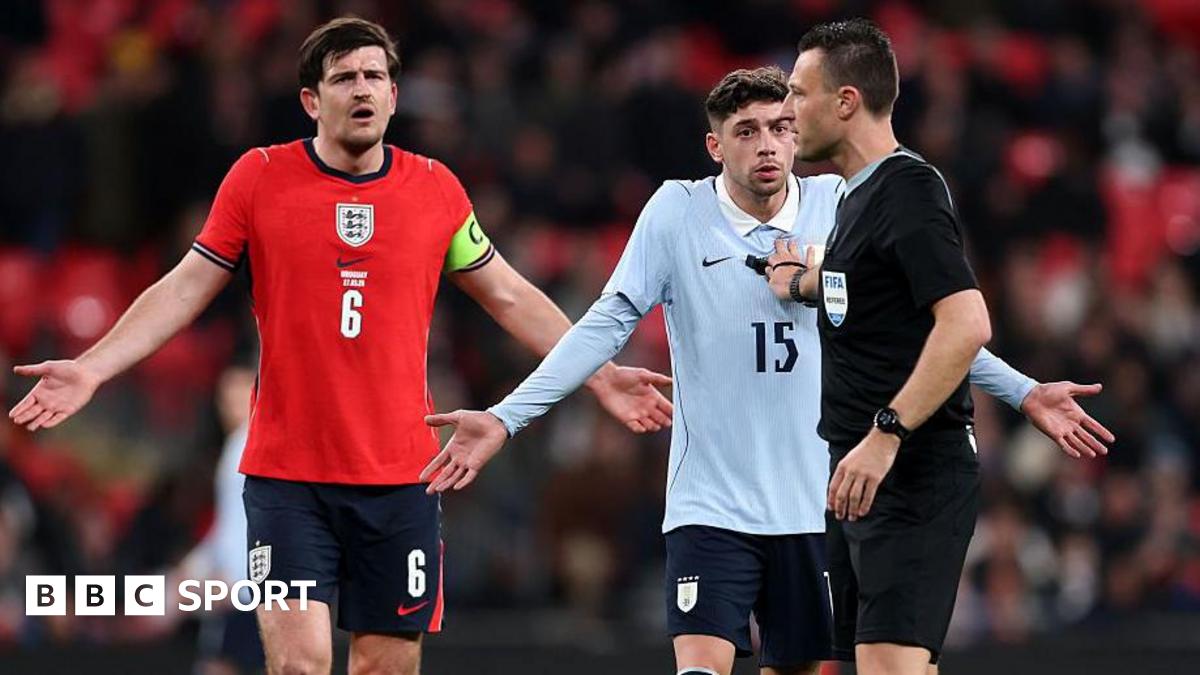
On a night of bizarre incidents, two of them centred around the goals.
White bundled home England’s opener from a corner, but there was a check by the video assistant referee (VAR) with Adam Wharton appearing to block Gimenez in the build-up.
Former Arsenal striker Ian Wright said on ITV: “Come the World Cup, they’d probably look at that and give it as a foul.”
USA Women head coach Emma Hayes added: “VAR was on and off tonight. I think nine times out of 10 blocking someone off like that is a foul and I was surprised it wasn’t given.”
Then came Uruguay’s equaliser.
White and Federico Vinas came together inside the box – and the referee originally allowed play to continue. But he was asked to go to the monitor by VAR after which he awarded a penalty that Valverde scored.
“I think the referee was in a very good position when he gave the initial decision,” former Tottenham goalkeeper Paul Robinson said on BBC Radio 5 live.
“That’s nothing more than clumsy from White. There is connection but he got the ball first. One of those decisions where if it’s not given on field you don’t interfere.”
There were fireworks, there was a flyover, there was Will Ferrell screaming and Keith Williams Jr. crooning and four months of cheers unleashed by fans wearing championship belts and howling grins.
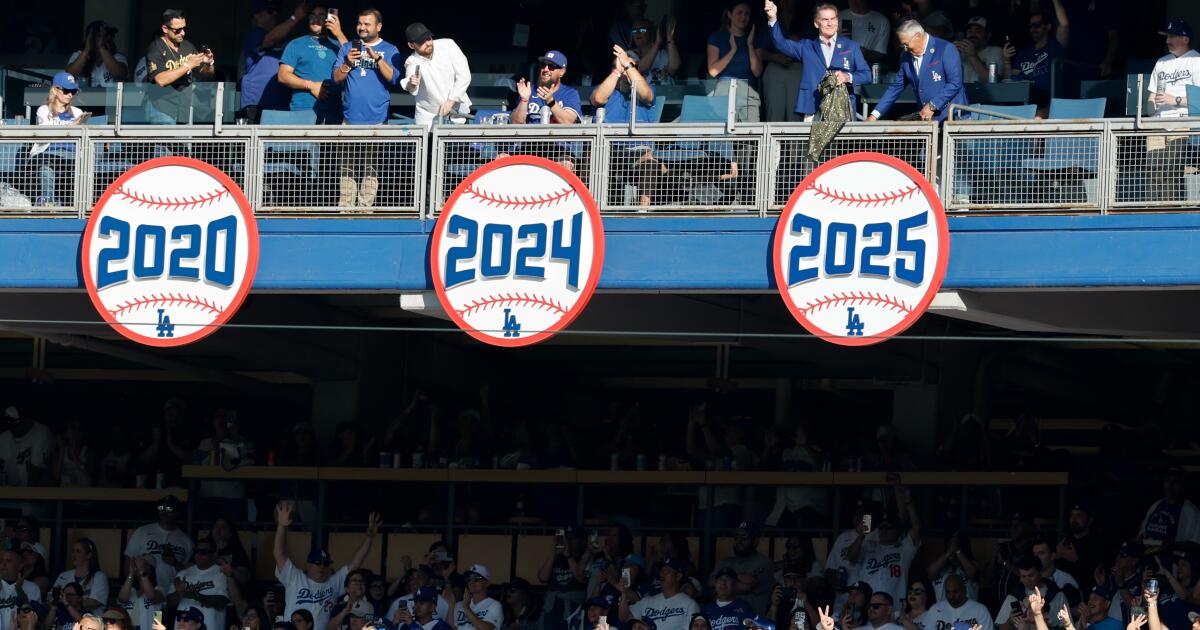
But the real stars of Thursday’s Dodger opening day show never made a sound.
They arrived silently at the end of the pregame ceremony, carefully held by two of the men who helped win them, lifted high for all those who so passionately longed for them.
They were the last two Commissioner’s Trophies, the back-to-back World Series championship trophies, the two symbols of the Dodgers domination held side by side in the afternoon sun.
Man, it was beautiful. Goodness, how they sparkled. Incredible, how they glowed.
It was almost as if they were powered by some electrical force, some sort of championship current running between them, lighting them up with a blinding power curated by the battered fingers of the two veterans who touched them.
Freddie Freeman, whose grand slam doomed the New York Yankees, held the 2024 trophy. Miguel Rojas, whose home run stunned the Toronto Blue Jays, held the 2025 trophy.
Together they brought the trophies to the dugout from center field while riding in the back of a blue convertible driven by Ferrell as part of an elaborate video skit.
It was the first time many had seen the hardware side by side, and, amid audible gasps, their power was unmistakable. The greatness of the Dodgers accomplishment came to life on a day when their new task became equally clear.
“Three-peat!” screamed one of the pregame musicians.
Welcome, Dodgers, to 2026.
While manager Dave Roberts downplayed the three-peat talk before the opening 8-2 victory over the Arizona Diamondbacks, you know it’s here, it’s there, it’s everywhere.
“At this moment, very minimal,” said Roberts when asked about the pressure. “…So yeah, hopefully we can keep that to a minimum throughout the season. But yeah, there’s obviously going to be a lot of talk about it.”
Thursday did nothing to dampen that talk. It was as if last season’s Game 7 against the Toronto Blue Jays was still being played. The Dodgers behaved like the exact same team with some of the same heroes.
The winning pitcher? Once again, it was Yoshinobu Yamamoto, who threw six solid innings with six strikeouts and no walks.
The game-changing play? Once again, it was Andy Pages, whose three-run home run in the fifth inning gave the Dodgers a lead they never lost.
The final big blow? Yep, Will Smith, whose two-run homer in the seventh inning clinched it.
Dodgers unveil the plaque for the 2025 World Series win.
(Ronaldo Bolanos / Los Angeles Times)
There was even a World Series star coming out of the bullpen, new cult hero Will Klein entering the game to the night’s loudest ovation and throwing a scoreless inning.
It’s as if the Dodgers have been on the same roll for four months…with no signs of slowing. This could be crazy. This already is crazy.
Other than the cool trophies and the Diamondbacks trampling, the most notable show Thursday was unwittingly staged by Dodger Stadium itself.
Your dutiful correspondent’s first impression of his favorite place on earth upon returning here for his 37th home opener wasn’t about the deep green or brilliant blue or enduring mountainscape.
It was, when did this place become Las Vegas?
Share via
Illuminated by the new grotesquely red Uniqlo Field billboard hanging high above center field, the stadium appears to have been transformed into something straight from NASCAR, advertisements filling every nook and cranny of the pavilion and beyond. There are giant billboards above the bullpens. There are scribbled ads on the bullpen walls. There are screaming displays for beer, soda and healthcare, the latter of which you will need if you heed too many of these ads.
The incessant sales pitches are buffeted by the usual deafening pounding music, which makes Vin Scully Avenue seem like Las Vegas Boulevard.
Was it always like this? It doesn’t seem like it. The Dodgers have always been relentless billboard salesmen, but since the arrival of Shohei Ohtani, they’ve become a global attraction with seemingly every major company on earth willing to pay for a piece of their success.
Fans will probably notice that the biggest difference this year is the $125-million sponsorship deal with Uniqlo, a Japanese apparel company that bought center field. Chavez Ravine is now officially known as Uniqlo Field at Dodger Stadium and, yeah, on Thursday it was awful hearing public address announcer Todd Leitz introduce it like that.
Not to worry, nobody in their right mind is ever going to call it that. Nonetheless, the whole atmosphere was weird and unsettling.
Still, it’s hard to blame the Dodgers. They’ve spent gobs of money building a two-time defending champion, and those bucks have got to come from somewhere.
You want Kyle Tucker? Live with the beer ad. You want a $1 billion rotation? Deal with the bank ad.
Dodgers Blake Snell, Kiké Hernandez, Roki Sasaki and Alex Call during player introductions before the game.
(Gina Ferazzi / Los Angeles Times)
Unlike many other teams that have made baseball a haven for cheapskates, the Dodgers invest much of their revenue back into the roster.
It’s not always pretty. It can be loud and distracting and obnoxious. But it works.
As night fell on a blessed blue Thursday, the Dodgers had won their eighth straight home opener. They did it with pitching, hitting, depth, and two of the prettiest pieces of jewelry you’ve ever seen.
It was a day to celebrate the completion of the most incredible two-year journey in franchise history.
It was also a day to realize that the journey has just begun.
He was on the bench for the Freeway Series finale at Dodger Stadium earlier this week, when manager Dave Roberts came over to check in and give Rojas the news.
“I didn’t know if ‘Thank you’ was the right thing to say because it’s something I earned,” Rojas recounted before the Dodgers’ 8-2 win Thursday against the Diamondbacks. “It’s not something that I asked for as a favor. So I was just kind of speechless.”
Rojas embraced Roberts.
“It was a gift to myself because of all the hard work and the preparation I put in throughout my whole career,” Rojas said. “This way is the best way possible because I got up to the big leagues as a utility defensive replacement who can play shortstop but couldn’t really hit much.”
Rojas, who intends to retire after this year, wrapped up his final opening day as a starter.
Opening day is a celebration across baseball. But the Dodgers made it a full production. The pregame program Thursday included roster-introduction pyrotechnics, along with a stage and blue carpet set up in center field.
From Bill Plaschke: There were fireworks, there was a flyover, there was Will Ferrell screaming and Keith Williams Jr. crooning and four months of cheers unleashed by fans wearing championship belts and howling grins.
But the real stars of Thursday’s Dodger opening day show never made a sound.
They arrived silently at the end of the pregame ceremony, carefully held by two of the men who helped win them, lifted high for all those who so passionately longed for them.
They were the last two Commissioner’s Trophies, the back-to-back World Series championship trophies, the two symbols of the Dodgers domination held side by side in the afternoon sun.
Man, it was beautiful. Goodness, how they sparkled. Incredible, how they glowed.
It was almost as if they were powered by some electrical force, some sort of championship current running between them, lighting them up with a blinding power curated by the battered fingers of the two veterans who touched them.
Get the latest on L.A.’s teams in the daily Sports Report newsletter.
By continuing, you agree to our Terms of Service, which include arbitration and a class action waiver. You agree that we and our third-party vendors may collect and use your information, including through cookies, pixels and similar technologies, for the purposes set forth in our Privacy Policy such as personalizing your experience and ads.
Mike Trout homers as Angels win
Mike Trout homered to launch what he hopes will be a bounce-back year, leading the Angels to a season-opening 3-0 win over the Houston Astros on Thursday.
Trout also walked three times and played center field for the first time since April 2024. The three-time MVP played 130 games last season, his most since 2019 because of various injuries.
Making his franchise-record 14th opening day start, the 34-year-old Trout broke a scoreless tie in the seventh inning when he sent a 96-mph fastball from reliever AJ Blubaugh (0-1) 403 feet onto the train tracks in left center. It was his fifth opening day homer, also a club record.
The Angels ended an eight-game road losing streak in season openers, starting 1-0 on the road for the first time since 2013.
From Marisa Ingemi: The UCLA women’s basketball team hasn’t lost a game in 120 days. In that time, the Bruins have outscored opponents by a total of 806 points and just one other school — Connecticut — has gone without a loss during the same stretch.
Yet somehow, the No. 1 seed in the Sacramento 2 region of the NCAA tournament hasn’t captured the same momentum and praise as the other three top seeds who have muscled their way into the Sweet 16.
UCLA (33-1) will play No. 4 Minnesota (24-8) at 4:30 p.m. Friday in Sacramento. The game will air on ESPN. Entering the matchup, is UCLA’s less dominant NCAA tournament run a cause for concern? Or is a win a win when it comes to March?
“Each game is going to present different adversity points,” UCLA coach Cori Close said. “And I think that we don’t look at it as getting back to something. We look at it as everything is a learning opportunity. ‘What does that teach us? How does that make us better? What kinds of things do we need to tighten up?’”
Darcy Kuemper made 19 saves for his third shutout of the season and 39th of his career to lead the Kings to a 4-0 victory over the Vancouver Canucks on Thursday night.
Mikael Granlund capped off his hat trick scoring on the power play with one second remaining in overtime on Thursday night to give the Ducks a 3-2 victory over the Calgary Flames.
Granlund has seven goals during a four-game goal streak that has him up to 19 on the season as the Ducks extended their winning streak to four games.
The Pacific Division-leading Ducks opened the night with a five-point cushion on the Edmonton Oilers and a six-point lead on the Vegas Golden Knights.
Eligibility for women’s competition will be determined by a one-time mandatory genetics test, according to the IOC. The test requires screening through saliva, a cheek swab or a blood sample.
No transgender woman competed at the 2024 Paris Summer Games, and it is unclear if any trans women currently compete at an Olympic level. Weightlifter Laurel Hubbard of New Zealand was the last to do so, competing in the 2021 Tokyo Olympics without winning a medal.
The new eligibility policy is not retroactive and does not apply to recreational sports programs. The IOC said in a statement that it “protects fairness, safety and integrity in the female category.”
“Eligibility for any female category event at the Olympic Games or any other IOC event, including individual and team sports, is now limited to biological females.”
1939 — Oregon beats Ohio State 46-33 in the NCAA’s first national basketball tournament.
1942 — Joe Louis knocks out Abe Simon in the sixth round at Madison Square Garden to retain his world heavyweight title.
1945 — Oklahoma A&M beats New York University 49-45 for the NCAA basketball championship.
1951 — Bill Spivey scores 22 points to lead Kentucky to a 68-58 win over Kansas State for the NCAA basketball title.
1960 — The Boston Celtics score a then NBA Finals record 76 points in the first half a 140-122 win over the St. Louis Hawks. Tom Heinsohn (24), Bill Sharman (23), Frank Ramsey (22) and Bob Cousy (20) each score 20-or-more points to win the series opener.
1971 — UCLA beats Villanova 68-62 for its fifth NCAA basketball title.
1978 — Jack Givens scores 41 points to lead Kentucky to a 94-88 victory over Duke for the NCAA basketball title.
1983 — Larry Holmes wins a unanimous 12-round decision over Lucien Rodriguez to retain his world heavyweight title in his hometown of Scranton, Pa.
2005 — Annika Sorenstam shoots a final-round 68 to finish at 15-under to win the Nabisco Championship by eight shots over Rosie Jones. It’s he 59th victory of the Swedish star’s LPGA Tour career — and her eighth major championship win.
2010 — Long shot Al Shemali wins the $5 million Dubai Duty Free, pulling away from a crowded field to pull off a surprisingly easy win in the Dubai World Cup. Al Shemali, at 40-1, starts slow then duels it out with Bankable before taking the lead for good.
2011 — Jamie Skeen scores 26 points as Virginia Commonwealth delivers the biggest upset of the NCAA tournament, a 71-61 win over No. 1 seed Kansas in the Southwest Regional final.
2014 — The Philadelphia 76ers tie the NBA record for futility with their 26th straight loss, falling 120-98 to the Houston Rockets. Philadelphia matches the 2010-11 Cleveland Cavaliers for the NBA’s worst skid.
2017 — UConn’s women’s basketball team advance to its 10th consecutive Final Four with a 90-52 victory against Oregon. The victory moves coach Geno Auriemma past Pat Summitt for the most NCAA tournament victories at 113.
Compiled by the Associated Press
Until next time…
That concludes today’s newsletter. If you have any feedback, ideas for improvement or things you’d like to see, email me at houston.mitchell@latimes.com. To get this newsletter in your inbox, click here.
How would you feel about getting a dream gig only to see it end in disgrace because of, well, you?
That’s what Gregory Bovino gets to think about for the rest of his life. Friday is the Border Patrol lifer’s last day on the job after 30 years — and he ain’t leaving because he wants to.
For the past year, the self-described “hillbilly” was the personification of the Trump administration’s xenophobic deportation deluge. Helicopter invasions of apartment complexes, tear gas canisters thrown into large crowds, defying court orders, glamorous photo shoots: There was no municipality too big, no tactic too crazy, no quote too incendiary for Bovino to take on while he treated immigrant neighborhoods like the shores of Normandy.
The North Carolina native’s caravan of cruelty quickly earned him a promotion from El Centro sector chief to Border Patrol commander at large, a new position crafted just for him. He embraced the role of migra bogeyman like a tween boy scarfing down a bowl of Warheads, always promising more deportations, more chaos, more more.
Not anymore.
In January, Border Patrol agents shot and killed ICU nurse Alex Pretti during a protest against them a few weeks after an Immigration and Customs Enforcement officer did the same to Renée Good, a mother of three. Bovino threw napalm on the matter by claiming Pretti wanted to “massacre law enforcement” without offering any evidence. The incidents so soured the public on immigration agents that a Public Religion Research Institute poll released this week showed only 35% of Americans surveyed approved of how Trump is handling immigration, compared to 48% a year ago.
Bovino was sent back down to El Centro and lost his social media privileges, where he had long posted cringe-inducing videos about what a swell guy he was. Even Trump turned on his migra man, telling Fox News that Bovino was “a pretty out-there kind of a guy … and in some cases that’s good. Maybe it wasn’t good [in Minneapolis].”
I should’ve warned Bovino the one time we met that failure was his fate.
Dressed in full Border Patrol uniform complete with a clipped-on walkie-talkie on his shoulder, the guy was billing himself as a modern-day Charles Martel defending the homeland from invading infidels. The nasal-voiced Bovino rambled to Michaelson about how “Ma and Pa America” deserved a country free from undocumented immigrants and vowed to remain in Los Angeles “until the operation is over.”
Then-U.S. Border Patrol commander at large Gregory Bovino, center, along with Border Patrol agents as they march to the Edward R. Roybal Federal Building after a show of force outside the Japanese American National Museum where Gov. Gavin Newsom was holding a redistricting press conference on Aug. 14, 2025, in Los Angeles.
(Carlin Stiehl / Los Angeles Times)
After his interview, Bovino and three Border Patrol agents strolled into the greenroom to grab some homemade cookies while I sat on a couch. He looked me in the eye while bending down to sign Michaelson’s guest book, as if he expected me to not only recognize him but say something.
It was like staring at someone doing an impersonation that was one part Lt. Col. Kilgore from “Apocalypse Now” and two parts Henery Hawk, the short, brash Looney Tunes character that was always trying to capture the much larger Foghorn Leghorn. He really thought that his scorched-earth assault on L.A. would defeat the city and convince other communities to offer no pushback once Bovino’s self-titled “Green Machine” trolled into town.
The opposite happened.
People who had never bothered with politics — even some who voted for Trump or at least agreed with deporting immigrants with criminal convictions — rose up to resist. Everywhere became a front — social media, the streets, courtrooms — and activists across Southern California began to share notes among themselves and with communities nationwide to prepare them for la migra. Bovino flailed back at every affront instead of focusing on his mission, not realizing his recklessness was eroding public support for his cause and threatening it altogether.
That’s when he convinced the Trump administration to send a skeptical National Guard alongside his men to surround the historic L.A. green space in the ludicrously named Operation Excalibur. Armed vehicles parked on Wilshire Boulevard. A grinning Bovino strutted around with media in tow. A wannabe cavalry unit, anchored in the center by an agent on a white horse, swept through a soccer field where children were attending day camp just minutes before.
No one was arrested or detained that day. Instead, Bovino left to a chorus of cuss words and boo birds. The exercise allowed Americans to see the folly of burning millions of taxpayer dollars just so someone could star in a TikTok reel. It also broke the spell Bovino had cast over many critics — myself included — who had feared he truly was an unstoppable Punisher.
Nah, he was just a spiky-haired pendejo.
If Bovino was as smart as he thinks he is, he would’ve followed the longtime strategy of another longtime immigration enforcer. Trump border czar Tom Homan executed a yearslong roundup under the Obama administration with numbers Trump has yet to reach and with nowhere near as much public rancor. Homan, who loves the camera almost as much as Bovino, knew then and now that an issue as explosive as deportations must be approached quietly if it’s to be done successfully.
Instead, not only does he have to clean up Bovino’s mess, there’s now a real chance that the Republicans will lose the midterms because of Latinos who voted for Trump in 2024 but are now furious at his administration. That’s why even Trump is now telling Republicans to tone down their anti-immigrant rhetoric, stat.
Gracias, Bovino!
You thought you would go down in U.S. history as a domestic Patton, a borderlands Sherman. Instead, your last week coincided with the publication of a New York Times profile of you railing at enemies while downing coffee at a burger bar in El Centro.
You called Customs and Border Protection commissioner Rodney Scott “weak-kneed,” mocked Homan and said you could’ve deported 100 million people — a radically racist number considering even the Center for Immigration Studies, which has long pushed for reduced immigration of all kinds, estimated a record 15.4 million illegal immigrants were in this country at the start of Trump’s second term.
Instead, you’re heading off to the Tar Heel State to spend your days hunting… coyotes.
“Maybe I get me some dogs and we go hard,” you told the New York Times. “I’ll take it in my own hands.”
Which reminds me of another hapless cartoon character who thought himself a genius but who kept screwing things up in ceaseless pursuit of his quarry: Wile E. Coyote.
Hi, and welcome to another edition of Dodgers Dugout. My name is Houston Mitchell. The long journey to the postseason begins today.
Are you a true-blue fan?
Get our Dodgers Dugout newsletter for insights, news and much more.
By continuing, you agree to our Terms of Service, which include arbitration and a class action waiver. You agree that we and our third-party vendors may collect and use your information, including through cookies, pixels and similar technologies, for the purposes set forth in our Privacy Policy such as personalizing your experience and ads.
As we embark on the 12th season of this newsletter, there are certain things, like death and taxes, that are guaranteed. Here they are.
—The Dodgers will charge way too much to park in their poorly designed, poorly lit parking lot.
—Shohei Ohtani will have a game where he strikes out 10 and hits multiple home runs. No one will be able to explain how he does this until we learn he was actually sent here by the aliens from “Project Hail Mary.”
—Ohtani will go hitless for three-to-four games in a row and have a bad pitching outing during the same time, leading to some to say he is overpaid.
—Will Smith will catch at least 130 games and be in the conversation for NL MVP.
—The Padres will be better than most are saying and their fans will approach the games with the Dodgers as if it is their World Series.
—The Rockies will be terrible again.
—Teoscar Hernández will continue to struggle as a fielder, but people won’t care as much as his bat will be rejuvenated.
—A pitcher no one has heard of will be signed by the Dodgers off the waiver wire. He will appear in a game and pitch great, maybe even getting the win. The following week, he will be designated for assignment.
—Mookie Betts will win the Gold Glove at short, and while he won’t reach his previous heights at the plate, he will hit better than last season.
—Andy Pages will slump at some point and fans will demand that Ryan Ward, who is hitting .350 with about a million homers in the minors, get a chance. He won’t get a chance and Pages will recover.
—Fans will complain that Joe Davis takes too many games off and isn’t a true Dodger like Vin Scully was, even though Vin took just as many games off for national duties.
—The music at Dodger Stadium will continue to be so loud that even the aliens from “A Quiet Place” will complain. (Editor’s note: Two outer space aliens references in one newsletter. What is wrong with this guy?)
—The most worn former Dodger jersey worn by fans at the stadium will continue to be… Fernando Valenzuela‘s. And it will be for many years to come.
—Max Muncy will look like the worst hitter in baseball for an extended period, then he will hit like Babe Ruth.
—Dalton Rushing will be a decent backup for Smith and will hit well enough that he can spell Freddie Freeman at first base on occasion.
—Freeman will hit .300 again in what will be his last great season at the plate.
—The Dodgers will continue to “give away” games during the season in order to be ready for the postseason. For example, they will allow a reliever to take a beating in a game at the start of long road trip in order to preserve the rest of the bullpen. Some fans will be irate at this, thinking the Dodgers should try to win every game at all costs.
—The Cool-A-Coo will not return to Dodger Stadium and will continue to be missed.
—The Dodgers will continue to call the hot dog they sell a Dodger Dog, even though it tastes nothing like a Farmer John Dodger Dog.
—Only three pitchers will pitch more than 100 innings, but the quality of the staff from top to bottom will be more consistent throughout the season, allowing them to use fewer than 40 pitchers this season.
—Either Blake Treinen or Tanner Scott will continue to pitch poorly, but the Dodgers, again with their eye on the postseason and on how much money they are paying these guys, will continue to trot them out there in hopes they will rebound.
—Some fans will complain about the abhorrent price of going to a Dodger game. They will still go though, and the Dodgers will draw four million, giving them no reason to lower prices.
—Justin Turner will sign a one-day contract with the team and then retire.
—Edwin Díaz will save 30 games and give the bullpen some much-needed stability.
—Kyle Tucker won’t hit as well as hoped, but will be a significant upgrade over Michael Conforto.
—Hyeseong Kim will come up at some point, wow fans with his blazing speed, hit close to .300, and then be sent back down.
—Dave Roberts will have a bad game or two where he makes a decision that seems nonsensical. Some will demand he be fired because “Anyone could manage this team.” Those people will be wrong.
—You will continue to need to subscribe to about a dozen streaming channels to watch all the Dodger games on TV. No one will.
—Yoshinobu Yamamoto will lead the team in victories.
—Organist Dieter Ruehle will continue to find the perfect song for any situation.
—Tyler Glasnow will look unbeatable one start, then get thrown off his next start by a hangnail and pitch like Dave Goltz.
—There will be thrilling victories, agonizing defeats and some boring games. But it will all be worth it as we look around and see all the different types of Dodger fans out there, reminding us that baseball unites us.
—The Dodgers will finish the season 98-64 and cruise to the NL West title. They will not have to play in the wild-card game.
—And that means they will be in the postseason where … anything can happen.
—So, don’t get so worried about the destination that you forget to enjoy the ride.
How many games will the Dodgers win?
We asked, How many games will the Dodgers win this season? After 10,566 responses:
They will win 96-100 games, 46.3% They will win 101-110 games, 35.5% They will win 91-95 games, 13.2% They will set the record by winning more than 116 games, 2.3% They will win 111-115 games, 1.6% They will win 86-90 games, 0.9% They will finish under .500, 0.2% They will win 81-85 games, one vote
We asked, Will the Dodgers win the World Series this season? After 10,538 responses:
Yes, 79.1% No, 20.9%
A walking path to Dodger Stadium?
Did you know there is a walking path to Dodger Stadium? There is a one-mile walking path from the Chinatown Metro station to Dodger Stadium. There’s one problem though, to quote Bill Shaikin‘s column on the path: “To go a very short distance safely with a feeling that you’re not going to die is very difficult.”
Our opening day tradition: Danny Kaye sings the Dodgers song. Watch and listen here.
Until next time….
Have a comment or something you’d like to see in a future Dodgers newsletter? Email me at houston.mitchell@latimes.com. To get this newsletter in your inbox, click here.
First baseman Freddie Freeman, pausing outside of the Dodgers’ home dugout to talk about the upcoming season, nodded his head toward the right-field foul pole, where just beyond it the Dodgers’ championships signs are displayed.
Eight baseball-shaped signs sported their years — 1955, 1959, 1963, 1965, 1981, 1988, 2020, 2024 — while a ninth was still shielded by a blue cover, with plenty of room along the stadium’s club level for more.
“You want to just keep putting those banners up,” Freeman said. “That one’s blocked for a reason. You want to do it again. You want to keep doing it over and over and over again. And that’s what’s fun, and then that’s what makes everything else just take care of itself.”
The 2025 championship sign will be revealed as the Dodgers both celebrate last year’s achievements and set the tone for this year.
They’ll receive their World Series ring on Friday, but they’ll also be in the midst of playing three games against the Arizona Diamondbacks.
“Everyone’s different,” Freeman said. “Some people want to move on and get on to the new season and not worry about last year. I’m one of the guys that can appreciate what we did last year, even in the present year.
“It’s hard to win a World Series. I don’t like to just kick it to the side. … Our fans haven’t celebrated it since the parade. We get to celebrate with our fans and open the weekend. It’s going to be a great time.”
“I get my ring, and I put it in the safe, and I don’t really look at it ever again,” he said when asked about the ring ceremony. “It brings back all the emotions from the prior year, you like showing friends and stuff, it’s cool. But no, for me, the motivation is just winning, being with these guys each and every day, and competing with them and working towards that goal.”
On that point, Dodgers players seem to agree.
They don’t need a tangible reminder of their World Series aspirations this year.
“It’ll be one of the few days where we really think about what we did last year, versus what we’re trying to do right now,” veteran third baseman Max Muncy said.
Plenty of teams say their goal is to win the World Series. But the Dodgers have raised their outside expectations, too. Entering Thursday, PECOTA put the Dodgers’ odds of completing a three-peat at 20.8%, by far the highest World Series chances in the majors. PECOTA, Baseball Prospectus’ projection system, listed the Mariners as next most likely to win the World Series, at 14.2%.
While those numbers establish a clear favorite, they also reflect how unpredictable the postseason can be. Even the Dodgers, with their lofty payroll and strong player development track record, will need health, luck, and the right mindset to pull off a third straight championship.
“You know what the goal is every single year, and that’s to be the last team standing at the end,” Mucy said. “But we more so preach, how do you get there, instead of that being the goal. And for us, it’s always been, you have to take it one day at a time.”
The phrase itself isn’t a novel concept. The trick is making that focus a reality, and a team standard.
“I talk about it every day,” manager Dave Roberts said. “I’ve talked about it since I got here. It’s just, let’s win a baseball game. That’s our mantra, and everyone in this building, that’s the goal.”
The veterans on the team preach it too, hoping to pass down that team-first focus to the generation coming behind them.
“When you put on this uniform, you come in here, you see all these superstars working extremely hard every single day — front office, ownership group doing the same thing — that’s the expectation,” Freeman said. “It’s a different standard, and you just want to be part of that standard that keeps the level high.”
After the commotion of the championship banner reveal and the ring presentation the first two days of the season, “let’s win a baseball game,” will continue to be the mantra.
Maybe it will even work well enough, day after day, for the Dodgers to add another sign to their championship display this time next year.
When Estuardo Mazariegos was 22, he was pulled over by Los Angeles police officers who found a gun and ammunition in the back seat of his Nissan Sentra.
The gun, he said, was not his. He was holding onto it for a friend, he said, but he got hit with a felony gun possession charge, later pleading it down to a misdemeanor.
Seventeen years later, Mazariegos is running for Los Angeles City Council — and he believes his gun conviction makes him a better candidate.
“I think it’s a strength. It’s not a liability,” said Mazariegos, who was born in Guatemala and grew up in Hollywood and South L.A. “I feel like it creates more of a connection with me and the community, because there’s so many people that are justice-impacted.”
But the gun charge could also be an issue for Mazariegos in his race against five other candidates to represent Council District 9, which covers part of South L.A. He was also convicted of shoplifting when he was 19.
The district is the poorest the city, and the council race is expected to be one of the most competitive city contests this June, with the current council member, Curren Price, terming out.
Mazariegos is head of the Alliance of Californians for Community Empowerment Los Angeles, a grassroots advocacy organization. The 40-year-old is backed by the L.A. chapter of the Democratic Socialists of America and supports leftist policies like reducing funding to the LAPD to spend more on other programs.
Jose Ugarte, a District 9 candidate who was a longtime Price staffer, believes his opponent’s criminal history is a red flag.
“Getting arrested and convicted for multiple crimes, including carrying a concealed loaded gun, should disqualify Estuardo in this race,” Ugarte said in a statement. “Instead, the Democratic Socialists of L.A. are propping up his candidacy and hiding his criminal past from voters who deserve to know the truth.”
DSA-LA co-chair Leslie Chang said her group is “proud” to stand with Mazariegos.
Mazariegos’ supporters say he hasn’t hidden his past.
Georgia Flowers-Lee, a vice president with United Teachers Los Angeles, said Mazariegos discussed his gun conviction and the circumstances surrounding it during his interviews with the union, which ended up endorsing him.
“He was up front, honest about the challenges and honest about the gun charge,” she said. “Walked us through what had happened and where it led and how and why he ended up pleading it out,” she said.
Flowers-Lee, who lives in the district, said that young men of color like Mazariegos are overpoliced.
“I do not see this as a disqualifier. And let’s talk about redemption,” she said.
Wednesday night, Mazariegos released a campaign video featuring him discussing gun violence and his conviction with childhood friends. He said it was a turning point in his life.
“That was the moment where I was like, it’s either now or never,” he said. “Either I leave this s— behind, or it’s going to eat me up. I’m never going back to that lifestyle. I’m going to dedicate myself to the people.”
Mazariegos said he never carried a gun, except for that one day, but many of his friends did.
“Guns were a very common thing. It was almost like having a bike,” he said.
Mazariegos said that in 2009, he was driving home from the San Fernando Valley in the early morning, after dropping friends off, when he was pulled over by the LAPD. He said the officers gave no reason for stopping him, but they made him get out of his car and searched it without a warrant, finding the gun.
He was a permanent resident at the time, after moving from Guatemala at a young age, and was advised by his attorney to plead guilty to a misdemeanor charge of carrying a concealed weapon in a vehicle, to avoid possible deportation, he said.
He was sentenced to 24 months of probation and one day in jail, court records show.
Growing up in Hollywood and Hyde Park, among other parts of the city, Mazariegos was intimately familiar with gun and gang violence.
His friend, Oscar Michael Morales, was shot to death in 2001 at age 14. He remembers Morales’ mother cleaning the blood off the sidewalk the next day.
His gun conviction helps him connect with residents of Council District 9, Mazariegos said, and he frequently discusses it while door-knocking.
Price himself has been criminally charged with four counts of voting on matters in which he had a conflict of interest, five counts of embezzlement and three counts of perjury. Prosecutors allege he voted to approve deals with developers or agencies that had done business with his wife.
1 of 3 | Union Station is largely empty amid lockdowns and social distancing due to the COVID-19 pandemic April 24, 2020, in Washington, D.C. On March 26, 2020, new unemployment claims in the United States surged to 3.3. million, the largest weekly increase in U.S. history to date amid job losses related to the pandemic. File Photo by Tasos Katopodis/UPI | License Photo
March 26 (UPI) — On this date in history:
In 1830, the Book of Mormon was published. There are about 200 surviving first editions of the book, one of which was stolen before being returned to its owner in 2013.
In 1971, East Pakistan declared independence as Bangladesh, sparking the Bangladesh Liberation War. The war ended Dec. 16, 1971, when West Pakistan surrendered.
In 1975, the city of Hue in South Vietnam fell to the North Vietnamese army.
In 1991, Mali’s dictator, Gen. Moussa Traore, was overthrown in a violent overnight military coup. Fifty-nine people died.
In 1992, former heavyweight boxing champion Mike Tyson, convicted of raping a teenage beauty pageant contestant, was sentenced to six years in prison. Tyson was released after three years.
File Photo by Jim Ruymen/UPI
In 1997, 39 members of the Heaven’s Gate religious cult were found dead in a large house in Rancho Mirage, Calif., in what authorities said was a mass suicide.
In 1999, Dr. Jack Kevorkian, the euthanasia advocate, was convicted of second-degree murder in an Oakland County, Mich., courtroom for the videotaped “medicide” of a man suffering from Lou Gehrig’s disease.
File Photo by Vaughn Gurganian/UPI
In 2000, acting Russian President Vladimir Putin was elected president by a more than 20 percent margin. Putin won a third term in 2012.
In 2014, a National Labor Relations Board regional director ruled that Northwestern University scholarship football players were employees of the school and entitled under federal law to form a union.
In 2020, new unemployment claims in the United States surged to 3.3. million, the largest weekly increase in U.S. history to date amid job losses related to the COVID-19 pandemic.
In 2024, a Singapore-based cargo ship struck the Francis Scott Key Bridge in Baltimore, causing a catastrophic collapse of the structure. Six people died in the failure of the bridge, which crossed the Patapsco River.
The US and Israel’s war on Iran is intensifying, as Trump again claims Iranian leaders want to ‘make a deal’.
Published On 26 Mar 202626 Mar 2026
The United States and Israel’s war on Iran continues, with an Al Jazeera correspondent in Tehran reporting strikes are “increasing in number and in intensity” amid conflicting claims about whether negotiations are taking place.
US President Donald Trump says talks are happening, but Iran rejects the talks, saying it will continue to “resist” US aggression.
On Thursday, Iran carried out retaliatory strikes against Israel and several Gulf countries, as the Middle East conflict sees no signs of ending, and global energy and food prices continue to rise.
In Iran
Intensifying attacks: US-Israeli attacks on Iran are “increasing in number and in intensity”, according to Al Jazeera correspondent, with Israel announcing extensive strikes on central Isfahan. Alongside US forces, Israel has launched a “wave of extensive strikes” across Iran.
Civilian casualties reported: Iranian media reported that two teenage boys were killed in a recent US-Israeli strike on a residential area in a village in the county of Shiraz.
Iran talks: US President Donald Trump insisted that Iran was taking part in peace talks.
Iran chooses ‘resistance’: Foreign Minister Abbas Araghchi said Tehran will continue its “resistance” and does not intend to negotiate.
US targets missile capacities: The US has hit two-thirds of Iran’s production facilities for missiles and drones, a top officer said.
Threat to Iranian island: Tehran warned enemies may try to occupy one of its islands with support from an unnamed regional country.
Iran’s leverage: Jane Foley, an analyst from Rabobank, noted that Tehran’s position on negotiations leaves the ball firmly in their court. Because the critical Strait of Hormuz remains effectively closed, she suggests Iran could have the power to dictate the terms of any resolution.
New toll legislation: The Iranian parliament is preparing a draft law that would mandate the collection of tolls and duties from ships and tankers transiting the Strait of Hormuz, treating the waterway like a standard transit corridor.
In the Gulf
Hezbollah plot uncovered in Kuwait: Authorities arrested six people allegedly linked to Hezbollah, accused of planning assassinations in the Gulf state, the Interior Ministry said.
Saudi Arabia: Saudi Arabia’s Defence Ministry on Thursday morning announced the interception and destruction of a drone in the Eastern Province. Its air defence systems intercepted and destroyed at least two dozen drones targeting the Eastern Province, home to the majority of the kingdom’s oil facilities, on Wednesday.
Bahrain: A fire broke out at a facility in the Muharraq Governorate due to what the Interior Ministry described as “Iranian aggression”.
United Arab Emirates: The UAE’s Defence Ministry said on Thursday that its air defence systems have been actively responding to and intercepting incoming missiles and drones from Iran.
In the US
Trump says Iran wants a deal: Trump again claims Iranian leaders want to “make a deal so badly” but are afraid to say so “because they figure they’ll be killed by their own people”.
Trump threatens ‘hell’ if no deal: Trump is ready to “unleash hell” on Iran if Tehran does not accept a deal to end the war, the White House warned on Wednesday.
Strategic posturing: Jason Campbell, a former Pentagon official, said US threats to “hit Iran harder” are more about signalling than intensifying attacks.
Intentional vagueness: Campbell told Al Jazeera that Trump is deliberately omitting specific details because he wants the Iranian regime to believe the US is fully capable and willing to execute these harsher attacks.
In Israel
Missile salvoes: Israel’s army on Thursday morning said it had detected a wave of missiles from Iran heading towards the country, the second salvo in less than 30 minutes.
Rockets and missiles targeting Israel: Iranian missiles continue to target central and northern Israel. Additionally, Hezbollah has fired volleys of rockets into the Western Galilee region.
In Iraq, Lebanon
Gulf issues Iraq demand: Gulf states and Jordan have urged Iraq to stop attacks by pro-Iran armed groups from its territory.
Ground clashes with Hezbollah: Israeli troops have crossed the border into Lebanese territory and are actively engaging in ground combat. Hezbollah says its fighters are continuing to clash with invading Israeli troops in south Lebanon.
Defending Lebanese soil: Hezbollah’s Secretary-General Naim Qassem stated that the group is now in a war against both the US and Israel and will do everything it can to defend Lebanese territory.
Oil markets and food
Oil prices climb: Oil prices have climbed higher amid fading hopes of de-escalation in the Iran war following Tehran’s rejection that talks with the US are under way.
Food supply shocks: Antony Currie, a columnist for Breakingviews, warned that the Iran war will likely have a more severe impact on global food security than Russia’s 2022 invasion of Ukraine.
Security guard Pascal Duvier, most recently infamous for allegedly scolding 11-year-old Ada Law at a hotel in São Paulo, is clearing the air.
Duvier issued a statement on Instagram on Wednesday night following four days of back-and-forth social media claims from soccer star Jorginho, his wife, Catherine Harding (singer-songwriter Cat Cavelli), and pop star Chappell Roan, who denied involvement in an incident that left Ada (the biological daughter of Jude Law and Harding) in tears ahead of her birthday celebration.
As a result of the controversy, speculation around Roan’s treatment of her fans has flooded social media for days. The “Hot to Go!” hitmaker has been vocal in the past about setting boundaries with fans and paparazzi, as well as her complicated relationship with fame.
Duvier, who insists he was not working for Roan at the time of the incident, began his statement saying that he does not normally address online rumors, “but the accusations currently circulating are false and constitute defamation.”
“I take full responsibility for the interactions on March 21st,” he wrote. “I was at the hotel on behalf of another individual, and I was not part of the personal security team of Chappell Roan.
“The actions I took were not on behalf of Chappell Roan, her personal security team, her management, or any other individuals. I made a judgment call based on information we obtained from the hotel, events I had witnessed in the days prior and the heightened overall security risk of our location. My sole interaction with the mother was calm and with good intentions, and the outcome of the encounter is regretful.”
Roan headlined Lollapalooza Brazil over the weekend, and Jorginho was in attendance along with his wife and stepchild. While there, the footballer said the 11-year-old (whom he did not name) thought she spotted the pop star at their São Paulo hotel.
The girl passed by Roan’s table “to confirm it was her, smiled, and went back to sit with her mum. She didn’t say anything, didn’t ask for anything,” he wrote.
Jorginho alleged that, after the girl sat down, a “large security guard” interrupted their breakfast to scold them. The guard allegedly told Harding “she shouldn’t allow [her] daughter to ‘disrespect’ or ‘harass’ other people.”
The girl was “extremely shaken and cried a lot,” said Jorginho, a player for the Brazilian club Flamengo whose legal name is Jorge Luiz Frello Filho.
On Sunday, Roan responded on Instagram, seemingly baffled by the swirling controversy. She insisted the guard was not her personal security and that no one had approached her.
“I did not ask the security guard to go up and talk to this mother and child. … They did not come up to me. They weren’t doing anything.
“I do not hate people who are fans of my music. I do not hate children.”
Three days ago Harding also responded to the brouhaha, posting her own video on Instagram in an attempt to bring some clarity following Roan’s statement. “So 100% this security guard was not a security guard of the hotel, that’s what I can say,” she said. “He looks after artists.
“So I don’t know if it was her personal security guard, but he was with her. So that is all I know. Did she send him to do it? Again, I don’t know.”
Duvier, a “protection specialist” and martial artist, according to his Instagram bio, worked for Kim Kardashian in 2016.
Times Deputy Editor Amy Hubbard contributed to this report.
NEW YORK — Wellness influencer Dr. Casey Means’ nomination to be U.S. surgeon general is stalled a month after senators of both major political parties grilled her on vaccines and other health topics during a tense confirmation hearing, deepening doubts about her ability to secure the votes she needs for the role.
The nomination has languished despite ongoing efforts from the White House and Make America Healthy Again activists, revealing how intractable rifts over health policy can be even when Congress has shown deference to President Trump. It’s become the latest snag in Health Secretary Robert F. Kennedy Jr.’s agenda after two legal setbacks last week.
Means, a 38-year-old Stanford-educated physician who became disillusioned with traditional medicine and did not finish her surgical residency program, has faced scrutiny for her lack of experience and potential conflicts. Another sticking point has been her close alignment with Kennedy, whose efforts to dramatically pull back vaccine recommendations have been slammed by lawmakers and medical groups.
To advance to a full Senate vote, Means likely needs every Republican on the Senate Health, Education, Labor and Pensions Committee to support her nomination. But after last month’s hearing, two of them — Sens. Lisa Murkowski of Alaska and Susan Collins of Maine — told reporters they still had questions for her.
Murkowski told reporters Tuesday that “I’m just in the same spot” when it comes to those hesitations. Collins and Republican committee chairman Sen. Bill Cassidy, a physician from Louisiana who interrogated Means about vaccines during the hearing, didn’t respond to multiple inquiries about the delay.
White House spokesman Kush Desai said in a statement that the Trump administration has been having “productive conversations with the Senate” to advance Means. He added that her “elite academic credentials, research background and advocacy on America’s chronic disease epidemic will make her a critical asset for President Trump’s push to Make America Healthy Again.”
Kennedy spokesman Andrew Nixon reinforced the Republican administration’s support for Means and praised her message calling for healthier lifestyle choices rather than “sick care.”
Contentious hearing set the stage for a tough path to confirmation
Means promotes ideas popular with the MAHA movement, including that Americans are overmedicalized and that diet and lifestyle changes should be at the center of efforts to end widespread chronic disease.
But she’s been criticized for having an inactive medical license, for sometimes failing to disclose financial relationships with brands she promotes and for some of her past health-related comments.
Senators asked her during her hearing about how she would speak to the public about vaccines.
Murkowski and Cassidy pressed Means about her past doubts about the birth dose of the hepatitis B vaccine, which the U.S. Centers for Disease Control and Prevention stopped recommending for all children late last year in a move later temporarily blocked by a federal judge. Means called the hepatitis B vaccine important and lifesaving but said parents should make their own decisions with their doctors.
Cassidy also asked Means whether she would advise Americans to vaccinate against the flu and measles amid outbreaks across the country. She didn’t make that commitment, instead emphasizing the importance of informed consent.
Collins asked Means about her past advocacy for the therapeutic use of psychedelic mushrooms. Means, who has spoken positively of her own experience with the drugs, said she wouldn’t recommend psychedelics for the American public.
Kennedy’s supporters put pressure on hesitant senators
Once it appeared Murkowski and Collins were undecided, MAHA activists orchestrated a push to support Means’ bid by surging phone calls to the two senators.
“Please call both of them. Call them time after time. Get your friends to call them,” Tony Lyons, head of the Kennedy-aligned group MAHA Action, told supporters earlier this month.
Others have loudly opposed Means’ nomination. Dr. Jerome Adams, Trump’s first-term surgeon general, has repeatedly called her unqualified for her lack of an active medical license. He said in an interview that Republicans in Congress and in the Trump administration have told him they disapprove of the pick but see it as Kennedy’s choice.
“What I keep hearing from folks is, ‘This is what Bobby wants,’” he said.
While surgeons general aren’t mandated by law to have an active medical license, they are required to be part of the U.S. Public Health Service Commissioned Corps, a group of health professionals that says members should have up-to-date licenses.
Means said during her confirmation hearing that she had voluntarily made her Oregon medical license inactive, and that Adm. Brian Christine, who runs the Commissioned Corps, had testified that she was eligible to serve.
Even if Means advances out of committee, she might have difficulty securing confirmation by the full 100-member Senate. Republican Sen. Thom Tillis of North Carolina, who isn’t seeking another term, told the Associated Press that he’s leaning against voting for Means.
“Her resume already puts me on alert — and then I don’t think she did herself any favors in the hearing,” Tillis said.
Means’ confirmation delay is unusually long
At nearly 300 days since her nomination in May, Means’ confirmation process has taken almost twice as long as the average presidential pick in Trump’s second term, according to data from the nonprofit Partnership for Public Service. The group found that in the first 400 days, the average time between nomination and confirmation for Trump’s nominees was 157 days.
Sometimes the process has gone far more quickly. Markwayne Mullin, the new Department of Homeland Security secretary sworn in Tuesday, had his confirmation hearing, floor vote and swearing-in all within a weeklong period.
One reason for Means’ drawn-out nomination is the birth of her son, which happened last October on the day of her initially scheduled confirmation hearing.
But Chris Piper, manager of public policy and stakeholder engagement at the Partnership for Public Service, said the length of time that has passed since Means’ rescheduled confirmation hearing also is unusual. He said candidates are often voted out of committee within a week of their hearing.
“A monthlong delay following a hearing is atypical for most nominations, particularly at this level of position,” he said.
Swenson writes for the Associated Press. AP writers Joey Cappelletti and Stephen Groves in Washington contributed to this report.
A woman in Indiana who put off dental surgery because she doesn’t know if she can afford the copay. A Florida couple with young children who are depleting their savings. A grandmother in Idaho who plans to sell her car to pay the rent.
They are among about 50,000 Transportation Security Administration officers expecting to receive another $0 paycheck this week. A dispute in Congress over funding the Department of Homeland Security has held up their salaries since mid-February. With monthly bills coming due, many of these federal employees, who screen passengers and luggage at airports across the U.S., are making difficult choices about how to make ends meet.
High absentee rates at some major airports have produced long lines and frustrated passengers at understaffed security checkpoints. Union leaders and federal officials say empty gas tanks, child care expenses and the threat of eviction keep more screeners from showing up the longer the shutdown continues. At last count, more than 455 had quit instead of weathering the ongoing uncertainty, according to DHS.
“Stop asking me about the long lines. Ask me if somebody’s gonna eat today,” Hydrick Thomas, president of the national American Federation of Government Employees union council that represents TSA employees, told reporters Tuesday.
Indiana TSA agent turns to food pantry for groceries
Before starting her shift at Indianapolis International Airport on Monday, Taylor Desert stopped at a food bank for meat, eggs, vegetables and dairy products.
“I never thought I would be in a position where, working for the federal government, I would need to go to a food bank to supplement my groceries,” she said as she loaded bags into her car.
Desert, who has been a TSA officer for seven years, said her last full paycheck came on Feb. 14, the day the shutdown started.
She had some savings to draw on despite a record 43-day shutdown last fall but put some personal plans on pause.
For example, Desert needs to get her wisdom teeth removed but says the TSA isn’t approving time off during the shutdown. She also worries about costs from the surgery not covered by insurance.
Wednesday was the 39th day of the DHS funding lapse. If it goes another 21 days, Desert said she would seek another job.
“I don’t want to have to spend my entire savings just to afford to keep living,” she said.
Florida TSA couple worry about their young children
Oksana Kelly, 38, and her husband, Deron, 37, both work as TSA agents at Orlando International Airport. They have two young children and don’t know how they will keep supporting their family without any income coming in.
Kelly said they’re dipping into savings for now, but it’s running dry. If the shutdown persists, they will ask relatives for help or take out a loan, which she worries would put them deeper in debt.
Her husband has worked as a DoorDash delivery driver in his spare time since the shutdown in October and November. He’s considered resigning from the TSA to put the couple on more stable financial footing.
“It’s very mentally exhausting,” said Kelly, who is an organizer for the labor union representing TSA workers across central and northern Florida. “How do we even decide between being able to feed our kids or come to work?”
Kelly said strangers might criticize the couple for “putting all eggs in one basket” since both choose to work for the TSA for the past decade.
“All we want is to pay our bills and get the pay we deserve,” she said.
A veteran officer in Idaho fears homelessness
Rebecca Wolf cries every day. She tries to hide it from her grandchildren, ages 11 and 6.
“They don’t understand why grandma’s crying,” Wolf said. “I try not to cry in front of them, but sometimes it’s just too much.”
The 53-year-old TSA officer and union leader in Boise, Idaho, joined the agency soon after its creation in the wake of the Sept. 11 attacks. She was homeless at the time but turned her situation around with steady work and the benefits of federal employment.
Now, Wolf can’t help but dwell on where she was 24 years ago. “I don’t want to be in that position again,” she said.
Her Feb. 28 paycheck amounted to $13.53, sending her “into a spiral right away.”
With no savings to fall back on, she is preparing to sell her car to cover her rent due in a week. She calls nonprofits daily seeking rental assistance, but hasn’t had any luck.
Supporting six family members — four children and two grandchildren — has always been challenging, but the repeated shutdowns have made it nearly unsustainable.
Wolf, who serves as president of AFGE TSA Local 1127, is hesitant to walk away from both the job that turned her life around and her role advocating for fellow officers.
“I worked hard to get to where I am now, and the thought I might lose it all scares me,” she said, her voice breaking as she tried to stifle the sound of weeping.
Massachusetts agent digs into savings to get by
Mike Gayzagian, a TSA officer at Boston’s Logan International Airport, says long stretches without pay have become enough of a “new normal” that he’s prepared for them.
The 56-year-old says he has a financial cushion of about six months to tap but that his situation is “an exception to the rule.”
“The majority live paycheck to paycheck and don’t have those kinds of reserves available,” said Gayzagian, who is president of his local TSA union chapter.
It shouldn’t be this way for federal workers, he said.
“The financial situation adds an additional burden to what is already a stressful job,” Gayzagian said. “I didn’t go into public service to make a lot of money. I went into public service because it has a certain stability and reliability and predictability that other jobs don’t have.”
A father in Utah leaves TSA
Robert Echeverria quit his job as a TSA agent at Utah’s Salt Lake City International Airport about two weeks into the current shutdown.
The 45-year-old, who has a wife and three children, counted five government shutdowns in the nine years he worked for the agency. The toughest was last year’s record shutdown that ended in mid-November around the start of the holiday season.
Echeverria said his family skipped Christmas and took months to recover financially. He began looking for a new job in February when it became clear Congress was headed for another budget battle.
“Emotionally I was already distraught,” Echeverria said last week. “We were barely recovering from the last shutdown.”
He now works for the department that manages the airports in Utah’s capital. Leaving federal service “was a hard decision for me,” Echeverria said.
“I really believed in the mission of the TSA,” he said. “We took an oath, and it was a way for me to give back to the country that gave me so much.”
He’s still based at Salt Lake City International, where his 20-year-old daughter works as a TSA agent, and says that seeing his former colleagues struggling is difficult.
“They all feel betrayed by their government because they’re showing up to work,” Echeverria said. “They’re there, but they feel that the government doesn’t care for them,” he said.
Marcelo, Lamy and Yamat write for the Associated Press. Marcelo reported from New York, Lamy reported from Indianapolis and Yamat reported from Las Vegas.
Hi, and welcome to another edition of Dodgers Dugout. My name is Houston Mitchell. If you told me five years ago that right now we would ‘ be discussing whether the Dodgers could win their third consecutive World Series, I would have laughed. How fortunate we are.
Are you a true-blue fan?
Get our Dodgers Dugout newsletter for insights, news and much more.
By continuing, you agree to our Terms of Service, which include arbitration and a class action waiver. You agree that we and our third-party vendors may collect and use your information, including through cookies, pixels and similar technologies, for the purposes set forth in our Privacy Policy such as personalizing your experience and ads.
Opening day is Thursday, with the flag ceremony that day and the ring ceremony Friday. So, let’s take a look at the opening day roster, barring an injury or implosion by someone.
Catchers
Will Smith — Some Mariners fans took umbrage that I said Smith was the best catcher in the game with Cal Raleigh second. Consistency lifts Smith to No. 1. If Raleigh has another season like last season, he could move up. And did you notice who started the key games for the U.S. in the WBC? Smith, not Raleigh.
Dalton Rushing — An important season for Rushing, who failed to impress last season. Far too early to throw in the towel on him. Can he become a consistent hitter while playing twice a week? Would Ben Rortvedt have made the team instead of Rushing?
Infielders
Mookie Betts — Remember, last season he was very sick around opening day and lost 20 pounds in two weeks. And he’s not exactly a physical giant to begin with. He then had to come back and learn a new position on the fly. It’s possible he never reaches the MVP heights of the past, but it’s also possible he hits much better than last season.
Santiago Espinal — Hitting .372 this spring and played steady defense, more than earning his way onto the team. Hasn’t had a good season on offense since 2021, but is a career .291 hitter against left-handers, so expect to see him against lefties.
Alex Freeland — He won the utility job over Hyeseong Kim despite having a terrible spring in which he went five for 45, though with 13 walks. There must be something about Kim the Dodgers do not like, though they say they sent him down so he can get consistent daily at-bats. Freeland will get a big opportunity here. Can he deliver?
Freddie Freeman — Here’s betting he becomes a .300 hitter again this season and that his mobility improves at first now that his ankle has had more time to heal.
Max Muncy — Everyone knows what Muncy will provide each season between stints on the IL, and there’s no reason to believe he won’t provide it again.
Miguel Rojas — Shohei Ohtani asked him not to retire. He will be the defensive glue for the infield, will get some key hits, and will help everyone on the infield become better defensively.
Outfielders
Alex Call — Exactly what you want in a fourth outfielder: Good defense with the ability to get on base and spell someone in the lineup without a huge dropoff in quality.
Teoscar Hernández — Says he never felt quite right after his injury early last season. Judging by his spring numbers (.468 with five homers), I’d say he was correct.
Andy Pages — Dave Roberts says Pages is his “pick to click” this season. Considering he hit 27 homers last season, you have to wonder what his numbers will be if he does click.
Kyle Tucker — Will the pressure of a big contract cause him to start slow as it has so many others?
Two-way player
Shohei Ohtani — Just think, Ohtani could hit 40 homers this season and be accused of having a disappointing season.
Tommy Edman will be back at some point, and Kiké Hernández will be back around the midpoint of the season, perhaps sooner.
Rotation
Yoshinobu Yamamoto — There are certain guys who should never be booed later in their playing career after what they have done in the past for the team. Fernando. Orel Hershiser. With his 2025 postseason, Yamamoto has claimed a spot on that list.
Tyler Glasnow — Fans still like to call him Glass-now. Pitched only 90 1/3 innings last season. Has pitched in 100 or more innings in only three of his 10 major league seasons. It would be a miracle if he makes 25 starts this season, but when he does pitch, he’s usually very good and the Dodgers will protect his arm as much as they can to make sure he can pitch in the postseason.
Shohei Ohtani — Will Ohtani win the MVP and Cy Young Award? The only time he came close was in 2022 with the Angels, when he was second in MVP voting and fourth in Cy Young voting. Last season he made 14 starts and pitched 47 innings. My prediction is he receives votes for both, but doesn’t win both as some pitcher will put up better or similar numbers in more innings.
Roki Sasaki — One of the big mysteries of the season. Can Sasaki harness his ability? His emotions seem to overwhelm his ability at times. But he’s only 24. When I was 24, I had just started working at The Times and my emotions overwhelmed my ability at times. It’s easy to forget these are men, not machines. However, after a disastrous start Monday against the Angels, giving up four runs in the first inning, you have to wonder if he will indeed start the season in the majors.
Emmet Sheehan — Went 6-3 with a 2.82 ERA last season before he was moved to the bullpen for the postseason and pitched terribly (8.59 ERA). When Blake Snell is ready to come back, hopefully in May, either Sasaki or Sheehan will either move to the bullpen or get sent down. They are in effect using April to battle for a permanent spot in the rotation.
Bullpen
Ben Casparius — He can be a starter, a short guy, a long man, an opener. He’s a jack-of-all-trades, or, a Ben of all trades. Has walked nine in 7.2 spring innings, so that’s something that can’t continue.
Edwin Díaz — The closer job is his. Mets fans say Dodgers fans should get used to Díaz walking a tightrope when he pitches. We’ll have to wait and see, but as of right now, this is a terrific signing.
Jack Dreyer — Had a solid rookie season and pitched four scoreless innings in the postseason.
Edgardo Henriquez — An electric arm that hasn’t always translated to electric results. He bounced back and forth between the minors and the Dodgers last season and could again this season.
Will Klein — Sometimes one outing transforms a player from being an average player to being a good-to-great one. Was Game 3 the pivot point for Klein, who has a career 5.16 ERA? He has been great this spring. And apparently Klein jerseys have become a top seller, so there will be a lot of people pulling for him.
Tanner Scott — He is in the second year of a four-year, $72-million deal, and he was terrible in Year 1 of the deal. The comment for Treinen below applies to Scott as well. Will the Dodgers use Scott and Treinen as their first non-closer option in high leverage roles at the start of the season?
Blake Treinen — Will the Treinen of 2024 return, or will it be the Treinen of 2025? And if it is the Treinen of 2025, how much leash will the Dodgers give him before giving up? Those will be two key things to watch early in the season.
Alex Vesia — After what he and his wife went through, is anyone rooting against this guy? He will wear his emotions on his sleeve as always and will neutralize left-handers.
Justin Wrobleski — Can give them some length out of the bullpen, plus can step into the rotation if Sasaki or Sheehan prove too unreliable before Snell returns.
Some teams say the Dodgers have an unfair advantage, because Ohtani being a two-way player means the Dodgers can carry nine relievers while most teams can carry only eight. Funny how those teams never complained about this when Ohtani was with the Angels.
At some point, Snell, Brusdar Graterol, Evan Phillips and Brock Stewart will be back.
Also keep in mind that last season the Dodgers used 40 pitchers, so there will be a lot of churn among that part of the roster. They will start April with these 14 pitchers, but it’s unlikely the same 14 reach the end of April, or maybe even mid-April.
They used 25 position players last season, but it seems like the opening 13 will stay together for a little bit, at least until the first injury.
How many games will the Dodgers win?
It’s that time of year where I ask you how many games the Dodgers will win, and this year I will also ask if the Dodgers will win the World Series again?
So, how many games will the Dodgers win this season?
They will finish under .500 (this will tell me how many Padres/Giants fans subscribe to the newsletter)
Most experts point to the fact the the Dodgers are favorites to win it all among oddsmakers. If you look around at the various oddsmakers, the Dodgers are given about a 28% chance to win the World Series, far ahead of any other team (Seattle usually is second).
But, look at it another way. You could also say there is a 72% chance the Dodgers won’t win the World Series. We have been spoiled the last two seasons. Really, compared to most teams, we have been spoiled ever since Guggenheim bought the team. Winning a World Series is really difficult, even if you have the best team during the season.
I’ll give my predictions on Thursday. In the meantime, Bill Plaschke gave his prediction, which you can read here.
Andrew Friedman speaks….
President of baseball operations Andrew Friedman sat down with our new Dodgers reporter, Maddie Lee (we’ll meet her officially soon) and answered some questions. You can read the whole thing here. A couple of highlights:
Q: It’s such a cliche to say you can never have too much pitching, but with this group, are you close?
Friedman: I’ve learned my lesson to never say that we have enough pitching. But I do feel like we are breaking camp with the most talented one through 20 arms — which gets at, obviously, who we’ll break with, and then depth behind it — that we’ve ever had.
Q: The Dodgers are very much caught in the middle of CBA posturing with the current agreement expiring this year. You hear a lot of players saying the Dodgers are doing it the right way and other teams could be doing something similar. On the other hand, the league appears to be floating a salary cap, and plenty of fans are accusing the Dodgers of “ruining baseball.” What’s it been like to see those conflicting narratives?
Friedman: Obviously see it, come across it, hear it quite a bit. But we’re just not that focused on it. We’re a really healthy organization, and the partnership we have with our fans is our guiding light. And we’re doing everything we can to put a team out there that our fans really connect with, and that they feel that partnership with all that they pour into us, and don’t really think about it in any other terms.
And so obviously, there’s a lot of narratives that get extrapolated from that. But our sole focus is on ourselves and the partnership we have with our fans and the rest of it to us, it’s kind of just noise.
Shohei Ohtani hits three homers and strikes out 10 in Game 4 of the 2025 NLCS. Watch and listen here.
Until next time….
Have a comment or something you’d like to see in a future Dodgers newsletter? Email me at houston.mitchell@latimes.com. To get this newsletter in your inbox, click here.
The Dodgers’ rotation order is set for the first homestand of the season.
To round out the series against the Arizona Diamondbacks, after Yoshinobu Yamamoto takes the mound Thursday on opening day, he’ll be followed by Emmet Sheehan and Tyler Glasnow. Roki Sasaki is penciled in for Monday against the Cleveland Guardians, followed by Shohei Ohtani on March 31.
Off days on Sunday and April 2 make it possible for the Dodgers to give all their pitchers at least five days’ rest between their first and second starts without needing a sixth starter.
Left-hander Justin Wrobleski is pegged to be that additional starter when the schedule features less frequent days off. In the meantime, he’ll be available to throw multiple innings out of the bullpen.
After starting the season for the Dodgers in Tokyo last year, Yamamoto is looking forward to opening day at Dodger Stadium.
“It’s going to be a different game, and with a different atmosphere,” Yamamoto said through an interpreter. “And then we’re coming off the championship year, then this is the first time I’ll be pitching in front of the Dodgers fans [since then].”
Yamamoto, who was on the mound for the final out of the 2025 season, hasn’t pitched at Dodger Stadium since Game 3 of the National League Division Series against the Philadelphia Phillies.
Sheehan claimed a regular spot in the rotation after returning last June from Tommy John surgery rehab. He had a 2.82 earned-run average through 15 appearances last season.
“I was maybe throwing bullpens right now a year ago,” Sheehan said after his last spring start. “So it’s definitely nice. That’s the main thing, to have my health. Grateful for that every time.”
Sheehan wrapped up Cactus League play with a 5.91 ERA in three starts, but he was encouraged by the progress he made in syncing up his delivery.
Glasnow capped his strong spring with five innings of one-run baseball against the Angels on Sunday.
“When everything’s lined up and feeling good … I think a lot of the other stuff follows,” Glasnow said. “And I was just able to go out and be myself.”
He recorded 11 strikeouts against the Angels, leaning on his curveball as his putaway pitch. It generated a 72% whiff rate, according to Statcast.
“Having my curveball feel so good, I kind of just leaned on it,” Glasnow said. “I’m sure things will change in-season, game to game. But tonight, it was a pretty obvious game plan for me.”