Victoria and David Beckham celebrated 27 years of marriage together with a series of sweet postsCredit: InstagramThe couple have been married since 1999Credit: Instagram
Today, they thrilled fans when they each shared posts to commemorate their long and happy marriage.
Victoria, 52, posted a picture of herself lovingly kissing her husband on the cheek, and penned: “After 27 years of marriage, four amazing children and countless matching outfits, you’re still my *everything*.
“Happy anniversary!! I love you so much.”
While David, 51, shared a slew of pics from their time together, dating back to when they first met.
However, the couple are currently estranged from their eldest sonCredit: GettyBrooklyn recently made a savage dig at his family for a new advertCredit: Instagram
In January, Brooklyn made a dozen explosive accusations in a ruthless statement hitting out at his family.
The aspiring chef called out his famous parents for their “inauthenticity”, accused them of making bribes and scolded the family for their treatment of his wife on their wedding day.
In a shock move, he also sent his parents a legal notice warning they can only contact him via lawyers.
In the extraordinary “desist” letter, he also instructed them not to “tag” him on social media.
It showed the eldest Beckham boy throwing down his match tickets onto the coffee table, which appeared to show a £250,000 designer watch gifted to him by his dad and a stack of unopened letters.
The teenager was pictured delivering a letter to the house Brooklyn shares with his wife Nicola Peltz, 31.
They quickly hit back at the Beckhams, claiming the letter felt like an “orchestrated move by his family” – insisting it “made them feel uncomfortable.”
A spokesman for the couple added: “That photographers were in place as the letter was hand-delivered says it all.
Hello! I’m Mark Olsen. Welcome to another edition of your regular field guide to a world of Only Good Movies.
July is another month absolutely packed with essential repertory screenings at venues all over Los Angeles. It’s genuinely impossible to attend everything that feels like a must-see. Joshua Rothkopf and I compiled a list of the 10 movies you need to see in L.A. this month to help in making some tough decisions.
On Monday at the Academy Museum will be a 30th anniversary screening of Wes Anderson’s debut feature, “Bottle Rocket,” which introduced the world to his still-evolving mix of whimsy and melancholy with an unmistakably specific sense of style. Anderson will make a rare Los Angeles appearance at the event, along with actor Luke Wilson and producer James L. Brooks.
The New Beverly will have a double bill on July 9 and 10 of Paul Brickman’s “Risky Business” and Steve De Jarnatt’s “Miracle Mile,” two neon-drenched artifacts of the 1980s that both feature scores by the German electronic group Tangerine Dream. (Be sure to also note the screening of “Sorcerer,” featuring another of their pulsing scores, below.)
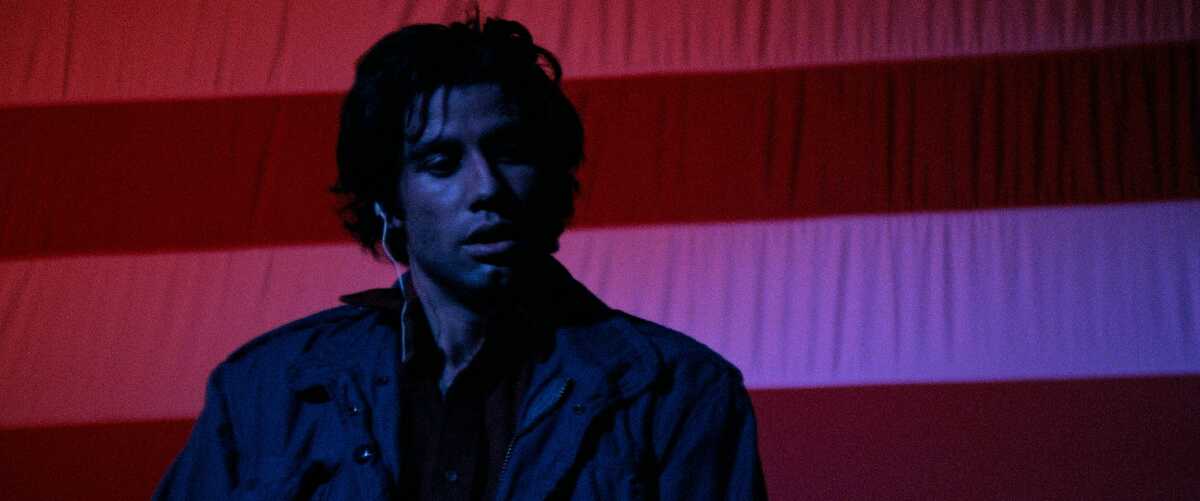
John Travolta in Brian De Palma’s 1981 thriller “Blow Out.”
(Criterion Collection)
On July 10 there will be a 35mm screening at the Academy Museum of Brian De Palma’s paranoid 1981 thriller “Blow Out,” starring John Travolta as a sound recordist who accidentally captures a political assassination. Anyone who still hasn’t gotten enough from the Fourth of July will want to see this for the thrilling fireworks display as part of its finale.
On July 12 at the American Cinematheque’s Los Feliz Theatre will be a screening of Alexander Mackendrick’s show-biz noir “Sweet Smell of Success” in 35mm with an introduction from filmmaker Shane Black, who presumably learned a thing or two about snappy, acid-drenched dialogue from the film. Black will also be appearing at the Culver Theater on July 22 for a 10th anniversary screening of his crime comedy “The Nice Guys.”
As part of the American Cinematheque’s ongoing 70mm festival, on the 22nd there will be a screening of Damien Chazelle’s 2022 “Babylon,” a bold and ambitious look at the early days of Hollywood starring Margot Robbie and Brad Pitt. It was a box office disaster when it came out but has already seen a passionate fan base grow around it.
Have a killer holiday
Richard Dreyfuss, left, Roy Scheider and Robert Shaw in the 1975 movie “Jaws.”
(Universal Pictures)
There is something rather wholesome about the fact that Steven Spielberg’s 1975 seaside horror-thriller “Jaws” has become the official unofficial movie of the Fourth of July. Set amid a beach community suddenly beset by a great white shark as the town prepares for the holiday, the movie is a mix of ’70s-style ramshackle, good-natured ease and precison-tooled action that prefigures the blockbuster era of the ’80s. Even now at more than 50 years old, there is something undeniable about the movie’s ability to entertain, delight and terrify an audience.
An image from Ken Jacobs’ 2004 movie “Star Spangled to Death.”
(Los Angeles Filmforum)
When acclaimed avant-garde filmmaker Ken Jacobs died last year at age 92, the world lost one of its most singular voices. In tribute to Jacobs and as a celebration of the 250th anniversary of America, on Sunday at 2220 Arts + Archives, Los Angeles Filmforum will show his “Star Spangled to Death,” a six-and-a-half-hour masterpiece that took decades to complete.
Beginning work on the project in the 1950s, Jacobs would eventually premiere the film in 2004. It is an epic compilation of his own imagery, some of it of his longtime friend and colleague Jack Smith, along with found footage that coalesces into a grand statement on nothing less than the state of the nation. Jacobs himself described the film as a portrait of “a stolen and dangerously sold-out America, allowing examples of popular culture to self-indict.”
A tribute to Marjane Satrapi
An image from the 2007 movie “Persepolis,” directed by Marjane Satrapi and Vincent Paronnaud.
(Sony Pictures Classics)
In tribute to Iranian French cartoonist and filmmaker Marjane Satrapi, who died at age 56 last month, the Los Feliz 3 will have a 35mm screening of her 2007 animated film “Persepolis” on Thursday. Director Ana Lily Amirpour will introduce the movie, which was nominated for an Oscar for animated feature.
Based on Satrapi’s own autobiographical graphic novel, “Persepolis” is about a young girl coming of age during Iran’s Islamic Revolution told with bold line drawings and a belief in the freedom of the imagination.
Love, crime and sweat
Katy O’Brian, left, and Kristen Stewart in the 2024 movie “Love Lies Bleeding.”
(Anna Kooris / A24)
Some movies arrive seeming ready made as cult revival objects. Ross Glass’ 2024 “Love Lies Bleeding” was overlooked when it was first released but seems ripe for rediscovery. In a story that knowingly plays with the motifs of classic film noir and crime dramas, Kristen Stewart plays a hapless, easily manipulated loner in a small dead-end town who falls in with a mysterious and charismatic drifter played by Katy O’Brian. Their chemistry is electric and gives the film a real charge.
The film will show on Thursday at the Frida Cinema as part of its ongoing Nu-Classics series, along with a conversation between actors and online personalities Maggie Mae Fish and Abigail Thorn.
In an interview at the time of release, Glass talked about the film’s appeal, saying, “It’s people meeting each other and falling in love for the first time and those whirlwind sort of first few weeks. Going into it, I don’t think I was specifically thinking of it as horny, but I definitely knew going into it that I wanted it to feel sweaty and intense.”
Road to nowhere
An image from William Friedkin’s 1977 adventure movie “Sorcerer.”
(Criterion Collection)
Though it is a movie we have talked about here before, it is always worth mentioning when there is a screening of William Friedkin’s 1977 “Sorcerer.” It will be playing tonight in the main room at the Academy Museum in a recent 4K restoration, which should be big and loud. The score by Tangerine Dream should be even more brain-rattling than usual in that venue.
The film notoriously first opened a week after “Star Wars” in 1977 and was left in the dust, though it has more recently become revered as one of Friedkin’s best — a movie of relentless, ratcheting tension. An adaptation of the novel that also inspired 1953’s “Wages of Fear,” Friedkin’s film is about a group of desperate men, each on the run from something, who must transport a truckload of nitroglycerine through a dangerous South American jungle.
New this week
Amy Nicholson found “Minions & Monsters” to be a “delightful dingbat homage to Tinseltown set during the transition from silents to sound.”
Carlos Aguilar spoke to Minions creator Pierre Coffin about all the old-school movie homages in the new film and its cameo from no less a film figure than George Lucas.
Katie Walsh reviews Jon Erwin’s “Young Washington,” calling it “propaganda in the form of a history lesson wrapped in a summer blockbuster.”
Tim Grierson reviews “Romería,” an autobiographical tale from Spanish writer-director Carla Simón starring newcomer Llúcia Garcia, noting “Simón and her star bracingly recall the electricity of youth.”
NEW YORK — David Clayton-Thomas, the lead singer of Blood, Sweat & Tears, whose husky, high-strung tenor on “Spinning Wheel,” “And When I Die” and other hits helped make the so-called brass rock band among the most popular acts of the late 1960s, has died at age 84.
Spokesperson Eric Alper said that Clayton-Thomas died peacefully Wednesday at St. Michael’s Hospital in Toronto. Alper did not cite a specific cause of death.
Clayton-Thomas was a onetime street fighter and petty thief from Canada who briefly became a rock superstar, the front man of a nine-member group that sold millions of records and won two Grammys for “Blood, Sweat & Tears,” which beat out the Beatles’ “Abbey Road” for best album of 1969. Calling out amid a jazzy parade of horns, keyboards and percussion, Clayton-Thomas’ urgent shout was a signature voice of the era, preaching love on the Motown cover “You’ve Made Me So Very Happy,” a lasting legacy on Laura Nyro’s “And When I Die” and a cool head on his own “Spinning Wheel.” Meanwhile, Blood, Sweat & Tears helped inspire a wave of horn-led bands, among them Chicago, the Electric Flag and Ten Wheel Drive.
“A lot of the guys [in Blood, Sweat & Tears] would play a Broadway show matinee, then go up to Harlem and play Latin music or R&B and funk at night, or come down to the Village and play pure jazz the next night,” Clayton-Thomas told Bestclassicbands.com in 2023. “I was just a blues player: Give me three chords and I’ve got a song.”
At its peak, Blood, Sweat & Tears’ appeal was so broad it helped lead to the band’s downfall.
Hip enough to perform at the 1969 Woodstock festival, where they were among the highest paid acts, they also were known enough to the establishment to tour Eastern Europe the following year on behalf of the State Department. When Clayton-Thomas and other band members denounced the Communist regimes on the other side of the Cold War, Rolling Stone’s David Felton wrote that “the State Department got its money worth.” Counterculture Yippies would turn up at a 1970 Blood, Sweat & Tears show at Madison Square Garden, carrying obscene banners outside and dumping manure by the front gate.
The band had practical reasons for going along with the government: Clayton-Thomas, who had allegedly wielded a gun at his girlfriend, had been denied a green card and faced deportation. But after topping the charts in 1970 with the album “Blood, Sweat & Tears 3,” their appeal soon faded. A burned-out Clayton-Thomas left the group in 1972, and neither he nor the remaining musicians ever regained their old stature. Blood, Sweat & Tears would continue recording over the next few years, and even briefly reunited with Clayton-Thomas, who went on to release more than a dozen solo albums and tour on his own for decades.
Beginning under a licensing agreement reached in 1984, Clayton-Thomas toured as “Blood, Sweat Tears” for 20 years with a revolving roster of bandmates. A 1994 Times review of a show at the Coach House in San Juan Capistrano reported that “BS&T’s formula has legs, that its music has withstood the test of time. Indeed, in a world full of today’s pop harmonic minimalism, the sound of trumpets, trombones, guitar and sax backing a singer somehow seems fresh, even if it has been around for so long,” and Clayton-Thomas “still has all the enthusiasm and buzz-saw roughness that gave his voice its distinctive quality way back when.”
In 2005, BS&T re-formed (without Clayton-Thomas, who continued his solo career) and has toured since with various lead singers.
Clayton-Thomas was inducted into the Canadian Music Hall of Fame in 1996. “Spinning Wheel,” covered by everyone from James Brown to TV star Barbara Eden, was voted into the Canadian Songwriters Hall of Fame a decade later.
Born David Henry Thomsett on Sept. 13, 1941, in Kingston upon Thames, near London, and raised near Toronto and Ottawa, he was the son of a Canadian World War II veteran and of a pianist-entertainer who helped inspire her son’s interest in music. Thomsett was lucky to have the chance. He fought violently with his father, was living in the streets by his mid-teens and by age 20 was serving time in a reformatory for vagrancy, assault and other crimes.
An old guitar, left behind by a fellow inmate, changed his life. He taught himself to play and began spending extensive time in the early 1960s around Toronto’s Yonge Street music “strip,” where peers included the American rockabilly star Ronnie Hawkins, a mentor to Robbie Robertson and other future members of the Band and a guide for Thomsett early in his career.
Eager to reinvent himself, he changed his last name to Clayton-Thomas while leading his own groups. In the mid-’60s, he released such albums as “Sings Like It Is” and had a hit single with the antiwar rocker “Brainwashed.” He would also befriend a rising star, Joni Mitchell, whose childlike “Circle Game” helped inspire “Spinning Wheel,” and the venerable John Lee Hooker, who would indirectly contribute to Clayton-Thomas’ breakthrough in the U.S.
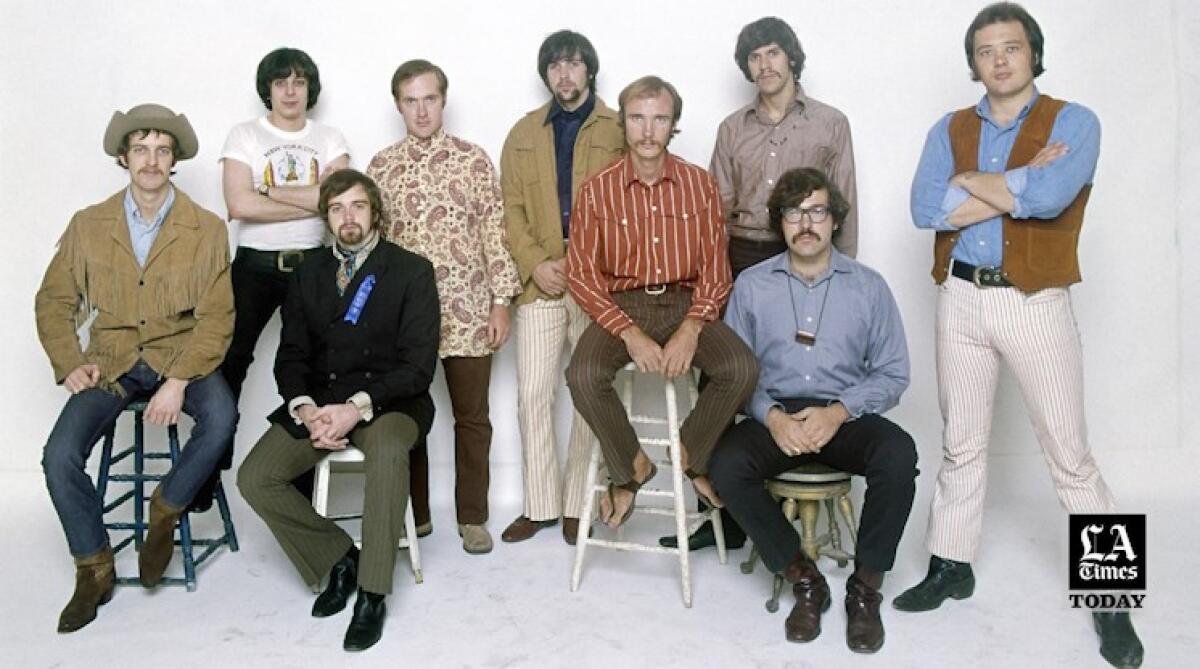
The band Blood, Sweat & Tears, including David Clayton-Thomas, far right, from the documentary “What the Hell Happened to Blood, Sweat & Tears?”
(Sony Music Archives)
Hooker had encouraged Clayton-Thomas to move to New York, where the American bluesman had an engagement at the Cafe Au Go Go in Greenwich Village. When Hooker unexpectedly departed for a tour of Europe, club owner Howard Solomon needed a replacement and recruited Clayton-Thomas.
“So I played him a couple songs on the guitar,” Clayton-Thomas told Bestclassicbands.com. “He said, ‘Do you have a band?’ I said, ‘Sure,’ and went out into Greenwich Village looking for anybody carrying a guitar case or even looking like a musician, and we put together a little band and we opened there that night. We ended up staying there for several months.”
Around the same time, session man-producer Al Kooper was looking to form a jazz-rock group and was joined by such musicians as guitarist Steve Katz, drummer Bobby Colomby and horn players Randy Brecker and Jerry Weiss. They called themselves Blood, Sweat & Tears, releasing the debut album “Child Is Father to the Man” early in 1968. Although praised by Rolling Stone publisher Jann Wenner as “a fine, exemplary group,” members were torn between those allied with Kooper and those who thought his vocals too weak to attract a substantial audience.
By the end of the year, Kooper and others had departed, and the band was seeking a new singer. After Judy Collins saw Clayton-Thomas perform, she recommended him to Colomby.
“I got home and just a couple of days later, Bobby Colomby called me up and said, ‘Hey, Kooper’s gone. We got four guys left out of the nine. And we still got a record contract with Columbia. Do you want to come down and try out for the band?’ ” Clayton-Thomas told Bestclassicbands.com. ”I said, ‘You’re damn right.’ I knew [bassist] Jim Fielder real well and I knew they were superb musicians. So I was on the next plane. We had a rehearsal that afternoon, an audition, and it was instant magic. We just knew right off the bat.”
Clayton-Thomas is survived by his daughters, Ashleigh Clayton-Thomas and Christine Graham.
Hello! I’m Mark Olsen. Welcome to another edition of your regular field guide to a world of Only Good Movies.
Two of my favorite movies of the year so far are opening in Los Angeles today and they both benefit from being seen with a proper audience. You will find yourself surprised by what you are laughing at, curious about what other people are laughing at and then feel the air in the room collectively shift as both films take unexpected turns toward more genuine emotional moments.
The third feature directed by Olivia Wilde, “The Invite” is a biting look at modern relationships. Wilde stars as one half of a struggling couple, unhappily married to a character played by Seth Rogen. She invites over a couple from the apartment upstairs, played by Penélope Cruz and Edward Norton, and soon all sorts of feelings start flying around.
I reviewed for the paper, noting, “It feels daring for how it wants to actually examine the emotional costs of contemporary grown-up life, bringing wincing laughs of recognition.”
Wilde will be making appearances around L.A. over the weekend, including at the Vista, where the movie is playing in 35mm.
Also opening this weekend is “Maddie’s Secret,” the debut feature as writer-director from comedian and actor John Early, who also stars as the title character, an aspiring L.A. food influencer battling bulimia. It is a truly astonishing performance, one that walks a difficult tightrope between sincerity and parody. Early will appear for Q&As around town this weekend.
I spoke to Early about the film when it played as part of the Los Angeles Festival of Movies about its unusual tone — somehow earnest, tender and very funny all at once. Joshua Rothkopf reviewed the film, which he calls the indie arrival of the year, comparing it to movies by John Waters, Todd Haynes and Douglas Sirk.
Jack meets the maestro
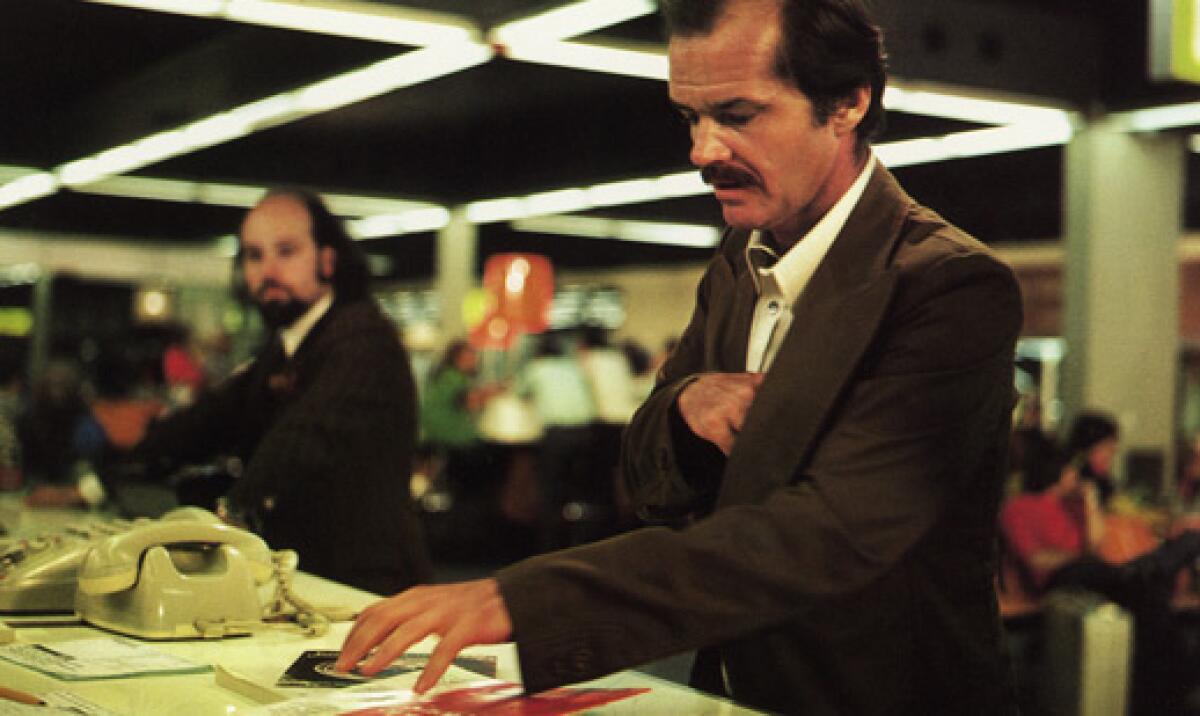
Jack Nicholson in the 1975 movie “The Passenger.”
(Sony Pictures Classics)
One movie I feel obligated to note whenever it plays it Michelangelo Antonioni’s “The Passenger.” Jack Nicholson stars as a disaffected journalist who assumes the identity of a dead man in an attempt to start over, only to find that his new life is even more complicated than his own. It is a powerful examination of middle-aged malaise that has Antonioni’s trademark mystery but, thanks to Nicholson, also has a directness that makes it accessible to wider audiences.
Nicholson made the film in between “Chinatown” and “One Flew Over the Cuckoo’s Nest,” at the height of his fame in the 1970s, a time when going to Europe and Africa to shoot a movie with an esoteric art-house filmmaker was a huge risk. He would personally purchase the rights to the film in the early 1980s and essentially treated it like owning an art object, very rarely allowing it to be shown publicly. It reentered circulation in 2005 with a rerelease but still has a certain air of rarity around it. The film will be showing at the New Beverly in 35mm on Saturday and Sunday.
Nicholson sat for an extended interview with The Times’ Patrick Goldstein around that 2005 reissue of the film, calling the production “the most vivid filmmaking adventure I’ve ever had.” He described his relationship to Antonioni by saying, “He’s been like a father figure to me. I worked with him because I wanted to be a film director and I thought I could learn from a master. He’s one of the few people I know that I ever really listened to.”
When the Italian filmmaker died in 2007, Nicholson got on the phone with us to say, “I don’t know how to put this: He’s just a maestro, and everybody loved him. … He was a man of joy and impeccable taste. His whole life was dedicated to modestly being a brilliant artist.”
Truffaut’s humanist warmth
Delphine Seyrig and Jean-Pierre Léaud in the movie “Stolen Kisses.”
(Janus Films)
Richard Linklater’s “Nouvelle Vague” last year didn’t exactly start a renewed wave of interest in the French New Wave of the 1960s, but then again, those movies never really went away. They’ve been inspirational to generations of film fans for more than 60 years now.
But one French director who has perhaps fallen out of favor slightly is François Truffaut. Long seen as one of the quintessential New Wave filmmakers, he has become taken for granted a little of late. Which is why it is exciting to see Brain Dead Studios showing his 1968 film “Stolen Kisses” in 35mm on Sunday.
The third in the series of films Truffaut returned to throughout his career, including his 1959 breakthrough “The 400 Blows,” the film again stars Jean-Pierre Léaud as Antoine Doinel, Truffaut’s alter ego through the stages of his life. Discharged from the army, Antoine drifts through a series of jobs. His real concern is juggling his busy love life, making the film something of a male-centered rom-com while capturing Truffaut’s warm, humanist worldview.
Rohmer’s caustic cynicism
Jean-Claude Brialy in the 1970 movie “Claire’s Knee.”
(Janus Films)
Conversely, a filmmaker of the French New Wave who has seen his stock rise during the last few years is Eric Rohmer, championed by Noah Baumbach among others. His more caustic view of the world may resonate better with more cynical modern audiences.
The American Cinematheque will begin showing Rohmer’s cycle of “Six Moral Tales” at the Los Feliz Theatre this weekend with a 35mm screening of “My Night at Maud’s” and continuing with other screenings through the end of July. Other films in the series include the sultry, summertime tale “La Collectionneuse,” the ethical dilemma of “Claire’s Knee” and the tale of infidelity “Love in the Afternoon.”
Writing about “Claire’s Knee” in 1971, Charles Champlin noted, “What redeems Rohmer’s films from a defeating sameness is the quite extraordinary charm, believability and complexity of his characters and his meticulous attention to detail and his refusal to go for gross events at the expense of the subtle shadings of human relationships.”
Honestly, if a trip to France isn’t happening for you this summer, this series makes for a not-bad substitute.
Reconsidering ’90s comedy
An image from the 2025 documentary “We Are Pat.”
(The Film Collaborative)
Fresh off its world premiere at the recent Tribeca Film Festival, Ro Haber’s documentary “We Are Pat” will screen at Vidiots on Sunday. Haber will be there along with comedians Julia Sweeney and Harper Steele and, for good measure, Alan Cumming.
“We Are Pat” examines the afterlife of Sweeney’s character from “Saturday Night Live,” a confusingly genderless person who no one can ever quite figure out how to engage with. The way Pat has been picked up by a new generation of genderfluid comedians shows how influence and inspiration can come from the unlikeliest of places, and also how comedic ideas can transform over time.
Ali in Africa
Muhammad Ali fights George Foreman in the 1996 documentary “When We Were Kings.”
(Gramercy Pictures)
Released in 1996, “When We Were Kings” depicts the 1974 boxing match in Zaire between Muhammad Ali and George Foreman known as “The Rumble in the Jungle.” Director Leon Gast was unable to complete the film at the time, so the footage languished for years until he got an assist from filmmaker Taylor Hackford in shooting contemporary interviews with the likes of Norman Mailer, George Plimpton and Spike Lee. “When We Were Kings” would go on to win the Academy Award for documentary feature. It will be screening at Vidiots on Saturday.
The core of the movie is watching the thrilling, inspiring footage of Ali training and interacting with the locals. As Kenneth Turan wrote in his original review, “Because a classic heavyweight championship fight, especially with these protagonists, epitomizes the drama inherent in sport, ‘When We Were Kings’ always compels our interest.”
Johnny Knoxville and friends are back for another round of stunts and pranks in “Jackass: Best and Last.” Age has finally caught up with them, Amy Nicholson laments.
It seems a little odd that a movie starring Angelina Jolie, “Couture,” is just sort of sneaking into theaters, but that’s movie business in 2026. We spoke to Jolie at last year’s Toronto International Film Festival about the film.
Brooklyn Beckham has shared a gushing post about his wife NicolaCredit: Instagram Brooklyn BeckhamHis post comes after David and Victoria left Brooklyn fuming with their posts on Father’s DayCredit: Getty
The famous family have been feuding for more than a year, with Brooklyn even issuing a brutal social media rant where he said he has no wish to reconcile with his parents.
But Brooklyn is in his own bubble with wife Nicola Peltz, and has now gushed how he “gets to do life” with her in yet another backhanded swipe directed at his family.
Taking to Instagram to mark a milestone with his wife, Brooklyn shared a smiley black and white photo of them and wrote a heartfelt caption.
“6 years ago I asked my best friend to marry me,” he began.
“You are my girl, my beautiful wife, and my whole heart.
“Every day with you feels like the best adventure, and I still can’t believe I get to do life with you.
“You make everything brighter, funnier, sweeter, and more magical just by being you.
David honoured his son Brooklyn on Father’s Day – a move that is said to have enraged himCredit: InstagramBrooklyn is in his own bubble with NicolaCredit: instagram/nicolaannepeltzbeckham
“I can’t wait to keep laughing, dreaming, and staying young with you forever.
“I love you more than words, Nicola,” he concluded.
Nicola commented on the post swiftly, writing: “I couldn’t possibly love you more. You’re my world, my rock and my soulmate.
“I love you a million times over and I love being your wife. Thank you for loving me so perfectly. My forever.”
Flocking to the comments, many fans were supportive of the pair.
One person wrote: “Awwww Happy Anniversary beautiful soulmates.”
While another penned: “Well done for putting your wife first, no one knows what goes on behind closed doors. Glad you are making each other happy.”
But others appeared to slam Brooklyn while supporting his mum and dad amid the rumbling family feud.
“Is that all you do all day, talk about how much you love your wife? We’ve all heard it by now,” said one.
“Team Posh all the way. Respect your parents,” penned a second.
This comes after both David and Victoria both marked Father’s Day by sharing snaps of all of their children – including Brooklyn.
But Brooklyn was left disgruntled by the posts which included him.
An insider told The Sun: “He’s fuming about it.
“He’s asked them to leave him alone and they just keep posting him.
“It just brings the whole thing up all over again. He wishes they’d leave it and leave him alone.”
The feud is rumbling on despite it being five months since Brooklyn unleashed his nuclear attack on his parents via an Instagram statement.
In a scathing statement, Brooklyn told how he grew up with “overwhelming anxiety” having been “controlled” by his parents most of his life.
His initial statement read: “I have been silent for years and made every effort to keep these matters private.
“Unfortunately my parents and their team have continued to go to the press, leaving me with no choice but to speak for myself and tell the truth about only some of the lies that have been printed.
“I do not want to reconcile with my family. I’m not being controlled, I’m standing up for myself for the first time in my life.”
TWO years after hanging up his football boots to pursue a career in modelling, a major curve ball has seen Romeo Beckham land his first acting role.
The 23-year-old will make his big-screen debut this November in movie Forty Love, which centres on a same-sex romance involving two rising tennis stars.
Romeo Beckham will be making his big-screen debut after hanging up his football bootsCredit: Instagram/@romeobeckhamRomeo in film Forty Love which centres on a same-sex romanceCredit: Studio Canal
Insiders say Romeo — the middle son of David and Victoria Beckham — honed his skills during secret acting lessons last year.
A source revealed: “Romeo has long been in demand for film and TV roles, but he made sure to do the work before putting his name to anything.
“Forty Love’s script and the team behind it resonated with Romeo, plus he has first-hand experience of being a professional sportsperson and knew he could bring that knowledge and experience to the role.
“It’s a French film and is currently only slated for release over there, although there will be plans for a wider rollout.
“Romeo had a handful of lessons with acting specialists early last year before they started filming. He has put his heart and soul into this role.”
Forty Love is described as a “sensual, romantic and deeply moving fable and coming-of-age story.”
Most of the movie will be in French, but Romeo plays an English-speaking character, using his native language in his scenes.
It is a far cry from the football pitch or runways across the globe where he has modelled for Saint Laurent, Balenciaga and Burberry.
His fans have applauded his new career, with many comparing Forty Love to HBO Max series Heated Rivalry, in which two professional male ice-hockey players have a secret romance.
But Romeo himself is aware of being branded a nepo baby as he expands his showbiz CV, just like his ex-footballer dad David and former Spice Girl mum Victoria did before him.
And he is not the first famous youngster to move into acting. Maya Hawke — daughter of Hollywood actors Ethan Hawke and Uma Thurman — is now a screen star following her breakout role in Netflix’s Stranger Things.
Romeo turned down a new contract with Brentwood FC’s B-team in 2024Credit: GettyRomeo with girlfriend Kim TurnballCredit: Getty
A source said: “Romeo knows there will be a lot of eyes on him, but his work will speak for itself.
“This film will show people what Romeo can do. He is an impressive actor and this is a great starting point for him.
“He is still working as a model and he has just launched his clothing range Intra, which is a project he has been working hard on in the background.
“Romeo is a grafter.”
Forty Love will be the directorial debut for fashion photographer Pierre-Ange Carlotti, who has cast French actor Paul Kircher alongside Romeo.
Paul plays the leading role of Sacha Gallo, a tennis superstar who is vying to win a major trophy in Paris under the guid- ance of his coach and father.
Romeo will play his rival — and his love interest. The film’s synopsis says of Sacha: “For the first time, he faces an opponent of an entirely different nature — love.
“A force as exhilarating as it is destabilising — and far more dangerous than anything he has encountered on the court.”
News of Romeo’s acting debut had been kept a closely guarded secretCredit: Instagram/@romeobeckhamRomeo and the family donning his new sportswear line, Intra, to mark the launchCredit: Instagram
Renowned French actress Catherine Deneuve has also been cast in the film, which will be released on November 25. Those close to Romeo say he is being quietly championed behind the scenes by David and Victoria, who are “beyond proud” of his new venture.
A source added: “David and Victoria have always supported all of their children. And seeing Romeo taking on his first big film is a huge moment for them. They couldn’t be more proud of him and what he has achieved.”
News of Romeo’s acting debut had been kept a closely guarded secret.
Work poured in for the youngster, who made his modelling debut for Burberry in 2012, aged ten.
In the months after his decision to step away from football, he walked on runways for Balenciaga, Burberry and Versace, before he was put forward for the role in Forty Love. Production started on the film last summer and wrapped late last year.
“Romeo didn’t want any fanfare around his new role, so he kept it very quiet,” an insider explained. “He wanted to get his head down and get his teeth into the character and focus on that as best he could.
“Romeo is used to playing a character on the catwalk — it’s why modelling is such a stepping stone for acting jobs because you are playing a role.
David Beckham had a cameo in Guy Ritchie’s King Arthur: Legend Of The SwordCredit: AlamyVictoria, here in 1997 film Spice World, was the first Beckham to hit the big screenCredit: Alamy
“His acting lessons made sure he felt confident and then he got to work.
“By all accounts, he loved the experience and it’s likely there will be more roles to come after Forty Love comes out.” Romeo will be following in his mum’s footsteps with his jump to the big screen.
Fashion designer Victoria was the first in the family to hit the big time in the Spice Girls film, Spice World, in 1997.
To date, it is the highest-grossing film of all time by a musical group, and in the US it broke the record for the highest-ever weekend debut for a Super Bowl weekend, with box office sales of more than £8million. Twenty years later, David followed suit with a small speaking role in Guy Ritchie’s King Arthur: Legend Of The Sword.
He said of breaking into films: “I am very aware that many sportsmen and other celebrities have turned their hand to acting and failed. I know it is a tough profession, where you need a huge amount of skill and discipline. I wouldn’t want to push myself forward too soon, without learning more about it and doing a lot more practice. But what I have done so far, I have loved.
“I can deal with most things. I am a well-known person, so I have gotten used to criticism. It was nerve-racking delivering the lines, but it actually went really well.
“The thing about sport is that it gets the heart beating faster.
“You focus the mind in order to deliver. Acting has a similar feel.”
Brooklyn, the eldest of the Beckham clan, demanded in January that his family only contact him through lawyersCredit: Getty
Romeo’s sister-in-law, Nicola Peltz, who is married to his estranged brother Brooklyn, works as an actress, too. But she has failed to make her mark on the industry.
Her directorial debut Lola, which she also starred in, came out to much fanfare two years ago. But it was savaged by critics and took just £480 at the box office.
Nicola was blasted for creating a film inspired by “poverty porn”, which a commentator said was “filled to the brim with underbaked, oftentimes harmful tropes”.
Undeterred by the failure, Nicola has spent the past few months filming Prima, which is a debut from famed photographers The Morelli Brothers.
The indie film will see Nicola playing a ballerina who is raised and coached by her grandmother, played by Faye Dunaway. Prima is expected to be released later this year, although no official date has been confirmed. Romeo, alongside the wider Beckham family, has had no meaningful contact with Brooklyn since he cut himself off last year.
Insiders joked Romeo was rivalling Nicola by entering the acting sphere, but conceded: “It’s hardly a competition.
“Romeo is carving out his own lane, just as he has done his entire career.”
Brooklyn, the eldest of the Beckham clan, demanded in January that his family only contact him through lawyers.
He later issued a blistering statement insisting he no longer wanted to be a part of the family.
His decision to cut himself off was hugely painful for the Beckhams, including his younger brother Cruz, 21, and his little sister Harper, 14, who was seen delivering a letter to the home he shares with Nicola in Los Angeles earlier this month.
A source said: “Brooklyn has made his position clear and the family have respected that.
“It’s painful for everyone involved.”
Romeo will be supported by family at the release of Forty Love, with promotional screenings being drawn up beforehand.
A source said: “David and Victoria are both so incredibly proud of Romeo.
“They know how hardworking he is and have supported him throughout this project.
“Romeo knows what he wants in life and will work hard to get it.”
Former Pfizer executive David Denton steps into the CFO role amid a bruising stock decline.
Nike Inc. said Tuesday it has hired David Denton as its next chief financial officer, tapping the former Pfizer Inc. finance chief to help stabilize a company navigating one of the most difficult stretches in its history.
Denton will join the Beaverton, Oregon-based sportswear giant as Executive Vice President and CFO effective Aug. 17. Matthew Friend, who has held the role since April 2020, will step down on that date and remain in the role through Sept. 4.
Nike Dogged by Rivals, Slumping Share Price
The announcement did little to reassure investors. Nike shares fell 4.5% to close at $42.38 Tuesday, leaving the stock down 33% year to date. The company has been grappling with slowing sales and eroding market share to nimbler rivals such as On Running and Hoka.
CEO Elliott Hill, who took the helm in late 2024, has been working to arrest the slide, but a full recovery has proven elusive.
Whether Denton’s expertise can generate a turnaround remains to be seen. He previously served as CFO and Executive Vice President at Pfizer since May 2022. Before that, he held the same title at Lowe’s Cos. from 2018 to 2022. He also spent two decades at CVS Health Corp., including as CFO during the company’s evolution into a diversified health. In all, he brings more than 30 years of finance and operating leadership across large, complex public companies.
Denton, in a prepared statement, called Nike “one of the world’s great brands.”
“I’m excited to partner with Elliott and the leadership team to support the company’s priorities, invest with discipline, and help deliver sustainable long-term value,” he said.
Hill framed the transition as a strategic inflection point. “This is a natural moment for a leadership transition as we move from foundational actions to sustained growth through our Sport Offense operating model,” he said.
Friend joined Nike in 2009 and rose through roles including CFO of the Nike Brand and VP of Investor Relations before assuming the top finance post. Nike expanded his responsibilities in late 2025 to include Global Sales and Direct-to-Consumer functions.
Prior to Nike, he worked in investment banking at Goldman Sachs and Morgan Stanley.
What’s Next
Nike expects to report fourth-quarter and fiscal year 2026 results on June 30. Analysts anticipate earnings of $0.12 per share on revenue of $10.85 billion, compared with 14 cents per share and $11.1 billion in the prior-year period — a stark illustration of how far the company still has to go. Results will include a one-time benefit from tariff refunds that were not previously factored into the guidance.
DJ Fat Tony has shared that he believes Brooklyn WILL reconcile with his familyCredit: GettyThe DJ is a friend of Brooklyn and Nicola, and also did his best to reframe what happened when Victoria danced at Brooklyn’s wedding ‘inappropriately’Credit: Shutterstock Editorial
The tell-all statement took the internet by storm, calling out David and Victoria for their ‘performative’ and ‘controlling’ behaviour.
But Brooklyn’s pal DJ Fat Tony (real name Tony Marnoch) believes that an olive branch is still yet to come, and has faith that all will be well with the Beckham clan again.
Speaking to Closer magazine, Tony shared: “I hope that they do sort it out, I really do, for all of their sakes.
“I think they will – of course they will. Like all family feuds, there comes a point where you think, ‘Well, what is this about?’
Brooklyn has been feuding with his family for over a year nowCredit: PAHe called his parents out for their ‘controlling’ and ‘performative’ behaviour earlier this yearCredit: GettyBrooklyn was left feeling furious after his parent dismissed his request to not post photos of him online or tag him on social mediaCredit: GettyBrooklyn shared at the end of his bombshell statement that he just wants a ‘peaceful’ life with his wifeCredit: Getty
“But it’s not for me to say, ‘She was wrong, he was right.’ It’s not my business.”
Tony also shared how he tried to correct the misinterpretation of what happened at Brooklyn and Nicola Peltz‘s wedding.
But Tony said: “Brooklyn is a friend of mine, and so is Nicola. I went on This Morning to change the narrative.
“The word ‘inappropriate’ was misused. Everyone thought that Victoria was slut-dropping – there was no slut-dropping.
“I wasn’t on there to take down the Beckhams. No one needs to do that. It’s a family and it’s a really sad situation.”
His comments come amid Brooklyn’s fresh frustrations with his parents after they posted photos of him in commemoration of Father’s Day.
Brooklyn has previously instructed his parents not to post photos of him anymore or to tag him in pictures.
But this request has been broken multiple times, leading to Brooklyn blocking his family online.
He found out about the Father’s Day snaps through friends and the media.
His wife Nicola also appeared to take a swipe back, sharing a cryptic quote to her Instagram story that read: “I am in love with this sentence: “Forgive yourself for not knowing earlier what only time could teach.””
DAVID and Victoria Beckham put on brave faces as they celebrated their second Father’s Day without their estranged son Brooklyn.
The pair were spotted heading to a London gastro-pub with their son Cruz, 21, and his girlfriend Jackie Apostel, 30.
Sign up for the Showbiz newsletter
Thank you!
David and Victoria Beckham were seen heading to a London gastro-pub with their son Cruz, 21, and his girlfriend Jackie Apostel, 30Brooklyn, who lives in Los Angeles with his American actress wife Nicola, 31, has been estranged from his family for over a yearCredit: Getty
Romeo also joined his dad for the Father’s Day mealThe Father’s Day party was also joined by David’s mum Sandra, 77Credit: w8media
He had previously instructed his parents not to tag him in online posts – something that they have continually ignored.
The feud has rumbled on for over a year with a source telling The Sun that Brooklyn has been left filled with rage following his mum and dad’s latest stunt.
An insider told The Sun: “He’s fuming about it.
“He’s asked them to leave him alone and they just keep posting him.
Victoria heading to the family mealCruz on his way to the gathering in London
“It just brings the whole thing up all over again.
“He wishes they’d leave it and leave him alone.”
Brooklyn, who lives in Los Angeles with his American actress wife Nicola, 31, has been estranged from his family for over a year and has accused them of trying to “control” him.
VICTORIA Beckham has extended the biggest olive branch to estranged son Brooklyn yet with a touching Father’s Day tribute to David.
The fashion designer, 52, took to social media to share a snap of David, 51, with Brooklyn, 27, Romeo, 23, Cruz, 21, and Harper, 14, in happier times.
Sign up for the Showbiz newsletter
Thank you!
Victoria shared a touching Father’s Day tribute to David which included estranged son BrooklynCredit: UnknownIt comes days after Brooklyn savagely mocked his strained relationship with his dadCredit: Instagram
Brooklyn has made it clear he has no intention of reconciling with his heartbroken parentsCredit: Samir Hussein/WireImageHe now lives in Los Angeles with wife Nicola PelztCredit: Admedia Photo / SplashNews.com
Brooklyn, who now lives in Los Angeles with wife Nicola Peltz, was seen in a clip saying: “You’re probably wondering why I’m watching the FIFAWorld Cup 2026 from home…”
Smirking Brooklyn then laughed: “It’s a long story.”
He went on to throw down his tickets onto the coffee table.
The advert then said: “It’s complicated. More soon.”
Following the US and Israeli airstrikes on Iran in February, reverberations were felt globally. But is the world really safer and Iranians freer or has the war unleashed disastrous consequences?
Mehdi Hasan goes head to head with David Des Roches, retired colonel, former Pentagon official and professor at the National Defense University on the justifications and costs of the war – and whether President Donald Trump sent U.S. troops to fight Israel’s war.
Joining the discussion are: Sanam Naraghi-Anderlini – founder and CEO of the International Civil Society Action Network Mohammad Ali Shabani – Middle East scholar and Editor of Amwaj.media, a London-based news outlet focused on Iran, Iraq and Arabian Peninsula countries Barak Seener – Associate Research Fellow, Henry Jackson Society
Recorded shortly before the announcement of a deal between the US and Iran.
Hello! I’m Mark Olsen. Welcome to another edition of your regular field guide to a world of Only Good Movies.
Recently, I don’t exactly know why, I was overtaken by a concern that because of the impending merger of Paramount and Warner Bros., Olivier Assayas’ 2022 series adaption of his own film “Irma Vep” would be removed from the HBO Max streaming platform. With no official physical release, the series — starring Alicia Vikander as a Hollywood movie star making a project in Paris — could be effectively vanished from existence.
This is sadly inevitable, though some superfans have gone to extra-legal measures to ensure otherwise (not that we would ever endorse this). Most famously it’s happened with the original “Star Wars” trilogy. Billed as the “Grindhouse Edition,” these are discs of the first three “Star Wars” films sourced from scans of original film prints before the digital fixes and polish of the more recent official releases. Reengaging with these works in this way, scratches and all, is (I’m told) a strong reminder of why they hit so hard in the first place, similar to how it might be to reread a text in the original language instead of a more recent translation.
‘Indiana Jones’ marathon
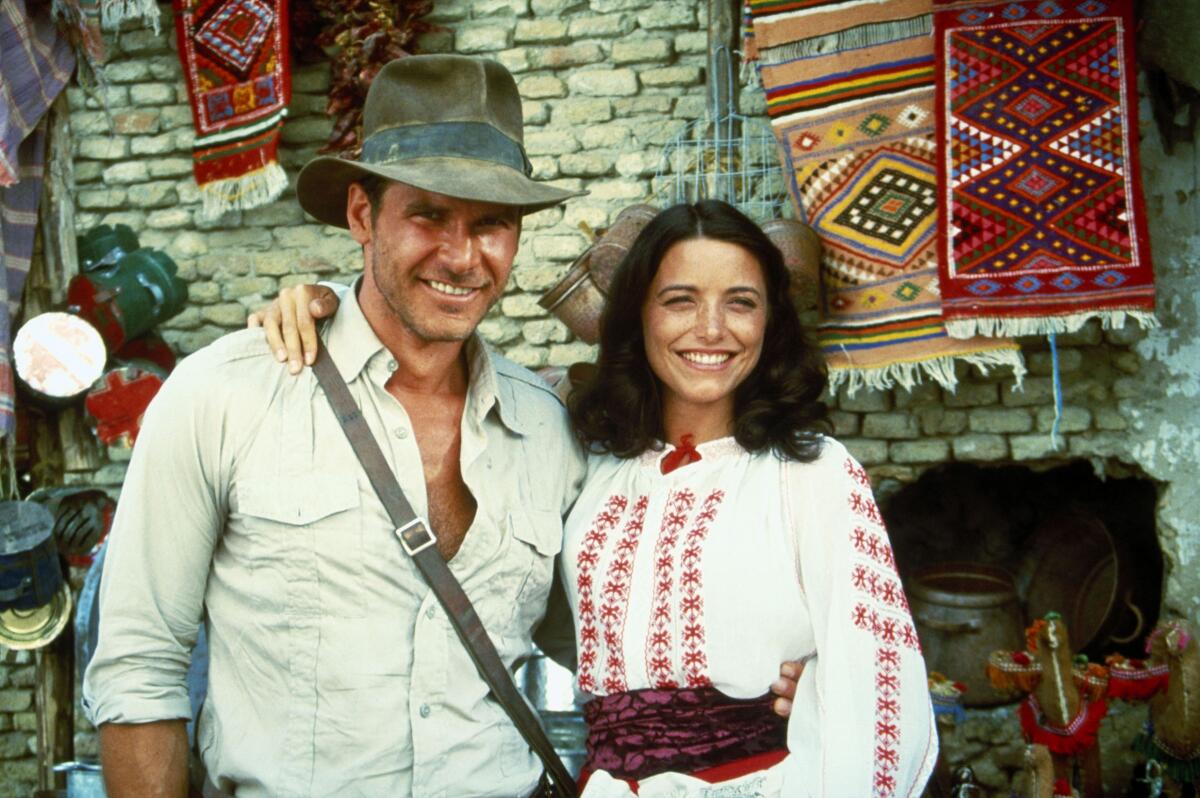
Harrison Ford and Karen Allen on the set of 1981’s “Raiders of the Lost Ark.”
(Lucasfilm Ltd.)
The same deep understanding of genre filmmaking that went into the original “Star Wars” also went into “Raiders of the Lost Ark,” the first adventure of the character of Indiana Jones. Directed by Steven Spielberg from a script by Lawrence Kasdan and story by George Lucas and Philip Kaufman, the film is playful, thrilling and self-aware. It is made with such care, attention to detail and sense of fun that I remember how disappointed I was to discover not all movies would be like this.
There have of course been diminishing returns with the more recent run of Indiana Jones sequels, but the first three installments all have a real spark. And so the Secret Movie Club will present “Raiders,” 1984’s “Indiana Jones and the Temple of Doom” and 1989’s “Indiana Jones and the Last Crusade,” all on 35mm at the Million Dollar Theater in DTLA on Sunday in celebration of Father’s Day.
In her original review of the first film, Sheila Benson described that while watching it, she felt “a rush of gratitude which almost brought tears of contagious joy and — not to be corny about this — the strength of the film’s positive vision. If this is an era in which the heroic is lacking and the mediocre threatens us from every side, then ‘Raiders,’ which has no pretensions to importance, which is unabashedly wide-eyed and exaggerated and true blue but somehow cherishes the best in life and filmmaking — is a high-water mark.”
Plenty of jokes could be made about the movies having settled into what might be thought of as part of the dadcore canon: action-adventure movies that play well on TV and maybe you can take a short nap and not miss anything. So be it.
From one master to another
Cary Grant and Eva Marie Saint in Alfred Hitchcock’s 1959 thriller “North by Northwest.”
(Sunset Boulevard / Corbis via Getty Images)
Filmmaker Guillermo del Toro has been making waves of late for his strong public stance against the use of AI in feature filmmaking. But it is worth remembering that he is also a deep and incisive thinker about older movies, a true fan, which makes his upcoming appearances at the Academy Museum a special occasion.
Del Toro will present five films by Alfred Hitchcock — 1946’s “Notorious,” 1943’s ‘Shadow of a Doubt,” 1959’s “North by Northwest,” 1953’s “I Confess” and 1972’s “Frenzy” — along with delivering a lecture on each of them. To see one great filmmaker reflect with such depth into the work of another is just remarkable. This is some genuine only-in-L.A. type stuff.
Comedy + politics = good fun
A scene from the 1976 movie “Car Wash.”
(Margaret Herrick Library / Academy of Motion Picture Arts and Sciences)
A raucous comedy set around the location of the title, “Car Wash” is also a sharp, politically minded satire about labor and money. Directed by Michael Schultz from a screenplay by Joel Schumacher, the film has an extended ensemble cast that includes Richard Pryor, Franklyn Ajaye, George Carlin and many others.
In his original review Charles Champlin compared “Car Wash” to films such as “American Graffiti” and “Nashville” and called it “light but not foolish. … The experience is exhilarating.”
A 50th anniversary screening at the Academy Museum on Saturday of a new 4K restoration will include a panel with Schultz and actors Bill Duke, Antonio Fargas, Melanie Mayron, Garrett Morris and Pepe Serna.
Collision report
James Spader in the 1996 movie “Crash,” directed by David Cronenberg.
(Jonathan Wenk / Fine Line Features)
The controversy that surrounded David Cronenberg’s “Crash” when it premiered at Cannes in 1996 and received a U.S. release in 1997 tended to overwhelm the actual movie. Shockingly explicit, the film is about a secret underground world of people who create a sexual fetish out of car crashes. An adaptation of the novel by J.G. Ballard, Cronenberg’s movie explores the cinematic obsession with sex and violence.
Over time, “Crash” has been evolving from a seemingly cursed object dogged by scandal into something that audiences can come to appreciate and admire — even if it is not a movie you can ever exactly fully understand. Part of Cronenberg’s brilliance is how enigmatic and unknowable his work can be: strange, inviting and enveloping while refusing easy or direct analysis.
The movie is playing twice locally this week, on Saturday at Vidiots in partnership with the Cinegogue, with special giveaways and exclusive merch, and again on Monday at the Academy Museum in 4K. Who will be brave (or perverse) enough to go twice?
A different view of Rio
Milton Gonçalves, center, in the 1974 movie “The Devil Queen.”
(Kino Lorber)
A drag queen (Milton Gonçalves) rules the criminal underworld of Rio de Janeiro in Antonio Carlos da Fontoura’s 1974 gangster drama “The Devil Queen,” an unlikely mix of camp aesthetics and gritty violence. Among the film’s many fans is Kleber Mendonça Filho, the filmmaker behind the recent Brazilian hit “The Secret Agent,” who referred to “The Devil Queen” as “bloody, nasty and full of personality.”
The movie is playing in a new 4K restoration at the Lumiere Cinema in Beverly Hills.
A musical melodrama returns
Raul Julia, left, and Teri Garr in Francis Ford Coppola’s 1981 movie “One From the Heart.”
(Rialto Pictures / American Zoetrope)
We have talked before about Francis Ford Coppola’s “One From the Heart,” a movie of such delirious audacity that it nearly ruined the filmmaker‘s career. A throwback musical about two lovers who break up in search of more excitement, the film stars Teri Garr, Frederic Forrest, Nastassja Kinski and Raul Julia.
On Saturday the film will screen at the American Cinematheque’s Aero Theater in a 70mm print for the first time in L.A. since 1990. The event is being dedicated to Dean Tavoularis, Coppola’s longtime production designer, who died in April. For “One From the Heart,” Tavoularis re-created the Las Vegas Strip on a studio back lot.
New this week
Amy Nicholson is not a fan of the new “Toy Story 5,” writing in her review, “Pixar has continued adding shades to the same plot outline like a child with a box of 128 crayons (or a company clinging to its billion-dollar idea).”
Glenn Whipp cast back into the “Toy Story” universe for a highly personal ranking of his 10 favorite “Toy Story” toys.
Two gay teenage boys attempt to survive a supernatural entity and conversion therapy in Adrian Chiarella’s debut feature “Leviticus.” Jen Yamato spoke to the filmmaking team.
I spoke to writer-director Michael Sarnoski about his new “The Death of Robin Hood,” starring Hugh Jackman in a subversively revisionist telling of the last days of the medieval bandit.
BC Place Vancouver was a battlefield as Kone was stretchered off, Qatar got 2 red cards, and both teams brawled after full time.
Published On 19 Jun 202619 Jun 2026
Canada thrashed nine-man Qatar 6-0 to clinch their first-ever World Cup victory in a Group B match, marred by a horrific injury to the home team’s midfielder Ismael Kone, and disciplinary issues both during and after the match.
A Jonathan David hat-trick, one goal apiece from Cyle Larin and Nathan Saliba, as well as a Qatar own goal, sealed a momentous victory for the Canadians at the BC Place Vancouver stadium on Thursday.
Recommended Stories
list of 4 itemsend of list
Canada now need only a draw against Switzerland in their final match to finish top of the group, while Qatar and Bosnia and Herzegovina will aim to finish third when they meet on Wednesday.
But the celebratory atmosphere in Vancouver, with Canadian Prime Minister Mark Carney cheering on Les Rouges, was soured by a serious injury to Kone in the 51st minute.
Qatar’s Assim Madibo upended Kone with a clumsy challenge from behind, leaving the Italy-based midfielder writhing in agony and clutching his left leg.
The seriousness of the injury was immediately apparent as teammates frantically called for help from the Canadian medical staff on the sidelines.
Kone was eventually stretchered off the pitch, waving to the crowd as he inhaled from an oxygen pipe.
Kone waves to the crowd as he receives oxygen while being stretchered off after sustaining an injury [Agustin Marcarian/Reuters]
Madibo, who had initially been given a yellow card for the tackle, was sent off after it was upgraded to red following a VAR review, the second Qatari dismissal after Homam Ahmed was given his marching orders in the first half.
With Qatar down to nine men, Canada took full advantage to score three more goals.
Saliba, who had replaced the injured Kone, curled in a free kick to make it 4-0 in the 64th minute.
The substitute celebrated his goal by racing to the sideline to hold up a replica of the stricken Kone’s Canadian jersey and pointing to his jersey number, eight.
Another substitute, Jacob Shaffelburg, then helped make it 5-0, his fierce shot turned into the Qatar goal by defender Mohamed Manai.
David, who had scored twice in the first half after Cyle Larin’s 16th-minute opener, then completed his hat-trick in the second minute of stoppage time to end the rout.
Jonathan David celebrates scoring his second goal [Fran Santiago/Getty Images via AFP]
‘Tough to focus’
David’s was the 56th hat-trick scored at a men’s World Cup and the second of the 2026 edition.
Argentinian superstar Lionel Messi earned his first of the tournament when he led his side to a 3-0 victory over Algeria and steamrolled several records in the process.
David is also the first Confederation of North, Central America and Caribbean Association Football (CONCACAF) men’s player to score a hat-trick since 1930 and the first Canadian man to record a multi-goal game at the World Cup.
Embers of carnage during the match were reignited after full-time when both sides brawled on the halfway line and had to be pushed apart by FIFA volunteers and team personnel.
“It was a great game even before [Kone] got hurt, but I think after he got hurt, it was tough to focus on the game, even finishing the game… We just wanted the game to end so we could all be together,” David said after the match.
“It will take a few days to sink in, but obviously we know that what we’ve done today is historical for the country, our first win in the World Cup, and to do it in that fashion is really amazing.”
Qatar had a forgettable day in the field [Lee Smith/Reuters]
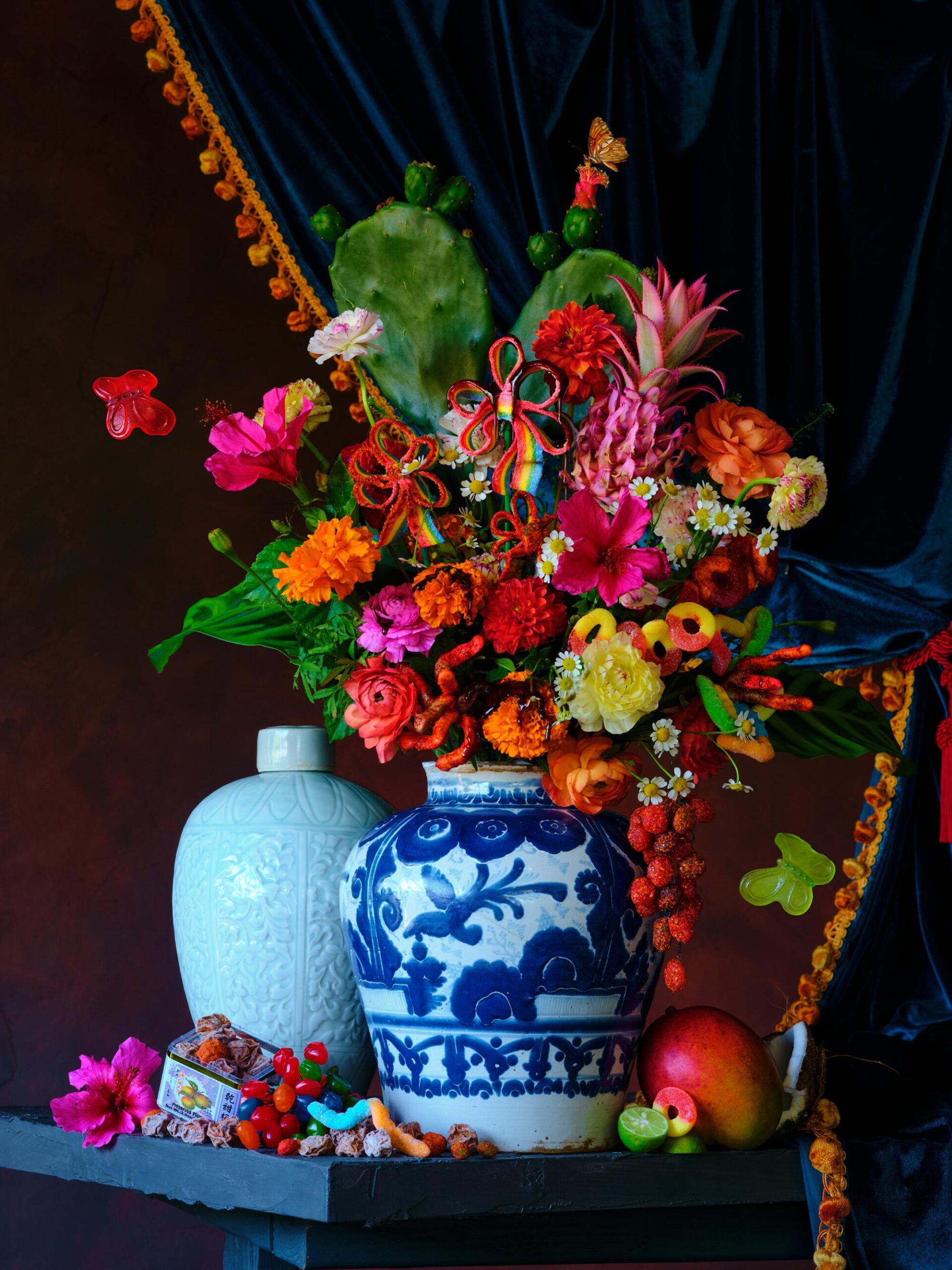
Stephanie Shih, “梅國 (Still life with chamoy and Dirty T Tamarindo),” 2025/2026. Archival pigment print on wood panel, varnish, glue, acrylic, frame. 38.25×48.25×3.75.
(From the artist)
Much has been written about the experience of aimlessness in the new David Geffen Galleries at LACMA, but it is another thing to experience it firsthand. The meandering floor plan, with its rooms of various sizes and orientations alongside their resulting passageways and corners, demands that you wander, not map, your perusal of the galleries. As a result, a visitor can easily feel disoriented, or in my case, a touch deconstructed. A little depersonalized, if you will.
Fortuitously, I was there to meet with multidisciplinary artist Stephanie Shih, whose photo-based compositions have the opposite effect, grounding the viewer in their personhood and experience. Her still lifes are made both beautiful and meaningful through their intentional arrangement of specific food, florals and ephemera, touching on diasporic understandings of self, Western and European appropriations of the “exotic” and the juxtaposition of the natural with the fabricated. In other words, to view a Shih piece is to collaborate with the artist on reconstructing or, in some cases, reclaiming an understanding of place and self.
We were talking about, and in front of, Shih’s new piece, “梅國 (Still life with chamoy and Dirty T Tamarindo),” which was not only commissioned by LACMA, but created in a temporary studio Shih constructed within the gallery itself over the course of two weeks late last year. The image features two ceramic vessels, one slightly in front of the other, within a traditional still life scene. The background jar stands alone, while the piece in the foreground overflows with a rainbow of plants, flowers, fruit, chamoy candies, gummies and a single real butterfly. To get to the small but sunny corridor that houses the work, one might make a few indirect turns and cross the gallery containing Andreas Gursky’s “Ocean” series. Flanked by four wall-size photographs of vast, overhead perspectives of the deep blue Indian Ocean, it’s easy to feel small among the giant panels. Luckily, when I met Shih at LACMA, she intercepted me outside and led us confidently up the Geffen’s dramatic exterior staircase and to “The Global Appeal of Blue-and-White Ceramics” installation — no crossing of oceans necessary.
After our conversation, I stayed to wander the galleries for a few more hours. I am a completist and I wanted, no, needed to see everything. Without the prescribed navigation I was accustomed to in a museum, this became a fool’s errand. I got physically lost and a bit lost to myself. Had I already seen that statue or did it just look like another visage also rendered in marble a few galleries back? I was pretty sure I had already taken these two rights and then a left before, but what if I hadn’t and would then miss a whole other room? The 360-degree curved glass walls encasing the galleries offered many glimpses of a face that belonged to me but somehow wasn’t mine. Who was I? I felt like I would never see everything on display, but also maybe never again exist beyond the funhouse of the Geffen Galleries. In my confusion, I passed by “梅國 (Still life with chamoy and Dirty T Tamarindo)” more than once and was reminded of Shih’s ability to articulate complex reconstructions of self through her exquisite, serene compositions. It was enough to reassure me that I could find myself again, if only I slowed down and considered my context with curiosity instead of fear.
This curiosity led me to “Shaping Dutch Identity: The Mr. and Mrs. Edward Carter Collection.” It was a serendipitous encounter for two reasons: One, the visual and symbolic correlation between Shih’s painterly use of shadow in her food- and floral-centered compositions, and the still life masterpieces of the 17th century Dutch. And two, because much like her work itself, our interview included layered discussion of constructing and shaping identities. Take the new Peter Zumthor-designed building in which we found (and in my case, lost) ourselves, which builds upon the existing galleries of LACMA while redefining the museum’s identity. Or Shih’s in-situ studio, which was created for creation’s sake, then taken down with only a photo of its contents remaining — contents which were constructed by the artist, too.
There was also the progression across cultures and continents of blue-and-white ceramics, which mirrors the evolution of chamoy, a pickled fruit condiment in Mexican cuisine that, along with a blue-and-white Talavera jar, is at the center of Shih’s piece. Both the ceramic and the chamoy traditions symbolize layers of culture as shaped by globalism and localism.
At one point in our conversation, I was momentarily embarrassed when I couldn’t recall the Filipino term for dried sour plums (kiamoy), a precursor to Mexico’s chamoy. It was an aspect of my identity as a third-generation Filipina that was also irretrievable to me that day. Shih was understanding and gracious in her response: “One of the really fun parts of the work I get to do is learning a lot of these histories that get hidden from us.” Given Shih’s academic background — she holds a PhD from Stanford University in linguistics — it makes sense that she brings deep research to her practice. Her art is rich with symbolism and history. But Shih’s work is also playful and, much like her response to me, generous in the invitation it extends to viewers to bring their own identities to her pieces in order to construct meaning for themselves. I may have felt unmoored among the Geffen’s myriad corners and paths, but never when I was standing in front of Shih’s piece.
Installation view of the inaugural presentation in the David Geffen Galleries, April 2026, featuring (top) Stephanie Shih’s 梅國 (Still life with chamoy and Dirty T Tamarindo) (2025- 26) and (bottom) Jar (c. 1700-50).
(Museum Associates / LACMA)
Claire Salinda: Your composition captures flowers, chamoy and other candies and fruit sumptuously arranged in and around a ceramic jar from LACMA’s permanent collection. How did you decide on chamoy as a subject? And how is it contextualized within the new David Geffen Galleries?
Stephanie Shih: “梅國 (Still life with chamoy and Dirty T Tamarindo)” is on display in “The Global Appeal of Blue-and-White Ceramics.” The gallery presents a condensed history of blue-and-white ceramics globally in dishes, starting in the Middle East with a 9th century Iraqi piece. From the Middle East we really got the use of cobalt in designs, and that married with the introduction of porcelain from China. We also have the Iznik kilns in Turkey, which are still operating today, and influences into Southeast Asia, and so on. Later on, the influence spread farther afield into Japan and France, where they started adding even more to it. The blue-and-white tradition has really spread globally, so this gallery is a nice microcosmic story of the effects of globalism before modern globalism.
For a long time I’ve been wanting to make a piece about chamoy and was just waiting for the opportunity to do so. The story of chamoy really parallels this journey of blue-and-white ceramics, which got to Mexico because of Spanish colonialism and then was adopted by local artisans. They really made it their own in the Talavera tradition. Chamoy similarly comes from Asia through pickled plums, particularly China via the Philippines. Filipino laborers came to Mexico via colonialism, and adapted and adopted champoy with spices and chilies from Mexico to become chamoy.
The curator, Susie Ferrell, gave me a whole list of blue-and-white surveys that they were looking at. We went to storage and to the conservation labs to look at all the pieces and we ended up choosing two pieces to work with. The one in “梅國 (Still life with chamoy and Dirty T Tamarindo)” is a Mexican Talavera jar from the 1700s. It’s the first non-Asian origin institutional ceramic I’ve gotten to work with in my career, which is the reason that I gravitated toward it.
Chamoy has been used by a lot of modern day food makers and chefs with American nostalgic candies, like peach rings and gummy worms, and my personal favorite, Gushers. One of these food makers, Alana Solis, who’s based in Tucson, runs Dirty T Tamarindo, a chamoy candy business she started during the pandemic. It was from her that I learned the history of chamoy, and so I wanted to do a piece with her candies for a long time. And this is just a really perfect opportunity with the Talavera jar.
I had pitched to Susie that it might be nice to have a second ceramic in the piece, a companion that demonstrates the origins and precursors of the blue-and-white ceramics in Mexico, a Chinese piece or something. She actually picked the one pictured here, which is also from the LACMA collection. It’s a 12th century Qingbai ware prunus vase, a meiping jar. When Susie pitched it to me, I didn’t even realize how perfect it was: A prunus vase is usually what they put plum blossoms in, and meiping means beautiful plum vase. It just ended up being a really, really good pick from her.
CS: You built a studio space within the gallery to create the piece. I’m curious about the constraints and what was surprising for you.
Artist Stephanie Shih’s makeshift set in the Los Angeles County Museum of Art (LACMA) David Geffen Galleries for her two-week commission project residency; Light test detail.
(Stephanie Shih)
SS: I was here for two weeks. I had a friend build a wall, we painted it downstairs and then brought it in and had it in the gallery with the light coming in through the windows. They gave me a refrigerator to store all the food, because I wasn’t supposed to have it out in the gallery space. We built out work tables too … it’s hard to kind of imagine with all the other stuff here now.
It was in December, and so the building was in several stages of installation with the art. There were just stacks of crates and boxes, which is amazing — it was very cool to just see statues half unpacked.
And actually, seeing everything get installed affected my thinking about the frame. Originally I wasn’t going to do a framed piece, it was just going to be on a panel. But then as I saw everything else go up, there was a weightiness to the way everything was framed and thought about. A lot of the frames are gold gilded, which are incredibly beautiful and historical. I wanted something that played off of that tradition, but using a red frame made it really obvious that it’s not 100% within tradition.
CS: How does this commission fit into your practice?
SS: My work started out really thinking about the artistic references we get as people working in food and still life. So many of the references are of this very Eurocentric art historical tradition. But if you look at that tradition, many things are taken from other cultures and used to symbolize the access and wealth and value that was assigned to these objects from the perspective of European imperialists, to put it nicely. It wasn’t until very recently that people were even thinking, “Well, where are these things from? What other artistic traditions does that mean that we’ve sort of borrowed from?” And so a lot of my work thinks about responding to that, but also taking back some of that tradition to tell stories of diaspora communities today here in the U.S.
From there, I’ve really started thinking a lot about the construction of identity and how we get to the things that symbolize who we are, and how we use symbols as we move through the world. As a cognitive scientist and linguist, a lot of my research training is about symbols and about the construction of identity in that way.
CS: Do you think that this piece could have been made anywhere else?
SS: No, I don’t think so. There’s something so special about the mission with the new building, how it’s so much more fluidly built and how LACMA is trying to think curatorially outside of the silos that have been set up by traditional art history. Thinking about that really, really influenced my approach to these pieces in terms of trying to collapse in each piece the timescales of historical influences and contemporary identity, but also the locality.
There’s stuff in “梅國 (Still life with chamoy and Dirty T Tamarindo)” that’s very global and far away, but also hyper local and here in L.A. For instance, the butterfly was found by my friend just a couple miles north in WeHo while I was working at LACMA. It’s native to California.
Do you know who Rachel Ruysch is? She was one of the big Dutch still life painters and in some of her later work, she was able to access flowers and plants from the American West, which was really rare at that time. She has a piece with prickly pear cactus as well as datura in it, which is crazy. We see those plants right here, but not in England and the Netherlands, where she was working at the time. Seeing that piece was part of the influence as well. In my piece, we have candy stripe ranunculus, which I was able to find for the candy. The cactus is from my backyard. There’s marigold and chamomile for their significance in Mexican culture, and the hibiscus flower, which has a long history across the Pacific Rim, tracing a lot of the places that ended up with chamoy and sour plums. I wanted a little nod to Hawaii with the pineapple because that’s where we also get salted plum culture.
Artist Stephanie Shih poses on set.
(From the artist)
CS: As we stand and chat in front of “梅國 (Still life with chamoy and Dirty T Tamarindo),” I can’t help but notice folks stopping to take it in. How is it being here and seeing people interact with the work?
SS: Oh, really fun!
CS: Do you ever want to interrupt them to answer a question you overhear?
SS: No. I think my favorite part of watching people interact with the pieces is what they bring to it. Some people see the chamoy immediately and they recognize their experiences in it, which is really lovely to see. Like, I can see someone’s been pointing at it, there’s a nice fingerprint mark. That’s funny. Some people recognize the candy in it. Kids often ask me, “How did the gummy butterflies fly?” and that’s really fun to answer. I appreciate that everyone brings their own experiences to it, and that sort of completes the piece for me.
Brooklyn Beckham made a savage dig at his family for a new advertCredit: InstagramDavid and Victoria Beckham are said to be ‘furious’Credit: Getty
Brooklyn – whose dad played for England in three World Cups – tells the camera: “You’re probably wondering why I’m watching the FIFA World Cup 2026 from home…”
He ends the DoorDash ad laughing: “It’s a long story.”
Now sources close to David and Victoria say they’ve been left “furious” over the ‘attack’ ad.
A source close to the Beckhams said: “To do an ad based on estrangement from family as if it’s a joke when his family is devastated and sister and grandparents are inconsolable…
“Surely he’s going to get stick for claiming he wants peace and privacy and nothing to do with his family, before trying to cash in on it all?
“He says he wants nothing to do with his family, but is now completely trading off them again.”
Brooklyn has been estranged from his family – including his siblings – for more than a year.
In January, the Beckhams’ eldest son made a dozen explosive accusations in a ruthless statement hitting out at his family.
The 26-year-old called out his famous parents for their “inauthenticity”, accused them of making bribes and scolded the family for their treatment of his wife on their wedding day.
He sent his parents a legal notice warning they can only contact him via lawyers.
In the extraordinary “desist” letter, he also instructed them not to “tag” him on social media.
But in a surprising twist, Brooklyn filmed a World Cup advert taking a savage swipe at his family’s estrangement.
It showed Brooklyn throwing down his match tickets onto the coffee table, which appeared to show a £250,000 designer watch gifted to him by his dad and a stack of unopened letters.
The ad went live on social media after we revealed Brooklyn spurned his sister Harper‘s attempt at a reconciliation.
The 14-year-old was pictured delivering a letter to the house Brooklyn shares with his wife Nicola Peltz at the weekend.
The couple were not home at the time and have not yet responded.
They quickly hit back at the Beckhams, claiming the letter felt like an “orchestrated move by his family” – insisting it “made them feel uncomfortable.”
A spokesman for the couple added: “That photographers were in place as the letter was hand-delivered says it all.
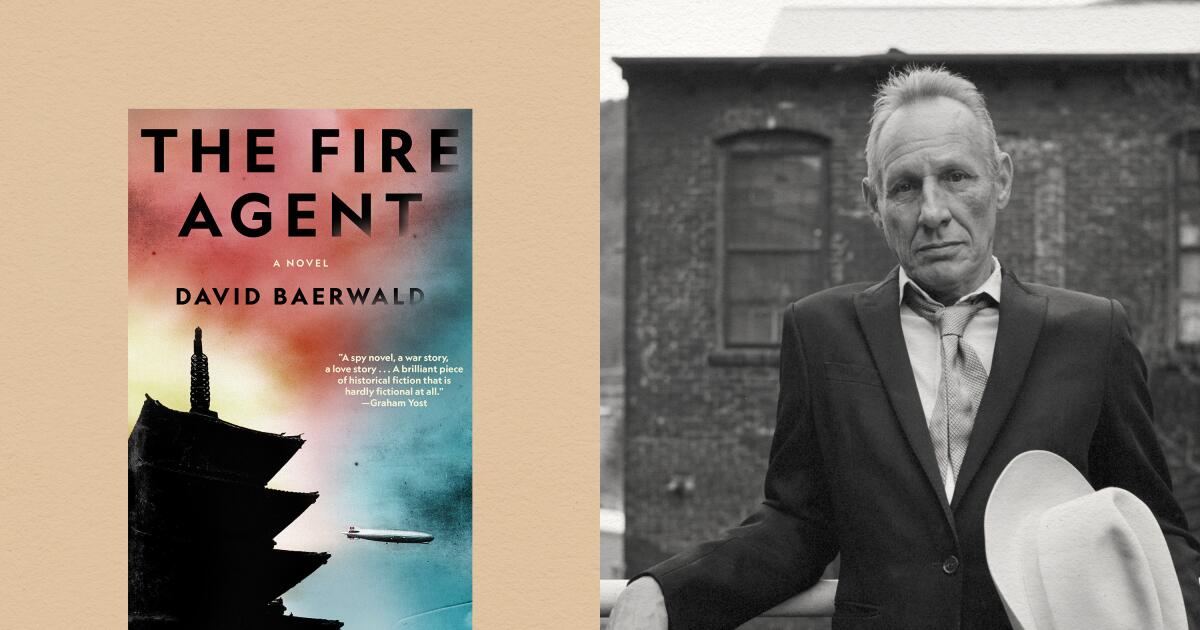
David Baerwald holds up his most precious possession so that it’s visible on our video conference: a very old violin in a very old, battered case.
Baerwald, an award-winning musician, film composer and songwriter who called Los Angeles home for nearly four decades, doesn’t play the violin. During his years with the Tuesday Music Club (immortalized in the Sheryl Crow album “Tuesday Night Music Club”), he played guitar. But the violin belonged to his grandfather Ernst Baerwald — and it plays an important role in his recently published debut novel, “The Fire Agent.”
Not every successful artist turns to a new medium at age 65 or moves to the opposite coast (Baerwald now lives in Kingston, N.Y.). Then again, not every artist has a family history quite like Baerwald’s, one that includes Germany and Japan, two world wars, a 1920s throuple and Beethoven’s Ninth.
On the Shelf
The Fire Agent
By David Baerwald Spiegel & Grau: 624 pages, $32
If you buy books linked on our site, The Times may earn a commission from Bookshop.org, whose fees support independent bookstores.
The violin in Baerwald’s hands was the one his German-Jewish grandfather played as a Japanese prisoner of war in the Bandō camp at Tokushima during World War I. “It’s a very serviceable violin,” Baerwald notes. “A friend of mine played it for some years in the Long Beach Symphony. When my grandfather was older and wealthy, he bought a better violin, which was lost in a fire. But this is the one that matters.”
It matters because Ernst Baerwald was a founding member of a German POW orchestra that chose Beethoven’s great symphony as their premiere work — a performance so moving that it began a Japanese tradition marking the December holidays that persist to this day. Baerwald’s grandfather not only kept his violin throughout the war in which he fought; when he defected from the Third Reich in 1941, he placed it in an oiled bag and brought it with him via an oceanic escape.
Ernst Baerwald’s odyssey from a cushy childhood in Frankfurt to his final days in a beautiful Berkeley mansion, with a long sojourn in Tokyo along the way, reads like, well, a novel. Sent to an elite boys’ prep school in Germany, then on to a seriously disciplined Milanese dojo where he was trained by a Japanese sensei, Ernst was a prisoner in Japan for four years during World War I.
Those details might have been easy to find, but it wasn’t until David Baerwald went to clear out his parents’ house in Brentwood that he discovered papers showing that his grandfather had not only been the head of the Tokyo office of I.G. Farben, but that he had given a major speech to the nascent Office of Strategic Services (precursor to the Central Intelligence Agency) in 1943 that laid out the plan for the firebombing of Japan.
For the record:
10:56 a.m. June 8, 2026An earlier version of this story said Ernst Baerwald’s 1943 speech to the OSS urged use of the atomic bomb on Japan. It laid out the plan for the firebombing of Japan. It also said Kurt Baerwald joined the CIA. He joined the U.S. Army.
He also urged them not to allow partnerships between large corporations and the military, the way the German scientific community and government did with I.G. Farben and Krupp Armaments and Steel. “Any business that makes peace with Fascism will become Fascist,” he said. “And once Fascism captures economic control, then a Fascist coup will inevitably follow to seize political power. Germany, Italy, Rumania, Japan, Spain the story is the same. We cannot allow it to become the story of America.”
When Baerwald read that, “I was really alarmed, in the moment,” he says, realizing how closely tied his grandfather had been to the bombs dropped on Hiroshima and Nagasaki. “But it gave me a plan.” He wanted to show how deeply his grandfather had become integrated into Japanese culture.
“One of my characters tells Ernst that he has ‘yuyo,’ which might best be described as grace,” says Baerwald. “Its Japanese meaning is closer to the state of a river rock that has been washed over and tumbled thousands of times, so that it’s both distinct, and a meaningful part of its environment.” To some extent, the author understands “yuyo” personally, having lived in Japan and been educated at its International School until age 12, when his family moved back to California, “although I wouldn’t claim it for myself,” he says.
That move, in the early 1970s, may have led to his career in music. “When we got back to the States, I was extremely troubled. Call me a fish out of water, I guess. I went through a period of voluntary mutism — I think they call it selective communication. I didn’t talk to anyone, especially not to my family. My hearing would sort of come and go at will, too.” His mother understood he seemed to like his sister’s acoustic guitar, so she suggested he take some lessons. “At the time, it wasn’t at all a career path, it was a way of reassembling my brain so that I could cope with the reality I was experiencing, finding a way to communicate again.”
Part of what he was experiencing, which he knows a great deal more about now, was feeling “the secrets that were the engine propelling my family.” After Ernst’s long career of service and deception, David Baerwald’s father, Kurt, entered the U.S. Army during WWII and later became a professor of Japanese studies at both in Japan and at UCLA. The effects on their family of five still reverberate. Baerwald’s mother eventually became a clinical psychologist who specializes in trauma. “I had to separate myself completely from my family in order to survive,” he says.
However, what stalled the writing of this first novel were the two decades he initially left out, which included Ernst, Lina and their lover Chizuko being a ménage à trois in a 1923 Tokyo dealing with the aftermath of an earthquake and wildfires.
Although “The Fire Agent” is based on Ernst’s history, not all of the facts are congruent. The wrestling coach at the American school in Tokyo, Ernst’s glamorous courtesan Chizuko, and many of the characters are composites. Speaking of that courtesan, Baerwald says it’s true that his grandfather and grandmother cohabited with a Japanese woman for many years, even after Lina and Ernst had a child together. “I found so many letters between my grandfather and my grandmother and I think they truly loved each other, and I think they truly loved that woman, too.”
That didn’t make it easy for Baerwald to write about that love. “My German grandmother, on whom Lina is partly based, was terrifying,” he says. “It was easier to write about her sex life with my grandfather and their Japanese lover by creating composite characters.”
He didn’t want to leave out their sex life, though, or that of others.
“Every generation of young people thinks they invented sex, right? But nothing is new — and it never gets old. Here’s an example. One of my godfathers, Sam Jameson, was the L.A. Times bureau chief in Tokyo for decades. He was also the doyenne, if you will, of the cross-dressing community in that city. It was this rich world he was a part of that nobody knew anything about. I based the character I call Bünheimer on him.”
Some of the worlds Baerwald has uncovered through his family’s papers are rich and sensual; others, like the POW camp where Ernst was held and the speech he gave to the OSS analysts at the Presidio in the 1940s, are stark and terrible. While he renders all appropriately, he’s aware that his perspective remains that of a white Western man. How did he gain the courage to write about people of other races, cultures and genders? He says it comes from something he did when he was on a swim team in high school. “The psychological trick I would play on myself at each meet was to imagine the water I’d dive into was freezing cold,” he says. “And of course it wasn’t. Which was such a relief and kept me going.”
Like his grandfather’s beloved violin, Baerwald has taken a deep dive into previously unknown waters — and survived. As he works on his second novel, he’s better prepared for airing family secrets and the publishing world. Ever the musician, he likens his first round with it to a Shepard tone, the auditory illusion that can make listeners feel like two notes one octave apart are constantly ascending or descending in pitch (Baerwald has worked with famed composer Hans Zimmer, who used the tone in, for example, “The Dark Knight”).
“A Shepard tone can make you feel like you’re flying. Or sinking,” he says. “At this point in my life and art, I prefer to have my feet firmly on the ground.”
David Beckham can’t keep away from his Hollywood Walk of Fame starCredit: InstagramHe unveiled the iconic star on Friday in a formal ceremonyCredit: Getty
And it seems that Sir David still can’t get over the exciting honour.
He was seen posing with it the day after it was unveiled at a formal event attended by his famous family.
Crouching down to see it while donning casual clothes, the sporting legend looked proud as punch as she took a selfie with the star.
His wife Victoria then snapped a photo of her husband as he took the selfie, with her sitting several feet away from him.
At the formal event, David was supported by sons Romeo and Cruz, daughter Harper, and wife VictoriaCredit: GettyVictoria and David shared a smooch after the unveiling of his starCredit: Getty
She then uploaded the snap to her own Instagram story and wrote: “Spotted. @davidbeckham fan.”
David’s wife Victoria Beckham and three of their children, Harper Seven, Cruz and Romeo were all in attendance at the formal event that saw the iconic star unveiled on Friday.
David’s eldest child Brooklyn failed to show up to the very special event, despite living down the road from the Los Angeles location that the unveiling took place.
As David gave his speech before unveiling the star, he mentioned his children – but did not name them individually.
“My beautiful children who are the reason I get out of bed in the morning,” he said while choking back tears.
“Kids, I hope you bring my grandchildren here one day and tell them about a boy who dreamed big,” he added.
After the star’s unveiling, the Beckham’s youngest child Harper visited eldest sibling Brooklyn’s Los Angeles home.
In a scathing statement, Brooklyn told how he grew up with “overwhelming anxiety” having been “controlled” by his parents most of his life.
His initial statement read: “I have been silent for years and made every effort to keep these matters private.
“Unfortunately my parents and their team have continued to go to the press, leaving me with no choice but to speak for myself and tell the truth about only some of the lies that have been printed.
“I do not want to reconcile with my family. I’m not being controlled, I’m standing up for myself for the first time in my life.”
There’s a good reason why David Sedaris is the most beloved humorist in America. He has an unerring ability to tap into the absurdity and petty annoyances of American culture more cogently than any other writer of his generation. He is also funny as hell.
Sedaris’ latest collection, “The Land and Its People,” finds the author grappling with the seductions and consolations of technology, creeping mortality, unwanted sexual advances and feral dogs, for starters. I recently chatted with Sedaris about books, nannies and iPhones.
My fiction is always way, way over the top. I can’t write any story where people are reasonable.
— David Sedaris
You’re reading Book Club
An exclusive look at what we’re reading, book club events and our latest author interviews.
By continuing, you agree to our Terms of Service, which include arbitration and a class action waiver. You agree that we and our third-party vendors may collect and use your information, including through cookies, pixels and similar technologies, for the purposes set forth in our Privacy Policy such as personalizing your experience and ads.
✍️ Author Chat
Your first book was a collection of short stories. Was it always the intent to move into writing essays, or did you have designs on being a novelist?
It never occurred to me that I would write essays about my life. I started off writing fiction, and then I started doing these readings in Chicago. Then I was to read at this variety show at this place called Park West. I was limited to about five minutes, and so I just plucked something from my diary. And it worked. I would walk onstage wearing a tie with a stack of diaries in my hand. Then I started doing these radio shows, and I thought I could read my fiction, but it had to be nonfiction. So a lot of the earliest pieces that I ever read were just things plucked from my diary.
What actually happened was that after this piece I wrote called “The Santaland Diaries” had been on the radio, I had this other book that I had already written, and I was just kind of waiting for someone to call and ask if they could publish it. But it couldn’t be published unless “Santaland” was included.
That book was “Barrel Fever” in 1994 which was a big hit. Now you were that rare creature: a bestselling essayist.
With essays, there’s a kind of shorthand to it. If you’re writing fiction, you have to world-build with every story, whereas with an essay I can just get up on stage and say “my sister and I went shipping” and people know who my sister is, and I can just get right into it. My fiction is always way, way over the top. I can’t write any story where people are reasonable.
What makes you unique is that you are onstage in front of an audience more often than 99% of authors. You can workshop material to see if it lands, much like a comic.
Yes, and I don’t ever want to waste an opportunity to do that. The frustrating thing about being on a book tour is that I can no longer make any changes to the book. So I’ve been bringing out some little, short things I’ve been working on to get it on its feet.
Much of your writing is observational. Do you find, given your public profile, that it becomes harder to do that?
It depends on where I am. If I’m hanging out in places where people don’t read, or in another country, then it doesn’t make any difference. The bigger problem is that when you’re spying on the world now, the world is just looking at their phones.
“The Land and Its People” is the new collection of essays by David Sedaris.
(Little, Brown and Company)
I know you aren’t big on the phone, or at least taking pictures with your phone. In one of your essays in the new book, you are on a Kenyan safari with your partner Hugh and you adamantly refuse to snap a single photo.
If you’re at a book signing, you meet someone and then stand up and someone takes a picture with their phone. I’d rather talk to that person, you know? The picture thing, it just doesn’t make any sense to me. It doesn’t mean anything. I was invited to the Academy Awards because I wrote something about a movie, which was crazy. But it never for one moment occurred to me to go up to anybody to take a selfie. All that means is that I bothered this person. By the way, I have never once asked Hugh to send me his safari pictures.
What books make you laugh out loud?
I’m always happy to find a funny book, but they are hard to find. Did you read “Rejection” by Tony Tulathimutte?
It’s on my nightstand.
Oh my God, I laughed out loud so many times at that book. And he’s not a humorist. I’m not even sure if he thinks the book is funny. There’s a short story in there, about a guy who’s just a complete a— and his girlfriend moves in with him and he makes her put all of her stuff in the oven.
I like things that are funny that aren’t supposed to be funny. Somebody said to me a few weeks ago, “How can we laugh with the world in such terrible shape?” I said, it’s easy. Just get rid of any sense of empathy or compassion! If you’re writing satire, you have to go big. You can’t tone it down. Then it’s not satire anymore, it’s just cereal milk.
You do write in the new book about this kind of language policing that is prevalent now.
I hate it. I mean, the New Yorker is pretty good to me. I can’t complain. But I turned something in to them, and they told me I couldn’t use the word “nanny” in the piece. I mean, a nanny is a real profession, like a pharmacist. I told them I wouldn’t cut it. It just makes me think about young people who are starting out, who can’t say no because they need the money.
(This Q&A was edited for length and clarity.)
📰 The Week(s) in Books
(Illustration by Jim Cooke / Los Angeles Times; Photo via Getty Images)
Leigh Haber is blown away by Anne Patchett’s 10th novel, “Whistler.” “This exquisite writer has once again delivered an incandescent work of fiction — sweet, but never sentimental, infinitely wise and suffused with love,” Haber writes.
Songwriter and Sheryl Crow collaborator David Baerwald has written a novel called “The Fire Agent,” about his grandfather Ernest, a musician and a prisoner of war in a Japanese internment camp during World War I. “One of my characters tells Ernst that he has ‘yuyo,’ which might best be described as grace,” Baerwald tells Bethanne Patrick. “Its Japanese meaning is closer to the state of a river rock that has been washed over and tumbled thousands of times, so that it’s both distinct, and a meaningful part of its environment.”
Rasheed Newson, a showrunner for “The Chi” and “Bel-Air,” has written “There’s Only One Sin in Hollywood,” a novel about an often-neglected chapter of Hollywood’s Golden Age. “I wanted to do a deep dive into Black queer history during the Golden Age of cinema,” Newson tells Meredith Maran. “The first thing that came to me was Xavier’s character. I decided to make him the 10-years-younger, queer rival of Sidney Poitier, to highlight the acceptable versus unacceptable — meaning, straight versus gay — 1950s Black movie star.”
Finally, Adam Messinger, a staffer at West Hollywood’s Book Soup, attempts to answer the question: Why are books shrinking? One possible culprit may be social media. “Holding the book up to take a photo of it is easier,” writer and social media influencer Caroline Mason tells Messinger. “Although I do sometimes still drop it.”
📖 Bookstore Faves
Lost Books in Montrose looks and feels unlike any other bookstore in L.A. — a verdant terrarium filled with new and used books and vinyl. Created by Last Bookstore co-owners Jenna and Josh Spencer, Lost Books also sells plants. Moss has colonized the ceiling, and tall trees keep sentry over the store’s diverse and eclectic inventory. I asked Josh Spencer about how Lost came about.
What was the thinking behind opening Lost?
It was spontaneous. My wife and I were eating dinner in the very charming neighborhood of Montrose, and saw a very cool vacant storefront. It also happened to be on Honolulu Avenue, and with both of us being from Hawaii, we took it as a sign. We did not want to franchise the Last Bookstore at the time, and wanted the new store to have its own name and unique vibe.
You also sell plants. Where did that idea come from?
My wife grew up in a rain forest on Maui. She loves plants, and we thought that a pairing of nature with literature was exciting and not done before.
Who are your customers?
Mostly locals in Montrose, La Cañada, La Crescenta, Glendale. But we get a fair number of tourists and also people from other parts of L.A. People who love beauty, nature and books. And vinyl!
Are you seeing that big vinyl resurgence we’ve been hearing about?
Absolutely! Our vinyl does very well for us.
What genres or types of books do well for you there?
Classics, kids books, mysteries, graphic novels, art, self-help, memoirs, cookbooks and gardening of course!
Lost Books is located at 2233 Honolulu Ave., Montrose.
(Please note: The Times may earn a commission through links to Bookshop.org, whose fees support independent bookstores.)
More than any other artist in the 20th century, David Hockney defined Los Angeles in the public imagination. When he first arrived in January 1964, age 26, his mental image of the city had been forged not by art but by Hollywood movies, which he had watched as a young boy in Yorkshire, England. In later life, he often recollected the sharp-edged shadows cast by the Californian sunlight in movies such as Laurel and Hardy’s “Big Business.
Before he ever went to L.A., Hockney — who died Thursday at 88 — knew that he would love it. Writing about his first descent into the city, he recalled how “as I flew over San Bernardino and looked down — and saw the swimming pools and the houses and everything and the sun, I was more thrilled than I’ve ever been arriving at any other city, including New York.” By this time, the glamour of Hollywood had been compounded by other influences, including the homoerotic magazines that an American friend had given him at the Royal College of Art in London. Titles such as Physique Pictorial, published in L.A. by the pioneering “beefcake” photographer Bob Mizer, held out a promise of California as a paradise of rippling men and permanent sunshine. A darker, no less thrilling image of the city had arisen from Hockney’s reading of “City of Night,” the 1963 novel by John Rechy that tells the story of a hustler in the gay underworld of downtown L.A.
Los Angeles itself felt young to Hockney. He loved the light, the architecture, the sense of space and the sense of possibility — not least the possibility of greater sexual freedom. West Hollywood boasted a large gay bar, the Red Raven on Melrose Avenue, that was unlike anything he had found in London or New York. There was also the lure of the beach, with its pageant of sculpted physiques. Venice Beach struck him as a more body-beautiful version of London’s Portobello Road.
Before long, his work shifted from generic fantasies of the city (a young man showering in Beverly Hills, for instance) to vivid portrayals of its real-life pools, palm trees, architecture and people. American artists such as Edward Ruscha and Edward Kienholz were producing their own canonical images of L.A. in these years, but for Hockney, there were no artistic precedents — “no ghosts,” as he later put it — to live up to. “People then didn’t even know what it looked like,” he once said. “And when I was there, they were still finishing up some of the big freeways.… I suddenly thought: ‘My God, this place needs its Piranesi, Los Angeles could have a Piranesi, so here I am!’ ”
He was true to his word, even if his luminous, serene images of the city were a far cry from Giovanni Battista Piranesi’s feverish visions of Baroque Rome. “Beverly Hills Housewife” (1966), a portrait of a pink-dressed collector in her modernist home, marked the onset of a realist style that would define Hockney’s work for the next decade. This era gave rise to paintings that became icons of their time and place. Among them were “A Bigger Splash” (1967), which was based on a magazine cover that he came across on a newsstand, and “Christopher Isherwood and Don Bachardy” (1968, sold last year at Christie’s New York for $44.3 million). Inspired by Hans Holbein, this portrait of the English novelist and his artist partner was one of the first celebratory portrayals of a gay couple. Hockney would later recount how Isherwood proclaimed: “Oh David, we’ve so much in common; we love California, we love American boys, and we’re both from the north of England.” Hockney’s beloved American boy at this time was Peter Schlesinger, a young artist he had met while teaching at UCLA in the summer 1966 — and a recurring presence in the early L.A. pictures.
According to Norman Rosenthal, who curated a major survey of Hockney’s art at the Fondation Louis Vuitton in Paris last year: “It is astonishing that a boy from a poor family in Bradford became the person — partly because of his gayness, but also his talent — who defined what everybody now thinks of as California. L.A. had no real image in the world before then, unlike New York.”
Despite his enchantment with Los Angeles, Hockney didn’t settle there until 1978, after a decade of bouncing between America and Europe. In the summer of 1979 he moved into a house in the Hollywood Hills, and soon adorned its pool with swishing strokes of blue paint. In the early 1980s, he converted the paddle tennis court into a studio. The meandering routes and Mediterranean scenery of the Hills were a fresh source of amazement, giving rise to monumental depictions of Mulholland Drive and Nichols Canyon in a newly abstract style.
By this time, the city was deeply familiar — a second home — and he had a close circle of friends around him who included the patron Betty Freeman (subject of “Beverly Hills Housewife”), the designer Gregory Evans, the gallery owner Nicholas Wilder and the film producer Joe Simon. “L.A. had represented a whole new world for him,” says Simon, who remained in regular contact with the artist until his final days. “He just loved the light. He was like a kid in a candy store when he first came. But David was all about the work. Everything came back to that.”
In recent decades, Hockney’s name had become synonymous with the landscapes of his native Yorkshire, which he began painting prolifically in the early 2000s. But Los Angeles never lost its newness and promise. His house in the Hills remained a sanctuary until his final years, when he was too frail to travel. L.A. was where he had come of age, and it remained an indelible part of his life and psyche — not least in terms of its egalitarian spirit and its tendency toward the horizontal. “The great thing about Hockney was that he spoke to everybody,” says Rosenthal. “Few artists of his world and his generation could do that.”
James Cahill, a novelist and an art critic, is the author of, among other books, “David Hockney” and the forthcoming “The Beverly Hills Housewife: Hockney’s Californian Muse and the World Beyond the Pool.”
David Beckham has snapped “That’s a private matter’ as he shut down any questions on his son Brooklyn amid their ongoing family riftCredit: GettyThe soccer legend was being interviewed ahead of receiving a star on the Hollywood Walk of FameCredit: Splash
The Beckhams have been embroiled in an ugly fallout with Brooklyn and his wife Nicola Peltz for monthsCredit: GettyDavid received a star on the Hollywood Walk of Fame on Friday, June 12, 2026, in Los Angeles.Credit: APTom Cruise, Victoria Beckham, and Harper Seven Beckham attended the ceremony honouring DavidCredit: APBrooklyn confirmed he had cut ties with his family following a statement on his Instagram accountCredit: Splash
David told Variety: ‘We’ve got four incredible kids. We’ve got businesses that we work hard on.
“But we always make time for each other, and we always have. I want Victoria to be the best version of herself, and vice versa.
“And as busy as we are, our family always comes first.
“That’s our priority, and that’s what makes it work when you’ve been together for so long. Our priority will always be our family.”
It is thought Brooklyn is unlikely to attend the ceremony despite living just a short distance away in Los AngelesCredit: GettyDavid grafted for his star under the category of Sport Entertainment after becoming the UK’s first billionaire sportsmanCredit: Getty
David Hockney, the innovative and prolific British artist who arrived in Los Angeles in 1964, soon celebrating its sun-drenched life and landscapes in colorful, wildly popular paintings, has died.
He was 88.
Calling himself “an English Los Angeleno,” Hockney immortalized the city’s sparkling swimming pools, palm trees and beautiful young men, then went on to experiment with intricate photo collages, portrait suites, painted and filmed images of Yorkshire landscapes, iPad drawings and more.
Since his Pop Art paintings in the early ‘60s at London’s Royal College of Art, Hockney was rarely out of the limelight and, more important, rarely out of fresh ideas for how to draw, paint, film, print, photograph or otherwise express his creativity. The David Hockney Foundation owns more than 8,000 of his works, including about 200 sketchbooks, more than 230 self-portraits, opera designs and portraits of family and friends.
Hockney loved Hollywood — the people and the place — and liked to say he was brought up in England and Hollywood because of the time he spent at the movies. His peroxide blonde hair reportedly was inspired when he was a student and saw Clairol TV ads claiming “blondes have more fun.” But it was his interest in everything from Elvis Presley to the Hubble Space Telescope and his sense of humor that set him apart. Time Magazine art critic Robert Hughes once called him “the Cole Porter of modern art.”
He was open about being gay, even when homosexuality was outlawed in Britain. His early love affair with artist Peter Schlesinger, a younger man he met when teaching a summer drawing class at UCLA in 1966, inspired Hockney’s monumental 1972 painting “Portrait of an Artist (Pool with Two Figures),” a centerpiece of Jack Hazan’s 1974 film “A Bigger Splash.” The painting’s 2018 auction at Christie’s drew a record $90 million for a living artist.
He was a dedicated reader and student of art, paying homage in his work to Picasso and Cubism as well as to Monet, Matisse, Van Gogh and Cezanne. A lover of opera, he often had it playing loudly in the studio and enjoyed taking visitors on curated car trips through the Hollywood Hills or Malibu while listening to Wagner. He designed sets for major companies in Los Angeles, Chicago, New York, London and elsewhere over the years, and some of his set models were later shown in museums.
David Hockney’s work “Gregory in the Pool (Paper Pool 4)” is part of his solo exhibition “David Hockney: Perspective Should Be Reversed” at the Palm Springs Art Museum in Palm Springs. (Courtesy of the Palm Springs Art Museum)
(Courtesy of the Palm Springs Art Museum)
His solo shows drew enormous crowds to the Los Angeles County Museum of Art as early as 1988. In 2017 a major retrospective of his work, keyed to his 80th birthday, was presented at New York’s Metropolitan Museum of Art, Paris’ Centre Pompidou and London’s Tate Modern. Chronicling Hockney’s arrival as an important artist in the “ravishing” Met retrospective, the New Yorker writer Andrea K. Scott called it “a revelation.” It was, she wrote, “a retort to all the eye-rollers,” including herself, who dismissed his work “as, at best, a guilty pleasure.”
In 2012 he received the coveted Order of Merit, which Queen Elizabeth II presented to him at Buckingham Palace.
David Hockney was born the fourth of five children to a working-class family in Bradford, Yorkshire, on July 9, 1937. He has said he started “making marks on paper” at 8 and received private painting lessons before moving on to Bradford School of Art in 1953. The first painting he sold was a portrait of his father in 1955. He attended the Royal College of Art in London from 1959 until his graduation in 1962 and received the school’s Gold Medal.
After college he did not slack off, noted his biographer Christopher Simon Sykes. In his 2014 book, “Hockney: The Biography,” Sykes pointed out that the artist’s first flat had a chest of drawers near the bed on which he had painted, in large capital letters, the words “get up and work immediately.”
David Hockney in 2017.
(Catherine Opie, Courtesy of Regen Projects, Los Angeles and Lehmann Maupin, New York, Hong Kong and Seoul.)
Hockney lived by that command for the rest of his life, turning out canvas after canvas, photo after photo. In the ‘80s came his extraordinary multi-image photographic collages of friends including writer Christopher Isherwood and artist Don Bachardy and such landmarks as the Brooklyn Bridge, Grand Canyon and Pearblossom Highway.
“The Polaroids started oddly enough when I’d just finished a long period of work in the theater, which is of course playing with perspective and illusion,” he once told The Times. “People say, ‘You are a painter, and photography is a sideline.’ But nothing is a sideline for me.”
That included his continuing fascination with technology. The artist’s long career swept in artworks made not only on cameras and canvases, but on such things as fax machines and photocopiers. Hockney liked to experiment, whether it was with state-of-the-art printing devices or centuries old painting techniques. He went several times to a show of portraits by Jean Auguste Dominique Ingres at London’s National Gallery in 1999 and was greatly taken with the photographic’ quality of Ingres’ 19th century drawings. Certain that Ingres had used something optical to achieve that quality, Hockney bought himself a camera lucida, a small device that works like a prism. He then applied Ingres’ methods–as Hockney imagined them–to his own portraits of friends and family, and in 2001, he published “Secret Knowledge,” exploring his theories on early artistic uses of optical devices.
His death was confirmed by the Associated Press and New York Times.
Hello! I’m Mark Olsen. Welcome to another edition of your regular field guide to a world of Only Good Movies.
It seems odd that the biggest news of the week was the fact that tickets for a movie went on sale, but apparently Christopher Nolan’s upcoming “The Odyssey” is no typical movie. Having already made tickets available for some shows a full year in advance, Universal put more of them on sale for the July 17 opening weekend of the Oscar-winning filmmaker’s ancient epic. There were reports of long online wait times, crashing ticketing systems and the kind of problems more often associated with pop stars than movie nerds.
“The Odyssey” will be playing in a variety of formats, with the Imax 70mm screenings among the most coveted. More venues than usual have also been announced as playing the film in 70mm, including the Village Theatre in Westwood. (A handy visual guide to the different fomats is on the film’s website.) While there is a hint of the ridiculous to some of this mania — popcorn buckets in the shape of Imax cameras and movie tickets going on the resale market for hundreds of dollars — there is no denying how exciting it is to see this kind of anticipation building around any movie.
Back to a ’90s phenomenon
Ewen Bremner, left, Ewan McGregor, Johnny Lee Miller and Robert Carlyle in the movie “Trainspotting.”
(Liam Longman / Sony Pictures Classics)
When it first came out in 1996, “Trainspotting” was an instant cultural phenomenon, capturing the vibes of the “Cool Britannia” moment with its sparkling soundtrack, inventive, high-energy style and cast that included up-and-coming talents such as Ewan McGregor and Kelly Macdonald. It was only the second feature directed by Danny Boyle, who would go on to be an Oscar winner, mount an Olympics opening ceremony and remain a reliably exciting filmmaker all the way to his recent “28 Years Later.”
“Trainspotting” is now back in theaters in a 4K restoration for its 30th anniversary, having lost none of its brash vigor. In his original review, Kenneth Turan said of the film, “Exuberant and pitiless, profane yet eloquent, flush with the ability to create laughter out of unspeakable situations, ‘Trainspotting’ is a drop-dead look at a dead-end lifestyle that has all the strength of its considerable contradictions.”
Appearing like magic
Kathy Najimy, left, Bette Midler and Sarah Jessica Parker in the 1993 comedy “Hocus Pocus.”
(Disney)
Directed by Kenny Ortega, “Hocus Pocus” is one of those movies that has seen its fanbase grow steadily over the years — it is now much more beloved than it ever was on initial release. (It even inspired a 2022 sequel.) Bette Midler, Sarah Jessica Parker and Kathy Najimi play the Sanderson sisters, 17th century witches who find themselves inadvertently brought to modern day by a group of teenagers messing around with casting spells.
The film will play Saturday at the Gardena Cinema, featuring a live commentary from cast members Omri Katz, Thora Birch, Larry Bagby, Tobias Jelinek and Vinessa Shaw followed by a Q&A. This is a rare appearance by Katz in particular, who has retired from acting. Fans of the movie should make the effort to attend.
The Gardena, the last family-owned single-screen theater in Los Angeles, suffered a blow last weekend when a burst pipe flooded the venue. Though they are operational, a campaign has been started to help them recoup repair costs.
Examining the life of the mind
John Turturro in the 1991 movie “Barton Fink.”
(20th Century Fox)
Ranking the films of Joel and Ethan Coen has become a cottage industry of its own. Personally, I go back-and-forth on where to place 1991’s “Barton Fink,” which won the Palme d’Or at Cannes, as well as prizes for director and actor. The movie is by turns funny, disturbing and inscrutable (all good things), with John Turturro in the title role as an intellectual New York playwright who goes to Hollywood to write screenplays — and slowly goes insane.
The movie will play Friday in 35mm at Vidiots with an introduction from Noah Segan, who directed Turturro in one of the breakout titles from this year’s Sundance, “The Only Living Pickpocket in New York.” Hopefully, this will turn into a year in which Turturro gets some long-deserved accolades.
Christmas in June
Elliott Gould on the set of 1978’s “The Silent Partner.”
(Anwar Hussein / Getty Images)
There is something particularly charged about watching a Christmas movie at other times of year — an odd sense of dislocation and maybe even something a little naughty, a circuit-scrambling frisson. So it is particularly notable that as part of their salute to the independent studio Carolco Pictures (behind such films as “Basic Instinct,” “Terminator 2: Judgment Day” and “Reservoir Dogs”), the Vista will be showing 1978’s “The Silent Partner.”
Just the kind of tight and gripping thriller that people pine for all year round, “The Silent Partner” has a screenplay by Curtis Hanson, who would go on to make “L.A. Confidential.” Elliott Gould plays a Toronto bank teller who tries to rip off the thief (Christopher Plummer) who robs his branch wearing a Santa costume as a disguise. Soon they are both scheming against each other.
In his original review of the film, Kevin Thomas called it “tense and ingenious.” In a reconsideration of the film some months later, Charles Champlin called it “a stylish crime-suspense story, a cat-and-mouse game between Christopher Plummer as a clever, sadistic bank robber and Elliott Gould as a bored bank teller who sees a way out of his boredom and into riches.”
So much beauty
Brooke Adams and Sam Shepard in the 1978 movie “Days of Heaven.”
(Criterion Collection)
Terrence Malick’s 1978 “Days of Heaven” is still strikingly singular: a love story told with a stirring visual style. The film’s beauty — aside from its impossibly good-looking lead actors, Richard Gere and Brooke Adams — in part comes from gifted Spanish cinematographer Néstor Almendros, who made his American debut after a career in Europe that saw him working with filmmakers such as Eric Rohmer and François Truffaut. Almendros would win an Academy Award for the film.
The New Beverly will show “Days of Heaven” in 35mm Tuesday through Thursday as a double bill with Truffaut’s 1970 “The Wild Child,” shot by Almendros in black-and-white. Writing about “Days” in 1978, The Times’ Charles Champlin called it “an extraordinary and original visual experience and a movie which is thrilling in its uncompromised purity.”
Perverse fun
Ha Jung-woo, left, and Kim Min-hee in the 2016 movie “The Handmaiden.”
(TIFF)
Korean filmmaker Park Chan-wook was just president of the Cannes jury and has become a much-beloved figure on the international circuit for his wicked sense of humor and sharp sense of style. Nowhere is that on better display than his 2016 film “The Handmaiden,” which is somehow at once a period drama, a con-man thriller and an erotic lesbian romance. Vidiots will be showing the movie Sunday.
As Justin Chang wrote when the film was released, “Without sacrificing his taste for psychosexual perversity or his flair for violent grace notes, Park has given us a teasingly witty and elegant puzzle-box of a thriller whose pleasures are rooted not in visceral shock but in narrative surprise, and which wisely opts to seduce rather than pulverize its audience.”
In an interview at the time, Park said the film’s unpredictability was part of the project’s appeal. “That’s the exact kind of fun to be had with this film and the reason why I chose to make this film. Everything becomes a game of perception. Rather than to say it’s a difficult thing to navigate, it is fun to deal with. Not only for me as a filmmaker but for the audience to see that and engage in that game.”
New this week
Amy Nicholson reviews the latest attempt to make a movie out of a popular Mattel toy with the lightly-tongue-in-cheek “Masters of the Universe.”
Amy also reviewed the revival of the satirical “Scary Movie” franchise, with original stars Anna Faris and Regina Hall returning to make fun of such recent hits as “Sinners,” “Weapons” and “The Substance.”
The documentary “Time and Water” looks at climate change through the life and work of Icelandic writer Andri Snaer Magnason as directed by Sara Dosa, who had a hit with her last film “Fire of Love.” Robert Abele reviews.
One last thing…
This week, our colleagues at De Los launched a podcast hosted by Fidel Martínez and Suzy Exposito. The interview-style video podcast will feature conversations with the people shaping Latino culture in the United States.
The first episode features singer and actor Leslie Grace, who talks about her experiences working on the film “In the Heights” as well as being the star of the canceled “Batgirl.”