Billionaire tax is dividing California healthcare system it’s designed to support
A proposal to tax California’s billionaires has fractured Democratic politics, repelled some of the state’s richest residents and exploded into a costly battle that’s overshadowing even the gubernatorial election.
Known as Proposition 40, the ballot measure is also dividing the very industry it’s supposed to help. The healthcare workers union behind the initiative, which would authorize a wealth tax on billionaires, says the levy would raise sorely needed funds to shore up health coverage.
By contrast, leading California hospital and doctor groups are opposing the measure ahead of the November vote. They say the one-time 5% levy on the state’s wealthiest is a risky gambit with an uncertain path to victory — as well as a distraction from other proposals to shore up healthcare.
“This is an experiment on a taxation scheme that’s not been done before, and it puts healthcare in a more vulnerable position as a result,” California Medical Assn. Chief Executive Dustin Corcoran said at a recent briefing in Sacramento. “It’s not a healthcare ballot measure.”
Less than six weeks before election day, polls show a divided electorate. But whatever the outcome, the fight is exposing a broader problem confronting California: how to preserve one of the nation’s largest expansions of publicly funded healthcare as a big chunk of the money that helped pay for it disappears.
Over the last decade, California increased access to publicly funded healthcare by broadening eligibility for Medi-Cal, the state’s Medicaid program, and other types of insurance, allowing millions more residents to gain coverage. The number of people without insurance fell to 2.4 million in 2024 from about 6.5 million in 2011.
Now, that trend is expected to reverse. According to the Congressional Budget Office, President Trump’s budget bill last year will lead to $1 trillion in healthcare-related cuts over a decade. Earlier this week, the Trump administration said it recently removed 760,000 people from Obamacare plans across the nation, alleging that some were enrolled improperly and others don’t exist.
Combined with strict work requirements, more frequent eligibility checks and a pullback in state spending pushed by Democratic Gov. Gavin Newsom, the changes are projected to push California’s uninsured population under the age of 65 to 4.6 million by 2030, according to the UC Berkeley Labor Center.
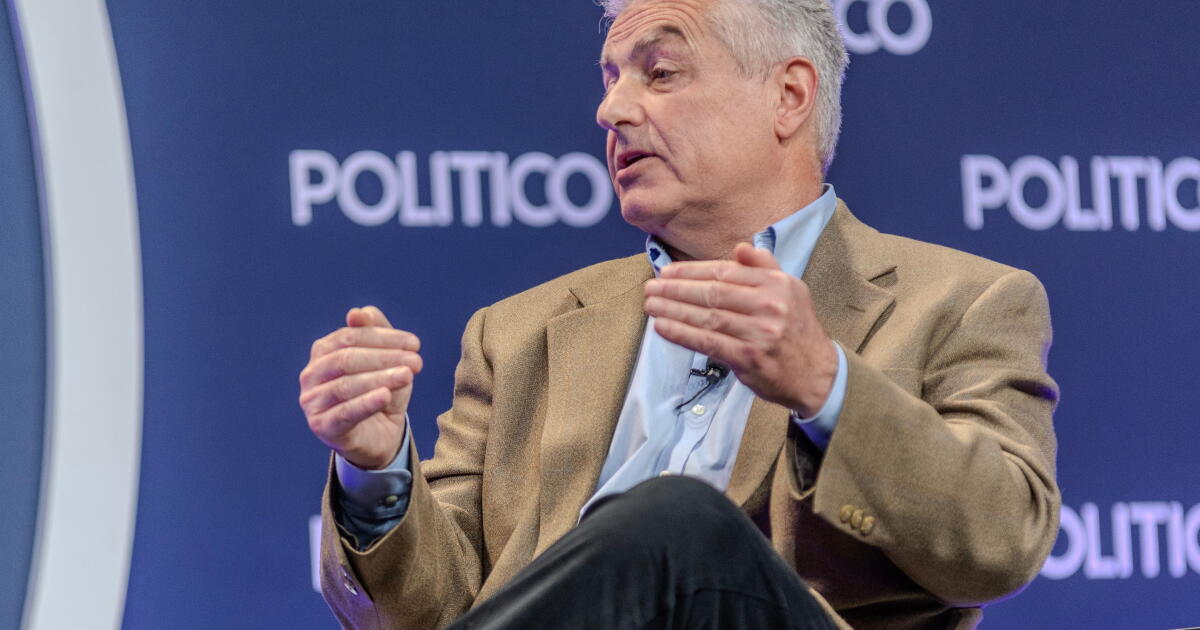
“Without trying to be melodramatic, when millions of people lose coverage, it is entirely predictable that thousands will die unnecessarily because of foregone treatment,” said Dave Regan, president of SEIU-UHW, the healthcare-workers union pushing the billionaire tax.
“There is an absolute consensus on what the problem is, and there’s a consensus that there’s no other solution on the table,” he said in an interview at Bloomberg’s San Francisco offices.
Even before the budget cuts start to bite, financial strains are mounting at institutions such as Martin Luther King Jr. Community Hospital in South Los Angeles.
MLKCH’s waiting room is now mostly used for treating patients, with 16 wooden cubicles functioning as care rooms. Sick or injured people are also cared for in the hospital’s front hallways and in what used to be the meditation chapel and the gift shop.
The hospital opened in 2015 with an emergency department built for 25,000 visits annually. In 2024, it handled 130,000. Dr. Elaine Batchlor, its CEO, said further funding reductions “would threaten the sustainability of the hospital.”
Batchlor isn’t taking a position on Proposition 40 and has been looking for other sources of revenue. SEIU-UHW’s Regan argues there’s no other way to raise the money needed to fill the massive gap.
The California Budget & Policy Center estimates the state stands to lose roughly $30 billion in federal Medi-Cal funding each year. Asking California lawmakers for that amount is a “fool’s errand,” Regan said. “And on top of that, the only people the legislature will tax are ordinary people.”
The union estimates the levy would raise $100 billion over five years, with 90% earmarked to shore up health coverage amid impending budget cuts.
Critics dispute the projection. The state’s nonpartisan Legislative Analyst’s Office says the tax would probably raise tens of billions of dollars, but potentially reduce income-tax revenue in the long run, as some ultrawealthy residents depart the state.
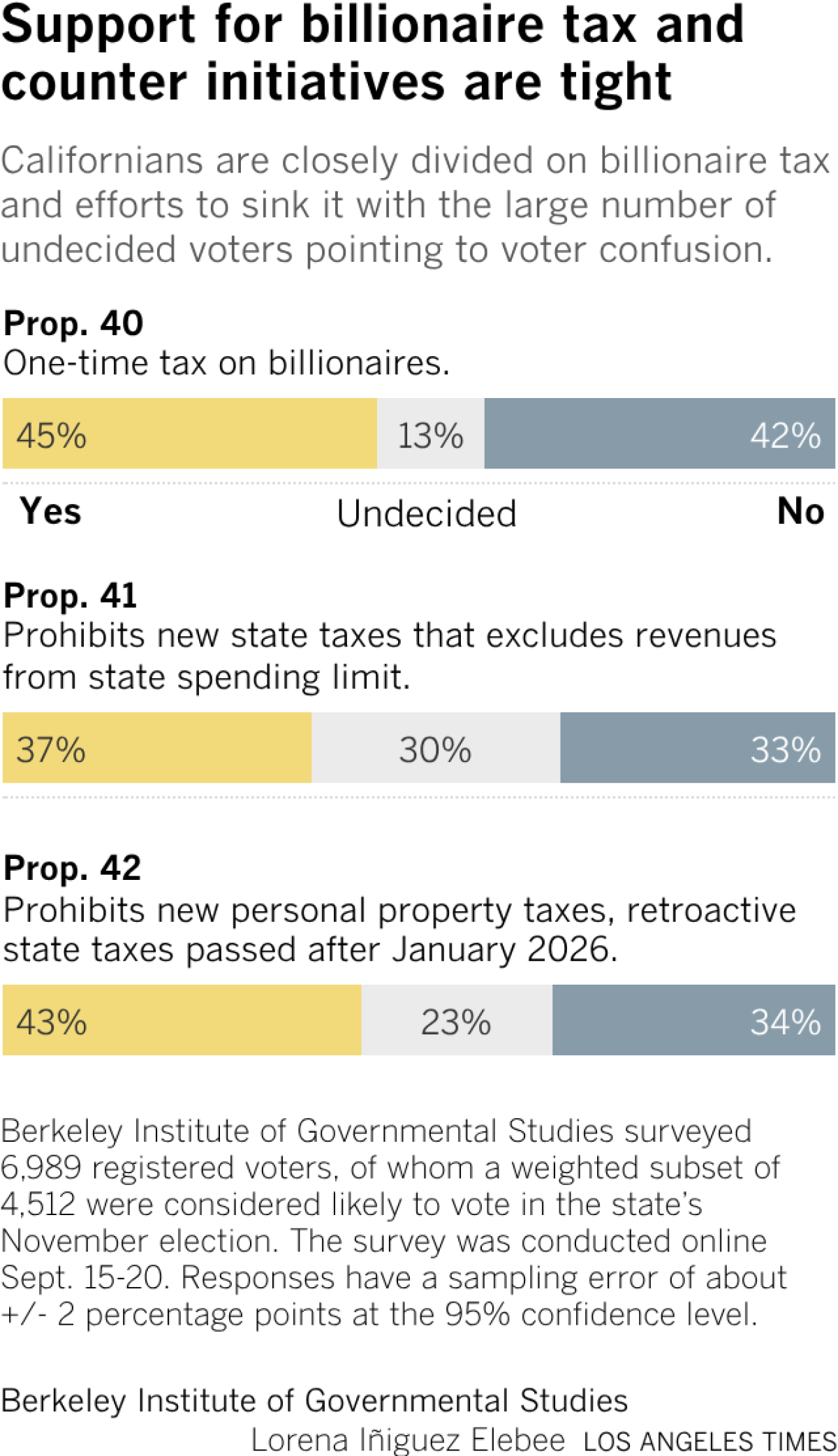
Recent polls show an increasingly contested path for Proposition 40. A recent UC Berkeley-Politico poll found 45% of likely voters in favor, but opposition has increased since early this year and now stands at 43%. A separate Public Policy Institute of California survey put support at 52% and opposition at 46%.
Led by Sergey Brin, wealthy opponents have poured almost $230 million into funding Building a Better California, according to a filing late Thursday. That’s helping them flood the airwaves with anti tax advertising. There are also two competing ballot measures designed to torpedo Proposition 40 if they pass.
Billionaires aren’t the only detractors. Critics have also assailed Proposition 40 for carving out an exception to California’s constitutional funding rules to steer most proceeds to healthcare. While the state generally earmarks at least 40% of General Fund revenue to public schools and community colleges, the billionaire-tax proposal excludes the new levy from that calculation.
Corcoran, the medical association chief, argues that even if Proposition 40 passes in November, legal challenges would potentially delay its implementation for years.
“There’s a lot that we can do looking ahead to 2028 when these cuts start taking greater effect that frankly would provide more immediate relief than Proposition 40 would,” he said. His group and others are pushing instead for large corporations to help cover the cost of public insurance for their workers.
Regan called that proposal “the worst public policy on planet Earth,” saying costs will be passed on to consumers and that it essentially acts as a payroll tax on low-wage workers.
He also disputed the notion the billionaire tax would lead the ultrawealthy to leave the state, pointing to Nvidia Corp. CEO Jensen Huang, who earlier this year said he would be “perfectly fine” with the levy. As for legal challenges to the billionaire tax, Regan said he believes they can be resolved in 12 months.
The uncertain funding picture has many hospitals bracing for cuts.
James Suver, CEO of Ridgecrest Regional Hospital, about 150 miles north of Los Angeles, said he’s not betting on proceeds from the billionaire tax. He’s weighing options that include pausing maternity care again, cutting physician recruitment and reducing emergency-room service.
“Our future under the most likely scenario is not looking very good,” Suver said. “We’re beyond doing minor nips and tucks to be able to offset some of the changes that I suspect may be happening in the future.”
Clanton writes for Bloomberg. Kara Wetzel of Bloomberg contributed.