dangerous

The search for gold is a dangerous and laborious gamble for Sudan’s miners | Sudan war News

When Altayeb Alhadi was just six years old, his father died after a well collapsed in his village in White Nile state, south-central Sudan. Two months later, and his mother also died, leaving the five children in the family as orphans. As the eldest of the siblings, it was Altayeb’s responsibility to find work and help the family survive.

At 14, he travelled hundreds of kilometres from his home in Galli village to seek work in the north, where gold mines dot the landscape, so he could feed his siblings and keep them in school.

Recommended Stories

list of 3 itemsend of list

“We warned him about the dangers, but he was ambitious. Some relatives were already working in the area although they had found jobs in restaurants and other services rather than underground extraction,” Ayateb’s uncle Alhadi Hamid told Al Jazeera.

The boy initially worked in transport and other jobs, but when he heard lucrative stories from miners in the area, he began to search for gold in the surrounding mountains.

Altayeb died in an air strike attributed to the Egyptian military at a gold-mining site near Jabal Al-Aigdat in Sudan’s Red Sea region on October 10, which killed at least 72 miners, a few months after he began working at the site.

“It was less than 30 minutes since we separated, and he said he was going to the mine. We suddenly heard a loud sound of bombardment, and we ran. It was too chaotic with people running in all directions and many attacks taking place within a few minutes,” a fellow miner told Al Jazeera, speaking on condition of anonymity.

“We found Altayeb with his hand and leg [blown off] and a severe injury to his abdomen [which] was open. We tried to help him and took him to a safer place near a mountain. We were terrified. He died within hours. … We couldn’t believe how quickly things could happen.”

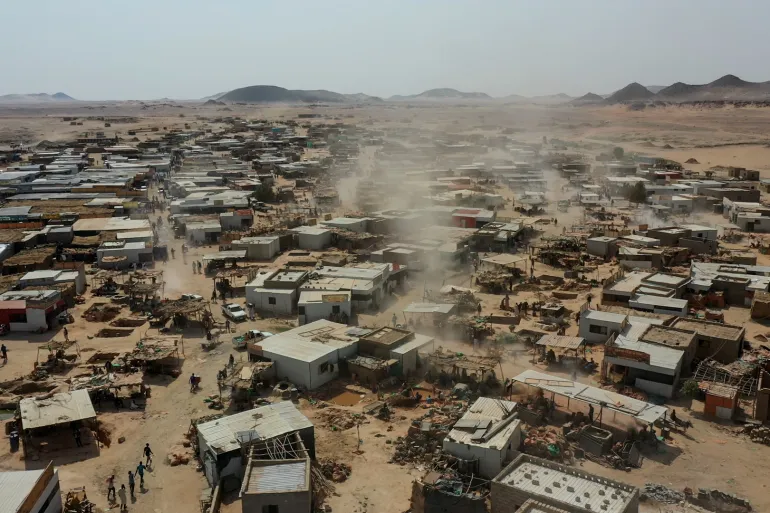
Dalago market in northern Sudan close to gold mines [Mojahid Satti/Al Jazeera]
Dalago market in northern Sudan close to gold mines [FILE: Mojahid Satti/Al Jazeera]

Altayeb worked alongside about 15 young men and children, using basic tools to extract gold from the rocks. The miners worked night and day, taking the material they gathered to nearby mills for processing.

Proceeds from any gold found were shared, but earnings depended on the amount of gold recovered and individual agreements. On productive days, the group could earn more than $100, the miner said.

“We used to dig for two to three weeks until we found a gram or less. If the gold percentage in the well wasn’t good, we would change locations. When we found a gram or less, we sold it and shared the profit, which was about $100,” Altayeb’s former colleague said.

For young people supporting relatives, even irregular earnings in these dangerous gold mines can seem preferable to unemployment.

Altayeb told his siblings 10 days before his death that he would soon return home, his sister Rogaia Alhadi told local media.

Friends told the family that Altayeb visited them at a restaurant near the mining site on the morning of the attack, his uncle said. They shared a cup of tea before heading towards the mine for the final time. Minutes later, the air strike hit the area.

An artisanal miner breaking stones to extract gold, Dalago market [Mojahid Satti/Al Jazeera]
An artisanal miner breaking stones to extract gold, Dalago market [FILE: Mojahid Satti/Al Jazeera]

Authorities in Egypt have accused Sudanese miners of crossing its border and reportedly linked some to gold smuggling, drugs and human trafficking. The Sudanese side did not respond to these allegations.

Since a civil war between Sudan’s military and the Rapid Support Forces paramilitary group broke out in 2023, the economy has tanked and forced thousands with no other source of income to find work in the artisanal gold mines of northern Sudan.

This can vary from independent prospecting to working in investor-owned pits for a share of the proceeds. Earnings depend on the amount of gold found, equipment and fuel costs, and profit percentages agreed with financiers.

Although some miners strike gold, they still face an array of dangers, ranging from collapsing shafts and unstable ground to air strikes. Limited medical care makes mining, particularly in remote areas, especially hazardous.

Living conditions are also extremely hard. Mohamed Awadalkarim, who was a miner in River Nile state for 10 years, said workers often shelter in makeshift huts made from burlap sacks and plastic sheeting. Their diet consists mainly of lentils and sorghum porridge.

But for families without reliable incomes, mining offers a possible source of immediate earnings. Miners may spend hours searching for gold and not find enough to cover their expenses. Others share proceeds with investors or equipment owners, leaving them with limited money left.

Artisanal and small-scale mining accounted for 53.71 tonnes, or about 83 per cent, of Sudan’s declared gold production in 2024, but this was just in areas under government control, according to research by the Chatham House think tank. About one million people were involved in artisanal mining across Sudan’s 18 states, generating $1bn annually for the country.

An artisanal miner burning gold in Dalago Market, Sudan [FILE: Mojahid Satti/Al Jazeera]

Artisanal mines, while generally viewed as being outside the main war-funding networks, have still been exposed to violence.

On June 16, several people were reportedly killed and injured in attacks on mining sites near the Egyptian border, according to local sources and miners.

The repeated air strikes near Sudan’s border with Egypt have raised concerns about civilian protection, territorial sovereignty and accountability.

Egyptian authorities have accused Sudanese prospectors of crossing the border to mine near a concession managed by an Egyptian company, but there is little independent evidence to back these claims.

Sudanese military leader Abdel Fattah al-Burhan reportedly ordered a fact-finding committee involving prosecutors, judicial representatives and security agencies to investigate the attack. Findings from an inquiry into a similar incident announced in June have not been made public.

Altayeb paid the highest price in this regional conflict and the hunt for gold, which provides huge profits for some and meagre incomes for many.

Altayeb’s siblings are now living with their extended family, including uncles, aunts and cousins. People who know them are trying to help his brothers and sisters and are carrying out community initiatives in Galli to keep his memory alive.

“We will raise the children and care for them as he would have wanted. He was young, caring and brave, and he will always be remembered,” Altayeb said.

Source link

Flight attendant shares 1 item of clothing that could prove dangerous on planes

A flight attendant has shared the thing that she would never wear during a flight abroad, because it can be dangerous, and could have an unexpected physical impact too

Dressing up for the airport is part of the fun for many people, because as much as you want to look comfy while you travel, you also want to look chic. However, when it comes to your footwear, a flight attendant has shared that there’s something you should never wear, even though it might at first seem like the comfiest and best idea you’ve ever had.

Sille shared some advice about what’s best to avoid on a plane, and promised she didn’t intend to pass judgement on people’s clothing choices, rather that she wants everyone to be safe and happy in all potential circumstances.

On TikTok, @sillerydell wrote: “I see this on almost every flight, and I promise it’s not a judgment. Your feet and body will thank you,” as she detailed the things that she’d “skip” when travelling on a plane.

Flip flops

Footwear that could prove to be dangerous on planes are flip-flops. She wrote: “Flip-flops. Feet swell, cabins get cold. And imagine running to your gate in flip flops.”

Shorts or crop tops

“First of all, the aircon is brutal,” she said. “Secondly, you don’t ever want your naked skin near those seats.” You might want to opt for full-length trousers and a proper t-shirt, and perhaps even take a jumper with you in case you get too cold.

Content cannot be displayed without consent

Tight jeans

She warned that “your body swells at altitude,” so if you wear jeans that are too tight, you may end up feeling extremely uncomfortable, and wondering whether it was worth looking good and suffering, especially if you pair them with a crop top.

One thin layer

She shared that wearing one thin layer and hoping for the best isn’t ideal, as “planes can be freezing, even to hot destinations,” so you may want at least a jacket to keep you warm, or a jumper, and you can wear it on the journey back home.

What the flight attendant suggests you wear instead…

She suggested “Something comfy, covered and in layers,” reiterating that she “works on planes so you don’t have to learn this the hard way”.

What did people in the comments say?

In the comments, someone wrote: “Totally agree!!! Flip flops and Crocs should be banned from flights.” Responding to people asking why, they replied they’re “not appropriate footwear”.

Another defended them, however, saying: “I always wear flip flops, BUT I have specific aeroplane socks that I wear on the plane, except to the bathroom, a different pair of flip flops go on for that, and then they get put in the trash. They are throwaway ones.”

A third wrote: “People wear flip flops to make it easier at security, but honestly, that’s so disgusting! I can’t imagine my bare feet touching those floors. Always socks and sneakers when I fly!”

Somebody else shared other things that they think people should stop doing on planes.

They wrote: “Also, stop wearing strong perfumes when flying. It can trigger allergies, migraines, and respiratory issues in a confined cabin space. Wear perfume or cologne when you’re outside the plane.”

Another said that they wear “linen trousers with elastic waistband, a vest top and a long shirt for layer, but I do wear sandals.”

Source link