Fuel theft cited in Baniyas-Homs leak as gas export line in Hasakah catches fire.
Published On 15 Oct 202615 Oct 2026
Two pipelines carrying gas and oil products were damaged in separate incidents in Syria, state media reported, the latest disruptions to the country’s energy infrastructure following a series of suspected sabotage attacks.
The state-owned Syrian Petroleum Company announced the damage on Thursday, according to the Syrian Arab News Agency (SANA). The incidents add to a number of attacks on Syria’s oil and gas network in recent months, as the government tries to revive its energy sector.
Recommended Stories
list of 2 itemsend of list
An explosion struck the Jbessa gas pipeline in southern Hasakah province in the late afternoon, hours after damage to a pipeline transporting oil products from the coastal city of Baniyas to Homs caused a fuel leak.
The company said the gas pipeline had been targeted in a “sabotage attack”, according to SANA.
Neither SANA nor the company named a suspect or group responsible for the attacks.
Repairs under way
Oday al-Satouf, head of the company’s media office, told SANA that a hole was found in the Baniyas-Homs pipeline in the Hadida area, west of Homs. Crews isolated the affected stretch and secured the surrounding area, he said, closing valves on either side of the damaged section. Repairs have begun, while other teams monitor the area for safety. State media said the leak was believed to be linked to an attempted fuel theft.
Al-Satouf said gas would continue to reach power stations through alternative arrangements, and that domestic gas supplies were unaffected, according to SANA.
A man fills a container with petroleum for heating at home in Suwayda, Syria [File: Elke Scholiers/Getty Images]
A string of incidents
More than a week ago, the company said an oil pipeline near Tal Hamis in the northeastern province of Hasakah was damaged in a sabotage attack. It added that authorities had arrested those responsible.
In late September, a fire broke out on a gas pipeline between al-Shoula and Deir Az Zor in the east, halting gas flows from the Jbessa plant to power stations, SANA reported. Hisham al-Saleh, a gas sector official at the company, said gas pressure in the area fell as crews worked to extinguish the blaze.
Syria has been working to restore its energy infrastructure and increase domestic oil production. That includes resuming operations at oil fields in Hasakah to supply refineries in Homs and Baniyas. In January, the petroleum company announced plans to transport crude from recently recovered fields to the two refineries as part of efforts to revive the sector.
Towie’s Jordan Brook has revealed his brain will be damaged foreverCredit: InstagramJordan was battling meningitis in hospital for weeks earlier this yearCredit: Instagram
Jordan faced a terrifying battle to survive for his unborn child – as thevirus attacked his brain, leaving him unable to speak or walk.
He said: “It’s a real and bittersweet feeling when you see a picture of your brain and you see that there is damage there that will be there forever.
“I’m so proud of myself and how far I’ve come and really feel that I’m making that recovery. I’m almost at the six months mark now, which is a huge milestone in brain recovery.”
Reality star Jordan’s girlfriend Sophie was pregnant with their son during his health battleCredit: InstagramSophie Kasaei and Jordan Brook hard-launched their romance on Instagram in December 2022Credit: Instagram
Speaking about the scan pictures, Jordan continued: “Imagine breaking your leg or your arm… you will always see that scar on your body and this is one unfortunately you can’t see it, it’s in the head.
“It’s just a reminder about how bad these infections can be on the brain and that they can affect anyone.
“I’m doing everything I can do in my power to help people and raise awareness. I’ve got a lovely charity that I’m working closely with, we’re gonna do some amazing things.”
“I’m so determined to be me, I’m feeling like Jordan again. The energy is high, just got to keep going and fighting through this,” he added.
Jordan captioned the post: “I’ve just come out of another follow-up appointment and today I got to see my MRI and the scarring that’s been left on my brain.
“I won’t lie, seeing it was hard to take. But if this journey has taught me anything, it’s how resilient we really are.
“There are good days and difficult ones, but I’m still here, still recovering and still moving forward.”
One fan wrote: “You are an amazing human been through so much staying positive always is key keep going Jordan take care of yourself.”
Another fan penned: “You have come a long way and have achieved so much. Seeing how poorly you were to where you are now is testament to you.
“Enjoy your family with Soph and Brody. Onwards and upwards Jord!”
Jordan recently fought back tears as he recalled the scary moment doctors suspected he had brain cancer.
After going through a lumbar puncture – a procedure in which spinal fluid is drained and examined in a lab – doctors told him they were considering the possibility that he might have had brain cancer.
During an episode of By the Brook podcast, which he hosts with his girlfriend Sophie Kasaei, Jordan said: “Obviously, the doctors have to give you the worst case scenario.
“That’s when the doctors said, ‘We can’t rule out brain cancer.
“Now, to hear that when you’ve got your girlfriend sat next to you who’s seven months pregnant with a baby you’ve waited for so long…”
Jordan added: “You never want to hear that about your kids. Sophie’s holding my kid.
“You never want to hear about your partner. It was the worst time of our lives ever.”
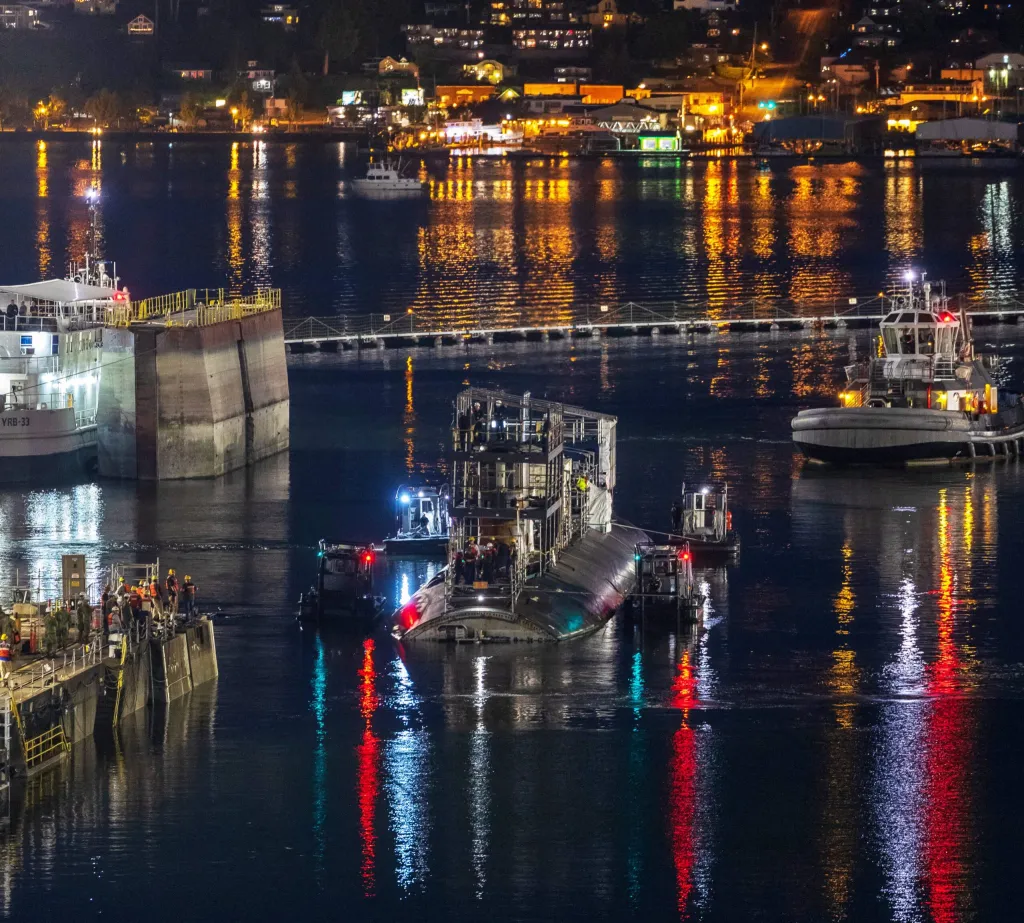
The U.S. Navy’s schedule for getting USS Connecticut, one of its prized Seawolf class nuclear attack submarines, back into service has slipped into next summer. The boat suffered severe damage, especially to its bow, in a collision with an underwater seamount in the South China Sea in 2021. The service had previously hoped that repairs would be finished before the end of this year, and planning is also now underway for the submarine’s retirement in 2031. This would mean it could serve for just four years before being pulled from service once and for all.
“USS Connecticut (SSN 22) is currently undergoing a complex Extended Docking Selected Restricted Availability (EDSRA) at Puget Sound Naval Shipyard & Intermediate Maintenance Facility. Current work consists of structural and systems restoration and required lifecycle maintenance,” a Navy official told TWZ today. “The Navy’s target completion date for the availability is the summer of 2027. PSNS & IMF is dedicated to executing this work with the highest standards of safety, technical accuracy, and craftsmanship to ensure the ship returns to the fleet ready to take its place at the tip of the spear in defense of our nation’s interests.”
The USS Connecticut seen at the Puget Sound Naval Shipyard in 2023. USN
USS Connecticut is the second of just three Seawolf class submarines commissioned between 1997 and 2005, the others being USS Seawolf and USS Jimmy Carter. The Jimmy Carter, which came last, is a one-of-a-kind subvariant of the design that is optimized for underwater espionage missions. However, the Seawolf and Connecticut also feature advanced capabilities compared to other submarines in the Navy’s inventory today, and the service utilizes all three for a variety of specialized tasks, for which they are in very high demand.
After USS Connecticut hit the seamount in October 2021, the submarine first limped to Guam, and then made its way to San Diego in southern California. From there, it headed north to the Puget Sound area, where it has been ever since. The Navy’s investigation into the incident put heavy emphasis on how a weak command environment and lax attitudes toward the performance of key tasks had put the submarine on a path to the accident, as you can read more about in detail here.
The EDSRA formally began in February 2023. At that time, the Navy projected that the repairs would be completed in September 2025. By July 2023, the schedule had already shifted to early 2026, according to Naval News. In July 2025, the service confirmed to TWZ that the timeline had moved again to the right, to late 2026.
Another view of USS Connecticut at the Puget Sound Naval Shipyard in 2023. This picture offers a good sense of the extent of the damage to its bow. USN
The exact reasons for the delays are unclear. TWZ has stressed the particular complexities of major repairs to any of the Navy’s trio of Seawolf class submarines in our past reporting on Connecticut. As we wrote in 2023 around the start of the EDSRA:
“As for the USS Connecticut, as the images show, her state remains relatively the same, at least in terms of what is visible, compared to when she arrived over a year and a half ago. Her sonar dome is still missing and, clearly, the boat has been idle for some time, with huge sections of its anechoic coating missing from its sail.”
“Major repairs to the submarine’s bow, sonar, and other underside structure components will be challenging as the Seawolf class is long out of production. On top of that, just three boats were ever built, with one being a heavily modified sub-type in its own right, the highly secretive USS Jimmy Carter (SSN-23). In the past, similar damage has been fixed by leveraging spare parts and entire sections of decommissioned submarines of the same class. That simply is not an option in this case.”
The Navy’s 2025 Fiscal Year budget proposal highlighted exactly these broader issues in seeking funds for spare bow domes “for use in the event replacement is required,” separate from the incident with the USS Connecticut. The original sustainment strategy for the Seawolf class did not include these items, which have a “three plus year lead time” to produce.
With the EDRSA, the Navy is also taking the opportunity to conduct a deep overhaul of USS Connecticut, which could include the integration of various upgrades. The Navy’s budget documents have long highlighted efforts to modernize key systems on all three Seawolf class submarines, some of which were first designed in the 1970s.
USS Connecticut underway in 2009. USN
How much the repairs and accompanying overhaul will cost is also not clear. In 2021, Congress approved $40 million for “emergency repairs” for Connecticut and an additional $10 million for a new bow dome, but the full price tag is expected to be far steeper. The Seawolf class submarines were extremely expensive to procure in the first place, costing approximately $3.1 billion apiece in 1983, or some $10.6 billion in 2026 dollars. This was due in large part to the truncated order, from 29 down to three, as a result of post-Cold War drawdowns.
Depending on when repairs to the USS Connecticut are actually finished, the Navy could find itself for at least a time with just one Seawolf class submarine in active service. USS Seawolf is currently scheduled to start a routine maintenance availability next May, which will then run through February 2030, per Navy budget documents. As mentioned, the Navy is now also planning to inactivate USS Connecticut in 2031, making it the first Seawolf class submarine to be retired, per its most recent annual shipbuilding plan.
The service still has plans to acquire a new class of attack submarines, which has been discussed in the past as something closer to a true successor to the Seawolf class than the Virginia class boats being procured now. However, these new submarines, currently referred to as SSN(X), are not expected to arrive until the mid-2040s at the earliest. Between now and then, the Navy is set to acquire a one-of-a-kind seabed warfare version of the Virginia, which could well take over for the USS Jimmy Carter, as you can read more about here. In August, the service announced that stretched Block IV and V Virginia class submarines with Virginia Payload Modules (VPM) will now be categorized as guided-missile types (SSGN), as well.
When it comes to USS Connecticut, the Navy remains committed to getting the highly capable submarine back to the fleet after being sidelined for nearly five years now. At the same time, the boat has now already entered the twilight of its career, with just four years of active service life left if the current repair schedule holds.
The Trump administration has proposed investing $5B in a new fund that would help Middle Eastern countries rebuild energy infrastructure battered in the Iran war and reduce their reliance on the Strait of Hormuz to transport oil and gas, according to U.S. and Middle