Cup

Which World Cup teams, players and officials were denied US visas, entry? | World Cup 2026 News

The United States government has faced sharp criticism from immigration and human rights experts due to the ongoing visa-related complications and entry denials for athletes and officials participating in the FIFA World Cup.

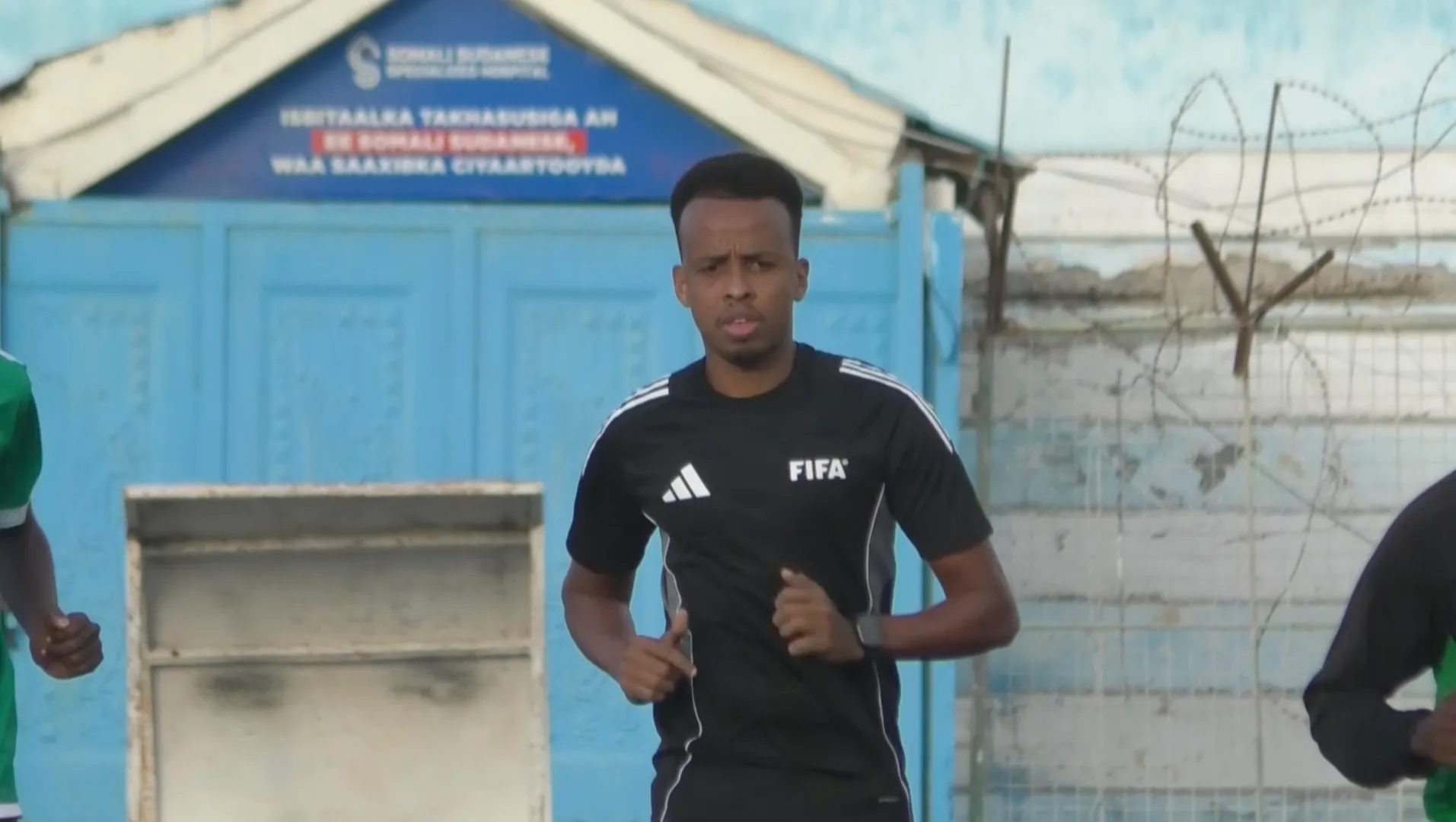
The censure of US President Donald Trump’s administration grew after top Somali football referee Omar Artan, who was set to officiate in World Cup games, was denied entry into the country this week.

Recommended Stories

list of 4 itemsend of list

“Human rights organisations and advocacy groups have repeatedly raised concerns regarding immigration enforcement practices and treatment of migrant communities in the US,” international sports lawyer Khayran Noor told Al Jazeera last month.

Noor said that while these debates are “independent” of football, they inevitably become relevant when a country hosts one of the world’s largest international gatherings.

“The challenge is that major sporting events rely not only on logistics and security but also on atmosphere and perception.”


UN High Commissioner for Human Rights Volker Turk called for a “massive rethink” of US immigration policies, saying that he hoped issues around “racial profiling, around surveillance, around immigration enforcement are not going to affect this World Cup in the way that they have already done”.

Although Artan returned home on Wednesday to a hero’s welcome and sporting a positive attitude, the incident rehashed the conversation on geopolitics and racism being cloaked by US visa denials ahead of the 48-nation, 39-day tournament starting on Thursday.

Fans from several countries, including Morocco and Scotland, who spent thousands of dollars on flights, hotels and tickets for the most expensive World Cup in history, have also reported having their travel documents denied or revoked just days before they were due to travel.

Here’s a look at the athletes, officials and fans affected by US visa complications:

Omar Artan: Somalia

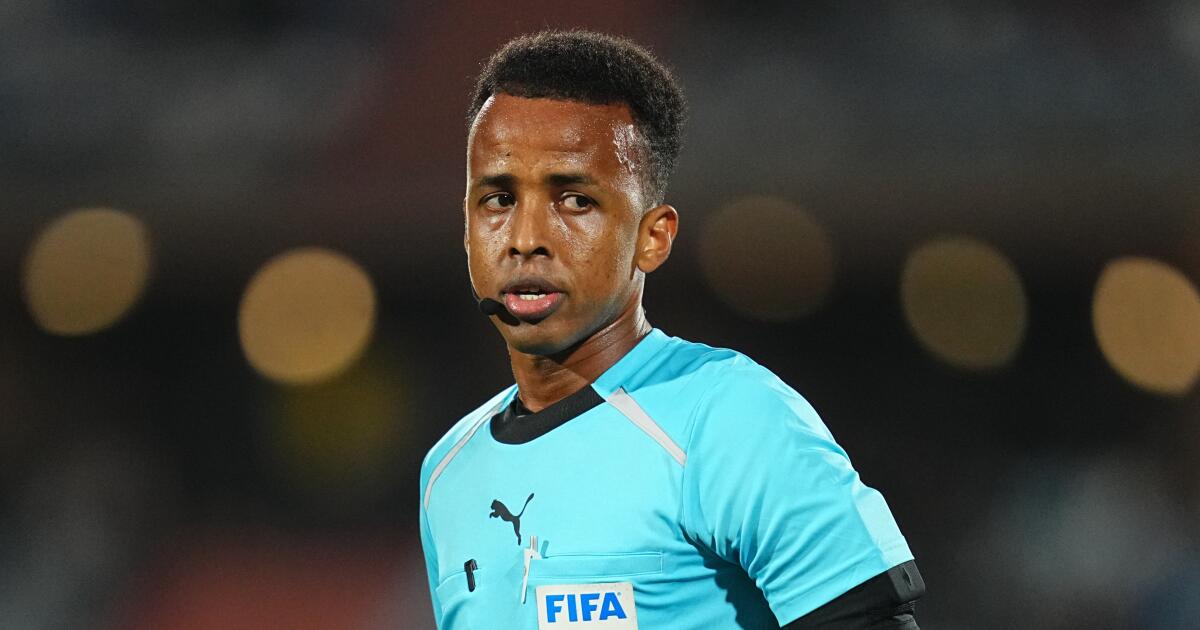
Artan, 34, was set to make history as the first Somali referee to officiate at a World Cup, but his dream debut ended at Miami airport where he was denied entry into the country and flown back to Istanbul, despite having a valid US visa and all required documents.

The US Department of Homeland Security (DHS) confirmed to Al Jazeera on Monday that Artan was “determined to be inadmissible” to the country “due to vetting concerns”, despite having been listed as one of FIFA’s 52 World Cup referees.

Trump has targeted both Somalia and the Somali-American community with inflammatory rhetoric, at one time calling the community “garbage”, and has put Somalia on the US travel ban list.

Iranian World Cup squad and officials

Until last week, there was uncertainty over whether Iran’s football team would be granted visas by the US due to the ongoing US-Israel war on Iran, which has brought geopolitical tensions into the sports sphere.

The US awarded visas to all the players on Friday, just ⁠10 days before their first match, but several members of the ⁠support squad were denied visas, including “key managerial and administrative members,” according to the Iranian football federation.

Iran’s team, whose base camp was to originally be in Arizona, will be based in Tijuana, in neighbouring Mexico, throughout the tournament, despite playing their entire group stage on the US West Coast.

The team will be able to enter the US the day before each of their three World Cup matches, the DHS said on Tuesday.

Media reports over the weekend quoted the Iranian ambassador to Mexico, Abolfazl Pasandideh, as saying that Iran’s team would have to enter and leave the US on the same day as they were playing, raising questions about logistics and whether it would affect team performance.

Aymen Hussein: Iraq

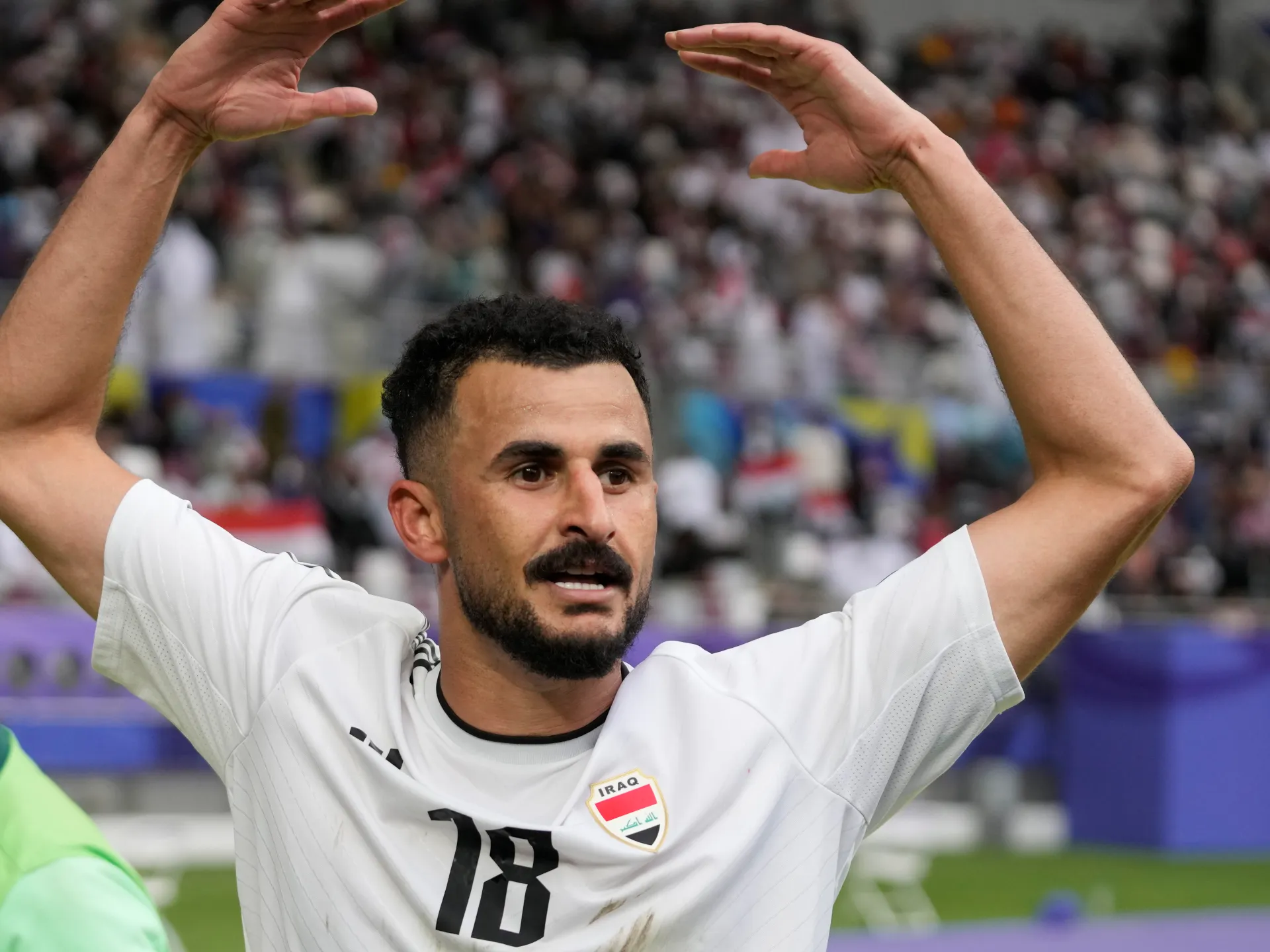
Iraq striker Aymen Hussein was detained for nearly seven hours and his phone inspected at Chicago’s O’Hare airport before he was eventually allowed into the country.

“Why is America hosting the World Cup if it is so hostile to foreign nationals?” the 30-year-old said after the incident.

Meanwhile, national team photographer Talal Salah was held for more than 10 hours, underwent similar phone checks, and was ultimately denied entry into the US.

Woodensky Pierre: Haiti

Woodensky Pierre, the only member of Haiti’s national football team who lives in the Caribbean country, was granted a late visa by the US government to play in the World Cup.

Pierre had been training with local players in an upscale area of Haiti’s capital, Port-au-Prince, as he awaited the visa, which was a “great moment for him, a moment of happiness”, an official of the Haitian Football Federation had said.

The midfielder from Cite Soleil was unable to play in a friendly against New Zealand because his visa was not approved by US authorities until it was too late. He landed at Miami airport around half-time with Haitian football officials and hoped to catch the last part of the game.

Breel Embolo: Switzerland

Swiss forward Breel Embolo was unable to travel with his team due to a flagged visa, but eventually caught up with them after being cleared to enter the US.

The snag was linked to a previous conviction over an altercation in Basel in 2018. Embolo had been convicted of making threats five years later, which he chose not to appeal, but it left his fate to be decided at a meeting at the US Embassy in Bern, where he made his case and was cleared for travel.

Is FIFA obligated to ensure visas?

FIFA’s bidding rules in 2017 for nations wanting to host this World Cup stated that visa processing “must be applied in a non-discriminatory manner”, with the caveat it must not “adversely affect the national immigration and security standards”.

Sports lawyer Noor explained that states understandably retain sovereign responsibilities regarding border control and national security, but global sporting events often require exceptional frameworks.

“This is not about requiring states to abandon immigration laws or surrender sovereignty.

“Rather, it is about asking whether hosting the world’s largest sporting events also carries responsibilities around meaningful inclusion and access,” Noor said.

FIFA president Gianni Infantino has fended off concerns and criticism, saying the global football body’s executives are not “kings of the world” and cannot override government decisions.

Infantino, facing questions from the media on the eve of the World Cup on Wednesday, said that FIFA ⁠is focused on being a “sports organisation” and will not intervene in helping the US determine approvals for entry into the country.

“We try always to find solutions – always,” Infantino said at a news ⁠conference in Mexico City. “But then we need to respect that we are not the kings of the world who can rule over governments and police forces and I don’t know what. We are a sports organisation; we try to do our best ⁠with the means that we have.”

Source link

World Cup 2026: Who will Thomas Tuchel pick in England team against Croatia?

Kane’s status as captain, talisman and main marksman is illustrated very simply by his all-time record of 79 goals in 114 England games.

And yet, at 32, he continues to add strings to his bow in a fashion that now makes him the complete player.

In Orlando, there was further evidence that Tuchel has effectively given Kane a roving commission to link, create and score – all tasks he performs superbly.

In the first half, there was even the sight of Kane picking the ball up in England’s own penalty area as they played out from the back, linking comfortably with his defenders.

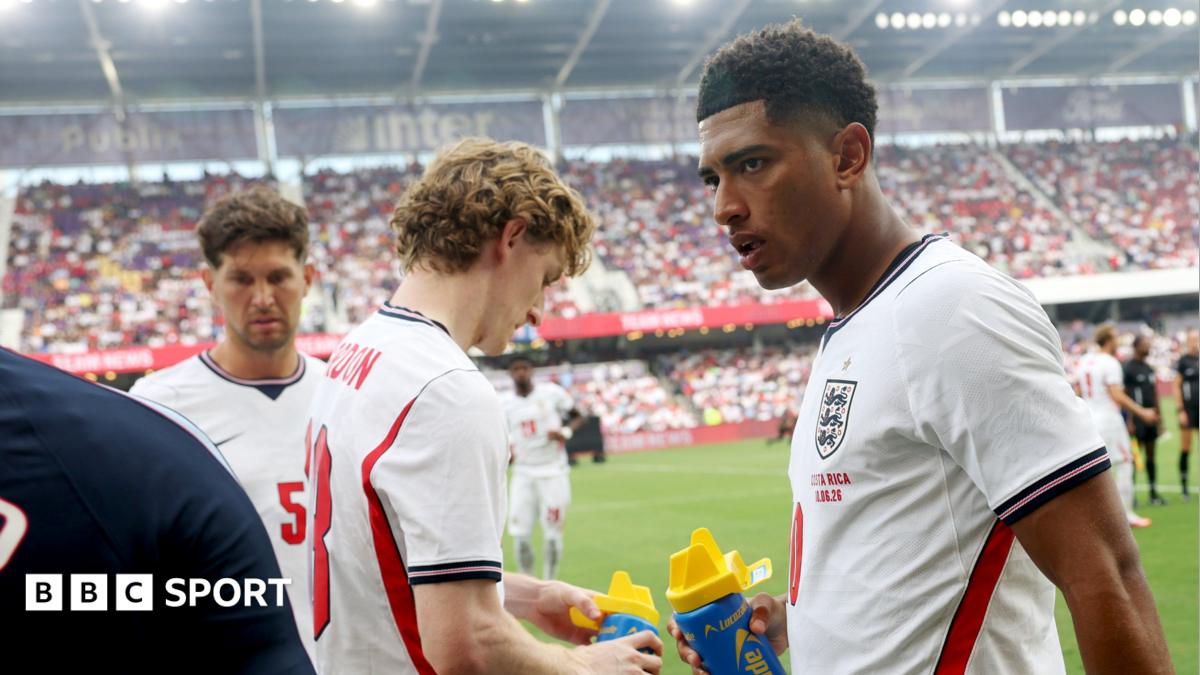
And then, as half-time approached, he produced a stunning pass with the inside of his right foot from a deep position, taking out four Costa Rica defenders to find Anthony Gordon, who thought he had won a penalty only for the decision to be overturned after a video assistant referee review.

Tuchel’s willingness to allow Kane to roam freely, as he does for Bayern Munich, adds an intriguing layer to the German’s strategy.

It is clear that Kane possesses the natural game intelligence – described as “uncoachable” by former England striker Chris Sutton – to not only create but also still arrive with perfect timing in attacking positions.

Kane’s range of passing and vision enables him to find runners like Gordon or Saka, as well as Bellingham and Rogers when they make their trademark surges.

It may just give Tuchel and England an X-factor if they drive deep into the World Cup and have to unlock superior opposition.

No wonder Tuchel is reluctant to leave Kane out, even for a friendly, so central is he to his plans.

Source link

World Cup 2026: Was weather delay to England v Costa Rica sign of things to come?

England head coach Thomas Tuchel said the delay to their World Cup warm-up game with Costa Rica gave them a “little taste of what can happen” – but will that prove to be an understatement?

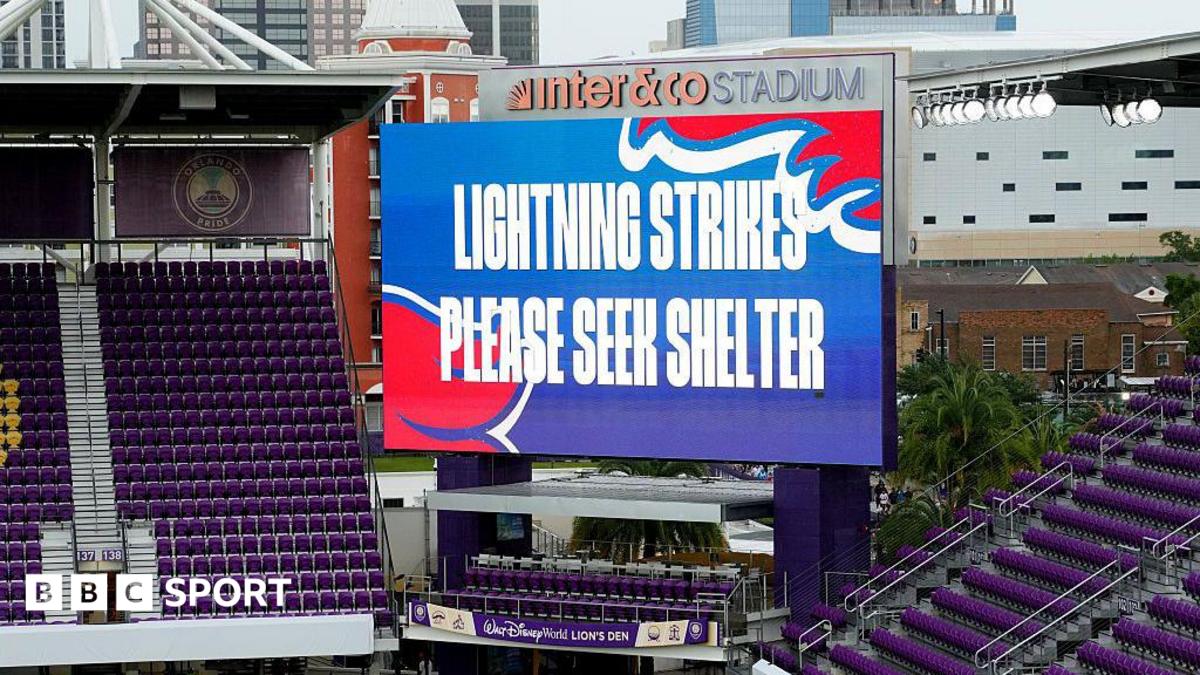
The match was due to start at 21:00 BST in Orlando, Florida, but heavy rain and thunderstorms pushed it back an hour to 22:00 BST.

Weather delays have been a major talking point in the build-up to this year’s World Cup, with several matches in last year’s Fifa Club World Cup in the United States impacted by thunderstorms.

This was not the first tournament warm-up game to suffer delays caused by storms either – and many fans are concerned it could become a theme throughout the World Cup.

“We were aware of that before – now we experience it,” Tuchel told ITV before the game. “It’s no problem.

“It should not be an excuse to lose our mood or patience or to lose our hunger to play the game.

“No problem at all. We realised it when we were still at the hotel so it was easy. We just said half an hour later in the bus and let’s go.”

Fans who had already arrived at Inter&Co Stadium were told to evacuate from the stands and retreat to a safe position on the concourses to avoid lightning strikes.

Thunderstorms in the US are not uncommon, but when it comes to them impacting matches, Fifa has no power to make its own rules and must adhere to the advice of local authorities.

Recommendations of the National Oceanic and Atmospheric Administration (NOAA) are used and they say if any lightning strike is detected within eight miles of a stadium, the game has to be stopped.

A mandatory 30-minute countdown begins and each time there is a lightning strike inside the distance, the countdown clock resets to 30 minutes.

If a full 30 minutes has elapsed, the supporters can go back to their seats and players will have a short warm-up.

Source link

World Cup 2026: Haiti forced to alter kit days before opener against Scotland

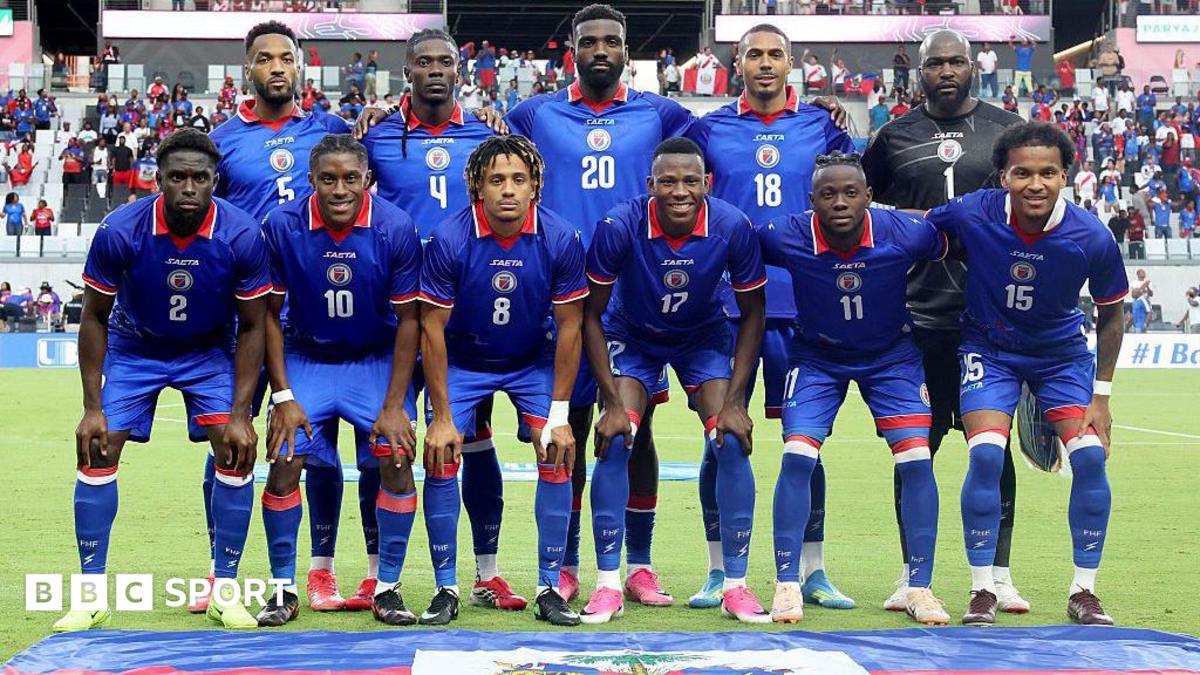
Haiti have been forced to change their kit design just four days before their World Cup opener against Scotland after their shirt, depicting a war scene, failed to comply with Fifa rules.

An illustration of the Battle of Vertieres in 1803, which secured Haiti’s independence, with the country’s flag had been embedded on the shirts worn in both of their pre-tournament friendlies.

However, equipment regulations set out by the world governing body prohibits the use of any “political, religious, or personal messages or slogans” on kit.

In a statement, Colombian manufacturer Saeta, said its original design “was a tribute to the men and women who contribute every day to Haiti’s future” and “was not intended as a political statement”.

It added: “Fifa determined that certain visual elements could be interpreted differently under its equipment regulations and ultimately requested modifications to the design.

“While this interpretation differed from our intention, Saeta respected the process and implemented the final requirements communicated by Fifa.”

Haiti begin their first World Cup campaign in 52 years against Scotland at Boston Stadium, Foxborough at 02:00 BST on Sunday.

The Caribbean country then face five-time winners Brazil and Morocco in Group C.

In their only previous World Cup appearance in 1974, Haiti lost all three group games and conceded 14 goals.

Source link

U.S. issues travel advisory for fans attending World Cup in Mexico

Soccer fans gather outside Mexico City Stadium in Mexico City on Wednesday on the eve of the opening match of the 2026 FIFA World Cup between Mexico and South Africa. Photo by Mario Guzman/EPA

June 10 (UPI) — The U.S. Embassy in Mexico issued a travel advisory for American citizens who plan to attend soccer matches at the 2026 FIFA World Cup, warning of security risks, mobility restrictions and significant differences in risk levels among Mexican states.

The diplomatic mission urged travelers to review current advisories for each Mexican state before traveling and reminded them that Mexico includes states classified from Level 1 (“exercise normal precautions”) to Level 4 (“do not travel”).

“If you scored tickets for a FIFA World Cup 2026 match in Mexico, check the latest travel advisory level and risk information before you travel,” the embassy said in a message released this week.

Although the Mexican government has announced deployment of nearly 100,000 security personnel to protect the World Cup host cities of Mexico City, Guadalajara and Monterrey, international travel advisories remain in place because of cartel-related violence and organized crime, which vary by state.

The State Department maintains a Level 2 advisory for Mexico, recommending travelers “exercise increased caution” because of risks related to terrorism, crime and kidnapping.

However, the agency noted that specific areas of the country remain under Levels 3 and 4, the highest risk categories.

According to the advisory, violent crimes including homicide, kidnapping, carjacking, sexual assault and robbery occur in Mexico.

The U.S. government also said there is a risk of terrorist violence and reminded travelers that consular assistance may be limited in certain regions.

U.S. authorities recommended that citizens follow the same restrictions that apply to U.S. government personnel stationed in Mexico.

Those measures include avoiding intercity travel at night, using only regulated transportation services or ride-hailing applications such as Uber and Cabify, avoiding solo travel in remote areas and refraining from driving between border cities and the country’s interior except in specific circumstances.

The advisory also says that emergency services may be limited or unavailable in rural and remote areas.

In addition, it advises travelers to cooperate with highway checkpoints and roadblocks, warning that ignoring instructions or attempting to flee could result in violent situations.

The State Department recommended that travelers enroll in the Smart Traveler Enrollment Program, obtain travel insurance and review security conditions in the states they plan to visit during the tournament.


Source link

No World Cup for Somali referee Omar Artan suspected of terrorist ties

Somali referee Omar Abdulkadir Artan was denied entry into the United States for the World Cup after enduring an 11-hour interrogation in Miami, according to media reports. Andrew Giuliani, head of the White House Task Force on the World Cup, indicated Artan was suspected to having ties to a Somali militant group.

“We want to make sure we are not going to allow a soccer tournament to be the opportunity for terrorists to potentially get in the country or anybody who is actually talking to them,” Giuliani told the British Broadcasting Corporation.

The New York Times reported that Artan’s name is similar to that of a man identified as linked to Al Shabab, a group that has been the target of U.S. government sanctions.

“I am very, very disappointed,” Artan told the Times from Istanabul, where he stopped on his way back to Somalia. “I’m just simply a referee who’s trying to live his dream, the biggest dream of my life, to come to the World Cup.”

Safety was purportedly the concern with Artan, whose interrogation was conducted by the U.S. Customs and Border Protection.

“During processing, the traveler underwent additional inspection, a routine part of CBP’s inspection process when officers need to verify information or determine admissibility,” CBP said in a statement. “Following inspection, the traveler, a referee for the FIFA World Cup, was determined to be inadmissible due to vetting concerns and was denied entry.”

Somalia is on the U.S. list of banned countries for immigration, although exceptions can be made. Artan is considered one of the best referees in Africa, having officiated in the Somali national football league championship and at the African Cup of Nations.

“Despite the circumstances, I am in a positive mood and focused on the next challenges in my refereeing career,” Artan said in a statement. “I would like to thank FIFA and [the African federation] for all their support and I promise to keep my refereeing levels up as I concentrate on the future.”
Artan, Africa’s Referee of the Year in 2025, was greeted Wednesday at Aden Adde International Airport in Somalia by government officials and hundreds of well-wishers.

“I want to thank FIFA for supporting me all the way, and for Somali people also,” he told Al Jazeera. “So I am very grateful for FIFA and for CAF also. This is what I have to say.”


Source link

Social movements in Mexico use World Cup to spotlight demands

Mexican President Claudia Sheinbaum cast doubt Tuesday on her attendance at the Fan Fest organized in the Zocalo for the World Cup, pending developments in the demonstrations by teachers and other groups protesting in the city center. Photo by Sashenka Gutierrez/EPA

June 10 (UPI) — Mexican President Claudia Sheinbaum cast doubt whether she will attend the 2026 World Cup Fan Fest on Thursday because of demonstrations by teachers from the National Coordinator of Education Workers.

During her press conference Tuesday, the president said her being there would depend on “how what is happening with the teachers and some other groups develops, because I obviously have to pay attention to that.”

The highly anticipated World Cup opening ceremony in Mexico City and the game between Mexico and South Africa, are scheduled at 1:30 p.n. local time at Banorte Stadium, renamed from Azteca Stadium for the tournament.

The event will be held as social protests seek to capitalize on the tournament’s international attention to publicize demands related to human rights, pensions, public services and labor conditions.

Among the most visible movements those formed by teachers from the National Coordinator of Education Workers, who have maintained a protest camp for weeks in Mexico City’s Zócalo. They have erected blockades at different locations to demand repeal of reforms to the pension system for state employees and salary increases.

The demonstrations have impacted streets, public buildings and areas linked to the operation of the World Cup.

Mexico City’s Secretariat of Citizen Security reported about 6,000 teachers are participating in demonstrations in areas near the stadium. Although the federal government maintains that fully reversing the reform would carry a high fiscal cost, union leaders have warned they will continue protesting until they receive a favorable response.

Political analysts agree that the 2026 FIFA World Cup has become the main battleground for the public narrative in Mexico — a phenomenon in which social tensions are colliding directly with government efforts to project stability abroad.

One example will be the mobilization of groups representing relatives of missing persons, known as “searching mothers.” Thousands of women plan to march on the same day as the opening ceremony under the slogan, “Do not play with our pain,” to denounce a crisis involving more than 134,000 people who are missing or whose whereabouts remain unknown in the country.

The organizations have begun to post photographs and missing-person notices around the stadium and have announced activities aimed at drawing attention to the issue before the millions of viewers who will follow the tournament around the world.

Amnesty International said it will act as an observer of the protest.

“As tens of millions of people around the world prepare to tune in to what FIFA describes as ‘the biggest opening ceremony on the planet,’ in Mexico thousands of brave women will seize the opportunity to take to the streets and remind the world that their loved ones remain missing,” said Edith Olivares Ferreto, executive director of Amnesty International Mexico.

“The Interior Ministry works permanently on the issue of missing persons, is permanently engaged in search efforts in a way that has never been done before and also with prevention at the moment a person finds themselves in this situation,” Sheinbaum said Tuesday.

“Therefore, the issues are being addressed. If they want to demonstrate, then they should do so peacefully.”

Neighborhood organizations have also joined the protests.

With slogans that oppose gentrification and evictions and protest water shortages, anti-World Cup groups contend that projects associated with the tournament have deepened structural problems in different neighborhoods of the capital.

They have been joined by farmers’ organizations, transport workers and retired members of the judiciary, who have called for demonstrations on strategic routes leading to the stadium.

The protests also coincide with questions about infrastructure that must deal with the tournament.

In recent days, users reported water leaks at recently renovated stations on Metro Line 2, one of the main transportation routes for fans attending the opening match. Rainfall also caused delays on the rail network because of speed restrictions implemented for safety reasons.

Against this backdrop, federal and local authorities announced a security operation that involves more than 10,000 personnel to safeguard the opening ceremony, guarantee the movement of teams and fans, and prevent incidents around the stadium and the FIFA Fan Festival in the Zócalo.


Source link

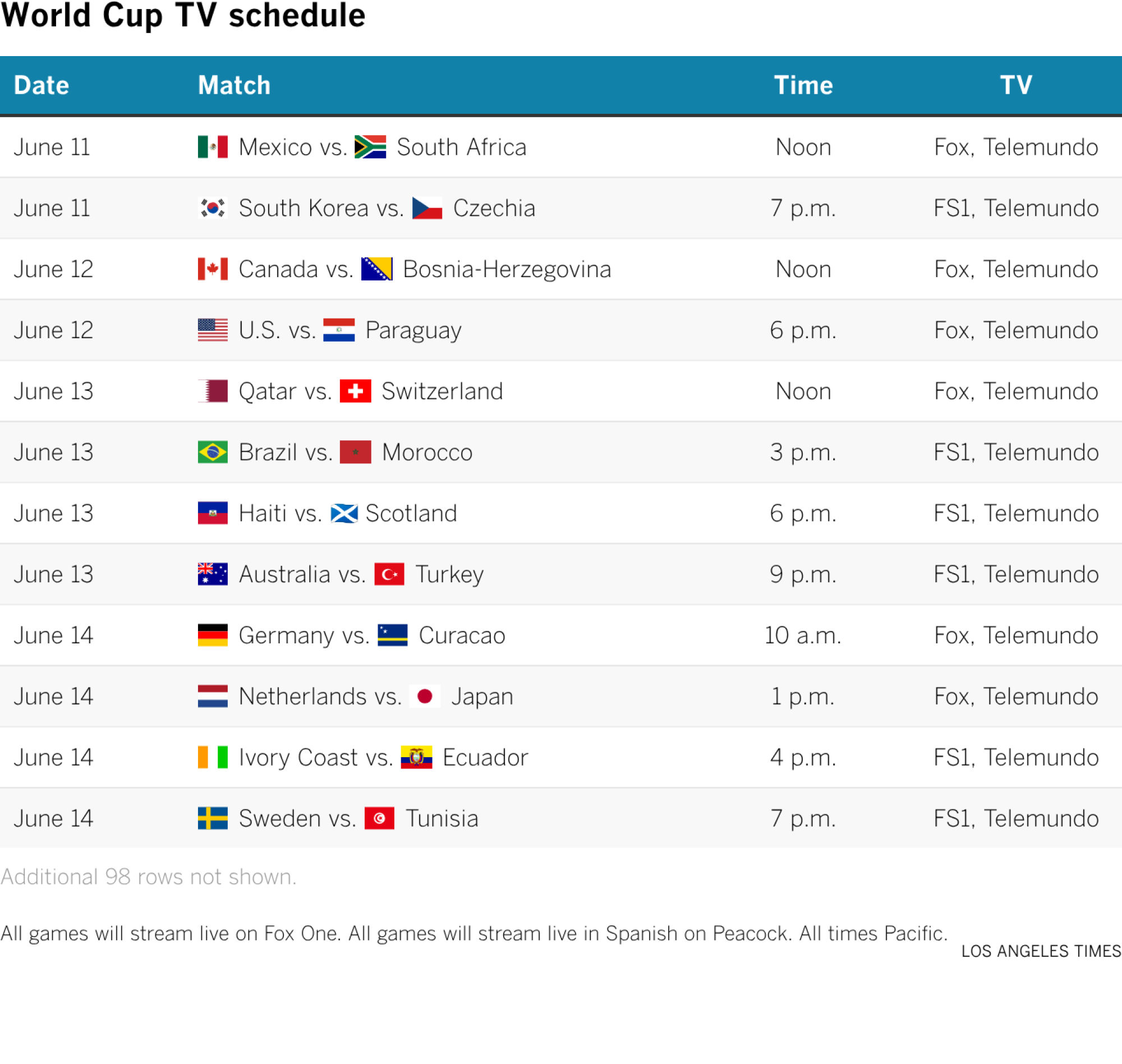
World Cup matchups: Start times for every match and how to watch

The 2026 FIFA World Cup is set to start Thursday with Mexico facing South Africa in Mexico City and South Korea taking on Czechia in Guadalajara, Mexico.

The tournament then heads north on Friday, with Canada facing Bosnia-Herzegovina in Toronto before the United States opens Group D play against Paraguay at SoFi Stadium.

Here’s everything you need to know about the matches through the opening days of the 39-day, 48-team tournament across the U.S., Mexico and Canada.

Here’s a look at Thursday’s matchups (all times Pacific):

Mexico vs. South Africa

Mexico's Raúl Jiménez, left, celebrates after scoring during an international friendly against Serbia on June 4.

Mexico’s Raúl Jiménez, left, celebrates after scoring during an international friendly against Serbia on June 4.

(Agustin Cuevas / Getty Images)

Where: Azteca Stadium | Mexico City

Time: Noon

TV | Streaming: Fox, Telemundo | Fox One, Peacock

The buzz: Although the World Cup will be shared by three countries for the first time, Mexico gets the honor of playing the opening game. No country has played host to more World Cups than Mexico, which also staged the tournament in 1970 and 1986. Both times the first game was played in the iconic Azteca Stadium, where the World Cup kicks off again. The first two times the World Cup was played in Mexico, the home team made the quarterfinals and El Tri, playing under coach Javier Aguirre, a midfielder on the 1986 team, seems poised for another long run. Mexico is unbeaten in eight games this year, including wins over World Cup qualifiers Panama, Ghana and Australia and draws with Belgium and Portugal. Mexico has given up just one goal in the past eight months. South Africa, which played Mexico to a draw in the opening game of the 2010 World Cup, is winless in 2026.

South Korea vs. Czechia

South Korea's Son Heung-Min controls the ball in front of El Salvador's Brayan Landaverde.

South Korea’s Son Heung-min controls the ball in front of El Salvador’s Brayan Landaverde during an international friendly match on June 3.

(Alex Goodlett / Getty Images)

Where: Estadio Akron | Guadalajara, Mexico

Time: 7 p.m.

TV | Streaming: FS1, Telemundo | Fox One, Peacock

The buzz: South Korea is one of five countries to have played in the past 11 World Cups — and it’s the only one of the five never to have won the tournament. And the only two times South Korea played in a North American World Cup, in 1986 and 1994, it failed to win a game. Still, with an offense led by LAFC’s Son Heung-min, the MLS leader in assists, and a defense anchored by Bayern Munich center back Kim Min-jae (aka The Monster), the Taegeuk Warriors are a formidable foe. Czechia, playing in the World Cup for just the second time as an independent nation, has been unimpressive in its tournament warm-ups; its last win over a World Cup qualifier was a 2-1 win over Norway 27 months ago.

Here’s a look at Friday’s matchups:

Canada vs. Bosnia-Herzegovina

Bosnia's Edin Dzeko heads the ball during a World Cup qualifying match against Italy on March 31.

Bosnia’s Edin Dzeko heads the ball during a World Cup qualifying match against Italy on March 31.

(Armin Durgut / Associated Press)

Where: BMO Field | Toronto

Time: Noon

TV | Streaming: Fox, Telemundo | Fox One, Peacock

The buzz: Alphonso Davies has been ruled out of Canada’s World Cup opener in the hope that he will be available for the rest of the tournament. And his absence will be felt since Davies, sidelined since May 6 with a hamstring injury, is not only the team’s best player but also its captain. The injuries are piling up for Canada, which lost center back Moïse Bombito and forward Marcelo Flores to injuries after the World Cup roster had been determined. Under American coach Jesse Marsch, the team entered the top 30 in the FIFA world rankings for the first time, losing just five times in 29 matches, but still looking for its first victory in a World Cup match.

Bosnia, playing in the World Cup for the second time since gaining independence, is led by 40-year-old Edin Dzeko, the country’s all-time leader in caps and goals. It qualified for the World Cup by drawing Wales, then Italy, and beating both on penalty kicks in a pair of UEFA playoffs in March.

United States vs. Paraguay

U.S. forward Christian Pulisic controls the ball in front of Senegal's Krepin Diatta.

U.S. forward Christian Pulisic controls the ball in front of Senegal’s Krepin Diatta during an international friendly on May 31.

(Jamie Squire / Getty Images)

Where: SoFi Stadium | Inglewood
Time: 6 p.m.
TV | Streaming: Fox, Telemundo | Fox One, Peacock

The buzz: With a goal and an assist in the Americans’ penultimate warm-up with Senegal, Christian Pulisic broke out of a career-long scoring drought and proved himself ready for the World Cup. But he’ll need help from his supporting cast if the U.S. is to get out of group play and this game could be key to that goal. Paraguay’s schedule over the past year featured several games with World Cup qualifiers, including wins over Mexico and Uruguay, draws with Japan and Ecuador and one-score losses to Brazil, Morocco and the U.S. Its leading scorer is midfielder Miguel Almirón, who plays in MLS with Atlanta United.

Here’s a look at Saturday’s matchups:

Qatar vs. Switzerland

Qatar's Akram Afif plays during an international friendly against El Salvador on June 6.

Qatar’s Akram Afif plays during an international friendly against El Salvador on June 6.

(Luiza Moraes / Getty Images)

Where: Levi’s Stadium, Santa Clara
Time: noon
TV | Streaming: Fox, Telemundo | Fox One, Peacock

The buzz: Qatar made its World Cup debut four years ago and became the first host to exit the tournament without a point, losing all three group-play games by two goals each. The team has improved dramatically since then, beating Mexico to reach the quarterfinals of the 2023 CONCACAF Gold Cup. But its World Cup preparations were disrupted by war in the Middle East, which forced the cancellation of scheduled friendlies with Serbia and Argentina. As a result, the team has played just twice in the last seven months and hasn’t scored a goal since last December.

Switzerland, meanwhile, is ranked in the top 20 in the world by FIFA, has lost just twice — to No. 2 Spain and No. 10 Germany — in its past 17 tries and made the quarterfinals of the past two Euros.

Brazil vs. Morocco

Brazil's Casemiro, right, celebrates with teammate Vinicius Junior after scoring against Panama.

Brazil’s Casemiro, right, celebrates with teammate Vinicius Junior after scoring against Panama during an international friendly match on May 31.

(Bruna Prado / Associated Press)

Where: MetLife Stadium, East Rutherford, N.J.
Time: 3 p.m.
TV | Streaming: FS1, Telemundo | Fox One, Peacock

The buzz: Group C gets off to a compelling start with sixth-ranked Brazil, the tournament’s only five-time champion, facing No. 7 Morocco, the surprise team of 2022. And both come in hot: Morocco has lost just one of its past 45 games, dating to January 2024, while Brazil has beaten World Cup qualifiers Egypt, Panama, Croatia, Senegal, South Korea, Paraguay, Colombia, Ecuador and Mexico over the past 24 months.

Barring a major stumble, both will make it out of group play but this game will likely determine which will go through as a group champion, giving it a much easier path through the knockout rounds.

Haiti vs. Scotland

Haiti's Frantzdy Pierrot controls the ball in front of Tunisia's Mohamed Amine Ben Hamida.

Haiti’s Frantzdy Pierrot controls the ball in front of Tunisia’s Mohamed Amine Ben Hamida during an international friendly on March 28.

(Vaughn Ridley / Getty Images)

Where: Gillette Stadium, Foxborough, Mass.
Time: 6 p.m.
TV | Streaming: FS1, Telemundo | Fox One, Peacock

The buzz: Though lacking the sizzle of Brazil-Morocco, Group C’s other first-day matchup is no less important. With eight third-place teams advancing out of group play, a win here would give either Scotland or Haiti a solid shot at going through while a draw could doom both.

Haiti, participating in the World Cup for just the second time — and the first time since 1974 — hasn’t played at home in five years because of violence and instability in Haiti. But it thumped New Zealand 4-0 in one of its final World Cup tuneups and lost to three other World Cup qualifiers — the U.S., Saudi Arabia and Tunisia — by just a goal in the past year. All but three of the players on Haiti’s roster play for first- or second-division teams in Europe or the U.S.

Scotland had an easier time in qualifying and won its past two World Cup tuneups, beating Curacao and Bolivia by a combined score of 8-1. Its top player is Liverpool defender Andy Robertson but its oldest is goalkeeper Craig Gordon, at 43 the most senior player in the tournament.

Australia vs. Turkey

Australia goalkeeper Mathew Ryan warms up before an international friendly match against Mexico at the Rose Bowl on May 30.

Australia goalkeeper Mathew Ryan warms up before an international friendly match against Mexico at the Rose Bowl on May 30.

(Luiza Moraes / Getty Images)

Where: BC Place, Vancouver, Canada
Time: 9 p.m.
TV | Streaming: FS1, Telemundo | Fox One, Peacock

The buzz: Turkey could be one of the surprise teams in the tournament after qualifying for the World Cup for the first time since 2002 with a pair of 1-0 wins over Romania and Kosovo. Turkey has risen five spots, to No. 22, in the FIFA world rankings in the past ninth months, its best showing in a decade. And in the last year it has beaten the U.S. and tied No. 2 Spain. Its best player is Inter Milan midfielder Hakan Calhanoglu, Turkey’s active leader in caps and goals.

Australia had its best-ever World Cup four years ago in Qatar, winning twice and advancing to the round of 16 for the first time since 2006. But it has struggled of late, losing four of its past six games to fellow World Cup qualifiers.

Source link

Jordan Staal’s spectacular goal helps Carolina tie Stanley Cup Final with Vegas

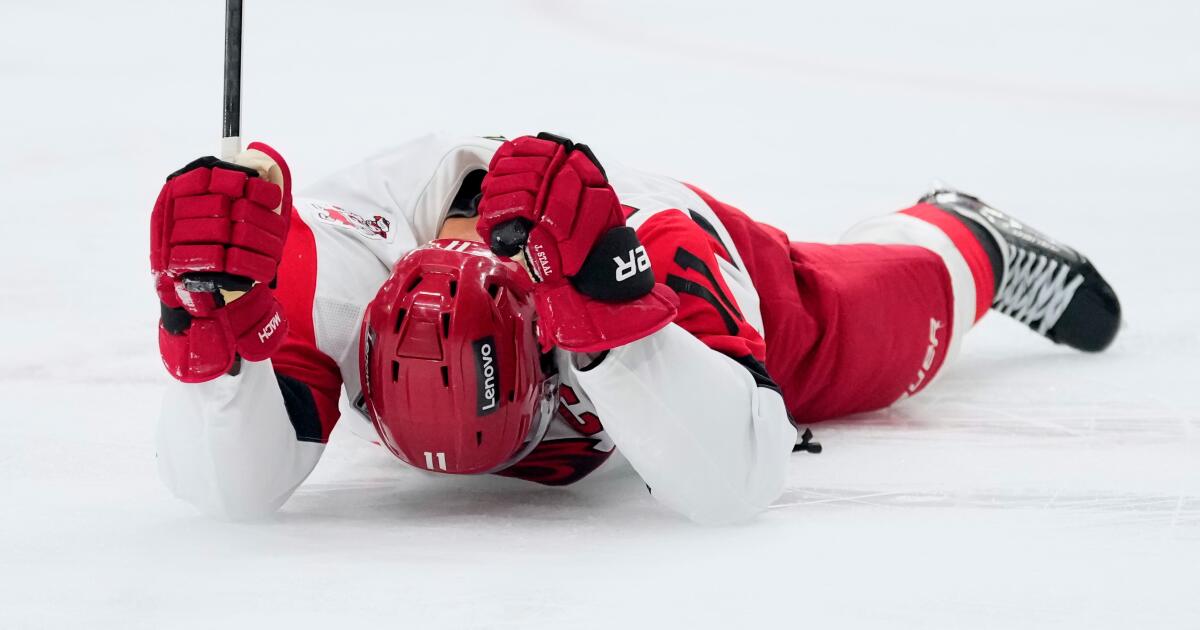
Jordan Staal scored his second goal of the game while stretched out on his stomach at 6:32 of the third period to put the Carolina Hurricanes ahead for good in their 5-3 victory on Tuesday night over the Vegas Golden Knights and even the Stanley Cup Final after four games.

Game 5 is Thursday night at Carolina, which will potentially have two games on home ice to win its first Cup in two decades. The Golden Knights are searching for their second in four years.

This was the first game not decided by one goal.

A two-goal lead has disappeared in all four games in what has been a remarkable series in which momentum often changes at a moment’s notice. Each team has led by at least that many twice.

Staal became the first player in 44 years to score at least one goal in each of the first four games of the final and the ninth overall. Mike Bossy in 1982 with the New York Islanders against the Vancouver Canucks was the last player to score in the first four games of a final.

Nikolaj Ehlers added an empty-net goal and two assists for the Hurricanes, Jackson Blake had a goal and an assist, and Logan Stankoven scored a goal.

Brandon Bussi started in place of Frederik Andersen in goal and made 18 saves. Hurricanes coach Rod Brind’Amour told ABC that Andersen, who did not dress, needed the rest. Pyotr Kochetkov was the backup goalie with Andersen serving as the emergency goaltender.

“Let [Andersen] rest,” Brind’Amour said. “Give him as many days here as we can.”

Mark Stone, William Karlsson and Brett Howden scored goals for the Golden Knights, and Carter Hart made 23 saves. Karlsson also had an assist.

The Hurricanes outplayed the Golden Knights in the period, outshooting Vegas 14-6. But the Golden Knights, according to Natural Stat Trick, had four high-danger chances to three for Carolina.

The difference was the Hurricanes took advantage of their chances.

Brind’Amour replaced Andersen with Bussi trailing 4-0 after two periods in Game 2 on Saturday, and he saved the first 18 shots he faced as the Hurricanes mounted a furious rally. Bussi failed to save the 19th shot when Shea Theodore knocked the puck off the boards and it bounced off Bussi’s skate for a Golden Knights victory.

Source link

BBC Sport quiz: Who am I? Guess World Cup star footballer No 3

Welcome to our brand new Who am I? game.

The rules are simple. Each day there’s a new footballer and the challenge is to guess who they are in as few attempts as possible.

After each wrong guess you unlock a new clue. Guess the answer after as few clues as possible to score more points.

Three is a good score, four or five points is exceptional.

So, take part in quiz number three and return for more tomorrow.

Today’s player and clues are set by BBC Sport’s Joe Rindl.

Source link

Why England missed out on automatic Women’s World Cup spot

England did almost everything right in their qualifying group, winning five of their six matches, including the victory over Spain at Wembley in April.

They also scored 13 goals, conceded just five – four of which came against Spain – and kept four clean sheets.

But it is not easy to qualify automatically and England were given a rough draw with world champions Spain in their group. The quest for top spot was always likely to come down to their head-to-head record.

That is what happened as England ultimately missed out because they were thumped in Majorca.

That humbling defeat – which showed the gulf between the two teams when Spain are at their best – was their downfall.

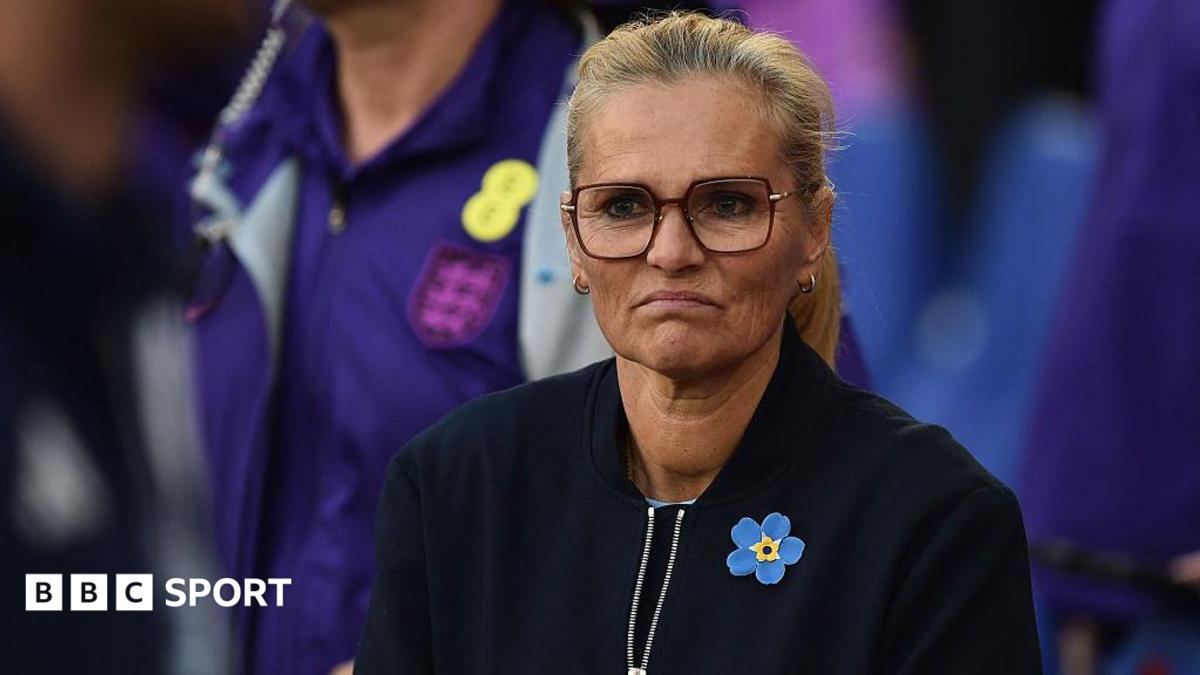
Wiegman opted for experience in the starting XI against Spain. Despite not featuring for England since October, and only returning from a four-month injury in April, midfielder Ella Toone was given the nod over Lucia Kendall and Laura Blindkilde Brown.

Chelsea’s Lucy Bronze started at right-back despite an injury in the build-up to the game.

In the end, England’s midfielders were too passive and easily controlled by Spain, while the usually explosive frontline of Alessia Russo, Lauren Hemp and Lauren James proved ineffective.

At the back, England struggled to live with Spain’s creativity and dynamism, with only Esme Morgan impressing in a generally dismal performance.

England’s sloppiness was compounded by the fact Spain produced one of their best performances to date and Wiegman could not come up with an answer for it.

Wiegman told BBC Radio 5 Live this week that she is “absolutely convinced” England can match Spain at their best if they are to meet again next year.

But that one crucial defeat showed just how difficult it is for England to qualify for major tournaments and why they cannot afford an ‘off day’ against the best teams.

“We have mixed feelings, of course. We were very disappointed with the way the game went [against Spain],” said midfielder Georgia Stanway, a scorer on Tuesday along with Jess Carter and Beth Mead.

“It’s very rare that you get 15 points and still not make it out of the group. I think that it shows our level, our consistency, but we know our performance wasn’t good enough against Spain.”

Wiegman said it was a “good thing” that there is more competition throughout Europe but admitted it was tough to miss out on such fine margins.

“The Nations League brought more competition in Europe. I think that’s really nice. We also noticed we have to play Spain so many times,” she said.

“I was excited for this group to play Iceland as we hadn’t played them. It’s something for Uefa to have a look at, at least. The good thing is there is a lot of competition.”

Source link

U.S. captain urges World Cup teammates to enjoy the experience

Tim Ream is the only player on the American World Cup team who was alive the last time the tournament was played in the U.S. But he was only 5, so the memories are kind of sketchy.

“I remember bits and pieces of 1994,” he said.

Still, it’s fallen on Ream, as both the captain and the oldest man on the roster, to prepare the team for what they’re about to experience when the U.S. opens play Friday at SoFi Stadium.

“I’ve tried to tell guys and tried to convey the message that this is a once-in-a-career [opportunity] and with that comes more expectation, more pressure,” he said. “But at the same time we have to enjoy it.

“It’s about just opening your eyes and taking everything in because this is unique, this is completely different from anything that any of us as players has experienced.”

Only 22 men in history have suited up for a home World Cup game on U.S. soil. Players including Alexi Lalas, Eric Wynalda, Cobi Jones and Marcelo Balboa parlayed that fame into broadcasting careers. Others have become coaches. Fifteen of them were inducted into the National Soccer Hall of Fame.

Ream, who played in the last World Cup in Qatar, said it’s difficult to compare the experience of that tournament with this one — especially since this one hasn’t started yet.

“It’s not our first rodeo, but it’s our first one on U.S. soil,” he said. “So it’s kind of our first rodeo in a way. It’s exciting.

“So take it in, enjoy it, embrace everything that it is. Because it’s so unique, it’s so special. And it’s not something that we will ever get to do again.”

Midfielder Cristian Roldan was also at the last World Cup, although he didn’t appear in a game. He says the energy is different this time around.

“You feel it when you’re there. You’re kind of isolated, you’re alone,” said Roldan, one of 13 players on this team who were also on the team in Qatar, half a world away. “But it’s different here. You see how many media members are here. You see how many people we’ve seen in training over the last few weeks. You feel that energy, you feel that support.

“Now it’s about translating that energy, that support, that pressure into something good.”

Goalkeeper Matt Turner agreed.

“This one, obviously, it’s a lot more tangible,” he told reporters Tuesday. “You guys are all here, right, real close to us. We have 5,000 fans for training yesterday. It’s very different. In Qatar, you’re in a lot more of a bubble.

“But us players, the ones that had the [World Cup] experiences, I think we’ve done a really good job of keeping that boundary.”

What’s lacking this time, Turner said, was the pressure of a qualifying campaign to bring the team together. Because the U.S. is one of the three host countries — alongside Mexico and Canada — it was assured a spot in 48-team field when it won the right to stage the tournament eight years ago. As a result it hasn’t played a competitive game in more than 11 months.

“The intensity of those games, the environments that you have to dip into and get results, you find out a lot about the players and find out a lot about the team,” he said. “This time around, it’s been different. We’ve had a lot of different looks, a lot of different players getting a chance to prove themselves and show themselves.

“It’s not anything bad or good. I just think it was a little bit different.”

Striker Folarin Balogun, one of 13 World Cup newbies on the U.S. team, said he doesn’t expect the gravity of the experience to hit him until he lines up for Friday’s opening game with Paraguay.

“It’s probably going to start to go more real to me when I’m preparing to go on to the pitch,” he said, sitting behind a table next to Ream. “I’m hearing the fans shouting and screaming, so I definitely think it’ll be real to me the closer I get.

“But you know, this is the first opportunity for me to play in the World Cup so I don’t really have any expectations.”

Balogun then looked over at a frowning Ream, who had just finished urging his teammates to be sure to stop and smell the flowers along this World Cup journey.

“Just trying to stay present, stay in the moment,” Balogun hastened to add. “You know, enjoying the experience. I think it can be a really memorable World Cup.”

Source link

Mexico and South Africa both faced challenges ahead of World Cup

History tends to repeat itself at the World Cup. Such is the case with Mexico and South Africa, two teams that will face off in the World Cup opening match for the second time in history, just as they did in Johannesburg on June 11, 2010. The score that night was 1-1.

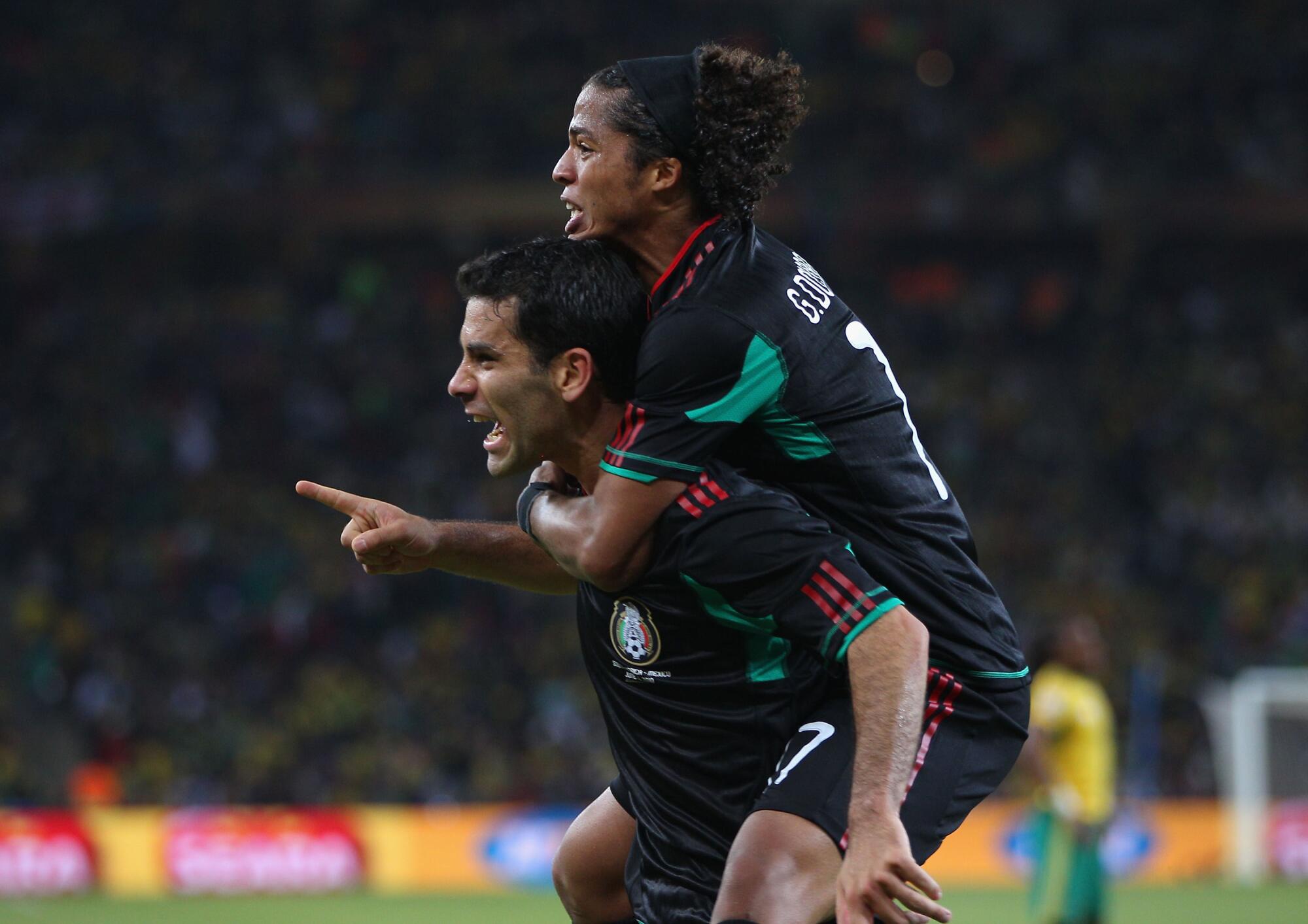
Many still remember Siphiwe Tshabalala and his powerful shot into the top corner that beat Mexican goalkeeper Óscar Pérez, and a celebration that remains etched in the collective memory of the soccer world. Unfortunately for the South African team that night, Rafa Márquez equalized for El Tri with 11 minutes remaining during what turned out to be a disappointing World Cup for the host nation.

Sixteen years later, the 2026 World Cup kicks off, curiously enough, with the same matchup, but with the roles reversed. Mexico is now the host at Azteca Stadium, known during this competition as Mexico City Stadium, at 7,216 feet above sea level. It will be the third World Cup the venue has hosted.

“It won’t be easy at all,” South Africa coach Hugo Broos said last December upon learning his team would debut against one of the hosts. “It’s a great thing to play in front of 80,000 people. We have nothing to lose.”

Mexico's Giovani Dos Santos jumps on the back of Rafael Marquez after Mexico scored against South Africa.

Mexico’s Giovani Dos Santos jumps on the back of Rafael Marquez after Mexico scored against South Africa during a World Cup group match on June 11, 2010, in Johannesburg, South Africa.

(Michael Steele / Getty Images)

On the Mexican side, the similarities to 2010 are striking — and not necessarily for the right reasons. Coach Javier Aguirre is back on El Tri’s bench — the same coach who led that campaign in South Africa — which, at first glance, might seem curious, though in practice it reflects the stagnation of a soccer team that has gone eight consecutive World Cups without advancing past the round of 16.

Former Barcelona player Márquez, who scored the equalizer, also remains connected to the national team, now as an assistant coach, with the mandate to take the reins of the team once the Aguirre era concludes after the World Cup. The squad has seen more than a dozen coaches come and go since 2010, including a qualification for Brazil 2014 that nearly ended in tragedy before a goal by the United States rescued the Mexican team and sealed its admission into the tournament.

“Javier [Aguirre] was a firefighter in 2002, he was a firefighter in 2010 and he stepped in as a firefighter again then — it’s the same old story,” said John Sutcliff, a journalist who has covered Mexico for more than 36 years. “[The federation officials] aren’t working in the best interest of the national team. There’s a lot of interest in bringing in foreigners [to the Mexican league] for business purposes and we don’t have players in Europe’s top leagues.”

Mexico’s recent record speaks for itself. It was eliminated in the World Cup round of 16 in 2010 by Argentina, by the Netherlands in 2014, by Brazil in 2018 and failed to even advance past the group stage in Qatar in 2022. Considered the “Giant of CONCACAF,” Mexico has remained dominant in its region since 2010, with five Gold Cups, although it has lost ground to the United States in the Nations League.

Outside the region, its participation in 2010 has been limited mainly to two editions of the Copa América held on U.S. soil, in which it has failed in both, reaching the quarterfinals in 2016 and being eliminated in the group stage in 2024.

“I think it’s been a roller coaster ride over these 16 years; for a moment it seemed like it was making progress, but then there were spectacular crashes,” said Gibrán Araige, a journalist who has followed El Tri through several World Cup cycles.

Mexico's Raúl Jiménez celebrates with teammates after scoring against Serbia during a friendly.

Mexico’s Raúl Jiménez celebrates with teammates after scoring against Serbia during a friendly at Nemesio Diez Stadium on June 4 in Toluca, Mexico.

(Agustin Cuevas / Getty Images)

For Araige, the level of the 2010 squad is similar to the current one, with players who are not yet established but have solid European experience.

Of the 26 players called up by Aguirre, 10 play in Europe, but few play for elite clubs or get significant playing time on their teams, mostly hampered by injuries, as is the case with Santi Giménez (AC Milan, Italy), César Huerta (Anderlecht, Belgium), Luis Chávez (Dinamo, Russia) and Edson Álvarez (Fenerbahçe, Turkey).

For its part, South Africa has not made significant progress since 2010.

After being eliminated in the group stage, finishing behind Uruguay and Mexico in a tournament held in its own country, it became the first host nation in a World Cup to fail to advance past that stage — a record that Qatar matched in 2022.

Bafana Bafana failed to qualify for the next three World Cups. In fact, this is the first time they have qualified since 2002, as they did not have to qualify in 2010, having hosted the tournament.

They were eliminated as group runners-up behind Ethiopia on the road to Brazil in 2014, they finished last in their group on the road to Russia in 2018 and finished second behind Ghana in the qualifiers for Qatar in 2022.

South African players run during a World Cup training session at Estadio Hidalgo on June 3 in Pachuca, Mexico.

South African players run during a World Cup training session at Estadio Hidalgo on June 3 in Pachuca, Mexico.

(Manuel Velasquez / Getty Images)

They have also lacked consistency in the Africa Cup of Nations, missing the 2012 and 2017 editions.

Broos, who took over as South Africa’s head coach in 2021, sought to instill discipline and relied on local talent, which was vital in securing a spot in this year’s World Cup. During the qualifying round, South Africa won its group by finishing ahead of Nigeria and advanced despite starting the campaign with a loss due to an ineligible player used in a match against Lesotho.

Broos faced criticism for strategic errors early on, but ultimately built a competitive team that achieved historic qualification, aided by nine direct World Cup spots in the expanded tournament field.

“It’s a truly excellent group of players. We got through a very tough qualifying phase, which I think helped polish the team,” said Mark Gleeson, a journalist specializing in African soccer.

For Gleeson, South Africa missed a major opportunity to strengthen its league by failing to retain investors and wealthy clients after the 2010 World Cup and continued to operate in the same way — a trend reflected in the league’s stagnation and the scarcity of talent playing abroad.

Lwethu Makhanya (Philadelphia Union, USA), Ime Okon (Hannover 96, Germany), Mbekezeli Mbokazi (Chicago Fire, USA), Sphephelo Sithole (CD Tondela, Portugal) and Lyle Foster (Burnley, England) are among the few South African players competing abroad for a national team reliant on domestic soccer.

South Africa huddle during a training session at Estadio Hidalgo on June 3 in Pachuca, Mexico.

South Africa huddle during a training session at Estadio Hidalgo on June 3 in Pachuca, Mexico.

(Manuel Velasquez / Getty Images)

However, with the World Cup’s new 48-team format, the task of advancing proved less daunting for teams in the qualifying phase and at the World Cup, there will also be more opportunities to advance beyond the group stage because the best third-place finishers move on. That math could benefit South Africa even if it loses its opening match.

Should Bafana Bafana lose to Mexico, they would have to beat the Czech Republic in their second match on June 18 in Atlanta and would likely play for qualification on June 24 against South Korea in Monterrey.

“The Czechs are among the weakest in Europe, and there’s a good chance of beating them. Furthermore, South Korea is well below its own historical standards, as was evident in March with very poor results in high-pressure matches,” Gleeson said.

To prepare for the altitude in Mexico City, Broos, a former Belgian player who competed in the 1986 World Cup in Mexico, brought his team in early and, starting May 30, held training camp in Pachuca, a city at higher in elevation than the capital. Several of his players are already accustomed to some altitude from playing for clubs in Johannesburg, at 5,751 feet.

“South Africa has a chance; we can compete,” Tshabalala said in an interview after the draw. “I think the pressure will be on Mexico because they’re the hosts. That gives us a real opportunity to pull off an upset.”

A scoreless draw against Nicaragua in Johannesburg days before the World Cup isn’t exactly encouraging, but it also fits with the team’s expectations and the mindset of “having everything to gain and little to lose.”

“We have to enjoy it, and when you enjoy something, you can achieve great things,” said Broos.

Source link

World Cup opening ceremony: Who’s performing, when it starts, how to watch | World Cup 2026 News

The 2026 World Cup will launch with a series of historic opening ceremonies across North America, marking the first time the tournament has been launched simultaneously in three host countries.

The United States, Mexico and Canada will officially launch the biggest World Cup in history.

Recommended Stories

list of 4 itemsend of list

While the US hosted the tournament in 1994 and Mexico in 1970 and 1986, Canada will host the competition for the first time. Together, the three countries will open the tournament.

This World Cup will feature a record 104 matches spread across 16 host cities. The global event will run from the opening match in Mexico on Thursday, June 11, to the final on Sunday, July 19, in New York.

Here is what we know:

What are the 2026 FIFA World Cup opening ceremonies?

The three interconnected ceremonies staged across Mexico, Canada and the US are built around a shared theme designed to unite the three host nations while showcasing each country’s culture, identity and creative talent.

Each event will begin 90 minutes before the host nation’s opening match.

The ceremonies are being produced by Marco Balich, the creative director behind several Olympic opening ceremonies, including the 2026 Winter Games edition and major international sporting events. While each show will have its own distinct character, all three will be linked by a shared theme centred on football’s ability to unite people across borders.

Each host country will bring its own visual style to the ceremonies. Canada will be represented through a cultural mosaic, Mexico through papel picado, and the US through what Balich called “a super shiny, glowing cup”.

“The FIFA World Cup is a moment the world shares, and that begins with how we open it,” said FIFA President Gianni Infantino.

“Starting with Mexico City and continuing the next days with Toronto and Los Angeles, these ceremonies will bring together music, culture and football in a way that reflects both the individuality of each nation and the unity that defines this tournament. It is a powerful way to begin a truly global celebration.”

According to The Athletic, the ceremony in Mexico City is expected to run for about 16 minutes and 30 seconds, while the shows in Toronto and Los Angeles are scheduled to last approximately 13 minutes each.

Once the performances conclude, the pitch will be handed over to the teams for their pre-match warm-ups. Matchday protocol ceremonies, including the player walkouts and official introductions, will then begin 25 minutes before kickoff and are expected to last about 13 minutes.

Who is playing in the opening games?

Mexico will face South Africa in the first match of the tournament, which will take place following the opening ceremony in Mexico City.

Canada will play against Bosnia and Herzegovina in Toronto, marking a historic milestone as it will be the Canadian Men’s National Team’s first World Cup match played on home soil.

The US will take on Paraguay in their opening match following the celebration in Los Angeles.

When and where are the World Cup opening ceremonies?

Mexico City (June 11)

Mexico will launch the tournament at Mexico City Stadium (formerly known as the Estadio Azteca) 90 minutes before its opening match against South Africa, in a repeat of the 2010 opener.

The ceremony is expected to celebrate Mexican culture through Indigenous performers, contemporary folkloric acts and the traditional art of papel picado.

Artists featured on the Official FIFA World Cup Album are expected to perform, including Alejandro Fernandez, Belinda, Danny Ocean, J Balvin, Lila Downs, Los Angeles Azules, and Mana. The show will also include South African singer-songwriter Tyla.

Shakira is also expected to perform her Dai Dai – an Italian phrase meaning “let’s go” or “come on” – along with Burna Boy. Shakira is also set to co-headline the inaugural FIFA World Cup Final Halftime Show on July 19, alongside Madonna and K-pop band BTS.

Authorities have declared June 11 a public holiday in Mexico City, with schools closed and employers encouraged to allow remote work. Access to the stadium area will be restricted to ticket holders, accredited media and authorised personnel.

Opening day schedule in Mexico
9:00 (15:00 GMT): Stadium gates open
11:00 (17:00 GMT): Opening ceremony begins
12:10 (18:10 GMT): Team warm-ups
13:00 (19:00 GMT): Mexico vs South Africa kickoff

Toronto (June 12)

Canada’s ceremony will take place at Toronto Stadium before the country’s World Cup match against Bosnia and Herzegovina. The opening ceremony in Toronto will kick off at 1:30pm local time (17:30 GMT).

The ceremony will begin with a unique countdown designed to take viewers on a “journey across Canada”, highlighting moments that reflect the nation “from coast to coast to coast”.

Centred on the theme of a cultural mosaic, the event will highlight Canada’s diversity through music and performance, with artists including Alanis Morissette, Alessia Cara, Elyanna, Jessie Reyez, Michael Buble, Nora Fatehi, Sanjoy, Vegedream and William Prince.

The match immediately following the ceremony against Bosnia and Herzegovina is deeply significant, as it will be the first FIFA World Cup match to be played by the Canadian Men’s National Team on home soil.

FIFA President Gianni Infantino noted that the Toronto ceremony will be a “powerful reflection of Canada’s identity” and a “moment of pride, unity and anticipation” as the country steps onto football’s biggest stage.

Opening day schedule in Canada

13:30 (17:30 GMT): Opening ceremony begins.
15:00 (19:00 GMT): Canada vs Bosnia and Herzegovina kicks off.

After the ceremony concludes, the teams will complete their warm-ups before the official pre-match proceedings and kickoff at 3pm local time (19:00 GMT).

Los Angeles (June 12)

The US will host its opening celebration at the Los Angeles Stadium before facing Paraguay.

The ceremony will feature large-scale visuals, immersive storytelling and performances from global artists including Katy Perry, Future, Anitta, LISA, Rema and Tyla.

FIFA President Gianni Infantino highlighted that this specific artist lineup was chosen to reflect the cultural diversity and vibrant diasporas of the US, showcasing the nation’s considerable influence on global pop culture, music, and entertainment.

Opening day schedule in US

16:30 (23:30 GMT): Opening ceremony begins
18:00 (01:00 GMT June 13): The US vs Paraguay kicks off.

How can you watch the World Cup opening ceremony?

Fans in the US can watch the opening ceremonies through FIFA’s official broadcast partners. English-language coverage will be available on FOX and FS1, while Spanish-language coverage will air on Telemundo and Universo.

For free streaming, Tubi will simulcast the opening ceremonies and the opening matches, including Mexico vs South Africa on June 11 and the United States vs Paraguay on June 12.

All 104 World Cup matches will also be available through the FOX One app (subscription required), while Spanish-language viewers can stream every match on Peacock and the Telemundo app.

International broadcasters include:

  • Canada: CTV, TSN and RDS
  • Mexico: Televisa and TV Azteca
  • United Kingdom: BBC and ITV

How many fans are expected to attend and watch?

FIFA has not released an official number for the opening ceremonies. However, the three events are expected to fill their host venues in Mexico City, Toronto and Los Angeles, with a combined live attendance of roughly 200,000 spectators.

The ceremonies will also be broadcast worldwide as part of the opening match coverage, likely attracting a global television audience in the tens or hundreds of millions.

Are the hosting nations facing any challenges before the ceremony?

Yes. In Mexico City, ongoing protests by teachers’ unions and other groups have raised concerns about possible disruptions before the opening match between Mexico and South Africa.

Protesters have threatened to block major roads leading to Mexico City Stadium and other key locations. Authorities have responded with a large security operation and say the opening ceremony is not at risk, although organisers remain on alert as the tournament approaches.

In Los Angeles, officials have focused on security planning, crowd management and preparations for large-scale events across the city. Local authorities have also said they do not expect immigration enforcement operations at World Cup venues.

In Toronto, organisers are preparing for an influx of visitors, with transport agencies adding services and coordinating plans to reduce congestion. Across all three host nations, security and logistics remain key priorities as the tournament gets under way.

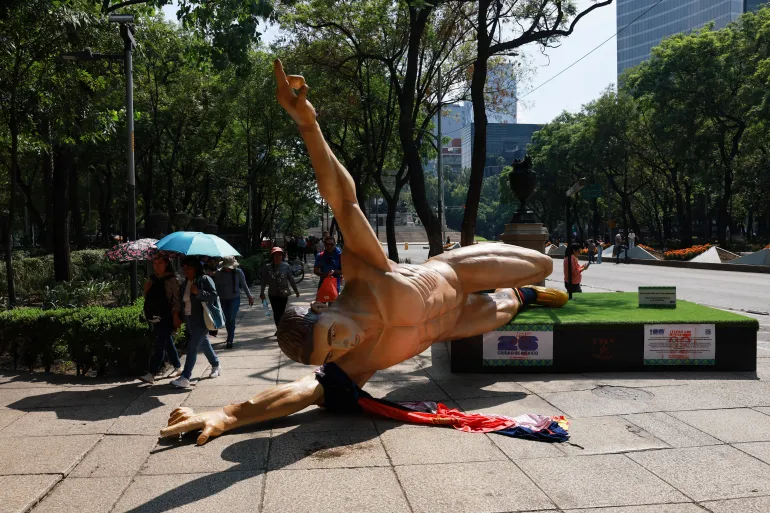
People walk near the fallen statue of a soccer player
People walk near the fallen statue of a football player, placed along Avenida Reforma for the 2026 FIFA World Cup, that was vandalised by teachers from Mexico’s National Coordination of Education Workers (CNTE), following a protest demanding better wages and pensions, under the slogan “If there’s no solution, the ball won’t roll,” in Mexico City [Henry Romero/Reuters]

The FIFA World Cup begins on June 11. You can follow the action on Al Jazeera’s dedicated World Cup 2026 page with all the latest news, match build-up and live text commentary, and keep up to date with group standings, real-time match results and schedules.

Source link

Thousands welcome U.S. men’s soccer team to SoCal ahead of World Cup

With its World Cup opener just four days away, the U.S. team moved into its temporary home in Irvine on Monday, where the players found thousands of new Southern California neighbors waiting in line to watch them kick a ball.

After the U.S. announced that Orange County Great Park would be its base for at least the group stage of the tournament, the City of Irvine held a raffle for passes to see the team train in its only public workout.

Thirty-two thousand people applied and 5,500 received access on a warm Monday morning to watch the team rush through a light 45-minute practice that was notable primarily because it was the first in which injured center back Chris Richards was fully involved. Richards tore two ligaments in his left ankle playing for Crystal Palace, his English club team, on May 17 and hadn’t played or fully trained since. The team is rushing to get him ready in the hopes he can play at some point in the three-game group stage.

But the practice was also notable because it was the first at Championship Soccer Stadium, about 50 miles southeast of SoFi Stadium in Inglewood, where the U.S. will open its World Cup on Friday against Paraguay.

“[The] environment and facilities are crazy. It’s more than we expect,” U.S. coach Mauricio Pochettino said of the venue. “We are so grateful.”

Championship Soccer Stadium is owned and managed by the city, which has leased it to the Orange County Soccer Club of the second-tier USL Championship. But the club was temporarily evicted in late April to make space for the national team — which is just fine with them.

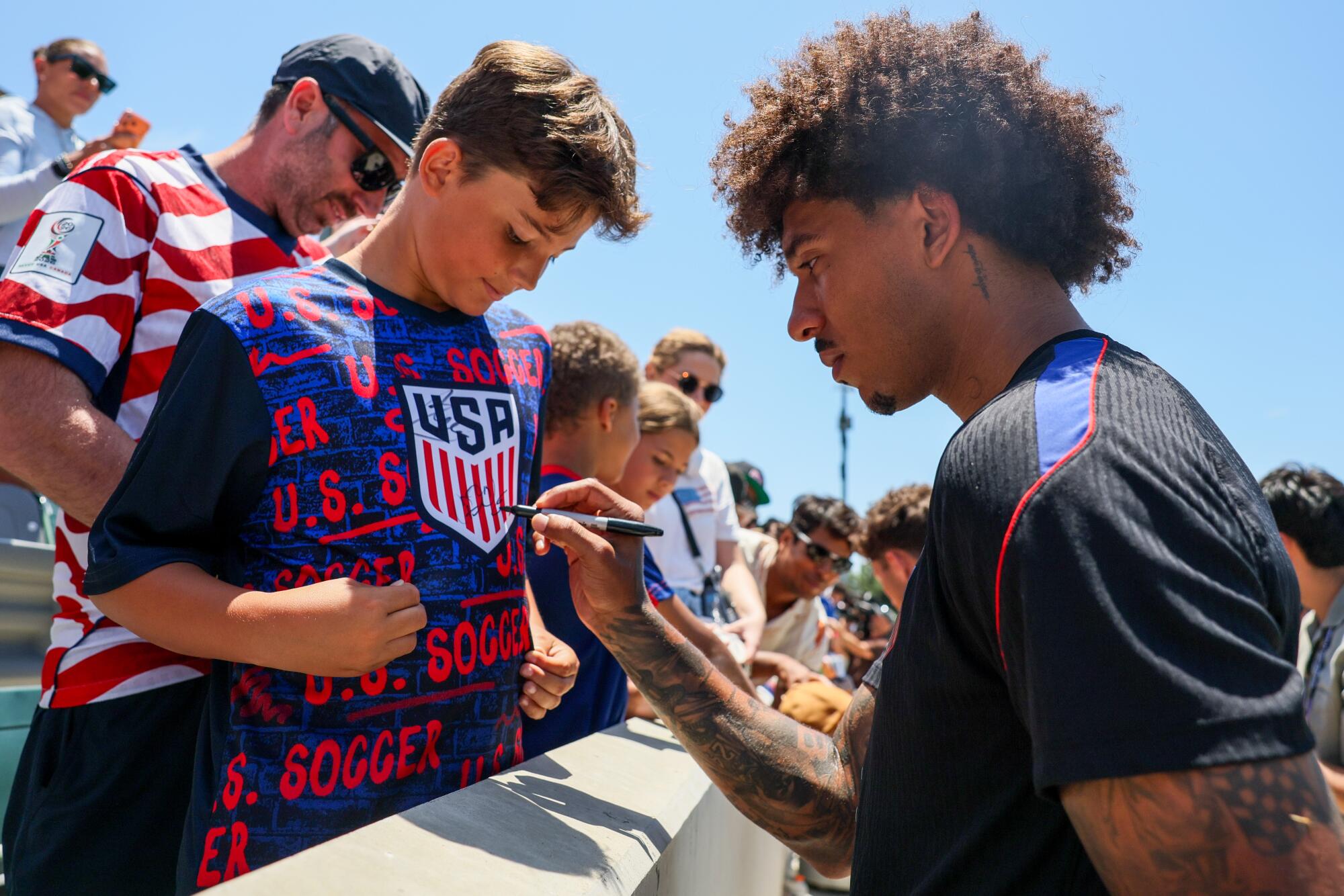
Irvine, CA - June 08: USMNT player Chris Richards autographs the shirt of a young fan.

U.S. men’s soccer player Chris Richards autographs the shirt of a young fan during a team practice Monday.

(Ronaldo Bolaños / Los Angeles Times)

“How can you not be excited about the host nation training in your facility?” said Dan Rutstein, president of business operations of the Orange County club.

“We’re proud to be associated with the U.S. national team. We wouldn’t want to ever block anything, even if we could.”

(And they couldn’t, the city said.)

The Great Park is a sprawling 500-acre complex built on the site of the former Marine Corps Air Station El Toro, which closed in 1999 after 56 years training pilots for conflicts from World War II through the first Gulf War. In 2001, voters approved a proposal to convert the space into a public park and nature preserve, one which now includes, among other things, five sand volleyball courts, four basketball courts, 25 tennis courts, 12 softball and baseball fields, the ice arena where the Ducks practice and 25 soccer fields, including the pristine one FIFA just installed inside the 5,500-seat stadium.

“The idea was that this would be a quality facility, a great park that we hope will rival San Diego’s Balboa Park and other great parks across the country,” Irvine mayor Larry Agran said. “It took a lot of nurturing, a lot of time, a lot of work.”

Bringing the World Cup — or at least a World Cup team — to Irvine also took a lot of time and work. Agran said the city put out feelers about hosting a training base five years ago and made the first cut in 2024 when the Great Park was placed on a list of options distributed to tournament qualifiers.

Over the next two years, Rutstein said, about a dozen national teams sent representatives to have a look while Sam Zapatka, the operations manager of the USMNT, said he scouted 27 facilities from Seattle to San Diego. After his first visit to the Great Park, however, he said he stopped looking and in March, the team announced it would train in Irvine.

On Monday, when the players filed out of the stadium’s locker room, which FIFA expanded and upgraded, they were greeted by rhythmic clapping and chants of “USA! USA!”

1

U.S. men's soccer player Weston McKennie takes part in a training session at

2

U.S. men's soccer players (from left) Weston McKennie, Christian Pulisic and Sergino Dest take part in a training session.

3

U.S. men's national soccer team coach Mauricio Pochettino waves to fans attending practice on Monday.

4

U.S. coach Mauricio Pochettino speaks to players after

1. U.S. men’s soccer player Weston McKennie takes part in a training session at Orange County Great Park. (Ronaldo Bolanos / Los Angeles Times) 2. (Ronaldo Bolanos/Los Angeles Times) 3. U.S. men’s national soccer team coach Mauricio Pochettino waves to fans attending practice on Monday. 4. Pochettino speaks to players after drills at Orange County Great Park on Monday. (Ronaldo Bolanos / Los Angeles Times)

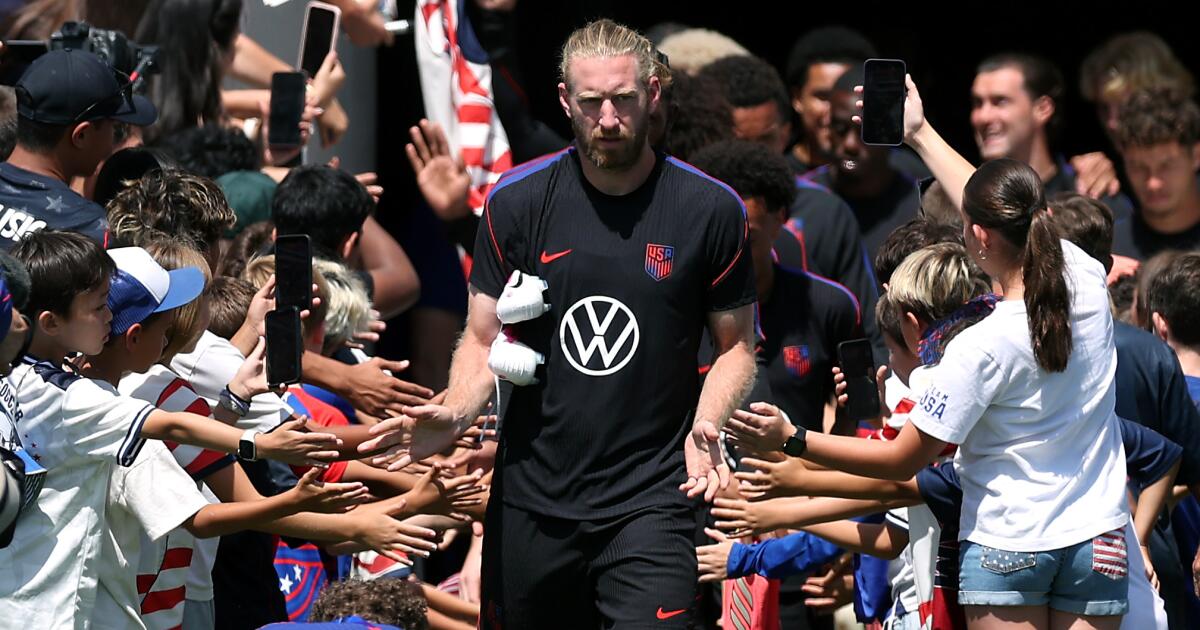
“I think we’ve all been, I wouldn’t say overwhelmed, but possibly surprised by the excitement and the buzz,” said captain Tim Ream, who led the team onto the field. “Pulling up here with 5,500 fans ready to watch a training session is incredible.

“We get to train in an actual stadium with a good pitch. The support, really, from all the kids out there is amazing. You want to feel like you have a good home base, right? So really, we’re looking forward to being here.”

Especially after 5,000 of your neighbors show up for the housewarming party.

Source link

Iranian team wears #168 pins for airstrike victims ahead of World Cup

The shuttle of the Iran World Cup team between Mexico and the United States took root Sunday in Tijuana with an accessory.

The players arrived in Tijuana wearing gold-colored lapel pins on their jackets acknowledging victims of a missile strike on an elementary school that took place Feb. 28 at the outset of the war in their country.

The pins simply read “#168” — replicating the hashtag of the number of people killed in the daytime strike in Minab in southern Iran. Most of the victims were girls attending Shajareh Tayyebeh Elementary School.

The Iran delegation flew on a private jet from Turkey to Tijuana. Mehdi Taj, president of the Iran Football Federation, said two weeks ago that the training base would be in Mexico instead of Tucson.

FIFA has not given a reason for the change, although delays have occurred in processing U.S. visas for some Iranian players and other members of the delegation that allegedly have ties to the Revolutionary Guard.

Iran is preparing to play its three group-stage games in the United States, with the first scheduled June 15 against New Zealand at SoFi Stadium (called Los Angeles Stadium during the World Cup). Its second game, June 21 against Belgium, is also scheduled in L.A. and the third game will take place June 26 in Seattle against Egypt.

It is unclear whether FIFA — the governing body of the World Cup — would allow the pins to be worn by anyone on the sidelines during matches. That would include coaches and other team personnel in addition to players.

FIFA took no action in response to earlier displays of remembrance by the Iran players and has not commented on the legality of wearing the pins. FIFA regulations state that “equipment must not have any political, religious or personal slogans, statements or images.” The rule applies to players, coaches and officials on the sidelines during matches.

The Iran team twice acknowledged victims of the airstrike during the Iran national anthem before warmup matches in March. In the first, players held purple school backpacks decorated with bows. In the second, players held images of those who had died.

Before more recent warmup games, the Iran team stood with their right hands across their chests during the anthem. And earlier in March, some members of the Iran women’s soccer team remained quiet during the national anthem at an Asian Cup match, leading Iranian state TV to call them “wartime traitors.”

Video footage analyzed by investigative group Bellingcat appears to show a U.S. Tomahawk missile striking the school, which was adjacent to a compound associated with the Iranian Revolutionary Guard and barracks for its naval brigade. The United States has not accepted responsibility for the attack, although the military is investigating.

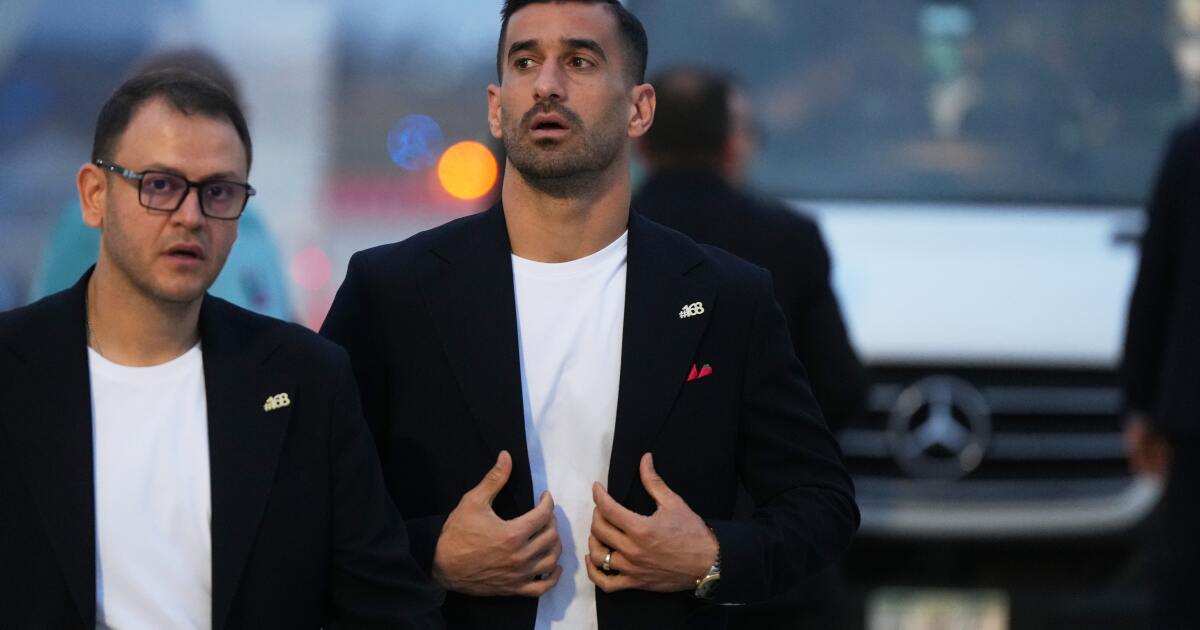
Upon arriving in Tijuana, Iran team captain Ehsan Hajsafi criticized FIFA about the delay in obtaining visas.

“First of all, we’re very happy that the team has finally arrived, and we’re delighted about that,” Hajsafi told reporters. “Thank God, the team’s condition is very good.

“With everything that happened, visas were eventually issued. Personally, however, I do have a complaint about FIFA. Why did it take so long? As far as I understand, visas were issued only to the players and a few members of the coaching staff.”

Ahead of the 2022 World Cup in Qatar, Hajsafi spoke boldly about the government crackdown on mass demonstrations in Iran.

“Before anything else, I would like to express my condolences to all of the bereaved families in Iran,” Hajsafi said. “They should know that we are with them, we support them and we sympathize with them. “We cannot deny the conditions — the conditions in my country are not good and the players know it also.”

The Associated Press contributed to this story.

Source link

Teachers’ protests challenge Mexico ahead of World Cup

Mexican teachers block an avenue during a national teachers’ strike organized by the National Coordination of Education Workers in Mexico City on Tuesday. The CNTE union vowed to maintain their national strike indefinitely over their demands, which include a salary increase and a reversal of the current pension and retirement frameworks. Photo by Madla Hartz/EPA

June 8 (UPI) — Thousands of teachers continue to block streets and maintain an encampment in Mexico City’s historic center just days before the opening match of the 2026 FIFA World Cup, as negotiations with the federal government remain deadlocked.

Mexican educators have sought to use the visibility of the tournament to pressure President Claudia Sheinbaum’s administration for higher wages and pension reforms.

The National Coordinator of Education Workers, known by its Spanish acronym CNTE, reaffirmed Sunday that it will continue its strike indefinitely and intensify demonstrations in the coming days despite calls from the federal government to end the work stoppage, according to Infobae.

“There are groups that want to provoke the Mexican government and are not necessarily teachers,” Sheinbaum said during her daily news conference. “What they want is repression. They want the national headline to be ‘Mexico represses teachers.’ They are not going to get that.”

The protests are concentrated around Mexico City’s Zócalo, the capital’s main public square, where FIFA has organized official fan activities.

Visitors seeking access to the FIFA Fan Festival must pass through the teachers’ encampment and additional security checkpoints, according to TV Noticias Telemundo.

The report said the historic center remains affected by the encampments, creating disruptions for tourists, residents and local businesses.

CNTE leaders are also considering extending demonstrations to Azteca Stadium, which is scheduled to host the World Cup opening match Thursday.

Interior Secretary Rosa Icela Rodríguez urged teachers Saturday to end the protests and continue negotiations, arguing that the demonstrations are affecting students, workers, merchants and tourism activity in the city center.

The CNTE rejected the government’s pension proposal as insufficient and announced that additional groups of teachers will join the protests this week.

Sheinbaum called Monday for patience while awaiting decisions in the coming days and said she remains confident that the opening of the 2026 World Cup “will be very good, without repression.”

The dispute comes as Mexico hopes the tournament will boost tourism and economic activity.

According to tourism industry estimates, the World Cup could generate as much as $3 billion in economic activity and attract more than 5 million international visitors.

Mexico City’s three host cities, Mexico City, Guadalajara and Monterrey, reported hotel occupancy rates of about 60% ahead of the tournament.

Nelly Carrasco Godínez, secretary of Culture and Tourism for the State of Mexico, said the state expects to receive about 1.6 million visitors in small historic towns and tourist destinations promoted during the World Cup. The expected economic impact is 1.4 billion pesos, or approximately $80 million.

Source link

How extreme weather and heat could affect players at World Cup 2026 | World Cup 2026

Sweaty, shirtless football players lying on the pitch have seldom raised eyebrows as they did last week when photographs of European players struggling to train in the heat sparked concerns over sweltering US summer temperatures at the World Cup.

Scientists have long cautioned that extreme heat could disrupt sporting events. Last month, climate experts warned that one in four World Cup games could be played in very hot conditions, affecting fans and players alike.

Recommended Stories

list of 4 itemsend of list

Those warnings materialised last week; social media was abuzz with sunburnt players — mostly from European teams used to cooler climates — dousing themselves with water to cool off. Norway’s team even opted to wear ice collars around their necks during the friendly against Morocco.

But England captain Harry Kane quickly dismissed speculation over how much the heat would affect players, saying it “won’t be a factor”, thanks to his team’s World Cup training regimen.

So, how much will higher temperatures actually affect players at the World Cup? Al Jazeera takes a look.

What have experts said about heat during World Cup matches?

Th 2026 World Cup could be the hottest on record since the tournament began in 1930 due to a sharp rise in global temperatures, explained Al Jazeera weather presenter Everton Fox.

“Around half a dozen of the venues are prone to extreme heat; places like Dallas, Houston, Miami and the Mexican venues are all likely to swelter,” Fox said.

Daytime temperatures there are expected to average 28C, though the stadiums in Dallas, Houston and Atlanta have air conditioning.

Approximately 26 of the 104 matches could reach at least 26C in the Wet Bulb Globe Temperature (WBGT) index — which measures how effectively the body can cool itself — while five games are expected to be played in conditions of 28C WB or higher, according to World Weather Attribution (WWA), a network of climate scientists.

Of those 26 matches, 17 will be played in stadiums with cooling systems, reducing risks for players and fans.

But more than a third of the games with a one in 10 chance of exceeding 26C will be in venues without air conditioning.

How do hotter temperatures impact athletes’ performance?

Heat stress due to increased humidity, exposure to solar radiation and the effects of wind speed will impact players running around in direct sunlight, Fox said.

“All this makes it harder for the body to cool down as it becomes harder for sweat to evaporate as quickly,” said Fox, a senior meteorologist with more than 30 years of experience.

Physical performance coach Raiyan Abbasi explained that, although the body sweats to achieve thermoregulation – a process that allows the body to maintain its core internal temperature – excessive sweating due to heat could lead to dehydration, cramps and increased fatigue.

Are athletes used to such high temperatures?

“Yes, the majority of athletes will know how to deal with this kind of heat since they’re elite players training and competing in various conditions,” said Abbasi, who has worked as a physical performance coach for British clubs Swansea and West Ham, as well as the Pakistan national side.

Teams will have a performance coach and medical staff to make sure players are ready for the tournament, including through acclimatisation, Abbasi explained – echoing what Kane said over the weekend after his side beat New Zealand 1-0 in Tampa, Florida, where temperatures soared beyond 30C.

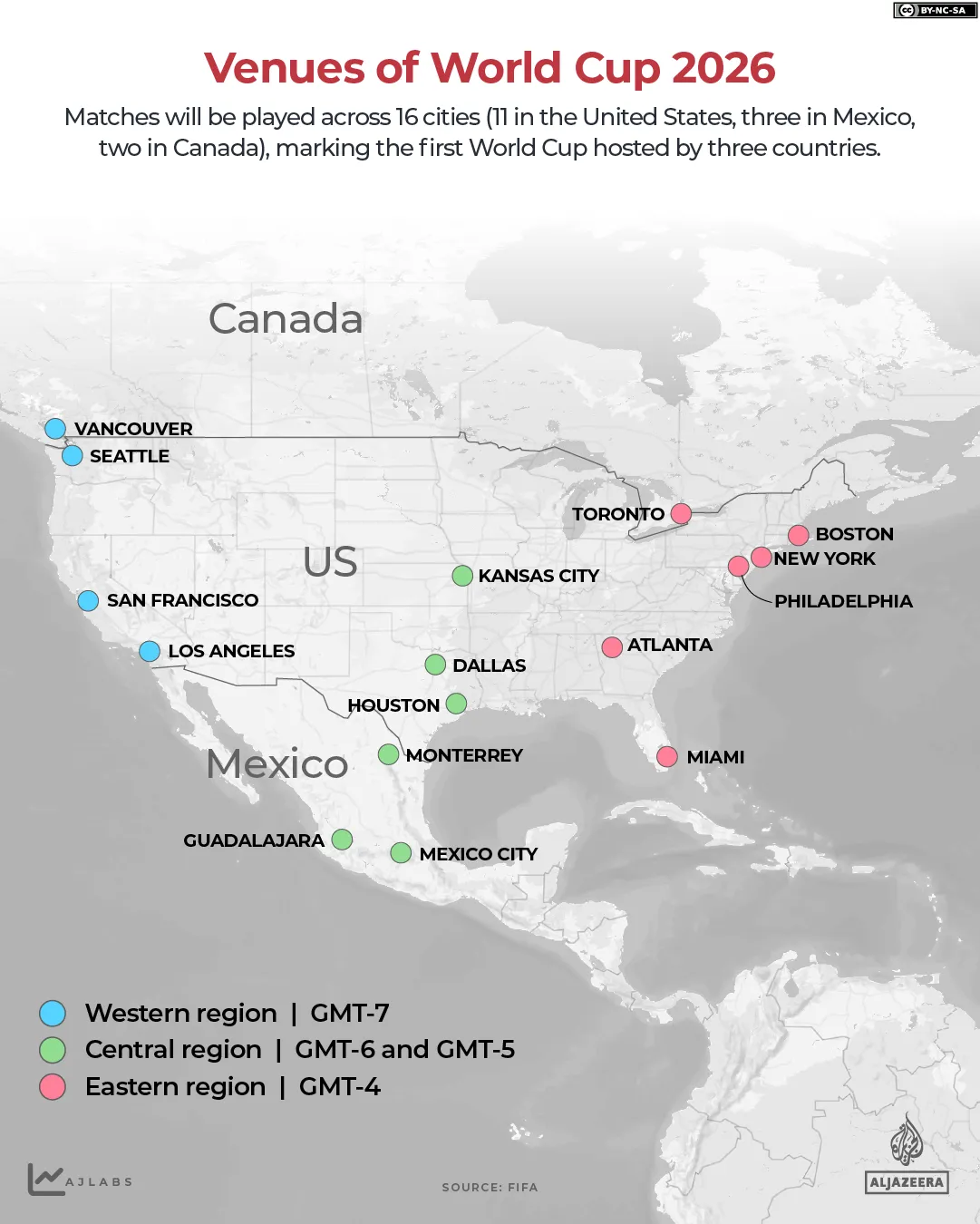
INTERACTIVE-Football FIFA Venues of World Cup 2026-1776670771

Do athletes from hotter nations have an advantage?

World Cup nations whose players train in hotter climates may have a slight advantage when it comes to adjusting to high temperatures in the US.

“But essentially, countries that prepare and perform well can minimise that difference,” Abbasi said, adding that heat can be used positively too.

“Heat is a significant factor in creating good athletes; one way to improve athletic capabilities is to train in the heat.

“It can make big adaptations in your body to improve body temperature.”

Could the World Cup have been held before or after summer in the US?

Fox noted that international tournaments are traditionally in the European domestic off season, which is when the 2026 World Cup is being held.

“Ideally, US weather is most conducive in the spring and autumn, but you’d then be looking at the tornado season in spring and hurricane late summer through autumn before you even begin to think about their domestic sports which locals have more interest in,” Fox said.

What measures has FIFA taken for players and fans?

FIFA said it has carried out heat-risk planning, with measures including three-minute hydration breaks in each half of games, cooling infrastructure for fans and players, adapted work-rest cycles, and enhanced medical readiness that scale according to real-time conditions.

“The hydration breaks probably need to be longer to gain full benefit, but then you risk turning it into a game of four quarters,” Fox said jokingly, although he argued that FIFA could have confined games to northern parts of the US and Canada.

FIFA has also delayed kickoff times for some matches to start outside the hottest afternoon hours.

Source link

World Cup 2026: Jude Bellingham has fight to start for England – Thomas Tuchel

Bellingham missed just 29 minutes of England’s Euro 2024 campaign, starting all seven matches, but his fortunes have changed under Gareth Southgate’s replacement.

The 22-year-old missed two qualifying matches last September because of a shoulder injury but was overlooked for October’s international camp, including a qualifier against Latvia.

He returned to the squad in November but was forced to miss friendlies in March with a persistent hamstring issue.

His relationship with Tuchel has frequently come under scrutiny, with the manager describing Bellingham’s on-field behaviour during last June’s defeat by Senegal as “repulsive” – a remark Tuchel later apologised for.

In November, Tuchel said he would “review” Bellingham’s behaviour following his reaction to being substituted during a qualifier against Albania.

However, he was impressed with Bellingham’s performance in Saturday’s World Cup warm-up match against New Zealand in Tampa, believing he has hit a “sweet spot” heading into the tournament.

Bellingham took the captain’s armband after coming on at half-time in the 1-0 win.

“You can see Jude has for sure the decisiveness and bite,” Tuchel said. “This is his key characteristic, but you can see that he comes from an injury and is full of energy and happy to be back on the pitch.

“He had his break, unfortunately, in a decisive part of the season, the Champions League season and campaign for the championship in Spain, so this was very unfortunate for Real Madrid and for him personally.

“But you can see now that he is actually in a sweet spot. He comes back, he’s fresh, he wants to play and he’s in top shape.”

Source link

New York stabbing, Kansas City shooting raise World Cup security concerns | World Cup 2026 News

Two separate incidents of violence have left nine people injured in World Cup host cities in the United States, raising concerns over the safety and security of fans attending the tournament that starts in three days.

Six people were wounded in a stabbing on Sunday at New York’s Penn Station, the city’s mayor said, as the metropolitan area geared up to host two major sporting events, the NBA Finals and the FIFA World Cup.

Recommended Stories

list of 4 itemsend of list

Meanwhile, nine people sustained non-life-threatening injuries in a shooting near England’s World Cup base camp in Kansas City, Missouri, on Saturday.

The New York City Fire Department said a suspect was detained and the victims, including one with serious injuries, were taken to hospital.

Fire Department officials initially reported five wounded, but Mayor Zohran Mamdani said on X that “based on the information available right now, six people were stabbed and the alleged perpetrator is in custody.”

Circumstances of the attack were not immediately clear, but city Comptroller Mark Levine said on X that the suspect is “said to be an emotionally disturbed homeless person”.

All victims are expected to survive, he added.

State Governor Kathy Hochul described the attack as “an act of horrific violence”.

“New Yorkers deserve to feel safe wherever they go, and we will never stop working to make that a reality,” she said in a statement.

The incident occurred at one of the nation’s busiest rail and subway transport centres as the city prepares for two huge sporting spectacles.

Madison Square Garden, located directly above Penn Station in downtown Manhattan, will host games three and four of the NBA Finals on Monday and Wednesday between the New York Knicks and the San Antonio Spurs.

MetLife Stadium, outside the city in neighbouring New Jersey state, will host its first match of the World Cup on Saturday.

INTERACTIVE - venue world cup poster image-1780896044
[Al Jazeera]

US President Donald Trump is scheduled to attend Monday’s NBA game at Madison Square Garden, saying recently that he accepted an invitation from Knicks owner James Dolan.

Security has been enhanced in the city before the two events.

New York’s official emergency notification system did not describe the incident but said people should avoid the area and “expect traffic delays, road closures, mass transit disruptions & emergency personnel near Penn Station”.

Before the stabbing, New York officials had already cancelled an outdoor watch party set for Monday outside the Garden.

Thousands of spectators descended onto the streets outside the venue on Friday for a game two watch party. New York authorities said a police officer was assaulted and 26 people were arrested as a number of fans turned rowdy.

Meanwhile, Kansas City police said there were no suspects in custody and that at least three of the shooting victims were taken to local hospitals.

The incident occurred about 6.5km (4 miles) from where England are set to train at the Swope Soccer Village. England have not arrived in Kansas City and are due to play a friendly against Costa Rica in Orlando, Florida, on Wednesday.

A general view of Arrowhead Stadium as it is rebranded as Kansas City Stadium, Monday, May 11, 2026, ahead of the 2026 FIFA World Cup soccer matches in Kansas City, Mo. (AP Photo/Charlie Riedel)
The Arrowhead Stadium, rebranded as Kansas City Stadium, will host World Cup games [Charlie Riedel/AP]

What security measures has the US put in place for the World Cup?

The 48-team, 104-match World Cup comes with an unprecedented security challenge for the host nations, particularly the US, which is hosting 78 matches across 11 cities.

Overseeing the sprawling security apparatus is a legion of federal agencies, state and local police departments and private entities. Their responsibilities range from securing stadiums and fan zones to escorting teams and protecting dignitaries.

Their tools include hunter drones that can shoot nets over objects in restricted airspace, bag-inspecting robot dogs, giant X-ray trucks and thousands of AI-powered cameras trained on public spaces soon to be thronged by fans.

Drones are prohibited over stadiums and fan zones, and the FBI has a “full suite of options” to thwart incursions, according to FBI Special Agent in Charge Amit Kachhia-Patel.

On match days, the FBI will activate joint operations centres in each host city, bringing together local, state and federal law enforcement agencies to monitor and investigate threats.

The tournament has the same high-level federal security designation as the Super Bowl, just below a presidential inauguration or a national political convention, ensuring federal, state and local coordination. It coincides with other major events linked to the 250th anniversary of the US’s founding.

So far, there are no credible threats, according to Andrew Giuliani, executive director of Trump’s World Cup task force, which is overseeing the multiagency effort.

The Department of Homeland Security, focused on Trump’s immigration enforcement crackdown and hit by a funding lapse only recently resolved, estimates that up to seven million people will visit the US for the World Cup.

The US Secret Service, under scrutiny after security breaches and attempts on Trump’s life, is in charge of protecting world leaders who show up to cheer on their countries. Trump has expressed interest in attending a match.

Gun violence is common in the US, where there were more than 400 mass shootings in 2025, according to the Gun Violence Archive.

Source link

World Cup 2026: Scotland captain Andy Robertson – inside the fairytale journey

“He doesn’t like talking about his story,” John McGinn told the Scottish FA.

“He’ll no like hearing it – but that’ll never happen again. Part-time football to go so quickly to Hull, Liverpool, Champions League winner, Premier League winner, captaining your country at a World Cup. That’s fairytale stuff.

“It’s a documentary I can’t wait to sit back and watch, the Andy Robertson documentary.”

His manager at Hull, Steve Bruce, cited Robertson’s ability to grow and meet bigger challenges as they came along. Strachan said his intelligence meant he learned extremely quickly.

Robertson mainly ascribes his ascent to “luck” in having coaches and managers who were willing to give him a chance, as well as his work ethic.

“What I could control is I went into football with: ‘I will give this 100% and, if I don’t make it, at least I can look back and go, you know what, I gave that absolutely everything and wasn’t for me.”

Robertson is on his way to surpassing the great Dalglish’s record of 102 caps for Scotland and already has the most appearances as captain.

The McTominay mural marking the midfielder’s overhead kick in the defining game against Denmark adorns a tenement next to Hampden, only a few miles from where Robertson grew up. It may need some company.

Robertson is the boy who went from posting about being broke to ruffling Lionel Messi’s hair on his way to winning the Champions League.

From answering the Hampden phones to ending Scotland’s World Cup hurt in the same place, 14 years on.

He might not like to hear it, but it is a story that should inspire young Scots for generations.

Source link