Fifa World Cup 2026 fans were quick to take to social media to share their reactions to tonight’s coverage.
Hayley Anderson and Hayley Anderson Screen Time TV Reporter
21:29, 27 Jun 2026
ITV’s Fifa World Cup 2026 host Laura Woods. (Image: ITV)
Football fans voiced the same complaint minutes into tonight’s World Cup match on ITV.
Ahead of this evening’s match against Panama, England was sent through to the last 32 following matches against Croatia and then Ghana earlier this week.
So England fans were on a high prior to tonight’s game, which kicks off at MetLife Stadium in East Rutherford, New Jersey at 10pm UK time and 5pm US time.
However, just minutes into the coverage ahead of this evening’s match, viewers couldn’t stop themselves from flocking to X as two unexpected faces popped up on their screens.
Presenter Laura Woods welcomed none other than ITV legends Ant McPartlin and Dec Donnelly as they joined her at the channel’s stunning New York studio.
She asked about their opinion on tonight’s match, as well as about their own memories of previous World Cups but not everyone was happy to see the I’m A Celebrity hosts.
In fact, many commented that they were ‘switching off’ ITV’s coverage following their appearance.
“Ant and Dec FFS, I’ll switch back on at 9.55,” someone said on X (Twitter).
A second echoed: “Ant and Dec appeared. I switched to Five Live”, with someone else adding: “Ant & Dec being ‘interviewed’ during the World Cup may be the strangest thing I’ve seen during this whole event.”
Taking to X, a fan exclaimed: “Surely they could have got better than ant and dec for the World Cup, so annoying!”
Meanwhile, someone else asked: “No football people available tonight?”, as a fellow viewer sarcastically commented: “I was just saying to myself ‘We really don’t see Ant and Dec on the tellybox enough'”.
However, one fan defended the award-winning ITV duo, arguing: “Ant and Dec are much better than Neville and carragher.”
The last time England took centre stage was against Ghana which ended 0-0 at the Gillette Stadium in Boston.
Meanwhile, even though Scotland beat Haiti 1-0 in their first match of the World Cup 2026, they have since lost to both Morocco and Brazil.
The Fifa World Cup is available to watch on ITV and ITVX.
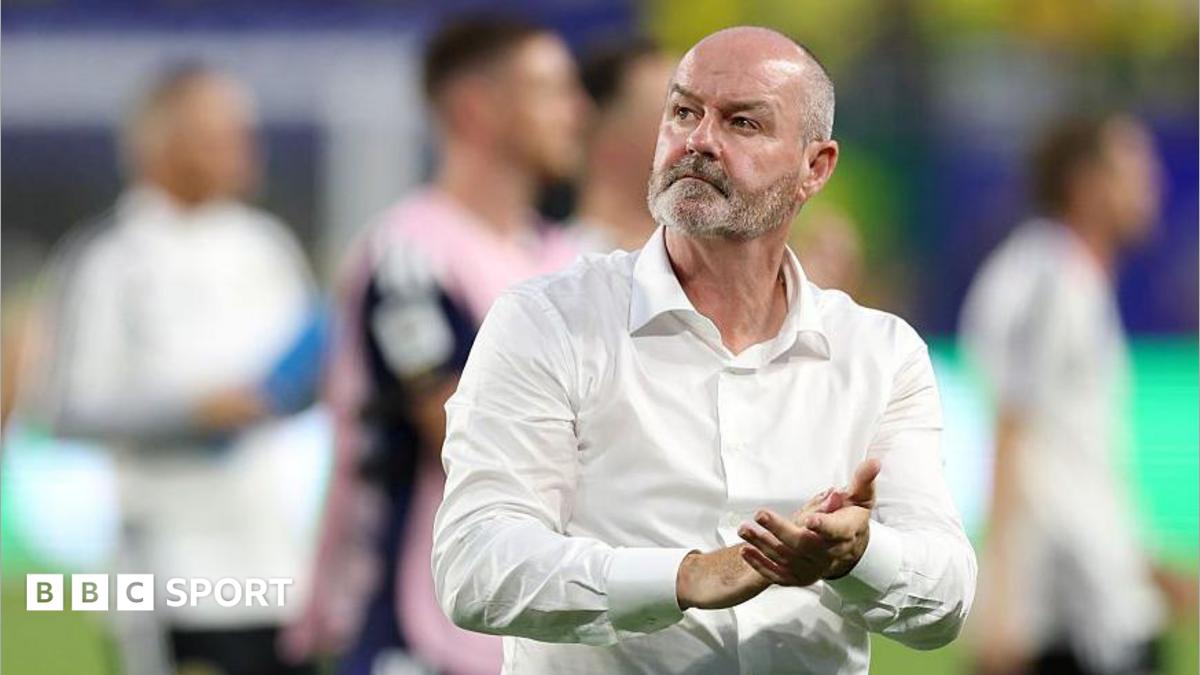
“Over the three games you’re definitely looking at below-par performances,” said Willie Miller, who played at the 1982 and 1986 World Cups for Scotland.
“I keep looking back on the Denmark game [November’s 4-2 win to seal qualification] with those outstanding goals, but they didn’t get anywhere near those levels.”
The former defender described the lack of a top-class striker as “a major issue” and said he was “uncertain about the logic of a few selections”.
However, he did back Clarke by adding: “He got us there and that’s what the Scotland manager’s job is.
“He has introduced a real togetherness in the squad as well, which wasn’t always the case.”
With 81 matches under his belt, Clarke is Scotland’s longest-serving manager.
Support from the Scottish FA has been emphatic, with their coffers significantly enhanced by participation at three of the past four major finals.
“I’m sure he can go again over the next few years if he wants to,” Miller added of Clarke.
“The new contract was a positive step. I think it was the right thing to do.”
Scotland conceded soft, early goals in defeats by Morocco and Brazil, with former striker James McFadden saying: “The defending was certainly below the standard we’re used to and the errors were costly.
“I just feel the players could have shown more. We could have done better against Morocco in terms of having a go.
“But a lot of people think we should have had two penalties and a red card in that game, which is nothing to do with the manager and players.
By The Associated Press and Al Jazeera staff and The Associated Press
Published On 27 Jun 202627 Jun 2026
Tiny Cape Verde have become the history makers of World Cup 2026 by defying all odds to become the smallest country to earn a spot in the knockout stages of the competition.
Their improbable run through the group stage, with a third straight World Cup draw, was completed with a 0-0 draw against Saudi Arabia on Friday night to advance in the tournament.
Recommended Stories
list of 4 itemsend of list
Keeping goal for Cape Verde throughout has been Vozinha, 40, who has embodied the grit of his nation.
“We are small, but we have big hearts and we are fighters,” said the goalkeeper, who last season played for Chaves in Portugal’s second tier.
The island nation off the western coast of Africa, which is making its debut on football’s grandest stage, already held 2010 champion Spain to a 0-0 draw – a shock in itself to begin their campaign.
They then came from behind to get a 2-2 result against Uruguay – the winners of the inaugural World Cup in 1930.
“The team was very eager to show this to the whole world,” Cape Verde coach Bubista said while draped in his country’s flag after the Saudi Arabia game.
“We are proud of having arrived at this stage. We have shown that we are a small country, but that we fight for the things that we want to achieve.”
Cape Verde’s three points put the team in second place behind Spain, which beat Uruguay on Friday night and won the group.
Cape Verde will play reigning World Cup champion Argentina in Miami on July 3.
Drawing all three group matches doesn’t guarantee advancement at major football tournaments, but several teams have done it in the past. Those include: Wales in 1958, Ireland and the Netherlands in 1990, and Chile in 1998. New Zealand, however, also got three draws at the 2010 World Cup and were eliminated.
On the eve of the match, Bubista mused, “Everyone is entitled to dream and nothing is impossible.”
The Blue Sharks proved him right, overcoming seemingly insurmountable odds as this country of just 530,000 reached the round of 32.
A woman, her face painted with a flag of the archipelago, held a sign that read: “Small Islands, Big Dreams,” a dream that these underdogs have made reality as they continue their charmed run on the world stage.
They did it with another strong game from Vozinha, whose tournament success has helped him amass more than 16 million Instagram followers.
He had a save in first-half stoppage time, grabbing a header from Mohamed Kanno to keep Saudi Arabia scoreless. Another save came in the 66th minute when he leaped to deflect a shot from Mohammed Abu al-Shamat.
A third came in the 92nd minute when he stopped a shot by Abdullah al-Hamdan.
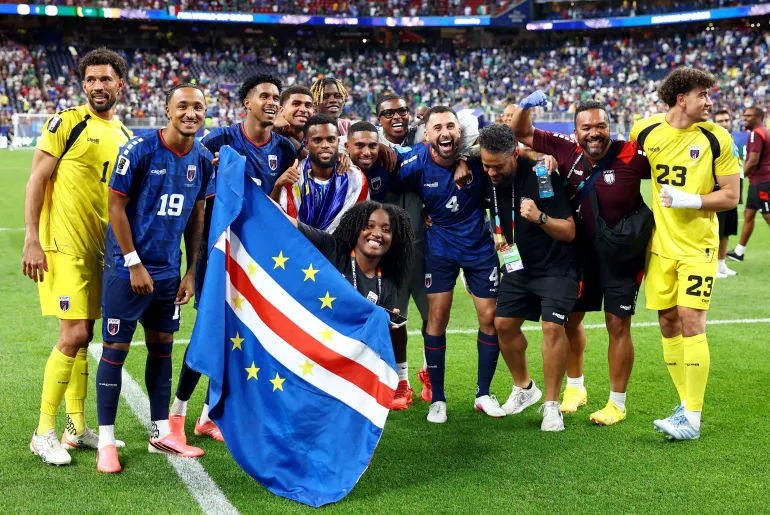
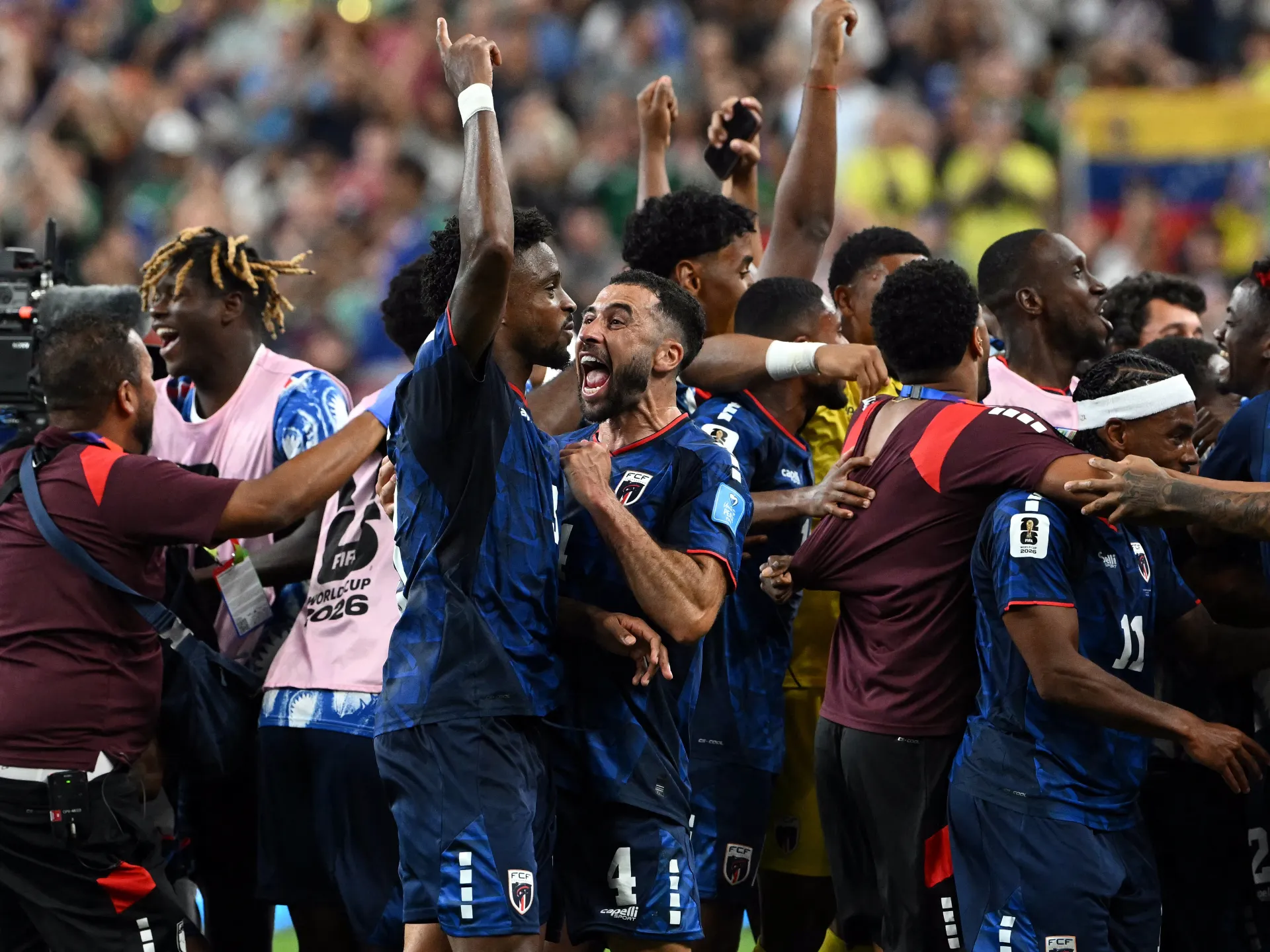
Cape Verde players and staff celebrate after the Saudi Arabia match [Phil Noble/Reuters]
“There is a lot of quality in our national team,” Vozinha said. “Maybe for many of you, you think the Cape Verdean player is not good enough. But we came here to show that we have a lot of quality and we are here to compete and our players can play everywhere in the big competition, in the big leagues.”
A group of shirtless men in the crowd each painted one letter of his name on their chests as they cheered Cape Verde.
But Vozinha had a much bigger fan among the crowd of 68,278 as his mother Ana Candida Evora watched from a luxury suite, waving a tiny Cape Verde flag. It was her second match of the tournament after missing Vozinha’s epic seven-save performance against Spain because of visa issues.
Cape Verde had a chance to score in the 50th minute, but Kevin Pina’s shot from distance was just above the crossbar. Another chance came in the 74th minute when Laros Duarte’s shot from the middle of the box was stopped by goalkeeper Mohammed al-Owais.
A last chance to score came in the final seconds when Nuno da Costa sent a shot from the middle of the box wide left.
But it didn’t matter because a couple of minutes after the final whistle, Spain completed its victory over Uruguay and set off a joyous celebration among Cape Verde’s players and fans, many of whom cried as they rejoiced.
Having led his squad to new heights, Bubista was asked if he could have imagined such a run entering the tournament.
“I’ve always said that sooner or later Cape Verde would be on such a stage,” he said. “Of course, it’s hard to have such a forecast, but I always knew.”
Saudi Arabia were eliminated after finishing with two points in the group stage.
“We were very poor in terms of creating things, controlling the game and creating actions,” coach Georgios Donis said. “And one cannot win a game this way. It would be very difficult.”
The 2026 World Cup will have 13 different kickoff times. You can use the Al Jazeera Sport widget to find out exactly when your team is playing in your local time.
Who: Colombia vs Portugal What: FIFA World Cup 2026 Group K match Where: Hard Rock Stadium, Miami When: Saturday, 7:30pm local time (23:30 GMT) How to follow: We’ll have all the build-up on Al Jazeera Sport from 20:30 GMT ahead of our live text commentary stream.
Recommended Stories
list of 4 itemsend of list
One of the biggest group games of the 2026 World Cup takes place in Miami on Saturday when Colombia face Portugal in a battle of Group K’s top two.
Colombia, powered by Luis Diaz and Daniel Munoz, have already booked their ticket to the round of 32 as the current table-toppers, while Cristiano Ronaldo-led Portugal, who are second, are also assured of a knockout berth.
Those standings could change after Saturday’s fixture at Hard Rock Stadium, where a capacity crowd is expected after tickets reportedly sold for thousands of dollars.
Al Jazeera tells you everything you need to know about Colombia vs Portugal:
Portugal expect ‘away’ atmosphere in Miami
Spearheaded by the larger-than-life presence of superstar Ronaldo, Portugal are a huge and popular draw globally – but for this match, Colombia will hold the spectator edge at Hard Rock Stadium.
With hundreds of thousands of Colombian Americans living in the Miami metropolitan area, the Colombian team has a partisan crowd behind them. In the lead-up, Portugal coach Roberto Martinez remarked that his side would be playing “away from home” while acknowledging the enormous hype around the final matchday for both teams.
Colombia vs Portugal is the most in-demand fixture of all 72 group-stage games, according to The Athletic, with five million ticket requests made in the first 24 hours of the Random Selection Draw in December.
“It means I had to buy tickets for my family in November,” Martinez quipped when asked about the fan dedication. “That’s what it means, because I knew it was going to be difficult to get tickets.”
“I think it’s fascinating. The passion of the game in a difficult moment in the world. Football still brings unity, it brings passion, it brings inspiration for the kids … So I hope football wins and inspiration of anyone that watches the game.”
While Colombia have reached the knockout stages with six points from two games, Portugal sit second on four points and are all but through. Finishing second could give them a tougher path in the knockout stage, with England or Croatia potential opponents.
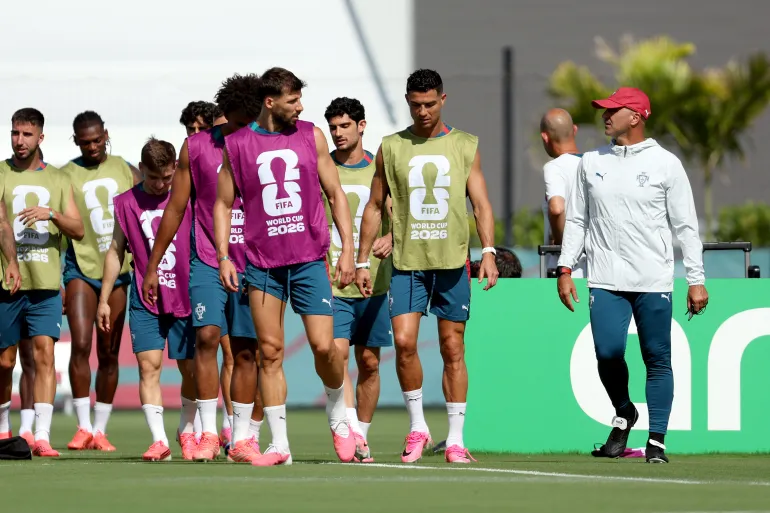
Portugal train ahead of their game against Colombia, where they’ll be aiming to earn the top spot [Leonardo Fernandez/Getty Images via AFP]
Colombia coach warns team against Ronaldo, Vitinha
Colombia coach Nestor Lorenzo said his team will need “special tactical discipline” against Portugal, whom he considers one of the favourites to win the tournament. The Colombians need to avoid defeat to advance as group winners, but Lorenzo was taking nothing for granted against the No 5 side in the FIFA world rankings.
“We’ll try to maintain our style and our footballing identity,” he said.
“But without a doubt, we have to pay attention to the other characteristics and strengths [that Portugal] has. It’s a very well-coached team. They have a coach and players who are at the elite level of world football … and that shows in their game.”
Lorenzo also said Colombia will be wary of the threat posed by Ronaldo, who scored twice in the last match, and Vitinha, the defensive midfielder known for his ball control, work rate and playmaking abilities.
“Both Vitinha and Ronaldo are decisive players. One in the organisation of the game and the quality of his playmaking, and the other in finishing,” he added. “So we absolutely cannot leave them alone or neglect them. Hopefully, the team collective will be well-oiled.”
Colombia are set to feature in the World Cup knockouts for the first time since 2018, having failed to qualify for the 2022 World Cup in Qatar.
Wing-back Daniel Munoz has been a standout player in the Colombia squad, with two goals in two games [Ulises Ruiz/AFP]
Colombia vs Portugal prediction
Opta’s supercomputer has calculated a 48.9 percent probability of Portugal winning this fixture, while Colombia is assessed a 26 percent chance of victory. There is a 25.1 percent probability of the game ending in a draw.
Overall, Colombia are favourites to finish on top of Group G, with a 53.32 percent probability, according to Opta.
Colombia vs Portugal: Kickoff time, TV channel
Colombia: DSPORTS, RCN TELEVISION SA, CARACOL, DGO (6:30pm Colombia Standard Time)
Portugal: RTP 1, RTP Play, LiveModeTV, SPORT.TV5 (00:30am on Sunday, Western European Summer Time)
United Kingdom: BBC iPlayer, BBC One, Red Button 1 (00:30 am on Sunday, British Summer Time)
To check the TV listings for your country, head to FIFA’s TV listing schedule here.
What’s the scenario in Group K?
Colombia (six points) and Portugal (four points) are assured of a round of 32 berth each as the top two teams. The Democratic Republic of the Congo are third with one point, and Uzbekistan bottom with zero.
The top two teams from each of the 12 groups, along with the eight best third-placed teams, will proceed to the round of 32.
DR Congo have to beat Uzbekistan to stand a chance of advancing via the third-place team route.
Can Portugal finish on top of Group K?
Yes, Portugal can topple Colombia from first place in Group K if they beat the South Americans. Currently, they have a two-point difference.
If Portugal draw with Colombia or lose to them, Ronaldo’s side will remain second.
What’s the benefit of winning a group?
Group winners start their knockout campaign against a third-placed team from another group.
In this case, the Group G winner will face a third-placed team from Group D, E, I, J or L in the round of 32 in Kansas City on July 3.
Form guide
(Last five games, latest first)
Colombia: W-W-W-W-L
Portugal: W-D-W-W-W
Both teams have a solid record over the last five matches, with Portugal edging Colombia with an unbeaten streak over that period.
Portugal thrashed Uzbekistan 5-0 and were held to a 1-1 draw by DR Congo in the first game of the World Cup. They defeated Nigeria and Chile in pre-World Cup friendlies and beat the USA in a March friendly.
Colombia defeated DR Congo 1-0 and Uzbekistan 3-1 at the tournament. Before that, they beat Jordan and Costa Rica in June friendlies but lost to France in a March exhibition fixture.
Portugal have scored six goals across two matches at the tournament, including a double from Cristiano Ronaldo [Ronaldo Schemidt/AFP]
Colombia vs Portugal: Team news
No injuries have been reported by either Colombia or Portugal.
Seattle, United States – There were goals. There were jubilations and heartbreak. There were raucous crowds, confrontations and comradery. There were protests, politics and Palestinian flags. There was a missed penalty. There was joy. There was disappointment.
Egypt’s 1-1 draw with Iran in Seattle at the FIFA World Cup on Friday had it all. Iran is still in contention to qualify as one of the eight best third-place finishers, depending on Saturday’s results.
Recommended Stories
list of 4 itemsend of list
Wild celebrations among the Egyptian fans erupted outside the stadium after the match, as the country proceeded past the World Cup group stages for the first time.
“The feeling is outstanding,” Daniel Salib, who was draped with an Egyptian flag, told Al Jazeera.
“After this game, and the game we played against New Zealand, and how we played against Belgium, we absolutely deserve it. So, I couldn’t be more proud of this country and this team.”
Egypt survived a late Iranian onslaught that saw Team Melli, as the Iran team is known, hit the woodwork and have a goal chalked off by VAR for offside.
Iran also had a penalty saved in the first half, but the entire match was action-packed, going blow-for-blow.
Iran supporter Saeed Nassef said he was disappointed with Friday’s result but hopeful that Iran would still make it through to the round of 32, all depending on the results of Sunday night’s games.
“The Iranian team did a beautiful job. They faced a lot of hardship, but we’re really happy how they played,” Nassef told Al Jazeera.
Protests
Protesters against the Iranian government had gathered outside the stadium, waving US and Israeli flags and holding up photos of Iranian opposition figure Reza Pahlavi.
Nassef, who carried the official Iranian flag, which features the name of God, was one of several fans who told Al Jazeera they faced harassment from opposition activists.
“We’re here to support the team. We’re here to support sports… It’s not cool for people to come here and say bad things because we are here to support the players. We want some happiness,” he said.
After the match, Al Jazeera witnessed a confrontation between antigovernment activists and a supporter carrying an Iranian flag.
The protesters hurled insults at the fan, calling him a “terrorist” and saying he should leave the country. They also engaged in expletive-laden Islamophobic chants.
The fan, who identified himself by his first name only as Milad, approached a man leading the chants on a megaphone and criticising Team Melli fans. He stood inches away from the protester before police officers intervened to pull them apart.
“My issue is not political. My issue is: Players, they play for the country, they play for the people. I support the people. That’s it,” Milad said.
“Good or bad, it doesn’t matter. Our people went and they tried to create joy for other people, and that’s all that matters,” he added.
But the commotion did little to overshadow the nearby festivities where Egyptians had gathered, singing and dancing at their country’s historic moment.
Protesters against the Iranian government outside the Seattle Stadium, June 26 [Ali Harb/Al Jazeera]
Electric atmosphere
Inside the stadium, the atmosphere was electric throughout the match – not an empty seat, not a quiet moment.
When the first half concluded, several sets of Iranian and Egyptian fans started taking pictures together.
The players also showed support for each other. After the final whistle, several Egyptian players consoled their Iranian counterparts, who were visibly upset with the result.
Throughout the 90 minutes, spectators appeared to be alternating in their chants between “Iran, Iran” and “Misr, Misr”, Arabic for Egypt, rather than chanting over each other.
There were a few pre-Islamic revolution Iranian flags in the crowd – featuring a regal lion and sun – but they were far outnumbered by the country’s official flag.
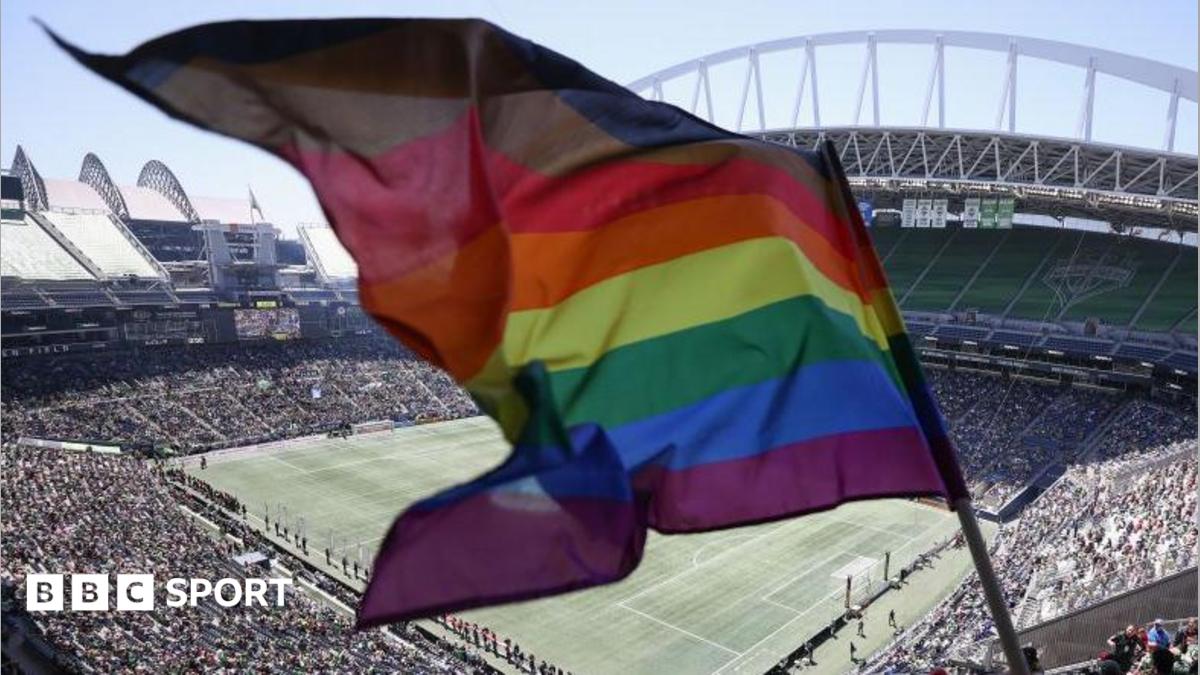
Some people waved LGBTQ+ pride flags and rainbow paraphernalia, due to the game being designated the World Cup’s “Pride Match”. But there did not appear to be any problems in the stadium, despite the hype around the issue.
The Egypt supporters boasted their ancient heritage with pharaohs’ headdresses and outfits.
“We’re so proud to be Egyptian and so proud of our national team,” said Karim Elshabini, who was sporting a gold and black pharaoh’s headpiece and a red Egypt football top.
“It feels amazing. Everybody’s vibing really well. People are really cool. The Egyptian fans, the Iranian fans, we’re all having a really good time.”
There were numerous Palestinian flags at the match, including a couple that were prominently displayed behind the goals.
Egypt fan Bilal Ali, who brought a Palestinian flag to the stadium, told Al Jazeera he would like to keep politics out of football, but with Israeli atrocities continuing in Gaza and elsewhere, he could not remain silent.
“I feel guilty sometimes when I get to [see] the game and our people in Palestine just get bombed and killed,” Ali added.
Several Egyptian and Iranian fans shouted “Free Palestine” as they walked past Ali with his flag.
Iranian fan Hameed with his children outside the Seattle Stadium, June 26 [Ali Harb/Al Jazeera]
‘Minab 168’
There was more than football at the game.
Hameed, an Iranian fan who wished to be identified by his first name only, wore a shirt that said Minab 168.
The message is meant to honour the victims of the school in southern Iran that was bombed on the first day of the US-Israel war on the country.
“I just want to remind the world that the plight of these kids who were bombed, either intentionally or not intentionally, should not be forgotten,” Hameed told Al Jazeera.
“This is why we should not have wars.”
He added that there must be a credible investigation into the incident.
“Politics aside, humanity needs to survive, and the only way to do it, whether the kids are being blown up in Palestine, in Lebanon, in Iran, in Sudan, in Congo, we’ve got to protect them,” Hameed said.
Political statements, flags and protests aside, at the final whistle, the moment belonged to Egypt with a historic sporting achievement.
“Seeing your country after all these years of cheering them, all the highs and lows, finally putting in all the high, good effort and getting good results is a surreal feeling,” said Rafael Youssef, who had the colours of the Egyptian flag painted on his cheek.
“I’m very happy for them, very happy to be here with them.”
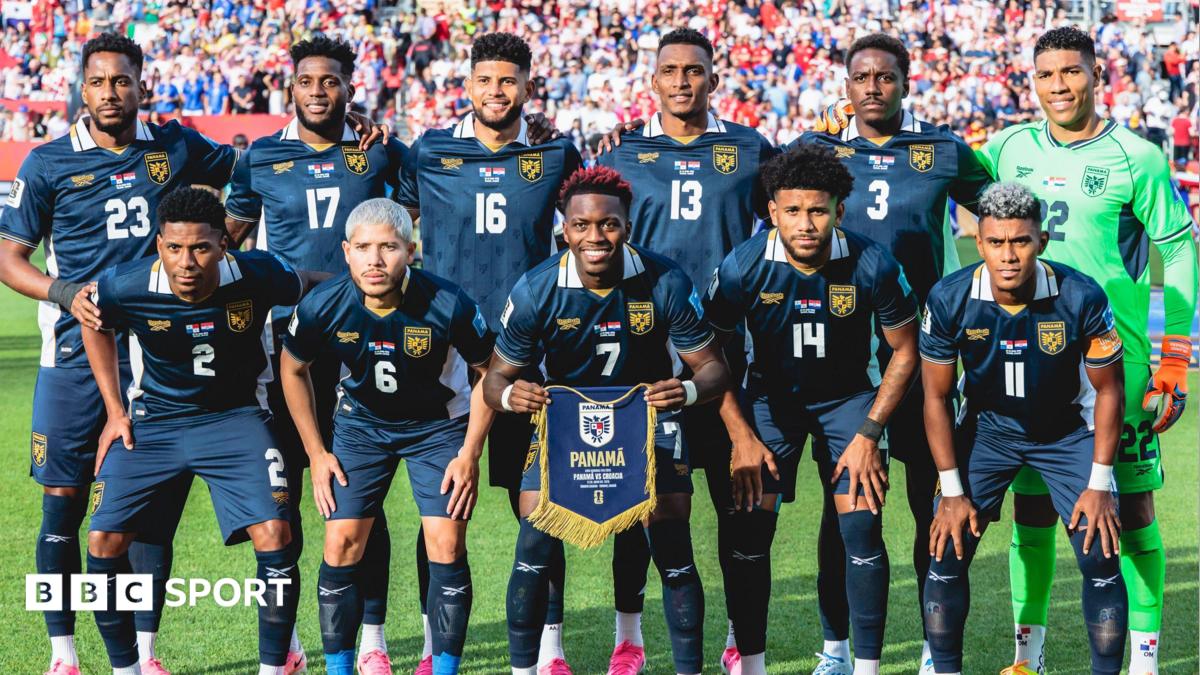
During their first two games, Panama have taken a dynamic approach depending on the phase of play the game is in.
From opposition goal-kicks, Panama have stepped up to press aggressively in a 4-4-2 shape.
If the opponents have quality on the ball and find themselves in possession higher up the pitch, Panama’s high press falls into a mid-block, and they move from a 4-4-2 into a 5-3-2. Their focus is on making it hard for teams to play through them.
As Croatia, in particular, grew into the game, Panama took an even more defensive approach.
Their 5-3-2 became a 5-4-1, a shape they adopted with a deeper defensive line for large parts of the game.
A double strike from Arsenal’s Leandro Trossard against New Zealand carried Belgium to top of Group G, ahead of Egypt on goal difference.
Published On 27 Jun 202627 Jun 2026
Belgium defeated New Zealand 5-1 to book their place in the knockout rounds of the 2026 World Cup on Friday, eliminating the All Whites from the tournament. The result secured the European nation’s first win of the World Cup, as they finished on top of Group G in Vancouver.
A double strike from Arsenal’s Leandro Trossard and goals from Kevin De Bruyne, Romelu Lukaku and Alexis Saelemaekers carried Belgium into the last 32 in first place ahead of Egypt on goal difference.
Recommended Stories
list of 4 itemsend of list
Egypt claimed the runners-up spot after a 1-1 draw with Iran in Seattle. The Iranians finished third in the group and face an anxious wait to know about their knockout fate.
Belgium dominated a lopsided first half and had alarm bells ringing in the New Zealand defence early on when Trossard’s angled shot cannoned off the inside of the upright only to be cleared off the line by Tyler Bindon.
Belgium looked poised to take the lead moments later when Jordanian referee Adham Makhadmeh pointed to the penalty spot after Trossard’s shot hit the arm of covering defender Finn Surman.
But VAR sent Makhadmeh to the monitor to take another look at the decision, which was subsequently overturned and New Zealand breathed again.
Yet Belgium did not have long to wait before the breakthrough and again it was Trossard who proved to be in the right place at the right time, bundling home from close range after De Bruyne’s corner sowed panic in the six-yard box.
Trossard effectively made the game safe five minutes into the second half, controlling a rebound in a crowded area to volley home past New Zealand goalkeeper Max Crocombe at the near post.
Kevin De Bruyne #7 of Belgium celebrates after scoring his team’s third goal [Emilee Chinn/Getty Images via AFP]
De Bruyne then stroked home an elegant low finish in the 66th minute to make it 3-0, a crucial goal which saw the Belgians leapfrog over Egypt into first place on goal difference.
Yet there was to be a dramatic end when New Zealand’s Elijah Just volleyed home a consolation strike from the edge of the area to make it 3-1.
That could have been potentially costly, with the goal suddenly bumping Belgium down into second place.
But Lukaku nodded home his team’s fourth in the 86th minute with his first touch just a minute after coming on as a substitute to return Belgium to the top of the table.
Saelemaekers completed the scoring with a shot from the edge of the area.
Cape Verde’s stunning debut headlines the team list for the World Cup knockouts, which begin on Sunday in Los Angeles.
Published On 27 Jun 202627 Jun 2026
The 48-team FIFA World Cup is nearing the end of the group stage matches and moving towards the knockout stages, beginning on Sunday.
Only 32 teams will advance to the next round of football’s most prestigious tournament. The 2026 iteration in North America is the first time 48 teams have featured, and some debutants have already left their mark.
Here’s what you need to know about the round of 32:
Cape Verde players celebrate after the 0-0 draw during the FIFA World Cup 2026 Group H match with Saudi Arabia at Houston Stadium on June 26, 2026 in Houston, Texas [Michael Steele/Getty Images/AFP]
What is the format of the World Cup knockouts?
The top two teams in each of the 12 groups, along with the eight best third-place finishers, advance to the knockouts.
The knockout phase begins with the round of 32, introduced at the World Cup following the tournament’s expansion from 32 to 48 teams.
Then comes the round of 16, followed by the quarterfinals, semifinals and a playoff for third place. The final is on July 19.
The stage-wise breakdown of the tournament’s knockout schedule is:
Round of 32: June 28 to July 3
Round of 16: July 4–7
Quarterfinals: July 9–11
Semifinals: July 14–15
Bronze medal match: July 18
Final: July 19
South Africa players celebrate after the match at Estadio Monterrey, Mexico on June 24, 2026 [Daniel Becerril/Reuters]
Which teams have qualified for the round of 32?
So far, 26 teams have punched their ticket to the knockouts. They include:
⚽️ Colombia
⚽️ Argentina
⚽️ France
⚽️ Norway
⚽️ Germany
⚽️ USA
⚽️ Mexico
⚽️ Switzerland
⚽️ Canada
⚽️ Brazil
⚽️ Morocco
⚽️ South Africa
⚽️ Ivory Coast
⚽️ Bosnia and Herzegovina
⚽️ Ecuador
⚽️ Netherlands
⚽️ Japan
⚽️ Sweden
⚽️ Australia
⚽️ Spain
⚽️ Cape Verde
⚽️ Paraguay
⚽️ Egypt
⚽️ England
⚽️ Ghana
⚽️ Portugal
FIFA World Cup 2026: Round of 32 full schedule
Sunday, June 28
South Africa vs Canada, 12pm (19:00 GMT) — Los Angeles Stadium, USA
Monday, June 29
Brazil vs Japan, 12pm (17:00 GMT) — Houston Stadium, USA
Germany vs Paraguay, 4:30pm (20:30 GMT) — Boston Stadium, USA
Netherlands vs Morocco, 7pm (01:00 GMT+1) — Estadio Monterrey, Mexico
Tuesday, June 30
Ivory Coast vs Norway, 12pm (17:00 GMT) — Dallas Stadium, USA
France vs Sweden, 5pm (22:00 GMT) — New York New Jersey Stadium, USA
Mexico vs 3C/3E/3F/3H/3I, 7pm (02:00 GMT+1) — Mexico City Stadium, Mexico
Wednesday, July 1
USA vs Bosnia and Herzegovina, 5pm (01:00 GMT+1) — San Francisco Stadium, USA
1L vs 3EHIJK, 12pm (16:00 GMT) — Atlanta Stadium, USA
1G vs 3AEHIJ, 1pm (20:00 GMT)— Seattle Stadium, USA
Thursday, July 2
Spain vs 2J, 12pm (19:00 GMT) — Los Angeles Stadium, USA
2K vs 2L, 7pm (23:00 GMT) — Toronto Stadium, Canada
Switzerland vs 3EFGIJ, 8pm (03:00 GMT+1) — Vancouver Stadium, Canada
Friday, July 3
Australia vs 2G, 1pm (18:00 GMT) — Dallas Stadium, USA
Argentina vs Cape Verde, 6pm (22:00 GMT) — Miami Stadium, USA
1K vs 3DEIJL, 8:30pm (01:30 GMT+1) — Kansas City Stadium, USA
Sciver-Brunt first injured her calf on 29 April, suffering what was then described by England as a “minor” tear when playing in domestic cricket.
She subsequently sat out series against New Zealand and India at the start of the international summer before returning for England’s World Cup warm-up matches.
The England captain came through warm-ups against Australia and India and the first match of the World Cup against Sri Lanka but reported ‘tightness’ in a win over Ireland 10 days ago.
She has not played since and England will either play their semi-final on Tuesday or Thursday next week, depending on other results.
“The one thing you need is time,” Worth said.
“You need time to allow the muscle to repair and then strengthen in the right way. Those timelines are tight, particularly given a history of previous injuries in the same area, but not impossible.”
Calf injuries are a regular issue for cricketers. England’s leading wicket-taker James Anderson had calf problems in the latter part of his career.
Worth said this is because of issues specific to cricket, like batters having to sprint from a standing start or bowlers slamming their front foot into the crease in their delivery stride, and the make-up of the muscle.
“You have two different types of tissue that come together,” he said. “You have your calf which is the upper bit and then the Achilles tendon.
“Wherever there are two types of tissue in terms of composition, that is often where there is a weak point.
“Things like taking a run, going from 0 to 100mph, are really difficult to replicate in rehabilitation.
“You have the immediate calming down on inflammation but tendons like load and need to strengthen.
“It is very difficult to get the balance between working the muscle enough and not pushing it too far.
“Quite often calf injuries are tricky because you feel like you have done the work and you put them back onto the field in a match situation and something goes again.”
It was billed as a World Cup Golden Boot showdown between France superstar Kylian Mbappe and Norway goal machine Erling Haaland.
In the end Haaland started on the bench and it quickly turned into the Ousmane Dembele show after the Ballon d’Or winner hit a stunning 25-minute first-half hat-trick as Les Bleus coasted to a 4-1 win at Boston Stadium.
While France went with an array of attacking talent they hope will fire them to World Cup glory in New Jersey on 19 July, Norway decided this final group game was the right time to exclude Manchester City forward Haaland from the starting XI for the first time since 2024.
It wasn’t just Haaland though as Norway boss Stale Solbakken, with his side already through to the knockout stages, opted to make a whopping 10 changes.
“A no-brainer,” he said when asked why he decided to rest so many.
“Both my part and from the physio, health and medical department, and from some of the players themselves.
“The only consideration was for the Norway fans. They would have wanted to see Erling and Martin [Odegaard] play.
“We did a summary after the Senegal game and five or six players [were] very affected after 80 minutes. The entire defensive line and one or two midfielders.”
As a result of the changes, Dembele filled his boots after Mbappe struck the underside of the crossbar inside the opening minute.
“If Erling Haaland needs a rest for the latter stages of the tournament he will take that,” former England striker Ian Wright told ITV Sport before the game.
With Haaland, who had scored four goals in the previous two group games, sat on the bench, his deputy Jorgen Strand Larsen missed a penalty that would have made it 3-2 after half-time.
Haaland had already made his feelings clear about facing France after scoring two in a 3-2 win over Senegal on Tuesday.
“I couldn’t care too much about that game now,” he said after Norway qualified for the knockout stages.
“They’re probably going to win against us. They’re probably going to win the whole tournament.”
So was it a shrewd move by Norway to make so many changes – or the wrong decision?
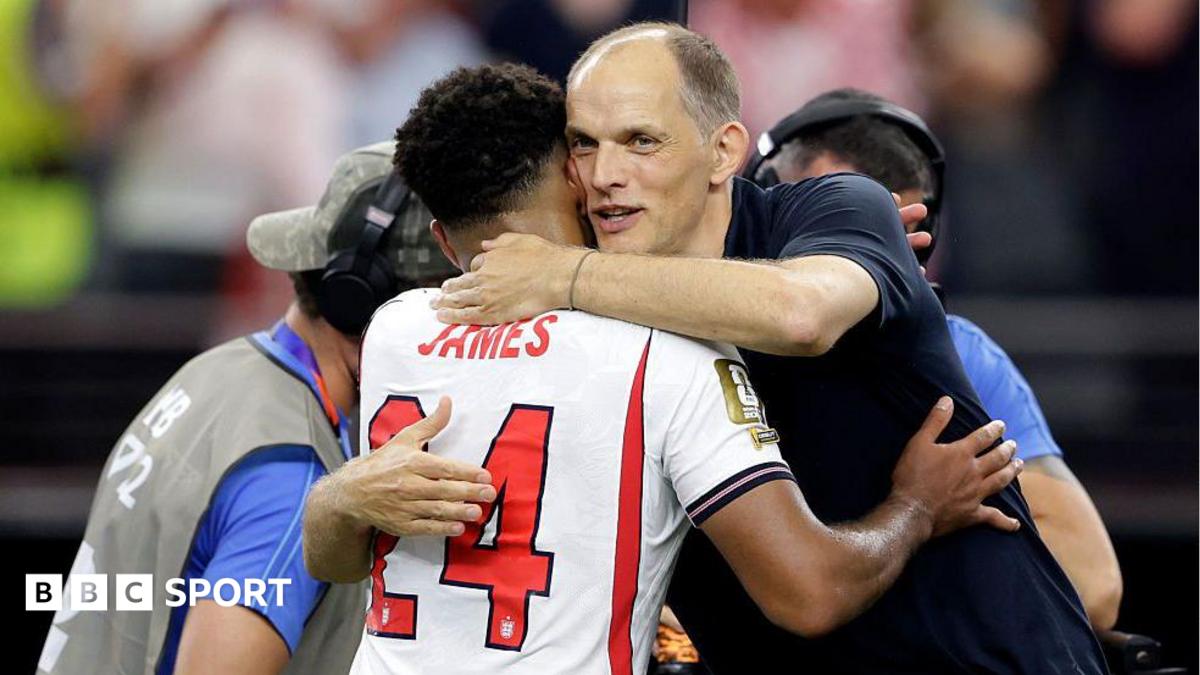
England manager Thomas Tuchel has defended his full-back selection policy after confirming Reece James will miss Saturday’s World Cup match against Panama.
As revealed by BBC Sport this week, James was assessed by England medics following Tuesday’s goalless draw against Ghana after complaining of a hamstring issue.
Tuchel has since confirmed that the Chelsea right-back has not travelled to New Jersey from their Kansas City base for their final Group L game against Panama on Saturday (22:00 BST). But he insists James has a chance of playing in England’s possible last-32 match next week.
However, BBC Sport understands that James is a significant doubt for the start of the knockout stages, should England qualify.
James’ injury – and the calf issue that caused Tino Livramento to return home from the United States – has thrown into question Tuchel’s decision to bring just three recognised full-backs to the World Cup.
Djed Spence, James and Livramento were the only genuine full-backs selected.
Nico O’Reilly, who played at left-back for Manchester City last season, is also in the squad – but he came through the ranks at Etihad Stadium as a midfielder. Dan Burn has also played at left-back but is recognised as a centre-back.
Spence and central defenders Jarell Quansah and Ezri Konsa are Tuchel’s alternative options at right-back.
Nevertheless, Tuchel said: “Yes, I am [happy with my options at right-back]. I selected the team, so I’m very happy with everything with the characteristic of the players and strengths that they give us.
“We would love to have every single key player, we would love to have them available, it’s not available – we find solutions, it’s what we do. It’s a tournament, we move on.”
James and Livramento, in particular, have a chequered injury history and Tuchel’s decision to take both to the World Cup is likely to be called into question.
Tuchel, though, is confident James will play again in the World Cup should England progress.
“It’s a minor hamstring issue, he’s not been able to train the last two days,” confirmed Tuchel.
“He’s now on an accelerated rehabilitation program and we take it game by game, but we strongly believe that he will be available [during the tournament].”
There was better news with regards to the availability of Bukayo Saka, Declan Rice and Elliot Anderson, who Tuchel said would all be available to face Panama.
Rice (calf) and Anderson (glute) missed training on Thursday – but returned on Friday.
Tuchel confirmed Saka is ready to start after coming off the bench in the opening two matches because of a long-term Achilles tendinitis complaint.
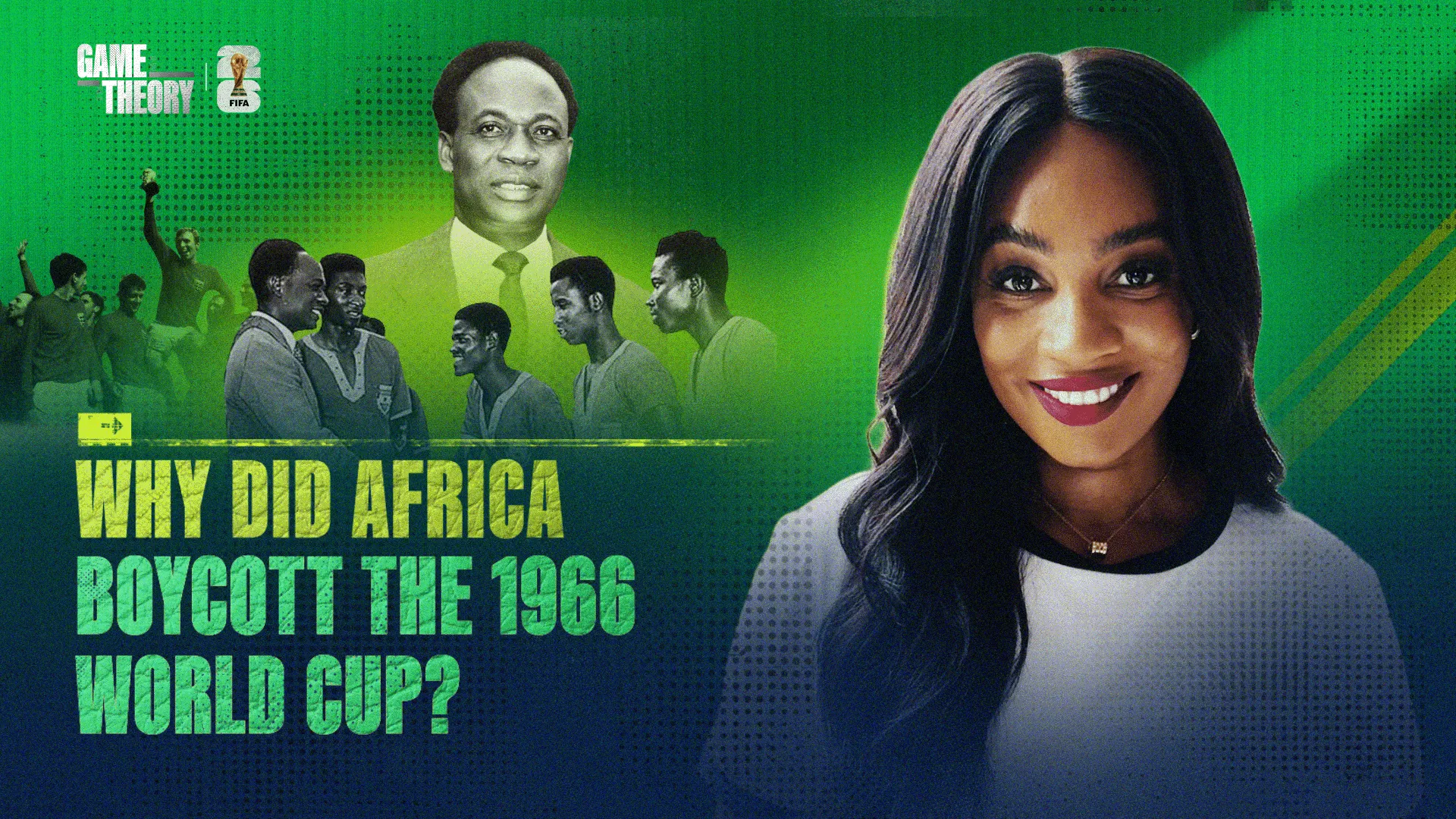
A record 10 African teams are competing at the 2026 World Cup. But 60 years ago, not one African nation played in the 1966 World Cup. Al Jazeera’s Samantha Johnson looks at the 1966 boycott that helped reshape the tournament for generations to come.
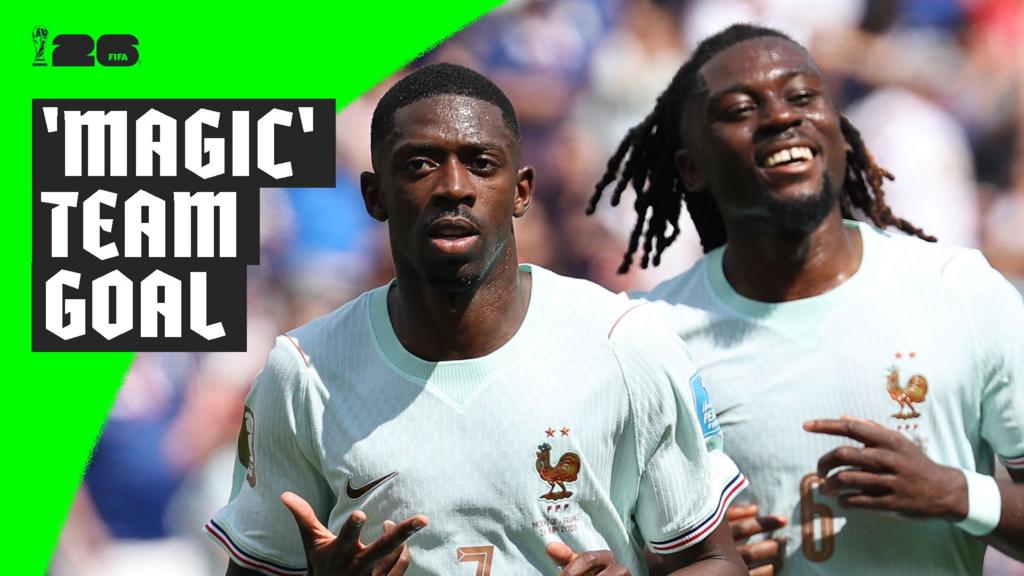
Every member of France’s starting XI gets involved as a 17-pass move is put away by Ousmane Dembele to seal his hat-trick in France’s 4-1 win over Norway in their final FIFA World Cup Group I match at Boston Stadium.
Through the first two games of this summer’s World Cup, the U.S. was about as perfect as a team could be. It won both games, never trailed, gave up just a goal and won its group handily, playing with a verve and confidence that erased all the doubts that had shadowed it coming in.
Then came Thursday.
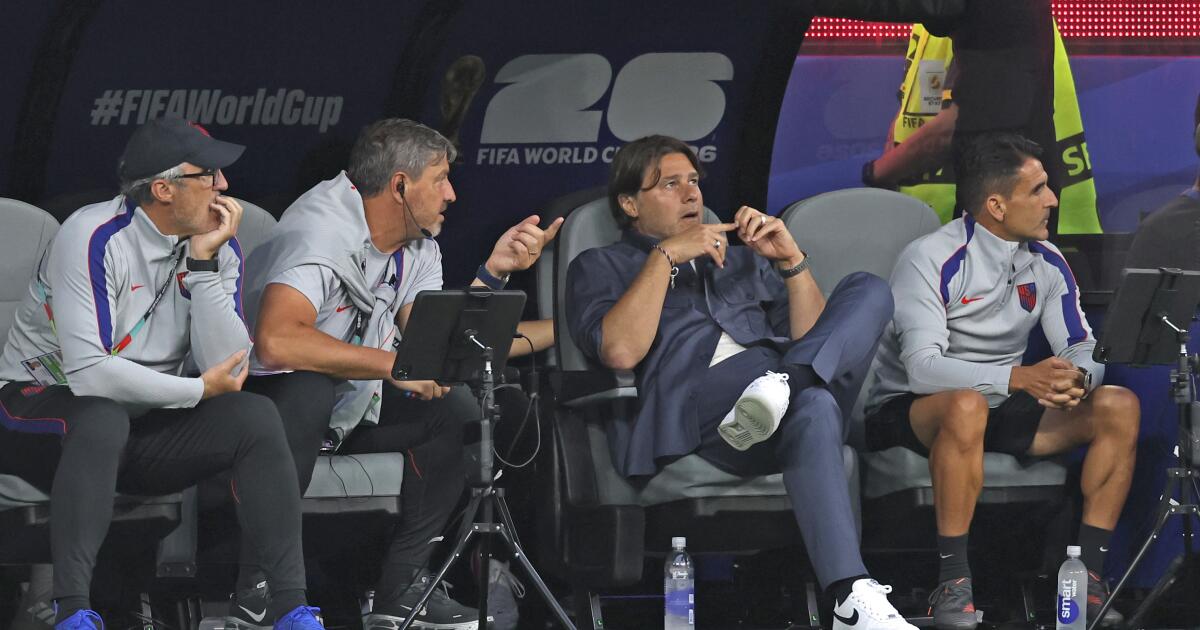
With Mauricio Pochettino making a record nine changes to a lineup that had given the U.S. its most successful start to a World Cup in 96 years, the B team that closed the group stage at SoFi Stadium with a 3-2 loss to Turkey served to remind everyone how flawed this group can be.
The backline was porous, goalie Matt Turner gave up goals on the first two shots he faced and with the exception of midfielder Sebastian Berhalter, who had a goal and an assist, none of the starters really distinguished themselves. Whether any of that matters won’t be known until the U.S. next takes the field in the knockout rounds, facing Bosnia and Herzegovina on Wednesday in Santa Clara, Calif.
For Pochettino, whose contempt for convention has been a hallmark of his team’s World Cup run, clearing his bench and getting a U.S.-record 23 players on the field in the group stage was more more important than the result.
“The objective was to finish first and we are first,” he said. “Now it is the next stage and it is going to be a final. And we are ready. We are much better than before that game because we had players now with 90 minutes in their legs and performing and ready to help if we need from the beginning or from the bench. It’s all positive.”
Maybe. Sure, Christian Pulisic, who hadn’t played since the first half of the first game, got back on the field and looked good in a 32-minute cameo. But other than that the game was meaningless since the Americans had already won the group and qualified for the next round while Turkey was going home no matter the result.
The U.S. came in riding a huge wave of momentum, though, and that’s gone now, erased on Kaan Ayhan’s goal on the last touch of the game.
Does that matter?
“No,” captain Tim Ream said with conviction. “You just turn the page.”
The experience the role players got, he said, is more important than the final score.
“When we say it didn’t mean anything, it’s still a meaningful game, right? It’s a World Cup game,” he said. “So it gives everybody a taste of what life will be like if they are called upon and have to contribute.”
Midfielder Tyler Adams wasn’t so sure.
“I don’t know what it’s going to do,” he said. “I can’t predict the future. I don’t have an eight ball in front of me. We’ll see what happens.”
What Adams can say with certainty, however, is that in the future the U.S. will have no room for error. The games are all elimination matches now and 13 players on the U.S. roster, including Adams, have experienced that first hand, having lost in the round of 16 four years ago in Qatar.
Turner said it’s up to those veterans to impart that wisdom on the 13 who are playing in their first World Cup.
“You need to really take care of the boxes when it comes to knockout round. That’s the biggest lesson that we learned,” said Turner, who started all four games in the last World Cup. “It’s not necessarily how beautiful a style you play. The chances you create is important, [but] the way you defend your box is more important.
“Those games are going to be decided by one goal, they’re going to be narrow, and we’re going to have to be compact and be together, defensively, offensively, and take the chances when they come.”
The U.S. did little of that Thursday.
After a Berhalter corner set up Trusty for the first goal in the third minute, Turkey’s Arda Guler, a Real Madrid midfielder, tied the score seven minutes later, splitting a pair of U.S. defenders and running onto a pass from Kenan Yildiz in the center of the box, then lifting a shot over Turner.
Orkun Kokcu handed the U.S. its first deficit of the tournament when he found another big hole in the U.S. defense, redirecting a cross from Eren Elmali in from the center of the box to give Turkey a 2-1 lead.
Berhalter tied the score again four minutes into the second half, latching onto a loose ball at the top of the penalty area and one-hopping a right-footed shot just inside the near post. The game stayed that way until Ayhan, who came on with two minutes left in regulation, slid between two U.S. defenders to knock in the game-winner eight minutes into stoppage time.
For Berhalter, one of a record 21 Americans to get a start in this World Cup, Pochettino’s decision to clear his bench was not only a reward, it was preparation for what’s to come.
“It’s every little kid’s dream, across the United States of America, to play in a home World Cup. Just in a World Cup in general,” he said. “People made their debuts today, so congratulations everyone. This is what everybody looks forward to.”
More important, he added, “we know everyone’s ready to step up at any moment.”
Which is good because history suggests the road ahead is about the get a lot more challenging. The loss to Turkey was the Americans’ 10th straight to a UEFA team, running their winless streak against European opponents to 13 in a row.
Guess which continent Bosnia and Herzegovina, who the U.S. faces next, is from?
Sports editor Iliana Limón Romero contributed to this story.
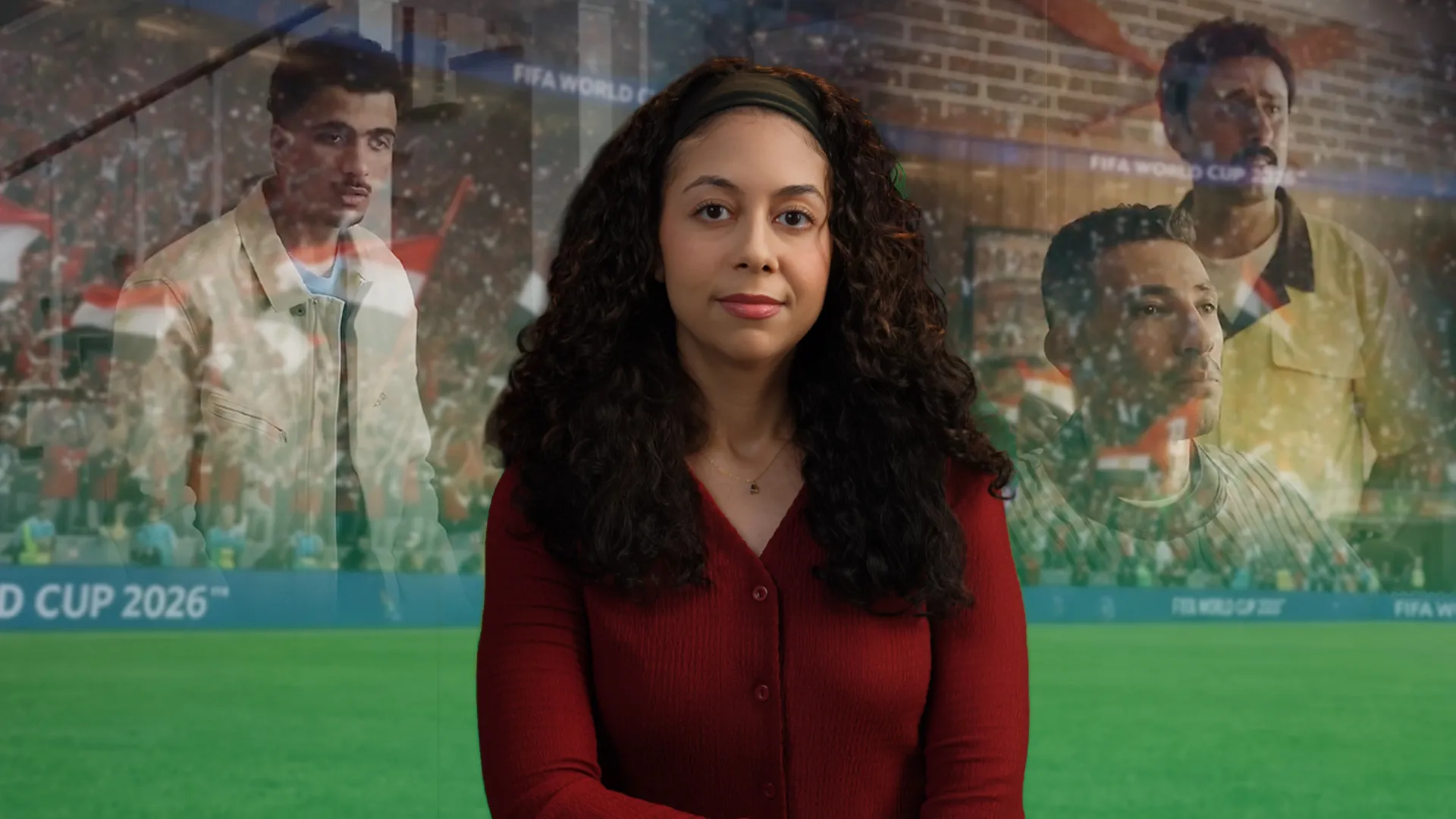
A viral World Cup campaign tapped into a familiar conversation among Egyptian football fans, prompting debate over hope, expectation and decades of World Cup disappointment. Al Jazeera’s Yasmeen ElTahan explains.
The advertisements all start the same way. It could be a barber, an aunt or a family member in discussion with others about the FIFA World Cup, but in each case, they assume Egypt will be heading home after the group stage.
Then an Egyptian footballer pushes back: “To all the doubters, this time we’re staying longer.”
It’s a line that’s resonating like never before in the nation of 120 million people, as Egyptian football fans wait with bated breath for the final round of group stage matches that could send The Pharaohs, as the national team are known, into uncharted territory: the knockout stages.
Here’s why these commercials have captured the zeitgeist in Egypt:
Egypt’s poor World Cup track record
Egypt was the first African and Arab nation ever to play in a World Cup, back in 1934. It has won the Africa Cup of Nations a record seven times. Football in Egypt isn’t just a sport, it’s a national identity, and The Pharaohs have long been a source of genuine pride and belief.
But the World Cup has always told a different story. Before this tournament, Egypt had qualified just three times — in 1934, 1990 and 2018.
It had never won a single match. Fans still carry the painful memories of a penalty shootout loss to Senegal that kept Egypt out of the Qatar World Cup 2022 entirely.
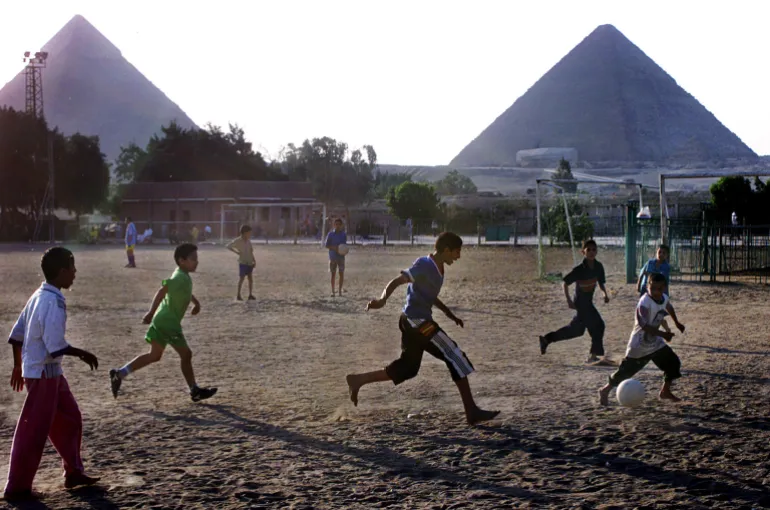
Egyptian children play football in front of the Giza Pyramids in Giza, on Friday, May 17, 2002 [Amr Nabil/ AP Photo]
What’s different this time?
Everything — at least, so it seems.
After two games at the World Cup, Egypt sits at the top of Group G, above Iran, Belgium and New Zealand.
The 26th ranked Egypt drew 1-1 with Belgium — ranked 10 in the world — in its first match. Then, it beat lower-ranked New Zealand 3-1.
Its four points are the most Egypt has ever earned at a World Cup. Its four goals are the most Egypt has ever scored at a World Cup.
Now, on Friday night in Seattle — early Saturday morning in Egypt — the team faces Iran in their final group game. A win or a draw would guarantee that Egypt’s national team goes into the knockout stages for the first time.
If Egypt loses to Iran, they might still make it to the round of 32, but their fate will depend on what happens in the Belgium-New Zealand match that will be held at the same time, and potentially, on the outcomes of matches in other groups. Eight of the 12 teams places third in their groups will also move into the next round.
So in a nutshell, Egypt is on the cusp of going where it never has before — and only a rare set of permutations can deny it that chance.
Hossam Hassan, now the Egyptian coach, seen here manoeuvring the ball during a friendly international match against Zambia in Cairo January 9, 2001 [Reuters]
But it isn’t just the performances. Part of what makes this year feel different, to many fans, is the identity of the main man standing outside the pitch, next to the Egyptian dugout.
Hossam Hassan is Egypt’s all-time top scorer and one of the most iconic figures in the country’s football history. In 1990, he scored the goal that ended a 56-year wait and sent Egypt to the World Cup in Italy. Now, more than three decades later, he is the national team’s coach, making him the first Egyptian ever to reach the World Cup as both player and manager.
For older fans, his presence carries the memory of a time when Egypt genuinely believed it could make its mark on the world stage.
Mohamed Salah scored during the second half against New Zealand in the 2026 FIFA World Cup in Vancouver on June 21, 2026, as Egypt registered its first-ever win at the tournament [Anne-Marie Sorvin /Reuters]
So what are the advertisements really about?
They aren’t really making fun of the team. They’re making fun of the deeply ingrained expectation that Egypt won’t go very far. And that expectation, many argue, goes beyond football. Years of economic hardship and political uncertainty have made expecting the worst feel like common sense for many Egyptians. They protect themselves from disappointment. They assume it won’t work out before it doesn’t.
That’s what has also made the campaigns somewhat divisive. For some viewers, the humour felt honest — a reflection of a habit fans know they have. It prompted real questions about why low expectations have become so normal. Others argued the advertisements risked making those same low expectations feel permanent, even acceptable.
Either way, they underscore how the 2026 World Cup has reignited faith among Egyptian fans, as they wait for the Iran match. An advertisement campaign challenging doubters has come to reflect the broader hopes, doubts and debates surrounding The Pharaohs.
United States president Donald Trump was expected by many to regularly feature at the World Cup.
But he is yet to attend a single match, despite the United States team winning two of their three group games, and qualifying for the knockout stages.
So is it a surprise? Why may he have stayed away? And will he appear before the final? BBC Sport takes a closer look.
“My fellow Americans, citizens of the world, the United States is honoured to play host to this magnificent celebration. The World Cup has captured the imagination of our country, as has the game itself in the last few years…So I welcome all who have come from all countries and all continents and all who will watch these games in the United States for the next 30 days.”
The words of president Bill Clinton on 17 June, 1994 at Soldier Field in Chicago when attending the opening match of the first World Cup to be held in the United States.
The day is remembered more for Diana Ross’ missed ‘penalty-kick’ during the pre-match festivities than Clinton’s address, but his presence now seems more notable.
Because 32 years on, the country is once again staging the event, and yet, with the halfway point of the tournament passed, the current president has stayed away.
Earlier this month, Trump hailed the number of tickets sold by Fifa, labelling it “the most successful World Cup they’ve ever had”, and reinforcing the widely-held view that he would be a highly visible and enthusiastic presence.
After all, in the build-up, the tournament had seemed very important to him. He even referenced it, external in an address at a rally staged on the eve of his presidential inauguration early last year.
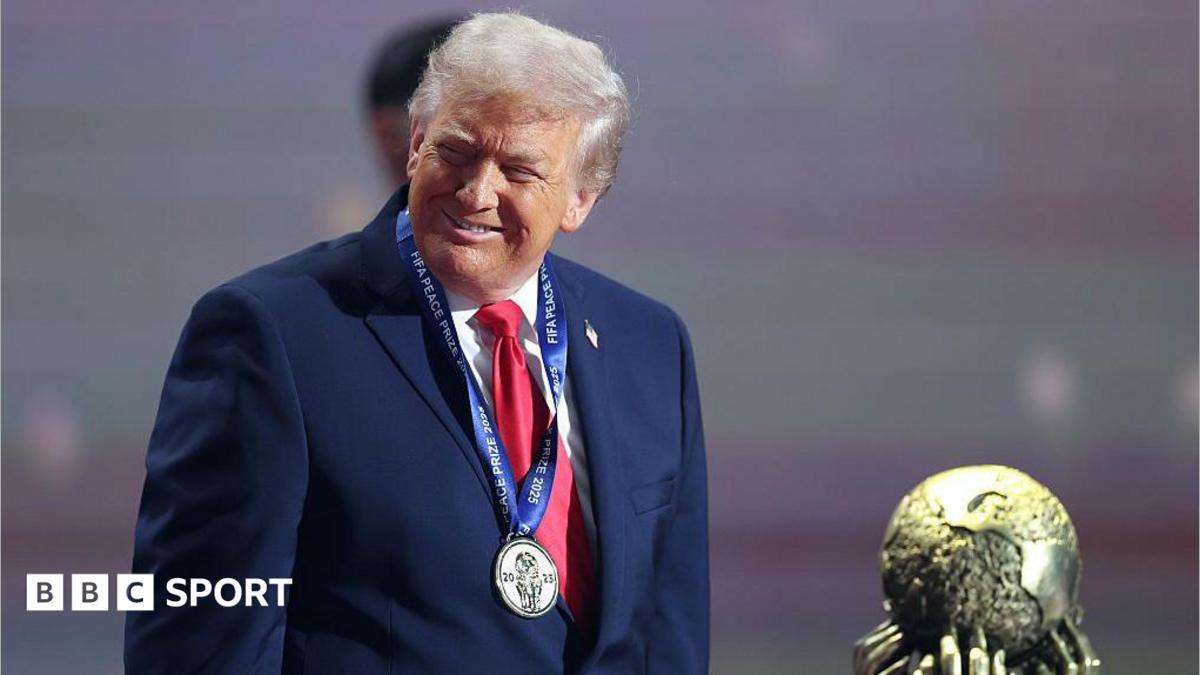
And Trump then played a central role at the draw in Washington DC in December, where he was awarded Fifa’s inaugural ‘Peace Prize’ by the governing body’s president Gianni Infantino.
The two men have forged a close relationship in recent years, with Infantino welcomed to both the Oval Office and Trump’s Florida residence Mar-a-Lago.
Trump has also been a regular presence at several other major sports events in the US during his second term, from the Super Bowl, and last summer’s Club World Cup final, to the opening day of golf’s Ryder Cup at Bethpage.
However, when co-hosts the US played their opening match v Paraguay on 12 June in Los Angeles, following on from an opening ceremony, the president was notable by his absence, with secretary of state Mark Rubio travelling from Washington instead.
It appeared that Trump had prioritised an Ultimate Fighting Championship (UFC) event on the White House lawn two days later, celebrating his 80th and America’s 250th birthday.
At a fan zone, we met Egyptian fans cheering on Mexico days before their team takes on Iran. For them gay pride was irrelevant.
“Right now it’s about two teams trying to get to the next round,” Makarius Demian told us, adding that he supports gay rights. “Pride match or no Pride match, that’s not what matters.”
Not far from the big screen, an Egyptian restaurant pop-up is getting ready for the match – and for fans craving a taste of home. ‘Koshari’ is a staple Egyptian dish; a mix of lentils, chickpeas, pasta, fried onions and garlic tomato sauce.
Owners Ayman Almasri and Amani Abouammo shut their restaurant Koshari for the duration of the World Cup to open a pop-up version at the fan zone where they were serving up the vegan Egyptian street food.
They say having Egypt and Iran play in a Pride match is awkward and rooted in cultural misunderstanding.
“Here it is the culture. People are used to that,” Abouammo said. “Back home, people are not used to it. It’s this piece of confusion that each party cannot understand the other party.”
On the pitch, there is plenty at stake. Egypt come into this match with momentum after beating New Zealand, and with a real chance of winning Group G.
Iran, meanwhile, arrive in a very different mood – their tournament already shaped by politics, travel restrictions and complaints about preparation time, even if they have been allowed to get to the host city earlier than in previous matches.
As Egypt and Iran try to edge closer to the knockout stages, this match is about more than what happens on the pitch.
It is also a glimpse of what happens when a World Cup lands in a city celebrating one set of values, while two of the teams taking part arrive carrying very different ones of their own.
Expanding the World Cup to 48 teams always presented one obvious problem – it was an imperfect number for a tournament.
With 32 teams, the maths was simple – eight groups of four teams, with the top two going through to a last 16, then quarter-finals, semi-finals and a final.
By adding another 16 nations, Fifa had to find a way to get to a symmetrical knockout stage. There was no ideal solution – one which preserved the intensity of the previous format.
The original plan was to create 16 groups of three teams. The two top in each would go through to the last 16.
But there was an issue. Three-team groups meant individual fixtures – and those in the final match would know exactly what they needed to do to qualify. Nations could play for specific results to secure their passage to the knockout rounds.
Fifa, after all, knew all about alleged collusion from the scandal at the 1982 World Cup. Back then, with groups of four, teams did not play their final group matches at the same time.
West Germany faced Austria in the standalone last game. A slender win for the Germans would send both teams through at the expense of Algeria. The match finished 1-0 to West Germany. Algeria went out.
Fifa changed the format so all final fixtures would be played simultaneously, but that would not have been possible with three-team groups.
The climax to the group stage in Qatar was so exciting that Fifa had a rethink. It accepted there must be 12 four-team groups and two matches would be played at the same time to determine who would qualify.
Except for one crucial difference – something that removed much of the jeopardy that made the last World Cup so gripping.
Eight of the third-placed teams must go through for there to be 32 teams in the knockout rounds. It became harder to be knocked out than to progress.
And one issue becomes clear with two matches this week.
First up, Australia played Paraguay on Thursday. The teams were second and third in Group D and both on three points.
Four points is almost certain to be enough to take one of the eight third-placed qualifying slots, so it created a situation in which the teams knew that a draw was helpful to both.
Australia are definitely through in second place and celebrated with their supporters at the final whistle. Paraguay played it low key but, barring a very unlikely set of results in the remaining groups, they will go through too.
The next game of interest in this respect is Austria v Algeria in Group J (03:00 BST Sunday).
Again, the two teams are second and third on three points. A point is very likely to send both teams through, while defeat is much more likely to send one home.
Will we see another draw?
After being impacted negatively in 1982, Algeria could be the beneficiaries in 2026.
You could argue a game in Group F on Thursday fell into the same category, with Japan starting the match on four points and Sweden on three.
That match also finished 1-1 to guarantee the Scandinavians would progress, but there was no real risk involved for Japan if they have lost.
It is the same in Group L, too, with Ghana on four points and Croatia on three.
The rules are simple. Each day there’s a new footballer and the challenge is to guess who they are in as few attempts as possible.
After each wrong guess you unlock a new clue. Guess the answer after as few clues as possible to score more points.
Three is a good score, four or five points is exceptional.
So take part and return for more tomorrow.
Missed yesterday’s quiz? Go back and try your luck here.
Today’s player and clues set by BBC Sport’s Joe Rindl.
After more quizzes? Go to our dedicated Football Quizzes and Sports Quizzes pages and sign up for notifications to get the latest quizzes sent straight to your device.
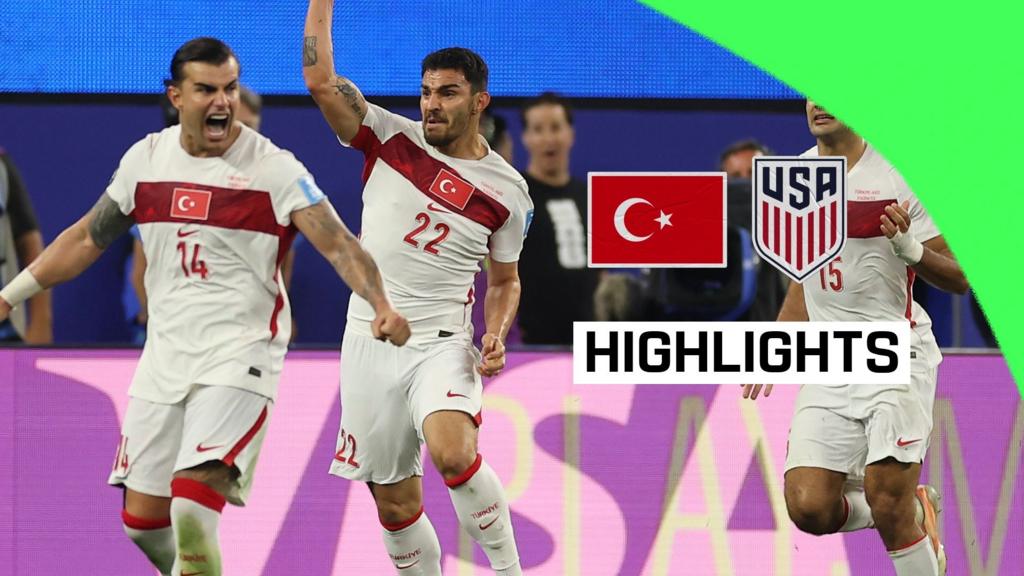
Turkey come out on top in the last minute of an end-to-end 3-2 win over a second string USA side, in their final Group D match at SoFi Stadium in Los Angeles.