SCOTT Mills was first investigated over sex offences against a teenage boy seven years ago – but only now the BBC has acted.
In a sensational move the BBC pulled Mills off air last Tuesday – with it emerging days later that the axing was linked to a complaint about the 2018 probe into the 53-year-old.
Sign up for the Showbiz newsletter
Thank you!
Officials kept Mills on air for seven years before suddenly dismissing him on MondayCredit: Shutterstock EditorialIn March that year The Sun on Sunday revealed how an investigation was being carried out into an unnamed radio presenter
Mills was questioned over allegations of “serious sexual offences” against a boy who police confirmed was under 16 at the time of the allegations.
The case – said to have taken place between 1997 and 2000 – was later dropped in full due to a lack of evidence.
Officials decided to keep Mills on air for seven years after he informed them of the investigation before suddenly dismissing him on Monday.
It was only after a complaint was made regarding the police probe that Beeb bosses gave Mills the boot.
Mills’ £360,000 a year contract was terminated within five days of the complaint being made.
But the BBC has since apologised for not taking action on an allegation against Scott Mills raised last year. So, as the scandal unfolds, here is what was known and when.
1997 – 2000
The alleged “serious sexual offences” against a boy under 16 take place with Scott Mills joining the BBC in 1988.
Mills initially joined the corporation as a presenter on BBC Radio 1, presenting the early morning slot before earning his own namesake programme The Scott Mills Show.
December 2016
The Metropolitan Police launch a probe into allegations regarding Scott Mills.
The investigation, which related to allegations of serious sexual offences, followed a referral from another police force.
The former Radio 2 host was probed over serious sexual offencesCredit: PA
July 2018
Mills is questioned by police under caution about historical sexual offences against a teenage boy.
The former BBC Radio 2 star told the corporation about the investigation and denied the allegations.
May 2019
After it was decided there wasn’t enough evidence to bring charges against Mills the investigation is closed.
BBC bosses were tonight urged to say why they kept Scott Mills on air while he was probed for sex offences with a boy under 16, only to fire him seven years later.
The Beeb also remain tight-lipped over what changed since their original decision not to act — knowing the star, 53, had been quizzed under caution between 2018 and 2019.
Sign up for the Showbiz newsletter
Thank you!
BBC bosses have been urged to explain why they kept Scott Mills on air while he was probed for sex offencesCredit: Darren FletcherAllegations are reported to relate to events between 1997 and 2000, when Mills was in his 20sCredit: BBC
The allegations are reported to relate to events between 1997 and 2000, when Mills was in his 20s.
Broadcasters and MPs demanded answers over the latest of multiple scandals to rock the corporation in recent years.
TV presenter Piers Morgan said: “I don’t understand. He was investigated by police 10yrs ago over alleged offences 25+ years ago, but no action was taken and case was closed.
“Now he gets instantly fired over same thing? The BBC needs to explain why, surely?”
Insiders have claimed the BBC moved swiftly over Mills following criticism they were slow to act over shamed newsreader Huw Edwards.
Discussing the cases yesterday Radio 2 host Jeremy Vine said: “There is a thought here they decided to treat Scott how they wish they’d treated Huw. Which would be a bit unfair would it not?
“Regarding the inconsistency here, we were told Huw Edwards couldn’t be sacked because he was in a fragile mental state, everything I have read about Scott’s history today goes back to his own anxiety and depression and everything else but there doesn’t seem to be the same break cut for him.”
Tory Shadow Crime Minister Matt Vickers told The Sun: “This pattern of failure by the BBC is letting the public down whilst the institution continues to protect its own reputation over addressing serious internal concerns.
“Time and again, the public are asked to place their trust in an institution that too often seems unwilling to come clean when it matters most.
Mills was sacked as the £360,000-a-year host of Radio 2’s Breakfast ShowCredit: BBCAllegations about Mills were first reported to police in 2012Credit: PAMills is understood not to have spoken to colleagues or pals since being axedCredit: PA:Press Association
“For a broadcaster funded by the public and serving audiences of all ages, any failure to act on safeguarding concerns is unacceptable.”
Mills joined Radio 1 in 1998. Allegations about him were first reported to Hampshire Police by a third party in 2012.
The force logged the details and later passed on information to the Met’s Operation Winter Key.
In December 2016 Winter Key cops launched an investigation.
At that time, Mills was the Drivetime DJ for Radio 1 and hosted the Official Chart Show, which has a target age range of 15-plus.
Mills was interviewed under caution in July 2018 and denied the claims against him.
In March that year The Sun on Sunday revealed how an investigation was being carried out into an unnamed radio presenter.
A file was submitted to the Crown Prosecution Service, which ruled there was insufficient evidence to charge. The investigation was then closed in May 2019.
BBC bosses, including Ben Cooper, the then-controller of Radio 1 and 1Xtra, chose not to take Mills off air despite the investigation.
“Scott said he denied the allegations that had been made against him. Ben stood by Scott and allowed him to continue working while the police investigated.
“Given how serious the complaint was, it raises questions about why the BBC decided to keep him on air on Radio 1 — whose target audience is teenagers — rather than removing him while the police continued the investigation.”
The BBC have now removed Mills from a Race Across The World podcast and pulled scenes he filmed for EastEndersCredit: PAScott Mills joined Radio 1 in 1998Credit: PA
Mr Cooper left his position as the controller of Radio 1 in 2020 after nine years.
Yesterday the Met issued a new statement and confirmed: “In December 2016, the Met began an investigation following a referral from another police force.
“The investigation related to allegations of serious sexual offences against a teenage boy. These were reported to have taken place between 1997 and 2000.
“As part of these enquiries, a man who was in his 40s at the time of the interview, was questioned by police under caution in July 2018.
“A full file of evidence was submitted to the Crown Prosecution Service, who determined the evidential threshold had not been met to bring charges.
“Following this advice, the investigation was closed in May 2019.”
A source said: “The BBC’s second probe into this saw them speaking to Scott, as well as individuals with knowledge of Scott’s dealings with the police in 2018.
“Whatever they discovered this time around clearly was treated more seriously, or given more credence than when it was first discussed with Scott in 2018, as this time they decided to sack him.”
The Sun revealed Huw Edwards paid a teenager thousands of pounds for explicit imagesCredit: PA
KEY MOMENTS IN COPS’ INVESTIGATION
1997-2000:
The alleged incidents take place, with Mills joining BBC Radio 1 in 1998.
DECEMBER 2016:
The Metropolitan Police start looking into claims regarding Mills.
JULY 2018:
Mills is questioned under caution by police about historical serious sexual offences against a teenage boy.
He tells the BBC about the investigation and denies the allegation.
MAY 2019:
The investigation ends as the CPS decide there is not enough evidence to charge.
OCTOBER 2022:
He joins BBC Radio 2, taking over the afternoon slot from Steve Wright.
JANUARY 2025:
Mills takes over as new Radio 2 Breakfast Show host after Zoe Ball stepped down — calling the role his “dream job”.
MARCH 24 2026:
He signs off “See you tomorrow,” in his slot only to be taken off air the following day.
MARCH 25 2026:
An investigation begins at BBC into the 2016 complaint.
MARCH 30 2026:
The BBC announce Mills is sacked and no longer works for the BBC.
MARCH 31 2026:
Metropolitan Police confirm the boy at the centre of the investigation was under 16 at time of the alleged offences.
APRIL 1 2026:
Insiders tell The Sun the BBC was aware of the investigation in 2018 after Mills told them about it and denied the allegations.
Insiders at the BBC also pointed to Channel 5’s documentary, Power: The Downfall of Huw Edwards, as a possible reason for the complainant to contact the BBC.
It came after The Sun revealed Edwards paid a teenager thousands of pounds for explicit images.
The source added: “With the timing of the Huw film it makes sense why the person at the centre of the original (Mills) complaint may have decided to speak to the BBC again.
“Many in the BBC are saying the timing doesn’t feel like a coincidence.
“The drama showed actions do have consequences.” Separately, The Telegraph reported former BBC presenter Anna Brees contacted the Beeb in May 2025 to say she had received information about alleged “inappropriate communications” involving Mills.
She also asked whether the BBC had ever received any “formal or informal complaints” about Mills “relating to safeguarding, inappropriate conduct or harassment” and whether it had ever conducted an internal investigation into him.
She did not receive a response. The BBC admitted her information “should have been followed up and we should have asked further questions”.
There is no suggestion the inquiries by Ms Brees related to the same alleged victim whose complaint to the police led to Mills being questioned in 2018.
BBC bosses were left with “no choice” but to sack Mills after being passed compelling new information, it was claimed last night.
The Mirror reported the fresh details are different to the claims probed by police in 2016 but relate to the same complainant.
Yesterday charity Neuroblastoma UK dropped him as a patron. Dermot O’Leary who hosts the Saturday morning Breakfast Show, said yesterday: “This was a shock to everyone. It came from nowhere.”
Insiders said the BBC were now discussing who would take over the Breakfast Show – which in the latest round of Rajar figures in February revealed Mills had 6.5million listeners.
ATLANTA — Over the past three decades, the collection of DNA from convicted criminals has become standard in the U.S. justice system, and many states now also swab people arrested for serious crimes.
Legislation awaiting a final vote in Georgia would take that a step further by collecting DNA from people charged with less serious misdemeanors — but only if federal immigration authorities want them detained. That could include immigrants not ultimately deported.
If enacted, Georgia’s measure would make it the third state to single out immigrants believed to be in the U.S. illegally for the collection of genetic material that wouldn’t be taken from others. Florida passed a similar law in 2023. And Oklahoma in 2009 authorized DNA collection from immigrants in the U.S. illegally, though it remains subject to funding.
The new legislation comes as President Trump’s administration seeks to expand its use of DNA and biometrics in immigration enforcement as it carries out a plan to deport millions of people from the U.S.
“It is one example of something we are seeing across the landscape, which is government actors at all levels vacuuming up DNA in all available contexts,” said Stevie Glaberson, director of research and advocacy at the Center on Privacy and Technology at Georgetown University law school.
Immigrant DNA collection has grown in recent years
The FBI launched the National DNA Index System in 1998 to compile DNA samples submitted by federal, state and local authorities. It’s grown in size and scope and now contains more than 26 million DNA profiles, many from people convicted of crimes.
A federal law enacted 20 years ago allowed the attorney general to expand DNA collection to people arrested and to noncitizens detained under federal authority. But because of exceptions authorized by federal officials, few immigrants had their DNA collected.
That changed in 2020, during Trump’s first term, when a new Department of Justice rule took away much of that discretion. Over the next five years, the Department of Homeland Security added the DNA profiles of more than 2.6 million detainees to the national database, according to an analysis by the Center on Privacy and Technology.
The department did not answer questions from the Associated Press about the percentage of detained immigrants whose DNA has been collected during Trump’s second term.
But the department is looking to expand its authority. A proposed rule would allow it to collect DNA, including from U.S. citizens, to determine family relationships in immigrant benefit cases.
States don’t typically collect DNA for misdemeanor arrests
Though many states collect DNA from people arrested for felonies, just 10 states collect it from people arrested for certain misdemeanors, such as sex offenses, and none collect it for all misdemeanor arrests, according to an AP analysis of data compiled by the Boise State University Department of Criminal Justice.
But under the Florida and Oklahoma laws, any arrest could lead to DNA collection for immigrants subject to federal detainer requests. Officials in the Florida Department of Law Enforcement and Oklahoma State Bureau of Investigation did not respond to questions about whether those laws are being used.
The Georgia legislation would require DNA collection from immigrants facing any misdemeanor or felony charges if U.S. Immigration and Customs Enforcement has issued a detainer request but has not picked up the person within 48 hours.
Georgia state Sen. Tim Bearden, a Republican sponsoring the bill, described the measure as a means of solving crimes.
“Technology is changing quickly, and DNA is one of those things that help us tremendously when we’re trying to make sure to bring justice to victims in this state and across this country,” Bearden said at a March hearing.
The Department of Homeland Security said in a statement that “partnerships with law enforcement are critical to having the resources we need to arrest criminal illegal aliens across the country.”
Could a broken tail light lead to a DNA swab?
A 2024 Georgia law mandates that local law enforcement cooperate with federal authorities to identify and detain immigrants in the U.S. illegally, or else lose state funding. This year’s legislation would build upon that.
Some legal experts say it could result in DNA collections from immigrants taken into custody for minor violations. Traffic offenses that are penalized as civil violations in some states are considered misdemeanors in Georgia, making them subject to the new law, said Mazie Lynn Guertin, executive director and policy advocate with the Georgia Assn. of Criminal Defense Lawyers.
“We don’t think that swabbing a person who’s committed a traffic violation is a boon for public safety,” Guertin said. “The correlation between a broken tail light and a crime that’s solvable with DNA is pretty attenuated in most cases.”
People subject to federal immigration detainer requests aren’t necessarily undocumented or deportable, because they may later prove their legal presence, said Kyle Gomez-Leineweber, director of policy for Common Cause Georgia. But such people could have their DNA collected under the Georgia legislation.
“What this really does is it creates a two-tiered system where some of the DNA would be collected based off of the perception of an individual’s immigration status,” said Gomez-Leineweber.
Legal experts raise questions about constitutional rights
The U.S. Supreme Court in 2013 upheld a Maryland law allowing DNA to be collected from people charged — but not yet convicted — of certain serious crimes. That law allows DNA to be added to a database after it’s determined there is probable cause to detain someone, provided it’s deleted if the person is not ultimately convicted.
The Maryland case often is cited as justification for an expansion of DNA collection. But some immigrant advocates question whether civil immigration detainers meet the probable cause threshold to make DNA collection acceptable under the U.S. Constitution’s Fourth Amendment protection against unreasonable searches and seizures.
“There doesn’t appear to be any kind of meaningful justification for states to step in to require the collection of DNA — of genetic material — from noncitizens in their custody who have merely been accused of a crime, even a low-level crime,” said Jorge Loweree, managing director of the American Immigration Council. “It seems like this is just an effort to increase the surveillance of noncitizens.”
Kramon and Lieb write for the Associated Press. Lieb reported from Jefferson City, Mo.
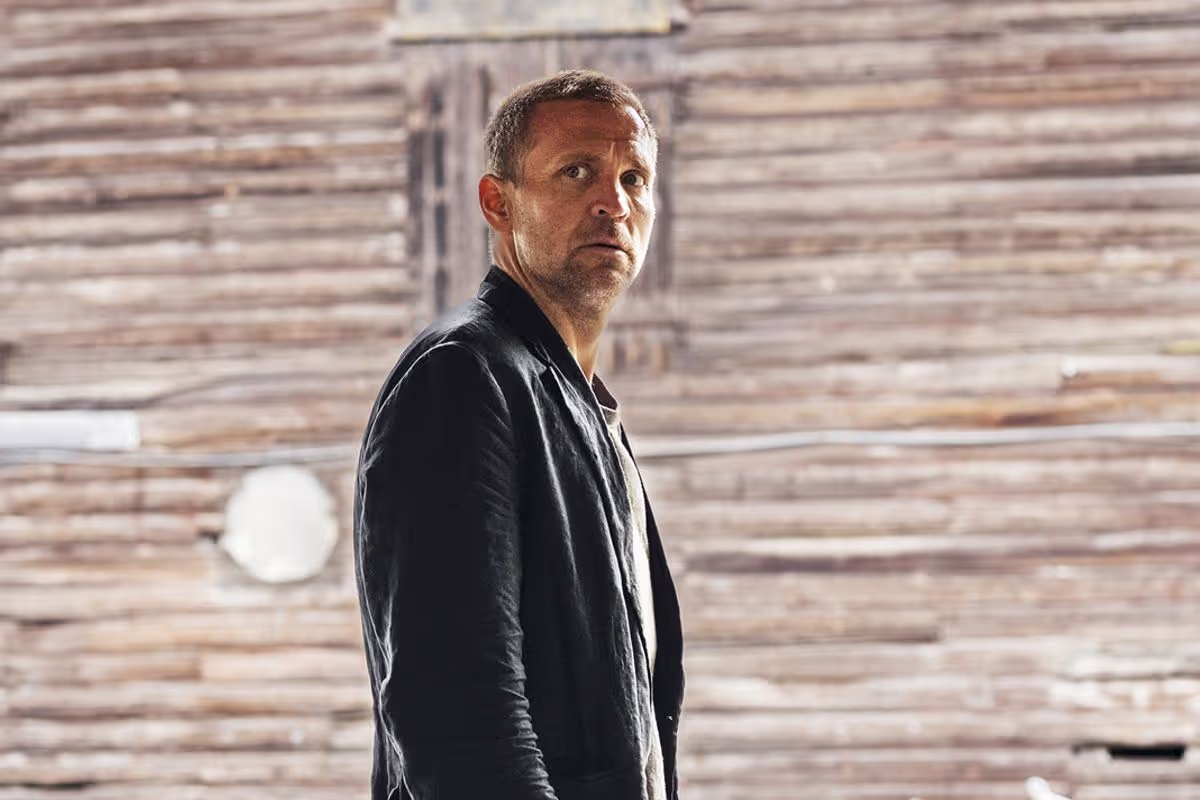
The series, which arrived on Netflix on March 26, focuses on a troubled Oslo police detective (portrayed by Tobias Santelmann), who must grapple with both a horrific serial killer and his corrupt colleague.
“Created by one of the greatest storytellers in crime fiction, Jo Nesbø’s Detective Hole is a whodunnit serial killer mystery led by famed anti-hero Harry Hole,” the official synopsis teases.
“Underneath the surface, this series is a nuanced character drama about two police officers – and supposed colleagues – operating on opposite sides of the law. Throughout the season, Harry goes head-to-head with his long-time adversary and corrupt detective Tom Waaler,” reports the Express.
The description concludes: “Harry is a brilliant but tormented homicide detective who struggles with his demons. As the two navigate the blurred ethical lines of the criminal justice system, Harry must do all he can to catch a serial killer and bring Waaler to justice before it is too late.”
Joel Kinnaman portrays Tom, alongside Tobias Santelmann as Harry. Pia Tjelta, Peter Stormare, Anders Baasmo Christiansen, Ellen Helinder, Simon J. Berger, and Ingrid Bolsø Berdal also star.
Jo Nesbø has a devoted following, with his novels selling 60 million copies globally, including 5.6 million in Norway – exceeding the nation’s total population. It appears the series has proved to be just as successful as the books, with Detective Hole climbing the Netflix UK rankings just one week after arriving on the streaming service. It currently sits as the fifth most-watched TV programme, and presently maintains a 90% score on review aggregator Rotten Tomatoes.
Critics have lavished praise upon the series, with Collider stating: “A roundhouse-kick of a thrill ride that lives up to the promises baked into the thriller subgenre’s name, Jo Nesbø’s Detective Hole delivers virtually everywhere it should – which is nothing less than what a modern legend deserves.”
FandomWire contributed: “Stylish, gritty, and suspenseful, Jo Nesbø’s Detective Hole is a knockout and Nordic noir done right,” while The Times remarked: “So much plot, so much incident, plus heatwaves, tropical thunder and sweat. As rides go, it’s certainly rollicking.”
Fans have also expressed their enthusiasm, with many devouring all nine episodes in one go. One individual posted on IMDb: “Excellent adaptation of Jo Nesbø’s The Devil’s Star. As an avid reader of the books, I found this to be absolutely spot on with its recreation and casting of the Harry Hole universe. So atmospheric, capturing the style and tone of Jo Nesbø’s writing. Excellent acting and riveting storyline, this was an easy binge. I sincerely hope there will be more seasons as there is a wealth of material to tap into.”
Another chimed in: “A gripping Norwegian masterpiece that stays with you. Just finished bingeing the new Norwegian Netflix series Jo Nesbø’s Detective Hole (based on the Harry Hole novels), and wow – what an intense, atmospheric ride… By the finale, I was emotionally drained in the best way.”
They went on to say: “If you love smart, character-driven crime dramas with heart and moral weight (think The Killing or The Bridge but with Jo Nesbø’s signature edge), drop everything and watch Jo Nesbø’s Detective Hole. It’s binge-worthy perfection. 10/10 from this amateur reviewer – easily one of the best new international series I’ve seen in a while.”
A third viewer described the series as “absolute perfection,” while a fourth fan likewise commented: “Detective Hole is a gripping, unforgettable series that captures the raw brilliance and dark originality of Jo Nesbø. With its intense atmosphere and a deeply flawed yet magnetic protagonist, it pulls you straight into a world where crime, emotion, and truth collide.”
Jo Nesbø’s Detective Hole is available to stream on Netflix
COMIC Russell Brand’s rape trial has been delayed by four months and is expected to last eight weeks — up from five — due to “numerous” and expanded charges.
The screen star, 50, faces three counts of rape, three of sexual assault and one indecent assault against six women from 1999 to 2009.
Sign up for the Showbiz newsletter
Thank you!
Russell Brand’s rape trial has been delayed by four monthsCredit: PA
Brand — who denies all the charges in full — was facing trial at Southwark crown court on June 12.
But Mr Justice Joel Bennathan KC put it back until October 12.
He noted an eight-week trial in June would run into August — with potential summer holiday and travel interruptions.
Brand, of Hambleden, Bucks, didn’t attend court today.
Brand had appeared in court last month and denied charges of rape and sexual assault against two women in 2009.
Before the hearing, Brand took out a copy of the bible and began reading it but it was confiscated by the dock officer until the case was done.
The Met Police launched a probe into the TV presenter in September 2023 after The Sunday Times and Channel 4’s Dispatches published an investigation into allegations over his treatment of women.
Following the charge, Brand told his 11.3million X followers that he was “never a rapist”.
He added: “I’ve always told you guys that when I was young and single, before I had a wife and family… I was a fool, man.
“I was a fool before I lived in the light of the Lord… I have never engaged in non consensual activity, I pray you can see that by looking in my eyes.”
Brand, who was previously married to pop star Katy Perry, shares three children with his wife, Laura Gallacher, 37.
Brand faces three counts of rape, three of sexual assault and one indecent assault against six women from 1999 to 2009Credit: Andrew Styczynski
Cops have dropped an investigation into a raid at the home of model and TV star Danielle LloydCredit: Getty ImagesDanielle shared a tour of her new property with fansCredit: InstagramDanielle and husband Michael were out celebrating Halloween when they were alerted to a break-in at their homeCredit: Instagram/Missdlloyd
We told how Danielle, 42, was at a Halloween party with husband Michael O’Neill and her five children when she watched the raid in real time on a security app on her phone.
“They will be aghast to discover police have dropped the probe, as convictions would have brought peace of mind.
“But they have moved home now — and security at their new place is tougher than ever.”
The professional gang took just 90 seconds to smash through the back door of Danielle’s home in October 2023.
They were then in the house for one minute and 26 seconds as they dashed straight to a bedroom and stole a jewellery box and designer handbags worth £100,000.
West Midlands Police said: “We carried out a number of enquiries but weren’t able to identify a suspect.”
It is feared the burglary gang are from South America and have fled the country.
Danielle with Michael and her five childrenCredit: Instagram
A BITTERLY fought five-year dispute between an EastEnders star, his wife and their neighbours over a dog bite on a Lord’s estate has finally ended.
TV actor and film star John Blundell and his wife Mercina were locked in a bitter legal fight with neighbouring lodge owners Alison and Andrew Girdiefski after the row over their tiny pooch Ziggy.
Sign up for the Showbiz newsletter
Thank you!
Mercina and John Blundell are now selling their holiday lodge after the Girdiefski’s made their lives’ hellCredit: B176Alison and Andrew Girdiefski ended up settling out of courtCredit: FacebookZiggy, the Chinese crested dog, that caused a four year feud was placed on the dangerous dogs registerCredit: Instagram/Alison Girdiefski
The Sun can now confirm that Mercina and John have finally seen a closure in their favour, with an out of court payment after bringing a civil court case.
John – who also starred in Quadrophenia and Scum – and his wife are understood to be delighted by the result.
The long-running saga dates back to 2021 at the plush Fritton Lake estate in Norfolk, a 5,000-acre retreat owned by aristocrats Hugh and Lara Crossley, Lord and Lady Somerleyton.
The row all kicked off when Mercina had been visiting her neighbours’ lodge to admire renovation work when she says their small hairless Chinese crested dog, Ziggy, suddenly bit her on the wrist.
The attack, they claimed, left her with a half an in inch wound that later scarred, with the actor’s wife needing hospital treatment.
With the row spiralling out of control – John and Mercina then launched a civil case at Norwich County Court seeking damages.
The Sun has now confirmed the long-running dispute has been settled out of court.
It brings to an end to years of acrimony.
Court officials told The Sun the matter was settled out of court using a Part 36 offer – a formal settlement under the law.
A source close to the couple told us: “While the couple are selling their property at Fritton they are reluctant to talk.
“It has been a very difficult few years for the Blundell’s, who really have done nothing wrong at all.”
Back in 2021, what should have been a tranquil countryside getaway quickly spiralled into a toxic feud involving police, lawyers and estate bosses.
Relations between the couples then soured dramatically.
Lord Somerleyton – pictured with his wife Lara – even tried to mediate between the Blundell’s and Girdiefski’sCredit: ArchantThe 115 lodges at the resort, owned by Lord Somerleyton, sell for up to £350,000 and are set in secluded locations in the 5,000-acre groundsCredit: Fritton LodgeThere is a floating sauna on Fritton Lake as part of the resortCredit: TripAdvisor
The dispute even drew in Norfolk Police, with officers speaking to both sides.
Ziggy was added to a register of dangerous dogs, but no further action was taken due to the time elapsed.
Complaints of harassment were also investigated by Norfolk Police – but no offences were ultimately found.
Mercina also accused the pair of taunting them by singing “who let the dogs out” and filming them nearby.
Frustrated, the Blundells launched civil action – setting them for a court showdown.
The pair even recruited James McNally – known as “The Dog Bite Solicitor” who specialises in getting civil damages on dog attacks.
The Blundells said at the time they had been quoted £1,500 for a plastic surgeon to fix Mercina’s wrist – and were believed to be seeking up to £30k in costs and damages.
And the Girdiefskis had said ahead of the looming case that they found the figures “ridiculous”.
“The sort of money you would expect to be paying somebody who has had their face ripped off by a dog, not this mere 1.2cm cut,” said Alison in July 2025.
Speaking at the time, she added: “From day one, we have accepted responsibility.
“Our Ziggy did bite Mercina and we have never denied this.”
But the dramatic court clash never happened after the Girdiefskis agreed to settle.
A court spokesperson said: “This case was settled out of court by way of accepting a Part 36 offer, therefore there is no final order or settlement details to provide.
“Both sides had solicitors so in the end the court was not involved.”
John said the retreat, meant to be a peaceful escape, had instead become “a living nightmare”.
Both couples are now trying to sell their lodges on the exclusive estate.
The Girdiefski’s and Blundells have been approached for comment.
The Sun have also contacted Lord Somerleyton.
John Blundell starred in Quadrophenia, The Bill and EastendersCredit: IMDBJohn Blundell in The Bill, 1987Credit: ITVJohn Blundell as PC WILLIS in soap EastendersCredit: BBCJohn Blundell playing Banks in film ScumCredit: BBCJohn playing the leader of the rocker gang in cult film Quadrophenia
The streamer’s latest true crime offering tells the harrowing story of Manuel Blanco Vela.
The harrowing Netflix documentary is climbing the charts(Image: NETFLIX)
Netflix’s dark new documentary has left viewers reeling. It has just added a new series to its extensive library of true crime offerings, which delves into a case that evaded justice for many years until one survivor spoke out.
The Netflix series recalls a woman’s fight to expose Manuel Blanco Vela, a Spanish tour guide who ran student trips and abused the trust of young women by assaulting them.
Blanco Vela, who ran Discover Excursions, a travel company offering trips across Spain, is the main subject of The Predator of Seville.
Viewers learned of how between 50 and 100 women may have accused Blanco Vela of assaults or attempted assaults over time, although only a small number of cases were prosecuted.
Taking to X, formerly Twitter, to share their thoughts on the new crime documentary, one viewer said: “That Manuel Blanco documentary is horrifying.”
Another praised the survivors, sharing: “What a brilliant and brave woman you are. He massively underestimated the collective power of women.”
On IMDb reviews, one viewer expressed their shock, sharing: “How could this go on for so long?
“It’s disgusting to see how long Manuel was able to get away with this abuse and how difficult it seems to be to actually convict someone like that. Incredibly brave of all the women who have shared their stories.”
Another shared: “It is a very interesting story on Manuel’s serial behaviour. It’s sad to hear it took so long to be recognised. The woman starting the story seems to have been healing well and hope she continues on doing so.”
A third added: “Every woman that was affected by this guy, I am so happy that you stood up for yourself, the fact that he was running away for so long honestly mind-boggles me.”
A fourth shared: “Unbelievable that that man got away with it for so long. A confronting story for parents and young girls. Let it be a lesson that young girls should never go out alone, no matter where in the world.”
The synopsis for the limited series reads: “A sexual assault by a Spanish tour guide sparks a surge of similar claims from multiple US students. This documentary follows their fight for justice.”
The trailer for the series sees a group of women explaining how Blanco Vela took advantage of their vulnerable state until one survivor set up an online investigation to expose him.
We spoke exclusively to Altered Carbon and For All Mankind actor Joel Kinnman about his brand-new Netflix crime drama Jo Nesbø’s Detective Hole
Netflix has dropped a brand new crime drama that’s perfect for audiences looking for their next binge watch.
Jo Nesbø’s Detective Hole is adapted from the internationally best-selling author’s acclaimed books and follows alcoholic but brilliant detective Harry Hole (Tobias Santelmann) as he tries to hunt down a brutal serial killer on the prowl in Oslo, Norway.
However, Harry is also trying to take down corrupt fellow detective Tom Waaler (Joel Kinnaman) as the two men try to out-wit each other.
The nine-part series, which can be described as Luther meets Line of Duty, has some gruesome moments putting it in on par with Idris Elba’s BBC detective drama.
In a recent interview with the Mirror’s publishers Reach Plc, Detective Hole star Joel Kinnaman broke down perhaps the most stomach-churning moment in the show and shared some surprising behind-the-scenes insight into bringing the grisly scene to life.
Get Netflix free with Sky
This article contains affiliate links, we will receive a commission on any sales we generate from it. Learn more
Sky is giving away a free Netflix subscription with its new Sky Stream TV bundles, including the £15 Essential TV plan.
This lets members watch live and on-demand TV content without a satellite dish or aerial and includes hit shows like Stranger Things and The Last of Us.
WARNING: This article contains major spoilers from Jo Nesbø’s Detective Hole on Netflix
The scene in question saw Kinnaman’s sociopathic police officer Waaler luring an unsuspecting man into public toilets on the promise of sexual favours, before castrating and murdering his victim.
Kinnaman said: “When we were shooting that, that’s where you really felt like this big budget was coming in because that penis prosthesis was so perfect. It felt very real holding it.” Adding: “It was a very realistic experience.”
Despite the sequence proving a tough watch, filming it was another matter for Kinnaman and the rest of the crew.
The star joked that every time the prosthetic appeared, he would “make a soundtrack” for its entrance.
“It was pretty hard to keep from laughing but then when he got into it, it became sort of horrifying,” he said.
Adding: “It was a very strange feeling. It was very strange to do it, but I enjoyed it.”
Addressing joining the crime drama, the Swedish-American actor said he was “very excited” about the idea of playing the Swedish character in a Netflix production, which he said would make it “accessible” to audiences.
Kinnaman went on to say that he was excited to step into acclaimed crime author Nesbø’s world and the character of Waaler, saying: “I’ve never got to play this kind of mouth-watering, crazy role. So fun and such an opportunity.”
The star went on to say about Waaler’s mindset: “He’s sort of morally conflicted and he’s driven by his sexual confusion and his sexual desires and his strive for power and power games. But what is also fuelling all of this is his childhood trauma.
“I sort of play him as a malignant narcissist on the scale of psychopathy. That was sort of the hypothesis that I was playing off of and that’s someone… he’s not born a psychopath, but he has been damaged at a young age.
“And then it veers, it makes his personality veer off in this direction and course.”
Kinnaman said that childhood trauma had created a lack of empathy in Waaler that led to his extremely violent behaviour.
Jo Nesbø’s Detective Hole is streaming on Netflix now
The three part series has recently been added to BBC iPlayer as true crime fans say it is ‘well worth a watch’
19:03, 28 Mar 2026Updated 19:03, 28 Mar 2026
Captive Audience features interviews with Steven’s family including mum Kay Stayner(Image: BBC/Hulu)
A “mind blowing” true crime documentary with a twist fans do not see coming, is now available to stream online for free.
The mini series, titled Captive Audience: A Real American Horror Story, was first released on Disney Plus and Hulu back in 2022 as it follows the real life story of a seven year old boy who suddenly vanishes from his home in California.
Named Steven Stayner, he miraculously returns seven years later, sparking a media sensation, but where had he been? Spanning across three episodes, the documentary is now available to stream on BBCiPlayer as it has been dubbed the perfect watch for fans of true crime.
A BBC synopsis reads: “A story that captivated a nation – and destroyed a family. A boy missing for seven years miraculously returns home, but it wasn’t the Hollywood ending it seemed to be.”
The three-part series plunges viewers back to 1972 when the unusual kidnapping case first came to light. It then explores his return as well as the family being thrust back into media headlines decades later.
Featuring heartbreaking accounts from family members, including Steven’s daughter and mother, fans have also admitted they were not expecting the revelations made in the third episodes.
Viewers may also recognise a TV film titled I Know My Name is Steven, which was released in 1989, also exploring the same case.
The documentary has been branded a must watch for fans of the genre as one person said in a TikTok video: “It’s really good, well worth a watch.”
Another commented: “I watched the three episodes of Captive Audience last night and OMG I never dreamed of what was coming in episode 3.”
A third added: “I was fascinated watching Captive Audience. It was shocking and sad.”
In another video, recommending the documentary, one viewer said: “You will want to watch it because it is a mind blowing story.
“It’s a really fascinating documentary. If you haven’t watched it already, I would definitely recommend it.”
Another commented: “It’s absolutely mad, very sad as well.” A third echoed: “It’s a heartbreaking real life story from beginning to end.”
Over on Facebook, one user said: “A heartbreaking and chilling story about trauma, survival, and the long shadow of tragedy.”
An IMDB reviewer said: “This documentary is heart breaking and captivating. To learn what this kid went through and his own heroic act to save another child, is mind blowing.”
Another added: “I loved this story and the way it was told. It is not often in true crime that we get to see the family and friends and how their lives have been impacted by the crime.”
Captive Audience: A Real American Horror Story can be streamed on BBC iPlayer and Disney Plus.
Ramirez is among the advocates who say children are suffering under the uncertainty and widespread detentions taking place in El Salvador.
In 2025, El Salvador had the highest incarceration rate in the world, with approximately 1.7 percent of its population in prison — roughly twice the rate of the next highest country, Cuba.
According to human rights organisations such as MOVIR, El Salvador’s youth are among the most seriously impacted by the downstream effects of mass incarceration, especially when their caregivers are imprisoned.
“There is a very grave situation with children,” said Ramirez. “There are many children who have been left without their parents, so those who used to provide for their basic needs are not there any more.”
As a result, experts say the affected children are experiencing psychological issues.
“Anxiety issues in these children have increased,” said a psychologist with Azul Originario, a nonprofit youth organisation based in San Salvador.
The psychologist often works with children whose parents have been abducted. She asked to remain anonymous for fear of reprisals, as NGO workers and critical voices have been intimidated, surveilled and, in some cases, arrested under El Salvador’s state of exception.
Rosalina González, 59, protests for the release of her sons Jonathan and Mario, who were arrested under the state of emergency on February 19, 2025 [Euan Wallace/Al Jazeera]
“Sometimes they don’t want to do any physical activity or any studying,” she said.
“They don’t want to spend time with other children or go outside. They’re afraid of authorities, because some of them experienced the authorities taking their parents away.”
At a recent demonstration near San Salvador’s Cuscatlan Park, several families echoed those observations.
Among them was Fatima Gomez, 47, whose adult son was arrested in 2022. He left behind two daughters, ages 10 and three.
With their mother working full-time, Gomez has been taking care of the children. But she has noticed the eldest daughter seems traumatised.
“When she sees soldiers and police, she starts crying and runs inside,” Gomez said of the 10-year-old. “She says they are going to take all of us, too.”
Gomez had gathered with a crowd of men and women to demand the release of their loved ones.
Clutched in Gomez’s hands is a blue printed poster, emblazoned with her son’s face and a single word: “innocent”.
It flutters in a rush of wind from the passing traffic.
Some people prefer a laid back comedy, while others look for a psychological thriller that keeps them on the edge of their seats – but these 10 shows are tried and tested
Abigail Nicholson Content Editor
10:59, 27 Mar 2026
The Good Place(Image: Daily Mirror)
When it comes to watching TV, everyone has different opinions on what they like to watch. Some people prefer a laid back comedy, while others look for a psychological thriller that keeps them on the edge of their seats.
But there are some cult classics that hundreds of thousands of people watch, and rewatch, that bring joy, excitement and nostalgia. One Reddit user posed in the R/AskReddit community to ask members what their favourite TV show of all time was.
The post said: “What’s a TV series you’ll never get tired of recommending to someone?” Hundereds of people were quick to hail their 10 favourite TV shows, with some being aired for the first time in 2002.
1. The Wire, 2002
The Wire was aired on HBO between 2002 and 2008 and looks at the narcotics scene in Baltimore through the eyes of police, as well as the drug dealers and users.
The show was created by former police reporter David Simon, who also wrote many of the episodes, and has a huge 94% rating on Rotten Tomatoes.
One person commented: “I was advocating for someone I know to watch it about four hours ago. I had to share, to someone who works in a bureaucracy, the line ‘There you go Jimmy…Givin’ a f***, when it ain’t your turn to give a f***’. Masterpiece of a show.”
A second said: “So I just watched this cause everyone raves about it. And I liked it, but it felt really forced in season 5.”
The Wire can be watched on HBO Max.
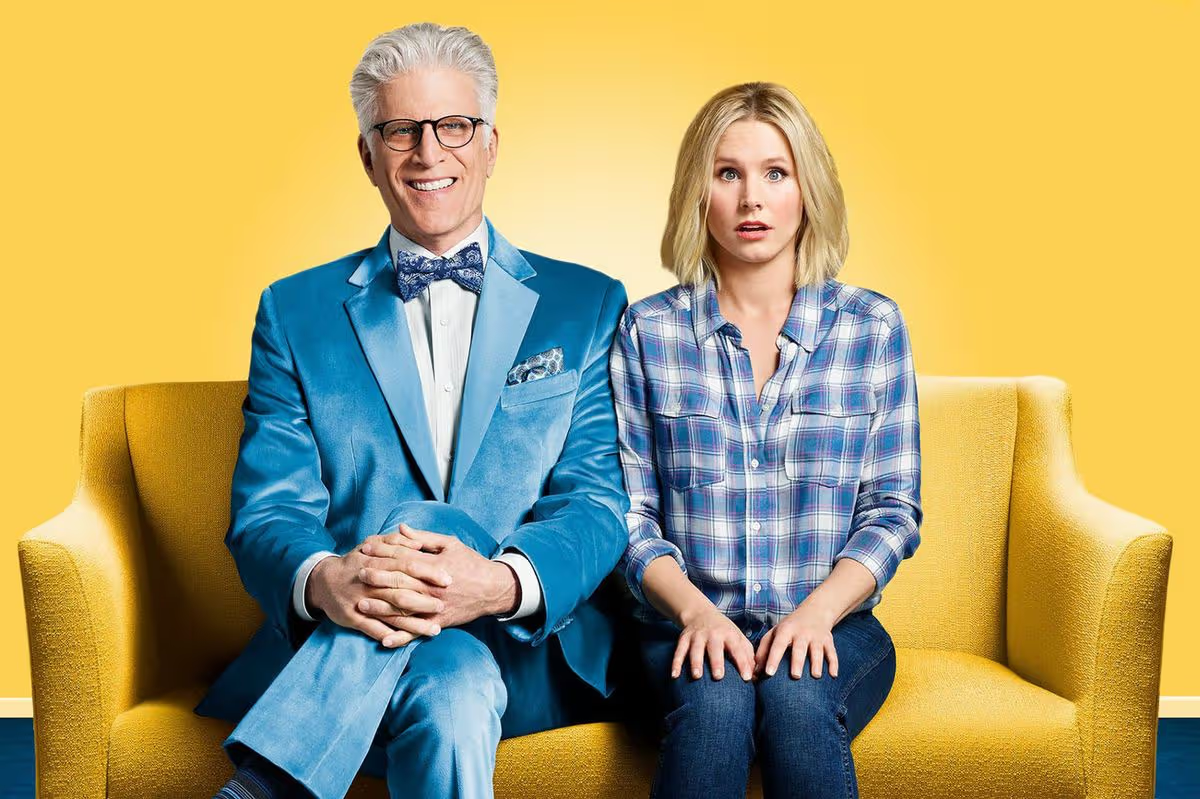
2. The Good Place, 2016
The Good Place was first aired on NBC in 2016 and follows four people who enter the afterlife after dying on earth. Eleanor Shellstrop [Kristen Bell] is both relieved and surprised that she’s made it into the Good Place.
But it doesn’t take long for her to realize she’s there by mistake, and is forced to hide in plain sight. The show has a huge 97% rating on Rotten Tomatoes and is a firm favourite by TV fans.
One person said: “One of the most perfect shows ever made, imo. From start to finish.”
A second said: “I recommend this show to my mom and I regret it LOL. she watches it everyday. AND I mean everyday. She will just keep watching it and not get tired of it.”
Dark was first aired on Netflix in 2017 and follows two families searching for answers when their children go missing in a small German town. A sinful past is exposed along with the double lives and fractured relationships that exist among four families as they search for the kids.
The mystery-drama series introduces an intricate puzzle filled with twists that includes a web of curious characters, all of whom have a connection to the town’s troubled history.
The series has a 95% rating on Rotten Tomatoes and can be watched in Netflix.
One person said: “Dark was incredibly fine-tuned. I had found a chart online to help with family connections and time jumps.”
A second said: “Truly a 10/10 show. Still sad 1899 didn’t get the full run it deserved.”
4. Arrested Development, 2003
Arrested Development was first aired on Fox in 2003, and follows the Bluth family. Michael Bluth finds himself forced to stay in Orange County and run the family real estate business after his father, George Bluth Sr, is sent to prison for committing white-collar crime.
He tries to juggle the wants and needs of his spoiled and eccentric family while being a good role model for his teenage son, George Michael.
The series, which has a Rotten Tomatoes score of 75%, is known for having a reboot after season three, which did not go down as well as the first three seasons of the programme.
One person said: “Arrested Development (Seasons 1-3 too afraid to watch reboot so never did).”
A second person said: “Arrested Development is mine for sure. I don’t think there has ever been a funnier show on television.”
You can watch Arrested Development on Netflix and Disney+.
5. The Expanse, 2015
The Expanse was first aired on Syfy channel in 2015, and takes viewers hundreds of years into the future. Things are much different than what humanity is used to after humans have colonized the solar system and Mars has become an independent military power.
She show follows rising tensions between Earth and Mars that have put them on the brink of war. The show has a massive 95% rating on Rotten Tomatoes, with many people singing its praises.
One person said: “Such a great show. One of the only good things Bezos has done in his life is paying to finish that show.”
A second said: “Excellent show! You gotta check out.”
The Expanse can be watched on Prime Video.
6. Parks and Recreation, 2009
The comedy was first aired on NBC in 2009 and follows the Indiana Parks and Recreation Department as they deal with oafish bureaucrats, selfish neighbours, governmental red tape and a myriad of other challenges.
The show is known as an easy to watch cult classic, and has a massive 93% rating on Rotten Tomatoes.
One person said: “The first show my wife and I binged when we first started dating. We ended up finishing our wedding vowels with “I love you and I like you” and engraving it on our wedding rings.”
A second said: “Way better than the office in my opinion.”
Parks and Recreation on Sky.
7. Psych, 2006
The Comedy, Crime and Mystery & Thriller was first aired on USA network in 2006, and follows Shawn Spencer as he happens to possess some uncanny powers of observation thanks to his father, Henry, a former police officer who taught his son to remember even the smallest details of his surroundings.
When Shawn is accused of committing a crime that he actually solved, he convinces the cops that he’s a psychic. The show has an 89% rating on Rotten Tomatoes and ran for 8 seasons.
One person said: “Psych was an incredible mix of humor, intrigue, creative writing and stupidity. I loved every second of it.”
A second said: “Episodic shows have so much rewatchability. Need to sit for 40 minutes? Watch an episode. Doesn’t matter which, they’re all self contained. Serial shows you can’t watch a random episode because you may not remember what’s going on.”
Psych can be bought on Prime and Apple TV.
8. Ted Lasso, 2020
Ted Lasso was first released on Apple TV in 2020 and follows an American football coach who is hired to manage a British soccer team.
What he lacks in knowledge, he makes up for in optimism, determination and biscuits. This comedy/drama is an easy watch, and features some big stars such as Hannah Waddingham, Jason Sudeikis and Nick Mohammed.
The show has a 90% rating on Rotton Tomatoes, and you don’t need to enjoy football to watch the show.
One person said: “I’m not even a fan of Soccer or most sports, but this show may be the most Wholesome, Down to Earth show I’ve ever seen. For anyone who hasn’t seen it, Soccer & sports is only about 5% of the show. The other 95% is behind the scenes, character development, comedy, and straight up genuine wholesomeness.”
A second said: “Idk if I’d even say it’s 5%, the soccer thing is all just backdrop really for some incredible character development.”
Ted Lasso can be watched on Apple TV.
9. Fleabag, 2016
Fleabag was first aired on BBC Tree in 2016 and follows a dry-witted woman, known only as Fleabag, as she navigates life and love in London while trying to cope with tragedy. The angry, grief-riddled woman tries to heal while rejecting anyone who tries to help her.
The show has a 100% rating on Rotten Tomatoes and is known for its depth and dark comedy.
One person said: “Kind of dark to be fair. More raunchy than dark to me really. But it’s amazing, so I agree on the brilliance. Olivia Coleman may be my favourite British actresses of all time, even if she has been around the station a few times.”
A second said: “Season 2 is as close to perfection as any show will ever get.”
Fleabag can be watched on Prime Video, Sky and BBC iPlayer.
10. Brooklyn Nine-Nine, 2013
Brooklyn Nine-Nine was first aired on Fox in 2013 before moving to NBC for the final three seasons. The show follows the team of detectives at Brooklyn’s 99th Precinct – made up a loveable and offbeat squad that must get its act together when the office gets a new captain.
The show has a 95% approval rating on Rotten Tomatoes, with many describing the show as “hilarious”.
One person said: “My wife made me watch it and I was hooked from the first episode.”
A second said: “I have to admit, this was recommended many times and when I saw bits and pieces I really hated it. Then I gave it a chance, now I’m at season 5, so many hilarious bits.”
We spoke exclusively to Detective Hole creator Jo Nesbø and lead star Tobias Santelmann about the Netflix crime drama’s future
Jo Nesbø’s Detective Hole is adapted from a series of best-selling crime novels(Image: NETFLIX)
Netflix has only just dropped its thrilling new crime drama Jo Nesbø’s Detective Hole but some viewers are already keen to know if there will be another series.
The nine-part detective series is adapted from best-selling crime author Nesbø’s The Devil’s Star and takes Netflix viewers on quite the ride.
Detective Hole follows troubled detective Harry Hole (Tobias Santelmann) as he races against the clock to track down a serial killer before they can strike again.
At the same time, Harry is locked in a dangerous cat-and-mouse game with crooked fellow police officer Tom Waaler (Joel Kinnaman).
Will there be a Detective Hole season 2?
In an exclusive interview with Mirror publishers Reach Plc, creator Nesbø, lead actor Santelmann and Beate Lønn star Ellen Helinder addressed the future of the show.
Nesbø said: “No plans yet [for a season two]. Right now, we’re just concentrating on getting this TV series out to the audience and we’ve been working on this for three years now.
“So, just the thought of starting all over again right now is a bit premature and we’re so exhausted right now that we want a vacation.”
Get Netflix free with Sky
This article contains affiliate links, we will receive a commission on any sales we generate from it. Learn more
Sky is giving away a free Netflix subscription with its new Sky Stream TV bundles, including the £15 Essential TV plan.
This lets members watch live and on-demand TV content without a satellite dish or aerial and includes hit shows like Stranger Things and The Last of Us.
However, Harry Hole star Santelmann said: “I’m ready. You might be exhausted.”
Nesbø jokingly added: “You’re ready? Then I’m ready too for season two.”
The crime author admitted that he hadn’t yet thought about the direction he’d like to take the show in or which Harry Hole novel a possible season two might take.
Meanwhile, actress Helinder, who portrays the brilliant forensics officer Beate, shared her hopes for more seasons of Detective Hole: “Just to keep working with these amazing people and develop the characters even more.
“There’s so much to find in these people, who work within the law enforcement.
“Even more the morality, the ethical dilemmas and how is Harry going to cope with everything? Who is Beate? I would like to explore her backstory.
“I think this ability that she has for facial recognition is so cool, just for her to keep tracking cases and doing her thing.”
Given Jo Nesbø’s Detective Hole has only just been released, Netflix will be keeping an eye on the viewing figures before making any renewal decisions.
The Devil’s Star is just one of 13 Harry Holes books that Nesbø has written, so there is plenty of content for the programme-makers and indeed the author, who also served as the screenwriter on the Netflix series, to draw on.
Jo Nesbø’s Detective Hole is streaming on Netflix now
WASHINGTON — When President Trump ordered immigration raids in Los Angeles last June, only a handful of those arrested were violent criminals. The sweeps split families, cost businesses millions of dollars and drove many undocumented residents into hiding.
Activists protested the Immigration and Customs Enforcement actions, prompting the president to deploy thousands of federal troops in what he called a security operation. A federal judge called it unlawful and said the deployment caused “greater harm” to the city.
Now, Trump wants a redo.
At a Cabinet meeting Thursday, he called on the mayors and governors of several blue cities and states to allow troops to “come in and stop the crime,” pointing to purported successes in Washington, Memphis and New Orleans.
“Crime is down 75% in a short period of time,” Trump told his top advisors. “We could do that for L.A. and we could do that for, frankly, San Francisco.”
The president framed the deployments as both a crime-fighting and immigration enforcement tool, saying that federal authorities can remove people from cities in ways local officials cannot.
“We can do it much more effectively, because [local leaders] can’t do what we do,” Trump said. “All the time, people come up to me … and they say ‘thank you so much.’ I know immediately what they’re talking about. They’re able to walk to work.”
Trump also said this week that he would consider deploying the National Guard at airports to assist with mounting security delays amid a 40-day partial government shutdown.
The renewed call comes after a series of controversial federal interventions in cities across the country. In Washington, Trump has repeatedly touted a visible security presence near federal buildings, crediting it with improving public safety, though local officials and analysts have debated how much of any decline in crime can be attributed to his order.
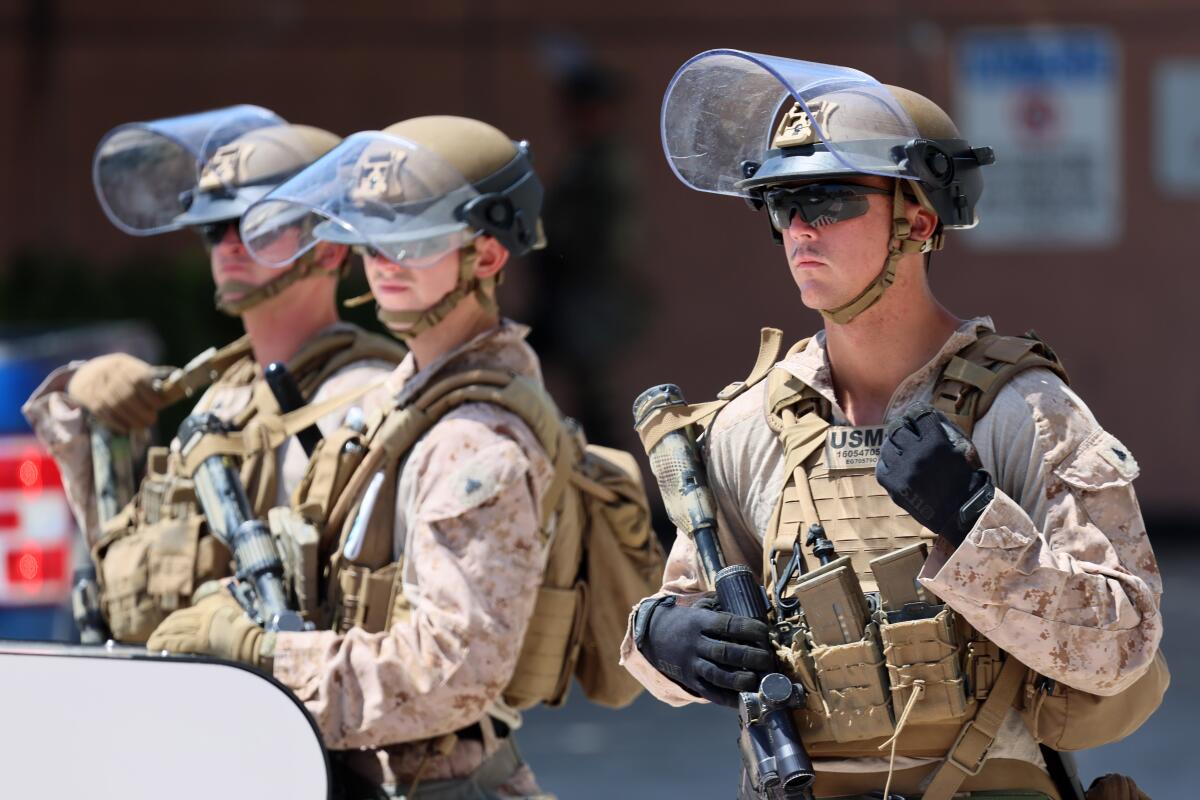
U.S. Marines stationed outside the federal detention center in downtown Los Angeles in June.
(Allen J. Schaben / Los Angeles Times)
In January, Trump threatened to invoke the Insurrection Act to deploy troops to Minneapolis during the civil unrest that followed the fatal shooting of Renee Good by a federal immigration agent. The Pentagon prepared active-duty troops for a possible deployment, but they were ordered to stand down following the shooting of a second Minneapolis civilian, Alex Pretti, the same month.
Immigration sweeps in Los Angeles targeted workplaces, neighborhoods and churches, stirring widespread panic and forcing many undocumented residents — including those with long-term residency and native-born children — into hiding. As a result, businesses reported sharp declines in revenue and customer traffic. A county analysis found that 82% of surveyed businesses experienced negative impacts, with some losing more than half their income amid workforce shortages and traffic reductions.
During the fallout, Mayor Karen Bass condemned Trump’s deployment of some 4,000 California National Guardsmen and 700 U.S. Marines.
“Deploying federalized troops on the heels of these raids is a chaotic escalation,” she said. “The fear people are feeling in our city right now is very real — it’s felt in our communities and within our families, and it puts our neighborhoods at risk. This is the last thing that our city needs.”
The president called the occupation off after U.S. District Judge Charles Breyer ruled that control of the California National Guard should be returned to the governor, rejecting the federal government’s authority to maintain control indefinitely. A similar Supreme Court ruling effectively ended federalized deployments throughout the country.
“The judges are really hurting this country,” Trump said Thursday. “Frankly, the justices — the Supreme Court — has really hurt our country, too.”
At the meeting, Trump also narrowed his comments on San Francisco and its mayor, Daniel Lurie.
“San Francisco was a great city, could quickly become a great city again,” Trump said. “But we can do it much more effectively.”
Last year, Trump considered carrying out similar federal law enforcement operations in the city. He backed off after a somewhat conciliatory phone call with Lurie, in which Trump said the mayor asked him “very nicely” to call off the deployment. Afterward, he agreed to give the newly elected mayor “a chance” to address crime in the city.
“In San Francisco, crime is down 30%, encampments are at record lows, and our city is on the rise,” Lurie said in a statement Thursday. “Public safety is my number one priority, and we are going to stay laser focused on keeping our streets safe and clean.”
A spokesperson for Lurie’s office said the two have not spoken since that October conversation, indicating Trump’s latest remarks do not reflect any new request or ongoing negotiations. Even so, the president struck a measured tone toward the San Francisco mayor on Thursday. He said Lurie is “trying very hard” but insisted federal intervention would get the job done faster.
Whether any Democrat-led city will take Trump up on that offer remains to be seen. City leaders have previously resisted federal deployments, arguing they undermine local control and risk inflaming already tense situations.
The White House did not respond to questions about whether any current plans exist to redeploy federalized troops to California cities.
Times staff writer Melissa Gomez in Los Angeles contributed to this report.
Police source tells Al Jazeera the attack hits positions of the Iran-aligned PMF, which the US has increasingly targeted.
Published On 25 Mar 202625 Mar 2026
An aerial attack on a military base in western Iraq’s Anbar province has killed seven fighters and wounded 13, according to Iraq’s Ministry of Defence.
The strikes on Wednesday targeted the military healthcare clinic at the base in Habbaniyah, according to the ministry. It called the attack “a heinous crime” that violated “all international laws and norms”.
Recommended Stories
list of 3 itemsend of list
An Iraqi police source told Al Jazeera the attack targeted positions of the Iraqi military’s Popular Mobilisation Forces (PMF), a paramilitary force that includes some Iran-aligned brigades and reportedly shares the base with members of Iraq’s regular army.
“What we understand from the military here is that air strikes were carried out and then further strikes carried out on that same position,” said Al Jazeera’s Assed Baig, reporting from Baghdad. He said it appeared to be the first time the PMF was hit alongside the broader Iraqi military.
Iraq has denounced the attack as the country has been dragged into the United States-Israeli war on Iran. On Tuesday, Iraqi Prime Minister Mohammed Shia al-Sudani’s office said Baghdad would summon the Iranian and US ambassadors over the recent strikes.
‘Right to respond’
A security official quoted by the AFP news agency said the strike occurred at the same base that suffered a deadly attack the day before.
Tuesday’s strike, which the PMF blamed on the US, was the deadliest in Iraq since the start of the war on Iran on February 28, It killed 15 fighters, including a commander.
The attack prompted Iraq’s government to grant the PMF a “right to respond” to any attack against it, a position Baghdad reaffirmed on Wednesday.
“We reserve our full right to take all necessary measures to respond to this aggression within the established legal frameworks,” the Defence Ministry said.
Since the war began, pro-Iran armed groups have claimed responsibility for attacks on US interests in Iraq and across the region while strikes have also targeted these groups, including at government-linked positions.
The US Department of Defense has acknowledged that combat helicopters have carried out strikes against pro-Iran armed groups in Iraq during the current conflict.
Baig said the latest strikes demonstrate “an escalation in terms of the PMF being targeted”.
“Increasingly, Iraq is becoming a battlefield between Iraqi armed factions and the United States,” he said.
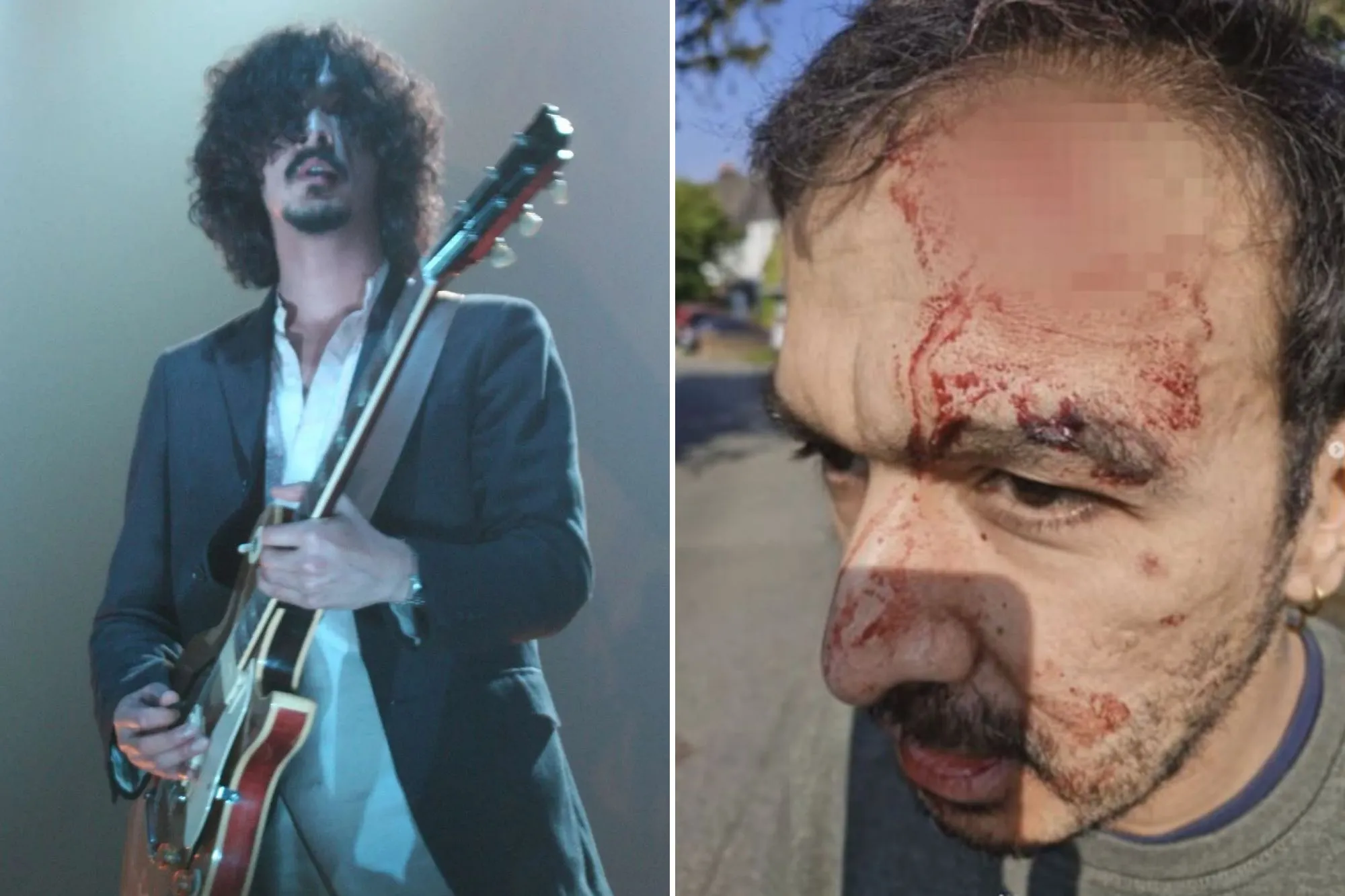
A FOUNDING member of the indie rock band The Zutons has been badly hurt in an “abhorrent” racist attack.
Guitarist Boyan Chowdhury, 46, suffered a serious head injury needing hospital treatment when he was struck by a man with a piece of wood in the Wavertree area of Liverpool just after 2pm on Saturday.
Sign up for the Showbiz newsletter
Thank you!
Boyan Chowdhury, who was a guitarist in the rock band The Zutons, has been attackedCredit: instagramChowdhury (right) was battered in a shocking ‘racist’ assaultCredit: Handout
Merseyside Police said Chowdhury, who left the band in 2007, had been “racially abused” after an “altercation” with a gang of men near Fieldway.
Chowdhury said they then struck him on the head with a piece of wood while he was out.
The Zutons star, known for singles like ‘Why Won’t You Give Me Your Love?’, shared photos of his injuries on social media.
The guitarist wrote on Instagram: “If I hadn’t of turned around I believe I would’ve been struck on the back of the head and dead right now.”
Cops said the ex-Zutons star sustained a serious head injury and required hospital treatment, following the altercation.
Detective Inspector Debra Morley of Merseyside Police said: “This was a shocking assault that has absolutely no place in our communities.
“To racially abuse someone and then attack him with a weapon is abhorrent and I’m sure the public in Merseyside will be just as appalled as we are about what happened.
“An investigation is ongoing into this incident and we are appealing for anyone with information to come forward.
“If you saw this group of males near Fieldway or witnessed the incident, then please come forward.
“Violence and hate crime will simply never be tolerated in our communities.
“We have specially trained officers who respond to reports of hate crime with compassion and sensitivity, ensuring that every piece of information is acted upon to bring offenders to justice.”
Anybody with information can contact police on their social media desk, or call 101 quoting reference 26000226633.
Anonymous information can be given to independent charity Crimestoppers anonymously, on 0800 555 111 or via the online form.
The Zutons released three studio albums between 2004 and 2008, and celebrated nine UK Top 40 singles.
They included two Top 10 singles – Valerie (covered by Amy Winehouse) and Why Won’t You Give Me Your Love?
He left the Liverpool band in 2007The star performing at Brixton Academy London, England, in 2005Credit: Wenn
Experts have urged holidaymakers to make this check before jetting off
12:57, 21 Mar 2026Updated 12:57, 21 Mar 2026
If you fail to check this before your holiday, your travel insurance could be invalidated(Image: Getty)
Brits planning a getaway have been warned to check one crucial detail beforehand or risk potentially losing hundreds or even thousands of pounds. Neglecting to do so could leave your travel insurance worthless, meaning you’d be left out of pocket should anything go wrong.
The team at Travel Health Pro stressed that travellers must always keep abreast of guidance regarding their destination from the Foreign, Commonwealth and Development Office (FCDO). You should “keep checking” during the “days and weeks leading up to your trip” to ensure you don’t miss anything.
This guidance will inform you whether there are any present dangers associated with your chosen location. These could stem from severe weather conditions, criminal activity, political instability, conflict, or terrorism threats.
Occasionally, the advice may be severe enough to recommend not travelling altogether, whilst in other instances it might suggest steering clear of particular regions or remaining vigilant about certain circumstances. Travel Health Pro stated: “Planning to travel abroad?
“Before you book your trip, check Foreign, Commonwealth and Development Office (FCDO) foreign travel advice for information on safety and security at your destination. Remember to keep checking FCDO advice in the days or weeks leading up to your trip too, as circumstances can change very quickly.” The guidance elaborated on the meaning of these warnings: “If the FCDO think the risk of travel is unacceptably high, they will formally advise British people against ‘all but essential travel’ or ‘all travel’ to a particular country or region.
“The ‘warnings and insurance’ section of each FCDO country advice page lists all the areas (if appropriate) to which this applies. You can also receive FCDO email alerts about specific countries by signing up through a link on the FCDO country page for your destination.”
Neglecting to carry out this verification and venturing to a high-risk destination could result in your insurance policy becoming void. This could mean you’re left out of pocket for hundreds or even thousands of pounds if something goes wrong and your trip is cancelled or cut short.
Travel Health Pro warned: “Remember – your foreign travel insurance could be invalidated if you travel against FCDO advice. If you travel, remember to check FCDO travel advice regularly, as situations can change quickly.”
Nations with an FCDO warning currently active
At the time of publication, numerous countries are currently subject to an FCDO travel warning. These include:
Afghanistan
Belarus
Burkina Faso
Haiti
Iran
Iraq
Israel
Mali
Niger
Russia
South Sudan
Syria
Ukraine
Yemen
The complete list of foreign travel advice for countries can be viewed online here.
Fans are already adding the ‘haunting’ series to their watchlists
Long Bright River: Official trailer
Fans of true crime say that they are already ‘hooked’ on the idea of Netflix’s upcoming series as it unveils plans for an adaptation based on a ‘haunting’ bestseller.
The series, The God of the Woods will be based on the New York Times bestselling novel of the same name, written by Liz Moore. It is the same writer behind the book Long Bright River, which was also turned into a series that hit screens last year and starred Amanda Seyfried in the leading role.
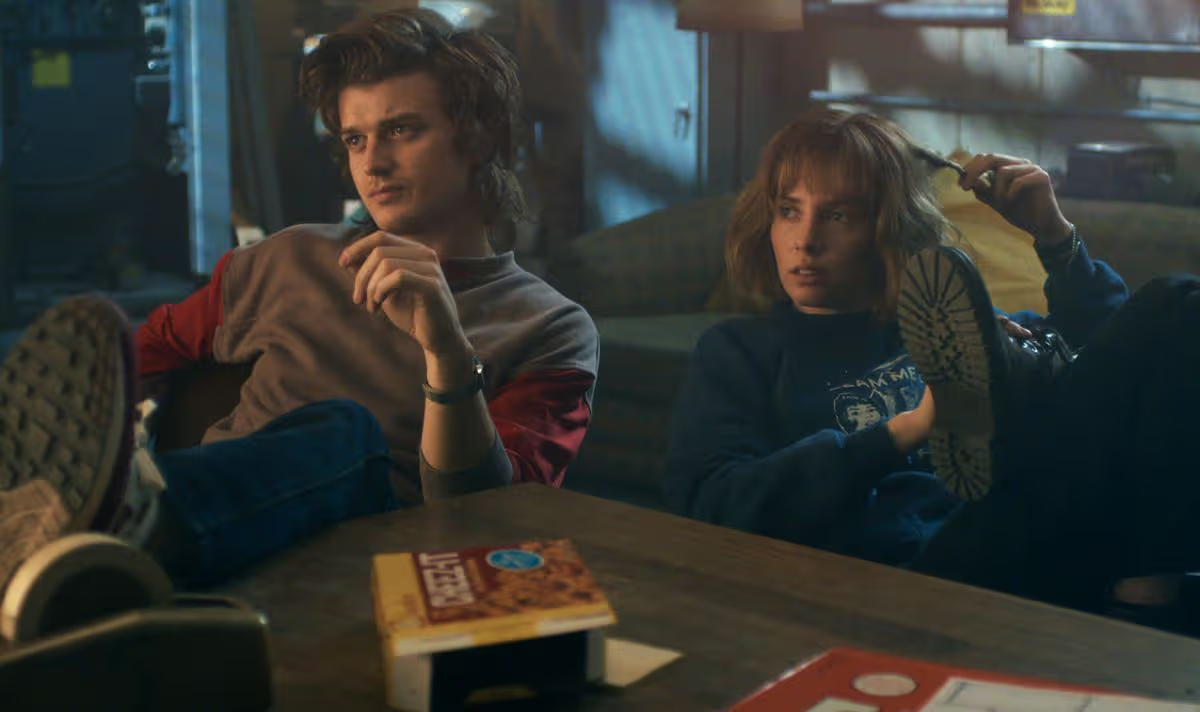
Author Moore will also serve as a co-showrunner according to Deadline, alongside Liz Hannah who has previously worked on The Girl From Plainville and Mindhunter. This time around, it has been confirmed that Stranger Things star Maya Hawke has been cast in the starring role.
She will play Judy Luptack, a smart and quietly determined investigator assigned to unravel the disappearance of a young girl from a summer camp in upstate New York. While the show will be a work of fiction, those who are obsessed with true crime have already admitted they can’t wait for the show to release. Unfortunately, there’s currently no confirmed release date.
The official synopsis describes the show as “a multi-generational drama series set in the Adirondacks, exploring the Van Laar family’s dark secrets, class tensions, and the mysteries surrounding the disappearance of 13-year-old Barbara Van Laar from her family’s summer camp – in the wake of an earlier family tragedy that may be related.”
It continues: “As the past and present collide, the Van Laars’ wealth and influence unravel, revealing the damaging consequences of privilege and the abuse of power.”
While this looks set to be the Robin Buckley actress’ next major role for TV, fans will also be able to see her in romantic comedies Wishful Thinking and One Night Only as well as the Hunger Games prequel Sunrise on the Reaping. All of which are all currently scheduled for 2026 releases.
Fans are already highly anticipating the series and claiming this casting news as ‘perfect’. One responded to the news on social media saying: “That sounds like a perfect role for Maya Hawke. She really shines in those layered, introspective characters.
“A quiet but determined investigator in a mystery like this? Yeah, this could be something special. Definitely adding The God of the Woods to my watchlist already!”
Another added: “Read The God of the Woods last year and loved how layered and haunting it is. Maya Hawke feels like perfect casting for Judy Luptackquiet. Intensity is her specialty. Netflix, you’re cooking!”
Someone else replied: “The book-to-Netflix pipeline is undefeated right now. Liz Moore wrote one of the best thrillers in years, perfect choice for adaptation.”
While one person commented: “Maya Hawke in a thriller about a missing girl from summer camp?? This is literally made for my true crime obsessed brain, I’m already hooked.”
Stranger Things is streaming on Netflix now. The God of the Woods will be streaming on Netflix soon.
Colombia’s President Gustavo Petro has been named in two separate criminal investigations led by prosecutors in the United States.
The New York Times was the first to report the existence of the two probes on Friday, citing sources familiar with the proceedings.
Recommended Stories
list of 3 itemsend of list
Media reports indicate that Petro is not personally the target of the investigations, which focus on drug-smuggling in Latin America.
But according to the Times, US attorneys in Brooklyn and Manhattan are looking into whether Petro met with drug traffickers and solicited donations from them for his 2022 presidential campaign. Al Jazeera has not independently verified the Times report.
By Friday afternoon, Petro had issued a statement denying the claims, which threaten to reopen the rift between the US and Colombia.
“In Colombia, there is not a single investigation into my relationship with drug traffickers, for one simple reason: I have never in my life spoken with a drug trafficker,” Petro wrote on the social media platform X.
He added that he told campaign managers to never accept donations from bankers or drug traffickers.
The investigations in the US, he argued, would ultimately exonerate him, and he blamed Colombia’s right-wing opposition for stirring controversy.
“So, the proceedings in the US will help me to dismantle the accusations of the Colombian far right, which is indeed closely linked to Colombian drug traffickers,” Petro said.
Petro has not been charged with any crimes, and the investigations are in their initial stages, according to the Times.
But experts say the timing of the report is significant, as it comes barely two and a half months before Colombia is set to hold a closely watched presidential election on May 31.
“If this would have happened a week before the first round, it would be election interference,” Sergio Guzman, director at Colombia Risk Analysis, a security think tank, told Al Jazeera.
“This seems to be more of a warning that shows how the US could influence the outcome of the election.”
Petro, Colombia’s first left-wing president, is limited to a single term in office, but the election is likely to be a referendum on his four years in office.
It will also be a test for Petro’s Historic Pact coalition, whose candidate, Ivan Cepeda, is currently leading in the polls.
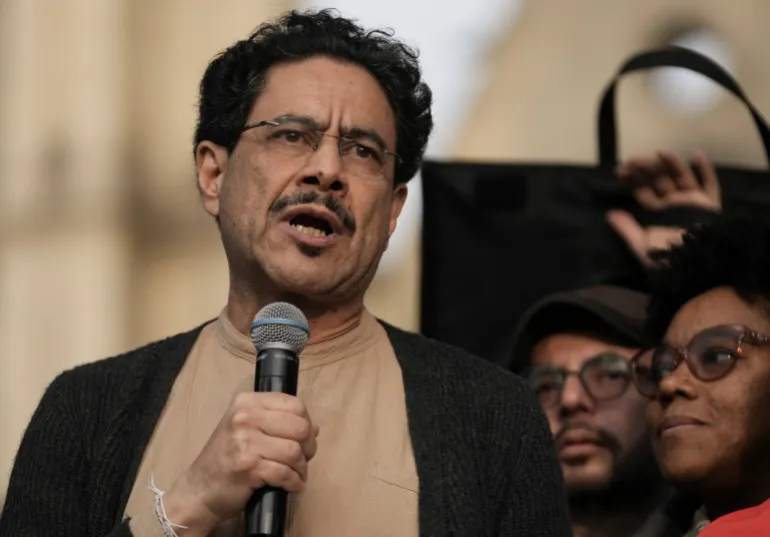
Colombian presidential candidate Ivan Cepeda speaks at a rally in support of current President Gustavo Petro on February 3 [Nathalia Angarita/Reuters]
But United States President Donald Trump has repeatedly sought to boost the prospects of right-wing candidates in Latin America. He and Petro have been at loggerheads since Trump returned to office in January 2025.
Their feud came to a head in January after the US attacked Venezuela and abducted its president, Nicolas Maduro.
Shortly afterwards, a reporter asked if the US would take military action against Colombia. Trump replied: “It sounds good to me.”
To cool tensions, Trump and Petro held a call afterwards and agreed to meet.
Petro then visited the White House in early February to mend his often-combative relationship with Trump. While there, the Colombian delegation interacted with their counterparts, including Secretary of Defense Pete Hegseth and Secretary of State Marco Rubio.
Republican Senator Bernie Moreno, a longtime critic of Petro’s government, was also in attendance. Guzman believes the senator’s presence was significant.
“We don’t have a lot of straightforward answers about what were the commitments during that meeting, but Bernie Moreno did say that he wanted Petro not to be as involved in elections,” Guzman told Al Jazeera.
“And guess what? Petro is fully involved in the elections.”
The meeting also addressed collaborative efforts to combat drug trafficking, an issue core to Trump’s foreign policy.
Both presidents walked away from the meeting in good spirits, with Petro sharing a photo signed by Trump that read, “Gustavo – a great honor. I love Colombia.”
But Petro and Trump have long been at odds over how to tamp down on narcotics smuggling.
Colombia, the region’s largest producer of cocaine, has been criticised by the Trump administration for what it sees as soft-on-crime policies, including negotiations with armed groups.
Petro, meanwhile, has denounced the US for its lethal tactics, calling them tantamount to murder.
The US, for instance, has bombed at least 46 alleged drug boats and vessels in the Caribbean Sea and eastern Pacific Ocean. Some of the 159 people killed were Colombian citizens.
The US has also floated the idea of conducting military attacks in Latin America against suspected drug traffickers, and it recently began joint operations against gangs in Ecuador, Colombia’s neighbour.
A screen shows Colombian President Gustavo Petro and US President Donald Trump shaking hands at Plaza Bolivar in Bogota, Colombia, on February 3 [Nathalia Angarita/Reuters]
Analysts say actions like these have Latin American leaders on edge.
Trump’s aggressive manoeuvres suggest that the US president is willing to jeopardise “the sovereignty and peace of every nation” in his campaign against illicit drugs, according to Rodrigo Pombo Cajiao, a constitutional law professor at the Pontificia Universidad Javeriana.
Pombo Cajaio pointed to the US abduction of Venezuelan President Nicolas Maduro on January 3. Maduro was a longtime adversary of Trump, and he is currently being held in prison in New York on drug-related charges.
“Every political leader in the region has been put on notice” after that abduction, Pombo Cajiao said.
“As the world’s leading producer of cocaine, Colombia found itself at high risk of judicial prosecution” from the US, he added.
Currently, Petro’s Historic Pact is leading May’s presidential race. A GAD3 poll released this week suggested Cepeda is ahead in the polls with 35 percent voter approval, ahead of far-right candidate Abelardo de la Espriella, who had 21 percent.
THIS is the moment Justin Timberlake is put in cuffs as the body cam footage of his arrest for drink driving is released.
The pop star, 45, was arrested in Sag Harbor, New York, in June 2024 after he failed to stop at a stop sign and could not stay in his lane.
Sign up for the Showbiz newsletter
Thank you!
This is the moment Justin Timberlake failed a sobriety test during a drink driving arrestCredit: Sag Harbour Police DepartmentThe pop star was arrested in June 2024 for driving while intoxicatedCredit: Sag Harbour Police DepartmentJustin Timberlake’s mugshot following his arrestCredit: Getty
Shortly after leaving The American Hotel following a night out with friends, the singer was pulled over while traveling southbound on Madison Street, a public highway in the Hamptons village.
Cops, often stationed nearby, noticed Justin swerving on the road and blowing through a stop sign.
They later smelled alcohol on his breath and noted that he was unsteady on his feet and also had slowed speech and glassy eyes.
The body cam footage of his arrest was released on Friday after the star’s legal team reportedly tried to previously prevent its release.
In the video, an officer can be seen shining a flashlight in Timberlake’s face at the roadside before the star performs poorly on sobriety tests.
He is asked to walk in a straight line but has difficulty with the instructions, appearing confused.
Timberlake tells them: “Guys, I’m just following my friends back to my house. I’m not doing anything.”
While attempting the sobriety test, he stumbles before apologising and saying ” I’m a little nervous”.
When asked to do the next test, the officers are forced to explain multiple times before Timberlake says “sorry, my heart is racing” while clutching his chest.
Looking unsteady on his feet, the singer is then heard saying: “By the way, these are like, really hard tests.”
After failing the roadside tests, an officer is then seen asking Timberlake “turn around for me please”.
Saying nothing and looking resigned, he slowly turns before he’s put in handcuffs.
A friend appears and is shocked when police tell her Justin is going with them, saying: “You’re arresting Justin Timberlake? Stop it. What?”
She pleads with the officers to speak with him and give him his phone before she takes his car home.
Timberlake was eventually put in handcuffsCredit: Sag Harbor Police DepartmentThe footage was released despite a challenge from his legal teamCredit: Sag Harbor Police Department
She begs: “Can you guys please do me a favour because you loved Bye Bye Bye or Sexy Back, do me one favour. This is insane.”
At the end of the footage, the 10-time Grammy winner can be seen in the back of a cop car behind bars.
He was taken into custody that night and arraigned in Sag Harbor Village Justice Court the following morning.
He was released without bail on his recognizance and was also charged with one count of DWI due to his refusal of the breathalyzer, according to Justin’s lawyer.
Timberlake’s lawyers previously sued the Village of Sag Harbor to prevent the release as it showed him “in an accutely vulnerable state”, reports CBS.
It was later agreed it would be released with redactions.
That September, Timberblake reached a plea deal to bring the case to an end.
The judge sentenced Justin to a $500 fine with a $260 surcharge, and 25 hours of community service at the nonprofit of his choosing.
After the sentencing, Justin said: “Even if you’ve had one drink, don’t get behind the wheel of a car.
“There are so many alternatives. You can call a friend [or] take an Uber.”
He added: “This is a mistake that I made, but I’m hoping that whoever is watching and listening right now can learn from this mistake. I know that I certainly have.”
During the proceedings the star remained standing throughout and gave a statement in which he expressed remorse for his actions.
He was unsteady on his feet when he was asked to walk in a straight lineCredit: Sag Harbor Police Department
Jordan Wright was found dead in Thailand aged 33Credit: instagramHaunting CCTV showed him running down a streetCredit: Asia Pacific Press via ViralPressHe was seen running around frantically before being discovered in a drainage canalCredit: Asia Pacific Press via ViralPress
Chilling CCTV captured the beloved TV personality running erratically past a truck before taking a sharp left turn.
The clip was timestamped to 11:25pm on March 12 – about 36 hours before he was found dead on Saturday.
Wright, 33, appeared to be somewhat disoriented and panicked as he rushed through the hotel complex.
He even grabbed onto a white pickup truck to help propel himself forward as he jolted away while turning.
Police now fear he may have been trying to lose someone as he sprinted through the streets of Phuket.
Lieutenant Colonel Sutthirak Chuthong of Choeng Thale district station has refused to rule out foul play.
He said: “The circumstances leading up to the death are quite unclear. It is possible that other people were involved.”
Wright was weaving erratically through the Hotel COCO Phuket Bangtao grounds in the video.
Authorities have also confirmed that they will be reviewing CCTV again throughout Friday in order to get any more details from the haunting clip.
The grainy night-time footage has raised questions over what Wright was doing in the moments leading up to his death.
The CCTV shows him pacing back and forth before suddenly bolting out of the complex again and vanishing into the darkness beyond the hotel perimeter.
From there, his final movements become even more disturbing.
Wright is believed to have sprinted across rough, uneven fields surrounding the hotel before leaping down a 10ft creek.
He is then thought to have splashed through a shallow stream and scrambled towards a nearby construction site.
Wright grabbed onto a white truck as he took a sharp leftCredit: Asia Pacific Press via ViralPressThe drainage canal where Wright was foundCredit: Asia Pacific Press via ViralPress
That site, which is a desolate, half-built area with no CCTV, would become the place where his body was found.
Two days later, a Myanmar worker harvesting morning vegetables made the grim discovery – around 300 metres from his hotel.
A hotel insider revealed he had been staying alone and had no visitors.
They said: “He would go out at night like other guests. There was nothing unusual until we could not find him when he was due to check out.”
Records show Wright checked into the hotel alone and was due to leave on March 13, but never showed up.
JORDAN Wright’s death has been shrouded in mystery as the Towie star was seen pacing erratically before he was found in a drainage canal.
The beloved TV personality, whose new iPhone was found nearby, also checked in to a luxury hotel alone before his tragic passing.
Sign up for the Showbiz newsletter
Thank you!
Jordan Wright was found dead on March 14Credit: Instagram/@jordanwrightsHis body was found in a drainage canal in ThailandCredit: Asia Pacific Press via ViralPress
It also remains unclear how long Wright, who used to date Vicky Pattison, had been missing for – or whether he was under the influence of intoxicants.
Wright was due to check out of his room on March 13, according to staff at Hotel COCO Phuket Bangtao where he was believed to have been staying.
But employees told police he never did check out – meaning he could have been missing for days.
It is currently unclear who the last person to see Wright was or how long he had vanished for.
Cops said they were led to Hotel COCO due to the key card inside Wright’s pocket at the time he was found.
He was reportedly seen pacing frantically shortly before his death, but it has not been confirmed whether anyone saw Wright at this time in person.
Why was he pacing around on CCTV?
Despite footage reportedly showing the ITV star looking restless before he was found dead at 12.30pm local time – it is not clear why he was in this alleged frantic state.
Cops said: “CCTV footage showed that he appeared restless and was moving back and forth in front of the hotel before leaving the area.”
An autopsy is currently being carried out to determine his cause of death.
But it will also conclude whether drugs or alcohol were involved.
No signs of physical assault or struggle were found on his body, authorities confirmed.
There were also no signs of forced entry or disturbances at his hotel room.
Police have launched an investigation into the case to probe the full circumstances of Wright’s death.
He had checked in at Hotel COCO in PhuketCredit: Coco PhuketWright pictured with Vicky PattisonCredit: Fame Flynet
When did he end up in the canal?
It is also unclear when exactly Wright entered the canal drain.
He was said to have been wearing a grey shirt and black trousers but no shoes on when he was found.
Authorities said Wright had been in the canal for some time, but didn’t elaborate on how long he was in there.
They only said the Brit star was believed to have been dead for no longer than two days.
Police said: “His movements eventually led to the location where his body was later discovered.
“We are still waiting for the autopsy results from Vachira Phuket Hospital to determine whether drugs were present in his system.”
Why was his phone left on a nearby bank?
Police explained that Wright’s new iPhone 17 was found on a nearby bank.
It was not in his trouser pockets, unlike the hotel key card police discovered.
Both Wright and the location of his phone are about a 20-minute walk away from Hotel COCO.
The Towie and Ex On The Beach star had posted photos online of his life in Thailand in the weeks leading up to his tragic death.
His “new life” showed him enjoying beach trips and taking part in martial arts classes.
It is unclear why the popular TV personality, from Basildon, Essex, had left the smartphone behind.
The star was best known for Towie and Ex On The BeachCredit: ITVTributes have poured in for the late starCredit: MTV
Why did he check into the hotel alone?
Wright had also checked into a hotel room alone before he was found dead on Saturday.
It is not understood why Wright checked into the luxury hotel alone, and what day he checked in.
He was reportedly seen in security camera footage outside the hotel.
But police have said: “CCTV footage related to the incident is part of the case file and cannot be released at this stage.”
They also confirmed: “Hotel records showed that he had checked in alone and was due to check out on March 13, but staff reported that he never checked out.”
Did he have drugs or alcohol in his system?
The star’s autopsy will determine whether or not Wright had any drugs or alcohol in his system.
Wright was seen pacing frantically before his death, but it is unclear what caused him to do this.
Pictures showed police scouring the scene in the aftermath of his death.
Several reality TV figures have paid their respects to Jordan online, including his The Only Way is Essex co-stars.
Fellow Towie star Chloe Brockett wrote in an emotional tribute “Rest in peace Jordan” followed by a red heart emoji.
While Love Island star Chloe Crowhurst also took to the comments, penning “Rest in peace Jord” with a white heart and cloud emoji.
Before Wright was named, an FCDO spokesperson said: “We are supporting the family of a British man who died in Thailand and are in contact with the local authorities”.
Wright pictured in uniform as a firefighter at the age of 19Credit: Instagram/@jordanwrights




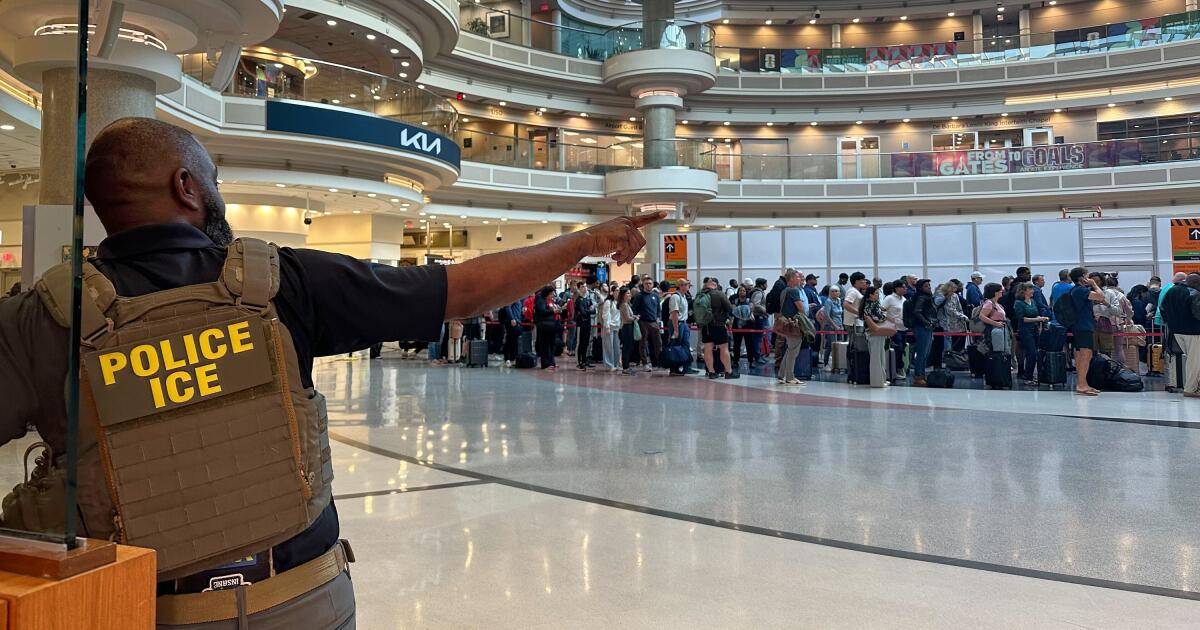
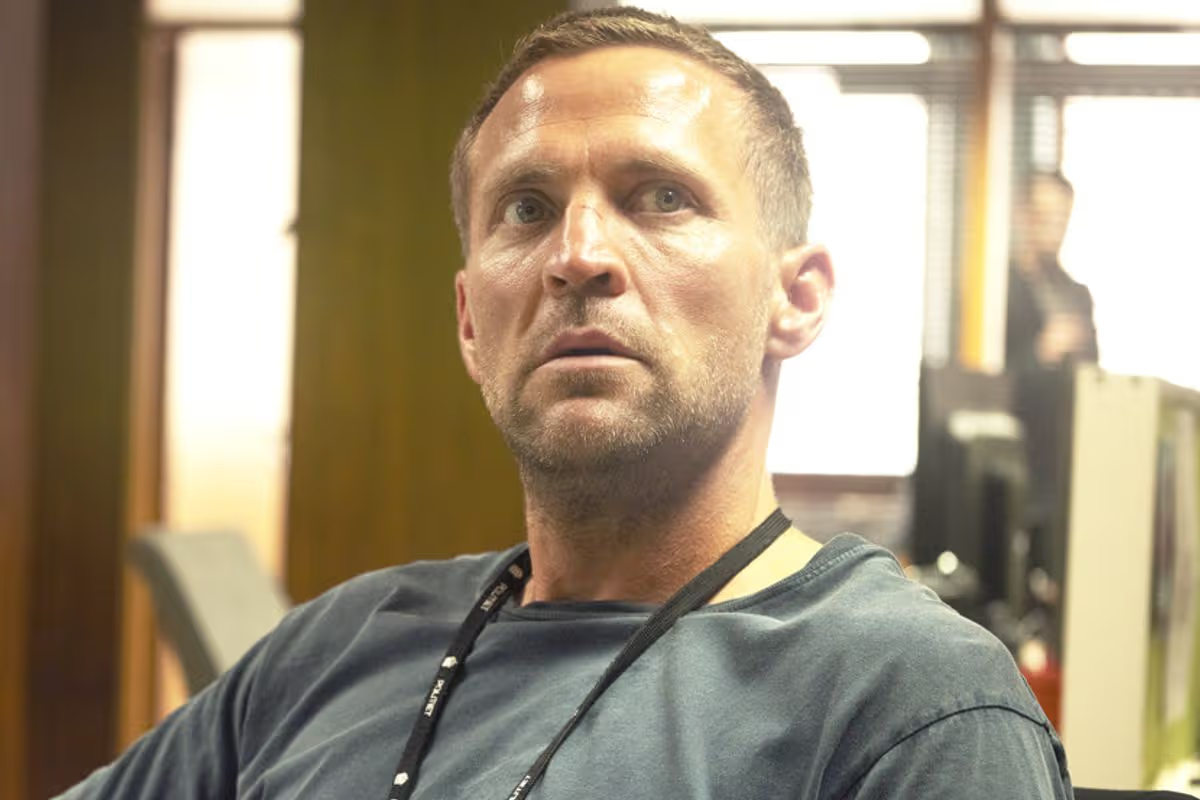

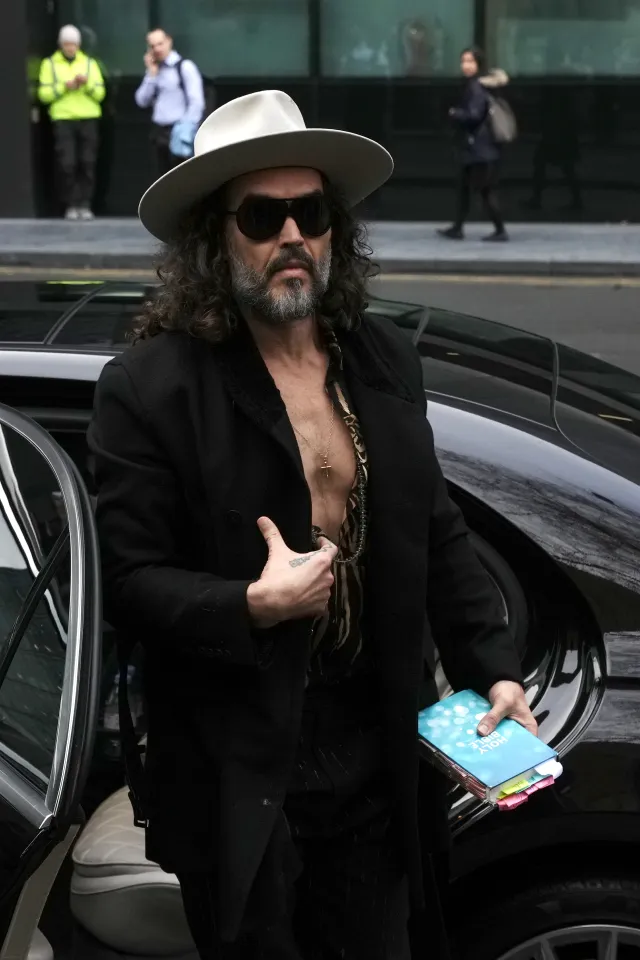




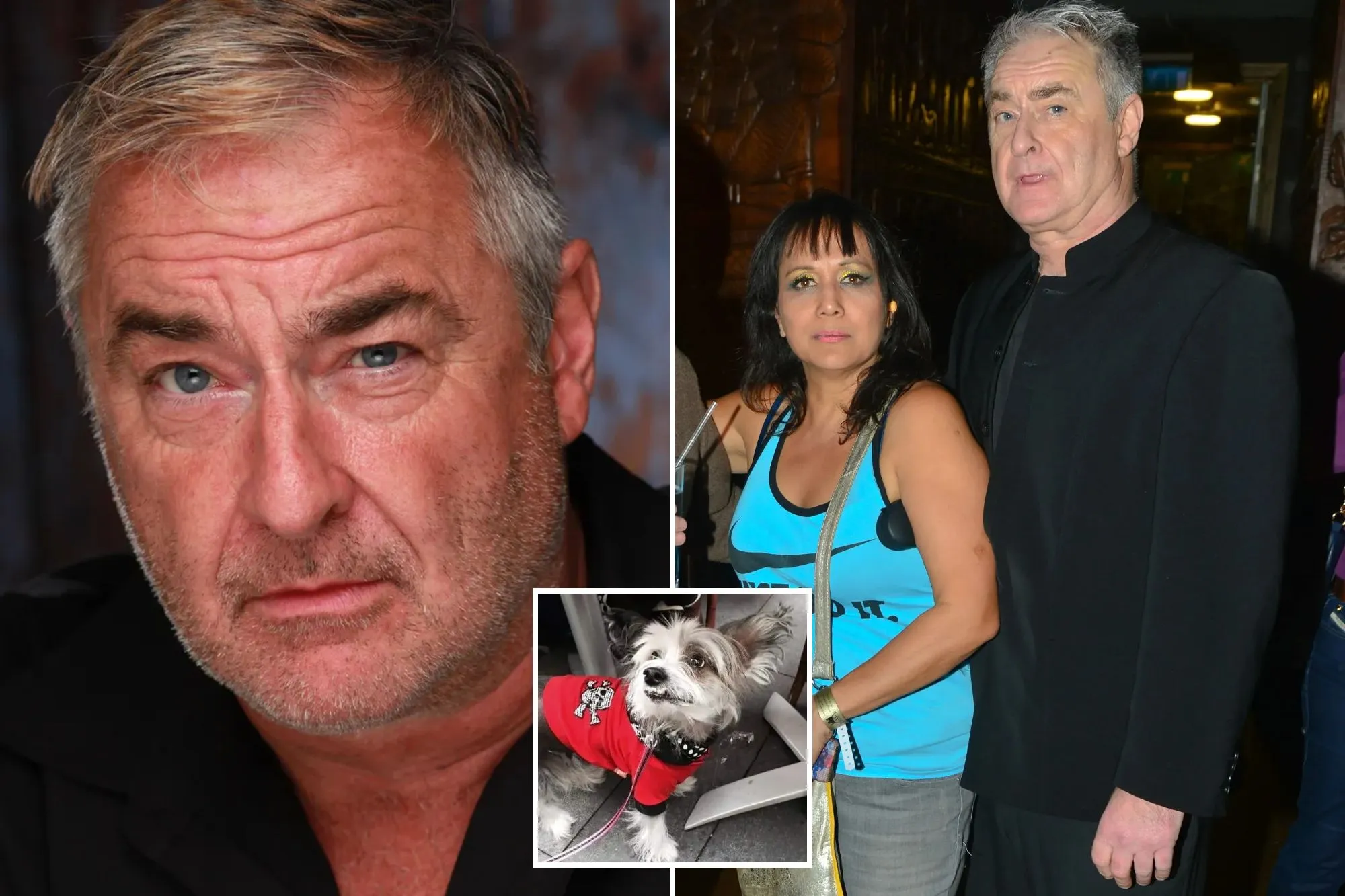



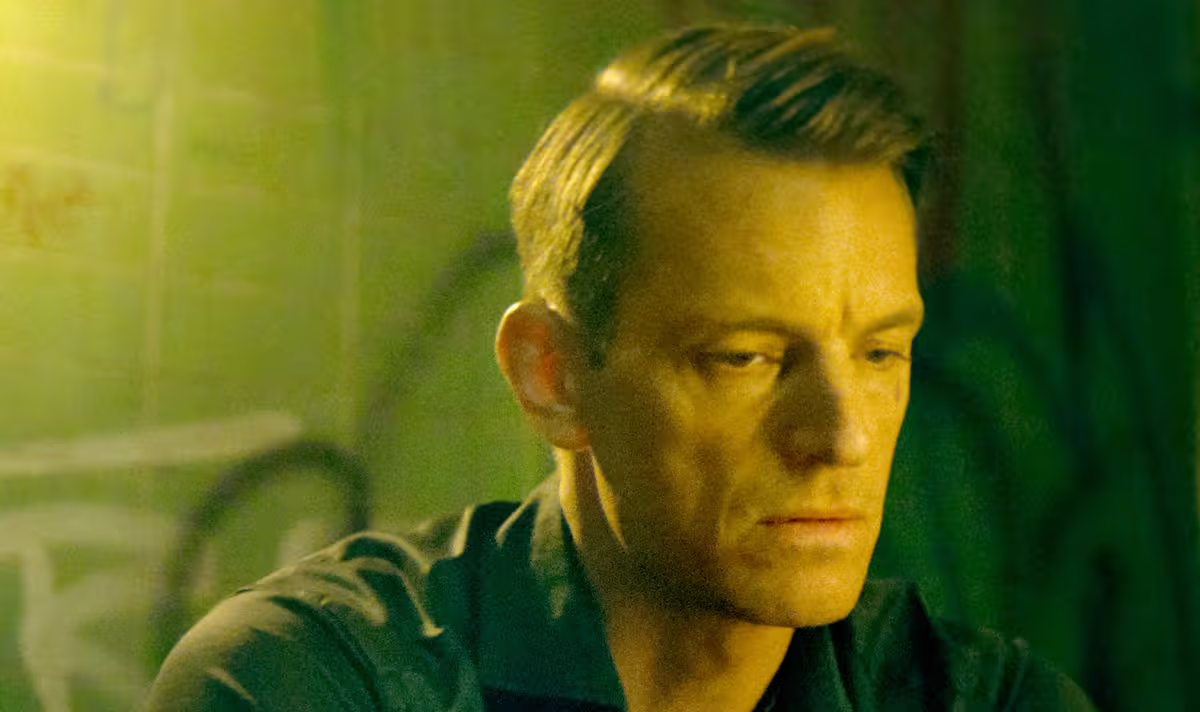


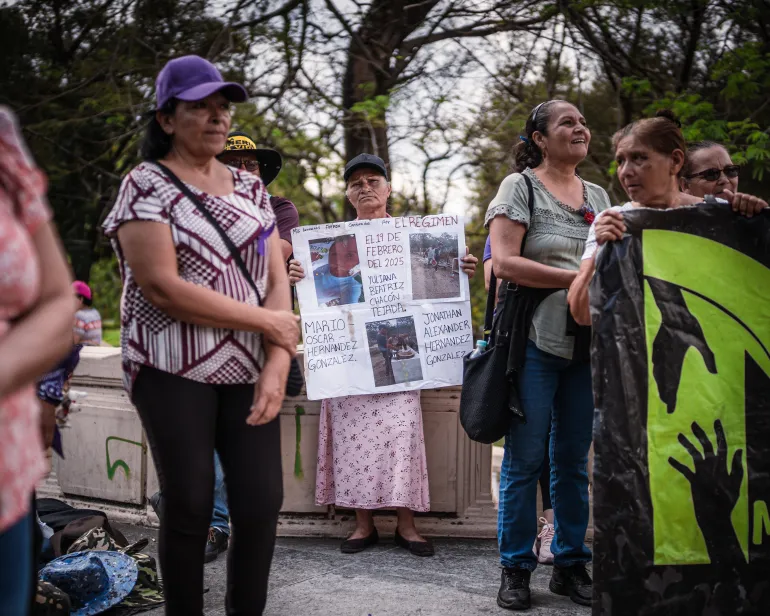
![Rosalina González, 59, mother of Jonathan and Mario, who were detained under the state of exception on February 19, 2025, during ademonstration on March 8 2026 in San Salvador, El Salvador [Euan Wallace/ Al Jazeera]](https://i0.wp.com/occasionaldigest.com/wp-content/uploads/2026/03/DSC00090-3-1774485050.jpg?w=640&ssl=1)