Forget Tarantino, Jumbo’s dancers are driving a wildly creative L.A. scene
Every so often, an aspiring screenwriter wanders into the dim red glow of Jumbo’s Clown Room hoping to interview one of the dancers. “They’re like: ‘I’m writing a screenplay. Can I interview you?” says Cecilia Fairchild, one of the longtime dancers at the renowned East Hollywood bikini bar.
Her response is usually some version of this: “I’m like, ‘Why are you writing about that? Don’t you know we are all writing that too? Leave us alone,’” Fairchild says with a mischievous laugh. What bothers Fairchild is the assumption behind it — that the dancers are voiceless and helpless. Worst of all, they’re presumed to have stories worth mining but not the ability to produce literature themselves.
Jumbo’s has a longstanding reputation of being part of L.A.’s literary lore.
In the 1970s and 1980s, Charles Bukowski — L.A. nightlife’s debaucherous poet laureate — was rumored to haunt the bikini bar in its early days. David Lynch wrote his classic screenplay “Blue Velvet” at the bar. (According to local legends, the iconic opening shot of “Blue Velvet” came to Lynch when he spotted a dancer with only one ear.) Writer and director Quentin Tarantino reputedly wrote at the bar. But while Jumbo’s has garnered a mythology as a magnet for filmmakers, writers and musicians who collect impressions, the dive’s dancers have shifted from being the subject to the artists.
Many of Jumbo’s dancers write fiction and memoir, host literary salons across Los Angeles and find ways to tell their own stories rather than serve as muses. “It’s funny because I wish that male auteurs would tell the story of customers. I want a sniffer’s memoir. I think that’s a real point of view,” Fairchild says. (Speaking of alienation and horniness, the dancer has been meaning to crack the Marcel Proust canon.)


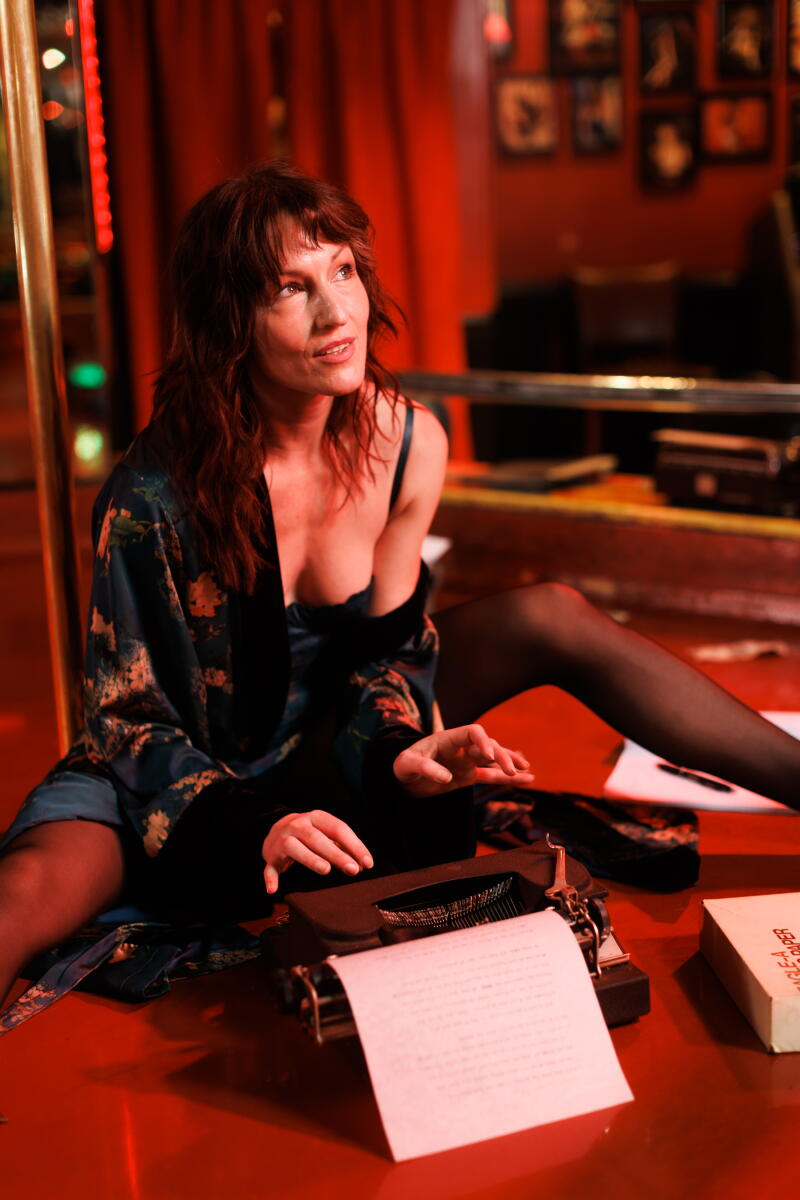
Honey Ryder (Claudia Musikul) types on the bar inside Jumbo’s Clown Room. (Carlin Stiehl / For The Times)
Fairchild is a playwright, poet and memoirist. Her recently completed memoir, “The Poison + The Spit,” traces a life of tumultuous love affairs and a stint dancing in New Orleans, rendered in prose that is whimsical, surreal and deeply emotional. The dancer also hosts the Downpour, a popular monthly literary salon at Bar Covell, and recently directed “Fool in the Pool,” a play that premiered at El Condor in Silver Lake this summer.
Her writing style mirrors her dancing: kinetic, wild and unpredictable. She sometimes takes the stage in roller skates, dancing to David Bowie. Her memoir achieves that same sense of hypnotic motion. “The memoir is so heavy,” she says. “Everything was so sad that I needed some lens to look at it that was fun, zippy and crazy.”
For Fairchild, dancing and writing possess the same need to expose oneself. “Vulnerability is one of the most interesting things about dancing,” she says. “There really is the potential to look into people, and they look into you, and you wordlessly share something with them that is half sexual and half this other thing.”
Meanwhile, Danielle Henderson — another dancer and aspiring novelist at Jumbo’s who writes under the pen name D.M. Faulk — has been working on a science-fiction novel titled “Meridian.” The book imagines a dystopian American wasteland where pregnant women are surveilled and controlled. She has been a longtime science-fiction fan since she and her father watched “Jurassic Park” and “Planet of the Apes” when she was a child.

Long treated as passive muses by visiting writers, Jumbo’s dancers — from left, Caroline Blaike (Caroline Moyer), Honey Ryder (Claudia Musikul), and Cecilia Fairchild — are reclaiming the narrative as active poets, memoirists and screenwriters.
(Carlin Stiehl / For The Times)
Unexpectedly, the Jumbo’s comically tiny dressing room became the inspiration for her novel. In 2022, when Roe v. Wade was overturned, conversations between dancers about reproductive rights ignited in the dressing room, which in turn informed her novel.
“A lot of those conversations happen in the dressing room. I’m incredibly inspired by the women I’m with who are incredibly sex positive and strong.” That ethos informed Henderson’s protagonist, Zayla.
In recent years, the bar has become a local author hangout. Allie Rowbottom, the author of the recent buzzy adult film novel “Lovers XXX,” discovered the bar in 2011 on the occasion of writer Elizabeth Hall’s birthday party. “I recall sitting front row on novelist Jon Lindsey’s lap, raining dollar bills on dancers performing intricate, beautiful athletic feats,” Rowbottom says. “I spent more than I could afford that night and have been back often since.”
Increasingly, Jumbo’s has cemented itself as a watering hole to the local writing scene. “Two years ago, I rented out a few tables for Jon Lindsey’s birthday, attended by Los Angeles literati like Tea Hacic-Vlahovic, Sammy Loren, Morgan Krantz, Tex Gresham and Nada Alic,” she adds.
According to Rowbottom, Jumbo’s is rife for literary inspiration. “To me, Jumbo’s feels uniquely dedicated, as a venue, to intersecting sex and art, despite the obvious dissonance of selling either,” she says. “I suspect such is what has historically made it a rich spot for writers, dissonance and tension being of utmost importance to good literary work.”

From left, Caroline Blaike (Caroline Moyer), Honey Ryder (Claudia Musikul), Cecilia Fairchild and Stephen (Aaron Laughton) inside Jumbo’s Clown Room.
(Carlin Stiehl / For The Times)
A charged scene in L.A. writer Aiden Arata’s critically-acclaimed 2025 essay collection, “You Have a New Memory,” features a night out at Jumbo’s Clown Room. “The dancers are starlets, athletes, artists; the theme is clown, and also longing — longing is a high form of physical comedy,” says Arata. “It possesses that heady mix of scuzz and glamour that can trick you into thinking your life is about to change.”
Jumbo’s burgeoning literary interest revives a hotly debated question: Who gets to tell the stories of sex work? For decades, the club has inspired celebrated writers and filmmakers, but Claudia Musikul — a dancer at Jumbo’s and a screenwriter herself — hopes its literary legacy will increasingly belong to the people at its core: the dancers.
“I hope that everybody can actually get their work out there because I feel it’s much deserved,” says Musikul. “You’ve probably heard about Bukowski, David Lynch doing ‘Blue Velvet’, or Anthony Bourdain. That’s all really cool, but in a way, it’s the actual dancers’ turn to have that kind of recognition.”
Musikul primarily writes screenplays about strippers, a subject she believes is seldom represented authentically. She has been in writing partnerships and workshops while developing scripts centered on dancers. In a sea of films depicting sex work, she cites Paul Verhoeven’s “Showgirls” as a film that resonates with her experience.
“‘Showgirls’ is my very favorite movie,” she says. “It’s my very special place in my heart movie.”
For Caroline Blaike, a poet and dancer at Jumbo’s, the connection between dancing and writing lies in observation. Years of performing have made her acutely attentive to the people who pass through the club, a voyeuristic habit that carries over into her poetry.
“When you’re a dancer, you’re very observant. You watch every person that walks in,” she says. “I feel like the way dancing makes you observe people helps you write from a perspective that other people can then relate to.”
Blaike has been working on a poetry collection that explores love, queerness, desire and personhood. “It’s gotten a little sexier over time, which is kind of fun,” she says. “I also just write about love, being gay, just existing. It can be a little aggressive, but people seem to like it, so that’s good.” She writes these poems from her prized typewriter — a “1951 Olympia typewriter that is my child.”
Among Blaike’s earliest literary touchstones was Maya Angelou. She still remembers encountering Angelou’s line in her poem “Still I Rise,” “I dance like I have diamonds at the meeting of my thighs,” and being stunned by it.
“I was like, ‘Oh, you can write that? That’s amazing,’” she says.
The literary ambitions at Jumbo’s extend well beyond the stage. Stephen Laughton, one of the club’s security guards, jokes that he leads a double life. By night, he keeps watch at the door; by day, he is an award-winning playwright. He’s recently been named the new associate artistic director of the Echo Theater in Atwater Village, and Laughton’s served as the writer-in-residence in the astrophysics department at the Natural History Museum in New York. Last November, his latest play became the first in the world to be staged in a planetarium.
“It’s this crazy, beautiful science play about two guys who meet in a club that explores mental health in the LGBT community, human interaction, time and astrophysics,” Laughton says.
Like many of his co-workers, Laughton has found himself turning Jumbo’s into copy. The club, he suggests, has a way of compelling everyone who works there to write about it.
“I think that probably what we’re all going to realize is that we’re all writing a version of the exact same story,” Laughton jokes.
Blaike argues that the dancers’ diverse talents are a key reason why Jumbo’s Clown Room has become such a beloved institution in the city. “It attracts confident, creative women who work there,” says Blaike. “Our community of women is supportive of each other and each other’s endeavors. … It really does facilitate that.”


