CPJ warns of ‘invisible pressure’ on media in South Korea, Japan

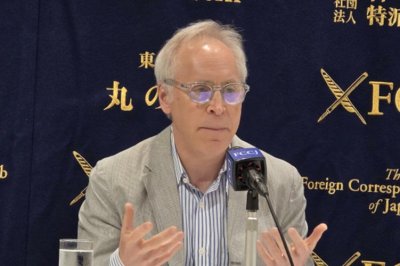
1 of 2 | Jacob Weisberg, chairman of the Committee to Protect Journalists, speaks during a news conference Thursday at the Foreign Correspondents’ Club of Japan in Tokyo. Photo by Asia Today
May 22 (Asia Today) — The head of the U.S.-based Committee to Protect Journalists warned Friday that pressure on press freedom is not limited to imprisonment, killings or direct censorship, saying lawsuits, access restrictions and online attacks can also intimidate reporters and encourage self-censorship.
Jacob Weisberg, chairman of the Committee to Protect Journalists, made the remarks during a news conference at the Foreign Correspondents’ Club of Japan in Tokyo when asked about indirect pressure on journalists in democracies such as South Korea and Japan.
“The issue of reporters being prevented from doing their jobs or being punished in unofficial ways, and the issue of threats and self-censorship, are much more difficult matters,” Weisberg said.
Asia Today asked how the organization evaluates cases in which press freedom is restricted not through direct censorship but through exclusion, intimidation or loss of access, citing press corps-centered reporting restrictions, limits on access to government briefings, defamation lawsuits and online harassment.
Weisberg said the CPJ is still considering how to respond to such issues.
“That does not mean CPJ is not concerned about such issues, but to be fair, we are still thinking about how to deal with questions like that,” he said.
He said the group’s top priority remains helping journalists who face physical danger.
“CPJ’s first obligation is to help journalists who are in physical danger,” he said. “We first deal with cases involving journalists who are imprisoned, abused, tortured or killed.”
But he stressed that this does not mean the organization is unconcerned about more subtle and complicated issues surrounding press freedom.
Weisberg also addressed Japan’s press club system. While saying he did not know enough about Japan, he said he had often heard about the country’s press clubs and the inherent limits of that system.
He said reporters outside press clubs may not have the same access to information and that the system can function as an exclusive channel through which information is delivered.
Weisberg did not equate the issue with censorship seen in authoritarian countries.
“It is not censorship, but it is a lower-level problem than that,” he said.
He also cited the United States, saying there have been no confirmed recent cases of journalists being jailed or killed there, but that the environment for reporters has worsened and become more dangerous in several ways.
He mentioned “media capture,” in which government approval or corporate merger issues can be used as leverage over broadcasters and media companies, as well as concerns over lawsuits and self-censorship.
Referring to the Trump administration, Weisberg also raised concerns about restrictions on White House access for certain media outlets and limits on access to Pentagon briefings.
Restricting government access to the press because of political views is “illegal and unconstitutional,” he said.
On Asia, Weisberg expressed more direct concern. He said that as of May 13, CPJ counted 103 journalists imprisoned across Asia. China had the largest number, with 51, followed by Myanmar with 18 and Vietnam with 16.
Weisberg also said that while Japan has no recorded cases of journalists being imprisoned or killed, worsening press freedom across Asia affects the safety, movement and reporting ability of Japanese journalists working abroad.
He cited the case of NHK Tehran bureau chief Shinnosuke Kawashima, who was arrested in Iran and later released but has not yet been able to return to Japan.
Weisberg said Japan could play a more active diplomatic role in defending press freedom in Asia.
His remarks suggested that press freedom debates in South Korea and Japan should move beyond the question of whether censorship exists and ask who monopolizes information, who loses the right to ask questions and who is pressured into silence.
— Reported by Asia Today; translated by UPI
© Asia Today. Unauthorized reproduction or redistribution prohibited.
Original Korean report: https://www.asiatoday.co.kr/kn/view.php?key=20260522010006683

