court pick

Column: Possible stock market crash means California, Becerra need to wise up

Gov.-elect Xavier Becerra received a welcome card from Sacramento’s premier fiscal guru last week. The message: Current state spending is unsustainable and watch out for a stock market crash.

That’s not the sort of greeting this cautious incoming governor likes to hear. No new governor would, but especially one who isn’t known for boldness and rapid decisions — a career liberal who, like most Democratic politicians in California, cultivates alliances with spending lobbies such as public employee unions and healthcare advocates.

But this particular gloomy message from nonpartisan Legislative Analyst Gabriel Petek should open the eyes of millions more people than the governor-elect and his team of advisors. It’s worth the attention of anyone who has invested money in a retirement account such as an IRA or 401(k).

“U.S. households have dramatically increased their ownership of stocks over the last four years, pushing their stock holdings to 175% above historical norms,” the analyst wrote in his annual California Fiscal Outlook.

“Debt taken on by investors to buy stocks has more than doubled over the last three years.…. Stock prices are at historic highs rivaled only by the dot-com boom.”

You’re reading the L.A. Times Politics newsletter

Expert columnists cover the insights, legislation, players and politics you need to know.

Many of us remember how the dot-com bust deflated our retirement savings.

“While the stock market’s recent run has been great for many investors and the state budget,” Petek wrote, “it now appears to have advanced to a dangerous stage. The risk now facing state revenues is that this boom, like many in the past, will abruptly end in a bust.”

Petek has unassailable credentials. He’s a career market analyst and student of various states’ budgets, including California’s. Before being appointed by the Legislature to be its chief fiscal advisor in 2019, Petek oversaw Standard & Poor’s ratings on California government and had a hand in assessing this state’s creditworthiness.

In Sacramento, lawmakers anxiously listen to what Petek has to say — even if they don’t always follow his advice, which is often a tough sell politically.

“The recent market run-up shares several common characteristics with past speculative bubbles that eventually ended with crashes,” Petek warned. “Enthusiasm builds into a euphoria in which investors go all in on stocks, often taking on large amounts of debt to do so. Stock prices rise so high they become divorced from underlying fundamentals like company profits….

“In fact, the market has moved sideways since June… On top of this, financing for AI might be tightening.”

And as Petek was releasing his report, tech stocks indeed were falling.

In summary, Petek asserted “there is a clear and present risk of a market crash.”

That could severely mess up Becerra’s first year as governor — and his second year and whole term.

He’d either need to dramatically cut spending — including popular safety net programs for the poor — or boldly raise taxes. Probably he and the Legislature would do both, moves that could cost some politicians their jobs.

If stocks crashed, annual state budget deficits would exceed $30 billion, “almost certainly necessitating [spending] cuts or revenue increases,” Petek said.

Targeted for cuts surely would be the programs that Gov. Gavin Newsom and the Democratic-controlled Legislature have expanded in recent years — especially Medi-Cal healthcare for the poor, including undocumented adult immigrants, plus child care and in-home supportive services. There’s a long list.

Of course, everyone — politicians and voters alike — would call for socking the rich harder. They’re easy targets. But we’ve already got the highest income tax rates in the nation and wealthy people have been heading for the border. The top 1% of earners supply between 40% to 50% of the state income tax, which feeds 70% of the state’s general fund.

One reason state finances are in such shambles is our unreliable roller coaster tax system that badly needs to be updated. Politicians never have the guts to do it. Some taxes would be cut, but others raised.

We rely too heavily on rich people’s capital gains. When they prosper, money pours into the state treasury and the politicians spend it. When stocks tumble, the revenue dwindles and we wind up where Petek is warning us about.

Even in boom times, the state couldn’t afford what it did in recent years, Petek wrote: maintain existing programs while adding new ones.

Regardless of whether there’s a crash next year, Petek advises Becerra and the Legislature to prepare for the inevitable by saving more and paying down the state’s “wall of debt.”

If the market does crash, Petek said, it would require the equivalent of another Proposition 3 to balance the state books. That measure permanently cemented the state’s highest income tax rates into the California constitution. So we’d need to push the rates even higher — up to, say, 16%? Forget it.

The most likely ultimate response when the new governor and Legislature enact the next budget: Deja vu. More gimmickry while kicking the can down the road, never throwing it in the trash.

The immediate response from Becerra’s shop and legislative leaders after Petek issued his warning? Essentially mush not worth repeating.

None of this is new, of course. Petek and his predecessors have been warning about overspending, undersaving and an unstable tax system for years. The politicians have basically nodded and yawned.

To their credit, this year they did trim Medi-Cal services for undocumented immigrants — services Becerra would like to restore. They also placed Proposition 2 on the ballot requiring the governor and lawmakers to save more. It passed.

Now, Becerra needs to move unusually fast. He must propose his first budget by Jan. 10.

He’d be wise to soon have a long chat with Petek.

What else you should be reading

The must-read: Ritz-Carlton rooms and a $665 steak dinner: Chad Bianco’s security detail cost taxpayers millions
Law & Order: Can prosecutors block Newsom’s move to wipe out death sentences? It’s unlikely, experts say
The L.A. Times Special: Democrats will soon represent the reddest parts of coastal Orange County in Sacramento

Until next week,
George Skelton

—
Was this newsletter forwarded to you? Sign up here to get it in your inbox.
Source link

Why two blue states voted differently on taxing the rich

These are happy days for California’s super wealthy. (Unless you’re Jensen Huang.)

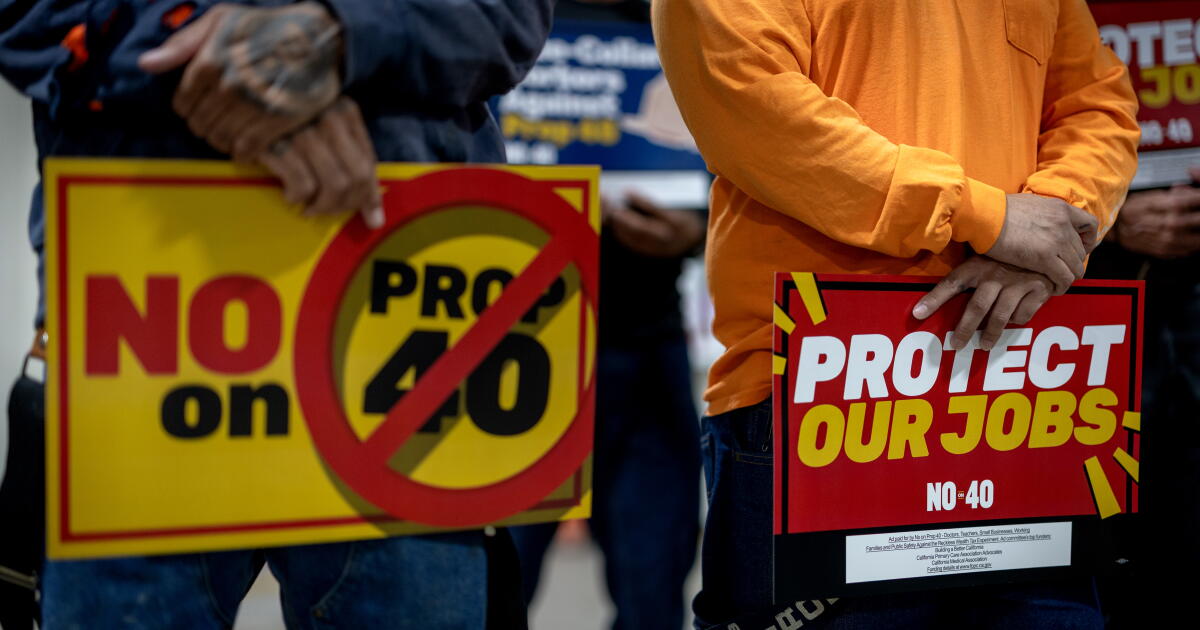
After a phenomenally expensive campaign — financed by some of the self-same members of that upper strata — voters rejected a ballot measure that would have slapped a one-time, 5% tax on billionaires’ assets.

The measure, a first of its kind, was sold as a way to offset federal cuts to healthcare imposed by the heedless Trump administration. The outcome wasn’t especially close: Proposition 40 lost 53% to 47%.

On the very same day, hundreds of miles up the coast, voters in Washington state were asked whether they wished to roll back a new law imposing a 9.9% tax on incomes over $1 million a year.

Washington is a place with no corporate or personal income tax and opponents suggested the “millionaire tax” was a first step — a slippery slope, the proverbial camel poking its snout under the tent — toward a broader tax that would ultimately hit middle- and lower-income residents as well.

Despite that, voters upheld the tax; the result was even more decisive than in California. Washingtonians opposed repeal, 58% to 42%.

The two almost-neighbors, California and Washington state, are deep-blue bulwarks with celebrated tech industries, nagging affordability issues and many of the same animosities and resentments toward a swelling population of filthy-rich tech bros and the rarefied ranks of the 1%. (Like California, Washington has seen the exodus of several of its uber-rich executives, including Amazon founder Jeff Bezos and former Starbucks Chief Executive Howard Schultz.)

“The economy has been helped in many ways in Seattle and surrounding areas by these big companies, but there’s also a real rejection of the ethos that goes with it,” said Mark Stephan, who teaches political science at Washington State University Vancouver. “We don’t want to live in a society up here in the Northwest where things are so out of whack between those who have more and those who have less.”

How, then, to explain the disparate election results?

The establishment strikes back

Perhaps the most significant difference is the opposition that lined up against Proposition 40.

Yes, billionaires spent nearly $400 million to throttle the measure. But money isn’t everything. Witness Texas, where California expat Elon Musk burned through $224 million — like one of his exploding rockets! — only to see the Lone Star state turn blue from the Panhandle to the Rio Grande.

More vital to tanking the wealth tax was the opposition of prominent Democrats — Gov. Gavin Newsom, heir apparent Xavier Becerra, progressive stalwart Katie Porter, to name a few — and the resistance from influential left-leaning organizations such as Planned Parenthood and several of California’s powerful labor unions.

They offered “what I like to call the permission slip” to vote no, said Brandon Castillo, a veteran Sacramento strategist who watched the Proposition 40 campaign from the sidelines. Opponents “had enough groups to either confuse or give that permission slip to those sort of moderate voters, Democrats and decline to state, that are critical to get a ballot measure to pass.”

In Washington state, by contrast, Democratic Gov. Bob Ferguson supported the millionaire tax, which was less ambitious in scope and more straightforward in design — a levy on annual income vs. cumulative wealth — than California’s measure. The tax was also supported by the state’s major labor unions, which helped out-raise the opposition, led by a Seattle-area hedge fund millionaire.

Seeing is believing

Proponents of the tax also benefited from a court decision that allowed a statement on the ballot negatively describing the effect repeal would have on the state’s perennially strained budget. The language, drafted by the state’s Democratic-led attorney general’s office, warned of cuts to education and healthcare in particular.

That was crucial, said Kara Krnacik a Seattle pollster whose surveys found that voters were significantly more likely to support the tax when presented with that warning. “I think that’s what pushed people over the edge,” Krnacik said.

Todd Donovan, a political science professor at Western Washington University in Bellingham, agreed.

“You could see the clear stakes if you voted against it,” Donovan said. “It wasn’t just like a hypothetical…. It was like, these programs are going to go away.”

The vote against repeal isn’t the final word.

The tax, which aims to bring in more than $3 billion a year starting in 2029, seems destined to wind up before the state’s Supreme Court before a single cent can be collected. “Our fight … is far from over,” Brian Heywood, the millionaire hedge fund manager who was the tax’s most prominent opponent, said in a postelection statement.

In California, the verdict on taxing the state’s well-to-do was more mixed.

While rejecting Proposition 40, voters overwhelmingly approved a measure to make permanent a state income tax on high earners — the top 2% — that had been set to expire in 2030. (There was no richly funded opposition.)

Voters also narrowly passed a ballot initiative banning new taxes on an array of personal assets, such as business interests and financial investments, which opponents of Proposition 40 qualified as a poison pill to nullify the result had voters approved the measure.

Despite that, proponents of a wealth tax say they may try again with another ballot initiative in 2028.

Death and skirmishing over taxes: Two of life’s inevitabilities.

What else you should be reading

Get smart:Trump’s troubles at home deepen Asian fears of a pivot toward China
The deep dive: The L.A. mayor’s race is over. Now the scramble is on for elected L.A. County executive
The L.A. Times Special: Newsom, Hegseth, Becerra — who’s in the hottest water? Our columnists discuss
Until next time,
mzb
—
Was this newsletter forwarded to you? Sign up here to get it in your inbox.

Source link

Column: The arrogance of Newsom’s death penalty commutations

Excuse me, but I’m not ready to extol Gov. Gavin Newsom as a heroic leader merely because he intends to grant clemency to all 548 murderers on California’s death row.

He may be headed in the right direction, but has stopped far too short of the ultimate goal of officially abolishing capital punishment in California.

In fact, I see Newsom’s controversial mass clemency as an abuse of power and a tad arrogant. Smacks of laziness, too. Rather than acting unilaterally, Newsom should have spent the time and energy taking a death penalty repeal to the Legislature and voters for their approval.

California citizens rightfully should share in the momentous decision of whether to continue or conclude capital punishment — especially after Newsom previously promised to abide by their will on the matter.

Guiding voters toward ripping up our death penalty laws would have been true gubernatorial leadership.

Yes, I believe the death penalty should finally be wiped off the books as a possible punishment for even the worst of the worst killers in California. Not for moral reasons. Most of these creeps don’t deserve any mercy.

You’re reading the L.A. Times Politics newsletter

Expert columnists cover the insights, legislation, players and politics you need to know.

To be sentenced to death in California, someone must commit more than murder. The murderer must also, for example, rape, torture, kidnap, kill a cop or kill many.

But capital punishment should be eliminated in California on practical grounds. It has long existed in name only. We’ve executed only 13 murderers since California reestablished the death penalty in 1978, and none since 2006. It’s a broken system that doesn’t work.

Yet, it has cost taxpayers billions of dollars to maintain the death penalty pretense, largely for funding inmates’ automatic appeals and special prison treatment. It would be much more efficient and less expensive to just sentence them to life without parole and allow the killers to die naturally in prison without all the court appeals and other extra costs.

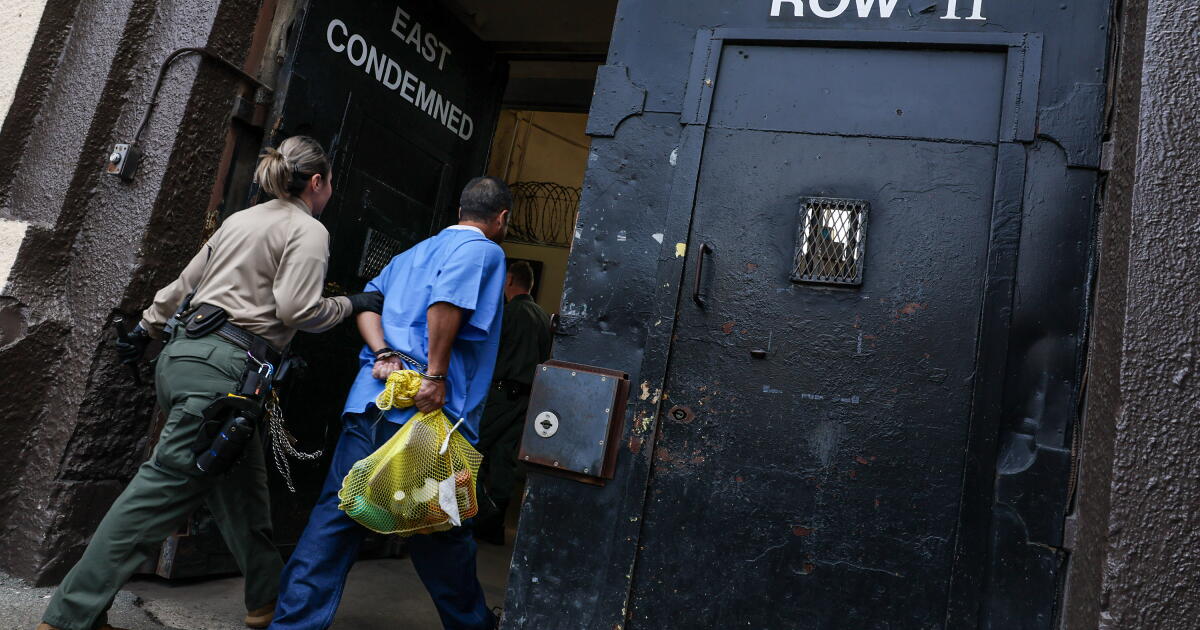
Newsom has been moving toward that on his own. Shortly after becoming governor in 2019, he reneged on his previous vow to follow the voters’ lead and declared a moratorium on capital punishment. Later, he dismantled San Quentin’s actual “death row” and execution chamber, dispersing the condemned killers throughout the prison system.

On Nov. 5, he announced that he’ll commute the death sentences of all murderers awaiting execution, reducing their punishment to life in prison without parole.

But there’s a problematic legal hurdle. The commutation of any death row prisoner who has committed more than one felony must be approved by the state Supreme Court. And 70% — or 382 — of the 548 prisoners Newsom plans to commute have a prior felony.

Not only that, but the court presumably must act before Newsom leaves office in a few weeks. His replacement, Democrat Xavier Becerra, will be sworn in on Jan. 4. Becerra has promised to continue the death penalty moratorium, but has been mum about the commutations, as of this writing.

Unless the court grants blanket clemency to all 382 prisoners without carefully reviewing each case — and this isn’t how the system was intended — the justices’ only option seems to be to ignore Newsom’s request. Otherwise, we’re talking about an impossible workload over the holidays.

Absent court action, Becerra — a death penalty opponent — would be smart to do what Newsom should have: Sponsor a repeal measure on a future state ballot.

Newsom did not even consider that, I’m told. Instead, he exercised his legal authority to go solo.

“The conditions never presented themselves,” he told the New York Times. “So many things got in the way of that.”

Sure, things like spending inordinate time and energy jockeying for position to run for president.

And conditions lacking? Nonsense. His Democratic Party completely dominates the Legislature with a supermajority. And this would have been the perfect year to place a repealer on the ballot and catch the blue wave.

In an open letter to Californians, Newsom said he was commuting all the death sentences because “I firmly believe that state-sanctioned killing is incompatible with California values. … I am compelled to follow my conscience.”

But Newsom’s action wasn’t necessary to spare anyone’s life. Judges and juries are still sentencing some murderers to death. But no California execution is conceivable in the foreseeable future.

Let’s recall the history here.

Voters rejected ballot initiatives to repeal the death penalty in 2012 and 2016. In fact, they voted to expedite executions in 2016 — a fruitless exercise, thanks in part to Newsom’s moratorium.

In 2016, as then-Lt. Gov. Newsom was starting to run for governor, he told the Modesto Bee editorial board that he would “be accountable to the will of the voters” on capital punishment. “I would not [put] my personal opinions in the way of the public’s right to make a determination.”

And in 2018, candidate Newsom again said he didn’t “want to get ahead of the will of the voters,” adding that he desired to “give the voters a chance to reconsider” their previous rejections of repeals.

A broken promise.

Contrast Newsom’s action with how one of California’s greatest governors, Democrat Pat Brown, handled death penalty cases in the early 1960s.

Sure, the world has changed since then. But the death penalty argument is essentially the same. And politicians still should keep their word and listen to voters.

Brown was adamantly opposed to the death penalty. But there were no mass clemencies for him. He carefully weighed each case separately, granting 23 clemencies and sending 36 prisoners to their deaths. He urged the Legislature to repeal capital punishment and narrowly failed.

“The death penalty constitutes an affront to human dignity and brutalizes and degrades society,” Brown said.

“But I have sworn to uphold and faithfully execute the laws of this state. … The chief executive, whatever his personal beliefs, must respect and be guided by the will of the people.”

At least Brown tried. Newsom missed his chance to be a true heroic leader.

What else you should be reading

The must-read: California Democrats plan to investigate Trump but leave a third impeachment off the table for now
Money talks: Voters pass Proposition 42, barring new taxes on personal assets
The L.A. Times Special: Millions of Californians have been cast adrift. For nothing

Until next week,
George Skelton

—
Was this newsletter forwarded to you? Sign up here to get it in your inbox.
Source link

Why California’s Prop. 50 redistricting measure was a mistake

President Trump fancies himself a farsighted man of destiny and if his vision has often proved lacking — witness the Iranian quagmire — he was right about one thing: 2026 was going to be a rough year for Republicans.

That’s typically how midterm elections work for the party in the White House.

And so Trump, knowing the GOP’s House majority was hanging by the slenderest of threads, strong-armed Texas into redrawing its congressional map to boost Republican chances of keeping control by nabbing up to five extra seats.

The move was stunningly brazen — redistricting usually takes place once, early in a decade after the census — and it was a terrible thing to do.

Lest there’s any doubt how your friendly political columnist feels, let us repeat: It was a very, very, very, very, very bad thing. And provocative, at that.

You’re reading the L.A. Times Politics newsletter

Expert columnists cover the insights, legislation, players and politics you need to know.

In response, California — egged on by its White House-hankering governor — passed a ballot measure to gerrymander five of its House seats to give a big advantage to Democrats. With that, the battle was joined. More than half a dozen Republican-led states ultimately ended up redrawing their congressional districts in an effort to bypass voters and predetermine the outcome of the November election.

It didn’t work. (Yay, voters! Way to show who’s in charge!)

But that’s not nearly the end of it.

A mind-blowing election

Last week’s Republican wipeout was beyond anything that anyone, save the most hopium-addled Democrat, could have imagined. The party needed a gain of three seats to flip the House. Democrats are on track to pick up more than 40, despite all that Republican gerrymandering.

And what of those five rigged seats in California? Democrats captured them all.

“We fought fire with fire,” Gov. Gavin Newsom crowed on social media. “And won.”

At least, Newsom did. His headlining role as champion of Proposition 50, his Trump-trolling and online towel-snapping antics have turned the gallivanting governor into one of the party’s most talked-about 2028 presidential prospects.

But the body politic that he yields to incoming-Gov. Xavier Becerra didn’t fare nearly as well.

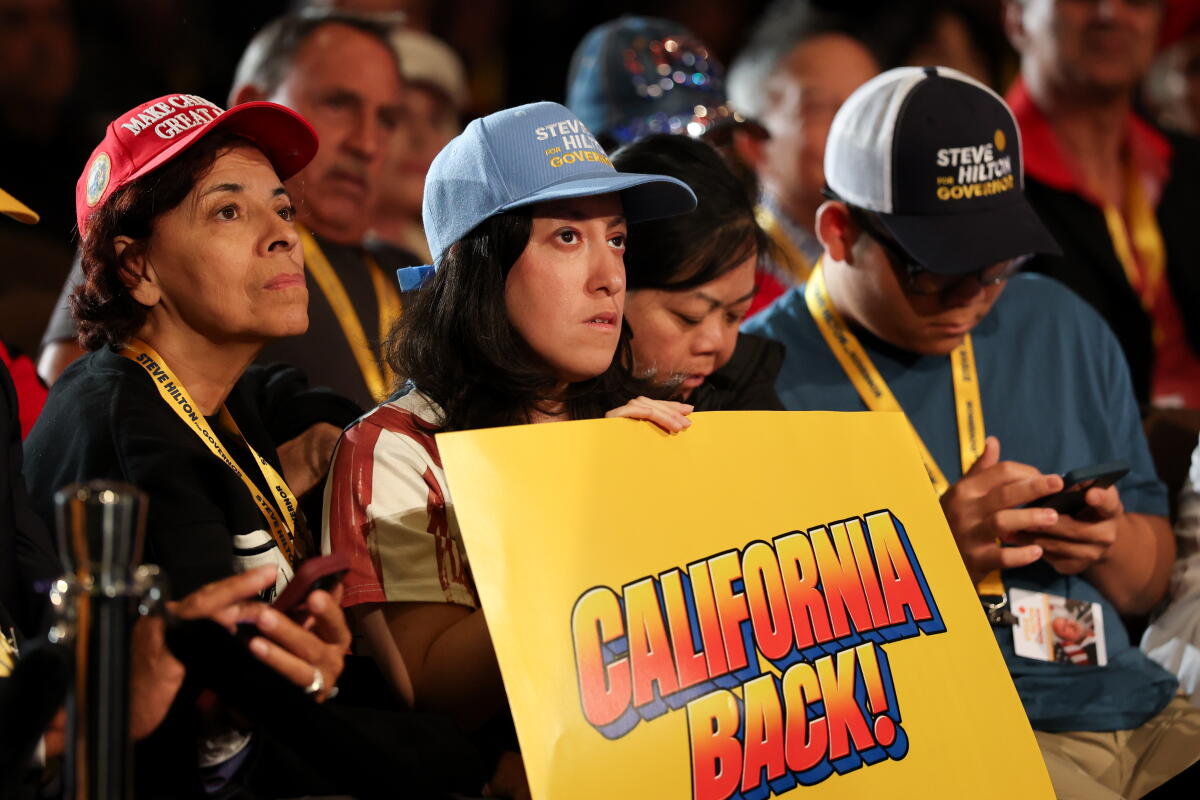
A crowd of people, some wearing caps, and one person holding a yellow sign that says California Back!

Registered Republicans make up 25% of California’s electorate and many more regularly support the GOP. In Garden Grove, supporters await GOP gubernatorial candidate Steve Hilton’s arrival at his election night event on Nov. 3, 2026.

(Allen J. Schaben / Los Angeles Times)

The map drafted to bolster Democrats has resulted in the near-extinction of California Republicans on Capitol Hill. When the next session of Congress convenes in January, the state’s four remaining House members can caucus inside a Toyota Camry, with room to spare.

Consider: Registered Republicans make up 25% of California’s electorate and many more regularly support the GOP. The party’s share of the 52-member House delegation will be less than 8%.

If you’re a fiercely partisan Democrat, a give-no-quarter lefty or someone who’s animating political impulse is to drive your fist into the other guy’s face, this is all lip-smackingly delicious.

For everyone else, not so much.

Especially if you’re one who believes in the representative part of representative democracy and thinks that if our government and political system are to function properly, it’s important that citizens of all stripes and all political persuasions feel as though they’re invested and have a stake. In short, they need to feel as though their voice and their votes matter.

Millions of Californians now have good reason to doubt that.

Anger and agita

We’ve just witnessed an election that amounted to a primal scream. Much, if not most, of the distemper was aimed at the would-be authoritarian in the White House. But a goodly amount of anger was directed at politicians of both parties and a sense they’re focused more on power and their own interests — such as holding on to power — than the needs of those they’re supposed to represent.

In hindsight, it’s obvious that gerrymandering those five California House seats was unnecessary for Democrats to seize the majority. Given the magnitude of the blue wave, it’s quite possible they might have flipped a few of those seats even without partisan tinkering.

But that’s not just assessing the results with a 20-20 rearview.

On the day that voters approved Proposition 50 last November, Trump’s approval rating was already heading south. More than half a century of history shows a strong correlation between a president’s standing in polls and his party’s performance in the midterm election; on average, the opposition party gained more than two dozen seats. So even then it appeared highly likely that Democrats would take control of the House, even if the Texas gerrymander worked as planned.

(It didn’t. Democrats ended up winning four of the five seats the GOP intended to flip.)

Proposition 50, which undid the lines carefully drawn by the state’s nonpartisan, independent redistricting commission, was billed as a one-time, break-glass solution to a political emergency. However, the new map will stay in effect through 2030.

So much for a temporary fix.

Voters should hold Democrats to their word and see to it that the nonpartisan commission resumes its map-making role after the next census. (With California projected to lose anywhere from two to four House seats, Democrats will be sorely tempted to again hijack the process to protect their interests.)

With their new majority in Congress, Democrats should act to ban gerrymandering nationwide. The Problem Solvers Caucus, a bipartisan group, has put forth a proposal to begin that process, demonstrating that support exists on both sides of the aisle.

Gerrymandering is a dirty business, notwithstanding its practice dating to the Colonial era. It needs to stop.

Once and for all.

What else you should be reading

Get smart: In search of post-midterm message, Trump waffles on trusting election, immigration policy
The deep dive:Empowered congressional Democrats gear up for battles over immigration and ICE oversight
The L.A. Times Special:As Stephen Miller rises, California hopes it can blunt his force with Democratic gains
Until next time,
mzb
—
Was this newsletter forwarded to you? Sign up here to get it in your inbox.

Source link

Column: The comeuppance of a despot president

Billions of words have been regurgitated analyzing how Democrats flipped so many Republican seats last week. But all that’s really needed are five: Americans flipped off the president.

My quick in-depth elaboration:

Sure, voters were fed up with a botched war that raised gas prices to an intolerable level. And they were stung financially by nonsense tariffs that jacked up costs for farming, food, manufacturing and household necessities, including Halloween candy. But there was much more.

Americans were disgusted by the bullying, vindictiveness, ICE thuggery, self-enrichment and the president’s vain focus on monuments to himself, including a silly medieval ballroom, a hideous arch and an algae-laden reflecting pool.

Beyond that, they’d lost respect for the Republican lemmings in Congress who were too cowardly to back away from President Trump and chart their own path instead of sheepishly trailing him to the fatal cliff.

You’re reading the L.A. Times Politics newsletter

Expert columnists cover the insights, legislation, players and politics you need to know.

OK, enough of that.

These are other observations from the election:

First, as it turns out, one additional proposition should have been placed on the California ballot: a referendum on the death penalty.

Gov. Gavin Newsom should have shown respect for voters and asked them whether they wanted to abolish capital punishment. Especially since he promised while initially running for governor to “be accountable to the will of the voters. … I would not [put] my personal opinions in the way of the public’s right to make a determination [on] the death penalty.”

Voters rejected death penalty repeals in 2012 and 2016. In fact, they voted to expedite executions in 2016.

But soon after taking office in 2019, Newsom declared a moratorium on capital punishment. And his successor-elect, Xavier Becerra, has promised to maintain the policy. OK.

But last week, Newsom took an unprecedented extra step by announcing he will commute the death sentences of all 548 convicted murderers awaiting execution, reducing their punishments to life in prison without parole.

“I firmly believe that state-sanctioned killing is incompatible with California values,” Newsom declared. That’s his opinion. But he should have asked Californians about their values.

Back to the actual election:

Trump’s and the GOP’s self-immolation was sparked in Texas and that’s where they ultimately perished so dramatically.

The president last year strong-armed Gov. Greg Abbott into gerrymandering Texas’ U.S. House seats so Republicans could pick up five. And that triggered a national gerrymandering war that the GOP lost spectacularly.

Newsom and California smartly countered Trump and Texas by gerrymandering our House districts. Voters agreed by approving Proposition 50. Last week, Democrats gained five redrawn seats in California, while Republicans were losing many in Texas and all over America. Abbott was ousted as governor, and Texas even elected its first Democratic U.S. senator since 1988.

Not even Sam Houston could have saved Texas Republicans on Nov. 3.

Another observation:

Look at the vote count in any California statewide race where a Democrat and Republican competed — whether it was Becerra versus Steve Hilton or some other partisan constitutional office. The voting percentages are the same: roughly 65% Democrat, 35% Republican — landslide numbers in all six races mimicking each other.

What does that tell us? The campaigns and the candidates didn’t matter. All that mattered was whether the candidate was a “D” or an “R.” This is how polarized we’ve become.

Most of us are voting a straight party ticket — a far cry from my parents’ proud boast in the 1950s that they voted “for the candidate, not the party.” That was healthy. This is not, although last week’s blowout in congressional elections was certainly justified.

The blue wave also swept over state elections like an El Niño storm washing away an entire beach front.

Democrats increased their supermajorities in both California legislative chambers, very likely leaving Republicans with their fewest Senate and Assembly seats since the 1880s, according to veteran political analyst Tony Quinn.

Another watershed, of course, was California’s first election of a Latino governor.

There wasn’t even one Latino legislator when I first began covering the state Capitol as a twirp reporter in 1961. Now, the governor-elect and the top leader of each legislative chamber are Latinos. And California’s senior U.S. senator is a Latino.

For decades, California was a purple state that alternately elected Democrats and Republicans to high office. That changed after 1994 when the GOP aggressively backed the infamous Proposition 187 to deny public services, including education, to undocumented immigrants. The measure was ruled unconstitutional. But 187 awakened Latinos politically in California. And the GOP slid into the abyss.

Proposition “187 is where it started. And the party really has never gotten out from under it,” says Quinn, a former Republican redistricting guru.

Trump failed to learn from the California GOP’s fatal attraction to immigration politics. Instead, he angered Latino voters everywhere by brutally corralling brown-skinned people for deportation without cause.

Mike Madrid, a former Republican strategist who wrote a book on Latino politics, says Trump’s “ICE raids terror” was “no question a big part” of what turned Latinos against the GOP after they moved toward the party in 2024.

And in California and Texas, Madrid notes, Latinos jumped at the chance to “elect one of their own” as governor.

“Let me make something crystal clear,” Becerra said in his election night victory speech, “I didn’t run to make history. I ran to make a difference. … California is exceptional, but it is far from perfect. We have a lot of work to do.”

He’ll have no excuse not to make a substantial difference with a record legislative supermajority to help, a friendly Congress and a weakened White House enemy.

In America, we rebel against tyrants. Reread the Declaration of Independence, whose 250th anniversary we’re fittingly celebrating this historic election year.

Across the country, voters chose to rebel against the despot president and Make America Great Again.

What else you should be reading

The must-read: With death sentence clemency, Newsom takes another big political risk
California vs. Trump: Feds move to dismiss case over 20,000 ballots after Supreme Court denied appeal
The L.A. Times Special: What Becerra’s historic win says about Latino political power in California

Until next week,
George Skelton

—
Was this newsletter forwarded to you? Sign up here to get it in your inbox.
Source link

Column: A boring governor is fine. A do-nothing governor is not

Xavier Becerra hasn’t even been elected yet — officially, anyway — and I am already bored.

The Democrat merely seemed to be going through the motions in a plodding gubernatorial campaign he couldn’t possibly lose.

That said, it isn’t a governor’s job to excite any journalist or to entertain the public.

It’s OK for a governor to be boring — Pete Wilson and George Deukmejian, for example — if they can produce results that improve the state and lives of its residents.

California needs a governor who gets stuff done. Boring is acceptable, even in this fast-paced polarized world. But a do-nothing governor who’s just moseying along is intolerable.

We’ve had a showboat governor for nearly eight years. Gavin Newsom and Californians would have been better off if he’d spent more time governing hands-on and less chasing national media and the presidency.

We can’t know yet what kind of governor Becerra will be — except rather boring, most likely. No Jerry Brown or Arnold Schwarzenegger.

Will this 68-year-old career politician with the yardlong resume have the resolve and courage to stand up to special interests — labor as well as business, immigration rights activists and rich techies alike — and make timely decisions they won’t like?

You’re reading the L.A. Times Politics newsletter

Expert columnists cover the insights, legislation, players and politics you need to know.

Decisions such as whether the state should continue rolling back Medi-Cal healthcare benefits for undocumented immigrants.

Newsom and the Democrat-dominated Legislature began providing free Medi-Cal for all low-income Californians regardless of their immigration status. But reality quickly smacked them in the face. The state couldn’t afford the generosity. So the governor and lawmakers began retreating.

Becerra, who will be California’s first elected Latino governor, is the proud son of Mexican immigrants. Will he make the prudent decision to chop more Medi-Cal benefits for undocumented noncitizens, especially in the wake of President Trump’s huge cutbacks in federal healthcare funds?

The new governor will need to act fast on all things involving money. He must send his first state budget proposal to the Legislature by Jan. 10, six days after taking office. For practical reasons, he has to decide by mid-December.

He could kick the can down the road until the annual May budget revision, using the excuse of revenue uncertainty and needing more time for study. But that would be seen by many as a sign of indecisiveness and weakness. Not a good start.

During the campaign, Becerra talked vaguely about the lofty goal of universal healthcare coverage, but never was specific about how he’d achieve it.

He has long advocated “Medicare for all.” But that’s not the same as government-run “single payer,” the dream of Democratic progressives. Medicare for all is, well, just that. And Medicare is not single-payer because it allows for supplemental private insurance. The issue of universal coverage is horrendously complicated and the goal is massively expensive.

Another contentious budget decision Becerra must make soon is what to do about the sputtering bullet train. Scrap it or keep throwing tax money at the failed project that’s decades behind schedule and $100 billion over budget. No tracks have even been laid.

One immediate problem: High-speed rail’s anticipated $1-billion annual funding source from the state’s Cap-and-Invest program is drying up. That’s because industrial polluters aren’t buying permits to emit greenhouse gas like they were. It’s a long story that means short revenue for rail construction.

“We’re going to build the bullet train, but not this bullet train,” Becerra told me in April. “It’s too expensive. Sit everybody down and come out with a position.”

Lately, he has been promising to “clean shop” at the High-Speed Rail Authority and “get this done the right way. We’re not gonna have this overspending.”

OK, but based on his campaigning, Becerra still doesn’t know “the right way.” That’s understandable. No one else seems to either. Take your time, Xavier, but not a lot — or you’ll be seen as part of the problem, like Newsom is.

There’s a long list of nagging state dilemmas we didn’t hear specific solutions for during Becerra’s sleepwalk campaign. He spoke mostly in generalities. Did he not know the fixes? Or was he too risk-averse to speak out? Probably both.

Becerra adhered to the old playbook taught to young political consultants in campaign management 101:

If you’re ahead, hide. When you do emerge from under the bed, avoid risky provocation. It could cost you poll points and potentially the election.

Becerra did get out and jog round the track — never a sprint and always stepping cautiously.

He missed a golden opportunity.

Becerra had nothing to lose. He was a Democrat running against a Trump-embraced Republican in a deep blue state angry at the GOP president. He could have created some excitement by making bold pronouncements about, for example, what he’d do “first thing on Day One.”

He certainly should have participated in more than one general election debate, especially after initially declaring that he would. He performed well in his one debate — coming across as calm, likable and capable.

Becerra should have held more — and more meaty — news conferences with reporters. The few he engaged in were relatively brief and unenlightening, I’m told by colleagues.

He missed a chance to build a solid statewide support base that could help when the postinaugural honeymoon quickly ends.

But that‘s not his natural style. And, anyway, when all the votes are counted, he’ll be a landslide winner.

One smart move at the end: helping Democratic candidates in hot House races by campaigning with them.

Becerra could be just the governor California needs: an experienced pol knowledgeable on most issues — a longtime U.S. House member, state attorney general and U.S. Health secretary.

Importantly, he’s not someone who craves national attention. He’ll be focused on the job he was elected to.

He’ll just need to be bolder, more decisive and move faster than what we saw during the campaign — while having the guts to tell allies “no.”

That wouldn’t be boring. It could be exciting.

What else you should be reading

The must-read: Support dwindles for wealth tax, voter ID ballot measures, new poll shows
CA vs. Trump: Justice Dept. sent subpoenas to L.A. election officials. What that means and what happens next
The L.A. Times Special: Voter guide to the 2026 California general election

Until next week,
George Skelton

—
Was this newsletter forwarded to you? Sign up here to get it in your inbox.

Source link

A guide to Nov. 3 midterm election with history, perspective

Today we discuss board games, snacks and boomerangs.

So where do things stand less than a week from election day?

With the usual caveats, about no certainties in life or politics …

Of course …

…. it seems pretty darned certain that Democrats are going to take control of the House next week, notwithstanding the delusions (or professed confidence) of Speaker Mike Johnson and his Republican allies. The only question is the margin.

Democrats need to flip just three seats, and even the most conservative handicappers (in terms of circumspection, not political views) see them netting more than half a dozen, at a minimum. From there, forecasts climb into the double digits.

“In the best-case scenario,” Erin Covey wrote in a recent analysis for the Cook Political Report, Democrats “could enter the new Congress with more seats than they had after successfully flipping control of the House in 2006 and 2018.”

You’re reading the L.A. Times Politics newsletter

Expert columnists cover the insights, legislation, players and politics you need to know.

Didn’t Republicans gerrymander several states to boost their chances?

They did, starting in Texas. Then California moved to gerrymander its political map, to boost Democratic chances.

That helped precipitate a nationwide redistricting war which, once the haze cleared, resulted in a third of the nation’s 435 House districts being redrawn to at least some extent. But that only marginally increased Republicans’ advantage. And there are signs the rejiggering of political lines may have backfired, or boomeranged, on the GOP.

How so?

By spreading their reliable voters thin and counting on support from 2024 Trump backers who’ve since soured on the president. In particular Latinos. In doing so, Republicans have put several House seats into play, most notably in Texas and Florida.

That’s what’s known in the business as a “dummymander.”

A knife’s edge

What about the Senate?

That remains a toss-up, which few would have imagined at the start of this election season.

Virtually all the contests that will decide control of the Senate are being fought in states that President Trump carried — several by landslide margins — making them not exactly friendly Democratic territory. But war, inflation and Trump’s wretched approval rating have dragged GOP candidates down in states such as Kansas, Mississippi and Texas, which, a year ago, would have required hallucinogens to appear remotely competitive.

So what’s the math?

Democrats need to hold on to all of their seats and gain four to flip the Senate.

While incumbent Jon Ossoff seems certain to win in Georgia, Democratic-held seats in Minnesota, New Hampshire and, especially, Michigan are more problematic. In terms of pickup opportunities, the aforementioned Kansas and Texas are toss-ups, along with Alaska, Iowa, Ohio and Maine. North Carolina seems ready to flip Democrats’ way.

And, who knows, there might be a surprise or two — which, obviously, wouldn’t be a surprise if we’re talking about it here.

One thing to bear in mind: Close races all tend to break in favor of one party or the other. Think of dominoes falling, not checkers hopscotching across the board.

Polls look good for Democrats.

They do. But as both of my faithful readers know, your friendly political columnist can’t stand the constant chattering about polls.

It’s not just how surveys understated Trump’s support the two times he won the White House. (In their defense, pollsters did pretty well in the last two midterm elections, in 2018 and 2022.)

It’s that too many people — including folks who should know better — ascribe a false precision to polls, which at best offer nothing more than an educated guess.

Are the polls again overstating Democratic support?

Could be.

In a recent analysis, the Economist found that polls tend to underestimate a party’s strength in states they dominate. That could mean surveys showing toss-up races in red states such as Alaska, Iowa, Kansas, Ohio and Texas could be overstating Democratic strength.

(Research also has shown that dispirited voters are less likely to participate in a poll, which could mean an oversampling of Democratic sentiments despite quite conscious attempts to adjust and weight the data.)

All of which is to say, ignore the polls and don’t let your hopes get too high, or your mood too low. We’ll have election results soon enough.

What does the early voting tell us?

Nothing dispositive. (That’s a fancy way of saying, again, don’t read too much into those numbers.)

Democrats are evidently way more enthused about voting this election than Republicans. And there have been some eye-popping turnout numbers among Black and Latino voters. But maybe Republicans are holding back to cast their ballots closer to or on election day.

Things will be abundantly clear after the fact, as they always are.

Table stakes

How about all the money Republicans — and Elon Musk — are pouring into the election?

It’s gross. But money alone is not determinative.

Just ask Tom Steyer, who spent the GDP of a small country on his failed run for California governor. Or Trump, who was outspent by Hillary Clinton nearly 2-to-1 when he was elected in 2016.

A certain amount of money is necessary to compete; it’s like the table stakes required for a serious competitor to get into the race. Beyond that, factors like candidate performance, external events and, especially, the overall political climate matter a good deal more.

The big Republican money advantage can help drive turnout, which is no small thing, especially if it helps coax reluctant GOP voters to the polls. But elections aren’t like vending machines, where the more money you put in, the more you take out.

Thankfully, we haven’t reached a point where public office can be purchased automatically like soda or a candy bar. At least not yet.

So get out and vote, or make a plan to, if you haven’t already.

What else you should be reading

Get smart: Many Latinos are done with Trump. The shift is especially striking in Texas
The deep dive: “A butter knife against a nuclear arsenal:” Tech billionaires vastly outspend wealth tax supporters
The L.A. Times Special: Skelton: Need help deciding on the state ballot measures? Here are my recommendations
Until next time,
mzb
—
Was this newsletter forwarded to you? Sign up here to get it in your inbox.

Source link

Need help deciding on the state ballot measures? Here are my recommendations

You haven’t voted yet because the state propositions are too bewildering? I’m with you. There are too many for normal human consumption. But I’ve figured them all out at last.

I’ve concocted my own personal voter information guide that I’ll share here. Heads up: I’m negative on most measures, including some expected to pass.

Anyway, here’s my thinking:

Proposition 1: Affordable housing bond

The state would borrow $11.25 billion for affordable housing programs, mainly to provide below-market rentals for poor people. Students and farmworkers also would benefit minimally. So would military veterans through the CalVet program. The proposal is packed with goodies aimed at drawing broad political support. Which it has.

But it’s an expensive item — costing the state at least $500 million annually for 25 years. Taxpayers already are paying about $6 billion annually to retire $80 billion in bond debt.

This measure is too costly given our fragile, chaotic state budget. There should have been more prioritizing. I’m a “no” vote.

Proposition 2: Doubles the state’s ‘rainy day’ fund

It requires the Legislature to pour money into the state savings account until it reaches 20% of general fund tax revenue, rather than the current 10%. The fund can be tapped when the economy sours and revenue falls.

Sure, save away if you can. Yes.

Proposition 3: Makes high tax rates permanent

This would cement the nation’s highest state income tax rates into the California Constitution — up to 12.3%, affecting the top 2% of earners with incomes above $371,000 for single filers and $743,000 for married couples. (Million-dollar earners pay an added 1%.) The money helps fund schools, healthcare and other state programs.

The high rates were sold to voters as temporary in 2012. Later, voters extended them until 2031.

My hesitancy: Tax rates should not be embedded in the constitution where they can only be altered by voters. The governor and legislators should do their jobs and update our volatile state tax system. Moreover, “temporary” shouldn’t be translated into “permanent.” And there’s no rush. The rates don’t expire for five years. No.

You’re reading the L.A. Times Politics newsletter

Expert columnists cover the insights, legislation, players and politics you need to know.

Proposition 4: Repeals ban on public financing of election campaigns

This would allow the state and local governments to create partial public financing systems for political candidates. “Charter” cities such as Los Angeles and San Francisco already can.

Look, either wealthy donors and special interests buy the politicians or the public does. Anyway, if a few major cities are permitted to enact public financing, all cities should be. Yes.

Proposition 5: Changes recall elections

Currently, voters decide two questions in a state recall election: 1. Should the official be recalled? 2. Who should be the replacement? Under this proposal, only the first question would be asked. Any replacement would be determined by the normal non-recall process. Depending on the office, that usually ends up in a special election.

This makes lots of sense. Too many shabby games have been played with the present bifurcated system. Yes

Proposition 37: Down payment loans for home buyers

Middle-income buyers could take out a second mortgage to cover most of their 20% down payment on a newly constructed home. They’d need to dig up only 3% in cash. The program would be financed by a $25-billion state revenue bond, repaid by home buyers. Lending institutions would qualify the borrowers and take the risk, costing the state zilch.

This makes sense. Easy yes.

Proposition 38: Medical research bond

The state would borrow $8.4 billion to fund research into cures for cancer, heart disease, Alzheimer’s and other ailments. The state cost: at least $500 million annually for 20 years.

My hang-up is that the measure was crafted to assure that half the money goes to one institute, whose billionaire founder is the proposition’s chief backer. State money should be available to all potential bidders. No.

Proposition 39: Voter ID

This would force everyone to show a government ID before being allowed to vote. Those casting mail ballots would need to write a four-digit PIN on the back of the return envelope.

There’s simply no evidence of widespread voter cheating anywhere. This measure is unneeded and would just hassle voters and slow the vote count. Flat no.

Proposition 40: The billionaire tax

It would impose a one-time 5% tax on billionaires’ worth, probably raising tens of billions of dollars. Ninety percent would go to healthcare to replace federal funding cutbacks.

This is nutty. There’s no such thing as a temporary tax. Proposition 3 is an example. We shouldn’t have a one-time tax anyway. It’s like a sugar high that quickly wears off. Then what? Who’s next to have their wealth taxed? Want a wealth tax? Make it national to keep billionaires from fleeing California with their riches for more friendly states. No way.

Proposition 41 and Proposition 42: Twin poison pills

Ignore their superficial intents, the sole purpose of both measures is to invalidate the billionaires tax.

I don’t like Proposition 40, but I also detest deceptive games-playing with ballot initiatives. They should be discouraged. No.

Proposition 43: Raises vote requirement for local tax hikes

Currently, special tax increases placed on a local ballot by citizen signature-collecting require only a simple majority vote. This measure would increase the threshold to two-thirds, the same as if proposed by a city council or county supervisors board.

It’s ridiculously confusing. But I don’t like two-thirds requirements for taxes because a minority of voters can overrule the majority. That’s undemocratic. No.

The low-profile measure would require local nonprofit clinics caring for poor people to spend 90% of their funds on health services.

This smacks of a failed negotiating tactic by the union sponsor of the billionaires tax. Many clinics say they’d need to close shop. No.

Proposition 45: Regulatory streamlining for building projects

This would substantially overhaul the environmental protection act that has kept California less polluted from development projects. The act also has been sorely abused and used as a tool to stop projects, particularly housing. This measure would make it easier to build, not just housing but many things, such as water facilities, clean energy, giant warehouses and freeway expansions.

It goes too far, enabling sprawl and leaving citizens with fewer weapons to fight projects. The Legislature has been trimming home building regulations and should continue. No on 45.

Happy voting. I’m glad I didn’t vote early so there’d be time to bone up on this hodgepodge.

What else you should be reading

The must-read: “A butter knife against a nuclear arsenal”: Tech billionaires vastly outspend wealth-tax supporters
Against the wind: Hope and despair simmer among California Republicans ahead of election day
CA vs. Trump: ‘This is not normal’: Feds demand California counties set aside ‘likely’ noncitizen ballots

Until next week,
George Skelton

—
Was this newsletter forwarded to you? Sign up here to get it in your inbox.
Source link