Measure G, propelled by Horvath, will result in expanding the Board of Supervisors from five to nine members in 2032 and create a new county chief executive position, with an election in 2028. It passed narrowly, with 51.6%.
It also called for creating a county ethics commission and an ethics compliance office. Other branches of government already have this, including the city of Los Angeles, where the commission’s duties include overseeing campaign finance, such as the matching funds program for political candidates. The commission also regulates lobbying and can issue penalties for fundraising and other infractions.
The Measure G governance reform task force is setting everything up, but officials realized that for true independence, the seven-member commission and the compliance office must be permanently enshrined in the county charter. That requires the approval of voters.
Establishing the commission and the compliance office, Horvath said in a statement in May, “delivers on the will of the voters and marks a monumental step toward greater transparency and accountability in County government.”
Justin Allen Clayton, L.A. County deputy public defender
Bar rating: Qualified
Clayton is a Los Angeles native who attended public schools, earned a bachelor’s degree in criminology and passed the bar in 2012. He joined the public defender’s office two years later and since 2023 has served as deputy in charge of the Inglewood branch.
Clayton describes himself as a “working supervisor” who conducts arraignments and represents clients at preliminary and other hearings. He has completed dozens of trials, including three with life sentences, according to his website.
The position involves overseeing and training attorneys, as well as law clerks and summer interns, on misdemeanor and felony case preparation and trial strategy.
Clayton said a priority is improving court efficiency through pretrial preparation and “firm but fair enforcement of deadlines.”
Time as a candidate, he said, has shown him the importance of effective communication within the court system in bridging language and cultural differences. He called that a guiding principle, particularly for clients who lack counsel.
“Sometimes, one additional question, or one additional statement, can make all the difference in resolving an issue,” he said.
Clayton said running a public defender branch office, which brings him in contact with judges, sheriffs, court clerks, interpreters and others, combined with 14 years as a trial attorney, gives him a “comprehensive understanding” of the courtroom.
“That combination of courtroom experience, leadership and daily interaction with the many people who make our justice system work has uniquely prepared me to serve as a Superior Court judge,” he said.
Anna Slotky Reitano, L.A. County deputy county counsel
Bar rating: Qualified
Reitano spent the early part of her career in criminal defense, contract law and other sectors. In 2014, she joined the L.A. County public defender’s office. A decade there included three years in juvenile court, where she primarily handled felony cases, and five years at the San Fernando Courthouse, where she represented indigent clients facing felony charges.
Reitano focused on mental health diversion and treatment, aiming to support rehabilitation when possible. Having a brother with schizophrenia and witnessing how families navigate the legal system when dealing with mental illness has informed her approach.
“This has given me a deeper understanding of both the challenges individuals and families face and the ways in which the system can fall short in addressing those needs,” she said.
This is not her first bid for office. She lost a campaign for a judgeship in 2022 and two years later assumed her position in the county counsel’s justice and safety division, where she supervises litigation and advises county departments.
Reitano, a former child actor, volunteers with local schools and, according to her website, mentors “future lawyers” through moot court competitions.
Campaigning, Reitano said, has shown her that constituents, no matter how different, uniformly want “a judge who is experienced, prepared, fair and willing to listen.”
“My experience across criminal, juvenile, civil, administrative and government law has uniquely prepared me to serve wherever the court needs me,” she said.
The measure is backed by four of the five supervisors. During the February meeting, Horvath, who authored the initial motion, said that binding arbitration would promote transparency and push the sides to reach a deal. She said that 21 California jurisdictions, including Sacramento and San Francisco counties, have implemented binding arbitration.
Supervisor Hilda Solis called this “another tool in the toolbox.”
A battery of labor unions representing county workers are on board, including the International Assn. of Firefighters Local 1014, the Assn. for Los Angeles Deputy Sheriffs and the Los Angeles County Lifeguard Assn.
Dave Gillotte, president of IAFF Local 1014, which represents more than 3,000 L.A. County Fire Department employees, said contract negotiations with the county generally are intense and lengthy. He said the goal is never having to resort to binding arbitration, but that if required, this would allow a “neutral third party” to make the final decision.
“Binding arbitration really brings about leverage to move both parties to work hard to get a contract done, where we don’t have that now,” Gillotte told the Times.
Former Long Beach Police chief Robert Luna came out of retirement to run for sheriff in 2022, promising to turn around a department that had veered off course.
As someone who didn’t have the wide name recognition or countywide political experience of some of his challengers, Luna’s second-place finish to Villanueva in the primary was far from guaranteed, but he ultimately cleared the rest of the field by a wide margin.
Fast-forward four years to June, and Luna received 44.2% of the vote in this primary — less than six points short of winning the race outright — versus Villanueva’s 21.7%. And Luna’s been a more effective fundraiser, bringing in $366,000 since Jan. 1, more than three times the nearly $109,000 Villanueva had raised by June 30, according to their most recent campaign filings. Luna had $352,000 in the war chest as of June 30, and Villanueva had about $56,000.
But Villanueva has wide name recognition in L.A. County. And he pulled off a historic political upset of his own in 2018 when he beat Sheriff Jim McDonnell, who is now the Los Angeles police chief. It was the first time an incumbent L.A. County sheriff lost a reelection campaign in more than a century. It was also the first time in 100 years that a Democrat had been elected to the nonpartisan sheriff’s job.
After running on a progressive platform and pitching himself as a criminal justice reformer, Villanueva tacked hard to the right. Within two years he was a favorite of conservative media, including Fox News, where he appeared repeatedly to vilify “woke” culture and criticize Democrats. He ultimately switched his party registration to Republican in a move that solidified a new base of law-and-order supporters while alienating many who supported him in 2018.
Villanueva’s tenure was marked by controversy and scandal. He launched, then walked back a criminal leak investigation of a Los Angeles Times reporter and was ordered to testify after sheriff’s deputies took and shared pictures at the site of Kobe Bryant’s helicopter crash. Villanueva defied subpoenas over so-called deputy gangs.
Now, Luna is the one defending his record as sheriff over the last four years. He’s presided over declines in homicides and violent crime and established a period of relative calm after the stormy Villanueva years. But Luna’s department has come under scrutiny in the wake of a July 2025 incident in which a grenade exploded accidentally in a department parking lot, killing three deputies. The state has fined the department more than $350,000 after identifying a series of safety violations leading up to the blast.
And the Civilian Oversight Commission filed suit against the department in June for declining to provide certain records related to three cases of use of force the commission issued subpoenas for in February 2025. Luna has said the county’s attorneys maintain that the unredacted records can’t be released until it completes a “meet and confer” process with the Sheriff’s Department union, a claim that watchdogs have disputed.
Vintage-inspired mini golf in San Clemente. Mai tais on a sunken ship in Anaheim. Sprawling red rocks in Trabuco Canyon. It’s time to go deeper into great, big, always juicy O.C.
Federal investigators have sent Los Angeles County elections officials at least five grand jury subpoenas for individual voter records as part of a criminal investigation into illegal voting, according to partially redacted records reviewed by The Times.
The subpoenas — released in response to a public records request — appear related to a nationwide effort by the Trump administration to identify noncitizens who have illegally cast ballots in U.S. elections.
The subpoenas were issued in the U.S. District Court for the Central District of California. They were sent to L.A. County Registrar-Recorder/County Clerk Dean Logan’s office at the request of prosecutors in the office of First Assistant U.S. Atty. Bill Essayli.
“The enclosed subpoena has been issued in connection with an official criminal investigation being conducted by the Department of Homeland Security, Homeland Security Investigations,” Assistant. U.S. Atty. Michael Wheat — based out of the district’s Orange County office — wrote in a letter accompanying a Sept. 10 subpoena.
Wheat wrote that a custodian of records from Logan’s office must either appear before the grand jury to present the records or deliver the materials to a special agent from Homeland Security Investigations.
Four of the subpoenas — one issued on July 13 and three on Sept. 10 — request “any and all original and non-redacted voter records” from Jan. 1, 2020, to the present for a list of individual voters stretching across two pages. The lists were redacted by Los Angeles County officials, and it is unclear how many individuals each list contained.
Each of those subpoenas notes that records to be produced include information on individual voters, such as their “registration file” and “addresses listed, history and method of voting, [and] any and all attestation regarding citizenship status.”
A fifth subpoena, issued July 31, appears to request similar information for a single voter, and notes that the voter’s “ballot content or vote selections” should not be included.
Ciaran McEvoy, a spokesman for Essayli’s office, declined to comment on the investigations Monday.
The Times first reported the existence of the subpoenas, but not details from the records themselves, last week, after Logan confirmed that his office was complying with the federal inquiry despite having concerns that investigators may be using incorrect or outdated information to produce their lists of voters to investigate.
“We’re responding appropriately as directed through a subpoena, but that doesn’t afford the dialogue for us to get the background on what they’re looking for and how they came up with the names that they did,” Logan said. “There’s really no information being provided to us on that.”
President Trump has alleged for years that illegal voting by noncitizens is widespread, though experts say the problem — which they acknowledge occurs — is exceedingly rare. Homeland Security officials have been leading a campaign in recent months to identify such fraud nationwide, and the subpoenas received by L.A. County appear to match others received by elections officials elsewhere in the country.
Essayli — a Trump loyalist who has not been confirmed to lead the Los Angeles prosecutor’s office by the U.S. Senate and whose de facto leadership has been contested in court — has been vocal about his office’s pursuit of voter fraud, including by noncitizens.
His office has announced two voter fraud cases in recent weeks, including one involving the arrest of 30-year-old Honduran national on two felony charges of falsely claiming U.S. citizenship and fraudulently registering to vote. That man, Darwin Jonathan Rivera-Flores, has pleaded not guilty and is out on bond pending trial.
Rivera-Flores and his attorney declined to comment.
The Justice Department also recently announced it had charged 16 noncitizens in six other states with illegal voting and other election-related crimes.
Homeland Security Secretary Markwayne Mullin publicly claimed in July — without providing evidence — that there may be more than 190,000 such voters on California rolls, a claim California officials dismissed as baseless.
Three of the five subpoenas received by Logan’s office ask that the voter information be shared with Al Rossi, the acting assistant head of Homeland Security Investigations in Los Angeles.
Reached by phone, Rossi referred questions to an agency spokesperson, who did not respond to a request for comment.
Wheat had asked that the subpoenas be kept secret, so as not to impede an open investigation. Logan’s office released the records in accordance with California public records law, but redacted the names of voters on the grounds that doing so “protects those individuals from undue attention, harassment, intimidation, or possible harm” and “protects the integrity” of the investigation.
The U.S. Supreme Court on Friday upheld Trump’s expanded use of government data to search for noncitizens who are registered to vote. A lower court order had blocked use of the data over concerns — shared by the Supreme Court’s liberal wing — that the data are error-prone.
Voting rights experts have expressed concern that misuse of the data could lead to legitimate voters being purged from rolls.
States across the country, including California, have successfully fought off lawsuits from the Trump administration demanding the states’ complete voter rolls.
It is unclear why a subpoena for a single voter’s information would come between subpoenas for information on longer lists of voters. But it lines up with the case against Rivera-Flores.
In an affidavit filed with a criminal complaint against Rivera-Flores, Special Agent Christopher Kuzma — the same agent listed on the July 31 subpoena requesting a single voter’s information — said he received a series of texts he believed were from Rivera-Flores, who had previously been issued a misdemeanor citation on suspicion of disrupting immigration law enforcement operations at the federal building in Camarillo.
One text sent in April 2026 stated, “Your not the good guy I can’t wait until the mid terms you dont have qualified immunity then we can start and indict all you guys one bye one.”
Kuzma said in his affidavit that he took the message to mean Rivera-Flores “has both an interest in the voting process and an intent to participate in the election process.”
According to the affidavit, Kuzma said he conducted several record checks through public databases, including on the California secretary of state’s website, which “disclosed an online voter registration record” for a “Darwin Rivera” at Rivera-Flores’ address.
In July 2026, Kuzma said in the affidavit, he reviewed records from California Secretary of State Shirley Weber’s office for “Darwin J Rivera,” which showed the applicant had checked a box stating he was a U.S. citizen.
Kuzma’s affidavit said in August 2026 he received certified voter registration records from Los Angeles County.
The spokesman for the U.S. attorney’s office did not respond to a question about whether Kuzma’s July 31 subpoena was specific to Rivera-Flores, but the office has previously said Wheat is prosecuting the case.
When Rivera-Flores’ arrest was announced, Essayli said it was “the first of many to come.”
Championship titles are constructed on a bedrock of solid sessions interspersed with the occasional spectacular one – and Hain and Barnard’s efforts were the epitome of solid.
Resuming on 130-4, already five runs in front, they added 51 without loss in a morning session truncated by bad light.
Hain and Barnard did exactly what their team required, advancing steadily to lay the platform for a big lead and potential innings victory.
The Bears’ fifth-wicket pair continued to concentrate hard after lunch until, with the lead already 126, Barnard departed livid with himself at edging a big drive at a wide ball from Ben Green – just 12 shy of a century.
Chris Woakes chipped his second ball to mid-on, but Kai Smith and Manny Suthar enjoyed useful cameos before also falling to the persevering Hull.
They had accompanied the excellent Hain towards his century which was greeted by a standing ovation from the big audience, then Bamber added further useful runs before being bowled by a beauty from Patel.
Even then the Foxes’ frustration went on as last pair Hain and Olly Hannon-Dalby added 35.
Leicestershire opener Sol Budinger then came out firing, hitting 43 not out off 36 balls, But Bamber struck twice in three balls, trapping Sheridon Gumbs and then flattening Rishi Patel’s off-stump two balls late.
After a bad-light interruption, Woakes then pinned Steve Eskinazi lbw in the gloom to leave Warwickshire maybe only one strong session away from the title.
The California Supreme Court excoriated Riverside County Sheriff Chad Bianco over his seizure of hundreds of thousands of Proposition 50 ballots earlier this year, ordering the former gubernatorial candidate to immediately hand over all remaining material in a pair of scathing decisions on Thursday.
“We hold that the seizure of the ballots was unlawful,” wrote Chief Justice Patricia Guerrero. “While allegations of election improprieties are a very serious matter, our Elections Code contains numerous established mechanisms for investigating and proving misconduct that do not compromise the integrity of voted ballots — contrary to the means employed here.”
The ruling comes less than two weeks before Californians will start casting ballots in the race for governor and a handful of hotly contested congressional midterms — nationally watched elections that would be vulnerable to similar interference unless the court gave clear orders, advocates warned at oral arguments last month.
“It’s bound to be repeated again,” said Chad W. Dunn of the UCLA Voting Rights Project, which led the first of two election interference suits against Bianco, a popular MAGA personality and former Republican candidate for governor.
Bianco has long flirted with President Trump’s election fraud conspiracy movement. Though the ballot seizures in February were widely seen as a campaign stunt, the legal theory behind them — that local lawmen can commandeer voter materials from elections officials, and that sheriffs are unanswerable to officials who outrank them, including attorneys general — belongs to a larger “constitutional sheriffs” ideology.
California‘s seven Supreme Court justices appeared by turns perplexed by and incredulous of those theories during oral arguments last month.
“You are walking into a very dense thicket of very specific laws that govern elections in particular and I think it’s a very established cannon of interpretation that the specific trumps the general,” Justice Goodwin H. Liu said.
The ballot battle emerged from a Riverside County pilot program meant to boost voter confidence, a handwritten tally that ultimately fell about 46,000 votes short of the official count, sparking claims of fraud.
Riverside County Registrar of Voters Art Tinoco met with the county board of supervisors and the citizens’ group behind the claim and carefully explained how the discrepancy emerged. Yet, Bianco pursued warrants to seize more than 650,000 ballots, alleging they were evidence in an investigation of wide-ranging election fraud.
When he learned of the warrants, California Atty. Gen. Rob Bonta ordered Bianco to stand down. Instead, the sheriff accelerated his plans, dispatching armed deputies from Riverside County’s Special Investigations Bureau, Emergency Response Team and SWAT unit to sweep up the votes.
Later, Bianco directed his underlings to begin counting those ballots by hand — a potential felony under state law, which forbids anyone other than an election official from so much as touching a ballot container.
When Bonta again ordered him to stop, Bianco argued the attorney general had no authority to command him, later claiming in court that the law conferred only an “advise and consent” role.
In fact, California courts have spent more than a century delineating power between the state’s attorney general and local sheriffs and prosecutors. Voters took the matter a step further in 1934, endorsing a ballot initiative that clearly named the attorney general as California’s top law enforcement official, and put the state’s other lawmen beneath him.
In a footnote, justices also took a swipe at Bianco’s initial effort to have the case tossed for lack of standing — a move apparently undertaken on the legal advice of an elaborate artificial intelligence hallucination.
“In his preliminary briefing, Bianco challenged petitioners’ standing based on misquoted passages from, and an incorrect recitation of our holding in, Common Cause v. Board of Supervisors,” Guerrero wrote. “We disapprove of the improper use of artificial intelligence tools, which apparently contributed to the significant error that occurred here and remind counsel of attorneys’ professional duties of competence and candor to the court.”
Los Angeles County officials aim to break ground on the new Eaton Canyon Nature Center before 2028, with plans to construct a facility that can withstand the region’s changing climate and future disasters.
The previous nature center, which replaced the original Robert M. McCurdy Nature Center that burned down in 1993, was destroyed in the Eaton fire last January. The fire not only destroyed the structure but also a large library and several decades’ worth of archives, and it also killed the reptiles that lived inside the center.
It took about five years to rebuild and open the last nature center. L.A. County Parks Director Norma Edith García-Gonzalez said after the design phase is completed, which could be soon, the county and the architect firm hired for the project will plan out the construction phase.
“We modeled 100-year patterns of wind, fire and flood so that when we build back, we are building back with resistance, and that is able to guide how we plant [and] what type of plants, and how we build, [including] how we build back trails,” García-Gonzalez said.
Norma Edith García-Gonzalez, director of L.A. County Department of Parks and Recreation, speaks during an Eaton Canyon design meeting in mid-September.
(Kayla Bartkowski / Los Angeles Times)
The biggest impediment to rebuilding, though, is funding. The county has about $16.2 million in state money, about half of what county officials think is needed to build a new nature center, she said. García-Gonzalez said she hopes the philanthropic community will step up to fill the gaps, but county leaders have noticed that “philanthropy goes from one hot issue to another,” and interest to donate to fire recovery is cooling.
In this week’s edition of The Wild, our weekly outdoors newsletter, I will provide an update on the design plans for the new nature center and when we can expect to hike again in Eaton Canyon — and how you can help with the canyon’s restoration too.
You are reading The Wild newsletter
Sign up to get expert tips on the best of Southern California’s beaches, trails, parks, deserts, forests and mountains in your inbox every Thursday.
By continuing, you agree to our Terms of Service, which include arbitration and a class action waiver. You agree that we and our third-party vendors may collect and use your information, including through cookies, pixels and similar technologies, for the purposes set forth in our Privacy Policy such as personalizing your experience and ads.
First, let’s discuss a little bit of the history of the area.
The Eaton Canyon Natural Area, managed by L.A. County Parks and Recreation, is a 190(ish)-acre swath of land at the foothills of the San Gabriel Mountains near Altadena.
“Originally called ‘El Precipicio’ by the Spanish settlers because of its steep gorges, it is now named after Judge Benjamin Eaton, who built the first Fair Oaks Ranch House in 1865 not far from Eaton Creek,” according to the Eaton Canyon Nature Center Associates, a volunteer-run education and stewardship group. “Judge Eaton was the first to use irrigation from the creek to grow grapes on the slopes.”
The canyon has long been a fascination of adventuresome L.A. residents.
The hike to Eaton Canyon Falls in the San Gabriel Mountains before the Eaton fire last January.
(Myung J. Chun / Los Angeles Times)
In 1921, writer Frances Mathilda Purdy wrote for The Times that few people knew of the “hidden, but very easily accessible waterfall” in Eaton Canyon. Purdy outlined a few ways to access the canyon and reach the falls, including a shorter route where visitors “after alighting from motor, or stage,” could take a small flight of stone steps near the Mt. Wilson Toll Road bridge.
I chuckled when I read Purdy’s suggestion that this particular route was “perfectly comfortable for those who have arrived on the scene in city garb.” Apparently, underprepared hikers have been coming to Eaton Canyon for more than 100 years. What do you think was the 1920s version of hiking in flip-flops?
For the more rugged adventurer, Purdy laid out a “serpentine trail” that leads to “such lovely possibilities for the pleasure-seeking jaded worker, who, from only one afternoon spent in this quietly entrancing corner of the great outdoors, will return, refreshed and invigorated to meet the daily grind with a mind stored full of the charm of Lower Eaton Canyon.”
Architect Anne Mooney of Sparano + Mooney Architecture speaks about a site plan for the next Eaton Canyon Nature Center.
(Kayla Bartkowski / Los Angeles Times)
It wasn’t until 1930 that Pasadena set aside property that the city owned for a bird and game sanctuary in Eaton Canyon and Eaton Wash, preserving the land from development, according to a historical record compiled by the nature center associates.
There was interest in doing more.
Pasadena Park Superintendent Gilbert Skutt, who served from 1923 to 1936, wanted to see a large scenic public park in Eaton Canyon similar to what the city had built along the Arroyo Seco, according to city records. “He sought to correct the imbalance in the distribution of park space in Pasadena, which favored the west side of town,” according to a historical document. “During the Depression, however, the city could not afford to purchase the land.”
Over time, the city started working with county officials on Eaton Canyon Regional Park, eventually giving the entire project to the county.
In 1931, the L.A. County Board of Supervisors considered financing a 1,000-acre “gigantic regional park system” for the area, according to The Times’ archives, but that idea apparently never fully came to fruition.
Thankfully, in 1950, landowner Mary Beatrice Fox sold the canyon portion of her property to L.A. County to use for a park, “with a provision that mammals are not to be kept in cages,” according to a park history compiled by the Eaton Canyon Nature Center Associates.
A hiker slips in a creek in Eaton Canyon after a 2023 storm.
(Wally Skalij / Los Angeles Times)
Then, in 1958, naturalist Louise A. Luckan moved her “nature appreciation operation from the Eaton Canyon Golf Course to Eaton Canyon Park,” according to the organization’s history.
Soon, L.A. County officials set aside $154,797 — about $1.7 million in today’s dollars — for the Robert M. McCurdy Nature Center. They had big plans for the facility, which was to include two classrooms, an office, museum, library, display area, gift shop, laboratory and an auditorium that could seat 200.
“This park will be an outstanding facility — the only one of its kind in magnitude this side of Chicago,” Supervisor Warren Dorn said in a 1962 Times story.
The nature center opened in 1963, and became popular among scouting and school groups, to whom naturalists taught about the local flora and fauna. By the early 1970s, more than 2,000 school children were regularly attending lectures at the nature center, according to Times archives. The students wrote thank-you notes to the park staff, including one that read, “I think it was nice of you to buy this park instead of someone buying it for houses and factories. Because if they did, it would ruin this beautiful land.”
L.A. County sustainability policy director Rebecca Ferdman talks with community stewards about how to educate and engage the public about the goldspotted oak borer, a pernicious invasive beetle that destroys oak trees, during a meeting at Eaton Canyon Nature Center in 2024.
(Brian van der Brug / Los Angeles Times)
But, in 1993, the canyon’s first nature center was destroyed by the Kinneloa fire. The next nature center didn’t reopen until 1998.
Karen Mateer, vice president of the Eaton Canyon Nature Center Associates, said for more than 25 years, that nature center served as a meeting place and an educational hub for the millions who visited the canyon over the years.
Mateer, who started volunteering in 1998, said many local schoolchildren first experienced the concept of “nature” at Eaton Canyon on field trips. Volunteers would regularly hear from adults, who pursued recreation- or nature-focused careers, that the first place they ever hiked or learned about their natural habitat was at Eaton Canyon.
“Eaton Canyon also, for the community, for those of us up here who lost so much, it is familiar and is a place you often go for recreation, for solace,” Mateer said. “It means a lot.”
At a presentation last week, architect Anne Mooney said her firm analyzed where to best place the new nature center, and not wanting to destroy any existing habitat or take down any of the area’s oaks or other trees, recommended the new building be placed east of the previous site.
It was easy for visitors to miss the previous nature center, because it was situated in a thick stand of oaks, and the new location will allow the nature center to serve as a gateway to the park, as it will be near the canyon’s trailhead.
“The nature center has always been more than just a building,” Mooney said. “It’s really been a gateway to an experience of learning about nature, experiencing a connection to the wildlands and developing stewardship of the canyon. We want to continue that tradition.”
A diagram of the wind analysis conducted by architects as they assessed where to place Eaton Canyon’s new nature center.
(Kayla Bartkowski / Los Angeles Times)
The new nature center, as shown in the current design plan, is horseshoe-shaped with a covered entryway. It will be constructed using durable, fire-resistant materials, including stone and steel. Builders would also construct curved walls to serve as windbreaks, which would not only slow gusts but also divert airborne embers during a fire.
The proposed designs also include roof and eave sprinklers that could pre-wet the building and nearby surrounding area with a specialized firefighting foam during a wildfire.
“We recognize that the fire is a recurring part of the ecology, and we will have another fire,” Mooney said. “We’re working to design something that allows us to be more prepared in the future.”
The Eaton Canyon Nature Center, a 7,600-square-foot building, was destroyed in the Eaton fire. It housed live animals, exhibits, classrooms, a gift shop and more.
(Jaclyn Cosgrove / Los Angeles Times)
The design also includes a research lab, a learning lab or classroom, a large multipurpose space that can fit an estimated 150 people when seated (or 300 people when standing), an exhibit space, a gift shop and a large courtyard in the center with shade, seating and live animal enclosures.
Officials stressed that the design is preliminary and dependent on funding. Anyone who wants to see the design for themselves and provide their feedback can attend the next public meeting, From Ashes to Action: Reimagining Eaton Canyon, from 5 to 7 p.m. Oct. 7 at the L.A. County Arboretum.
Kevin Singleton, center, points to the Eaton Canyon Nature Center design during a recent county event where officials discussed the future of Eaton Canyon.
(Kayla Bartkowski / Los Angeles Times)
In terms of when hikers will return to the canyon’s trails, García-Gonzalez said the county needs an estimated $8 million to reestablish the trail system. The county has fundraised and received only $900,000 of that.
“We already put that money to work,” García-Gonzalez said, partnering with L.A. Conservation Corps to start rebuilding trails. “But there are some [trails] that really need significant and heavy engineering.”
The county also has to plan its work around the strong winter storms forecasted as a result of El Niño, she said. “We are bracing ourselves for even more damage,” García-Gonzalez said.
A map of the proposed courtyard of the new Eaton Canyon Nature Center.
(Kayla Bartkowski / Los Angeles Times)
Since the fire, volunteers have donated hundreds of hours to work on restoring the canyon’s habitat.
You can join them. Volunteers meet from 8 to 11:30 a.m. every Friday and the second and fourth Saturday of every month. Participants remove invasive plants that zap up resources for native plants trying to reestablish themselves. Training and tools are provided. You can sign up by visiting signupgenius.com.
“The love, the care, the stewardship, the commitment, the hope, the inspiration of the volunteers is unparalleled,” García-Gonzalez said. “They’re driving us to build back because they’re so committed. They’re all in.”
3 things to do
“MASH,” a military dramedy that aired on CBS from 1972 to 1983, is one of several Hollywood productions filmed at Malibu Creek State Park.
(Courtesy of California State Parks, 2026.)
1. Celebrate 50 years of public land in Calabasas Malibu Creek State Park will celebrate its past 50 years from 4:30 p.m. to 10 p.m. Saturday at 1925 Las Virgenes Road in Calabasas. Attendees can touch fossils, explore the park‘s trees and make art, all while listening to music and eating from local food trucks. At Stories Under the Stars at 6:30 p.m., a diverse cast of storytellers will teach visitors about the park’s history, culture and science. The L.A. Astronomical Society will host a star party at 8 p.m. Guests are encouraged to carpool or use the free shuttle from Juan Bautista de Anza Park to the park. The event is free, but parking is not. Register at eventbrite.com.
2. Repair the river near Azusa Volunteers are needed from 8 a.m. to noon Saturday, which is National Public Lands Day, at the Oaks Picnic Area near the San Gabriel River for a cleanup effort. Organized by five community conservation corps groups, including San Gabriel Valley Conservation Corps, volunteers will pick up trash and help clean the river. Register at docs.google.com.
3. Cast a line under a full moon in Castaic Friends of Castaic Lake will host the organization’s final Moonlight Madness event of the year from 6 p.m. to 12:30 a.m. Saturday at Castaic Lake. Guests can fish from the shore, from a boat or not fish at all as they enjoy an evening in the outdoors. Tickets start at $23. Glow sticks required for each participant. Register at givebutter.com.
The must-read
Jim Crouch stands in a field with Englemann oaks at the Santa Ysabel Open Space Preserve.
(Sandy Huffaker / For The Times)
Jim Crouch, a retired science teacher near San Diego, noticed how the oak trees around him were disappearing, succumbing to disease, drought and development. Times contributor Jessie Schiewe wrote that Crouch, moved to action, collected acorns and gave away the resulting potted seedlings to others. Now, after planting 10,000 acorns, he dreams of the day he completes his 20,000th seedling. “I’ve never been so ambitious,” he says, “and I’ve never done a project with as much love in it and as little ego.”
Happy adventuring,
P.S.
Torrey Pines State Natural Reserve will be closed until March as construction workers upgrade gas, water, wastewater and communication lines. They also will install new accessible parking stalls and an accessible pedestrian path from the upper parking lot to the restroom and park’s lodge. Times staff writer Christopher Reynolds wrote that the park’s 1,750-acre Torrey Pines reserve attracts about 4 million visitors each year (about the same number as visit Yosemite National Park). Torrey Pines State Beach will remain open through the closure. If you’d hoped to visit this particular park in the fall, consider instead one of 13 places in California that Reynolds recently wrote are ideal to check out in autumn. Warning: As I read the piece, I felt the immediate urge to book campsites at several spots around our state! I am so ready for cozy season.
For more insider tips on Southern California’s beaches, trails and parks, check out past editions of The Wild. And to view this newsletter in your browser, click here.
To attract patrons, the Los Angeles County Library turned to some of the most familiar faces on earth: Hello Kitty and her friends.
The bet seemed to be paying off Friday, as thousands of adults flocked to local branches to snag library cards featuring the adorable anthropomorphic gang on launch day.
The county’s library director, Skye Patrick, told The Times Thursday evening that they were bracing for “complete mayhem.”
A library spokesperson said they were still tallying the number of card sign-ups, but at least 4,400 had been issued as of Friday afternoon.
One of them went to Mar Vista resident Sisa Salazar.
“I thought it was super cute,” the 22-year-old said as she waited in line at the Marina del Rey branch Friday afternoon.
The florist used to frequent the library in high school, checking out books and watching shows. But she lost her card in recent years.
So when she came across the special Hello Kitty-themed card on Instagram, she took the opportunity to get a replacement.
Shortly after 2 p.m. Friday, the line for Hello Kitty library cards at the Marina del Rey branch stretched out the door.
(Iris Kwok / Los Angeles Times)
The Marina del Rey library remained busy throughout the afternoon, with a steady line of more than 50 people stretching out the door. Across town, dozens of people lined up outside the South Whittier Library before its 10 a.m. opening, hoping to be among the first to snag the card.
The West Hollywood, Carson, West Covina, La Mirada, Marina del Rey and Alondra branches ran out of cards on the first day, library spokesperson Jessica Lee wrote in an email. She noted the cards can still be found at other locations and roving bookmobiles.
In addition to Hello Kitty, the card depicts several other recognizable characters produced by the Japanese company Sanrio: My Melody, Kuromi, Pompompurin, Keroppi, Cinnamoroll, Chococat and Pochacco.
Many people in line in Marina del Rey chatted about their favorite Sanrio characters and exchanged childhood memories.
Playa del Rey resident Rebecca Leach, 43, already has an L.A. County Library card, which she often uses to read e-books on the Libby app.
Playa del Rey resident Rebecca Leach said she wanted to get the Hello Kitty library card because she grew up with the character and finds it nostalgic.
(Iris Kwok / Los Angeles Times)
But for the registered nurse, who dons a Hello Kitty badge reel at work, nostalgia was part of the card’s appeal. She has fond childhood memories of playing with a color-changing Hello Kitty plush toy. Leach visited several branches Friday before finding a manageable line in Marina del Rey.
“I think it’s great that they’re promoting the library more and doing outreach,” said Jolyne Jimenez, 51, a library assistant at the Santa Monica Public Library and fan of My Melody.
She spent her day off at the Marina del Rey library waiting for the card. (The Santa Monica Public Library is independent of the L.A. County Library system.)
Limited-edition library cards aren’t new in L.A. County. Previous popular designs have included cards commemorating the centennial of the 19th Amendment and the FIFA World Cup, Patrick said.
“What is uncommon is this amount of buzz,” Patrick said, adding that she hoped the heavy interest in the card would translate to increased awareness of the library’s offerings — not just books and e-books, but streaming content, household tools, musical instruments and podcast equipment.
The Hello Kitty card is available through Oct. 18, Patrick said. The library has permission to use Sanrio’s characters for one month for free and plans to restock the cards before the collaboration period ends.
WHEN there’s a chill in the air but you still fancy a trip to the seaside, you have to visit this one destination – it’s the warmest in the UK and HAS the least rain.
Not to mention it has some incredible beaches and the world’s biggest Wetherspoons – so it’s the perfect place for a break on the coast this September.
Kent is the warmest spot along the UK coastline in autumn – you can head to BroadstairsCredit: AlamyOr visit Margate which is also home to the world’s largest WetherspoonsCredit: Alamy
Away Resorts has found the best UK seaside spots by analysing average daytime temperature, sea water temperature, rainfall and in top spot, is Kent.
Kate Watts from Away Resorts said: “September can be a brilliant time to enjoy everything the UK has to offer.”
Sign up for the Travel newsletter
Thank you!
She continued: “Our research highlights that you don’t need to go abroad to catch the last of the sun.
“From the Kent Coast to the Isle of Wight, Pembrokeshire to Cornwall, there are plenty of destinations around the UK where Brits can make the most of the coast before autumn arrives.”
Thanks to it being the warmest destination with temperatures of 19C and only 11 days of rain – Kent is the best place to visit in autumn.
And luckily, there are plenty of coastal spots within the county to choose from.
If you’re after a traditional seaside experience, head to Broadstairs.
It has seven sandy beaches and bays including Viking Bay – lots have traditional beach huts and stripy deck chairs.
One must-do is to pop into Morelli’s Gelato, a retro ice cream parlour, for some mega sweet treats – it first opened in 1932.
As for what else you can do there, Deputy Travel Editor Kara Godfrey who hails from Kent tells us her favourite spots in Broadstairs.
Away Resorts has found the warmest spots along the UK coastlineCredit: Away Resorts
She said: “Bar Ingo is my favourite restaurant in Kent, offering Basque small plates with some of the friendliest staff (and in this year’s OpenTable Top 100), and I can never leave Arrowsmiths without picking up a few gifts for myself.
“You can also explore its history via Charles Dickens, exploring his home and namesake pub after he spent some time there.
“But come for Viking Bay, a rare sandy beach in Kent, with some fish and chips from The Mermaid or even a surf lesson or two and embrace the seaside town life.
“Make sure to stay at Smith’s Townhouse – having only opened last year, its one of the coolest in town without the price tag (with some of the best coffee in town too).”
Ramsgate is where you’ll find a soft sandy beach backed by the world’s biggest Wetherspoons.
Called the Victoria Pavilion, arguably the best views are up the top on the enormous rooftop terrace which looks over the coast.
The Old Neptune is right on the beach front in WhitstableCredit: AlamyDon’t miss the Folkestone Mermaid by the beach frontCredit: Alamy
Whitstable is another popular seaside town where you’ll find oyster shops, posh charity shops and art galleries.
One of the most beautiful beach pubs is there, called The Old Neptune; punters love it as they can enjoy a pint right on the sand.
Margate has been nicknamed Shoreditch on Sea thanks to its fancy wine bars, cafes and fine dining restaurants.
Or if you want a bit of nostalgia, head into the Dreamland theme park that visitors say is like ‘stepping back in time’ thanks to its vintage fairground rides.
Don’t miss Folkestone either which was voted Time Out’s best UK place to visit last year.
It has trendy shops and coffee spots on its brightly coloured high street and heading down to the beach don’t miss the Folkestone Mermaid – like they have in Copenhagen.
In La Palma Park Stadium in Anaheim, a month before the Bay of Pigs invasion, 7,500 students and parents skipped school or work and gathered to learn about communist plans to take over the United States.
“Right now, we have a 50-50 chance of defeating the communist threat,” Herbert Philbrick, a former FBI agent, told the crowd on March 8, 1961. “Each day our chances grow less.”
Walter Knott, of berry-farm fame, sponsored the five-day “Christian Anti-Communist School” to help Orange County see the world that he saw, one where big government and liberalism led to Soviet domination.
The message stuck. Within the decade, Orange County would have 38 chapters of the conspiracy-minded, ultra-right-wing John Birch Society, which called Republican President Dwight D. Eisenhower a “communist tool.” Knott and actor John Wayne were members, as was the county’s congressman.
The rightward mobilization during the suburban explosion of the 1960s gave Orange County a national reputation for hard-line conservatism with a crackpot edge — “nut country,” in the words of Fortune magazine.
The county’s deep pockets funded right-wing candidates and movements throughout the nation. At home it spawned popular but ultimately doomed measures such as the Briggs Initiative in 1978 to ban gays and lesbians from working in public schools, and Proposition 187 in 1994, which would have denied public services to immigrants in the country illegally.
The Republican Party reached its peak in the Reagan era and has been slowly losing its membership edge since 1990, as the diversity of Los Angeles and the world at large started to bleed through the so-called Orange Curtain.
Source: California Secretary of State
(Priya Krishnakumar / Los Angeles Times)
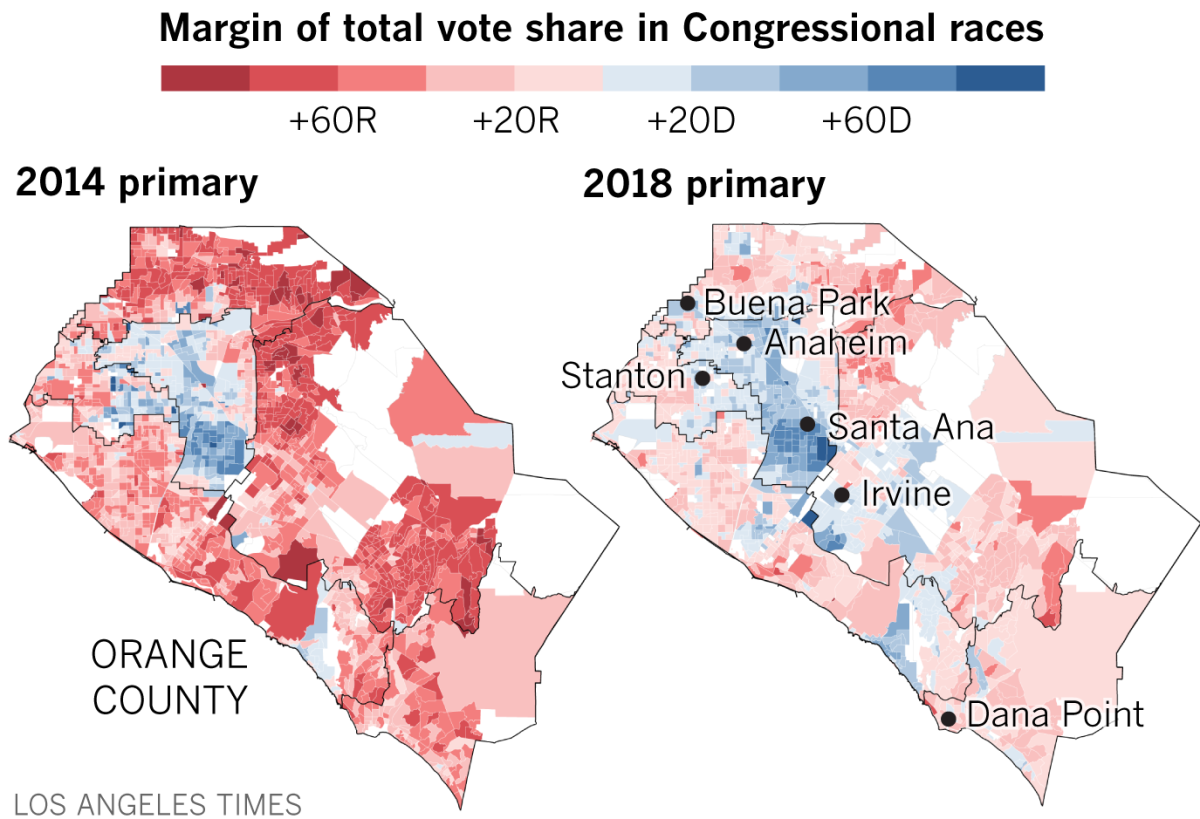
Registered Republicans today outnumber Democrats by only 2 percentage points, down from 22% at the peak, with a large contingent of self-declared independents positioned to swing elections either way. The GOP has a chance of losing four congressional seats in the county in Tuesday’s midterm election. If so, it would be the first time since the 1930s that Orange County would be without Republican representation in the House.
A GOP loss of even one or two seats would be significant, not as a turning point so much as a powerful sign of change — hastened by dislike for President Trump — in this one-time heart of American conservatism.
Source: Political Data, Inc.
(Priya Krishnakumar / Los Angeles Times)
::
Orange County seceded from its northwestern neighbor, Los Angeles, in 1889, led by fiercely independent ranchers, sheepherders, beekeepers, citrus growers and crop farmers who had bristled under the control of a rich city 30 miles up the rail line.
The county then was a constellation of small farm and dairy towns in the north and scattered resort towns along the coast. In the south, the basin tapered off into a narrowing valley between the Santa Ana Mountains and the coastal San Joaquin Hills, where sheep and cattle ranches had thrived since California was part of Spain and Mexico.
Americans had taken over the ranchos in the late 19th century after a devastating drought left many old landowners of Spanish ancestry, the Californios, broke.
Lewis Moulton was one of the Yankee migrants. He came from Boston in 1874 and grazed sheep on the open range from Oceanside to Long Beach. Family lore has it that natural gas seeps were so rich in some spots that, as he camped, he would light them to cook his breakfast.
After two decades of renting land, he and a Basque shepherd, John Pierre Daguerre, had enough money to buy Rancho Niguel, which they eventually expanded to 22,000 acres. It was rugged, isolated country, good mostly for grazing. The cheapest land was the steep part near the coast, between what would become Laguna Beach and Dana Point — about $15 an acre. Today, small fractions of an acre go for double-digit millions.
In the second half of the 20th century, these backwater ranchers and farmers, the Moulton family, the O’Neills, Floods, Irvines, Segerstroms, would physically and culturally shape Orange County into the suburban giant it is today.
But there was always an underclass that made their dreams work.
Tenant farmers — often with roots in Mexico, the Basque country or in California before the American conquest — rented spots on these ranches to graze and grow barley. Others toiled as hands for the landowners.
In the north, they lived in segregated barrios in Santa Ana, Westminster, Anaheim and Garden Grove — where their children attended separate “Mexican schools” until a federal appeals court ruled them unconstitutional in 1947. In the south, they made up smaller communities in El Toro and San Juan Capistrano.
Stephen Rios stands in the doorway of the adobe house in San Juan Capistrano built by his family in 1794.
(Mark Boster / For The Times)
“My tata got killed right there by the train when he was 93 years old,” Stephen Rios said of his grandfather, an American Indian named Mochanai, as he sat in his front garden across from the Mission San Juan Capistrano. “He was a vaquero, a well-known horse trainer.”
Rios’ family worked for the Moultons and O’Neills and lived in the adobe house built in 1794 for their ancestor Feliciano Rios, who came to California as a Spanish soldier and married an American Indian woman.
Rios, an attorney, inherited the home from his father and lives there today. His son’s bedroom has the ceiling boards that the famed bandito Joaquin Murrieta, a family friend known as the Robin Hood of El Dorado, would lift to hide in the attic in the 1850s. A flat-screen TV sits below them now.
The American Indian, Californio and Mexican residents of their dirt street — the oldest neighborhood in California — were conservative. “They loved their families, their church,” he said. “They loved their pieces of land. They were strong, religious independent people.”
Republicans reigned during the rural era. The land barons did not want labor organizers anywhere near their field hands.
When orange pickers walked out of the orchards in 1936, the strikers were arrested and beaten by police and mobs. The Times reported “old vigilante days were revived in the orchards of Orange County yesterday as one man lay near death and scores nursed injuries.”
Changes in Orange County’s 948 square miles — physical, demographic and political — have always rolled from north to south. While the Rios family was still living in the cowboy era, World War II brought rapid transformation to the northern part of the county.
The military needed more West Coast bases to fight the Japanese, and the open space between Long Beach and San Diego was perfect. The government built bases in Seal Beach, Los Alamitos, Santa Ana and El Toro.
Defense contractors and other big manufacturers followed: Hughes Aircraft, Rockwell, Ford Aeronutronic, Boeing, American Electronics, Beckman Instruments.
The farmers and ranchers became developers, or sold their land to other builders, creating vast tracts of homes across the northern end of the county from Huntington Beach to Fullerton. In this era of big cars and backyard barbecues, houses turned inward. Garages replaced porches and picture windows; neighborhoods were quiet.
The newcomers, many from the South and Midwest or white-flighters from Los Angeles, converged at church.
::
At its core, Orange County held a tension between Midwestern traditionalism and California’s drive for reinvention.
The midcentury suburbs in the north were libertarian-leaning enclaves, yet living on Washington defense spending, and listening to a sunny California-bred gospel of self-empowerment and prosperity.
An Iowan named Robert Schuller put out a newspaper ad in 1955, “Come as you are … In the family car!”
He preached from the roof of the snack bar at the Orange Drive-in theater, not about fire and brimstone, but about “possibility thinking” with catchphrases like “Turn your scars into stars.”
Robert Schuller, who delivered a new type of self-healing Gospel to the country, at the new Crystal Cathedral in 1980.
(Tony Barnard / Los Angeles Times)
Schuller’s congregation boomed, becoming one of the nation’s first megachurches. His “Hour of Power” television sermon beamed across the country. In 1980, he built a glass church longer than a football field, the Crystal Cathedral.
Orange County birthed hugely influential ministries that mixed God with conservative politics: Chuck Smith’s Calvary Chapel, Greg Laurie’s Harvest Crusade, Paul and Jan Crouch’s Trinity Broadcasting Network and Rick Warren’s Saddleback Church.
“The megachurches reinforced and marinated the conservatism coming out of the defense plants,” said Fred Smoller, associate professor of political science at Chapman University.
Orange County’s open space and space-age technology, coupled with fervent entrepreneurship and an-edge-of-the-continent mentality, let tinkerers and visionaries experiment with minimal regulation.
This was a suburban county that, like no other, reached deep into popular culture.
Knott’s Berry Farm was the nation’s first theme park. Disneyland became one of the world’s biggest destinations. The ministries reached millions. South Coast Plaza shopping mall would draw more people from around the world than Disneyland. The Irvine ranch grew into the largest planned city in America. Leisure World became the first retirement community.
Leisure World resident Jerry Wyss enjoys the pool in 1999.
(Mark Boster / Los Angeles Times)
In new coastal towns such as Dana Point and San Clemente, Hobie Alter, Gordon “Grubby” Clark and John Severson (living next door to Orange County native Richard Nixon in his “Western White House”) helped create a whole new culture around an ancient Polynesian sport that would become a multibillion-dollar surf industry.
In Laguna Beach, Tom Morey, a Douglas Aircraft composites engineer, invented the bodyboard. In Anaheim, the Van Doren brothers opened the first Vans store.
And the likes of Knott and Anaheim’s Carl Karcher, the founder of Carl’s Jr., would help give America a new brand of conservatism, with their friend John Wayne in Newport Beach to embody it.
With the Cold War at its peak in the 1960s, families in Orange County, so many of them in the military or defense industry, heeded their call.
“At living room bridge clubs, at backyard barbecues, and at kitchen coffee klatches, the middle-class men and women of Orange County ‘awakened’ to what they perceived as the threats of communism and liberalism,” wrote Lisa McGirr, a professor of history at Harvard, in “Suburban Warriors: The Origins of the New American Right.” “They became the cutting edge of the conservative movement in the 1960s.”
“The lack of a large organized working class and the near absence of racial minorities made it likely that Orange County’s political rainbow would consist of relatively few colors.”
The quiet homogeneity of the walled and gated communities allowed politicians to exploit fears of the outsider — whether they be African Americans from Los Angeles, immigrants from Mexico, or gays, Muslims and Koreans.
“The anti-minority stuff accelerated political careers here,” said Smoller, the political scientist. “We have a history of sending some real oddballs to Congress.”
An early one was Rep. James Utt, who in 1963 warned about the United Nations training “a large contingent of barefooted Africans” in Georgia to take over the country.
Cementing this conservatism: its daily newspaper, the Register, and its libertarian owner Raymond C. Hoiles. He had once waged war against a measure to improve mental health care in Alaska because he said it was a communist plot to brainwash Americans in concentration camps.
In 1964, Pat Donnelly, a young aerospace engineer working at McDonnell Douglas, bought a small home in Buena Park for $18,500. His neighbor’s first admonition to him: They must help ensure no blacks, Mexicans or Catholics moved in.
Donnelly was a Catholic, and even worse, a union-card-carrying Democrat who once played guitar and banjo in a touring folk band. He and his wife had two girls and joined the St. Pius V Church on Orangethorpe Avenue and started a choir. With his own slice of suburbia, he became more concerned about taxes and grew more conservative.
“I didn’t like some of the stuff I was seeing in the cities, the drugs and crime. It seemed like people were abusing welfare. I was paying for that.”
He switched parties and never looked back.
After Orange County’s favorite candidate Barry Goldwater lost to President Lyndon B. Johnson in 1964, Republican rainmakers turned their attention to Reagan’s run for governor. His first political fundraiser was at a home in Anaheim, and the county would nurture his ambitions the rest of his career.
By the 1970s, developers had reached deep into south Orange County. The Irvine Co. had wound down its cattle operations and was parceling out its 185 square miles of land. Some 1,500 acres near Newport Beach would become UC Irvine. The company developed a master plan for a city to grow around the university, which would incorporate in 1971.
The Moultons sold their land soon after to developers who would build Laguna Hills, Laguna Woods, Laguna Niguel and Aliso Viejo. In their yards, homeowners would find rattlesnakes that wandered out of the wild canyons and steep hillsides between subdivisions.
To the east and south, the O’Neills’ vast scrubby land would give way to even newer, posher cities such as Rancho Santa Margarita, Ladera Ranch and the community of Coto de Caza — the setting for the “Real Housewives of Orange County.”
With all this construction, Stephen Rios’ 225-year-old adobe home is hemmed in by suburbia.
The “Los Rios District” is now on the National Register of Historic Places and is highly sought-after real estate for its quaint atmosphere.
Most of the old Californio families sold and moved on.
“Everyone else wants to live here now,” Rios said.
Jared Mathis, left, and Scott T. Barnes stand off the trail in the Aliso and Wood Canyon Wilderness looking over the 22,000 acres that their great-grandparents bought in the 1890s.
(Mark Boster / For The Times)
Lewis Moulton’s great-grandson, Jared Mathis, came back from a job back east to Laguna Hills to manage the family’s remaining holdings. A few years ago, he took his dad — who moved away in the 1970s — for a drive to look at the old ranch where he grew up.
But his father couldn’t get his bearings. All the landmarks were gone, the hills terraced, new trees and houses blocked once wide views. “They say they moved more dirt building Aliso Viejo than they did digging the Panama Canal,” Mathis said.
Mathis drove his father to the ridgeline of Laguna Beach. From there, you could see the whole ranch area, smell the laurel sumac in Aliso Canyon, glimpse some old corrals in the distance, get a grip of the topography. The white striations of terraced neighborhoods faded in the haze. The twin peaks of Modjeska and Santiago, called Old Saddleback, framed the view, as they did in most of the county, one thing that never changed.
“He could see where they had the old roundups,” he said. “That was a powerful image for him.”
As development moved south, the older, northern parts of the county lost some of their luster. The affluent white Republicans drifted to the shinier places depicted in shows such as “The O.C.”
The explosion in South County home construction created thousands of jobs. “The people building all of those houses were Latino,” said Smoller, the political science professor. Like the old tenant farmers, they helped families such as the Irvines realize their dreams.
Thousands of other Latinos would follow to work in service jobs in these wealthy new areas.
The humming economy overall and good schools also lured professional and middle-class Latinos to the northern neighborhoods that Anglos were leaving in their migration south.
In Santa Ana in the 1970s, the population of Latinos went from 40,000 to 90,000. Today, Latinos account for 78% of Santa Ana’s population. Northwest Orange County looks a lot like Southeast L.A. County. La Habra is 57% Latino; Anaheim, 52%; Buena Park, 40%; Garden Grove, 37%.
The other big factor that brought demographic change was seeded 53 years ago, when the federal government removed racist quotas on immigrants from Asia, and Greater Los Angeles became a major destination for Koreans and Chinese.
In 1975, after Saigon fell, 50,000 South Vietnamese landed in nearby Camp Pendleton, and conservative Orange County stepped up to take the anti-communist refugees.
The Register called on churches and citizens to sponsor these newcomers. They were put up in apartments in neglected parts of Westminster and Garden Grove still surrounded by bean fields.
Soon the fields and dilapidated commercial strips gave way to bustling places such as Saigon Market and Hoa Binh Market, ushering in a wave of new Vietnamese businesses that would revitalize the area.
Frank Jao started off in America selling Kirby vacuum cleaners in Whittier. Within a year, he moved to Garden Grove, became a real estate agent, then developer, first building a shopping mall in Westminster with the help of Chinese investors.
So many Vietnamese storefronts were opening in Westminster, changing its look so rapidly, that more than 100 residents signed a petition calling for the city to stop issuing business licenses. It was an ugly time.
“Anyone driving on Bolsa would more than occasionally be confronted by drivers who rolled down their windows and asked us to roll down ours, and they’d give us the middle finger,” recalled Jao, now 70. “When we’d go to work in the morning, we’d find the windows shot out by BB guns.”
His buildings became the core of Little Saigon, notably its landmark Asian Garden Mall. His company built $400 million worth of shopping centers and apartment buildings throughout Orange County and beyond.
Upscale Chinese families took to Irvine. Many had left China because of the lack of opportunities for their children to attend college, and this master-planned community, built around UC Irvine, was a huge draw, as it was to moderately affluent Koreans, Iranians and Latinos. Irvine is nearly 40% Asian now.
Koreans had begun trickling in from Los Angeles during the 1980s, seeking better schools. The 1992 Los Angeles riots, in which many Korean store owners lost their businesses, sped up the flow. They often stuck close together, moving into specific neighborhoods in Garden Grove, Fullerton and Buena Park.
The Asian influx has also contributed to the reordering of politics in once reliably Republican Orange County.
As a whole, Asian Americans are more likely to register as “no party preference” and vote based on specific issues, not party, said Karthick Ramakrishnan, a professor of political science and public policy at UC Riverside. They leaned Republican during the Reagan era and well into the 1990s while subsequent generations moved to the left.
“About one-third of Asian Americans voted for Clinton in 1992,” Ramakrishnan said, “but two-thirds voted for Obama in 2008.”
He said in the last five years strong GOP outreach to the community in Orange County — and encouragement of Asian Americans to run for office — has brought many back to the party. But Ramakrishnan said too many factors are at play to say how they will vote on Tuesday. An example: They don’t like Trump’s anti-immigrant rhetoric, but Vietnamese, Taiwanese and Koreans like his confrontational stance toward China.
In Buena Park, Pat Donnelly, still a Republican, met a Korean American estate attorney named Sunny Park — a Democrat — at his Lion’s Club. He came to realize she had values he admired: honesty, a family focus, strong work ethic. Now he’s campaigning for her as she runs for City Council.
Park had followed her aging Korean clients from Los Angeles, moving into the affluent and increasingly Korean Bellehurst neighborhood. When she knocks on doors, many white people have offered support. But some have grumbled “No Koreans” and shut the door in her face.
A couple weeks ago, she started seeing campaign signs that said “No Sunny Park, Carpetbagger.”
She says the message that sends the Korean community is that she — and by extension they — are not from here and they shouldn’t try to take part in politics.
The political dynamic in Orange County is not so much a rising blue tide, but an ebbing red one. Since 1999, registered Democrats rose by less than 2 percentage points to 33.6%, while Republicans have fallen 14 points to 35.6% of voters. The wave is of independent voters who increased in numbers nearly as much as the Republicans fell.
A majority of Latinos vote Democrat, and growth in their community has buoyed the party. While they tend to be more socially conservative, they favor more lenient immigration policies, social programs that help the poor, strong unions and high minimum wages.
Historically, turnout has not matched their share of the population, but some Republican strategists fear Trump’s derogatory comments about Mexican and Central American immigrants might motivate them this year.
In 1996, the anti-immigrant rhetoric surrounding Proposition 187 helped end the ultra-right Orange County Republican Bob Dornan’s political career, and put Democrat Loretta Sanchez in Congress.
Just like the development, the diversity and Democratic edge are pushing south in this county of 3.2 million people.
In 2002, Democrats outnumbered Republicans only in Santa Ana, Buena Park and Stanton. Now they do in 11 cities reaching down to Irvine.
In Laguna Niguel, Candy Antone, 47, said Democrats such as her essentially lived in the closet until recently. She would go quiet when a Republican friend or neighbor would go on a political rant. “You just had to bite your lip,” she said.
But Trump is repelling even many Republicans here. “Democrats are coming out of the woodwork,” Antone said. “People we’ve known for years, we’re just finding out they’re Democrats.”
A relentless Yorkshire bowling performance put a significant dent in Somerset’s County Championship title challenge, the hosts consigning the pre-game Division One leaders to a hammer blow defeat at Headingley.
Somerset – chasing 287 – started day four on 73-3, quickly slipped to 79-6 and were later bowled out for 101 just before 12:00 BST to lose by 185 runs.
A third defeat of the season, and a second against Yorkshire, means that Warwickshire now lead Division One by 11 points from second-placed Somerset, who have never won this title. Nottinghamshire will also be in the mix come next week’s final round even if they lose against Sussex later on Friday.
For the mid-table White Rose, they claimed their fifth win in 13 games and backed up May’s success at Taunton. New ball seamers Ben Coad and Ben Cliff starred today, Coad finishing with four wickets and Cliff three.
Outstanding Cliff ended with career best match figures of 11-105, the 13th best match analysis in his county’s first-class history.
Cliff and Coad struck in the space of five balls inside the day’s opening half an hour, putting Yorkshire on course for a 19-point haul to Somerset’s three.
They removed not out batters Tom Lammonby and Tom Abell as Somerset lost two wickets for the addition of only three runs – 76-5.
Lammonby was squared up and caught behind off Cliff for 32 before Abell looped a catch up to backward point off the shoulder of the bat against Coad.
And when Coad struck again almost three overs later, at the end of the 39th, Somerset were in significant trouble, with James Rew caught at second slip on the drive.
Yorkshire came into day four knowing they had the edge, but one wicket they were desperate for was that of Craig Overton, who had broken their hearts back in July here with a stunning 79 not out off 30 balls in the Vitality Blast quarter-final.
Cliff got him caught behind pushing forwards in the 42nd over for five, also trapping Lewis Gregory lbw three balls later.
At 88-8, it was all but game over under an overcast Headingley sky but not quite matching the gloomy Somerset outlook.
The Overton and Gregory wickets were Cliff’s 10th and 11th in the match following his eight in the first innings.
Like Overton, Migael Pretorius had scored a first-innings fifty. But George Hill had him caught behind, leaving Somerset at 92-9.
Matthew Revis then wrapped things up by yorking Jake Ball, with day four lasting only 82 minutes in all.
Somerset face Surrey at the Cooper Associates County Ground, Taunton in the final round of fixtures, which starts on Thursday, while Yorkshire can continue to play the role of spoilers when they travel to face Nottinghamshire at Trent Bridge.
California and other Democratic-led states and localities filed a pair of lawsuits Monday challenging new Trump administration rules giving immigration officials more power to deny green cards to applicants whose families have relied on public assistance programs in the past.
California Atty. Gen. Rob Bonta, whose office is helping lead the states’ challenge, said the rule changes seek to “rewrite more than 100 years of law” by making even brief use of public benefits in years past grounds for the federal government to deny a person’s application for legal permanent residency in the future — which he said was clearly illegal and would push tremendous costs onto states, counties and cities.
“No family should have to choose between accessing healthcare and nutrition assistance today — or protecting their pathway to a green card tomorrow,” Bonta said. “We’re going to court on behalf of the millions of immigrants who call this state home — and we will fight to get this unlawful rule undone.”
San Francisco City Atty. David Chiu, whose office is helping lead a separate challenge from Democratic-led cities and counties, said in a statement that the new Trump administration policies are “a blatant attempt to sow fear and confusion in our immigrant communities and coerce people into withdrawing from critical government services” — which he also said would shift millions in costs to local governments.
A spokesperson for the Department of Homeland Security, which promulgated the new rules, said the lawsuits were proof that immigrants are unlawfully tapping into benefits programs intended for U.S. citizens.
“Sanctuary states are terrified they will lose federal funds because hundreds of thousands of illegals and noncitizens might remove themselves from American welfare programs,” the spokesperson said. “This is the ideological contortion required by left-wing leaders to justify their defrauding of the American taxpayer at the hands of illegal criminals.”
The White House did not respond to a request for comment.
President Trump won office on a promise to rein in illegal immigration. Since taking office, his administration has launched a mass crackdown that has targeted both undocumented and documented immigrants. It has done so in part by targeting federal and state programs that offer immigrant assistance — which Trump has derided as diverting resources away from U.S. citizens.
In their lawsuit, the states acknowledge that federal law enacted by Congress in 1882 allows the U.S. to deny noncitizens entry to the country if they would be a “public charge,” or someone who is unable to support themselves and must rely on the government for assistance.
However, the states argue that Congress, the courts and federal government agencies have for “over 140 years” understood the term “public charge” to mean a person “who has become, or is likely to become, primarily dependent on the government for long-term subsistence” — not someone who has ever taken public assistance of any kind in the past, even in the short term.
And yet, the new policy promulgated by Homeland Security and U.S. Citizenship and Immigration Services gives immigration officers “unprecedented, sweeping new discretion to deny admission” to families that have tapped any number of public assistance programs for which both Congress and individual states have chosen to make them eligible, the states wrote.
The lawsuit, joined by Bonta, the attorneys general of 19 other states and the District of Columbia, and the governor of Pennsylvania, was filed in federal court in New York.
A separate lawsuit was filed in the same court by San Francisco and Santa Clara County in California, as well as New York City, Chicago, and Seattle and surrounding King County, Wash.
In a morning news conference, Bonta said the Trump administration’s new rules target families in unprecedented ways.
As one example, he said the new rules would potentially allow immigration officials to deny permanent residency to immigrant parents based on their U.S. citizen children accessing public benefits that they are clearly entitled to under the law.
As another, he said the new rules could penalize immigrant families for accessing basic, preventative healthcare that actually helps control the broader public cost of illness to localities and states.
Chiu said federal limits on residency for those who would be a “public charge” have in the past been applied in a “narrow and consistent way,” focusing on certain cash assistance and long-term medical needs. The new rules, he said, make “almost any” kind of government assistance grounds for residency denial.
The states’ lawsuit — California’s 92nd against the current Trump administration — revises a policy battle that began during Trump’s first administration, when it attempted in 2019 to implement similar policies, was sued by California, San Francisco and Santa Clara County, and lost.
The Biden administration later dropped the plans to change the rules.
Tony LoPresti, county counsel for Santa Clara County — which has per capita one of the largest foreign-born populations in the country — said that it was “déjà vu all over again.” and that the Trump administration will lose again because the new “public charge” policy is “outright illegal.”
It “bullies our community members into dropping health insurance, bypassing food assistance and turning their back on critical services out of fear” and constitutes “a wealth test for residents who are lawfully seeking status,” LoPresti said.
Los Angeles County launched a probe into Farmers Insurance Company’s handling of claims by policyholders impacted by last year’s devastating Eaton and Palisades wildfires, after a growing number of residents complained of delays, denials and underpayments.
In a letter sent to Farmers on Wednesday, the county’s lawyers said if the company is engaging in any unlawful or unfair business practices, it must immediately stop.
“Eaton Fire survivors did everything right—responsibly paying their premiums year after year—but when disaster hit, Farmers left them with a contaminated home and refused to pay for testing and cleanup,” said Los Angeles County Supervisor Kathryn Barger, who represents Altadena, in a statement.
“My constituents shouldn’t have to walk back into homes with lead and asbestos because an insurance company won’t pay for the test that would prove it’s there,” she added.
Farmers disputed the county’s claims.
“As always, we operate in accordance with applicable laws and regulations,” the insurer said in a Thursday statement. “We do not believe the inquiry accurately characterizes our actions or practices and will cooperate through the appropriate process.”
“Serving our customers during difficult times is at the heart of what we do, which is why each claim is reviewed individually, taking into account the specific circumstances of the loss and the coverage provided under the policy,” the company said. “We remain focused on handling claims with care, consistency and attention to each customer’s unique situation.”
County officials said that at a recent meeting with Eaton fire survivors, those with Farmers policies said the insurer had been slow or resistant to pay for toxin testing by qualified industrial hygienists, forcing residents to pay for it themselves.
The testing revealed that many homes were contaminated with unsafe levels of lead, asbestos, chromium, and other toxic substances, the county said.
The residents also told the county that Farmers has refused to pay for adequate remediation of the contaminants and declined to cover ongoing living expenses.
“After paying millions of dollars in premiums, policyholders deserve the benefits and support they paid for,” said Supervisor Lindsey Horvath, whose district includes Pacific Palisades. “Families whose homes survived the Palisades and Eaton Fires but remain damaged or contaminated should not be forced to choose between returning to an unsafe home and financial devastation.”
The new investigation comes after the county filed a lawsuit against State Farm on Aug. 31 for its handling of Eaton and Palisades fire claims. The county claims State Farm engaged in illegal and deceptive business practices that kept victims from receiving what they were entitled to under their policies. State Farm denied the county’s claims.
Jim McGuinness is to remain Donegal senior football manager for the 2027 season.
It will be his fourth year at the helm during his second stint in charge of the Ulster county.
Meanwhile Mickey McCann will continue to manage the county’s senior hurlers for a further two years, having been in the role since 2018.
Donegal GAA confirmed the news on social media on Monday evening.
“Following a meeting of the County Committee, Donegal confirm the appointment of Michael McCann as Senior Hurling Manager for a two year term and Jim McGuinness as Senior Football manager for a one year term,” it read.
During his second term in charge, McGuinness has helped guide Donegal to back-to-back Ulster titles in 2024 and 2025 and an All-Ireland final appearance in 2025.
The 53-year-old led Donegal to a Football League Division One final success over Kerry in March this year but the county’s championship season was a disappointing one.
They were defeated by Down in the quarter-finals of the Ulster SFC and went down to Dublin after extra-time in Round 3 of the All-Ireland series.
McGuinness, who led Donegal to the All-Ireland in 2012 in his first spell as manager, initially returned on a three-year-deal with an option of a fourth.
Good vibes weren’t invented in Marin County. But reading “Morning in Marin,” David Perlis’ history of the place and its outsize cultural influence for much of the 20th century, you get the sense it served as America’s leading countercultural way station.
Book Review
Morning in Marin
By David Perlis Heyday Books: 384 pages, $35
If you buy books linked on our site, The Times may earn a commission from Bookshop.org, whose fees support independent bookstores.
Hosts of spiritual-minded sorts called it home: Alan Watts popularized Zen Buddhism in the ’60s, alongside poets Gary Snyder and Kenneth Rexroth. Francis Ford Coppola decamped there to write his script for “The Godfather,” and it’s where his compatriot George Lucas conjured up the “Star Wars” universe. (The cuddly Ewoks in “Return of the Jedi” were named after the region’s Miwok tribe.) Jack Kerouac sought enlightenment there; his compatriot Neal Cassady was imprisoned there, in San Quentin. It was the Grateful Dead’s retreat, Robin Williams’ launchpad, and the solid ground upon which Philip K. Dick questioned reality.
Why all these people, in this place, at that time? Perlis, an artist, radio host and Marin native, doesn’t strive for sociological or demographic explanations. His strategy is to sinuously move from moment to moment, artist to artist, as if in one continuous tracking shot, pausing only for a moment to catch some of the interesting characters he spots along the way. Over there, film critic Pauline Kael; and there, poet and sitcom star Suzanne Somers; and look, there’s bar-band singer Hugh Cregg, who’ll eventually use the stage name Huey Lewis.
Author David Perlis
(Jordan Blackman)
Still, Perlis breaks the flow just enough to offer a few reasons why the region became America’s affluent bohemia. It is, of course, gobstoppingly gorgeous, with Mount Tamalpais, Stinson Beach, Point Reyes and Bolinas practically designed to be edenic retreats. (Fairfax, he writes, is “ribboned with waterfalls, tufted with moss.”) Its isolation made it a counterculture haven for those looking to avoid San Francisco’s bustle: Gay poet Elsa Gidlow made her home there in the 1940s, among the first of many misfit pioneers. Wreckage from the 1906 earthquake was used to build the first “arks,” houseboats in Sausalito, providing a quirky infrastructure. Add some slow-growth initiatives, and you get artsy scrimping arrivistes; add LSD, legal until 1966, and you have a party.
So by the late ’60s, Marin had become a haven for a particular type: creative, interested in Eastern spirituality and profoundly disinterested in social convention (not to mention conspicuously white). Perlis’ portrait of the county at the height of the decade suggests a region that had escaped — or at least refused to look at — the worst of America’s turmoil. “Despite atomic bombs, rampant racism, political violence, and the war in Vietnam and Marin, there is hope, a sincere, emphatic belief, in an imminent inner revolution,” he writes. “When Zen, acid, or whatever your trip is, opens enough minds that people can outgrow this absurd, unwinnable conflict with nature and themselves.”
Perlis writes that with a slight smirk — of course nobody outgrew the conflict. Sure, a lot of people made a mint on the dream of transcendence: The Grateful Dead became a premier touring act, Lucas taught the country the ways of the Force and Sausalito’s Record Plant became the studio of choice for Sly Stone, Fleetwood Mac and more. But in the process, Marin became a kind of parody of itself, satirized by the writer Cyra McFadden in her 1977 novel, “The Serial.” In a world of what Perlis calls “swimmable wealth,” enlightenment sure looked a lot like narcissism in caftans. “I have no idea how I manage to do it,” Dick muses about his productivity at one point, prompting Perlis to bluntly break into the narrative: “I do. Drugs.”
Perlis could have gone further than that. One of the peculiarities of the Marin cultural scene, at least in Perlis’ reckoning, is that it hardly seems like a scene at all. Otis Redding and Frank Herbert and Linda Ronstadt and Anne Lamott and Shel Silverstein and Van Morrison all had little in common and interacted even less; if Marin was an incubator, it’s one where every egg hatched a different, brand-new species. Communal activity seemed relegated to the checkout aisles where locals kibbitzed over “The Serial,” or druggy extravaganzas that would in time claim Dick and various Dead members and associates as victims.
The irony, as the region stumbled into the ’80s, is that between its wealth and carefully cultivated isolation, Marin came to exemplify the ethos of conformist America: every man for himself. The actor Peter Coyote resisted: “When a Buddhist is thinking about shooting out traffic lights, it’s time to leave,” he quips. Others dug in: Huey Lewis and the News climbed the charts with a song titled “Hip to Be Square,” though to his credit, he explains to Perlis that it was meant to be a song about the difficulty of reconciling affluence and bohemian values. The man knows where he lives.
Perlis’ book isn’t a dismissal of Marin’s cultural moment, or even really a critique of it: His story is more something to be wondered at, like fog rolling over Mount Tamalpais. And Perlis’ storytelling skills make it seem like good fun as he pingpongs from artist to artist, each somehow inventing a meaningful, or at least recognizable, cultural touchstone. Marin gave us New Age music and Pablo Cruise; it also gave us Jim Carroll’s indelible punk classic, “People Who Died.” But one of the things to wonder at amid the good vibes is whether a different, more coherent, more sober scene would have been more meaningful, more enduring.
A regular contributor to The Times, Athitakis is a writer in Arizona and the author of “The New Midwest.”
Gov. George Deukmejian named on Monday Ventura County Superior Court Judge Kenneth R. Yegan to join the state 2nd District Court of Appeal, fulfilling the judge’s longtime dream of becoming an appeals court justice.
If a judicial review panel confirms Yegan’s nomination to the court’s 6th Division on Dec. 27, he will replace Justice Richard W. Abbe, who retired Nov. 28 after eight years on the three-member court.
“If I get confirmed on the 27th, I’ll take the oath right on the spot and hope to report to work the next day,” said Yegan, 43, of Westlake.
The review panel, composed of Supreme Court Justice Malcolm Lucas, Atty. Gen. John K. Van De Kamp and presiding 2nd District Court of Appeal Justice Lester Roth, is scheduled to meet next week in Los Angeles to discuss Yegan’s qualifications.
If confirmed, he will consider appeals cases from Ventura, Santa Barbara and San Luis Obispo counties with Justices Steven J. Stone and Arthur Gilbert, who have served on the 6th Division bench since it was established in 1982.
“Without even thinking about it, I’m really ecstatic about the appointment,” said Gilbert, who has reviewed Yegan’s Superior Court opinions on appeal and worked with him when Yegan served as a temporary appeals justice in the summer of 1986.
“I think he’s as good as you can get. He’s just first-rate,” Gilbert said. “He supports his point of view with well-reasoned statements of decision on the Superior Court, and he did the same thing when he was here.”
Stone said Yegan has a reputation for being able to handle all levels of appeals work, from doing legal research to writing the final draft of opinions.
“I have a lot of respect for Ken and I think that he will work very well with us,” Stone said. “I’m looking forward to it.”
Yegan said that Deukmejian called him Friday to offer him the seat. He said the governor swore him to secrecy until Monday, but gave him permission to tell his family.
“My wife was home with my oldest daughter and she was screaming, and my daughter was screaming,” Yegan said. “After they calmed down a little bit she asked me if I could pick up my youngest daughter from ballet and asked if I could go to the store and pick up some things. . . .and that’s when I knew things hadn’t changed.”
The focus of Judge Yegan’s work has not changed much from his first days in law. He said he has been fascinated by appeals work ever since law school.
“I took all the courses I could in law school in appellate practice,” Yegan said. “It’s intellectually challenging and it’s very stimulating to figure out where the facts meet the law and. . . .which is the better-reasoned opinion.”
Yegan graduated in 1972 from the University of the Pacific’s McGeorge School of Law in Sacramento and began work as a deputy in the Ventura County public defender’s office, handling trials and appellate cases.
Beginning in 1975 he worked as a senior attorney in the appeals court’s 5th Division in Los Angeles, researching cases and helping justices write opinions. In January, 1983, Gov. Edmund G. Brown Jr. appointed him to the Ventura County Municipal Court.
Deukmejian elevated him to the Superior Court in July 1986, where he tried criminal, civil and cases appealed from Municipal Court.
In recent months, Yegan said, letters urging his nomination have flowed into the governor’s office from County Dist. Atty. Michael D. Bradbury, Sheriff John V. Gillespie, three Supreme Court justices and a variety of appeals court justices, trial court judges and lawyers.
Abbe said of Yegan’s appointment: “His work when he was. . . .here was excellent. He was knowledgeable, he was able to evaluate cases quickly and accurately and make sensible decisions.”