



country

New York Gov. Hochul moves to weaken aggressive state climate law

Citing concerns about affordability, New York Gov. Kathy Hochul is proposing revising the state’s 2019 climate law, asking to delay implementation by several years and to adopt a different greenhouse-gas accounting method.

The changes would effectively water down a law viewed as one of the most ambitious state climate policies in the U.S.

Hochul called the law’s current targets “costly and unattainable” in a statement released Friday. “This is solely out of necessity — to protect New Yorkers’ pocketbooks and economy,” she said.

The Climate Leadership and Community Protection Act targets a 40% reduction in greenhouse gas emissions from 1990 levels by 2030 and an 85% cut by 2050. As of 2023, the state had lowered its emissions by about 14%.

Meeting the 2030 deadline would drastically drive up energy bills for New Yorkers, Hochul, a Democrat, has said. Regulations to implement the law are already delayed; Hochul wants to push them back to 2030 and create a new emissions target for 2040.

Energy bills have surged around the U.S., partly as a result of AI-driven demand. As of November, the average residential electricity price in New York was 26.5 cents per kilowatt-hour, ranking eighth highest in the country, according to Empire Center, a nonprofit think tank in Albany. The Iran war has sent oil and gas prices surging.

The proposed weakening of the law comes amid the Trump administration’s dismantling of federal climate regulations and clean energy incentives, which environmentalists have looked to Democrat-led states and cities to counter.

“Lots of people around the country — really around the world — have been looking to see how New York does in implementing this strong climate law,” said Michael Gerrard, a Columbia University law professor who directs the Sabin Center for Climate Change Law.

“If a very blue state like New York moves backwards on climate change as well, that’s a negative sign for the country,” he said. “If you can’t do it here, can you do it anywhere?”

Hochul, who is running for reelection this year, is seeking to advance changes through the state’s budget, which is due April 1. The proposal is expected to meet resistance from some Democratic lawmakers.

“We will negotiate with the governor,” said State Sen. Pete Harckham, who chairs the body’s environmental conservation committee. “We’ll be able to get to, I think, a resolution of this.”

Policymakers including Harckham and State Sen. Liz Krueger, who chairs the finance committee, penned a letter to Hochul earlier this month urging her not to back a delay.

Given Washington’s war on climate policy, they wrote, “it is incumbent on states like New York to reject this new wave of climate denial and put forward bold policies that will save New Yorkers money, reduce pollution and protect a livable climate.”

Krueger said Friday the proposed changes would increase the likelihood that the climate law will never be fully enacted.

“This is a serious problem,” she said. “We need to be spending the money for the infrastructure to help meet the targets.”

Business groups and Republicans in Albany have argued that implementing the law as it stands would drive up costs and worsen the affordability crisis. State Sen. Tom O’Mara has urged changes. “It is time [to] amend the CLCPA to account for economic realities,” he said in a statement. The Business Council, representing New York companies, last month said the deadlines stipulated “are proving unachievable.”

Even some Democrats have advocated for amendments. State Assemblymembers Carrie Woerner and John T. McDonald said last week that “the reality is difficult to ignore: New York is not on track to meet the CLCPA’s targets on the timeline written into law.”

“The real question is whether New York can remain committed to deep decarbonization while adapting its strategy to today’s conditions,” they added. “The goal should not be abandoning ambition. It should be pursuing it intelligently.”

In 2025, environmental groups sued Hochul’s administration after the state failed to set up a regulatory program for the climate law.

“The main effect of these proposed changes is to allow the Hochul administration to do nothing for at least the next four years,” said Rachel Spector, deputy managing attorney at Earthjustice, an environmental law organization that represents the groups. “These proposals will do nothing to benefit New Yorkers. The only beneficiaries would be Hochul along with gas utilities and corporate polluters.”

Hochul also wants to align New York’s emissions-counting standards with other U.S. states and the international community. That might mean switching from a 20-year emissions-counting methodology to a 100-year one. The shorter timeframe highlights the pollution impact of methane, a short-lived but potent greenhouse gas and the main component of natural gas. The 100-year metric essentially balances out short- with longer-lived gases like carbon dioxide.

“It’s ultimately a way to cheat on a test,” said Liz Moran, New York policy advocate at Earthjustice.

In October, a judge ruled in favor of the environmental groups, putting pressure on Hochul to enact a so-called cap-and-invest program that would help generate revenue for the state to transition to renewable energy.

However, a memo released in February by the New York State Energy Research and Development Authority concluded that implementing the policy would result in rocketing energy bills for New Yorkers.

It modeled a scenario in which the law were “implemented with regulations to meet the 2030 targets” and found that upstate New York households relying on oil and natural gas “would see costs in excess of $4,000 a year.”

Many Democrats and environmental advocates have pushed back on the narrative that climate policy is spiking costs. Harckham said the solution to improving affordability and lowering emissions is clear: “It’s renewable energy.”

“We set a law for ourselves,” he added. “We should be held accountable to it.”

Raimonde writes for Bloomberg.

Source link

‘It’s the Cuban people who are suffering.’ How Cuba is struggling under U.S. oil blockade

Reggaeton boomed in a neighborhood bar in Old Havana on a recent night, when, suddenly, the music stopped and everything went dark.

The customers groaned. Another blackout.

A U.S. blockade on oil shipments to Cuba has plunged the island into its worst energy crisis in modern history. The country’s already cratering economy now teeters on the verge of collapse, with vehicles idled by a lack of gas, hospitals forced to cancel surgeries and millions living without a steady supply of electricity and water.

It is the result of a calculated pressure campaign by President Trump, whose administration is negotiating with Cuba’s leaders over the future of the communist-ruled Caribbean island.

People fed up with rolling blackouts have staged sporadic protests in recent days, banging pots and shouting slogans against the government, rare demonstrations in a country known for repressing dissent.

Some power outages hit isolated areas, but in recent weeks Cuba has experienced three island-wide blackouts. The most recent one struck Saturday night and continued into Sunday.

A food cart on a street at night.

Two men sell food from a cart in front of the Kempinski hotel Friday night in Havana.

As Havana and Washington hash out a possible deal — which is likely to include some form of economic opening, and perhaps limited changes to Cuba’s leadership — many people here say they feel like pawns in a geopolitical game beyond their control.

Some, like those at the bar, who kept drinking in the dark after the power vanished, say they have little choice but to adjust to a life where flushing a toilet, cooking a pot of rice or riding a bus to work is now considered a luxury.

“The U.S. is trying to punish the Cuban government,” said one customer, named Rolando. “But it’s the people who are suffering.”

Cuba’s struggles long predate the oil embargo. For years, Cubans have complained of food shortages, crumbling public services and political repression. Demographers say Cuba is undergoing one of the world’s fastest population declines — a 25% drop in just four years — as birth rates fall and emigration soars.

Cuban President Miguel Díaz-Canel blames “genocidal” economic, financial and trade restrictions imposed by the United States in the decades since Fidel Castro’s army toppled the U.S.-backed dictator Fulgencio Batista in 1959.

1

Young people play dominoes in the streets of Old Havana

2

A woman reacts to her granddaughter at a bar

1. Young people play dominoes in the streets of Old Havana. 2. A woman reacts to her granddaughter at a bar in Old Havana. (Natalia Favre/For The Times)

But many Cubans blame their own leaders for mismanaging the economy — and straying from the ideals of Castro’s revolution. They were raised to believe in an implicit social contract, which maintained that while Cubans might not have luxuries or be allowed all civil liberties, they would always have free education and healthcare, a place to sleep and enough to eat.

“The pact has failed,” said Juan Carlos Albizu-Campos Espiñeira, an economist at the Christian Center for Reflection and Dialogue in Havana.

He faults the government for soaring inflation and a misguided investment strategy that pumped money into the tourism industry while neglecting fundamental sectors like industry and healthcare.

“This is the worst moment in Cuba’s history,” he said. “But things were really bad before this.”

An aerial view of the Vedado neighborhood in Havana.

The Vedado neighborhood in Havana.

Life has long been challenging for Pablo Barrueto, 63, who works mornings at a construction site and now spends afternoons filling plastic jugs from a tap on the street and hauling them up narrow stairwells to neighbors who have been without water for weeks.

His two jobs barely enough cover food for him and his partner, Maribel Estrada, 55, who earns $5 monthly as a security guard at a state-run museum.

The pair, who live in a cramped studio apartment in a crumbling colonial-era building, can’t afford butter or mayonnaise, so breakfast is a piece of plain bread. Barrueto said he often goes to bed hungry. It has been years since he has tasted pork or beef.

“I work so hard,” said Barrueto, who on a recent afternoon was cooking beans in a pair of tattered jeans. “But I don’t see the fruits of my labor.”

Men fill plastic containers with water on a sidewalk.

Pablo Barrueto, center, fills water containers from a public tap after more than 17 days without running water.

Estrada has developed ulcers on her legs, but the doctor who prescribed her antibiotics said she wouldn’t be able to find them on the empty shelves of state-run pharmacies. On the black market, the medication was being sold for more than what Estrada makes in a month.

“If I lived in another country, my legs wouldn’t look like this,” she said, rolling up her pants to show the chronic sores on her calves.

Estrada said she was reaching a point where she would accept anything that would improve her life, even U.S. intervention.

“If things don’t get better, they should just hand over the country to Trump,” she said.

The U.S. has long played a major role in Cuban history, from its involvement in the island’s war of independence from Spain to the heavy hand of American companies in Cuba’s sugar industry. Washington repeatedly backed unpopular leaders who protected U.S. interests, including Batista, whose corrupt and repressive regime sparked support for the Cuban Revolution.

For decades, the island was celebrated by U.S. critics worldwide as a scrappy symbol of anti-imperialism and a utopic experiment in socialism. But in recent years, amid a government crackdown on dissent, some of that support has faded.

A man holds a booklet and cash wrapped in a small plastic bag.

A man holds his ration book and cash while waiting to collect his daily bread in Havana.

The Trump administration’s bellicose new push to dominate Latin America with tariffs and military intervention has scared allies who in the past might have come to Cuba’s rescue.

Mexico, Brazil and Colombia, all led by leftists, have declined to provide emergency fuel shipments in recent months out of fear of angering Trump.

The current crisis was set in motion on Jan. 3, when the U.S. launched a surprise attack on Venezuela, killing 32 Cuban security guards stationed there — in addition to scores of Venezuelan troops and civilians — and capturing President Nicolás Maduro.

As the U.S. seized control of Venezuela’s oil industry, the impacts immediately rocked Cuba, which had long relied on subsidized oil shipments from Maduro’s regime.

Cuba’s leaders say the country has not received a single fuel shipment in three months, debilitating an economy that depends on oil to generate the electricity.

There is little relief in sight.

An employee of a grocery sells vegetables and other goods

An employee of a MIPYME sells vegetables and other goods to a customer Friday in Havana.

A state-owned Russian oil tanker loaded with 750,000 barrels of crude is currently crossing the Atlantic. It’s unclear whether the U.S. will try to stop the ship from reaching Cuba, where the oil, once refined, could provide Havana with energy for several weeks.

At the same time, the “Nuestra América” humanitarian convoy is in the process of delivering more than 20 tons of critical supplies to Cuba, some of which will arrive by boat in the coming days.

David Adler, a general coordinator of Progressive International, a global leftist group that helped organize the flotilla, said he hoped the delivery of medicine, food, baby formula and solar panels would highlight the severity of Trump’s restrictions on Cuba.

“We’re beginning to come to grips with the fact that there will be mothers and children and elderly and sick people who will die simply as a result of this senseless and cruel and criminal policy,” Adler said. “Why are we inflicting such cruel punishment on a country that does not represent any threat to the United States?”

In Cuba, where many fear the prospect of no electricity come summer, with its muggy heat and swarms of disease-carrying mosquitoes, people are getting creative. With virtually no public transport and few drivers able to find — or afford — gas that costs more than $5 a gallon, many people have resumed riding bicycles. Others have fashioned electric-powered scooters into slow-moving taxis.

Four young people stand and sit in a dark street.

Young people talk in the street in central Havana.

One man in the small town of Aguacate made headlines after he modified his 1980 Fiat Polski to run on charcoal, the same fuel many people here are now cooking with.

Camila Hernández, who works at Havana’s airport, had hoped to celebrate her 21st birthday at home with friends, eating and dancing. “It would have been wonderful,” she said.

But it had been weeks without regular electricity in the home she shares with her parents and boyfriend. His family’s home had power — but lacked water.

To avoid yet another night sitting in the darkness, she marked her birthday by strolling to the Paseo del Prado, an iconic boulevard not far from the waterfront cooled by a light sea breeze.

Her boyfriend’s mother, Yusmary Salas, 47, said poor living conditions were testing her patience. “I can’t even go to the bathroom without planning how I will flush the toilet,” she said. She said she is hungry for change, but has no idea what shape it will take.

Trump insists he “can do whatever I want” in Cuba, and recently said he expects to have the “honor” of “taking Cuba in some form.”

A man climbs a steep flight of stairs.

Pablo Barrueto carries a water container up to his home in Old Havana.

Such talk rattles many here who grew up in a country where government buildings still bear the revolutionary motto: “Homeland or death, we will prevail.”

Salas said she hopes that whatever comes next is peaceful, and that Cubans, long a proud people, have their dignity restored. And their power restored, too.

At the darkened bar in Old Havana, workers scrambled to light candles and serve beer that, without refrigeration, would soon go warm. Someone with a battery-powered speaker hit “play” on a song, the 2004 Daddy Yankee hit “Gasolina.”

Dáme más gasolina!” they sang together. “Give me more gasoline!”

Source link

Trump border advisor says ICE to deploy to U.S. airports Monday

What began as a social media post from President Trump on Saturday has grown quickly into a full-scale plan to deploy ICE agents to U.S. airports.

Amid a partial government shutdown, TSA lines have grown to be hours long at some U.S. airports, creating problems for travelers across the country. Call-out rates have started to increase at some airports, and the U.S. Department of Homeland Security said at least 376 TSA agents have quit since the partial shutdown began Feb. 14.

White House border advisor Tom Homan said that ICE plans to dispatch agents to airports as soon as Monday, and that he was working with other officials to determine where to send agents.

“It’s a work in progress,” Homan said during a Sunday appearance on CNN. “But we will be at the airports tomorrow helping TSA move those lines along.”

Homan stressed that ICE agents would provide support where possible, so that TSA staffers could better fulfill specialized positions.

“I don’t see an ICE agent looking at an X-ray machine, because they are not trained in that,” Homan said.

On Saturday, President Trump posted to social media, “If the Radical Left Democrats don’t immediately sign an agreement to let our Country, in particular, our Airports, be FREE and SAFE again, I will move our brilliant and patriotic ICE Agents to the Airports where they will do Security like no one has ever seen before.”

The pushback to the White House plans was immediate.

Rep. Bennie G. Thompson (D-Miss.), ranking member of the Committee on Homeland Security, released a statement that read, “Masked, armed police at travel checkpoints is a hallmark of dystopian movies. Now, Donald Trump is threatening to bring this tool of fascism to America. He is manufacturing chaos at airports for political leverage and trying to force Democrats to accept unaccountable secret police at security checkpoints around the country.”

Also speaking to CNN on Sunday, House Democratic Leader Hakeem Jeffries said, “The last thing that the American people need are for untrained ICE agents to be deployed at airports all across the country, potentially to brutalize or, in some instances, kill them. We’ve already seen how ICE conducts itself.”

Representatives from Los Angeles International Airport did not immediately respond to a request for comment. A spokeswoman for Orange County’s John Wayne Airport said she was not currently aware of any communication or Homeland Security guidance on the proposed plan.

A spokesperson for San Francisco International Airport said airport officials have not yet received anything specific from Homeland Security about a deployment of ICE agents. He said SFO security personnel are not part of TSA, and as a result, the airport has not had any checkpoint backups.

Source link

After judge rules Voice of America be revived, what’s next?

In a strongly worded decision this week, a federal judge ordered that the Voice of America — an international broadcaster with the mission to provide news for countries around the world that was largely shut down for the last year by the Trump administration — come roaring back to life.

Whether or not that actually happens is uncertain.

The government filed notice Thursday to appeal U.S. District Judge Royce C. Lamberth’s order two days earlier to put hundreds of VOA employees who have been on paid leave the last year back to work. Lamberth had ruled on March 7 that Kari Lake, President Trump’s choice to oversee the bureaucratic parent U.S. Agency for Global Media, didn’t have the authority to reduce VOA to a skeleton.

The Voice of America was established as a news source in World War II, beaming reports to many countries that had no tradition of a free press. Before Trump took office again last year, Voice of America was operating in 49 different languages, heard by an estimated 362 million people.

Trump’s team contended that government-run news sources, which also include Radio Free Europe/Radio Liberty, were an example of bloated government and that it wanted news reporting more favorable to the current administration. With a greatly reduced staff, VOA currently operates in Iran, Afghanistan, China, North Korea and in countries with a large population of Kurds.

Lamberth, in his decision, said Lake had “repeatedly thumbed her nose” at laws mandating VOA’s operation.

Time to turn the page at VOA?

VOA director Michael Abramowitz said legislators in both parties understand the need for a strong operation and have set aside enough funding for the job to be done. “It is time for all parties to come together and work to rebuild and strengthen the agency,” he said.

Don’t expect that to happen soon. “President Trump was elected to eliminate waste, fraud and abuse across the administration, including the Voice of America — and efforts to improve efficiency at USAGM have been a tremendous success,” said White House spokeswoman Anna Kelly. “This will not be the final say on the matter.”

Patsy Widakuswara, VOA’s White House bureau chief and a plaintiff in the lawsuit to bring it back, said that “restoring the physical infrastructure is going to take a lot of money and some time, but it can be done. What is more difficult is recovering from the trauma that our newsroom has gone through.”

It’s an open question whether the administration wants a real news organization or a mouthpiece, said David Ensor, a former Voice of America director between 2010 and 2014. “We don’t know — maybe no one does at the moment — what the future holds,” he said.

The administration’s efforts over the last year to bolster friendly outlets and fight coverage that displeases Trump offer a clue, even though Congress has required that Voice of America be an objective and unbiased news source. This week it was announced that Christopher Wallace, an executive at the far-right network Newsmax who had previously spent 15 years at Fox News Channel, will be the new deputy director at VOA. Abramowitz didn’t know he was getting a new deputy until it was announced.

Widakuswara wouldn’t comment on what Wallace’s appointment might mean. “I’m not going to pass judgment before seeing his work,” she said.

While Lamberth ordered more than a thousand employees on leave to go back to work, it’s not clear how many of them moved on to other jobs or retired in the last year. The judge also said he did not have the authority to bring back hundreds of independent contractors who were terminated.

One employee who left is Steve Herman, a former White House bureau chief and national correspondent at VOA and now executive director of the Jordan Center for Journalism Advocacy and Innovation at the University of Mississippi. Despite the court decisions, he questions whether the Trump administration would oversee a return to what the organization used to be.

“I’m a bit of a pessimist,” Herman said. “I think it’s going to be very difficult.”

An administration loath to admit defeat

Besides fighting to shut it down, Trump is loath to admit defeat. The White House recently nominated Sarah Rogers, the undersecretary of State for public diplomacy, to run the U.S. Agency for Global Media, putting it more firmly within the administration’s control. Her nomination requires Senate approval.

“Is Marco Rubio’s State Department going to allow objective journalism in 49 languages?” Herman asked. “I don’t think so. I would want that to happen, but that’s a fairy tale.”

In the budget bill passed in February, Congress set aside $200 million for Voice of America’s operation. While that represents about a 25% cut in the agency’s previous appropriation, it sent a bipartisan message of support, said Kate Neeper, VOA’s director of strategy and performance evaluation. Besides being a plaintiff with Widakuswara in the lawsuit to restore the agency, she has helped some of her colleagues deal with some of their own problems over the past year, including immigration issues.

“There is a lot of enthusiasm for going back to work,” she said. “People are eager to show up on Monday.”

The hunger for information from Voice of America in Iran when he was director was a clear example of what the organization meant, Ensor said. Surveys showed that between a quarter and a third of Iran’s households tuned in to VOA once a week, primarily on satellite television. Occasionally the government would crack down and confiscate satellite dishes, but Iranians could usually quickly find replacements, he said.

“I believe in Voice of America as a news organization and as a voice of America,” Ensor said. “It was important, and it can be again.”

Bauder writes for the Associated Press.

Source link

Ukraine’s Saab 340 Airborne Early Warning Radar Plane Spotted Operating Over The Country

Footage has emerged that purportedly shows a Saab 340 airborne early warning and control (AEW&C) aircraft operating over Ukraine. If legitimate, this would be the first time that the radar plane has been seen in Ukrainian service, as far as we know, and would mark an important new capability for Ukraine, and one that we have discussed in depth in the past.

Russians are posting footage they claim shows likely a Swedish Saab 340 AEW&C long-range radar and control aircraft flying over Ukraine. pic.twitter.com/XkFZlok2B3

— WarTranslated (@wartranslated) March 20, 2026

The video in question appears to have been first posted to a Russian Telegram account and clearly shows one of the aircraft, with its distinctive ‘balance beam’ radar fairing on the upper fuselage, in level flight during the daytime. The date and location of the video cannot be confirmed. It should also be noted that we cannot verify the footage itself, but there is nothing to immediately suggest it may have been doctored.

As mentioned, this appears to be the first time we have ever seen one of the Ukrainian Air Force’s two Saab 340 AEW&C planes, although there are suggestions that the type has been flying in Ukrainian skies for some time.

In April of last year, open-source flight-tracking platforms suggested that a possible Ukrainian radar plane was operating in the Lviv region, in western Ukraine, flying circuits and using the callsign WELCOME. Before that, an unidentified aircraft with the same callsign was observed operating in airspace near Poland and Hungary. If true, that suggests that the track over Lviv may have been a post-delivery acceptance or calibration flight. It’s also worth noting that transponders can be manipulated to provide false aircraft tracks, too.

Stockholm’s transfer of two Saab 340 AEW&C aircraft to Ukraine was announced in May 2024, as we reported at the time. The donation was part of the biggest Swedish military aid package for Ukraine up to that point, worth around $1.25 billion.

At the time, it was said that it would take around a year to train the aircrew and maintenance personnel, as well as prepare the ground facilities for the new aircraft.

The Saab 340 AEW&C aircraft is known in Swedish military service as the ASC 890 and alternatively as the S 100D Argus. The Swedish Air Force operated two of these aircraft, with both understood to have been provided to Kyiv. Another two ex-Swedish Saab 340 AEW&C aircraft are operated by Thailand, and another pair were sold to Poland, having previously been operated by the United Arab Emirates.

Royal Thai Air Force Gripen and Saab 340 Erieye AEW


For Ukraine, the significance of the Saab 340 AEW&C is hard to overstate.

It brings an entirely new capability for the Ukrainian Air Force, which has never operated any type of AEW&C platform.

The core of the aircraft is its Saab Erieye active electronically scanned array (AESA) radar. Carried atop the fuselage, this can detect air and sea targets at ranges of up to around 280 miles, with the aircraft typically operating at an altitude of 20,000 feet. Reportedly, the AESA system can track up to 1,000 airborne and 500 surface targets simultaneously.

Erieye explained


All this data is handled by three mission crew: a mission control officer, a combat control operator, and a surveillance operator. It can also be downlinked to ground stations and to other aircraft, at least in theory, of which more later.

Unlike a surface-based air defense radar, the Erieye provides a ‘lookdown’ capability. Without the line-of-sight limitations of terrain, the radar will be especially useful for detecting low-flying Russian drones and cruise missiles. These are otherwise notably tricky targets, due to the low altitudes at which they fly and their small radar signatures. With that in mind, the aircraft should provide Ukraine’s air defenses with a huge situational-awareness boost.

A photograph taken on December 27, 2025 shows an Iranian-designed Shahed 136, (Geranium-2) drone used by Russian Army flying over Kyiv during a Russian drones and missiles attack, amid the Russian invasion in Ukraine. A Russian drone and missile barrage on Kyiv and its suburbs killed one person, wounded two dozen and cut off heating and electricity for hundreds of thousands of people left in freezing temperatures on December 27, 2025. (Photo by Sergei SUPINSKY / AFP via Getty Images)
A photograph taken on December 27, 2025, shows an Iranian-designed Shahed-136 (or Russian-made Geran-2) drone flying over Kyiv during a Russian drone and missile attack. Photo by Sergei SUPINSKY / AFP via Getty Images SERGEI SUPINSKY

Within its layered air defense network, Ukraine relies heavily on crewed fighter jets (as well as other aircraft platforms) to intercept drones and cruise missiles. Adding the Saab 340 AEW&C to the equation, the radar plane should be able to work as a fighter controller, detecting targets, prioritizing them, and then assigning them to the fighters for interception. Equally, this data could be provided to other air defense assets.

Especially useful in this regard would be the NATO-standard Link 16 datalink communications system. This would, in theory, be compatible with Ukraine’s F-16 and Mirage 2000 fighters, as well as Western-supplied ground-based air defense systems.

Український пілот про ефективність Mirage2000/Ukrainian Pilot on the Effectiveness of the Mirage2000


However, in late 2024, it was reported that the F-16s donated to Ukraine have had Link 16 systems removed or disabled, due to U.S. worries that they could end up in Russian hands.

This would deprive those fighters of a real-time air defense ‘picture’ sourced from the Erieye radar, and, at this point, it’s unclear if the Link 16 connectivity is available to Ukraine.

As of March 2025, it was reported that the delivery of the radar planes was on track, and they would be able to operate effectively with Ukraine’s F-16s.

A Ukrainian Air Force F-16 takes off for an air defense sortie. Ukrainian Air Force

“The timing of ASC 890 deliveries is linked to when certain modifications to F-16 fighters will be ready. There is no delay in the transfer of airborne early warning aircraft to Ukraine,” the Lithuanian Delfi news agency reported. This sounds very much like a reference to enabling the Link 16 connectivity.

However, even without Link 16, the Saab 340 AEW&C is able to provide much-enhanced air and sea surveillance for Ukraine.

Later versions of the Erieye radar also have a synthetic aperture radar and ground moving target indication (SAR/GMTI) capability, although it’s not clear if Ukraine has received that either. While SAR provides detailed image-like mapping of the ground at standoff ranges, GMTI detects and tracks movements on the ground over time, which would allow monitoring of Russian troop movements.

Should Ukraine’s ambitious plans to buy Saab Gripen fighters in the future materialize, the combination of these jets and the Saab 340 AEW&C could make a tailor-made solution for air defense and other missions.

For all its capabilities, the Saab 340 AEW&C will also be a prime target for Russia.

Russia’s own A-50 Mainstay AEW&C aircraft have been repeatedly targeted by Ukraine, in recognition of their value as force multipliers.

A Russian Aerospace Forces A-50U Mainstay. Russian MoD Russian Air Force A-50U Mainstay. (Russian MoD)

Russia was estimated to have nine A-50s in active service at the start of the full-scale invasion. Since then, there have been two combat losses, and another of these aircraft was damaged in a drone attack while on the ground at a base in Belarus, and its current status is unknown. More recently, the General Staff of the Ukrainian Armed Forces claimed an A-50 had been hit in a strike on a maintenance facility in the Novgorod region of Russia.

This reality almost certainly means Ukraine operates the Saab radar planes from the far west of the country, likely moving them between airfields to reduce their exposure to airstrikes. Similar tactics are also employed by Ukrainian F-16s. With a maximum of two aircraft, round-the-clock coverage is also impossible, so one aircraft may well be kept on permanent ground alert to respond to particularly intensive Russian drone and missile barrages.

It is likely for this reason, too, that we have not seen anything of the Ukrainian Saab 340 AEW&C aircraft since their delivery.

With time, we will hopefully learn more about what these secretive assets are bringing to Ukraine’s air defenses and what kind of effect they are having on countering the near-constant Russian drone and missile attacks.

Contact the author: thomas@thewarzone.com

Thomas is a defense writer and editor with over 20 years of experience covering military aerospace topics and conflicts. He’s written a number of books, edited many more, and has contributed to many of the world’s leading aviation publications. Before joining The War Zone in 2020, he was the editor of AirForces Monthly.


Source link

Cheapest country for a summer holiday named — only £33 a night

The most affordable place for a week-long holiday has been revealed – and it’s a stunning beach resort town that’s perfect for a summer escape

With the arrival of warmer weather, it’s time to start planning your summer getaways. If you’re pondering where to jet off to this year, there’s one destination that should be on your list.

This breathtaking beach resort town has been crowned as the most budget-friendly spot for a week-long holiday. A seven-day stay in this picturesque town will set you back £230 all-inclusive.

This research is courtesy of online travel agent loveholidays who have identified the cheapest locations for a break.

Taking the top spot is Agadir in Morocco. Renowned for its laid-back coastal atmosphere, this stunning resort town is the ideal summer retreat.

It’s situated on the western coast of Morocco, five hours from the capital city of Casablanca.

The town nestles near the base of the Atlas Mountains and boasts a population of over half a million people.

It’s celebrated for its gorgeous beaches – Plage d’Agadir in the city centre and the equally enchanting Plage Aourir to the north, both offering wonderfully soft sands and warm temperatures.

The climate is mild throughout the year, with winter temperatures averaging 20.5°C, but in the summer months, it climbs into the mid to high 20s – perfect for a sun-soaked getaway, reports the Express.

If you book a package hotel between the June 1 and August 31, you can secure an all-inclusive stay for as low as £33 per person per night.

If Morocco doesn’t tickle your fancy, there are plenty of other destinations to choose from. Coming in second place for the most affordable are the Costa Dorada at £381 and Murcia at £399.

Lanzarote and Goza in Malta also present extremely cost-effective choices if you’re seeking some sunshine.

Al Murray, chief marketing officer at loveholidays, stated: “Our ranking shows that a week of summer sun doesn’t have to carry a premium price tag.

“Whether it’s the beaches of Agadir or firm favourites like Costa Dorada and Lanzarote, all offer incredible value for money; a top priority for British holidaymakers.

“By highlighting these affordable hotspots, we’re helping travellers plan ahead and secure a summer getaway regardless of their budget.”

Source link

FIFA denies Iran’s push to move its World Cup matches to Mexico

The public wrangling between Iran, FIFA and U.S. President Donald Trump over the narrative of playing in the World Cup shifted on Tuesday to Mexico where President Claudia Sheinbaum seemed open to a suggestion by Islamic Republic diplomats that Iran’s games in June be moved to her country.

The Iranian ambassador and embassy in Mexico City said the country was negotiating with FIFA to move Iran’s three group-stage matches from the United States to Mexico after Trump last week discouraged the team from attending the 48-nation tournament, citing safety concerns.

It was already unclear whether such talks were even happening before FIFA said such unprecedented changes in World Cup history were not planned to a match schedule agreed three months ago.

Sheinbaum was asked about it Tuesday during her daily briefing.

“They are discussing with FIFA whether it’s feasible because they were going to hold the [games] in the United States,” she said. “They are looking into whether they can hold [them] in Mexico, and we will inform you when the time comes. Mexico has relations with all countries in the world. We’ll see what FIFA decides and then we’ll announce it.”

In a statement, FIFA said it is “in regular contact with all participating member associations, including [the Islamic Republic of] Iran, to discuss planning for the FIFA World Cup 2026. FIFA is looking forward to all participating teams competing as per the match schedule announced on Dec. 6, 2025.”

The Feb. 28 start of U.S. and Israeli bombing of Iran that killed the Islamic Republic’s Supreme Leader Ayatollah Ali Khamenei and senior officials immediately cast doubt on the national soccer team going to play at least three World Cup games in the U.S., which is co-hosting the most watched global sports event with Mexico and Canada.

Iran’s soccer federation has not canceled its World Cup entry with FIFA, though official comments have variously suggested the U.S. is unable or unwilling to ensure the delegation’s secure arrival and accommodation.

Since last week, Trump has variously said “I don’t really care” if the Iran team comes, that it was welcome and would be treated like all players as stars, and that the players’ safety was at risk.

In comments posted late Monday on the embassy website, Iran’s Ambassador to Mexico Abolfazl Pasandideh urged FIFA to move the team’s games to Mexico, saying the U.S. was not cooperative on visas.

“We love the Mexican people very much and for us, the best situation is for our games to be held in Mexico,” he was quoted as saying by state-run news agency IRNA.

An Iranian government spokesman and the team itself have said in recent days it is up to FIFA and the U.S. to keep the team safe during the World Cup. The Iran team’s planned training camp is in Tucson.

Pasandideh’s embassy in Mexico City also posted a statement attributed to national soccer federation president Mehdi Taj saying Iran wants to move its group-stage matches out of the U.S.

“When Trump has explicitly stated that he cannot ensure the security of the Iranian national team, we will certainly not travel to America,” the statement said. “We are currently negotiating with FIFA to hold Iran’s matches in the World Cup in Mexico.”

Iran is scheduled to play New Zealand on June 15 and Belgium on June 21 at SoFi Stadium before finishing group play in Seattle against Egypt on June 26.

Moving the games would be remarkable less than three months before the World Cup and risks being judged a failure in the history of tournament hosting.

It also is not envisaged by Iran’s first opponent.

New Zealand soccer federation chief executive Andrew Pragnell said Monday: “I also don’t foresee it as remotely feasible” to move scheduled games to another country. Tens of thousands of tickets have been sold for Iran games, including to visiting fans who have booked flights to the U.S.

“By trying to move the match schedule, you actually create more problems down the track,” Pragnell told New Zealand media outlet Stuff, adding “I don’t think it’ll happen.”

The Belgian soccer federation declined to comment Tuesday.

Trump said last week that the Iran team was welcome at the World Cup despite the ongoing war in the Middle East but “I really don’t believe it is appropriate that they be there, for their own life and safety.”

Iran’s mixed signals include Sports Minister Ahmad Donyamali telling state TV last week that it was not possible to play “due to the wicked acts they have done against Iran.”

But after Trump’s post the national team said on Instagram that “no one can exclude” it from the tournament and a government spokesman in Tehran stressed it was the responsibility of FIFA and the U.S. as a co-host nation to keep players safe and secure.

“FIFA is the organizer of the World Cup,” Iran Foreign Ministry spokesman Esmail Baghaei said. “When warnings are issued at the highest level about the environment being unsafe for Iranian football players, this indicates that the host country apparently lacks the capacity and ability to provide security for such an important sporting event.”

Soccer is followed passionately in Iran, a nation of more than 90 million people which has qualified for seven men’s World Cups and each of the past four editions. The team is ranked No. 20 in the world by FIFA and behind only Japan from Asia.

FIFA has not commented in recent days beyond an Instagram post by president Gianni Infantino last week that he’d received assurances from Trump that Iran was welcome at the tournament.

Dunbar and Pye write for the Associated Press. Amir-Hussein Rajdy in Cairo and Fabiola Sanchez in Mexico City contributed to this report.


Source link

Israel kills Iran’s spy chief; government seen as ‘largely degraded’

The Iranian government remains “intact but largely degraded,” National Intelligence Director Tulsi Gabbard told Congress on Wednesday, as Israel continued to hunt down the Islamic Republic’s leadership with an overnight airstrike that killed the nation’s spy chief.

The death of Intelligence Minister Esmail Khatib, announced Wednesday by Israel, was the third high-level assassination in roughly 24 hours in a series of strikes that have hollowed out Tehran’s leadership ranks.

Israel ordered strikes Tuesday that killed Iranian security chief Ali Larijani and Basij paramilitary commander Gholamreza Soleimani.

Additional senior Iranian figures could be targeted, Israeli Defense Minister Israel Katz said Wednesday. “Israel’s policy is clear and unequivocal: No one in Iran has immunity — everyone is a target,” Katz said.

Ayatollah Mojtaba Khamenei, Iran’s new supreme leader, issued a rare statement Wednesday addressing Larijani’s assassination.

“Undoubtedly, the assassination of such a person shows the extent of his importance and the hatred of the enemies of Islam towards him,” he wrote, according to the Associated Press. “All blood has its price that the criminal murderers of the martyrs must pay soon.”

Tehran responded with renewed missile and drone attacks on Israel and U.S.-aligned countries across the Persian Gulf, further disrupting strained energy infrastructure and shipping lanes. Fighting has halted oil and gas production throughout the region, as shipping was stalled through the Strait of Hormuz, a key artery for global oil supplies.

The war has triggered a severe global oil shortage that has destabilized electronics, agriculture, pharmaceutical and energy supply chains.

Exacerbating those disruptions, the U.S. and Israel carried out a coordinated attack on the South Pars natural gas field on Wednesday. The strikes drew swift condemnation from Qatar, a U.S. ally that shares the reservoir with Iran. The Qatari Foreign Ministry called the attack “dangerous and irresponsible” and “a threat to global energy security.”

The attack is a major blow to Iran’s supply of electricity too, as most of the country’s energy grid relies on gas, analysts said. The field accounts for about 75% of Iran’s natural gas production.

Tehran promised to respond with more attacks on its Mideast neighbors, the Associated Press reported.

Meanwhile, near-constant Israeli strikes in Beirut and southern Lebanon have displaced over 1 million people, and killed 968 civilians, according to the Lebanese Health Ministry.

With the war in its third week, deaths now number in the thousands across Iran, Israel and neighboring countries.

International reaction has sharpened as the fighting showed no sign of relenting. Russia condemned the “murder and liquidation” of sovereign leadership and called for an immediate ceasefire, while European leaders voiced growing alarm about the war’s trajectory and the risks of broader destabilization.

Director of National Intelligence Tulsi Gabbard testifies Wednesday before the Senate Committee on Intelligence.

Director of National Intelligence Tulsi Gabbard testifies Wednesday before the Senate Committee on Intelligence.

(Jose Luis Magana / Associated Press)

All allies in the North Atlantic Treaty Organization have refused to heed President Trump’s call to send warships to the Strait of Hormuz, signaling a deepening rift in the world’s most powerful military alliance. Trump has sought to sever the U.S. from the alliance.

“We no longer ‘need,’ or desire, the NATO Countries’ assistance — WE NEVER DID! “ he wrote on social media Tuesday.

Trump on Wednesday signaled little appetite for de-escalation, floating the prospect of a decisive military endgame.

“I wonder what would happen if we ‘finished off’ what’s left of the Iranian Terror State,” he wrote on his social media website.

The president visited Dover Air Force Base in Delaware on Wednesday, where the remains of six U.S. service members killed in the crash of a refueling aircraft were returned to their families. The visit marks the second time since the Feb. 28 launch of the war with Iran that Trump has attended the solemn military ritual known as a dignified transfer, the Associated Press reported.

At a Senate Intelligence Committee hearing on “worldwide threats” Wednesday, Democrats grilled Gabbard and other intelligence leaders over their preparation for Iranian retaliation against Mideast energy infrastructure, civilian areas and American military sites and personnel.

Trump has maintained that the U.S. was caught off guard by Iran’s retaliatory strikes.

“Nobody expected that. We were shocked,” he said at a Kennedy Center board meeting Monday. Later in the day, when asked at an Oval Office news briefing whether he had been warned about the possibility of Iranian retaliation, Trump reiterated his surprise.

“Nobody, nobody, no, no, no. The greatest experts — nobody thought they were going to hit,” he said.

Last year, intelligence agencies testified to Congress that Iran was capable of inflicting substantial damage on an attacker, executing regional strikes and disrupting shipping, “particularly energy supplies, through the Strait of Hormuz,” Sen. Ron Wyden (D-Ore.) said at the hearing, reading from last year’s worldwide threats report.

“In other words, every problem we’re seeing now was not only foreseeable, but was actually predicted by the intelligence agencies,” Wyden told Gabbard. “It’s hard to see how you can sit here and say that the intelligence agencies couldn’t provide a clear warning that if attacked, the Iranians would respond by attacking our people.”

Gabbard refused to confirm whether intelligence agencies briefed the president on the subject, saying she “won’t divulge internal conversations.”

She also testified that U.S. strikes on Iran had “obliterated” the country’s nuclear enrichment program, including underground facilities, and said officials are now watching to see whether Tehran attempts to rebuild. So far, she said, Iran has not restarted the program.

But Sen. Jon Ossoff (D-Ga.) challenged that assessment, noting that Trump had used the same word — “obliterated” — to describe strikes just months before. He pressed Gabbard on how serious the nuclear threat was leading up to the February operation, given that timeline.

The intelligence community assessed that Iran “maintained the intention to rebuild and to continue to grow their nuclear enrichment,” Gabbard said adding that the “only person” who can determine what constitutes an imminent threat is the president.

“False,” Ossoff shot back. “It is precisely your responsibility to determine what constitutes a threat to the United States.”

Source link

UK Foreign Office issues travel warning for country popular with 400,000 Brits

The country welcomed 400,000 Brits in 2025, and now the government has updated its travel advice for the country and have highlighted some issues that tourists visiting the area might face

The Foreign, Commonwealth and Development Office (FCDO) has issued a travel warning for a destination that’s popular with Brits and updated some of its advice for those visiting the country. This included a stark warning about a particular tourist attraction that has become increasingly dangerous.

South Africa saw 400,000 visitors arrive from the UK in the past year alone, and the FCDO has previously said it is ‘likely’ that terrorists could try to carry out attacks such as a ‘lone actor’ attacking public spaces including tourist sites. Its advice for tourists is to: “Stay aware of your surroundings, keep up to date with local media reports and follow the advice of local authorities.”

However, it’s worth noting that many countries have similar advice around terror attacks, and that the FCDO is careful to state that “No travel can be guaranteed safe.” Recently, the FCDO updated the advice for those visiting South Africa to add some new warnings on fraud and scams and other risks.

It reiterated: “Be alert to the risk of scams, including through business or job opportunities, visa services or offers of romance and friendships, including on dating apps. Do not meet up with or send money to someone you do not know or have not met in person.”

It warned of the risks of common scams like card skimming and confidence tricks, and said there had been an increase in cybercrime and internet scamming. The FCDO also updated its advice about nightlife and dating, saying: “Criminals use dating apps to rob, rape or sexually assault victims. Be cautious using dating apps and meet in well-lit, public places. Always tell friends or family your plans.

“Be wary when dealing with strangers who offer free drinks, rides or unexpected personal attention. There have been instances of drink spiking involving robbery and sexual assault with both male and female victims. If you think your drink has been spiked, seek immediate medical help and contact the police.”

The FCDO has also offered advice for those planning to hire a car in South Africa and said that visiting Brits should drive carefully. It added: “Driving standards vary in South Africa. Fatal road accidents are common, particularly around weekends and major public holidays.” Brits should also make themselves familiar with local rules and etiquette such as speed limits and overtaking.

Another section of the page that was update gave specific advice about Table Mountain National Park. The area is a popular tourist attraction for hikers and cyclists, and has many unique plants and trees that can’t be found anywhere else in the world. However, the FCDO says: “There have been recent violent attacks and muggings against hikers and foreign tourists in Table Mountain National Park, including on Lion’s Head and Signal Hill.”

READ MORE: UK’s most beautiful village brings in strict rules for tourists after locals mobbedREAD MORE: World’s best waterparks revealed – and two UK ones made the cut

It gave some advice to people planning a trip to the national park, advising them to avoid quieter areas, especially during early mornings and evenings when there won’t be many fellow hikers around. Visitors should stay on busy, marked trails, and visit during peak times such as weekends.

Finally, the FCDO advised people not to hike alone in the area.

Anyone planning a trip to South Africa in the near future should ensure they check the FCDO advice page before they leave, and sign up for e-mail alerts so they can be notified when any changes are made.

Have a story you want to share? Email us at webtravel@reachplc.com

Source link

In blow to Tehran, Iran’s top security official killed in Israeli airstrike

Iran’s top security official, Ali Larijani, has been killed in an Israeli airstrike, a move that represents a palpable hit to an Iranian leadership that has shown little interest in compromise after almost three weeks of war with the U.S. and Israel.

Killing Larijani, who led Iran as de facto wartime leader after Supreme Leader Ayatollah Ali Khamenei died on the first day of the war, eliminates a veteran official seen as the consummate insider despite not having the religious credentials for the Islamic Republic’s highest offices. Israel, in an announcement Tuesday, said the attack occurred the night before.

For all his bellicose comments since the war began, Larijani was also seen as a pragmatist, and observers say his death might strengthen the resolve of what’s left of Iran’s leadership, rather than induce a willingness to compromise.

His post as secretary of Iran’s Supreme National Security Council gave Larijani control of the country’s top security body, where he tasked government forces with subduing anti-regime protests in January. Thousands of Iranians were killed.

Also killed in the Israeli strikes was Gen. Gholamreza Soleimani, the head of the Basij, the volunteer auxiliary wing of the Islamic Revolutionary Guard Corps and an integral part of the state’s ability to keep order.

“Larijani and the Basij commander were eliminated overnight and joined the head of the annihilation program, Khamenei, and all the eliminated members of the axis of evil, in the depths of hell,” Israeli Defense Minister Israel Katz said in a statement Tuesday.

Israeli officials have employed “axis of evil” to refer to Iran and its allies, including the militant groups Hamas and Hezbollah.

Larijani had served as parliamentary speaker for 12 years and became the point man on nuclear negotiations as well as relations with allies such as China and Russia. He often acted as the government’s representative in the media.

Iranian officials confirmed that Larijani and Soleimani had been killed. They said Larijani’s son, the head of his office and several guards were also killed in the strikes.

Soon after Katz’s announcement, Iranian authorities released an undated note said to have been written by Larijani in which he honored Iranian sailors killed in a U.S. attack. The image of the note was also posted to Larijani’s account on X.

There was no explanation why the note was released and whether it is signified Larijani was still alive.

“We are undermining this regime in the hope of giving the Iranian people an opportunity to remove it,” said Israeli Prime Minister Benjamin Netanyahu.

Netanyahu and President Trump have repeatedly called on ordinary Iranians to topple the government.

Though assassinating Larijani counts as yet another intelligence coup for Israel and the U.S., both may come to regret the loss of a figure who, despite his defiant rhetoric since the war began Feb. 28, was considered by some analysts as a realist.

His killing adds to the evisceration of Iran’s upper echelons, raising the question of who is left to negotiate an end to the war, or have enough influence to make Iran’s deep state accept compromise.

Some observers say that’s the point.

“Why did the Israelis take out Larijani in this moment? Because Netanyahu is focused on blocking Trump’s pathways for a ceasefire and follow-up negotiations with Iran,” said Ellie Geranmayeh, a senior policy fellow at the European Council for Foreign Relations, adding that “Larijani would have been the man to get that job done.”

Khamenei’s assassination, Geranmayeh said, had already empowered more hard-line figures in government, and Larijani’s death “could act as an accelerator to that path.”

“Israel seems to be turning its attention to targeting those that could push for a political solution to the current crisis,” she said.

Larijani’s death would add to the murkiness surrounding Iran’s leadership. After Khamenei was killed and it remained unclear who would replace him, Trump added to the uncertainty by saying that the country’s new leader would need his approval, but also that the U.S. had killed many of the leaders whom he would have deemed acceptable.

After Khamenei’s son, Mojtaba Khamenei, was named the new supreme leader, Trump expressed his displeasure but repeatedly dodged questions about what the transition under the younger Khamenei would mean for the U.S. war effort.

After the elder Khamenei’s death, Larijani emerged as a high-profile voice for Iran, saying that Trump must “pay the price” for the U.S. strikes on the country.

In response, Trump acted as if he didn’t know who Larijani was.

“I have no idea what he’s talking about, who he is. I couldn’t care less,” Trump told CBS News.

Benjamin Radd, a political scientist and senior fellow at the UCLA Burkle Center for International Relations, said Larijani was perceived to be “the last of the competent bunch” within the Iranian leadership — an intellectual who had a complex understanding of the geopolitical reality on the ground, who had negotiated with the U.S. in the past, and who was “adept at maneuvering” all the various parts of the Iranian power structure.

Radd said Larijani “lost that mantle of being the pragmatist” when he strongly backed the deadly January crackdown on protesters, for which he was “more responsible than anyone else.”

He “absolutely was responsible for a tremendous amount of carnage and death and destruction,” Radd said.

And yet, with his death, “all of that diplomatic, institutional experience” that he did have “is gone” from the Iranian leadership, Radd said.

Those left in power, he said, are “generally not the sharpest people, they’re not the people who understand the subtleties of diplomacy, of what negotiating with the U.S. is like.”

Bulos reported from Beirut and Rector from Colorado.

Source link

Suspending gas tax, reducing refinery regulations pushed by two Democrats running for governor

As gas prices surge in California and nationally due to the war in Iran, two Democrats running for California governor are calling for the state to temporarily suspend its fuel tax or ease refinery regulations in an effort to lower costs.

Standing in front of a gas pump in a video posted to social media, San Jose Mayor Matt Mahan said the costs are “becoming an emergency for working families, and I think we ought to act like it.”

The moderate Democrat called on state lawmakers to suspend California’s gas tax, which at 61 cents per gallon is the highest in the nation.

Former Los Angeles Mayor Antonio Villaraigosa also called for an “immediate moratorium” on regulations that he blamed for “overburdening” California refineries and working families.

“These failed policies are not only hurting tens of millions of Californians, they are terrible for the environment because they have forced California to depend on imported foreign oil from the Middle East,” Villaraigosa said in a statement.

The cost of living in California, including the price at the pump, remains a pivotal issue for voters in the state, and has become central to the moderate-leaning campaigns of Mahan and Villaraigosa as they attempt to distinguish themselves in the tightly contested race for governor.

According to AAA, the average price for a gallon of regular gasoline in California on Monday was $5.52, the highest in the nation and more than 50 cents higher than any other state. The national average was $3.71, up from the previous month’s average of $2.92.

Gasoline prices in California are often among the highest in the country for a number of reasons, including environmental rules that require a unique blend of cleaner-burning fuel.

The state also relies mostly on crude oil imported from other countries including Brazil, Iraq and Guyana and processed at in-state refineries. In 2025, 61% of oil processed at California refineries was imported, compared with 23% that was produced in the state, according to data from the California Energy Commission.

A greater reliance on foreign oil has made California more susceptible to price spikes during global conflicts and other disruptions.

Republicans have long supported suspending the gas tax and cutting regulations in order to lower prices at the pump.

Steve Hilton, a GOP candidate for governor and former Fox News host, outlined a plan to lower California gas prices to $3 per gallon by slashing regulations including the low-carbon fuel standard, the rule that requires cleaner-burning gas in order to reduce tailpipe emissions.

The other major Republican in the race, Riverside Sheriff Chad Bianco, supports suspending the gas tax, according to his website.

The current price spike echoes 2022, when Russia invaded Ukraine and disrupted global oil markets.

As prices eventually fell around the rest of the country that year, they remained high for months in California, leading Gov. Gavin Newsom to wage war against oil and gas companies. He accused them of price-gouging drivers and backed laws requiring companies to report their profit margins and keep a supply of fuel on hand to prevent shortages and price spikes.

The governor backed off his battle with the oil companies last year after two refineries announced plans to close. In September, he signed legislation to permit 2,000 new oil wells in Kern County, reflecting an acknowledgement that his war on oil companies threatened to send California’s gas market spiraling.

Republican state lawmakers in 2022 pushed for a temporary suspension of California’s excise tax on gasoline, arguing that it would provide immediate relief to California drivers. That effort was rebuffed by Newsom and Democratic lawmakers, but they later approved $9.5 billion in tax refunds to Californians, providing as much as $1,050 to families as financial relief from record-high gasoline prices and other rising costs.

In 2017, the Democratic-controlled Legislature passed Senate Bill 1, which then-Gov. Jerry Brown signed into law, levying the state’s first gas tax increase in 23 years to fix California’s roads and bridges in disrepair. Under the law, the tax increases each year on July 1 based on the growth in the California Consumer Price Index.

California voters remain conflicted on the state’s regulation of the oil industry, according to an August survey by the Public Policy Institute of California. It found that more than 60% of adults support goals to reduce greenhouse gas emissions and generate electricity from renewable energy sources.

But majorities also said the costs of gasoline and utility bills is a major problem for them personally, according to the poll.

Mahan and Villaraigosa are the only two Democrats who have publicly called to roll back regulations on the state’s oil and gas market, illustrating the political murkiness at the nexus of California’s climate and affordability challenges.

Still, Democratic lawmakers – who hold supermajorities in the state Senate and Assembly – continue to shut down proposals to pause the gas tax, arguing that the state would lose out on much-needed money for roads.

“If anyone has a proposal about how to backfill (transportation) revenues, I’m up for that conversation, but so far, it’s just a bulls— political talking point,” said Assemblymember Cottie Petrie-Norris (D-Irvine).

Petrie-Norris chairs the Assembly Utilities and Energy Committee and has helped lead legislative efforts to stabilize California’s fuels market without retreating from goals to achieve carbon neutrality.

”When I ask people, ‘Do you want affordable gas, clean air or safe roads?’ they say yes. So they want us to do all three of these things,” she said. “We’ve got to be honest with Californians about trade-offs so that we can have real conversations.”

Mahan pushed back on the importance of collecting gas tax revenue.

“The truth is we have the highest taxes in the country and a $350-billion budget, and we ought to be able to pave our roads and enable working families to put food on the table,” he said in an interview. “I just reject the notion that the sky is going to fall if we provide temporary relief to working families who are being pushed to the brink by a war that they didn’t ask for.”

The San José mayor said the state should suspend the fuel tax “for the duration of the war” in Iran “or as long as gas prices are over $5 a gallon” in the state. He also called for “massive regulatory overhaul that brings down costs across the board,” including rules on refineries.

If elected governor, Villaraigosa said he would “reform and overhaul” the California Air Resources Board, which enacts many of the state’s environmental laws — including the low carbon fuel standard and cap-and-invest program.

“We can no longer allow bureaucrats who live in a bubble — with no accountability for the harm they are causing our economy and our people — to have so much power over the lives of every Californian,” Villaraigosa said in a statement.

Source link

Trump calls on allies to help guard the Strait of Hormuz. Most have refused

President Trump expressed frustration Monday that U.S. allies were not enthusiastic about sending warships to protect merchant vessels passing through the Strait of Hormuz, a sign of Washington’s growing isolation as it tries to stabilize one of the world’s most critical shipping lanes amid its war against Iran.

Trump declined to name the “numerous countries” he said had agreed to help reopen the oil route, which has come under the threat of retaliation from Iran, but was annoyed that most longtime allies were hesitant about joining his international police force. He said they should be “jumping to help us.”

“Some countries that we have helped for many, many years, we’ve protected them from horrible outside sources and they weren’t that enthusiastic — and the level of enthusiasm, it matters to me,” Trump said at the White House.

For Trump, securing allies’ help is as much a domestic economic need as it is international diplomacy. Since the hostilities against Iran began on Feb. 28, Tehran has retaliated by targeting regional oil facilities and at least 20 vessels operating in and around the Persian Gulf, the Strait of Hormuz and the Gulf of Oman.

The result has been “the largest supply disruption in the history of the global oil market,” according to the International Energy Agency, and it has led to international oil prices surging more than 30% to over $100 a barrel as the war entered its third week with no clear end in sight.

The diplomatic friction, meanwhile, reflects the limits of Trump’s influence at a moment when the global economy is absorbing one of the worst oil supply shocks in modern history, a dynamic that has prompted Trump to warn that countries refusing to help may find Washington a far less generous partner in turn.

Despite Trump‘s demands, several key allies have publicly rebuffed his calls for support.

French President Emmanuel Macron formally rejected the request, saying that France would maintain a “defensive and protective” posture focused on stability rather than escalation.

German Foreign Minister Boris Pistorius was blunter, saying, “This is not our war; we didn’t start it.”

British Prime Minister Keir Starmer also declined to commit, saying the U.K. “will not be drawn into the wider war.” Italy, Spain, Australia and Japan similarly declined, while South Korea and China have not publicly stated their intentions.

The rejections seems to have only sharpened Trump’s demands. At one point during an event Monday, the president turned to House Speaker Mike Johnson (R-La.) and said he would share a list of nations that declined to help, suggesting Congress could have a role in any retaliatory measures against reluctant allies.

“Why are we protecting countries that don’t protect us?” Trump said.

Yet Trump also sent conflicting signals about how much allied help he actually needs. At one point he claimed the United States did not require assistance from other countries.

“We don’t need them, but it’s interesting — I am doing it, in some cases, not because we need them, but because I want to see how they react,” Trump said.

On the threat to merchant ships, Trump projected uncertainty. He said the possibility of mines was “enough to keep people” from transiting the waterway, but said that “we don’t even know” if Iran has placed any mines in the strait.

“They may have no mines,” he said. “We hit every one of their mine ships. Every one of them is gone — but it only takes one.”

Speaking aboard Air Force One on Sunday, Trump also sent mixed messages about the threats and the need for help. He said the United States was coordinating with roughly seven countries to deploy naval forces to “police the straits — before adding, in the same remarks, that “maybe we shouldn’t even be there at all.”

He suggested American forces should not be there because other nations depend more heavily on oil shipments through the oil route, an about-face that drew criticism from allies, who said it created confusion about Washington’s strategy in a conflict the United States had itself started.

“To keep the strait open, I have a very hard time believing that China and the other countries the president enlisted are really going to be escorting ships through the strait. That just really doesn’t add up to me,” Sen. Adam Schiff (D-Calif.) said in an NBC “Meet the Press” interview Sunday.

“The bottom line is, we really don’t know how long this war is going to be,” he added.

Trump, however, is keeping the pressure on allied countries, making the future of the conflict more open-ended depending on their response.

Trump insisted Monday that “numerous countries have told me they are on their way,” but said he would “rather not say” who they are.

He then said the tepid responses from some U.S. allies had reinforced his skepticism about the value of the NATO alliance, echoing comments he made over the weekend when he warned that a failure to assist would be “very bad for the future of NATO” and that the U.S. would “remember” those who did not step up.

When asked if he was confident Macron will help with the reopening of the strait, Trump told reporters: “Yeah, I mean sure. … I think he’s gonna help. I mean I’ll let you know.”

Europe has nonetheless been drawn deeper into the conflict.

The U.K. initially refused to support U.S. military operations, but softened its position after Trump mocked Starmer as “no Winston Churchill” and called Britain a “once great ally.” France also said last week that it was preparing a separate “purely defensive” naval mission to escort commercial vessels through the strait once it was safe to do so.

Moving forward, it is unclear how the European Union and other nations around the world will respond to Trump’s pressure.

“Nobody wants to go actively in this war. And of course, everybody is concerned what will be the outcome,” Kaja Kallas, the European Union’s top diplomat, said Monday after a meeting of foreign ministers in Brussels. “This is not Europe’s war, but Europe’s interests are directly at stake.”

Source link

Supreme Court will rule on Trump’s plan to end temporary protection for Haitians, Syrians

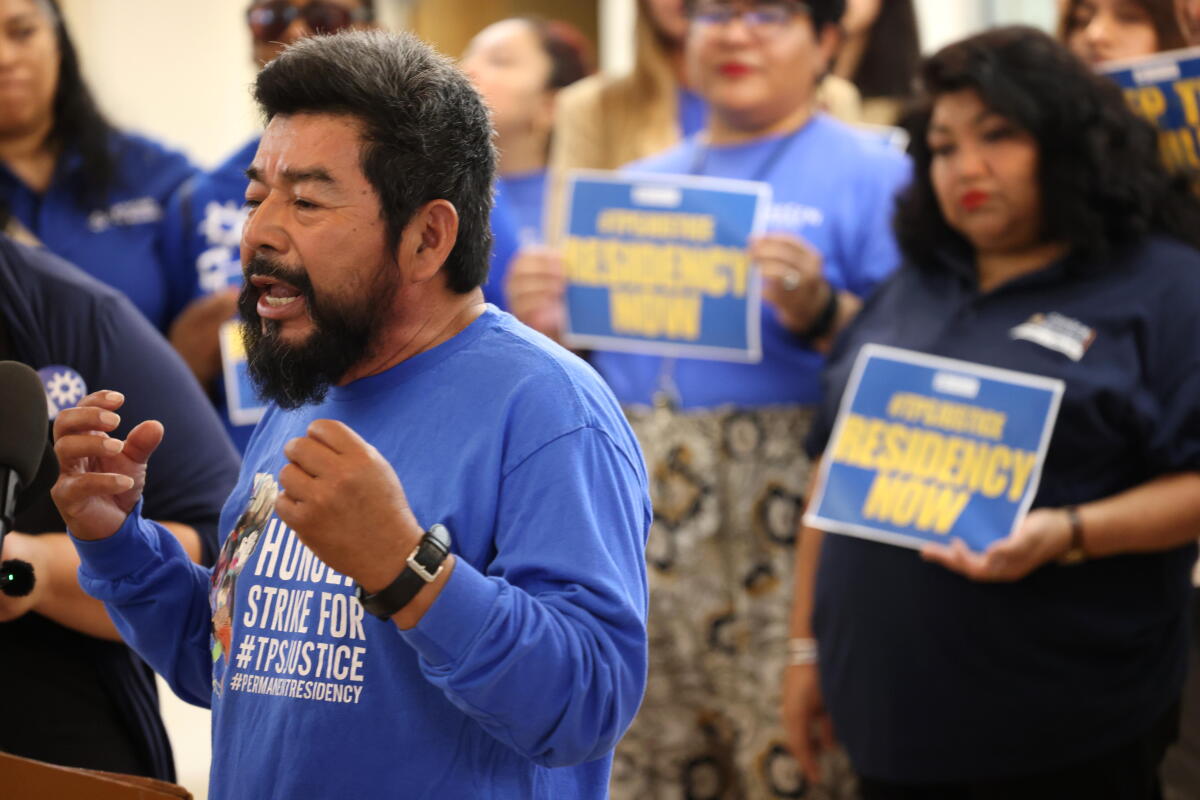
The Supreme Court agreed Monday to rule on whether the Trump administration may end the temporary protection that had been extended in the past to migrants who live and work in the United States.

At issue are legal protections for about 6,000 Syrians and up to 350,000 Haitians.

The court’s announcement signals the justices want to resolve this issue in a written opinion rather through emergency appeals.

Twice last year, the court’s conservatives set aside decisions from judges in San Francisco who said President Trump’s Homeland Security secretary had overstepped her authority.

Those cases involved the temporary protection status extended to about 600,000 Venezuelans.

But those decisions did not set clear precedents, and in recent weeks, judges in New York and Washington, D.C., blocked the administration’s plan to end the special protections for Haitians and Syrians.

Frustrated by what he labeled “indefensible” decisions, Trump’s Solicitor Gen. D. John Sauer advised the court to hear arguments and issue a written ruling on the issue.

The justices on Monday agreed to just that. Arguments will be heard in April, and a decision will be handed down by July.

Immigrant-rights advocates argued the repeal of the special protection would be cruel and unjust to migrants who have established lives and careers in this country.

In 1990, Congress authorized giving temporary shelter to non-citizens from countries experiencing armed conflict, natural disaster or “extraordinary and temporary conditions” that prevent them from returning there.

In 2012, the Homeland Security secretary extended this protection to Syrians in response to a “brutal crackdown” engineered by its then-President Bashar al-Assad.

Last year, citing Assad’s fall from power, Trump’s Secretary Kristi Noem proposed to cancel the temporary protection for Syrians. Lawyers for the Syrians questioned how this could be seen as an emergency requiring an immediate ruling.

They said about 6,100 Syrians who have lived here lawfully for years.

They are “highly sought-after doctors and medical professionals, reporters, students, teachers, business owners, caretakers, and others who have been repeatedly vetted and by definition have virtually no criminal history. The government apparently needs urgent authority to send them to a country in the middle of an active war,” the lawyers said.

In 2010, the Obama administration extended the protection to Haiti after an earthquake caused death and damage in Port-au-Prince, the capital.

Judges in New York and Washington blocked those repeals and said the high court had given “no explanation” for its decision upholding the repeal for Venezuelans.

Those judges said the Supreme Court’s earlier orders orders “involved a TPS designation of a different country, with different factual circumstances, and different grounds for resolution by the district court.”

Sauer pointed to a provision in the 1990 law that says judges have no authority to second-guess the government’s decision to end it.

“There is no judicial review of any determination of the [Secretary] with respect to the designation, or termination or extension of a designation, of a foreign state under this subsection,” the law says.

In the three weeks since Trump’s attorney filed his emergency appeal, there have been two significant changes since then.

Trump fired Homeland Security Secretary Kristi Noem. And his war launched against Iran threatens countries throughout the Mideast, including Syria.

In agreeing to hear the pair of cases, the justices did not disturb the lower court rulings that blocked the repeals for now.

Source link

Watch moment huge country star kicks ‘jealous boyfriend’ out of his show after he’s hit with a phone and left BLEEDING

COUNTRY music heartthrob Riley Green furiously kicked a “jealous boyfriend” out of his gig after being hit with a phone that left him with a bloody ear.

Riley needed five stitches to piece his ear back together following the Melbourne show on his Cowboy As It Gets tour.

Riley Green was hit by a phone at a gig in AustraliaCredit: annaperitivo/Instagram
It left him with a bloodied face, though he smiled it offCredit: annaperitivo/Instagram
The person who threw the phone was kicked outCredit: annaperitivo/Instagram

During the gig, he was struck by a phone pelted from the pit which caused him to stop the performance and take off his guitar.

He then pointed out the offender and directed security to haul him out. Smiling with blood running down his neck, Riley then slung his guitar back on before being cheered by the raucous crowd.

The 37-year-old told them: “Damn, am I bleeding? See how tough I am?”

He then said: “You can get your phones out, and you can turn the flashlight on – but don’t throw them at me.”

READ MORE ON COUNTRY MUSIC

AISLE SAY!

Country music superstar secretly marries fiancée on ‘trip to remember’ in Spain


SONGWRITING STAR

Country music legend known for Johnny Cash & Reba McEntire hits dead at 78

The violent incident certainly did no harm to Riley’s aura. His smitten fans sent messages of support on Instagram.

One said: “My babyyyyyy was bleeding.”

Another wrote: “Brother, don’t hurt my wife’s boyfriend!”

A third said: “He was bleeding but he’s a Bama boy…that’s just a little scratch. He can do anything he wants!”

While on one video, a fan wrote: “PSA to the jealous boyfriends., don’t throw your phones at Riley Green xx.”

Riley had a fun time despite the incident and regretted not being able to play for longer.

He wrote on Instagram: “Ole buddy ’bout ran outta anytime minutes last night… but a hell of a time was had.”

Riley’s become a global phenomenon in recent years.

Heartfelt songs like I Wish Grandpas Never Died, There Was This Girl, and Different ‘Round Here (feat. Luke Combs) have resonated thanks to their honest storytelling and southern drawl.

He supported Morgan Wallen at his BST Hyde Park gig in 2024 but put on a headline-worthy show.

Speaking about his summer in the capital, he told Entertainment Focus: “I wasn’t nervous but I certainly didn’t expect what happened! I thought that there would be, maybe, a handful of folks that knew a couple of my songs but they knew every word to every song.

“To see the size of the crowd……. especially when you go to another country and Canada had been the only other time I had played outside the States….. things are usually gradual in building up a fan base, right? It was shocking to see how passionate people were about country music over here.”

And he returned to these shores last year for some sold out gigs of his own.

Riley didn’t look too upset after the showCredit: rileyduckman/Instagram
He grabbed a bottle of water before tending to the woundCredit: rileyduckman/Instagram
He needed five stitches to sew it upCredit: rileyduckman/Instagram

Source link

Trump seeks to close $1.6-trillion revenue gap with new tariffs

The Trump administration is stepping up its ambitious effort to replace about $1.6 trillion in lost tariff revenue that was eliminated by the Supreme Court’s decision to strike down a range of the president’s import taxes.

Recovering that lost revenue, which the White House was counting on to help offset the steep, multitrillion-dollar cost of its tax cuts, is possible but will be challenging, experts say. The administration has to use different legal provisions to impose new import taxes, and those provisions require longer, complex processes that U.S. companies can use to seek exemptions. It could be months or more before it is clear how much revenue the replacement tariffs will yield.

“I wouldn’t bet against this administration being able to get back on paper the same effective tariff rate they had before,” said Elena Patel, co-director of the Urban-Brookings Tax Policy Center. But the new approach will “make it easier for people to contest the tariffs, which is going to put a big asterisk on the revenue until all that is settled.”

On Wednesday, U.S. Trade Representative Jamieson Greer said the administration will investigate 16 economies — including the European Union — over whether their governments are subsidizing excessive factory capacity in a way that disadvantages U.S. manufacturing. The investigation will also cover China, South Korea and Japan, Greer said.

In addition, he said, there would be a second investigation of dozens of countries to see whether their failure to ban goods made by forced labor amounts to an unfair trade practice that harms the United States. That investigation will also cover the EU and China, as well as Mexico, Canada, Australia and Brazil.

Both investigations are being conducted under Section 301 of the 1974 Trade Act, which requires the administration to consult with the targeted countries, as well as hold public hearings and allow affected U.S. industries to comment. A hearing as part of the factory capacity investigation will be held May 5, while a hearing on the forced labor investigation will occur April 28.

It’s a far cry from the emergency law that President Trump relied on in his first year in office, which allowed him to immediately impose tariffs on any country, at nearly any level, simply by issuing an executive order.

Moments after the Supreme Court’s ruling, Trump imposed a 10% tariff on all imports under a separate legal authority, but that duty can only last for 150 days. The president has said he would raise it to 15%, the maximum allowed, but has yet to do so. Some two dozen states have already challenged the new taxes. The administration is aiming to complete its Section 301 investigations before the 10% duties expire.

The effort underscores the importance that the Trump White House has placed on tariffs as a revenue-raiser at a time when the federal government is facing huge annual budget deficits for decades into the future. Previous administrations, by contrast, used tariffs more sparingly to narrowly protect specific industries.

Erica York, vice president of federal tax policy at the Tax Foundation, noted that the first investigation covers roughly 70% of imports, while the second would cover nearly all of them.

“That breadth suggests the goal isn’t to address the issues at hand, but instead to re-create a sweeping tariff tool,” she said.

Trump portrays tariffs as a way to force foreign countries to essentially help pay the cost of U.S. government services, even though all recent economic studies find that American companies and consumers are paying the duties, including analyses by the Federal Reserve Bank of New York and economists at Harvard University. In his State of the Union address last month, Trump even touted his tariffs as a potential replacement for the income tax, which would return the United States’ tax regime to the late 19th century.

Trump also wants tariffs to help pay for the tax cuts he extended in key legislation last year. The tax cut legislation is expected, according to the most recent estimates by the nonpartisan Congressional Budget Office, to add $4.7 trillion to the national debt over a decade, while all Trump’s import taxes, including ones not struck down by the court, were projected to offset about $3 trillion — or two-thirds of that cost.

The high court’s ruling Feb. 20 that he could no longer impose emergency tariffs eliminated about $1.6 trillion in expected revenue over the next decade, according to the CBO.

Some of Trump’s import taxes remain place, including previous tariffs on China and Canada that were imposed after earlier 301 investigations. The administration has also imposed tariffs on some specific products, including steel, lumber and cars. Those, combined with the 10% tariff for part of this year, should yield about $668 billion over the next decade, the Tax Foundation estimates.

“It’s going to take a really big patchwork of these other investigations to make up for the [lost] tariffs,” York said.

The administration’s efforts are also unusual because they reflect an overreliance on tariffs to bring in more government revenue. Trump has also said the import taxes are intended to return manufacturing to the United States — manufacturing jobs, however, are down since he returned to office — and he has used the tariffs to leverage trade deals.

“What makes this really different,” said Kent Smetters, executive director of the Penn Wharton Budget Model, “it is really the first time tariffs have been mainly used as a revenue raiser.”

Patel, meanwhile, argues that raising revenue can be done more reliably and straightforwardly by Congress. Laws like Section 301 are traditionally intended to be used to address specific trade policy concerns in particular countries.

“It’s not supposed to be there to raise revenue,” she said. “If we want to raise revenue through tariffs, then Congress should impose a broad based tariff.”

Rugaber writes for the Associated Press.

Source link

California national parks set attendance record, despite controversy

Despite morale-sapping staff layoffs, bizarre executive orders and a 43-day federal government shutdown last fall, the grandeur and serenity of national parks in California remain irresistible to outdoors lovers looking to unwind.

The nine national parks in the Golden State — including Yosemite, Death Valley and Joshua Tree — attracted nearly 12 million recreational visits in 2025, according to statistics from the National Park Service.

That’s up more than 800,000 visits from 2024 and up more than 300,000 from the previous record set in 2019, according to the data, which stretches back to 1979.

Nationally, visits were high, at 323 million, but down a couple of percentage points from the record set in 2024, according to a park service press release.

“America’s national parks continue to be places where people come to experience our country’s history, landscapes and shared heritage,” said Jessica Bowron, acting director of the NPS.

“We are committed to keeping parks open, accessible and well-managed so visitors can safely enjoy these extraordinary places today and for generations to come,” Bowron added.

President Trump’s critics beg to differ.

Since Trump resumed office in January 2025, his administration has slashed the NPS workforce by nearly a quarter, buying out or laying off hundreds of rangers, maintenance workers, scientists and administrative staff across the country.

And last year, as part of his war on “woke,” Trump instructed the park service to scrub all signs and presentations of language he would deem negative, unpatriotic or smacking of “improper partisan ideology.”

He also ordered administrators to remove any content that “inappropriately disparages Americans” living or dead, and replace it with language that celebrates the nation’s greatness.

That gets tricky at places such as Manzanar National Historic Site in the high desert of eastern California — one of 10 camps where the U.S. government imprisoned more than 120,000 Japanese American civilians during World War II.

It’s also hard to dance around disparaging details at Fort Sumter National Monument, where Confederates fired the first shots of the Civil War; Ford’s Theater National Historic Site in Washington, D.C., where Abraham Lincoln was assassinated; and Martin Luther King Jr. National Historic Park, which commemorates the assassination of the country’s best known civil rights leader.

“This administration is actively erasing the history, science and culture that our national parks protect,” said Emily Douce, deputy vice president for government affairs for the nonprofit National Parks Conservation Assn.

Douce argued that morale among staff at the parks — a string of 63 federally protected natural wonders often described as “America’s best idea” — has never been lower.

But the fact that employees still showed up, including without pay during last year’s federal government shutdown, demonstrates their commitment to keeping the beloved parks flourishing.

“The enduring popularity of America’s national parks is not surprising,” Douce added. “What’s shocking is this administration’s relentless attacks on these places and their caretakers, which threatens their future.”

The White House did not immediately respond to a request for comment.

The National Park Service is routinely ranked among the most admired branches of the large and sprawling federal government. Even Americans who have never watched a minute of C-SPAN, or get a little lost in the alphabet soup of other agencies, will probably never forget standing in Yosemite Valley and admiring a towering waterfall.

There were 4.3 million visits to Yosemite in 2025, 2.9 million to Joshua Tree and 1.3 million to Death Valley, according to the data.

The 323 million visits to America’s national parks in 2025 are more than twice the attendance — 135 million — at professional football, baseball, basketball and hockey games combined.

Of course, it’s a lot cheaper to get into a park. U.S. residents pay between $20 and $35 per vehicle for a day pass, or $80 for an annual pass. The Trump administration recently raised the annual fee to $250 for foreign visitors.

National Park Service officials did not respond to emails requesting comment on California’s 2025 attendance.

Source link

Poor in an oil-rich country: Republic of Congo’s youth hope for change | Elections News

Pointe-Noire and Brazzaville, Republic of Congo – In Pointe-Noire, the economic capital of the Republic of Congo, the aisles of the Grand Marche come alive in the early hours of the morning. Among the market stalls, street vendors, and shoppers pushing their way through the crowd, Romain Tchicaya is selling medicines on the sly.

As the price of basics – including pharmaceutical products – rises, and people turn to more affordable unregulated options, merchants like Tchicaya step in to fill the gap while trying to earn a living in a struggling economy.

Recommended Stories

list of 3 itemsend of list

However, the 37-year-old’s background is far from typical for a street vendor.

With a degree in management, he thought he would find a stable job after graduating from university. But like many young Congolese, he found himself facing a tight job market with few opportunities.

“We are told that the country is rich in oil. But I don’t see that wealth in my daily life,” he told Al Jazeera. “Look at Pointe-Noire, formerly nicknamed as Ponton la Belle [Beautiful Pointe-Noire]. Today, the city is unrecognisable.”

Around the Grand Marche, the main roads are potholed, and when it rains, the streets get flooded, making it almost impossible to drive.

Like Tchicaya, Brice Makaya, in his 40s, has never managed to find a stable job here despite having a degree in computer science.

With no stable employment, he is unable to rent a house and now lives outside the church where he prays.

“I am still underhoused at my age and have no prospects for the future,” he told Al Jazeera. “Without a job, I can’t plan ahead. I’m just trying to survive.”

For many young Congolese, daily life is a paradox: though they live in a resource-rich country – the third largest oil producer in sub-Saharan Africa and a producer of liquefied natural gas (LNG) – nearly half the population live below the poverty line.

This Sunday, Congo goes to the polls in which President Denis Sassou Nguesso, 82, is again seeking another term. For young voters, jobs and the economy are a big concern. But for the government, there appear to be limitations to what is possible.

During one of his speeches in the election campaign, Nguesso pointed out that the civil service could not absorb all job seekers, and urged young people to take charge of their own futures by encouraging self-employment.

Congo-Brazzaville
A market in the Republic of the Congo before the 2026 presidential election [Al Jazeera]

Oil: ‘Fuel of the political system’

According to the World Bank, oil accounts for about 70 percent of Congo’s exports and nearly 40 percent of its gross domestic product (GDP).

But this wealth does not automatically translate into an improvement in living standards for most of the populace.

The World Bank estimates that more than 40 percent of Congolese people live below the poverty line, despite the country’s significant natural resources.

For economist Charles Kombo, this can be explained in large part by the very structure of the Congolese economy, which is dependent on oil revenues.

“Oil dependency plays a structuring role in many African economies. In what some call a ‘rentier state’, a large part of public resources comes from the exploitation of natural resources rather than taxation,” he explained.

In a rentier state, the country generates substantial revenue from “renting out” natural resources, such as oil, to foreign companies. In exchange for the exploitation rights granted on these resources, the state receives royalties, taxes, or a share of production.

In this type of system, Kombo explains, the management of revenues becomes central to political power.

“Control of this revenue often reinforces institutional centralisation,” he said, explaining that dependence is no longer solely economic, but becomes institutional and sometimes psychological, as it influences budgetary priorities, political strategies, and even perceptions of development.

He points out that when the economy relies heavily on extractive revenues, economic and political resources tend to become intertwined, which can limit electoral competitiveness.

“Oil revenues can generate significant income, but they do not guarantee the structural transformation of the economy,” he said.

This oil dependence also exposes the country to fluctuations in oil prices on international markets.

After the fall in crude oil prices in 2014, the Congolese economy experienced a severe crisis. Public debt exceeded 90 percent of GDP, before being restructured under agreements with the International Monetary Fund and several international creditors.

Although this has helped stabilise the macroeconomic situation, the country remains heavily indebted. According to the World Bank, public debt fell from 103.6 percent of GDP in 2020 to about 93.6 percent in 2024, reflecting a gradual improvement, but also the continued vulnerability of Congo’s economy to fluctuations in global oil prices.

For political analyst Alphonse Ndongo, oil revenues also influence political life in Congo.

“Oil has become the fuel of the political system. It is used to finance parties, co-opt elites, and maintain social balance,” he said.

According to him, “oil money comes easily and quickly”, but this financial windfall has long delayed necessary structural reforms such as economic diversification.

In his view, the steady flow of money from the oil sector can create a sense of complacency within the system, reducing the pressure to pursue deeper structural reforms. As a result, debates around economic diversification tend to emerge mainly during periods of financial stress, when falling oil prices expose the limits of the model. But when revenues rise again, he argues, the urgency to diversify often fades, leaving the economy heavily dependent on the same resource.

Congo
A man walks past a campaign banner of first-time presidential candidate Destin Gavet, in advance of the election [Roch Bouka/Reuters]

‘An uphill battle’

As the country’s oil wealth fails to filter to the majority of the population, young people are particularly affected and many face unemployment.

According to data from the World Bank and the International Labour Organization, the youth unemployment rate in Congo is among the highest in Central Africa, while the informal sector absorbs the majority of new entrants to the labour market.

During a news conference on March 4 in Brazzaville, Prime Minister Anatole Collinet Makosso, who is also spokesperson for presidential candidate and incumbent leader Nguesso, said that young people were at the heart of the government’s policy.

“Youth has always been at the centre of Denis Sassou Nguesso’s policies and social projects,” he said, citing investments in education and the construction of universities.

He also claimed that the unemployment rate had fallen from 44 percent to 39 percent in recent years.

But on the ground, many young people remain sceptical.

Landry, 23, a student in the capital Brazzaville who did not want to give his last name, says he has lost faith in political promises.

“Promises of jobs come back every election. It’s become a cycle,” he said.

A months-long strike at Marien Ngouabi University, the country’s main institution of higher education, forced him to interrupt his studies.

“I went back to my parents’ house to wait and see what I could do. Today, I’m seriously thinking about going abroad.”

Another student in Brazzaville, a 26-year-old woman who did not want to give her name, expressed similar frustration.

“The only sector that is really recruiting today is the army. But not everyone can become a soldier. Becoming a civil servant is also an uphill battle,” she said.

Even sectors that are supposed to be structured are not immune to precariousness. Regine, a young journalist who also did not want to provide her last name, said she works without a stable employment contract.

“In the media, many young people live off ‘camora’, one-off payments for services. It’s not a real salary.”

She also lamented the difficulties of everyday life, including infrastructure issues, such as power cuts and inconsistent water supplies, despite repeated government investment plans.

“In the 21st century, people rejoice when the electricity comes back on. And when the water finally flows, everyone rushes to fill buckets,” she said.

Sassou
President of Congo Denis Sassou Nguesso [File: Minasse Wondimu Hailu/Anadolu Agency]

‘Social time bomb’

Congo’s infrastructure problems are a reminder to Regine and many others that economic difficulties go beyond the issue of employment.

At the same time, the consequences of the country’s youth employment crisis also reverberate more widely and into the social sphere.

Analyst Ndongo sees this as a potentially explosive situation.

“When there are large numbers of young people who are unemployed and have no prospects, it can become a social time bomb,” he said.

This dynamic is already visible in the tensions that emerge when unemployment and inequality intersect, Ndongo explained: As large numbers of young people struggle to find work while wealth linked to the oil sector remains visible, frustration can build among those excluded from economic opportunities.

He says pressure can be contained for a time, but without meaningful job opportunities and stronger education systems, resentment may deepen. Over time, he warns, groups of unemployed and poorly trained youth can become more vulnerable to crime or gang activity.

The Congolese population is very young: more than 60 percent of people are under 25, according to United Nations data. This demographic reality represents both economic potential and a major challenge for the authorities.

For economist Kombo, the issue goes far beyond just unemployment.

“Demographics are a major political factor in many African countries. When the population is predominantly young, expectations for employment and social mobility are particularly high.”

According to him, long-term political stability will depend on the ability to create economic opportunities.

“Development is not distributed,” he said, “it is built.”

Despite the frustrations, political mobilisation remains limited, even as several candidates rally to compete against Nguesso in this weekend’s vote.

Chris Taty, a young student in Brazzaville, says he is not interested in the current election, as it is clear that the president who has already been in power for more than 40 years will once again reign supreme.

“Everyone already knows who is going to win. So why bother voting? I’d rather stay at home and do other things,” he said.

“Sometimes we joke that Sassou [Nguesso] is our grandfather,” the young journalist Regine said. “He has been ruling for so long that many of us have never known another president”

Nguesso has been a dominant figure in Congolese politics for decades, first ruling the country from 1979 to 1992 before returning to power in 1997 following a brief period out of office. His long tenure has enabled him to consolidate influence over key state institutions. Meanwhile, analysts say the country’s opposition remains fragmented and lacks the organisational capacity to pose a strong challenge.

For some potential voters, the perception of a largely predictable outcome has contributed to a degree of political disengagement, which Ndogo says is a “feeling of resignation”.

“Resignation is ingrained in everyone … Students, politicians, intellectuals … everyone is forced to scramble for a piece of the pie,” he said.

“We are all lulled into resignation because we tell ourselves that if we stand up against the established order, against those in power, we risk ending up in prison or even six feet under. It’s risky to oppose the system today.”

This combination of economic frustrations and limited political participation is a main challenge facing Congo, observers say. And the issue of youth unemployment risks becoming a major crisis in the coming years if nothing is done to fix it.

For many educated yet underemployed young people in the oil-rich country, the question is whether or not Congo can transform its natural wealth into concrete opportunities for its people.

“We are not asking for much,” said Regine. “Just the chance to work, to live in our own country with dignity and to believe that our future can be built here, without connections, with equal opportunities for young people, and without conditions.”

Source link

Lawmakers vent frustration over Homeland Security shutdown as lines grow at nation’s airports

Republican and Democratic senators vented their frustrations with the lack of progress in funding the Department of Homeland Security, which is resulting in more Americans enduring long lines at airports around the country. It’s a problem that is expected to intensify as the impasse enters its fourth week.

Democrats stressed they were willing to fund some of Homeland Security, but not Immigration and Customs Enforcement as well as Customs and Border Protection, without changes in their operations. Republicans made clear that some of the Democratic demands were a non-starter. The result was that each party blocked the other’s proposal for temporarily resolving the standoff during an hours-long debate Wednesday on the Senate floor.

The stark divide over a shutdown that began on Feb. 14 was acknowledged by members on both sides of the political aisle.

“We are in a negotiation. However, we are not close,” Sen. Brian Schatz (D-Hawaii) said at one point. “You may think this is some issue that we think we’re going to turn to our political advantage, but I promise you, when we saw Renee Good and Alex Pretti killed, this became an issue that was beyond politics.”

“And there are a lot of us who are not going to provide resources to this agency that is acting in such a ways that makes citizens of the United States so unsafe.”

Some Republicans were just as adamant that they oppose some of the changes Democrats are seeking to make.

“Let me be clear, we are going to do nothing — nothing — that kneecaps ICE’s ability to enforce our immigration laws,” said Sen. Eric Schmitt (R-Mo.).

Following the longest federal shutdown in the country’s history last year, Congress completed work on 11 of this year’s 12 appropriations bills. Only the bill for Homeland Security remains outstanding.

Democrats are seeking several changes at the department that include prohibiting ICE enforcement operations at sensitive locations like schools and churches, allowing independent investigations into alleged wrongdoing, requiring warrants to be signed by judges before federal agents can forcibly enter private homes or other nonpublic spaces without consent, and requiring agents to wear identification and remove their masks.

A push for more talks

Senate Majority Leader John Thune (R-S.D.) said his side has made repeated overtures to Democrats on a funding bill. He said the last offer on Homeland Security funding came from the White House nearly two weeks ago and there has been no response from the Democrats.

“Usually, around here, in order to get a deal, there has to be a negotiation where the two sides sit down together,” Thune said. “And my understanding is that has been completely rebuffed by the senator from Washington.”

The senator Thune was referring to, Sen. Patty Murray, the lead Democrat on the Senate Appropriations Committee, said she’s continued to talk with Republican colleagues, but those aren’t “real negotiations.” The White House needs to be at the table for that to occur. She said she needed assurance that Stephen Miller, the influential White House deputy chief of staff, would not upend any agreements that senators reach.

“I am willing to talk to people, but I’m not willing to sit in a room, have coffee, give away a few things and have Stephen Miller override whatever we all agree to,” Murray said. “ … We need to know the White House is serious.”

Homeland Security has been central to President Trump’s sweeping changes in immigration enforcement. Under Trump, the number of people ICE arrests and detains each month has climbed dramatically. The tactics that ICE has employed have generated alarm among Democrats, and some Republicans have also called for a more “strategic” approach.

During bipartisan negotiations earlier this year, appropriators agreed to a Homeland Security funding bill that did include more resources for de-escalation training and $20 million to outfit immigration enforcement agents with body-worn cameras. But that deal unraveled after the Pretti shooting in Minneapolis.

“My side was not going to stand down and say, ‘oh well, nothing happened,’” Murray said.

For the second time in two weeks, Murray offered a proposal to fund all of Homeland Security except for ICE and Customs and Border Protection, but Republicans objected.

Similarly, Sen. Katie Britt (R-Ala.) offered a proposal to fund all of Homeland Security for two weeks so that federal workers could get paid and government operations could continue while the two sides negotiate their differences on immigration enforcement. This time, Democrats objected.

The result was the standoff continues, but lawmakers were at least talking to each other, perhaps one small sign of progress.

Shutdown strains air travel

The large majority of the more than 260,000 employees at Homeland Security continue to work but are going unpaid. It’s the second time in recent months they’ve had to work without pay after last fall’s record, 43-day shutdown. The most visible sign of the shutdown has been a shortage of Transportation Security Administration screeners at airports.

Houston’s secondary airport weathered the worst problems, with lines consistently lasting over three hours for much of Sunday and Monday. Passengers also had to wait more than an hour to get through security at several other airports, including in New Orleans and Atlanta.

Homeland Security in a social media post Wednesday blamed Democrats for a shutdown that “has led to HOURS long security lines at airports across the country, leading Americans to miss their spring break flights.”

Trade groups are also worried about the economic impact of the travel delays. The U.S. Chamber of Commerce called on Congress to quickly approve a funding bill and end the department’s shutdown.

“Blocking operational funding and paychecks for those who help us travel safely is wrong and strains the air travel system,” said Neil Bradley, the business group’s executive vice president and chief policy officer.

Freking writes for the Associated Press.

Source link

Cuba is ‘ready’ for talks with U.S. amid growing pressure from Trump

Cuba’s top diplomat in Washington says Havana is prepared to enter diplomatic talks with the United States, reiterating the country’s willingness to engage even as tensions escalate with President Trump asserting that the island nation’s government could soon collapse.

“We are ready to engage with the U.S. on the issues that are important for the bilateral relation, and to talk about those in which we have differences,” Ambassador Lianys Torres Rivera, who leads Cuba’s mission in Washington, told The Times on Wednesday.

Any dialogue would need to respect Cuba’s sovereignty and its “right to self-determination,” the ambassador said.

“We are sure that it is possible to find a solution,” she said.

Her comments in a wide-ranging interview come at a particularly volatile moment for Cuba, which is under mounting economic pressure after the Trump administration imposed an oil blockade that has choked off the island’s energy supplies.

The measures have deepened a humanitarian crisis and prompted Cuban President Miguel Díaz-Canel to call for an “urgent” overhaul to the country’s economic model.

The situation in Cuba worsened after U.S. forces removed Venezuelan President Nicolás Maduro in January, allowing Washington to later cut off oil shipments from Venezuela to its longtime ally. The Trump administration later pressured other suppliers, including Mexico, to reduce deliveries.

“We are doing our best, and we are being very creative, but it has a serious impact,” Torres Rivera said of the blockade. “It is a collective punishment against the Cuban people.”

The White House this week framed Cuba’s worsening economic and humanitarian conditions as a potential opening to pressure Havana into negotiations.

“The country is obviously in a very weak place, economically speaking, the people are crying out for help, and the president believes and knows the Cuban regime wants a deal,” White House Press Secretary Karoline Leavitt said during a news briefing Tuesday.

Rep. Mario Diaz-Balart (R-Florida) told the Miami Herald on Wednesday that the Trump administration had been having secret, high-level conversations with several people in former President Raul Castro’s inner circle, a similar approach that was taken in Venezuela before Maduro’s capture. (The operation to seize Maduro killed 32 Cuban officers stationed in the country.)

Three people in uniform hold portraits of three men, while a row of people above them, also in uniform, wave flags

Cuban President Miguel Díaz -Canel, fourth from right, holds up a Cuban flag during a rally in Havana on Jan. 16, 2026, to protest the killing of Cuban officers during the U.S. operation that captured Venezuelan President Nicolás Maduro.

(Ramon Espinosa / Associated Press)

Another report by the USA Today this week said the Trump administration was close to announcing an economic deal with Cuba that would ease travel restrictions, among other things. A representative with the Cuban government declined to comment on the report.

The White House has not specified what a deal may look like. But Trump has said the United States is interested in a “friendly takeover” and has suggested that the move would allow Cubans to visit the island, a place that many Cuban exiles have worried about returning to while the current regime is in place.

“It is just a question of time before a lot of unbelievable people are going back to Cuba,” Trump said at an event last week.

Several news outlets have reported that the Justice Department is examining possible federal charges against officials within Cuba’s government, a move that could prompt a change in the island’s government.

Torres Rivera said she is aware of the reports but said the “judicial accusations” are an “instrument of political coercion without any legitimacy.”

“It is not something we are losing sleep over,” she said.

As for the potential negotiations, Torres Rivera did not provide specifics but talked about restoring diplomatic ties somewhat to how they existed during the Obama administration.

“We are neighbors,” she said. “We have common challenges, common threats, and we can speak about all that, and we can speak on the basis of respect for each other’s sovereignty and each other’s right of self-determination. We are ready for that.”

President Trump has approached diplomacy with Cuba with a harsher tone.

“As we achieve a historic transformation in Venezuela, we’re also looking forward to the great change that will soon be coming to Cuba,” Trump said Saturday, one week after U.S. and Israeli forces attacked Iran and killed Supreme Leader Ayatollah Ali Khamenei.

He added: “Cuba’s at the end of the line. They’re very much at the end of the line. They have no money. They have no oil. They have a bad philosophy. They have a bad regime that has been bad for a very long time.”

Trump said that he has put Secretary of State Marco Rubio in charge of leading the talks with Cuba and that he believes a “deal would be made very easily with Cuba.”

Torres Rivera did not offer an opinion on Rubio being tapped to lead the negotiations. Rubio is the son of Cuban immigrants who came to Florida three years before Castro’s brother, revolutionary Fidel Castro, rose to power in 1959. She reiterated that Cuba is “ready to engage” in talks regardless of who is leading them.

“We are not talking about persons, we are talking about the government and we are ready to engage with the U.S. to talk about the very important issues that we have in bilateral relations,” she said.

Source link

FIFA has discretion deciding how to replace Iran in the World Cup

Iran’s sports minister said his nation will not participate in this summer’s World Cup following the attacks on the country by the U.S., one of the tournament’s hosts.

The U.S. bombing campaign against Iran, which began two weeks ago, has triggered a region-wide conflict and killed more than 1,300 Iranians including Ayatollah Ali Khamenei, the country’s supreme leader, according to Iran’s U.N. ambassador Amir Saeid Iravani.

“Considering that this corrupt regime has assassinated our leader, under no circumstances can we participate in the World Cup,” sports minister Ahmad Donyamali said on state television Wednesday.

“Our players do not have security, and fundamentally the conditions for participation do not exist.”

Donyamali’s statement came just hours after FIFA president Gianni Infantino said he had received assurances from President Trump that Iran would be allowed to participate in the tournament, which will be played in the U.S., Mexico and Canada.

“President Trump reiterated that the Iranian team is, of course, welcome to compete in the tournament in the United States,” Infantino wrote in an Instagram post. “We need an event like the FIFA World Cup to bring people together now more than ever, and I sincerely thank the President of the United States for his support.”

Last year President Trump signed an executive order suspending visa issurance to nationals of 19 countries, including Iran, although the State Department can make exceptions for “participants in certain major sporting events” such as the World Cup.

Iran, which has played in the last three World Cups, earned its place in this summer’s tournament by dominating its group in the Asian confederation tournament. However it did not send a representation to a World Cup planning summit last week in Atlanta.

Iran was drawn into Group G for the World Cup and is scheduled to begin play June 15 against New Zealand at SoFi Stadium in Inglewood. Iran’s second group-stage game, against Belgium, is also scheduled for SoFi Stadium before the team finishes the first stage of the tournament against Egypt in Seattle.

According to The Athletic, no country has withdrawn from a World Cup after qualifying since the 1950 tournament in Brazil, when India, Scotland, France and Turkey pulled out, mostly over costs and logistical issues.

Donyamali did not say whether he has begun the formal process or withdrawing Iran from the World Cup but FIFA could be facing a time crunch if it had to replace Iran in the 48-team field. Article 6.7 of FIFA’s 2026 World Cup regulations states: ‘If any Participating Member Association withdraws and/or is excluded from the FIFA World Cup 26, FIFA shall decide on the matter at its sole discretion and take whatever action is deemed necessary. FIFA may decide to replace the Participating Member Association in question with another association.”

The most likely replacement scenario would have Iraq, the top non-qualifier from the Asian confederation, taking Iran’s place. Iraq is scheduled to play the winner of a Suriname-Bolivia playoff in Mexico later this month for a final World Cup berth but with airspace over the Middle East closed because of the war, the Iraqis are unsure how they will get to Mexico. Giving them Iran’s berth would solve that problem but it would create another; who would replace Iraq in the playoff against the Suriname-Bolivia winner? Based on the Asian qualifying tournament, the UAE would be the most likely candidate but it, too, would face travel concerns in getting to Mexico.

FIFA could leave those playoffs untouched and give Iran’s spot to Italy, which is ranked 13th in the world but must win a four-team UEFA playoff later this month to qualify for the World Cup. Basically FIFA can do whatever it wants.

FIFA regulations say that any team that withdraws from the tournament “no later than 30 days before the first match” will be fined and could face other “disciplinary sanctions” including expulsion from subsequent FIFA competitions. This summer’s World Cup kicked off June 11 in Mexico City and Toronto. The U.S. opener is scheduled for June 12 in Inglewood.

Earlier this week six members of Iran’s delegation to the Women’s Asian Cup were granted humanitarian visas and allowed to remain in Australia rather than return to Iran where they feared persecution for not singing the national anthem during the tournament.

Source link

As U.S. democracy is in peril, these Brazilian films offer perspective

When Brazilian journalist Tatiana Merlino watched “The Secret Agent” — one of this year’s Oscar nominees for best picture — it felt like seeing scattered scenes from her own life.

As the movie follows Marcelo (played by Wagner Moura) — a professor fleeing from a vindictive businessman during Brazil’s military dictatorship (1964-1985), the story skims through old audio tapes and newspapers, reviewed by a researcher looking into how he died. Like her, Merlino also dug into the past to piece together how her uncle, Luiz Eduardo Merlino, a communist activist, was killed by the right-wing regime in 1971. Though it was initially reported as a suicide, the family soon found his corpse with torture marks in a morgue.

“It became necessary to fight for memory, truth, and justice, because these crimes committed by dictatorship agents weren’t punished at that time, and have not been to this day,” says the 49-year-old journalist, who first saw “The Secret Agent” in São Paulo, and made a career from investigating human rights abuses.

“When a country does not come to terms with its past,” she adds, “its ghosts resurface.”

Recent dictatorship-themed movies like “The Secret Agent” and “I’m Still Here,” which won the Oscar for best international film in 2025, were instant blockbusters back home in Brazil. While both films honor those who, like Merlino, still seek justice for the regime victims, their popularity also got boosted by the country’s zeitgeist.

To many Brazilians, these movies served as reminders of what could have been had former far-right President Jair Bolsonaro, himself a retired Army captain and a dictatorship nostalgic, succeeded in his 2022 attempt at a coup d’etat.

On Jan. 8, 2023, encouraged by Bolsonaro, hundreds of vandals stormed into the Three Powers Plaza, a square in the country’s capital, Brasília, that gathers the congress, the supreme court and the presidential palace. Neither he nor the vandals accepted the 2022 election — won by the veteran leftist Luiz Inácio Lula da Silva, better known as “Lula.”

The uprising followed the same blueprint as the pro-Trump rioters behind the Jan. 6 insurrection in the United States. Although President Trump himself was federally prosecuted for election obstruction, the case was dismissed after his reelection in 2024.

Unlike the U.S., however, Brazil has charged, judged and arrested the conspirators — including Bolsonaro and members of his staff who participated in the coup plot.

“Bolsonaro doesn’t come from Mars,” said “The Secret Agent” star Wagner Moura to the L.A. Times in February. “He’s deeply grounded in the history of the country.”

In 1964, a U.S.-backed coup enacted a violent, 21-year autocracy run by the military, whose effects still resonate today, says Alessandra Gasparotto, a professor at the Federal University of Pelotas (UFPEL).

“It was a dictatorship that worked from a perspective of building certain legitimacy, keeping the congress functioning, but of course, after purging dissent,” explains the Brazilian historian.

“I’m Still Here,” for example, dramatizes the real-life quest of Eunice Paiva, a housewife whose husband Rubens Paiva, a former leftist congressman who had his tenure revoked after the coup, then disappeared in the hands of the military in 1971. To this day, his body still hasn’t been recovered.

In 2014, Bolsonaro, then just a congressman, spit on a bust of Paiva erected to honor his memory during the coup’s 50th anniversary in Congress.

“The cinema of all countries has the role of preserving memory, so if you take a look at the Holocaust, the American Civil War, or World War II movies, it has this role of almost an ally of history,” says writer Marcelo Rubens Paiva, son of Rubens Paiva and author of the book from which “I’m Still Here” is based. “There’s an old saying: History is the narrative of winners, while art is of the defeated.”

In the case of Brazil, the militaries who led the repressive apparatus of the dictatorship got away with torture and murder through a 1979 amnesty law. It was initially enacted to pardon alleged “political crimes” committed by the regime opposition and allow a transition to democracy — but it was also used to pardon the dictatorship’s human rights violations. Then, in the late 1980s, the military oversaw a slow, gradual shift to democracy, stepping down from power only in 1985.

“This new republic had more continuity than novelty, since many politicians who were central to the dictatorship moved to central roles in the democratic government,” explains Gasparotto. “That’s why they built this pact [to forgive the regime’s crimes].”

For that reason, these movies still feel contemporary. “The Secret Agent,” for example, blends past and future through the records analyzed by a researcher, while “I’m Still Here” highlights Eunice Paiva’s post-regime fight for the recognition of Rubens Paiva’s death; without any corpse to officialize his death, he was just deemed disappeared.

When Merlino watched the movie, for example, Eunice reminded her of her grandmother, Iracema Merlino.

“I’m the third generation of my family fighting for memory, truth and justice,” says Merlino. “It started with my grandmother, who passed away, then it was handed to my mother, who’s now very ill, then to me.”

Nowadays, she awaits trial for the third lawsuit attempt of the family to hold her uncle’s torturer, Col. Carlos Alberto Brilhante Ustra, accountable — the two other cases against the accused were dismissed over the years.

Since Ustra’s death in 2015, the Merlino family is now suing his estate for reparations. Yet he still remains a hero to some; in 2016, while Bolsonaro was still a congressman, he shouted a dedication to the memory of the torturer during the voting of the impeachment of Brazil’s former President Dilma Rousseff — herself one of the victims of Ustra in the 1970s, but among the few who survived.

“These films make connections with the present because understanding the past is important for understanding today’s contradictions,” says Marcelo Rubens Paiva. “What happened before interferes in the conflicts a country lives in today.”

So if authoritarians like Bolsonaro don’t come out of the blue, the same goes for other autocratic leaders, like President Trump.

Although founded on democratic principles, the U.S. itself has a long, muddled history with the concept. The authoritarian turn the country is reckoning with is part of a long legacy of inequality that stemmed from the 246-year institution of slavery. Following its abolishment in 1865 came a near-centurylong period of tension marked by racial segregation that we now refer to as “Jim Crow.”

“With some exceptions, the South was governed by a then-segregationist Democrat party — with [rampant] electoral fraud, authoritarianism, use of local police for political repression, and no chance for opposition, even [by] moderates,” says Arthur Avila, a history professor at the Federal University of Rio Grande do Sul (UFRGS) in Brazil.

Although the Civil Rights Act of 1964 and the Voting Rights Act of 1965 ended segregation and granted voting rights to people of all races — signed by then-President Lyndon B. Johnson, a Southern Democrat who broke away from the party’s history to spearhead progressive domestic policy — the decades that followed were ridden with manipulations of the electoral system. For example gerrymandering, or the practice of manipulating electoral district boundaries to favor one political party, is an ongoing, albeit controversial tactic among both Democrats and Republicans.

President Trump himself was federally prosecuted for election obstruction. The indictment alleged that, upon losing the 2020 election, Trump conspired to overturn the results and manipulate the public by spreading false claims of election fraud on social media. It argued that this, in turn, stoked a mob of his supporters into leading the deadly Jan. 6 attacks on the Capitol; but the case was dismissed upon his reelection in 2024.

In the lead-up to the midterm elections in November, Trump has pushed for federal control over elections, restrictions on mail-in voting and the addition of citizenship documents to vote, despite an existing federal law that already prohibits noncitizens from voting in U.S. elections. (He tried implementing the latter through an executive order in 2025, but it was permanently blocked by a federal court; a voter ID bill called the “SAVE America Act” is currently stalling in the Senate.)

“There’s a strong local authoritarian tradition in the U.S. that Trump himself feeds from,” says Avila.

Besides that, according to Avila, the country faces a growing “de-democratization” process from within. This shows in the rising control and dismantling of institutions by reactionary sectors — including efforts to block professional, educational and athletic programs promoting DEI, or diversity, equity and inclusion — from what many critics and scholars have cited as lingering resentment from desegregation, he says.

“We may see it as a slow authoritarian turn in North American politics that didn’t overturn the democratic regime yet,” Arthur considers. “But if this process goes on, and that’s a conjecture, in the next decade the U.S. may become a state of exception that keeps democratic appearances but has been stripped of any democracy’s substance whatsoever.”

As movies such as “The Secret Agent and “I’m Still Here” remind us, a great deal of maintaining a democracy has to do with keeping a good memory.

Source link

Australia grants asylum to 5 members of Iranian women’s soccer team

Five players who defected from the Iranian women’s soccer team after the team’s final match in the Asian Women’s Cup in Australia were granted asylum Tuesday.

Police assisted the women in leaving their hotel and placed them in a safe house. There, they met with Australian home affairs minister Tony Burke and their humanitarian visas were processed.

At least seven players left the hotel, according to Raha Pourbakhsh, a journalist for Iran International TV. Families of at least three of the five players granted asylum had been threatened, Pourbakhsh told CNN. At least two other players who left the hotel haven’t been located.

According to an X post by Reza Pahlavi, son of the deposed Shah of Iran, the players who “successfully sought refuge in Australia” are Fatemeh Pasandideh, Zahra Ghanbari, Zahra Sarbali, Atefeh Ramazanzadeh, and Mona Hamoudi.

Pahlavi warned in a separate post that the women would face “dire consequences” if they return to Iran.

“I don’t want to begin to imagine how difficult that decision is for each of the individual women, but certainly last night it was joy, it was relief,” Burke said.

Burke said the asylum offer was extended to all 26 players and the coaching staff, but the team left Australia for Iran on Tuesday, Ten Network News reported. It was unclear whether anyone besides the seven players who had left the team hotel had defected.

The team remained silent during the Iranian national anthem before their first Asian Cup match a week ago, which was interpreted as a protest against the regime. They saluted and quietly mouthed words to the anthem before a match against Australia after pushback from the Iranian government and accusations of treason.

Australia assisted the women, who apparently fear persecution at home. Following the United States-Israeli strikes on Iran and retaliation in the Middle East, Iranian state television labeled the soccer team “wartime traitors” and alluded to repercussions upon their return to the country.

Protesters converged near the bus transporting the team after its final match Sunday night, shouting “save our girls” and carrying the Iranian Lion flag used before the 1979 Islamic Revolution. Today, the flag is a symbol of resistance against the current regime.

Iran is now under the rule of Mojtaba Khamenei, a new hardline supreme leader. Khamenei is the son of Ayatollah Ali Khamenei, the 86-year-old leader who was killed on the first day of U.S. and Israeli attacks.

President Trump, in a statement Monday on Truth Social, said the United States would grant the Iranian players asylum if Australia did not. Trump posted a second time, saying he had spoken to Australian Prime Minister Anthony Albanese and that five players had “already been taken care of” and that “the rest are on their way.”

However, Iranian first Vice President Mohammad Reza Aref objected to the involvement of Trump and Australia, saying: “Iran welcomes its children with open arms and the government guarantees their security. No one has the right to interfere in the family affairs of the Iranian nation and play the role of a nanny who is kinder than a mother.”

Australian Foreign Minister Penny Wong told ABC that her country sides with the men and women of Iran.

“For Australians to see [Iranian players] in Australia and the Matildas swapping jerseys with them was, I think, a very evocative moment,” Wong said. “We know this regime has brutally oppressed many Iranian women and we stand in solidarity with the men and women of Iran, particularly Iranian women and girls.”


Source link