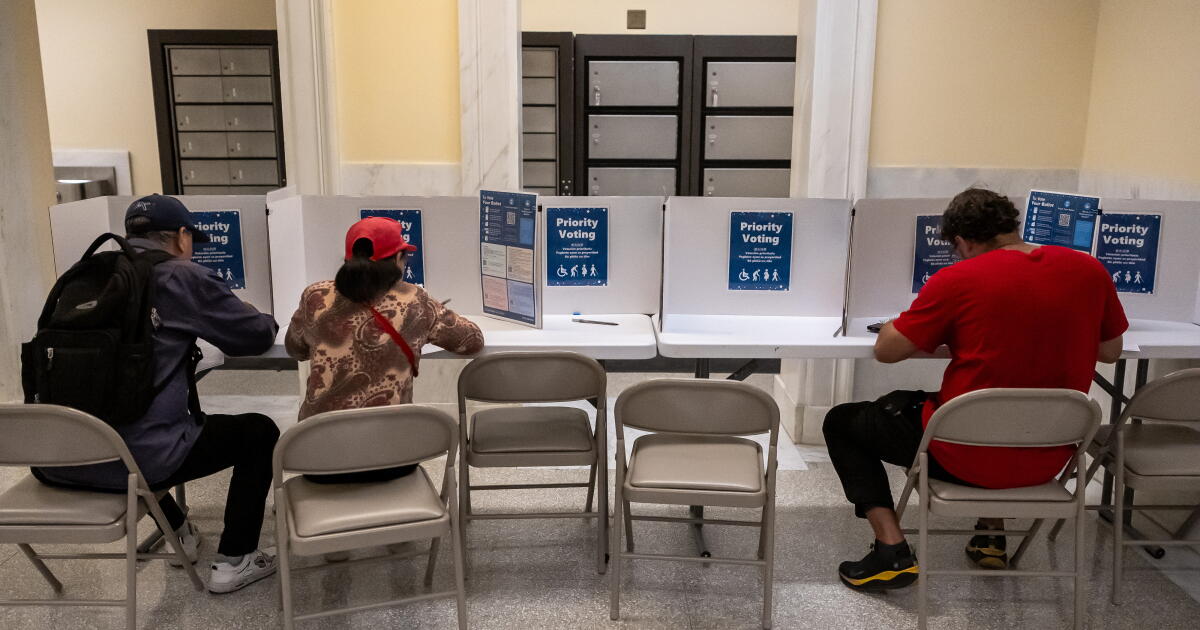
Counting

Hasten California vote counting to quash MAGA conspiracy

If Gov. Gavin Newsom and the Legislature truly believe that slow vote counting is a horrible problem — which it’s not — right now is the time to fix it.

They’re crafting a new state budget. And they could choose to spend the money needed to help counties hire more temporary election workers, buy more sophisticated vote-counting machines and add space for all of it.

That’s the only way to significantly speed up vote counting and mute the MAGA drivel about California being a national “laughingstock.”

How much money?

“We’ve suggested $55.5 million,” says Kim Alexander, president of the nonpartisan California Voter Foundation, which pushes to improve the election process.

“That’s not a lot in the big scheme of the state budget.”

She’s right. It’s essentially pocket change in a proposed budget still being negotiated that tentatively totals $356 billion.

But don’t bet on much of it being allotted for swifter vote counting.

Regardless of all the potshots at California from cable news panelists about our “embarrassing” elections, faster vote tallying doesn’t seem to be a high priority for the Legislature.

Democrats are justifiably much more concerned about protecting poor people’s healthcare, in-home services for seniors and the unraveling safety net as the Trump administration and GOP Congress slash federal funding.

Federal cutbacks aside, the state for years has been spending more money than it takes in despite tax revenue exceeding expectations. Sacramento has a severe deficit spending problem that is projected to last for a while.

So, allocating more money to speed up vote counting by a few days isn’t very high on the governor’s and legislative leaders’ to-do lists.

“The reality is elections currently are underfunded,” says Assembly Elections Committee Chairwoman Gail Pellerin, a Democrat who was Santa Cruz County’s chief elections official for 27 years.

She also says, referring to demands for faster counting: “The media outlets want to call the races and be the first. And that’s what this is all about.”

I don’t disagree. By our nature, we journalists are anxious to report fresh news, including the outcomes of elections. And we become impatient when vote counts roll in seemingly at a snail’s pace.

But come on, it’s not a horrendous burden on the public to wait a few days for an accurate vote count.

It does, however, provide an excuse for President Trump and MAGA Republicans to regurgitate unfounded accusations that elections won by Democrats are “stolen” from the GOP.

“Look what’s happening in California … it’s a rigged election,” Trump bellowed in a June 7 interview on NBC’s “Meet the Press” with Kristen Welker. “They’re cheating on the election.”

When Welker challenged him for evidence, Trump heatedly replied: “They’re crooked just like you’re crooked. Your press is crooked. And ‘Meet the Press’ is crooked. … You’re either crooked, or you’re stupid.”

To put this in context, the Trump diatribe came immediately after he called police officers attacked by Jan. 6 Capitol invaders “a bunch of dirty cops” and “crooked cops.” The Trump-inspired rioters were trying to prevent Congress from certifying President Biden’s “rigged” election.

It’s constantly puzzling why millions of Americans take this unhinged man’s blatherings so seriously. But they do.

And when the president lies about ballot fraud, it erodes public confidence in the integrity of our election system and undermines democracy. Americans become even more cynical and polarized.

So, the governor, Legislature and counties would do everyone a favor by investing in a faster vote count.

“It’s a problem,” Alexander asserts. “The slow vote count has become the norm in California, but it’s not normal for a democracy. It opens the door for false fraud claims.”

Much of the slow count results from tallying mail ballots, which amount to at least 80% of votes cast. They take longer to process, largely because each voter’s signature on the ballot’s envelope needs to be checked against one on file.

So, California could speed up counting by mailing out fewer ballots. Now, every registered voter gets one. We could go back to requiring voters to request an “absentee” ballot.

But forget that. We’re right to make it easy for people to participate in democracy — as long as safeguards are maintained to prevent fraud.

Some counties have taken advantage of a new law that allows a voter to drop off a filled-in mail ballot inside a voting center. There, it’s handled like an old-fashioned ballot that’s filled out at a booth. This significantly reduces processing time. But many counties say they need more state money to implement the program. I have no idea why.

Counting also is slow, of course, because lots of voters wait until election day — or near it — to cast their mail ballot. That clogs the system.

If the ballot is postmarked by election day, it’s allowed seven days to reach vote processors. Trump and fraud conspirators want to trash all ballots arriving after election day. That would speed up counting. But it’s un-American.

California election officials also try to pressure voters into mailing their ballots early. Rubbish.

Election day should mean something. It’s a day citizens are allowed to vote — whether they hand their ballot to a clerk at a voting center or drop it in the mail. They’ve got a right to take their sweet time in concluding what the wisest voting decisions are.

After all, the government allows us to drop our tax return in the mail on April 15 each year — and is very happy to receive our check a few days later. They process that check plenty fast.

“There’s nothing wrong with a slow count,” says Rick Hasen, a UCLA law professor who specializes in election law. “But it‘s a major problem because, unfortunately, it’s a manufactured crisis that can undermine public confidence. And it has gotten worse.”

So, Sacramento needs to undermine the demagogic manufacturers by stepping up vote counting while keeping elections virtually fraud-free.

You’re reading the L.A. Times Politics newsletter

George Skelton and Michael Wilner cover the insights, legislation, players and politics you need to know. In your inbox Monday and Thursday mornings.

What else you should be reading

The must-read: Trump prosecutor in L.A. pushing unusual public search for voter fraud during ongoing count
California love: From the scene of South L.A.’s erupting sidewalks, 5 questions for Bass and Raman
The L.A. Times Special: Who loved Bass, Raman and Pratt the most? A district-by-district breakdown

Until next week,
George Skelton


Was this newsletter forwarded to you? Sign up here to get it in your inbox.

Source link

S. Korea Protesters block Seoul counting center after ballot dispute

Protesters demonstrate in front of a polling station in Songpa District, Seoul, South Korea, 04 June 2026, to call for the suspension of ballot counting. A shortage of ballot papers forced an extension of voting at several polling stations in the area during the local elections held the previous day. Photo by YONHAP / EPA

June 5 (Asia Today) — Protesters who had blocked a polling station in Seoul’s Songpa district for two nights and three days moved Friday to a vote-counting center, demanding a new election after ballot shortages disrupted voting in the June 3 local elections.

The ballot boxes from the No. 2 polling station in Jamsil 7-dong were transferred and counted after about 1,000 police officers were deployed. But protesters said they could not accept the result and effectively occupied the entrance area of the counting center, calling for a revote.

About 300 people, including citizens and conservative YouTubers, gathered near the entrance of the Olympic Park handball arena, according to an unofficial police estimate.

Even after the counting was completed, protesters chanted slogans including “revote” and “invalidate the vote.” Some protesters have alleged election fraud, but election authorities have attributed the disruption to a shortage of ballot papers during voting.

The atmosphere grew tense as access for election workers and arena employees was effectively blocked. Some arena employees who tried to leave were reportedly stopped by protesters and remained inside.

Police continued to guard the area around the arena after the vote count ended. Officials at the scene were considering sending election commission workers home first and removing vote-counting materials separately.

The protest followed a broader ballot shortage controversy in South Korea’s local elections. The National Election Commission said ballot shortages occurred at 50 polling stations nationwide and temporarily halted voting at 22 sites. The disruption drew public criticism and led the commission’s chairman, Roh Tae-ak, to announce his resignation Friday.

Earlier, protesters blocked the removal of ballot boxes from Jamsil 7-dong’s No. 2 polling station after a ballot shortage left voters waiting for hours. Police later escorted officials to retrieve the remaining ballot boxes, and the final count ended Friday afternoon.

— Reported by Asia Today; translated by UPI

© Asia Today. Unauthorized reproduction or redistribution prohibited.

Original Korean report: https://www.asiatoday.co.kr/kn/view.php?key=20260605010001909

Source link

Some in GOP want ballots to be counted by hand, not machines

A growing effort to raise suspicion about the security of voting systems has kindled a back-to-the-future moment among conservatives in some parts of the U.S.

Republican lawmakers in at least six states have introduced legislation that would require all election ballots to be counted by hand instead of electronic tabulators. Similar proposals have been floated within some local governments, including about a dozen New Hampshire towns and Washoe County in the presidential battleground state of Nevada.

The push for hand-counting ballots comes amid mistrust of elections stoked by many Republicans who advance the false narrative that widespread fraud cost former President Trump reelection in the 2020 contest.

Despite no evidence of widespread fraud or major irregularities, conspiracy theories have proliferated among his allies that voting systems were somehow manipulated to favor Democrat Joe Biden. That has prompted calls to ban electronic tabulators used to scan ballots, record votes and compile race tallies.

“It’s our responsibility, and it should be our desire, to count every vote and to imbue confidence in our citizenry that our elections are fair and free, and that their vote is being counted,” said New Hampshire state Rep. Mark Alliegro, sponsor of a hand-counting bill that is similar to ones proposed in Arizona, Colorado, Missouri, Washington and West Virginia.

Alliegro said he was motivated by his analysis of recounts in nearly 50 New Hampshire state legislative races, not by the 2020 presidential election.

But some of the bill’s supporters reference the 2020 election to explain why they argue his hand-count legislation is needed. They cite a belief — despite evidence disproving it — that Trump actually won a landslide victory and that cheating is the only way to explain how New Hampshire voters elected a Republican governor and GOP majorities in the Legislature, but then backed Democrats for federal office.

Critics of the proposals to ditch electronic ballot tabulators and return to hand-counting are blunt about what they see as the motivation.

“It’s coming from conspiracy theories and lies,” said Sylvia Albert, director of voting and elections for Common Cause, a nonpartisan group that advocates for expanded voter access. “It’s attempting to lower people’s confidence in elections.”

Albert and others said it’s unrealistic to think election officials can count millions of ballots by hand and report results quickly, given that ballots often include dozens of races. The partisan review last summer of the 2 million ballots cast in Maricopa County, Ariz., which included a hand count, took several months and hundreds of people to complete.

“If you have a jurisdiction with 500 voters, you might be OK. But if you have a jurisdiction with thousands of voters, tens of thousands of voters, hundreds of thousands of voters, it’s just not going to work,” said Jennifer Morrell, a former elections clerk in Colorado and Utah who now advises state and local election officials.

Even in New Hampshire’s small towns, hand-counting is a complicated, lengthy process when a typical ballot might include 50 questions, said Milford Town Clerk Joan Dargie, who spoke against the proposed legislation on behalf of the New Hampshire City and Town Clerks Assn. She estimates her town would have to boost election workers from 200 to 350, and said many of her fellow clerks have said they will quit if they have to tabulate every ballot by hand. “People who are asking to get rid of machines obviously haven’t worked in an election,” she said.

As one example, Cobb County, Ga., performed a hand tally ordered by the state after the 2020 election. It took hundreds of people five days to count just the votes for president on roughly 397,000 ballots, said Janine Eveler, elections director for the county in metro Atlanta. She estimates it would have taken 100 days to count every race on each ballot using the same procedures.

Counting by machine isn’t just faster. Multiple studies have shown it’s also more accurate, said Charles Stewart, professor of political science at the Massachusetts Institute of Technology.

The first research on the topic was done almost two decades ago, comparing recounts of New Hampshire races that were originally tabulated by hand with those tabulated by machines. In that study and subsequent research, the machines won, he said.

“Counting votes is very tedious. Human beings are bad doing tedious things, and computers are very good at doing tedious things,” Stewart said.

Most states also conduct postelection audits that are designed to identify any irregularities with ballot scanning and counting. But with many Republicans believing Biden was not legitimately elected, election machines have become a popular target.

In Nevada, a Republican county commissioner is pushing a proposal that would require hand-counting of all ballots, along with a return to primarily in-person voting and beefing up uniformed security at polling places.

“I’m 82 years old, and I’ve been through a lot of elections,” said Washoe County Commissioner Jeanne Herman. “I know that something is not right.”

The proposal has drawn opposition from other commissioners, the biggest labor union in the state and a rare front-page editorial in the largest newspaper in northern Nevada, which said the measure could cost taxpayers “millions of dollars to chase down Facebook rumors of illusory election fraud.”

In West Virginia, a bill to repeal the state law governing tabulation machines died in committee earlier this month. In Missouri, lawmakers have not yet acted on a proposal that would ban electronic voting machines and tabulation equipment and require hand-counting to be livestreamed and recorded.

The bill’s sponsor, Republican state Rep. Mitch Boggs Jr., said he has no proof elections have been manipulated but is responding to constituent concerns.

“You file what the constituents are asking for,” Boggs said. “But at the end of the day, what they’re really wanting is just the transparency. They want to know that our elections are secure.”

Republican state Rep. Petty McGaugh said the legislation would delay election results and likely undermine their accuracy. When she became clerk of rural Carroll County in 1995, election staff were still hand-counting ballots by marking tallies in blocks of five on paper. She noticed multiple errors and eventually switched the county to an electronic tabulation system.

“I don’t really think that in this day and age we need to go back to hand-counting where it’s so susceptible to human error,” she said. “We’ve got to start trusting electronics and computers.”

In New Hampshire, that message seems to have gotten through. Last week, a state House committee unanimously recommended killing the hand-counting legislation and voters in nine towns where the question was on the ballot in local elections rejected it.

Source link