Book Review
Look at Me
By Dustin Hoffman and Ariel Levy
Simon Six/Scribner: 320 pages, $35
If you buy books linked on our site, The Times may earn a commission from Bookshop.org, whose fees support independent bookstores.
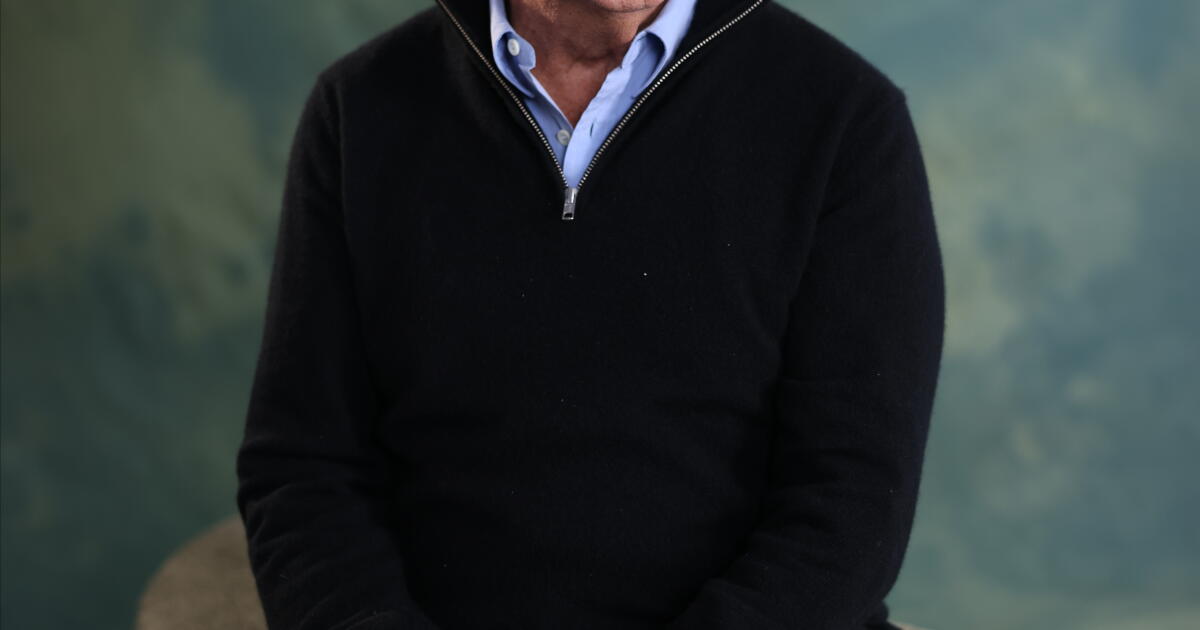
In his jaunty new memoir, Dustin Hoffman describes himself as “a guy with a bawdy sense of humor who is obsessed with sex and is always looking for attention.”
Yet in “Look at Me,” the two-time Oscar-winning actor maintains that “when a reckoning started making its way around the internet, and tearing through Hollywood, I thought it was a very good thing.” Until, in 2017, he found himself in the crosshairs of #MeToo, accused by several women of sexual misconduct from decades earlier.
Hoffman denied the allegations at the time, issuing only a vague apology. In the memoir, he admits to having “made some women uncomfortable” and perhaps being “guilty of insufficient empathy.” But “taking something from someone sexually that they didn’t want to give,” he writes, “it’s just not something I’ve ever done.”
He also says: “Different times have different rules. The way we perceive what’s appropriate all depends on the air we’re breathing.”
Draw your own conclusions.
Co-authored with New Yorker staff writer and “60 Minutes” contributor Ariel Levy, “Look at Me” is a gossipy, entertaining compendium of stories assembled in a nonchronological mosaic. It makes clear that Hoffman wasn’t the most congenial of colleagues. His intense combination of self-confidence and insecurity led to repeated clashes with directors and sometimes costars. He even quarreled with his Method acting teacher, Lee Strasberg.
About all this, he is mostly unapologetic. “I’m really not that difficult,” he insists, only partly tongue in cheek. “It’s not my fault I’m right all the time.”
Hoffman, as the unemployable actor Michael Dorsey, famously lampooned his own perfectionistic tendencies in the 1982 film “Tootsie.” He reproduces one comic scene in the memoir. Director Sydney Pollack, as Dorsey’s agent, George, tells him: “You argue with everyone. You’ve got one of the worst reputations in this town.” Dorsey indignantly defends his refusal to sit down while portraying a beefsteak tomato, declaring: “Nobody does vegetables like me!”
There is just enough candor and self-reflection in “Look at Me” to make the actor seem, on balance, sympathetic, even endearing. Certainly, Hoffman’s childhood in Los Angeles was not easy. His father, the onetime head of the Columbia Pictures prop department, aspired to directing but became instead a perennially bankrupt businessman. When Hoffman was about 12, his mother urged him to get a nose job. “No one suspected I might have any kind of intellect or talent,” he recalls. “I was designated to be the failure in the family, and I accepted my role entirely.”
A distracted student, he found focus in an acting class. There, he writes, “for the first time in my life I had girls whom I considered to be attractive approaching me.” Later, when he became famous, he recalls women waiting for him on his Manhattan doorstep.
Like many young New York actors, Hoffman struggled for years to get roles and make rent. He lost one big break — a 1964 Broadway debut in Frank Gilroy’s “The Subject Was Roses” — after suffering severe burns in a kitchen accident. He stoically showed up for rehearsals anyway but ended up in the hospital and was fired. That misfortune left him free to accept an Obie-winning part off-Broadway that led, circuitously, to his career-making 1967 role as Benjamin Braddock in “The Graduate.”
Hoffman’s philosophy of acting inevitably caused conflicts. “You can’t force me to do something that feels inauthentic to me,” he writes. “Truthful acting has to do with understanding a character’s inner life, not forcing outward expressions of emotion.” Until an actor finds his character, “blindly obeying the director isn’t going to fix anything.”
Hoffman was so stymied by his autistic character in “Rain Man” (1988) that he almost quit the movie. Director Barry Levinson’s collaborative spirit kept him engaged. But he tangled with other directors, including Pollack and Nichols, who directed “The Graduate.” Working on that film was “a terrible experience,” Hoffman remembers, but Nichols’ later praise mollified him.
Hoffman’s relationship with Steve McQueen, his costar in the 1973 film “Papillon,” followed a similar trajectory. Furious when McQueen chased a friend of his from the set, Hoffman gave McQueen the silent treatment and then ranted at him on a live microphone as the rest of the cast and crew listened in. But he concludes the story on an upbeat note, quoting a letter, four years later, from McQueen that said: “We were good, weren’t we?”
Hoffman lavishes his own encomia on friends and costars, including Tom Cruise (“Nobody worked harder”), Robin Williams (“the fastest brain I’ve ever encountered”), Gene Hackman (“hilarious”), Robert Duvall, Bill Murray and others. As the director of “Quartet” (2012), he worked with “the incomparable Maggie Smith,” known for her curmudgeonly temperament. In a backstage encounter in London years later, she greeted him warmly as “Dustin! My favorite Jew.”
The nonlinear, anecdotal structure of “Look at Me” presents some challenges. The narrative ping-pongs somewhat confusingly between Hoffman’s two wives — dancer and actor Anne Byrne, whom he divorced in 1980, and his longtime spouse, Lisa Gottsegen. It also skips around freely among his films, including “Midnight Cowboy” (1969), “Lenny” (1974), “All the President’s Men” (1976), “Marathon Man” (1976) and “Kramer vs. Kramer” (1979).
Even now, at age 89, Hoffman’s restless self-doubt persists. “I’ve never allowed myself to feel truly gratified by a positive review or deserving of a trophy,” he confesses. “But I can remember every negative review I ever received.” Only in his family life — he has six children and eight grandchildren — does he seem to permit himself unalloyed joy.
The memoir’s title, “Look at Me,” drawn from a conversation with Laurence Olivier, suggests a profound, narcissistic neediness that may be endemic to the profession. What distinguishes Hoffman, along with his unconventional leading-man looks, is the magnitude of his talent and his unyielding faith in his own instincts. No doubt many egos, and maybe hearts as well, were bruised along the way. But the camera loved him, and it is hard to argue with the results.
Klein, a cultural reporter and critic in Philadelphia, has been a three-time finalist for the National Book Critics Circle’s Nona Balakian Citation for Excellence in Reviewing.