corporate

What’s Left of Corporate Finance in Venezuela?

Venezuela has banks, but it no longer has banking in the functional sense. Branches are open, digital platforms work, and companies process payroll and manage accounts. What has disappeared is the core of any financial system: the ability to extend credit and working capital solutions at scale and at maturities that support productive investment. This is not a temporary liquidity problem. It is the result of two decades of policy intervention, macroeconomic collapse, and institutional erosion that left the country with the façade of a banking system but almost none of its substance.

Understanding this transformation requires retracing how a once-normal Latin American financial sector was rewired into a system that processes transactions but cannot perform financial intermediation—and how Venezuelan corporations have adapted to an economy where banks exist but lending, for all practical purposes, does not.

The Chávez–Maduro restructuring

Before 1999, Venezuela had a volatile yet recognizable banking model. Private banks dominated, interest rates generally tracked inflation, and although the 1994 crisis inflicted serious damage, the system broadly resembled that of its regional peers. Foreign banks operated locally, corporate lending mattered, and financial institutions played a visible role in funding economic activity.

Chavismo altered this trajectory. Throughout the 2000s, the government nationalized banks, created new state institutions, and converted them into channels for social programs and politically directed credit. Regulation shifted from prudential oversight to political management. Interest-rate caps, mandated lending quotas, and tight currency controls after 2003 trapped the system in a multi-tiered foreign exchange regime that eroded the bolívar’s credibility and strangled lending incentives.

The hyperinflationary spiral that intensified from 2017 onward delivered the final blow. With nominal interest rates capped far below inflation, real lending returns turned sharply negative. Loan portfolios shrank to irrelevance, and banks survived by pivoting toward payments, payroll, and cash-management services—the activities least distorted by regulation. Credit intermediation effectively disappeared.

The scale of collapse is visible in the numbers: by 2023, total banking sector assets had shrunk to roughly $3 billion—less than what a single mid-sized regional bank in Colombia or Peru might hold. This is an economy that once had a banking system managing tens of billions in assets. The financial system didn’t simply contract: its fundamental function ceased to operate.

Our corporate banking today

On paper, Venezuela still has the institutional layout of a modern financial system. SUDEBAN supervises banks, the Central Bank manages monetary policy and FX operations, SUNAVAL oversees securities markets, and FOGADE provides deposit insurance. Private institutions such as Banesco and Mercantil coexist with public entities like Banco de Venezuela. Microfinance firms and small fintech platforms also exist.

But this resembles scaffolding rather than load-bearing structure. Public banks dominate assets yet lack operational strength. Private banks are better managed but constrained by regulation, small capital bases, and the absence of meaningful lending. Political influence has blurred the lines between regulator and regulated, turning compliance into a mechanism of control rather than stability.

Most private lending takes place offshore, secured by foreign receivables or export flows. Domestic institutional private credit is effectively nonexistent.

Venezuelan banks still serve corporate clients, though in a radically diminished role compared to regional norms. Their value proposition is almost entirely transactional: checking and custodial accounts (including limited USD-denominated products), payroll processing, electronic payment channels, and basic trade-payment facilitation. What they do not provide is medium-term, scalable, predictable credit.

Companies across sectors—retail, logistics, pharmaceuticals, food importation, light manufacturing, agro-industry—maintain bank relationships, but these relationships revolve around moving money, not financing growth. Banks function as utilities, not credit providers.

Traditional investment banking has also largely disappeared. Underwriting, mergers and acquisitions advisory, capital-raising, and structured finance have retreated offshore or into highly specialized boutique work tied to restructurings or distressed assets. Local securities markets are too thin, volatile, and uncertain to support meaningful deal flow.

Markets that should exist but don’t

In most emerging markets where bank credit contracts, private equity and private credit step in. That pattern never took root in Venezuela.

Private equity requires predictable regulation, enforceable contracts, credible exits, and transparent corporate information. Venezuela lacks these conditions. Public markets are weak, expropriation risk remains salient, and capital controls complicate repatriation. What little PE-style activity exists is limited to family-office investments or distressed-asset acquisitions structured abroad.

Private credit faces the same obstacles. Even though Venezuela exhibits every condition that theoretically invites direct-lending funds—a collapsed banking sector, high demand for working capital—legal uncertainty and currency instability make enforcement and repayment unpredictable. Most private lending takes place offshore, secured by foreign receivables or export flows. Domestic institutional private credit is effectively nonexistent.

Venezuela is thus in the rare position of having vast financing needs and a large inventory of underutilized assets, yet lacking the institutional channels to mobilize capital toward them.

Financing in a credit desert

Without functioning bank credit, Venezuelan companies rely on alternative mechanisms that would be unrecognizable to CFOs in neighboring countries.

Supplier credit has become the backbone of financing. Importers and wholesalers extend terms to distributors, creating an informal credit chain in lieu of bank financing.

Offshore financing is available only for firms with foreign affiliates or export-related revenue. Domestic subsidiaries borrow against offshore balance sheets, not Venezuelan assets.

Domestic intra-group lending within business families and conglomerates substitutes for external credit markets.

Since 2023, authorities have tightened scrutiny over cash-dollar usage, imposed taxes on FX transactions (IGTF), and encouraged re-bolivarization through regulation rather than credibility.

Multinational parent financing sustains foreign subsidiaries but usually at a conservative operating scale.

Ultra-short cash cycles are core to survival—firms rotate inventory quickly and avoid holding cash in bolívars.

Banks do offer some small FX-indexed credit products, but these are short-term, tightly regulated, and immaterial to corporate expansion. Even the most efficient companies operate with minimal leverage, not because they prefer low risk, but because credit simply does not exist at scale.

A dollar reality that complicates everything

Between 2019 and 2022, Venezuela underwent a largely spontaneous, market-driven dollarization. Prices, wages, savings, and accounting practices migrated to USD despite the absence of formal legal approval. Banks adapted by offering custodial dollar products, facilitating conversions, and enabling local dollar payments.

But the state never fully legalized dollarization. Dollar products required BCV approval, oversight fluctuated, and rules shifted with political priorities. Since 2023, authorities have tightened scrutiny over cash-dollar usage, imposed taxes on FX transactions (IGTF), and encouraged re-bolivarization through regulation rather than credibility.

The result is a hybrid currency system: the dollar dominates transactions, the bolívar dominates regulation. Corporate treasury management now requires dual accounting, parallel liquidity planning, and constant adaptation to policy signals.

Why trade finance matters and what happens without it

For economies built on commodities, trade finance is essential infrastructure. Instruments like letters of credit, pre-export financing, receivables discounting, and supply-chain finance allow producers to operate at scale, smoothing cash flow between harvest and payment, reducing counterparty risk, and attracting external capital tied to exportable output.

Brazil’s agribusiness relies on pre-export finance to fund soy and meat exports. Colombia’s coffee sector depends on letters of credit. Peru’s mining operations use receivables-backed credit to expand production. These mechanisms let firms scale quickly even under volatile prices.

Venezuela has almost none of this today. Over the last decade, capital controls, sanctions, and the loss of correspondent relationships dismantled the machinery that supports cross-border financing. Traditional trade-finance instruments became difficult or impossible to execute through local banks.

A cacao exporter who once could finance an entire harvest with a pre-export credit line now operates cycle-by-cycle on partial prepayments. Agro-industrial firms can no longer use inventory-backed financing to expand storage or processing.

What remains operates through improvisation: exporters rely on advance payments that cap growth and transfer risk back to producers. Importers use supplier financing, not banks, to fund inventory. Offshore entities when possible handle letters of credit, bypassing the local system entirely. Producers with export potential cannot leverage pre-export loans, limiting their ability to scale.

For commodity producers—cacao, coffee, fisheries, metals, and emerging agricultural clusters—this is crippling. A cacao exporter who once could finance an entire harvest with a pre-export credit line now operates cycle-by-cycle on partial prepayments. Agro-industrial firms can no longer use inventory-backed financing to expand storage or processing. Venezuela has the resources but not the financial infrastructure that resource-based economies require.

Venezuela’s banking sector retains institutional memory. Bank staff understand underwriting, risk management, and trade-finance mechanics. Executives remember normal intermediation. Correspondent relationships can be rebuilt. Capability exists. The policy environment and stability do not.

A post-transition recovery could rebuild credit intermediation within several years—if there is macroeconomic stabilization, credible monetary policy, realistic interest rates, recapitalization of banks, legalization of dollar-based banking, and a restoration of correspondent links. Trade finance, in particular, could rebound quickly, unlocking immediate gains for agriculture, mining, and manufacturing.

Until then, the sector remains an accurate reflection of the broader economy: functional enough to survive, too constrained to support growth, and waiting—like much else in Venezuela—for the space to operate like a real financial system again.

Source link

South Korean Big 5 banks’ corporate loan growth rate halves in 2025

A financial data screen in the dealing room of Hana Bank shows the benchmark Korea Composite Stock Price Index, in Seoul, South Korea, 02 January 2026. South Korean stocks surged to close at an all-time high, led by strong gains in large-cap semiconductor shares, having gained 95.46 points, or 2.27 percent, to close at 4,309.63. Photo by YONHAP / EPA

Jan. 4 (Asia Today) — Corporate lending at South Korea’s five largest commercial banks grew at about half the pace of the previous year, despite government calls for “productive finance” aimed at steering money toward businesses, industry data showed.

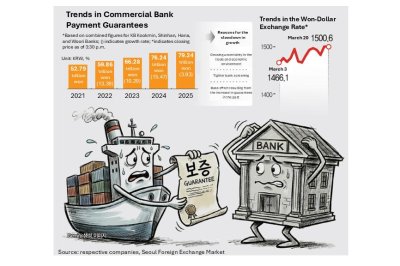
Outstanding corporate loans at KB Kookmin Bank, Shinhan Bank, Hana Bank, Woori Bank and NH Nonghyup Bank totaled 844.7 trillion won (about $650 billion) at the end of December, up 2.94% from a year earlier, the data showed. The increase of 24.1 trillion won (about $18.5 billion) compared with 2024’s 6.95% rise, when balances increased 53.3 trillion won (about $41.0 billion).

The lending trend diverged between the first and second halves of the year. Corporate loan balances rose 9.1 trillion won (about $7.0 billion) in the first half as banks prioritized asset quality amid higher rates and more financially strained firms. Growth accelerated in the second half, rising 15.0 trillion won (about $11.5 billion), as the government that took office in June pushed banks to expand credit to companies and advanced industries while tightening household lending.

Even so, growth in loans to small and medium-sized firms slowed sharply. SME lending at the five banks increased 12.2 trillion won (about $9.4 billion) last year, down from 31.3 trillion won (about $24.1 billion) in 2024, the data showed. Loans to large companies rose 11.9 trillion won (about $9.2 billion), down from 22.0 trillion won (about $16.9 billion) the prior year, but large-company loan growth still outpaced SME growth, with rates of 7.52% and 1.84%, respectively.

Loans to the self-employed declined. Balances fell 1.2 trillion won (about $915 million) to 324.4 trillion won (about $249.6 billion) from 325.6 trillion won (about $250.5 billion) a year earlier, according to the data.

Bankers cited higher delinquency risks among SMEs and the self-employed and said lenders have leaned toward higher-quality corporate borrowers to protect capital, including common equity tier 1, or CET1, ratios.

Authorities are expected to intensify pressure this year to expand corporate credit. Banks have said they broadly agree with the policy direction but want regulatory relief, including lower risk weights on corporate loans, to increase supply while meeting capital rules.

In September, financial authorities said they would adjust capital regulations, including raising the minimum risk weight on mortgage loans and lowering risk weights on banks’ stock holdings. The move could expand corporate lending capacity by up to 73.5 trillion won (about $56.5 billion), the report said.

— Reported by Asia Today; translated by UPI

© Asia Today. Unauthorized reproduction or redistribution prohibited.

Source link

Standard Bank on Corporate Risk and Liquidity Strategies

Home Executive Interviews Standard Bank’s Arno Daehnke On Corporate Risk And Liquidity Strategies

The chief finance and value management officer at the Johannesburg, South Africa-based bank explains how companies are strengthening liquidity, diversifying funding, and adopting digital tools to manage rising debt pressures and global volatility.

Global Finance: What risk management innovations are corporates pursuing to address rising debt pressures and uncertain trade regimes?

Arno Daehnke: The convergence of rising debt pressures and uncertain trade regimes is driving a wave of innovation in corporate risk management. Financial leaders are increasingly recognizing that traditional approaches, focused narrowly on cost containment and compliance, are insufficient in a world characterized by systemic shocks and structural shifts.

One of the most significant developments in diversifying funding sources is the rise of sustainability-linked financing. Corporates are issuing green bonds, entering sustainability-linked loans, and participating in blended finance structures that tie funding costs to ESG performance. These instruments not only provide access to capital but also align financing with broader strategic goals, including climate resilience, social impact and governance reform. In addition, corporates are increasingly engaging in strategic advisory partnerships to restructure debt, extend maturities, and align funding strategies with macroeconomic realities. This includes exploring alternative financing channels, such as private placements, syndicated loans, and development finance instruments that offer greater flexibility and resilience.

Digitization is also transforming risk management. Corporates are deploying AI-driven credit analytics, real-time liquidity dashboards, and automated risk scoring systems to enhance decision-making and reduce exposure. These tools enable firms to respond more quickly to market shifts, optimize capital allocation, and improve transparency across financial operations.

Together, these innovations reflect a shift from reactive risk management to strategic resilience. Corporates are not just defending against shocks; they are building systems that enable them to thrive in uncertainty.

GF: How might corporates maintain flexible funding and liquidity buffers amid macro and cross-border shocks?

Daehnke: In an era defined by macroeconomic volatility and cross-border disruptions, maintaining flexible funding and liquidity buffers is no longer a best practice, it is a strategic imperative. Corporates must build capital structures that are not only robust but also agile, capable of absorbing shocks and supporting growth in uncertain conditions.

Diversification of funding sources is foundational. Corporates should maintain access to a mix of local and international debt markets, equity financing, and structured instruments such as revolving credit facilities and asset-backed securities. This diversification reduces dependency on any single funding channel and enhances the ability to respond to market dislocations.

Liquidity buffers must be calibrated to operational cycles and stress-tested against multiple scenarios. Advanced cash flow forecasting tools, integrated with treasury management systems, enable firms to anticipate funding gaps and adjust capital deployment proactively. These tools should be complemented by contingency planning frameworks that include access to emergency credit lines and pre-approved facilities.

GF: What other factors should corporates be considering at this point?

Daehnke: Capital discipline is equally important. Corporates must balance dividend policies, capital expenditure plans, and debt servicing obligations to ensure long-term solvency and strategic flexibility. This includes regular reviews of covenant structures, refinancing options, and interest rate exposures.

Strategic advisory support can also play a critical role. Corporates benefit from partnerships that help them align funding strategies with macroeconomic realities, optimize working capital, and restructure liabilities in response to changing conditions. This includes guidance on optimal capital allocation, liquidity management, and risk-adjusted return strategies.

Ultimately, financial resilience is not just about weathering storms, it is about building the capacity to adapt, evolve, and lead in a world of constant change. Corporates that invest in flexible funding structures and dynamic liquidity management will be better positioned to navigate the complexities of global finance and seize opportunities amid disruption.

Source link