coronavirus

Cold Feet star Hermione Norris shares battle with long Covid – ‘It gave me a shock’

Long Covid is when the symptoms of Covid-19 – extreme fatigue, shortness of breath, joint pain, aching muscles and brain fog – last longer than 12 weeks

Hermione Norris has revealed she has suffered from long Covid, which left her concerned about her ability to take on physical challenges. The Cold Feet star, 59, said she is now much better but the change to her body has been a “shock”.

Norris is one of seven celebrities who embarked on a pilgrimage through north-east England to one of Britain’s most important pilgrimage sites, Lindisfarne, for new BBC series Pilgrimage: The Road To Holy Island.

She was joined by stars including Ashley Banjo, Patsy Kensit and Tasha Ghouri for the programme but said she had concerns about her health before setting off.

READ MORE: Pilgrimage star Patsy Kensit says ‘I used to run towards love’READ MORE: Dr Hilary Jones’ urgent ‘always’ meningitis advice that could ‘save a life’

She told Prima magazine : “I’m not great at extreme discomfort. I had long Covid a few years ago, so I was worried about my physical fitness and the demands of walking so much every day, plus carrying the backpack. But we did a couple of massive walks and I was fine. I was pleasantly surprised.”

She added: “Having been ill [with long Covid], my focus is on being well and healthy. It’s about exercising, not to make me look good but to keep me strong. I stretch a lot, and I’ve really got to start lifting weights.

“I also use an infrared sauna for my autoimmune condition. I get really stiff joints. I’m so much better after the long Covid, but I feel different, physiologically. It gave me a shock, as I’ve always been quite fit and strong.”

Long Covid is when the symptoms of Covid-19 last longer than 12 weeks, according to the NHS website. Symptoms include extreme fatigue, shortness of breath, joint pain, aching muscles and brain fog.

Norris, best known for her role as Karen Marsden in cult 90s drama Cold Feet, said she has also noticed significant changes since going through the menopause, telling the magazine: “Menopause talk is everywhere now. But the alchemy that happens is unquestionable. The masks drop.

“I feel like a different person from who I was in my 40s – mentally and physically – in a good way. Now I enjoy simple things. My morning coffee, a walk, my doggies, beautiful skies. The joy is in the day-to-day of living, not the big things.”

Read the full interview in the May issue of Prima , on sale now

Pilgrimage: The Road To Holy Island airs on BBC2 5-7 April

Like this story? For more of the latest showbiz news and gossip, follow Mirror Celebs on TikTok , Snapchat , Instagram , Twitter , Facebook , YouTube and Threads .


Source link

Paramount may have landed Warner Bros., now comes the baggage

It took months of effort, lobbying and mounds of cash for Paramount Skydance to finally clinch its prize of Warner Bros. Discovery.

Now, however, the David Ellison-led company faces a long and challenging road to merge these two media giants and set it up for a successful future.

Key to that will be striking a delicate balancing act between investment and paying down its debt load of $79 billion, which is massive even by Hollywood standards.

Notably, the figure is even greater than Warner’s nearly $55 billion of debt post-merger with Discovery, a burden that hamstrung the company for years and led to successive rounds of layoffs and relentless cost cutting.

Last week, my colleague Meg James wrote about the concerns Fitch Ratings and S&P Global Ratings have about Paramount’s credit, given the mountain of debt the company will now carry. Fitch downgraded its credit to BB+ — “junk” territory — from BBB-, and S&P Global Ratings placed the company’s ratings on “negative watch.”

Carrying that amount of debt comes with significant risks.

You’re reading the Wide Shot

Samantha Masunaga delivers the latest news, analysis and insights on everything from streaming wars to production — and what it all means for the future.

By continuing, you agree to our Terms of Service and our Privacy Policy.

For one, a company with a lot of debt that is “junk”-rated is going to be under pressure to cut costs. “Junk status” means a company’s debt is rated below the level that credit agencies consider investment grade. Such a rating means it can be more expensive to refinance or take out new loans, raising the cost of capital.

Paramount executives have already said they plan to find $6 billion in “synergies” within three years, though they’ve emphasized that the majority of their cost cutting will come from “non-labor sources,” including consolidating their streaming technology and cloud providers, combining IT systems across the company and “optimizing the combined real estate footprint and the broader corporate overhead,” among other ideas.

And as I wrote last week, most Hollywood observers and those familiar with Ellison’s plans predict that Paramount will be forced make steep layoffs to offset the cost of the deal and eliminate overlapping roles and functions between the two historic studios.

At the same time, in order to compete with well-funded rivals, Paramount-Warner Bros. will also need to invest in new programming — something that can be difficult for a heavily leveraged business .

Paramount executives have said their cost-cutting efforts won’t include a reduction in production capacity, and Ellison has reiterated that there will be continued spending on programming. Beyond content, he’ll also likely need to invest in improving the technology along with the look and feel of the streaming platforms.

“Whether or not they have the capital to do all of that and to try to get their leverage down is something I’m curious to hear about,” said Naveen Sarma of S&P Global Ratings.

It’s possible that Paramount may not be able to pursue a good opportunity in the future because it has used up all its debt capacity and can’t raise additional financing, said Kelly Shue, a professor of finance at Yale School of Management.

“It might cause them to underinvest in good projects in the future,” she said.

And the company needs to spend on good projects.

The economics of this deal hinge on the combined heft of Paramount and Warner’s two libraries and valuable intellectual property, which will unite Harry Potter, DC Studios, SpongeBob SquarePants and “Mission Impossible” all under one roof.

Building up its streaming platform, which will combine Paramount+ with HBO Max, is important for competing with the behemoth Netflix, which bowed out of the Warner Bros. auction.

And on the theatrical side, Ellison has said the combined company will release 30 films a year — 15 from each studio. That would be a substantial increase from 2025, when the two companies released 18 films — eight at Paramount and 10 from Warner Bros.

“While studios content budgets might not come under immediate focus for cost cutting, we have a hard time seeing no content costs savings considering opportunities to reallocate or pull back from at least the linear networks,” MoffettNathanson’s Robert Fishman wrote in a note to clients last week.

Of course, all of this would come only after the deal’s completion. On the immediate horizon, Paramount needs to secure international regulatory approval as well as at home. Although state attorneys general including Rob Bonta of California have said this is not a “done deal,” most analysts expect that any opposition there is only likely to slow — not stop — the transaction.

A very masculine year in film

A recent study from San Diego State University put a number on something we all suspected: The percentage of female protagonists in the top 100 films last year dropped. A lot.

Female protagonists made up just 29% of the top-grossing films in 2025, down from 42% in 2024, according to the university’s annual study of women’s representation in top films. A selection of film titles from the last year says it all: “The Running Man,” “A Working Man,” “Superman.”

That 29% figure has, unfortunately, been very consistent over the years — it was the same in 2016 and has largely hovered in the range of high 20s to low 30s for the last decade, with a few exceptions (40% in 2019 and 42% in 2024).

Focusing on just the protagonists in the top 100 films means that small fluctuations can change that percentage greatly.

But when the study looked at a broader sample size of the more than 1,900 characters in those films, the results weren’t much better.

The percentage of women in speaking roles was 38%, up just 1% from 2024. And the percentage of major female characters declined to 36% in 2025 from 39% the year before.

The fact that these figures have not moved much, in spite of the countless panels and think pieces about the issue, suggests there isn’t much will in Hollywood to change, said Martha Lauzen, author of the study and founder and executive director of San Diego State’s Center for the Study of Women in Television and Film.

“Representation is social relevancy and social capital,” she told me. “So when you see fewer women than men, that’s a message.”

Stuff We Wrote

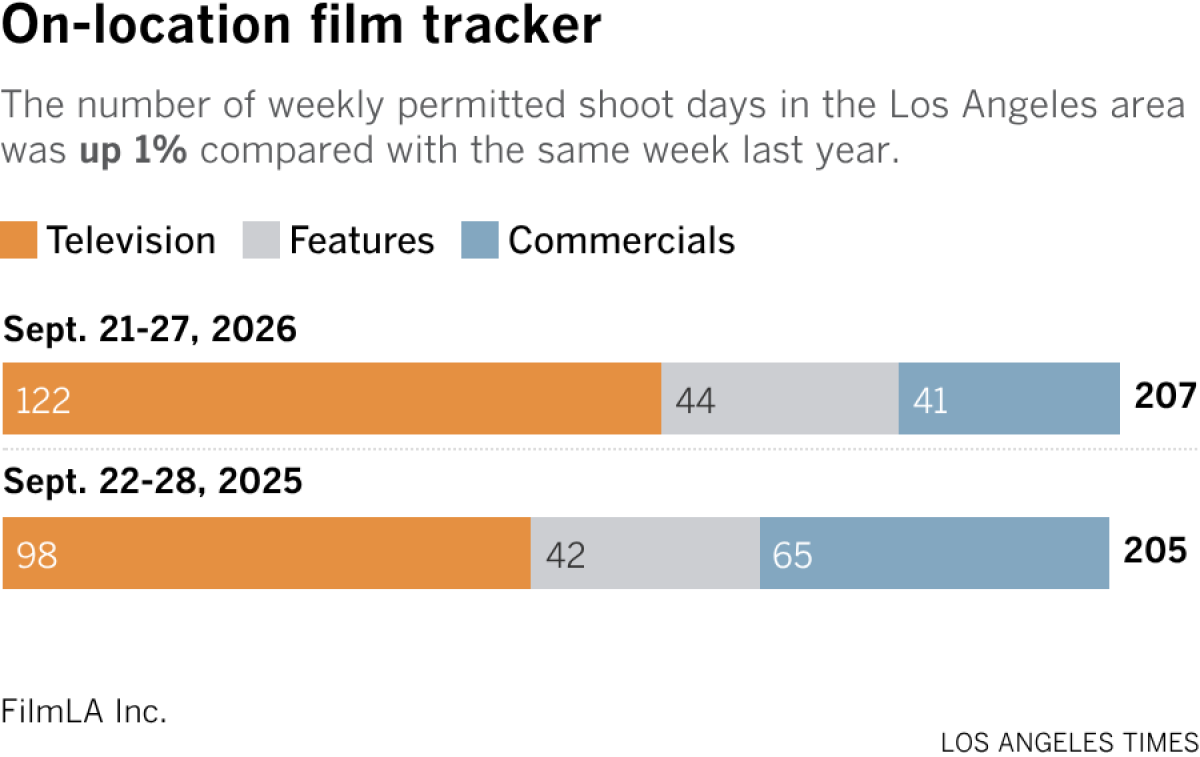
Film shoots

Number of the week

forty-six million dollars

Walt Disney Co. and Pixar’s “Hoppers” came in big at the box office this weekend with a $46-million opening in the U.S. and Canada — the strongest domestic debut for an original animated movie since “Coco” in 2017. Globally, the film made $88 million.

The reception is an encouraging sign for original animated movies, which have largely struggled at the box office since the COVID-19 pandemic while their sequel counterparts have shined.

What I’m watching

Several months ago, some friends and I started a movie club, where we each nominate a film we want to watch and we rotate who gets to make the final selection. Last week, we watched the 1996 comedy “First Wives Club,” which I had never seen but loved for its goofy antics, unexpected song-and-dance number and the focus on the enduring power of female friendships.

Source link

Paramount-Warner Bros. Discovery deal stirs fears of mass layoffs

Four days after the stunning news that Paramount Skydance would acquire Warner Bros. Discovery, Paramount executives tried to calm fears that the blockbuster deal would result in massive layoffs.

In a call Monday, Paramount Chief Strategy Officer and Chief Operating Officer Andy Gordon told Wall Street analysts that $6 billion in merger “synergies” would come from “non-labor sources” and not a “reduction in production capacity.”

Instead, Gordon said, the company would reduce costs by consolidating its streaming technology and cloud providers, finding marketing efficiencies and “optimizing the combined real estate footprint,” likely an allusion to widely anticipated plans that the new owners will consolidate operations around the Warner Bros. lot in Burbank.

Efficiencies aside, most Hollywood observers — including people who are familiar with Paramount Skydance Chief Executive David Ellison’s plans — predict that Paramount will be forced to make large-scale layoffs in order to offset the enormous costs of the mega-deal, which is valued at more than $111 billion (counting debt).

It’s a reasonable expectation, at least if history is any guide.

Many at Warner dread the kinds of cuts seen after Walt Disney Co. bought most of 21st Century Fox’s assets, resulting in thousands of layoffs as the two companies combined operations and shed redundant jobs.

You’re reading the Wide Shot

Samantha Masunaga delivers the latest news, analysis and insights on everything from streaming wars to production — and what it all means for the future.

By continuing, you agree to our Terms of Service and our Privacy Policy.

In the case of Warner-Paramount, the new company will have two film and TV studios, as well as two streaming businesses, two legal departments, two marketing departments and so on. It’s doubtful these overlapping functions will survive budget cuts.

Already, consolidation plans are underway.

This week Paramount announced it would combine the two streaming services — Paramount+ and HBO Max — to reach a total of more than 200 million subscribers and better compete against the behemoth Netflix, which boasts 325 million subscribers worldwide.

Ellison was full of praise for the HBO team on Monday’s analyst call, saying the premium service was a “crown jewel” and that it will “continue to have the resources and independence to do what it does best.”

He also reiterated that there is “no intention to pull back on production,” and that the company intends to make 30 films a year — 15 apiece from Paramount and Warner Bros.

“We have all the economic incentives to make sure that we grow this business and are going to invest in content to basically achieve those goals,” Ellison said Monday.

But this deal also includes $79 billion in net debt — a staggering load that overshadows even that of the merger that resulted in Warner Bros. Discovery. That amount became an albatross around that company’s neck and led to waves of layoffs.

“What everybody’s hoping is that the noise that’s being made around prioritizing content will hold true,” said Kevin Klowden, a Milken Institute fellow focused on entertainment and technology. “But until they see that happen, it’s really a question.”

Further job losses would be a blow to an industry that has been reeling from a steady drumbeat of job cuts fueled by media consolidation, dwindling streaming profits and the migration of film and TV jobs to cheaper states and countries.

Paramount executives have said the deal is expected to close in the fiscal third quarter of this year, and Ellison said he was “absolutely confident” they will meet that goal, based on conversations with regulators.

Despite support from the Trump administration, the acquisition is not yet final. Already, California Atty. Gen. Rob Bonta said he was in communication with other states’ attorneys general about challenging the merger on antitrust grounds, saying it wasn’t a “done deal.”

And on Monday, Rep. Sam Liccardo (D-San José), Sen. Elizabeth Warren (D-Mass.) and Sen. Richard Blumenthal (D-Conn.) called on Atty. Gen. Pam Bondi and White House Chief of Staff Susie Wiles to provide details of their conversations about the merger with Ellison and Netflix co-Chief Executive Ted Sarandos, highlighting the role of politics in the auction.

Paramount plans to keep the two studios separate for now, though company executives have discussed combining operations at the Warner Bros. Burbank lot at some point, according to sources close to Paramount who were not authorized to speak publicly. That could mean a wind down at the historic Paramount lot on Melrose Avenue — and more job losses.

The anxiety over looming cuts is especially deep inside Warner, where staff are still trying to process the news, according to people I spoke with. They noted that when Netflix was the winning bidder, co-Chief Executives Sarandos and Greg Peters came to the Burbank lot and spoke with several hundred of Warner’s senior leaders and outlined their plans, giving staff more clarity about a future under their ownership. No such conversations have occurred with the Paramount team, they said.

“I think genuinely, everyone’s nervous and a little uneasy,” said one Warner Bros. Discovery employee. “With the Netflix option, people had become a little more hopeful. But this outcome is a little more frightening for the staff.”

Stuff We Wrote

Film shoots

Number of the week

sixty-four point one million dollars

After 30 years, the Ghostface killer has still got it. Paramount Pictures and Spyglass Media Group’s “Scream 7” topped the box office this last weekend with $64.1 million in the U.S. and Canada, marking a franchise-best domestic opening. Globally, the film made $97.2 million.

The film centered on original franchise actors Neve Campbell and Courteney Cox, and featured numerous callbacks to the previous movies.

But the film’s debut did not come without controversy. Pro-Palestinian groups protested outside the “Scream 7” premiere on the Paramount lot last week and called for a boycott of the film after franchise star Melissa Barrera was fired more than two years ago for her comments on the Israel-Hamas war.

What I’m watching

On Sunday, I watched the UCLA women’s basketball team dominate USC in what I think is one of the best college rivalries out there (though I’m probably biased. Go Bruins!)

Source link