Pennsylvania senator who has clashed with party over Israel support says he will reject ‘the extremes and socialism’.
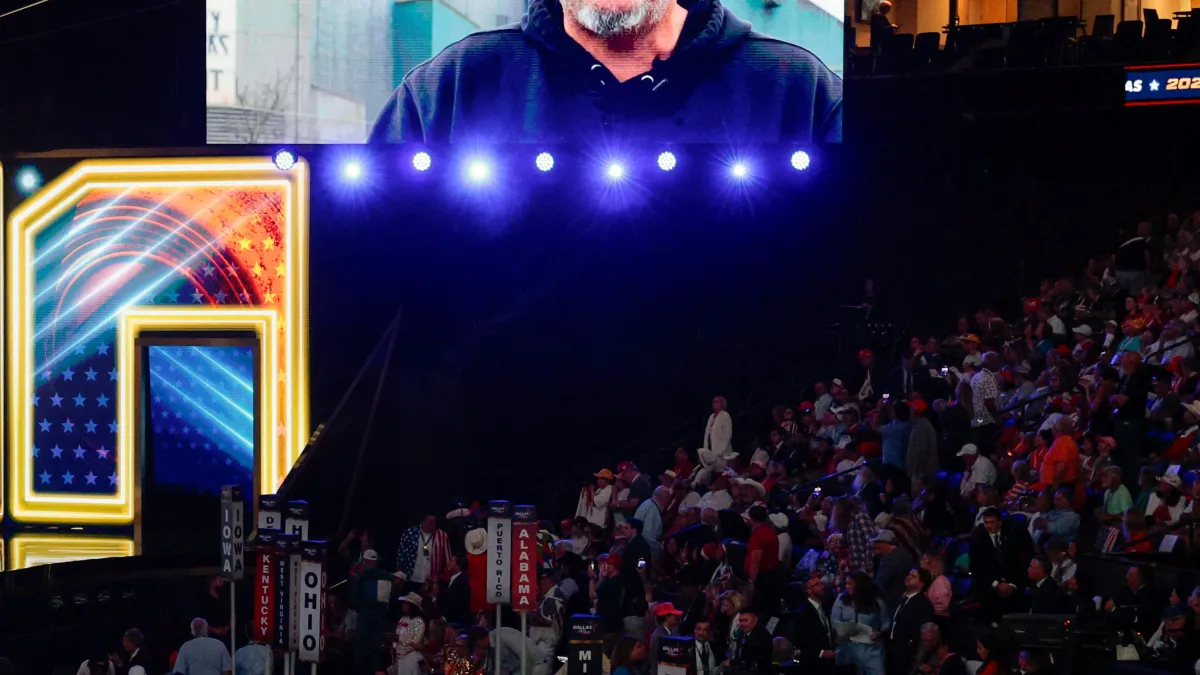
Pennsylvania Senator John Fetterman, a Democrat who has distanced himself from his party, has appeared in a video recording on the first day of the Republican Party’s two-day midterm convention in the United States.
The video on Wednesday was a surprise for those who attended the conservative gathering in Dallas, Texas, where President Donald Trump is seeking to galvanise support ahead of the November elections.
Recommended Stories
list of 3 itemsend of list
“Yes, I’m Senator John Fetterman, Pennsylvania. Yes, I’m a Democrat. Why am I here talking to you today? Because, well, I’m a common-sense Democrat,” Fetterman said as he introduced his Republican colleague, Senator Dave McCormick of Pennsylvania.
Fetterman, a 57-year-old first-term senator, has cast himself as an outsider within the Democratic Party.
He has offered outspoken support for Israel and the war on Iran, even as voters and progressive voices in his party criticise those elements of US foreign policy.
“I’m always going to stand with America. I’m always going to reject the extremes and socialism and that anti-American way of life,” Fetterman said in the video clip.
But his appearance at the Republican Party’s first-ever midterm convention is likely to exacerbate criticism from his Democratic colleagues.
US Representative Brendan Boyle, another Pennsylvania Democrat, has repeatedly questioned Fetterman’s party allegiance, as well as his commitment to public service. He renewed that sentiment after Wednesday’s video aired.
“A year ago I labeled John Fetterman ‘Trump’s favorite Democrat.’ Tonight, he yet again proves why,” Boyle wrote on social media.
Fetterman has also faced questions about his fitness for office following a series of reports that detail his apparent lack of enthusiasm for his Senate responsibilities.
A recent Wall Street Journal article found that the senator had cancelled meetings with constituents.
In one case, The Wall Street Journal said he skipped a June meeting with injured military veterans, citing illness, only to show up later for a Fox News interview about Israel and its joint war with the US on Iran.
His approval rating is now higher among Republicans in Pennsylvania than among members of his own party.
Last month, a poll from The New York Times, Siena College and The Philadelphia Inquirer suggested that 73 percent of Pennsylvania Republicans approved of Fetterman’s performance, up from 25 percent in 2024.
Meanwhile, Democratic support in the state had slid dramatically over the last two years, slipping from 74 percent to 22 percent. Some 63 percent of Democratic respondents held an unfavourable view of him.
While Fetterman has depicted himself as a maverick within the Democratic Party, he has denied that he would switch parties to become a Republican.
“I’m not going to be a Republican, but I’m going to be a Democrat that’s going to have a conversation with whoever is playing it straight,” he said in a recent interview with Fox News.
Still, speculation about Fetterman’s party credentials has continued as the midterms near.
The election on November 3 will decide which party controls Congress for the final two years of Trump’s term.
Republicans currently hold a small majority in the House of Representatives and Senate, but they could face a setback at the polls as voters express frustration over cost of living issues and Trump’s deepening unpopularity.
Still, reclaiming the Senate especially could be an uphill climb for Democrats. Only a third of Senate seats are up for re-election this year, compared with all 435 House seats.
DALLAS : Republicans used the opening night of their unusual midterm convention on Wednesday to hammer Democrats as extremists and pledge unwavering devotion to President Donald Trump, proudly placing their party’s undisputed leader at the center of upcoming midterm elections — even if his low approval ratings might ultimately drag them down in November.
Many Republicans, including those facing tight races, are skipping the two-day affair in Dallas, while others hope their appearance will put them in the national spotlight as they work to turn out Trump’s supporters in a year without him on the ballot.
The convention — part rally, part fundraiser — comes as Republicans try to boost enthusiasm heading into the final stretch before Election Day, despite voters’ economic concerns and dissatisfaction with the war in Iran. Much of the agenda sought to cast Democrats as too left wing, describing them as communists, anti-American or even evil. Republicans called themselves a “common sense” alternative in the fight to maintain control of Congress.
The show even got a boost from an unlikely source, Democratic Pennsylvania Sen. John Fetterman, who told the crowd in a video message that “I’m always going to reject the extremes and socialism.” Fetterman, who has clashed with his party’s leaders, referenced his state’s steel industry in pledging to “work with President Trump to fight and defend the steel way of life.”
Coinciding with the convention’s opening night, Trump’s political operation, which has been sitting on hundreds of millions of dollars, began spending heavily through a new group, the No Going Back PAC Inc., The New York Times first reported Wednesday. The group has reserved $49 million in six competitive Senate races and one competitive House race.
That’s in addition to the $10 million that MAGA Inc., Trump’s super PAC, has spent on the Texas Senate race.
The lineup features Trump and more Trump
Normal political conventions are held every four years and serve a purpose beyond pomp and circumstance, with parties formally nominating their presidential picks. This week’s convention, by contrast, is The Trump Show, through and through.
“Do we love President Trump?” Republican National Committee Chair Joe Gruters, one of the first speakers, asked the crowd. He had promoted the event before it began as “a Trump-a-Palooza.”
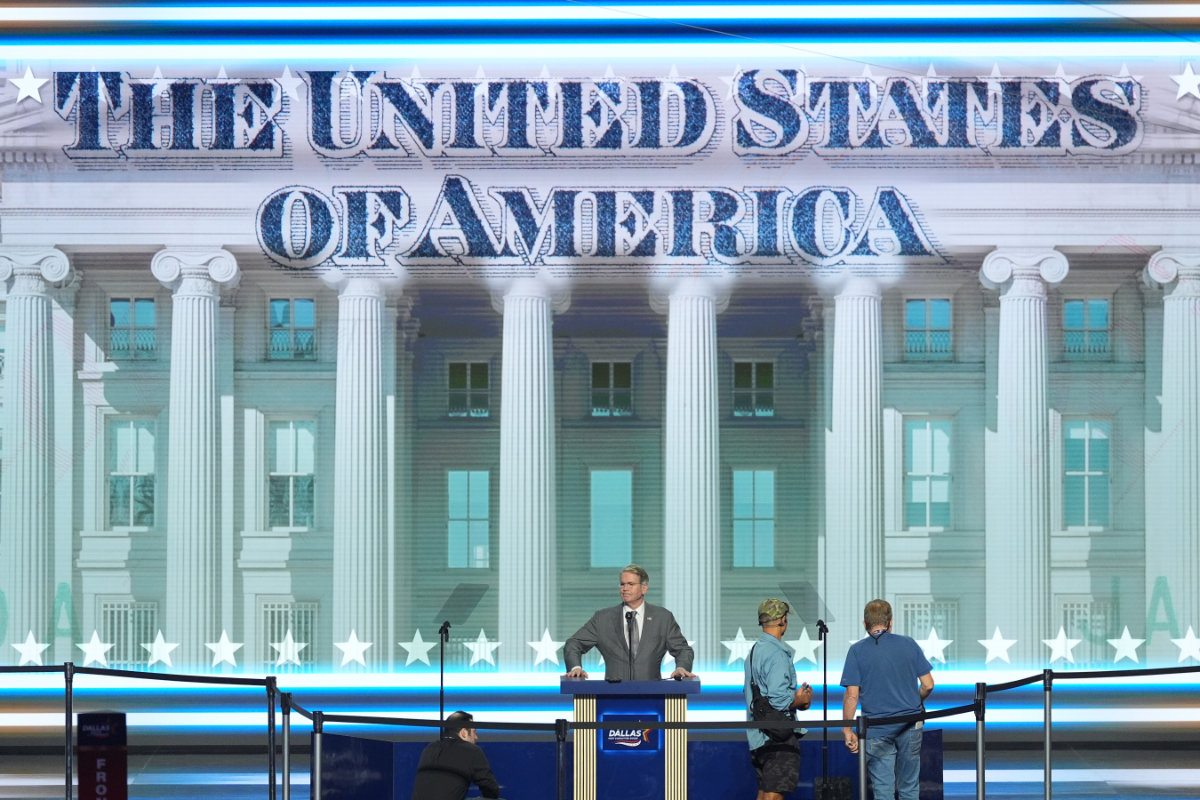
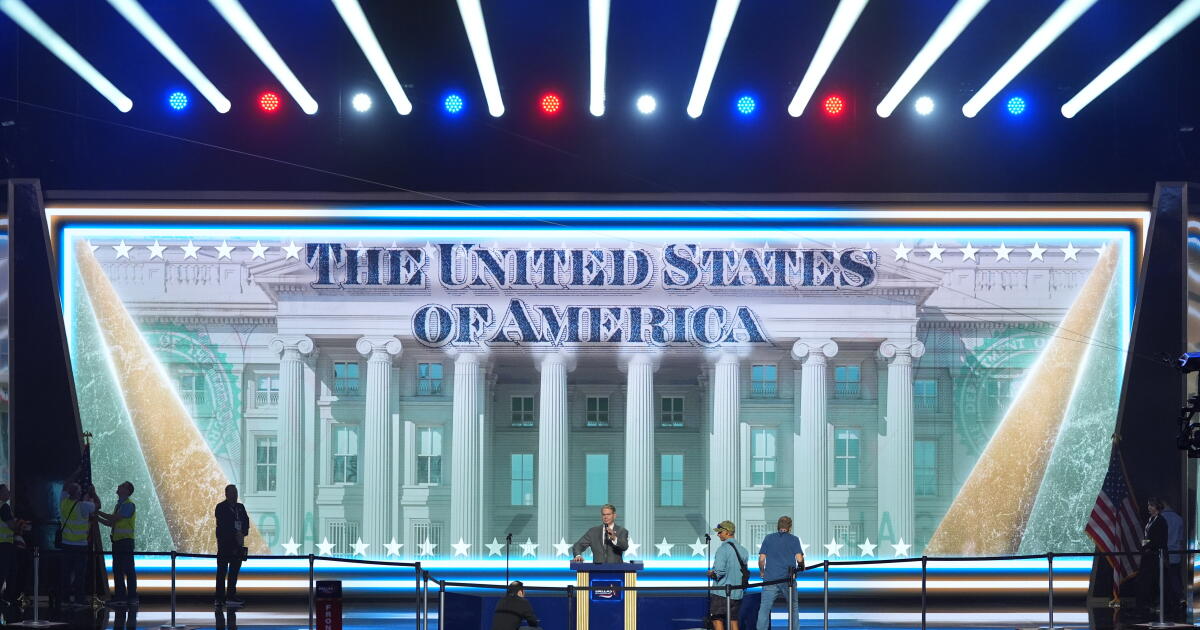
The walls of the basketball arena, where the Dallas Mavericks play, were covered with photographs of Trump, even in the elevators. Plenty of attendees wore cowboy hats and boots, as well as “Make America Great Again” and American flag caps and other gear.
“Looks very big. Looks very exciting,” Trump said of the gathering crowd before boarding Air Force One to fly to Dallas.
That wasn’t actually the case during the first hour of afternoon programming, when speeches were delivered to scores of empty seats, even in areas close to the stage. Crowds began filling them up well before Trump’s speech, however.
The president also said that oil prices — which have surged because of the Iran war — likely won’t come down until after the midterms, a bit of economic forecasting that could darken his party’s fortunes.
“Right after the election, oil prices are going to be tumbling downward,” he promised. That came as oil prices jumped more than 3 percent Wednesday.
Trump speaks both nights, delivering a keynote address on Wednesday night and speaking again on Thursday, after Vance gives his own address.
“Look, he’s an entertainer, right? He obviously loves big, big events and his career has been built around that,” said Ray Washburne, co-chair of the Dallas host committee, at a pre-convention event hosted by Bloomberg News. “He’s always front and center.”
Washburne said the event is expected to draw roughly 30,000 people across both nights, but getting airtime could be challenging. The NFL season kicks off Wednesday with a game between the Seattle Seahawks and the New England Patriots. And on Thursday, the San Francisco 49ers and Los Angeles Rams will be playing in Australia.
The agenda includes some key candidates
Also addressing the convention are members of the Republican congressional leadership and Cabinet members, including Attorney General Todd Blanche and Health Secretary Robert F. Kennedy Jr. The president’s oldest son, Donald Trump Jr., is on the roster, too.
Candidates who will speak include Michigan Senate nominee Mike Rogers, who is running a high-profile race against Democratic nominee Abdul El-Sayed, and North Carolina Senate nominee Michael Whatley, who is up against former Gov. Roy Cooper.
Organizers have outlined 12 hours of programming over the two nights, featuring more than 100 speakers and segments focused on subjects such as tax cuts, fraud allegations, border security and a proposed ban on members of Congress trading stocks.
Missing from the public agenda: any mention of the unpopular Iran war.
Republican House Speaker Mike Johnson said some members of his caucus plan to skip Dallas, preferring to stay home and campaign for reelection, but many of them will make an appearance.
“We’ll parade our stars across the stage,” he said.
Organizers say they’re fine with some Republicans skipping the convention
Washburne said there were strong reasons for some lawmakers and candidates to pass on attending.
“One thing, we just have so many speaking slots. We can’t get them all in. The other is: If you’re not in a contested race, it really doesn’t make much sense to come. And the ones in contested races, they need to be in their home states to campaign,” he said.
Some balked at high attendance fees. Republican House members were being asked to pay $25,000 for convention tickets and lodging, according to people familiar with the situation and granted anonymity to speak frankly about the private arrangement.
An additional 2,000 tickets were distributed by the National Republican Congressional Committee, largely to donors and others to attend the convention. Other tickets were allocated to state parties to distribute as they saw fit.
“Per the RNC, this is a ticketed fundraiser and rally, not a traditional national convention,” the Denton County Republican Party in Texas wrote in a Facebook post, which advertised packages from $5,000 to $20,000.
Still, more than 100 Republican House members and candidates are expected to attend, including almost all of the MAGA Majority class of candidates in the most targeted congressional districts, according to a person familiar with the event who requested anonymity before it begins.
Democrats say Republicans are out of touch
“The fact that these Republicans are planning a celebration in the middle of an economic crisis — where everyday Americans are drowning because of this high cost of living — is extraordinary,” Rep. Hakeem Jeffries, the House Democratic leader, said at the US Capitol last week.
Democrats have held such midterm conventions in the past but are not doing so this year. Rep. Suzan DelBene of Washington, chair of the Democratic Congressional Campaign Committee, said she wasn’t worried that her party was missing an opportunity to make its case on a national stage like Republicans.
“They are not focused on the issues that people are struggling with right now, that they’ve created,” DelBene said. “Cost, housing, food, health care, childcare, energy costs, gas prices all going up. That’s what we’re talking about on the ground all across the country.”
Dallas, Texas – The Republican midterm convention has represented a gambit for the party: centring US President Donald Trump in the final stretch of the midterm elections, even as the first two years of his second term have cast a polarising political shadow.
That has been particularly true when it comes to the war on Iran, which Trump launched alongside Israel on February 28, and the knock-on effects on affordability in the United States, a key issue for many voters.
Recommended Stories
list of 3 itemsend of list
As Trump prepared to deliver a keynote address on Wednesday in Dallas, prices for Brent Crude, the global benchmark, rose above $100 a barrel for the first time since July, a reminder of the conflict’s continued fallout for global markets.
Nevertheless, supporters who spoke to Al Jazeera still saw the president as the man to rally Americans to vote Republican in November, as the party fights to hold onto control of the House of Representatives and Senate.
But some voiced concern – or confusion – over the impact of the war.
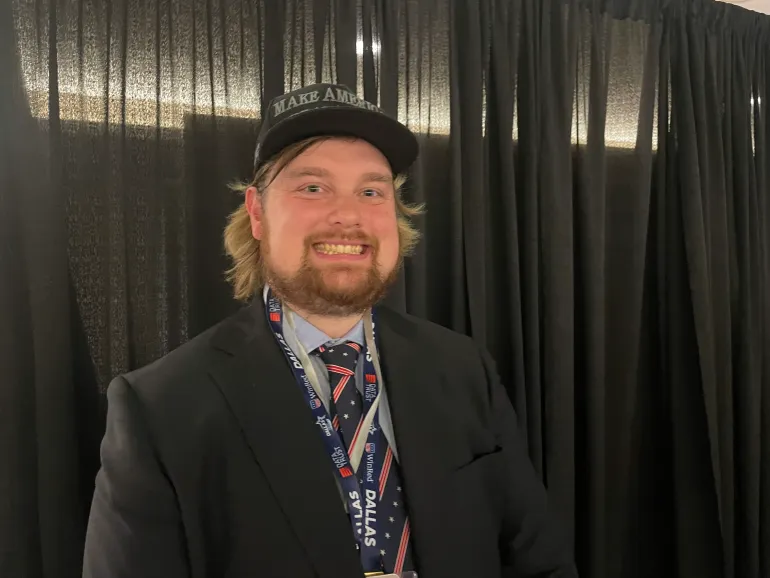
“This really is a Trump-a-palooza, as people have been saying,” said Carter Eisinger, a 27-year-old electrician who travelled from Fargo, North Dakota.
“I think some people say that in a derogatory way, but I think it’s very much a complimentary phrase,” he added. “The reality of it is we are in a Trump Republican Party.”
Convention attendee Carter Eisinger has mixed opinions about the US-Israel war on Iran [Joseph Stepansky/Al Jazeera]
Still, Eisinger struggled to see how the war fit into Trump’s “America First” vision.
“In my opinion, I don’t really see the connection of how a war in Iran helps us here in the country,” he said. “If the Iran war is justified, I’m willing to pay the gas prices, but I haven’t seen that justification.”
He felt a similar confusion about the close relationship between the US and Israel.
“At the end of the day, I’m going to come right back to whatever is best for families, young people, anyone in America,” he said. “If it’s helping Israel in a way that helps us, then great… but it needs to help us first.”
Others were more charitable towards Trump’s approach to the Middle East, even if they saw the war on Iran as a misstep.
Bijay Dixit, a 59-year-old photographer from Houston, Texas, gave Trump high marks on his approach to immigration. He also believed Republicans were the party to steward the economy in the years ahead.
But on Iran, he said there had been a “miscalculation”, even if he agreed with the Trump administration’s position that the war was ultimately a necessary response to the totality of Iran’s actions in the 47 years since the Islamic revolution in 1979.
“Iran needed to be stopped at some point,” he said. “When I say miscalculation, what I mean is underestimation of the capacity of the IRGC [Islamic Revolutionary Guard Corps].”
Helen Vennett, a 65-year-old small business owner from Maryland and the chairman of her county’s Republican Party, likened the convention to a high-school pep rally.
“All of us need to have cheerleaders in our life… It just gets you fired up again. You kind of need to know that you’re not alone, that there are believers,” she added.
But while she said she broadly supported the Trump administration’s justification for the war, she acknowledged the potential political fallout.
“It’s a tough one,” she said.
Vijay Dixit, a Texas photographer, believes the war against Iran was a ‘miscalculation’ [Joseph Stepansky/Al Jazeera]
Polls have regularly suggested widespread disapproval among US citizens of the war on Iran, with independents in particular expressing disapproval. Many, in turn, rank affordability as their top issue heading into the midterm vote.
A recent Reuters/Ipsos poll suggested that only a quarter of Americans think the war is worthwhile.
For its part, the Trump administration has downplayed the prospect of ending the war, focusing instead on efforts to open shipping routes in the Strait of Hormuz, over which Iran continues to assert its influence.
Speaking to reporters on Wednesday as he departed for the convention, Trump sought to temper expectations that the war would end before November’s pivotal vote.
“I think it’s going to take a little bit longer than the midterm,” he said, accusing Iran of intentionally holding out until November.
“They’re desperate to try and affect the election so that we can get a nice weak group of people in there and leave them alone and let them have their nuclear weapons,” he said.
He predicted the war would end swiftly after the final votes have been cast.
“They can’t hold out any longer,” he said.
John Russell, 55, from Rockford, Illinois, who regularly travels to Trump rallies as part of the “Front Row Joe’s” group, said he believed voters would still view the first two years of Trump’s second term as a net positive.
“It’s been a small bump with the gas going up,” he told Al Jazeera from the convention.
“But it had to be done. We can’t allow [Iran] to have a nuclear bomb,” he said, referring to one of the administration’s main justifications for the war.
John Russell is optimistic about the Republican Party’s prospects ahead of the midterm elections [Joseph Stepansky/Al Jazeera]
Tehran has long denied seeking a nuclear weapon, with military analysts generally agreeing that destroying its nuclear programme would require a major military escalation, involving boots on the ground.
Russell predicted that the Republican Party’s bet would pay off at the polls.
“It’s going to fire up the base,” he said of the convention. “It’s going to switch some independents to vote for the Trump-backed candidates, and they will win.”
NEW YORK — Republicans are gathering in Dallas on Wednesday for a highly unusual midterm convention, a “Trump-a-Palooza” that will put President Trump at the center of this fall’s midterm elections — whether the candidates running like it or not.
Many party members, including those facing tight races, are skipping the two-day affair, citing conflicting obligations or balking at demands that they pony up for access. Others are hoping an appearance alongside Trump will put them in the national spotlight as they work to turn out his voters without him on the ballot.
The convention, which is part rally and part fundraiser, comes as Republicans try to boost enthusiasm heading into the midterms’ final stretch despite Trump’s low approval ratings. Organizers have cast it as “a primetime showcase for President Trump’s success, candidates, and causes that have propelled the 2026 midterms to unprecedented focus.” Much of the programming will focus on Democrats, trying to cast them as extremists by highlighting the party’s insurgent left wing.
The lineup features Trump and more Trump
Normal political conventions are held every four years and serve a purpose beyond pomp and circumstance, with parties formally nominating their presidential picks. In 2024, Trump used the opportunity to announce JD Vance as his running mate.
The schedule this week released by organizers makes clear that the convention will be the Trump Show, through and through.
“It’s gonna be a Trump-a-Palooza,” RNC Chairman Joe Gruters told Spectrum News.
The president will be speaking both nights, delivering a keynote address on Wednesday night and speaking again Thursday after Vance to close out the event. He had originally been scheduled for only one speaking slot.
Also addressing the convention will be members of the Republican congressional leadership and Cabinet members including Atty. Gen. Todd Blanche and Health Secretary Robert F. Kennedy Jr. The president’s oldest son, Donald Trump Jr., is on the roster, too.
Candidates who will speak include Michigan Senate nominee Mike Rogers, who is running a high-profile race against Abdul El-Sayed, and North Carolina Senate nominee Michael Whatley, who is up against former Gov. Roy Cooper.
Organizers have outlined 12 hours of programming over the two nights that will include more than 100 speakers and segments focused on subjects like tax cuts, fraud allegations, border security and a proposed ban on members of Congress trading stocks.
Missing from the public lineup: any mention of the unpopular war with Iran.
Republican House Speaker Mike Johnson said some members of his caucus plan to skip Dallas, preferring to stay home and campaign for reelection, but many of them will make an appearance.
“We’ll parade our stars across the stage,” he said.
Many will be skipping the event
An Associated Press survey of more than four dozen Republican candidates found a majority either planned not to attend, said their plans were to be determined, or ignored requests for comment.
“I had stuff already planned in my congressional district or I would be there,” Kentucky Rep. James Comer told NewsNation. “Got a lot going on back in Kentucky, so my time is needed there.”
“Well, unfortunately, I have a family obligation, so I won’t be able to be there,” Georgia Rep. Buddy Carter said on Fox Business.
Some members balked at high attendance fees. Republican House members were being asked to pay $25,000 for convention tickets and lodging, according to people familiar with the situation and granted anonymity to speak frankly about the private arrangement.
An additional 2,000 tickets were distributed by the House GOP’s campaign arm, largely to donors and others to attend the convention. Other tickets were allocated to state parties to distribute as they saw fit.
“Per the RNC, this is a ticketed fundraiser and rally, not a traditional national convention,” the Denton County Republican Party in Texas wrote in a Facebook post, which advertised packages from $5,000 to $20,000.
The Republican Party of Virginia was offering a relative discount of $1,000 to $1,500, not including accommodations, according to an email obtained by the AP.
Despite the many no-shows, more than 100 Republican House members and candidates are expected to be in Dallas, including almost all of the MAGA Majority class of candidates in the most targeted congressional districts, according to a person familiar with the event who requested anonymity before it begins.
“It’s like any political convention, it’s no different than the traditional RNC,” said Matt Beynon, a spokesperson for Pennsylvania Rep. Scott Perry, who won his district by barely 1 percentage point in 2024 with Trump on the ballot. “Obviously, you’re out of the district, but it’s a really good opportunity to get in front of people” and “talk to the press.”
It remains unclear what kind of air time the convention will receive. The two nights of programming will coincide with the launch of football season. The NFL season is set to kick off Wednesday with a game between the Seattle Seahawks and the New England Patriots. And on Thursday, the San Francisco 49ers and Los Angeles Rams will be playing an international game in Australia.
In a sign of the growing focus on the midterms, Trump’s political organization, which is sitting on a big war chest, is spending heavily to back a new group, the No Going Back PAC Inc., The New York Times reported Wednesday. The new group started reserving $47 million for six competitive Senate races and one competitive House race. That’s in addition to the $10 million the Trump-affiliated MAGA, Inc. political group is spending in the Texas Senate race.
Democrats say Republicans are out of touch
Democrats, meanwhile, are planning their own counterprogramming.
“The fact that these Republicans are planning a celebration in the middle of an economic crisis — where everyday Americans are drowning because of this high cost of living — is extraordinary,” Rep. Hakeem Jeffries, the House Democratic leader, said at the U.S. Capitol.
Democrats have held such midterm conventions in the past but are not doing so this year. Rep. Suzan DelBene of Washington, chair of the Democratic Congressional Campaign Committee, said she wasn’t worried that her party was missing an opportunity to make its case on a national stage like Republicans.
“They are not focused on the issues that people are struggling with right now, that they’ve created,” DelBene said. “Cost, housing, food, healthcare, childcare, energy costs, gas prices all going up. That’s what we’re talking about on the ground all across the country.”
Americans “are going to continue to see how much they don’t care,” she added. “And we’re gonna be on the ground all across the country with great candidates talking directly to the American people.”
Colvin writes for the Associated Press. AP writers Steven Sloan and Lisa Mascaro in Washington, Marc Levy in Harrisburg, Pennsylvania, Hannah Fingerhut in Des Moines, Iowa and Sarah Rankin in Richmond, Va., contributed to this report.
The United States Republican Party – and its talisman President Donald Trump – is descending on Dallas, Texas, to host a rare convention before the midterm elections in November.
Usually reserved for presidential election cycles, Trump’s call to hold the high-cost event before the November 3 midterm vote has underscored both the president’s unorthodox campaign style and the urgency of the political moment for his Republican Party.
Recommended Stories
list of 3 itemsend of list
Trump’s approval rating has tanked in the lead-up to the midterm vote, with polls pointing to a panoply of factors, most notably the US-Israel war on Iran and its knock-on economic effects for US consumers.
The lack of enthusiasm threatens what are already considered long-shot odds in the Republicans’ effort to hold on to control of the House of Representatives. Shifting public opinion has also put control of the Senate increasingly in play, although Democrats still face an uphill battle to pull off an upset.
A loss of control in either chamber would serve as a major check on Trump’s authority in the final two years of his second term.
But not all Republicans have bought into Trump and the party’s claims that the convention will spur voter turnout.
Several, particularly those in the tightest races, have kept the event at arm’s length amid concerns that associating with the president could only further mobilise his detractors.
Here’s what to know:
When and where is the Republican midterm convention?
The convention will be hosted at the American Airlines Center in Dallas, Texas, on Wednesday, September 9 and Thursday, September 10.
The event is expected to run from 3pm to 9pm Central Time (20:00 to 02:00 GMT) on both days.
Trump is scheduled to speak on both nights, including a Wednesday address and the convention’s closing keynote on Thursday from 8pm to 9pm Central Time (01:00 to 02:00 GMT on Friday).
US Vice President JD Vance will close out night one with a speech.
A person takes pictures of signage during preparation for the Republican National Committee (RNC) Midterm Convention at the American Airlines Center on September 7, 2026 in Dallas, Texas [Brandon Bell/Getty Images via AFP]
Is this a typical political convention?
Not at all.
The Republican National Committee (RNC), the party’s official organising body, has billed the Dallas midterm convention as a “first in American political history”.
Both Democratic and Republican national conventions have historically capped the primary season before a presidential election. The emphasis has historically been on the presidential nomination process during the largely ceremonial events.
During those conventions, so-called “delegates” from every state pledge their votes for a candidate based on the primary election outcome from their home state.
A candidate who secures the required majority of delegates formally becomes the party’s presidential nominee at the convention.
Parties also typically hold several smaller meetings surrounding the event to establish and release the party’s official platform.
Why are Republicans holding a midterm convention in 2026?
To start with, there will be no nominating process – presidential or otherwise – during the event, as there is no presidential election in 2026.
Instead, the convention has taken the shape of a supercharged campaign rally and fundraiser.
It has been pitched as an opportunity to introduce candidates in punishing races to potential donors and to give a clear, if Trump-dominated, party message as the races enter their final stretch.
The RNC has promised “a primetime showcase for President Trump’s success, candidates, and causes that have propelled the 2026 midterms to unprecedented focus”.
What’s on the schedule?
There will be quite a lot. The official programme lists “53 items and speakers” on night one, followed by 56 more on night two.
The first night will focus on issues including tax cuts, healthcare affordability, immigration, border policy, trade and domestic manufacturing.
The second night will focus more on affordability and families, including policies related to taxes on tips, overtime and Social Security.
The subject areas hew closely to Trump’s wider political messaging.
The official programme gives relatively little attention to several other subjects. The US-Israel war with Iran and Trump’s aggressive tariff policy receive scant mention.
Who else is speaking?
Trump and Vance are the convention’s marquee speakers, but an array of prominent Republicans and candidates are expected to feature across the two-day programme.
Texas Attorney General Ken Paxton is likely to get a healthy amount of stage time. Paxton is running for Senate against Democrat James Talarico, whose early lead in polling has raised alarm bells for Republicans. A Democrat has not won statewide office in Texas since 1994.
“We’re going to have a lot of speakers, and the ones we want to focus on will be obviously Ken Paxton,” Trump told reporters last week. “We gotta get him elected.”
The race is particularly personal for Trump, who endorsed MAGA-aligned Paxton over Republican Senator John Cornyn, a four-term incumbent seen by many as the surest challenger for Talarico.
Will Trump’s convention help Republicans in the midterms?
It remains to be seen whether the convention will help to turn out voters in a meaningful way.
Trump has proven a canny campaigner in the past, leveraging his eye for television spectacle to build support and turn out low-propensity voters. But several factors could limit the impact.
Trump’s Thursday night speech conflicts with the opening games of the National Football League (NFL) season. The event also runs up against several memorial events for the September 11, 2001 attacks throughout the week.
Some Republican officials have also reportedly criticised the hasty announcement of the event, which Trump called for in late June, raising questions over whether organisers will indeed be able to achieve the spectacle envisioned.
For his part, Trump enters the convention with his approval rating continuing to tank, hovering at a 38 percent average in major polls. Several of the most recent polls, including a Reuters-Ipsos poll and a Financial Times-Focaldata poll conducted in late August, reflected only a 33 percent approval.
Trump entered office in January 2025 sitting at about 52 percent approval.
Why are some Republicans skipping?
To be sure, several Republicans in key races have said they will attend the convention.
They include former Congressman Mike Rogers, who is running against Democrat Abdul El-Sayed for an open Senate seat in Michigan; Ohio Senator Jon Husted, who is facing an unnerving challenge from former Democratic Senator Sherrod Brown; and Georgia Congressman Mike Collins, who is seeking to unseat Democratic Senator Jon Ossoff.
Others have been wary.
Trump’s policies in his second term have cast a long shadow, leaving many candidates calculating whether attendance could backfire and instead energise voters opposed to Trump.
Democratic primary turnout in several key states – including Michigan, Wisconsin, Texas and Georgia – has soared this year, while Republican turnout has remained steady but unextraordinary, as reported by The Associated Press news agency. That has been a worrying sign for Republicans.
Maine Senator Susan Collins, a Republican incumbent seen as vulnerable in her race against Democrat Troy Jackson, has been among those who have said they will not attend.
Several candidates in key House races have pointed to prior commitments.
Representative Mariannette Miller-Meeks told The Bulwark she preferred to spend her time in her home district in Iowa, where she faces a challenge from Democrat Christina Bohannan.
“Because I have a district that I have to be in and take care of, so I’ll be in my district,” she explained about her decision.
Miller-Meeks eked out a victory over Bohannan in 2024, winning by a margin of just 0.1 percent.
Are Democrats countering?
Several left-leaning groups are organising protests.
House Democratic leader Hakeem Jeffries has announced that four Democratic lawmakers will travel to Dallas for counterprogramming during the Republican convention.
However, the cash-strapped Democratic National Committee (DNC) has avoided holding its own midterm convention.
The committee went into debt in the wake of the 2024 presidential election, even putting up its Washington, DC-based headquarters as collateral for a $15m loan, the NOTUS news site reported in July.
The RNC has not yet released a final price tag for its convention.