congress

Virginia voters deciding on redistricting plan that could boost Democrats’ seats in Congress

Virginia voters on Tuesday are deciding whether to ratify an unusual mid-decade redrawing of U.S. House districts that could boost Democrats’ chances of flipping control of the closely divided chamber, as the state becomes the latest front in a national redistricting battle.

A proposed constitutional amendment backed by Democratic officials would bypass the state’s bipartisan redistricting commission to allow use of new congressional districts approved by state lawmakers in this year’s midterm elections.

The referendum, which needs a simple majority to pass, tests Democrats’ ability to push back against President Trump, who started the gerrymandering competition between states after successfully urging Texas Republicans to redraw congressional districts in their favor last year. Virginia is the second state, after California last fall, to put the question to voters.

It also tests voters’ willingness to accept districts gerrymandered for political advantage — coming just six years after Virginia voters approved an amendment meant to diminish such partisan gamesmanship by shifting redistricting away from the legislature.

Even if Democrats are successful Tuesday, the public vote may not be the final word. The state Supreme Court is considering whether the redistricting plan is illegal in a case that could make the referendum results meaningless.

Virginia Democrats are following California’s lead

Congressional redistricting typically is done once a decade after each U.S. census. But Trump urged Texas Republicans to redistrict ahead of the November elections in hopes of winning several additional seats and maintaining the GOP’s narrow House majority in the face of political headwinds that typically favor the party that is out of power during midterms.

The Texas gambit led to a burst of redistricting nationwide. So far, Republicans believe they can win up to nine more House seats in newly redrawn districts in Texas, Missouri, North Carolina and Ohio.

Democrats think they can win up to five more seats in California, where voters approved a mid-decade redistricting effort last November, and one more seat under new court-imposed districts in Utah. Democrats hope to offset the rest of that gap in Virginia, where they decisively flipped 13 seats in the state House and won back the governor’s office last year.

Voters focus on fairness, with different perspectives

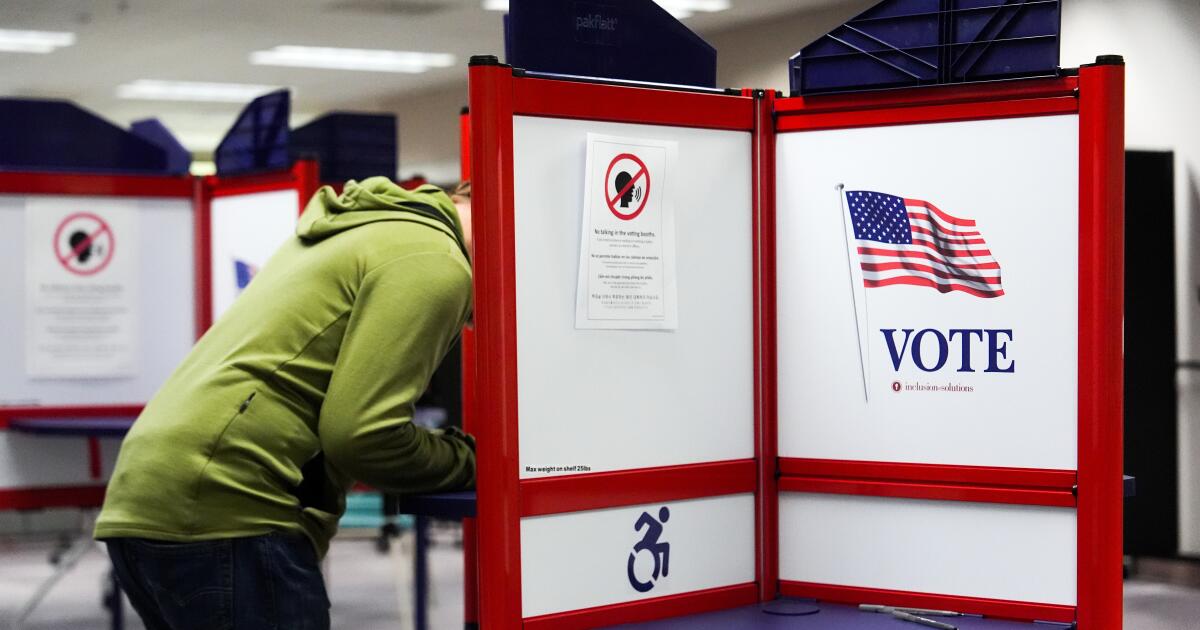
The stream of voters was steady Tuesday at a recreation center in the Old Town area of Alexandria, Virginia.

Matt Wallace, 31, said he votes regularly but this election has additional emphasis.

“I think the redistricting issue across the country is unfortunate, that we’ve had to resort to temporary redistricting in order to sort of alter our elections across the country,” Wallace said. He said he voted for the Democratic redistricting amendment “to help balance the scales a bit until things get back to normal.”

Joanna Miller, 29, said she voted against the redistricting measure, “because I want my vote to count in a fair way.” Miller said she was more concerned about representation in Virginia than trying to offset actions in other states.

“I want my vote and my representation to matter this fall,” she said.

Political parties made a big push in Virginia

Leaders of both major parties see Tuesday’s vote as crucial to their chances to win a House majority in the fall. Trump weighed in via social media Tuesday morning, telling Virginians to “vote ‘no’ to save your country!”

Former Virginia Gov. Glenn Youngkin, a Republican, rallied with opponents of the measure Monday night, calling the redistricting plan “dishonest” and “brazenly deceptive.” House Minority Leader Hakeem Jeffries told reporters at the Capitol earlier in the day that a vote to approve the redraw “will serve as a check and balance on this out-of-control Trump administration.”

A committee supporting the Democratic redistricting effort had raised more than $64 million — three times as much as the roughly $20 million raised by opponents, according to finance reports filed less than two weeks before the election.

The back-and-forth battle over congressional districts is expected to continue in Florida, where the Republican-led legislature is scheduled to convene April 28 for a special session that could result in a more favorable map for Republicans.

A lobster-like district could aid Democratic efforts

In Virginia, Democrats currently hold six of the 11 U.S. House seats under districts that were imposed by the state Supreme Court in 2021 after a bipartisan commission failed to agree on a map based on the latest census data.

The new plan could help Democrats win as many as 10 seats. Five are anchored in Democratic-heavy northern Virginia, including one shaped like a lobster that stretches into Republican-leaning rural areas.

Revisions to four other districts across Richmond, southern Virginia and Hampton Roads dilute the voting power of conservative blocs in those areas. And a reshaped district in parts of western Virginia lumps together three Democratic-leaning college towns to offset other Republican voters.

The Virginia redistricting plan is “pushing back against what other states have done in trying to stack the deck for Donald Trump in those congressional elections,” Democratic Gov. Abigail Spanberger said during an online rally last week.

Ads for the “yes to redistricting” campaign featuring former President Barack Obama have flooded the airwaves.

Opponents have distributed campaign materials citing past statements from Obama and Spanberger criticizing gerrymandering, but those were before Trump pushed Republican states to redraw their congressional maps in advance of this year’s midterms.

Democrats “were all against gerrymandering before they were for it,” Virginia Republican Party Chairman Jeff Ryer said.

Virginia court weighs whether lawmakers acted illegally

Virginia lawmakers endorsed a constitutional amendment allowing their mid-decade redistricting last fall, then passed it again in January as part of a two-step process that requires an intervening election for an amendment to be placed on the ballot. The measure allows lawmakers to redistrict until returning the task to a bipartisan commission after the 2030 census.

In February, they passed a new U.S. House map to take effect pending the outcome of the redistricting referendum. Republicans have filed multiple legal challenges against the effort.

A Tazewell County judge ruled that the redistricting push was illegal for several reasons. Circuit Court Judge Jack Hurley Jr. said lawmakers failed to follow their own rules for adding the redistricting amendment to a special session.

He ruled that their initial vote failed to occur before the public began casting ballots in last year’s general election and thus didn’t count toward the two-step process. He also ruled that the state failed to publish the amendment three months before that election, as required by law.

If the state Supreme Court agrees with the lower court, the results from Tuesday’s vote could be rendered moot.

Lieb writes for the Associated Press. AP writers Gary Fields in Virginia and Lisa Mascaro in Washington contributed to this report.
Source link

A renewed threat to JPL as the Trump administration tries again to cut NASA

NASA recaptured the world’s attention with Artemis II, which took astronauts to the moon and back for the first time in half a century. But the agency’s scientific projects could again be under threat as the Trump administration makes a renewed push to drastically cut their funding — including at the Jet Propulsion Laboratory.

The cuts, proposed in the Trump administration’s 2027 budget request to Congress, would pose further challenges to the already weakened Caltech-managed lab and could be broadly damaging to American efforts to bring back new discoveries from space. They echo last year’s attempt by the administration to slash NASA funding, which Congress rejected.

Though the Artemis project is billed as laying a foundation for a crewed NASA mission to Mars, exploration of the Red Planet is among the endeavors that could be slashed. The rover currently exploring Mars’ ancient river delta and a mission to orbit Venus are among projects with JPL involvement targeted for spending cuts, according to an analysis of the NASA budget proposal by the nonprofit Planetary Society.

“This isn’t [because] they’re not producing good science anymore. There’s no rhyme or reason to it,” said Casey Dreier, chief of space policy at the Planetary Society, which led opposition to the administration’s similar effort to cut NASA funding last year.

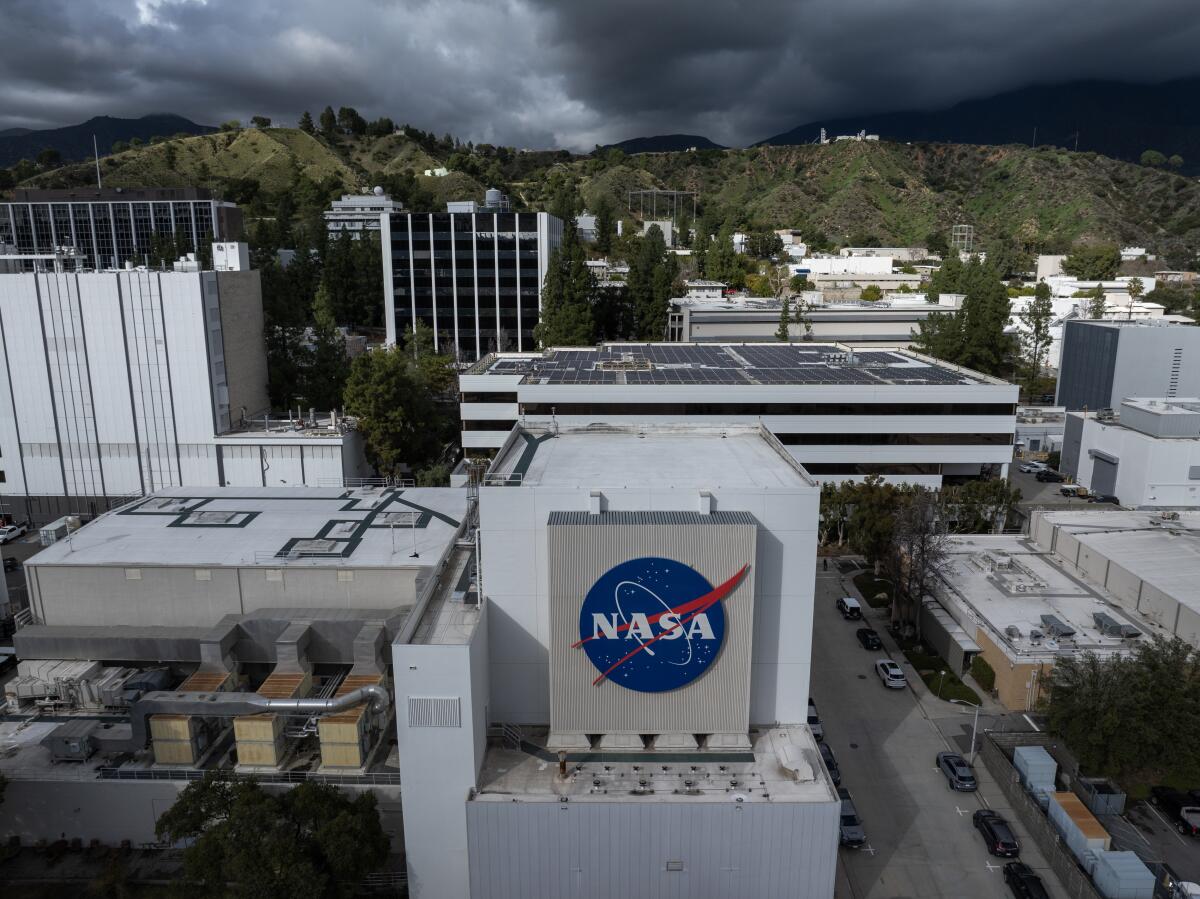
Storm clouds hang over the Jet Propulsion Laboratory on Feb. 7, 2024.

Storm clouds hang over the Jet Propulsion Laboratory on Feb. 7, 2024.

(David McNew / Getty Images)

This time, the administration is asking Congress to cut NASA funding by 23% — including a 46% cut to its science programs, which are responsible for developing spacecraft, sending them into outer space to observe and analyzing the data they send back.

The proposal would cancel 53 science missions and reduce funding for others, according to the Planetary Society analysis. The effort to pare down NASA Science comes amid the Trump administration’s broader effort to cut scientific research across federal agencies.

The plan swiftly drew bipartisan criticism from members of Congress, who rejected the administration’s similar 2026 proposal in January. Republican Sen. Jerry Moran of Kansas, who chairs the Senate appropriations subcommittee that oversees NASA, indicated last week that he would work to fund NASA similarly for 2027, saying it would be “a mistake” not to fund science missions.

Moran plans to hold a hearing with NASA Administrator Jared Isaacman before the end of April to review the budget request, a spokesperson for his office said. The president’s budget request is an ask to Congress, which ultimately holds the power to allocate funding.

But until Congress creates its own budget, NASA will use the plan as its road map, which could slow grants and contracts. The proposal “still creates enormous chaos and uncertainty in the meantime for critical missions, the scientific workforce, and long-term research planning,” said Rep. Judy Chu (D-Monterey Park), whose district includes JPL.

A NASA spokesperson declined to comment Friday. In the budget request, Isaacman wrote that NASA was “pursuing a focused and right-sized portfolio” for its space science missions in order to align with Trump’s federal cost-cutting goals.

The budget “reinforces U.S. leadership in space science through groundbreaking missions, completed research, and next-generation observatories,” Isaacman wrote.

Jared Isaacman testifies during his confirmation hearing to be the NASA administrator

Jared Isaacman testifies during his confirmation hearing to be the NASA administrator in the Russell Senate Office Building on Capitol Hill on Dec. 3, 2025.

(Anna Moneymaker / Getty Images)

At JPL — which has for decades led innovation in space science and technology from its La Cañada Flintridge campus — questions had already swirled about the lab’s role in the future of NASA work.

Multiple rounds of layoffs over the last two years, the defunding of its embattled Mars Sample Return mission and a shift by the Trump administration toward lunar exploration and away from the type of scientific work that JPL executes had pushed the lab into a challenging stretch.

It has had a steady stream of employee departures in recent months, and those left have been scrambling to court outside funding from private investors, sell JPL technology to companies and increase productivity in hopes of keeping the lab afloat, according to two former staffers, who requested anonymity to describe the mood inside the lab.

“If we’re not doing science, then what are we doing?” asked one former employee, who recently left JPL after more than a decade there.

A spokesperson for the lab declined to comment, referring The Times to the budget proposal.

The NASA programs marked for cancellation or cutbacks support thousands of jobs at JPL and other centers, said Chu, who has led a push for increased funding for NASA Science. After last year’s layoffs, JPL “cannot afford to lose more of this expertise,” she said in a statement.

Among the JPL projects that appear to be slated for cancellation are two involving Venus, Dreier said. One, Veritas, is early in development and would give work to the lab for the next several years, he said.

The project would be the first U.S. mission to Venus in more than 30 years, Dreier said, and aims to make a high-resolution mapping of the planet’s surface and observe its atmosphere.

The Perseverance rover, which is on Mars collecting rock and soil samples, could face spending reductions. The budget request proposes pulling some funding from Perseverance to fund other planetary science missions and reducing “the pace of operations” for the rover.

Though how the Mars samples might get back to Earth is uncertain, the rover is still being used to explore the planet and search for evidence of whether it could have ever been habitable to life.

Researchers hope the tubes of Martian rock, soil and sediment can eventually be brought back to Earth for study. The team has about a half a dozen more sample tubes to fill and the rover is in good shape, said Jim Bell, a planetary scientist and Arizona State University professor who leads the camera team on Perseverance, which works daily with JPL.

He said NASA’s spending proposal put forth “no plan” for the future of the agency’s work.

“Are people just supposed to walk away from their consoles,” Bell asked, “and let these orbiters around other planets or rovers on other worlds — just let them die?”

The NASA document did not clearly show which programs were targeted for cuts and did not list which projects were targeted for cancellation. The Planetary Society and the American Astronomical Society each analyzed the proposal and found that dozens of projects appeared to be canceled without being named in the document.

Across NASA, other projects slated for cancellation according to the Planetary Society’s analysis include New Horizons, a spacecraft exploring the outer edge of the solar system; the Atmosphere Observing System, a planned project to collect weather, air quality and climate data; and Juno, a spacecraft studying Jupiter.

The administration’s plan also doesn’t prioritize new scientific projects, Bell said, which further jeopardizes long-term job stability and space discovery at centers like JPL.

“We’re going through this long stretch now with very few opportunities to build these spacecrafts,” Bell said. “All of the NASA centers are suffering from the lack of opportunities.”

Last year, the Trump administration proposed to slash NASA’s 2026 funding by nearly half. Instead, Congress approved funding in January that provided $24.4 billion for the agency — a cut of about 29% rather than the proposed 46%. The 2027 budget request asks for $18.8 billion.

Congress kept funding for science missions nearly steady, allocating $7.25 billion for science missions, about a 1% decrease from 2025. The administration had proposed cutting the science investment down to $3.91 billion. This time, the budget requests $3.89 billion.

Under the Trump administration, NASA has put an emphasis on moon exploration, including this month’s successful Artemis II mission. Isaacman, who defended the proposed cuts on CNN last week, touted the agency’s lunar plans, including a project to build a base on the moon.

The agency has indicated commitment to some existing science missions, including the James Webb Space Telescope, the to-be-launched Nancy Grace Roman Space Telescope, the Dragonfly spacecraft set to launch for Saturn’s moon in 2028, and other projects.

“NASA doesn’t have a topline problem, we just need to focus on executing and delivering world-changing outcomes,” Isaacman said on CNN.

Scientists have urged the government not to choose between funding science and exploration but to keep up investment in both.

“It’s ultimately kind of confusing, especially on the heels of the Artemis II mission,” said Roohi Dalal, deputy director for public policy at the American Astronomical Society. “The scientific community … is providing critical services to ensure that the astronauts are able to carry out their mission safely, and yet at the same time, they’re facing this significant cut.”

Source link

ICE acting director Todd Lyons will resign at end of May, DHS says

U.S. Immigration and Customs Enforcement acting director Todd Lyons, a key executor of President Trump’s mass deportations agenda, will resign at the end of May, federal officials announced Thursday.

Homeland Security Secretary Markwayne Mullin announced Lyons’ departure, calling him a great leader of ICE who helped to make American communities safer. Mullin said Lyons’ last day will be May 31.

“We wish him luck on his next opportunity in the private sector,” Mullin said in a statement. The Department of Homeland Security did not immediately respond to an email from the Associated Press asking why he is resigning.

Lyons, who was named acting director in March 2025, led the agency at the center of President Trump’s plans to reshape immigration to the U.S.

Under his leadership, the agency was granted a massive infusion of cash through Congress, which it used to expand hiring and detention capabilities, and it ramped up arrests to meet demand from the administration.

ICE was also central to a series of high-profile immigration enforcement operations in American cities, including Chicago and Minneapolis, a deployment that ended after backlash erupted over the deaths of two American protesters at the hands of federal immigration officers.

Stephen Miller, the president’s deputy chief of staff and the main architect of his immigration policy, called Lyons a “dedicated leader.”

“His courageous work at ICE has saved countless thousands of American lives and helped deliver safety and tranquility to millions of Americans,” Miller said in a statement.

White House spokesperson Abigail Jackson described Lyons in a post on X as “an American patriot who made our country safer.”

It’s not clear who might replace Lyons. But whoever does will take over an agency flush with cash while still a flashpoint for controversy. ICE is at the center of a battle in Congress, with Democratic lawmakers demanding restraints on immigration officers before agreeing to restore routine funding for DHS.

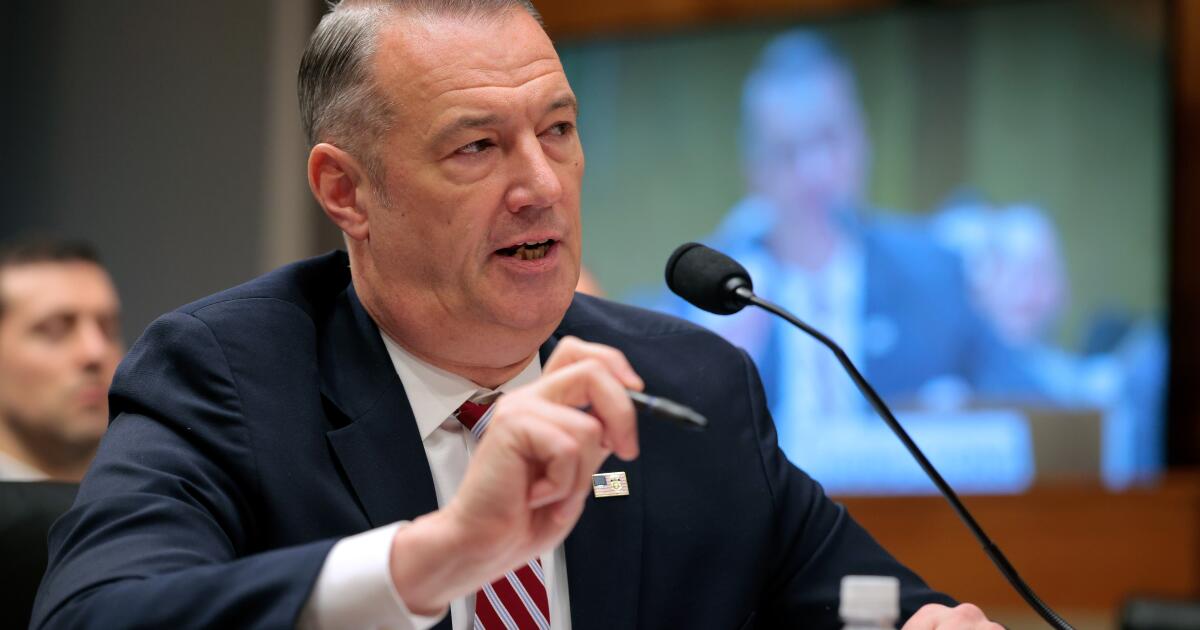
On Thursday, Lyons, along with two other top immigration officials, appeared before a House subcommittee to argue for his agency’s budget and faced continued scrutiny from lawmakers of ICE’s actions.

Lyons’ departure also comes as DHS is under new leadership after Trump fired former Secretary Kristi Noem, who led the department through the administration’s major immigration policy changes.

Mullin, who took over as secretary last month, is likely to continue to advance the president’s agenda but has struck a softer tone on some of the administration’s most contentious policies.

Public perceptions of ICE during Lyons’ tenure were low. In a February AP-NORC poll, most U.S. adults, including independents, said they have an unfavorable view of the agency.

Lyons faced questions in Congress over the shooting deaths of Renee Good and Alex Pretti and was asked if he would apologize for the way some Trump administration officials characterized Good as an agitator. He declined to do so.

“I welcome the opportunity to speak to the family in private. But I’m not going to comment on any active investigation,” Lyons said.

Lyons said he had seen video that captured Pretti’s shooting but said he could not comment, citing an active investigation.

Lyons, who joined ICE in 2007 as an immigration enforcement agent in Texas, signed off on a memo, first obtained by the Associated Press, that granted federal immigration officers sweeping powers to forcibly enter homes and make arrests without a judge’s warrant.

Trump’s border advisor Tom Homan described Lyons as serving selflessly and “a highly respected and effective acting Director of ICE.”

Goldenberg and Golden write for the Associated Press. Golden reported from Seattle.

Source link