congress

Biden sues Justice Department to stop release of audio and transcripts tied to special counsel probe

Joe Biden sued the Justice Department on Tuesday in an effort to block the release of audio recordings and transcripts of the former president’s interview with a ghostwriter that were obtained by the special counsel who investigated his handling of classified documents.

Biden’s lawyers said in a lawsuit filed in Washington’s federal court that the Justice Department plans to release the files to Congress and a conservative group, the Heritage Foundation, after the department had previously argued that they were exempt from disclosure under the public records law.

Biden’s lawyers argued that the disclosure would “constitute an unwarranted invasion of President Biden’s privacy.”

“Every American, including a sitting or former Vice President, has a right to privacy in the personal conversations he has within his own home,” his attorneys wrote. “And when the U.S. Department of Justice obtains that private information through a criminal investigation, the Department bears a particular responsibility to protect it from disclosure.”

At issue in the case are audio recordings and transcripts of Biden’s interviews at his home in 2016 and 2017 with Mark Zwonitzer, who worked with Biden on his two memoirs. The files were scrutinized by special counsel Robert Hur as part of his investigation into the president’s improper retention of classified documents, from his time as a senator and as vice president.

Hur’s yearlong investigation led to a 345-page report that questioned Biden’s age and mental competence but recommended no criminal charges against the then-81-year-old. Hur said he found insufficient evidence to successfully prosecute a case in court.

Biden has separately fought the release of the audio of his interview with Hur. The House in 2024 voted to hold Biden Atty. Gen. Merrick Garland in contempt of Congress for refusing to turn over that audio after the White House exerted executive privilege, shielding it from Congress.

The transcripts of five hours of Biden interviews with federal prosecutors was released that same year. While Biden was adamant that he treated classified information seriously, the transcript shows that he was at times fuzzy about dates and details and he said he was unfamiliar with the paper trail for some of the sensitive documents he handled.

Republicans have argued Biden was being given a pass by his own Justice Department and that Trump had been unfairly victimized by prosecutors. Democrats, for their part, stressed Biden’s cooperation in the investigation and strongly contrasted that with the separate criminal case against Trump, who was accused of refusing to return classified documents requested by the National Archives that he had at his Florida estate.

Richer writes for the Associated Press.

Source link

News Analysis: Uncertainty, frustration define messy midterm battles for mayor, governor and Congress

With little more than a week left until primary voters winnow the candidates for Los Angeles mayor, California governor and Congress, there remains a palpable sense of political uncertainty among the electorate — attributable to a lack of clear front-runners, redrawn political maps, messy party infighting and competing voter frustration with both President Trump and the state’s Democratic establishment.

In a state where Democrats hold a substantial advantage among registered voters and Trump lost in 2024 by more than 20 percentage points, MAGA-aligned Republicans are nonetheless competing on a message of ineptitude from longtime liberal leaders to address the state’s most intractable problems. Even some Democrats have railed against the status quo.

With Trump’s grip on the Republican base intact despite abysmal overall approval ratings, many Republican candidates have courted his approval — and been hammered for it by their Democratic opponents.

But those same Democrats have found it harder to explain why their own party should continue to lead the state despite allowing its affordability, housing and homelessness crises to take root and persist — taking little responsibility while swiping at each other for having failed to find solutions sooner.

All that party infighting — present before every primary, but at a fever pitch now — comes against a backdrop of broader voter unease about the war in Iran, volatile oil and gas prices, and the burgeoning threat of AI to the American workforce.

Republican voters are being warned of a blue wave in November giving Democrats control of Congress and grinding Trump’s agenda to a halt. Democratic voters are being warned of Trump administration efforts to undermine local and state elections, and of control of Congress unfairly slipping from reach thanks to further Republican redistricting following a U.S. Supreme Court decision undermining the Voting Rights Act and its protections for majority-Black districts across the South.

Many California voters — some already shaken or burned by former Rep. Eric Swalwell dropping from the gubernatorial race amid sexual assault and rape allegations last month — appear hesitant to cast ballots early, despite warnings that the Trump administration may try to discount those mailed at the last minute.

“Voters don’t want to make a mistake. They’re not absolutely certain,” said Rob Stutzman, a Republican consultant in California. “It’s just not real clear where to land.”

James Adams, a political science professor at UC Davis who studies elections and public opinion, said California Democrats this cycle “have a candidate problem and they have a message problem,” in that they are trying to convince voters to back them “not because they offer exciting ideas or inspiring leadership, but because their Republican opponents are even worse.”

And that message — offered as they gerrymander California in a race to the bottom with Republicans nationally — isn’t cutting it, Adams said.

“People are alienated from our current politics not because Americans are cynical, but because people recognize that they deserve better.”

Outsider shakes up L.A. mayor’s race

Amid entrenched homelessness, affordability concerns and lingering anger over the bungled response to last year’s wildfires, the L.A. mayor’s race was “supposed to be a referendum” on embattled Mayor Karen Bass, Stutzman said.

And yet, Bass remains in the lead, and many voters remain confused about which way to turn away from her — if at all.

Bass has won the endorsement of three council members who are members of the Democratic Socialists of America, despite City Councilmember Nithya Raman, an ally who’d previously endorsed Bass and is a member of the DSA herself, entering the race to her left.

Unable to consolidate support from the city’s progressive flank, Raman is now running neck and neck for a second-place finish and a chance to face Bass in the November runoff with former reality TV personality Spencer Pratt, who has remained in contention in ultra-liberal L.A. despite pushing a MAGA-aligned message to Bass’ right.

Pratt, who did not respond to a request for comment, lost his Pacific Palisades home in the fires and has won over many frustrated city residents with his anti-establishment message and cheeky AI videos — including one casting him as Batman, taking on a corrupt Democratic bourgeoisie.

Pratt, a registered Republican, has tried to dance around politics in the race, calling his campaign a “nonpartisan” one and comparing himself to President Obama politically. But he is backed by many Republicans, has echoed Trump’s rhetoric around restoring “common sense” and a “Golden Age” to L.A., and recently responded to Trump saying that he’d heard Pratt “is a big MAGA person” — and Raman posting the quote to X — with a meme of himself shrugging.

Fernando Guerra, founding director of the Center for the Study of Los Angeles at Loyola Marymount University, said he’s glad city voters have choices this race, because they clearly aren’t happy. He said Angelenos are less optimistic today than ever before and are deeply frustrated with “this same liberal Democratic regime from Bradley to Bass over 50 years” — a reference to former Mayor Tom Bradley, who first took office in 1973.

Voters are clearly tired of that regime, which has succumbed to “policy paralysis” in the name of “inclusion” and trying to please everyone, Guerra said — but not so much that they will consider going MAGA for Pratt.

“People say, ‘Yeah, Democrats have really f—d it up, but there’s no way we’re going to [back] Republicans. Look what they’ve done to the nation.’”

Others aren’t so sure. In its voter guide, the progressive group LA Forward wrote that the “most important thing” in the June 2 primary is to block Pratt — whom it called a “right-wing reality TV buffoon” — from advancing, and the best way to do so is to vote for Raman.

“We would much rather see a Bass/Raman runoff, with no chance of Pratt becoming mayor, than a Pratt/Bass runoff where a Pratt win would be a real possibility — plunging LA into a Trumpian mayoral nightmare,” the group wrote.

An unsettled gubernatorial contest

In the gubernatorial race, none of the many Democratic candidates has been able to consolidate a sizable lead, creating a lingering apprehension that Republicans could somehow eke out a stunning upset in the biggest of blue states.

That’s in part thanks to leading Democratic candidate Xavier Becerra, the former California attorney general and U.S. Health secretary under President Biden, being dogged by insinuations, including from fellow Democrats, that he was somehow complicit in a scheme by underlings to steal from his campaign coffers, despite prosecutors in the case — which resulted in his former chief of staff pleading guilty — never alleging wrongdoing on his part.

It’s also thanks in part to the fact that the leading progressive, Tom Steyer, is a billionaire who has bought his way into contention with nearly $200 million of his own money — in an election cycle in which progressive voters nationwide are decrying billionaires as the clearest symbol of all that is wrong with the nation’s lopsided economy.

“This kind of weird self-loathing rationale of why he’s the right guy to take on billionaires because he is one? You can’t build a Mamdani movement around that,” said Stutzman, referring to New York City Mayor Zohran Mamdani, who shot to power on a democratic socialist platform last year.

The Democrats have also struggled to combat the criticism — leveraged time and again by their Republican competitors — that their party has failed for years to solve California’s most substantial problems, and deserves to be ousted from power.

Republican Steve Hilton and Democrat Xavier Becerra speak during a break in the April 28 gubernatorial debate.

Republican Steve Hilton and Democrat Xavier Becerra speak during a break in the April 28 gubernatorial debate.

(Eric Thayer / Los Angeles Times)

Former Fox News commentator Steve Hilton has hammered that message in ads and on the debate stage, lambasting the Democratic establishment for pushing so much unnecessary regulation that it has chased out business and investment and made everything from gas to housing to groceries more expensive for average residents.

He has blamed Democrats for California’s high rates of poverty and unemployment, its high cost of living and high taxes, its record homelessness and its poor public school results.

In an interview, Hilton said he understands that California voters may not like Trump — who endorsed him — and may have conflicting beliefs about federal and international policy, but that California’s biggest problems have “nothing to do with President Trump.”

“Voters need to decide on what direction they want to take in terms of the policies that affect their daily lives in California,” he said, and those are “devised and enacted within California by our politicians here in Sacramento.”

He also said it’s no surprise that some of his Democratic rivals have also acknowledged that the Democratic establishment has been a failure, because “if you pretend otherwise, you show that you’re just completely out of touch with public opinion.”

Rusty Hicks, chair of the California Democratic Party, said “every campaign is entitled to run the race that they believe matches their story,” even if that means questioning the party’s past performance. But he also said polling hasn’t shown that message to be an effective one, and he’s confident that voters will show their ongoing trust in the party at the polls.

Redistricting, sniping and name-calling

The decision by California voters last November to pass Proposition 50 and allow the state’s Democratic leaders to redraw the state’s congressional maps to favor Democratic candidates in a handful of additional districts — part of a wider redistricting war sparked by Trump — has intensified the primary races in those areas.

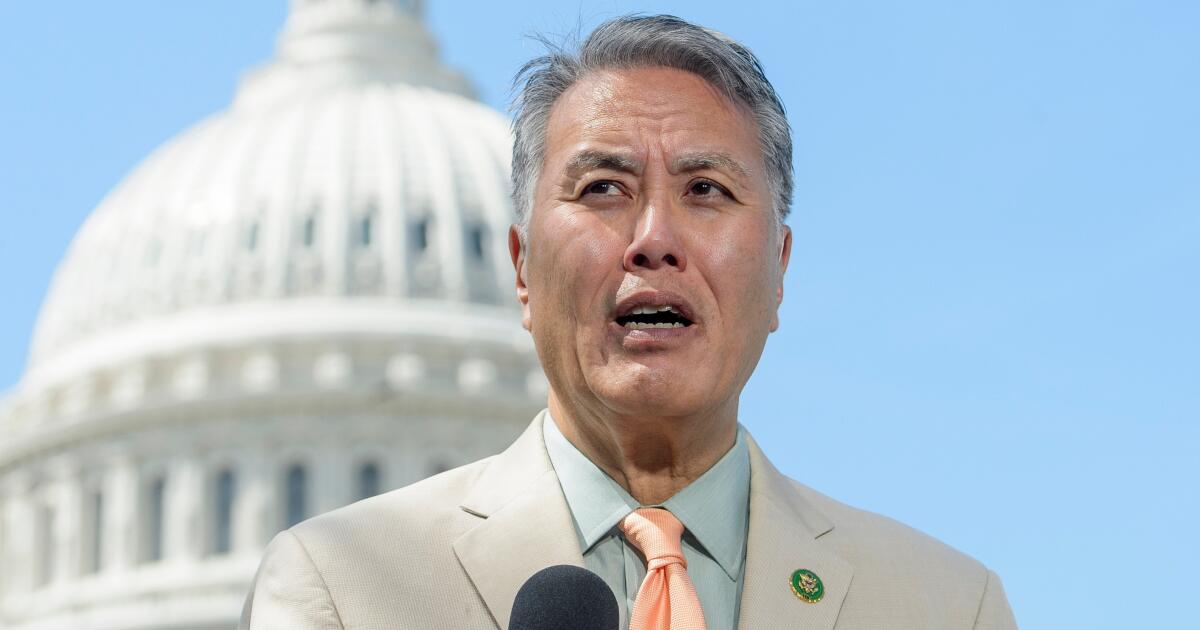
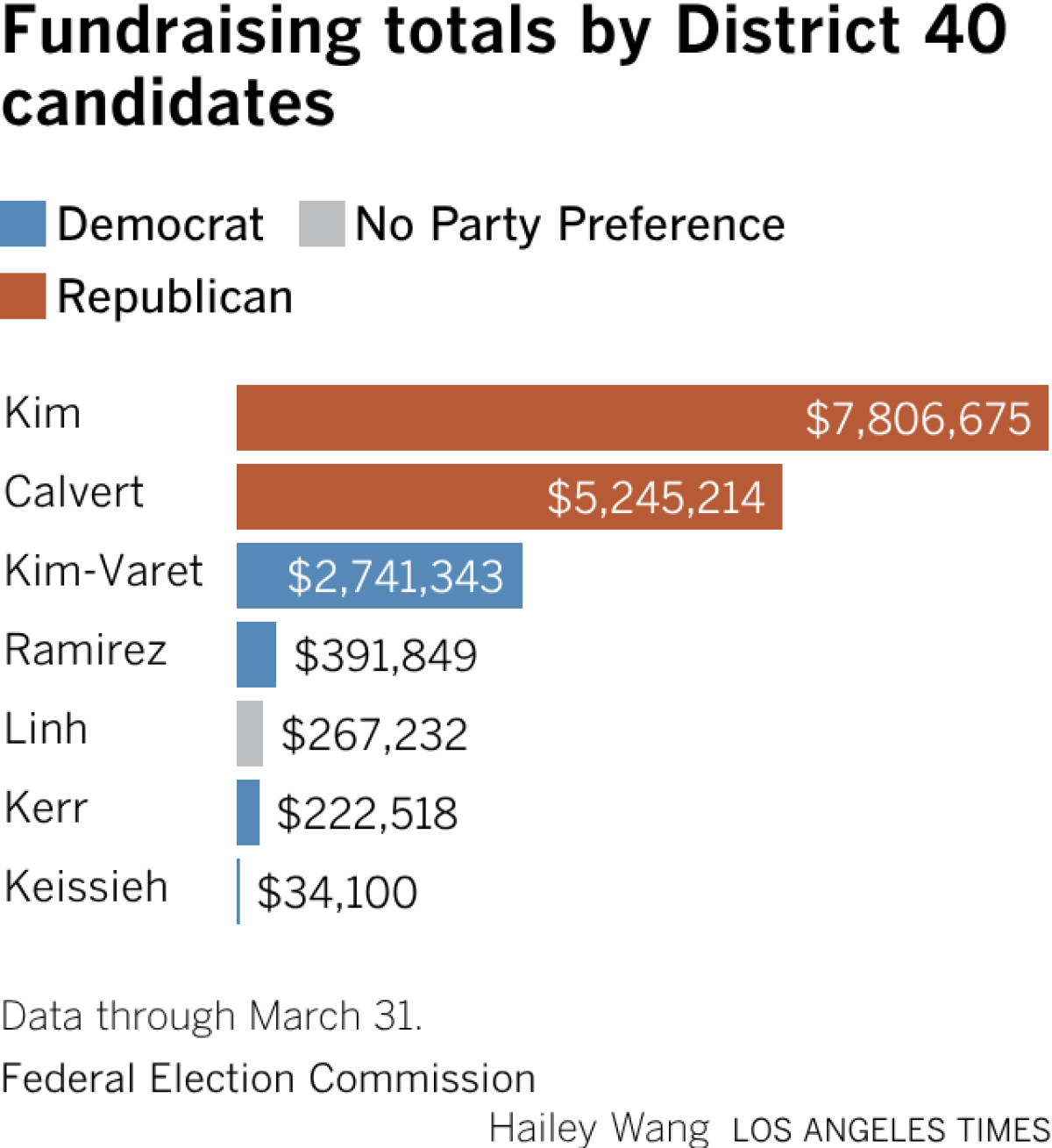
As an example, longtime incumbent Reps. Ken Calvert (R-Corona) and Young Kim (R-Anaheim Hills) are now competing to represent the same redrawn swath of Orange, Riverside and San Bernardino counties, and have bitterly attacked one another. Kim has called Calvert a “swampy,” “sleazy” and “corrupt” politician guilty of “sabotaging President Trump’s agenda.” Calvert has called Kim a “RINO,” or Republican In Name Only, and a “Trump-hating liberal.”

Democrats have also sniped at each other, including in the race to replace retiring Rep. Darrell Issa (R-Bonsall) in his redrawn district in San Diego and Riverside counties — where Trump also holds an outsize presence.

Rep. Young Kim and Rep. Ken Calvert are opponents in a heated race in a newly redrawn congressional district.

Rep. Young Kim and Rep. Ken Calvert are opponents in a heated race in a newly redrawn congressional district.

(Associated Press)

Stutzman said it will be interesting to see how those primaries play out, but also how Democrats there and in other races perform in November — when Democrats are expected to perform well nationally given Trump’s lousy ratings, but Democrats in California could underperform thanks to statewide frustration with affordability, housing and homelessness here.

“People are like, ‘Eh, you know, yeah, Trump — but there’s some problems here,’” Stutzman said.

Hicks said he expects California voters to not only elect another Democratic governor, but to “push back on a Trump administration and congressional Republicans and Republicans around the country that have sought to rig the game in their favor,” including by “ensuring that we fulfill the promise of Proposition 50 by winning congressional seats and retaking the House of Representatives.”

He said the current political moment “can feel like a pressure cooker,” but Californians will “continue to adapt and overcome and be resilient, just as they always have been.”

Source link

Contributor: The GOP is collapsing under Trump’s loyalty tests

Americans always say they want politicians with backbone — men and women of principle who will stand up for what they believe in, even when it’s unpopular.

And every so often, the American people prove their commitment to this noble aspiration by firing anybody who actually tries it.

Take Republican Rep. Thomas Massie, who just lost a reelection bid by double digits after President Trump’s affiliated committees dumped enough money into Kentucky to purchase, well, Kentucky.

Massie committed the cardinal sin of modern Republican politics: He behaved as though Congress were a coequal branch of government instead of the warm-up act before a Trump rally.

He bucked Trump on spending, Iran and — in what apparently qualified as political suicide — whether or not to release the Epstein files. For this display of independent thought, Massie was summarily retired by what can only be described as the Trump cult (formerly known as the Republican primary electorate).

Before anybody accuses me of hyperbole, consider the remarkably revealing example presented recently on the New York Times podcast, “The Daily.”

At a town hall in Burlington, Ky., one voter explained to Massie that Trump is basically omniscient.

“As I see it,” the voter said, “the one person in the whole United States, maybe the world, that understands everything and has input to everything is Donald Trump.”

Not content with mere earthly wisdom, Trump also possesses universal awareness, superior intelligence and perhaps even low-level clairvoyance. The voter continued that Trump “gets more information, more meetings, more everything” than anybody else in government.

When Massie noted that Trump opposed releasing the Epstein files, the man calmly explained that if Trump changed positions, “there was a reason” — one too profound for ordinary mortals to comprehend.

Massie’s reply deserves to be bronzed and mounted over the entrance to the U.S. Capitol: “I don’t give anybody but God that kind of trust.”

Unfortunately, for a large portion of the Republican electorate (about 55%, based on the Kentucky primary results), those words constitute sacrilege against their earthly savior.

As South Carolina Sen. Lindsey Graham cheerfully boasted on NBC’s “Meet the Press” on Sunday, “This is the party of Donald Trump.” Which is true in much the same way North Korea is the party of Kim Jong Un.

The one ironic twist in all of this is that Americans finally managed to punish somebody over the Epstein files — only it turned out to be the guy who wanted them released.

There’s American justice for you.

Massie isn’t the only Republican currently being fitted for concrete shoes. Trump also helped finish off Louisiana Sen. Bill Cassidy, whose unforgivable crime was voting to convict Trump during the impeachment trial following Jan. 6. And Trump has endorsed controversial Texas Atty. Gen. Ken Paxton over incumbent Sen. John Cornyn, which in today’s GOP primary environment is roughly the equivalent of finding a horse head in your bed.

Now, to be fair, Cassidy and Cornyn are no Massie, who openly opposed Trump and paid the price standing upright. Cassidy and Cornyn demonstrated brief moments of independence, only to spend years vainly performing political interpretive dance routines in hopes of regaining Trump’s favor.

Still, there may be a silver lining here for students of political irony.

Trump’s endorsement of Paxton will force Republicans to spend enormous sums defending a deep red state that would ordinarily require little more than a campaign sign and a pickup truck.

Meanwhile, Trump is creating resentful lame-duck Republicans in Congress who now possess the most dangerous attribute in politics: nothing left to lose.

But the broader message is unmistakable. Trump wants Republicans to understand that disagreement will not be tolerated. No criticism. No distancing. No independent branding.

The party line is whatever Trump said five minutes ago, amended by whatever he says five minutes from now. By now, everyone knows this to be true.

Which would be excellent news for Trump, if not for one small complication: The rest of the country appears to be tiring of his act. Recent polling shows Trump’s approval slipping to 37%, while Democrats gain major ground, surging to a +11 on the generic congressional ballot.

Trump, it seems, has created a situation in which Republicans can either oppose him and be destroyed in a primary, or they can embrace him and risk losing the House and the Senate in November’s general election. It’s the old “damned if you do, damned if you don’t” conundrum.

The point is this: With the midterms approaching, Trump is making sure Republicans are ensnared in the gravitational pull of his unpopularity.

That may satisfy the president’s desire for complete loyalty. It may also hand Democrats control of both chambers of Congress.

Trump is settling all family business this week, by purging those pesky disloyal Republicans. Only time will tell whether he’s also purging America’s non-Republican “swing” voters, as well.

Matt K. Lewis is the author of “Filthy Rich Politicians” and “Too Dumb to Fail.”

Source link

Barney Frank, a liberal congressman and trailblazer for gay rights, dies. He was 86.

Barney Frank, the longtime Democratic congressman and leading liberal who brought new visibility to gay rights and crafted the most significant reforms to the financial system in a generation, has died. He was 86.

Frank died late Tuesday, according to Jim Segel, Frank’s former campaign manager and close friend.

After representing broad swaths of Boston’s suburbs in Congress for 32 years, Frank and his husband moved to Ogunquit, Maine. He entered hospice there in April with congestive heart failure and is survived by his husband, Jim Ready, and sisters, the longtime Democratic strategist Ann Lewis and Doris Breay, along with brother David Frank.

A self-described “left-handed gay Jew,” Frank was known for his acerbic wit, combative style and focus on marginalized communities. He represented the party’s left wing while keeping close with Democratic leaders who sometimes frustrated progressives.

He is best known as a pioneer for LGBT rights. After decades of grappling with his sexuality, he publicly came out as gay in 1987, the first member of Congress to do so voluntarily. With his 2012 marriage to Ready, he became the first incumbent lawmaker on Capitol Hill to marry someone of the same sex.

But in an April interview as he entered hospice, Frank said he hoped he would be remembered for advocating a brand of politics that embraced progressive ideals without forcing them on voters prematurely. It is an approach he feared was being rejected as Democrats prepare for what could be a rollicking primary as they hope to retake the White House in 2028 and move past the Trump era.

“I hope I made the point that the best way to accomplish the improvements in our society that we need, particularly in making it less unfair economically and socially, is by conventional political methods,” Frank said. “The main obstacle to our defeating populism and going further in the right direction is that mainstream Democrats have to make it clear that we oppose that part of the agenda of our friends on the left that is politically unacceptable. They’re right about a lot of things but you have to have some discretion.”

“You should not take the most unpopular parts of your agenda and make them litmus tests,” he added. “And that’s what my friends on the left have been doing.”

Frank’s path to public life

Born in 1940 in Bayonne, N.J., Frank wrote in his 2015 memoir that he was drawn to public life after Emmett Till, a Black 14-year-old from Chicago, was lynched by white men in Mississippi. Frank would volunteer in Mississippi during the Freedom Summer of 1964, though he acknowledged the fast-talking style was a challenge in the Deep South.

“My direct organizing of Mississippi voters was limited by the fact that my accent [to this day more New Jersey than New England], my poor diction, and my rapid speech, especially when I got excited, rendered me largely incomprehensible to rural Mississippians of both races,” he wrote.

He entered politics in 1968 as an aide to Boston Mayor Kevin White before winning a seat in the Massachusetts House in 1972. Frank was elected to Congress in 1980, an otherwise dismal year for Democrats as the party lost dozens of seats in the U.S. House and Republican Ronald Reagan won the White House.

Frank’s pragmatic style surfaced early in his congressional career. He joined the liberal Democratic Study Group to help push then-Speaker Tip O’Neill (D-Mass.) to respond more aggressively to the Reagan administration. But Frank said he found himself more often agreeing with O’Neill’s less confrontational approach.

Years later, as Congress prepared to pass a massive tax overhaul package, Frank intended to vote “no,” opposed to the bill’s lowering of top tax rates. He changed his mind, however, when he worked out a deal boosting affordable housing tax credits.

“I was happy to sacrifice my ideological purity to improve legislation that was going to become law with or without me,” he wrote.

Rep. Nancy Pelosi, the California Democrat and former House speaker, called Frank an “idealist to the nth degree.”

“The goals, the vision, the promise of it all,” she recalled in an interview. “Nobody could ever surpass what he brought to the table in that regard.”

Making history in Congress

Through his early years in Washington, Frank led something of a double life.

Privately, he socialized in the city’s gay circles and had relationships but did not publicly acknowledge his sexuality. The media at the time rarely reported that someone was gay unless that person was involved in a scandal. When Frank in 1987 invited a reporter to his office to formally ask whether the congressman was gay, Frank responded, “yeah, so what?”

Other elected leaders, perhaps most notably San Francisco’s Harvey Milk, had come out years before. Members of Congress, including Rep. Gerry Studds (D-Mass.), were previously outed through scandal.

Frank’s approach made him the most prominent gay leader in national politics for much of the 1980s and 1990s. He helped secure AIDS funding and pressed the Democratic Clinton administration, unsuccessfully, to lift a ban on gays serving in the military.

But there were low points, too, most notably an overwhelming 1987 House vote to reprimand him for poor judgment involving a male prostitute he hired in 1985. Rep. Newt Gingrich of Georgia, the Republican whip at the time, pressed for the more severe punishment of censure, which was rejected by a large margin.

Frank became something of a punch line among conservative Republicans, with House Majority Leader Dick Armey (R-Texas) calling him “Barney Fag” in 1995. Armey said he misspoke and later apologized from the House floor.

Along the way, Frank became known as one of the most quotable lawmakers in Congress.

Regarding abortion, he said Republicans believed “life begins at conception and ends at birth,” criticizing the party’s push to curb social programs. After Ken Starr released a report describing President Clinton’s relationship with Monica Lewinsky in sometimes intimate detail, Frank said it required “too much reading about heterosexual sex.”

Rep. Steny Hoyer (D-Md.) entered Congress the same year as Frank and he recalled his former colleague: “You may get a blow, but it was softened by the humor that came with it.”

Presiding over a financial overhaul

By 2007, Frank was the chairman of the House Financial Services Committee, where he would leave his lasting policy mark as the U.S. economy careened toward collapse. He worked with the Republican Bush administration to pass a rescue package, providing vital support to financial institutions but spurring a populist revolt that still courses through American politics.

Once the initial crisis eased, Frank helped develop the most significant reform legislation since the New Deal. Working with then-Senate Banking Committee Chairman Chris Dodd (D-Conn.), the Dodd-Frank Act would enhance consumer protections, impose new capital requirements for banks and boost the ability of regulators to monitor risk.

“Barney and I shared a fantastic relationship,” Dodd said. “I had many good moments in those 36 years in Congress, but none more significant, joyful, or productive than those almost two years working with Barney on our banking bill.”

During President Trump’s second term, his Republican administration has worked to roll back many of the legislation’s provisions, arguing they were too onerous.

Frank faced his toughest reelection campaign in years in 2010 as the tea party wave swept over American politics. He opted against running again in 2012, though remained engaged in politics long after leaving Congress and was a fierce critic of Trump.

Asked for his prediction on who might succeed Trump, Frank said “unfortunately I won’t get to vote for it.”

Sloan writes for the Associated Press.

Source link

Officers who defended Capitol from rioters sue to block payouts from $1.8-billion ‘anti-weaponization’ fund

Two police officers who helped defend the U.S. Capitol from an attack by a mob of President Trump’s supporters sued on Wednesday to block anyone — including Jan. 6, 2021, rioters — from receiving payouts from a new $1.776-billion settlement fund for people who claim to be victims of politically motivated prosecutions.

The officers’ attorneys filed the federal lawsuit a day after acting Atty. Gen. Todd Blanche defended the fund’s creation during a congressional hearing. Blanche, a personal attorney for Trump before joining the Justice Department, wouldn’t rule out the possibility that rioters who assaulted police on Jan. 6 would be eligible for fund payouts.

The lawsuit claims the government’s “Anti-Weaponization Fund” is an illegal slush fund that Trump will use to “finance the insurrectionists and paramilitary groups that commit violence in his name.” It describes the fund’s creation as “the most brazen act of presidential corruption this century” and calls for dissolving it.

“No statute authorizes its creation, the settlement on which it is premised is a corrupt sham, and its design violates the Constitution and federal law,” the suit says.

The fund stems from a settlement of Trump’s $10-billion lawsuit against the IRS over the leak of his tax returns. It’s designed to compensate those who believe they were mistreated by prior administrations’ Justice Department. Decisions on payouts will be made by a five-member commission appointed by the attorney general.

More than 100 police officers were injured during the Capitol riot. Nearly 1,600 people were charged with Jan. 6-related crimes, but Trump used his pardon powers to erase all of those cases in a sweeping act of clemency last year.

The plaintiffs suing Trump over the fund are Metropolitan Police Department officer Daniel Hodges and former U.S. Capitol Police officer Harry Dunn, who is running in Maryland for a seat in Congress. Hodges and Dunn both testified before Congress about their harrowing experiences on Jan. 6. Videos captured a rioter ripping a mask off Hodges as he was pinned against a door during a fight for control of a tunnel entrance.

The officers claim the fund “encourages those who enacted violence in the President’s name to continue to do so.”

“Dunn and Hodges already face credible threats of death and violence on regular basis; the Fund substantially increases the danger,” the suit alleges.

On Tuesday, members of Congress peppered Blanche with questions about the fund. He described it as “unusual” but not unprecedented. Blanche failed to acknowledge that Trump’s Justice Department has investigated and prosecuted some of the Republican president’s political enemies, including former FBI Director James Comey and New York Atty. Gen. Letitia James.

Blanche and Treasury Secretary Scott Bessent also are named as defendants in the officers’ lawsuit. Spokespeople for the Justice and Treasury departments didn’t immediately respond to requests for comment on the suit.

One of the attorneys for the officers is Brendan Ballou, a former Justice Department prosecutor who handled Jan. 6 cases.

Kunzelman writes for the Associated Press.

Source link

Trump shows reporters ballroom site amid $1-billion security request

Shouting over the banging and clanging sounds from heavy construction equipment, President Trump on Tuesday gave a group of reporters a closer look at the construction for the White House ballroom he’s building on the site of the former East Wing to mount a defense for the project that has hit a speed bump in Congress.

The administration has asked for $1 billion from taxpayers for security additions on the White House campus, including for the ballroom. But the Senate parliamentarian ruled the proposal could not be included in a bill to fund immigrant enforcement agencies for three years, and several Republican lawmakers have balked at the price tag in an election year where voters are grappling with gasoline, grocery and other prices spurred to new heights by the Iran war and the disruption in oil supplies.

So Trump, ever the pitchman, surprised White House reporters by bringing them to a platform overlooking the construction site on a hot and breezy morning as workers in hard hats and fluorescent yellow vests milled about below.

Easels were set up to display renderings of the ballroom building and at least one of them blew off in the wind. “Give that to me, I’ll hold it,” Trump told an assistant.

“There will never be another building like this built, that I can tell you,” Trump told reporters.

He highlighted the security aspects of the building, notably its “dead flat” roof made of “very strong steel” and said it is “drone-proof” because “if a drone hits it, it bounces off, it won’t have any impact — but it’s also meant as a drone port, so it protects all of Washington, the roof of the building.”

He said the military will “stay on it” to keep watch over the city.

There’s no air conditioning or other equipment on the roof for safety reasons, Trump said, explaining that all duct work and equipment like it was hidden within the walls of the complex, which will serve as a “shield” for a military hospital, research facilities, offices for the first lady and her staff, and a full-service kitchen — in addition to a ballroom big enough for 1,000 people.

He said the ballroom building goes down six stories underground and is really “complex” because “everything is intertwined.”

“The roof goes with the ground floor, the ground floor goes with the roof. The roof also goes down into the basement,” the president said. “This is one well-knit building. One thing doesn’t work without the other.”

Trump says the ballroom is a ‘gift’ to the country

He reiterated that the $400-million ballroom cost will be covered by donors, including him, and that the work is being done “in strict coordination” with the military and U.S. Secret Service.

“This is not going to be paid for by the taxpayer,” Trump said. “This is a gift to the United States of America.”

But it’s somewhat of an unwanted present as polling shows most Americans oppose the ballroom, which is embroiled in litigation in federal court. A Washington Post/ABC News/Ipsos poll conducted in April found that a majority, 56%, of U.S. adults oppose Trump’s decision to tear down the East Wing to make way for the ballroom, while only 28% are in support.

The National Trust for Historic Preservation sued to halt construction until Congress approves plans for the building.

Trump insisted he will have “very little” time to use the ballroom. He recently announced that it will be ready in September 2028, less than six months before his term ends.

“This is really for other presidents,” he said.

Trump sidestepped a question about whether he’ll kick in any more of his own money if Congress rejects the $1-billion funding request.

White House spokesperson Davis Ingle said Trump’s tour was not in response to the difficulties brewing in Congress. “President Trump is the most transparent president of all time and was excited to showcase to the press and American people the amazing gift he is giving to the White House and generations of future presidents to come,” Ingle said.

Trump also touched on some of the other beautification projects he’s undertaking across the city, such as restarting dormant park fountains. He claimed to be spending much less to clean up the Lincoln Memorial Reflecting Pool than did his immediate predecessors — both Democrats.

“I’m doing a job on the Reflecting Lake for a fraction of what they paid,” Trump said. He’s having the surface coated in a shade of blue and wants to reopen it by July 4. A separate nonprofit group, the Cultural Landscape Foundation, has sued to halt this project.

Superville writes for the Associated Press.

Source link

California, other states sue over new Trump limits on loans for nurses, PAs, therapists

California and a coalition of other Democratic-led states are suing the Trump administration over new limits on federal borrowing by aspiring nurses, physician’s assistants, therapists, social workers, mental health practitioners and other healthcare workers, arguing the changes will further reduce a struggling but vital workforce.

“This case is about protecting access to education, protecting our healthcare workforce, and protecting patients who rely on these providers every single day,” California Atty. Gen. Rob Bonta said during a virtual news conference Tuesday. “The Trump administration is going out of its way to make it harder and more expensive for students to pursue the advanced degrees necessary to serve their communities and pursue meaningful careers that allow them to support themselves and their families.”

Bonta said the new limits on loans sought by nursing and other healthcare students — which the U.S. Department of Education initiated in response to Republicans passing broader student loan caps as part of last year’s One Big Beautiful Bill Act — was an illegal overreach by the agency that was “deeply shortsighted” and went beyond the scope of the legislation.

“Congress can act,” he said. “But what the Department of Education can’t do is — contrary to law and in an arbitrary and capricious way and in violation of the Administrative Procedure Act — redefine what a professional student is.”

In response to the litigation, Trump administration officials defended the new rules, saying they will help student borrowers in the long run by driving down schooling costs at universities nationwide and preventing them from taking on too much debt.

“After decades of unchecked student loan borrowing that gave schools no reason to control costs, these commonsense loan caps — created by Congress — are already incentivizing colleges and universities to lower tuition,” Under Secretary of Education Nicholas Kent said in a statement to The Times.

Kent said Bonta and his fellow Democratic litigants “are more concerned about institutions’ bottom-line [than] American students and families’ ability to access affordable postsecondary education.” As one example of institutions responding to loan caps by lowering costs, Kent pointed to UC Irvine reducing the costs of its master’s in business programs by up to 38% to keep them below a federal loan cap for such programs.

The One Big Beautiful Bill, passed by Congress in July 2025, placed new limits on student loans, which could previously be sought for the full cost of such degrees. Starting this July, applicants categorized as “graduate students” will be capped at borrowing $20,500 per year and $100,000 in total, while applicants categorized as “professional students” will be allowed to borrow up to $50,000 annually and $200,000 in total.

On May 1, the U.S. Department of Education issued a new rule defining the “professional student” category as including those pursuing degrees to become doctors, pharmacists, dentists, veterinarians, lawyers, various medical specialists, pastors and other religious academics, and excluding those pursuing nursing and other advanced healthcare degrees.

In announcing the change, Kent said it would “simplify our complex student loan repayment system and better align higher education with workforce needs,” “drive a sea change in higher education by holding universities accountable for outcomes and putting significant downward pressure on the cost of tuition,” and “benefit borrowers who will no longer be pushed into insurmountable debt to finance degrees that do not pay off.”

Others fiercely disagreed, including healthcare industry leaders who also had objected to the rule change during a public comment period. Some said the changes would simply increase student reliance on less favorable, private-sector loans.

The American Assn. of Colleges of Nursing, in a statement, said it and its members were “angered by the Department of Education’s failure to support the nursing profession as the demand for patient care services rises.”

Nearly 150 members of Congress — including more than a dozen Republicans — wrote a letter the day after the rule was promulgated expressing “disappointment” over the exclusion of post-baccalaureate nursing degrees.

“At a time when our nation is facing a health care shortage, especially in primary care, now is not the time to cut off the student pipeline to these programs,” the lawmakers argued.

Rachel Zaentz, a spokesperson for the University of California, which is not party to the lawsuit but operates a vast network of public health programs, said in a statement Tuesday that UC “strongly opposed” the administration’s new caps on federal loans for nurses and other health professionals, which she said “will be felt most strongly by lower-income graduate students.”

“UC will continue to do all we can to ensure that cost is not a barrier for anyone who wants to pursue higher education, and we will continue to advocate with our federal partners for the programs and policies that make this possible,” Zaentz said.

Bonta rejected the administration’s argument that the new caps would help students pursuing a dream of a medical career avoid taking on too much debt — calling it “tone deaf.” He said those students are already “struggling with all costs right now” thanks to the Trump administration’s tariffs, war in Iran and lax approach to regulating monopolies and other big business.

He also rejected the idea that the new loan caps would force institutions to reduce costs for students, calling that “wishful thinking.”

The lawsuit is the 68th filed by Bonta’s office against the second Trump administration. Joining Bonta in the lawsuit — which was filed in the U.S. District Court in Maryland — were the attorneys general of Arizona, Colorado, Connecticut, Delaware, the District of Columbia, Hawaii, Illinois, Maine, Maryland, Massachusetts, Michigan, Minnesota, Nevada, New Jersey, New Mexico, New York, North Carolina, Oregon, Rhode Island, Vermont, Virginia, Washington and Wisconsin, as well as the governors of Kentucky and Pennsylvania.

Times staff writer Jaweed Kaleem contributed to this report.

Source link

Democrat Rep. Steve Cohen ending campaign after redraw of his Memphis district

Democratic Rep. Steve Cohen of Tennessee on Friday announced that he is ending his bid for reelection, his career upended by the redistricting battles that are sweeping the country after last month’s Supreme Court decision.

Republicans in Tennessee this month enacted a new U.S. House map that carves up Cohen’s majority-Black district, reshaping it to the GOP’s advantage as part of President Trump’s strategy to hold on to a slim majority in the November midterm elections.

“I don’t want to quit. I’m not a quitter. But these districts were drawn to beat me,” Cohen told reporters in his Washington, D.C., office.

Cohen is challenging the state’s redistricting effort in court and said that he would reenter the race if that lawsuit succeeded in restoring his old congressional district.

He lamented that Tennessee would likely shift to an entirely Republican congressional delegation after the next election, warning that it could also leave the state out of the loop once Democrats are able to regain the White House.

Redistricting targeted Cohen’s district

Tennessee was the first state to pass new congressional districts after a U.S. Supreme Court ruling that significantly weakened federal Voting Rights Act protections for minorities. But more Southern states could follow. Republicans in Louisiana, Alabama and South Carolina also have taken steps toward redistricting.

Cohen has represented his Memphis-based district for about two decades, among the last of the white Democrats representing the South. He has been a longtime member of the House Judiciary Committee and has focused on strengthening voting access and civil rights.

“It’s unique in America that an African American majority district has elected a white guy, and that we’ve got a great relationship, great amount of support,” said Cohen, who is also the first Jewish person to represent Tennessee in Congress.

He was facing a primary challenge from state lawmaker Justin Pearson, a Black Democrat who represents Memphis in the state’s General Assembly. Pearson has said he will continue his campaign in the state’s newly redrawn 9th Congressional District.

But Cohen predicted that it would be nearly impossible for Tennessee Democrats to win a seat in Congress with the new districts. He added there was a chance the redistricting effort could “backfire on the Republicans” but that would require an “unbelievable registration effort among Democrats” and a massive vote turnout effort.

Cohen vows to oppose Trump

Sitting in his congressional office with staff looking on, Cohen pointed to photos of Memphis and local projects that he had championed during his career and expressed worry that Memphis voters would no longer have a voice in Washington. He also recounted how he had worked with the state’s Republican leaders to win funding during the Biden administration for a larger bridge to cross the Mississippi River into Memphis.

House Democratic leader Hakeem Jeffries said in a statement that Cohen was “a powerful champion for civil rights” and that “the City of Memphis, the Congress and the nation are better because of Steve’s commitment to making a difference.”

Cohen said that the Republican’s redistricting effort was being done “for Donald Trump to get one more vote, he thinks, to stop them from being impeached.”

Still, he vowed to use his remaining time in Congress to try to mount opposition to Trump, calling the president “the greatest threat to democracy and to decorum and grace that we’ve ever seen.”

Like many lawmakers, Cohen has often attracted attention with colorful outbursts during congressional debates and hearings. During Trump’s first term, in 2019, Cohen brought a bucket of fried chicken to a House Judiciary Committee hearing at which then-Atty. Gen. William P. Barr was a no-show.

“The message is Attorney General Bill Barr is not brave enough to answer questions from a staff attorney and members of the Judiciary Committee,” he said in a statement at the time.

Groves writes for the Associated Press.

Source link

Kentucky Republicans love Trump. Will they ignore him and reelect Thomas Massie?

Rep. Thomas Massie was stuck in Washington for a vote on Capitol Hill, so one of his supporters made the pitch for his campaign in a banquet hall packed with Republicans in northern Kentucky.

The audience had just heard Ed Gallrein, who was drafted by President Trump to run against Massie in next Tuesday’s primary, describe the congressman as suffering from “a severe case of Trump derangement syndrome.”

Then Gex Williams, a state senator backing Massie, told the audience at the Lincoln Day Dinner not to worry about all that.

“If you are thinking that you can’t be for President Trump and for Thomas Massie, you certainly can be,” Williams said.

Whether voters agree will determine whether Massie’s political career survives Trump’s most aggressive attempt to purge the Republican Party of dissenters. The president already succeeded last week in dislodging several Indiana state senators who opposed his redistricting plan, and he’s supporting a primary challenge against U.S. Sen. Bill Cassidy in Louisiana on Saturday.

But nothing compares to the vitriol against Massie, whom Trump has called a “moron” and a “nut job” who “will go down as the WORST Republican Congressman.” Trump made an unusual trip to Kentucky to campaign against Massie, and some of the president’s top advisors are working to help Gallrein, a former Navy SEAL.

Massie angered Trump by voting against his signature tax legislation over concerns of adding to the national debt, pushing for the release of the Jeffrey Epstein files and opposing his decision to go to war with Iran. His positions, Massie insists, reflect the America First promises Trump initially made on the campaign trail.

In a Kentucky district where the president won by 35 points two years ago, Massie told the Associated Press that the upcoming primary is “by far the most challenging reelection I’ve ever faced.”

Party loyalty or ideological purity?

The race is playing out across Kentucky’s 4th Congressional District, which sweeps northeast from the outskirts of Louisville along the Ohio River, through the suburbs south of Cincinnati and over to the lush foothills and old coal towns of Appalachia.

Voters here have sent Massie back to Congress ever since his first election in 2012, embracing his stalwart independence and jaunty personality. Back in 2020, they brushed off Trump’s social media demand to “throw Massie out of Republican Party” because he was a “third rate Grandstander.”

Now, Republican voters are debating whether they will do the same thing again.

“If all we’re doing is pulling in yes men, then how do you grow from that? How do you have the best end product if everyone just says, ‘Oh yeah, that’s a great idea,’” said Tonya Young, an attendee of the Lincoln Day Dinner who is leaning toward Massie but still undecided.

“However, I do feel like it’s important to stay loyal. That’s where, I’m like, I’m a hot mess,” said the 57-year-old special education teacher. “Sometimes you have to just bite the bullet and compromise on things.”

Young said she will plumb through the Republican-backed bills that Massie voted against before she makes up her mind. What isn’t a major part of her calculation is Trump’s endorsement of Gallrein or his epithets against Massie.

Young still supports Trump, rating his second term at a “B to a C+” relative to his campaign promises. During Trump’s first term, Young said, she’d “probably put more stock in” his endorsement.

‘I’m going to vote for Massie even though he makes me mad’

At the Lincoln Day Dinner in Covington, well-dressed Republicans sat at circular tables, ate dinner and listened attentively as candidates gave speeches.

Steve Jarvis, a 77-year-old retired law enforcement officer, who stood near the late night coffee station, has decided to vote against Massie for the very first time.

“Made me sad, truly it does,” said Jarvis, wearing a bespoke American flag bow tie made of feathers, “I like Massie.”

When Massie first ran for Congress, Jarvis bought a Massie campaign sign, sized for a freeway overpass, and planted it outside his home, a few doors down from which lived Massie’s opponent.

But some of Massie’s departures from the party, he said, “made me nuts. I can’t do it anymore.”

One was Trump’s flagship Big Beautiful Bill, which Massie voted against citing the consequent budget deficit and increased inflation.

“I understand voting your principle once or twice,” said Jarvis, “but at some point in time when it becomes crucial, I think they have to get in line.”

Gallrein, he said, would get in line.

Jana Kathman came to a different conclusion.

“I’m going to vote for Massie even though he makes me mad,” she said while shopping for bagels at a local farmers market outside Covington.

The 56-year-old registered nurse said, “I just like him as a person, I like how he lives his life, and I know he stands very strong with his convictions.”

Though she still likes Trump, his endorsement and attacks don’t impress her.

“I don’t like when Trump plays the little games as soon as someone opposes him, but we know that’s how Trump lashes out,” Kathman said.

‘Antibodies’ to Trump’s electoral broadside

Gallrein mounted the stage at the Lincoln Day Dinner with a prepared speech. He grew up on a family farm, was inspired by President Reagan to join the Navy SEALs and was recently asked by Trump to serve his country again in Congress.

He hyped up Trump — “Do you know he doesn’t take a salary?” — and launched into a list of Trump-backed policies Massie had voted against, lumping him in with the “radical Democrats.”

Gallrein declined an interview request, and he’s declined to attend candidate forums and debates with Massie.

Several voters said they were grateful for Gallrein’s service, but still don’t have a grasp of his platform, aside from his fidelity to Trump.

Massie argues that’s why Kentucky should stick with him, using what has become a go-to refrain.

“Politicians promise during the campaign, and then they go to D.C. to go along to get along,” he said. “My opponent is promising to go along to get along.”

Massie is hopeful that Trump’s anger will blow over once he wins the primary.

“Once this race is over, I don’t think there’s any benefit to him attacking me, I’ll have the antibodies from a natural infection,” Massie said chuckling.

After years of being considered a conservative gadfly in Congress, he said, maybe he has some of those antibodies already.

“This will be the booster shot,” he said.

Bedayn writes for the Associated Press.

Source link

Democrats test a new red state strategy: Back independents over their own nominees

Democratic leaders, desperate to compete in red states where their party brand is toxic, are embracing something new this midterm season: not backing Democrats.

In states like Nebraska and Alaska, Democratic officials are, in some cases, looking past their own party’s candidates while subtly encouraging — or even openly promoting — independent candidates they hope can outperform the Democratic label. The Democratic National Committee and some of its allies in Washington are quietly supporting the new strategy.

Meanwhile, some of the independent candidates are chatting in a group text about their approach as they plot a path that could shake up Congress, which is consumed by partisan gridlock.

Nebraska Democrats this week chose a nominee for U.S. Senate, Cindy Burbank, who said a major campaign priority was to ensure a Democrat wouldn’t be on the fall ballot to pull support from independent Dan Osborn. Shortly after polls closed, Burbank reiterated her plan to drop out in the coming weeks during a private conversation with a party official, according to state Democratic chair Jane Kleeb.

Democratic leaders believe Osborn, who came within 7 percentage points of winning a Senate seat in 2024, has the best chance to defeat Republican Sen. Pete Ricketts.

Democrats’ pivot toward independents is part of an intentional strategy in some places — and something closer to a wink and a nod in others — that covers a handful of high-profile Senate and House and even statehouse contests. Independent Senate candidates are also running in states like Idaho, South Dakota and Montana, where Democratic leadership has so far been unwilling to fully embrace the independents, although many view them as the Democrats’ best chance to stop Republicans this fall.

“For some states, and Nebraska is one of them, where Democrats are 32% of the electorate, this is a long-term strategy for us,” said Kleeb, who also serves as a vice chair to the Democratic National Committee.

Kleeb said her state party is backing independents in at least four state legislative seats in addition to the U.S. Senate: “We have to build a coalition with independents in order to win elections so we can do good work for the people. Period.”

Some of the Democratic Party’s national political machine appears to be on board.

The Democrats’ fundraising site, ActBlue, serves some of the independent candidates, as do popular Democratic-allied website builders. At the same time, some of the party’s campaign committees in Washington quietly provide logistical support in some cases, while avoiding public criticism of the independent candidates even in some races where there is a Democratic nominee.

“The Democratic Party’s brand is awful right now,” said Democratic strategist Josh Schwerin. “The combination of the brand problem and the existential nature of the threat that our country is facing requires us to have a big tent and look for candidates who can win.”

There are risks for the Democratic Party

Some Democratic donors, strategists and party leaders from other states have privately pushed back, insisting Democrats should not look past their own nominees for short-term political gain. They want Democratic officials, in Washington and on the ground in red states, to work harder to make the Democratic brand more attractive — even if it takes several more years to be competitive.

“What’s the independent going to do for the Democratic Party if they win?” asked Democratic strategist Mike Ceraso, who sees the shift toward independents as an attempt to disguise Democrats in some cases. “We’re the party of truth and honesty and integrity, but we’re playing these stupid political games?”

And there is no guarantee that the independent candidates, if elected, would support all of the Democrats’ policy priorities or even Democratic leadership in Congress.

In Idaho, independent Senate candidate Todd Achilles, an Army veteran and former Democratic state legislator, said he won’t be caucusing with either party if elected. He explained his politics as “straight down the middle,” and said he believes in individual liberties.

“Idahoans should be able to live how they want,” he said. But the Democratic Party was a bad fit because it “has given up on little red states like Idaho.”

On his list of problems with Democrats is that the party made a big mistake by initially running Joe Biden again for president in 2024. But he also said “the shine is coming off” Trump, whom Idaho voters backed by 36 points in 2024.

Achilles said he and other military veterans running for Senate as independents chat in the text chain and are “very much on the same page.” He says the group wants to see “guardrails,” including term and age limits and campaign finance reform.

“The priority is to get Congress functioning again,” he said. “We gotta break the grip of the two-party system.”

‘I’ll never vote for a Democrat’

In South Dakota, Navy and Air Force veteran Brian Bengs has launched an independent bid to defeat Republican incumbent Sen. Mike Rounds, who’s seeking a third term this fall.

Bengs ran as a Democrat against Senate Majority Leader John Thune four years ago and lost by 43 points.

A lifelong independent, he said he got turned down by the party this time when he sought to run with its organizational support but without the label. Still, he insists he can win without the party’s formal backing.

One key lesson from his 2022 campaign, he says, was how hard it was to break through with the Democratic Party label.

Voters would immediately ask, “What are you?” he recalled.

“When you say, ‘I’m a lifelong independent running as a Democrat,’” Bengs said, the response was quick. “‘I’ll never vote for a Democrat.’ And that was it,” he said.

“So that takeaway soured me on running again in any party system, because it was just a soul-sucking experience.”

In Alaska, some Democrats believe that commercial fisherman Bill Hill, a retired school superintendent, may represent their best hope in defeating first-term Republican Rep. Nick Begich for the state’s only House seat.

Hill, a lifelong independent, raised more than $780,000 in the first three months of the year, besting Democrat Matt Schultz, a pastor, who raised $578,000 from last October through March.

The state Democratic Party declined to endorse Schultz at its recent convention, which Hill also attended. The House Democrats’ campaign committee in Washington has also declined so far to promote Schultz’s candidacy. Hill, meanwhile, is racking up local union endorsements.

Hill’s message to voters, he said, is the same for Republicans, Democrats and independents: “You need to be pragmatic about who you choose to support in this election cycle, because at the end of the day, we need a change in the House seat in Alaska.”

A spokeswoman for the National Republican Senatorial Committee criticized independents like Osborn, Bengs, Achilles and Seth Bodnar, who is running in Montana, as “fake Independents who would push liberal Democratic policies in the Senate.”

Currently, there are two independents in the Senate: Maine Sen. Angus King and Vermont Sen. Bernie Sanders. Both caucus with Democrats.

In an interview, Hill said he’s unlikely to caucus with Republicans in Washington if elected, but he’s not committing to joining Democrats either. He was reluctant to criticize the Democratic Party or Trump.

Hill acknowledged the challenge of running for Congress as an independent, but said there are benefits, too.

“There’s freedom,” he said. “I can truly represent the working people of Alaska.”

Peoples and Catalini write for the Associated Press.

Source link

Senators approve withholding their own pay during government shutdowns

Senators unanimously approved a resolution Thursday to withhold their pay during government shutdowns, an attempt to make federal closures financially painful for lawmakers after a string of record-breaking impasses in the past year.

The bipartisan support for the measure comes at a time when federal closures have become longer and more frequent, frustrating lawmakers who say there should be punishment when Congress fails at its most basic legislative duty.

Under the resolution, senators’ pay would be withheld by the secretary of the Senate whenever a government shutdown affects one or more agencies, then released once funding is restored. It will take effect the day after the Nov. 3 general election.

“Shutting down government should not be our default solution to our refusal to work out our issues and our differences,” said Sen. John Kennedy, the bill’s sponsor, in a floor speech Wednesday.

“This is about putting our money where our mouth is,” said Kennedy, R-La.

Two shutdowns in the past year created significant financial hardship for tens of thousands of federal workers, particularly at the Department of Homeland Security. The department reopened last month after a 76-day partial shutdown, the longest agency funding lapse in history.

The Homeland Security shutdown came just a few months after a 43-day lapse of the entire federal government, which was the longest such closure on record.

The Constitution stipulates that lawmakers must be paid so they have received salaries during shutdowns even as federal workers went without paychecks. When the full government shutdown began in October amid a dispute over health care subsidies, Sen. Lindsey Graham proposed a constitutional amendment to require members to forfeit their paychecks when the government is closed.

“If members of Congress had to forfeit their pay during government shutdowns, there would be fewer shutdowns and they would end quicker,” Graham, R-S.C., said at the time.

Graham said his legislation was the most “constitutionally sound” way to deal with the problem, but the process would have been much more laborious as three-fourths of states must ratify an amendment.

Lawmakers in previous shutdowns have often pledged to forgo their paychecks while federal workers went unpaid.

Kennedy told reporters Wednesday that he pushed his measure to ensure there is “shared sacrifice” during shutdowns. He added that it does not go as far as he would like, but that it’s a start.

Asked why it does not extend to the other chamber of Congress, Kennedy said “the House’s business is the House’s business” while also touching on the tensions between the Senate and House.

“There’s a very strong undercurrent of animosity among some of my friends in the House,” Kennedy said.

“It’s quickly becoming like two kids fighting in the back of a minivan,” he said.

Cappelletti and Jalonick write for the Associated Press.

Source link

Republican resistance to Iran war grows in the Senate as Murkowski flips

Senate Republicans on Wednesday again blocked Democratic legislation that would halt President Trump’s war with Iran, but the number of GOP senators voting against the war grew.

Republican Sen. Lisa Murkowski of Alaska voted against the war for the first time since it began at the end of February. Two other Republicans, Sens. Susan Collins of Maine and Rand Paul of Kentucky, also voted against the war, as they had done previously.

The war powers legislation ultimately failed to advance 49-50, with Sen. John Fetterman of Pennsylvania the only Democrat to oppose it, yet the close tally reflected growing unease with Trump’s war. Several other Republican senators have signaled they want Congress to weigh in on the direction of the conflict.

“There will be a day — and it might be soon, I believe — where this Senate will say to the president, ‘Stop this war,’” Democratic Sen. Tim Kaine of Virginia, who has spearheaded his party’s tactic of forcing repeated votes on the war, said before the vote.

Even if it passes the Senate, a war powers resolution would have a slim chance of passing the House and would also certainly be vetoed by Trump. But Democrats say the votes are about building political pressure on the president either to withdraw from the conflict or seek congressional authorization to wage the war.

Trump officials downplay role for Congress

The White House, meanwhile, has asserted that it does not need congressional authorization for the war and has circumvented legal requirements to gain approval from Congress to continue the military campaign. It claims that it has “terminated” hostilities with Iran because the U.S. has entered a ceasefire.

That posture has created tension between the Republican-controlled Congress and the White House because presidents under the War Powers Resolution of 1973 are required to obtain authorization from Congress after 60 days of engaging in a conflict.

Defense Secretary Pete Hegseth told lawmakers this week that the U.S. could start attacking Iran again without the White House seeking congressional approval. He told Murkowski during a hearing on Tuesday that the Trump administration believes it has “all the authorities necessary.”

Murkowski voiced skepticism about that argument. She pointed to the troops and war ships deployed to the region, saying, “It doesn’t appear that hostilities have ended.”

GOP leaders back the war, but unease grows

Republican leadership has continued to back the war with Iran, arguing that the stalemate in the Strait of Hormuz that has blocked most commercial shipping puts more economic pressure on Iran than it does on the U.S.

“Iran’s economy is on life support. Its leadership is eliminated,” said Sen. John Barrasso, the No. 2 Republican in leadership, during a floor speech Wednesday.

He also argued that the Democratic effort on the war is all about undermining Trump. Forcing the issue just as he arrived in China for a summit would “pull out the rug from under him,” Barrasso said.

Still, Republicans are also growing uneasy about the high gas prices, especially as the November elections draw near.

Sen. Mike Rounds, a Republican from South Dakota, said Wednesday he’d prefer that the two branches of government work out the constitutional issues instead of a congressional war powers vote or a potential challenge in court.

The two sides should sit down together and say “we have shared constitutional responsibilities,” Rounds said.

Democrats plan to keep forcing weekly votes on war powers resolutions and are looking ahead to put limitations on Trump during the debate over annual legislation that authorizes and funds the military.

Sen. Jeff Merkley, an Oregon Democrat who sponsored Wednesday’s resolution, told reporters that he believes there is an “erosion of support, erosion of enthusiasm, an increase in skepticism” about the war from Republicans.

Groves writes for the Associated Press.

Source link

ICE puts new restrictions on members of Congress inspecting detention centers

A new Immigration and Customs Enforcement policy requires members of Congress to seek advanced approval in order to speak with detainees during oversight inspections at detention facilities.

It’s the latest twist in a months-long effort by ICE to restrict such visits by lawmakers, which have skyrocketed amid the Trump administration’s mass deportation campaign.

California Reps. Mike Levin (D-San Juan Capistrano) and Sara Jacobs (D-San Diego) learned about the new policy when they made a surprise visit on Monday to the Otay Mesa Detention Center in San Diego.

ICE allowed them to enter, Levin said, but when the members asked to speak with detainees, local personnel handed them a memo outlining the new policy — dated the same day and signed by acting ICE Director Todd Lyons.

In it, Lyons calls the visits disruptive and resource-intensive because they pull staff away from law enforcement duties. Lawmakers sometimes request to speak with a particular kind of detainee — for example, people held longer than 90 days — and Lyons said meeting such requests takes up too much time.

“This is an unsustainable burden for ICE employees and a hindrance to ICE operations given the exceptional growth in congressional visits,” he wrote.

Moving forward, members must identify detainees by name at least two business days in advance of a visit and provide a signed consent form from each detainee.

The Department of Homeland Security and ICE did not immediately respond to a request for comment.

Levin said the new policy effectively defeats the purpose of unannounced oversight visits.

“I think it’s a deliberate effort to make sure we don’t hear from people in ICE custody,” he said.

Democratic House members sued the Trump administration last July after they were repeatedly denied access to immigrant detention facilities in California and across the country.

Under federal law, funds appropriated by Congress cannot be used to prevent a member of Congress from entering or inspecting a detention facility operated by or for Homeland Security.

Monday’s unannounced visit was Levin’s first to the Otay Mesa facility since a federal judge in February blocked a previous Trump administration policy requiring members of Congress to give seven days notice before visiting ICE detention centers.

The administration appealed, and on Friday an appellate court in Washington denied the administration’s request to restore the seven-day policy while the case proceeds, saying the government hadn’t provided enough evidence that the visits are harmful.

That win for the lawmakers could be short-lived — the panel of judges who denied the administration’s request also wrote in their order that the members of Congress “have no standing to maintain this lawsuit, so the government is very likely to succeed on the merits of its appeal.”

In the memo on ICE’s new policy, Lyons noted that in the 10 fiscal years before 2025, ICE facilitated roughly 45 congressional visits to detention centers each year.

After Trump took office, the agency facilitated more than 150 visits in fiscal year 2025. As of May 11, ICE had facilitated about 200 congressional visits since the start of this fiscal year.

Levin said the increased visits by himself and other members have become necessary because Homeland Security has slashed the vast majority of staff at the Office for Civil Rights and Civil Liberties, as well as the Office of the Immigrant Detention Ombudsman.

“The volume Lyons is citing is a direct consequence of his own department dismantling all the alternatives,” Levin said. “They gutted the internal oversight and then complained that the external oversight is too active, then issued a memo to restrict it. All of that only makes sense if the goal is no oversight.”

During previous visits, Levin said he would ask for detainees who met specific criteria, such as those held in a unit of the detention center that was the source of complaints to his office. Those detainees would write their names on a sheet of paper if they were interested in speaking with him.

Barred from speaking with detainees, Levin inspected what he could at Otay Mesa on Monday. Levin said he drank the facility’s water (it tasted like regular tap water) and tried the food — chili, salad, corn, chips and cake that won’t “win any culinary awards, but it was fine.”

At one point, Levin said he saw a detainee using a tablet and asked how it works. An employee interjected and reminded him of the new policy, he said.

Observation is a necessary part of any inspection, Levin said, but you don’t really know what’s going on without talking to people in a way that’s unplanned.

The facility held 1,008 ICE detainees — 864 men and 144 women, as well as others in U.S. Marshals Service custody, Levin said. Nearly a third of the detainees were from Mexico, with smaller numbers from Guatemala, China and other countries. On average, they had been detained 130 days.

Levin said he sent the ICE memo to Rep. Joe Neguse (D-Colo.), who is the main plaintiff in the lawsuit over the oversight visits, and lawyers in the case are now reviewing its legality.

Eighteen people have died so far this year in immigrant detention facilities, leaving 2026 on track to be the agency’s deadliest year in more than two decades. Last year, 32 people died in detention facilities.

Since Trump returned to the White House, reports from detention centers have highlighted issues of overcrowding, insufficient medical care and widespread use of force.

Source link

Hegseth faces bipartisan grilling about weapons drawdown during the Iran war

Defense Secretary Pete Hegseth faced tough questions Tuesday from Republican and Democratic lawmakers about the Trump administration’s end game for the Iran war, the cost of the conflict and its impact on diminishing U.S. weapons stockpiles.

For his part, the Pentagon chief softened his tone from hearings before Congress nearly two weeks ago, notably avoiding the same pointed criticism of lawmakers in his opening remarks as he outlined the Trump administration’s efforts to ramp up production of weapons and other military capabilities.

Even so, Hegseth insisted that the military has plenty of missile defense systems and other munitions for the Iran war or future conflicts as both Republicans and Democrats hammered him with those concerns.

“I take issue with the characterization that munitions are depleted in a public forum,” Hegseth said. “That’s not true.”

The cost of the Iran war has risen to about $29 billion, the vast bulk of which — $24 billion — is related to replacing and repairing munitions but also includes operational costs to keep forces deployed, Pentagon comptroller Jay Hurst said. That’s up from $25 billion that he told lawmakers nearly two weeks ago.

The powerful House and Senate Appropriations subcommittees that oversee defense spending are holding back-to-back hearings to review the Trump administration’s 2027 military budget proposal, which calls for a historic allocation of $1.5 trillion. The discussions in the House quickly veered into the handling of a war that appears locked in a stalemate as higher fuel prices pose political problems for Republicans in the midterm congressional elections.

Hegseth and Caine face bipartisan pushback on munitions stockpiles

Rep. Rosa DeLauro, the ranking Democrat on the House Appropriations Committee, told Hegseth that the “question must be answered at the end of this crisis: What have we accomplished and at what cost?”

“This administration has not presented Congress with any kind of clear or coherent strategy week to week, day to day, hour to hour,” DeLauro said. “The rationale shifts, the objectives change. The end game is ill-defined when it is defined at all.”

California Republican Rep. Ken Calvert, the House subcommittee’s chair, also asked about the impact of the Iran war on military funding as well as the U.S. military’s weapons stockpiles.

“Questions persist about whether we are building the depth and reliance required for a high-end conflict,” Calvert said.

Minnesota Rep. Betty McCollum, the defense subcommittee’s ranking Democrat, pressed Hegseth on whether the military has a plan to draw down troops in the Middle East if Congress passes so-far-unsuccessful efforts to end the Iran war.

“We have a plan to escalate if necessary,” Hegseth said. “We have a plan to retrograde if necessary. We have a plan to shift assets.”

He said he would not reveal any next steps publicly. Noting repeated questions from lawmakers over the military’s weapons stockpiles, drawn down from the Iran war, Hegseth said the concerns have been “unhelpfully overstated” and that “we have plenty of what we need.”

He said the defense industry has been told to “build more and build faster,” blaming the military industrial base’s inadequate capacity on previous administrations and U.S. aid to Ukraine in its war with Russia.

Trump administration faces pressure from impact of the Iran war

President Trump is facing increasing pressure from the economic shocks of Iran effectively closing the Strait of Hormuz, a vital shipping corridor where 20% of the world’s oil normally flows. The U.S. military in turn has blockaded Iranian ports and the two sides have traded fire, with American forces thwarting attacks on their warships and disabling Tehran-linked oil tankers.

Trump said Monday that the ceasefire is on “massive life support” and criticized Iran for its latest proposal, pointing to his demands that Iran significantly limit its nuclear program.

“I would call it the weakest right now after reading that piece of garbage they sent us,” Trump said.

The Republican president also said he wanted to suspend the federal gas tax to help Americans shoulder surging fuel prices. He has previously said higher costs are worth it to prevent Iran from getting a nuclear weapon.

Tuesday’s hearings are giving a mostly new group of lawmakers the chance to grill or applaud Hegseth and Gen. Dan Caine, chair of the Joint Chiefs of Staff, on the planning and execution of the war.

The Senate hearing later Tuesday will include Sen. Susan Collins of Maine, a Republican whose reelection this year is far from guaranteed. She voted with Democrats on an effort to halt the conflict late last month, saying she wants to see a defined strategy for bringing the war to a close.

Alaska Sen. Lisa Murkowski, another Republican on the Senate Appropriations defense subcommittee, has voted against the string of unsuccessful war powers resolutions but spoken of the need for congressional authorization so Americans will know the war’s limits and objectives.

He also will face plenty of friendly Republicans, including the Senate subcommittee’s chair, Sen. Mitch McConnell of Kentucky, and perhaps the Iran war’s biggest booster in Congress, Sen. Lindsey Graham of South Carolina.

Finley, Toropin and Barrow write for the Associated Press. Barrow reported from Atlanta.

Source link

As questions of temperament persist, Katie Porter tries to regain edge

In Congress, Katie Porter’s blunt, combative style helped rocket her to progressive stardom. It has also become her biggest vulnerability as she campaigns to be California’s next governor.

Her brusque approach, prosecutorial instincts and suburban mom appeal fueled Porter’s rise during her three terms in the U.S. House of Representatives, where she rattled CEOs and Trump administration leaders and batted away GOP challengers in a competitive Orange County district.

Her tack, however, made her a polarizing force within her own party, where fidelity remains an essential currency of success and power. In Congress, Porter clashed with then-House Speaker Nancy Pelosi and L.A.’s Rep. Maxine Waters.

The same rough edges that endeared Porter to many voters have also alienated some Democratic insiders and interest groups whose support could prove critical in the race to replace outgoing Gov. Gavin Newsom.

Congresswoman Katie Porter sits at a long table with others

Then-Rep. Katie Porter meets with parents, doctors and diabetic patients in her Irvine office in 2019.

(Mark Boster / For The Times)

“She came in [to the governor’s race] as an outsider, as a mom, as a fighter. She wasn’t pulled into the establishment,” said Lorena Gonzalez, president of the California Federation of Labor Unions. “I think that’s why she’s popular with voters, because they want somebody who’s going to fight, and sometimes that ruffles feathers.”

In the campaign for governor, Porter, a single mother of three, has struggled to convert grassroots popularity into broader institutional support. Even after former Rep. Eric Swalwell dropped out of the race amid allegations of sexual assault, she has yet to see a major surge in support or endorsements from Democratic power brokers.

A pair of embarrassing videos continue to hang over her campaign. The videos, which surfaced in October, showed Porter yelling at a staff member and threatening to walk out of a television reporter’s interview.

As former U.S. Health and Human Services Secretary Xavier Becerra has ascended and she remained stagnant in polls following Swalwell’s exit, Porter has increasingly sought to redeem her image. She poked fun at the incident with her staffer in an ad, smilingly asking a group of whiteboard-wielding supporters behind her to “please get out of my shot.”

In recent debates, Porter has sought to play up the qualities that made her a standout among resistance-era progressives, needling former hedge fund executive Tom Steyer over his past investments in private prisons and the pressing Becerra for a “yes” or “no” on statewide single-payer healthcare. Porter emphasizes her support for single-payer healthcare, providing free child care and college tuition and making wealthy corporations pay their “fair share” in taxes.

Porter said she wants to increase taxes on the state’s wealthiest residents but doesn’t support the proposed billionaire’s tax ballot measure because it is a “one-time tax” that won’t solve the state’s underlying budget issues.

During a particularly chaotic debate last week, she scolded her opponents’ incessant interruptions and called out what she considered a double standard over her behavior.

“I can’t believe, with [the] interrupting and name-calling and shouting and disrespect for everyone up here who’s stepping into public service that anyone wants to talk about my temperament,” she said during the May 5 debate on CNN.

Though she acknowledged she mishandled both caught-on-tape situations and said she apologized to the staffer, the videos hindered her early momentum and have undercut her efforts to make inroads with potential allies in the race.

Katie Porter, left, speaks while seated onstage alongside other candidates

Porter speaks at a gubernatorial candidates forum on Sept. 28, 2025, in Los Angeles.

(Carlin Stiehl / Los Angeles Times)

Influential lawmakers, labor groups and party insiders have coalesced behind Becerra and Steyer, her top Democratic rivals.

Porter has scored some key endorsements. She is one of three candidates backed by the California Federation of Labor Unions, along with Steyer and former Los Angeles Mayor Antonio Villaraigosa. She also has support from Teamsters California, the National Union of Healthcare Workers and progressive groups such as Emilys List and California Environmental Voters, which dual-endorsed her and Steyer.

Union support is pivotal for Democratic candidates in California, sending a clear signal that they support the priorities of working-class voters. For Porter, who has proudly refused to accept corporate donations throughout her political career, the labor endorsements also help her attract the small-dollar donations that are essential to her campaign.

While in Congress, Porter proved to be a prodigious fundraiser. In her last reelection campaign for the House of Representatives in 2022, she raised more than $25.6 million in contributions — the second-most in Congress, behind only Bakersfield’s Rep. Kevin McCarthy, who was then the House Republican leader.

Still, her backing from elected Democrats remains comparatively thin. Along with her mentor, Sen. Elizabeth Warren (D-Mass.), just three members of Congress have endorsed her gubernatorial bid: Reps. Robert Garcia of Long Beach, Dave Min of Irvine and Derek Tran of Huntington Beach. She also picked up an endorsement from Assemblywoman Cottie Petrie-Norris (D-Irvine) after Swalwell dropped out.

Though none would speak publicly, multiple sources who work in and around the state Capitol expressed concerns about Porter’s temperament and her willingness to work collaboratively with people she disagrees with.

“Katie Porter hurt herself big time because she needs anger management and she doesn’t have the temperament” to be governor, Democratic former Sen. Barbara Boxer said during a recent interview with NewsNation’s Leland Vittert.

Through her campaign spokesperson, Porter’s declined to be interviewed for for this story.

Representative Katie Porter asks a question at a hearing in Washington, D.C.

Porter questions Tim Sloan, president and chief executive officer of Wells Fargo, during a House Financial Services Committee hearing in Washington in 2019.

(Andrew Harrer / Bloomberg)

Defenders argue the backlash reflects a double standard for women in politics — a salient point in a state that, despite its liberal reputation, has never elected a woman as governor.

“Sacramento sizes up every gubernatorial candidate the same way: Can they win, and is this someone I actually want to work with?” said Elizabeth Ashford, a Democratic consultant who is not working with any of the candidates running for governor. “The videos showed an angry woman, and for a lot of people that translated to ‘I don’t want her as my boss.’

“It’s a double standard that dogs women in politics. Jerry Brown was famous for his loud, unfiltered outbursts and nobody questioned whether he was up to the job,” said Ashford, who served as the former governor’s deputy press secretary.

Gonzalez agreed, arguing that women who stand up for themselves “are often labeled as ‘difficult.’ Probably a lot of people think I’m difficult,” the labor leader added with a laugh.

Born in Iowa, Porter often connects her politics to her family’s financial struggles after losing their farm during the 1980s farm crisis. She earned degrees from Yale and Harvard, where she studied bankruptcy law under Warren. In 2012, while working as a law professor at UC Irvine, Porter was appointed by then-Atty. Gen. Kamala Harris to oversee California’s $18-billion mortgage settlement.

After defeating Republican incumbent Rep. Mimi Walters in 2018, Porter quickly emerged as one of the Democratic Party’s most recognizable progressives. Armed with a whiteboard and other visual aids in congressional hearings, she confronted banking and pharmaceutical executives over drug prices, consumer debt and corporate profits.

The props, theatrical at times, seemed to aggravate Waters, then the Democratic chairwoman of the Financial Services Committee. On several occasions, Waters sided with Republicans who challenged Porter’s use of visual and audio aids during hearings.

“Please do not raise your board. We’ve talked about this before,” the chairwoman scolded when Porter tried to hold up a “Financial Services Bingo” card during a 2019 hearing on debt collection. (She later got to show the board on “Late Night with Seth Meyers.”)

Eager to force change they campaigned on, Porter and other freshmen, including members of “The Squad,” at times clashed with Pelosi and other Democratic leaders.

Democratic candidate Katie Porter speaks to volunteers

Porter speaks to volunteers while campaigning in Mission Viejo in 2018.

(Victoria Kim / Los Angeles Times )

Porter has slammed lawmakers, including Democrats, for stock trading and funneling earmark funding to their home districts, arguing that such practices breed corruption and mistrust in Congress. The critiques irked Pelosi, a powerful force in California politics.

In her second term, the Orange County Democrat lost her coveted spot on the Financial Services Committee after she listed it as her third choice and requested a waiver to stay on it. Typically, members prioritize such high-profile committees and request waivers to serve on lesser ones in addition. The move was seen as a risk, the result a check on Porter’s ambition.

“So many of us, regardless of ideology, run on ‘shaking up Washington.’ But then when you actually come here, there’s a lot of consequences for doing that,” Rep. Alexandria Ocasio-Cortez (D-N.Y.) told The Times after Porter lost the committee position.

Porter’s willingness to buck party norms also raised eyebrows during her Senate campaign, when she entered the race for Sen. Dianne Feinstein’s seat before Feinstein had announced retirement plans in early 2023. Although then-Rep. Adam Schiff also launched an early campaign, he did so only after privately seeking Feinstein’s blessing. She ultimately finished third in the primary.

Her decision to run for Senate did not ingratiate her with Washington’s Democratic leadership. The party was forced to spend millions to ensure another Democrat was elected to her contested Orange County congressional seat, and Schiff, her top rival in the race, was a close ally of Pelosi — who endorsed him — and helped lead the first impeachment effort against President Trump.

Controversy surrounding Porter’s personal relationships have also surfaced during previous campaigns. In 2024, she obtained a five-year restraining order against a former boyfriend who she said bombarded her and her children with threatening messages.

When a whisper campaign about the end of her marriage threatened her first House run, Porter shared details of her 2013 divorce with the Huffington Post, including that her ex-husband, Matthew Hoffman, physically intimidated and verbally abused her. Hoffman also claimed to be the victim of abuse, including an incident in which Porter allegedly threw hot mashed potatoes at him. Both filed for restraining orders and sought anger management during the divorce.

Former employees have also rallied to her defense. In an open letter last month, 30 former staffers described Porter as a “workhorse” who “asked of us what she expected of herself.”

“She demanded a lot, but she also fought for us, mentored us, and stood by us when life got hard,” the former aides wrote. “We believe the public should understand the full person we know, not a caricature built from a few clips on a bad day.”

Porter has argued that voters are looking for someone willing to challenge powerful interests rather than accommodate them.

Katie Porter is interviewed by a television reporter

Katie Porter is interviewed after the California Gubernatorial debate at Skirball Cultural Center on Wednesday.

(Jason Armond/Los Angeles Times)

“It’s on me to keep campaigning and keep demonstrating that,” she told reporters after a recent gubernatorial debate in San Francisco. “It’s also not lost on me that the last time the Democratic Party had a woman nominee for governor was 1994, when I was in college.”

The affordability crisis is at the forefront of the race to replace term-limited Newsom. As a single parent, Porter argues she is acutely aware of gas and grocery prices — as well as higher-stakes consequences.

She described feeling shocked when, during a recent conversation with her 17-year-old son, he asked if she would visit him if he moved to another state.

“I said, ‘Paul, you love California, why would you leave California?’ And he said, ‘Well, I’m thinking I might want to have a family and I might want to have a house, and I know that means I’ll have to leave California,’” Porter recounted at a March forum hosted by the California Assn. of Realtors. “We need to be a state that doesn’t just retain people like my son … but welcomes new families.”

The centerpiece of her proposed “affordability solutions” are free child care, free tuition at UC and CSU schools for students who complete two years of community college, and ending income taxes for those who earn less than $100,000 — an idea she acknowledges she “stole” from Republican candidate Steve Hilton. “I will take a good idea anywhere I can get it,” she said at a recent forum.

To pay for it, Porter would impose a progressive corporate tax, meaning more profitable businesses and corporations would pay a higher rate. A less than 1% tax hike on businesses that earn hundreds of millions in profit would bring in around $8 billion, according to her website.

“I think she deeply and personally understands the everyday struggles that so many Californians are grappling with right now,” said Petrie-Norris, who last month became the first state legislator to endorse Porter.

While Petrie-Norris describes herself as more politically moderate than Porter, the Irvine assemblywoman praised her as a “pragmatic problem-solver” and “proven fighter” who has taken on corporate interests and the Trump administration.

For a while, Porter was one of four women among the major candidates running for governor. One by one they have dropped out of the race, citing difficulties raising money and support.

After sharing the debate stage with five men recently, Porter was asked whether California is ready for a female governor.

“I sure as hell hope so,” she said.

Source link